

Those who have made fortunes out of the war must pay for the war; and Labour will insist upon heavily graduated direct taxation with a raising of the exemption limit. That is what Labour means by the Conscription of Wealth.
—Labour Party Manifesto, 1918Footnote 1For more than a century, debates about redistribution have focused on, among other issues, the question of progressive taxation. Should individuals pay a tax proportional to their income, or should the rate of taxation actually increase with income, and by how much? Normative discussions have focused on the trade-off between the benefits of progressive taxation in terms of minimizing sacrifice and reducing income disparities—to the extent this is seen as desirable—while also considering the associated costs involving altered labor supply and investment incentives. But precisely because choices about progressive taxation can have major distributional implications, it also makes sense to ask what conditions in practice lead actual governments to adopt tax policies in which the rich pay a higher percentage of their income when compared with other groups.
One common, and very plausible, response to this question is to suggest that the rise of progressive taxation has depended on the development of electoral democracy characterized by universal suffrage, as well as on the presence of political parties that mobilize lower-income groups.Footnote 2 This account has dominated political science and economics scholarship on the development of progressive taxation and redistributive policies more generally. We argue in this article that this ignores the critical role of mass warfare in the development of redistributive policies. We suggest that when governments demanded sacrifices from the mass of their citizens on the battlefield, this led to demands for more progressive tax policies so that the sacrifices in the war effort were more fairly distributed throughout society. The conscription of wealth in the form of progressive taxation constituted part of a new social compact in which the mass of citizens agreed to fight while the rich agreed to bear a higher tax burden.
Why would mobilization for war be associated with a shift in public attitudes toward progressive taxation? It is a characteristic of modern mass warfare that large numbers of individuals make a sacrifice of time, foregone income, and potentially their lives for a collective cause. It is also the case that these sacrifices may not be borne equally in society. In the mass wars of the twentieth century, even under universal conscription, the young and less wealthy were often more likely to find themselves on the front lines. Further, some individuals who remained at home (or whose capital remained at home) earned higher incomes as a result of heightened demand for certain products in war time. As we will show, perceptions of war profits and war profiteering played a key role in debates about progressive taxation, as the British Labour Party manifesto of 1918 suggests. We argue that the perceived unfairness of a situation in which some sacrificed at the front while others earned profits at home led to demands for increased taxation of those with high incomes, and in particular those at the very top of the income distribution who derived earnings primarily from capital income.
It is important to emphasize that we are certainly not the first scholars to emphasize a link between mass warfare and redistributive or welfare state policies. In an early and penetrating discussion of the subject, in 1950 Titmuss wrote about the way in which state interventions taken out of necessity during World War II helped pave the way for the development of Great Britain's National Health Service.Footnote 3 Likewise, Skocpol's work has provided an important example of how demands made by soldiers returning from war can have an effect on welfare state development.Footnote 4 In fact, as we will discuss below, the argument that when societies ask the mass of their citizens to fight, demands for new political rights are made extends back to the fifth century B.C. Our study is original in three key ways. First, we focus on the effect of mass warfare on political demands for progressive taxation, and we provide the most convincing comparative evidence to date that the history of progressive taxation would have been very different were it not for the mass wars of the twentieth century. Second, our argument and evidence emphasize how mass war mobilization influences progressive taxation through its effect on fairness concerns rather than its influence on political rights or regime type, which are the most common narratives in the current literature. Third, we link our findings to recent discussions of the long-run evolution of income inequality.
We present four types of empirical evidence to support our argument.
First, we discuss the historical context for the development of income taxation. While by 1914 the income tax was established in many countries, and many observers saw it as the wave of the future, the top marginal rates of income tax universally remained extremely low (often in the single digits). The year 1914 proved to be a watershed in countries that underwent mass mobilization for World War I. It proved to be a break point in terms of policies, as top tax rates in countries participating in the war rose dramatically to levels that seemed beyond the realm of imagination before 1914. It also proved to be a turning point in other terms, as debates about the appropriate levels of taxation on top incomes became inextricably linked with debates about burden sharing during wartime. When we look at countries that did not participate in the war, such as the Netherlands and Sweden, we observe trends also seen in war participants, including debates about expansion of the suffrage and the development of parties of the left that supported progressive taxation. But in these countries, there was no sharp break either in top income tax rates or, equally importantly, in the political debate about income taxation.Footnote 5
In addition to the qualitative evidence, we also make use of time-series data on top marginal rates of income tax to examine systematically whether war mobilization made a difference for progressive taxation.Footnote 6 Top marginal tax rates are only a proxy for progressivity, but they are available at annual frequencies. It is also inherently interesting to identify the factors that may prompt a society to tax its richest members heavily. We devote particular attention to a difference-in-differences comparison involving World War I. Since four of the eight countries were significant participants in the war and four were not, we can conduct an analysis where the counterfactual for countries that mass-mobilized for the war is provided both by their experience prior to the war and by the experience of other countries that did not mass-mobilize for the war.Footnote 7 Using this identification strategy, we conclude that war mobilization had a significant effect on top tax rates, while there is much less evidence that either universal suffrage or strong representation of the left were sufficient conditions for tax progressivity to dramatically increase. We do not interpret this as meaning that partisanship did not matter. Progressive taxation was certainly an idea for which the earliest and strongest advocates were on the left of the political spectrum—socialist and social democratic parties in Europe and progressives in the United States. However, what our evidence shows quite clearly is that if left and right parties had different levels of enthusiasm for progressivity, in the context of mass warfare, governments of both types felt compelled to respond to fairness demands by tilting policies in this direction.
As a third step in our empirical inquiry, we consider more direct evidence that is available on the extent to which taxation became more progressive in countries that participated in World War I and whether similar developments occurred in nonparticipants. This evidence serves to verify whether our tests using the top marginal tax rate are simply reflecting a general tax increase in war participants, as opposed to an increase in progressivity. The evidence strongly supports the latter interpretation.
The fourth step in our empirical inquiry was to examine observed changes in public opinion about taxation before and after the United States mobilized for World War II. We show that across all different economic groups, the war had virtually no impact on how much tax respondents thought relatively low- and middle-income families should pay, but that mobilization for the war corresponded with substantially higher preferred income taxes for the rich—in most cases doubling at the higher income levels. In short, war mobilization was associated with greater demands for progressive taxation.
Our empirical findings cast new light on current debates about democracy, inequality, and redistribution. They suggest first that precisely because the rise of progressive taxation was a product of war, it was not an inevitable development. As such, we contribute directly to work on inequality by authors such as Piketty, who has suggested that much of the reduction in income inequality observed in advanced industrial countries during the twentieth century was an “accidental” product of war.Footnote 8 According to Piketty, the reduction in income inequality can be explained by a story where events such as wartime destruction and economic depression helped to destroy great fortunes, and following these events the presence of high top rates of income tax and inheritance taxation prevented fortunes from becoming reconstituted. But his analysis leaves open the question—what force made it politically possible to sustain high top tax rates in the first place? Our contribution is to suggest how the particular wartime conditions of the twentieth century created political pressures for the adoption of high top rates of taxation.
A second important implication of our study, which follows immediately from the above point, is that electoral democracy may be insufficient to produce a reduction in income inequality in the absence of some event, such as a war, that serves to heighten demands for taxation of the rich. If true, this would call for revisiting the assumption in theoretical models such as those of Acemoglu and Robinson or Boix where the expansion of the suffrage represents a commitment to redistribute.Footnote 9 The same conclusion would apply to the assumption in Ticchi and Vindigni that wars generate incentives to expand the suffrage, precisely because suffrage expansions represent a commitment to future redistribution toward those who have fought for their country.Footnote 10
Mass Mobilization and Demand for Progressive Taxation
There is a long-standing argument that when states increase the extent to which they rely on the broad mass of citizenry for military service, then they also feel compelled to extend greater political rights to these same citizens.Footnote 11 We may also logically expect that a broader distribution of political rights will then be translated into redistributive policies. Perhaps the earliest example of this claim comes from an Athenian observer in the fifth century B.C. known to posterity as the Old Oligarch. In a short text entitled “The Constitution of the Athenians,” (not to be confused with the similarly titled text associated with Aristotle) the Old Oligarch suggested with regard to Athens that it was just (dikaios) for the poor and the common people to be given rights of political participation and to be allowed to hold office
because it is the common people who man the ships and confer power on the city—helmsman, signalmen, captains, look-out men, and shipwrights—these are the ones who confer power on the city much more than the hoplites, the well-born, and the better class.Footnote 12
This same example no doubt provided the inspiration for Aristotle's later observations about reliance on naval power being associated with democracy.Footnote 13 Thus, one possible reason that mass warfare may be associated with more progressive tax systems is that it makes democracy more likely, which in turn leads to greater taxation of the wealthy.Footnote 14 The main problem with such an argument is empirical. As we will show below, there is little evidence that democracy is a sufficient condition for the development of the type of highly progressive tax systems that evolved in many countries during the twentieth century. The argument we make in this article does not emphasize the role of democracy, but it does follow the insights of the Old Oligarch by suggesting that when a society shifts from fighting wars using a small professional army to instead depending on a mass army, then this may change perceptions about the set of policies that are perceived as being just or fair.Footnote 15 We suggest that redistribution in the form of progressive taxation emerged as part of a social compact in which the masses would fight in war, often by conscription, while wealth holders would be obliged to bear a disproportionate part of the financial burden for the war.
Would it not be the case that creation of universal conscription would suffice to ensure equality of contribution (at least in expected terms)?Footnote 16 We suggest two reasons why this might not be the case. First, in practice, those with high incomes and/or accumulated wealth may be less likely to fight than individuals lower down the income distribution. Even after the adoption of universal conscription in the advanced industrial countries, individuals were conscripted on the basis of characteristics correlated with income and wealth. The most important of these is age, and older individuals on average have higher incomes and more accumulated wealth than younger individuals. The existence of deferment policies for educational or other reasons can also produce a de facto bias whereby those higher up the income distribution were less likely to be required to fight in the front lines.Footnote 17 Second, irrespective of whether they serve in the armed forces, perceptions may arise that individuals with invested wealth have possibilities to earn financial profits out of a war because of increased demand for certain goods and services. It has long been recognized that attitudes toward income inequality and redistribution depend on beliefs about the process through which inequality was generated. In the context we consider, attitudes regarding progressivity are likely to depend on whether income is thought to be gained as a result of the sacrifices of others. Writing on the taxation of war wealth, Hicks noted that “a sense of unfairness is particularly aroused when the high incomes are earned, not by those who are in the centre of the war effort, but by those who are on the edge of it.”Footnote 18 Thus, mobilization for mass warfare, with and without conscription, creates a situation in which governments are asking tremendous sacrifices on the part of some of their citizens, while others not only benefit from those sacrifices but actually gain financially from the war. Fairness concerns are central to all debates about taxation and war mobilization only accentuates these considerations, increasing demands for progressive taxation so that the sacrifices in the war effort are more evenly distributed throughout society.
Our argument does not apply to all wars—it applies to conflicts of mass mobilization in which a substantial proportion of the population are required to fight the war. In cases where a war is instead fought with a small portion of the population, potentially with individuals drawn primarily from groups lower down the socioeconomic ladder, there will be fewer people likely to demand policies that equalize the burden of a war. Further, it will be more difficult to claim that there should be heavy taxation of the rich, because only a small portion of the middle classes may have served. Although we expect our argument to apply to mass mobilized wars with and without conscription, conscription is likely to magnify fairness concerns because service under conscription is more clearly a tax-in-kind on those who fight the war. Moreover, governments must be more sensitive to setting policies that address fairness considerations to ensure compliance with conscription.
The argument that we have laid out above refers to demands for tax progressivity that will emerge during wartime. Why would one not expect that after war's end, tax schedules will return back to their prior peacetime level? There are several reasons why the effect we describe is more likely to be long-lived. First, since wars are often financed by borrowing, the political debate over how to pay for them is often prolonged for a considerable time afterward. This was certainly the case in countries such as France and the United Kingdom (UK) after World War I. Second, if concerns about equalizing wartime sacrifice extend to subsequent obligations for war veterans, then this can also have direct implications for financing debates long after a war is over. Third and more speculatively, wartime sacrifices may have a permanent effect on perceptions of the generation that fought in the war about fair tax burdens for the wealthy, independent of what the revenue is spent on. All public goods must be eventually paid for, and the perceived fair distribution of these burdens may be permanently influenced for the generation that fought in the war. Finally, it may also be possible that the persistence of the war effect on progressive taxation has less to do with the endurance of beliefs forged during wartime than with a more conventional account involving a bias toward status quo policies. Even if this final mechanism provided the only reason for why top tax rates remained high, our identification of the war effect is still a critical part of the story. If there is a status quo bias in policy, war is one reason why policy might move away from a low progressivity status quo in the first place.
One might ask how our argument is distinct from an account that simply says that taxes need to go up during wartime and that revenue-maximizing governments will seek to raise funds both through taxation-in-kind and by taxation of income. The problem with this argument is that there is no particular reason to believe that a government seeking to raise the most revenue at minimum cost would necessarily decide to impose high rates of taxation on the rich. The modern literature on optimal taxation suggests that a government purely interested in maximizing revenue should impose a tax schedule that is either flat or regressive. This is because earnings elasticities with respect to taxation are observed to be larger for high-income individuals, and thus the deadweight costs of taxation increase as one taxes individuals higher up the income distribution.Footnote 19 Even if government policymakers in 1914 did not have the benefit of modern econometric evidence, observers during this era were certainly aware of the incentive effects of taxation.Footnote 20 These incentive costs were emphasized in the popular debate by opponents of steeply progressive tax schedules, just as is the case today. So if taxes need to go up during wartime, it is not clear why the optimal choice would be to tax the rich heavily. Keeping these considerations in mind, we will nonetheless evaluate this argument empirically in this article by examining whether the observed effect of mass mobilization on top tax rates is attenuated when including revenues as a share of gross domestic product (GDP) as an additional explanatory variable in our regressions.Footnote 21
Using World War I to Identify the Effect of Mobilization
Our principal goal in this study is to empirically test the hypothesis that the experience of modern mass warfare produced new demands for progressive taxation. In the absence of this war effect, extensions of the suffrage and the rise of the political left may have produced less of an increase in redistribution through the tax system than would commonly be expected. For part of these tests we will adopt a long-run view that helps establish the general applicability of our results. In this section, however, we will first consider developments with regard to progressive taxation prior to and around the time of World War I.
Pre-1914 Development of Progressive Taxation
Great Britain in 1799 was the first country to create something resembling a modern income tax, a measure adopted to raise war finance against the threat posed by Napoleon Bonaparte's armies. As a consequence, discussions of income taxation often begin with this event. The British income tax was not progressive to the extent that all households liable paid a single rate regardless of their level of income, a rate that reached a peak of 10 percent. The tax was progressive, however, to the extent there was an exemption limit that exempted all but high-income households from the tax. This exemption of the large majority of households from tax would also be a hallmark of income tax systems in almost all other countries up to 1945. The British income tax had an uncertain initial history, as it was phased out completely between 1816 and 1843. The tax was reinstated for good in 1843, but rates were kept extremely low by modern standards. From the late nineteenth century there were heated debates over whether the income tax should be graduated, with higher-income groups bearing a heavier burden than other taxpayers. The principle of graduation was first introduced as part of British Prime Minister Lloyd George's “people's budget” in 1909 with the creation of a “super tax” that effectively raised the top tax rate to 8.33 percent (the standard rate stood at 5.83 percent). What is particularly striking here is that by modern standards both the level of rates and the extent of graduation seem extremely low.
During the nineteenth century, the possibility of establishing an income tax also became a subject of debate in numerous other European countries, in no small part because of the perceived success of the British innovation. During periods of significant unrest, some individuals even proposed graduated tax systems with top rates that resembled modern rates.Footnote 22 By all accounts, however, the idea that up to half of an individual's income might be drawn away in taxes was seen by most observers at the time as what The Economist called a “preposterous system of finance.”Footnote 23 In the decades leading up to World War I, a number of states joined the UK by creating an income tax, including Japan in 1887, Prussia in 1891 (there was no German federal income tax until 1919), the Netherlands in 1893, and Sweden in 1903. The United States first adopted a federal income tax in 1862 in connection with the Civil War, but after 1872 the tax was not renewed by Congress, and a federal income tax was not reinstated until 1913.
So it seems clear from the above developments that there was a general trend toward the adoption of an income tax. It was also the case that a graduated income tax became the norm, and that many countries more or less simultaneously established graduated inheritance taxes. These developments were certainly significant, but what is most striking is that even after the adoption of graduated income taxes, top earners before World War I paid only a small portion of their income in the form of tax. On the eve of World War I, among countries that had an income tax, the top rate stood at 7 percent in the United States, 8.33 percent in the UK, 12 percent in Sweden, and 3.2 percent in the Netherlands. The extensive early study by Kennan presents information on income tax rates for different groups in a broad set of countries circa 1910.Footnote 24 It confirms the initial impression that even when they had an income tax with a graduated rate schedule, it was rare for countries at this time to adopt top rates of more than 10 percent. In sum, for an observer of international events in the early months of 1914, it may have appeared that the income tax was the wave of the future, but it would have been seen as unlikely that within a matter of a few years, some countries would adopt taxes that saw the richest members of society pay as much as 50 percent of their income in taxes.
Progressive Taxation and World War I
World War I placed substantial financial demands on the countries that were major participants in the conflict. Governments needed to respond to this demand by some combination of an immediate tax increase and increased issuance of debt, which implied future tax commitments. What was new about this conflict, though, when compared with other wars, such as those waged during the eighteenth century, was that heavy burdens were placed on top-income groups. Debates about top marginal tax rates also took on a new political salience. Either during or soon after the end of the war, participant countries adopted steeply graduated rate schedules with top rates that The Economist had previously seen as “preposterous.” In the UK, a series of war budgets saw the top rate of income tax increased from 8.33 percent in 1914 to 60 percent by 1920. Observers at the time also suggested that in a country such as the UK, the changes in the tax system had an important effect on the distribution of both income and wealth.Footnote 25 In the United States, the top marginal rate of income tax rose from 7 percent at the outset of the war to 77 percent by the end.Footnote 26 A similar pattern of events took place in Canada, which first established a federal income tax in 1917 with a top rate of 21.9 percent and which subsequently raised this rate to 72.5 percent by 1920.Footnote 27 In France, a national income tax was first implemented in 1915 with a top statutory rate of 2 percent. By 1919, the top rate had risen to 50 percent. It should be emphasized that the top-income tax rates that we refer to above certainly applied to a small percentage of households, and more generally only a small fraction of households in these countries were liable for any income tax at this time. In the case of the UK, the super tax was initially paid by something on the order of 0.1 percent of households, and the number of households paying the top rate of super tax was considerably smaller.Footnote 28 In other countries, such as France and Canada, the fraction of households liable at the top rate of income tax was on the order of 1,000 households and 500 households respectively.Footnote 29 While this implies that the revenues generated by this top rate were certainly too small to solve France's postwar fiscal problems, the move to a high top marginal tax rate obviously had major implications for the large fortunes to which it applied.
One particularly interesting aspect of the World War I period is that at the same time we observe the evolution of tax systems in countries that mobilized heavily for the war, we can also observe what happened in those countries that either remained neutral or which were relatively minor participants. Historical series on top income tax rates exist for four such countries: Sweden, the Netherlands, Spain, and Japan. As noted above, Sweden, the Netherlands, and Japan had established income taxes at the end of the nineteenth century (Spain did not adopt an income tax until 1932). The Swedish and Dutch cases are particularly interesting for our purposes, because these two countries were subject to many of the same political developments that occurred in war participants such as France and the UK. In both Sweden and the Netherlands, universal male suffrage was adopted around this time.Footnote 30 In addition, in both of these countries, parties of the political left first gained a significant share of parliamentary seats at this time, and both countries experienced episodes of working-class unrest similar to those in participant countries.Footnote 31 Yet, despite these shared political conditions, outcomes with regard to top tax rates were very different in Sweden and the Netherlands when compared with France and the UK. For the Netherlands, van Zanden emphasizes the lack of movement toward progressive taxation as right and center-right governments in the interwar period maintained a system based primarily on indirect taxation and relatively low top income tax rates.Footnote 32 This raises the possibility that progressive income taxes failed to develop early in the Netherlands because the left was not yet in government. But among the war-participant countries that adopted progressive tax systems, such as Canada, France, and the UK, parties of the left were not in power either.
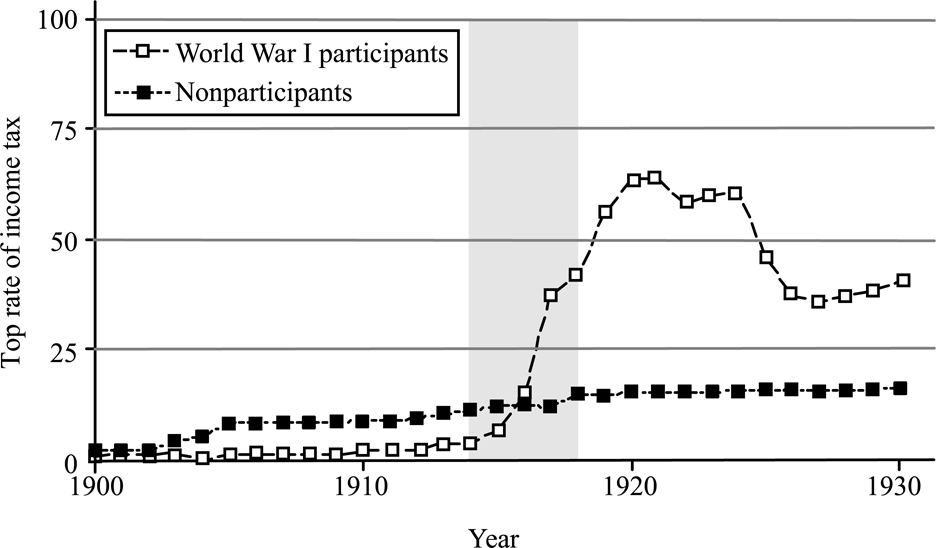
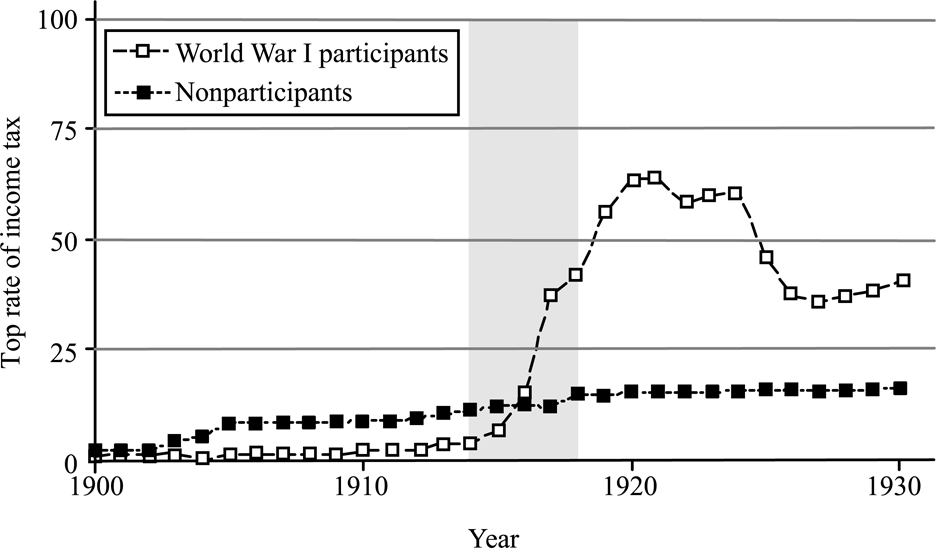
Figure 1 presents the available information on top tax rates between 1900 and 1930 for our four sample countries that were heavily mobilized and that participated in World War I, and in the four sample countries that were either neutral or did not mobilize heavily. It is apparent that in participant countries, World War I was accompanied by a huge shift toward greater tax progressivity, at least in terms of the willingness to tax the richest members of society. No such break is observable in any of the four nonparticipants.
World War I and top income tax rates
Notes: The figure compares the average top marginal income tax rate in four high-mobilization countries (United States, UK, France, and Canada) and four low-mobilization countries (Sweden, Netherlands, Japan, and Spain). High mobilization is defined as participation and mobilization of more than 2.0 percent of the population. See data appendix and text for full description of rate definitions and sources.
There was an evident connection in political debates of the time between increases in tax progressivity and the idea of equalizing sacrifice in wartime. This pattern was typically characterized by new demands for the taxation of “war wealth” and “war profits” often most vocally from labor organizations and left parties. What distinguished these demands from previous ones of a similar flavor was their connection to the war and the logic of equal sacrifice and their resonance with the public and governments across the political spectrum. There developed a perception in many countries that certain individuals were reaping large profits as a result of the increased demand for certain goods. In a context where many individuals were conscripted into service at the front, it became a common rallying cry that those who profited from the war should have their wealth conscripted in the same manner that others had been obliged to make more direct sacrifices. It is important to note that we are by no means implying that this perception was always completely accurate. In the case of the UK, it is known that the upper classes volunteered heavily for the war.Footnote 33 What is also certainly true, though, is that in all countries, older individuals were more likely to be exempted from military service, and older individuals tended on average to have higher incomes and higher levels of wealth. In English-language countries, frequent calls appeared for “the conscription of wealth,” a phrase that seems to have been used in particular by groups that had originally been most reluctant in their support for the war. Elsewhere the language differed but the policy demands were similar. Grotard emphasizes how discussions of the war-profits tax in France were linked in the popular press to the sacrifices of soldiers.Footnote 34 She notes that during the parliamentary debate over the war-profits tax, it was specifically stated that given that many individuals were sacrificing themselves at the front “it was necessary to reestablish equal sacrifice for all.”Footnote 35 After the conclusion of the war, such calls continued as the issue shifted to being one of how to repay war debts. The issue of how to finance benefits for war veterans also rose to prominence, and in the case of the United States, Alstott and Novick have shown that debates about veterans benefits were explicitly linked with debates over tax progressivity.Footnote 36
All of the countries that mobilized heavily for World War I ended up adopting “excess-profits” or “war-profits” taxes of one form or another, in parallel with the major increases they adopted in top rates of income tax. In public debate, these different types of taxes were often described as satisfying similar objectives. In the UK, the government adopted an excess-profits duty in 1915 that was maintained through 1921 at an average rate of 63 percent.Footnote 37 In the United States an excess-profits tax was levied that by 1918 reached a rate of 80 percent.Footnote 38 Similar schemes were adopted in France and Canada, where the top rate on this tax reached 80 percent by 1917. The Nordic countries also adopted windfall-profits taxes during these years on companies for which revenues increased due to war demand. Importantly, however, these taxes were set at much lower marginal rates than in the case of the war participants.
Though we do not consider the trade-off between funding wars with current taxation versus debt (deferred taxation assuming repayment), it is worth noting that political debates on this topic paralleled those with regard to progressive taxation. During the war, those who argued in favor of progressive taxation also generally argued against heavy recourse to debt finance based on the supposition that instead of representing a conscription of wealth, borrowing meant giving additional profits in the form of interest payments to owners of capital.
A final question one might ask is whether the conclusion we draw from Figure 1, which will be supported by statistical tests in the next section, is biased by the omission of Germany from the sample. Germany did not have a federal income tax prior to 1919 though its constituent states did have income tax systems with generally low rates prior to the war. After 1919, however, Germany closely resembled other war participants as it created a federal income tax with a high top marginal rate of 60 percent. In introducing this new rate, the Minister of Finance Mathias Erzberger of the Weimar government made an explicit attempt to justify it based on the same solidarity among citizens as had been required during the war.Footnote 39 It should also be emphasized that the Weimar government's actions followed on the heels of significant war-profits levies during the war itself.Footnote 40 Overall then, while no one would dispute the fact that the course of economic and political events in Germany was much different from that which took place in other war participants, we can nonetheless suggest that, in Germany, war participation also increased demands for tax progressivity.
The evidence in Figure 1 supports our idea that participation in mass warfare was associated with dramatic increases in income tax rates on top income groups. In the next section we will consider this issue econometrically while controlling for other potential political factors that might influence the choice of progressive taxation, including the extent of the suffrage and the extent to which parties of the left have representation in a country's legislature.
Difference-in-Differences Analysis, 1900–30
We now evaluate the impact of mass mobilization in World War I more formally by examining how top income tax rates were set in our full sample of eight countries. This difference-in-differences evaluation allows us to use the behavior of top rates in nonparticipant countries throughout the 1900 to 1930 period, in addition to the value of top rates before the war, to construct the counterfactual for what would have happened to top rates in participant countries had they not entered the war.Footnote 41
For this analysis, we define the variable top rate equal to the highest marginal income tax rate for a country in a given year. This variable is set equal to zero for years in which a country did not yet have an income tax.Footnote 42 The key independent variable is wwi mobilization, which is set equal to 0 in each year before the country enters the war, and 1 thereafter.Footnote 43 In some specifications, we include controls for levels of economic development, the representation of left parties in the legislature, the extent of the franchise, and the magnitude of government revenues. The variable gdp per capita is equal to gross domestic product divided by population.Footnote 44 The variable left seat share is equal to the percentage of seats in the national legislature held by a left party in a given year.Footnote 45 To measure the extent of the franchise, we constructed the variable male universal suffrage equal to 0 for each year preceding universal male suffrage, and 1 for each year after the onset of universal male suffrage.Footnote 46 The variable revenue to gdp is equal to the ratio of central government revenues to gross domestic product.Footnote 47 Note that we add this revenue measure separately from the other control variables because it is not clearly exogenous to the top rate and thus could bias the estimates. We are, nonetheless, interested in exploring this specification to evaluate the “need for financing” alternative explanation of the impact of war on progressivity. If the need for finance was driving the war effect, then we would expect our estimate of the war mobilization coefficient to be attenuated once we include the extent of government revenues relative to the economy.
The top rate is modeled as:

where i indexes each country and t indexes each year; top rate is the top tax rate measure; wwi is our measure of war mobilization, wwi mobilization; Xit is a vector of control variables and is excluded in some specifications; f (T t) is a function of time, either a simple linear trend or vector of dummy variables for each year between 1900–30; α, β, γ, and θ are parameters to be estimated; ηi are country fixed effects parameters also to be estimated; and ɛit is the error term. We report Newey-West standard errors to account for serial autocorrelation.Footnote 48 The initial specifications that exclude the control variables are essentially difference-in-differences tests that compare the changes before and after participation in the war for countries that mass-mobilized for the war, compared with changes over the same period for countries that did not mobilize. The specifications that include the control variables make this same comparison but adjust for differences in the top rate that are a function of levels of economic development, the representation of left parties in the legislature, the extent of the franchise, and the magnitude of government revenue extraction.Footnote 49
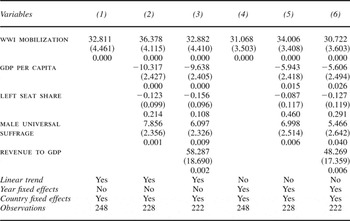
Table 1 reports the ordinary least squares estimates for this analysis. The results in column (1) include only the key war mobilization variable, a year trend, and country fixed effects. The estimated coefficient for the variable wwi mobilization in this specification is equal to 32.8 with a standard error of 4.5. As indicated in column (2), the estimate for this coefficient is slightly higher once the controls gdp per capita, left seat share, and male universal suffrage are added to the specification (coefficient estimate is 36.4 with standard error of 4.1).Footnote 50 Adding the control for the magnitude of government revenues relative to the economy yields an almost identical estimate for the wwi mobilization coefficient. Thus, across these specifications that include country-fixed effects and a linear time trend, there is substantial evidence that the top rate increased significantly more over time in those countries that participated in World War I than those that did not. Further, this difference remains significant even after we adjust for differences in economic development, the strength of left parties, the extent of the franchise, and the magnitude of government revenues.
World War I and progressive income taxation, 1900–30, pooled estimates

Notes: The table reports the results of ordinary least squares regressions for the variable top rate on the indicator variable for mass mobilization in World War I, wwi mobilization, and various control variables for the years 1900–30 for the eight countries in our sample. Each specification includes fixed effects for each country. Specifications (1) to (3) condition on a common linear trend. Specifications (4) to (6) include indicator variables for each year. The table reports the OLS coefficient estimates for each variable, their Newey-West standard errors in parentheses, and p-values at the bottom of the cell. A constant term is included in each regression but not reported in the table.
The estimates in the last three columns of Table 1 substitute dummy variables for each year for the linear time trend. The estimated coefficient for the variable wwi mobilization is 31.1 with a standard error of 3.5 for the specification excluding the control variables and is of similar magnitude in the specifications including the control variables. Given that each specification includes both country-fixed effects and year dummy variables, this is compelling evidence that mass mobilization for World War I was associated with a statistically and substantively significant increase in the top tax rate.
Across both sets of specifications in Table 1, the results for the control variables are quite similar. There is little evidence of a significant partial correlation between the representation of left parties in the national legislature and top tax rates. However, the estimated coefficient for the variable male universal suffrage is positive and statistically significant in all four specifications. For example, the estimate is 7.0 with a standard error of 2.5 for the specification in column five with year dummy variables. But the magnitude of this effect is quite small compared to our estimated effect of war mobilization on the top tax rate. Table 1 also indicates a negative and significant partial correlation between gdp per capita and the top rate. Finally, there is some evidence in these estimates that as countries collected greater revenues relative to the size of their economies, they adopted more progressive income taxes with higher top rates. The estimated coefficient for the variable revenue to gdp is positive and statistically significant in both specifications in which it is included. The inclusion of this variable does not, however, significantly attenuate the estimate for war mobilization. This result is therefore consistent with our view that while the need for finance was certainly part of the story of the adoption of progressive taxation during wartime, it does not account for dramatic impact of war mobilization on the willingness of governments to tax the rich at particularly high rates.
There are a couple of potential concerns about these estimates of the causal effect of war mobilization on progressivity. The implicit assumption in this approach is that, whatever the initial differences in top tax rates between participant and nonparticipant countries, absent mass mobilization for war, these differences would have remained constant during the 1900–30 period (that is, these countries would have parallel trends) or at least that the differences after taking account of the time-varying control variables would have remained constant. Visual inspection of Figure 1 before the beginning of the war suggests that this assumption is at least plausible and is bolstered by the relatively good performance of the control variables.
Another potential concern about these estimates is the possibility that countries select into the war based on its anticipated impact on progressive taxation. A few considerations suggest that this is unlikely. First, a large literature on entry into World War I suggests that few initial participants expected the long costly, mass-mobilized war that ensued but rather anticipated a short and decisive conflict.Footnote 51 Second, it seems implausible given what was at stake that countries would choose to participate in the war even in part based on considerations about the impact of the war on the progressivity of taxation. Third, at least some accounts suggest that, with the partial exception of the United States, the participant countries in our sample did not select into the war at all, much less as a function of its anticipated effect on progressive taxation. A common account is that the event that precipitated the war was of course a political assassination and the participation of France, the UK, and Canada was not certain until Germany decided to follow the Schlieffen Plan for a general European war that started with a Western offensive.Footnote 52
One might also ask whether the effect of World War I on tax progressivity is limited to its impact on the very highest earners that pay the top rate. We think the result would be important even if this were true, but in our view, the finding indicates a larger impact of the war on progressivity.Footnote 53 To explore this claim further, we highlight three pieces of evidence.
First, and most simply, a complete assessment of British tax changes during World War I shows a marked increase in tax progressivity at almost all levels of income. Samuel in 1919 conducted a painstaking analysis designed to estimate the tax burden including all types of national taxation and at all different levels of income before and after the war.Footnote 54Figure 2 reports his main results. The overall picture is striking. The tax schedule on earned income for 1913–14 was essentially flat over most of the income distribution though moderately progressive for those with the highest incomes. By the end of the war, it was significantly progressive across the entire distribution.Footnote 55 Overall, Samuel's evidence rules out the possibility for the British case that even if income taxes on the rich increased, other forms of taxation, the incidence of which fell primarily on the poor, may have increased even more.Footnote 56 Second, we replicated our statistical analysis for an alternative measure of tax progressivity, income tax share, equal to the percentage of central government revenues raised by the income tax.Footnote 57 Use of this measure depends on the assumption that income taxes are more progressive than alternative sources of revenue such as customs, excise, and general sales taxes. It should be remembered that 10 percent or less of the population was subject to income taxation at this time. In the specification with country- and year-fixed effects and control variables for gdp per capita, left seat share, and male universal suffrage, the estimated coefficient for wwi mobilization is equal to 6.87 with a standard error of 2.20 (p-value is equal to 0.002). This estimate is statistically and substantively significant as mass mobilization for the war is associated with an increase of about 7 percentage points (a bit over one standard deviation of the variable income tax share) in the percent of central government revenues raised by the income tax. Again, to the extent that war-profits taxes fell more heavily on the wealthy, and certainly in light of the fact that it does not take into account increased inheritance taxes, this figure underestimates the effect of the war on progressivity. The result is consistent with the claim that mass warfare has a general impact on tax progressivity that is not limited to the highest income tax rates.
Percentage of income taxed in England
Notes: The figure reports Samuel's 1919 estimates of total taxes paid as a percentage of income before and after World War I. Includes income taxation, inheritance taxation, and all forms of indirect taxation. These calculations do not include the incidence of excess (war) profits duties.

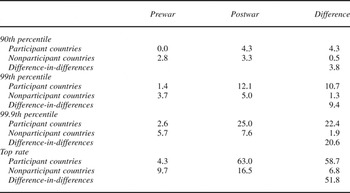
Third, we examined changes in progressivity within the top 10 percent of income earners. Table 2 reports the changes in participant and nonparticipant countries in average marginal income tax rates for individuals at the 90th, 99th, and 99.9th percentiles and in top rates before and after World War I.Footnote 58 The table shows that the war was associated with increased taxes in participant countries compared to nonparticipants at all of these high income levels but that these differences increased as incomes increased. For example, effective taxes at the 90th percentile increase by 3.8 percentage points more in participant than nonparticipant countries compared to a difference of 20.6 percentage points at the 99.9th percentile (51.8 percentage points for top rates). The tax rates reported here make it clear that the increases in income tax rates adopted as a result of World War I involved the very rich being asked to pay a much larger fraction of their incomes than were individuals who merely had incomes within the top decile. As we have already noted, the high top marginal tax rates adopted during World War I were generally paid by a small number of individuals, numbering in the hundreds. But when we look at a larger grouping, such as the top 0.1 percent of earners (generally 30,000 to 50,000 individuals in the countries considered here), the increase in taxes was also dramatic. In sum, we have every indication from the above information that the interpretation we have given to our analyses of top tax rates is accurate—mobilization for World War I was associated with a dramatic increase in tax progressivity.
World War I and progressive income taxation, changes in average marginal tax rates

Notes: The table reports pre- and postwar average marginal income tax rates for the 90th, 99th, and 99.9th percentiles in participant and nonparticipant countries. See the data appendix for sources, available at ⟨http://pantheon.yale.edu/~ks298⟩.
Further Evidence on the Demand for Progressive Taxation
In this section, we consider how evidence on the timing of policymaking in participant countries and the political debates surrounding war finance lends additional support to our argument. Among our participant countries, Canada and the UK are particularly enlightening because the extent and nature of mobilization for the war effort varied significantly within each. Each country relied on a volunteer army for a significant portion of the war before introducing conscription. While our argument suggests that mass mobilization under a volunteer army is likely to push attitudes about taxation toward greater progressivity, the logic of the argument implies that conscription will generate further pressures toward progressive taxation.
In Canada, the war arrived with a Conservative government led by Prime Minister Robert Borden. Canada was initially quite successful in recruiting volunteers with many of them being recent immigrants from the UK. To finance the war, the government relied at first on tariffs, increased consumption taxes, and debt. As the war progressed, Canada adopted a war-profits tax in 1916, which in 1917 was revised to have a progressive scale.Footnote 59 Interestingly, it did not initially enact an income tax, and as late as April 1917, the Minister of Finance Thomas White noted the use of the income tax in the UK and the United States in his annual budget remarks, but citing a number of considerations such as administrative expense and fairness in a time of rising prices, he concluded that in Canada “it would appear to me that income tax should not be resorted to.”Footnote 60 However, at the end of July 1917 White yielded to increasing pressure to tax the wealthy more heavily and introduced income tax legislation. Two characteristics of this policy change are significant. First, it followed the government's announcement in May that it intended to introduce conscription.Footnote 61 Second, it was adopted in a political environment demanding greater sacrifices on the part of the wealthy in response to war sacrifices. For example, Canadian Trade and Labour Congress leaders met with Borden in December 1916 seeking a commitment from him to not implement conscription and to equalize war burdens. Borden refused to tie his hands on conscription but even then acknowledged that “the government accepted and acted on the principle that the accumulated wealth of the country should bear its due proportion of contributions and sacrifices in the war.”Footnote 62 Once the government enacted conscription, organized labor pushed even harder for various versions of the “conscription of wealth.”Footnote 63 Though the more radical proposals did not find mainstream acceptance, arguments for greater sacrifices on the part of the wealthy certainly did. The Liberal Platform for the fall 1917 election argued, even after the government had introduced the income tax and war-profits tax, that “a fundamental objection to the government's policy of conscription is that it conscripts human life only, and that it does not attempt to conscript wealth…”Footnote 64 The government's Unionist Platform, however, clearly also recognized the importance of the principle as it promised that “in order to meet the ever-increasing expenditure for war purposes and also to ensure that all share in common service and sacrifice, wealth will be conscripted by adequate taxation of war profits and increased taxation of income.”Footnote 65 In short, in Canada, with greater mobilization from conscription, across the political spectrum, support for progressive taxation on fairness grounds increased.
In the UK, the government at the start of the war was led by Prime Minister Herbert Asquith and the Liberal Party, though by May 1915, Asquith was forced to form a new coalition government with the Conservatives. Further setbacks in the war led, in 1916, to yet another coalition government with Lloyd George as the new prime minister. Like Canada, but on a much larger scale, the UK began the war with a successful voluntary recruitment campaign. The effect of the war on the progressivity of taxation was nonetheless more immediate than in Canada. Prior to the outbreak of hostilities, the government's 1914 budget proposal slightly reduced the income tax rate and proposed a combination of increased customs and excise taxes and reduced spending to balance the accounts.Footnote 66 It is clear that at least for 1914, the UK was not going to have a more progressive tax system absent the war. With the war, however, the first and second war budgets in 1914 and 1915 increased income tax rates significantly making the tax system more progressive.
In January 1916, the government's Military Service Bill, which adopted conscription, passed quickly into law and was expanded several times throughout the remainder of the war. Importantly, once conscription was adopted, it became central to political debates about how the war was to be financed and certainly appeared to lead to policy changes that made taxation even more progressive. Calls for progressive taxation to equalize sacrifices in the war, particularly those associated with conscription, came primarily in two forms. The first was simply more progressive income taxation, the “conscription of income,” while the second was a capital levy or literally the “conscription of wealth.” These demands came in part from the expected places, such as the Trades Union Congress, which held “that, as the manhood of the nation has been conscripted to resist foreign aggression … this Congress demands that such a proportion of the accumulated wealth of the country shall be immediately conscripted”Footnote 67 but they were also reflected in publications like The Economist, which, as indicated above, previously opposed high levels of income taxation. To be clear, The Economist opposed a capital levy but supported “direct taxation heavy enough to amount to rationing of citizens' incomes” and explicitly endorsed an article in the Economic Journal by Harvard economist O. M. W. Sprague entitled “The Conscription of Income,”Footnote 68 in which he argued that “conscription of men should logically and equitably be accompanied by something in the nature of conscription of current income above that which is absolutely necessary.”Footnote 69
In the UK, policy responded to demands for greater progressivity in income taxation. The third war budget, introduced in April 1916 just after the conscription bill was passed, significantly increased the income tax with revenues from higher income taxes expected to generate over twice as much additional revenue as increases in indirect taxes.Footnote 70 The capital levy debate also intensified following the introduction of conscription though the levy was never adopted.Footnote 71
War and Progressive Income Taxation in the Long Run
In this section we analyze the impact of mass warfare on progressive taxation for the period 1850 to 1970. The main objective of this analysis is to evaluate whether our findings for World War I generalize to a much longer time period. The pattern of participation and nonparticipation in World War I may be helpful in cleanly identifying the effect of mass warfare on demands for progressive taxation, but ultimately we are also interested in knowing whether mass warfare more generally might have had such an effect. In what follows we focus on reporting the results of our analyses, pooling the eight countries in our sample together.Footnote 72
To indicate whether or not a country engaged in mass warfare between 1850 to 1970, we constructed the variable war mobilization equal to 1 if in a particular year, the country was engaged in an interstate war and at least 2 percent of the population was serving in the military, and equal to 0 otherwise.Footnote 73 This variable captures the key characteristics necessary for conflict to have its hypothesized effect on progressive taxation. There must be an active war being fought in which the citizens who fight in the conflict sacrifice not only their time and livelihood but also risk their lives. It must also be a conflict that involves a significant proportion of the population. This operationalization captures not only the high mobilization years during World War I featured in the Footnote previous section, but also country years for many of the participants in World War II, as well as the Franco-Prussian and Korean wars.Footnote 74 Our data do not track civil conflicts.
The dependent variable for this analysis is the top rate variable described above. The main independent variable is war mobilization and the control variables are gdp per capita, left seat share, male universal suffrage, and revenue to gdp as defined above.
The top rate is modeled as:

where i indexes each country and t indexes each year; top rate is the top tax rate measure; war mobilization is the key measure of participation in mass warfare in a given year; Xit is a vector of control variables and is excluded in some specifications; f (T t) is a function of time, either a simple linear trend or vector of dummy variables for each decade between 1850–1970; ρ, α, β, γ, and θ are parameters to be estimated; are country-fixed effects parameters also to be estimated;Footnote 75 and ɛit is the error term. Because some countries experience more than one case of mass warfare in this analysis, our modeling strategy has changed in at least two important ways from the World War I analysis. First, rather than coding mass mobilization in terms of before and after, the variable war mobilization is simply equal to one for mass mobilization war years and zero otherwise. Second, we include a lagged dependent variable to model the dynamics for the top rate series as an autoregressive process in which current realizations of the top rate variable depend on past realizations. These two changes in the specification are important for interpreting the results. Any shift in the top rate of taxation due to mass mobilization from war has a long-run impact that is a function of precisely how responsive current values are to past realizations.Footnote 76
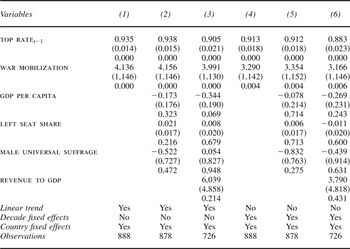
Table 3 reports the ordinary least squares regression estimates for this analysis with panel-corrected standard errors. The results in the first three columns use a common linear trend for the f (T t) function with and without control variables.Footnote 77 The estimates in the last three columns use decade dummy variables for the f (T t) function.Footnote 78 Across all six specifications, the estimated coefficient for the variable war mobilization is positive and statistically and substantively significant. In the specification reported in column two with a linear trend and control variables, the estimated coefficient is 4.16 with a standard error of 1.15. This estimate implies a long-run effect of 67.0. In the analogous specification with decade dummy variables, the implied long-run effect is 38.1. This is strong evidence consistent with the main argument of this study.
War mobilization and progressive income taxation, 1850–1970, pooled estimates

Notes: The table reports the results of ordinary least squares regressions for the variable top rate on its lagged values, the indicator variable for war mobilization, war mobilization, and various control variables for the years 1850—1970 for the eight countries in our sample. Each specification includes fixed effects for each country. Specifications (1) to (3) condition on a common linear trend. Specifications (4) to (6) include indicator variables for each decade. The table reports the OLS coefficient estimates for each variable, their panel-corrected standard errors in parentheses, and p-values at the bottom of the cell. A constant term is included in each regression but not reported in the table.
Across the specifications in Table 3, the results for the control variables are negative. There is little evidence of a significant partial correlation between gdp per capita, left seat share, male universal suffrage, and revenue to gdp and top tax rates. This lack of evidence of a partial correlation between revenue to gdp and top tax rates undermines the idea that over the course of the twentieth century, variation in top marginal income tax rates has been determined above all by changes in the need for revenue, and not the type of political changes associated with war that we emphasize. The explanation for this null result no doubt lies in the fact that if, during the first half of the twentieth century, top marginal tax rates rose along with the overall ratio of revenues to GDP, during the latter half of the twentieth century revenues have continued to increase while top income tax rates have almost invariably been reduced.
One interesting possibility we explored is whether the impact of war mobilization is greater in countries for which the left is well-represented or for which suffrage rights are more extensive. We might, for example, expect the effect of mass wars on progressive taxation to operate more clearly or even exclusively in democratic regimes. We explored these hypotheses by adding interaction terms between the war mobilization measures and the suffrage and partisanship variables. While the estimate for the interaction term for mobilization and partisanship was in the hypothesized positive direction, it was not statistically significant. The estimate for the interaction term between mobilization and male universal suffrage was not in the anticipated direction nor was it statistically significant. Given the limited sample and intuitive appeal of these ideas, both hypotheses, nonetheless, merit further investigation.
In assessing these results, it is also useful to consider alternative measures of participation in mass warfare. We explored three. The first, war mobilization 2, simply adjusts the threshold that needs to be mobilized for the war to count as a mass mobilization war up to 5 percent. The second, war mobilization 3, codes only the two twentieth-century world wars as mass mobilization conflicts. The third, war mobilization 4, is equal to one if the country experienced a war year for which fatalities in the conflict exceeded one thousand deaths.
In specifications that mirror those reported in Table 3 but which substitute these alternative measures of mass warfare for war mobilization, the results are substantively quite similar. The coefficient estimates for each of the alternative measures is positive and statistically significant. Perhaps more important than the robustness of the results is how variation in the magnitude of the estimates reflects the logic of the main argument of this article. Focusing attention on the results with decade dummy variables and control variables included, the implied long-run effect for the most restrictive definition of what constitutes a mass war, war mobilization 2, is equal to 51.1 and is the largest of the estimates for the alternative measures. The estimate for war mobilization 3, which is the alternative measure closest to our preferred definition, is 41.5 which is somewhat larger than the estimate reported in Table 3 for war mobilization. Finally the coefficient estimate for war mobilization 4, the least restrictive definition of what counts for a mass-mobilized war, is 23.0. One interpretation of this pattern of estimates is that the more extensive is mobilization for a war, the greater is the impact on progressive income taxation.
This pattern is consistent with the key claim of this article and is also helpful in thinking about the potential effects of participation by some of our sample countries in recent interstate conflicts such as the Gulf War, Iraq War, and Afghanistan War. Importantly, these wars were fought by relatively small, professional armies and did not involve mass mobilization on the scale of World War I and World War II. As such, it is not surprising that at least to date, participation in these wars has not seemed to increase progressive taxation.
Evidence on Individual Attitudes
One observable implication of our claim that mobilization for mass warfare increases demands for progressive taxation as a means of ensuring equal sacrifice is that war mobilization should lead citizens to prefer more progressive tax policies. While a complete evaluation of this implication is beyond the scope of this article, we present in this section one such test using survey data for the United States during World War II.Footnote 79
In July 1941, when U.S. participation in World War II was still an open question, Gallup asked the following question to a sample of the national adult population:Footnote 80 “In order to help pay for defense, the government will be forced to increase income taxes. If you were the one to decide, how much income tax, if any, would you ask a typical family of four with an income of $X to pay?”
Using a split ballot questionnaire, the survey elicited preferred tax rates for eight different income categories ranging from $1,000 per year to $100,000 per year.Footnote 81 Then in March 1942, after the attack on Pearl Harbor lead the United States to mobilize for the war, Gallup asked the identical questions with the exception that the words “the war” were substituted for “defense.” The timing of the surveys and the corresponding difference in question wording allow for a before and after test of our claim that mobilization for mass warfare increases public demands for progressive taxation. Did the public's preferred tax schedule become more progressive?
Figure 3 presents the observed changes in opinions about taxation after the United States mobilized for World War II. The three panels in Figure 3 report data for respondents in different socioeconomic status (SES) groups as determined by the interviewer's coding of the respondent on a subjective class scale. The scale ranged from “poor” to “average” to “wealthy”; the “low,” “middle,” and “high” SES respondents in Figure 3 correspond to these categories.Footnote 82 In each panel, the preferred effective tax rate of the median respondent is plotted against the income of the hypothetical family of four referred to in the question. There are several important features of the data. First, across all three SES groups, the war had virtually no impact on how much taxes respondents thought relatively low- and middle-income families should pay. Second, across all respondents, mobilization for the war corresponds with substantially higher preferred income taxes for the rich—in most cases doubling at the higher income levels. Third, the increased progressivity in these tax schedules is, if anything, larger for middle and high SES respondents. This final observation is important because it is consistent with the claim that war sacrifices changed beliefs about what constituted a fair tax system across all income groups not just the poor. The evidence in Figure 3 is strongly consistent with the main argument of this article.
U.S. public opinion on income tax progressivity before and after the onset of World War II
Notes: The figure reports median responses to Gallup questions eliciting effective tax preferences in the U.S. public before and after the onset of World War II for a family of four with various levels of income. Preferred tax schedules are reported separately for low, middle, and high SES respondents as determined by the interviewer's coding of the respondent on a subjective class scale.
Sources: Gallup Poll #1941-0242 an Gallup Poll #1942-0263.

Conclusion
We have argued that mobilization for mass warfare produces demands for progressive taxation as a means of ensuring greater equality of sacrifice in the war effort. There is substantial evidence consistent with this hypothesis. Focusing attention on World War I, we find a significant upward shift in top tax rates in those countries that participated and mobilized for the war. Further, we find a substantial positive war-mobilization effect based on difference-in-differences estimates that compare changes in top rates from 1900 to 1930 in participant and nonparticipant countries. This effect is not limited to top tax rates but reflects changes in other measures of progressivity as well. This article also reports several forms of additional evidence to support our argument. First, the timing and political rhetoric of war financing debates during World War I is consistent with our claim that progressive taxation was a response to demands for equalizing war-time sacrifice. Second, we provide evidence of an effect of mass warfare on top income tax rates over a much longer period from 1850 to 1970. Finally, we also report an analysis of survey data from the World War II era that is consistent with our argument.
Our argument and empirical results have important implications for debates about the determinants of redistribution and progressive taxation. It is often suggested that the rise of progressive taxation has depended on the development of electoral democracy as well as on the presence of political parties that mobilize lower-income groups. Our findings are at best mixed on the claim that these developments alone account for the pattern of progressive taxation observed during the course of the twentieth century. Within this literature it is also often asked why there is not more progressive taxation, that is, why do the poor not soak the rich in electoral democracies? An important class of answers to this question focuses on beliefs about fairness. Our argument and evidence about the influence of war contribute to this class of answers by suggesting that financial sacrifices required of the wealthy depend on the type of sacrifices society demands from the rest of its citizens.
Finally, our findings also cast new light on current debates about progressive taxation and income inequality. Recent work on income inequality over the twentieth century has argued that much of the reduction in top income shares can be explained by events such as wartime destruction and economic depression, which helped to destroy great fortunes, and that following these events the presence of high top rates of income tax and inheritance taxation prevented fortunes from becoming reconstituted. Our study sheds light on the unanswered question of what force made it politically possible to sustain higher top tax rates. In the absence of mass warfare, there may have been nothing inevitable about the development of highly progressive tax systems.