I. INTRODUCTION
Titanium silicide (Ti5Si3) has considerable development potential as high-temperature material for aircraft due to its high melting temperature (2130 °C), low density (4.32 g/cm3), high hardness (11.3 GPa), and excellent creep resistance as well as high oxidation resistance.Reference Schneibel and Rawn1–Reference Vyas, Rao and Prasad5 However, like other intermetallics, Ti5Si3 possesses a low toughness and its fracture toughness is only ∼2.5 MPa/m1/2 below the ductile–brittle transition temperature, which hinders its application.Reference Kishida, Fujiwara, Adachi, Tanaka and Inui6, Reference Mitra7 Actually, substantial evidence in the literature suggested that the proper addition of an alloying element such as Al, Nb, Cr, or Cu, to Ti–Si system could improve the mechanical properties of Ti5Si3.Reference Wang, Si, Li, Zhang and Jiang8–Reference Kang, Ryoo, Hwang, Hwang and Kim10 Moreover, according to results reported by Park et al.,Reference Park, Kim and Hwang11 addition of Cu acted as a sintering aid and facilitated greatly the densification of Ti5Si3 during modified hot pressing process. Hence, it is hoped that the alloying element of Cu could be helpful to effectively improve the microstructure and properties, e.g., fracture toughness, of Ti5Si3.
As is known, due to the high heat of formation (▵Hof,298K = −579 kJ/mol),Reference Riley, Oliver and Kisi12 Ti5Si3 could be synthesized by combustion synthesis (CS), which has the advantages of low cost, high energy- and time efficiency, and high purity of the reaction products.Reference Tjong and Ma13–Reference Alman16 To effectively control the CS process and eventually to obtain desired reaction products, we investigated the combustion synthesis of Ti5Si3 in Ti–Si–Cu system with different Cu additions in a previous study.Reference Wang, Lü, Zha, Li, Liu and Jiang17 In Ti–Si system, most Ti5Si3 grains synthesized exhibit the polygon-shaped coarse appearance with an obviously sintered morphology; when Cu content increases from 10 to 50 wt%, however, the Ti5Si3 exhibits cobblestone-like shape with a relatively smooth surface, and its average size decreases significantly from ∼15 to ∼2 μm or less.Reference Wang, Lü, Zha, Li, Liu and Jiang17 The addition of Cu to Ti–Si system significantly decreases the onset temperature of the reaction during differential thermal analysis (DTA) process, suggesting that the role of Cu serves as a reactant and the same participates in the CS reaction process.Reference Wang, Lü, Zha, Li, Liu and Jiang17
During CS process, not only the compositions but also the particle sizes of reactants play an important role in the reaction pathway and phase transitions. According to results reported by Khoshkhoo et al.,Reference Khoshkhoo, Shamanian, Saidi, Abbasi, Panjehpour and Javid18 the Mo particle size played an important role in CS reaction mechanisms of MoSi2 in Mo–2Si system. They found that in the case of small Mo particles, MoSi2 formed by complete dissolution of Mo in the molten Si. The large Mo particles, however, could not be completely dissolved and remain unreacted surrounded by thin solid state diffusional layers of Mo5Si3 and Mo3Si. Moreover, Fan et al.Reference Fan, Chai and Jin19 investigated that the combustion reaction in Fe–Ti–C system occurred by a dual dissolution-precipitation mechanism when the Ti powder is finer (<45 μm), whereas it occurred by a ternary dissolution-precipitation mechanism when the Ti powder is coarser (135–154 μm). In addition, Trambukis and MunirReference Trambukis and Munir20 reported that the combustion synthesis of Ti5Si3 in the thermal explosion mode involved two reactions: the solid-state diffusion reaction and the reaction involving a liquid phase. The solid-state reaction dominated in conditions of small particle sizes (r < 75 μm) and low heating rates (45 and 70 °C/min); however, increasing the titanium particle size and the heating rate changed the nature of the reaction from a solid-state diffusion-limited process to a liquid-state reaction.Reference Trambukis and Munir20 Unfortunately, effects of reactant particle sizes on the reaction pathway and phase transitions of combustion synthesis in Ti–Si–Cu system were rarely studied.
In the present study, we report the results of investigations on effects of Ti and Si particle sizes on phase transformations during DTA in a typical Ti–Si–Cu system. Compared with the CS process, the ignition process in DTA is accomplished at a relatively low heating rate. Although the reaction in DTA apparatus is not capable of fully reproducing the conditions of the combustion synthesis process, it can provide important information on the amount of heat released by the reactions, the ignition temperature and also some indication of what could be the triggering mechanism of the reactions.Reference Kunrath, Reimanis and Moore21, Reference Zahid, Azhar, Musaddiq, Rizvi, Ashraf, Hussain and Iqbal22 It is expected that the preliminary results could be crucial in promoting the understanding of combustion synthesis in Ti–Si–Cu system.
II. EXPERIMENTAL PROCEDURE
The starting materials in the present work were prepared from commercial powders of Ti (99.5% purity, ∼15 and ∼150 μm), Si (99.5% purity, ∼15 and ∼150 μm), and Cu (99.7% purity, ∼45 and ∼75 μm). For clear differentiation among and identification of the different samples, Ti[x]Si[y]Cu[z] is defined, where x, y, and z represent the particle sizes (μm) of Ti, Si, and Cu, respectively. In Ti–Si–Cu system, the Ti and Si powders in a ratio corresponding to that of stoichiometric Ti5Si3 mixed with 20 wt% Cu were used as blended powders. Based on our previous study, the Ti–Si–Cu sample with the 20 wt% Cu addition was a typical system to investigate the reaction pathway. For comparison purpose, the Ti–Si powder mixture with a ratio of 5:3 was also prepared and defined as Ti[15]Si[15], which represents the particle sizes of Ti and Si, both being 15 μm. All powder blends were dry-mixed for 6 h in a cylindrical stainless steel jar containing GCr15 bearing quality steel balls with a ball-to-powder weight ratio of about 2:1 by mechanical rotation at 50 rpm. Then blends were isostatically cold-pressed at pressures ranging from 70 to 75 MPa to obtain preformed cylindrical shape (20 mm in diameter and 10 ± 1 mm in height). The green density of the compacted reactants varied around 67 ± 2% of the theoretical density of the powder mixtures.
DTA experiments were conducted by using the Model TA SDT–Q 600 apparatus (New Castle, DE), with Al2O3 powders as the reference materials. A small amount of reactants weighing about 45 ± 1 mg was manually pressed into Al2O3crucibles under flowing ultrahigh purity argon (200 mL/min) and heated at a rate of 30 °C/min up to about 1200 °C, except for some occasional interrupted runs to obtain the intermediate reaction products. Repeated experiments were conducted and the results with good repeatability were presented.
The combustion synthesis experiments were carried out under a protective atmosphere of industrial argon (99.9%). The combustion reaction of the compacted reactant was ignited by heating its bottom surface. The compacts were placed on the graphite flat, which was fixed above a tungsten electrode and ignited by the arc heat. Experiments were performed without any preheating.
The phase compositions and microstructures of products retrieved from the DTA were investigated by XRD using CuKαradiation (Model D/Max 2500PC, Rigaku, Japan) and FESEM (FEIXL–30, Hillsboro, OR) equipped with energy-dispersive spectrum (EDS) analyzer (EDAX, SEDX–Genesis 2000, Hillsboro, OR). Microstructures of the fracture surface of the products from the CS reaction were investigated via scanning electron microscope (SEM) (Model JSM 5310, JEOL, Tokyo, Japan) equipped with EDS (Model Link–ISIS, Oxford, UK).
III. RESULTS AND DISCUSSION
A. DTA scans
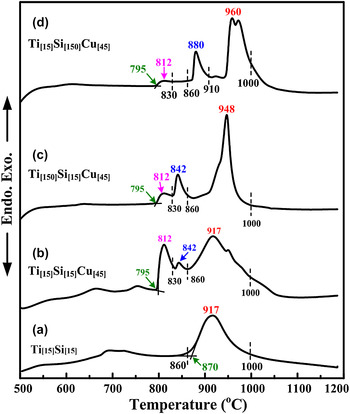
Figure 1 shows the DTA scans of Ti–Si and Ti–Si–Cu systems with different reactant particle sizes. For Ti[15]Si[15] powders with fine Ti and Si particles of 15 μm [Fig. 1(a)], only an exothermic peak with the onset at ∼870 °C and the maximum at ∼917 °C emerges on the curve. For Ti–Si–Cu systems [Figs. 1(b)–1(d)], the first peak with the onset at ∼795 °C and the maximum at ∼812 °C emerge on the curves. However, compared with that in Ti[15]Si[15]Cu[45] system with fine Ti and Si particles [Fig. 1(b)], the intensity of the first peak became weaker in Ti[150]Si[15]Cu[45] system with coarse Ti particle of 150 μm [Fig. 1(c)], especially in Ti[15]Si[150]Cu[45] sample with coarse Si particle of 150 μm [Fig. 1(d)]. Continuous heating brings a second exothermic peak at ∼842 °C in Ti[15]Si[15]Cu[45] and Ti[150]Si[15]Cu[45] systems, while the peak appeared at ∼880 °C in Ti[15]Si[150]Cu[45] sample. With the further increase in temperature, a third intensive exothermic peak appeared at ∼917 °C in the Ti[15]Si[15]Cu[45] sample. Nevertheless, with coarse Ti or Si particles, i.e., Ti[150]Si[15]Cu[45] and Ti[15]Si[150]Cu[45]samples, the third intensive peaks were delayed to ∼948 and ∼960 °C, respectively. Hence, it is indicated that the reaction, especially the third intensive exothermic reactions are different from each other in Ti–Si–Cu systems with various Ti and Si particle sizes.
DTA traces of (a) Ti[15]Si[15], (b) Ti[15]Si[15]Cu[45], (c) Ti[150]Si[15]Cu[45], and (d) Ti[15]Si[150]Cu[45]systems, respectively, at a constant heating rate of 30 °C/min and up to ∼1200 °C in flowing high purity argon (200 mL/min).

B. Effect of reactant particle size on phase formation process
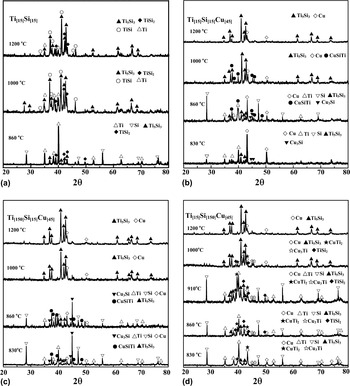
To make clear of phase transformation occurring during heating process, samples of Ti–Si and Ti–Si–Cu systems were heated in DTA and stopped at the fixed temperatures, and then cooled to ambient temperature to be examined by XRD (Fig. 2). In addition, to understand influences of yielded products (intermediate phase) on third intensive exothermic reactions, samples of Ti[15]Si[15], Ti[15]Si[15]Cu[45], Ti[150]Si[15]Cu[45], and Ti[15]Si[150]Cu[45] mixtures were heated to 1200, 860, and 910 °C and examined by FESEM (Fig. 3). The Ti–Si system was studied for comparison with the Ti–Si–Cu system. The Ti[15]Si[15] samples were heated to different temperatures (i.e., 860 and 1000 °C) as indicated in Fig. 1(a). After heating reactants to 860 °C (below the onset temperature), the major phases detected were Ti and Si, along with minor TixSiy phases (e.g., Ti5Si3 and TiSi2) which may be caused by solid-diffusion reaction between α-Ti and Si [Fig. 2(a) 860 °C]. Interestingly, the onset temperature (∼870 °C) of the Ti[15]Si[15] system in DTA is close to the temperature of the eutectoid reaction between α-Ti and Ti3Si at ∼865 °C.Reference Massalski23 By high-speed in situ neutron powder diffraction experiments, however, RileyReference Riley, Oliver and Kisi12 reported that the CS reaction was narrowly preceded by the α-Ti→β-Ti phase transformation and acted as a trigger for the reaction. Further study is still continuing. Moreover, when the heating run was stopped at 1000 °C, the major product identified was Ti5Si3, together with some amounts of TiSi2 and TiSi, as well as remnant Ti [Fig. 2(a) 1000 °C]. At last, when the temperature reached 1200 °C, Ti5Si3 increased visibly in amount, and a small quantity of TiSi2, TiSi, and unreacted Ti remained in final products, indicating that the Ti–Si system to form Ti5Si3was incomplete.
XRD patterns of DTA products for (a) Ti[15]Si[15], (b) Ti[15]Si[15]Cu[45], (c) Ti[150]Si[15]Cu[45], and (d) Ti[15]Si[150]Cu[45]systems interrupted at fixed temperatures at a constant heating rate of 30 °C/min in flowing high purity argon (200 mL/min), respectively.

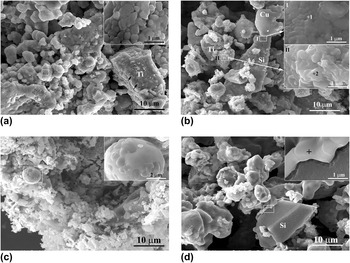
Typical FESEM micrographs for various reactant particle sizes of Ti–Si–Cu systems after heating to different temperatures: (a) Ti[15]Si[15] system at 1200 °C, (b) Ti[15]Si[15]Cu[45] system with fine Ti and Si particles (∼15 μm) at 860 °C, (c) Ti[150]Si[15]Cu[45] system with coarse Ti particle (∼150 μm) at 860 °C, and (d) Ti[15]Si[150]Cu[45]system with coarse Si particle (∼150 μm) at 910 °C, respectively.

Figure 3(a) shows the typical FESEM of DTA products in Ti[15]Si[15] system when the temperature heated to 1200 °C. Note that many fine particulates were formed after heated to ∼1200 °C. According to the XRD analysis [Fig. 2(a) 1200 °C], the Ti5Si3 is dominant phase in the final products of Ti[15]Si[15] system, accompanying with some transient phases. Therefore, the fine particulates developed might correspond to Ti5Si3 particulates. In addition, the remnant Ti phase, with some reacted products formed on the surface (see arrows), can also be observed clearly, which might indicate that the Si penetrated into Ti in the Ti[15]Si[15] system. Hence, it is not difficult to conclude that the wide exothermic peak was primarily associated with the formation of Ti5Si3by the solid diffusion reaction between β-Ti and Si.
Interrupted experiments were conducted for Ti[15]Si[15]Cu[45], Ti[150]Si[15]Cu[45], and Ti[15]Si[150]Cu[45] powders heated to 830 °C, respectively, and the XRD results are presented in Figs. 2(b)–2(d) (830 °C). Note that in Ti[15]Si[15]Cu[45] sample, in addition to Ti, Si, and Cu, small amounts of Ti5Si3 and Cu3Si were identified, as shown in Fig. 2(b) (830 °C). For Ti[150]Si[15]Cu[45] system with coarse Ti particles, however, the dominant products became Cu3Si, accompanying with a few Ti5Si3 and CuSiTi, as well as remnant Ti, Si, and Cu [Fig. 2(c) 830 °C]. Moreover, with the temperature increasing to 830 °C in Ti[15]Si[150]Cu[45] system with coarse Si particles, minor Ti5Si3, CuTi2, and Cu3Ti phases were formed first among reactants [Fig. 2(d) 830 °C]. Note that the Cu3Si is formed initially by the solid state diffusion reaction between Cu and Si during the low-temperature range, which further reacts with Si to form Si–Cu liquid at the eutectic temperature (corresponding to the temperature of 802 °C in the phase diagramReference Massalski23). Then α-Ti dissolves into the Si–Cu liquid leading to the formation of Ti–Si–Cu liquid; at last, minor Ti5Si3 precursors are precipitated out of the saturated Ti–Si–Cu liquid. That means the first exothermic peak of ∼812 °C in Ti[15]Si[15]Cu[45], Ti[150]Si[15]Cu[45], and Ti[15]Si[150]Cu[45] systems were all attributed to the formation of Ti5Si3precursors.
Nevertheless, the intensity of the first peak became weaker in Ti[150]Si[15]Cu[45] system, which was due to the fact that the dissolution speed of coarse Ti particle to Si–Cu liquid decelerated, resulting in decreased amount of Ti5Si3 precursors. In Ti[15]Si[150]Cu[45] sample particularly, increase in the size of Si particles led to decrease in the surface atomic activity and contact surface area between Cu and Si, thereby significantly retarding the formation rate of Cu3Si compound between Cu and Si. As a result, in Ti[15]Si[150]Cu[45] sample with coarse Si particles, the reaction between Si and Cu was relatively more difficult, resulting in the formation of insufficient Cu3Si, which diminished the amount of Si–Cu liquid and the formation of Ti5Si3 precursor. Hence, compared with Ti[15]Si[15]Cu[45] system, intensities of the first peaks are weak in Ti[150]Si[15]Cu[45] and Ti[15]Si[150]Cu[45]systems.
When Ti[15]Si[15]Cu[45] and Ti[150]Si[15]Cu[45] systems were heated to 860 °C and then cooled to room temperature, besides Ti5Si3, Cu3Si as well as unreacted Ti, Si and Cu, a trace of CuSiTi can also be detected [Figs. 2(b) and 2(c) 860 °C]. In addition, it is revealed that Ti–Si–Cu liquid phase can be formed at about 844–846 °C, depending on the reaction scheme and liquids projection of Ti–Si–Cu.Reference Berbecaru, Naka and Schuster24 Therefore, it is speculated that the weak exothermic peaks with the maximum at ∼842 °C in Ti[15]Si[15]Cu[45] and Ti[150]Si[15]Cu[45]systems could be attributed to the formation of Ti–Si–Cu liquid phase.
For Ti[15]Si[150]Cu[45] system, however, when the temperature reached 860 °C, no apparent exothermic peak appeared [Fig. 1(d)]. Besides Ti5Si3, CuTi2, and Cu3Ti, only a minor amount of TiSi2 was detected by XRD [Fig. 2(d) 860 °C]. Compared with Ti[15]Si[15]Cu[45] and Ti[150]Si[15]Cu[45] samples, the second peak in Ti[15]Si[150]Cu[45] emerged at ∼880 °C instead of at ∼842 °C. The corresponding XRD result [Fig. 2(d) 910 °C] showed that the phase contained CuTi2 and Cu3Ti, rather than Cu3Si. According to results reported by Liang et al.,Reference Liang, Wang, Yang, Wang and Jiang25 a large quantity of CuxTiy compounds, e.g., CuTi2 and CuTi, can be formed at ∼887 °C (1160 K) by the solid-state diffusion reaction between Cu and β-Ti mixtures. Hence, it can be concluded that the second exothermic peak in Ti[15]Si[150]Cu[45] system with the maximum at ∼880 °C is attributable to the formation of CuxTiycompounds by Cu and β-Ti.
The third exothermic peaks in Ti–Si–Cu systems with various reactant particle sizes were different greatly among each other. For Ti[15]Si[15]Cu[45] sample, the third exothermic peak appeared at ∼917 °C with a mass of Ti5Si3 formed. Figure 3(b) shows the typical microstructures of the Ti[15]Si[15]Cu[45] mixtures with temperature heating to ∼860 °C (before the third exothermic peak). It can be observed that the phase located on the Si particle which is near the Cu particle, corresponded to the Ti–Si–Cu phase, as identified by EDS (e.g., point +1: 41 at.% Ti, 30 at.% Si, and 29 at.% Cu), while the phase located on the Ti particle which is far from the Cu particle, mainly attributed to Ti–Si phase, as identified by EDS (e.g., point +2: 56 at.% Ti, 38 at.% Si, and 6 at.% Cu). Although the microstructures displayed here are actually those obtained from DTA products cooled to ambient temperature, it can always be a reflection of the high temperature microstructure and to some degree an indication of the reaction. In addition, after heating the mixtures to 1000 °C, the Ti5Si3, Cu, and CuSiTi were detected, while no Ti, Si, and Cu3Si were found [Fig. 2(b) 1000 °C]. As the temperature further increased to 1200 °C, the CuSiTi disappeared and the thermodynamically stable phases Ti5Si3 and Cu were identified in final products without any intermediate phase [Fig. 2(b)1200 °C].
Therefore, the third exothermic reaction in Ti[15]Si[15]Cu[45] sample largely corresponded to the formation of Ti5Si3 by the reaction of β-Ti and Si with the assistance of Ti–Si–Cu liquid. However, compared with that in Ti[15]Si[15] sample, the Ti–Si–Cu liquid in Ti[15]Si[15]Cu[45]sample completed the reaction.
For Ti[150]Si[15]Cu[45] sample, the third exothermic peak was delayed to 948 °C. From the FESEM micrograph of the products heated to ∼860 °C [Fig. 3(c)], we can see it clearly the globular-like grain consists of white matrix and gray bulk phase. The white matrix of the grains mainly corresponds to Cu3Si phases in accordance with our recent study, and more detailed results will be reported elsewhere. However, after heating to 1000 °C, only Ti5Si3 and Cu phases were detected, while no transient phases, i.e., Cu3Si and CuSiTi as well as remnant Ti and Si, were found in the products [Fig. 2(c) 1000 °C]. With the increase of temperature to 1200 °C, the identified phases in final products were still Ti5Si3 and Cu [Fig. 2(c) 1200 °C]. Therefore, the third intensive exothermic reaction in Ti[150]Si[15]Cu[45] system is primarily associated with the formation of Ti5Si3, as follows: first, Si and Cu3Si which are formed at the low-temperature range react to form Si–Cu liquid at the eutectic temperature (802 °C), and then with the temperature increasing, coarse Ti dissolves into the binary liquid to form Ti–Si–Cu ternary liquid; at last, Ti5Si3is precipitated out of the Ti–Si–Cu liquid.
However, the coarse Ti particle leads to reduction in both the contacting surface area and the activity of surface atom, making it harder for the formation of Ti–Si–Cu liquid than that in Ti[15]Si[15]Cu[45] system. Hence, the rate of forming Ti5Si3 in the Ti[150]Si[15]Cu[45] system reduced greatly, causing the third peak delayed to 948 °C [Fig. 1(c)].
For Ti[15]Si[150]Cu[45] sample, the third exothermic peak was further delayed and appeared at ∼960 °C. Figure 3(d) shows the FESEM micrograph for DTA products heating to 910 °C. One can observe clearly the bulk-like gray particles of remnant Si and many fine particulates with smooth surface corresponding to CuxTiy compounds, as identified by EDS (e.g., point +: 55 at.% Ti, 4 at.% Si, and 41 at.% Cu). The CuxTiy phase was not completely eliminated but significantly reduced after heating to 1000 °C [Fig. 2(d) 1000 °C]. When the temperature reached to 1200 °C, in similarity with Ti[15]Si[15]Cu[45] and Ti[150]Si[15]Cu[45] systems, only Ti5Si3 and Cu were detected in the final products [Fig. 2(d) 1200 °C]. Note that the CuxTiy compounds would alter the reaction pathway of Ti5Si3 in Ti[15]Si[150]Cu[45] sample. As mentioned above, the coarse Si particle impeded the formation of sufficient Si–Cu liquid in the initial stage; while CuxTiy compounds (e.g., Ti2Cu and Cu3Ti) were formed at ∼880 °C instead. According to the Cu–Si–Ti terminal ternary phase diagram, it is indicated that Ti2Cu can be formed in the isothermal section at 900 and 950 °C.Reference Berbecaru, Naka and Schuster24 Moreover, CuxTiy compounds will melt into Ti–Cu liquid when the temperature reaches the eutectic temperature of 960 °C.Reference Liang, Wang, Yang, Wang and Jiang25, Reference Bochvar, Du, Kevorkov, Nast and Rogl26 As a result, coarse Si dissolved into the Ti–Cu binary liquid to form Ti–Si–Cu liquid; finally, the Ti5Si3 was precipitated out of the liquid. Consequently, the third exothermic reaction in Ti[15]Si[150]Cu[45] system is primarily associated with the formation of Ti5Si3, which can be described as follows: the coarse Si particle impedes the formation of sufficient Si–Cu liquid in the initial stage; while Ti–Cu liquid is formed at ∼960 °C instead, which further reacts with coarse Si to form the Ti–Si–Cu liquid, and the Ti5Si3are precipitated out of the ternary liquid.
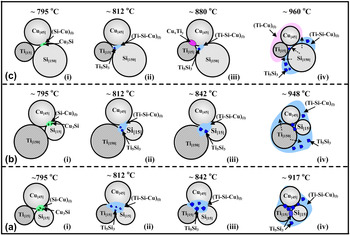
Motivated by Jo et al.,Reference Jo, Lee, Moon and Kim27 Hu et al.,Reference Hu, Luo, Yan and Li28 and Deevi,Reference Deevi29 we depict phase transformations in Ti[15]Si[15]Cu[45], Ti[150]Si[15]Cu[45], and Ti[15]Si[150]Cu[45] systems schematically in Fig. 4. With the temperature increasing to ∼795 °C, some amount of Si–Cu liquid was formed between Si and Cu3Si which was produced at lower temperature (<795 °C) [see (i) in Figs. 4(a)–4(c)]. Simultaneously, Ti diffused into the Si–Cu liquid to form Ti–Si–Cu ternary liquid, and then Ti5Si3 precursors were precipitated out of the liquid at ∼812 °C [see (ii) in Fig. 4(a)–4(c)]. Generally, the Ti–Si–Cu liquid increased with temperature increasing in Ti[15]Si[15]Cu[45] and Ti[150]Si[15]Cu[45] systems [see (iii) in Figs. 4(a) and 4(b)]. Unlike the former two systems, in the Ti[15]Si[150]Cu[45] system with coarse Si particle, CuxTiy compounds were formed between Cu and Ti when the temperature increased to ∼880 °C [see (iii) in Fig. 4(c)]. In addition, for Ti[15]Si[15]Cu[45] system, the Ti–Si–Cu liquid participated into the reaction of β-Ti and Si to yield a massive amount of Ti5Si3 particulates at ∼917 °C [see (iv) in Fig. 4(a)]. For Ti[150]Si[15]Cu[45] system, the formation of Ti5Si3 was delayed to ∼948 °C due to the coarse Ti particles [see (iv) in Fig. 4(b)]. For Ti[15]Si[150]Cu[45] system, CuxTiy melted into Ti–Cu liquid when the temperature reached to 960 °C, and then coarse Si dissolved into the liquid, leading to the formation of Ti–Si–Cu liquid; at last, Ti5Si3 was precipitated out of the ternary liquid [see (iv) in Fig. 4(c)].
Schematic of phase transformations for (a) Ti[15]Si[15]Cu[45], (b) Ti[150]Si[15]Cu[45], and (c) Ti[15]Si[150]Cu[45]systems during DTA, respectively.

Therefore, as stated previously, we can see that Ti and Si particle sizes play an important role in Ti–Si–Cu system during DTA, which could alter phase transformations of Ti–Si–Cu system.
In addition, the particle sizes of Cu powders (∼45 and ∼75 μm) were also studied, but they had little influence on the DTA curve and phase transformations. This may be due to the particle sizes of ∼45 and ∼75 μm with no great difference. Hence, the detailed analysis of the Ti–Si–Cu system with various Cu particles is not given.
C. Products of combustion synthesis
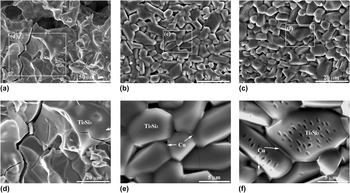
To study influences of reactant particle sizes on CS products, the combustion reactions of Ti–Si and Ti–Si–Cu systems with various Ti and Si particles were performed under the protection of an argon atmosphere. The XRD patterns and SEM analysis are presented in Figs. 5(a)–5(d) and Figs. 6(a)–6(f), respectively. Without Cu addition, only Ti5Si3 phase is detected as expected in Ti[15]Si[15] system [Fig. 5(a)]. For Ti[15]Si[15]Cu[45], Ti[150]Si[15]Cu[45], and Ti[15]Si[150]Cu[45] systems, no matter what reactant particle sizes change, the final products only consist of Ti5Si3 and Cu without transient phase [Figs. 5(b)–5(d)]. However, morphologies of CS products have great differences depending mainly on the reactant particle sizes. For the Ti[15]Si[15] system, the monolithic Ti5Si3 synthesized exhibits the coarse irregular appearance with an obvious sintered morphology [Figs. 6(a) and 6(d)]. Besides, the transgranular and intergranular mircrocracks in coarse Ti5Si3 grains are also clearly observed, which may account for the great anisotropy of coefficient of thermal expansion of Ti5Si3.Reference Riley, Oliver and Kisi12 In addition, the heating and cooling rates are extremely fast in the CS process, so it is not difficult to accept the fact that so much microcracks formed in the coarse grains.
XRD patterns of the products in combustion synthesis reaction of (a) Ti[15]Si[15], (b) Ti[15]Si[15]Cu[45], (c) Ti[150]Si[15]Cu[45], and (d) Ti[15]Si[150]Cu[45]systems.

Typical SEM of microstructure of the products in combustion synthesis reaction of (a) Ti[15]Si[15], (b) Ti[15]Si[15]Cu[45], (c) Ti[15]Si[150]Cu[45]systems, and (d), (e) and (f) are local magnifications of the selected areas in (a), (b), and (c), respectively.

For Ti[15]Si[15]Cu[45] sample, most grains in product took on the polyhedron- and short rod-like appearance with smooth surface and an average size of ∼10 μm [Figs. 6(b) and 6(e)]. In addition, it is worth noting that microcracks were evidently reduced in the product. For the Ti[15]Si[150]Cu[45] sample with coarse Si particle, however, surprisingly enough, it is clearly seen that the Ti5Si3 grains exhibit polyhedron-like appearance with a polyporous surface [Figs. 6(c) and 6(f)]. Besides, for Ti[150]Si[15]Cu[45] sample with coarse Ti particle, Ti5Si3 grains are similar with those of Ti[15]Si[150]Cu[45] sample. It can be speculated that different morphologies of Ti5Si3are mainly attributed to the coarse Ti and Si particles, which lead to the low diffusion speed during reaction. However, the exact reason for the peculiar appearance is still unclear. Further research still needs to be carried out in this area.
IV. CONCLUSIONS
The Ti and Si particle sizes have a great influence on phase transformations in Ti–Si–Cu system. For Ti[15]Si[15]Cu[45] system, fine Ti particle easily dissolves into Si–Cu binary liquid to form Ti–Si–Cu ternary liquid at ∼795 °C, which further participates into the reaction of β-Ti and Si to yield abundant Ti5Si3 particulates at ∼917 °C. For Ti[150]Si[15]Cu[45] system, however, it is relatively difficult for coarse Ti particles to react with the Si–Cu liquid to form the ternary liquid and, thereby delaying the formation of Ti5Si3 to ∼948 °C. For Ti[15]Si[150]Cu[45] system, coarse Si particle results in the formation of insufficient Si–Cu liquid initially, while Ti–Cu liquid formed at ∼960 °C instead, which further reacts with coarse Si to form the Ti–Si–Cu liquid, and the Ti5Si3are precipitated out of the ternary liquid.
During combustion synthesis, Ti5Si3 took on the polygon-and short rod-like morphology in Ti[15]Si[15]Cu[45] sample; for Ti[150]Si[15]Cu[45] and Ti[15]Si[150]Cu[45] system, Ti5Si3grains exhibit polyhedron-like appearance with polyporous surface.
ACKNOWLEDGMENTS
This work is supported by The National Natural Science Foundation of China (No. 50671044) and The Foundation of Jilin University for Distinguished Young Scholars. Partial financial support comes from The Graduate Innovation Fund of Jilin University (20111045).