





The various stage-salient physical, cognitive, and socioemotional developments of adolescence may explain adolescents’ increased vulnerability to depression (Blakemore, Reference Blakemore2019; Fosco et al., Reference Fosco, Weymouth and Feinberg2023). During this unique developmental period, the hormonal and physical changes associated with puberty precede cognitive changes in adolescent perceptions and neural functioning, which may render the adolescent brain particularly vulnerable to negative environmental experiences (Blakemore, Reference Blakemore2019). These developmental changes may result in compounded risk for depression in adolescents, with cumulative risk rising from 5% in early adolescence to 20%–25% by the end of adolescence (Solmi et al., Reference Solmi, Radua, Olivola, Croce, Soardo, de Pablo, Il Shin, Kirkbride, Jones, Kim, Kim, Carvalho, Seeman, Correll and Fusar-Poli2022; Thapar et al., Reference Thapar, Collishaw, Pine and Thapar2012). Moreover, research suggests that early-onset depression may be more likely to reoccur or present a chronic course into adulthood (Blakemore, Reference Blakemore2019; Solmi et al., Reference Solmi, Radua, Olivola, Croce, Soardo, de Pablo, Il Shin, Kirkbride, Jones, Kim, Kim, Carvalho, Seeman, Correll and Fusar-Poli2022). Therefore, identifying the negative environmental experiences that increase early adolescents’ risk for depression holds considerable weight for prevention and treatment efforts.
Adolescent perceptions and family instability
The enhanced social understanding and self-awareness that accompany puberty and adolescent brain maturation also likely alter adolescents’ perceptions of negative environmental experiences, especially within the family (Hughes & Gullone, Reference Hughes and Gullone2008; Thapar et al., Reference Thapar, Collishaw, Pine and Thapar2012). As adolescents mature cognitively, their ability to detect and distinguish subtle changes in family functioning increases, and with this, they may become sensitized to threats against their own safety or the safety of their family (Davies et al., Reference Davies, Coe, Martin, Sturge-Apple and Cummings2015; Kim et al., Reference Kim, Jackson, Conrad and Hunter2008). These altered perceptions make adolescents particularly attuned to deviations in the stability of the family system. Family instability has typically been conceptualized as transitions in family structure (e.g., changes in parents’ romantic partners), environmental unpredictability (e.g., household chaos, changes in living arrangements), or disruptive family adversities (e.g., destructive conflict between parents; Ackerman et al., Reference Ackerman, Kogos, Youngstrom, Schoff and Izard1999; Bakker et al., Reference Bakker, Ormel, Verhulst and Oldehinkel2012; Davies et al., Reference Davies, Pearson, Coe, Hentges and Sturge-Apple2021; Koss et al., Reference Koss, Kronaizl, Brown and Brooks-Gunn2025). While traditional models have emphasized objective markers such as income or parental marital status, adolescents’ subjective appraisals of family instability may be more proximal predictors of psychological adjustment. Because the adolescent brain may perceive rewards and dangers differently than preadolescent children or adults (Blakemore, Reference Blakemore2019; Thapar et al., Reference Thapar, Collishaw, Pine and Thapar2012), adolescent perceptions may be an underexamined measure of family instability. Considering such, operationalizing family instability in a way that captures more of their representations and affective responses to family challenges as index of their insecurity in the family unit may be more appropriate for adolescent samples. If adolescents perceive the family as erratic, chaotic, and uncontrolled, these threatening perceptions may persist long after the actual threat has been resolved (Fosco & Feinberg, Reference Fosco and Feinberg2015), influence their ability to access other potential protective factors (Kim et al., Reference Kim, Jackson, Conrad and Hunter2008), and modify adolescents’ propensity to appraise these challenges as increasingly threatening moving forward (Fosco et al., Reference Fosco, Weymouth and Feinberg2023). Consequently, these perceptions which indicate how adolescents process and make meaning of family events in relation to their own needs, goals, and desires (Rhoades, Reference Rhoades2008) warrant further consideration to expand upon previous research on family instability and adjustment.
The timing of family instability on child development may be important (Cavanagh & Huston, Reference Cavanagh and Huston2008), with some evidence suggesting early adolescence may be an especially vulnerable time (Bakker et al., Reference Bakker, Ormel, Verhulst and Oldehinkel2012; Forman & Davies, Reference Forman and Davies2003; Marcynyszyn et al., Reference Marcynyszyn, Evans and Eckenrode2008; Vargas et al., Reference Vargas, Roosa, Knight and O’Donnell2013). Family instability may add stress to an already stressful developmental period by disrupting normative adolescent social processes (e.g., burgeoning autonomy from parents, identity development), placing adolescents at greater risk of maladjustment (Cavanagh & Huston, Reference Cavanagh and Huston2008; Davies et al., Reference Davies, Coe, Martin, Sturge-Apple and Cummings2015; Fosco & Feinberg, Reference Fosco and Feinberg2015; Vargas et al., Reference Vargas, Roosa, Knight and O’Donnell2013). Further, family chaos and instability may limit adolescents’ opportunities to learn effective emotion regulation, self-efficacy, problem solving, and provoke depressive symptoms that may persist into adulthood (Davies et al., Reference Davies, Pearson, Coe, Hentges and Sturge-Apple2021; Göbel & Cohrdes, Reference Göbel and Cohrdes2021; Koss et al., Reference Koss, Kronaizl, Brown and Brooks-Gunn2025). In this context, adolescents may also be more likely to develop hostile world views, disengage from family relationships, and lose confidence in the family as a source of security and support (Davies & Forman, Reference Davies and Forman2002; Forman & Davies, Reference Forman and Davies2003; Fosco & Feinberg, Reference Fosco and Feinberg2015). Moreover, research has identified family instability – even at modest levels (Forman & Davies, Reference Forman and Davies2003) – as a risk factor for internalizing problems like depression or anxiety (Bakker et al., Reference Bakker, Ormel, Verhulst and Oldehinkel2012; Davies & Forman, Reference Davies and Forman2002; Göbel & Cohrdes, Reference Göbel and Cohrdes2021; Koss et al., Reference Koss, Kronaizl, Brown and Brooks-Gunn2025; Marcynyszyn et al., Reference Marcynyszyn, Evans and Eckenrode2008; Milan et al., Reference Milan and Pinderhughes2006; O’Hara et al., Reference O’Hara, Cummings and Davies2024; Vargas et al., Reference Vargas, Roosa, Knight and O’Donnell2013).
Adolescent involvement in interparental conflict
Another negative environmental experience that may increase adolescents’ risk for depression is involvement in interparental conflict. When parents engage in destructive conflicts – marked by hostility, anger, and a lack of resolution – adolescents are likely to experience these interactions as stressful sources of emotional insecurity in the family (Davies & Forman, Reference Davies and Forman2002; Kopystynska et al., Reference Kopystynska, Crapo, Barnett, Bradford, Higginbotham and Curran2025; van Eldik et al., Reference van Eldik, de Haan, Parry, Davies, Luijk, Arends and Prinzie2020), further bolstering their perceptions of family instability (Coe et al., Reference Coe, Davies and Sturge-Apple2017; Davies et al., Reference Davies, Pearson, Coe, Hentges and Sturge-Apple2021), and increasing their likelihood of involvement (Davies & Cummings, Reference Davies and Cummings1994; Jouriles et al., Reference Jouriles, Rosenfield, McDonald and Mueller2014; Kerig, Reference Kerig1996). This involvement may include the adolescent being emotionally or behaviorally drawn into parental disputes, potentially through triangulation, scapegoating, or emotional alignment with one parent (Buehler & Welsh, Reference Buehler and Welsh2009; Davies et al., Reference Davies, Coe, Martin, Sturge-Apple and Cummings2015; Kerig, Reference Kerig1996; McCauley et al., Reference McCauley, Sloan, Xia and Fosco2021; Rhoades, Reference Rhoades2008). Ample research has linked adolescent involvement in their parents’ disputes as a risk factor for psychopathology (e.g., Holt et al., Reference Holt, Sand Helland, Morbech, Larsen, Gustavson, Ha and Cummings2021; Jouriles et al., Reference Jouriles, Rosenfield, McDonald and Mueller2014; Warmuth et al., Reference Warmuth, Cummings and Davies2018), with even stronger links for internalizing problems than externalizing problems (Buehler & Welsh, Reference Buehler and Welsh2009; Mueller et al., Reference Mueller, Jouriles, McDonald and Rosenfield2015; Rhoades, Reference Rhoades2008). Further, even if children only intervene in interparental conflict occasionally or sometimes, the evidence suggests involvement needs not be frequent to be problematic (Jouriles et al., Reference Jouriles, Rosenfield, McDonald and Mueller2014). Given that Mueller et al. (Reference Mueller, Jouriles, McDonald and Rosenfield2015) found that nearly 75% of children in their sample reported at least some involvement in interparental conflict, renewed investigation of involvement as a risk factor for psychopathology is merited.
Compared to their younger counterparts, adolescents may be acutely perceptive when detecting subtle signs of interparental disputes and may be more likely to intervene in these conflicts (Cummings et al., Reference Cummings, Schermerhorn, Davies, Goeke-Morey and Cummings2006; Davies et al., Reference Davies, Sturge‐Apple, Bascoe and Cummings2014; Fosco & Feinberg, Reference Fosco and Feinberg2015; Kim et al., Reference Kim, Jackson, Conrad and Hunter2008), which may further amplify their vulnerability to these stressful environmental experiences. Moreover, these stressful circumstances may threaten their wellbeing, decrease their feelings of competence, and intensify distress (Fosco & Feinberg, Reference Fosco and Feinberg2015). Adolescents may also be more likely to discern their role in parents’ conflicts or hold themselves responsible for causing the conflict, making them feel further compelled to intervene (Jouriles et al., Reference Jouriles, Rosenfield, McDonald and Mueller2014; Kim et al., Reference Kim, Jackson, Conrad and Hunter2008; McCauley et al., Reference McCauley, Sloan, Xia and Fosco2021). Although involvement may provide adolescents a means to temporarily de-escalate or stop parents’ conflicts and provide a short-term sense of control over the situation (Mueller et al., Reference Mueller, Jouriles, McDonald and Rosenfield2015), involvement may also serve to embroil adolescents in their parents’ discord (Davies et al., Reference Davies, Coe, Martin, Sturge-Apple and Cummings2015). When adolescents become involved in their parents’ disputes, they may become further sensitized to interparental conflict (Kerig, Reference Kerig1996; McCauley et al., Reference McCauley, Sloan, Xia and Fosco2021). While parents may experience relief from marital tension through their adolescent’s involvement, they may consequently make fewer attempts to restore balance to the family and resolve their disagreements effectively (McCauley et al., Reference McCauley, Sloan, Xia and Fosco2021). At the same time, the adolescent’s own views of the family as a source of stability and security may deteriorate as their heightened involvement burdens them with responsibilities well beyond their years (McCauley et al., Reference McCauley, Sloan, Xia and Fosco2021; Mueller et al., Reference Mueller, Jouriles, McDonald and Rosenfield2015). Taken together, these dynamic family processes increase the likelihood of continued interparental conflict, diminish adolescent perceptions of family stability, and promote adolescent risk of internalizing problems (Buehler & Welsh, Reference Buehler and Welsh2009; Davies et al., Reference Davies, Coe, Martin, Sturge-Apple and Cummings2015; Fosco & Feinberg, Reference Fosco and Feinberg2015; McCauley et al., Reference McCauley, Sloan, Xia and Fosco2021; Mueller et al., Reference Mueller, Jouriles, McDonald and Rosenfield2015).
Emotional security theory
While perceived family instability and adolescent involvement in interparental conflict are both known risk factors for adolescent depression, the temporal ordering and interplay between these processes remain underexamined. Emotional security theory guides investigation of these potential reciprocal influences by enlightening how adolescent involvement in interparental conflict may come at a significant psychological cost (Cummings et al., Reference Cummings, George, McCoy and Davies2012; Davies et al., Reference Davies, Coe, Martin, Sturge-Apple and Cummings2015; van Eldik et al., Reference van Eldik, de Haan, Parry, Davies, Luijk, Arends and Prinzie2020). Emotional security theory (EST; Davies & Cummings, Reference Davies and Cummings1994) postulates that parents’ destructive conflicts progressively sensitize children to their parents’ disputes, cultivating perceptions of the family as instable and at risk for separation or dissolution. Over time, repeated exposure to destructive interparental conflicts lowers thresholds for how much insecurity children and adolescents can tolerate, which may motivate them to intervene in their parents’ quarrels to attempt to restore security in the family (Cummings & Davies, Reference Cummings and Davies2010; Davies & Forman, Reference Davies and Forman2002; Davies et al., Reference Davies, Sturge‐Apple, Bascoe and Cummings2014). Although involvement may initially help children and adolescents adapt to or cope with the stress of interparental conflict, the effectiveness of these interventions likely wanes over time (Davies et al., Reference Davies, Coe, Martin, Sturge-Apple and Cummings2015) leaving adolescents no longer able to regain emotional security (Davies & Forman, Reference Davies and Forman2002). Emotional insecurity and involvement, in turn, promotes psychopathology in children and adolescents (Cummings et al., Reference Cummings, Schermerhorn, Davies, Goeke-Morey and Cummings2006, Reference Cummings, George, McCoy and Davies2012; Davies et al., Reference Davies, Harold, Goeke-Morey, Cummings, Shelton, Rasi and Jenkins2002, Reference Davies, Coe, Martin, Sturge-Apple and Cummings2015; Warmuth et al., Reference Warmuth, Cummings and Davies2018). This psychopathology may then erode adolescent capacities to weather challenging developmental demands and further exacerbate their vulnerability to threatening negative circumstances (Coe et al., Reference Coe, Davies and Sturge-Apple2017; Yap et al., Reference Yap, Allen and Sheeber2007). Indeed, EST proposes that adolescent insecurity and involvement likely result in disproportionate allocation of psychobiological resources toward physical and emotional safety leaving insufficient skills and resources to successfully resolve other developmental tasks (Cummings et al., Reference Cummings, Schermerhorn, Davies, Goeke-Morey and Cummings2006, Reference Cummings, George, McCoy and Davies2012; Davies & Forman, Reference Davies and Forman2002; Davies et al., Reference Davies, Coe, Martin, Sturge-Apple and Cummings2015; Forman & Davies, Reference Forman and Davies2003, Reference Forman and Davies2005; Mueller et al., Reference Mueller, Jouriles, McDonald and Rosenfield2015). Therefore, the sensitization of adolescents to their parents’ destructive conflicts likely fosters a negative cycle of increasing perceptions of family instability, adolescent involvement, and symptoms of depression. Taken together, EST suggests that family instability may catalyze adolescents’ involvement in interparental conflict, which, in turn, may heighten the risk for depression through compromised emotional security and systemic enmeshment.
Gaps in the literature
However, gaps in the extant literature leave much to be explored about family instability, involvement, and depression in adolescence. First, much of the prior work delineating these mechanisms has been cross-sectional (e.g., Camisasca et al., Reference Camisasca, Miragoli and Di Blasio2019; Choi & Goldberg, Reference Choi and Goldberg2021; Forman & Davies, Reference Forman and Davies2003; O’Hara et al., Reference O’Hara, Cummings and Davies2024), limiting inferences about directionality and transactional effects. Evidence suggests the likelihood of bidirectional effects for many of these family-wide mechanisms in adolescence (Camisasca et al., Reference Camisasca, Miragoli and Di Blasio2019; Davies et al., Reference Davies, Sturge‐Apple, Bascoe and Cummings2014; Jouriles et al., Reference Jouriles, Rosenfield, McDonald and Mueller2014; Koss et al., Reference Koss, Kronaizl, Brown and Brooks-Gunn2025; Simpson, Reference Simpson2020), yet many of the analytic techniques employed have not cogently advanced the study of bidirectional relations. To address these gaps, longitudinal designs using advanced statistical models are needed to disentangle dynamic processes from stable individual differences (Cheung et al., Reference Cheung, Cummings, Zhang and Davies2016). Autoregressive latent trajectory (ALT) modeling using longitudinal data provides an examination of time-invariant, trait-like stability and allows for the separation of within- and between-person effects (Hamaker et al., Reference Hamaker, Kuiper and Grasman2015; Lucas, Reference Lucas2023) while also examining growth trajectories (Bollen & Curran, Reference Bollen and Curran2004). This analytic technique may elucidate whether any observed associations between adolescent perceptions of family instability, involvement in interparental conflict, and adolescent depressive symptoms represent stable within-person (state-like) or between-person (trait-like) differences.
Second, much of the research on family instability, involvement in interparental conflict, and psychopathology has utilized childhood samples (e.g., Camisasca et al., Reference Camisasca, Miragoli and Di Blasio2019; Choi & Goldberg, Reference Choi and Goldberg2021; Coe et al., Reference Coe, Davies and Sturge-Apple2017, Reference Coe, Davies, Hentges and Sturge-Apple2020; Davies et al., Reference Davies, Pearson, Coe, Hentges and Sturge-Apple2021; Jourlies et al., Reference Jouriles, Rosenfield, McDonald and Mueller2014; Kopystynska et al., Reference Kopystynska, Crapo, Barnett, Bradford, Higginbotham and Curran2025; Milan et al., Reference Milan and Pinderhughes2006; Mueller et al., Reference Mueller, Jouriles, McDonald and Rosenfield2015); less is known about the adolescent experience with these processes. Adolescence may be a sensitive period for development of adjustment problems (Simpson, Reference Simpson2020), and the heightened stress of puberty, school transitions, and their nascent autonomy may further diminish their capacity to cope with family difficulties (Cheung et al., Reference Cheung, Cummings, Zhang and Davies2016). Moreover, meta-analytic findings suggest the link between interparental conflict and internalizing problems increases with age (Rhoades, Reference Rhoades2008), pointing to the importance of examining adolescent samples. Third, past research has largely relied upon objective measures of family instability (e.g., family income, number of relocations or parents’ romantic partners; Bakker et al., Reference Bakker, Ormel, Verhulst and Oldehinkel2012; Choi & Goldberg, Reference Choi and Goldberg2021; Coe et al., Reference Coe, Davies and Sturge-Apple2017, Reference Coe, Davies, Hentges and Sturge-Apple2020; Davies et al., Reference Davies, Pearson, Coe, Hentges and Sturge-Apple2021; Koss et al., Reference Koss, Kronaizl, Brown and Brooks-Gunn2025; Marcynysyn et al., Reference Marcynyszyn, Evans and Eckenrode2008; Milan et al., Reference Milan and Pinderhughes2006; Vargas et al., Reference Vargas, Roosa, Knight and O’Donnell2013) that may not capture adolescents’ subjective experiences. Because adolescents view the world through a unique lens (Blakemore, Reference Blakemore2019), including their perceptions of family instability may likely predict their adjustment beyond the effects associated with individual dyadic subsystems (Forman & Davies, Reference Forman and Davies2005; O’Hara et al., Reference O’Hara, Cummings and Davies2024).
Present study
The current study aims to address these gaps using a three-wave longitudinal design to explore perceptions of family instability, involvement in interparental disputes, and symptoms of depression in early-to-middle adolescents (ages 13–15 years) using ALT modeling to disentangle within-person (state-like) and between-person (trait-like) dynamics. The current study adds valuable insight into the adolescent experience in the family and how these dynamics influence their depressive symptomatology at a vulnerable time. Based on the extant literature pointing to adolescence being a high-flux period of development, we did not anticipate between-person (trait-like) stability in perceptions of family instability, adolescent involvement in interparental conflict, or adolescent symptoms of depression (i.e., significant intercept–slope correlations for these variables); however, we did hypothesize that latent intercepts would be significantly correlated. Specifically, we hypothesized that latent intercepts for perceived family instability, adolescent involvement in interparental conflict, and adolescent depression would all be significantly positively correlated. To examine transactional associations at a within-person (state-like) level, we hypothesized that when adolescents displayed levels of perceived family instability, involvement, or depression higher than their individual average, these associations would have cascading effects over time. Said another way, we hypothesized that temporary increases in perceived family instability or involvement (relative to each adolescent’s own average) would predict an increase in depressive symptoms at the next time point.
Method
Participants
The sample consisted of 296 families (n = 149 (50.3%) females and n = 147 (49.7%) males) drawn from a broader multi-site longitudinal investigation focused on adolescent development and family processes. Eligibility criteria required that the parents lived together for at least one year (or three years for the first cohort) and had an adolescent currently enrolled in seventh grade. At the initial assessment (Wave 1), adolescents were on average 13.10 years old (SD = 0.57), followed by 14.02 years at Wave 2 (SD = 0.49), and 15.06 years at Wave 3 (SD = 0.43). The racial and ethnic breakdown of the sample reflected the broader demographics of the recruitment regions: 73.5% identified as European American, 17.1% as Black or African American, 4.3% as Hispanic, and 5.1% as multiracial or another racial identity. Although household income ranged broadly, from under $6,000 to over $125,000, most participating families were from middle-income households, with a median income between $55,000 and $74,999. Most parents were married (84.9%) and biological caregivers of the target adolescent (91.8% of mothers, 79.2% of fathers). Fathers’ ages ranged from 25 to 76 years (M = 43.67, SD = 6.74), with 75.8% employed full-time. Mothers were between 25 and 71 years old (M = 41.73, SD = 5.99), and 45.9% held full-time employment. Educational attainment varied widely across the sample, but just under half of fathers (49.5%) and just over half of mothers (52.3%) obtained at least an associate’s degree. Retention across waves was strong: 280 families (95%) completed Wave 1, 266 (90%) participated in Wave 2, and 250 (85%) remained at Wave 3. Attrition analyses revealed no significant demographic differences between retained and non-retained families.
Procedure
Data collection occurred annually over three consecutive waves at two university-affiliated research laboratories from 2006 to 2010. Recruitment occurred in two urban regions in the Midwestern and Northeastern United States through a variety of methods, including school and community flyers, newspaper advertisements, direct mailings, and outreach at local events. Families were enrolled in two sequential cohorts to maximize diversity and statistical power. Each wave involved two in-person visits: one with the entire family and a second follow-up session for the adolescent and one parent. Visits typically lasted 2.5–3 hours. Informed consent was obtained from parents, and assent was obtained from adolescents prior to participation. During these sessions, families completed structured interviews, standardized questionnaires, and videotaped interaction tasks designed to assess family functioning and adolescent adjustment. All study procedures were reviewed and approved by the Institutional Review Board at the University of Notre Dame (IRB Protocol #00014997). Families received financial compensation for their participation, and adolescents were given gift cards in appreciation of their time.
Measures
Perceived family instability
Adolescent perceptions of family-level unpredictability and instability were assessed using the preoccupation subscale of the Security in the Family System (SIFS; Forman & Davies, Reference Forman and Davies2005), completed by adolescents at each wave. This 8-item subscale measures adolescents’ perceptions of chaos, instability, and lack of control in the family system (e.g., “I don’t know what to do about things that are happening in my family,” “I feel like something could go very wrong in my family at any time”). Items were rated on a 5-point Likert scale ranging from 1 (strongly disagree) to 5 (strongly agree) and summed to create a total score, with higher scores indicating greater perceived instability. The Family Preoccupation subscale has demonstrated strong psychometric properties, including high internal consistency in previous studies (α = 0.80–0.90) and the current study (α ≥ 0.83 across waves), and strong construct validity in assessing children’s emotional security in the family context (Forman & Davies, Reference Forman and Davies2005).
Adolescent involvement in interparental conflict
Adolescent involvement in interparental conflict was measured using the Child Involvement subscale of the Conflicts and Problem-Solving Scales (CPS; Kerig, Reference Kerig1996), completed by both parents at three waves. This 16-item subscale captures the extent to which children are drawn into, react to, or attempt to mediate interparental disagreements (e.g., “The child tries to stop the argument,” “The child gets upset when we fight”). Items were rated on a 4-point Likert scale (0 = never, 3 = often). Reports from both parents were averaged to create a composite score for each wave. The CPS Child Involvement subscale has demonstrated good internal reliability in previous research (α = 0.75–0.83) and the current study (α ≥ 0.78 across waves) and is sensitive to family dynamics that involve triangulation or role confusion (Kerig, Reference Kerig1996).
Adolescent depression
Adolescent depressive symptoms were assessed at three time points using the Center for Epidemiological Studies Depression Scale for Children (CES-DC; Radloff, Reference Radloff1977). This 20-item self-report instrument measures the frequency of depressive symptoms experienced during the past week (e.g., “I felt down and unhappy,” “I felt like I couldn’t pay attention”). Items were rated on a 4-point Likert scale ranging from 0 (not at all) to 3 (a lot), with higher scores reflecting greater depressive symptomatology. The CES-DC has demonstrated excellent internal consistency in adolescent samples (α ≥ 0.85 across waves; Radloff, Reference Radloff1977) and in the current study (α ≥ 0.88 across waves) and has been widely validated in both clinical and community populations.
Analysis plan
Using the lavaan package in R (Version 0.6–21; Rosseel et al., Reference Rosseel, Jorgensen and De Wilde2025) and Mplus (Version 8.10; Muthén & Muthén, Reference Muthén and Muthén2023) to distinguish between within- and between-person variance, we employed ALT modeling using the approach recommended by Bollen and Curran (Reference Bollen and Curran2004) to separate stable between-person differences from dynamic within-person processes. Because the model includes both latent intercept and latent slope components alongside autoregressive and cross-lagged residual paths (Bollen & Curran, Reference Bollen and Curran2004), this ALT model approach allows parsing of state-like fluctuations in within-person processes from stable, trait-like individual differences. This isolation of within-person processes from stable traits is suggested to result in a refined model that may yield more accurate interpretations of longitudinal data (Hamaker et al., Reference Hamaker, Kuiper and Grasman2015).
To overcome limitations of the traditional cross-lagged panel models (Lucas, Reference Lucas2023, Reference Lucas2025) while still estimating growth trajectories, we estimated five ALT models, which include latent intercepts to account for trait-like stability and estimate within-person fluctuations over time. Each model introduced progressively more constraints: Model 1 was the baseline model with random intercepts and freely estimated autoregressive and cross-lagged paths, Model 2 introduced latent slopes to capture individual variability in growth over time, Model 3 constrained autoregressive coefficients to equality across adjacent time points, Model 4 imposed additional equality constraints on cross-lagged paths, and Model 5 further constrained residual variances across time. By comparing these models, we aimed to determine not only whether these constructs were reciprocally predictive, but also how intra-individual changes in one domain relate to changes in another. Parental age, parental education, and adolescent gender were tested as time-invariant covariates simultaneously across all three waves and all three constructs within the model. None reached statistical significance at any wave, and all were subsequently removed from the final model to maximize parsimony and statistical power.
The percentage of missing data was relatively low overall, with less than 5%–7% missing across the key time points and variables. We examined patterns of attrition and found no significant differences between families who remained in the study and those who dropped out in terms of the primary variables or covariates included in the model. This suggests that the data are likely missing at random (MAR), supporting the appropriateness of model-based imputation. To handle the missing data, we used full-information maximum likelihood (FIML) estimation, which allowed us to retain all available data and produce unbiased parameter estimates under the MAR assumption. FIML was implemented within the structural equation modeling framework, and all models converged without issues.
Results
Descriptive statistics, correlations, and ICCs
Table 1 presents the descriptive statistics and intercorrelations among the three primary constructs: perceived family instability, adolescent involvement in interparental conflict, and adolescent depressive symptoms. Mean levels of perceived family instability and adolescent depression were notably high at Wave 1, with modest declines or slight increases in subsequent waves. Intraclass correlation coefficients (ICCs), calculated using empty multilevel models with time nested within individuals, were 0.39 for perceived family instability, 0.51 for adolescent involvement, and 0.47 for depressive symptoms, indicating moderate between-person variance and supporting the need for ALT modeling to distinguish within- and between-person effects. In this community sample, analyses were also conducted to evaluate the severity of adolescent depressive symptoms on a descriptive level. Scores above 15 are generally considered clinically relevant (Weissman et al., Reference Weissman, Orvaschel and Padian1980) and in the current sample, 24.6% of adolescents (n = 69) at W1, 25.9% (n = 69) at W2, 28.0% (n = 70) at W3 met or exceeded this cutoff, suggesting clinically significant levels of depressive symptoms. Based on comparable numbers from the National Surveys on Drug Use and Health for 2005 to 2014, these sample numbers tended be higher than the U.S. general population, with only 8.7%–11.3% of similarly aged adolescents nationally reporting a major depressive episode in the previous 12 months (Mojtabai et al., Reference Mojtabai, Olfson and Han2016).
Means, Standard Deviations, and Intercorrelations Among Study Variables

Table 1. Long description
The table presents descriptive statistics and intercorrelations among three primary constructs: perceived family instability, adolescent involvement in interparental conflict, and adolescent depressive symptoms. It includes means, standard deviations, and correlation coefficients for these variables across three waves. The table has 9 rows and 9 columns. Column headers are Variable, M, SD, 1, 2, 3, 4, 5, 6, 7, 8. Row labels include W1 INST, W2 INST, W3 INST, W1 INV, W2 INV, W3 INV, W1 DEP, W2 DEP, W3 DEP. Row 1: W1 INST, M 16.98, SD 6.04, 1-. Row 2: W2 INST, M 16.88, SD 6.45, 1 0.52**, 2-. Row 3: W3 INST, M 16.55, SD 6.47, 1 0.44**, 2 0.57**, 3-. Row 4: W1 INV, M 5.06, SD 2.45, 1 0.09, 2 0.14, 3 0.15*, 4-. Row 5: W2 INV, M 5.13, SD 2.42, 1 0.14, 2 0.17*, 3 0.13, 4 0.81**, 5-. Row 6: W3 INV, M 4.96, SD 2.30, 1 0.20**, 2 0.13, 3 0.14*, 4 0.72**, 5 0.71**, 6-. Row 7: W1 DEP, M 12.17, SD 5.71, 1 0.43**, 2 0.23**, 3 0.26**, 4 0.04, 5 0.03, 6 0.09, 7-. Row 8: W2 DEP, M 12.40, SD 5.97, 1 0.26**, 2 0.31**, 3 0.26**, 4 0.06, 5 0.09, 6 0.07, 7 0.40**, 8-. Row 9: W3 DEP, M 14.53, SD 6.58, 1 0.29**, 2 0.23**, 3 0.41**, 4 0.13, 5 0.16*, 6 0.04, 7 0.30**, 8 0.51**, 9-.
Note. Means, standard deviations, and Pearson correlations are presented for perceived family instability, adolescent involvement in interparental conflict, and adolescent depressive symptoms across three waves. Intraclass correlation coefficients (ICCs) reflect moderate between-person variability, supporting the use of multilevel models to disaggregate within- and between-person effects. W1 = Wave 1; W2 = Wave 2; W3 = Wave 3; INST = family instability; INV = adolescent involvement; DEP = adolescent depressive symptoms.
* p < .05; **p < .01.
Autoregressive latent trajectory (ALT) model
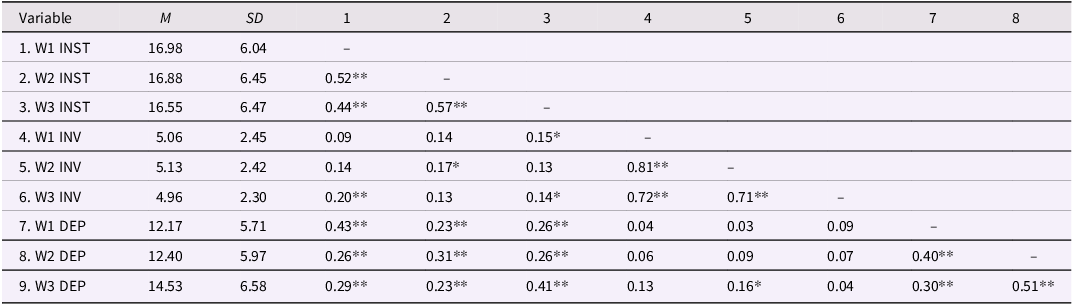
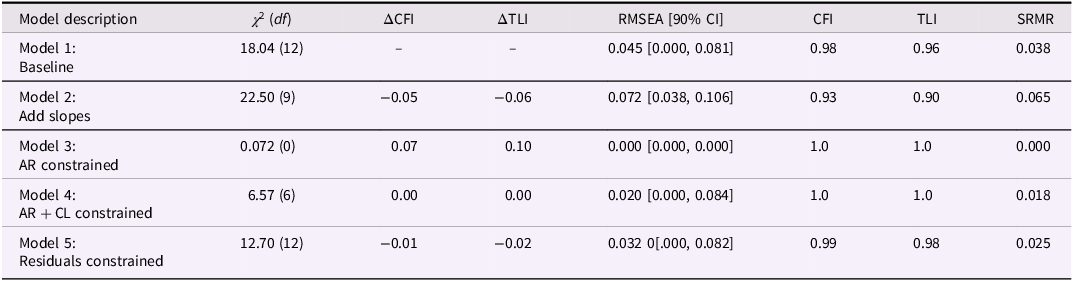
To disentangle trait-like between-person variance from dynamic within-person processes, we estimated five ALT models. Fit indices for all models are presented in Table 2. Model 1 (latent intercept only) served as the baseline, showing acceptable fit. Model 2 added latent slope components but demonstrated slightly worse fit, suggesting potential over-parameterization. Model 3, in which autoregressive paths were constrained to equality, substantially improved model fit. Model 4, which constrained both autoregressive and cross-lagged paths, offered the best overall balance of parsimony and fit, scaled χ 2(6) = 6.57, p = .59, RMSEA = 0.020, CFI = 1.00, TLI = 1.00, SRMR = 0.018, and was selected for interpretation. See Figure 1 for visualization of the conceptual model. Model syntax is available from the second author upon request.
Autoregressive latent trajectory (ALT) conceptual model.

ALT fit indices across models
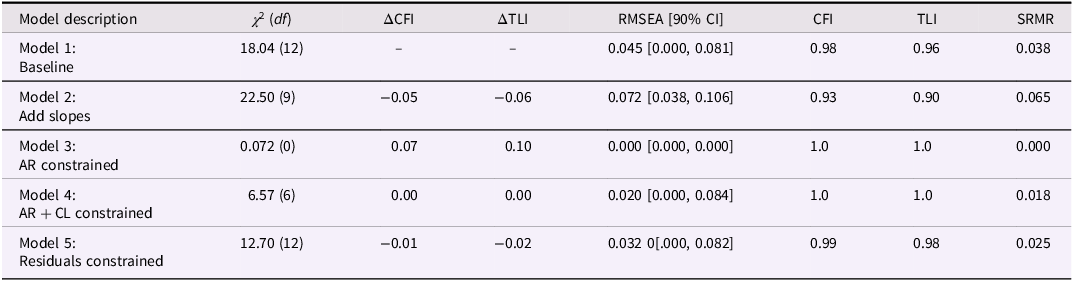
Table 2. Long description
A table comparing fit indices across different models. The table has five rows and eight columns. Column headers are Model description, Chi-square (df), Delta CFI, Delta TLI, RMSEA [90% CI], CFI, TLI, and SRMR. Row labels are Model 1: Baseline, Model 2: Add slopes, Model 3: AR constrained, Model 4: AR + CL constrained, and Model 5: Residuals constrained. Row 1: Model 1: Baseline, Chi-square (df) 18.04 (12), Delta CFI -, Delta TLI -, RMSEA [90% CI] 0.045 [0.000, 0.081], CFI 0.98, TLI 0.96, SRMR 0.038. Row 2: Model 2: Add slopes, Chi-square (df) 22.50 (9), Delta CFI -0.05, Delta TLI -0.06, RMSEA [90% CI] 0.072 [0.038, 0.106], CFI 0.93, TLI 0.90, SRMR 0.065. Row 3: Model 3: AR constrained, Chi-square (df) 0.072 (0), Delta CFI 0.07, Delta TLI 0.10, RMSEA [90% CI] 0.000 [0.000, 0.000], CFI 1.00, TLI 1.00, SRMR 0.000. Row 4: Model 4: AR + CL constrained, Chi-square (df) 6.57 (6), Delta CFI 0.00, Delta TLI 0.00, RMSEA [90% CI] 0.020 [0.000, 0.084], CFI 1.00, TLI 1.00, SRMR 0.018. Row 5: Model 5: Residuals constrained, Chi-square (df) 12.70 (12), Delta CFI -0.01, Delta TLI -0.02, RMSEA [90% CI] 0.032 [0.000, 0.082], CFI 0.99, TLI 0.98, SRMR 0.025.
Note. Fit indices for the five ALT model variations are presented. Model 4, which constrained both autoregressive and cross-lagged paths to equality, demonstrated the best fit and parsimony, as indicated by RMSEA, CFI, TLI, and SRMR values. AR = autoregressive paths; CL = cross-lagged paths.
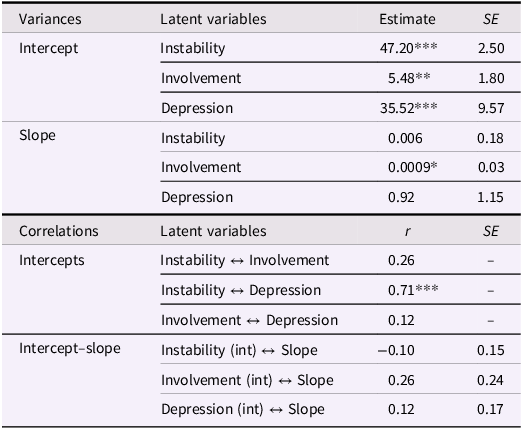
As a test of between-subjects effects, Model 4 included linear latent intercept and slope factors for each construct. The three latent intercept means (perceived family instability: M = 16.60, SD = 6.87; involvement: M = 5.12, SD = 2.34; depression: M = 11.50, SD = 5.96) captured the average baseline level of each construct (all p < .001) and significant intercept variances demonstrated meaningful between-person variability in baseline levels for all three constructs (see Table 3). Latent intercept correlations generally showed that baseline levels were not stably associated with one another, with the exception of the latent intercepts of perceive family instability and adolescent depression (see Table 3), suggesting that an adolescent who started higher on perceived family instability also tended to show higher baseline levels of adolescent depression.
Standardized ALT model between-person effects (intercept and slope variances and intercept–slope and latent growth correlations)

Table 3. Long description
A table with three main sections: Variances, Correlations, and Intercept-slope. The Variances section has two subcategories, Intercept and Slope, each listing three latent variables: Instability, Involvement, and Depression. Each variable has an Estimate and SE value. The Correlations section lists intercept correlations between the latent variables with their respective r and SE values. The Intercept-slope section shows correlations between intercepts and slopes for each latent variable with their respective r and SE values. Row 1: Intercept, Instability, 47.20***, 2.50. Row 2: Intercept, Involvement, 5.48**, 1.80. Row 3: Intercept, Depression, 35.52***, 9.57. Row 4: Slope, Instability, 0.006, 0.18. Row 5: Slope, Involvement, 0.0009*, 0.03. Row 6: Slope, Depression, 0.92, 1.15. Row 7: Correlations, Intercepts, Instability Involvement, 0.26. Row 8: Correlations, Intercepts, Instability Depression, 0.71***. Row 9: Correlations, Intercepts, Involvement Depression, 0.12. Row 10: Intercept-slope, Instability (int) Slope, -0.10, 0.15. Row 11: Intercept-slope, Involvement (int) Slope, 0.26, 0.24. Row 12: Intercept-slope, Depression (int) Slope, 0.12, 0.17.
Note. Model 4 estimated latent growth components for each construct.
*p < .05; **p < .01; ***p < .001.
Also in Table 3, the three latent slope means (perceived family instability: M = −0.04, SD = 0.08; involvement: M = −0.03, SD = 0.03; depression: M = 0.80, SD = 0.96) specified the average rates of change over time for all adolescent participants (all p < .001). Latent slope variances suggested adolescent participants did not differ on their rates of change for perceived family instability or depression, but some participants’ rate of change grew faster than others with regard to adolescent involvement in interparental conflict (p < .05). This means that while adolescents differed meaningfully from one another in their starting levels (significant intercept variances), they mostly did not differ significantly from one another in their rate of change over the three years (non-significant slope variances) except for involvement. Although the inclusion of linear slope components appeared to display slight declines in perceived family instability and conflict involvement over time, alongside modest increases in depressive symptoms, none of the intercept–slope covariances reached significance (see Table 3), suggesting that initial levels were not significantly associated with rates of change over time.
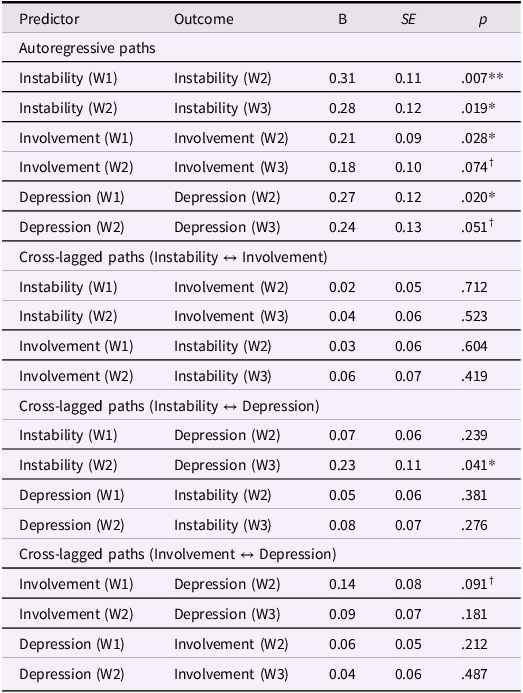
Model 4 also estimated autoregressive and cross-lagged paths at the within-person level, providing a clearer view of how deviations from an individual’s typical emotional or relational baseline unfolded over time (see Table 4). In ALT modeling, a random intercept is modeled first for each individual to isolate their within-person effects and determine their stable, time-invariant trait level. From there, autoregressive effects estimate each individual’s deviation from their own average levels to show whether their temporary fluctuations indicate predictable, within-person carry-over. Autoregressive pathways for all three constructs demonstrated within-person stability from Wave 1 to Wave 2 (βs = 0.21–0.31, p < .05), with only perceived family instability also showing stability from Wave 2 to Wave 3 (β = 0.28, p < .05). Cross-lagged paths indicated that higher-than-usual perceived family instability at Wave 2 predicted increased depressive symptoms at Wave 3 (β = 0.23, p = .041), with no other cross-lagged pathways reaching significance. These results highlighted that only specific within-person deviations – namely, perceived family instability at Wave 2 predicting elevated depressive symptoms at Wave 3 – reliably influenced future symptoms.
standardized ALT model within-person effects (model 4)

Table 4. Long description
A table showing standardized ALT model within-person effects with four rows and three columns. The columns are labeled Predictor, Outcome, B, SE, and p. The table is divided into sections for autoregressive paths and cross-lagged paths among instability, involvement, and depression across three waves. Each row lists specific predictors and outcomes with corresponding B, SE, and p-values. Notable trends include significant autoregressive paths for instability, involvement, and depression, with specific cross-lagged paths showing significant relationships, such as instability at Wave 2 predicting depression at Wave 3.
Note. † p < .10; *p < .05; **p < .01.
Discussion
This longitudinal study investigated how adolescents’ perceived family instability, involvement in interparental conflict, and depressive symptoms unfold together over time. By leveraging ALT modeling, the findings offer novel insights into adolescents’ emotional experiences and family relationships. In line with hypotheses, between-person (trait-like) stability was not found in perceived family instability, conflict involvement, or adolescent depression over time as indicated by the non-significant intercept–slope correlations. Consistent with emotional security theory (EST; Davies & Cummings, Reference Davies and Cummings1994) and shown by a significant latent intercept correlation, adolescents with higher initial perceptions of family instability tended to share higher initial levels of depressive symptoms, independent of change over time and autoregressive stabilities. Contrary to expectations, however, other latent intercepts were not significantly correlated, with involvement in interparental conflict being unrelated to adolescent depressive symptoms or perceptions of family instability. The longitudinal ALT model served to disentangle enduring between-person differences from moment-to-moment, within-person variability, stressing the value of examining within- and between-person effects that may be confounded or misinterpreted with cross-lagged panel modeling alone (Lucas, Reference Lucas2023, Reference Lucas2025) or lack the inclusion of growth trajectories of random-intercept cross-lagged models (Bollen & Curran, Reference Bollen and Curran2004).
Between-person results showed that average initial baseline levels of all three constructs (i.e., latent intercept means) differed significantly from zero, and adolescent participants had widely varying initial scores on perceived family instability, conflict involvement, and depressive symptoms, with these significant intercept variances pointing to meaningful between-person variability in baseline levels of all three constructs. Said another way, these findings point to the presence and variability of perceived family instability, involvement in interparental conflict, and depressive symptoms in adolescence. Latent intercept correlations showed that only the baseline levels of perceived family instability and adolescent depression were stably associated with one another, indicating that if an adolescent started higher on perceived family instability, they were likely to also score higher on initial symptoms of depression. Patterns in significant latent slope means – which showed slight declines in perceived family instability and conflict involvement, but a slight increase in depression – may reflect normative developmental changes, such as adolescents becoming more attuned to family instability and vulnerable to internal distress (Coe et al., Reference Coe, Davies and Sturge-Apple2017; Koss et al., Reference Koss, Kronaizl, Brown and Brooks-Gunn2025). This lends support to the idea that involvement in interparental conflict need not be frequent to be problematic (Jouriles et al., Reference Jouriles, Rosenfield, McDonald and Mueller2014). Regarding individual differences in their rates of change, only adolescents’ slope variance for involvement was significant, suggesting that some adolescents’ involvement in their parents’ disputes increased faster than others over this three-year period and the non-significant intercept–slope correlations indicated this was independent of their initial level of involvement. Together, this suggests meaningful differences in starting levels of perceived family instability, involvement in interparental conflict, and adolescent depression, but generally similar rates of change over the three years observed (again, with involvement being the slope exception). This points to the multifaceted nature of adolescent conflict involvement and the need for within-person models to identify meaningful interpretations of these differences.
For within-person effects, autoregressive pathways showed temporal stability for perceptions of family instability across all waves; however, stability in conflict involvement and depression were only observed from Wave 1 to Wave 2 (with Wave 2 to Wave 3 trending but not reaching significance). This suggests greater within-person carry-over for perceived family instability than conflict involvement or depression, indicating that when an adolescent scored above their own expected family instability score, they were likely to experience future occasions where they scored above their individual expected score on perceived family instability again. Cross-lagged ALT results did not display all our hypothesized dynamic processes over time; however, within-person associations did show that higher-than-average perceived family instability at age 14 predicted higher depression at age 15, suggesting that acute feelings of instability within the family system may catalyze emotional deterioration (Mueller et al., Reference Mueller, Jouriles, McDonald and Rosenfield2015). These findings underscore the importance of examining within-person fluctuations in family functioning and psychological symptoms, demonstrating that even temporary shifts in adolescents’ internal states or perceptions can trigger cascading effects across domains. Cross-lagged ALT findings pointed to within-person deviations in perceived family instability predicting higher depressive symptoms, suggesting the likelihood of cascading effects for those individuals. These results align with recent work emphasizing youth agency, and emotional reactivity in shaping their own environments (e.g., transactional models of development; Bakker et al., Reference Bakker, Ormel, Verhulst and Oldehinkel2012; Coe et al., Reference Coe, Davies, Hentges and Sturge-Apple2020; Koss et al., Reference Koss, Kronaizl, Brown and Brooks-Gunn2025), while also validating EST’s central tenet that disruptions to emotional security play a central role in youth maladjustment. Taken together, the between- and within-person ALT results showed that adolescents with higher initial levels of perceived family instability were also likely to display higher initial levels of depression at age 13 years, and adolescents who displayed higher-than-their-individual-average perceived family instability at age 14 were likely to report higher symptoms of depression at age 15 even when controlling for prior autoregressive stability.
Results of the current study add to the extant literature regarding the importance of incorporating adolescent perspectives into investigations of family dynamics. The cognitive changes that occur in adolescence shape how adolescents view the world and may result in unique perspectives within the family (Blakemore, Reference Blakemore2019). Adolescents’ own reactions and emotional security processes likely serve as explanatory mechanisms for their adjustment (Cummings et al., Reference Cummings, Schermerhorn, Davies, Goeke-Morey and Cummings2006; Davies et al., Reference Davies, Coe, Martin, Sturge-Apple and Cummings2015), potentially making this an ideal time to utilize measures like the SIFS which emphasize adolescent perspectives of family dynamics (Forman & Davies, Reference Forman and Davies2005). Unlike much of the previous work on family instability, the current study relied upon adolescents’ perceptions rather than concrete measurements like parents’ number of romantic partners or disruptions in housing (e.g., Ackerman et al., Reference Ackerman, Kogos, Youngstrom, Schoff and Izard1999; Bakker et al., Reference Bakker, Ormel, Verhulst and Oldehinkel2012; Choi & Goldberg, Reference Choi and Goldberg2021; Coe et al., Reference Coe, Davies and Sturge-Apple2017, Reference Coe, Davies, Hentges and Sturge-Apple2020; Davies et al., Reference Davies, Pearson, Coe, Hentges and Sturge-Apple2021; Koss et al., Reference Koss, Kronaizl, Brown and Brooks-Gunn2025; Marcynysyn et al., Reference Marcynyszyn, Evans and Eckenrode2008; Milan et al., Reference Milan and Pinderhughes2006; Vargas et al., Reference Vargas, Roosa, Knight and O’Donnell2013). In the current study, the non-significant correlations between parent reports of adolescent involvement and adolescent-reported perceived family instability and depression may be an artifact of parents’ frequent underreporting of children’s involvement in interparental disputes (Holt et al., Reference Holt, Sand Helland, Morbech, Larsen, Gustavson, Ha and Cummings2021). Some evidence suggests parents may underestimate the degree to which their children are involved in and affected by these disagreements, potentially because parents have directed their attention during conflicts toward their partners and not toward their children’s distress or involvement (Davies et al., Reference Davies, Coe, Martin, Sturge-Apple and Cummings2015; Holt et al., Reference Holt, Sand Helland, Morbech, Larsen, Gustavson, Ha and Cummings2021). Understandably then, parent and child reports of involvement may only be weakly to moderately correlated (Holt et al., Reference Holt, Sand Helland, Morbech, Larsen, Gustavson, Ha and Cummings2021), with greater discrepancies the more triangulation adolescents experienced (McCauley et al., Reference McCauley, Sloan, Xia and Fosco2021). Also in the current study, we failed to find differences in adolescent boys and girls and thus, adolescent gender was removed as a covariate to maintain model parsimony. Although post-pubertal adolescent girls tend to experience depression at twice the frequency as adolescent boys (Blakemore, Reference Blakemore2019; Thapar et al., Reference Thapar, Collishaw, Pine and Thapar2012), gender differences in earlier adolescents tend to be minimal, with differences often appearing around age 15 years (Yap et al., Reference Yap, Allen and Sheeber2007). Consistent with previous research (e.g., Bakker et al., Reference Bakker, Ormel, Verhulst and Oldehinkel2012; Forman & Davies, Reference Forman and Davies2003; Marcynyszyn et al., Reference Marcynyszyn, Evans and Eckenrode2008; van Eldik et al., Reference van Eldik, de Haan, Parry, Davies, Luijk, Arends and Prinzie2020), we failed to detect gender differences in family instability and internalizing problems, suggesting proposed differences may not appear until later adolescence. Together with the extant literature, results of the current study point to the value of examining adolescents’ distinctive and potentially fluctuating perspectives and experiences.
These findings carry important implications for intervention and prevention. First, they underscore the need to monitor adolescents’ perceptions of family instability, as these appraisals may be more proximal predictors of mental health risk than objective indicators of family dysfunction (Fosco & Feinberg, Reference Fosco and Feinberg2015) and may explain the relationship between an unpredictable family environment and adolescent mental health (Bakker et al., Reference Bakker, Ormel, Verhulst and Oldehinkel2012). Second, although cross-lagged ALT results of the current study did not longitudinally link adolescent conflict involvement with their depressive symptoms, interventions should still consider targeting youth who are frequently drawn into interparental disputes – either physically or emotionally – to help reduce risk for internalizing symptoms and break cycles of triangulation and insecurity (van Eldik et al., Reference van Eldik, de Haan, Parry, Davies, Luijk, Arends and Prinzie2020). Diminishing destructive interparental conflict via intervention has long been established as a worthwhile approach (for a review, see Hopson et al., Reference Hopson, Fonagy and Rosan2026) and it may simply be that cascading effects have a longer latency period than was tested in the current study. Additionally, interventions promoting emotional security across family systems may reduce conflict, improve parent–adolescent relationships, and attenuate adolescent perceptions of family instability, potentially mitigating the harmful effects of interparental conflict on adolescent mental health (O’Hara et al., Reference O’Hara, Cummings and Davies2024). Moreover, though not observed within the three-year span of the current study, previous research suggests that depressive symptoms may render adolescents more reactive to family conflict or more inclined to insert themselves into adult disputes (Davies et al., Reference Davies, Coe, Martin, Sturge-Apple and Cummings2015; Fosco et al., Reference Fosco, Weymouth and Feinberg2023). This points to the need for emotion regulation training and therapeutic strategies that enhance youth coping and interpersonal boundaries, particularly among those with depressive tendencies (Buehler & Welsh, Reference Buehler and Welsh2009; Koss et al., Reference Koss, Kronaizl, Brown and Brooks-Gunn2025; Yap et al., Reference Yap, Allen and Sheeber2007). Further, early adolescents who have not yet experienced the spike in post-pubertal depression common to female adolescents may be particularly receptive to intervention (Thapar et al., Reference Thapar, Collishaw, Pine and Thapar2012; Yap et al., Reference Yap, Allen and Sheeber2007).
Limitations and future directions
Several limitations should be noted. First, while ALT models offer significant advances over traditional panel models, causal inferences remain limited due to the non-experimental design of the current study. Although the longitudinal design serves to elucidate temporal associations, causal conclusions cannot be made (Jouriles et al., Reference Jouriles, Rosenfield, McDonald and Mueller2014). Additionally, extending assessments across more than three waves could clarify whether observed patterns continue or shift across later adolescence, when the dramatic physical, cognitive, and socioemotional changes that define early adolescence have slowed or leveled (Blakemore, Reference Blakemore2019). Second, the reliance on self-report and parent-report measures, while methodologically common, introduces shared method variance and potential reporter biases (Forman & Davies, Reference Forman and Davies2003). Future studies could incorporate observational coding of conflict and physiological measures of stress reactivity to triangulate findings. Further, future studies should consider the incorporation of adolescent reports of involvement in their parents’ disputes to compensate for parents’ likely underreporting (Davies et al., Reference Davies, Coe, Martin, Sturge-Apple and Cummings2015; Holt et al., Reference Holt, Sand Helland, Morbech, Larsen, Gustavson, Ha and Cummings2021; McCauley et al., Reference McCauley, Sloan, Xia and Fosco2021) and incorporation of parent measures of family functioning or stability to reduce single-reporter biases. Considering such, future studies should incorporate adolescent reports into measurements of involvement and parental reports of perceived family instability and adolescent depression. Third, due to the primarily White, middle-class sample of the current study, the generalizability of current findings may be limited. Because multiracial children are likely to experience more family instability than their monoracial counterparts (Choi & Goldberg, Reference Choi and Goldberg2021), future studies should aim for more diverse when investigating family instability. Fourth, although examination of differences in cross-lagged pathways by gender may offer meaningful developmental insight, we did not have adequate statistical power to reliably detect differential cross-lagged path coefficients across groups in multi-group ALT modeling. Although rates of depression in boys and girls remain equivalent and relatively low throughout childhood, the onset of puberty results in a sharp increase in rates of depression, with adolescent girls experiencing depression at twice the frequency as adolescent boys (Blakemore, Reference Blakemore2019; Thapar et al., Reference Thapar, Collishaw, Pine and Thapar2012). Considering such, future studies with larger, more diverse samples that would afford adequate power for multi-group modeling should consider broader inclusion of gender in these analyses. Finally, while this study focused on depressive symptoms as the primary internalizing outcome, it is plausible that similar dynamics operate for anxiety, self-esteem, or behavioral dysregulation (Holt et al., Reference Holt, Sand Helland, Morbech, Larsen, Gustavson, Ha and Cummings2021; Rhoades, Reference Rhoades2008; Warmuth et al., Reference Warmuth, Cummings and Davies2018). In the current study, it may be that our measure of perceived family instability (the preoccupation subscale of the SIFS; Forman & Davies, Reference Forman and Davies2005) served as an early marker of adolescent anxiety over interparental conflict, which subsequently predicted their involvement in these disputes and predisposed adolescents to future depressive symptomatology. Since anxiety often precedes depression (Hughes & Gullone, Reference Hughes and Gullone2008), future research should aim to differentiate generalized anxiety from perceptions of family instability.
Conclusions
This study underscores the interplay between adolescents’ emotional distress and their involvement in family conflict and instability. By distinguishing within-person fluctuations from trait-like stability, our findings deepen understanding of how vulnerability unfolds across adolescence. Although the salience of interparental conflict tends to be emphasized in early and middle childhood, these disputes continue to influence adolescents (Cheung et al., Reference Cheung, Cummings, Zhang and Davies2016; Cummings et al., Reference Cummings, George, McCoy and Davies2012). Adolescents are not merely passive recipients of family stress; their own emotional states and perceptions actively shape – and are shaped by – their roles in the family system, and their relative lengthier exposure to interparental conflict compared to younger children may strengthen the role of these disputes on their development (Cummings et al., Reference Cummings, Schermerhorn, Davies, Goeke-Morey and Cummings2006). Moreover, in line with family models of emotional security, cumulative experiences with family instability and accompanying adolescent involvement may increase adolescents’ risk for depression based on how they evaluate and interpret threatening family experiences (Forman & Davies, Reference Forman and Davies2003). By separating trait-like stability from state-like variation, ALT model results revealed that adolescents experiencing above-average family instability at age 14 exhibited significantly higher depressive symptoms at age 15, pointing to an unfolding emotional cost of instability. These findings highlight the importance of modeling both enduring vulnerabilities and intra-individual fluctuations in family and emotional processes during adolescence, offering implications for risk detection and intervention. Intervening early in these patterns may be critical for promoting resilience and supporting adolescent mental health during this sensitive developmental window.
Data availability statement
The data and code that support the findings of this study are not publicly available due to containing confidential data but are available from the corresponding author upon reasonable request and pending de-identification and approval by the IRBs of the University of Rochester and the University of Notre Dame.
Acknowledgments
The authors are grateful to the families who participated in this project. We would also like to thank the graduate and undergraduate students at the University of Rochester and the University of Notre Dame who assisted with data collection on this project.
Funding statement
This research was supported by a grant from the National Institute of Mental Health (MH057318-06) to the third and fourth authors.
Competing interests
The authors declare none.
Pre-registration statement
This study utilizes longitudinal data collected between 2006 and 2013. As this data collection preceded the widespread adoption of pre-registration practices, the study was not pre-registered. However, all data analysis decisions were made in an exploratory, transparent manner, with all procedures, variables, and models reported in full.


 Open access

