INTRODUCTION
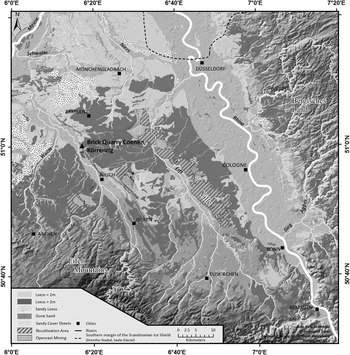
During the 1960s, various large mammal remains were found in the Brick Quarry site in Coenen, Körrenzig, Germany (Figure 1). The inventory contains samples of horse (Equus sp.), bos/bison, woolly rhino (Coelodonta antiquitatis), giant deer (Megaloceros giganteus), mammoth (Mammuthus primigenius), hyena (Crocuta spelaea), cave bear (Ursus spelaeus), and lion (Panthera spelaea).
Locality (black triangle) of the Brick Quarry site Coenen, Körrenzig, Germany, and Loess distribution along the left lower Rhine Valley (Lehmkuhl et al. Reference Lehmkuhl, Zens, Krauß, Schulte and Kels2016)

Nine radiocarbon (14C) measurements, performed in the Leibniz-Laboratory, Kiel, and the Center for Isotope Research (CIO), Groningen, gave 14C ages between 34,000 BP and >45,000 BP, which place the find horizon into the Interpleniglacial (marine oxygen isotope stage MIS3) (Matzerath et al. Reference Matzerath, Turner, Fischer and van der Plicht2012).
The 14C dates on selected faunal samples point to a rather broad temporal deposition history, while the analysis of the stable isotope composition (δ13C, δ15N, δ34S) seems to indicate a comparably shorter deposition period (e.g. cold MIS3 stadial/possibly Heinrich 5; Wißing et al. Reference Wißing, Matzerath, Turner and Bocherens2015).
Considering controversial discussions with respect to bone sample pretreatment for 14C analysis, i.e. with or without ultrafiltration (e.g. Bronk Ramsey et al. 2004a; Higham et al. Reference Higham, Bronk Ramsey, Karavanić, Smith and Trinkaus2006; Huels et al. Reference Huels, Grootes and Nadeau2007, Reference Huels, Grootes and Nadeau2009), a 14C intercomparison study between the Leibniz-Laboratory in Kiel (Germany), the Center for Isotope Research (CIO) in Groningen (the Netherlands), and the Oxford Radiocarbon Accelerator Unit (ORAU, United Kingdom) was performed on three Pleistocene (MIS3) mammal bone samples from the Brick Quarry site Coenen (BQC) in Germany, as follows:
-
∙ Sample BQC-101, Equus sp., right radius, seems to be intentionally fractured by humans, 14C age GrA-53420: >45,000 BP.
-
∙ Sample BQC-55, Equus sp., right tibia.
-
∙ Sample BQC-78, Bos/Bison, distal piece of left femur, 14C age KIA44874: 34,190 +330/–320 BP.
METHODS
The three samples, each consisting of a single piece of bone, were individually sampled in the participating laboratories, prepared and subsequently measured using in-house accelerator mass spectrometry (AMS) systems. In addition to individual measurements, collagen extracted by each laboratory was also sent to the other participating laboratories for AMS measurements.
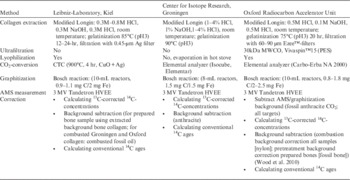
All three laboratories use a modified Longin protocol (Longin Reference Longin1971) for collagen extraction, i.e. an acid-base-acid (ABA) treatment for demineralization with small differences in concentration of chemicals used and temperatures for collagen dissolution during the gelatinization step (see Table 1; Mook and Streurman Reference Mook and Streurman1983; Grootes et al. Reference Grootes, Nadeau and Rieck2004; Brock et al. Reference Brock, Higham, Ditchfield and Bronk Ramsey2010). An additional preparation/cleaning step after collagen gelatinization is applied by the Oxford laboratory using ultrafiltration (Bronk Ramsey et al. Reference Bronk Ramsey, Higham, Bowles and Hedges2004a), which intends to remove lower molecular weight (possible environmentally contaminated) protein molecules (molecular weight cut off [MWCO] 30 kDa).
Sample preparation: collagen extraction procedure, CO2 conversion, graphitization, AMS system, and applied measurement corrections.

The conversion of extracted sample collagen to CO2 was done either by closed quartz tube combustion (CTC; with CuO and Ag; Kiel) or using an elemental analyzer and cryogenic separation (Groningen, Oxford). The resulting sample CO2 was graphitized by the Bosch reaction
 $$( {CO_{2} {\plus}2H_{2} \buildrel {\hskip -38pt 550{\minus}600\deg\! \rm{C}};Fe \,\,catalyst} \over {-\!\!\!-\!\!\!-\!\!\!\!-\!\!-\!\!\!\!\!\!-\!\!\!\!\!\!\!-\!\!\!\!-\!\!\!\!-\!\!\!\!-\!\!\!\!-\!\!\!-\!\!\!-\!\!\!-\!\!\!\!\!-\!\!\!-\!\!\!\!\longrightarrow \limits ^{{}} C{\plus}2H_{2} O})$$
(Aerts-Bijma et al. Reference Aerts-Bijma, Meijer and van der Plicht1997; Nadeau et al. Reference Nadeau, Schleicher, Grootes, Erlenkeuser, Gottdang, Mous, Sarnthein and Willkomm1997, Reference Nadeau, Grootes, Schleicher, Hasselberg, Rieck and Bitterling1998; Dee and Ramsey Reference Dee and Ramsey2000).
Radiocarbon measurements were performed in each laboratory’s own 3 MV HVEE AMS system, normalized to modern oxalic acid II standard (NBS SRM 4990C) and corrected for isotopic fractionation:
 $${F<sup>14</sup>C_{{corrected}} =F<sup>14</sup>C_{{measured}} {\times} \left[ {{{0.975} \over {1{\plus}{{\delta {}_{{}}^{{13}} C} \over {1000}}}}} \right]^{2} }$$
(van der Plicht and Hogg Reference van der Plicht and Hogg2006)
Final conventional 14C concentrations (F14Cfinal) are calculated by subtracting background effects, i.e. apparent measured 14C concentration measured in fossil sample material, which, according to its age, should not contain 14C:
 $$\displaystyle F<sup>14</sup>C_{{final}} =F<sup>14</sup>C_{{corrected}} {\minus}\left[ {F<sup>14</sup>C_{{Background}} {\rm }{\times}\left( {1{\minus}{{F<sup>14</sup>C_{{sample}} } \over {F<sup>14</sup>C_{{standard}} }}} \right)} \right]$$
These corrections intend to remove—aside from material specific, intrinsic contamination—any possible effects occurring during the sample preparation, i.e. collagen extraction, CO2 conversion, graphitization, and AMS measurement. The Kiel laboratory uses fossil bone samples as background material (Huels et al. Reference Huels, Rakowski, Nadeau and Grootes2014; Rakowski et al. Reference Rakowski, Huels, Schneider, Dreves and Meadows2014). For the measurements of shared collagen fractions, i.e. collagen extracted by another laboratory, background corrections in the Kiel AMS facility were performed using crude North Sea oil to correct for contamination effects occurring during CO2 conversion, graphitization, and AMS measurement. The Oxford laboratory uses CO2 derived from anthracite to determine an AMS/graphitization background; nylon to determine a combustion background; and fossil bone to determine a pretreatment background (Bronk Ramsey et al. Reference Bronk Ramsey, Higham and Leach2004b; Wood et al. Reference Wood, Ramsey and Higham2010). Due to concerns regarding the suitability of background bone standards to represent bone samples from different depositional environments, Groningen uses a pragmatic approach by applying an upper limit of 45 ka BP (F14C concentration ~0.0037) and using anthracite as background sample material (van der Plicht and Palstra Reference van der Plicht and Palstra2014).
Final given uncertainties include variance observed during the measurement and the uncertainties in the background correction
 $\left( {\sigma _{{final}} =\sqrt {\sigma _{{meas.}} \,{\!}^{2} {\plus}\sigma _{{bg\_corr}} \,{\!}^{2} } } \right)$
. Kiel uses for background correction uncertainty (σbg_corr) a factor of 1/3 of the applied background correction (see Nadeau and Grootes Reference Nadeau and Grootes2013); Groningen and Oxford use the standard deviation of measured background signatures.
RESULTS AND DISCUSSION
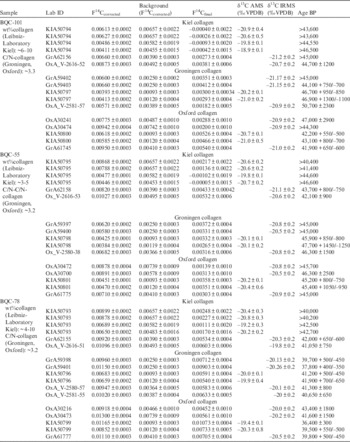
In Table 2, collagen content (estimated in Kiel laboratory), C/N atomic weight ratios (measured by Groningen and Oxford laboratories), 14C concentrations, and conventional 14C ages for samples BQC-101, BQC-55, and BQC-78 are given.
Radiocarbon concentrations (F14Ccorrected, background 14C, and F14Cfinal), δ13C (AMS and IRMS), and conventional 14C ages of samples BQC-101, -55, and -78.
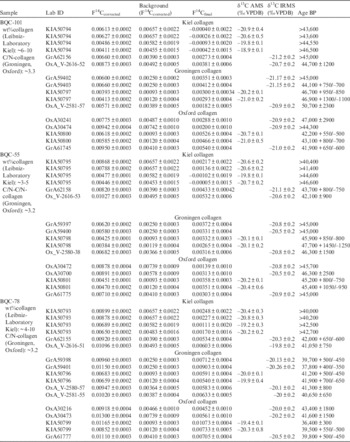
All three bone samples are degraded with respect to organic preservation (collagen content <10 wt% in comparison to >20 wt% in fresh bone; Pasteris et al. Reference Pasteris, Wopenka and Valsami-Jones2008). However, measured C/N ratios ~3.2 of extracted collagen and collagen contents above 1 wt% indicate reasonably preserved collagen with intact polypeptide properties (van Klinken Reference van Klinken1999; Dobberstein et al. Reference Dobberstein, Collins, Craig, Taylor, Penkman and Ritz-Timme2009).
For all three bones, final 14C concentrations ≤0.011 F14C are measured. Comparatively large uncertainties seen for Kiel measurements stem from background correction uncertainties, i.e. using 1/3 of the background correction value as the background correction uncertainty. This factor is representative of the observed long-term scatter in bone background 14C signature (Nadeau and Grootes Reference Nadeau and Grootes2013). Consequently, Kiel determined for all three bone samples infinite ages, i.e. final 14C concentrations are smaller than two times the measurement uncertainty (so-called 2σ criterion; Olsson Reference Olsson1989; van der Plicht and Hogg Reference van der Plicht and Hogg2006). Groningen and Oxford, on the other hand, estimated finite ages. Interlaboratory estimated age differences for BQC-101 and BQC-55 are within given uncertainties, and a somewhat larger scatter is observed for results of BQC-78 (estimated age range from ~39 to ~43 kyr).
A comparison of the results of collagen extracted by one laboratory and measured by another, with in-house prepared and measured collagen, offers a more detailed look into possible causes for observed differences, since possible effects introduced by differences in sample preparation, e.g. with or without ultrafiltration or collagen gelatinization temperatures etc., will not be an issue.
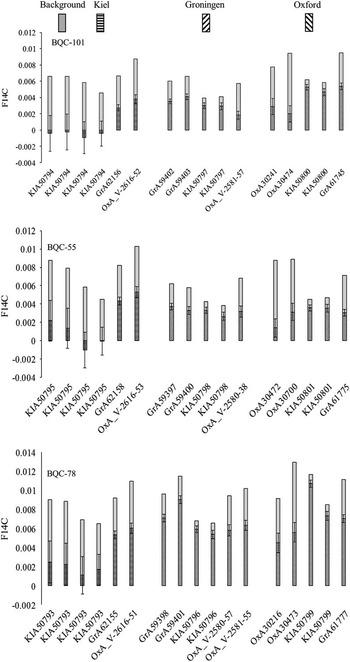
In Figure 2, final 14C concentrations (F14C) are shown as stacked column graphs with respective background corrections.
Measured 14C concentrations of BQC-101, BQC-55, and BQC-78. Patterned columns represent Kiel, Groningen, and Oxford (from left to right) extracted collagen F14Cfinal values. The magnitude of applied background correction is shown in gray columns.

Kiel Collagen
-
∙ Measurements made in Groningen and Oxford indicate comparable uncorrected 14C-concentrations, suggesting comparable magnitudes of background contamination introduced by CO2-conversion, graphitization, and AMS measurement in comparison to Kiel measurements.
Groningen Collagen
-
∙ Measurements made in Kiel give slightly lower uncorrected 14C-concentrations, indicating lower magnitudes of background introduced by combustion-graphitization-AMS procedures. The measurements at Oxford imply a comparable background to Groningen.
Oxford Collagen
-
∙ Measurements performed in Kiel give lower uncorrected 14C-concentrations for BQC-101 and BQC-55, which seem to indicate a lower background from combustion-graphitization-AMS procedures, and a comparable magnitude of background in BQC-78. Measurements in Groningen indicate a similar size of background effects for BQC-101 and BQC-78 and a lower background effect for BQC-55.
Overall, the observed differences seem to have been caused largely by different apparent background signatures of the participating laboratories. For example, in sample BQC-101, the Leibniz-Laboratory in Kiel measured a F14Ccorrected between 0.00411 and 0.00627. The same collagen, measured in Groningen and Oxford, gives F14Ccorrected=0.00660 and F14Ccorrected=0.00873, respectively. The ORAU, on the other hand, measures slightly more active, non-background corrected 14C concentrations between F14Ccorrected=0.00775 and F14Ccorrected=0.00942 on ultrafiltered collagen. The apparent background of about F14Ccorrected=0.00455–0.00657 in Kiel and F14Ccorrected=0.00487–0.00742 in Oxford is comparable in magnitude, however, when background correction is applied, estimated F14Cfinal results in minimum ages of >43,600 BP to >46,500 BP for Kiel measurements and a finite age of 47,000±2900 BP and >44,300 BP for Oxford measurements.
Observed inter- and intralaboratory background signatures are greater, and mask, any differences in applied sample treatment (e.g. whether collagen is ultrafiltered or not).
Limited in the number of samples measured, this intercomparison exercise is far from being representative. However, the results shown indicate the necessity of a more detailed examination of background effects, that is, the measurement of background material, the procedures for correction, and the evaluation of the suitability of background material for a given set of sample materials, in particular for samples close to the limit of the 14C dating method.
CONCLUSIONS
For three Pleistocene mammal bone samples recovered from the Brick Quarry site Coenen, Körrenzig (BQC), Germany, a 14C intercomparison study was performed between the Leibniz-Laboratory in Kiel (Germany), the Center for Isotope Research (CIO) in Groningen (the Netherlands), and the Oxford Radiocarbon Accelerator Unit (ORAU; United Kingdom).
The collagen contents of between 3wt% and 10wt% and C/N ratios ~3.2 indicate a reasonable preservation state of the three bones BQC-101, BQC-55, and BQC-78.
Estimated 14C ages vary between minimum ages ~>40,000 BP to a finite age ~47,000 BP.
The comparison of individually sampled, prepared, and measured bone collagen 14C results as well as the results from shared collagen measurements points to the background correction (e.g. apparent measured background 14C activity and correction applied) as the main factor responsible for observed differences in estimated 14C ages.
With respect to the starting point, measured 14C concentrations and 14C ages are not in contradiction to the assumption of a short deposition period within a cold MIS3 stadial (Wißing et al. Reference Wißing, Matzerath, Turner and Bocherens2015).
ACKNOWLEDGMENT
The critical discussions regarding the stable isotope results of the Coenen Brick Quarry-inventory with Christoph Wißing are highly appreciated.