Young children's help-seeking is now recognized as an important part of emerging self-efficacy and self-regulation, particularly in the context of adult–child collaborative problem-solving (Nelson-Le Gall, Reference Nelson-Le Gall, Hertz-Lazarowitz and Miller1995). Three key principles established in the early childhood language and cognition literature have informed the research questions of the present study: (1) help-seeking increases during the toddler and preschool years and is linked to increasing effectance motivation (Ames, Reference Ames, DePaulo, Nadler and Fisher1983; De Cooke & Brownell, Reference De Cooke and Brownell1995); (2) it is associated with improvements in self-monitoring and self-regulation abilities (Matthews, Ponitz & Morrison, Reference Matthews, Ponitz and Morrison2009; Nelson-Le Gall, Reference Nelson-Le Gall1987); and (3) it is associated with increases in linguistic and social competence (Cooper, Reference Cooper1980; Jambunathan & Norris, Reference Jambunathan and Norris2000). Despite these well-established patterns, a connection has not been drawn between these areas of development and the rich literature on early gender differences in language use – particularly collaborative problem-solving discourse (e.g. Goodwin & Goodwin, Reference Goodwin, Goodwin, Philips, Steele and Tanz1987; Holmes-Lonergran, Reference Holmes-Lonergran2003; Leaper, Reference Leaper1991; Sheldon, Reference Sheldon1990). Largely absent from the preschool language research is in-depth analysis of how gender may affect the developmental timing of help-seeking and its relationship with task difficulty.
There are many studies documenting early gender differences in social, cognitive–linguistic and behavioral self-regulatory ability (Berk & Garvin, Reference Berk and Garvin1984; Bornstein, Hahn & Haynes, Reference Bornstein, Hahn and Haynes2004; Burman, Biten & Booth, Reference Burman, Bitan and Booth2008; Charman, Ruffman & Clemens, Reference Charman, Ruffman and Clements2002). The consistent trend of earlier self-regulatory and linguistic ability among girls, together with research linking help-seeking to increased self-regulation, collectively adds credibility to the hypothesis that older preschool girls will use more help-seeking in a formal task setting and outperform boys the same age.
Help-seeking is an important facet of Vygotsky's (Reference Vygotsky, Cole, John-Steiner, Scribner and Souberman1978) principle of scaffolded learning and has been systematically documented in later empirical work (Nelson-Le Gall, Reference Nelson-Le Gall, Hertz-Lazarowitz and Miller1995; Rogoff, Reference Rogoff and William1998). Thus, a key premise underlying the hypotheses of the present study is that requesting help from a more experienced partner reveals more, not less, independence and self-regulation, because it requires the ability to evaluate one's own progress, limitations, and the efficacy of collaborative effort. In a scaffolded problem-solving context, Thompson and Moore (Reference Thompson and Moore2000) reported more frequent collaborative language and help-seeking among preschool girls than boys. Since no performance differences were observed, they proposed that help-seeking may overlap with a collaborative/affiliative motivation and/or competence that may emerge earlier among preschool girls. We have extended a set of recent studies (Benenson & Koulnazarian, Reference Benenson and Koulnazarian2008; Thompson, Reference Thompson1999; Thompson, Arsenault & Williams, Reference Thompson, Arsenault and Williams2006) that documented gender differences in preschoolers' use of help-seeking and collaborative language, and its impact on adult perceptions and evaluations.
The issue of gender differences and developmental timing for task-related help-seeking is critical because the appropriate amount of adult intervention in the Vygotskian zone of proximal development (ZPD; Vygotsky, Reference Vygotsky1986) depends on an adult simultaneously interpreting the child's bids for help or collaboration, while remaining attentive to the child's actual progress. Our goal was to examine early age and gender differences in help-seeking – not merely overall amount, but how frequency changes with fluctuations in difficulty as children progress on a challenging task. This necessitated high resolution, within-subject data analysis.
The context of our observations was naturalistic problem-solving in a preschool setting, where children solved a challenging jigsaw puzzle in the presence of an adult (either male or female). The focus of the analyses was on language that invited an adult to help or collaborate, either by directly requesting participation, or by asking questions related to the task. Given patterns reported in previous research, we hypothesized greater frequency of help-seeking overall among girls that would not be associated with poorer performance. For all children we hypothesized a pattern of increasing help-seeking associated with moments of greater difficulty (within-subject increases in solving time). But importantly, we predicted that older preschool girls would use more frequent help-seeking than other children as more challenging segments of the task were encountered. Our specific set of questions were as follows.
First, are there significant differences in how girls and boys handle the task (overall completion rates and elapsed times)? Do girls in fact use more help-seeking overall; and if so, is it merely because they are talking more overall? Second, are there patterns in how boys and girls use help-seeking as they encounter increasing difficulty, and do these patterns change with age as suggested by previous research (e.g. Nelson-Le Gall, Reference Nelson-Le Gall1987; Puustinen, Reference Puustinen1998)?
We planned two types of analyses to address these questions. One approach was to conduct repeated measures ANOVAs for 12 levels of difficulty (based on per segment solving time) for each child. A second approach was to explore how each child responded to his or her easiest versus most difficult segments of the task by comparing help-seeking in the slowest versus fastest solving time quartiles of the puzzle.
METHOD
Participants
Sixty-two preschoolers in total participated in the study. There were 28 girls, ranging in age from 2.91 years to 5.17 years. Using a median split these children were divided into younger and older children (mean age, younger group = 3.60, SD = 0·39; mean age older group = 4.65, SD = 0·32). There were 34 boys, ranging in age from 3·00 years to 5·33 years (mean age, younger group = 3.75, SD = 0·46; mean age, older group = 4.77, SD = 0·34). The children attended an all-day, urban preschool that included families of diverse socioeconomic status, though most children were from middle- and lower-middle-class families. All but one child (a girl of mixed, African and Indonesian descent) were White, Anglo-Europeans. Parents were met in person for the informed consent process, during which each child's first language was ascertained (all children spoke English as a first language). Only children with no documented learning disability or developmental delay were included in the study. Thirty-two of the participants (15 girls, 17 boys) interacted with a female researcher; the other 30 children (13 girls, 17 boys) interacted with a male researcher. All children were asked to solve one of two equally difficult puzzles, counterbalanced between the male and female researchers.
Design
The study was a mixed, cross-sectional and repeated-measures design. Cross-sectional comparisons were made between girls and boys and between older and younger children overall, using a median split. The longitudinal aspect of the design consisted of within-subject observations across 12 segments (pieces) of a jigsaw puzzle. The puzzle consisted of interlocking pieces that were unambiguous as to whether they fit correctly. Therefore, we were able to operationalize a ‘search segment’ as the duration of time following the end of a correctly placed piece and the moment the next piece was correctly placed. This method was used as the primary way to quantify relative difficulty on each piece. The corresponding language use in each search was transcribed and coded.
Observational context and procedure
For the dyadic problem-solving sessions each child was presented with a challenging jigsaw puzzle, which they solved in the presence of either a male or female researcher. In order to avoid possible effects of a sex-typed puzzle picture, two identical puzzles were used, which were customized to display different pictures. One depicted a domestic house scene, the other a city bus (see Figure 1). These were counter-balanced across the male and female researchers.
Two equivalent puzzles used for adult–child dyadic problem-solving.

The researchers were always seated next to the child at a small preschool table with the child directly facing an unobtrusive video camera. Prior to tipping out the puzzle pieces and beginning the puzzle, each child was prompted to describe the picture, label each main feature and to count various items, such as windows and people. This step was taken to ensure that all children were equally aware of the picture.
At the start of each session, each child was told to solve the puzzle as best as he or she could. Extensive pilot testing of the procedure revealed two patterns: the formality of the context and the instruction to ‘solve the puzzle as best you can’ prompted maximal effort among all the children, resulting in their fastest times. Explicit instructions to solve the puzzle as fast as possible only resulted in children interpreting the situation as a race, with exuberant but chaotic, often incomplete performance. Completion rates (persistence) and each child's solving time in seconds for each puzzle segment were recorded to establish relative performance.
Formal comparisons were made between language children used with a male researcher and the female researcher, and with each puzzle. We found no significant researcher-gender or puzzle differences related to children's overall verbosity, or help-seeking as a rate per minute, or as a proportion of talk; nor were there any interactions. Therefore, data from the two researchers and puzzles were collapsed and analyzed together.
Language elicitation designs pose a common dilemma: if adults provide instrumentally helpful participation when asked, then one cannot meaningfully compare children's responses to increasing difficulty. Conversely, if help is withheld in order not to affect progress, there is the danger of disturbing the quality of spontaneous discourse. Our compromise used a standardized, scripted set of responses to children's help-seeking. These consisted of encouraging, refocusing remarks that are in fact ubiquitous in parent and teacher talk to children (e.g. ‘Hmm, I'm not sure which goes next, what do you think?’). The researcher, therefore, could remain engaged and responsive to the children – truly collaborating in a social sense, but not provide any instrumental help that would influence their progress.
Measuring relative difficulty and problem-solving performance
A key aim was to document preschoolers' verbal responses to moment-to-moment changes in difficulty. This is a problematic question in most research using elicitation tasks because what is ‘easy’ or ‘difficult’ during a puzzle or construction task (e.g. Lego, building blocks) is almost always unique to each and every child. Therefore, most research has only been able to focus on overall performance, such as completion rates and total solving times, or they have required tasks that artificially impose a sequence of difficulty by design. A disadvantage to standardized increases in difficulty (rare in most preschool activities) is less ecological validity, and an increase in the likelihood of cumulative frustration as a child progresses. In this study we utilized jigsaw puzzles with pieces that fluctuated randomly in difficulty among the children. Thus ‘difficulty’ for each and every piece was unique and unpredictable for each child. Following data collection, analyses of mean solving times for each puzzle piece confirmed there was no pattern of relative difficulty.
Coding system for operationalizing ‘help-seeking’
Searle's (Reference Searle1976) conceptualization of speech act categories were used as an underlying theoretical framework for categorizing help-seeking. The formal criteria for categorizing children's utterances as help-seeking centered on the speech act as a “unit of meaning” (Searle, Reference Searle1969), where the perlocutionary force or meaning-effect was used (Austin, Reference Austin1962). Thus a child's utterance (e.g. ‘Where does this piece fit?’) was categorized according to whether an adult would interpret it as a bid for help or collaboration.
Classifying speech acts as ‘help-seeking’ in this study acknowledged the inherent ambiguity of the communicative intent behind preschoolers' utterances and their possible overlap with ‘private-speech’. The coding system was intended to identify talk in a close, dyadic problem-solving situation, where an adult's subjective interpretation would be that the child is implicitly or explicitly inviting helpful collaboration. Because of this discourse-oriented design aim, the presence of an adult prevented a formal disambiguation and analysis of language that might function as private speech, distinct from language that sought help.
The formal problem-solving context made judging divisions between speech acts straightforward with few overlaps, interruptions and unfinished utterances. In ambiguous cases where a stream of speech could be interpreted as one or two separate utterances, syntactic markers and timing were used to decide. If two successive, grammatically independent sentences (e.g. ‘This one is too hard for me. Will you do this one?’) occurred with more than two intervening seconds, they were counted as two speech acts. If two clauses such as ‘This is too hard, so you do it’ appeared together with a grammatical connective they were counted as one speech act. They were counted as one speech act if they occurred without a connective but were less than two seconds apart (‘This is too hard … you do it.’). Utterances that were either unintelligible and/or unfinished were coded as ‘unclear’ (e.g. ‘Hmm, this one …’). These operational definitions were based on the literal semantic content of each speech act, combined with the context within which they occurred. Attention was paid to important paralinguistic and prosodic cues, such as stress and intonation. Rising tone at ends of declarative utterances, signifying questions, were coded as such. Thus, ‘This goes here [?]’ would be categorized as help-seeking since, as an interrogative, it invites participation. Below are examples of children's help-seeking utterances, some indirectly requesting adult participation, and some directly requesting participation.
Indirect requests for adult participation.
Knowledge or information ‘I don't know where this one goes.’
‘I don't know how to do these.’
Difficulty of puzzle ‘This one is too hard for me.’
Progress/ability ‘I can't do this one.’
Direct requests for adult participation.
Knowledge or information ‘Where does this piece go?’
Requests for help ‘Will you do this one for me?’
Although pilot testing revealed no gender patterns in direct and indirect help-seeking, we retained the two categories during the coding process, and found no gender differences. Further analyses used data that collapsed the two types of help-seeking.
Inter-observer reliability
Reliability levels were computed for each of the collaborative language subcategories above. These subcategories were distinguished from all other non-collaborative utterances by a second coder who was unaware of the study's hypotheses. The second observer coded the entire video clip for each selected child using the same procedure, video equipment and coding sheets. Fifteen percent of the total language samples was selected at random to be coded by the second observer. Reliability levels were assessed using Cohen's kappa statistics. A kappa coefficient of 0·81 was achieved overall, indicating high reliability within the coding scheme. To ensure that the researchers were behaving the same way with all children, a separate set of analyses was conducted using the same trained coder as with the reliability testing. Once these analyses were completed, it was found that no instances of inadvertent helping, idiosyncratic verbal or non-verbal behaviors, or inconsistencies in prosodic form were recorded.
Analyses and statistical design
Using the precise onset and offset times for children's searches and corresponding speech acts allowed us to rank order each child's searches from easiest to most difficult – creating a search/talk sequence (1–12) that was unique to each child. Our intent was to create a framework to allow us to study patterns of help-seeking related to fluctuating difficulty that may reveal important gender- and age-related patterns. Help-seeking was quantified in two ways: (1) as a rate per minute (elapsed time in a search divided by the number of help-seeking utterances in the same search); and (2) as a ratio of help-seeking utterances in a search to total utterances within the same search (number of help-seeking utterances divided by total utterances). This combination provided a way to examine rate of help-seeking and proportion of talk that was help-seeking.
Using SPSS, a set of mixed analyses of variance (ANOVAs) was computed to test for main effects and interactions using gender and age groups as independent factors, and mean solving times per search and help-seeking as dependent variables. Repeated measures consisted of elapsed solving times and help-seeking in each of the 12 segments of the puzzle. A series of partial correlations (controlling for elapsed solving time per segment), using Pearson product moment correlations were conducted on age and help-seeking. These were computed for girls and boys separately for each child's puzzle performance overall and for their easiest and most difficult quartiles of the task.
RESULTS
Overall performance and task-related talk overall
Task performance
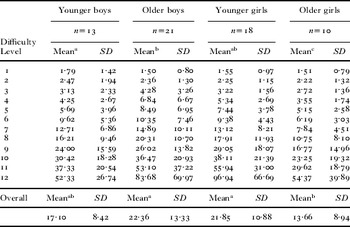
Although each child managed to finish his or her puzzle, there was great variation in how long children took. Overall, girls' and boys' average per-piece solving times were nearly identical (girls' mean per search = 18·51 seconds, SD = 10·02; boys' mean per search = 19·51 seconds, SD = 10·82) (see Table 1). Surprisingly, for overall solving time there was no main effect for age, though gender was found to interact with age across levels of difficulty, using a median split for older and younger children (F(1, 60) = 5·55, p < 0·05, η2 = 0·10). (note: ANOVA results use partial eta-squared and Greenhouse–Geisser adjustments to degrees of freedom for non-sphericity.) Post-hoc comparisons with Fisher's LSD adjustment indicated that the older girls (Mean time per search = 13·66 seconds, SD = 8·94) took less time per search than older boys (Mean = 22·36, SD = 13·01, p < 0·05). Older girls also took less time per piece than the younger girls (Mean = 21·85, SD = 10·88, p < 0·05). All other pairwise comparisons were non-significant, though solving times decreased with age among all children as expected. No discernible pattern emerged whereby particular pieces were consistently more or less difficult for children (confirming earlier pilot work). Across 62 children, the sequence of pieces placed to complete the puzzle was random.
Children's task performance (elapsed time in seconds) in each segment and overall)

note: Different superscripts indicate a significant difference (p < 0·05) using LSD multiple comparisons.
Task-related talk overall
No gender or age difference in total on-task talk occurred; nor did gender and age interact. This confirmed previous observations (Thompson, Reference Thompson1999; Thompson & Moore, Reference Thompson and Moore2000) that girls did not talk more than boys overall during the task, or at any stage of the puzzle, eliminating the possibility that verbosity alone could explain reported differences in help-seeking.
Help-seeking as a function of difficulty, gender and age
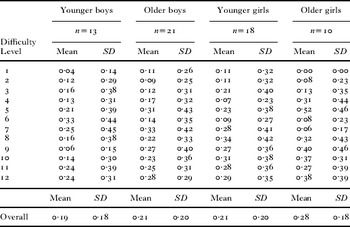
A mixed (repeated measures and between-subjects) ANOVA (Difficulty level × Gender × Age group) was conducted to test whether children adjusted their use of help-seeking according to the amount of time they spent on each piece (relative difficulty), and whether any changes occurred as a function of age and gender. We first explored the proportion of talk that was coded as help-seeking to generate a picture of how pervasive help-seeking was as a function of difficulty (see Table 2). As hypothesized, there was a significant increase in help-seeking as children encountered greater difficulty (F(7·92) = 3·89, p < 0·05, η2 = 0·07). Age emerged as a significant factor that interacted with difficulty level, but did not interact with gender. Older children overall increased their use of help-seeking more than younger children across the 12 levels of difficulty (F(7·92) = 2·24, p < 0·05, η2 = 0·05). Girls increased their use of help-seeking across levels of difficulty more than boys but the trend did not reach significance and had a small effect size (F(7·92) = 1·48, p = 0·10, η2 = 0·03). No gender differences were found in children's rates of direct or indirect help-seeking.
Children's help-seeking as a proportion of total task talk, in each segment and overall

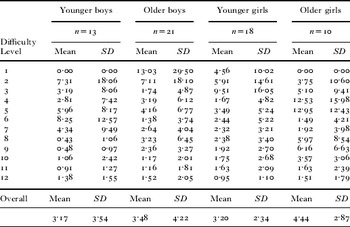
The rate per minute of help-seeking in each segment was also computed in order to have a picture of frequency across levels of difficulty (see Table 3). This was computed by dividing speech acts by elapsed time (generating utterances per minute in each search) in order to control for individual differences in solving time per segment. However, an arithmetic artifact occurs when using rates per minute. As solving times increase with more difficult segments, each talk-to-time ratio must get smaller (due to the increasing size of each denominator). Thus, greatest use of help-seeking across 12 incrementally more difficult segments is inferred by how much a child maintains a rate of talk compared to other children.
Children's help-seeking per minute, in each segment and overall

No main effect of age for help-seeking acts per minute emerged. As with proportion values, girls overall used more help-seeking but this effect did not reach significance using rates per minute. However, a significant three-way, gender × age × difficulty interaction occurred (F(4·09) = 2·22, p < 0·05, η2 = 0·08) whereby the older girls maintained a higher rate of help-seeking as a function of increasing difficulty, even when mean solving time was controlled. Post-hoc comparisons indicated that older girls used more help-seeking than younger girls (F(11) = 2·33, p < 0·01, η2 = 0·08), older boys (F(11) = 2·02, p < 0·05, η2 = 0·07) and younger boys (F(11) = 1·83, p < 0·05, η2 = 0·08).
A series of partial correlations (controlling for mean solving time per segment) was computed for boys and girls separately. These examined in more detail how help-seeking changed with age across the task as a whole, and during the easiest and most difficult segments of the task. Girls' use of help-seeking overall increased significantly with age. This phenomenon occurred when help-seeking acts were computed as a rate per minute (r(27) = 0·41, p < 0·05) and as a proportion of talk overall (r(27) = 0·45, p < 0·05). Among boys neither the rate of help-seeking, nor the proportion of talk that was help-seeking had a significant relationship with age. Among both boys and girls (aggregated and separately) there was no significant relationship found between age and help-seeking during the easiest segments of the task (fastest quartiles). However, during the most difficult segments of the task (for each child individually), girls' rate of help-seeking increased significantly with age (r(27) = 0·33, p = 0·05), even when controlling for their solving time in this period.
DISCUSSION
This study explored the role of age and gender in how preschool children used help-seeking while working on a challenging task with an adult. The primary purpose was to gain more detailed insight into one aspect of communication that developmentalists place at the center of Vygotsky's theory of scaffolded problem-solving – that being the emerging ability of children to adaptively use help-seeking that engages a more expert partner in a challenging task. We used a naturalistic, but highly standardized context, to systematically explore how children's help-seeking changes as a function of difficulty, gender and age. Using within-subject data for each child, we were able to create a high-resolution picture of how individual girls and boys across a range of preschool ages responded verbally to fluctuations in difficulty.
We found that girls' discourse tended to include more bids for help, especially in terms of their rate per minute, as the task became more challenging. However, as a group they were not less proficient at this task compared to boys, in terms of completion rates or solving times per segment. Specifically, girls and boys were approximately on par with each other at the younger ages, but older girls significantly outperformed all other children.
A significant finding in the present study was that among girls only, increasing age was associated with faster solving times on the task (the reported age and elapsed time correlation). This coincided with their increased use of help-seeking with age, particularly during the most difficult segments of the task (the reported age and help-seeking correlation). Older girls outperformed all other children across the 12 segments of the task, and these were the girls with the greatest increases in help-seeking. Among boys no equivalent pattern was observed (in terms of improvements across age, or increases in use of help-seeking).
Vygotskian theory describes preschoolers' development as a process of increasing ability to use language in a productive way within problem-solving contexts, where a child's help-seeking reflects a growing ability to self-monitor and self-regulate (De Cooke & Brownell, Reference De Cooke and Brownell1995; Nelson-Le Gall, Reference Nelson-Le Gall, Hertz-Lazarowitz and Miller1995; Puustinen, Reference Puustinen1998; Rogoff, Reference Rogoff and William1998). Our findings are consistent with this perspective. One related possibility that requires further exploration is that girls in this study benefited from their greater use of help-seeking, not because they received help, but because help seeking may overlap with private speech and serve a self-instructive function. Future research, perhaps using micro-genetic techniques, could investigate age and gender effects in how children modify their questioning in response to adult feedback during a task.
The findings are also relevant to another facet of language, which is a child's enculturation into a world of collaborative discourse (Berko Gleason, Reference Berko-Gleason, Philips, Steele and Tanz1987; Bruner, Reference Bruner1986; Leaper, Reference Leaper1991; Rogoff, Reference Rogoff1990; Rogoff, Mistry, Goncu & Mosier, Reference Rogoff, Mistry, Goncu and Mosier1993; Sheldon, Reference Sheldon and Wodak1997). Puustinen (Reference Puustinen1998) and Newman (Reference Newman, Schunk and Zimmerman1994) argue that help-seeking, even when unambiguous, is a facet of self-instruction where children form discourse with a virtual interlocutor as part of the internalization process of self-questioning and self-regulation. This perspective integrates the self-instructive and collaborative nature of help-seeking, and prompts further questions about the role of routinized parent (or teacher) questions that may model both self-instructive talk, as well as socialize collaborative discourse.