


Introduction
Traditional control methods of gastro-intestinal nematodiasis in sheep are based mainly on the use of anthelmintic chemical drugs (Mendoza de Gives & Herrera Rodríguez, Reference Mendoza de Gives, Herrera Rodríguez and Prats2004). However, commercially available anthelmintic products are less effective each time, because of the development of anthelmintic resistance in the parasites (Chandrawathani et al., Reference Chandrawathani, Jamnah, Adnan, Waller, Larsen and Gillespie2004). Medicinal plants have been used for hundred of years against gastro-intestinal disorders, including several parasitoses, around the world, and most of these are used in an empirical way (Carretero-Accame, Reference Carretero-Accame2000).
A number of plants, including those of the Mexican flora, possess enormous potential against many diseases in humans as well as in animals, and for controlling agricultural pests. The ‘mezquite’ (Prosopis laevigata) is a Mexican plant that has being used as a natural remedy in the Mexican State of Puebla to cure several gastro-intestinal disorders (Hernández et al., Reference Hernández, Canales, Caballero, Durán and Lira2005). Despite the enormous potential of P. laevigata in the medical industry, particularly related to curative properties of extracts against a number of gastro-intestinal diseases (Hernández et al., Reference Hernández, Canales, Caballero, Durán and Lira2005; López-Franco et al., Reference López-Franco, Goycochea, Valdéz and Calderón de la Barca2006), no reliable information is available about its use against gastro-intestinal parasitic nematodes in ruminants. Recently, a couple of research studies were conducted to evaluate the in vitro nematocidal effect of several plant extracts from La Sierra de Huautla ecological reserve, within the boundaries of the Morelos State in Mexico, including P. laevigata against infective larvae (L3) and fourth-stage larvae of the sheep abomasum nematode Haemonchus contortus. The results showed that the lethal activity against this parasitic nematode was 86 and 82.4% for L3 and L4 stages, respectively (Galicia-Aguilar et al., Reference Galicia-Aguilar, Mendoza de Gives, Salinas-Sánchez, López-Arellano, Liébano-Hernández, López-Aroche and Valladares-Cisneros2008; López-Aroche et al., Reference López-Aroche, Salinas-Sánchez, Mendoza de Gives, López-Arellano, Liébano-Hernández, Valladares-Cisneros, Arias-Ataide and Hernández-Velázquez2008).
However, there is no scientific information about the in vivo nematocidal effect of P. laevigata extracts against any of the parasitic nematodes of importance, either in agriculture or veterinary medicine. The utilization of plant extracts with potential for the control of ruminant parasitic nematodes could be a promising alternative in preventive or control programmes of gastro-intestinal parasitosis of cattle and sheep; therefore, the selection of candidate plant extracts with nematocidal activity has to pass through different experimental stages, including the initial in vitro assays as the first analysis, until eventual evaluation in sheep or cattle. When so many plant extracts are to be evaluated, the search for possible bio-compound candidates to be used as natural anthelmintics in animals is expensive and time consuming, and it needs special infrastructure. So, the use of gerbils is an economic, easy and suitable in vivo model of study to evaluate compounds for anthelmintic efficacy or resistance. The use of gerbils allows the pre-selection of a number of extracts with possibilities for use in veterinary medicine and the evaluation of broad-spectrum anthelmintic activity (Ostlind et al., Reference Ostlind, Cifelli, Mickle, Smith, Ewanciw, Rafalko, Felcetto and Misura2006). This research aimed to investigate the anthelmintic effect of Prosopis laevigata n-hexane extract against the endo-parasitic stages of the sheep parasitic nematode Haemonchus contortus in artificially infected gerbils Meriones unguiculatus.
Materials and methods
The present study was carried out at The National Centre for Disciplinary Research in Veterinary Parasitology (CENID-PAVET-INIFAP), located in Jiutepec municipality, in the State of Morelos in Mexico. This geographic zone has been characterized meteorologically as a sub-tropical warm climate with summer rains within the range of 800–1000 mm, 24°C mean temperature (Síntesis Geográfica de Morelos, 1991).
Harvesting of Prosopis laevigata plants
Plant material was obtained from the low-growth caducifolia jungle in the Sierra de Huautla, Biosphere Reserve. This reserve is an arid and semi-arid tropical area comprising 60,000 ha, situated in the southern region of the State of Morelos in Mexico (10°32.317′N, 98°55.956′W; 1298 m above sea-level) (Valenzuela-Galván et al., Reference Valenzuela-Galván, Mariano, Osorio-Berinstain and Urbina2006). The temperature during the rainy season ranges between 20 and 29°C. Such features are considered to be crucial factors for the great biodiversity in this region (Rzedowski, Reference Rzedowski1988). The predominant vegetation is characterized by tropical dry forest and secondary vegetation and possesses an important variety of plants with enormous potential for use in traditional medicine.
Processing of plant material
On the day of collection, leaves were separated and small plant pieces were cut and put separately into newspaper sheets to reduce humidity. Plant material was allowed to totally dry in shade at outdoor temperatures for 1 month. After that, material was weighed. Leaf weight was 0.2572 kg. The distillation process was carried out as follows. Leaves were transferred into a 5000 ml glass container and n-hexane was added, using a funnel, to totally cover the dry plant material. The containers were wrapped and kept for 3 days at room temperature (25–30°C) in the laboratory. After this time, material was transferred to a 5000 ml flask and incubated for 6 h at 60°C. The resulting liquid, containing the residue of n-hexane, was discarded. In order to eliminate any possible residue of n-hexane, extracts were evaporated using a Rota evaporator (VICHI Scientific Instruments, Puebla, Puebla, Mexico) at 95–100 rpm for 2.5 h at 68°C. A small amount of extract was eventually recovered and kept in a glass beaker. Extracts were maintained for 3 days at a room temperature. The complete distillation process was repeated three times to completely discard any possible residue of solvent.
Dilution of the Prosopis laevigata n-hexane extract
Forty milligrams of the P. laevigata leaf final extract were diluted with 30 μl of Tween 20 per millilitre of distilled water. The preparation was mixed to get a homogeneous mixture.
Haemonchus contortus (L3) infective larvae
A H. contortus isolate was originally obtained from a naturally infected sheep from ‘Las Margaritas’ Experimental Sheep Farm (INIFAP), in Hueytamalco Municipality, in the State of Puebla, Mexico. A H. contortus egg donor lamb was orally infected with an aqueous suspension containing 350 larvae/kg of body weight. Twenty days after infection the presence of H. contortus eggs in fecal samples was detected through the McMaster technique and faecal cultures were prepared by mixing faeces with polystyrene particles in plastic bowls. Water was added to the faecal cultures and the mixture was homogenized to keep the cultures hydrated and oxygenated to promote better larval hatching (Liébano, Reference Liébano and Prats2004). Faecal cultures were covered with paper foil and incubated for 7 days at room temperature (25–30°C). Infective larvae were extracted from faeces using the Baermann funnel technique (Thiempont et al., Reference Thiempont, Rochete and Vanparijs1979). The larvae were washed several times in density gradients of 50% saccharose solution, rinsed and suspended in sterile water. The number of larvae for sheep inocula was estimated by counting them in ten 10 μl aliquot drops (Mendoza de Gives et al., Reference Mendoza de Gives, Flores Crespo, Herrera Rodriguez, Vázquez Prats, Liébano Hernandez and Ontiveros Fernandez1998).
Shedding of H. contortus (L3) larvae
The H. contortus in vitro shedding process was achieved by exposing the larvae to 0.187% sodium hydrochloride for a few seconds on Petri dishes and observing the separation of shed material from the larval bodies. When most of larvae had shed, larvae were washed with distilled water and centrifuged at 3000 rpm at 4°C for 3 min to sediment shed larvae. Supernatant water containing the sodium hydrochloride was replaced with chemical-free sterile water to avoid any larval damage due to chemical exposure (Ramírez et al., Reference Ramírez, López, Mendoza-de Gives, Liébano and Vázquez2006).
Experimental infections in gerbils
Twenty-one 5-week-old male and female gerbils (Meriones unguiculatus) were selected, with a range of body weight 20–25 g. All the animals were orally de-wormed with 2.5% albendazol (Valbazen®) at a dose of 50 μl, using an automatic micropipette. Animals were immune-depressed with 100 μl hydrocortisone (Azium®, Shering-Plough Labs, La Grindoliere, France) intramuscularly for two consecutive days to promote a better parasite establishment.
Twenty-four hours before the artificial infection of the gerbils, drinking water was suspended to facilitate the administration of larval inocula in suspension. Forty thousand H. contortus shed larvae in 100 μl of aqueous suspension were administered orally to every animal.
Experimental design
Twenty-one gerbils were divided randomly into three groups: group 1 (n = 7); group 2 (n = 6) and group 3 (n = 8). Eight days after infection animals in group 1 were treated intraperitoneally with 100 μl of a Prosopis laevigata n-hexanic extract at a concentration of 40 mg/ml. Group 2 was treated with 3% Tween 20 using the same administration route. Group 3 received only purified water as a placebo, using the oral route. Additionally, an extra group of seven gerbils (group 4) was administrated orally with fenbendazole at the manufacturer's recommended dose, as a positive control.
Necropsy of gerbils
Five days after treatment, all gerbils were euthanizated and necropsy was carried out to obtain the stomach and to collect the nematodes present in the gastric lumen. Stomachs were ligated and removed from abdominal cavities and put on a Petri dish containing phosphate-buffered saline (PBS). Additionally, gastric mucosa were removed from the stomachs and hydrochloric acid artificial digestion was performed. Parasites from the gastric lumen and mucosa were collected, quantified and recorded to obtain the recovery average of parasites per group.
Parasite reduction percentage
The reduction percentage of the parasitic burden in the different groups of gerbils was estimated using the following formula:
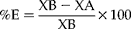
where: %E is the reduction percentage; XA, the mean of recovered parasites from the treated group, and XB is the mean of recovered parasites from the control group.
Since plant extracts were solubilized in Tween 20, the mean of recovered parasites from gerbils in group 2 (treated with Tween 20) was considered as the control group to be used as a comparison. Parasite recovery in this group was considered to be 100%, to automatically remove any possible negative effect of this detergent on the viability of the parasites and to get more realistic results.
Statistical analyses
Data were analysed using the Student's t-test to compare the mean of nematodes obtained from group 1 and their corresponding control group 2 or group 3.
Results
The total number, and means ( ± SD) of recovered parasites at necropsy, and the percentage reduction of the parasitic burden due to the treatments are shown in table 1. The means of recovered parasites were: 36.5 ± 23.3 in group 1 (treated with P. laevigata n-hexanic extract) and 63.5 ± 19.7 in group 2 (treated with Tween 20). The reduction percentage of the parasitic burden due to the P. laevigata extract was 42.5% in comparison with the corresponding control treated with Tween 20 (P < 0.05). The mean of recovered parasites in group 3 (water) was 78 ± 10.9. When the mean of recovered parasites in group 1 was compared with group 3, a 53.11% parasite reduction was recorded. The gerbils in group 4 showed a 97.5% parasite reduction compared to group 3 (table 1).
Total, mean, standard deviation and reduction percentage of the Haemonchus contortus parasitic burden in gerbils treated with Prosopis laevigata n-hexanic extract and two control groups.

* (P < 0.05).
When the mean of recovered parasites in gerbils of the plant extract group was compared with the control group with water the reduction percentage was 53.11%.
The extra group of gerbils treated orally with fenbendazole gave a 97.5% nematode reduction.
Discussion
The use of bio-compounds with nematocidal activity has become of enormous interest to researchers around the world; not only in human health but, recently, also with application in the area of veterinary parasitology (Githiori et al., Reference Githiori, Athanasiadou and Thamsborg2006; Iqval et al., Reference Iqval, Lqteef, Nisqr, Jqbbqr and Shoqib2006; Shaik et al., Reference Shaik, Terril, Miller, Kouakou, Kannan, Kaplan, Burke and Mosjidis2006). The present paper demonstrates the nematocidal effect of the intraperitoneal administration of a P. laevigata n-hexane extract in H. contortus infected gerbils, reducing the parasitic burden. Some P. laevigata plant extracts have being used as home remedies to cure a number of mouth and eye infections (Monroy-Ortiz & Castillo, Reference Monroy-Ortiz and Castillo2007); however, so far, there is no information about their possible in vivo nematocidal effect. In a recent work published by López-Aroche et al. (Reference López-Aroche, Salinas-Sánchez, Mendoza de Gives, López-Arellano, Liébano-Hernández, Valladares-Cisneros, Arias-Ataide and Hernández-Velázquez2008), an assay was performed to evaluate the in vitro nematocidal activity of a number of different plant extracts obtained from the Sierra de Huautla, an ecological reserve situated in the Morelos state, Mexico. They recorded 50 and 85% nematocidal activity with P. laevigata n-hexane extract against H. contortus infective larvae. Later, Galicia-Aguilar et al. (Reference Galicia-Aguilar, Mendoza de Gives, Salinas-Sánchez, López-Arellano, Liébano-Hernández, López-Aroche and Valladares-Cisneros2008) evaluated the in vitro anthelmintic activity of a series of plant extracts from the Mexican flora against the fourth larval stage of H. contortus. Their results showed a range of anthelmintic activity between 63 and 86% with the P. laevigata n-hexane extract. In the present study, the plant extract used showed a moderate anthelmintic efficacy (42%) when compared with the control, Tween 20. On the other hand, when we used water as the control, the recorded efficacy was 53.11%. It is important to mention that the P. laevigata n-hexane extract has very low solubility in water, so Tween 20 was used to dilute our plant extract. However, as we found in our controls, Tween 20 showed a negative effect per se on the viability of nematodes. For that reason, we had to consider a group with only Tween 20 as a control group. Despite such a situation, if the concentration of Tween 20 necessary to dilute P. laevigata n-hexane extract is low enough to be innocuous for animals, then it might be considered as a suitable diluent to be used with this and other plant extracts in the control of animal parasitic nematodes.
Due to the lack of information about the use of P. laevigata plants as an anthelmintic, there are no data about the optimal dose required to obtain the expected results in the reduction of the parasitic burden. Probably the use of the highest dose of this extract could increase the lethal effect against nematodes. After an exhaustive bibliographic search, authors of the present study did not find any reference about the nematocidal effect of an extract of P. laevigata against H. contortus using gerbils as an in vivo model of study; so, this is the first record about the nematocidal effect attributable to this extract, with important implications about the additional medical property of the plant. Extracts obtained from other plants have been evaluated to determine their nematocidal activity against H. contortus and other gastro-intestinal parasitic nematodes in sheep, with variable results. An extract obtained from Carica papaya showed low anthelmintic activity affecting gastro-intestinal parasitic nematode eggs (Krychak-Furtado et al., Reference Krychak-Furtado, Negrelle, Miguel, Zaniolo, Kapronezai, Ramos and Sotello2005). There are other records of in vivo anthelmintic activity of extracts obtained from other plants. For instance, the anthelmintic efficacy of extracts obtained from Spigelia anthelmia against Nippostrongylus braziliensis in rats was recorded as 74% (Cornelius-Jegede et al., Reference Cornelius-Jegede, Ologunja Ajanusi and Rowland2006). Other relevant research has demonstrated the use of the plant Sericea lespedeza as a natural de-worming agent against goat parasitic nematodes, reducing up to 70% the parasitic burden in comparison with a control group (Shaik et al., Reference Shaik, Terril, Miller, Kouakou, Kannan, Kaplan, Burke and Mosjidis2006).
The use of selected plant extracts could be considered as a highly promising tool to reduce the parasitic burden in these animals; however, a lot of work has to be done and many aspects still need to be investigated, such as the potential anthelmintic effect, possible collateral effects, optimal doses and the cost–benefit impact under production conditions. This research shows for the first time the in vivo anthelmintic effect of P. laevigata n-hexane extract, using gerbils as an in vivo model, with potential use in sheep.
Acknowledgements
This research received financial support from CONACYT-SAGARPA, Mexico, Project: 078/2005.



