INTRODUCTION
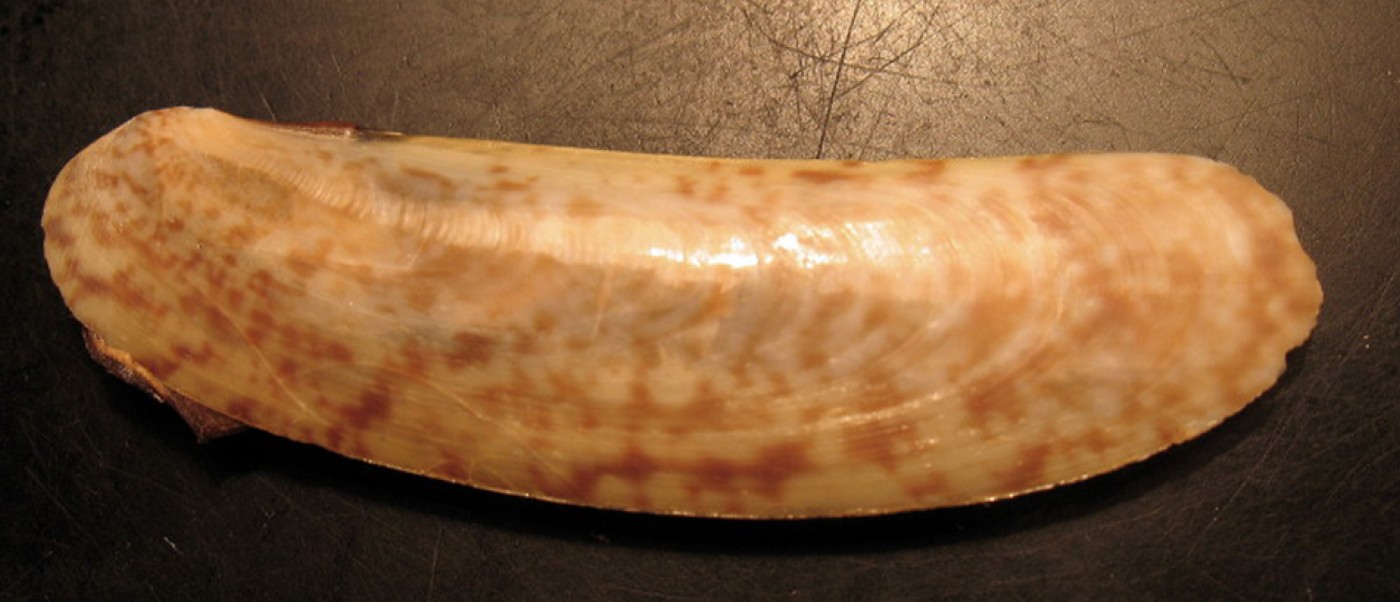
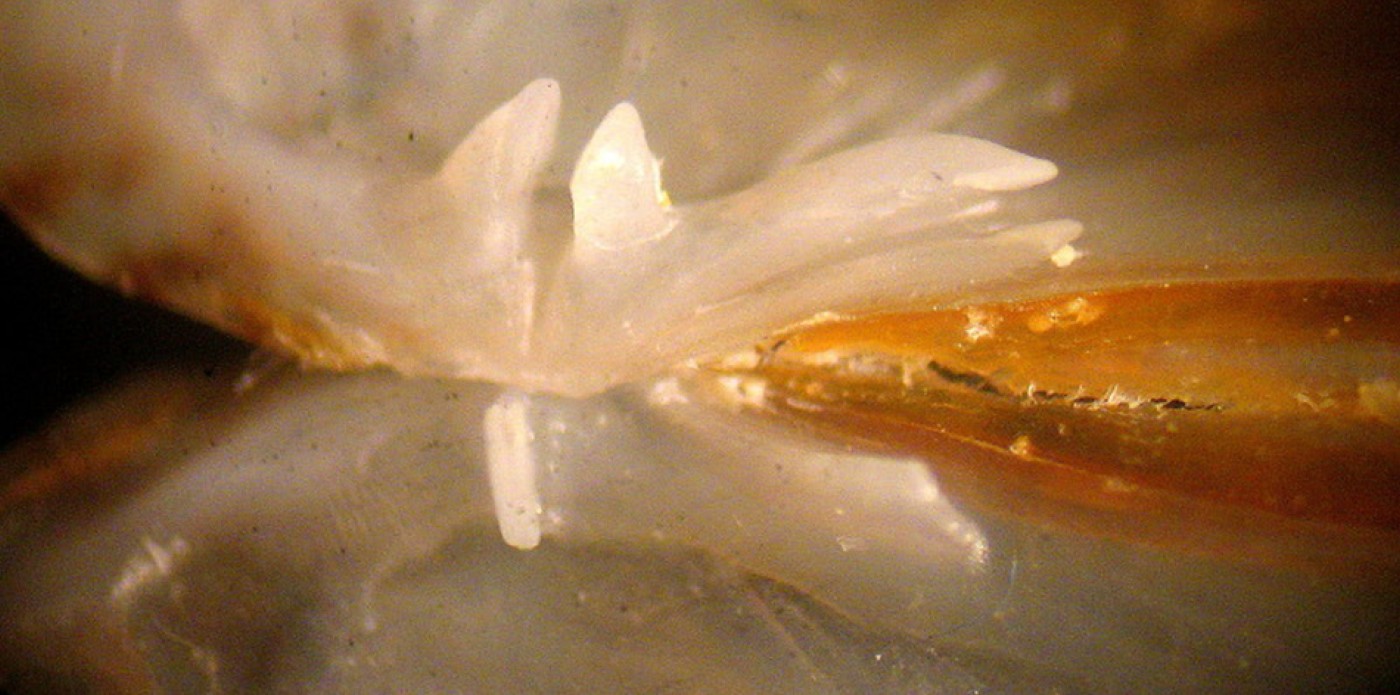
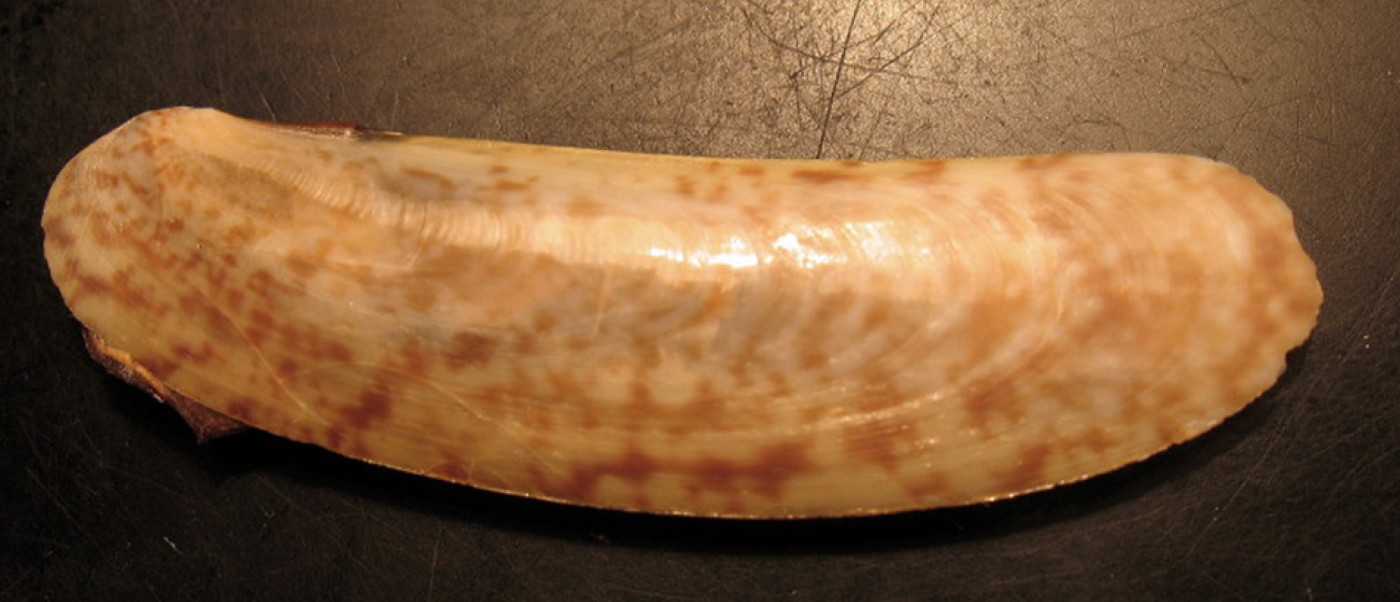
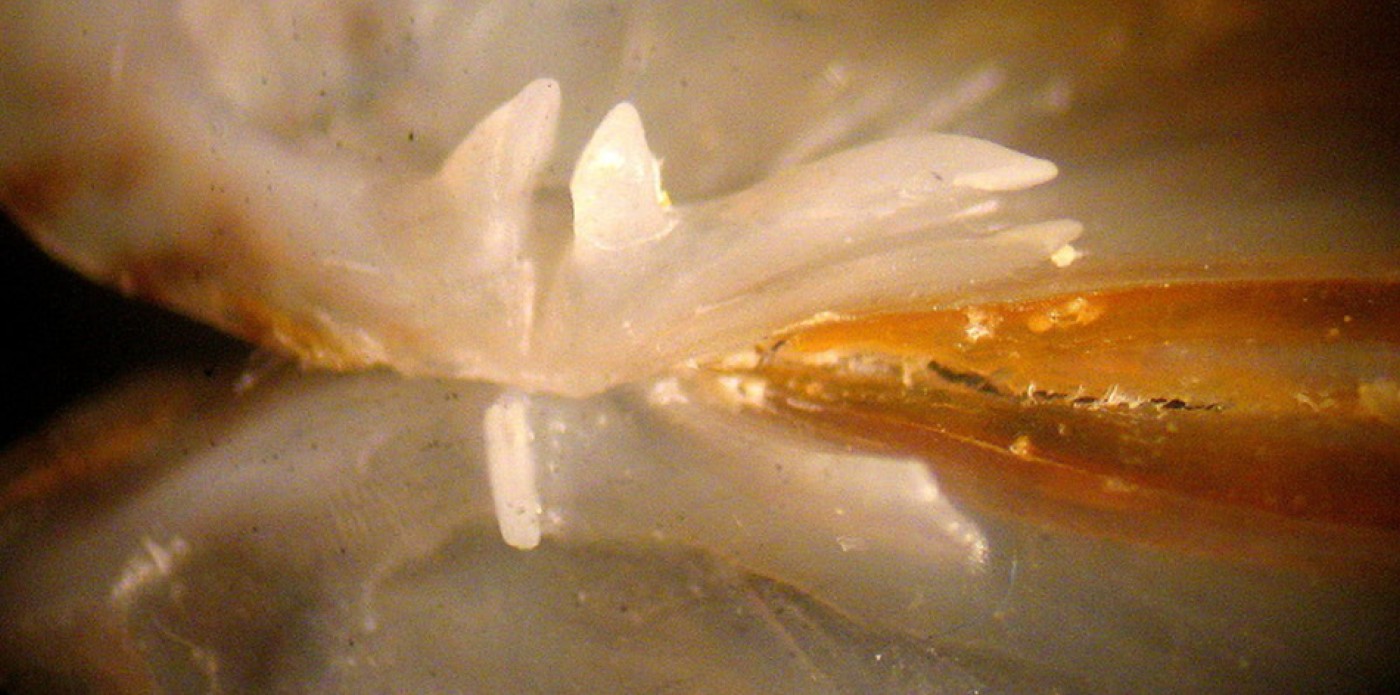
The razor shell Ensiculus cultellus (Linnaeus, 1758), family Pharidae, originally described from the East Indies, is a native of the tropical and subtropical Indo-West Pacific Ocean (Oliver, Reference Oliver1992). It is a medium-sized bivalve, reaching 70 mm in length, with elongate shell, nearly parallel-sided, rounded at both ends, strongly compressed, equivalve, inequilateral. The umbo is near the anterior end of the shell. The hinge bears two teeth on the right valve and four teeth on the left valve, appearing as two deeply bifid teeth (Figure 2). The dorsal posterior tooth is frequently lost in the adult. Anterior adductor muscular impression rounded, posterior one triangular, pallial line with a small, truncate sinus. Juvenile specimens are less curved than adults and may be separated from juvenile Solen species by hinge denticulation characters (Oliver, Reference Oliver1992). Its shell is thin, smooth and polished, pale-coloured and handsomely mottled reddish-brown (Figure 1). It is found in muddy sands in shallow water.
Ensiculus cultellus (Linnaeus, 1758), collected in Haifa Bay, Israel, 4 May 2008, external view of shell.
Ensiculus cultellus (Linnaeus, 1758), collected in Haifa Bay, Israel, 4 May 2008, internal view of the hinge.
The first record of the species from the Red Sea appears in Savigny's plates (Reference Savigny1817), identified as Solen cultellus by Audouin (Reference Audouin1826, p. 194, pl. 7, figure 9). The specimen may have been collected at Suez, where Savigny stayed in December 1799 and January 1800 (Galil, Reference Galil, Gollasch, Galil and Cohen2006a). Issel (Reference Issel1869) thought Savigny's drawing was insufficient to determine the species, but Pallary (Reference Pallary1926) firmly identified it as Cultellus cultellus. M'Andrew, who conducted a dredging expedition in the Gulf of Suez in the winter of 1869 (M'Andrew, Reference M'Andrew1870; Cooke, Reference Cooke1886), collected a specimen at a depth of 10 fathoms (identified as Cultellus marmoratus) and considered the species ‘rare’. Sturany (Reference Sturany1899), who examined the bivalves collected by the ‘Pola’ in the Red Sea in 1895–1898, found a single specimen, collected off Ras Mallap (Sinai coast) in the Gulf of Suez, at 50 m, on a muddy-sand bottom. Lamy (Reference Lamy1928, Reference Lamy1938), who studied the Red Sea material in the collection of Jousseaume and that collected by Dollfus, also considered the species rare. Moazzo (Reference Moazzo1939: 100) considered the species ‘… très rare dans Iabaie de Suez. … Nous n'avons trouvé dans nos dragages qu'une valve à Ras Sudr (Sinai coast) et un fragment dans la Crique de Suez’. Zuschin & Oliver (Reference Zuschin and Oliver2003) collected only a single valve in Safaga Bay (Egypt, Red Sea) in muddy-sand at a depth of 23 m.
RESULTS
On 4 May 2008, a single live specimen (48 mm in length) was collected using a stainless steel 0.08 van Veen grab sampler on a sandy bottom, at depth of 15 m, in Haifa Bay, Israel. The specimen is deposited in the National Collections of Natural History, Tel Aviv University (TAU MO 60854).
DISCUSSION
Ensiculus cultellus is not the first introduced pharid clam in eastern Atlantic waters. The shells and dying specimens of the American jackknife clam, Ensis directus (Conrad, 1843), native to the Atlantic coast of North America, are ‘frequently washed onto Belgian shores in millions’ (Kerckhof et al., Reference Kerckhof, Haelters and Gollasch2007). This American pharid was first recorded from the German Bight in 1978 (von Cosel et al., Reference von Cosel, Dörjes and Mühlenhardt-Siegel1982), and has since spread along the European coastline from Norway and Sweden to France and Britain (www.europe-aliens.org/speciesFactsheet). Presumably its long-lasting pelagic larvae were transported with ballast water and released off the Elbe estuary, whereas larval swimming and juvenile byssus-drifting with currents made for rapid secondary dispersal along the European coastline (Armonies & Reise, Reference Armonies and Reise1999).
The Mediterranean Sea is highly susceptible to ship-transported bio-invasions: in 2006, 13,000 merchant vessels made 252,000 calls at Mediterranean ports and an additional 10,000 vessels transited through the sea (REMPEC/WG.29/INF.9). The increase in shipping-related invasions was noted in recent publications, and may be attributed to the increase in shipping volume throughout the region, changing trade patterns that result in new shipping routes, improved water quality in port environments, augmented opportunities for overlap with other introduction vectors, and rising awareness and research effort (CIESM, 2002; Galil, Reference Galil, Davenport and Davenport2006b). It is possible that E. cultellus may have been transported to Haifa Bay in vessels arriving from Indo-West Pacific ports to the port of Haifa—another Asian bivalve, the semelid Theora (Endopleura) lubrica Gould, 1861, was recently collected in the port of Haifa (Bogi & Galil, Reference Bogi and Galil2007).
However, given the species' presence in the Gulf of Suez, it is suggested that E. cultellus is a naturally dispersing Erythrean alien that had entered the Mediterranean by autochthonous active or passive larval passage through the Suez Canal unaided directly or indirectly by human activity.
Following the increase in the Suez Canal's depth and width in the late 1970s, a model of tidal currents has shown that the ‘… deepening of the canal to depths more than 19.0 m has increased the M2 tidal current in the southern part of the canal from 37.0 cm s−1 to more than 45.0 cm s−1. Hence the tidal current alone … may reach values more than 100.0 cm s−1' (Soliman, Reference Soliman1995). The canal is undergoing further enlargement in order to maintain its market share. The current expansion will increase the canal width to 400 m and its depth to 25 m by 2010 (Al-Ahram Weekly, no. 440, 29 July 1999), and its typical cross-sectional area that was 304 m2 in 1869, 1800 m2 in 1970s, 3600 m2 in 2000, is increased to 4600 m2 (Abril & Abdel-Aal, Reference Abril and Abdel-Aal2000). The implications of higher current velocities on transport of Erythrean biota through the canal are all too clear: ‘with gradually improving chances for planktonic larvae to pass through the canal, a steeply increasing invasion of Red Sea animals into the Mediterranean can be expected’ (Thorson, Reference Thorson1971: 846). Indeed, chances have improved so far that E. cultellus, a species considered rare in the Gulf of Suez, has been able to make its way into the Mediterranean Sea.
ACKNOWLEDGEMENTS
The authors thank Giora Boxer the captain of RV ‘Shikmona’, and Mel Cooper who collected the specimen.