Public health threats are always present. Whether caused by natural, accidental, or intentional means, these threats can lead to the onset of emergencies. During and after such incidents, hospitals play the predominant role in providing health services efficiently and without interruption to the affected populations.Reference Kaji, Langford and Lewis 1 Being prepared to prevent, respond to, and rapidly recover from public health threats is critical for protecting and securing a nation's public health, thus, emphasizing the importance of hospital preparedness.
While relatively large amounts of money have been invested in improving public health preparedness, measuring hospital preparedness for public health emergencies still undergo 2 major challenges. First, no national standards define ideal preparedness. Many experts agree that jurisdictions of different sizes and characteristics may require different objectives, but no consensus has been reached regarding the minimum functions that should be implemented at various levels.Reference Pezzino, Thompson and Edgar 2
Also, to our knowledge, no standardized and validated instruments are available to assess and measure hospital preparedness for public health emergencies, and no consensus has identified an appropriate tool for widespread adoption.Reference Jenkins, Kelen, Sauer, Fredericksen and McCarthy 3 Therefore, a comprehensive framework to evaluate hospital emergency preparedness is needed.
In this report, we reviewed instruments that have been developed in the context of disaster readiness to understand the concept of hospital public health emergency preparedness, and identified elements for high-level preparedness to further the development of a universal assessment tool that hospitals can use to guide their emergency preparedness efforts.
Methods
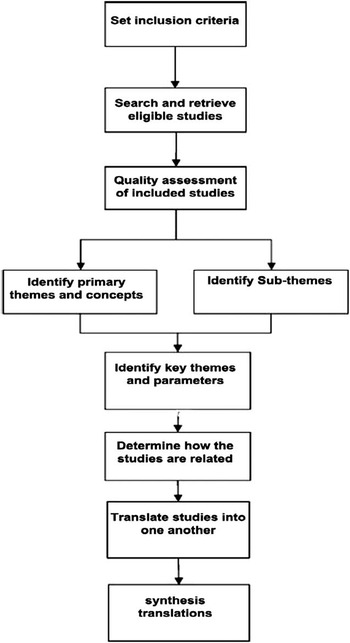
This review was performed in 2012, and followed a meta-ethnography approach,Reference Noblit and Hare 4 the steps of which are outlined in Figure 1, to synthesise findings across included studies. This meta-analysis translated ideas, concepts, and metaphors across different studies, and was increasingly considered the most well-developed approach for synthesising qualitative health research.Reference Noblit and Hare 4 , Reference Britten, Campbell, Pope, Donovan, Morgan and Pill 5
Meta-Ethnography Process.

Inclusion Criteria
The literature search was limited to journal articles published in English and Chinese. We included studies that used qualitative methods focusing on instruments for measuring or evaluating the concept of hospital preparedness or the related concepts of response to public emergencies. Included were reports that described qualitative research only, as well as research using both qualitative and quantitative methods (mixed method) that reported qualitative findings. To obtain authoritative information, this review included only peer-reviewed journal articles; books, reports, and conference abstracts were excluded.
Search Strategy and Study Selection
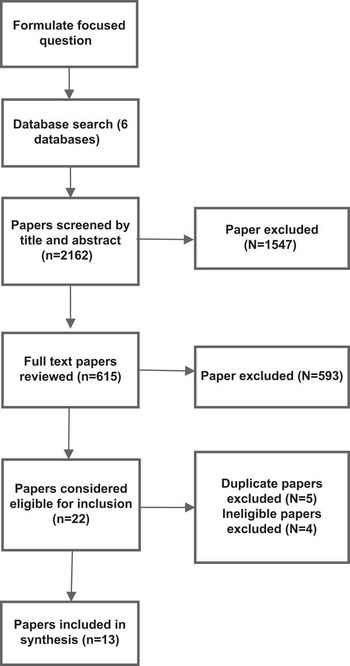
Figure 2 maps the process by which articles were selected for our systematic review. We searched 6 electronic databases (ProQuest, EBSCO, Web of Science, PubMed, Scopus, and ScienceDirect) from January 2002 through December 2012. We combined the following groups of terms during the search: disaster/emergencies, preparedness, hospital, assess/measure/evaluate, and instruments/tool/indications.
Search Process and Study Selection.

Next, snowballing search strategies were used once specific key studies were retrieved. The related key references, citations, instrument names, and author names of the identified articles were assessed to ensure that all relevant articles were included. The focus was to identify peer-reviewed journal articles closely related to the evaluation instrument of hospital preparedness for public health emergencies.
Quality Assessment
This research assessed the quality of individual study by using a checklist based on an existing appraisal scoring system for qualitative study quality assessment (Critical Appraisal Skills Programme). By evaluating study quality, the reviewer could depict the range of quality across included studies.Reference Munro, Lewin, Smith, Engel, Fretheim and Volmink 6 The strengths and weaknesses of research articles were identified using this approach. The findings of studies could be weighted by the quality grade of studies included. Poorer-quality studies tended to contribute less to cumulative meta-analyses, so the synthesis therefore becomes weighted toward the findings of the better-quality studies.Reference Munro, Lewin, Smith, Engel, Fretheim and Volmink 6 , Reference Campbell, Pound and Pope 7
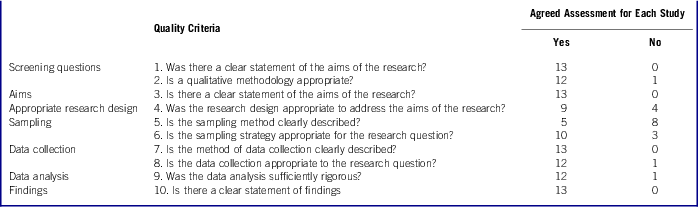
Articles were independently scored (agreement categories were either yes= 1 or no = 0). The overall score of each article was calculated by summing the category score. In general, the higher the score, the higher the quality of the article. Data were extracted on a standard pro forma instrument containing 10 criteria. Study quality was assessed by 2 reviewers independently using a pretested form (Table 1). No studies were excluded on the basis of quality.
Methodological Quality of Included Studies (n = 13)

Synthesis
Based on the meta-ethnography approach,Reference Noblit and Hare 4 a line-of-argument synthesis was conducted in this research. This approach was similar to the grounded theory in primary researchReference Munro, Lewin, Smith, Engel, Fretheim and Volmink 6 used to determine an evaluation instrument for hospital public health emergency preparedness.
Identifying Themes and Concepts
Concepts, themes, and subthemes were identified by reading and rereading the included studies. Initially, the assessor summarized the authors’ original findings using original terms and key concepts from the article. In this process, primary themes were found in the results section of an article, and secondary themes (translation) were extracted in the discussion and conclusion sections. Also extracted were the definition of public health emergency preparednessReference Nelson, Lurie, Wasserman and Zakowski 8 and the preparedness pyramidReference Adini, Goldberg, Laor, Cohen, Zadok and Bar-Dayan 9 that has been adapted to include 4 major layers of maintaining a high level of preparedness: (1) operational capability improvement; (2) expert and fully staffed workforce; (3) infrastructure, equipment, and other supplies; and (4) plans and management. Although the foci of these studies were different and not all their components were directly comparable, a number of recurring themes and subthemes were identified, which were then added to the initial themes.
Determining How the Studies Are Related
Thematic analysis was used to develop categories from the primary themes identified in the included studies. These categories represented related themes and concepts and initially included (1) prevent, protect, and response ability; (2) surveillance; (3) training and drills; (4) stockpiles; (5) emergency management; (6) staff; (7) on-site rescue and medical treatment; (8) evaluation; and (9) emergency funding. These categories were revised and merged through team discussion. We followed a similar process for subthemes from the included studies.
Reciprocal Translation of Studies
According to the meta-ethnography method, we began with the categories identified across each article and translated the primary themes from one study to another and determined emerging subthemes. Translation involved the comparison of themes across articles and an attempt to match themes from one paper to another, ensuring that a key theme captured similar themes from different articles.Reference Britten, Campbell, Pope, Donovan, Morgan and Pill 5 , Reference Munro, Lewin, Smith, Engel, Fretheim and Volmink 6
Synthesizing Translation
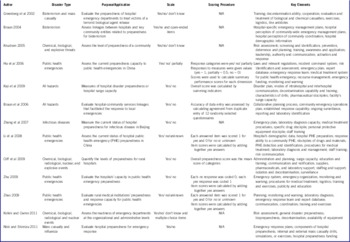
To develop an overarching framework, the translated themes and subthemes were listed in a table, juxtaposed with parameters derived from the articles (Table 2). Then the research team considered if and how the translations and authors’ interoperations were linked together. This line-of-argument synthesis, which is a method to create a theoretical framework, represented a further level of conceptual development by incorporating all of the included studies rather than a description of the synthesized papers.Reference Jenkins, Kelen, Sauer, Fredericksen and McCarthy 3 , Reference Munro, Lewin, Smith, Engel, Fretheim and Volmink 6
An Overview of Related Instruments

Results
Description of Studies
Included in this review were 13 studies published from 2002 through 2012. The studies were mainly conducted in the United States, United Kingdom, and China (Table 2). All studies focused on evaluation instruments for hospital preparedness in different types of disasters. Most studies were concerned with the preparedness or readiness of hospitals (including emergency departments) to disasters (n = 11). The other articles examined linkages between hospitals and key community entities related to preparedness during disasters (n = 2). All reviewed instruments were likely to contribute to a new instrument of evaluating hospital preparedness directly or indirectly. Notably, most of the studies were based on US samples after 9.11.
Common limitations of these studies were mainly the lack of reliability and validity tests.Reference Kaji, Langford and Lewis 1 , Reference Braun, Darcy, Divi, Robertson and Fishbeck 10 – Reference Li, Huang and Zhang 15 In addition, a small sample size limited some studies from being fully representative.Reference Kaji, Langford and Lewis 1 , Reference Zhao 16 , Reference Zhang, Jianshi, Xiong, Peng and Dalong 17 Also, some self-report studies had no further verification.Reference Kollek and Cwinn 13 , Reference Cliff, Morlock and Curtis 18 – Reference Zhu 21 For example, Braun etal assessed community emergency preparedness linkages among hospitals, public health officials, and first responders by using a self-administered questionnaire. However, the quality of linkages and the extent of possible biases favoring positive responses were not assessed.
Description of Themes
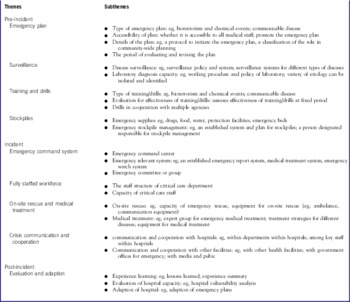
The translated themes and subthemes were synthesized across all studies to develop a new instrument for the evaluation of hospital preparedness in public health emergencies. Our findings showed 8 primary themes and 23 subthemes from the related studies (Table 3). These themes were structured throughout the cycle of pre-incident preparedness, incident management, and postincident recovery or adaptation. The primary themes included (1) emergency plan; (2) surveillance; (3) training and drills; (3) stockpiles; (4) emergency command system; (5) fully staffed workforce; (6) on-site rescue and medical treatment; (7) crisis communication and cooperation; and (8) evaluation and adaption.
Themes and Subthemes Emerging From the Included Studies

Although different instruments varied in assessment objectives and preparedness elements, no strong differences emerged among these studies. Common themes appeared both in research on preparedness and in guidance documents. Moreover, almost every instrument covered functional requirements of disaster management; therefore, they were judged appropriate to synthesize the findings across all studies.
The element of preplanned and coordinated capability governs 2 main areas, the emergency plan and the incident command system. Emergency plans consist of the activities of developing, evaluating, and revising emergency plans and other agreements. Such plans can be either informal or formal, and different plans can be developed for different types of emergencies. For examples, organizations, multi-organizational response networks, and preparedness activities center on the development and adoption of formal disaster plans.
In addition, the emergency plan should be accessible to all hospital staff. The activities of a command system include the identification of responsibility in all sectors and the specification of how resources will be managed, preparedness networks formed, and management procedures adopted. The goal of a command system is developing, testing, and improving decision-making and response capability using an integrated incident command system in a hospital.
Surveillance and laboratory identification involve the ability to maintain and improve the systems and network to monitor, detect, and investigate the potential hazard. Laboratory functions are mainly to identify, test, and isolate a variety of etiologies.
Training and exercises mainly focus on developing and maintaining a public health and health care workforce through training, exercises, and drills and real events or other educational activities.
Stockpiles include emergency supplies, pharmaceutical stockpiles, and emergency funding; and containing a range of activities of building infrastructure, such as original critical facilities meet a building code of high risks (eg, floods, earthquakes). Included in the concept of stockpiles are emergency supplies (eg, water, food, and certain numbers of ambulances, beds, protection for inventories, and drugs). Funding management involves the means for collecting and analyzing funding for emergency response and for tracking resources and ensuring adequate and timely reimbursement.
Fully staffed workforce indicates having an operations-ready medical staff, leadership, and volunteers. It refers to the staff structure of the critical care department and the skills and knowledge of hospital workers. This element emphasizes the capacity of people who can perform optimally under stressful circumstances. The elements of on-site rescue and medical treatment involve the ability to implement public health functions, including capabilities to detect, investigate, and identify health hazards; and rapidly provide medical services to the public and casualties during crisis.
Surge capacity in this research is proposed in a disaster context rather than in daily activities. When considering surge to mean large-scale, unanticipated, and sudden escalation, this element includes the ability to respond to a sudden increase in patient care demands as well as sufficient resources and rapidly expand capacity.
Communication and cooperation involves the activities that provide accurate and credible messages to and cooperation with the public, organizations, and community institutions. Types of information focus on health and safety, continuity of operations and government, critical facilities and infrastructure, delivery of services, the environment, and economic and financial conditions.
Evaluation and adaption elements contain the use of hazard and hospital vulnerability analyses to determine what should be done in the future and to ensure that mitigation issues are addressed during the adaption process. The emergency plan will be revised or a new plan may be needed based on results of evaluation and experience.
Developing a Framework for Hospital Preparedness
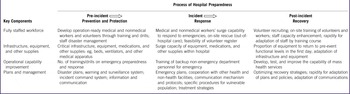
Drawing on the themes described here, the framework was based on a clear definition that identified preparedness as involving activities of prevention, protection, response, and recovery from emergencies. The disaster risk management lifecycle included pre-impact incident risk reduction-prevention and preparedness as well as response during incidents and recovery postincident management activities. To some extent, the disaster risk management cycle could be adapted for hospital preparedness. Thus, the process of hospital preparedness encompassed 3 phases that fall within 1 of 3 time periods: pre-incident, incident, and post-incident.
We also determined that the evaluation framework must be based on valid criteria that are measurable, reliable, and enable conclusions to be drawn. The disaster management model and rigorous definition provided performance criteria, and influenced the approach toward a high-order interpretation. Therefore, the framework for hospital preparedness was developed based on risk management, disaster lifecycle, and basic domains of preparedness (Table 4). According to the relationship, it was suggested that all the proposed themes and subthemes from the literature review could be applicable for this evaluation framework.
Metrics of Hospital Preparedness

Discussion
This study used a rigorous literature search, critical appraisal, and meta-ethnography approach to review and synthesize qualitative research. We identified themes and indicators of the concept of hospital preparedness for public health emergencies based on the synthesis of findings across these studies.
Since 2001, public health emergency preparedness in the United States and other countries has become a national security priority and an important focus of public health programming to improve the capability to respond to any event with serious public health consequences. According to the findings of this review, 2 main categories of assessing emergency preparedness can be applied.
Surveys
The Joint Commission for the Accreditation of Healthcare Organizations (JCAHO) continuously conducts surveys of hospitals to assess their levels of emergency preparedness. The tool includes the following elements: (1) involvement of leaders in planning for emergencies; (2) level of staff understanding of the plan; (3) clinical leadership; and (4) the treatment environment. Barbara etal conducted a pilot study before and after the terrorist events of September 11, 2001, in 2 independent samples of hospitals scheduled for JCAHO accreditation survey to assess linkages between hospitals and key community entities related to preparedness for bioterrorism. This questionnaire could not evaluate the complete accuracy of the linkages.Reference Braun, Darcy, Divi, Robertson and Fishbeck 10
Self-Assessment of Preparedness
Self-assessment enables hospitals to evaluate their level of preparedness capability, and to document their performance in activities relevant to emergency preparedness. The topics reviewed included emergency planning, workforce, and exercises and drills. The Montana Department of Public Health and Human Services established a partnership with Montana State University-Bozeman to develop a tool to gauge baseline preparedness and progress made during the first 2 years of cooperative agreement funding.Reference Kuntz, Smilie and Wang 14 The tool extrapolated a point-in-time measure (a single numerical score) and gave health departments a baseline/starting point preparedness score for 2002.
In China, research on hospital public health emergency preparedness (PHEP) is a relatively new area of research.Reference Chen 22 The studies performed in China may be categorized as theoretical study and empirical study.
Theoretical Study
Most of the discussions of theoretical study explore hospital preparedness and discuss the problems based on the authors own work or research experience. For example, He etal reported on the hospitals’ role and function in public health emergency (PHE), and described those roles as rescue and medical treatment; report and release information promptly and accurately; and crisis communication and cooperation with other facilities such as government agencies, the Centers for Disease Control and Prevention, and other medical institutions.Reference He 23 Jiang etal considered hospitals to be more vulnerable than other kinds of facilities in PHE. These vulnerabilities were mainly owing to their complex combinations of utilities; surgical and diagnostic equipment; and hazardous materials, along with a changing influx of visitors and patients in various conditions of physical and mental health. Therefore, hospitals were important institutions to prevent, control, and manage PHE.Reference Jiang, Jiang and Yu 24
Empirical Study
Empirical studies on the assessment of hospital public health emergency preparedness capacity in China largely began between 2006 and 2007.Reference Xin and Xu 27 Zhang and Zhu developed evaluation instruments with indicators and assessed hospital emergency preparedness in Beijing and Guangdong province, respectively.Reference Zhang, Jianshi, Xiong, Peng and Dalong 17 , Reference Zhu 21
Combined, these reports suggest progress in the understanding of hospital preparedness. However, many deficiencies are found in conceptual understanding and methods for measuring preparedness. Most instruments have been designed by the researchers themselves, and the elements that must be assessed are not specified. Also, a consensus evaluation tool is lacking to measure the level of hospital preparedness. It is suggested that a holistic assessment tool be developed to evaluate hospital preparedness extensively.Reference Adini, Goldberg, Laor, Cohen, Zadok and Bar-Dayan 9
Maintaining the emergency preparedness of hospitals requires a dynamic framework.Reference Adini, Goldberg, Laor, Cohen, Zadok and Bar-Dayan 9 Because emergencies occur suddenly and unpredictably, their required preparedness differs from the routine and daily functions of hospitals. It is difficult to know from normal circumstances how effectively hospitals will be prepared for emergencies. Therefore, evaluations must be constructed to conform to stages of modern disaster management.
To maintain hospital emergency preparedness, it is necessary to include organizational emergency plans, checklists (action sheets) that specify the activities required of each staff member, preparation of equipment and infrastructure, staff reinforcement, and staff training. It is recommended that the primary themes and subthemes derived from the layers identified in this interpretive review are intricately linked and should be considered as a basis for maintaining a high level of hospital preparedness.
Conclusions
This comprehensive review identified a variety of existing instruments for assessing hospital preparedness to disasters. Using a thematic analysis, 9 consistent themes were identified that may form the basis of a consistent approach for developing a model of hospital preparedness. However, further research is needed to validate this conceptual framework and the performance indicators within each of the themes to identify explicit or minimum criteria for designing a resilient hospital.
Acknowledgement
Graceful acknowledgement is made to my supervisors Mr. Fitzgerald, and Xiang-Yu Hou, who gave me considerable help by means of suggestion, comments and criticism. Their encouragement and unwavering support has sustained me through frustration and depression. Without their pushing me ahead, the completion of the paper would be impossible. Besides, I deeply appreciate the contribution to this paper made in various ways by my friend Ya-ping Wu who supplied me kind encouragement and useful instructions.
Funding and Support
This study was funded by a PhD scholarship at Queensland University of Technology, Brisbane, Australia.