1. Introduction
The cornerstone of the Jaynesian approach to statistical mechanics (SM) is the claim that the probability distribution associated with the statistical mechanical ensemble be interpreted as epistemic.Footnote 1 More to the point, the approach claims that the probability distribution should not be thought of as an objective physical part of our ontology. Rather, it is generated by a privileged way of assigning a measure to one's uncertainty or ignorance regarding the exact microstate of an SM system given a set of known constraints by means of a generalized principle of indifference known as the Maximum Entropy Principle (MEP).
Briefly, the MEP prescribes an algorithm for the generation of probabilities in SM through the use of a standard calculation by the technique of Lagrange multipliers, where one adopts the density matrix that both satisfies a set of thermodynamic constraints (interpreted as the phase averages of the density matrix) and also maximizes the von Neumann (or Shannon-Weaver) entropy

over the relevant space of states.
As Jaynes repeatedly emphasized, he saw the MEP as providing the foundation for making the best inferences possible given a state of incomplete information, and SM is but a particular example of this method. As he characterized it, the proper objective of SM is to generate inferences as to how thermodynamic systems are likely to behave, given all the knowledge one possesses regarding their current and past states.
One aspect (and indeed a very important one) of any foundational account of SM includes an interpretation and a demonstration of the second law: we look to provide a statement of how the second law is to be understood within a given interpretation and to show how the second law follows from this interpretation (if it follows at all). Although a clear and unproblematic statement of the content of the second law is problematic (Uffink Reference Uffink2001), one intuitive aspect of the content of the second law is the claim that the entropy increases over time. In the Jaynesian vein, this is translated as the claim that given some thermodynamic constraints that initially generate an ensemble distribution and a particular thermodynamic entropy, it is a consequence of the unitary evolution of such systems that the predicted entropy based on the evolved thermodynamic observables cannot be less that the initial values. As Jaynes characterizes it, the “real reason for the second law [is that] it is a fundamental requirement on any reproducible process that the phase volume W′ compatible with the final state cannot be less that the phase volume W0 which describes our ability to reproduce the initial state” (Reference Jaynes and Rosenkrantz1965/1983, 395).
This article is an attempt to investigate Jaynes's attempt to characterize and prove an ‘information-theoretic’ account of the second law, in the limited sense just described. The next section briefly presents the proof. Section 3 discusses and evaluates some common criticisms that the proof is too weak in its results, which I argue demand more out of the proof than Jaynes either desires or feels is necessary on his conception of the second law. Section 4 argues that in fact the proof is in some sense too strong in its assumptions, as one is not immediately entitled to assume unitary evolution from the Jaynesian perspective, and absent this assumption the proof fails.
2. The Unbelievably Short Proof
This emphasis on the manipulability of physical systems is a major theme of Jaynes (Reference Jaynes and Rosenkrantz1965/1983). In this article, Jaynes offers an “almost unbelievably short” proof of the second law, derived on the basis of his approach to SM. His proof is indeed very short, and discussion of the proof has focused on a more detailed exposition found in Lavis and Milligan (Reference Ridderbos and Redhead1985), which is itself cobbled together from Robertson (Reference Uffink1966) and Hobson and Loomis (Reference Hobson and Loomis1968).Footnote 2
The proof considers a canonical system undergoing an adiabatic change. Define an arbitrary set of observables {Ω1(t), Ω2(t), Ω3(t), Ω4(t), … Ωm(t)} and suppose we have made a set of measurements at t 0, {ω1(t 0), ω2(t 0), ω3(t 0), ω4(t 0), … ωm(t 0)}. On the basis of these values, we find the density matrix  that maximizes the information-theoretic entropy
 subject to the constraints

and the thermodynamic entropy is given as a function of this density matrix, byFootnote 3

Although the information-theoretic entropy and the thermodynamic entropy are conceptually independent, in this case they yield identical values up to Boltzmann's constant. If we allow the system to evolve, at some later time t, we predict the values of the observables {ω1(t), ω2(t), ω3(t), ω4(t), ω5(t) … }, using

Given these predicted observables, we define a new density matrix (call it  ) according to these new constraints and subject to maximizing the information-theoretic entropy:

The new thermodynamic entropy is calculated according to the new density operator for the predicted values of the observables:

Since (i)  is invariant under unitary evolution, (ii) both
 and
 satisfy the constraints provided by the values of the predicted observables, and (iii)
 , but not necessarily
 , maximizes the information-theoretic entropy for the predicted values of the observables, it follows that
 .
3. Criticism
It is fair to say that philosophers have been unimpressed by this proof (e.g., Earman Reference Earman, Fine and Machamer1986; Sklar Reference Sklar1993; Frigg Reference Frigg and Rickles2008), and Earman has gone so far as to claim that he agrees that this proof is “almost unbelievably short” provided that one removes the ‘almost’. Generally, there appear to be three main threads of criticism concerning the proof.
Dynamical Details
First, it does not provide the kind of details one would expect from a proof of the second law, insofar as it cannot supply the values of transport coefficients, relaxation times, and so on. Taken on its face, this objection seems to fall flat. The proof does not purport to provide these details, and it is hard to fault the proof for failing to provide them as this is not its intent. This is not to say that these details are uninteresting, just that they are well beyond its intended scope. Given that all that is assumed is that the density matrix evolves unitarily, it would be hard to imagine that the details of the evolution would follow from this fact alone.
Further, there are two ways to read Jaynes's proof as demonstrating the increase of entropy. On the weak reading of the proof, all Jaynes demonstrates is that the entropy at some arbitrary later time (given unitary dynamics) will be greater than or equal to the entropy at the initial time. If this is all that Jaynes intends to demonstrate, he seems to be successful. There is no expectation that one should take the entropic values generated by this proof seriously, in the sense that this reading of the proof does not claim to (nor can it) generate specific predictions but only shows that the entropy must increase (or be equal to its initial value) at some later time. But this is not the entire content of the second law, and the worry is that the too much is missing from the proof to recover a useful statement of the law. This would be the intent of a stronger proof of the second law.
Monotonicity
Second, the proof fails to demonstrate that the entropy increases monotonically. Rather, the proof only asserts that the entropy value at later times will be greater than the initial value of the entropy based on the values of the observables at t 0; that is, although the proof asserts that for  ,
 and
 , it does not show that
 .
Piggybacking on the previous discussion, it is hard to see how this can be a problem for the proof itself since, again, the only dynamical assumption that enters into the proof is that the density matrix evolves unitarily. Further, it is even unclear as to whether a monotonically increasing entropy curve is a necessary or even desirable feature of a proof of the second law. Although monotonic increase is an intuitive desideratum for the behavior of entropy, there exists no consensus as to how to define the thermodynamic entropy in nonequilibrium contexts. The fact that the entropy described in (6) does not monotonically increase should not necessarily be seen as a problem.
Moreover, there are experimentally realizable scenarios in which the entropy curve does not monotonically increase (on an intuitive understanding of the entropy) but actually decreases. In the spin-echo experiments, where the entropy is associated with the alignment of the spins, the entropy increases until a magnetic pulse is applied to the system, and the entropy begins to decrease back to its initial value, in an apparent violation of the monotonic increase of the entropy. In such a case, Jaynes's proof captures the relevant features of this phenomenon rather nicely since at all times the entropy is greater than or equal to the initial entropy, although it does not increase monotonically.
Ridderbos and Redhead (Reference Sklar1998) and Ridderbos (Reference Robertson2002) suggest that the spin-echo experiments provide an argument for the correctness of the fine-grained Gibbs entropy, roughly since its constancy ensures that there is no spontaneous decrease in entropy as the spin states return to their original orientation. In the Jaynesian case, we have two density matrices to work with,  and
 , the latter describing the initial density matrix and the former indicating the distribution that would be used if it were constructed from the predicted values of the observables at a later time. Clearly, the behavior of the matrix
 , being restricted to unitary evolutions, mirrors the relevant features of the Gibbsian fine-grained entropy to which Ridderbos and Redhead appeal. In the current context, this adds force to the undesirability of a proof that strictly requires monotonic entropic increase. Conversely, the predicted matrix identifies the entropy that would be generated had the matrix been generated only from contemporaneous predicted constraints, that is, if one's knowledge of the state of the system were limited to the values of those predicted constraints.
Sklar (Reference Sklar1993) exploits this distinction. He argues that the spin-echo experiments are actually problematic for the Jaynesian because the proof seems to suggest that we get an increase in entropy through the use of the matrix  by purposely throwing away information about the history of the system (contrary to Jaynes's repeated assertions that we should never throw relevant information away), information that is crucial to providing a correct description of the spin-echo behavior. This seems in tension with the proof of the second law since it suggests that there may be contexts in which we might want to use the matrix
 and those in which it is preferable to use
 to describe the system, depending on our objectives. A partial solution to this worry is to maintain a conceptual separation between the experimental, thermodynamic entropy and the information-theoretic entropy associated with one's knowledge of the system, the latter always being described by the evolution of the matrix
 , whereas the former is at least partially defined by the subjunctive reading in the paragraph above.
Time Step Dependence
Finally, a third criticism attempts to block an obvious remedy to the problem of the nonmonotonic behavior of the entropy curve (on the assumption that this is a genuine problem). Lavis and Milligan (Reference Ridderbos and Redhead1985) suggest that we could recover monotonic behavior if, instead of comparing the entropy at later times with the entropy at the time of the initial measurements, we compare the entropy at t 0 to t 1 and then repeat the proof with t 1 taken as the initial time so that it ensures  . In Frigg's words, the problem with this approach is that “it would have the disadvantage that the entropy curve would become dependent on the sequence of instants of time chosen. This seems odd even from a radically subjectivist point of view: why should the value of Se at a particular instant of time, depend on earlier instants of time at which we chose to make predictions, or worse, why should it depend on us having made any predictions at all?” (Reference Frigg and Rickles2008, 172). Lavis and Milligan argue that this rescue, despite these problems, appears unmotivated from the Jaynesian perspective since it is assumed that the values of the observables at t 0 are privileged, in that this is the only time that the values are actually measured on the system itself, rather than ‘merely inferred’.
Here again, it is striking that such expectations are being placed on Jaynes's proof. Again, it is not clear that the monotonic increase in entropy is a desideratum for the proof, and without any dynamical assumptions in place it is hard to see how one might expect monotonicity to be shown.Footnote 4 Further, Frigg, Lavis, and Milligan are right to note that privileging certain times seems unmotivated from the Jaynesian perspective. Fortunately, as described above, monotonicity is neither a desired result nor to be expected from a proof that only relies on the unitary nature of the evolution.
Another point of concern in Frigg's evaluation of the proof is that the time dependence of this move only seems odd if we do identify the entropy predicted at later times with the thermodynamic entropy, which is thought to be a property of the physical system. Indeed, Frigg points to the possibility that making predictions, or even not making predictions, might have an effect on the system's entropy, which is indeed an odd claim. It would be strange for the entropy curve to depend crucially on the seemingly arbitrary times at which we make predictions about the system.
But is it the case that the entropy that figures into this proof really is the thermodynamic entropy? Although Jaynes seems to identify the predicted entropy with the thermodynamic experimental entropy, there is no demonstration that this is actually the case, and the entropy S I is treated as conceptually independent in the proof. Indeed, whether the thermodynamic entropy does match the predicted entropy depends on the details of the dynamics: one should not expect a detailed and correct entropy curve from the assumption of unitary evolution alone. Indeed, the immediate inference from the information-theoretic entropy to the experimental thermodynamic entropy is not licensed by Jaynes in any way. Jaynes (Reference Jaynes and Ford1963) himself argues that the information-theoretic entropy “for some distributions and in some physical situations, has long been recognised as representing entropy. However, we have to emphasize that the ‘information-theory entropy’ SI and the experimental thermodynamic entropy Se are entirely different concepts. Our job cannot be to postulate any relation between them; it is rather to deduce whatever relations we can from known mathematical and physical facts” (187). Absent some set of relevant “mathematical and physical facts,” such as the details of the dynamical evolution, there is no reason to expect that the two entropies should match. As such, (6) is ambiguous: the predicted entropy Se might refer to one of two quantities. We either take this quantity to be the actual predicted entropy given by a precise quantity or the weaker statement that whatever dynamics are in place, the expected experimental entropy will be greater than the initial entropy, without taking the proof to generate a specific numerical value for either the expectation values or the entropy. Given the analysis above, it is clear that the latter reading is to be preferred.Footnote 5 Nonetheless, in the next section we shall see that even this reading fails.
In sum, the expectations placed on the proof seem unreasonable, and they are fairly easy to diagnose. Instead of amounting to a critique of the information-theoretic approach on its own terms, these criticisms amount to a list of desiderata associated with interpreting SM as a proper physical theory and demanding that the proof track, in all its gory detail, the specifics of the physical behavior of the system. But the proof purports to do no such thing, and interpreted as reflecting the physical necessity of the second law, Jaynes's proof is indeed wanting in numerous respects. Insofar as the proof only assumes unitary evolution and nothing more, it is hard to see how one could hope for a stronger result than the one proven: the premises of the proof are far too weak to give us relaxation times or a monotonic entropy curve. Without a specification of the dynamics, what more could be expected out of this proof than what has been given?
However, when interpreted as a statement regarding the manipulability of such systems based on the values of the observables at some initial time, the proof takes a somewhat different light. If these probabilities are interpreted as epistemic rather than as a physical probability distribution (whatever the relation between these might be), the object of the proof is not to describe some physical necessity but to establish a restriction on one's ability to make inferences about and control the evolution of the system, given only the knowledge that the dynamics are unitary. Jaynes's objective in this proof is limited to this: there is no reproducible or controllable way that the values of the thermodynamic observables can change adiabatically such that the entropy associated with the predicted density matrix will decrease below its initial value.
4. Why Assume Unitarity?
This does not mean that all is well with Jaynes's proof. However, the qualm I have with the proof is not that the proof is too weak in its conclusions but that its fundamental assumption is too strong. Jaynes's program is intended as a framework in which one makes inferences about the future state of thermodynamic systems, on the basis of the results of an initial set of measurements. And although we can expect the evolution of the probability distribution construed physically to evolve unitarily, it is unclear why the evolution of an epistemic probability distribution, insofar as it describes the evolution of our knowledge, should evolve in this way. Indeed, it would be odd for this distribution to evolve unitarily, mirroring the physical evolution (unless we were Laplacian demons). Although the proof assumes unitary evolution, and many of the criticisms discussed above hit on this assumption as being too weak to deliver the results desired, this assumption in fact seems unjustifiably strong.
The natural counterpoint here is to defend Jaynes's proof by observing that there is a difference between actually being able to evolve a probability distribution through its unitary evolution, such that for any initial distribution one can actually describe its time-evolved state, and the weaker claim that we know that the distribution, however it evolves, evolves unitarily.Footnote 6 And in fact, nothing is assumed in the proof other than that the distribution evolves in a unitary fashion. So one should read the proof as not demanding a sort of Laplacian omniscience but merely the more general observation that we know evolutions are unitary. Clearly, this is in the spirit of the Jaynesian approach, and perhaps this would vindicate the proof.
However, this move will not work. Even though we assume the fundamental dynamical evolution to be unitary, this is not actually something one is entitled to assume in this proof. The assumption of unitary evolution is subject to an important qualification: the degrees of freedom that comprise the representation of the system must be complete. If there are additional physical degrees of freedom associated with the system beyond those that are specified, it is possible that the evolution, relative to the specified known degrees of freedom, will not appear unitary.
From an ‘objective’ perspective, this hardly matters: unitary evolution is a fundamental feature of the dynamics, and if one fails to incorporate some degrees of freedom into the description of the system, then the description is wrong. However, from the Jaynesian perspective, one is only permitted to assume unitarity if one is justified in believing that all the physical degrees are represented in one's description of the system since it is our goal to make inferences based only on the knowledge in hand.
To see how this is problematic, we consider a discrete phase space taking on six possible microstates as a toy example, which is loosely based on Jaynes's (Reference Jaynes and Ford1963) Brandeis dice problem. Initially, we are given an expectation value across the states of 4.5, which for the moment can be thought as representing the average value of the pips on a die. Jaynes (Reference Jaynes and Rosenkrantz1979/1983) solves this problem through the MEP method, attaining the following probability distribution:

According to Jaynes, this distribution represents the maximal entropic state for the constraints given, and the maximal entropic state for the system, absent the constraint that the expectation value is 4.5, has an expectation value of 3.5, where each outcome is assigned equal probability. Clearly, the farther the expectation value from 3.5, the lower the maximum entropy assigned to the system, such that

where x and y are the expectation values associated with some macrostate of the system.
Now, let us specify that the system evolves by some unitary dynamics, such that for each discrete time step, a new state is achieved by permuting the probabilities of each individual microstate in some definite but unspecified way. Clearly, the informational entropy due to such dynamical evolution is unchanged since this amounts to permuting the indexes on outcomes in the Shannon-Weaver entropy. However, the expectation value may change through arbitrary permutations. Because the probabilities assigned by the MEP are monotonically increasing when  and monotonically decreasing when
 , the expectation value of the system is bounded under evolution since the permutations can only move the expectation value closer to 3.5; that is, if the initial expectation value was 4.5, the dynamics can only generate probability distributions with expectation values between 2.5 and 4.5. Thus, if one constructs a new probability distribution on the basis of these new expectation values, the entropy associated with the new distribution must be greater than the entropy of the original distribution. This is the essence of Jaynes's proof.
We can see the relevant features of the proof, even in this toy model. Although the initial entropy represents a lower bound on the entropy, it is entirely possible that the unspecified unitary dynamics move the system into states that move closer to and farther away from the mean value of 3.5, and thus the entropy cannot, by this method, be shown to increase monotonically with each time step.
Despite the above arguments that usual criticisms of this ‘almost unbelievably short’ proof are misguided, there is a sense in which one needs a more robust characterization of the dynamics beyond the stipulation that they are unitary. The proof works because there is no way in which the expectation values can obtain values outside the bound described above, and this is achieved by limiting the dynamics to permutations of the initial probability distribution. However, if the state space is incompletely specified, in the sense that there are further degrees of freedom not accounted for in the description of the system, it is possible for the entropy relative to this description to decrease.
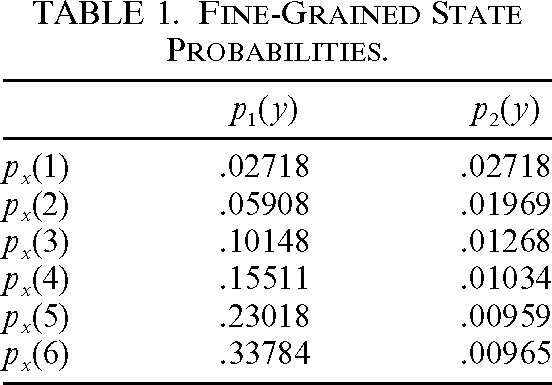
For instance, suppose that there are additional degrees of freedom not accounted for in the phase space, such that (according to some ‘natural’ measure or reproducible physical distribution) the probability of each outcome from 1 to 6 is actually the marginal sum over a more fine-grained joint distribution in which each outcome is actually associated with two outcomes of unequal weight. If these probabilities are permuted by some unitary dynamics, it is entirely possible for the expectation values (from the coarse-grained perspective) to, say, exceed 4.5 since it is with respect to the coarse-grained probability distribution that the initial probability distribution is generated. For instance, suppose that each microstate can be bifurcated into two states with different densities, such that according to the ‘natural’ measure  , with
 and
 for
 . The resultant probabilities for this fine-grained state are shown in table 1. If the actual dynamics are given by the rule that for each time step, the states in the left-hand column move to the right-hand column, and states in the right-hand column move to the left-hand column below it in a cyclical fashion such that
 , then one computes the expectation value after one time step to be 4.53, which has a lower entropy than the initial state from the perspective of the coarse-grained description where the only observable defined is Y. Such examples are easy to multiply.

| p 1(y) | p 2(y) | |
| p x(1) | .02718 | .02718 |
| p x(2) | .05908 | .01969 |
| p x(3) | .10148 | .01268 |
| p x(4) | .15511 | .01034 |
| p x(5) | .23018 | .00959 |
| p x(6) | .33784 | .00965 |
This point is similar to criticisms of Jaynes's program that suggest that he tacitly relies on systems being ergodic in order to get his program off the ground (Sklar Reference Sklar1993; Frigg Reference Frigg and Rickles2008). In the case of ergodicity, the worry is that if the space is not metrically indecomposable, the phase averages associated with the density matrix may not equal the time averages, so that the Jaynesian method will deliver the wrong predictions if it cannot demonstrate the system to be ergodic. However, this worry is different, and perhaps more fundamental, for in the case of ergodic theory the dynamics are assumed to be measure preserving. In this case, if there is no guarantee of unitary evolution because relevant degrees of freedom are missed, one cannot even assume measure preservation. Nonetheless, the best response available to the Jaynesian is likely parallel to the one offered against the ergodic criticism: provided that one is sure the dynamics are unitary, the appearance of apparent entropy-decreasing phenomena is an indication that important physical features of the system have been omitted and need to be found or included. As such, it should not be understood as an indictment of the Jaynesian program itself. The reader is left to decide whether this response is convincing.
5. Conclusion
Some common criticisms of Jaynes's unbelievably short proof have been discussed. Generally, these criticisms have pointed to the fact that the proof is too weak in its conclusions, and any attempt to strengthen them would be unjustified from the Jaynesian perspective. Conversely, I have argued that the demands placed on this proof are too stringent and, in fact, demand more from a proof of the second law than Jaynes desires or needs to show. However, I have suggested that there is a sense in which the proof is actually too strong, rather than too weak. Specifically, unless the dynamical description of the system is known to be complete, one is not entitled to assume the unitary evolution of the system relative to the description given. Without the assumption of unitarity, it is possible for the entropy to decrease, even if the fundamental dynamics are unitary.