












1 Introduction
1.1 Motivation and context
In [Reference Moore, Tachikawa, Block, Distler, Donagi and Sharpe40], Moore and Tachikawa posit the existence of certain two-dimensional topological quantum field theories (TQFTs) valued in a category
$\mathbf {MT}$
 of holomorphic symplectic varieties. The Moore–Tachikawa conjecture has featured in several papers over the last decade [Reference Arakawa4, Reference Bălibanu and Mayrand6, Reference Bielawski9, Reference Braverman, Finkelberg and Nakajima15–Reference Calaque, Pantev, Simpson, Toën, Vaquié and Vezzosi17, Reference Crooks and Mayrand21–Reference Crooks and Mayrand23, Reference Dancer, Kirwan and Martens25, Reference Gannon and Webster29, Reference Tachikawa, Sirakov, de Souza and Viana44] and continues to play a prominent role in geometric representation theory and theoretical physics. In [Reference Crooks and Mayrand22], we prove that any quasi-symplectic groupoid
$\mathcal G\;\substack {\longrightarrow \\[-9pt] \longrightarrow }\; X$
 and suitable global slice
$S\subseteq X$
 determine a two-dimensional TQFT
$\eta _{\mathcal G,S}:\mathbf {Cob}_2\longrightarrow \mathbf {WS}_1$
 behaving analogously to those conjectured by Moore and Tachikawa, where
$\mathbf {WS}_1$
 is a completion of a
$1$
 -shifted version of the Weinstein symplectic “category” [Reference Weinstein, Doebner, Andersson and Petry47]. More precise statements will be forthcoming.
In this manuscript, we view the Moore–Tachikawa conjecture as a mechanism for constructing TQFTs from purely Lie-theoretic data. We are thereby led to consider a class of the TQFTs
$\eta _{\mathcal G,S}$
 described above, and understand interrelationships among these TQFTs. Our class turns out to arise from partial Grothendieck–Springer resolutions in Poisson and quasi-Poisson geometry. One begins by fixing a connected complex semisimple affine algebraic group
$G$
 with Lie algebra
$\mathfrak {g}$
 . The operation
${P\mapsto \mathfrak {p}:= \mathrm {Lie}(P)}$
 induces a bijective correspondence between conjugacy classes of parabolic subgroups
$P\subseteq G$
 and those of parabolic subalgebras
$\mathfrak {p}\subseteq \mathfrak {g}$
 . Conjugacy classes
$\mathcal {C}$
 of the latter type are thereby identified with those of the former type. With this in mind, one has the incidence subvarieties

One also has the morphisms

where the Killing form is used to identify
$\mathfrak {g}^*$
 with
$\mathfrak {g}$
 . There is a unique Poisson Hamiltonian
$G$
 -variety structure on
$\mathfrak {g}_{\mathcal {C}}$
 for which
$\mu _{\mathcal {C}}$
 is a moment map. The partial Grothendieck–Springer resolution (resp. multiplicative partial Grothendieck–Springer resolution) associated with
$(G,\mathcal {C})$
 is defined to be
$(\mathfrak {g}_{\mathcal {C}},\mu _{\mathcal {C}})$
 (resp.
$(G_{\mathcal {C}},\nu _{\mathcal {C}})$
 ). If
$\mathcal {C}=\mathcal {B}$
 is the conjugacy class of Borel subalgebras of
$\mathfrak {g}$
 , then
$\mathfrak {g}_{\mathcal {C}}=\widetilde {\mathfrak {g}}$
 is the well-studied Grothendieck–Springer resolution of
$\mathfrak {g}$
 [Reference Evens and Lu26].
1.2 Main results
Let
$G$
 be a connected complex semisimple affine algebraic group with Lie algebra
$\mathfrak {g}$
 . One knows that the cotangent groupoid
$T^*G\;\substack {\longrightarrow \\[-9pt] \longrightarrow }\;\mathfrak {g}^*=\mathfrak {g}$
 induces the canonical Poisson structure on
$\mathfrak {g}$
 . We generalize this fact as follows.
Main Theorem 1 Let
$\mathcal {C}$
 be a conjugacy class of parabolic subalgebras of
$\mathfrak {g}$
 . There is a canonical algebraic symplectic groupoid
$(T^*G)_{\mathcal {C}}\;\substack {\longrightarrow \\[-9pt] \longrightarrow }\;\mathfrak {g}_{\mathcal {C}}$
 that induces the Poisson structure on
$\mathfrak {g}_{\mathcal {C}}$
 .
The term “canonical” warrants some clarification in this context. We construct
$(T^*G)_{\mathcal {C}}\;\substack {\longrightarrow \\[-9pt] \longrightarrow }\;\mathfrak {g}_{\mathcal {C}}$
 for a choice of
$\mathfrak {p}\in \mathcal {C}$
 , and then explain the sense in which this construction is choice-independent.
Now write
$(\mathfrak {g}_{\mathcal {C}})_{\text {reg}}\subseteq \mathfrak {g}_{\mathcal {C}}$
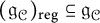 for the open dense subvariety of all points in
$\mathfrak {g}_{\mathcal {C}}$
 at which the Poisson structure has maximal rank; it coincides with
$\mathfrak {g}_{\mathcal {C}}$
 if and only if
$\mathcal {C}=\mathcal {B}$
 . The pullback of
$(T^*G)_{\mathcal {C}}\;\substack {\longrightarrow \\[-9pt] \longrightarrow }\;\mathfrak {g}_{\mathcal {C}}$
 to
$(\mathfrak {g}_{\mathcal {C}})_{\text {reg}}$
 is an algebraic symplectic groupoid
$((T^*G)_{\mathcal {C}})_{\text {reg}}\;\substack {\longrightarrow \\[-9pt] \longrightarrow }\;(\mathfrak {g}_{\mathcal {C}})_{\text {reg}}$
 integrating
$(\mathfrak {g}_{\mathcal {C}})_{\text {reg}}$
 . On the other hand, let
$\mathrm {Kos}:= e+\mathfrak {g}_f\subseteq \mathfrak {g}$
 be the Kostant slice associated with a principal
$\mathfrak {sl}_2$
 -triple
$(e,h,f)\in \mathfrak {g}^{\times 3}$
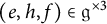 . We show
$\mathrm {Kos}_{\mathcal {C}}:= \mu _{\mathcal {C}}^{-1}(\mathrm {Kos})\subseteq (\mathfrak {g}_{\mathcal {C}})_{\text {reg}}$
 to be a global slice for
$((T^*G)_{\mathcal {C}})_{\text {reg}}\;\substack {\longrightarrow \\[-9pt] \longrightarrow }\;(\mathfrak {g}_{\mathcal {C}})_{\text {reg}}$
 , in the sense of [Reference Crooks and Mayrand22, Definition 4.9].
This is a point at which symplectic reduction along a submanifold [Reference Crooks and Mayrand21] becomes relevant. In more detail, suppose that
$m,n\in \mathbb {Z}_{\geq 0}$
 satisfy
$(m,n)\neq (0,0)$
 . The symplectic groupoid
$(T^*G)_{\mathcal {C}}^{m+n}\times \overline {(T^*G)_{\mathcal {C}}^{m+n}}$
 acts on
$(T^*G)_{\mathcal {C}}^{m,n}$
 in a Hamiltonian fashion. One may reduce by this Hamiltonian action along

yielding

We prove that these reduced spaces feature in the following.
Main Theorem 2 Let
$\mathcal {C}$
 be a conjugacy class of parabolic subalgebras of
$\mathfrak {g}$
 . There is an explicit TQFT
$\eta : \mathbf {Cob}_2\longrightarrow \mathbf {WS}_1$
 satisfying
$\eta (S^1) = ((T^*G)_{\mathcal {C}})_{\mathrm {reg}}$
 and
$\eta (C_{m,n})=[(T^*G)_{\mathcal {C}}^{m,n}]$
 for all
$(m,n)\neq (0,0)$
 , where
$C_{m,n}$
 denotes the genus-0 cobordism from
$m$
 circles to
$n$
 circles.
We call
$(T^*G)_{\mathcal {C}}^{m,n}$
 the open Moore–Tachikawa variety for
$\mathcal {C}$
 associated with
$(m, n) \ne (0, 0)$
 . In the case
$\mathcal {C}=\{\mathfrak {g}\}$
 , we omit the subscript and simply write
$(T^*G)^{m,n}$
 . The varieties
$(T^*G)^{m,n}$
 are often called open Moore–Tachikawa varieties, as their affinizations realize a scheme-theoretic version of the Moore–Tachikawa TQFT [Reference Crooks and Mayrand22, Reference Ginzburg and Kazhdan30].
It is natural to seek relationships between the varieties
$(T^*G)_{\mathcal {C}}^{m,n}$
 for fixed
$(m,n)\neq (0,0)$
 , as
$\mathcal {C}$
 ranges over the conjugacy classes of parabolic subalgebras of
$\mathfrak {g}$
 . We achieve this by appealing to Weinstein’s notion of a Lagrangian relation from a symplectic variety
$X$
 to another such variety
$Y$
 [Reference Bates and Weinstein7, Reference Weinstein, Doebner, Andersson and Petry47, Reference Weinstein48]; this is a set-theoretic relation from
$X$
 to
$Y$
 with the property of being an immersed Lagrangian in
$X\times \overline {Y}$
 , where
$\overline {Y}$
 results from negating the symplectic form on
$Y$
 . While a composition of relations is a relation set-theoretically, a composition of Lagrangian relations need not be a Lagrangian relation. A sufficient condition for the latter composition to be a Lagrangian submanifold is for the Lagrangian relations to be strongly composable [Reference Weinstein48]. If one is prepared to accept an immersed Lagrangian submanifold of
$X\times \overline {Y}$
 , then it suffices for the Lagrangian relations to be composable [Reference Wehrheim and Woodward46, Reference Weinstein48]. These last few sentences give context for the following main result.
Main Theorem 3 Fix
$(m,n)\in (\mathbb {Z}_{\geq 0})^2$
 with
$(m,n)\neq (0,0)$
 , and let
$\mathcal {C}$
 be a conjugacy class of parabolic subalgebras of
$\mathfrak {g}$
 . There is an explicit Lagrangian relation from
$(T^*G)_{\mathcal {C}}^{m,n}$
 to
$(T^*G)^{m,n}$
 .
A different approach to building TQFTs from Lie-theoretic data is given in [Reference Maiza and Mayrand36].
1.3 Multiplicative counterparts of main results
We also obtain multiplicative analogs of Main Theorems 1 and 2 by replacing
$\mathfrak {g}$
 and
$T^*G$
 with
$G$
 and
$\mathrm {D}(G)=G\times G$
 , respectively. The former (resp. latter) is a quasi-Poisson
$G$
 -variety (resp. quasi-Hamiltonian
$G\times G$
 -variety). On the other hand, the components of the moment map
$\mathrm {D}(G)\longrightarrow G\times G$
 constitute the source and target of an algebraic Lie groupoid
$\mathrm {D}(G)\;\substack {\longrightarrow \\[-9pt] \longrightarrow }\; G$
 . This groupoid is quasi-symplectic with respect to a quasi-Hamiltonian
$2$
 -form on
$\mathrm {D}(G)$
 and Cartan
$3$
 -form on
$G$
 . Using multiplicative versions of the constructions above, we obtain algebraic quasi-symplectic groupoids
$\mathrm {D}(G)_{\mathcal {C}} \;\substack {\longrightarrow \\[-9pt] \longrightarrow }\; G_{\mathcal {C}}$
 . Furthermore, replacing the Kostant slice
$\mathrm {Kos}\subseteq \mathfrak {g}$
 with the Steinberg slice
$\mathrm {Ste}\subseteq G$
 yields an analog
$\mathrm {D}(G)_{\mathcal {C}}^{m,n}$
 of
$(T^*G)_{\mathcal {C}}^{m,n}$
 . We have an induced TQFT
$\delta : \mathbf {Cob}_2\longrightarrow \mathbf {WS}_1$
 satisfying
$\delta (S^1)=(\mathrm {D}(G)_{\mathcal {C}})_{\text {reg}}$
 and
$\delta (C_{m,n})=[(\mathrm {D}(G))_{\mathcal {C}}^{m,n}]$
 for all
$(m, n) \ne (0, 0)$
 . Setting
$\mathcal {C} = \{G\}$
 recovers the multiplicative open Moore–Tachikawa varieties [Reference Bălibanu and Mayrand6].
1.4 Organization
Each section begins with a summary of its contents. Section 2 provides some of the crucial background, conventions, and results in Hamiltonian and quasi-Hamiltonian geometry. In Section 3, we develop the pertinent parts of [Reference Crooks and Mayrand22] on TQFTs in a
$1$
 -shifted Weinstein symplectic category. We establish the Lie-theoretic underpinnings of partial Grothendieck–Springer resolutions in Section 4. This allows us to discuss the Poisson geometry of
$\mathfrak {g}_{\mathcal {C}}$
 in Section 5. In Section 6, we associate a TQFT to each partial Grothendieck–Springer resolution with a fixed Kostant slice. The above-advertised Lagrangian relations are derived in Section 7.
Our attention turns to multiplicative/quasi-Poisson counterparts in Section 8, where we recall the quasi-Hamiltonian
$G$
 -variety structure on
$G\times _{U(P)}P$
 . In Section 9, we associate a TQFT to each multiplicative partial Grothendieck–Springer resolution
$G_{\mathcal {C}}\longrightarrow G$
 with a fixed Steinberg slice.
2 Quasi-symplectic groupoids
We now develop aspects of the theory of quasi-symplectic groupoids. This is intended to contextualize the TQFT-theoretic results of [Reference Crooks and Mayrand22] and lay a broad theoretical foundation for the entire manuscript. In Section 2.1, we set a few fundamental conventions. Section 2.2 then establishes some of our conventions for Lie groupoids. We discuss aspects of quasi-symplectic groupoids in Section 2.3. This allows us to integrate quotients of Hamiltonian
$G$
 -spaces in Section 2.4.
In Section 2.5, we review the theory of symplectic reduction along a submanifold [Reference Crooks and Mayrand21]. Certain Lagrangian relations arise in this context, as detailed in Section 2.6. Attention subsequently shifts to quasi-Poisson manifolds in Section 2.7. This leads to Section 2.8, where we construct quasi-symplectic groupoids over quotients of quasi-Hamiltonian manifolds.
2.1 Fundamental conventions
In this manuscript, we work exclusively over
$\mathbb {C}$
 ; it is the base field underlying all objects for which a base field is presupposed (e.g., vector spaces, manifolds, and algebraic varieties). The reader should interpret all differential-geometric notions as being in the holomorphic category.
2.2 Conventions for Lie groupoids
Let
$\mathcal G\;\substack {\longrightarrow \\[-9pt] \longrightarrow }\; X$
 be a groupoid object in the category of complex manifolds, with source, target, and identity bisection maps denoted
$\textsf {s}:\mathcal G\longrightarrow X$
 ,
$\textsf {t}:\mathcal G\longrightarrow X$
 , and
$\textsf {1}:X\longrightarrow \mathcal G$
 , respectively. Given a submanifold
$S\subseteq X$
 , we write
$\mathcal G\big \vert _S$
 for the restriction
$\textsf {s}^{-1}(S)\cap \textsf {t}^{-1}(S)\;\substack {\longrightarrow \\[-9pt] \longrightarrow }\; S$
 . Let us adopt the simplified notation
$\mathcal G_x:= \mathcal G\vert _{\{x\}}$
 for the isotropy group of
$x\in X$
 . We also observe the following convention for groupoid multiplication: given
$g,h\in \mathcal G$
 , the product
$gh\in \mathcal G$
 is defined if and only if
$\textsf {s}(g)=\textsf {t}(h)$
 . Multiplication thereby takes the form of a map
$\textsf {m}:\mathcal G{\, }_{\textsf {s}}{\!\!}\times _{\textsf {t}}\,\mathcal G\longrightarrow \mathcal G$
 .
One calls
$\mathcal G\;\substack {\longrightarrow \\[-9pt] \longrightarrow }\; X$
 a Lie groupoid if
$\textsf {s}$
 and
$\textsf {t}$
 are submersions. Assume this to be the case, and let
$M$
 be a manifold. An action of
$\mathcal G$
 on
$M$
 consists of holomorphic maps
$\mu :M\longrightarrow X$
 and

that satisfy the natural generalizations of the left group action axioms. The associated action groupoid is
$\mathcal G{\, }_{\textsf {s}}{\!\!}\times _{\mu }\,M\;\substack {\longrightarrow \\[-9pt] \longrightarrow }\; M$
 , with source
$(g,p)\mapsto p$
 , target
$(g,p)\mapsto g\cdot p$
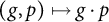 , identity bisection
$p\mapsto (\textsf {1}(p),p)$
 , and multiplication
$(g,p)(h,q)=(gh,q)$
 . We denote the action groupoid by
$\mathcal G\ltimes M$
 .
2.3 Quasi-symplectic groupoids
A quasi-symplectic groupoid is a triple
$(\mathcal G,\omega ,\phi )$
 of a Lie groupoid
$\mathcal G\;\substack {\longrightarrow \\[-9pt] \longrightarrow }\; X$
 , multiplicative
$2$
 -form
$\omega \in \Omega ^2(\mathcal G)$
 , and
$3$
 -form
$\phi \in \Omega ^3(X)$
 satisfying
$\mathrm {d}\omega =\textsf {s}^*\phi -\textsf {t}^*\phi $
 ,
$\dim \mathcal G=2\dim X$
 , and
$\ker \omega _x\cap \ker \mathrm {d}\textsf {s}_x\cap \ker \mathrm {d}\textsf {t}_x=\{0\}$
 for all
$x\in X$
 , where one uses the identity bisection to regard
$x$
 as belonging to
$\mathcal G$
 . We let
$\overline {\mathcal G}$
 denote the “opposite”
$(\mathcal G,-\omega ,-\phi )$
 of a quasi-symplectic groupoid
$(\mathcal G,\omega ,\phi )$
 .
Consider a quasi-symplectic groupoid
$(\mathcal G \;\substack {\longrightarrow \\[-9pt] \longrightarrow }\; X, \omega , \phi )$
 and manifold
$M$
 equipped with a 2-form
$\gamma \in \Omega ^2(M)$
 . Suppose that
$\mathcal G$
 acts on
$M$
 along a holomorphic map
$\mu : M \longrightarrow X$
 . This action is called Hamiltonian [Reference Xu49] if it satisfies the following properties:
-
• $\mu ^*\phi = -\mathrm {d}\gamma $
 ;
-
• the graph of the action, that is, $\{(g, m, g \cdot m) : (g, m) \in \mathcal G{\, }_{\textsf {s}}{\!\!}\times _{\mu }\,M\}$
, is isotropic in
$\mathcal G \times M \times M$
with respect to
$(\omega , \gamma , -\gamma )$
; -
• $\ker \mathrm {d}\mu \cap \ker \gamma = 0$
.





A quasi-symplectic groupoid
$(\mathcal G\;\substack {\longrightarrow \\[-9pt] \longrightarrow }\; X,\omega ,\phi )$
 is called symplectic if
$\phi =0$
 and
$\omega $
 is non-degenerate. It turns out that a Lie groupoid
$\mathcal G\;\substack {\longrightarrow \\[-9pt] \longrightarrow }\; X$
 and
$2$
 -form
$\omega \in \Omega ^2(\mathcal G)$
 constitute a symplectic groupoid if and only if the graph of groupoid multiplication is isotropic in
$\mathcal G\times \mathcal G\times \overline {\mathcal G}$
 . The Lie algebroid of
$\mathcal G$
 is then
$T^*X\longrightarrow X$
 , along with an anchor map that defines a Poisson structure on
$X$
 . An integration of a Poisson manifold
$X$
 is a symplectic groupoid
$\mathcal G\;\substack {\longrightarrow \\[-9pt] \longrightarrow }\; X$
 that induces the given Poisson structure on
$X$
 .
We now discuss a paradigm example of a symplectic groupoid. To this end, let
$G$
 be a Lie group with Lie algebra
$\mathfrak {g}$
 . Use the left trivialization to identify
$T^*G$
 with
$G\times \mathfrak {g}^*$
 . While the former is symplectic, the latter may be viewed as the action groupoid of the coadjoint action. These structures are compatible in the sense that
$T^*G\;\substack {\longrightarrow \\[-9pt] \longrightarrow }\;\mathfrak {g}^*$
 is a symplectic groupoid integrating the canonical Poisson structure on
$\mathfrak {g}^*$
 . The source
$\textsf {s}:T^*G\longrightarrow \mathfrak {g}^*$
 and target
$\textsf {t}:T^*G\longrightarrow \mathfrak {g}^*$
 are given by
$\textsf {s}(g,\xi )=\mathrm {Ad}_g^*(\xi )$
 and
$\textsf {t}(g,\xi )=\xi $
 , respectively, where
$\mathrm {Ad}^*:G\longrightarrow \mathrm {GL}(\mathfrak {g}^*)$
 is the coadjoint representation of
$G$
 . One calls
$T^*G\;\substack {\longrightarrow \\[-9pt] \longrightarrow }\;\mathfrak {g}^*$
 the cotangent groupoid of
$G$
 . Symplectic Hamiltonian
$G$
 -spaces are equivalent to symplectic manifolds equipped with Hamiltonian actions of
$T^*G\;\substack {\longrightarrow \\[-9pt] \longrightarrow }\;\mathfrak {g}^*$
 [Reference Mikami and Weinstein39, Example 3.9].
2.4 Integrating quotients of symplectic manifolds
Let
$(M, \omega )$
 be a symplectic manifold. Suppose that a Lie group
$G$
 acts on
$M$
 in a Hamiltonian fashion with moment map
$\mu : M \longrightarrow \mathfrak {g}^*$
 . Equip the total space of the pair groupoid
$\mathrm {Pair}(M)=M \times M\;\substack {\longrightarrow \\[-9pt] \longrightarrow }\; M$
 with the symplectic structure on
$M\times \overline {M}$
 , where
$\overline {M}$
 results from negating the symplectic form on
$M$
 ; this yields a symplectic groupoid integrating
$M$
 . The diagonal action of
$G$
 on
$M \times M$
 is then Hamiltonian with moment map

If the
$G$
 -action on
$M$
 is free and proper, then

is a Lie groupoid over
$M/G$
 . We also know
$\mathrm {Pair}(M)\mkern -4mu\mathbin {/\mkern -5mu/}_{\mkern -4mu{0}}G$
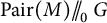 and
$M/G$
 to be symplectic and Poisson, respectively. These considerations give context for the following result.
Proposition 2.1 If the action of
$G$
 on
$M$
 is free and proper, then
$\mathrm {Pair}(M)\mkern -4mu\mathbin {/\mkern -5mu/}_{\mkern -4mu{0}}G\;\substack {\longrightarrow \\[-9pt] \longrightarrow }\; M/G$
 is a symplectic groupoid integrating the Poisson manifold
$M/G$
 .
Proof Note that the graph of multiplication
$\Gamma \subseteq \mathrm {Pair}(M) \times \mathrm {Pair}(M) \times \overline {\mathrm {Pair}(M)}$
 descends to a Lagrangian submanifold of
$(\mathrm {Pair}(M)\mkern -4mu\mathbin {/\mkern -5mu/}_{\mkern -4mu{0}}G) \times (\mathrm {Pair}(M)\mkern -4mu\mathbin {/\mkern -5mu/}_{\mkern -4mu{0}}G) \times (\overline {\mathrm {Pair}(M)\mkern -4mu\mathbin {/\mkern -5mu/}_{\mkern -4mu{0}}G})$
 , so that
$\mathrm {Pair}(M)\mkern -4mu\mathbin {/\mkern -5mu/}_{\mkern -4mu{0}}G$
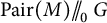 is a symplectic groupoid over
$M/G$
 . The symplectic form on
$\mathrm {Pair}(M)\mkern -4mu\mathbin {/\mkern -5mu/}_{\mkern -4mu{0}}G$
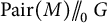 provides an isomorphism from its Lie algebroid to
$T^*(M/G)$
 . It follows that the anchor map
$T^*(M/G) \longrightarrow T(M/G)$
 is the Poisson structure on
$M/G$
 .
Remark 2.2 It seems likely that this result could be deduced from techniques in [Reference Brahic and Fernandes14].
2.5 Symplectic reduction along a submanifold
Let
$\mathcal G\;\substack {\longrightarrow \\[-9pt] \longrightarrow }\; X$
 be a symplectic groupoid. Write
$\sigma \in H^0(X,\wedge ^2(TX))$
 for the Poisson bivector field on
$X$
 , and
$\sigma ^{\vee }:T^*X\longrightarrow TX$
 for its contraction with cotangent vectors. One calls a submanifold
$S\subseteq X$
 pre-Poisson if

has constant fiber dimension, in which case
$L_S$
 is Lie subalgebroid of
$(T^*X,\sigma ^{\vee })$
 [Reference Cattaneo, Zambon, Dito, Lu, Maeda and Weinstein18, Reference Cattaneo and Zambon19]. Suppose that
$\mathcal {H}\;\substack {\longrightarrow \\[-9pt] \longrightarrow }\; S$
 is a Lie subgroupoid of
$\mathcal G$
 over a pre-Poisson submanifold
$S\subseteq X$
 . We call
$\mathcal {H}$
 a stabilizer subgroupoid if
$\mathcal {H}$
 is isotropic in
$\mathcal G$
 and has
$L_S$
 as its Lie algebroid [Reference Crooks and Mayrand21]. Noteworthy special cases of these definitions arise for
$\mathcal G\;\substack {\longrightarrow \\[-9pt] \longrightarrow }\; X$
 the (left-trivialized) cotangent groupoid
$T^*G\;\substack {\longrightarrow \\[-9pt] \longrightarrow }\;\mathfrak {g}^*$
 of a Lie group
$G$
 . The submanifold
$\{\xi \}\subseteq \mathfrak {g}^*$
 is pre-Poisson for all
$\xi \in \mathfrak {g}^*$
 and admits
$G_{\xi }\longrightarrow \{\xi \}$
 as a stabilizer subgroupoid. This observation foreshadows a generalization of Marsden–Weinstein reduction [Reference Marsden and Weinstein37]; the following are some details.
Suppose that a symplectic groupoid
$\mathcal G\;\substack {\longrightarrow \\[-9pt] \longrightarrow }\; X$
 acts on a symplectic manifold
$(M,\omega )$
 in a Hamiltonian fashion with moment map
$\mu :M\longrightarrow X$
 . Let
$\mathcal {H}\;\substack {\longrightarrow \\[-9pt] \longrightarrow }\; S$
 be a stabilizer subgroupoid of
$\mathcal G$
 over a pre-Poisson submanifold
$S\subseteq X$
 . Note that
$\mathcal {H}$
 acts on
$\mu ^{-1}(S)$
 . Consider the inclusion
$j:\mu ^{-1}(S)\longrightarrow M$
 and quotient
$\pi :\mu ^{-1}(S)\longrightarrow \mu ^{-1}(S)/\mathcal {H}$
 . If
$\mathcal {H}$
 acts freely and properly on
$\mu ^{-1}(S)$
 , then
$\mu $
 is transverse to
$S$
 , and the manifold
$\mu ^{-1}(S)/\mathcal {H}$
 carries a unique symplectic form
$\overline {\omega }$
 satisfying
$\pi ^*\overline {\omega }=j^*\omega $
 . The symplectic manifold

is called the symplectic reduction of M by
$\mathcal G$
 along S with respect to
$\mathcal {H}$
 [Reference Crooks and Mayrand21]. We use the simpler notation
$M \mkern -4mu\mathbin {/\mkern -5mu/}_{\mkern -4mu{S}} \mathcal G$
 if
$\mathcal {H}$
 is source-connected; all source-connected integrations of
$L_S$
 yield the same symplectic manifold.
The preceding construction is more general than described above; it also holds for smooth manifolds, complex analytic spaces, complex algebraic varieties, and affine schemes. Another feature of this construction is that it generalizes many of the approaches to symplectic reduction that have developed over the last 50 years. We refer the interested reader to [Reference Crooks and Mayrand21, Reference Crooks and Mayrand23] for precise details. A more leisurely introduction can be found in [Reference Crooks, Gao, Pound and Thompson20].
2.6 Some Lagrangian relations
Let
$X$
 be a Poisson manifold. Recall that a submanifold
$S\subseteq X$
 is called a Poisson transversal if it intersects each symplectic leaf of
$X$
 transversely and in a symplectic submanifold of that leaf. The Poisson structure on
$X$
 then induces a Poisson structure on
$S$
 [Reference Frejlich and Mărcuţ27, Lemma 3]. One also knows that the inverse image of a Poisson transversal under a Poisson map is a Poisson transversal [Reference Frejlich and Mărcuţ27, Lemma 7]. It is also clear that the Poisson transversals in a symplectic manifold are the symplectic submanifolds of that manifold. These considerations feature in the following result.
Lemma 2.3 Let a symplectic groupoid
$\mathcal G \;\substack {\longrightarrow \\[-9pt] \longrightarrow }\; X$
 act on a symplectic manifold
$(M,\omega )$
 in a Hamiltonian fashion with moment map
$\mu : M \longrightarrow X$
 . Suppose that
$\mathcal {H}\;\substack {\longrightarrow \\[-9pt] \longrightarrow }\; S$
 is a stabilizer subgroupoid of
$\mathcal G$
 over a pre-Poisson submanifold
$S\subseteq X$
 . Assume that
$\mathcal {H}$
 acts freely and properly on
$\mu ^{-1}(S)$
 .
-
(i) The submanifold $\{(m,[m]):m\in \mu ^{-1}(S)\}\subseteq M\times \overline {M\mkern -4mu\mathbin {/\mkern -5mu/}_{\mkern -4mu{S,\mathcal {H}}}\mathcal G}$
is isotropic. -
(ii) The submanifold in (i) is Lagrangian if and only if $S$
is coisotropic in
$X$
. -
(iii) If $P\subseteq X$
is a Poisson transversal containing
$S$
as a coisotropic submanifold, then the submanifold in (i) is Lagrangian in
$\mu ^{-1}(P)\times \overline {M\mkern -4mu\mathbin {/\mkern -5mu/}_{\mkern -4mu{S,\mathcal {H}}}\mathcal G}$
.




Proof Write
$Y$
 for the submanifold in (i) and
$\pi :\mu ^{-1}(S)\longrightarrow M\mkern -4mu\mathbin {/\mkern -5mu/}_{\mkern -4mu{S,\mathcal {H}}}\mathcal G$
 for the quotient map. Given
$(m,[m])\in Y$
 , one finds that

Let us therefore fix two vectors
$(v_1,\mathrm {d}\pi _m(v_1))$
 and
$(v_2,\mathrm {d}\pi _m(v_2))$
 in
$T_{(m,[m])}Y$
 . Write
$\overline {\omega }$
 for the symplectic forms on
$M\mkern -4mu\mathbin {/\mkern -5mu/}_{\mkern -4mu{S,\mathcal {H}}}\mathcal G$
 and
$j:\mu ^{-1}(S)\longrightarrow M$
 for the inclusion. Since
$\pi ^*\overline {\omega }=j^*\omega $
 , we have

The calculation

then shows
$Y$
 to be isotropic in
$M\times \overline {M\mkern -4mu\mathbin {/\mkern -5mu/}_{\mkern -4mu{S,\mathcal {H}}}\mathcal G}$
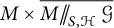 , verifying (i).
In light of (i),
$Y$
 is Lagrangian in
$M\times \overline {M\mkern -4mu\mathbin {/\mkern -5mu/}_{\mkern -4mu{S,\mathcal {H}}}\mathcal G}$
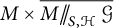 if and only if
$\dim Y=\frac {1}{2}(\dim (M\times \overline {M\mkern -4mu\mathbin {/\mkern -5mu/}_{\mkern -4mu{S,\mathcal {H}}}\mathcal G})$
 . We also have the identities

It is now straightforward to verify that
$\dim Y=\frac {1}{2}(\dim (M\times \overline {M\mkern -4mu\mathbin {/\mkern -5mu/}_{\mkern -4mu{S,\mathcal {H}}}\mathcal G})$
 if and only if
$\mathrm {rank}\hspace {2pt}L_S=\dim X-\dim S$
 . The latter equation holds if and only if
$L_S=\mathrm {ann}_{T^*X}(TS)$
 , as
$\mathrm {rank}\hspace {2pt}(\mathrm {ann}_{T^*X}(TS))=\dim X-\dim S$
 . Letting
$\sigma ^{\vee }:T^*X\longrightarrow TX$
 denote the contraction of the Poisson structure
$\sigma $
 on
$X$
 , the condition
$L_S=\mathrm {ann}_{T^*X}(TS)$
 becomes
$\mathrm {ann}_{T^*X}(TS)\subseteq (\sigma ^{\vee })^{-1}(TS)$
 . This new condition is precisely the definition of
$S$
 being coisotropic in
$X$
 , completing the proof of (ii).
Part (iii) follows immediately from (ii).
There is a another class of Lagrangian submanifolds arising in the context of symplectic reduction along a submanifold. To this end, let a symplectic groupoid
$\mathcal G \;\substack {\longrightarrow \\[-9pt] \longrightarrow }\; X$
 act in a Hamiltonian fashion on a symplectic manifold
$M$
 with moment map
$\mu : M \longrightarrow X$
 . The definition of a Hamiltonian action implies that

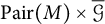
is a Lagrangian subgroupoid of
$\mathrm {Pair}(M) \times \overline {\mathcal G}$
 . More generally, consider a symplectic groupoid
$\mathcal G \;\substack {\longrightarrow \\[-9pt] \longrightarrow }\; X$
 , a Lie group
$G$
 , and a Hamiltonian
$\mathcal G\times T^*G$
 -space
$M$
 with moment map
$(\mu ,\nu ):M\longrightarrow X\times \mathfrak {g}^*$
 . The equivalence between Hamiltonian
$G$
 -spaces and Hamiltonian
$T^*G$
 -spaces renders
$M$
 a Hamiltonian
$G$
 -space. Suppose that
$G$
 acts freely and properly on
$M$
 . Proposition 2.1 yields a symplectic groupoid

It is also clear that
$\mu $
 descends to a Poisson map
$\overline {\mu }:M/G\longrightarrow X$
 . We conclude that

is a Lagrangian relation from
$\mathrm {Pair}(M)\mkern -4mu\mathbin {/\mkern -5mu/}_{\mkern -4mu{0}}G$
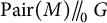 to
$\mathcal G$
 . The following result will be useful in Section 7.
Lemma 2.4 Retain the objects and notation of the previous paragraph. Let
$S \subseteq X$
 be a Poisson transversal, and set
$\tilde {S} := \overline {\mu }^{-1}(S) \subseteq M/G$
 . Then
$\tilde {\textsf {t}}^{-1}(\tilde {S}) \times \textsf {t}^{-1}(S)$
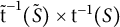 is a symplectic submanifold of
$(M \times _\nu \overline {M})/G \times \overline {\mathcal G}$
 , and its intersection with
$\mathcal {L}_{\overline {\mu }}$
 is a Lagrangian submanifold.
Proof As
$\overline {\mu }$
 is a Poisson map,
$\tilde {S}$
 is a Poisson transversal in
$M/G$
 . This implies the first claim. For the second claim, it remains to check that
$\mathcal {L}_{\overline {\mu }} \cap (\tilde {\textsf {t}}^{-1}(\tilde {S}) \times \textsf {t}^{-1}(S))$
 is smooth and has the correct dimension.
Let us set

Note that we have an embedding

whose image is
$\mathcal {L}_{\overline {\mu }} \cap (\tilde {\textsf {t}}^{-1}(\tilde {S}) \times \textsf {t}^{-1}(S))$
 . At the same time,

On the other hand,

2.7 Quasi-Hamiltonian and quasi-Poisson manifolds
Following Boalch [Reference Boalch10] and a number of his subsequent manuscripts [Reference Boalch and Yamakawa12], we now outline the algebraic and holomorphic approaches to quasi-Hamiltonian and quasi-Poisson geometry in this manuscript. Let
$G$
 be a Lie group with Lie algebra
$\mathfrak {g}$
 , exponential map
$\mathrm {exp}:\mathfrak {g}\longrightarrow G$
 , and fixed
$G$
 -invariant, non-degenerate, symmetric bilinear form
$(\cdot ,\cdot ):\mathfrak {g}\otimes \mathfrak {g}\longrightarrow \mathbb {C}$
 . The Cartan 3-form on
$G$
 is the unique
$G$
 -invariant element
$\eta _G\in \Omega ^3(G)$
 satisfying
$(\eta _G)_e(x,y,z)=\frac {1}{12}(x,[y,z])$
 for all
$x,y,z\in \mathfrak {g}$
 . Note that this expression defines an element of
$\wedge ^3(\mathfrak {g}^*)$
 . Using
$(\cdot ,\cdot )$
 to identify
$\mathfrak {g}$
 and
$\mathfrak {g}^*$
 , this is an element
$\chi _G\in \wedge ^3\mathfrak {g}$
 . One also has
$\theta ^L,\theta ^R\in \Omega ^1(G,\mathfrak {g})$
 , the left and right-invariant Maurer–Cartan forms on
$G$
 , respectively.
Suppose that
$G$
 acts holomorphically on a manifold
$M$
 . Each
$\xi \in \mathfrak {g}$
 thereby determines a generating vector field
$\xi _M\in H^0(M,TM)$
 , that is,

for all
$p\in M$
 . The Lie algebra morphism

extends uniquely to a graded algebra morphism
$\wedge ^{\bullet }\mathfrak {g}\longrightarrow H^0(M,\wedge ^{\bullet }(TM))$
 . Write
$(\chi _G)_M\in H^0(M,\wedge ^3(TM))$
 for the image of
$\chi _G\in \wedge ^3\mathfrak {g}$
 under the latter morphism. One calls
$M$
 a quasi-Poisson G-manifold [Reference Alekseev, Kosmann-Schwarzbach and Meinrenken1] if it comes equipped with a
$G$
 -invariant bivector field
$\sigma \in H^0(M,\wedge ^2(TM))$
 satisfying
$[\sigma ,\sigma ]=(\chi _G)_M$
 , where
$[\sigma ,\sigma ]\in H^0(M,\wedge ^3TM)$
 denotes the Schouten bracket of
$\sigma $
 with itself. Let us write
$\overline {M}$
 for the quasi-Poisson
$G$
 -manifold obtained by negating the quasi-Poisson structure on a quasi-Poisson
$G$
 -manifold
$M$
 .
Let
$M$
 be a quasi-Poisson
$G$
 -manifold. A holomorphic map
$\mu :M\longrightarrow G$
 is called a moment map if it is equivariant with respect to the conjugation action of
$G$
 on itself and satisfies a quasi-Poisson counterpart of Hamilton’s equations (see [Reference Alekseev, Kosmann-Schwarzbach and Meinrenken1, Definition 2.2]. One uses the term quasi-Poisson Hamiltonian G-space for a quasi-Poisson
$G$
 -manifold with a prescribed moment map. Let
$(M_1,\sigma _1,\mu _1)$
 and
$(M_2,\sigma _2,\mu _2)$
 be quasi-Poisson Hamiltonian
$G$
 -spaces. By a map of quasi-Poisson Hamiltonian G-spaces, we mean a holomorphic,
$G$
 -equivariant map
$f:M_1\longrightarrow M_2$
 satisfying
$\mu _1=\mu _2\circ f$
 and
$f_*((\sigma _1)_p)=(\sigma _2)_{f(p)}$
 for all
$p\in M$
 . A quasi-Poisson Hamiltonian
$G$
 -space
$(M,\sigma ,\mu )$
 is called non-degenerate if
$T_pM=\mathrm {im}(\sigma _p^{\vee })+T_p(G\cdot p)$
 for all
$p\in M$
 .
To describe a specialization of the previous paragraph, we again let
$G$
 act holomorphically on a manifold
$M$
 . Consider a
$G$
 -invariant
$2$
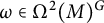
 -form
$\omega \in \Omega ^2(M)^G$
 and
$G$
 -equivariant holomorphic map
$\mu :M\longrightarrow G$
 , where
$G$
 acts on itself by conjugation. One calls
$(M,\omega ,\mu )$
 a quasi-Hamiltonian G-space [Reference Alekseev, Malkin and Meinrenken2] if the following conditions are satisfied:
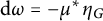
-
(i) $\mathrm {d}\omega =-\mu ^*\eta _G$
; -
(ii) $\mathrm {ker}(\omega _p)=\{\xi _M(p):\xi \in \mathrm {ker}(\mathrm {Ad}_{\mu (p)}+\mathrm {id}_{\mathfrak {g}})\}$
for all
$p\in M$
; -
(iii) $\iota _{\xi _M}\omega =\frac {1}{2}\mu ^*(\theta ^L+\theta ^R,\xi )$
for all
$\xi \in \mathfrak {g}$
.




If
$(M,\sigma ,\mu )$
 is a non-degenerate quasi-Poisson Hamiltonian
$G$
 -space, then there exists a unique
$2$
 -form
$\omega \in \Omega ^2(M)$
 for which
$\sigma $
 and
$\omega $
 satisfy [Reference Alekseev, Kosmann-Schwarzbach and Meinrenken1, Equation (32)] and
$(M,\omega ,\mu )$
 is a quasi-Hamiltonian
$G$
 -space. Quasi-Hamiltonian
$G$
 -spaces are thereby in bijective correspondence with non-degenerate quasi-Poisson Hamiltonian
$G$
 -spaces. At the same time, every quasi-Poisson Hamiltonian
$G$
 -space partitions into quasi-Hamiltonian leaves [Reference Alekseev, Kosmann-Schwarzbach and Meinrenken1].
2.8 Quasi-symplectic groupoids over quotients of quasi-Hamiltonian manifolds
Suppose that
$G$
 and
$H$
 are Lie groups with fixed, non-degenerate, invariant, symmetric bilinear forms on their respective Lie algebras. Let
$(M,\omega )$
 be a quasi-Hamiltonian
$G\times H$
 -space with moment map
$(\mu ,\nu ):M\longrightarrow G\times H$
 . If
$G$
 acts freely and properly on
$M$
 , then
$M/G$
 carries a unique quasi-Poisson
$H$
 -space structure for which the quotient map
$\pi :M\longrightarrow M/G$
 is a morphism of quasi-Poisson
$H$
 -spaces [Reference Bălibanu and Mayrand6, Corollary 4.7]. The moment map on
$M/G$
 is obtained by descending
$\nu $
 to a holomorphic map
$\overline {\nu }:M/G\longrightarrow H$
 .
On the other hand,
$M\times \overline {M}$
 is a quasi-Hamiltonian
$G\times G\times H\times H$
 -space. Two applications of fusion [Reference Alekseev, Malkin and Meinrenken2, Theorem 6.1] render
$M\times \overline {M}$
 a quasi-Hamiltonian
$G\times H$
 -space. The group
$G\times H$
 thereby acts diagonally on
$M\times M$
 , and with moment map

It follows that the quasi-Hamiltonian reduction
$(M\times \overline {M})\mkern -4mu\mathbin {/\mkern -5mu/}_{\mkern -4mu{e}}G=(M\times _GM)/G$
 is a quasi-Hamiltonian
$H$
 -space; write
$\sigma $
 for the underlying
$2$
 -form on
$(M\times _G M)/G$
 . One also finds that the Lie groupoid structure on
$\mathrm {Pair}(M)$
 induces such a structure on
$(M\times _G M)/G \;\substack {\longrightarrow \\[-9pt] \longrightarrow }\; M/G$
 ; write
$\mathrm {Pair}(M)\mkern -4mu\mathbin {/\mkern -5mu/}_{\mkern -4mu{e}}G$
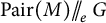 for this new Lie groupoid.
Proposition 2.5 If
$G$
 acts freely and properly on
$M$
 , then
$(\mathrm {Pair}(M)\mkern -4mu\mathbin {/\mkern -5mu/}_{\mkern -4mu{e}}G,\sigma ,\overline {\nu }^*\eta _H)$
 is a quasi-symplectic groupoid.
Proof We first check the following compatibility conditions:
-
(1) $\sigma $
is multiplicative; -
(2) $\mathrm {d}\sigma = \textsf {s}^*\overline {\nu }^*\eta _H - \textsf {t}^*\overline {\nu }^*\eta _H$
; -
(3) $\mathrm {d}\overline {\nu }^*\eta _H = 0$
.



Condition (3) is clear.
Let
$i : M \times _G M \longrightarrow M \times M$
 be the inclusion map and
$\pi : M \times _G M \longrightarrow (M \times _G M) / G$
 the quotient map. It follows from the definition of the quasi-Hamiltonian 2-form on the fusion product
$M \times \overline {M}$
 that its pullback by
$i^*$
 coincides with
$i^*(\mathrm {pr}_1^*\omega - \mathrm {pr}_2^*\omega )$
 , where
$\mathrm {pr}_i : M \times M \to M$
 are the projections. This implies that

Since
$\mathrm {pr}_1^*\omega - \mathrm {pr}_2^*\omega $
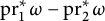 is multiplicative on
$\mathrm {Pair}(M)$
 , it follows that
$\sigma $
 is also multiplicative, verifying (1). To check that (2) holds, note that (2.1) gives

where the last equality follows from the fact that
$\mu \circ \mathrm {pr}_1 \circ i = \mu \circ \mathrm {pr}_2 \circ i$
 .
We have
$\dim (M \times _G M)/G = 2 \dim M/G$
 , so it only remains to show that
$\ker \sigma _{(p, p)} \cap \ker \mathrm {d}\textsf {s} \cap \ker \mathrm {d}\textsf {t} = 0$
 for all
$p \in M$
 . A general vector in
$\ker \mathrm {d}\textsf {s} \cap \ker \mathrm {d}\textsf {t}$
 takes the form
$(0,(\xi _M)_p)$
 for
$\xi \in \mathfrak {g}$
 , where
$\mathrm {d}\mu _p((\xi _M)_p) = 0$
 , that is,
$\mathrm {Ad}_{\mu (p)^{-1}}\xi - \xi = 0$
 . The condition that
$(0,(\xi _M)_p) \in \ker \sigma $
 then amounts to the condition that
$(\xi _M)_p \in \ker \omega _p = \{v_\zeta : \zeta \in \ker (\mathrm {Ad}_{\mu (p)} + 1)\}$
 . It follows that also
$\mathrm {Ad}_{\mu (p)}(\xi ) + \xi = 0$
 , and hence
$\xi = 0$
 .
Remark 2.6 Suppose that the hypotheses of Proposition 2.5 are satisfied. A straightforward exercise shows that the orbits of
$\mathrm {Pair}(M)\mkern -4mu\mathbin {/\mkern -5mu/}_{\mkern -4mu{e}}G\;\substack {\longrightarrow \\[-9pt] \longrightarrow }\; M/G$
 are precisely the subsets
$\mu ^{-1}(\mathcal {C})/G\subseteq M/G$
 , where
$\mathcal {C}$
 ranges over the conjugacy classes
$\mathcal {C}\subseteq G$
 . We exploit this observation in the proof of Theorem 9.5.
3 TQFTs in a
$1$
-shifted Weinstein symplectic category

This section outlines some results of [Reference Crooks and Mayrand22], including the construction of TQFTs in a completion of a
$1$
 -shifted Weinstein symplectic “category.” In Section 3.1, we recall the Moore–Tachikawa conjecture and outline progress on its resolution. Details on a completed
$1$
 -shifted Weinstein symplectic “category”
$\mathbf {WS}_1$
 are given in Section 3.2. Section 3.3 then outlines a main result of [Reference Crooks and Mayrand22], in which quasi-symplectic groupoids with admissible global slices determine TQFTs in
$\mathbf {WS}_1$
 . Connections to the Moore–Tachikawa conjecture are described in Section 3.4.
3.1 The Moore–Tachikawa conjecture
Let
$\mathbf {C}$
 be a symmetric monoidal category. A two-dimensional TQFT in
$\mathbf {C}$
 is a symmetric monoidal functor
$\mathbf {Cob}_2\longrightarrow \mathbf {C}$
 , where
$\mathbf {Cob}_2$
 is the category of two-dimensional cobordisms. While one often takes
$\mathbf {C}$
 to be vector spaces over a fixed field, other cases warrant consideration. This is a context in which to formulate the Moore–Tachikawa conjecture [Reference Moore, Tachikawa, Block, Distler, Donagi and Sharpe40]. Moore and Tachikawa take
$\mathbf {C}$
 to be
$\mathbf {MT}$
 , a category of affine symplectic varieties with Hamiltonian actions. Complex semisimple affine algebraic groups constitute the objects of
$\mathbf {MT}$
 . Morphisms in
$\mathrm {Hom}_{\mathbf {MT}}(G,H)$
 are certain isomorphism classes of affine Hamiltonian
$G\times H$
 -varieties. One composes morphisms in
$\mathbf {MT}$
 via Hamiltonian reduction at level zero: given
$[X]\in \mathrm {Hom}_{\mathbf {MT}}(G,H)$
 and
$[Y]\in \mathrm {Hom}_{\mathbf {MT}}(H,K)$
 , we have
$[Y]\circ [X]:= [(X\times Y)\mkern -4mu\mathbin {/\mkern -5mu/}_{\mkern -4mu{0}}H]\in \mathrm {Hom}_{\mathbf {MT}}(G,K)$
 . Products of objects and morphisms constitute the tensor product of a symmetric monoidal structure on
$\mathbf {MT}$
 .
Now let
$G$
 be a connected semisimple affine algebraic group with Lie algebra
$\mathfrak {g}$
 . Consider the Kostant slice [Reference Kostant33]
$\mathrm {Kos}\subseteq \mathfrak {g}$
 associated with a principal
$\mathfrak {sl}_2$
 -triple in
$\mathfrak {g}$
 [Reference Kostant32], that is, an
$\mathfrak {sl}_2$
 -triple
$(e,h,f)\in \mathfrak {g}^{\times 3}$
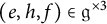 with
$e,h,f\in \mathfrak {g}_{\mathrm {reg}}$
 . It turns out that the affine variety
$G\times \mathrm {Kos}$
 is symplectic in a natural way, as follows from generalities on Kostant–Whittaker reduction [Reference Kostant34] (see [Reference Bielawski8, Reference Crooks and Röser24] as well). Left multiplication in the first factor defines a Hamiltonian action of
$G$
 on
$G\times \mathrm {Kos}$
 . As such, the isomorphism class of
$G\times \mathrm {Kos}$
 is a morphism from
$G$
 to the trivial group in
$\mathbf {MT}$
 . This is a context for the Moore–Tachikawa conjecture; we state it below.
Conjecture 3.1 (Moore–Tachikawa [Reference Moore, Tachikawa, Block, Distler, Donagi and Sharpe40])
Let
$G$
 be a connected semisimple affine algebraic group with Lie algebra
$\mathfrak {g}$
 . Suppose that
$\mathrm {Kos}\subseteq \mathfrak {g}$
 is the Kostant slice associated with a principal
$\mathfrak {sl}_2$
 -triple in
$\mathfrak {g}$
 . There exists a two-dimensional TQFT
$\eta _{G}:\mathbf {Cob}_2\longrightarrow \mathbf {MT}$
 satisfying
$\eta _G(S^1)=G$
 and
 .
The Moore–Tachikawa conjecture is known to hold in Lie type
$A$
 , as follows from combining the unpublished work of Ginzburg–Kazhdan [Reference Ginzburg and Kazhdan30] with the results of Braverman–Finkelberg–Nakajima [Reference Braverman, Finkelberg and Nakajima15]. In [Reference Crooks and Mayrand22], we reformulate the Moore–Tachikawa conjecture in the language of shifted symplectic geometry. We also generalize this reformulation to obtain new TQFTs in a
$1$
 -shifted Weinstein symplectic category. The following are some pertinent details.
3.2 A
$1$
-shifted Weinstein symplectic “category”

Recall that two morphisms in a category are composable if and only if the source of one is the target of the other. By relaxing this to a necessary condition for composing morphisms, we arrive at the definition of a “category.” One particularly notable example is Weinstein’s symplectic “category” [Reference Weinstein, Doebner, Andersson and Petry47]. We briefly recall our
$1$
 -shifted counterpart of this “category” (see [Reference Crooks and Mayrand22, Section 3] for a more comprehensive discussion).
Let
$(\mathcal G\;\substack {\longrightarrow \\[-9pt] \longrightarrow }\; X,\omega ,\phi )$
 be a quasi-symplectic groupoid. A 1-shifted Lagrangian on
$\mathcal G$
 is the data of a Lie groupoid
$\mathcal {L}\;\substack {\longrightarrow \\[-9pt] \longrightarrow }\; Y$
 ,
$2$
 -form
$\gamma $
 on
$Y$
 , and Lie groupoid morphism
$\nu :\mathcal {L}\longrightarrow \mathcal G$
 , such that certain compatibility conditions are satisfied (see [Reference Mayrand38, Section 3.1] or [Reference Pantev, Toën, Vaquié and Vezzosi41]). A 1-shifted Lagrangian relation from a quasi-symplectic groupoid
$\mathcal G_1$
 to a quasi-symplectic groupoid
$\mathcal G_2$
 is a
$1$
 -shifted Lagrangian
$\mathcal {L}\longrightarrow \mathcal G_1\times \overline {\mathcal G_2}$
 on
$\mathcal G_1\times \overline {\mathcal G_2}$
 . We sometimes adopt the notation

for such a correspondence. Two such correspondences

are declared to be composable if a transversality condition is satisfied (see [Reference Crooks and Mayrand22, Section 2.3] for further details). In this case, the homotopy fiber product [Reference Mayrand38, Section 4.2]

is a
$1$
 -shifted Lagrangian relation from
$\mathcal G_1$
 to
$\mathcal G_3$
 .
In light of the above, we define the 1-shifted Weinstein symplectic “category”
$\mathbf {WS}\text{"}_{\mkern -7mu 1}$
 as follows. Quasi-symplectic groupoids constitute the objects of
$\mathbf {WS}\text{"}_{\mkern -7mu 1}$
 . Morphisms from
$\mathcal G_1$
 and
$\mathcal G_2$
 are weak equivalence classes [Reference Crooks and Mayrand22, Section 2.4] of
$1$
 -shifted Lagrangian relations from
$\mathcal G_1$
 to
$\mathcal G_2$
 . Given composable
$1$
 -shifted Lagrangian relations

we define

Using a variant of the Wehrheim–Woodward approach [Reference Wehrheim and Woodward45], we complete
$\mathbf {WS}"_{\mkern -11mu 1}$
 to a genuine category
$\mathbf {WS}_1$
 . We subsequently show
$\mathbf {WS}_1$
 to be a symmetric monoidal category (see [Reference Crooks and Mayrand22, Section 3.3]).
3.3 TQFTs valued in
$\mathbf {WS}_1$

Recall that if
$M$
 is a Hamiltonian
$\mathcal G_1 \times \overline {\mathcal G_2}$
 -space for quasi-symplectic groupoids
$\mathcal G_1$
 and
$\mathcal G_2$
 , then the action groupoid
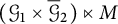
$(\mathcal G_1 \times \overline {\mathcal G}_2) \ltimes M$
 is a 1-shifted Lagrangian relation from
$\mathcal G_1$
 to
$\mathcal G_2$
 via the two projections (see [Reference Calaque, Pantev, Simpson, Toën, Vaquié and Vezzosi17, Example 1.31] or [Reference Mayrand38, Proposition 9.3]). In this way, Hamiltonian
$\mathcal G_1 \times \overline {\mathcal G_2}$
 -spaces are equivalent to
$1$
 -shifted Lagrangian structures on
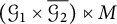
$(\mathcal G_1 \times \overline {\mathcal G_2}) \ltimes M$
 from
$\mathcal G_1$
 to
$\mathcal G_2$
 . Note that this perspective allows one to interpret Hamiltonian
$\mathcal G_1 \times \overline {\mathcal G_2}$
 -spaces as morphisms in
$\mathbf {WS}\text{"}_{\mkern -7mu 1}$
 .
Let
$\mathcal G\;\substack {\longrightarrow \\[-9pt] \longrightarrow }\; X$
 be a Lie groupoid. A submanifold
$S\subseteq X$
 is called a global slice if its intersection with each
$\mathcal G$
 -orbit in
$X$
 is transverse and a singleton. This slice is called admissible if the isotropy group
$\mathcal G_x:= \textsf {s}^{-1}(x)\cap \textsf {t}^{-1}(x)$
 is abelian for all
$x\in S$
 . For
$\mathcal G\;\substack {\longrightarrow \\[-9pt] \longrightarrow }\; X$
 , a symplectic groupoid with a global slice
$S\subseteq X$
 , it follows that
$\textsf {t}^{-1}(S) \subseteq \mathcal G$
 is a Hamiltonian
$\mathcal G$
 -space with respect to the action by right multiplication. This leads to the following result from [Reference Crooks and Mayrand22].
Theorem 3.2 Consider a quasi-symplectic groupoid
$(\mathcal G\;\substack {\longrightarrow \\[-9pt] \longrightarrow }\; X,\omega ,\phi )$
 and admissible global slice
$S\subseteq X$
 . If
$\phi $
 restricts to an exact 3-form on
$S$
 , then there exists an explicit TQFT
$\eta _{\mathcal G,S}:\mathbf {Cob}_2\longrightarrow \mathbf {WS}_1$
 satisfying
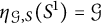
$\eta _{\mathcal G,S}(S^1)=\mathcal G$
 and
 .
As explained in [Reference Crooks and Mayrand22, Section 4.4], the TQFT structure comes from the abelian symplectic groupoid
$\mathcal {A} := \mathcal G\big \vert _S$
 ; it is Morita equivalent to
$\mathcal G$
 via the inclusion map
$\mathcal {A} \longrightarrow \mathcal G$
 . Let us set

for
$m,n\in \mathbb {Z}_{\geq 0}$
 with
$(m,n)\neq (0,0)$
 , where
$*$
 denotes the fiber product over
$S$
 . We have that
$\eta _{\mathcal G,S}(C_{m, n}) = [\mathcal {A}^{m, n}]$
 for all
$m,n\in \mathbb {Z}_{\geq 0}$
 with
$(m,n)\neq (0,0)$
 , where
$C_{m,n}$
 is the standard two-dimensional cobordism from
$m$
 circles to
$n$
 circles. One views
$\mathcal {A}^{m, n}$
 as a Lagrangian relation from
$\mathcal G^m$
 to
$\mathcal G^n$
 via the maps
$\mathcal {A}^{m, n} \longrightarrow \mathcal {A}^m \hookrightarrow \mathcal G^m$
 and
$\mathcal {A}^{m, n} \longrightarrow \mathcal {A}^n \hookrightarrow \mathcal G^n$
 (see [Reference Crooks and Mayrand22, Remark 4.6 and Section 4.4]).
The morphism
$\eta _{\mathcal G,S}(C_{m, n})$
 from
$\mathcal G^m$
 to
$\mathcal G^n$
 can be described as a Hamiltonian
$\mathcal G^m \times \overline {\mathcal G}^n$
 -space in the following way. The action groupoid
$(\mathcal G \times \mathcal G) \ltimes \mathcal G$
 for the Hamiltonian
$\mathcal G \times \overline {\mathcal G}$
 -space
$\mathcal G$
 acts as an identity in
$\mathbf {WS}_1$
 . By composing on both sides with identities

we see that
$\eta _{\mathcal G}(C_{m, n})$
 can be described as

where

Since
$\mathcal {A}^{m, n}$
 is closed in
$\mathcal G^m \times \mathcal G^n$
 , it acts freely and properly on
$Z$
 . It follows that (3.1) is equivalent to

(see [Reference Mayrand38, Theorem 7.2]). On the other hand, a Hamiltonian space is equivalent to a 1-shifted Lagrangian structure on an action groupoid [Reference Mayrand38, Proposition 9.3]. It follows that

is a Hamiltonian
$\mathcal G^m \times \overline {\mathcal G}^n$
 -space with respect to the
$2$
 -form
$\eta $
 determined by

where
$\pi : Z \to Z / \mathcal {A}^{m, n}$
 is the quotient map,
$i : Z \hookrightarrow \mathcal G^m \times \mathcal G^n$
 is the inclusion map, and
$(\omega , \ldots , \omega )$
 is the natural 2-form on
$\mathcal G^m \times \mathcal G^n$
 . We summarize this discussion in the following proposition.
Proposition 3.3 Consider a quasi-symplectic groupoid
$(\mathcal G\;\substack {\longrightarrow \\[-9pt] \longrightarrow }\; X,\omega ,\phi )$
 and admissible global slice
$S\subseteq X$
 with the property that
$\phi $
 restricts to an exact 3-form on
$S$
 . The TQFT
$\eta _{\mathcal G,S}:\mathbf {Cob}_2\longrightarrow \mathbf {WS}_1$
 then satisfies
$\eta _{\mathcal G,S}(C_{m,n}) = \mathcal G_S^{m,n}$
 for all
$(m, n) \ne (0, 0)$
 .
In the case, where
$\mathcal G$
 is a symplectic groupoid, the Hamiltonian space
$Z/\mathcal {A}^{m, n}$
 can be seen as a reduction along a submanifold in the sense of Section 2.5. To this end, note that
$\mathcal G^{m + n}$
 is a Hamiltonian
$\overline {\mathcal G}^m \times \mathcal G^n \times \overline {\mathcal G}^n \times \mathcal G^m$
 space. One finds that

is pre-Poisson with stabilizer subgroupoid
$\mathcal {A}^{m, n}$
 . It follows from (3.2) that
$\mathcal G^{m, n}_S$
 is the reduction of
$\mathcal G^{m + n}$
 along
$S^{m,n}$
 with respect to
$\mathcal {A}^{m, n} \longrightarrow S^{m, n}$
 .
Remark 3.4 More generally, if
$\mathcal G$
 is a quasi-symplectic groupoid, one can see that
$\mathcal G^{m,n}_S$
 is a reduction in the sense of [Reference Bălibanu and Mayrand6].
3.4 Connections to the Moore–Tachikawa conjecture and multiplicative counterparts
Let
$G$
 be a connected semisimple affine algebraic group with Lie algebra
$\mathfrak {g}$
 . Use the Killing form to freely identify
$\mathfrak {g}^*$
 and
$\mathfrak {g}$
 as Poisson varieties. At the same time, let
$(e,h,f)\in \mathfrak {g}^{\times 3}$
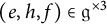 be a principal
$\mathfrak {sl}_2$
 -triple. The affine subvariety
$\mathrm {Kos}:= e+\mathfrak {g}_f\subseteq \mathfrak {g}$
 is an admissible global slice to the restricted cotangent groupoid
$(T^*G)_{\text {reg}}:= (T^*G)\big \vert _{\mathfrak {g}_{\text {reg}}}\;\substack {\longrightarrow \\[-9pt] \longrightarrow }\;\mathfrak {g}_{\mathrm {reg}}$
 . Theorem 3.2 then yields an explicit TQFT
$\eta _{\mathcal G,S}:\mathbf {Cob}_2\longrightarrow \mathbf {WS}_1$
 , where
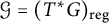
$\mathcal G=(T^*G)_{\text {reg}}$
 and
$S=\mathrm {Kos}$
 . Note that Proposition 3.3 gives explicit Hamiltonian spaces in the image of
$\eta _{\mathcal G,S}$
 ; these are called the open Moore–Tachikawa varieties. In [Reference Crooks and Mayrand22], we “affinize”
$\eta _{\mathcal G,S}$
 to construct the Moore–Tachikawa TQFT in a category of affine Hamiltonian schemes.
There is a multiplicative counterpart to the above. A first step is to replace
$T^*G\;\substack {\longrightarrow \\[-9pt] \longrightarrow }\;\mathfrak {g}$
 with the double
$\mathrm {D}(G)=G\times G\;\substack {\longrightarrow \\[-9pt] \longrightarrow }\; G$
 , a quasi-symplectic groupoid integrating the Cartan–Dirac structure on
$G$
 [Reference Alekseev, Malkin and Meinrenken2]. One then replaces
$\mathrm {Kos}\subseteq \mathfrak {g}$
 with a Steinberg slice
$\mathrm {Ste}\subseteq G$
 [Reference Steinberg43]. If
$G$
 is simply-connected, it turns out that
$\mathrm {Ste}$
 is an admissible global slice to the quasi-symplectic groupoid
$\mathrm {D}(G)_{\text {reg}}:= \mathrm {D}(G)\big \vert _{G_{\text {reg}}}\;\substack {\longrightarrow \\[-9pt] \longrightarrow }\; G_{\text {reg}}$
 . By [Reference Bălibanu and Mayrand6, Example 2.30], this groupoid
$\mathcal G$
 and slice
$S$
 satisfy the hypotheses of Theorem 3.2 and Proposition 3.3. The quasi-Hamiltonian spaces
$\eta _{\mathcal G,S}(C_{m,n})$
 are studied in [Reference Bălibanu and Mayrand6], as multiplicative analogs of the open Moore–Tachikawa varieties. We refer the reader to Sections 8 and 9 for precise descriptions of the objects in this paragraph.
4 Some Lie-theoretic considerations in Poisson geometry
In this section, we prove certain Lie-theoretic results needed to realize Poisson-geometric aspects of partial Grothendieck–Springer resolutions. Section 4.1 introduces universal Levi factors for parabolic subgroups and subalgebras, while Section 4.2 reviews regular elements in reductive Lie algebras. A useful characterization of regular elements in Levi factors is given in Section 4.3. We then devote Sections 4.4 and 4.5 to the Hamiltonian Poisson geometry of
$G\times _P\mathfrak {p}$
 , where
$P$
 is a parabolic subgroup with Lie algebra
$\mathfrak {p}$
 .
For the balance of this manuscript,
$G$
 is a connected semisimple affine algebraic group with Lie algebra
$\mathfrak {g}$
 , rank
$\ell $
 , adjoint representation
$\mathrm {Ad}:G\longrightarrow \mathrm {GL}(\mathfrak {g})$
 , and exponential map
$\mathrm {exp}:\mathfrak {g}\longrightarrow G$
 .
4.1 Parabolic subgroups and subalgebras
Given a parabolic subgroup
$P\subseteq G$
 (resp. parabolic subalgebra
$\mathfrak {p}\subseteq \mathfrak {g}$
 ), write
$U(P)\subseteq P$
 (resp.
$\mathfrak {u}(\mathfrak {p})\subseteq \mathfrak {p}$
 ) for the unipotent radical of
$P$
 (resp. nilpotent radical of
$\mathfrak {p}$
 ). The quotients
$L(P):= P/U(P)$
 and
$\mathfrak {l}(\mathfrak {p}):= \mathfrak {p}/\mathfrak {u}(\mathfrak {p})$
 will be called the universal Levi factors of
$P$
 and
$\mathfrak {p}$
 , respectively. If
$\mathfrak {p}$
 is the Lie algebra of
$P$
 , then
$\mathfrak {u}(\mathfrak {p})$
 and
$\mathfrak {l}(\mathfrak {p})$
 are the Lie algebras of
$U(P)$
 and
$L(P)$
 , respectively.
4.2 Regular elements in reductive Lie algebras
Let
$K$
 be a connected reductive affine algebraic group with Lie algebra
$\mathfrak {k}$
 . Write
$K_x\subseteq K$
 and
$\mathfrak {k}_x\subseteq \mathfrak {k}$
 for the
$K$
 and
$\mathfrak {k}$
 -centralizers of
$x\in \mathfrak {k}$
 under the adjoint representation, respectively. Consider the regular locus

If we identify
$\mathfrak {k}$
 with
$\mathfrak {k}^*$
 via a non-degenerate,
$K$
 -invariant, symmetric bilinear form on the former, then
$\mathfrak {k}_{\text {reg}}$
 becomes the regular locus of the Poisson variety
$\mathfrak {k}^*$
 . We are principally interested in the regular locus of
$\mathfrak {k}=\mathfrak {l}(\mathfrak {p})$
 for a parabolic subalgebra
$\mathfrak {p}\subseteq \mathfrak {g}$
 .
4.3 Regular elements in Levi factors
Let
$P\subseteq G$
 be a parabolic subgroup with Lie algebra
$\mathfrak {p}\subseteq \mathfrak {g}$
 . Observe that
$U(P)$
 acts trivially on the
$P$
 -module
$\mathfrak {l}(\mathfrak {p})$
 . One thereby obtains an action of the reductive group
$L(P)$
 on
$\mathfrak {l}(\mathfrak {p})$
 ; it is the adjoint representation of
$L(P)$
 . Write
$P_{[x]}\subseteq P$
 and
$L(P)_{[x]}\subseteq L(P)$
 for the stabilizers of
$[x]\in \mathfrak {l}(\mathfrak {p})$
 under the actions of
$P$
 and
$L(P)$
 , respectively. It is straightforward to verify that
$L(P)_{[x]}=P_{[x]}/U(P)$
 for all
$[x]\in \mathfrak {l}(\mathfrak {p})$
 .
Lemma 4.1 Suppose that
$x\in \mathfrak {p}$
 .
-
(i) If $(x+\mathfrak {u}(\mathfrak {p}))\cap \mathfrak {g}_{\mathrm {reg}}\neq \emptyset $
, then
$(x+\mathfrak {u}(\mathfrak {p}))\cap \mathfrak {g}_{\mathrm {reg}}$
is an orbit of
$P_{[x]}$
in
$\mathfrak {g}$
. -
(ii) One has $(x+\mathfrak {u}(\mathfrak {p}))\cap \mathfrak {g}_{\mathrm {reg}}\neq \emptyset $
if and only if
$[x]\in \mathfrak {l}(\mathfrak {p})_{\text {reg}}$
. -
(iii) If $\mathfrak {p}$
is a Borel subalgebra, then
$(x+\mathfrak {u}(\mathfrak {p}))\cap \mathfrak {g}_{\mathrm {reg}}$
is non-empty.








Proof We begin by proving (i). To this end, observe that
$x+\mathfrak {u}(\mathfrak {p})$
 is stable under the adjoint action of
$P_{[x]}$
 on
$\mathfrak {g}$
 . It therefore suffices to prove that the
$P_{[x]}$
 -orbit of any point in
$(x+\mathfrak {u}(\mathfrak {p}))\cap \mathfrak {g}_{\mathrm {reg}}$
 is open and dense in
$x+\mathfrak {u}(\mathfrak {p})$
 . We also recognize that
$P_{[x]}$
 -orbits are open in their closures, and that
$x+\mathfrak {u}(\mathfrak {p})$
 is irreducible. This further reduces us to proving that the dimension of the
$P_{[x]}$
 -orbit of any point in
$(x+\mathfrak {u}(\mathfrak {p}))\cap \mathfrak {g}_{\mathrm {reg}}$
 equals
$\dim (x+\mathfrak {u}(\mathfrak {p}))$
 .
Suppose that
$y\in (x+\mathfrak {u}(\mathfrak {p}))\cap \mathfrak {g}_{\mathrm {reg}}$
 . It follows that

where the fifth line follows from the fact that

Since
$P_{[x]}\cdot y\subseteq x+\mathfrak {u}(\mathfrak {p})$
 , the two inequalities in (4.1) must be equalities. We conclude that
$\dim (P_{[x]}\cdot y)=\dim (x+\mathfrak {u}(\mathfrak {p}))$
 and
$\dim L(P)_{[x]}=\ell $
 . This verifies (i), as well as the forward implication in (ii).
To prove the backward implication in (ii), choose a Cartan subalgebra
$\mathfrak {h}\subseteq \mathfrak {g}$
 and Borel subalgebra
$\mathfrak {b}\subseteq \mathfrak {g}$
 satisfying
$\mathfrak {h}\subseteq \mathfrak {b}\subseteq \mathfrak {p}$
 . These choices yield sets of roots
$\Phi \subseteq \mathfrak {h}^*$
 , positive roots
$\Phi ^{+}\subseteq \Phi $
 , and simple roots
$\Delta \subseteq \Phi ^{+}$
 . There is a unique subset
$\Gamma \subseteq \Delta $
 satisfying
$\mathfrak {p}=\mathfrak {l}\oplus \mathfrak {u}(\mathfrak {p})$
 , where

It suffices to prove that
$x+\mathfrak {u}(\mathfrak {p})\cap \mathfrak {g}_{\mathrm {reg}}\neq \emptyset $
 for all
$x\in \mathfrak {l}_{\text {reg}}$
 .
Suppose that
$x\in \mathfrak {l}_{\text {reg}}$
 . Choose
$e_{\alpha }\in \mathfrak {g}_{\alpha }\setminus \{0\}$
 for each
$\alpha \in \Delta $
 , and consider the elements

At the same time, let
$\mathfrak {b}_{-}\subseteq \mathfrak {g}$
 denote the opposite Borel subalgebra with respect to
$\mathfrak {h}$
 and
$\mathfrak {b}$
 . The regularity of
$x$
 in
$\mathfrak {l}$
 allows one to find
$g\in L$
 satisfying
$\mathrm {Ad}_g(x)\in e_{\Gamma }+\mathfrak {b}_{-}$
 [Reference Kostant33, Theorem 8], where
$L\subseteq G$
 is a Levi subgroup integrating
$\mathfrak {l}$
 . Setting
$y:= \mathrm {Ad}_g(x)$
 and noting that
$\mathrm {Ad}_g(\mathfrak {u}(\mathfrak {p}))=\mathfrak {u}(\mathfrak {p})$
 , it suffices to prove that
$(y+\mathfrak {u}(\mathfrak {p}))\cap \mathfrak {g}_{\mathrm {reg}}\neq \emptyset $
 . On the other hand, note that
$(e_{\Delta }-e_{\Gamma })\in \mathfrak {u}(\mathfrak {p})$
 and
$y+(e_{\Delta }-e_{\Gamma })\in e_{\Delta }+\mathfrak {b}_{-}$
 . The former implies that
$y+(e_{\Delta }-e_{\Gamma })\in y+\mathfrak {u}(\mathfrak {p})$
 , and the latter tells us that
$y+(e_{\Delta }-e_{\Gamma })\in \mathfrak {g}_{\mathrm {reg}}$
 [Reference Kostant33, Lemma 10]. We conclude that
$(y+\mathfrak {u}(\mathfrak {p}))\cap \mathfrak {g}_{\mathrm {reg}}\neq \emptyset $
 . This completes the proof of (ii). Part (iii) follows immediately from (ii).
Lemma 4.2 Let
$\mathfrak {p}\subseteq \mathfrak {g}$
 be a parabolic subalgebra. If
$x\in \mathfrak {p}\cap \mathfrak {g}_{\mathrm {reg}}$
 , then
$G_x\subseteq P$
 .
Proof Since
$Z(G)\subseteq P$
 , we may assume that
$G$
 is of adjoint type. We begin by letting
$\mathfrak {p}_{[x]}\subseteq \mathfrak {g}$
 denote the Lie algebra of
$P_{[x]}$
 , and recalling that the inequalities in (4.1) are equalities. By using these equalities in the special case
$y=x$
 , we find that
$\dim \mathfrak {p}_{[x]}-\dim (\mathfrak {p}_{[x]}\cap \mathfrak {g}_x)=\dim \mathfrak {p}_{[x]}-\ell $
 . This amounts to having
$\dim (\mathfrak {p}_{[x]}\cap \mathfrak {g}_x)=\ell $
 . We also have
$\dim \mathfrak {g}_x=\ell $
 , implying that
$\mathfrak {p}_{[x]}\cap \mathfrak {g}_x=\mathfrak {g}_x$
 . This is equivalent to the inclusion
$\mathfrak {g}_{x}\subseteq \mathfrak {p}_{[x]}$
 . In particular,
$\mathfrak {g}_{x}\subseteq \mathfrak {p}$
 . The inclusion
$G_x\subseteq P$
 now follows from the fact that
$G_x$
 is connected [Reference Kostant33, Proposition 14].
4.4 Residual actions on associated bundles
Consider a closed subgroup
$H\subseteq G$
 and finite-dimensional
$H$
 -module
$V$
 . Let
$G\times H$
 act on
$G\times V$
 by

The action of
$H=\{e\}\times H\subseteq G\times H$
 admits a geometric quotient

to which the action of
$G=G\times \{e\}\subseteq G\times H$
 descends. This quotient variety forms a
$G$
 -equivariant vector bundle over
$G/H$
 , with bundle projection

Now suppose that
$K\subseteq H$
 is a closed, normal subgroup. We may form the geometric quotient variety
$G\times _K V$
 , as above. Note that the action of
$G\times H$
 on
$G\times V$
 descends to an action of
$G\times (H/K)$
 on
$G\times _K V$
 . The natural map
$G\times _K V\longrightarrow G\times _H V$
 is then a geometric quotient of
$G\times _K V$
 by
$H/K = \{e\}\times (H/K)\subseteq G\times (H/K)$
 .
4.5 The Poisson Hamiltonian
$G$
-variety
$G\times _P\mathfrak {p}$


Consider a parabolic subgroup
$P\subseteq G$
 with Lie algebra
$\mathfrak {p}\subseteq \mathfrak {g}$
 . Let
$\pi :G\longrightarrow G/U(P)$
 denote the quotient morphism. The differential
$\mathrm {d}\pi _e:\mathfrak {g}\longrightarrow T_{[e]}(G/U(P))$
 is surjective with kernel
$\mathfrak {u}(\mathfrak {p})$
 , and so descends to a
$U(P)$
 -module isomorphism

By inverting the induced isomorphism of dual vector spaces, one obtains a
$U(P)$
 -module isomorphism

Note that

for all
$\phi \in (\mathfrak {g}/\mathfrak {u}(\mathfrak {p}))^*$
 and
$\xi \in \mathfrak {g}$
 , and that
$\alpha $
 induces an isomorphism of
$G$
 -equivariant vector bundles over
$G/U(P)$
 . This isomorphism is given by

where
$L_g:G/U(P)\longrightarrow G/U(P)$
 is left multiplication by
$g\in G$
 .
Consider the action of
$G\times G$
 on
$G$
 defined by

There is an induced action of
$G\times L(P)$
 on
$G/U(P)$
 . The group
$G\times L(P)$
 thereby acts on the cotangent bundle
$T^*(G/U(P))$
 . On the other hand, consider the
$P$
 -modules
$(\mathfrak {g}/\mathfrak {u}(\mathfrak {p}))^*$
 and
$\mathfrak {p}$
 . The discussion in Section 4.4 yields induced actions of
$G\times P$
 on
$G\times (\mathfrak {g}/\mathfrak {u}(\mathfrak {p}))^*$
 and
$G\times \mathfrak {p}$
 . The same discussion implies that these induced actions descend to ones of
$G\times L(P)$
 on
$G\times _{U(P)}(\mathfrak {g}/\mathfrak {u}(\mathfrak {p}))^*$
 and
$G\times _{U(P)}\mathfrak {p}$
 .
Proposition 4.3 The vector bundle isomorphism
$\varphi :G\times _{U(P)}(\mathfrak {g}/\mathfrak {u}(\mathfrak {p}))^*\longrightarrow T^*(G/U(P))$
 is
$G\times L(P)$
 -equivariant.
Proof It suffices to prove that
$\varphi $
 is
$L(P)$
 -equivariant. An examination of (4.2) reveals that this is so if and only if

as elements of
$T_{[gp^{-1}]}^*(G/U(P))$
 for all
$p\in P$
 and
$[g:\phi ]\in G\times _{U(P)}(\mathfrak {g}/\mathfrak {u}(\mathfrak {p}))^*$
 , where
$R_{p^{-1}}:G/U(P)\longrightarrow G/U(P)$
 is the result of letting right multiplication by
$p^{-1}$
 descend from a map
$G\longrightarrow G$
 to a map
$G/U(P)\longrightarrow G/U(P)$
 . To this end, note that each element of
$T_{[gp^{-1}]}(G/U(P))$
 is given by
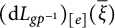
$(\mathrm {d}L_{gp^{-1}})_{[e]}(\overline {\xi })$
 for some
$\xi \in \mathfrak {g}$
 . We are therefore reduced to proving that

for all
$p\in P$
 ,
$[g:\phi ]\in G\times _{U(P)}(\mathfrak {g}/\mathfrak {u}(\mathfrak {p}))^*$
 , and
$\xi \in \mathfrak {g}$
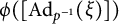
 . Our proof will consist of showing that each side of (4.3) is equal to
$\phi ([\mathrm {Ad}_{p^{-1}}(\xi )])$
 .
Observe that left-hand side of (4.3) is

The right-hand side of (4.3) can be simplified by observing that

where
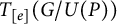
$\overline {\mathrm {Ad}_{p^{-1}}}:T_{[e]}(G/U(P))\longrightarrow T_{[e]}(G/U(P))$
 is the result of letting
$\mathrm {Ad}_{p^{-1}}:\mathfrak {g}\longrightarrow \mathfrak {g}$
 descend to an automorphism of
$T_{[e]}(G/U(P))$
 . The right-hand side is therefore given by

completing the proof.
Let
$\langle \cdot ,\cdot \rangle :\mathfrak {g}\otimes \mathfrak {g}\longrightarrow \mathbb {C}$
 be the Killing form. One knows that
$\mathfrak {p}$
 is the annihilator of
$\mathfrak {u}(\mathfrak {p})$
 in
$\mathfrak {g}$
 with respect to this form. We thereby obtain a
$P$
 -module isomorphism
$\mathfrak {p}\longrightarrow (\mathfrak {g}/\mathfrak {u}(\mathfrak {p}))^*$
 , whose composition with
$\alpha :(\mathfrak {g}/\mathfrak {u}(\mathfrak {p}))^*\overset {\cong }\longrightarrow T^*_{[e]}(G/U(P))$
 is

This combines with (4.2) and Proposition 4.3 to give a
$G\times L(P)$
 -equivariant isomorphism

of vector bundles over
$G/U(P)$
 . On the other hand, the
$G\times L(P)$
 -action on
$T^*(G/U(P))$
 is Hamiltonian with respect to the canonical symplectic structure on the latter. We may therefore equip
$G\times _{U(P)}\mathfrak {p}$
 with the symplectic Hamiltonian
$G\times L(P)$
 -variety structure for which
$\psi _{\mathfrak {p}}$
 is an isomorphism of symplectic Hamiltonian
$G\times L(P)$
 -varieties. A straightforward exercise shows

to be a moment map, where the Killing form is used to identify
$\mathfrak {g}^*$
 (resp.
$\mathfrak {l}(\mathfrak {p})^*$
 ) with
$\mathfrak {g}$
 (resp.
$\mathfrak {l}(\mathfrak {p})$
 ). It follows that

is a Poisson Hamiltonian
$G$
 -space with moment map

5 Partial Grothendieck–Springer resolutions
We now develop the relevant Poisson-geometric features of the partial Grothendieck–Springer resolutions
$\mu _{\mathcal {C}}:\mathfrak {g}_{\mathcal {C}}\longrightarrow \mathfrak {g}$
 . These resolutions are formally defined in Section 5.1. In Section 5.2, we give several characterizations of a canonical Poisson Hamiltonian
$G$
 -variety structure on
$\mathfrak {g}_{\mathcal {C}}$
 .
5.1 The partial Grothendieck–Springer resolution
$\mu _{\mathcal {C}}:\mathfrak {g}_{\mathcal {C}}\longrightarrow \mathfrak {g}$

The adjoint representation induces an action of
$G$
 on the set of parabolic subalgebras of
$\mathfrak {g}$
 . An orbit of this action will be called a conjugacy class of parabolic subalgebras. If
$\mathcal {C}$
 is one such conjugacy class, then the nonnegative integer
$d_{\mathcal {C}}:= \dim \mathfrak {p}$
 is independent of
$\mathfrak {p}\in \mathcal {C}$
 . It is straightforward to verify that
$\mathcal {C}$
 constitutes a closed
$G$
 -orbit in the Grassmannian
$\mathrm {Gr}(d_{\mathcal {C}},\mathfrak {g})$
 of
$d_{\mathcal {C}}$
 -dimensional subspaces of
$\mathfrak {g}$
 . It follows that
$\mathcal {C}$
 is a smooth projective variety carrying an algebraic
$G$
 -action.
Fix a conjugacy class
$\mathcal {C}$
 of parabolic subalgebras of
$\mathfrak {g}$
 . Let
$\pi _{\mathcal {C}}:\mathfrak {g}_{\mathcal {C}}\longrightarrow \mathcal {C}$
 be the
$G$
 -equivariant vector bundle obtained by pulling the tautological bundle on
$\mathrm {Gr}(d_{\mathcal {C}},\mathfrak {g})$
 back along the inclusion
$\mathcal {C}\subseteq \mathrm {Gr}(d_{\mathcal {C}},\mathfrak {g})$
 . It follows that

and that
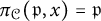
$\pi _{\mathcal {C}}(\mathfrak {p},x)=\mathfrak {p}$
 for all
$(\mathfrak {p},x)\in \mathfrak {g}_{\mathcal {C}}$
 . One also has the
$G$
 -equivariant morphism

Definition 5.1 The morphism
$\mu _{\mathcal {C}}:\mathfrak {g}_{\mathcal {C}}\longrightarrow \mathfrak {g}$
 is called the partial Grothendieck–Springer resolution determined by
$\mathcal {C}$
 .
5.2 The Poisson geometry of
$\mathfrak {g}_{\mathcal {C}}$

Let
$\mathcal {C}$
 be a conjugacy class of parabolic subalgebras of
$\mathfrak {g}$
 . Suppose that
$\mathfrak {p}\in \mathcal {C}$
 , and let
$P\subseteq G$
 be the parabolic subgroup integrating
$\mathfrak {p}$
 . One has the
$G$
 -equivariant variety isomorphisms

and commutative diagram

Proposition 5.1 If
$(\mathfrak {p},x)\in \mathfrak {g}_{\mathcal {C}}$
 , then the differential
$(\mathrm {d}\mu _{\mathcal {C}})_{(\mathfrak {p},x)}:T_{(\mathfrak {p},x)}\mathfrak {g}_{\mathcal {C}}\longrightarrow \mathfrak {g}$
 is an isomorphism if and only if
$\mathfrak {g}_x\cap \mathfrak {u}(\mathfrak {p})=\{0\}$
 .
Proof As
$\dim \mathfrak {g}_{\mathcal {C}}=\dim \mathfrak {g}$
 , it suffices to prove that
$(\mathrm {d}\mu _{\mathcal {C}})_{(\mathfrak {p},x)}$
 is surjective if and only if
$\mathfrak {g}_x\cap \mathfrak {u}(\mathfrak {p})=\{0\}$
 . Consider the quotient morphism
$\pi :G\times \mathfrak {p}\longrightarrow G\times _P\mathfrak {p}$
 . The composite map
$\delta _{\mathfrak {p}}\circ \pi :G\times \mathfrak {p}\longrightarrow \mathfrak {g}_{\mathcal {C}}$
 is a submersion that sends
$(e,x)$
 to
$(\mathfrak {p},x)$
 . It therefore suffices to prove that

is surjective if and only if
$\mathfrak {g}_x\cap \mathfrak {u}(\mathfrak {p})=\{0\}$
 . On the other hand, a straightforward calculation shows
$\mu _{\mathcal {C}}\circ \delta _{\mathfrak {p}}\circ \pi :G\times \mathfrak {p}\longrightarrow \mathfrak {g}$
 to be given by

for all
$(g,y)\in G\times \mathfrak {p}$
 . It follows that

for all
$(\xi ,\eta )\in \mathfrak {g}\oplus \mathfrak {p}$
 . The image of
$\mathrm {d}(\mu _{\mathcal {C}}\circ \delta _{\mathfrak {p}}\circ \pi )_{(e,x)}$
 is therefore
$[\mathfrak {g},x]+\mathfrak {p}$
 . We conclude that
$\mathrm {d}(\mu _{\mathcal {C}}\circ \delta _{\mathfrak {p}}\circ \pi )_{(e,x)}$
 is surjective if and only if
$([\mathfrak {g},x]+\mathfrak {p})^{\perp }=\{0\}$
 , or equivalently
$\mathfrak {g}_x\cap \mathfrak {u}(\mathfrak {p})=\{0\}$
 .
Recall the Poisson Hamiltonian
$G$
 -variety structure on
$G\times _P\mathfrak {p}$
 from Section 4.5. In this context, we have the following result.
Proposition 5.2 The following statements are true.
-
(i) There exists a unique Poisson structure on $\mathfrak {g}_{\mathcal {C}}$
that makes the
$G$
-equivariant isomorphism
$\delta _{\mathfrak {p}}:G\times _P\mathfrak {p}\longrightarrow \mathfrak {g}_{\mathcal {C}}$
Poisson for all
$\mathfrak {p}\in \mathcal {C}$
. -
(ii) The diagram
commutes for all $\mathfrak {p}\in \mathcal {C}$
.
-
(iii) The action of $G$
on
$\mathfrak {g}_{\mathcal {C}}$
is Hamiltonian with respect to the Poisson structure in (i), and it admits
$\mu _{\mathcal {C}}$
as a moment map. -
(iv) The Poisson structure and Hamiltonian $G$
-action on
$\mathfrak {g}_{\mathcal {C}}$
are uniquely determined by the property that
$\mu _{\mathcal {C}}$
is a moment map.





Proof Part (ii) is a straightforward computation, while (iii) is an immediate consequence of (i) and (ii). It therefore remains only to prove (i) and (iv). To prove (i), note that the uniqueness assertion follows immediately from the fact that
$\delta _{\mathfrak {p}}$
 is a bijection for all
$\mathfrak {p}\in \mathcal {C}$
 . The same fact also allows one to choose
$\mathfrak {p}\in \mathcal {C}$
 , and then endow
$\mathfrak {g}_{\mathcal {C}}$
 with the Poisson variety structure for which
$\delta _{\mathfrak {p}}$
 is an isomorphism of Poisson varieties. Our task is to prove that this Poisson structure does not depend on
$\mathfrak {p}$
 . This is the task of showing

to be a Poisson variety isomorphism for all
$\mathfrak {p}_1,\mathfrak {p}_2\in \mathcal {C}$
 with corresponding parabolic subgroups
$P_1,P_2\subseteq G$
 , respectively.
Suppose that
$\mathfrak {p}_1,\mathfrak {p}_2\in \mathcal {C}$
 , and choose
$h\in G$
 satisfying
$\mathrm {Ad}_h(\mathfrak {p}_1)=\mathfrak {p}_2$
 . A straightforward exercise reveals that

for all
$[g:x]\in G\times _{P_1}\mathfrak {p}_1$
 . Let us also observe that

is well-defined and makes

commute. It therefore suffices to prove that
$\eta $
 is an isomorphism of symplectic varieties.
Consider the variety isomorphism

and the symplectic variety isomorphism

that it induces. It is straightforward to check that

commutes, where
$\psi _{\mathfrak {p}_1}$
 and
$\psi _{\mathfrak {p}_2}$
 are defined in (4.5). Since
$\zeta $
 ,
$\psi _{\mathfrak {p}_1}$
 , and
$\psi _{\mathfrak {p}_2}$
 are symplectic variety isomorphisms, the same must be true of
$\eta $
 . This proves (i).
We now prove (iv). A first step is to invoke Proposition 5.1; it implies that the differential of
$\mu _{\mathcal {C}}$
 is an isomorphism at each point in
$\mu _{\mathcal {C}}^{-1}(\mathfrak {g}_{\text {reg}}\cap \mathfrak {g}_{\text {ss}})\subseteq \mathfrak {g}_{\mathcal {C}}$
 , where
$\mathfrak {g}_{\text {ss}}\subseteq \mathfrak {g}$
 is the locus of semisimple elements. Since moment maps are Poisson morphisms (resp.
$G$
 -equivariant morphisms), requiring
$\mu _{\mathcal {C}}$
 to be a moment map determines the Poisson bivector field (resp. generating vector fields of the
$G$
 -action) on
$\mu _{\mathcal {C}}^{-1}(\mathfrak {g}_{\text {reg}}\cap \mathfrak {g}_{\text {ss}})\subseteq \mathfrak {g}_{\mathcal {C}}$
 . We also note that
$\mu _{\mathcal {C}}^{-1}(\mathfrak {g}_{\text {reg}}\cap \mathfrak {g}_{\text {ss}})$
 is a non-empty open subset of the irreducible variety
$\mathfrak {g}_{\mathcal {C}}$
 . It follows that forcing
$\mu _{\mathcal {C}}$
 to be a moment map determines the Poisson bivector field on
$\mathfrak {g}_{\mathcal {C}}$
 , as well as the generating vector fields of the
$G$
 -action on
$\mathfrak {g}_{\mathcal {C}}$
 . As
$G$
 is connected, these generating vector fields determine the
$G$
 -action on
$\mathfrak {g}_{\mathcal {C}}$
 . The previous two sentences imply (iv).
Recall that the regular locus
$X_{\text {reg}}$
 of a Poisson manifold
$X$
 is the union of its top-dimensional symplectic leaves. The rank of a Poisson manifold is the supremum of its symplectic leaf dimensions. Returning to the notation of this section, we have the following result.
Proposition 5.3 The following statements are true.
-
(i) We have $(\mathfrak {g}_{\mathcal {C}})_{\text {reg}}=\{(\mathfrak {p},x)\in \mathfrak {g}_{\mathcal {C}}:[x]\in \mathfrak {l}(\mathfrak {p})_{\text {reg}}\}$
. -
(ii) The rank of $\mathfrak {g}_{\mathcal {C}}$
is
$\dim \mathfrak {g}-\ell $
.



Proof We first prove (i). Suppose that
$(\mathfrak {p},x)\in \mathfrak {g}_{\mathcal {C}}$
 , and let
$P\subseteq G$
 be the parabolic subgroup integrating
$\mathfrak {p}$
 . Recall that the canonical isomorphism
$\delta _{\mathfrak {p}}:G\times _P\mathfrak {p}\longrightarrow \mathfrak {g}_{\mathcal {C}}$
 is one of Hamiltonian
$G$
 -spaces. Since
$\delta ([e:x])=(\mathfrak {p},x)$
 , it suffices to prove that
$[e:x]\in (G\times _P\mathfrak {p})_{\text {reg}}$
 if and only if
$[x]\in \mathfrak {l}(\mathfrak {p})_{\text {reg}}$
 .
Recall that
$G\times _{U(P)}\mathfrak {p}$
 is a symplectic Hamiltonian (
$G\times L(P)$
 )-space with moment map

In light of Section 4.5, the symplectic leaves of
$G\times _P\mathfrak {p}$
 are the connected components of the Hamiltonian reductions of
$G\times _{U(P)}\mathfrak {p}$
 by
$L(P)$
 . It follows that the symplectic leaves of
$G\times _P\mathfrak {p}$
 are given by

as
$[y]$
 ranges over
$\mathfrak {l}(\mathfrak {p})$
 . We conclude that
$G\times _{P_{[x]}}(x+\mathfrak {u}(\mathfrak {p}))$
 is the symplectic leaf of
$G\times _P\mathfrak {p}$
 through
$[e:x]$
 . This implies that
$[e:x]\in (G\times _P\mathfrak {p})_{\text {reg}}$
 if and only if
$[x]$
 achieves the minimal
$P$
 -centralizer dimension of vectors in
$\mathfrak {l}(\mathfrak {p})$
 . On the other hand, it is clear that
$\dim P_{[x]}=\dim L(P)_{[x]}+\dim U(P)$
 . One concludes that
$\dim P_{[x]}$
 is minimal among the
$P$
 -centralizer dimensions of vectors in
$\mathfrak {l}(\mathfrak {p})$
 if and only if
$[x]\in \mathfrak {l}(\mathfrak {p})_{\text {reg}}$
 . The proof of (i) is therefore complete.
To prove (ii), suppose that
$(\mathfrak {p},x)\in (\mathfrak {g}_{\mathcal {C}})_{\text {reg}}$
 . It suffices to prove that the symplectic leaf of
$\mathfrak {g}_{\mathcal {C}}$
 through
$(\mathfrak {p},x)$
 has dimension
$\dim \mathfrak {g}-\ell $
 . In light of the previous paragraph, this is the task of showing the dimension of
$G\times _{P_{[x]}}(x+\mathfrak {u}(\mathfrak {p}))$
 to be
$\dim \mathfrak {g}-\ell $
 . We have

where the last line follows from (i).
Let
$\mathcal {B}$
 denote the conjugacy class of Borel subalgebras of
$\mathfrak {g}$
 , that is, the full flag variety of
$G$
 . Note that
$\mathfrak {g}_{\mathcal {B}}=\widetilde {\mathfrak {g}}$
 is the full Grothendieck–Springer resolution of
$\mathfrak {g}$
 [Reference Evens and Lu26]. The following well-known result is a special case of the previous result.
Corollary 5.4 The Poisson variety
$\mathfrak {g}_{\mathcal {B}}=\widetilde {\mathfrak {g}}$
 is regular of rank
$\dim \mathfrak {g}-\ell $
 .
6 TQFTs from Grothendieck–Springer resolutions
We now explain that each partial Grothendieck–Springer resolution
$\mu _{\mathcal {C}}:\mathfrak {g}_{\mathcal {C}}\longrightarrow \mathfrak {g}$
 determines a two-dimensional,
$\mathbf {WS}_1$
 -valued TQFT, in such a way that setting
$\mathcal {C}=\{\mathfrak {g}\}$
 recovers the open Moore–Tachikawa TQFT. Our first steps are to integrate
$\mathfrak {g}_{\mathcal {C}}$
 to a symplectic groupoid
$(T^*G)_{\mathcal {C}}\;\substack {\longrightarrow \\[-9pt] \longrightarrow }\;\mathfrak {g}_{\mathcal {C}}$
 and compute the isotropy groups of
$(T^*G)_{\mathcal {C}}$
 (see Section 6.1). Section 6.2 then establishes that
$\mathrm {Kos}_{\mathcal {C}}:= \mu _{\mathcal {C}}^{-1}(\mathrm {Kos})\subseteq \mathfrak {g}_{\mathcal {C}}$
 is an admissible global slice to the pullback groupoid
$((T^*G)_{\mathcal {C}})_{\text {reg}}\;\substack {\longrightarrow \\[-9pt] \longrightarrow }\;(\mathfrak {g}_{\mathcal {C}})_{\text {reg}}$
 , where
$\mathrm {Kos}\subseteq \mathfrak {g}$
 is a Kostant slice. Using Theorem 3.2 and Proposition 3.3, we obtain an explicit TQFT in
$\mathbf {WS}_1$
 . Section 6.3 concludes with some connections to the Moore–Tachikawa conjecture.
6.1 The symplectic groupoid
$(T^*G)_{\mathcal {C}}$

Let
$\mathfrak {p}\subseteq \mathfrak {g}$
 be a parabolic subalgebra integrating to a parabolic subgroup
$P\subseteq G$
 . Recall the discussion of the symplectic variety
$G\times _{U(P)}\mathfrak {p}$
 and Poisson variety
$G\times _P\mathfrak {p}=(G\times _{U(P)}\mathfrak {p})/L(P)$
 in Section 4.5. In light of Proposition 2.1, we may form the symplectic groupoid

Write
$\textsf {s}_{\mathfrak {p}}:(T^*G)_{\mathfrak {p}}\longrightarrow \mathfrak {g}_{\mathcal {C}}$
 (resp.
$\textsf {t}_{\mathfrak {p}}:(T^*G)_{\mathfrak {p}}\longrightarrow \mathfrak {g}_{\mathcal {C}}$
 ) for the result of composing the source (resp. target) of
$(T^*G)_{\mathfrak {p}}\;\substack {\longrightarrow \\[-9pt] \longrightarrow }\; G\times _P\mathfrak {p}$
 with the Poisson isomorphism
$\delta _{\mathfrak {p}}:G\times _P\mathfrak {p}\longrightarrow \mathfrak {g}_{\mathcal {C}}$
 . It follows that
$(T^*G)_{\mathfrak {p}}$
 is a symplectic groupoid over
$\mathfrak {g}_{\mathcal {C}}$
 with source
$\textsf {s}_{\mathfrak {p}}$
 and target
$\textsf {t}_{\mathfrak {p}}$
 ; groupoid multiplication and inversion are induced from those of the pair groupoid of
$G\times _{U(P)}\mathfrak {p}$
 , and composing
$\delta _{\mathfrak {p}}^{-1}:\mathfrak {g}_{\mathcal {C}}\longrightarrow G\times _P\mathfrak {p}$
 with the unit bisection of
$(T^*G)_{\mathfrak {p}}\;\substack {\longrightarrow \\[-9pt] \longrightarrow }\; G\times _{P}\mathfrak {p}$
 gives the unit bisection of
$(T^*G)_{\mathfrak {p}}\;\substack {\longrightarrow \\[-9pt] \longrightarrow }\;\mathfrak {g}_{\mathcal {C}}$
 . Straightforward computations also reveal that

for all
$[[g_1:x_1]:[g_2:x_2]]\in (T^*G)_{\mathfrak {p}}$
 .
Proposition 6.1 Let
$\mathcal {C}$
 be a conjugacy class of parabolic subalgebras of
$\mathfrak {g}$
 . If
$\mathfrak {p}_1,\mathfrak {p}_2\in \mathcal {C}$
 , then there is a canonical
$G$
 -equivariant isomorphism

of symplectic groupoids.
Proof Choose
$h\in G$
 satisfying
$\mathrm {Ad}_h(\mathfrak {p}_1)=\mathfrak {p}_2$
 . Let
$P_1,P_2\subseteq G$
 be the parabolic subgroups integrating
$\mathfrak {p}_1,\mathfrak {p}_2$
 , respectively. It follows that
$hP_1h^{-1}=P_2$
 , and that conjugation by
$h$
 descends to an algebraic group isomorphism
$\phi :L(P_1)\overset {\cong }\longrightarrow L(P_2)$
 . Let us also recall that
$G\times L(P_i)$
 acts on
$G/U(P_i)$
 for
$i=1,2$
 . In this context, we observe that the isomorphism

satisfies the equivariance condition

for all
$(g,[p])\in G\times L(P_1)$
 and
$[k]\in G/U(P_1)$
 . On the other hand, the proof of Proposition 5.2 explains that

is the isomorphism of cotangent bundles induced by
$\zeta $
 . We conclude that
$\eta $
 is an isomorphism from the Hamiltonian
$(G\times L(P_1))$
 -variety
$G\times _{U(P_1)}\mathfrak {p}_1$
 to the Hamiltonian
$(G\times L(P_2))$
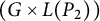 -variety
$G\times _{U(P_2)}\mathfrak {p}_2$
 , where
$L(P_1)$
 and
$L(P_2)$
 are identified via
$\phi $
 . This makes it clear that

is a well-defined,
$G$
 -equivariant symplectic variety isomorphism. It is also clear that (6.1) commutes if this isomorphism is taken as the top horizontal arrow, and straightforward to verify that
$\Psi _{(\mathfrak {p}_1,\mathfrak {p}_2)}$
 is an isomorphism of symplectic groupoids.
It remains only to prove that
$\Psi _{(\mathfrak {p}_1,\mathfrak {p}_2)}$
 does not depend on the choice of
$h\in G$
 satisfying
$\mathrm {Ad}_h(\mathfrak {p}_1)=\mathfrak {p}_2$
 . To this end, let
$h,k\in G$
 be such that
$\mathrm {Ad}_h(\mathfrak {p}_1)=\mathfrak {p}_2$
 and
$\mathrm {Ad}_k(\mathfrak {p}_1)=\mathfrak {p}_2$
 . It follows that
$\mathrm {Ad}_{hk^{-1}}(\mathfrak {p}_2)=\mathfrak {p}_2$
 , or equivalently that
$hk^{-1}\in P_2$
 . We also have

for all
$(g,x)\in G\times \mathfrak {p}_1$
 . In particular,
$(gh^{-1},\mathrm {Ad}_h(x))$
 and
$(gk^{-1},\mathrm {Ad}_k(x))$
 belong to the same
$L(P_2)$
 -orbit in
$G\times _{U(P_2)}\mathfrak {p}_2$
 for all
$[g:x]\in G\times _{U(P_1)}\mathfrak {p}_1$
 . This fact forces
$\Psi _{(\mathfrak {p}_1,\mathfrak {p}_2)}$
 to be independent of the choice mentioned in the first sentence of this paragraph.
We are now equipped to prove Main Theorem 1. For the sake of convenience, we restate it below.
Theorem Let
$\mathcal {C}$
 be a conjugacy class of parabolic subalgebras of
$\mathfrak {g}$
 . There is a canonical algebraic symplectic groupoid
$(T^*G)_{\mathcal {C}}\;\substack {\longrightarrow \\[-9pt] \longrightarrow }\;\mathfrak {g}_{\mathcal {C}}$
 that induces the Poisson structure on
$\mathfrak {g}_{\mathcal {C}}$
 .
Let
$\mathcal {C}$
 be a conjugacy class of parabolic subalgebras of
$\mathfrak {g}$
 . Consider the set

where
$\sim $
 is the equivalence relation defined by

Main Theorem 1 now follows from our next result.
Corollary 6.2 The set
$(T^*G)_{\mathcal {C}}$
 has a unique
$G$
 -equivariant symplectic groupoid structure
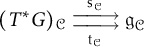 such that

is a
$G$
 -equivariant symplectic groupoid isomorphism for all
$\mathfrak {p}\in \mathcal {C}$
 .
Proof This follows immediately from Proposition 6.1 and the definition of
$(T^*G)_{\mathcal {C}}$
 .
Given
$(\mathfrak {p},x)\in \mathfrak {g}_{\mathcal {C}}$
 , the isomorphism
$(T^*G)_{\mathcal {C}}\cong (T^*G)_{\mathfrak {p}}$
 restricts to an isomorphism

between the isotropy groups of
$(\mathfrak {p},x)$
 and
$[e:x]\in G\times _P\mathfrak {p}$
 . We use this isomorphism to freely identify the two isotropy groups in our next proposition.
Proposition 6.3 If
$(\mathfrak {p},x)\in \mathfrak {g}_{\mathcal {C}}$
 , then

is a well-defined isomorphism of algebraic groups.
Proof A straightforward exercise reveals that

defines an algebraic group morphism. It therefore suffices to prove that (6.3) is surjective with kernel
$U(P)$
 . To establish surjectivity, suppose that
$[[g:y]:[h:z]]\in \left (\left (G\times _{U(P)}\mathfrak {p})\times _{\mathfrak {l}(\mathfrak {p})}(G\times _{U(P)}\mathfrak {p})\right )/L(P)\right )_{[e:x]}$
 . It follows that
$g,h\in P$
 ,
$y=\mathrm {Ad}_{g^{-1}}(x)$
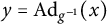 , and
$z=\mathrm {Ad}_{h^{-1}}(x)$
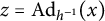 . The condition
$[y]=[z]\in \mathfrak {l}(\mathfrak {p})$
 then implies that
$gh^{-1}\in P_{[x]}$
 , so that

must be in the image of (6.3).
It remains to prove that
$U(P)$
 is the kernel of (6.3). To this end, note that
$p\in P_{[x]}$
 belongs to this kernel if and only if
$[[p:\mathrm {Ad}_{p^{-1}}(x)]:[e:x]]=[[e:x]:[e:x]]$
 . This is equivalent to the existence of
$q\in P$
 such that

We may rephrase this as the condition that

for some
$q\in P$
 and
$u,v\in U(P)$
 . Straightforward manipulations and substitutions show that this holds if and only if

for some
$u,v\in U(P)$
 , or equivalently
$p\in U(P)$
 . The kernel of (6.3) is therefore equal to
$P_{[x]}\cap U(P)$
 . Since
$U(P)$
 acts trivially on the
$P$
 -module
$\mathfrak {l}(\mathfrak {p})$
 , the kernel must be
$U(P)$
 .
6.2 Global slices to
$(T^*G)_{\mathcal {C}}$

Let
$\mathcal {C}$
 be a conjugacy class of parabolic subalgebras of
$\mathfrak {g}$
 . Fix a principal
$\mathfrak {sl}_2$
 -triple
$(e,h,f)\in \mathfrak {g}^{\times 3}$
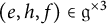 , and consider the associated Kostant slice

One knows that
$\mathrm {Kos}$
 is a fundamental domain for the adjoint action of
$G$
 on
$\mathfrak {g}_{\mathrm {reg}}$
 [Reference Kostant33]. It is also known to be a Poisson transversal for the Poisson structure on
$\mathfrak {g}=\mathfrak {g}^*$
 , where the Killing form is used to identify
$\mathfrak {g}$
 and
$\mathfrak {g}^*$
 (see [Reference Kostant32, Reference Kostant33] for the required ingredients, and [Reference Gan and Ginzburg28] for the case of arbitrary Slodowy slices). We conclude that

is a Poisson transversal. On the other hand, let
$((T^*G)_{\mathcal {C}})_{\text {reg}}\;\substack {\longrightarrow \\[-9pt] \longrightarrow }\;(\mathfrak {g}_{\mathcal {C}})_{\text {reg}}$
 denote the pullback of
$(T^*G)_{\mathcal {C}}\;\substack {\longrightarrow \\[-9pt] \longrightarrow }\;\mathfrak {g}_{\mathcal {C}}$
 to
$(\mathfrak {g}_{\mathcal {C}})_{\text {reg}}\subseteq \mathfrak {g}_{\mathcal {C}}$
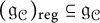 . We relate the preceding discussion to the notion of an admissible global slice, as defined in Section 3.3.
Theorem 6.4 The subvariety
$\mathrm {Kos}_{\mathcal {C}}$
 is an admissible global slice to
$((T^*G)_{\mathcal {C}})_{\text {reg}}\;\substack {\longrightarrow \\[-9pt] \longrightarrow }\;(\mathfrak {g}_{\mathcal {C}})_{\text {reg}}$
 .
Proof We first show
$\mathrm {Kos}_{\mathcal {C}}$
 to be a global slice to
$((T^*G)_{\mathcal {C}})_{\text {reg}}\;\substack {\longrightarrow \\[-9pt] \longrightarrow }\;(\mathfrak {g}_{\mathcal {C}})_{\text {reg}}$
 . To this end, note that the orbits of
$((T^*G)_{\mathcal {C}})_{\text {reg}}\;\substack {\longrightarrow \\[-9pt] \longrightarrow }\;(\mathfrak {g}_{\mathcal {C}})_{\text {reg}}$
 are precisely the top-dimensional symplectic leaves of
$\mathfrak {g}_{\mathcal {C}}$
 . This combines with Proposition 5.3 to reduce us to proving the following:
$\mathrm {Kos}_{\mathcal {C}}$
 has a non-empty intersection with the symplectic leaf of
$\mathfrak {g}_{\mathcal {C}}$
 through
$(\mathfrak {p},x)$
 if and only if
$[x]\in \mathfrak {l}(\mathfrak {p})_{\text {reg}}$
 , in which case the intersection is a singleton. By Lemma 4.1 and Proposition 5.2, this is equivalent to proving the following:
$\mu _{\mathfrak {p}}^{-1}(\mathrm {Kos})$
 has a non-empty intersection with the symplectic leaf of
$G\times _P\mathfrak {p}$
 through
$[e:x]$
 if and only if
$(x+\mathfrak {u}(\mathfrak {p}))\cap \mathfrak {g}_{\mathrm {reg}}\neq \emptyset $
 , in which case the intersection is a singleton. This leaf is
$G\times _{P_{[x]}}(x+\mathfrak {u}(\mathfrak {p}))$
 , as established in the proof of Proposition 5.3. The “if and only if” assertion now follows immediately from the fact that
$\mathrm {Kos}$
 is a fundamental domain for the adjoint action of
$G$
 on
$\mathfrak {g}_{\mathrm {reg}}$
 .
To complete our proof that
$\mathrm {Kos}_{\mathcal {C}}$
 is a global slice, let
$(\mathfrak {p},x)\in \mathfrak {g}_{\mathcal {C}}$
 be such that
$(x+\mathfrak {u}(\mathfrak {p}))\cap \mathfrak {g}_{\mathrm {reg}}\neq \emptyset $
 . Our task is to show that any two elements of
$G\times _{P_{[x]}}(x+\mathfrak {u}(\mathfrak {p}))\cap \mu _{\mathfrak {p}}^{-1}(\mathrm {Kos})$
 must coincide. To this end, suppose that
$[g,y],[h:z]\in G\times _P(x+\mathfrak {u}(\mathfrak {p}))\cap \mu _{\mathfrak {p}}^{-1}(\mathrm {Kos})$
 . It follows that
$\mathrm {Ad}_g(y),\mathrm {Ad}_h(z)\in \mathrm {Kos}$
 , implying that
$y,z\in \mathfrak {g}_{\mathrm {reg}}$
 . By Lemma 4.1(i),
$z=\mathrm {Ad}_p(y)$
 for some
$p\in P$
 . One consequence is that
$y$
 and
$z$
 must be conjugate to the same element of
$\mathrm {Kos}$
 , that is,
$\mathrm {Ad}_g(y)=\mathrm {Ad}_h(z)=\mathrm {Ad}_{hp}(y)$
 . We conclude that
$g^{-1}hp\in G_y$
 . Since Lemma 4.2 now implies that
$g^{-1}hp\in P$
 , we have

This establishes that
$\mathrm {Kos}_{\mathcal {C}}$
 is a global slice to
$((T^*G)_{\mathcal {C}})_{\text {reg}}\;\substack {\longrightarrow \\[-9pt] \longrightarrow }\;(\mathfrak {g}_{\mathcal {C}})_{\text {reg}}$
 .
It remains only to establish that the global slice
$\mathrm {Kos}_{\mathcal {C}}$
 is admissible. Given
$(\mathfrak {p},x)\in \mathrm {Kos}_{\mathcal {C}}$
 , the previous two paragraphs imply that
$[x]\in \mathfrak {l}(\mathfrak {p})_{\text {reg}}$
 . We conclude that
$L(P)_{[x]}$
 is abelian [Reference Kostant33, Proposition 14]. By Proposition 6.3, the isotropy group
$((T^*G)_{\mathcal {C}})_{(\mathfrak {p},x)}$
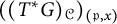 is also abelian. It follows that
$\mathrm {Kos}_{\mathcal {C}}$
 is admissible.
We have the following specialization to the case of the flag variety
$\mathcal {B}$
 of
$\mathfrak {g}$
 . It is presumably well known to experts. Note that
$\mathfrak {g}_{\mathcal {B}}=\widetilde {\mathfrak {g}}$
 is the full Grothendieck–Springer resolution in this case.
Corollary 6.5 The subvariety
$\mathrm {Kos}_{\mathcal {B}}$
 is an admissible global slice to
$(T^*G)_{\mathcal {B}}\;\substack {\longrightarrow \\[-9pt] \longrightarrow }\;\mathfrak {g}_{\mathcal {B}}$
 .
6.3 Grothendieck–Springer alterations of the Moore–Tachikawa TQFT
Recall that Main Theorem 2 is the following assertion.
Theorem Let
$\mathcal {C}$
 be a conjugacy class of parabolic subalgebras of
$\mathfrak {g}$
 . There is an explicit TQFT
$\eta : \mathbf {Cob}_2\longrightarrow \mathbf {WS}_1$
 satisfying
$\eta (S^1) = ((T^*G)_{\mathcal {C}})_{\mathrm {reg}}$
 and
$\eta (C_{m,n})=[(T^*G)_{\mathcal {C}}^{m,n}]$
 for all
$(m,n)\neq (0,0)$
 , where
$C_{m,n}$
 denotes the genus-0 cobordism from
$m$
 circles to
$n$
 circles.
The proof is now straightforward. Let
$\mathcal {C}$
 be a conjugacy class of parabolic subalgebras of
$\mathfrak {g}$
 . As
$(\mathfrak {g}_{\mathcal {C}})_{\text {reg}}$
 is Poisson, Theorem 6.4 implies that
$\mathcal G=((T^*G)_{\mathcal {C}})_{\text {reg}}$
 and
$S=\mathrm {Kos}_{\mathcal {C}}$
 satisfy the hypotheses of Theorem 3.2. Write
$\eta _{\mathcal {C}}:\mathbf {Cob}_2\longrightarrow \mathbf {WS}_1$
 for the resulting TQFT; it satisfies Main Theorem 2. Proposition 3.3 gives an explicit variety
$(T^*G)_{\mathcal {C}}^{m,n}:= \eta _{\mathcal {C}}(C_{m,n})$
 for
$(m,n)\neq (0,0)$
 . The following two special cases warrant further discussion:
-
(i) If $\mathcal {C}=\{\mathfrak {g}\}$
, then
$\eta _{\mathcal {C}}$
is the open Moore–Tachikawa TQFT constructed in [Reference Crooks and Mayrand22]. The varieties $$ \begin{align*}(T^*G)^{m,n}:= (T^*G)_{\mathcal{C}}^{m,n}\end{align*} $$are sometimes called open Moore–Tachikawa varieties, and feature in several recent works [Reference Bielawski9, Reference Crooks and Mayrand21, Reference Crooks and Mayrand22, Reference Ginzburg and Kazhdan30]. One may affinize these varieties to obtain a scheme-theoretic version of the Moore–Tachikawa TQFT [Reference Crooks and Mayrand22, Reference Ginzburg and Kazhdan30].
-
(ii) Suppose that $\mathcal {C}=\mathcal {B}$
is the conjugacy class of Borel subalgebras. By Corollary 6.5,
$\mathrm {Kos}_{\mathcal {C}}=\mathrm {Kos}_{\mathcal {B}}$
is an admissible global slice to the entire symplectic groupoid
$(T^*G)_{\mathcal {C}}=(T^*G)_{\mathcal {B}}$
.




Fix a pair of nonnegative integers
$(m,n)\neq (0,0)$
 . One might seek relationships among the varieties
$(T^*G)_{\mathcal {C}}^{m,n}$
 , as
$\mathcal {C}$
 ranges over the conjugacy classes of parabolic subalgebras of
$\mathfrak {g}$
 . Section 7 addresses this issue.
7 Lagrangian relations and TQFTs
We now prove Main Theorem 3. In the interest of clarity, we restate this theorem below.
Theorem Fix
$(m,n)\in (\mathbb {Z}_{\geq 0})^2$
 with
$(m,n)\neq (0,0)$
 , and let
$\mathcal {C}$
 be a conjugacy class of parabolic subalgebras of
$\mathfrak {g}$
 . There is an explicit Lagrangian relation from
$(T^*G)_{\mathcal {C}}^{m,n}$
 to
$(T^*G)^{m,n}$
 .
A preparatory result is derived in Section 7.1. The proof of Main Theorem 3 constitutes Section 7.2.
7.1 A useful result
Let
$\mathcal {C}$
 be a conjugacy class of parabolic subalgebras of
$\mathfrak {g}$
 . Suppose that
$\mathfrak {p}\in \mathcal {C}$
 , and let
$P\subseteq G$
 be the parabolic subgroup integrating
$\mathfrak {p}$
 . Recall from Section 4.5 that
$G\times _{U(P)}\mathfrak {p}$
 is a symplectic Hamiltonian
$G\times L(P)$
 -variety. Let
$\phi _{\mathfrak {p}}:G\times _{U(P)}\mathfrak {p}\longrightarrow \mathfrak {g}$
 denote the moment map for the Hamiltonian action of
$G=G\times \{e\}\subseteq G\times L(P)$
 . On the other hand, recall that
$G\times _P\mathfrak {p}=(G\times _{U(P)}\mathfrak {p})/L(P)$
 is a Poisson Hamiltonian
$G$
 -variety with moment map
$\mu _{\mathfrak {p}}$
 . One has
$\mathcal {L}_{\mu _{\mathfrak {p}}}=\mathcal {L}_{\overline {\phi _{\mathfrak {p}}}}$
 in the notation of Section 2.6. Note that
$\mathcal {L}_{\mu _{\mathfrak {p}}}$
 is a Lagrangian subgroupoid of
$(\mathrm {Pair}(G\times _{U(P)}\mathfrak {p})\mkern -4mu\mathbin {/\mkern -5mu/}_{\mkern -4mu{0}}L(P))\times \overline {T^*G}=(T^*G)_{\mathfrak {p}}\times \overline {T^*G}$
 , and that Lemma 2.4 gives information about Lagrangian intersections with
$\mathcal {L}_{\mu _{\mathfrak {p}}}$
 .
Use the isomorphism in Corollary 6.2 to identify
$(T^*G)_{\mathcal {C}}$
 with
$(T^*G)_{\mathfrak {p}}$
 , and Proposition 5.2(i) to identify
$\mathfrak {g}_{\mathcal {C}}$
 with
$G\times _P\mathfrak {p}$
 . Lemma 2.4 then implies the following about
$\mathcal {L}_{\mu _{\mathcal {C}}}$
 .
Proposition 7.1 Let
$\textsf {s}:T^*G\longrightarrow \mathfrak {g}$
 and
$\textsf {t}:T^*G\longrightarrow \mathfrak {g}$
 denote the source and target of
$T^*G$
 , respectively. The intersections
$(\mathcal {L}_{\mu _{\mathcal {C}}})\cap (\textsf {s}_{\mathcal {C}}^{-1}(\mathrm {Kos}_{\mathcal {C}})\times \textsf {s}^{-1}(\mathrm {Kos}))$
 and
$(\mathcal {L}_{\mu _{\mathcal {C}}})\cap (\textsf {t}_{\mathcal {C}}^{-1}(\mathrm {Kos}_{\mathcal {C}})\times \textsf {t}^{-1}(\mathrm {Kos}))$
 are Lagrangian subvarieties of
$\textsf {s}_{\mathcal {C}}^{-1}(\mathrm {Kos}_{\mathcal {C}})\times \overline {\textsf {s}^{-1}(\mathrm {Kos})}$
 and
$\textsf {t}_{\mathcal {C}}^{-1}(\mathrm {Kos}_{\mathcal {C}})\times \overline {\textsf {t}^{-1}(\mathrm {Kos})}$
 , respectively.
7.2 Proof of Main Theorem 3
To prepare for what follows, let
$X$
 and
$Y$
 be symplectic varieties. Our convention is to define a Lagrangian relation from
$X$
 to
$Y$
 to be an immersed Lagrangian submanifold
$L\subseteq X\times \overline {Y}$
 . We sometimes adopt the notation
$L:X\Longrightarrow Y$
 for a Lagrangian relation
$L$
 from
$X$
 to
$Y$
 . If
$L:X\Longrightarrow Y$
 and
$M:Y\Longrightarrow Z$
 are Lagrangian relations between symplectic varieties
$X$
 ,
$Y$
 , and
$Z$
 , then
$L$
 and
$M$
 may be composed as set-theoretic relations. Let
$\Delta (Y)\subseteq Y\times Y$
 denote the diagonal copy of
$Y$
 . We call
$M$
 and
$N$
 composable if
$L\times M$
 are
$X\times \Delta (Y)\times Z$
 are transverse in
$X\times Y\times Y\times Z$
 , and the projection map
$X\times Y\times Y\times Z\longrightarrow X\times Z$
 restricts to an immersion
$(L\times M)\cap (X\times \Delta (Y)\times Z)\longrightarrow X\times Z$
 . The image of this projection is then Lagrangian relation
$M\circ L:X\Longrightarrow Z$
 [Reference Bates and Weinstein7, Proposition 5.28]. We call
$L$
 and
$M$
 strongly composable if the map
$(L\times M)\cap (X\times \Delta (Y)\times Z)\longrightarrow X\times Z$
 is an embedding of manifolds. In this case,
$M\circ L$
 is a Lagrangian submanifold of
$X\times \overline {Y}$
 .
We now return to the matter at hand. Let
$\mathcal {C}$
 be a conjugacy class of parabolic subalgebras of
$\mathfrak {g}$
 . Recall that
$\mathrm {Kos}_{\mathcal {C}}:= \mu _{\mathcal {C}}^{-1}(\mathrm {Kos})$
 for
$\mathrm {Kos}:= e+\mathfrak {g}_f\subseteq \mathfrak {g}$
 , the Kostant slice associated with a principal
$\mathfrak {sl}_2$
 -triple
$(e,h,f)\in \mathfrak {g}^{\times 3}$
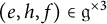 . We may specialize the end of Section 3.3 to
$\mathcal G=(T^*G)_{\mathcal {C}}$
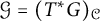 and
$S=\mathrm {Kos}_{\mathcal {C}}$
 . Given
$m,n\in \mathbb {Z}_{\geq 0}$
 with
$(m,n)\neq (0,0)$
 , this specialization yields a pre-Poisson subvariety

and abelian stabilizer subgroupoid
$\mathcal {H}_{\mathrm {Kos}_{\mathcal {C}}^{m,n}}\longrightarrow \mathrm {Kos}_{\mathcal {C}}^{m,n}$
 . On the other hand, consider the TQFT
$\eta _{\mathcal {C}}:\mathbf {Cob}_2\longrightarrow \mathbf {WS}_1$
 introduced in Section 6.3, and set
$(T^*G)_{\mathcal {C}}^{m,n}:= \eta _{\mathcal {C}}(C_{m,n})$
 for
$m,n\in \mathbb {Z}_{\geq 0}$
 with
$(m,n)\neq (0,0)$
 . The end of Section 3.3 implies that

Now observe that
$\mathrm {Kos}_{\mathcal {C}}^{m,n}$
 is coisotropic in the Poisson transversal
$\mathfrak {g}_{\mathcal {C}}^n\times \mathrm {Kos}_{\mathcal {C}}^{m+n}\times \mathfrak {g}_{\mathcal {C}}^m\subseteq \mathfrak {g}_{\mathcal {C}}^{m+n}\times \overline {\mathfrak {g}_{\mathcal {C}}^{m+n}}$
 . The preimage of this Poisson transversal under

is
$((T^*G)_{\mathcal {C}}^{0,1})^n\times ((T^*G)_{\mathcal {C}}^{1,0})^m\subseteq (T^*G)_{\mathcal {C}}^{m+n}$
 . The previous two sentences combine with Lemma 2.3(iii) to imply that

is a Lagrangian subvariety of
$(T^*G)_{\mathcal {C}}^{m,n}\times \overline {((T^*G)_{\mathcal {C}}^{0,1})^n\times ((T^*G)_{\mathcal {C}}^{1,0})^m}$
 , that is,

On the other hand, Proposition 7.1 implies that

is a Lagrangian subvariety of
$((T^*G)_{\mathcal {C}}^{0,1})^n\times ((T^*G)_{\mathcal {C}}^{1,0})^m\times \overline {((T^*G)^{0,1})^n\times ((T^*G)^{1,0})^m}$
 , that is,

The following result shows that these two Lagrangian relations are strongly composable.
Theorem 7.2 Suppose that
$m,n\in \mathbb {Z}_{\geq 0}$
 and
$(m,n)\neq (0,0)$
 .
-
(i) The subvarieties
$$ \begin{align*}\Lambda_{\mathcal{C}}^{m,n}\times\Gamma_{\mathcal{C}}^{m,n}\end{align*} $$and
$$ \begin{align*}(T^*G)_{\mathcal{C}}^{m,n}\times\Delta\left(((T^*G)_{\mathcal{C}}^{0,1})^n\times((T^*G)_{\mathcal{C}}^{1,0})^m\right)\times((T^*G)^{0,1})^n\times((T^*G)^{1,0})^m\end{align*} $$are transverse in
$$ \begin{align*} (T^*G)_{\mathcal{C}}^{m,n} &\times((T^*G)_{\mathcal{C}}^{0,1})^n\times((T^*G)_{\mathcal{C}}^{1,0})^m \\ &\times((T^*G)_{\mathcal{C}}^{0,1})^n\times((T^*G)_{\mathcal{C}}^{1,0})^m\times((T^*G)^{0,1})^n\times((T^*G)^{1,0})^m.\end{align*} $$
-
(ii) The projection of
$$ \begin{align*}(T^*G)_{\mathcal{C}}^{m,n} &\times((T^*G)_{\mathcal{C}}^{0,1})^n\times((T^*G)_{\mathcal{C}}^{1,0})^m\times((T^*G)_{\mathcal{C}}^{0,1})^n \\ &\times((T^*G)_{\mathcal{C}}^{1,0})^m\times((T^*G)^{0,1})^n\times((T^*G)^{1,0})^m\end{align*} $$to the first and last two factors
$$ \begin{align*}(T^*G)_{\mathcal{C}}^{m,n}\times((T^*G)^{0,1})^n\times((T^*G)^{1,0})^m\end{align*} $$restricts to an algebraic, locally closed embedding of
$$ \begin{align*}(\Lambda_{\mathcal{C}}^{m,n}\times\Gamma_{\mathcal{C}}^{m,n}) &\cap((T^*G)_{\mathcal{C}}^{m,n}\times\Delta(((T^*G)_{\mathcal{C}}^{0,1})^n \\ &\quad \times((T^*G)_{\mathcal{C}}^{1,0})^m)\times((T^*G)^{0,1})^n\times((T^*G)^{1,0})^m)\end{align*} $$into $(T^*G)_{\mathcal {C}}^{m,n}\times ((T^*G)^{0,1})^n\times ((T^*G)^{1,0})^m$
.



Proof As this proof is technical, we begin with an overview of its structure. Our approach is to choose
$\mathfrak {p}\in \mathcal {C}$
 . This allows us to identify
$\mathfrak {g}_{\mathcal {C}}$
 and
$(T^*G)_{\mathcal {C}}$
 with
$G\times _P\mathfrak {p}$
 and the pair groupoid

respectively, where
$P\subset G$
 is the parabolic subgroup integrating
$\mathfrak {p}\subset \mathfrak {g}$
 . These identifications yield concrete descriptions of
$\Lambda _{\mathcal {C}}^{m,n}$
 ,
$\Gamma _{\mathcal {C}}^{m,n}$
 ,
$(T^*G)_{\mathcal {C}}^{m,n}$
 ,
$(T^*G)_{\mathcal {C}}^{1,0}$
 , and
$(T^*G)_{\mathcal {C}}^{0,1}$
 . As a consequence, we obtain a concrete description of points in the intersection of the subvarieties in (i); this intersection is denoted by
$X$
 in our proof. We then find a sufficient linear-algebraic condition for the subvarieties in (i) to be transverse at points in
$X$
 : it suffices for the vector subspaces
$T_{\alpha }(\nu ^{m,n})^{-1}(\mathrm {Kos}_{\mathcal {C}}^{m,n})\oplus V$
 and
$T_{(\alpha ,\alpha )}\Delta (((T^*G)_{\mathcal {C}}^{0,1})^n\times ((T^*G)_{\mathcal {C}}^{1,0})^m)$
 to be transverse in
$T_{(\alpha ,\alpha )}((((T^*G)_{\mathcal {C}}^{0,1})^n\times ((T^*G)_{\mathcal {C}}^{1,0})^m)\times (((T^*G)_{\mathcal {C}}^{0,1})^n\times ((T^*G)_{\mathcal {C}}^{1,0})^m))$
 , where precise definitions of
$\alpha $
 and these vector spaces are given in the body of the proof. By combining (7.1) and (7.2) with dimension counts, we show that this sufficient condition holds if and only if
$\dim V=(m+n)\dim \mathfrak {g}$
 . This second condition is easily established, verifying (i).
The proof of (ii) also uses the identifications of
$\mathfrak {g}_{\mathcal {C}}$
 and
$(T^*G)_{\mathcal {C}}$
 with
$G\times _P\mathfrak {p}$
 and
$(T^*G)_{\mathfrak {p}}$
 , respectively. We first show that the projection indicated in (ii) defines a topological embedding of
$X$
 into the codomain of that projection. This embedding is subsequently shown to be one of smooth manifolds. Further arguments are then given to establish that this is a locally closed embedding of algebraic varieties.
We begin by proving (i). A point in the intersection

must take the form
$([\alpha ],\alpha ,\alpha ,\beta )$
 for some
$\alpha =(\alpha _1,\ldots ,\alpha _{m+n})\in (\nu _{\mathcal {C}}^{m,n})^{-1}(\mathrm {Kos}_{\mathcal {C}}^{m,n})$
 and
$\beta =(\beta _1,\ldots \beta _{m+n})\in ((T^*G)^{0,1})^n\times ((T^*G)^{1,0})^m$
 satisfying
$(\alpha _j,\beta _j)\in ((T^*G)_{\mathcal {C}}^{0,1}\times (T^*G)^{0,1})\cap \mathcal {L}_{\mu _{\mathcal {C}}}\text { for all }j\in \{1,\ldots ,n\}$
 and
$(\alpha _k,\beta _k)\in ((T^*G)_{\mathcal {C}}^{1,0}\times (T^*G)^{1,0})\cap \mathcal {L}_{\mu _{\mathcal {C}}} \text {for all } k\in \{n+1,\ldots ,m+n\}$
 .
Choose
$\mathfrak {p}\in \mathcal {C}$
 . Use Proposition 5.2 and Corollary 6.2 to freely identify the Poisson Hamiltonian
$G$
 -variety
$\mathfrak {g}_{\mathcal {C}}$
 and
$G$
 -equivariant symplectic groupoid
$(T^*G)_{\mathcal {C}}$
 with
$G\times _P\mathfrak {p}$
 and
$(T^*G)_{\mathfrak {p}}$
 , respectively. It follows that
$\mathrm {Kos}_{\mathcal {C}}=\mu _{\mathfrak {p}}^{-1}(\mathrm {Kos})$
 . We may find
$(g_i,[h_i:x_i])\in G\times \mathrm {Kos}_{\mathcal {C}}$
 for
$i\in \{1,\ldots ,m+n\}$
 such that

and

The condition
$\alpha \in (\nu ^{m,n})^{-1}(\mathrm {Kos}_{\mathcal {C}}^{m,n})$
 then yields
$[h_1:x_1]=\cdots =[h_{m+n}:x_{m+n}]\in \mathrm {Kos}_{\mathcal {C}}$
 . Denote this uniform element of
$\mathrm {Kos}_{\mathcal {C}}$
 by
$\gamma $
 . We have

Write
$\mathcal {A}_g:G\times _P\mathfrak {p}\longrightarrow G\times _P\mathfrak {p}$
 for the action of
$g\in G$
 on
$G\times _P\mathfrak {p}$
 . Consider the subspaces


and

Our objective is to prove that
$T_{\alpha }(\nu ^{m,n})^{-1}(\mathrm {Kos}_{\mathcal {C}}^{m,n})\oplus V$
 and
$T_{(\alpha ,\alpha )}\Delta (((T^*G)_{\mathcal {C}}^{0,1})^n\times ((T^*G)_{\mathcal {C}}^{1,0})^m)$
 are transverse in
$T_{(\alpha ,\alpha )}((((T^*G)_{\mathcal {C}}^{0,1})^n\times ((T^*G)_{\mathcal {C}}^{1,0})^m)\times (((T^*G)_{\mathcal {C}}^{0,1})^n\times ((T^*G)_{\mathcal {C}}^{1,0})^m))$
 .
Define a linear map
$\phi :\mathfrak {g}^{m+n}\oplus T_{\gamma }\mathrm {Kos}_{\mathcal {C}}\longrightarrow V$
 as follows: the projection of
$\phi (\xi _1,\ldots ,\xi _{m+n},[v])\in V$
 onto
$V_j$
 is

for
$j\in \{1,\ldots ,n\}$
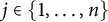 , and the projection to
$V_k$
 is

for
$k\in \{n+1,\ldots ,m+n\}$
 . A straightforward exercise reveals that

We claim that

where
$\mathfrak {g}_{\gamma }\subseteq \mathfrak {g}$
 is the Lie algebra of
$G_{\gamma }\subseteq G$
 . To this end, suppose that
$(\xi _1,\ldots ,\xi _{m+n},[v])\in \mathfrak {g}^{m+n}\oplus T_{\gamma }\mathrm {Kos}_{\mathcal {C}}$
 . This vector belongs to
$\mathrm {ker}\hspace {2pt}\phi $
 if and only if
$((\mathrm {d}\mathcal {A}_{g_j})_{[h_j:x_k]}(v)-(X_{\mathrm {Ad}_{g_j}(\xi _j)})_{[g_jh_j:x_j]},v)$
 is tangent to the diagonal
$L(P)$
 -orbit of
$([g_jh_j:x_j],[h_j:x_j])\in (G\times _{U(P)}\mathfrak {p})^2$
 for all
$j\in \{1,\ldots ,n\}$
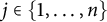 , and
$(v,(X_{\xi })_{[g_k^{-1}h_k:x_k]}+(\mathrm {d}\mathcal {A}_{g_k^{-1}})_{[h_k:x_k]}(v))$
 is tangent to the diagonal
$L(P)$
 -orbit of
$([h_k:x_k],[g_k^{-1}h_k:x_k])\in (G\times _{U(P)}\mathfrak {p})^2$
 for all
$k\in \{n+1,\ldots ,m+n\}$
 . One necessary condition for this to occur is that
$[v]=0$
 . Observe that
$(\mathrm {d}\mathcal {A}_{g_j})_{[h_j:x_j]}(v)$
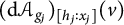 and
$(\mathrm {d}\mathcal {A}_{g_k^{-1}})_{[h_k:x_k]}(v)$
 are then necessarily tangent to the
$L(P)$
 -orbits of
$[g_jh_j:x_j]\in G\times _{U(P)}\mathfrak {p}$
 and
$[g_k^{-1}h_k:x_k]\in G\times _{U(P)}\mathfrak {p}$
 , respectively, for all
$j\in \{1,\ldots ,n\}$
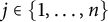 and
$k\in \{n+1,\ldots ,m+n\}$
 . We conclude that
$(\xi _1,\ldots ,\xi _{m+n},[v])\in \mathrm {ker}\hspace {2pt}\phi $
 if and only if
$[v]=0$
 ,
$(X_{\mathrm {Ad}_{g_j}(\xi _j)})_{[g_jh_j:x_j]}$
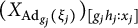 is tangent to the
$L(P)$
 -orbit of
$[g_jh_j:x_j]\in G\times _{U(P)}\mathfrak {p}$
 for all
$j\in \{1,\ldots ,n\}$
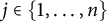 , and
$(X_{\xi _k})_{[g_k^{-1}h_k:x_k]}$
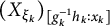 is tangent to the
$L(P)$
 -orbit of
$[g_k^{-1}h_k:x_k]\in G\times _{U(P)}\mathfrak {p}$
 for all
$k\in \{n+1,\ldots ,m+n\}$
 . This holds if and only if
$[v]=0$
 ,
$(X_{\mathrm {Ad}_{g_j}(\xi _j)})_{[g_jh_j:x_j]}$
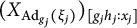 is zero in tangent space of
$[g_jh_j:x_j]=g_j\cdot \gamma \in G\times _P\mathfrak {p}$
 for all
$j\in \{1,\ldots ,n\}$
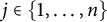 , and
$(X_{\xi _k})_{[g_k^{-1}h_k:x_k]}$
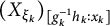 is zero in the tangent space of
$[g_k^{-1}h_k:x_k]=g_k^{-1}\cdot \gamma \in G\times _P\mathfrak {p}$
 for all
$k\in \{n+1,\ldots ,m+n\}$
 . We conclude that
$\mathrm {ker}\hspace {2pt}\phi $
 is as claimed.
Now observe that the
$G$
 -orbit of
$\gamma $
 in
$G\times _P\mathfrak {p}$
 has dimension at least that of the
$G$
 -orbit of
$\mu _{\mathfrak {p}}(\gamma )$
 in
$\mathfrak {g}$
 . Since
$\mu _p(\gamma )\in \mathrm {Kos}$
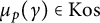 , the former orbit has dimension at least
$\dim \mathfrak {g}-\ell $
 . An application of Proposition 5.3 then reveals that the
$G$
 -orbit of
$\gamma $
 has dimension exactly
$\dim \mathfrak {g}-\ell $
 . The
$\mathfrak {g}$
 -centralizer
$\mathfrak {g}_{\gamma }$
 must therefore have dimension equal to
$\ell $
 . By (7.2),
$\dim \mathrm {ker}\hspace {2pt}\phi =(m+n)\ell $
 . This combines with (7.1) to imply that the intersection of
$T_{\alpha }(\nu ^{m,n})^{-1}(\mathrm {Kos}_{\mathcal {C}}^{m,n})\oplus V$
 and
$T_{(\alpha ,\alpha )}\Delta (((T^*G)_{\mathcal {C}}^{0,1})^n\times ((T^*G)_{\mathcal {C}}^{1,0})^m)$
 has dimension

The dimension of the sum of
$T_{\alpha }(\nu ^{m,n})^{-1}(\mathrm {Kos}_{\mathcal {C}}^{m,n})\oplus V$
 and
$T_{(\alpha ,\alpha )}\Delta (((T^*G)_{\mathcal {C}}^{0,1})^n\times ((T^*G)_{\mathcal {C}}^{1,0})^m)$
 is then

We conclude that
$T_{\alpha }(\nu ^{m,n})^{-1}(\mathrm {Kos}_{\mathcal {C}}^{m,n})\oplus V$
 and
$T_{(\alpha ,\alpha )}\Delta (((T^*G)_{\mathcal {C}}^{0,1})^n\times ((T^*G)_{\mathcal {C}}^{1,0})^m)$
 are transverse in

if and only if
$\dim V=(m+n)\dim \mathfrak {g}$
 . It therefore suffices to prove that
$\dim V_i=\dim \mathfrak {g}$
 for all
$i\in \{1,\ldots ,m+n\}$
 .
Given
$j\in \{1,\ldots ,n\}$
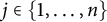 and
$k\in \{n+1,\ldots ,m+n\}$
 , consider the surjective linear maps

and

Their respective kernels are
$\mathfrak {g}_{\gamma }\oplus \{0\}\subseteq \mathfrak {g}\oplus T_{\gamma }\mathrm {Kos}_{\mathcal {C}}$
 and
$\mathrm {Ad}_{g_k^{-1}}(\mathfrak {g}_{\gamma })\oplus \{0\}\subseteq \mathfrak {g}\oplus T_{\gamma }\mathrm {Kos}_{\mathcal {C}}$
 . We also recall that
$\dim \mathfrak {g}_{\gamma }=\ell $
 . These last two sentences imply that

Our proof of (i) is therefore complete.
We now verify (ii). Let
$\pi $
 denote the projection of

to the first and last two factors

Our first step is to prove that
$\pi $
 restricts to a homeomorphism from
$X$
 to its image
$Y:= \pi (X)$
 . To this end, suppose that

satisfy
$[\alpha ]=[\alpha ']$
 and
$\beta =\beta '$
 . We may find
$(g_i,[h_i:x_i]),(g_i',[h_i':x_i'])\in G\times \mathrm {Kos}_{\mathcal {C}}$
 for
$i\in \{1,\ldots ,m+n\}$
 such that


and

The condition
$\beta =\beta '$
 then implies that
$g_i=g_i'$
 for all
$i\in \{1,\ldots ,m+n\}$
 . On the other hand, the condition
$[\alpha ]=[\alpha ']$
 means that
$\alpha $
 and
$\alpha '$
 belong to the same orbit of the group scheme
$\mathcal {H}_{\mathrm {Kos}_{\mathcal {C}}^{m,n}}\longrightarrow \mathrm {Kos}_{\mathcal {C}}^{m,n}$
 on
$(\nu ^{m,n})^{-1}(\mathrm {Kos}_{\mathcal {C}}^{m,n})\longrightarrow \mathrm {Kos}_{\mathcal {C}}^{m,n}$
 . It follows that
$\nu ^{m,n}(\alpha )=\nu ^{m,n}(\alpha ')$
 , so that
$[h_i:x_i]=[h_i':x_i']\in \mathrm {Kos}_{\mathcal {C}}$
 for all
$i\in \{1,\ldots ,m+n\}$
 . These last three sentences imply that
$\alpha _i=\alpha _i'$
 for all
$i\in \{1,\ldots ,n\}$
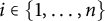 , that is,
$\alpha =\alpha '$
 . We conclude that
$\pi $
 restricts to a bijection
$X\longrightarrow Y$
 . Since this bijection is evidently continuous, it is a homeomorphism if and only if its inverse is continuous.
Consider the descent of
$\nu ^{m,n}$
 to a continuous map

Write
$\theta :(T^*G)_{\mathcal {C}}^{m,n}\longrightarrow \mathrm {Kos}_{\mathcal {C}}$
 for its composition with

Let us also consider the projection

These preliminaries allow us to define the map
$\tau $
 from

to

by
$\tau (\gamma ,\beta )=(\gamma ,\alpha ,\alpha ,\beta )$
 , where
$\alpha =(\alpha _1,\ldots \alpha _{m+n})\in ((T^*G)_{\mathcal {C}}^{0,1})^n\times ((T^*G)_{\mathcal {C}}^{1,0})^m$
 is given by

and

This map is evidently continuous. On the other hand, the discussion in the previous paragraph implies that
$\tau $
 restricts to an inverse of the map
$X\longrightarrow Y$
 .
Part (i) and [Reference Wehrheim and Woodward46, Lemma 2.0.5] imply that
$\pi $
 restricts to an immersion of
$X$
 into
$(T^*G)_{\mathcal {C}}^{m,n}\times ((T^*G)^{0,1})^n\times ((T^*G)^{1,0})^m$
 . Recalling that
$X\longrightarrow \pi (X)=Y$
 is a homeomorphism, we see that
$\pi \big \vert _X$
 is an embedding of manifolds. It therefore remains only to prove that this embedding is a locally closed embedding of algebraic varieties. A first step is to observe that
$Y$
 is a constructible subset of
$(T^*G)_{\mathcal {C}}^{m,n}\times ((T^*G)^{0,1})^n\times ((T^*G)^{1,0})^m$
 . Its closure
$\overline {Y}$
 in the Zariski topology must therefore coincide with its closure in the Euclidean topology [Reference Grothendieck31, Section XII, Proposition 2.2]. On the other hand,
$Y$
 being an embedded submanifold of
$(T^*G)_{\mathcal {C}}^{m,n}\times ((T^*G)^{0,1})^n\times ((T^*G)^{1,0})^m$
 forces
$Y$
 to be a Euclidean-open subset of
$\overline {Y}$
 . The constructibility of
$Y$
 then implies that
$Y$
 must be Zariski-open in
$\overline {Y}$
 [Reference Grothendieck31, Section XII, Corollary 2.3]. In other words,
$Y$
 is locally closed in the Zariski topology of
$(T^*G)_{\mathcal {C}}^{m,n}\times ((T^*G)^{0,1})^n\times ((T^*G)^{1,0})^m$
 . It is thereby a subvariety of
$(T^*G)_{\mathcal {C}}^{m,n}\times ((T^*G)^{0,1})^n\times ((T^*G)^{1,0})^m$
 . Since
$Y$
 is a submanifold, it is smooth as a subvariety of
$(T^*G)_{\mathcal {C}}^{m,n}\times ((T^*G)^{0,1})^n\times ((T^*G)^{1,0})^m$
 . The map
$X\longrightarrow \pi (X)=Y$
 is then a bijective morphism of smooth varieties, that is, an isomorphism. This completes the proof of (ii).
The following is an immediate consequence.
Corollary 7.3 If
$m,n\in \mathbb {Z}_{\geq 0}$
 and
$(m,n)\neq (0,0)$
 , then the Lagrangian relations

and

are strongly composable. The composition
$\Gamma _{\mathcal {C}}^{m,n}\circ \Lambda _{\mathcal {C}}^{m,n}$
 is a smooth Lagrangian subvariety of
$(T^*G)_{\mathcal {C}}^{m,n}\times \overline {((T^*G)^{0,1})^n\times ((T^*G)^{1,0})^m}$
 .
Let
$\textsf {s}:T^*G\longrightarrow \mathfrak {g}$
 and
$\textsf {t}:T^*G\longrightarrow \mathfrak {g}$
 denote the source and target of
$T^*G$
 , respectively. Set

and

In analogy with the discussion of
$\Lambda _{\mathcal {C}}^{m,n}$
 ,
$\Lambda ^{m,n}$
 is a Lagrangian subvariety of
$(((T^*G)^{0,1})^n\times ((T^*G)^{1,0})^m)\times \overline {(T^*G)^{m,n}}$
 . We may consider the set-theoretic relation

By arguments analogous to those in the proof of Theorem 7.2,
$\Lambda ^{m,n}$
 and
$\Gamma _{\mathcal {C}}^{m,n}$
 are composable as Lagrangian relations. We are unable to prove that
$\Lambda ^{m,n}$
 and
$\Gamma _{\mathcal {C}}^{m,n}$
 are strongly composable. One may nevertheless form the Lagrangian relation

This completes the proof of Main Theorem 3.
8 Some Lie-theoretic considerations in quasi-Poisson geometry
This section is a multiplicative counterpart to Section 4. In Section 8.1, we recall aspects of regular elements in reductive groups. A useful description of regular elements in Levi subgroups is given in Section 8.2. Section 8.3 then reviews the quasi-Hamiltonian geometry of the double
$\mathrm {D}(G)$
 . The quasi-Hamiltonian structure on
$G\times _{U(P)}P$
 is reviewed in Section 8.4, where
$P\subseteq G$
 is a parabolic subgroup.
8.1 Regular elements in reductive groups
Let
$H$
 be a connected reductive affine algebraic group. Write
$H_h\subseteq H$
 for the centralizer of
$h\in H$
 under the conjugation action of
$H$
 on itself. One has the regular locus

If we equip the Lie algebra of
$H$
 with an
$H$
 -invariant, non-degenerate, symmetric bilinear form, then
$H$
 inherits the canonical Cartan–Dirac structure. On the other hand, the regular locus of a Dirac manifold is the union of its top-dimensional pre-symplectic leaves. It turns out that
$H_{\text {reg}}$
 is the regular locus of the Cartan–Dirac structure on
$H$
 .
8.2 Regular elements in Levi subgroups
Let
$P\subseteq G$
 be a parabolic subgroup. Given any
$p\in P$
 , let
$[p]\in L(P)$
 denote the image of
$p$
 under the quotient
$P\longrightarrow L(P)$
 . Write
$P_{[p]}\subseteq P$
 for the
$P$
 -centralizer of
$[p]\in L(P)$
 . We have the following counterpart to Lemma 4.1.
Lemma 8.1 Suppose that
$p\in P$
 .
-
(i) If $pU(P)\cap G_{\text {reg}}$
is non-empty, then it is an orbit of
$P_{[p]}$
in
$G$
. -
(ii) One has $pU(P)\cap G_{\text {reg}}\neq \emptyset $
if and only if
$[p]\in L(P)_{\text {reg}}$
. -
(iii) If $P$
is a Borel subgroup, then
$pU(P)\cap G_{\text {reg}}$
is non-empty.
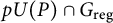



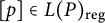

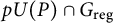
Proof The proofs of (i) and the forward implication in (ii) are completely analogous to their counterparts in Lemma 4.1. At the same time, part (iii) is an immediate consequence of (ii). It therefore remains only to establish the backward implication in (ii). To this end, choose a Levi factor
$L\subseteq G$
 of
$P$
 . Our task is to prove that
$pU(P)\cap G_{\text {reg}}\neq \emptyset $
 for all
$p\in L_{\text {reg}}$
 .
Suppose that
$p\in L_{\text {reg}}$
 . Choose a maximal torus
$T\subseteq G$
 and Borel subgroup
$B\subseteq G$
 for which
$L$
 and
$P$
 are standard, that is, associated with a subset of the simple roots. Let
$p=p_sp_u$
 be the Jordan decomposition of
$p$
 into a semisimple element
$p_s\in L$
 and unipotent element
$p_u\in L$
 . As
$U(P)$
 is invariant under conjugation by elements of
$L$
 , we may assume that
$p_s\in T$
 . Let us also note that
$p_u$
 is a unipotent element of
$L_{p_s}$
 . We may therefore assume that
$p_u\in U(B)\cap L_{p_s}$
 .
It is straightforward to verify that
$L_{p_s}$
 is a Levi subgroup of
$G_{p_s}$
 . By [Reference Lusztig and Spaltenstein35, Theorem 1.3(a)], there exists
$h\in U(P)$
 satisfying
$p_uh\in (G_{p_s})_{\text {reg}}$
 . Note that
$p_uh$
 is a unipotent element of
$G$
 that commutes with
$p_s$
 . We conclude that
$G_{ph}=(G_{p_s})_{p_uh}$
 is
$\ell $
 -dimensional, that is,
$ph\in G_{\text {reg}}$
 . This completes the proof.
Lemma 8.2 If
$p\in P\cap G_{\text {reg}}$
 , then
$G_p\subseteq P$
 .
Proof Consider the adjoint group
$G_{\mathrm {ad}}:= G/Z(G)$
 and its conjugation action on
$G$
 . An application of [Reference Bălibanu5, Lemma 3.1] reveals that
$(G_{\mathrm {ad}})_{p}$
 is connected. On the other hand, arguments analogous to those in the proof of Lemma 4.2 imply that
$\mathrm {Lie}(G_p)\subseteq \mathfrak {p}$
 . It follows that
$(G_{\mathrm {ad}})_p\subseteq P_{\mathrm {ad}}:= P/Z(G)$
 . By taking preimages under the quotient map
$G\longrightarrow G_{\mathrm {ad}}$
 , we deduce that
$G_p\subseteq P$
 .
8.3 The double
$\mathrm {D}(G)$

Adopt the notation
$\mathrm {D}(G):= G\times G$
 . Note that
$G\times G$
 acts on
$\mathrm {D}(G)$
 by

At the same time, let
$\theta ^L,\theta ^R\in \Omega ^1(G,\mathfrak {g})$
 denote the left and right-invariant Maurer–Cartan forms on
$G$
 , respectively. Let us also write
$\pi _1,\pi _2:\mathrm {D}(G)\longrightarrow G$
 for the projections to the first and second factors, respectively, and
$\langle \cdot ,\cdot \rangle :\mathfrak {g}\otimes \mathfrak {g}\longrightarrow \mathfrak {g}$
 for the Killing form. Consider the
$2$
 -form
$\omega \in \Omega ^2(G)$
 defined by

as well as the algebraic map

With respect to the above-mentioned
$G\times G$
 -action,
$(\mathrm {D}(G),\omega _{\mathrm {D}(G)},\mu _{\mathrm {D}(G)})$
 is a quasi-Hamiltonian
$G\times G$
 -space [Reference Alekseev, Malkin and Meinrenken2].
8.4 A quasi-Hamiltonian structure on
$G\times _{U(P)}P$

Let
$P\subseteq G$
 be a parabolic subgroup. Note that
$G\times L(P)$
 acts on
$G\times _{U(P)}P$
 by

We also have the map

Write
$j:G\times P\longrightarrow \mathrm {D}(G)$
 and
$\pi :G\times P\longrightarrow G\times _{U(P)}P$
 for the inclusion and quotient maps, respectively.
Proposition 8.3 The following statements are true:
-
(i) $\pi ^*\omega _P=j^*\omega _{\mathrm {D(G)}}$
for a unique algebraic
$2$
-form
$\omega _P$
on
$G\times _{U(P)}P$
; -
(ii) the $G\times L(P)$
-action (8.1),
$2$
-form
$\omega _P$
, and map
$\mu _P$
render
$G\times _{U(P)}P$
a quasi-Hamiltonian
$G\times L(P)$
-variety.



Proof These results follow immediately from Theorem 2.21(4), Lemma 4.3, and Example 4.5 of [Reference Bălibanu and Mayrand6].
The reader should note that the quasi-Hamiltonian structure of
$G\times _{U(P)}P$
 is studied extensively in [Reference Boalch13].
9 TQFTs from multiplicative Grothendieck–Springer resolutions
This section is a multiplicative counterpart to Sections 5 and 6. We begin by introducing the multiplicative partial Grothendieck–Springer resolutions
$\nu _{\mathcal {C}}:G_{\mathcal {C}}\longrightarrow G$
 in Section 9.1. In Section 9.2, we introduce and examine a quasi-symplectic groupoid
$\mathrm {D}(G)_{\mathcal {C}}\;\substack {\longrightarrow \\[-9pt] \longrightarrow }\; G_{\mathcal {C}}$
 . Steinberg slices are recalled in Section 9.3. These slices are used to construct admissible global slices to
$(\mathrm {D}(G)_{\mathcal {C}})_{\text {reg}}\;\substack {\longrightarrow \\[-9pt] \longrightarrow }\;(G_{\mathcal {C}})_{\text {reg}}$
 in Section 9.4. In Section 9.5, we describe the TQFTs that result.
9.1 The multiplicative partial Grothendieck–Springer resolution
$\nu _{\mathcal {C}}:G_{\mathcal {C}}\longrightarrow G$

Let
$\mathcal {C}$
 be a conjugacy class of parabolic subgroups of
$G$
 . Consider subvariety

of
$\mathcal {C}\times G$
 . Note that
$G$
 acts on
$G_{\mathcal {C}}$
 by

The morphism

is equivariant with respect to the conjugation of
$G$
 on itself.
Definition 9.1 The morphism
$\nu _{\mathcal {C}}:G_{\mathcal {C}}\longrightarrow G$
 is called the multiplicative partial Grothendieck–Springer resolution determined by
$\mathcal {C}$
 .
The reader should note that [Reference Boalch11] outlines a role for partial Grothendieck–Springer resolutions in quasi-Poisson geometry. For
$P\in \mathcal {C}$
 , the map

is a
$G$
 -equivariant variety isomorphism.
9.2 The quasi-symplectic groupoid
$\mathrm {D}(G)_{\mathcal {C}}$

Consider a conjugacy class
$\mathcal {C}$
 of parabolic subgroups of
$G$
 , as well as an element
$P\in \mathcal {C}$
 . As discussed in Section 8.4,
$G\times _{U(P)}P$
 is a quasi-Hamiltonian
$G$
 -variety. Proposition 2.5 then yields a quasi-symplectic groupoid

Note that the source (resp. target) morphism is projection from the first (resp. second) factor of
$G\times _{U(P)}P$
 . Write
$\textsf {s}_{P}:\mathrm {D}(G)_{P}\longrightarrow G_{\mathcal {C}}$
 (resp.
$\textsf {t}_{P}:\mathrm {D}(G)_{P}\longrightarrow G_{\mathcal {C}}$
 ) for the result of composing the source (resp. target) of
$\mathrm {D}(G)_{P}\;\substack {\longrightarrow \\[-9pt] \longrightarrow }\; G\times _PP$
 with the isomorphism
$\gamma _{P}:G\times _P P\longrightarrow G_{\mathcal {C}}$
 . It follows that
$\mathrm {D}(G)_{P}$
 is a quasi-symplectic groupoid over
$G_{\mathcal {C}}$
 with source
$\textsf {s}_{P}$
 and target
$\textsf {t}_{P}$
 ; groupoid multiplication and inversion are induced from those of the pair groupoid of
$G\times _{U(P)} P$
 , and composing
$\gamma _{P}^{-1}:G_{\mathcal {C}}\longrightarrow G\times _P P$
 with the unit bisection of
$\mathrm {D}(G)_{P}\;\substack {\longrightarrow \\[-9pt] \longrightarrow }\; G\times _{P}P$
 gives the unit bisection of
$\mathrm {D}(G)_{P}\;\substack {\longrightarrow \\[-9pt] \longrightarrow }\; G_{\mathcal {C}}$
 . Straightforward computations also reveal that

for all
$[[g_1:p_1]:[g_2:p_2]]\in \mathrm {D}(G)_{P}$
 .
Proposition 9.1 If
$P_1,P_2\in \mathcal {C}$
 , then there is a canonical
$G$
 -equivariant isomorphism

of quasi-symplectic groupoids.
Proof The proof is analogous to that of Proposition 6.1.
We now consider the set

where
$\sim $
 is the equivalence relation defined by

Corollary 9.2 The set
$\mathrm {D}(G)_{\mathcal {C}}$
 has a unique
$G$
 -equivariant quasi-symplectic groupoid structure
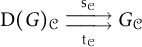 such that

is a
$G$
 -equivariant quasi-symplectic groupoid isomorphism for all
$P\in \mathcal {C}$
 .
Proof This follows immediately from Proposition 9.1 and the definition of
$\mathrm {D}(G)_{\mathcal {C}}$
 .
Given
$(P,p)\in G_{\mathcal {C}}$
 , the isomorphism
$\mathrm {D}(G)_{\mathcal {C}}\cong \mathrm {D}(G)_{P}$
 restricts to an isomorphism

between the isotropy groups of
$(P,p)$
 and
$[e:p]\in G\times _P P$
 . We use this isomorphism to freely identify the two isotropy groups in our next proposition.
Proposition 9.3 If
$(P,p)\in G_{\mathcal {C}}$
 , then

is a well-defined isomorphism of algebraic groups.
Proof The proof is entirely analogous to that of Proposition 6.3.
9.3 Steinberg slices
Fix a maximal torus
$T\subseteq G$
 and Borel subgroup
$B\subseteq G$
 satisfying
$T\subseteq B$
 . Choose an enumeration
$\alpha _1,\ldots ,\alpha _{\ell }:T\longrightarrow \mathbb {C}^{\times }$
 of the resulting simple roots. Given
$i\in \{1,\ldots ,\ell \}$
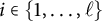 , let
$s_i\in W:= N_G(T)/T$
 denote the simple reflection corresponding to
$\alpha _i$
 . Choose a lift
$\widetilde {s_i}\in N_G(T)$
 of
$s_i$
 for each
$i\in \{1,\ldots ,\ell \}$
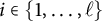 . Consider the subset

where
$\mathrm {exp}:\mathfrak {g}\longrightarrow G$
 is the exponential map and
$\mathfrak {g}_{\alpha _i}\subseteq \mathfrak {g}$
 denotes the root space associated with
$\alpha _i$
 . One calls
$\mathrm {Ste}$
 a Steinberg slice, largely to recognize the following results of Steinberg [Reference Steinberg43].
Theorem 9.4 The Steinberg slice
$\mathrm {Ste}$
 enjoys the following properties:
-
(i) One has $\mathrm {Ste}\subseteq G_{\text {reg}}$
. -
(ii) If $G$
is simply-connected, then
$\mathrm {Ste}$
intersects each conjugacy class in
$G_{\text {reg}}$
transversely and in a singleton. -
(iii) If $G$
is simply-connected, then the categorical quotient
$G\longrightarrow G\mkern -4mu\mathbin {/\mkern -5mu/}_{\mkern -4mu{}} G:= \mathrm {Spec}(\mathbb {C}[G]^G)$
restricts to an isomorphism
$\mathrm {Ste}\overset {\cong }\longrightarrow G\mkern -4mu\mathbin {/\mkern -5mu/}_{\mkern -4mu{}} G$
.



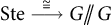
9.4 Global slices to
$\mathrm {D}(G)_{\mathcal {C}}$

Let
$X$
 be a quasi-Poisson Hamiltonian
$G$
 -variety. We define the regular locus
$X_{\text {reg}}$
 to be the union of the top-dimensional quasi-Hamiltonian leaves of
$X$
 .
We now return to the matter at hand. Let
$\mathcal {C}$
 be a conjugacy class of parabolic subgroups of
$G$
 . In light of [Reference Bălibanu5, Corollary 2.5],

is a smooth subvariety of
$G_{\mathcal {C}}$
 . Write
$(\mathrm {D}(G)_{\mathcal {C}})_{\text {reg}}\;\substack {\longrightarrow \\[-9pt] \longrightarrow }\;(G_{\mathcal {C}})_{\text {reg}}$
 for the pullback of
$\mathrm {D}(G)_{\mathcal {C}}\;\substack {\longrightarrow \\[-9pt] \longrightarrow }\; G_{\mathcal {C}}$
 to
$(G_{\mathcal {C}})_{\text {reg}}\subseteq G_{\mathcal {C}}$
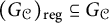 . We relate the preceding discussion to the notion of an admissible global slice, a notion defined in Section 3.3.
Theorem 9.5 If
$G$
 is simply-connected, then
$\mathrm {Ste}_{\mathcal {C}}$
 is an admissible global slice to
$(\mathrm {D}(G)_{\mathcal {C}})_{\text {reg}}\;\substack {\longrightarrow \\[-9pt] \longrightarrow }\;(G_{\mathcal {C}})_{\text {reg}}$
 .
Proof We first show that
$\mathrm {Ste}_{\mathcal {C}}$
 is a global slice to
$(\mathrm {D}(G)_{\mathcal {C}})_{\text {reg}}\;\substack {\longrightarrow \\[-9pt] \longrightarrow }\;(G_{\mathcal {C}})_{\text {reg}}$
 . To this end, choose
$P\in \mathcal {C}$
 . Let
$(\mathrm {D}(G)_P)_{\text {reg}}\;\substack {\longrightarrow \\[-9pt] \longrightarrow }\; (G\times _P P)_{\text {reg}}$
 denote the pullback of
$\mathrm {D}(G)_P\;\substack {\longrightarrow \\[-9pt] \longrightarrow }\; G\times _P P$
 to
$(G\times _P P)_{\text {reg}}\subseteq G\times _P P$
 . By Proposition 9.1, it suffices to show that
$\nu _P^{-1}(\mathrm {Ste})$
 is a global slice to
$(\mathrm {D}(G)_P)_{\text {reg}}\;\substack {\longrightarrow \\[-9pt] \longrightarrow }\; (G\times _P P)_{\text {reg}}$
 . A first step is to notice that the orbits of
$(\mathrm {D}(G)_P)_{\text {reg}}\;\substack {\longrightarrow \\[-9pt] \longrightarrow }\; (G\times _P P)_{\text {reg}}$
 are the top-dimensional orbits of
$\mathrm {D}(G)_P\;\substack {\longrightarrow \\[-9pt] \longrightarrow }\; G\times _P P$
 . A straightforward application of Remark 2.6 reveals that the orbits of
$\mathrm {D}(G)_P\;\substack {\longrightarrow \\[-9pt] \longrightarrow }\; G\times _P P$
 are the subvarieties
$G\times _{P_{[p]}}(pU(P))$
 , where
$[p]\in L(P)$
 . Lemma 8.1(ii) now tells us that the top-dimensional orbits are the subvarieties
$G\times _{P_{[p]}}(pU(P))$
 for which
$pU(P)\cap G_{\text {reg}}\neq 0$
 . It therefore suffices to prove the following:
$\nu _P^{-1}(\mathrm {Ste})$
 has a non-empty intersection with
$G\times _{P_{[p]}}(pU(P))$
 if and only if
$pU(P)\cap G_{\text {reg}}\neq \emptyset $
 , in which case the intersection is a singleton. The “if and only if” assertion follows immediately from the fact that
$\mathrm {Ste}$
 is a fundamental domain for the conjugation action of
$G$
 on
$G_{\text {reg}}$
 .
To finish proving that
$\mathrm {Ste}_{\mathcal {C}}$
 is a global slice, suppose that
$[p]\in L(P)$
 satisfies
$pU(P)\cap G_{\text {reg}}\neq \emptyset $
 . We must prove that any two elements of
$(G\times _{P_{[p]}}(pU(P)))\cap \nu _P^{-1}(\mathrm {Ste})$
 coincide. In light of Lemmas 8.1(i) and 8.2, the argument is analogous to one in the proof of Theorem 6.4.
It remains only to establish that the global slice
$\mathrm {Ste}_{\mathcal {C}}$
 is admissible. Given
$(P,p)\in \mathrm {Ste}_{\mathcal {C}}$
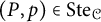 , the previous two paragraphs and Lemma 8.1(ii) imply that
$[p]\in L(P)_{\text {reg}}$
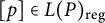 . It follows that
$L(P)_{[p]}$
 is abelian [Reference Springer42]. By Proposition 9.3, the isotropy group
$((T^*G)_{\mathcal {C}})_{(\mathfrak {p},x)}$
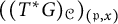 is also abelian. We conclude that
$\mathrm {Ste}_{\mathcal {C}}$
 is admissible.
Consider the flag variety
$\mathcal {B}$
 of all Borel subgroups of
$G$
 . The following is presumably known by experts in the field.
Corollary 9.6 If
$G$
 is simply-connected, then
$\mathrm {Ste}_{\mathcal {B}}$
 is an admissible global slice to
$\mathrm {D}(G)_{\mathcal {B}}\;\substack {\longrightarrow \\[-9pt] \longrightarrow }\; G_{\mathcal {B}}$
 .
9.5 Grothendieck–Springer alterations of the multiplicative Moore–Tachikawa TQFT
Take
$G$
 to be simply-connected, and let
$\mathcal {C}$
 be a conjugacy class of parabolic subgroups of
$G$
 . Theorem 9.5 and [Reference Bălibanu5, Corollary 2.5] imply that
$\mathcal G=(\mathrm {D}(G)_{\mathcal {C}})_{\text {reg}}$
 and
$S=\mathrm {Ste}_{\mathcal {C}}$
 satisfy the hypotheses of Theorem 3.2. Write
$\eta _{\mathcal {C}}:\mathbf {Cob}_2\longrightarrow \mathbf {WS}_1$
 for the resulting TQFT, and set
$\mathrm {D}(G)_{\mathcal {C}}^{m,n}:= \eta _{\mathcal {C}}(C_{m,n})$
 for
$(m,n)\neq (0,0)$
 . The following two special cases warrant further discussion:
-
(i) If $\mathcal {C}=\{G\}$
, then
$\eta _{\mathcal {C}}$
is a version of the multiplicative open Moore–Tachikawa TQFT; it is similar to the one first constructed in [Reference Bălibanu and Mayrand6], except that here we do not need to quotient the first factor of
$D(G)$
by the center. The varieties
$\mathrm {D}(G)^{m,n}:= \mathrm {D}(G)_{\mathcal {C}}^{m,n}$
also feature in [Reference Crooks and Mayrand22]. -
(ii) Suppose that $\mathcal {C}=\mathcal {B}$
is the conjugacy class of Borel subgroups. By Corollary 9.6,
$\mathrm {Ste}_{\mathcal {C}}=\mathrm {Ste}_{\mathcal {B}}$
is an admissible global slice to the entire symplectic groupoid
$\mathrm {D}(G)_{\mathcal {C}}=\mathrm {D}(G)_{\mathcal {B}}$
.






Acknowledgements
The authors thank Philip Boalch, George Lusztig, and Eckhard Meinrenken for explaining parts of [Reference Alekseev and Meinrenken3, Reference Boalch10–Reference Boalch13, Reference Lusztig and Spaltenstein35], respectively. We also thank the referee for detailed, thoughtful, and constructive comments that have improved the manuscript.


