INTRODUCTION
Kinetoplastida (Protozoa: Kinetoplastida) include a group of protozoa identified by the presence of the kinetoplast, a structure that contains condensed extranuclear DNA. The Trypanosomatidae family is composed of aetiological agents that cause diseases in humans and animals (Stuart et al. Reference Stuart, Brun, Croft, Fairlamb, Gurtler, McKerrow, Reed and Tarleton2008). This family includes genera that are parasites of plants, insects, reptiles and mammals; among them, the genera Trypanosoma and Leishmania are relevant for public health (Vickerman, Reference Vickerman, Lumsden and Evans1976).
The genus Trypanosoma includes several species of parasites of blood and other vertebrate tissues that may cause diseases in humans and animals (Hoare, Reference Hoare1972). Domestic dogs have been considered reservoirs of Trypanosoma cruzi infection in the peridomestic environment (Montenegro et al. Reference Montenegro, Jiménez, Pinto Dias and Zeledón2002). Natural infection of dogs by other Trypanosoma species, such as T. evansi (Franke et al. Reference Franke, Greiner and Mehlitz1994; Colpo et al. Reference Colpo, Monteiro, Staink, Colpo and Henriques2005) and T. rangeli (Pifano et al. Reference Pifano, Peñalver, Medina and Domingues1948; D'Alessandro, Reference D'Alessandro, Lumsden and Evans1976) have been reported.
The genus Leishmania is composed of different species with viscerotropic characteristics – i.e., Leishmania (Leishmania) infantum [syn. Leishmania (Leishmania) chagasi] – or dermotropic – i.e., L. (Viannia) braziliensis – that cause visceral leishmaniasis and tegumentary leishmaniasis, respectively. Due to their proximity to humans, domestic dogs participate in the zoonosis transmission cycle. Dogs have been found to be infected by Leishmania although their epidemiological importance is limited to the transmission cycle of visceral leishmaniasis. This animal has been also cited as an eventual host in the epidemiological cycle of tegumentary leishmaniasis (Reithinger and Davies, Reference Reithinger and Davies1999). In Brazil, the Ministry of Health recommends that diagnosis for American visceral leishmaniasis is via the indirect Immunofluorescence Antibody Test (IFAT). Antibody titres above 1:40 are used as dog elimination criterion (Ministério da Saúde, Reference Ministério da Saúde2006). Susceptibility of domestic dogs, including co-infections in overlapping endemic areas, to members of the Trypanosomatidae family has been reported. In the municipality of Rio de Janeiro, Madeira et al. (Reference Madeira, Schubach, Schubach, Pacheco, Oliveira, Pereira, Figueiredo, Baptista and Marzochi2006 a) described the case of a dog co-infected by L. (V.) braziliensis and L. (L.) chagasi. In the same municipality, a new Trypanosoma species identified as Trypanosoma caninum (a partial sequence of 28S gene is available in the GenBank under Accession number FJ01040) was isolated from the intact skin of a domestic dog co-infected with L. (V.) braziliensis (Madeira et al. Reference Madeira, Souza, Barros, Figueiredo, Fagundes, Schubach, De Paula, Faissal, Fonseca, Thoma and Marzochi2009). In this municipality, during a study on canine leishmaniasis diagnosis, a total of 19 Trypanosoma samples were isolated from dogs.
This study aimed at identifying the isolates through different approaches and warning public health authorities about these findings.
MATERIALS AND METHODS
Animals and parasites
In Rio de Janeiro city, 400 dogs were randomly selected for leishmaniasis diagnosis. Among those, a total of 19 Trypanosoma sp. samples obtained from the cultures of intact skin fragments were analysed. The approximately 4 mm skin fragments obtained from each animal were then placed in a saline solution containing 1000 U penicillin, 200 μg streptomycin and 50 μg 5-Fluorocytosine per ml, and stored for 24 h at 4°C and, after that period, tubes containing blood-agar slants (NNN) overlaid with 1·5 ml of Schneider's Drosophila Medium (Sigma) supplemented with 10% fetal calf serum (FCS) were inoculated. All cultures were kept at 27°C (±0·4°C) and were examined weekly under optical microscopy for a total period of 30 days.
IgG anti-Leishmania sp. antibodies were examined in the sera of all animals, via the IFAT technique, using the Canine Visceral Leishmaniasis Kit produced by Biomanguinhos/Oswaldo Cruz Foundation/Ministry of Health, and following instructions contained in the kit. Haemocultures were obtained from the 19 animals, inoculating about 5 ml of blood exactly as previously mentioned, and then examined fortnightly over a 2-month period.
Fisher's exact test was used to verify association between trypanosomiasis culture positivity and Leishmania seropositivity. Then, animals with Leishmania-positive parasitological results were excluded in order to detect the differences among Leishmania sp. non-infected animals. P-values <0·05 indicate a dependence relation between the results of the diagnostic tests.
All the procedures carried out during this study were approved by the Ethics Committee on Animal Experimentation of the Oswaldo Cruz Foundation (CEUA/FIOCRUZ/ P0298-06), and a consent document was signed by the animal's owner.
Methods employed in isolate identification
All the samples of Trypanosoma sp. were morphologically studied by optical microscopy of Giemsa-stained smears.
Multilocus enzyme electrophoresis – MLEE
Parasite cells were grown to obtain approximately 108 cells and harvested by centrifugation (1500 g, 15 min, 4°C), washed twice in saline solution plus EDTA (0·1 m, pH 8·0), and the pellets stored in liquid nitrogen until used for biochemical analyses. MLEE was performed in 1% agarose according to protocols described by Cupolillo et al. (Reference Cupolillo, Grimaldi and Momen1994).
Eight enzymatic loci: malate dehydrogenase (EC 1.1.1.37; MDH), glucose phosphate isomerase (EC 5.3.1.9; GPI), phosphoglucomutase (EC 2.7.5.1; PGM), isocitrate dehydrogenase (EC 1.1.1.42, IDH), mannose phosphate isomerase (EC 5.3.1.8, MPI), glucose 6-phosphate dehydrogenase (EC 1.1.1.49, G6PDH), nucleotidase (EC 3.2.2.1, NH) and 6-phosphogluconate dehydrogenase (EC 1.1.1.44, 6PGDH) were assessed. The electrophoretic pattern of the isolated samples was compared with the patterns of T. caninum (stock A27), T. cruzi (Y, CL Brener strains) and T. rangeli (Choachi strain).
PCR assay
The cultured epimastigotes were harvested through centrifugation and washed in sterile PBS. DNA was extracted with DNAzol (Invitrogen) according to the manufacturer's instructions. In this study, several PCR assays were applied for molecular analysis. Specific sequences were used for T. cruzi (D71: 5′ AAGGTGCGTCGACAGTGTGG 3′ and D72: 5′ TTTTCAGAATGGCCGAACAGT 3′) (Souto and Zingales, Reference Souto and Zingales1993); specific sequences for T. rangeli (R1: 5′ CGCGGCTCGCACTGCACCTC 3′ and R2: 5′ GGCGCATCCACCGAGCACTG 3′) (Vargas et al. Reference Vargas, Souto, Carranza, Vallejo and Zingales2000), conserved sequences targeted to all trypanosomatids (D75: 5′ GCAGATCTTGGTTGGCGTAG 3′ and D76: 5′ GGTTCTCTGTTGCCCCTTTT 3′) (Souto et al. Reference Souto, Vargas and Zingales1999) and a template in a nested PCR that targeted a variable region of the trypanosome 18S rRNA gene using trypanosome-specific oligonucleotides as described by Smith et al. (Reference Smith, Clark, Averis, Lymbery, Wayne, Morris and Thompson2008) using external primers: TRY927F (5′ GAAACAAGAAACACGGGAG 3′) and TRY927R (5′CTACTGGGCAGCTTGGA 3′); internal primers: SSU561F (5′ TGGGATAACAAAGGAGCA 3′) and SSU561R (5′ CTGAGACTGTAACCTCAAAGC 3′). All reactions were performed under the same conditions as described by the cited authors. The PCR products and a DNA ladder (100 bp) as molecular size marker were loaded onto the slots of agarose gels. Electrophoresis was performed at 70–73 V, for 1–2 h and the gels were stained with ethidium bromide, examined, and photographed under ultraviolet light. Samples of T. caninum (stock A27), T. cruzi and T. rangeli were used as reaction controls in each assay.
Sequencing of PCR product
Since all the 19 analysed samples presented similar characteristics through different methodologies, 2 of them (stock 20 and 118) were selected for sequencing analysis. T. caninum (stock A27) was included in this analysis. DNA sequencing was carried out using PCR products obtained by amplification of the partial 18S rRNA gene sequence using the primers described by Smith et al. (Reference Smith, Clark, Averis, Lymbery, Wayne, Morris and Thompson2008). For purification and sequencing procedures, the QIAquick PCR purification kit was used according to the manufacturer's instructions. Nucleotide sequences were determined in an ABI 3730 DNA Analyzer (Applied Biosystems) at the Center for Human Genome Studies, Institute of Biosciences of USP. To evaluate the similarity among T. caninum sequences, sequences of the stocks A27, 20 and 118 of T. caninum were aligned with Blast (http://blast.ncbi.nlm.nih.gov/Blast.cgi). For other homology studies, the 3 T. caninum stocks were aligned with reference strains obtained from the GenBank using Prank software (Löytynoja and Goldman, Reference Löytynoja and Goldman2005), and phylogenetic trees were made using the Neighbor-joining and maximun likelihood methods. These softwares were included in Phylo_Win 2.0 (Galtier et al. Reference Galtier, Gouy and Gautier1996) and MEGA 4.1 (Tamura et al. Reference Tamura, Dudley, Nei and Kumar2007) packages, respectively.
RESULTS
Animals
Out of 400 dogs studied, 306 were from the Guaratiba neighbourhood and 94 from Campo Grande, 2 geographically distant regions, localized in the western region of Rio de Janeiro municipality. The isolation of Trypanosoma sp. occurred in 5·23% (95% CI=3·02; 8·35) of dogs in Guaratiba and 3·19% (95% CI=0·66; 9·04) of dogs in Campo Grande, demonstrating that there was no significant difference in prevalence between the two localities studied.
Out of 400 dogs, 179 presented serum reactivity to Leishmania sp. and among these Leishmania sp. were isolated from 63 animals, Trypanosoma sp. from 10 and 106 animals were parasitologically negative for both parasites. Trypanosoma sp. was isolated in 9 animals from the group with negative sera to Leishmania sp. (n=221) and 212 animals presented negative parasite cultures. Leishmania sp. was not isolated from this group. Out of 19 dogs, from which Trypanosoma sp. was isolated, 10 presented specific IgG anti-Leishmania sp. antibodies with titres of 1:40 (10%); 1:80 (70%); 1:160 and 1:320 (respectively; 10%), and the others were non-reactive. The haemocultures of these animals presented negative results. Eighteen dogs presented good general conditions and 1 appeared thinner.
Fisher's exact test did not show significant differences in rates of T. caninum parasitologically positive animals between the Leishmania sero-positive and Leishmania sero-negative dogs (P-value=0·133).
Parasites
All samples isolated in cultures presented good growth in NNN/Schneider's medium supplemented with 10% fetal bovine serum (FBS) at 28°C. The morphological evaluation revealed the presence of characteristic epimastigote forms similar to sample A27 (T. caninum). Trypomastigote and spheromastigote forms were also observed in all samples.
Multilocus enzyme electrophoresis – MLEE
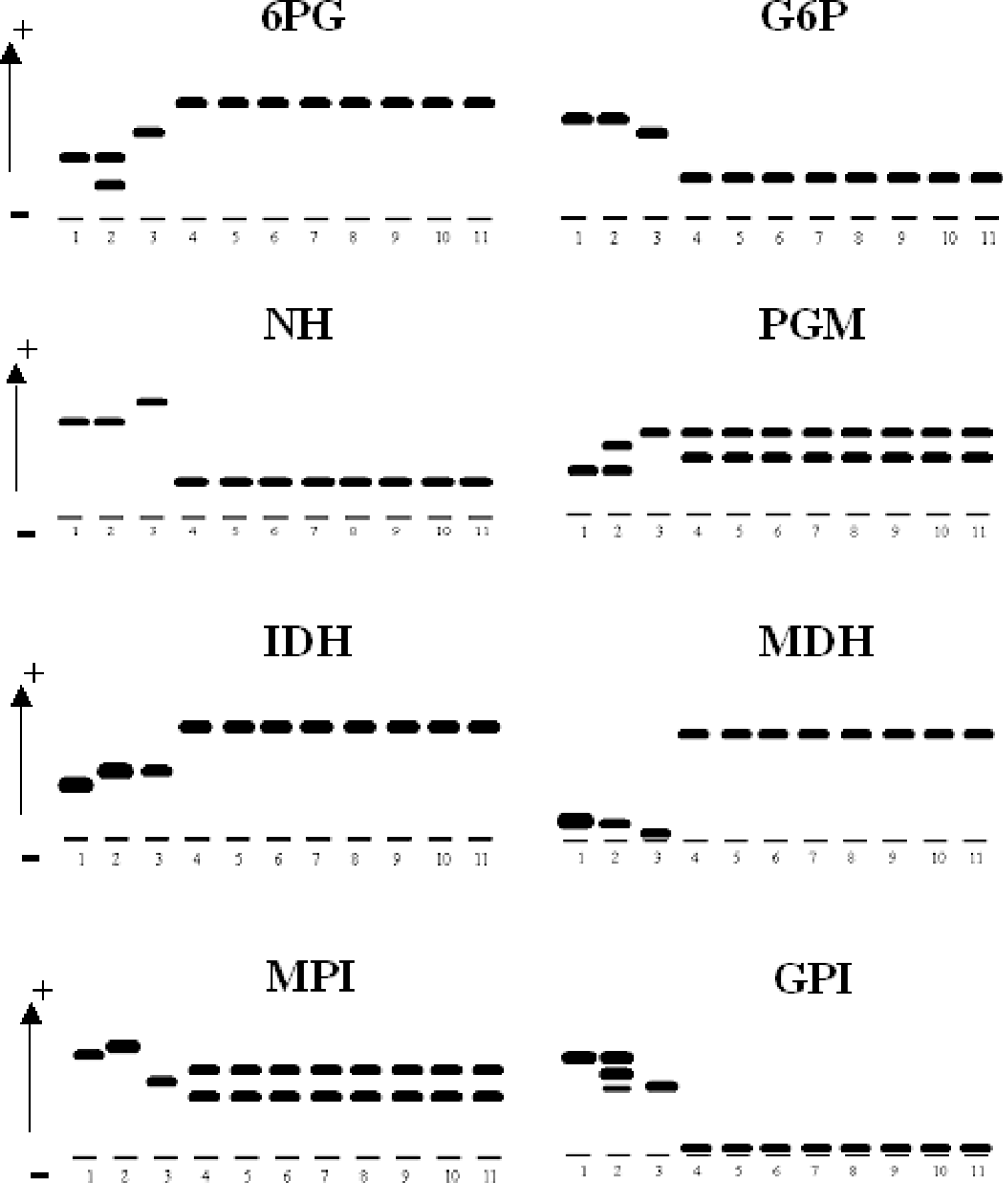
All 19 samples presented enzymatic patterns similar to T. caninum (stock A27) by MLEE in all the enzymatic systems studied and different patterns from the samples of T. cruzi (Y, CL Brener) and T. rangeli (Choachi) employed in this evaluation (Fig. 1).
Diagram of the electrophoretic patterns of 7 out of 19 studied samples. 6PG (6-phosphogluconate dehydrogenase, EC1.1.1.44); G6P (glucose-6-phosphate dehydrogenase, EC1.1.1.49); NH (nucleotidase, EC 3.2.2.1); PGM (phosphoglucomutase, EC2.7.5.1); IDH (isocitrate dehydrogenase EC1.1.1.42); MDH (malate dehydrogenase, EC1.1.1.37); MPI (mannose phosphate isomerase, EC 5.3.1.8); GPI (glucose phosphate isomerase, EC 5.3.1.9). 1: Trypanosoma cruzi (Y); 2: T. cruzi (CL Brener); 3: T. rangeli (Choachi); 4–10: isolates 3, 19, 20, 42, 53, 59 and 60; 11: T. caninum (stock A27).

PCR assay, sequencing and data analysis
Likewise, in this study, all molecular assays, showed the same amplification pattern of T. caninum. Using primers D71/D72 (T. cruzi specific) and primers R1/R2 (T. rangeli specific) no amplification products were obtained in all samples studied. Therefore, one product with approximately 250 bp was observed in all samples isolated by primers D75/D76, which amplified conserved sequences within the Trypanosomatidae genomes.
Using the target for 18S rRNA gene all samples presented an amplification product of around 700 bp. The PCR products obtained with this target were automatically sequenced and a fragment of about 560 bp was obtained for all 3 isolates selected and submitted to GenBank under Accession numbers GU385824 (isolate A27), GU385826 (isolate 20) and GU385825 (isolate 118). Alignment of the 3 sequences showed 100% similarity, with 100% query coverage and e-value of 0·0.
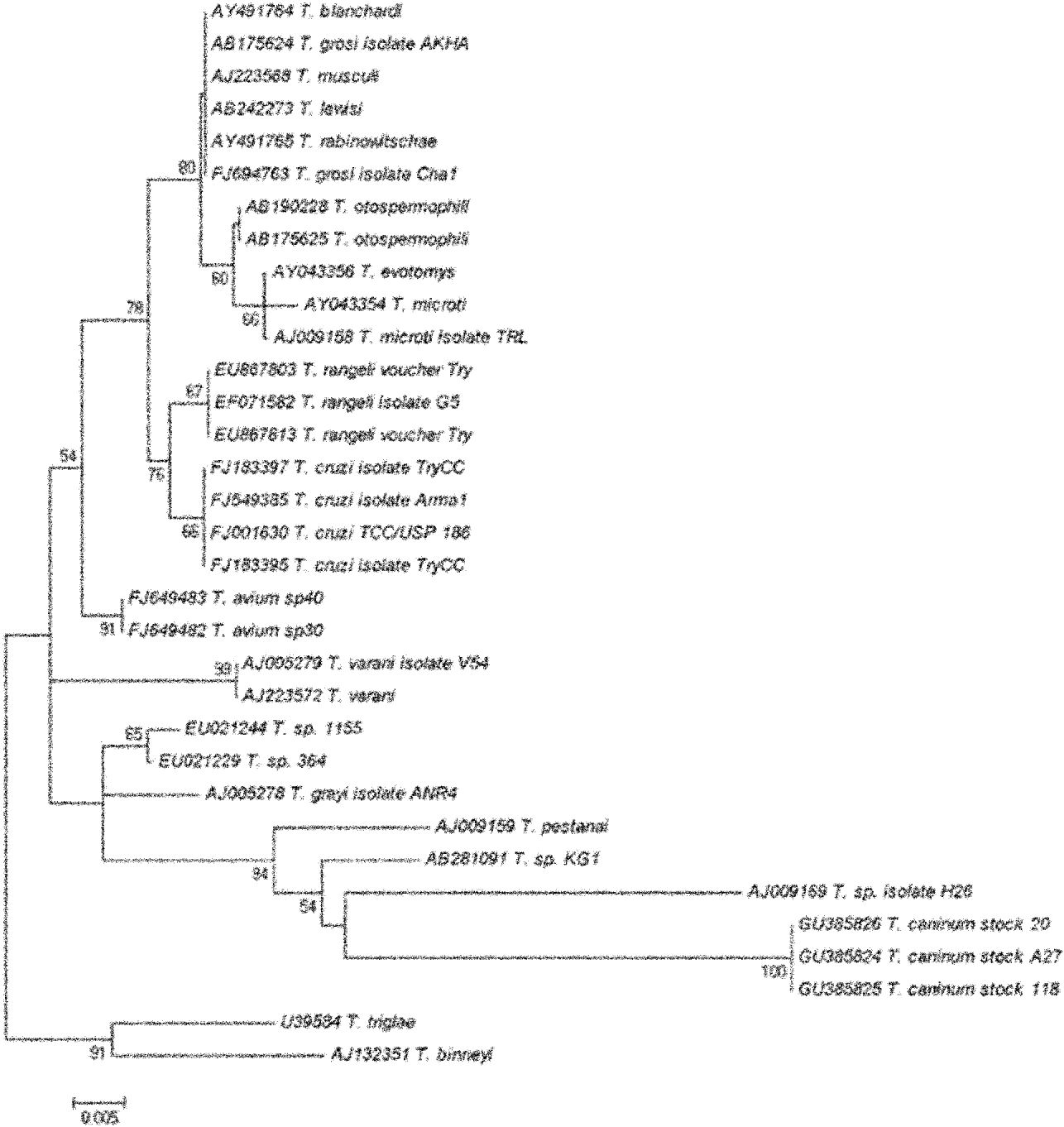
Nucleotide Blast search against GenBank retrieved partial similarity with about 100 sequences, mostly with query coverage of 41% and 33 sequences were selected for phylogenetic analysis, as shown in Figs 2 and 3.
Neighbor-joining phylogenetic tree of the partial sequences of the 18S rRNA gene of Trypanosoma caninum (stocks 20, 118 and A27) and other parasites aligned with Prank program. A percentage of replicate trees, in which the associated taxa clustered together in the bootstrap test (1000 replicates), are shown next to the branches. Trypanosoma triglae and Trypanosoma binneyi were used as outgroup. The Accession numbers of sequences in GenBank are shown in the figure.

Maximum likelihood phylogenetic tree based on partial 18S rRNA gene sequences Trypanosoma caninum (stocks 20, 118 and A27) and other trypanosomes available in GenBank.

Multiple alignments of the sequences with Prank were chosen for analysis because of the high divergence among the sequences of T. caninum and the other parasites. Neighbor-joining (Fig. 2) and maximum likelihood (Fig. 3) grouping of the isolates show that T. caninum is closer to Trypanosoma sp. strain KG1, which was the most similar strain of Trypanosoma, as shown in blast search (81% identity, query coverage of 98% and e-value of 6−118).
DISCUSSION
The Trypanosomatidae family includes several species of parasites that infect animals, some relevant to Public Health, such as parasites from Trypanosoma and Leishmania genera. Although canine visceral leishmaniasis is endemic in the municipality of Rio de Janeiro, with countless studies described in the literature (Madeira et al. Reference Madeira, Schubach, Schubach, Pereira, Figueiredo, Baptista, Leal, Melo, Confort and Marzochi2006 b), the presence of other trypanosomatides was unknown until 2009 when Madeira et al. described a new species of the genus Trypanosoma (T. caninum) in this region (Madeira et al. Reference Madeira, Souza, Barros, Figueiredo, Fagundes, Schubach, De Paula, Faissal, Fonseca, Thoma and Marzochi2009).
The objective of this study was to identify 19 samples of Trypanosoma sp. isolated from dogs and to compare them with the sample of T. caninum recently described in the municipality of Rio de Janeiro.
The Ministry of Health recommends performing canine serum surveillance in visceral leishmaniasis (VL) endemic areas, aiming to identify serum-reactive animals in order to practice euthanasia, not considering the general condition or signs of the presence of VL (Ministério da Saúde, Reference Ministério da Saúde2006). All studied samples were from cultures of intact skin fragments obtained during surveillance in different neighbourhoods of the municipality of Rio de Janeiro and all tools employed in identifying the isolates showed characteristics similar to those recently described in T. caninum. This result indicates circulation of this parasite in the municipality of Rio de Janeiro. Eighteen out of 19 animals from which T. caninum was isolated presented good clinical and dermatological conditions demonstrating that the isolated parasite may not be pathogenic as suggested by Madeira et al. (Reference Madeira, Souza, Barros, Figueiredo, Fagundes, Schubach, De Paula, Faissal, Fonseca, Thoma and Marzochi2009). An interesting fact was that the parasite could not be isolated by haemoculture in any of the animals, showing, once again, the parasite preference for peripheral blood vessels, as previously observed.
When serum was assessed, 10 of the animals presented serum reactivity to Leishmania sp. antigens with titres varying from 1:40 to 1:320; however, Leishmania parasites were not isolated from those animals. This result may indicate a possible cross-reactivity of sera between both parasites; however, no statistical significance was detected in our analysis. In the municipality of Rio de Janeiro euthanasia of serum-reactive dogs has been practiced as a VL control measure since 1979. Once both leishmaniasis forms (ATL and AVL) occur simultaneously in dogs in this municipality, the serological methods are of limited value to discriminate those infections (Madeira et al. Reference Madeira, Schubach, Schubach, Pacheco, Oliveira, Pereira, Figueiredo, Baptista and Marzochi2006 a), the presence of T. caninum could be another confusing factor in the diagnosis because cross-reactivity in sera is common between different members of the Trypanosomatidae family (Rosypal et al. Reference Rosypal, Troy, Duncan, Zajac and Lindsay2005; Desquenes et al. Reference Desquenes, Bosseno and Brenière2007). This information is reinforced when considering that 6 of the 19 studied animals underwent euthanasia due to suspicion of VL after presenting serum reactivity to leishmaniasis by IFAT, although infection by Leishmania in these animals cannot be ruled out.
All methodologies used in the present study, such as isoenzyme electrophoresis via 8 enzymatic systems and PCR directed to different molecular targets showed similar patterns to the T. caninum isolate, reinforcing the identification of those parasites. Additionally, the comparison of the nucleotide sequences of an 18S rRNA gene obtained from 2 of the analysed isolates indicated 100% similarity with T. caninum, as described by Madeira et al. (Reference Madeira, Souza, Barros, Figueiredo, Fagundes, Schubach, De Paula, Faissal, Fonseca, Thoma and Marzochi2009). The identity of the isolates was once more supported by Neighbor-joining and maximun likelihood analysis.
Although at present it is not possible to correlate epidemiological data with infection by the parasite found in dogs, the present work reinforces the need to identify elements that may be contributing to the propagation and dissemination of this parasite, including vector competence studies. In one experiment, Madeira et al. (Reference Madeira, Souza, Barros, Figueiredo, Fagundes, Schubach, De Paula, Faissal, Fonseca, Thoma and Marzochi2009) demonstrated that T. caninum was not able to evolve in triatomines of the Rhodnius and Triatoma genus. These results can suggest that other arthropods can act as vectors, such as fleas, ticks, mosquitoes and possibly phlebotomines.
There are many characteristics of this new parasite, such as its prevalence, pathogenicity and possible clinical manifestations in dogs that need to be investigated. In this study, out of 400, T. caninum was isolated from the skin of 19 animals. It should, however, be considered that, concerning the sensitivity of parasite isolation, there are limitations to parasite culture.
In addition, this work alerts the epidemiological surveillance of the Program for Leishmaniasis control, particularly, in the municipality of Rio de Janeiro, provoking several discussions, mainly related to the diagnosis of canine leishmaniasis, based on serological evidence.
FINANCIAL SUPPORT
This work was partly financed by Fundação de Apoio a Pesquisa do Rio de Janeiro (FAPERJ), Conselho Nacional de Desenvolvimento Científico Tecnológico (CNPq) and Programa de Incentivo a Pesquisa e Desenvolvimento Tecnológico (PIPDT/IPEC). T.M.P.S. is investigator of Conselho Nacional de Desenvolvimento Científico e Tecnológico (CNPq), Brazil.