How does electronic voting (e-voting) affect perceptions of election fraud in the United States compared with other potential sources of fraud? Since the controversies surrounding the US presidential election of 2000, scholars have become interested in the issue of “voter confidence,” or what Alvarez et al. (Reference Alvarez, Hall and Llewellyn2008, 755) describe as “trust in the electoral process,” and recent rulings on election laws in the United States have linked voter confidence to fraud perceptions.Footnote 1 Interest in electronic voting technologies increased during the same period, and much of that attention has focused on questions of fraud and ballot security. Research has investigated the impact of new voting technologies on election outcomes (Card and Moretti Reference Card and Moretti2007; Herron and Wand Reference Herron and Wand2007; Katz et al. Reference Katz, Alvarez, Calvo, Escolar and Pomares2011), legal challenges to electronic voting (Hasen Reference Hasen2005; Judis Reference Judis2001; Tokaji Reference Tokaji2007), and the impact of new voting technology on voter confidence (Alvarez and Hall Reference Alvarez and Hall2008; Alvarez et al. Reference Alvarez, Hall and Llewellyn2008, Reference Alvarez, Katz, Llamosa and Martinzez2009; Atkeson and Saunders Reference Atkeson and Saunders2007; Bullock et al. Reference Bullock, Hood and Clark2005; Murphy et al. Reference Murphy, Johnson and Bowler2007; Stein et al. Reference Stein, Vonnahme, Byrne and Wallach2008). Studies in the latter category, relying primarily on data from public opinion surveys, have found mixed empirical results.Footnote 2 This paper seeks to broaden our understanding of the impact of electronic voting on voter confidence using random assignment and experimental methods.
The paper proceeds with a discussion of the concept of voter confidence, the impact of voting technology on voter confidence, and links to public perceptions of election fraud. I then describe two separate nationally representative surveys that use experimental methods to test and reject the primary hypothesis that use of electronic voting methods will increase suspicion of election fraud; both find that fewer individuals are concerned about election fraud involving electronic voting, compared with other potential forms of election fraud such as registering ineligible voters or voter suppression. Another experimental treatment embedded in the second survey, an explicit polarization prime, allows for testing of a secondary hypothesis—that priming political polarization influences the impact of electronic voting on fraud perceptions for some subset of respondents. The results from this second experiment show that polarization increases older respondents’ concerns about fraud when electronic voting is employed. A comparison of these results with the first experiment suggests that question ordering in a survey has the potential to produce effects that are similar to an explicit prime.
VOTER CONFIDENCE, VOTING TECHNOLOGY, AND ELECTION FRAUD
Measures of voter confidence tend either to emphasize the accuracy of the individual's vote (Alvarez et al. Reference Alvarez, Goodrich, Hall, Kiewiet and Sled2004, Reference Alvarez, Hall and Llewellyn2008; Atkeson and Saunders Reference Atkeson and Saunders2007; Bullock et al. Reference Bullock, Hood and Clark2005) or the fairness of the electoral system more generally (Claassen et al. Reference Claassen, Magleby, Monson and Patterson2013; Hasen Reference Hasen2005).Footnote 3 Recent works are investigating perceptions of ballot secrecy as another indicator of confidence in elections (Alvarez et al. Reference Alvarez, Levin, Pomares and Leiras2013; Gerber et al. Reference Gerber, Huber, Doherty, Dowling and Hill2013), while other research has indicated that perceptions of fraud in the electoral system may also capture what Ansolabehere and Persily (Reference Ansolabehere and Persily2008, 1749) describe as “confidence in the integrity of elections.”.Footnote 4 Several studies have found one-quarter or more of respondents to suspect fraud in US elections. Hasen (Reference Hasen2005, 942) reports pre-election polls from the 2004 election that showed 58% of those polled believing there was “a lot” or “some” fraud in US elections. Ansolabehere and Persily (Reference Ansolabehere and Persily2008) found a quarter of respondents in a nationally representative sample to believe that some types of election fraud occurred regularly. Similarly, in the survey experiments conducted for this paper, approximately one-quarter of respondents found fraud to be “very likely.”
Studies have identified many different factors that affect voter confidence. Race affects both perceptions of accuracy (Alvarez et al. Reference Alvarez, Hall and Llewellyn2008; Bullock et al. Reference Bullock, Hood and Clark2005) and confidence in the fairness of election outcomes (Claassen et al. Reference Claassen, Magleby, Monson and Patterson2013). Partisanship is also associated with different levels of voter confidence (Alvarez et al. Reference Alvarez, Hall and Llewellyn2008; Atkeson and Saunders Reference Atkeson and Saunders2007; Bullock et al. Reference Bullock, Hood and Clark2005; Claassen et al. Reference Claassen, Magleby, Monson and Patterson2013; Murphy et al. Reference Murphy, Johnson and Bowler2007), particularly in relation to whether one's party won or lost (Sances and Stewart Reference Sances and Stewart III2012). Voters’ experience at their polling place is another factor shaping voter confidence (Atkeson and Saunders Reference Atkeson and Saunders2007; Claassen et al. Reference Claassen, Magleby, Monson and Patterson2013; Gronke Reference Gronke2013; Gronke and Hicks Reference Gronke and Hicks2009).
Voting technology, such as the electronic ballot, is also thought to affect confidence in the electoral process. Some studies relying on observational data have found that electronic voting reduces confidence (Alvarez et al. Reference Alvarez, Hall and Llewellyn2008, Reference Alvarez, Levin, Pomares and Leiras2013; Claassen et al. 2013).Footnote 5 Others studies have found electronic voting to have no effect on voter confidence (Bullock et al. Reference Bullock, Hood and Clark2005; Stein et al. Reference Stein, Vonnahme, Byrne and Wallach2008), or that the effects depend on other contextual factors, such as voting experience (Claassen et al. Reference Claassen, Magleby, Monson and Patterson2013) or partisanship (Murphy et al. Reference Murphy, Johnson and Bowler2007). Finally, some studies have found electronic voting to increase voter confidence (Alvarez et al. Reference Alvarez, Katz, Llamosa and Martinzez2009; Herrnson et al. Reference Herrnson, Niemi, Hanmer, Francia, Bederson, Conrad and Traugott2008).
Some of the mixed results surrounding electronic voting and voter confidence may be due to the controversy that accompanied the shift away from more traditional paper ballots. Particularly in the early 2000s, electronic voting technology received extensive media coverage, which emphasized accuracy, procurement, and cost from 2000–2002 but shifted to questions of security in 2003 and 2004, with a five-fold increase in stories regarding electronic voting and fraud by the mid 2000s (Alvarez and Hall Reference Alvarez and Hall2008, 64). A headline in the New York Times in 2003, for example, declared “Computer voting is open to Easy Fraud” (Schwartz Reference Schwartz2003), and surveys conducted from 2004–2006 found that over one-third of respondents agreed that electronic voting systems increased the potential for fraud (Alvarez and Hall Reference Alvarez and Hall2008). Like most of the studies reviewed here, this paper relies on survey data, but embeds an experimental design within the surveys in order to enhance our ability to understand the impact of electronic voting technologies on this particular aspect of voter confidence—fraud perceptions.Footnote 6
TWO SURVEY EXPERIMENTS
In the Fall of 2011, 1,000 respondents were asked about their perceptions of election fraud as part of the Cooperative Congressional Election Study (CCES) administered by YouGov/Polimetrix, and in the Fall of 2013, 3,840 respondents were asked about their perceptions of election fraud by the survey firm GfK as part of the Time-Sharing Experiments in the Social Sciences (TESS) program.Footnote 7 For each survey, the question about election fraud included experimental manipulations; respondents were told about a general election scenario where a candidate comes from behind to win, and two aspects of that scenario were varied at random: (1) some potentially suspicious activity, and (2) the party of the winning candidate.Footnote 8 By assigning these scenarios to respondents at random, we increase the likelihood that individuals within each group are similar across a range of observed and unobserved factors, which will allow us to infer the effect of particular scenarios on individuals’ perceptions of fraud. Because of the size of the CCES sample, the experimental design did not include a clean control group, yielding a 2×3 design with six total groups. Because the TESS sample was larger, clean control groups were included for both scenario and partisan treatments, as well as an additional treatment for polarization, yielding a 2×3×4 design with 24 total groups. After each scenario, respondents were asked: “How likely do you think it is that fraud was committed in this case?” and had four options to answer: very likely, somewhat likely, somewhat unlikely, very unlikely.
To enhance the external validity of this study, the three most widely publicized concerns about election fraud from the last decade were chosen for the scenarios: the security of electronic voting machines (“used electronic voting machines for the first time”), voter suppression (“voters turned away from the polls”), and concerns about voter fraud (“rumors of ineligible voters being registered”).Footnote 9 Descriptions of these circumstances were constructed to avoid obvious partisan triggers—such as references to ACORN, or language such as “voter suppression”—while providing enough of the flavor of prototypical scenarios so that respondents with particular concerns about fraud might recognize the potential implications.Footnote 10 At the same time, some measure of ambiguity was built into each treatment so that there is room for doubt in every scenario. The fact that the candidate comes from behind to win was an intentional choice to raise the stakes of the question of fraud, again without indicating fraud explicitly. And while all attempts were made to frame these scenarios neutrally, it must be recognized that asking respondents how likely it was that fraud was committed provides a framing that has been found to increase concerns in a way that a more neutral characterization, such as “irregularities,” would not (Ansolabehere and Persily Reference Ansolabehere and Persily2008, 1747). Since the goal of this study was to gauge individuals’ concerns about fraud, or deliberate manipulation, however, this framing was largely unavoidable.
As a final note about the construction of the surveys: In the CCES survey, the fraud-perceptions question was embedded in the second module of the survey, following a battery of issue-specific questions, and questions about partisan and religious identity in the first module. In particular, the questions asked in the module prior were on topics known to produce polarized responses, such as abortion, affirmative action (Layman et al. 2010), gay marriage (Abramowitz and Saunders Reference Abramowitz and Saunders2008; Layman et al. 2010), the Iraq war (Jacobson 2010), and climate change (McCright and Dunalp Reference McCright and Dunlap2011). Respondents were also asked several questions about the August 2011 debt ceiling crisis, which has been held up as a symbol of political polarization (Quirk Reference Quirk2011). By contrast, in the TESS survey, half of the respondents were randomly assigned to receive an explicit polarization prime before the fraud experiment, while the other half did not. Those who received the polarization prime were informed that “Election fraud has been a hot topic in recent elections, and Democrats and Republicans are intensely divided, both on the sources of fraud and appropriate policy solutions.”
ELECTRONIC VOTING AND FRAUD PERCEPTIONS
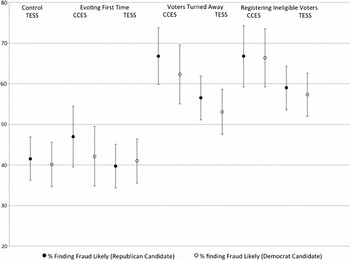
Figure 1 shows the proportion of individuals within each treatment group that thought fraud to be somewhat or very likely in the scenario they read, for both the CCES and TESS experiments—including the control condition from the TESS experiment as a point of reference.Footnote 11 The circles representing treatment group proportions are ordered by fraud scenario treatment, and the particular survey that produced those results. Within each survey/scenario, solid circles indicate the Republican candidate treatment and open circles the Democrat candidate treatment. The corresponding whiskers on each circle represent 95% confidence intervals (CIs). Comparing pairs of open and solid circles, and their overlapping whiskers, shows that the party of the winning candidate does not produce substantially different effects within each survey, for each of the three scenarios. Furthermore, while treatment proportions for CCES respondents tend to be approximately 5% larger in magnitude than proportions of TESS respondents, the overlapping confidence intervals indicate that the differences between the two surveys are not statistically significant.
Treatment Group Proportions Finding Fraud Somewhat or Very Likely

What is immediately clear from Figure 1 is that electronic voting generates less suspicion of fraud when compared with the issues of potential suppression or voter fraud, and is statistically indistinguishable from the control conditions included in the TESS survey. Between 40% and 41% of the respondents who received the control condition thought fraud likely. This is very close to the average proportions reported for the electronic voting treatment in both CCES and TESS surveys. Electronic voting generated the most fraud concern with a Republican winner in the CCES survey (47%), but the large confidence intervals associated with this group make it statistically similar to all of the other electronic voting groups and the TESS control groups. The electronic voting proportions contrast sharply, however, with the proportions of respondents who thought fraud likely in the other two scenarios, which range from a high of 66.8% of CCES respondents who received the Voters Turned Away scenario when a Republican candidate won to 53.1% of TESS respondents who received the Voters Turned Away scenario when a Democratic candidate won.
The inclusion of a control group in the TESS experiment allows for easy calculation of average treatment effects in that survey. The treatment effect for the electronic voting scenario is actually a 1.8% reduction in fraud suspicion, which is not statistically significant, while treatment effects for voter suppression and vote inflation scenarios increase fraud suspicions by 15% and 17.5%, respectively—effects that are statistically significant. For the CCES, we can say that the electronic voting scenario reduces fraud by approximately 20%, compared with the other two scenarios. While the upper confidence interval for electronic voting and a Republican candidate comes the closest to overlapping with the lower confidence interval for Voters Turned Away with a Democratic candidate, they are in fact separated by 0.5%.Footnote 12 Thus, the differences between electronic voting and the other two scenarios in the CCES survey are also statistically significant. Taken together then, Figure 1 reveals that the electronic voting scenario reduces concerns about fraud by approximately 15%–20%, compared with other potential sources of fraud.
INDIVIDUAL CHARACTERISTICS and ELECTRONIC VOTING
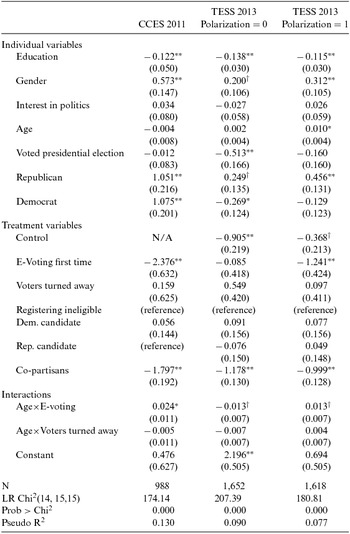
Figure 1 shows average response rates and treatment effects across treatment groups, but of course there is the possibility that particular treatments have heterogeneous effects on respondents with different characteristics. Thus, Table 1 presents the results of a series of logistic regressions with a number of individual-level indicators that have been found to affect voter confidence and fraud perceptions.Footnote 13 Model 1 uses data from the CCES survey. Model 2 uses the TESS data for those individuals who did not receive an explicit polarization prime, and Model 3 uses the TESS data for those individuals who did receive the polarization prime.Footnote 14
Individual Characteristics and Fraud Perceptions across Scenario Treatments
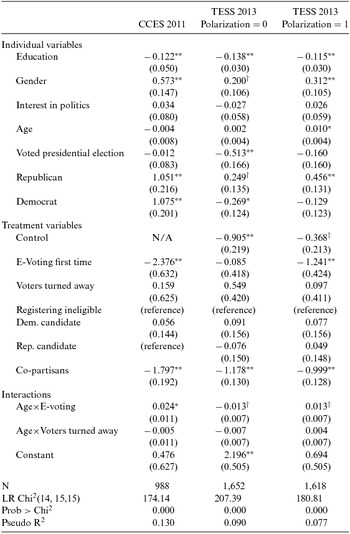
DV: = 1 if fraud “somewhat” or “very” likely.
†p > 0.10, *p > 0.05, **p > 0.01.
Based on previous research, the only characteristic we might expect to affect fraud perceptions distinctively for individuals who received the electronic voting scenario is age.Footnote 15 Alvarez et al. (Reference Alvarez, Katz, Llamosa and Martinzez2009) find that younger respondents in Latin America are more skeptical of the reliability of electronic voting machines. Thus, interaction terms are constructed to evaluate the effects of age, conditional on having received a particular scenario (Age×E-voting, Age×Voters turned away). The estimated coefficients for both interaction terms then are relative to the scenario with rumors of ineligible voters.Footnote 16 In addition to these interaction terms, and their constituent variables, the regression includes an indicator of whether the respondent received a Democratic candidate treatment in their scenario and, following Beaulieu (Reference Beaulieu2014), a co-partisan variable that equals to 1 if the respondent received a scenario where the candidate shared their partisan identity and zero otherwise.Footnote 17
Several individual-level characteristics are systematically related to fraud perceptions and obtain conventional levels of statistical significance.Footnote 18 In Model 1, the positive estimated coefficient associated with the Age×E-voting interaction term suggests that older respondents in that sample were more likely to suspect fraud when presented with the electronic voting scenario. This estimate obtains conventional levels of two-tailed statistical significance, while the Age×Voters turned away interaction does not. Thus, in the other two scenarios age appears to have no statistically significant impact on fraud perceptions in Model 1. In Model 2, the Age×E-voting interaction is negative and obtains conventional levels of one-tailed statistical significance whereas in Model 3 the Age×E-voting coefficient produces a positive coefficient that obtains conventional levels of one-tailed significance.
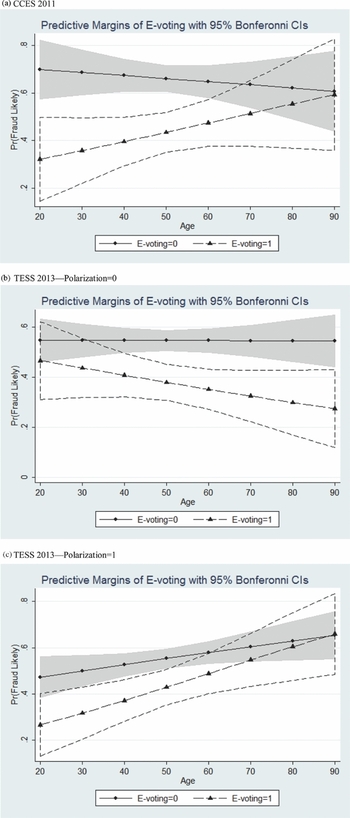
Figure 2 uses the three models presented in Table 1 to depict the marginal effect of age on the probability of finding fraud likely for the electronic voting scenario, compared with the other two scenarios, with 95% confidence intervals calculated using the Bonferonni correction to ensure that the standard errors in the model adequately account for multiple comparisons (Dunning Reference Dunning2012). In all three figures, predicted probabilities associated with electronic voting are indicated with a dash line, and the accompanying confidence interval is outlined with dashes. The predicted probabilities for other scenarios are indicated with a solid line and shaded confidence intervals.
Marginal Effect of Age on the Probability of Finding Fraud Likely: Comparing E-Voting with Other Scenarios (a) CCES 2011, (b) TESS 2013—Polarization = 0, (c) TESS 2013—Polarization = 1. (Color online)
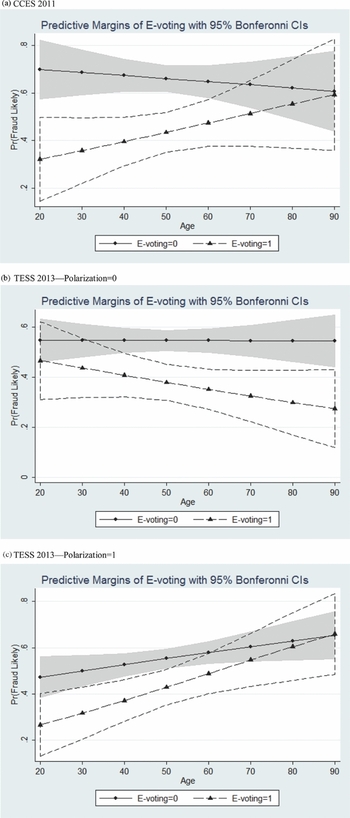
Figure 2a, from the CCES data, indicates that younger individuals are significantly less concerned about fraud in the case of electronic voting compared with the other two fraud scenarios, but concerns about fraud with electronic voting increase with age, such that, by the age of 60 approximately, the impact of electronic voting on fraud concerns becomes statistically indistinguishable from the other two scenarios. Figure 2b, constructed from the TESS respondents who did not receive a polarization prime, indicates no statistically significant reduction in fraud concerns for young individuals, but a significant reductive effect on fraud concerns with electronic voting as age increases. Finally, Figure 2c, calculated based on the TESS respondents who did receive a polarization prime, looks more like Figure 2a, with electronic voting increasing concerns about fraud among older individuals, such that for individuals aged over 50 years, electronic voting does not produce a statistically significant reduction in fraud concerns. In this final panel, it appears as though concerns about fraud increase with age in the other scenarios as well, but the steeper slope of the dashed line suggests that the rate of increase is greater in the electronic voting scenario.
CONCLUSIONS
The survey experiments presented in this paper have demonstrated that electronic voting generates less concern about election fraud, compared with other potential sources of fraud, but the investigation of individual-level effects suggests that concern about electronic voting as a source of fraud varies with age. When polarization was explicitly primed, and when respondents were exposed to a battery of unrelated questions on polarizing topics, electronic voting increased fraud among older individuals. Absent a polarization prime or polarizing questions, however, older individuals are actually less concerned about fraud with electronic voting, and while the analysis presented here included all respondents, all of the major findings are robust to a restricted sample of voters.Footnote 19 Thus, we can also interpret these results as telling us something about the impact of electronic voting on voter confidence.
The questions that remain unanswered in this study suggest a clear way forward for the future research. First, having established how electronic voting affects fraud perceptions relative to other sources of fraud, we should now investigate how electronic voting affects fraud perceptions and voter confidence relative to other sources of voting technology, such as absentee ballots and internet voting. It may be that the era of concern over election fraud via electronic voting has passed, and it is important to evaluate how new technologies are perceived by voters. Second, it may be that electronic voting could still generate concern over fraud if more of the potential problems associated with the technology were emphasized. Although designed with intentional ambiguity, the two other potential fraud scenarios: rumors of ineligible registration, and voters being turned away at the polls, may simply strike respondents as more problematic on their face, and, as such, may be more likely to trigger fraud concerns. An experimental treatment that characterized electronic voting as not producing paper verification, or reported problems with electronic voting, would help us rule out the possibility that the electronic voting scenario generated less fraud concern because the treatment did not provide enough of the kind of information likely to raise voter suspicions. Third, the TESS results show that the impact of electronic voting on older citizens’ fraud concerns depends on whether polarization has been primed prior to their evaluations. Does polarization condition other age effects, for example, the identified impact of age on issue positions, such as concerns about climate change (Kellstedt et al. Reference Kellstedt, Zahran and Vedlitz2006), or ideological self-placement (Gerber et al. Reference Gerber, Huber, Doherty, Dowling and Ha2010)?
Finally, the lack of a manipulation check in the CCES means we cannot know for certain that the controversial questions asked in the first module primed polarization in respondents prior to this survey experiment. However, comparison with the explicit polarization prime in the TESS survey shows CCES respondents look more like polarized TESS respondents than like those TESS respondents who received no explicit polarization prime, suggesting that module 1 questions in the CCES may have primed polarization. For those designing survey experiments, then, care should be taken to anticipate the potential priming effects of question ordering that might introduce pre-treatment effects. At a minimum, even if individuals cannot or do not wish to avoid priming in the design of a survey experiment, the potential for a survey to produce such pre-treatment effects must be considered carefully in the analysis and interpretation of survey experiments.
SUPPLEMENTARY MATERIAL
To view supplementary material for this article, please visit http://dx.doi.org/10.1017/XPS.2015.9.