


Introduction
The transitional period of adolescence is marked by major changes in biological, psychological and social systems (Feldman and Elliot, Reference Feldman and Elliot1990) and by stage salient tasks such as psychological autonomy (Cicchetti and Rogosch, Reference Cicchetti and Rogosch2002). The interplay of these factors may contribute to individual differences in adolescent adaptation (Costello, Erkanli and Angold, Reference Costello, Egger and Angold2005). The likelihood of developing depression increases throughout adolescence (Ford, Goodman and Meltzer, Reference Ford, Goodman and Meltzer2003) with girls more likely than boys to experience depressive symptomatology (Nolen-Hoeksema and Girgus, Reference Nolen-Hoeksema and Girgus1994) and clinically significant levels of depression (Giaconia et al., Reference Giaconia, Reinharz, Silverman, Pakis, Frost and Cohen1993). Prevalence studies of depressive symptoms in children and adolescents suggest an increase in recent decades from 10% to approximately 17% (Collishaw, Maughan, Goodman and Pickles, Reference Collishaw, Maughan, Goodman and Pickles2004), although meta-analysis of epidemiological studies with formal diagnosis of depression suggests relative stability (Costello et al., Reference Costello, Erkanli and Angold2006). This increase cannot be explained solely from a genetic standpoint (Rutter, Reference Rutter, Green and Yule2001).
A possible explanation of rising rates of childhood depression may lie in changes in familial contexts in recent decades, including rising divorce rates and changes in family composition (Collishaw et al., Reference Collishaw, Maughan, Goodman and Pickles2004), which may affect child and adolescent adjustment proximally through parental mental health (Harris, Brown and Bifulco, Reference Harris, Brown and Bifulco1986). Additionally, longitudinal studies indicate an interaction between genetic and psycho-social factors with children with a genetic vulnerability to depression being more likely to develop depressive symptoms following family conflict (Rice, Harold, Shelton and Tharpar, Reference Rice, Harold, Shelton and Thapar2006). Further, findings indicate that adolescent depression increases the likelihood of experiencing depression in adulthood (Fombonne, Wostear, Cooper, Harrington and Rutter, Reference Fombonne, Wostear, Cooper, Harrington and Rutter2001). Given these continuities, better understanding of specific factors contributing to depressive symptoms in late adolescence has implications for public health burden (Costello, Egger and Angold, Reference Costello, Erkanli and Angold2006) and subsequently intervention and prevention.
Cicchetti and Rogosch (Reference Cicchetti and Rogosch2002) suggest that examining correlates of sub-clinical presentations of depression may help identify factors that lead to development of depression. Additionally, the recognition that adolescents aged 16 to 18 years are frequently neglected in service delivery (Department of Health, 2003) highlights the importance of understanding key factors contributing to mental health in this transitional life stage. Given the brevity of the child and adolescent depression literature, the current study focuses specifically on psychosocial and cognitive variables within the context of potential psycho-social interventions.
Attachment relationships form the foundation of internal working models that are thought to have a far-reaching impact on emotional development, influencing understanding of relationships over the lifetime (Bowlby, Reference Bowlby1982). Secure attachment relationships predict both interpersonal (Allen, Moore, Kuperminc and Bell, Reference Allen, Moore, Kuperminc and Bell1998) and emotional adjustment (Cassidy, Reference Cassidy1988). Conversely, insecure attachment, through lack of psychological availability of the attachment figure, is considered a risk factor for dysfunctional adjustment (Cicchetti, Cummings, Greenberg and Marvin, Reference Cicchetti, Cummings, Greenberg, Marvin, Greenberg, Cicchetti and Cummings1990) and depression (Kobak, Sudler and Gamble, Reference Kobak, Sudler and Gamble1991). It has been suggested that attachment is linked to depression via a cognitive pathway. The child with an insecure attachment history learns that positive feedback is difficult to obtain (Rapee, Reference Rapee1997) resulting in helplessness and hopelessness regarding ability to master situations and regulate negative affect (Armsden, McCauley, Greenberg, Burke and Mitchell, Reference Armsden, McCauley, Greenberg, Burke and Mitchell1990).
Attachment remains important in the resolution of adolescent developmental tasks (Allison and Sabatelli, Reference Allison and Sabatelli1988). The parental relationship provides a secure base enabling the adolescent to retain a stable sense of identity during this time of transition (Cooper, Shaver and Collins, Reference Cooper, Shaver and Collins1998). In young adolescents, secure parental attachment is positively correlated with self-esteem, and adaptive emotional functioning (Armsden and Greenberg, Reference Armsden and Greenberg1987). Securely attached adolescents have significantly lower levels of depressive symptomatology in self-rated (Muris, Meesters, van Mellick and Zwambag, Reference Muris, Meesters, van Melick and Zwambag2001a) and observational studies (Kobak et al., Reference Kobak, Sudler and Gamble1991). The widening emphasis on relationships external to the family during adolescence highlights the formation of meaningful peer relationships as a developmental task (Allen et al., Reference Allen, Moore, Kuperminc and Bell1998). Arsmden and Greenberg (Reference Armsden and Greenberg1987) found secure attachment to peers predicted adaptive coping strategies, although the influence of peer relationships on vulnerability to depression remains unclear.
However, if adolescents are unable to negotiate increased autonomy with parents, compromising their ability to explore new situations, helplessness and a negative self-view is more likely to develop (Kobak et al., Reference Kobak, Sudler and Gamble1991). Armsden et al. (Reference Armsden, McCauley, Greenberg, Burke and Mitchell1990) found significant negative correlations between quality of attachment and a negative attributional style in adolescents. Muris, Schmidt, Lambricks and Meesters (Reference Muris, Schmidt, Lambrichs and Meesters2001b) found negative parental rearing and rejection was linked to depression via a pathway of negative attributional style and low self efficacy. Although both studies are cross-sectional, insecure attachment and negative attributional style are clearly linked.
Within child and adolescent populations, research on attributional style has focused on developing helplessness theory (Joiner and Wagner, Reference Joiner and Wagner1995). The diathesis-stress model highlights the role of internal, global and stable attributions following a negative event as increasing the likelihood of depression (Abramson, Seligman and Teasdale, Reference Abramson, Seligman and Teasdale1978). In college populations, students who made internal, global, stable attributions about failing an exam became more depressed than students with a more positive attributional style (Metalsky, Abramson, Seligman, Semmel and Peterson, Reference Metalsky, Abramson, Seligman, Semmel and Peterson1982.) According to Digdon and Gotlib (Reference Digdon and Gotlib1985), attributional style is an example of schema driven processing whereby past experiences are retrieved from memory and compared to current experiences with common themes being spontaneously extracted. If an adolescent has negative cognitive models arising from past or current interpersonal experiences, depression is likely (Armsden et al., Reference Armsden, McCauley, Greenberg, Burke and Mitchell1990).
Attributional style has also been found to contribute to the explanation of gender differences in depression that emerge in early adolescence (e.g. Abela, Reference Abela2001). Kutcher and Marton, (Reference Kutcher and Marton1989) suggest this additional pathway explains higher rates of depression in adolescent girls. Better understanding of relevant cognitive and perceived relationship variables for males and females should inform enhanced cognitive interventions to prevent and treat depression.
According to the UK National Institute of Health and Clinical Excellence (NICE, 2005), 50%-70% of children and adolescents becoming depressed experience negative life events immediately before onset of depression. Studies have established that this relationship is causal, and that life events were a strong predictor of subsequent depression in adolescents (Nolen-Hoeksama, Girgus and Seligman, Reference Nolen-Hoeksema, Girgus and Seligman1992). However, the finding that only a proportion of adolescents exposed to events become depressed highlights the influence of cognitive factors in the development of depression (Cole and Turner, Reference Cole and Turner1993).
In addition to stressful life events, current psychosocial environment has been identified as a risk factor in adolescent depression (Harrington et al., Reference Harrington, Rutter, Weissman, Fudge, Groothues, Bredenkamp, Pickles, Rende and Wickramaratne1997; NICE, 2005). Asarnow, Tompson, Hamilton, Goldstein and Guthrie (Reference Asarnow, Tompson, Hamilton, Goldstein and Guthrie1994) found parental criticism distinguished depressed children from children with schizophrenic spectrum disorders, and non-clinical controls. Perceived criticism rather than actual criticism has been found to be a more accurate predictor of relapse in depressed populations (Hooley and Teasdale, Reference Hooley and Teasdale1989) and has been linked to higher levels of depressive symptoms in clinical (Brewin, Andrews and Furnham, Reference Brewin, Andrews and Furnham1996) and community samples (Bolton, Reference Bolton2002). As with attachment, perceived criticism may be related to depression through cognitive processes with self-evaluation acting as a mediating variable (Bolton, Reference Bolton2002; Hunter, Reference Hunter2004). Hunter (Reference Hunter2004) concluded that cognitive vulnerability to depression is influenced by the internalization of perceived criticism, in addition to limited opportunities to internalize praise.
Hypotheses
The aim of the study was to examine the relative contribution of variables associated with the development of depression in the context of the transitional point of adolescence and its related tasks. The hypothesis was that variables relating to attachment, attributional style, life events, and perceived praise and criticism, would make significant independent contributions to variance in depressive symptoms. Exploratory mediator and moderator analyses were subsequently employed to investigate relationships between specific psychosocial and cognitive variables and scores on a measure of depressive symptoms.
Method
Ethical approval
Approval was granted by the University's Senate Committee on Research Ethics.
Sample
Eight urban further education colleges for 16–18 year olds were invited to participate. All had socio-economically and ethnically mixed intakes. Only two colleges could participate within the study timescale. One week prior to data collection, students were approached during class time and were given information regarding the study. The following week, data collection took place. Questionnaires took approximately 50 minutes to complete. Of 142 students approached to participate, only 2 declined (99.0% participation rate). The researcher and class teacher remained present during completion and all participants were given written information about relevant support services available to them, should they be experiencing emotional difficulties.
Measures
Demographics. Participants were asked to indicate household composition and ethnicity.
Depressive Symptoms. The Children's Depression Inventory (CDI; Kovacs, Reference Kovacs1981) is a 27-item questionnaire measuring intensity of symptoms of depression. Participants are asked to rate each item with three forced choice answers scoring from 0-2. It has high levels of internal consistency (e.g. Alphas of 0.83 – 0.88, Muris et al., Reference Muris, Schmidt, Lambrichs and Meesters2001b) and is widely used (Cole and Turner, Reference Cole and Turner1993). A CDI score of ≥ 20 is indicative of clinically significant depressive symptoms in a non-clinical sample.
The Inventory of Parent and Peer Attachment (IPPA; Armsden and Greenberg, Reference Armsden and Greenberg1987) was developed specifically for use with adolescents to measure the degree of attachment security in the different relationships of mother, father and a selected peer. It has high re-test reliability (0.86) and internal consistency (Alpha >0.87). It comprises 25 items yielding attachment scores for each source. Participants are asked to rate each item on a 5-point scale. The measure has three subscales of trust, communication and alienation.
The Relationship Rating Scales (RRS; Hunter, Reference Hunter2004) are adapted with permission from the Self Evaluation of Roles and Qualities measure of current interpersonal environment (SERQ; Brewin et al., Reference Brewin, Andrews and Furnham1996) to incorporate wider social sources. Participants rate on a 7-point scale the degree to which they are praised and criticised by each of the four sources of Mother, Father, Peer and Teacher across the four domains of schoolwork, appearance, behaviour with friends, and behaviour with family. Domain ratings for each source were summed and utilised in the data analysis. It has reasonable internal consistency (alpha 0.45 – 0.78).
The Life Events Checklist (Johnson and McCutcheon, Reference Johnson, McCutcheon, Sarason and Spielberger1980) is a 46-item measure developed specifically for adolescents that details the occurrence and impact of life events in the last year. Given the focus on the role of psycho-social and cognitive variables in the current study, the LEC was used to control for the incidence of life events and only the positive, negative and total life events were used in the analysis. This measure has established reliability and validity (Johnson and McCutcheon, Reference Johnson, McCutcheon, Sarason and Spielberger1980).
Attributional Style. Style A short version of the Adolescent Cognitive Style Questionnaire (ACSQ; Hankin and Abramson, Reference Hankin and Abramson2002) was used. Participants rate 6 negative event scenarios on a 7-point scale for internal, stable, and global causes, negative consequences, and negative inferences for self. The global and stable subscales are summed to give an “attributional style” score. This short version demonstrated reasonable internal consistency with Cronbach's Alpha ranging from 0.63 to 0.83 (Hunter, Reference Hunter2004).
Participants
Participants were 140 students aged 16-18 years attending further education colleges within the Manchester area between October 2005 and February 2006. Thirty-nine percent of the sample was male, 72% was White British, with the remainder of the sample having Asian (18%), mixed race (5%) or African (1.4%) families of origin. Ninety percent of participants lived with their biological mother, and 70% with their biological father. Nearly 23% of the sample lived with a stepfather, with 2% answering questions about a stepmother. One participant (1%) had no maternal attachment figure and 6% indicated that they had no paternal attachment figure.
Statistical analysis
Data analysis was undertaken using SPSS version 13. All measures were checked for skew and transformed as necessary. Regression analysis was used to identify the contribution of dimensions of measures to the variance in scores for depressive symptoms. Mediator and moderator models (Baron and Kenny, Reference Baron and Kenny1986) were employed to examine the relationships between psychosocial variables, cognitive variables, and depression. As, statistically, the mediating variable is considered a consequence of the first variable, as well as a cause of the outcome variable, a mediator model was used to examine relationships between attributional style, attachment and depressive symptoms. A moderator approach was employed to investigate interactions between perceived criticism and attributional style and their effect on depressive symptom scores. As negative early experiences are predicted to contribute to propensity to helplessness, helpless attributions (global and stable attributions) were examined. Propensity to make negative self-inferences was selected as alienation and rejection from parents lead to negative models of self (Muris et al., Reference Muris, Schmidt, Lambrichs and Meesters2001b). The two cognitive variables entered into the mediator and moderator analysis were examined for gender differences prior to entry into this analysis. Participant numbers are supplied for each analysis, or degrees of freedom stated.
Results
Nine (10.5%) female participants reached criterion for clinically significant depressive symptoms compared to 2 (3.7%) males. As male CDI total scores were positively skewed, non-parametric Mann Whitney U tests were employed to test for differences in CDI total scores according to gender. Differences were found using a two-tailed test (Z = −4.51, p ≤ .001). Therefore gender was included as a predictor variable in the multiple regression analysis.
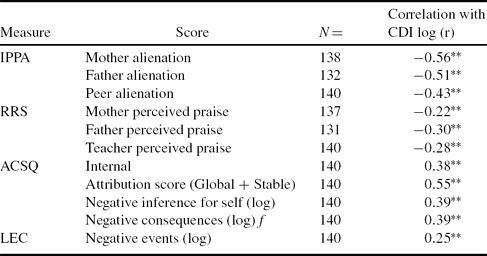
CDI Total score was positively skewed. The natural log transformation of this score was normally distributed and used in subsequent analyses. As there were 140 participants, only variables correlated with the CDI log at the 1% level were entered into the regression equation. Table 1 indicates the subsequent 12 (including gender) predictor variables entered into the multiple regression.
Correlations between CDI total score and variables entered into multiple regression analysis

**p ≤ .01 (2 tailed).
f Spearman's rho correlation.
On the IPPA, all three subscales as well as overall attachment demonstrated a significant relationship with depression at the 1% level for maternal, paternal and peer scales. However, as there were not enough participants to enter all of these variables and retain adequate power, alienation was used as the main attachment variable in multivariate regression analyses as this consistently demonstrated the strongest relationship to depression across all three scales of parental and peer attachment.
Multivariate regression analyses
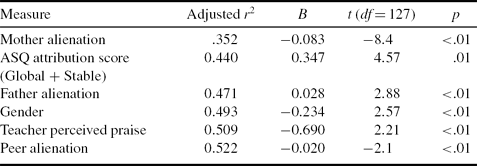
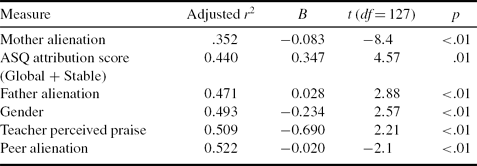
Table 2 shows the resulting model, where maternal alienation was entered at the first step, explaining 35.2% of the variance in CDI scores. It should be noted that high scores on the IPPA alienation subscale indicate low levels of alienation. At the second step, attributional style (global + stable) was entered, increasing the proportion of variance explained to 44%. Paternal alienation was entered at the third step, taking the proportion of variance accounted for up to 47.1%. Gender was entered at the fourth step, increasing the proportion of variance explained to 49.3%. The direction of the regression coefficient here indicated that being female was a significant predictor of depressive symptomatology. At the fifth step, perceived praise from teachers was entered, increasing the proportion of variance accounted for up to 50.9%. Finally, alienation from peers was entered at the sixth step, increasing the proportion of variance accounted for up to 52.5%. Perceived praise from mother and father, negative consequences for self, negative inferences for self, internal causal attributions and negative life events did not explain a significant proportion of variance in depression scores and were excluded from the final model. The F score for the final model was 24.26 (df 6,122), p < .001).
Multiple regression analysis of significant correlates of CBI total scores
Mediator and moderator analyses
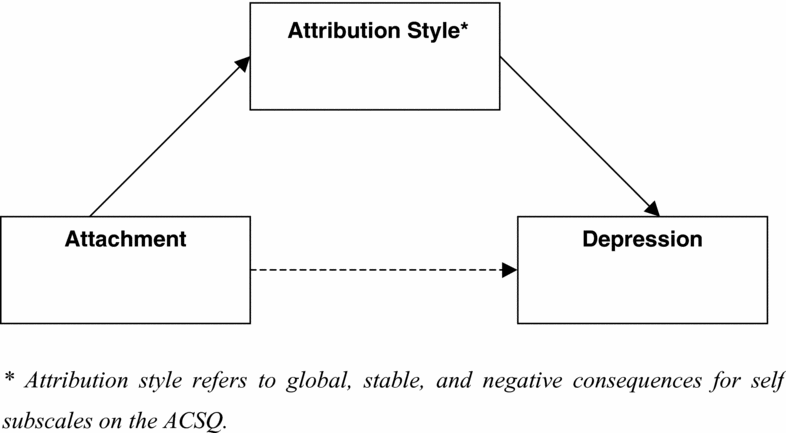
An independent samples 2 tailed t-test indicated significant differences at the 5% level between attribution (global + stable) scores for male and female participants (t = −2.46, df = 138, p < .05). Skew and kurtosis statistics indicated negative self-inference was positively skewed for male participants. Mann Whitney U tests revealed significant differences at the 5% level (z = −2.58, p ≤ .05). Separate analyses were therefore conducted for male and female participants in subsequent mediator and moderator analysis. The negative inference for self-score for male participants was subsequently transformed using a natural log transformation. For consistency, alienation (sum of mother, father and peer) was examined in the exploratory mediator analysis. Figure 1 indicates the mediator models tested for each gender.
Mediator model of attachment, attributional style and depression

Mediators of alienation and depressive symptoms: males
For male participants, a) alienation predicted attributional style (B = −.480, t = −3.767, df = 51, p < .01); and b) alienation (B = −.031, t = −6.158, df = 51, p < .01) and attributional style (B = 0.021, t = 3.825, df = 53, p < .01) predicted depressive symptoms. However, when c) alienation and attributional style were entered into the equation simultaneously, alienation remained a significant predictor of depressive symptoms (B = −.026, t = −4.7 (df = 51) p < .01). Similarly, a) alienation predicted negative self inference (B = −.016, t = −3.191 (df =51) p < .01); and b) alienation (B = −.031, t = −6.158 (df = 51), p < .01) and negative self inference (B = 0.445, t = 3.093 (df = 53) p < .01) predicted depressive symptoms. However, when c) alienation and negative self-inference were entered into the equation simultaneously, alienation remained a significant predictor of depressive symptoms (B = −.028, t = −5.125 (df = 51) p < .01). Therefore the relationship between alienation and depressive symptoms appears to be direct, and is not mediated by attributional style or negative self inferences.
Mediators of alienation and depressive symptoms: females
For female participants, a) alienation predicted attributional style (B = −.542, t = −5.427 (df =77) p < .01); and b) alienation (B = −.037, t = −6.949 (df = 77), p < .01) and attributional style (B = 0.034, t = 6.178 (df = 85), p < .01) predicted depressive symptoms. However, when c) alienation and attributional style were entered into the equation simultaneously, alienation remained a significant predictor of depressive symptoms (B = −.028, t = −4.588 (df = 77), p < .01). Similarly, a) alienation predicted negative self-inference (B = −.272, t = −3.371 (df = 77), p < .01); and b) alienation (B = −.037, t = −6.949, (df = 77) p < .01) and negative self-inference (B = 0.033, t = 3.770, (df = 85) p < .01) predicted depressive symptoms. However, when c) alienation and negative self-inference were entered into the equation simultaneously, alienation remained a significant predictor of depressive symptoms (B = −.034, t = −5.902, df = 77, p < .01). Therefore the relationship between alienation and depressive symptoms appears to be direct and is not mediated by attributional style or negative self-inferences.
Moderator analyses of perceived criticism, attributional style and depressive symptoms
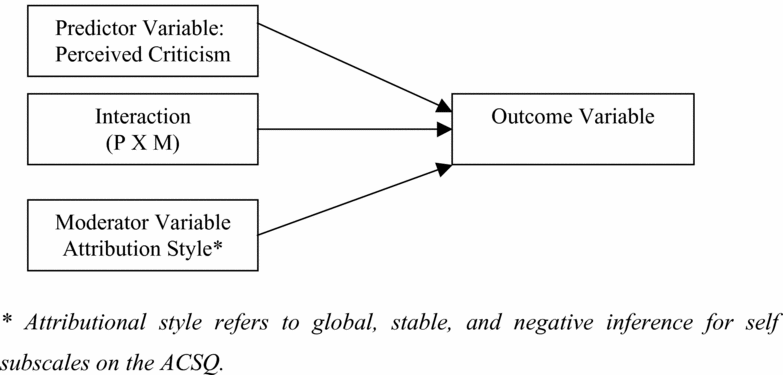
Perceived criticism across sources was summed to produce a total perceived criticism score for use in the moderator analysis. Figure 2 indicates the model to be tested.
Moderator model of perceived criticism, attribution style and depression

Moderator analysis: males
For male participants, perceived criticism, attributional style, and an interaction term of perceived criticism X attributional style were the three variables entered into a multiple regression simultaneously. Perceived criticism (B = −0.140, t = −2.958, (df = 51), p < .01) and attributional style (B = − 0.044, t = −2.399 (df = 51), p < .01) both predicted a significant proportion of the variance in depression scores. The interaction term also predicted a significant proportion of the variance (B = 0.005, t = −3.615, (df = 51), p < .01). This indicates that attributional style may be acting as a moderator between perceived criticism and depressive symptoms in male participants. The positive regression coefficient value of the interaction term indicates that the interaction term is dominant compared to the independent contribution of perceived criticism and attributional style. Perceived criticism, negative inference for self and an interaction term of total perceived criticism X negative inference for self were entered into a multiple regression simultaneously with depression scores as the outcome variable. The interaction term predicted a significant proportion of the variance (B = 0.093, t = 2.138, (df = 51), p < .05). However, perceived criticism (B = −.186, t = −1.912, (df = 51), p = .062) and negative inference for self (B = −0.737, t = −1.336, (df = 75), p = .188) did not predict a significant proportion of the variance. This indicates that negative self-inference moderates the relationship between perceived criticism in male participants.
Moderator analysis: females
In female participants, perceived criticism, attributional style, and an interaction term of perceived criticism X attributional style were the three variables entered into a multiple regression simultaneously, with depressive symptoms scores as the outcome variable. Perceived criticism (B = 0.191, t = 3.877, (df = 75), p < .01) and attributional style (B = .073, t = 5.402, (df = 75), p < .01) both predicted a significant proportion of the variance. The interaction term also predicted a significant proportion of the variance (B = −.004, t = −3.389, (df = 75), p = .01). Perceived criticism, negative inference for self and the interaction term were entered into a multiple regression simultaneously. Perceived criticism (B = 0.143, t = 4.199, (df = 75), p < .01), negative inference for self (B = 0.097, t = 4583, (df = 75), p < .01), and the interaction term (B = −.007, t = −3.44, (df = 75), p < .01) all predicted a significant proportion of the variance in depression scores. This suggests that attributional style, and negative inferences about self both moderated the effect of perceived criticism on depressive symptoms. The negative regression coefficient value of the interaction term in both models indicates a reduction in the effect of the variables on depressive symptoms when combined in the interaction term.
Discussion
This is the first study to examine the relative contribution of these specific psycho-social and cognitive variables to variance in depressive symptoms within a late adolescent population. The colleges sampled were ethnically diverse and participation rates were very high, at 99%, so we have confidence in our sampling. Initial analysis indicated that a substantial proportion of the female members of the sample reported clinically significant depressive symptoms. The observed differences between male and female participants on this variable meant that gender could be included in multivariate regression analyses. Mediator and moderator analyses were conducted separately for males and females due to gender differences in cognitive variables.
The prime position of maternal and paternal alienation in the regression equation demonstrates the importance of perceived parental relationships during this transitional stage. A helpless attributional style was also associated with vulnerability to signs of depression in this age group. These variables may be linked conceptually. A positive attachment relationship provides a safe base enabling the regulation of distress with comfort and support (Scott-Brown and Wright, Reference Scott Brown and Wright2001). If adolescents are having difficulty mastering developmental tasks such as autonomy due to attachment difficulties with parents, low self-efficacy in their ability to control outcome may lead to helplessness and a reduction in coping strategies, resulting in depressed mood (Shirk, Gudmunsen and Burwell, Reference Shirk, Gudmundsen and Burwell2005). Cicchetti and Toth (Reference Cicchetti and Toth1998) advocate focusing on striking an optimal balance between parental authority and adolescent autonomy to help the adolescent negotiate the challenges of this developmental stage. Our findings are consistent with arguments for considering the incorporation of a systemic component into cognitive intervention strategies when treating depression in this age group.
Gender was also found to contribute a significant proportion of the variance in the multiple regression equation; being a female in this age group is itself a risk factor for depressive symptomatology. An unexpected finding was that perceived praise from teachers was a significant statistical predictor of depressive symptoms, indicating that educational establishments may have a role in the facilitation of positive adjustment for this age group. The presence of perceived alienation from peers in the final regression model highlights the importance of extra-familial attachment relationships (Trinke and Bartholomew, Reference Trinke and Bartholomew1997).
Contrary to predictions, aspects of attributional style relating to self (internal attributions, and negative self-inference), as well as hopelessness (expectation of negative consequences), did not make significant contributions to the variance in self-reported depressive symptoms. Negative life events alone did not account for a significant proportion of the variance, contrary to hypotheses by NICE (2005) stating that more than 50% of cases of depression in childhood and adolescence are triggered by negative life events.
Using mediator analysis, the current study established links between relationship quality and attributional style, alienation and depressive symptoms, and attributional style and depressive symptoms. However, the nature of this link does not fit a model where attributional style plays a mediating role. Sroufe and Waters (Reference Sroufe and Waters1977) argue attachment supports exploratory endeavours through the provision of safety. Attributions may only be activated when the adolescent is feeling vulnerable due to a novel or stressful situation, consistent with the diathesis stress-model (Abramson et al., Reference Abramson, Seligman and Teasdale1978). Investigation of the attributions activated within stressful situations may inform researchers further about the links between attachment and depression via a cognitive pathway.
In the moderator analysis, males' tendency to make helpless (global and stable) causal attributions, and negative self-inferences interacted with psychosocial criticism and were associated with increased levels of depressive symptomatology. One may speculate that males are more likely to refer to existing working models in times of interpersonal stress (Digdon and Gotlib, 1984). If these models are negative, they become helpless about their ability to manage the criticism, and become depressed. In terms of negative self-inference, they may be more likely to accept perceived criticism as true and become depressed. Although females were significantly more likely to make helpless attributions, and more negative self-inferences, the impact of the two variables was reduced when they interacted with perceived criticism. The reason for this is unclear, although investigation of gender differences in perceived relationship quality and perceived criticism may provide further explanation.
The study has clear limitations. As a cross sectional design using correlation and regression analyses, causality cannot be inferred. The use of single informant self-report measures raises issues around response bias; we are only able to report adolescents' perceptions of relationships. Additionally, both attachment style and current mood have been found to produce response bias in self-report measures of depression within certain contexts (Cole-Detke and Kobak, Reference Cole-Detke and Kobak1996; Merrell, Reference Merrell1999). No diagnostic data on depression are included. Our approach to analysis, although allowing statistical prediction, cannot yield information on causality. Longitudinal analysis of relationships between attachment, cognitive variables, and depression would be an optimal approach.
Cicchetti and Rogosch (Reference Cicchetti and Rogosch2002) advocate that gender differences in pathways to depression mean that male and female adolescent depression may require different approaches to intervention. This is important in designing interventions to treat and to prevent recurrence of depression. On the basis of our data, for males, a cognitive intervention alone may reduce vulnerability to depression by reducing interaction between cognitive and psychosocial variables. For females, it may be that interventions that incorporate interpersonal factors may be more adequate. Attachment appears to play a prominent role in late adolescent adjustment in addition to helpless cognitive style and extra-familial interpersonal factors. Our mediator and moderator analyses indicate that although alienation and attributional style are linked, the mechanisms remain unclear and warrant further investigation, particularly with respect to gender.



Comments
No Comments have been published for this article.