




No CrossRef data available.
Preschooler witnesses of marital violence: Predictors and mediators of child behavior problems
Published online by Cambridge University Press: 12 May 2005
Abstract
This paper describes a conceptual approach to understanding the impact of marital violence on preschoolers, examines the predictors and mediators of child behavioral problems in a clinical sample of multiethnic preschoolers who witnessed their mothers' battering by their father figure, and presents empirical evidence supporting the use of relationship-based therapeutic modalities in treating preschoolers exposed to violence. We find that exposure to violence and maternal life stress are each predictive of child behavior problems, and that the impact of maternal life stress on child behavior problems is mediated by maternal psychopathology and the quality of the mother–child relationship.
This research was funded by a grant from the National Institute of Mental Health (R21 MH 59661) and by grants from the Irving Harris Foundation and the Miriam and Peter Hass Fund. The authors thank the mothers and children who participated in the study and the assessors who conducted the interviews. We also thank Rachel Kimerling, PhD, and Chandra Ghosh Ippen, PhD, for their review of earlier versions of the manuscript.
Information
- Type
- Research Article
- Information
- Copyright
- © 2005 Cambridge University Press
There is extensive research evidence that witnessing marital violence has a negative impact on child functioning. Children who have witnessed marital violence have more than twice the rate of clinically significant problem behaviors than children in comparison groups (McDonald & Jouriles, 1991; Wolfe, Jaffe, Wilson, & Zak, 1985).
Child witnesses of violence show an increased incidence of internalizing behaviors such as withdrawal and depression, and externalizing behaviors such as aggressiveness, defiance, and noncompliance (Cummings & Davies, 1994; Fantuzzo & Lundquist, 1989; Holden & Richie, 199l; Jaffe, Wolfe, & Wilson, 1990; Jouriles & Norwood, 1995; Jouriles, Norwood, McDonald, Vincent, & Mahoney, 1996).
The child's age and developmental level influence child's responses to marital violence (Pynoos, 1993). There is evidence that the impact of witnessing violence between parents may be more severe in younger children than in older ones (Fantuzzo & Mohr, 1999). Preschoolers show disturbances in relationships with peers and adults, affect dysregulation, play reenactment of the traumatic experience, sleep disturbances, and aggressive behavior (Eth & Pynoos, 1985; Gaensbauer, 1994; Parson, 1995; Pruett, 1979; Terr, 1981); bouts of intense fear and uncontrolled crying (Davidson, 1978; Layzer, Goodson, & Delange, 1985); and regression in developmental achievements, particularly in the areas of language, eating, toileting, separation anxiety, and sleep disorders (Drell, Siegel, & Gaensbauer, 1993; Layzer et al., 1985; Pynoos & Eth, 1985; Pynoos & Nader, 1988; Pynoos, Steinberg, & Wraith, 1995). These behaviors are consistent with descriptions of traumatic stress responses in young children (Lieberman, Van Horn, Grandison, & Pekarsky, 1997; Pynoos, 1993; Zero to Three, 1994). Witnessing acts of severe interpersonal violence is likely to constitute a traumatic experience for children, interfering with the mastery of age-appropriate developmental milestones and putting children at significant risk for posttraumatic stress disorder (PTSD), anxiety, depression, and conduct disorders (Marans & Adelman, 1997; Pynoos & Eth, 1985).
The negative effects of exposure to marital violence have also been attributed to a variety of mechanisms which most likely interact, including direct modeling of behavior, impaired security of attachment, and distortions of social information processing as the result of hostile attributional biases (Dodge, 1980; Greenberg, Speltz, & DeKlyen, 1993; Rutter, 1994). Scheeringa and Zeanah (1995) found that in children under 5 years of age, threat to the mother figure led to more symptoms of aggression, fear, and hyperarousal than exposure to other types of trauma, suggesting that fear for the safety of the attachment figure has a profound impact on children's behavior and emotional health.
From the perspective of attachment theory (Ainsworth, Blehar, Waters, & Wall, 1978; Bowlby, 1969/82), these empirical findings can be conceptualized as disturbances in the child's experience of the mother as a safe haven in times of uncertainty and fear. The mother's preoccupation with her immediate physical and psychological integrity during violent encounters may divert her attention from her child, leading her to overlook or downplay the scope and emotional impact of the child's exposure to violence (Peled & Edleson, 1992; Pynoos et al., 1999). This maternal unresponsiveness undermines the child's capacity to regulate emotion because it is incompatible with the child's age-appropriate strivings for physical and emotional proximity with the attachment figure at times of stress (George & Solomon, 1996; Lieberman & Van Horn, 1998; Lyons–Ruth & Block, 1996; Lyons–Ruth, Bronfman, & Atwood, 1999). Deprived of reassurance, young children may rely on their developmental propensity to learn by imitation (Kagan, 1981) to adopt the aggressive behaviors they witnessed at home as a way of coping with intense anger and fear. These processes may underlie the recurrent findings of co-occurrence of internalizing and externalizing behavioral problems (Shaw & Winslow, 1997).
Factors Influencing Child Functioning in the Context of Marital Violence
Despite the strong link between witnessing marital violence and child behavioral problems, variability of response has also been found (Holden, Geffner, & Jouriles, 1998; Margolin, 1998). Not all children demonstrate severe problems despite exposure to marital violence. The identification of factors that may either protect children from the adverse affects of marital violence or exacerbate these effects is critical both for the theoretical understanding of child development and for the design of effective intervention strategies (Cicchetti & Hinshaw, 2002; Rutter, 2000). Furthermore, there is compelling research evidence that developmental outcomes are best predicted by cumulative risk factors rather than by a single pathogenic condition (Rutter & Sroufe, 2000; Sameroff, 2000). Exposure to violent episodes against the self, between the parents, and in the neighborhood and larger community are likely to have compounded negative effects on the child's functioning (Lynch & Cicchetti, 1998; Richters & Martinez, 1993). A recent study by Levendosky, Huth–Bocks, Shapiro, and Semel (2003) points to the complex contextual patterns that underlie the functioning of preschool children exposed to domestic violence. In their study, the severity of violence witnessed, parenting effectiveness, maternal psychological functioning, and security of the child's attachment to mother were all related to child outcomes. Attachment relationships, while central to the child's emotional life, should be considered in a larger ecological context characterized by complex transactions between proximal and distal influences, potentiating and compensatory factors, and transient versus enduring stresses (Cicchetti & Lynch, 1993).
Role of maternal functioning in child behavior problems
There is recent empirical evidence that preschoolers' responses to traumatic events such as war and community violence are influenced by maternal psychological functioning. In a study of preschoolers residing in high-crime neighborhoods, maternal distress mediated the relationship between child exposure to community violence and child behavior problems (Linares, Heeren, Bronfman, Zuckerman, Augustyn, & Tronick, 2001). Maternal psychological functioning was also identified as a predictor of later behavior problems in a longitudinal study of Israeli preschoolers whose homes were damaged by SCUD missiles during the Gulf War (Laor, Wolmer, & Cohen, 2001). These studies highlight the potential role of mothers' psychological responses in buffering the negative impact of traumatic events for young children when these events are triggered by societal conditions, such as neighborhood violence and war. Marital violence might present an even greater challenge to mothers' psychological functioning as they strive to care for their children because they must contend with the personal physical and psychological sequelae of the violence perpetrated on them by their intimate partner, the impact of the violence on the child, and the relationship of the child with the other parent, who is frequently the child's biological father or stepfather. The present study extends the small amount of literature on maternal functioning as a mediator between adverse conditions and child behavior by evaluating the contribution of maternal psychological functioning to child behavior problems in a clinical population of children who witnessed marital violence against their mothers.
Mother's lifetime traumatic stress as a risk factor for children
Many battered women report life stresses and traumatic events while growing up as well as in their present circumstances (Groves, 2002; Osofsky, 1997). These life events may increase the likelihood of psychiatric problems among battered women because prior experience of trauma (i.e., trauma anteceding the “target” traumatic event) is a risk factor for PTSD, particularly among battered women (Astin, Ogland–Hand, Coleman, & Foy 1995; Kemp, Green, Hovanitz, & Rawlings, 1995; Ozer, Best, Lipsey, & Weiss, 2003; Perrin, Van Hasselt, Basilio, & Hersen 1996). Thus, we conceptualize mothers' lifetime traumatic stress as a risk factor for children's behavioral problems, proposing a model in which mothers' cumulative exposure to stressful or traumatic events is associated with more behavior problems in their children, as mediated by levels of maternal psychopathology.
This conceptualization is supported by several studies showing that, in a variety of different trauma populations, children of traumatized adults are less well adjusted than their peers. Rosenheck and Fontana (1998) found twice as many children with severe behavior problems in the families of Vietnam veterans who had experienced violent action and atrocities compared to children of a group of Vietnam veterans not directly exposed to such events. Similarly, some studies have found elevated behavior problems in the children of Holocaust survivors compared with children whose parents were not Holocaust survivors (Solomon, Kotler, & Mikulincer, 1988; Zilberfein, 1996). In a recent meta-analysis of studies examining the transmission of trauma symptoms from Holocaust survivors to their children, van Ijzendoorn, Bakermans–Kranenburg, and Sagi–Schwartz (2003) found this secondary traumatization effect only in second generations who were also stressed by psychological or physical adversities unrelated to their parents' Holocaust experiences. Consistent with this research, we reasoned that children in our sample, who suffered from the stress of witnessing domestic violence, would have elevated behavior problems associated with their mothers' history of stressful or traumatic life experiences.
Quality of mother–child relationship
There is empirical evidence that mothers who have experienced marital violence may be more likely to be impulsive and harshly punitive with their children (Osofsky, 1998; van der Kolk, 1987). This style of parenting has been further linked to internalizing and externalizing child problem behaviors (Chamberlain, Reid, Ray, Capaldi, & Fisher, 1997; Reid & Eddy, 1998; Shaw & Winslow, 1997). Thus, one likely way in which maternal psychological functioning can affect child behavior is through decrements in the quality of parenting. To our knowledge, no research has empirically tested the extent to which the quality of the mother–child relationship accounts for the association between maternal exposure to traumatic stress and child behavior problems. The present study addresses this gap by investigating the extent to which the quality of the mother–child relationship mediates the association between mothers' lifetime experience of stress and trauma and behavior problems in their children.
In the present study, we sought to elucidate the contributions to child behavior problems of child exposure to marital violence, as well as maternal life stresses, psychological functioning, and the quality of the mother–child relationship. We hypothesized that higher levels of child behavior problems will be associated with maternal life stress, maternal psychopathology, the quality of the mother–child relationship, and child exposure to violence. We also hypothesized that maternal psychopathology and the quality of the mother–child relationship will mediate the relationship between maternal life stress and child behavior problems.
Method
Participants and procedure
The participants were 85 preschoolers and their mothers referred to an early childhood mental health program because of clinical problems, concerns about the child's development, or concerns about the mother–child relationship following exposure to marital violence. Referral sources were Family Court, Child Protective Services, childcare providers, mothers' attorneys, restraining order clinics, and agencies advocating for battered women. The children ranged in age from 25 to 59 months (mean age = 50 months). There were 49 boys (57.6%) and 36 girls (42.4%). Child ethnicity was 46% mixed (primarily Latino/White or African American/White), 17% Latino, 17% White, 14% African American, and 7% Asian. Maternal ethnicity was 42% Latina, 32% White, 17% African American, and 9% Asian. Sixty-six percent of the mothers were employed, 20% were attending school, and 16% received some form of public assistance. Income ranged from $8,000 to $99,000/year, with a mean income of $25,000/year.
Inclusionary criteria were child witnessing marital violence, the child's preschool age (24–60 months), and the perpetrator of the marital violence not living in the home and not involved in a romantic relationship with the mother. Screening for marital violence was done using the Conflict Tactics Scale (CTS; Straus, 1979) at the time of referral to document that the mother had been physically assaulted by the child's father figure (biological father or stepfather) and that the child had witnessed the assault at least once in the year preceding the referral. Exclusionary criteria were documented child abuse by the mother, maternal substance abuse with less than 6 months in recovery, maternal homelessness, maternal psychosis or mental retardation, and child autism, psychosis, or mental retardation. These exclusionary criteria were adopted to facilitate a focus on the impact of violence by limiting the number of other risk factors that might be affecting children's behavior. All dyads completed a 4-week assessment protocol consisting of clinical interviews, structured and semistructured assessment instruments, videotaped mother–child free play and structured play, feedback about the results of the assessment, and treatment recommendations (Lieberman et al., 1997; Lieberman & Van Horn, 1998). The study was explained to the mothers, and their written informed consent on behalf of themselves and their children was obtained prior to the assessment. The assessment took place prior to the beginning of treatment.
Measures
The CTS (Straus, 1979) and its revised edition (CTS2; Straus, Hamby, Boney–McCoy, & Sugarman, 1996) were used to screen for eligibility for the study and to measure the violence sustained by the mother. Both versions of the CTS display internal consistency, with reliability scores ranging from .79 to .95 (Straus et al., 1996). For this study, data from the two measures were combined by creating new scales for psychological violence and physical violence, including only those items that appear in both instruments. The scores from the physical and psychological violence scales were then summed to create a total violence score. This method for combining data from the two scales was recommended by S. L. Hamby (personal communication, 2003), coauthor of the CTS2.
Children's exposure to interpersonal violence
Because the CTS does not assess children's exposure to violence, the 51-item Children's Exposure to Community Violence, Parent Report Version (Richters & Martinez, 1993) was completed by mothers to assess the level of the child's exposure to violence in the home and the community. For purposes of this study, items related to community violence and items related to violence directed against the child were deleted from consideration. A composite score of exposure to marital violence was constructed by adding the total number of items endorsed by the mother about the child's exposure to violence against a family member or a person known to the child. Items included in this study are listed in Appendix A. This score was used to measure the child's exposure to violence in all analyses.
Life Stressor Checklist—Revised
This questionnaire (Wolfe, Kimerling, Brown, Chrestman, & Levin, 1996) was used to assess the maternal lifetime incidence of traumatic stressors, the level of subjective distress they elicited, and their continued influence on the respondent's life. The events include accidents and natural disasters, personal events like severe illness, separation and loss, and physical and sexual violence and assault. The instrument has good psychometric properties. and endorsement of checklist items has been correlated with a diagnosis of PTSD (Wolfe & Kimerling, 1997).
Clinician-Administered PTSD Scale (CAPS)
This semistructured clinical interview (Blake, Weathers, Nagy, Kaloupek, Klauminzer, Charney, & Keane, 1990) was administered to the mothers to assess the frequency and intensity of PTSD symptoms listed in the Diagnostic and Statistical Manual of Mental Disorders (DSM-IV; American Psychiatric Association, 1994). A composite score is constructed using the total of the frequency plus intensity scores for the 17 symptoms of reexperiencing of the traumatic event, avoidance/numbing, and increased arousal. The CAPS has demonstrated excellent test–retest reliability ranging from .91 to .93, internal consistency ranging from .70 to .88 (Weathers & Litz, 1994), and convergent validity (Keane, Fairbank, Caddell, Zimering, Taylor, & Mora, 1989).
Parent–Infant Relationship Global Assessment Scale (PIRGAS) Diagnostic Classification: 0–3 (DC:0–3)
This scale (Zero to Three, National Center for Clinical Infant Programs, 1994), which is used to quantify clinical observations of the parent–child relationship in the first 5 years of life, is based on Sameroff and Emde's (1989) conceptualization of the quality of early relationships along a continuum from good adaptation, through perturbation and disturbance, to disorder. PIRGAS ratings are based on the degree of reciprocity and partnership between mother and child in maintaining the child's developmental progress. The scale ranges from 90 (well adapted) to 10 (grossly impaired). PIRGAS data were collected in two stages. In the first stage of data collection, all the mother–child dyads referred were offered treatment when the assessment was completed. For the 27 dyads assessed during this period, PIRGAS ratings were made by the assessment team, comprised of two master's level assessors and their PhD level supervisors, after the completion of three 1-hr home-based observations, two 15-min videotaped laboratory free play sessions, and observations of naturalistic interactions that occurred in the course of the assessment. Initial ratings were assigned by each assessor and supervisor, and disparities were resolved by discussion until consensus was reached. The consensus rating was used as the final rating. During the second stage of data collection, the mother–child relationship was assessed as part of a clinical trial with a study design that precluded home visits during the assessment period. For this reason, the PIRGAS was separately scored for all dyads based on the two 15-min videotaped play interactions and observations of naturalistic interactions that occurred in the course of the assessment. As before, the clinicians assessing the dyad and their supervisors each assigned ratings, and disparities were discussed to reach consensus. The consensus rating was used as the final rating. All supervisors involved in assigning PIRGAS ratings were trained in the use of the scale by the first author, who was a member of the task force that developed the DC:0–3.
Child Behavior Checklist (CBCL)
This widely used instrument (Achenbach, 1991a, 1991b; Achenbach & Edelbrock, 1983) uses maternal report to assess children's behavior problems in a variety of domains. It distinguishes between clinical and nonclinical child samples, and it has high 1-week test–retest reliabilities (.89, .93, and .93 on the total problem T score, externalizing T score, and internalizing T score, respectively), as well as high to moderate interparental agreement (rs = .76, .80, and .66, respectively). The total problem score was used in the present study for two reasons. First, the children's scores on the internalizing and externalizing scales were highly correlated (r = .57) and both the internalizing and externalizing scales were highly correlated with the total problems scale (r = .85 for both scales). Second, all mothers endorsed behavior problems for their children that are not included in either of the broadband internalizing or externalizing scales. We concluded that the total problems score best represents the mothers' perceptions of children's behavior problems in this sample. The CBCL discriminates strongly between children referred for mental health services and nonreferred, demographically matched children. It is valid for use in cross-cultural samples, and has good reliability, stability, and predictive validity.
Results
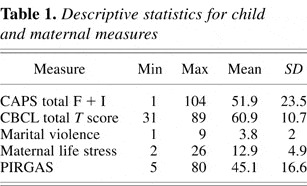
The mothers' and children's mean scores and standard deviations on all the measures are shown in Table 1. The mean CBCL total problem score in this sample of children was below the clinical cutoff (T = 70), but were slightly above one standard deviation over the normative average. Twenty-eight percent of the children in the sample scored in the clinical range. An additional 7% the children scored in the borderline clinical range (between T = 67 and 69).
Descriptive statistics for child and maternal measures

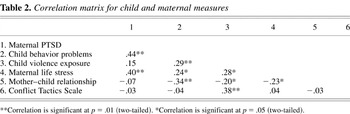
Pearson correlations are shown in Table 2. There were significant correlations in the predicted directions between child behavior problems and exposure to violence, maternal life stress, and quality of the mother–child relationship. Maternal life stress was positively correlated with PTSD symptoms and child exposure to violence, and negatively correlated with quality of the mother–child relationship. Marital violence sustained by the mother was correlated with children's exposure to marital violence, but with no other variables.
Correlation matrix for child and maternal measures

One-way analyses of variance (ANOVAs) were conducted to determine whether there were gender differences among the children in measures of child behavior problems, child exposure to violence, maternal life stress, maternal PTSD symptoms, and quality of the mother–child relationship. No significant differences were found. In addition, one-way ANOVAs were conducted to determine whether child behavior problems differed by ethnic group or by maternal income. Again, no significant differences were found. Pearson product–moment correlation between child age and child behavior problems was not significant.
Direct effects models
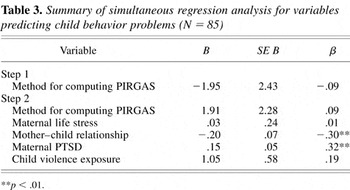
As expected, children's exposure to marital violence (r = .29, p < .01) and maternal life stress (r = .24, p < .05) were significantly correlated with total problem behaviors. A simultaneous multiple regression analysis was used to calculate the variance in child behavior problems explained by child exposure to marital violence, maternal life stress, maternal PTSD symptoms, and the quality of the mother–child relationship (Table 3). To protect against the possibility that the different methods for assigning PIRGAS scores might affect the outcome, we created a variable that tracked the method by which PIRGAS was assigned, and controlled for this variable in the regression analysis. This combination of variables explained 24% of the variance in children's behavior problems, F (5, 79) = 6.4, p < .001. After controlling for the other variables, severity of child behavior problems was uniquely predicted only by maternal PTSD (β = .39, p < .001) and quality of the mother–child relationship (β = −.31, p < .01).
Summary of simultaneous regression analysis for variables predicting child behavior problems (N = 85)

Mediational effects of maternal psychopathology and mother–child relationship
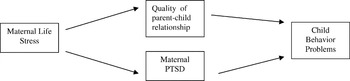
The mediation model tested the hypothesis that maternal PTSD symptoms and quality of the mother–child relationship would mediate the relationship between maternal life stress and child behavior problems (Figure 1). Both mediators were initially tested in one model, controlling for the method by which the quality of the parent–child relationship was assessed. Mediation was tested using the regression procedures recommended by Baron and Kenny (1986), with further analyses to test the significance of the mediated effect (MacKinnon, 2000; MacKinnon, Lockwood, Hoffman, West, & Sheets, 2002). Our mediational hypothesis was confirmed. Before controlling for both mediators, the relationship between maternal life stress and child behavior problems was statistically significant (β = .24, p < .05); the relationship between maternal life stress and child behavior problems was reduced to zero after controlling for both mediators (β = .02, ns). Post hoc analyses confirmed the significance of the mediated effect, t (83) = 3.79, p < .01.

The mediational model.
To clarify the relative strength of each mediator in the relationship between maternal life stress and child behavior problems, we also tested the significance of maternal PTSD symptoms and the quality of the mother–child relationship as two separate mediation models. Using the same procedure as outlined above (MacKinnon, 2000), post hoc t tests confirmed the significance of the mediated effect for maternal PTSD symptoms, t (84) = 3.77, p < .01. The quality of the mother–child relationship showed a significant trend, t (84) = 1.84, p < .10. Thus, the strength of the combined mediator model was based more heavily on the robust mediation effect for maternal PTSD.
Discussion
The empirical findings support an ecological–contextual framework in which child behavior problems in a clinical population of preschoolers who witnessed marital violence are influenced by multiple family factors, including maternal life stress, maternal psychological functioning, quality of the mother–child relationship, and the degree of child exposure to violence (Bowlby 1969/82; Cicchetti & Lynch, 1993; Levendosky et al., 2003; Lieberman & Van Horn, 1998).
The findings highlight a significant link between maternal risk factors and child behavior. Mothers who experienced higher levels of life stress had children with more behavioral problems, but this association was mediated by the mothers' response to stress, both in her individual functioning and in her relationship with her child. Using a mediation model that controlled for both maternal PTSD and the quality of the mother–child relationship, maternal lifetime exposure to major stressors was no longer significantly associated with child behavior problems. Further investigation of each mediator's effect on the relationship between maternal life stress and child behavior problems indicated that maternal PTSD showed the more robust effect. These findings indicate that while maternal life stress may be considered as a risk factor predisposing children to behavioral problems, the generative mechanism actualizing this risk is the mother's psychological response to these adverse circumstances. In addition to their theoretical relevance, the findings have important clinical implications because they suggest that effective interventions may need to incorporate a focus on maternal mental health and the mother–child relationship as mutative mechanisms to improve child functioning (Cicchetti, Toth, & Lynch, 1995; Lieberman, Weston, & Pawl, 1991; Toth, Maughan, Manly, Spagnola, & Cicchetti, 2002).
All the children in the sample had witnessed at least one episode of physical battering of the mother by their father figure and were living in single-mother households, and all the mothers had experienced battering by their partner. Within these commonalities, the sample was diverse with respect to the amount of marital violence and the extent to which the violence was witnessed by the child. Our findings indicate that the amount of violence witnessed by the child was significantly correlated with child behavior problems. Although there has been a consensus in the field that exposure to violence is a risk factor for children's emotional functioning, we are extending this empirical literature with the finding that the degree of exposure to violence is associated with problem behavior even within a clinical population in which all the children suffered from such exposure. Although the sample varied widely in terms of demographic and socioeconomic characteristics, this variation was not associated with child behavior problems.
Mothers in this sample reported a broad range of frequency and intensity of marital violence; more marital violence, however, was not associated with maternal PTSD among this sample of battered women. We found that mothers' experience of severe stress over the course of their lifetimes was more predictive of their psychological functioning than was the amount of violence they had sustained in the last year at the hands of an intimate partner.
This study has important strengths as well as significant limitations. Strengths of this study's design include successful recruitment and assessment of mother–child dyads from a particularly high-risk and difficult to recruit population, as well as its use of multiple methods (self-report instruments, clinical interviews, and systematic observations of the mother–child relationship) in gathering data from multiple sources (clinicians and mothers). Limitations include reliance on maternal report for several of the major variables and lack of data about the child's relationship with the father. Future research in this area could be further strengthened by supplementing maternal report of child's behavior problems with data from other sources, such as child observations. Although teachers' reports are commonly used in combination with parent report to assess behavior problems among school-aged children, this strategy is not viable for preschool-aged samples such as this one, in which the majority of children were not yet attending preschool. Information about fathers' psychological functioning and the quality of father–child relationship, data not gathered in this study, could also help provide a more complete understanding of the relationship context for child behavior problems. The authors are currently conducting longitudinal follow-up of this study sample to provide stronger evidence for causal relationships among key variables.
Additional research is needed to determine whether the findings are generalizable to a nonclinical sample of preschoolers who witnessed marital violence. It is worth noting, however, that the present findings are consistent with other studies reporting that the quality of parenting is associated with child behavioral problems among nonreferred samples of children who witnessed marital violence (Jouriles, McDonald, Stephens, Norwood, Spiller, & Ware, 1998).
The findings of this study have clear implications for clinical practice. Maternal psychopathology and quality of the mother–child relationship are significantly associated with child behavior problems in the context of marital violence, a finding that supports therapeutic approaches that incorporate specific attention to the mothers' psychological functioning and to the quality of the mother–child relationship when treating preschoolers. Fraiberg (1980) pioneered the treatment of mental health disturbances in infancy when she developed infant–parent psychotherapy, an approach to treatment based on the premise that parents reenact with their young children unresolved conflicts from their own childhoods, setting in motion the intergenerational transmission of psychopathology. Although her writings focused primarily in the first year of life, there is increasing clinical and research evidence that the therapeutic focus on the mother–child relationship can be usefully applied with toddlers and preschoolers, extending infant–parent psychotherapy to a broader age focus on child–parent psychotherapy (Cicchetti, Toth, & Rogosch, 1999; Lieberman, 1991; Lieberman & Van Horn, 1998; Toth et al., 2002). There is also increasing empirical support, both in this study and in prior research (Laor et al. 2001; Linares et al. 2001) for the view that psychotherapy that attends to the parent–child relationship and supports the optimal functioning of the parent is an effective tool for improving outcomes for children exposed to violence in their homes and communities. Rigorous empirical evaluation research of these types of therapies, assessing the extent to which improvements in parental functioning and the quality of the parent–child relationship are associated with improved child outcomes, should provide valuable data with which to further test the models examined here.
Appendix A

References
REFERENCES
Achenbach, T. M.
(1991a).
Manual for the Child Behavior Checklist 4–18 and 1991
Profile.
Burlington, VT:
University of Vermont Department of Psychiatry.
Achenbach, T. M.
(1991b).
Manual for the Teacher's Report Form and 1991 Profile.
Burlington, VT:
University of Vermont Department of Psychiatry.
Achenbach, T. M., &
Edelbrock, C. S.
(1983).
Manual for the Child Behavior Checklist and Revised Child Behavioral
Profile.
Burlington, VT:
University of Vermont Department of Psychiatry.
Ainsworth, M. D. S.,
Blehar, M. C.,
Waters, E., &
Wall, S.
(1978).
Patterns of attachment: A study of the Strange Situation.
Hillsdale, NJ:
Erlbaum.
American Psychiatric Association.
(1994).
Diagnostic and statistical manual of mental disorders
(4th ed.).
Washington, DC:
Author.
Astin, M. C.,
Ogland–Hand, S. M.,
Coleman, E. M., &
Foy, D. S.
(1995).
Posttraumatic stress disorder and childhood abuse in battered women:
Comparisons with martially distressed women.
Journal of Consulting and Clinical Psychology
63,
308–312.CrossRefGoogle Scholar
Baron, R. M., &
Kenny, D. A.
(1986).
The moderator–mediator variable distinction in social
psychological research: Conceptual, strategic, and statistical
considerations.
Journal of Personality and Social Psychology
51,
1173–1182.CrossRefGoogle Scholar
Blake, D. D.,
Weathers, F.,
Nagy, L.,
Kaloupek, D. G.,
Klauminzer, G.,
Charney, D., &
Keane, T. M.
(1990).
Clinician administered PTSD scale.
The Behavior Therapist
18,
12–14.Google Scholar
Bowlby, J.
(1969/1982).
Attachment and loss: Vol. I. Attachment.
New York:
Basic Books.
Chamberlain, P.,
Reid, J. B.,
Ray, J.,
Capaldi, D., &
Fisher, P. A.
(1997).
DSM-IV review for parent inadequate discipline (PID). In
P. A. Widiger (Ed.),
DSM-IV Sourcebook.
New York:
American Psychiatric Association.
Cicchetti, D., &
Hinshaw, S.
(2002).
Editorial: Prevention and intervention science: Contributions to
developmental theory.
Development and Psychopathology
14,
667–672.CrossRefGoogle Scholar
Cicchetti, D., &
Lynch, M.
(1993).
Toward an ecological/transactional model of community violence
and child maltreatment: Consequences for children's
development.
Psychiatry
56,
96–118.CrossRefGoogle Scholar
Cicchetti, D.,
Toth, S. L., &
Lynch, M.
(1995).
Bowlby's dream comes full circle: The application of attachment
theory to risk and psychopathology.
Advances in Clinical Child Psychology
17,
1–75.CrossRefGoogle Scholar
Cicchetti, D.,
Toth, S. L., &
Rogosch, F. A.
(1999).
The efficacy of toddler–parent psychotherapy to increase
attachment security in offspring of depressed mothers.
Attachment and Human Development
1,
34–66.CrossRefGoogle Scholar
Cummings, E. M., &
Davies, P. T.
(1994).
Children and marital conflict: The impact of family dispute and
resolution.
New York:
Guilford Press.
Davidson, T.
(1978).
Conjugal crime: Understanding and changing the wife beating
pattern.
New York:
Hawthorne.
Dodge, K. A.
(1980).
Social cognition and children's aggressive behavior.
Child Development
51,
162–170.CrossRefGoogle Scholar
Drell, M. J.,
Siegel, C. H., &
Gaensbauer, T. J.
(1993).
Post-traumatic stress disorder. In
C. H. Zeanah (Ed.),
Handbook of infant mental health (pp.
291–304).
New York:
Guilford Press.
Eth, S. E., &
Pynoos, R. S.
(1985).
Post-traumatic stress disorder in children.
Washington, DC:
American Psychiatric Association Press.
Fantuzzo, J. W., &
Lundquist, C. U.
(1989).
The effects of observing conjugal violence on children: A review and
analysis of research methodology.
Journal of Family Violence
4,
77–94.CrossRefGoogle Scholar
Fantuzzo, J. W., &
Mohr, W. K.
(1999).
Prevalence and effects of child exposure to domestic
violence. In
Domestic violence and children: The future of children
(Vol. 9, pp.
21–32).
Menlo Park, CA:
The David and Lucile Packard Foundation.
Fraiberg, S.
(1980).
Clinical studies in infant mental health.
New York:
Basic Books.
Gaensbauer, T. J.
(1994).
Therapeutic work with a traumatized toddler.
The Psychoanalytic Study of the Child
49,
412–433.Google Scholar
George, C., &
Solomon, J.
(1996).
Representational models of relationships: Links between caregiving
and attachment.
Infant Mental Health Journal
17,
198–216.3.0.CO;2-L>CrossRefGoogle Scholar
Greenberg, M. T.,
Speltz, M. L., &
DeKlyen, M.
(1993).
The role of attachment in the early development of disruptive
behavior problems.
Development and Psychopathology
5,
191–213.CrossRefGoogle Scholar
Groves, B. M.
(2002).
Children who see too much.
Boston:
Beacon Press.
Holden, G.,
Geffner, R. A., &
Jouriles, E. N.
(1998).
Children exposed to marital violence: Theory, research, and applied
issues.
Washington, DC:
American Psychiatric Association Press.CrossRef
Holden, G. W., &
Ritchie, K. L.
(1991).
Linking extreme marital discord, child rearing, and child behavior
problems: Evidence from battered women.
Child Development
62,
311–327.CrossRefGoogle Scholar
Jaffe, P. G.,
Wolfe, D. A., &
Wilson, S. K.
(1990).
Children of battered women.
Newbury Park, CA:
Sage.
Jouriles, E. N.,
McDonald, R.,
Stephens, N.,
Norwood, W.,
Spiller, L. C., &
Ware, H. S.
(1998).
Breaking the cycle of violence: Helping families departing from
battered women's shelters. In
G. W. Holden,
R. Geffner, and
E. N. Jouriles (Eds.),
Children exposed to marital violence: Theory, research and applied
issues (pp.
337–370).
Washington, DC:
American Psychological Association.
Jouriles, E. N., &
Norwood, W. D.
(1995).
Physical aggression toward boys and girls in families characterized
by the battering of women.
Journal of Family Psychology
9,
69–78.CrossRefGoogle Scholar
Jouriles, E. N.,
Norwood, W. D.,
McDonald, R.,
Vincent, J. P., &
Mahoney, A.
(1996).
Physical violence and other forms of marital aggression: Links with
children's behavior problems.
Journal of Family Psychology
10,
223–234.CrossRefGoogle Scholar
Kagan, J.
(1981).
The second year: The emergence of self-awareness.
Cambridge, MA:
Harvard University Press.CrossRef
Keane, T. M.,
Fairbank, J. A.,
Caddell, J. M.,
Zimering, R. T.,
Taylor, K. L., &
Mora, C. A.
(1989).
Clinical evaluation of a measure to assess combat exposure.
Psychological Assessment
1,
53–55.CrossRefGoogle Scholar
Kemp, A.,
Green, B. L.,
Hovanitz, C., &
Rawlings, E. I.
(1995).
Incidence and correlates of posttraumatic stress disorder among
battered women: Shelter and community samples.
Journal of Interpersonal Violence
10,
43–55.CrossRefGoogle Scholar
Laor, N.,
Wolmer, L., &
Cohen, D. J.
(2001).
Mothers' functioning and children's symptoms 5 years after
a SCUD missile attack.
American Journal of Psychiatry
158,
1020–1026.CrossRefGoogle Scholar
Layzer, J. I.,
Goodson, B. D., &
Delange, C.
(1985).
Children in shelters.
Response
9,
2–5.Google Scholar
Levendosky, A. A.,
Huth–Bocks, A. C.,
Shapiro, D. L., &
Semel, M. A.
(2003).
The impact of domestic violence on the maternal–child
relationship and preschool-age children's functioning.
Journal of Family Psychology
17,
275–287.CrossRefGoogle Scholar
Lieberman, A. F.
(1991).
Attachment theory and infant–parent psychotherapy: Some
conceptual, clinical, and research considerations. In
D. Cicchetti &
S. Toth (Eds.)
, Rochester Symposium on Developmental Psychopathology: Vol. 3.
Models and Integrations (pp.
262–287).
Rochester, NY:
University of Rochester Press.
Lieberman, A. F., &
Van Horn, P.
(1998).
Attachment, trauma, and domestic violence: Implications for child
custody.
Child and Adolescent Psychiatric Clinics of North America
7,
423–444.Google Scholar
Lieberman, A. F.,
Van Horn, P.,
Grandison, C. M., &
Pekarsky, J. H.
(1997).
Mental health assessment of infants, toddlers and preschoolers in a
service program and a treatment outcome research program.
Infant Mental Health Journal
18,
158–170.3.0.CO;2-L>CrossRefGoogle Scholar
Lieberman, A. F.,
Weston, D., &
Pawl, J. H.
(1991).
Preventive intervention and outcome with anxiously attached
dyads.
Child Development
62,
199–209.CrossRefGoogle Scholar
Linares, L. O.,
Heeren, T.,
Bronfman, E.,
Zuckerman, B.,
Augustyn, M., &
Tronick, E.
(2001).
A mediational model for the impact of exposure to community violence
on early child behavior problems.
Child Development
72,
639–652.CrossRefGoogle Scholar
Lynch, M., &
Cicchetti, D.
(1998).
An ecological-transactional analysis of children and context: The
longitudinal interplay among child maltreatment, community violence, and
children's symptomatology.
Development and Psychology
10,
235–57.CrossRefGoogle Scholar
Lyons–Ruth, K., &
Block, D.
(1996).
The disturbed caregiving system: Relations among childhood trauma,
maternal caregiving, and infant affect and attachment.
Infant Mental Health Journal
17,
257–275.3.0.CO;2-L>CrossRefGoogle Scholar
Lyons–Ruth, K.,
Bronfman, E., &
Atwood, G.
(1999).
A relational diathesis model of hostile-helpless states of
mind. In
J. Solomon &
C. George (Eds.),
Attachment and disorganization (pp.
35–69).
New York:
Guilford Press.
MacKinnon, D. P.
(2000).
Contrasts in multiple mediator models. In
J. Rose,
L. Chassin,
C. C. Presson, &
S. J. Sherman (Eds.),
Multivariate applications in substance use research: New methods for
new questions (pp.
141–160).
Mahwah, NJ:
Erlbaum.
MacKinnon, D. P.,
Lockwood, C. M.,
Hoffman, J. M.,
West, S. G., &
Sheets, V.
(2002).
A comparison of methods to test mediation and other intervening
variable effects.
Psychological Methods
7,
83–104.CrossRefGoogle Scholar
Marans, S., &
Adelman, A.
(1997).
Experiencing violence in a developmental context. In
J. Osofsky (Ed.),
Children in a violent society (pp.
202–222).
New York:
Guilford Press.
Margolin, G.
(1998).
Effects of domestic violence on children. In
P. K. Trickett and
C. J. Shellenbach (Eds.),
Violence against children in the family and the community
(pp.
57–101).
Washington, DC:
American Psychological Association.
McDonald, R., &
Jouriles, E. N.
(1991).
Marital aggression and child behavior problems: Research findings,
mechanisms, and intervention strategies.
Behavior Therapist
14,
189–192.Google Scholar
Osofsky, J. D.
(1997).
Children in a violent society.
New York:
Guilford Press.
Osofsky, J. D.
(1998).
Children as invisible victims of domestic and community
violence. In
G. W. Holden,
R. Geffner, &
E. N. Jouriles (Eds.),
Children exposed to marital violence: Theory, research, and applied
issues (pp.
95–117).
Washington, DC:
American Psychological Association.
Ozer, E. J.,
Best, S. R.,
Lipsey, T. L., &
Weiss, D. S.
(2003).
Predictors of posttraumatic stress disorder and symptoms in adults:
A meta-analysis.
Psychological Bulletin
129,
52–73.Google Scholar
Parson, E. R.
(1995).
Post-traumatic stress and coping in an inner-city child:
Traumatogenic witnessing of interparental violence and murder.
The Psychoanalytic Study of the Child
50,
252–271.Google Scholar
Peled, E., &
Edleson, J. L.
(1992).
Multiple perspectives on groupwork with children of battered
women.
Violence and Victims
7,
327–346.Google Scholar
Perrin, S.,
Van Hasselt, V. B.,
Basilio, I., &
Hersen, M.
(1996).
Assessing the effects of violence on women in battering
relationships with the Keanne MMPI-PTSD Scale.
Journal of Traumatic Stress
9,
805–816.Google Scholar
Pruett, K. D.
(1979).
Home treatment for two infants who witnessed their mother's
murder.
Journal of the American Academy of Child and Adolescent
Psychiatry
18,
647–657.Google Scholar
Pynoos, R. S.
(1993).
Traumatic stress and developmental psychopathology in children and
adolescents. In
J. M. Oldham,
M. B. Riba, &
A. Tasman (Eds.),
American Psychiatric Press review of psychiatry
(Vol. 12, pp.
205–238).
Pynoos, R. S., &
Eth, S. (Eds.).
(1985).
Post-traumatic stress disorder in children.
Washington, DC:
American Psychiatric Association Press.
Pynoos, R. S., &
Nader, K.
(1988).
Children who witness the sexual assaults of their mothers.
Journal of the American Academy of Child And Adolescent
Psychiatry
27,
567–572.Google Scholar
Pynoos, R. S.,
Steinberg, A. M., &
Piacentini, J. C.
(1999).
A developmental psychopathology model of childhood traumatic stress
and intersection with anxiety disorders.
Biological Psychiatry
46,
1542–1554.Google Scholar
Pynoos, R. S.,
Steinberg, A. M., &
Wraith, R.
(1995).
A developmental model of childhood traumatic stress. In
D. Cicchetti &
D. Cohen (Eds.),
Manual of developmental psychopathology: Vol. 2. Risk, disorder, and
adaptation (pp.
72–95).
New York:
Wiley.
Reid, J. B., &
Eddy, J. M.
(1998).
The prevention of antisocial behavior: Some considerations in the
search for effective interventions. In
D. M. Stoff,
J. Breiling, &
J. D. Maser (Eds.),
Handbook of antisocial behavior (pp.
343–356).
New York:
Wiley.
Richters, J. E., &
Martinez, P. E.
(1993).
The NIMH Community Violence Project: Children as victims of and
witnesses to violence. In
D. Reiss,
J. E. Richters,
M. Radke–Yarrow, &
D. Scharf (Eds.),
Children and violence (pp.
7–21).
New York:
Guilford Press.
Rosenheck, R., &
Fontana, A.
(1998).
Transgenerational effects of abusive violence on the children of
Vietnam combat veterans.
Journal of Traumatic Stress
11,
731–742.Google Scholar
Rutter, M.
(1994).
Family discord and conduct disorder: Cause, consequence, or
correlate?
Journal of Family Psychology
8,
170–186.Google Scholar
Rutter, M.
(2000).
Resilience reconsidered: Conceptual considerations, empirical
findings, and policy implications. In
Shonkoff, J. P. &
Meisels, S. J.
Handbook of early childhood intervention.
Cambridge:
Cambridge University Press,
651–682.
Rutter, M., &
Sroufe, L. A.
(2000).
Developmental psychopathology: Concepts and challenges.
Development and Psychopathology
12,
265–296.Google Scholar
Sameroff, A. J.
(2000).
Developmental systems and psychopathology.
Development and Psychopathology
12,
297–312.Google Scholar
Sameroff, A., &
Emde, R. N. (Eds.).
(1989).
Relationship disturbances in early childhood: A developmental
approach.
New York:
Basic Books.
Scheeringa, M. S., &
Zeanah, C.
(1995).
Symptom expression and trauma variables in children under 48 months
of age.
Infant Mental Health Journal
16,
259–270.Google Scholar
Shaw, D. S., &
Winslow, E. B.
(1997).
Precursors and correlates of antisocial behavior from infancy to
preschool. In
D. M. Stoff,
J. Breiling, &
J. D. Maser (Eds.),
Handbook of antisocial behavior (pp.
148–158).
New York:
Wiley.
Solomon, Z.,
Kotler, M., &
Mikulincer, M.
(1988).
Combat-related posttraumatic stress disorder among 2nd generation
Holocaust survivors—Preliminary findings.
American Journal of Psychiatry
145,
865–868.Google Scholar
Straus, M. A.
(1979).
Measuring intrafamily conflict and violence: The Conflict Tactics
(CT) Scales.
Journal of Marriage and the Family
41,
75–88.Google Scholar
Straus, M. A.,
Hamby, S. L.,
Boney–McCoy, S., &
Sugarman, D. B.
(1996).
The revised Conflict Tactics Scales (CTS2): Development and
preliminary psychometric data.
Journal of Family Issues,
17 (3),
283–316.Google Scholar
Terr, L. C.
(1981).
Forbidden games: Post-traumatic child's play.
Journal of the American Academy of Child and Adolescent
Psychiatry
20,
740–759.Google Scholar
Toth, S. L.,
Maughan, A.,
Manly, J. T.,
Spagnola, M., &
Cicchetti, D.
(2002).
The relative efficacy of two interventions in altering maltreated
preschool children's representational models: Implications for
attachment theory.
Development and Psychopathology
14(4),
877–908.Google Scholar
van der Kolk, B.
(1987).
Psychological trauma.
Washington, DC:
American Psychiatric Press.
van Ijzendoorn, M. H.,
Bakermans–Kranenburg, M. J.,
&
Sagi–Schwartz, A.
(2003).
Are children of Holocaust survivors less well-adapted? A
meta-analytic investigation of secondary traumatization.
Journal of Traumatic Stress
16,
459–469.Google Scholar
Weathers, F. W., &
Litz, B. T.
(1994).
Psychometric properties of the Clinician-Administered PTSD Scale,
CAPS-1.
PTSD Research Quarterly
5,
2–6.Google Scholar
Wolfe, D. A.,
Jaffe, P.,
Wilson, S. K., &
Zak, L.
(1985).
Children of battered women: The relation of child behavior to family
violence and maternal stress.
Journal of Consulting and Clinical Psychology
53,
657–665.Google Scholar
Wolfe, J. W., &
Kimerling, R.
(1997).
Gender issues in the assessment of posttraumatic stress
disorder. In
J. P. Wilson &
T. P. Keane (Eds.),
Assessing psychological trauma and Posttraumatic Stress
Disorder (pp.
192–238).
New York:
Guilford Press.
Wolfe, J. W.,
Kimerling, R.,
Brown, P. J.,
Chrestman, K. R., &
Levin, K.
(1996).
Psychometric review of The Life Stressor
Checklist—Revised. In
B. H. Stamm (Ed.),
Measurement of stress, trauma, and adaptation.
Lutherville, MD:
Sidran Press.
Zero to Three, National Center for Clinical Infant
Programs.
(1994).
Diagnostic classification: 0–3. Diagnostic classification of
mental health and developmental disorders of infancy and early
childhood.
Washington, DC:
Author.
Zilberfein, F.
(1996).
Children of Holocaust survivors: Separation obstacles, attachments,
and anxiety.
Social Work in Health Care
23,
35–55.Google Scholar
Descriptive statistics for child and maternal measures
Correlation matrix for child and maternal measures
Summary of simultaneous regression analysis for variables predicting child behavior problems (N = 85)
The mediational model.
 You have
Access
- 97
- Cited by