A long tradition of both economic and political science research concerns local governments. The vast literature on fiscal federalism has concentrated on the assignment of functions and taxes to different levels of government (Oates Reference Oates1999). A related result from Tiebout (Reference Tiebout1956) suggests that decentralization is a tool for efficiently pricing local public goods in a world where mobile households shop for suitable taxes and public goods combination offered by endogenously and optimally formed local jurisdictions. However, these strands of literature leave open the issue of where—and through what process—local governments or jurisdictions arise in the first place and what their optimal size is.
The current theoretical literature on endogenous mergers or coalition formation of nations or local jurisdictions (for example, Miceli Reference Miceli1993; Alesina and Spolaore Reference Alesina and Spolaore1997, Reference Alesina and Spolaore2003; Bolton and Roland Reference Bolton and Roland1997) emphasizes the fundamental trade-off between (1) economies of scale in the production of public goods and interjurisdictional spillovers (which favor merging) and (2) regional heterogeneity in preferences regarding local public goods (which favors separation). This trade-off determines the optimal size of a given jurisdictional coalition. Alesina and Spolaore (Reference Alesina and Spolaore1997), Bolton and Roland (Reference Bolton and Roland1997), and Ellingsen (Reference Ellingsen1998) also discuss how politics based on majority voting may cause departures from welfare-maximizing coalition formation. In addition, the size of a jurisdiction may have a direct effect on democracy and participation. In large jurisdictions, citizens may influence a more important and wider range of issues, but in small jurisdictions there are more opportunities to influence decision making.Footnote 1
This article contributes to the literature in a number of ways by empirically analyzing a recent wave of municipality mergers in Finland that was decided voluntarily at the local level by municipal councils. The novel contributions of our article are that we can use individual candidate-level elections data to measure the impact of potential mergers on the relative post-merger political power of the merging municipalities. This allows us to focus our analysis on issues related to local democracy, representation and voter preferences, which have been perceived as very important in political science, but have been somewhat neglected in economics. Moreover, we use Geographic Information System (GIS) techniques to accurately measure the geographic location of the median voter and analyze how this location is associated with merger decisions.
Prior empirical contributions to this field are scant, mainly because statistical modeling of spatial merger decisions is complicated for a number of reasons (Gordon and Knight Reference Gordon and Knight2009). First, merger decisions are multisided, so all potential merger parties have to agree to merge. Secondly, most jurisdictions face multiple potential merging partners, but can only merge once in a given time period. Thirdly, there is the possibility of one-to-many matching, meaning that mergers of more than two jurisdictions are possible. Fourthly, and perhaps most importantly, merger choices are spatially interdependent, because a merger between two or more jurisdictions changes the choice set of adjacent jurisdictions. In other words, a realized merger always effectively blocks some other potential mergers from taking place. Moreover, because the number of potential coalitions increases much faster with the number of players than the number of coalitions that can actually take place, a consistent estimator hinges on assumptions concerning the nature of spatial dependency.
In this setting, standard treatment effect analysis is difficult because the stable unit treatment value assumption (SUTVA) is violated.Footnote 2 If a treatment causes a coalition to form, the members of this coalition are no longer available for other potential partners, and mergers among the neighbors become less likely. Due to this spillover effect, the net effect of the treatment on merging activity is difficult to estimate.Footnote 3
In some situations, a researcher may be able to analyze many spatially independent coalition-formation games (that is, maps). For example, if mergers are not allowed to cross state borders, states can be treated as independent games.Footnote 4 In principle, we could exploit this feature in our data, but we have only 19 independent games (counties in our case). This approach may also be confounded by Tiebout (Reference Tiebout1956)-type household sorting after the map was originally drawn. By analyzing merger decisions, we avoid the sorting issue. Moreover, because of data aggregation, game-level analysis limits the scope of questions that can be asked.
Another way forward would be to build a structural statistical model that would be internally consistent and take these issues into account. The idea is to develop a coalition-formation game under such assumptions that allows the utility parameters of interest to be estimated. This avenue has proved somewhat limiting, however. Gordon and Knight (Reference Gordon and Knight2009) propose such a spatial merger estimator, but it can only be applied to data in which the mergers take place between two partners. Weese (Reference Weese2011) is another example that facilitates multiple-merger partners, but comes with computational burdens that severely limit the number of explanatory variables that can be used in the analysis. While technically impressive (and, loosely speaking, the only ‘correct’ way to proceed), these methods are vulnerable to the problems often present in structural modeling. Most importantly, a researcher using a structural approach has to make very specific assumptions about the nature of the coalition-formation game that is played and the underlying preference structure of the players (jurisdictions).Footnote 5
We do not attempt to estimate a structural model, but instead propose simpler statistical tools for descriptive analysis. In this respect, our article is related to Bhatti and Hansen (Reference Bhatti and Hansen2011), who analyze Danish municipality mergers, and Brasington (Reference Brasington1999, Reference Brasington2003a, Reference Brasington2003b), who analyzes US school district mergers.Footnote 6 However, our analysis deviates from theirs in a number of respects; we also discuss the benefits and shortcomings of our analysis compared to structural econometric models.
All Finnish municipal mergers in our sample took place between neighbors, and a large share of the mergers included more than one municipality. Spatial contiguity and multi-partner mergers pose some problems, and a key first step in our analysis is to create the dataset. We solve these problems by using Wernicke's (2006) network detection algorithm, which allows us to construct all the potential coalitions that can be formed from the original map while maintaining spatial contiguity.Footnote 7 We also illustrate how stratified choice-based sampling can be easily incorporated into the analysis in situations in which data collection or computational costs prohibit the analysis of the total population of potential coalitions, which in many cases can be substantive.Footnote 8 This type of data allows us to compare the realized mergers to potential mergers that did not take place using a simple binary logit model.
We acknowledge that our analysis is by no means perfect, and potentially severe issues of model misspecification remain. However, currently there are no existing reduced-form estimators that can consistently handle the type of data that we analyze. We argue that the trade-off between the computational burden and modeling assumptions in structural modeling—and the ability to provide rich descriptions of the data—is worth making, given an interesting empirical application. At the same time, our results should not be seen as causal evidence of the underlying utilities of the coalition-formation game, but instead as simple descriptions of the patterns in the data.
The rest of the article is organized as follows. First we describe Finnish municipalities, the institutional background for municipality mergers and the data. Then we explain our empirical approach, present the results and discus the caveats in their interpretation. The final section concludes.
Institutional Setting
Local governments play an important role in the economies of many countries. This is especially true in Nordic countries like Finland, which has a long tradition of decentralized political decision making. In Finland, public goods and services are provided by two tiers of government; municipalities constitute the local level.Footnote 9 Because of the variety of tasks assigned to them, municipalities are of considerable importance to the whole economy. The gross domestic product share of municipality spending is roughly 18 percent, and they employ around 20 percent of the total workforce.
The bulk of Finnish municipalities’ expenditures comes from producing welfare services with a strong redistributive character, such as social and health care services and primary education. Municipalities fund their spending mostly through their own revenue sources. The most important revenue source is the flat municipal income tax, which the municipalities can set freely. In addition, an extensive central government grant system is used to equalize local cost and revenue disparities. The grant system covers 20 percent of total municipal spending, but for every fourth municipality the grant system covers more than 50 percent of their revenues. Furthermore, co-operation in service production is quite common among municipalities, especially in health care.Footnote 10
The number of municipalities in Finland has diminished considerably since the 1940s, as can be seen from Figure 1. The reduction in the number of municipalities in the 1940s was due to losing land to the Soviet Union after the Second World War. Since the war, there have been two major merger waves. In the 1960s almost all of the mergers were voluntary, and in the 2000s all of them were.
Number of municipalities in Finland, 1917–2010

In addition to the two merger waves, municipality structure has been quite stable over time. The most recent merger wave can be explained by the central government's plan, which aimed to reform the municipal revenue structure and (more importantly) make the production of statutory municipal services more efficient. In 2007, these goals were made concrete by a provisional law. The law clearly states that municipalities should have strong enough revenue and labor force bases to cope with the production of statutory public services. The main tool for strengthening the operating environments of municipalities as set forth in the new law was municipality mergers. Municipalities are allowed to decide on the mergers themselves, but the government initiated a new subsidy scheme to encourage merger activity.Footnote 11
Finnish municipalities are governed by councils that have all the decision-making power, and decisions are based on a simple majority rule.Footnote 12 This is true for merging as well.Footnote 13 Municipal councils are elected every four years (at fixed dates) using open-list elections that apply the D'Hondt method. Finland has a multiparty system, and currently there are eight parties in the Finnish parliament; these parties also dominate municipal politics. In the 2004 municipal elections, the three largest parties (the Centre Party, the Social Democrats and the National Coalition) received roughly 68 percent of the votes with roughly similar shares. In addition to the traditional left/right division (the Social Democrats and the National Coalition), strong support for the Centre Party (formerly known as the Agrarian League) is a somewhat peculiar feature of the Finnish political landscape.
Each municipality has only one electoral district, and no quotas are in place. This also applies to the merged coalitions. Council size is a step function of a municipality's population and is determined by law. The council size varies from 13, for municipalities with a population of 2,000 or less, up to 85 for municipalities with a population of 400,000 or more.Footnote 14 Thus, in the case of a merger of a very large municipality and a very small municipality, it is likely that almost all the council members in the new coalition will be residents of the former larger municipality. Also, the size of the candidate list for each party in elections is a deterministic function of council size, since the maximum number of candidates per party is equal to 1.5 x council size.
Empirical Analysis of Spatial Mergers
Estimation
Statistical modeling of spatial merger decisions is complicated for a number of reasons. First, merger decision making is two sided in the sense that we observe a merger only if all potential merger parties agree to merge. Secondly, each local government faces multiple potential merging partners, but can merge only once during a given period. It is challenging both to account for all the potential merger partners and to restrict the sum of the probabilities of all the potential mergers to one. Thirdly, there is the possibility of one-to-many matching, meaning that coalitions consisting of more than two municipalities are possible. This means that the number of potential coalitions may be very large, and in some cases it may be difficult and costly to collect the relevant data. Fourthly, merger choices are spatially interdependent, so a merger between two or more municipalities changes the choice set of adjacent municipalities. Moreover, a consistent estimator hinges on assumptions concerning the nature of spatial dependency.
Our empirical approach is based on comparing the realized mergers to potential mergers that did not take place. The main empirical analysis is conducted at the coalition level so that the unit of observation is a group of municipalities that may or may not merge. Let yi denote the merger decision of coalition i (that is, yi equals 1 if the coalition decides to merge and form a new municipality and 0 otherwise). The merger choice can be modeled using the binary logit model:
 $${{y}_i}\, = \,{\rm{1}}\left( {{{{{\bf {{x^{\prime}}}}}}_{\!\!i}}{\bf {{\beta }}}\, + \,{{f}_{\!\!i}}\, + \,{{u}_i}\, \gt \,{\rm{0}}} \right),$$
where 1(.) is an indicator function that equals 1 if the statement in the parentheses is true and 0 otherwise. The vector x includes coalition-level covariates and fi are coalition-size fixed effects, where size refers to the number of municipalities involved in the coalition.
Coalition-level analysis abstracts away from individual municipalities’ choices, which solves the problem of two-sided decision making.Footnote 15 This choice imposes an assumption that only coalition-level shocks are relevant or that all the merger partners value the merger in the same way.Footnote 16 However, we include minimums of some municipal characteristics as our coalition characteristics. Since a single municipality can prevent a merger from taking place, extreme values of the municipalities’ characteristics seem to be good candidates for predicting merging.
Unfortunately, we are not able to address the second problem of one municipality appearing in many potential coalitions in this article, and thus the estimated merger probabilities may be biased. Although one could combine our data construction with a municipal-level multinomial logit to solve this issue, this would re-introduce the issue of two-sided decision making, which we think is a more fundamental problem. The third problem relates to constructing the dataset, which we explain in detail in the next subsection.
We can address the fourth problem of spatial interdependence only to a limited extent. Spatial interdependence leads to the violation of the SUTVA, implying that our model is misspecified. However, we can analyze subsamples of data in which direct blocking cannot take place. This is achieved by including in the control group only potential mergers that do not contain any municipalities involved in the realized mergers. While this does not remove indirect spillovers, the spillover effects should be different for the “not directly blocked” sample than for the full sample. Thus, analyzing these subsamples is a useful robustness exercise with respect to blocking.
Finally, spatial dependency also relates to the issue of whether the entire map or an individual coalition is the correct unit of observation. If the former is correct, adding new coalitions will not add any new information. Moreover, because the number of potential coalitions increases much faster with the number of players than the number of coalitions that can actually take place, the probability of any individual merger taking place converges towards zero. However, Gordon and Knight (Reference Gordon and Knight2009) argue that a coalition is the correct unit of observation, and their estimator is consistent under the assumption of vanishing spatial dependence, defined as the correlation between merger outcomes growing small as the distance between the coalitions grows larger. We follow Gordon and Knight (Reference Gordon and Knight2009) and maintain this assumption.
Data Creation and Choice-based Sampling
A key step in our analysis is creating the dataset that can be analyzed using the logit model in Equation 1. In the sample, all mergers took place between neighbors, and many of them included more than two municipalities. Multi-partner mergers, or one-to-many matching, cause two related problems for this type of analysis. First, it is more difficult to define the set of potential coalitions that could have formed than it is in a one-to-one matching situation.Footnote 17 Secondly, the number of potential coalitions that can be formed from the original municipal map becomes very large.
This means that we need to create a dataset that includes all the potential two- and multi-partner mergers that could have formed while maintaining the spatial contiguity of these entities. In creating the set of potential coalitions, we utilize the network algorithm created by Wernicke (Reference Wernicke2006). Using the original map at the start of 2006, this algorithm can be used to create all the potential coalitions that could be formed. Merging is possible between non-neighbors if they are part of a coalition that includes multiple municipalities that jointly form a geographically coherent entity.Footnote 18
None of the actual mergers crossed a county border, and we restrict the algorithm so that the potential coalitions cannot cross county borders either.Footnote 19 This implies that we treat each county as a separate and independent coalition-formation game, meaning that we have 19 of these games in the data. Furthermore, because a county border would be a perfect predictor of not merging, it would not be possible to use all the coalitions and simply include a county border dummy as a right-hand side variable. The map in Figure 2 illustrates municipality and county borders and the actual mergers that took place.
County and municipality borders and municipality mergers, 2007–09
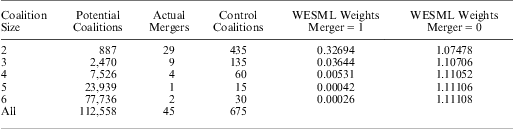
Table 1 presents the number of potential coalitions of different sizes using the county restriction and the number of actual mergers. The number of potential coalitions grows large even with the county restriction. Table 1 also reports information concerning choice-based sample data that we explain next.
Data Frequencies and Sampling Weights by Coalition Size
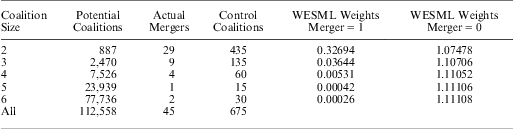
Note: includes the total number of potential coalitions, the number of mergers that actually took place, the sampled control coalitions and the WESML weights.
One of our main questions in this article is how political representation—in terms of pre-merger municipalities and parties—is associated with merging. Our analysis of these questions is based on hypothetical election outcomes that are calculated using the potential coalitions as constituencies (that is, as if they were actual municipalities) and data on pre-merger municipal vote distributions and actual election rules. These hypothetical election outcomes are used to measure the mechanical effects that mergers would have on political representation, as explained in more detail below.
Repeating these hypothetical elections for all potential coalitions would be very time consuming and would require handling very large datasets. So instead, we use choice-based sampling and calculate these election outcomes only for the choice-based sample.Footnote 20 In choice-based sampling, the basic idea is to keep all the rare events in the data as a treatment group. In our case, we include all the actual mergers, and then randomly sample a control group from the common events (the potential coalitions that did not merge). In our application, data collection is not costly for most variables, and thus we are able to confirm that the choice-based sampling results are consistent with the results obtained using the full data.
The sampling procedure is as follows. First, we select all the actual mergers into our sample. This type of endogenous sampling is necessary because a random sample from all potential coalitions would consist only of zeros with a high probability, as can be seen from Table 1. Secondly, for each actual merger in the data of size n (n=number of merging municipalities), we sample 15 potential coalitions of equal size that did not take place as controls.Footnote 21 We repeat this for all n that actually took place (in our case 2, 3, 4, 5 and 6).Footnote 22 That is, we stratify the sampling based on coalition size, because otherwise the control group would consist almost only of coalitions with many partners, making the estimation very inefficient. Combining Wernicke's (2006) algorithm with choice-based sampling has many attractive features that may be important for future spatial coalition-formation studies, not least because statistical theory on choice-based sampling is well developed and easy to apply.
Stratified choice-based sampling is prone to two sources of bias for which we need to account.Footnote 23 First, the analysis needs to be conditioned on strata fixed effects. In our case, the strata groups are defined by coalition size. Failure to do so results in omitted variable bias.Footnote 24 Secondly, we need to use weights based on the sampling rates, which can be done by using the weighted exogenous sampling maximum likelihood estimator (WESML) proposed by Manski and Lerman (Reference Manski and Lerman1977). WESML weights can be applied with any maximum likelihood estimation method, and in our case the weights can be calculated using the numbers in Table 1. Within each stratum, the weights take two values (w 1/p 1 and w 0/p 0), where w 1 and w 0 are the population proportions of merging and not merging and p 1 and p 0 are the respective sample proportions.
Data Sources and Variable Definitions
We have linked municipal merger data from 2007–09 to municipal characteristics obtained from Statistics Finland and candidate-level municipal election data obtained from the Ministry of Justice. We use pre-merger municipal characteristics from 2006 to ensure that these characteristics do not reflect any effects of the mergers. The councils in our data were elected in 2004 for a four-year term, and they made all the decisions regarding the mergers that took place in 2007–09. Future mergers are decided by councils elected in 2008 and after. The new municipal division to take place after the 2008 and 2009 mergers were implemented was used in the October 2008 municipal elections. By restricting the analysis to a single council term, we can think of this set-up as a one-period coalition-formation game in which municipalities make simultaneous choices within the same map.
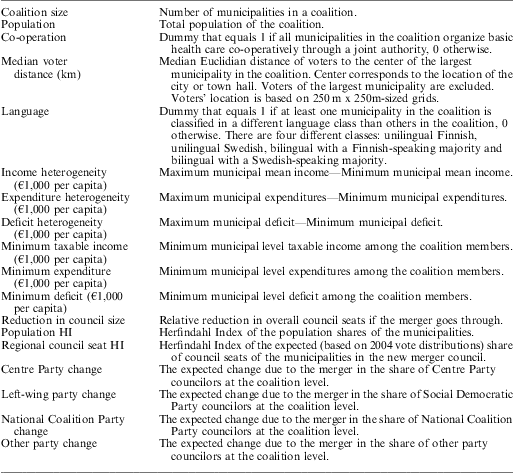
The starting point of our analysis is the result from Alesina and Spolaore (Reference Alesina and Spolaore1997), which states that optimal jurisdiction size is a trade-off between economies of scale (favoring large jurisdictions) and spatial heterogeneity in preferences (favoring small jurisdictions). More details on variable definitions are presented in Appendix Table A1. We account for economies of scale by including in the model the population of the potential coalition and its squared term. We also control for co-operation among coalition members in providing basic health care services, which may be a way for municipalities to benefit from economies of scale. Co-operation here means that the municipalities in the coalition had joint authority in producing basic health care services, which is the largest single expenditure item for municipalities.Footnote 25
We use a number of proxies for heterogeneity among the citizens of the municipalities in a potential coalition. First, because Finland is bilingual with a Swedish-speaking minority, we control for the official language status of the municipalities. Secondly, we control for differences in per capita taxable income (the main tax base), per capita expenditures and a four-year running deficit.Footnote 26 These measures are defined as the maximum value minus the minimum value of the variables among the municipalities in a given coalition. We also include the minimums of these three variables to capture some of the individual municipalities’ willingness to merge.
Thirdly, it is likely that the location of public services (schools, basic health care centers, etc.) matters to voters. It is also plausible to assume that there is pressure to concentrate services in the center of the largest municipality of a merger. The farther away the center is, the more costs voters have to bear when accessing these services after a merger. To see whether these costs prohibit mergers, we calculated for each potential coalition the median voter's distance to the center of the largest municipality in the coalition. This distance measure is calculated GIS techniques in the following way. We have data on the location of the eligible voter population in 2006 within 250 m x 250 m grids for the whole of Finland, which we use to calculate a Euclidean distance from all the grids within a coalition to the center of the largest municipality in the coalition. Since we have data on the number of eligible voters in the grids, we can calculate the median distance. The population of the largest municipality is excluded from these calculations. The intuition is that if a merger goes through, it is likely that some, if not all, municipal services will be concentrated in the largest municipality, and thus the distance to services will increase for voters living in smaller municipalities in a given coalition. This is a sensible measure, because any single municipality in a given coalition can prevent a merger from taking place.
Alesina and Spolaore (Reference Alesina and Spolaore1997) abstract away from various political aspects of merger decisions. We measure these aspects from three different points of view. First, local representation in the post-merger council may be important to voters in order to secure common pool-funded spending for their region (for example, Weingast, Shepsle and Johnsen Reference Weingast, Shepsle and Johnsen1981; Baron and Ferejohn Reference Baron and Ferejohn1987, Reference Baron and Ferejohn1989; Knight Reference Knight2005). To capture these preferences, we construct a Herfindahl Index of expected regional political representation. This variable is based on hypothetical election outcomes, which are calculated using the potential coalitions as constituencies (that is, as if they were actual municipalities) and data on the 2004 pre-merger municipal vote distributions, set of candidates and actual election rules. Using these hypothetical election outcomes, we calculate the market shares of the candidates that each municipality would get in the new hypothetical council. By using old vote distributions, we account for the mechanical change that a merger induces to political competition by changing the council size and the set of candidates that is competing for those seats, but do not account for any psychological or behavioral response of candidates or voters to the mergers.Footnote 27 This variable measures the regional concentration of the political power of the involved municipalities if the merger goes through.
The second set of political variables captures the effect of mergers on parties’ relative political power. Again we use the hypothetical elections to calculate how much the share of each party's representation changes due to the merger at the coalition level. For computational reasons, the variables based on the hypothetical election outcomes are calculated only for the choice-based sample. Thirdly, we also control directly for the relative reduction in the amount of council seats if a merger goes through.Footnote 28 A large value for this variable implies that many seats are lost relative to the overall number of seats before a merger.
Empirical Results
Descriptive Statistics
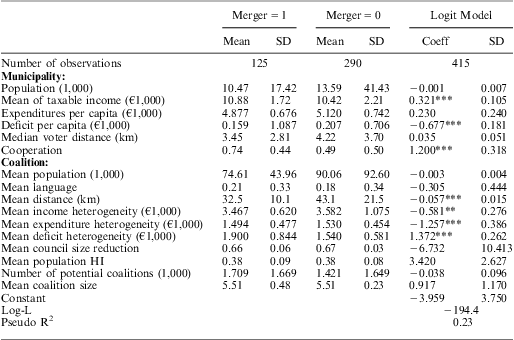
We start our analysis by presenting municipal-level descriptive statistics in Table 2. We present both standard descriptions according to whether the municipality underwent a merger or not and conditional correlations using a municipality-level logit model. In addition to describing some municipal-level variables, we include means of the characteristics of all potential coalitions that each municipality is able to consider. For example, the merging municipalities were able to consider on average 1,710 different coalitions in our data, which is bit more than for municipalities that did not merge. The reported coalition means are calculated for all these possibilities.
Municipal-level Descriptive Analysis
Note: Columns 2 to 4 present descriptive statistics for the municipalities that merged and did not merge in 2007–09. Coalition variables are calculated as averages over all possible coalitions that a municipality could have joined. Maximum coalition size in these calculations is six. Columns 5 and 6 present results from a municipality-level logit model in which the dependent variable equals one if the municipality was involved in a merger. *** and ** indicate statistical significance at the 1 and 5 percent level, respectively.
Of the 415 municipalities that existed at the beginning of 2006, 125 experienced a merger by the start of 2009. Municipal-level economic conditions, higher per capita income and larger deficits, and belonging to existing municipal co-operation seem to be positively associated with merging. These results are interesting, but they can also be used to highlight the problems with this type of analysis. For example, since merger decisions are two sided, it is not clear whether high-income municipalities are more eager to merge or whether they are more attractive as partners.
At the coalition level, having potential coalitions available that would lead to low heterogeneity in income and expenditures is positively associated with merging. This suggests that preference heterogeneity may matter. On the contrary, an increase in deficit heterogeneity is positively associated with merging. This might mean that some municipalities are forced to merge due to fiscal distress. Smaller median voter distances are also positively associated with merging.Footnote 29
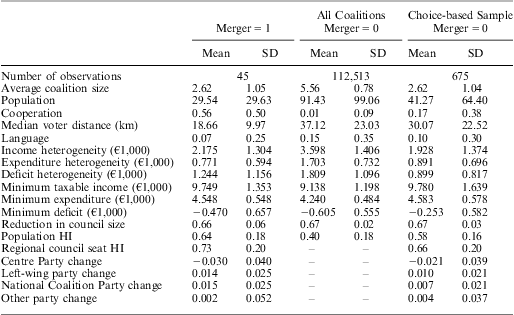
Descriptive statistics of our coalition-level data are presented in Table 3, which compares the actual mergers to all potential coalitions that could have merged and to our stratified choice-based sample from this population. Actual mergers differ, on average, from the potential coalitions in a number of respects, whereas the choice-based sample is much more similar, probably due to stratified sampling.
Coalition-level Descriptive Statistics
Interestingly, actual mergers are clearly more likely to have already co-operated before the merger. In actual mergers, the median distance from the median voter to the center of the largest municipality in the merger is much lower than in all potential coalitions or the choice-based sample. Actual mergers are also much less heterogeneous compared to all potential coalitions. In part, this is due to the fact that larger coalitions are more heterogeneous simply because there are more municipalities involved, and because coalitions with multiple partners dominate our data. For example, the expected maximum difference in municipal characteristics is larger for a coalition of six than for a coalition of three. This can be seen from the heterogeneity measures for the choice-based sample, which are much closer to the actual mergers.
Regression Analysis
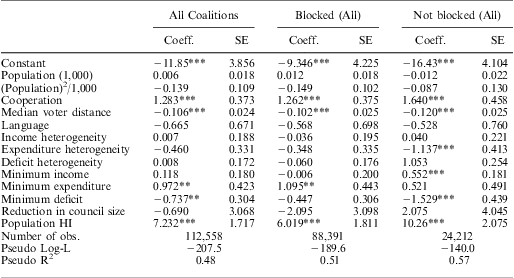
In this section, we present our main results from coalition-level logit models based on Equation 1. In Table 4, we report the results of logit regressions using the full sample.Footnote 30 The results in the first two columns are based on the whole dataset, whereas the results in Columns 4 through 6 use only a subset of potential coalitions (zeros), depending on whether they are blocked by the actual mergers or not. Blocked coalitions cannot merge because they include at least one municipality that actually underwent a merger with a different group of municipalities. The not-blocked subsample includes the coalitions that could merge as well as the actual mergers that took place. That is, the not-blocked group does not include any potential mergers that involve a municipality that actually underwent a merger. It is interesting to note that a clear majority (nearly 80 percent) of the 112,513 coalitions that did not merge were blocked by the mergers that took place.
Results for Coalition-level logit Regressions, all Coalitions
Note: the results are from coalition-level logit models in which the dependent variable equals one if the coalition actually underwent a merger. Coalition size fixed effects are included in all models. *** and ** indicate statistical significance at the 1 and 5 percent level, respectively.
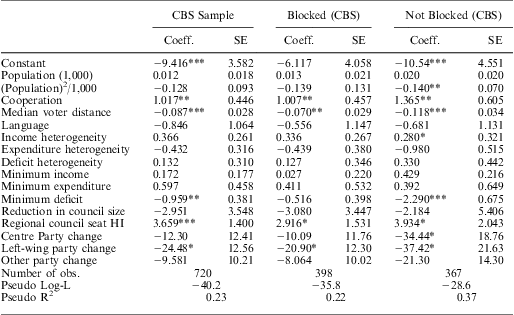
In Table 5, we report the results for the choice-based sample. The difference between Tables 4 and 5 is that we calculated the Herfindahl Index for regional representation only for the choice-based sample. In Table 4, the Herfindahl index is used as a proxy for this variable. The effect of mergers on party representation is available only for the choice-based sample. Reassuringly, the results in Tables 4 and 5 are very similar, which confirms that estimations based on the choice-based sample produce reliable results. From now on, we concentrate on the results based on the choice-based sample reported in Table 5. At this point, we interpret the results literally as predictors of mergers, putting aside the misspecification and endogeneity issues. We return to these in a separate subsection after we discuss the results.
Results for Coalition-level Logit Regressions, Choice-based Sample
Note: the results are from coalition-level logit models in which the dependent variable equals one if the coalition actually underwent a merger. WESML weights are used in all models. Coalition size fixed effects are included in all models. ***, ** and * indicate statistical significance at the 1, 5 and 10 percent level, respectively.
A number of interesting patterns arise. The results indicate that coalition population does not seem to matter, which would indicate that municipalities are not looking for economies of scale through merging. Alternatively, the detrimental effect of municipality size on democracy may prohibit large mergers. Median voter distance, on the other hand, is an important driver of merging, suggesting that the location of public services is important for voters, and that this is reflected in the merger decisions. Existing co-operation is also important and increases the likelihood of merging. This a very interesting result, because it indicates that merging takes place between municipalities that may already benefit from economies of scale in producing basic health care services. This casts some doubts on whether these mergers can lead to increased cost efficiency in service production. The co-operation result can also be interpreted from a preference heterogeneity point of view. Voters in co-operating municipalities are consuming health care services of the same quality, and thus probably have similar preferences for these services. In this sense, merging may not exhibit much extra costs in terms of preference heterogeneity for voters in these municipalities.
Language status and income, expenditure and deficit heterogeneity do not seem to be associated with merger decisions. However, minimum deficit within a coalition is negatively associated with merging. Recall that smaller (more negative) values of this variable indicate a worse fiscal state for a municipality. This means that a merger is more likely if it includes a municipality that is in fiscal distress. Presumably, these municipalities are not attractive merger partners, but simply are unable to provide the statutory services on their own.
Another surprising result is that the likelihood of merging increases as the Herfindahl Index of regional council seat shares increases. Since this index gains large values when political power is concentrated in larger municipalities within a merger, the result means that small municipalities are willing to give up political representation. One interpretation is that these small municipalities are, in fact, forced to merge due to fiscal distress, and more well-off municipalities accept them only if they maintain political control of the resulting coalition. An alternative explanation is that selection to office is different in different-sized municipalities. Perhaps councilors from small municipalities are less keen to remain in office. There is also weak evidence that the left-wing party is more sensitive to losing political power compared to other parties.
Finally, we can also compare the results across the models using different subsets of data in order to evaluate the issue of spatial interdependence. The purpose of this exercise is to evaluate the robustness of the results to blocking and spillovers, since these confounders are different for these different groups. If the results remain robust, the bias from spatial interdependency may be negligible. The results are robust with respect to co-operation, median voter distance and the Herfindahl Index. The result concerning minimum deficit is slightly less robust, but still of the same sign in all specifications. This gives us confidence that the results are informative about the underlying coalition-formation game. In other words, the results are not an artifact of how the original municipal map was drawn or of the coalition-formation possibilities from the map with respect to blocking.
Discussion
How do our results compare to the theoretical predictions from the prior literature? First, it seems that population is not associated with merging. However, this does not necessarily mean that economies of scale are not important; the result could instead be due to existing co-operation in service production. Secondly, the results imply that merger decisions are largely in line with voter preferences, and thus support the predictions by Alesina and Spolaore (Reference Alesina and Spolaore1997). Most importantly, mergers are clearly less likely when the distance of the median voter to the coalition center is large. The results concerning co-operation may also be seen in this light. These results clearly indicate that preference heterogeneity is an important factor behind merger decisions.
We also find that the distribution of political power across merging municipalities matters. This suggests that current theoretical and structural econometric models may miss some important factors behind real-world coalition formation of local jurisdictions.
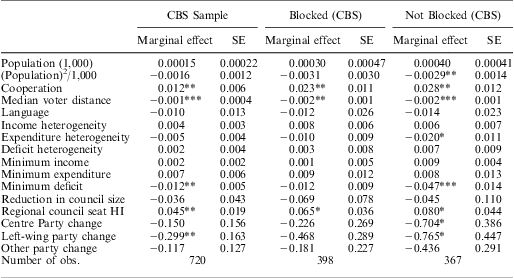
Thus far, we have shown that municipality borders are not drawn randomly and that mergers are associated with measures of local democracy and voter preferences. The next issue is whether we can say something meaningful about the magnitude of the results reported in Table 5. The quantitative effect we are interested in is what the municipal map would look like given a change in one of the covariates of interest, or alternatively, what the map would look like in a counterfactual world in which the effect of a given covariate is set to zero.
The main problem in this respect is spatial spillovers. Consider as an example the Herfindahl Index. The marginal effect of this variable calculated at the mean of other covariates is 0.045. For a pair of municipalities that is equal in size, the Herfindahl index is equal to 0.5. Increasing the size of one of the municipalities brings the index closer and closer to 1 as political power shifts in favor of this larger municipality. This change in the index (0.5) corresponds to a 0.0225 increase in the probability that the merger is part of the equilibrium map. However, by itself this number does not mean much, because on average, both of these municipalities are part of 1,500 potential mergers (Table 2); thus they prevent other potential mergers from taking place. Therefore, even a large marginal effect may imply a small effect on the resulting equilibrium map.Footnote 31 This discussion highlights the drawbacks of our approach and the benefits of structural methods that can be used to simulate the counterfactual maps of interest.Footnote 32
However, a structural approach hinges on a number of assumptions. First, existing structural models (Gordon and Knight Reference Gordon and Knight2009; Weese Reference Weese2011) are based on the assumption that coalition formation is decided by a single decision maker, which abstracts away from the political representation and legislative bargaining issues that we are directly interested in. Secondly, the underlying coalition-formation game can be either hedonic or strategic. There is a vast literature concerning the strategic interaction of local jurisdictions in different dimensions, which shows that these interactions are important.Footnote 33 However, incorporating strategic aspects into a structural econometric merger model is not trivial and has not been done in the literature. The third fundamental assumption concerning the game is whether transfers or side payments are possible. Gordon and Knight (Reference Gordon and Knight2009) and Weese (Reference Weese2011) assume that transfers are not possible, but in our case this is not clear.
The upshot of a reduced-form approach is that we can remain agnostic about the type of game played. Furthermore, for computational reasons, a number of potentially important factors contributing to merger decisions is left out in both Gordon and Knight's (2009) and Weese's (Reference Weese2011) empirical applications. Reduced form allows us to richly describe the qualitative patterns in the data.
Conclusions
This article empirically analyzes the coalition formation of local governments. We introduce a statistical procedure involving choice-based sampling from a spatial network to handle multi-partner mergers and apply this method to recent municipality mergers in Finland. Our main empirical question concerns the relationship between local political representation and merger decisions, which is a clear gap in both the empirical and theoretical literatures on local government coalition formation.
We find that the realized mergers allocate regional political power unequally, which indicates that small municipalities are willing to give up political representation. We also find that merging is more likely if a coalition includes a municipality that is in fiscal distress. Together, these results imply that some municipalities are forced to merge due to fiscal pressure and trade off political power to be accepted by the richer and larger neighbor. Furthermore, mergers clearly become less likely when the distance of the median voter to the coalition center increases. Moreover, existing co-operation in producing basic health care services is positively associated with merging. Interestingly, coalition population is irrelevant to merging, which possibly indicates that municipalities do not seem to be seeking economies of scale through merging. These findings suggest that current theoretical and structural econometric models may miss some important factors behind real-world coalition formation of local jurisdictions. Combining these issues into both theoretical and structural work should be a fruitful avenue for future research.
In addition to providing important information on coalition-formation mechanisms in general, our application of municipal mergers should be of practical interest to countries with a multilayer system of government. There have been a number of recent examples of municipality mergers, such as in Germany and Japan in the late 1990s and 2000s and in Denmark in 2007. In all these cases, the merger decisions were mostly made at the local level. Furthermore, the results serve as a first step in evaluating whether municipality mergers are an effective way of meeting the ultimate goal of the central government, which is to make municipal service production more efficient. For example, the finding that existing co-operation in basic health care is an important factor driving merger decisions could mean that a merger does not produce large efficiency gains because economies of scale are already exhausted through co-operation. However, we leave these issues for further research.
APPENDIX
Variable Descriptions
Marginal Effects for Choice-based Sample logit Model