Introduction
During recent decades, tremendous progress has been made in understanding relationships among Ascomycota by using DNA sequence data (Lutzoni et al. Reference Lutzoni, Kauff, Cox, McLaughlin, Celio, Dentinger, Padamsee, Hibbett, James and Baloch2004; Miądlikowska et al. Reference Miądlikowska, Kauff, Hofstetter, Fraker, Grube, Hafellner, Reeb, Hodkinson, Kukwa and Lücking2006; Hibbett et al. Reference Hibbett, Binder, Bischoff, Blackwell, Cannon, Eriksson, Huhndorf, James, Kirk and Lücking2007; Ekman et al. Reference Ekman, Andersen and Wedin2008). As a consequence, the classification of Ascomycetes has undergone substantial changes (Hibbett et al. Reference Hibbett, Binder, Bischoff, Blackwell, Cannon, Eriksson, Huhndorf, James, Kirk and Lücking2007; Kirk et al. Reference Kirk, Cannon, Minter and Stalpers2008; Lumbsch & Huhndorf Reference Lumbsch and Huhndorf2009). In addition, the constant increase in the number of taxa in phylogenetic studies has also revealed the phylogenetic placement of sterile or enigmatic taxa. In the lichen-forming Ascomycetes associating with cyanobacteria (cyanolichens), several recent major taxonomic changes have been proposed (Lumbsch et al. Reference Lumbsch, Prado and Kantvilas2005; Wedin et al. Reference Wedin, Wiklund, Jørgensen and Ekman2009; Otálora et al. Reference Otálora, Aragón, Molina, Martínez and Lutzoni2010; Muggia et al. Reference Muggia, Nelson, Wheeler, Yakovchenko, Tønsberg and Spribille2011; Spribille & Muggia Reference Spribille and Muggia2012). Molecular phylogenies suggest that cyanolichens form three distinct and distantly related lineages: Arctomiaceae (Lumbsch et al. Reference Lumbsch, Prado and Kantvilas2005; Wedin et al. Reference Wedin, Wiklund, Crewe, Döring, Ekman, Nyberg, Schmitt and Lumbsch2005) and the Peltigerales (Wedin et al. Reference Wedin, Wiklund, Crewe, Döring, Ekman, Nyberg, Schmitt and Lumbsch2005; Miądlikowska et al. Reference Miądlikowska, Kauff, Hofstetter, Fraker, Grube, Hafellner, Reeb, Hodkinson, Kukwa and Lücking2006) in the Lecanoromycetes, and Lichinales in the Lichinomycetes (Reeb et al. Reference Reeb, Lutzoni and Roux2004).
Although the Peltigerales is by far the most species-rich cyanolichen group, it contains lineages that have not yet been well studied. One of these is the Collemataceae s. str., a group of distinctly gelatinous cyanolichens which comprises two large genera; Collema F. H. Wigg. with c. 80 currently accepted species, and Leptogium (Ach.) Gray with c. 180 species (Kirk et al. Reference Kirk, Cannon, Minter and Stalpers2008). The detailed phylogenetic relationships within the Collemataceae are still unclear, despite some recent studies (Otálora et al. Reference Otálora, Martínez, Molina, Aragón and Lutzoni2008, Reference Otálora, Aragón, Molina, Martínez and Lutzoni2010; Wedin et al. Reference Wedin, Wiklund, Jørgensen and Ekman2009). Although these studies have confirmed that Collema and Leptogium are non-monophyletic, they have also shown that the traditional family delimitation (Henssen Reference Henssen1965; Henssen & Jahns Reference Henssen and Jahns1974; Henssen et al. Reference Henssen, Keuck, Renner, Vobis and Reynolds1981) did not reflect the phylogenetic relationships. Most genera previously classified in Collemataceae were shown to belong to Pannariaceae (Wedin et al. Reference Wedin, Wiklund, Jørgensen and Ekman2009; Otálora et al. Reference Otálora, Aragón, Molina, Martínez and Lutzoni2010), and currently only Collema and Leptogium constitute the Collemataceae.
Another group of cyanolichens that was earlier considered to belong to Peltigerales is Arctomiaceae. Arctomiaceae was originally proposed by Fries (Reference Fries1860), but never gained wide acceptance, and Arctomia Th. Fr. was included in Collemataceae by Zahlbruckner (Reference Zahlbruckner1925). Henssen (Reference Henssen1969), however, resurrected Arctomiaceae, based on differences in the ascoma development between Arctomia and Collemataceae. Molecular sequence data confirmed that Arctomiaceae is distantly related to Collemataceae and suggested that it belongs to Ostropomycetidae (Lumbsch et al. Reference Lumbsch, Prado and Kantvilas2005; Wedin et al. Reference Wedin, Wiklund, Crewe, Döring, Ekman, Nyberg, Schmitt and Lumbsch2005).
When studying the phylogenetic relationships within Collemataceae s. str., we soon found that the most deviating species regarding spore and apothecial characteristics within Collema [C. fasciculare (L.) F. H. Wigg.] not only grouped outside Collemataceae, but also outside the Peltigerales. Preliminary BLAST searches suggested similarities to Arctomiaceae. Collema fasciculare is a widely distributed, epiphytic species, forming rounded cushions usually up to c. 2 cm diam. (rarely up to 7 cm) with a crustose to subfoliose, indistinctly lobed thallus, which becomes swollen and gelatinous when wet. Similar to Collema, it associates with Nostoc, has a homoiomerous thallus organization without a true cortex, lecanorine apothecia with a persistent thalline exciple, and lacks secondary metabolites. However, it differs from other Collema species in some distinct ascomatal traits. The paraphyses and ascospores of C. fasciculare are comparatively more flexuous and thinner than in other Collema species (Degelius Reference Degelius1954, Reference Degelius1974), and the proper exciple is poorly developed or sometimes absent. Based on these differences, Degelius proposed the informal subgeneric Fasciculare group in which he included the widely distributed species C. fasciculare (Degelius Reference Degelius1954) and the three rare or poorly collected tropical species C. uviforme Hue, C. papuanorum Degel., and C. leptosporum Malme (Degelius Reference Degelius1974). Although the morphological differences between the members of the Fasciculare-group and other Collema species have largely been recognized and accepted by other lichenologists (Filson Reference Filson1992; Jørgensen Reference Jørgensen2007), no molecular studies have investigated the phylogenetic position of any member of this group.
The aim of this study is to investigate the phylogenetic placement of C. fasciculare. To achieve this we performed phylogenetic analyses, including representatives from the two lineages of Lecanoromycetes where cyanolichens are classified (Peltigerales and Arctomiaceae), based on sequences of the mitochondrial SSU rDNA and the protein coding genes RPB1 (RNA polymerase II subunit 1) and MCM7. In order to identify morphological characters that explain the phylogenetic placement of C. fasciculare, we also studied the ascus structure and the ascoma ontogeny. In addition, we studied material of one other species of the Fasciculare group, C. leptosporum, and of Arctomia s. str., for comparison.
Materials and Methods
Specimens and markers
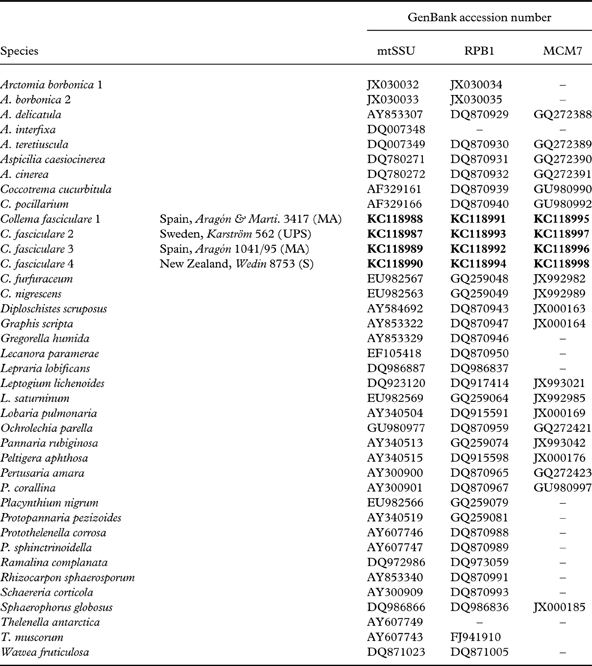
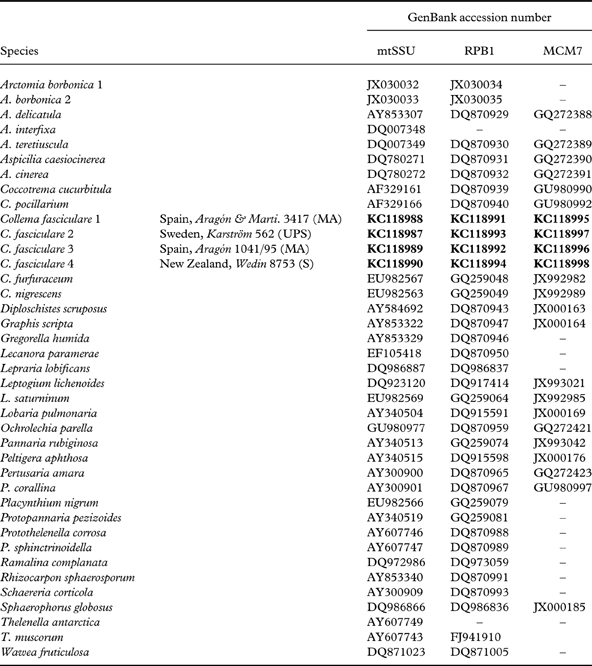
We used the mtSSU rDNA, RPB1 and MCM7 loci from a total of 35 species of Lecanoromycetes. Collema fasciculare was represented by four specimens originating from different parts of the world (New Zealand, Spain and Sweden). The other species of the Fasciculare-group were not represented in the sampling due to the lack of recent material. Only the sequences of C. fasciculare were generated for this study, the rest were obtained from GenBank (Table 1). A total of 39 mtSSU rDNA, 37 RPB1 and 23 MCM7 sequences were included in this study.
List of taxa included in this study and GenBank accession numbers. New sequences are indicated in bold
Additional material examined. Arctomia delicatula Th. Fr.—Sweden: Torne Lappmark: Karesuando par., Pältsan (Bealccan). alt. 1110 m, 2011, M. Westberg P108 (S).
Collema leptosporum Malme.—Brazil: Mato Grosso: Corumbá, in silva clararegionis calcariae, 14 viii 1894, Malme [Malme Lich. austr. amer. Exs. No 70] (S).
DNA sequencing
Total genomic DNA was extracted using DNeasy (Qiagen) according to the manufacturer's instructions. The mtSSU rDNA was amplified using the primers mtSSU1 and mtSSU3R (Zoller et al. Reference Zoller, Scheidegger and Sperisen1999); the protein coding gene RPB1 using primers RPB1-Af (Stiller & Hall Reference Stiller and Hall1997) and RPB1-6R1asc (Hofstetter et al. Reference Hofstetter, Miądlikowska, Kauff and Lutzoni2007); and MCM7 using the primers MCM7-709 and MCM7 1348 (Schmitt et al. Reference Schmitt, Crespo, Divakar, Frankhauser, Herman–Sackett, Kalb, Nelsen, Rivas-Plata, Shimp and Widhelm2009). PCR amplifications were performed using IllustraTM Hot Start PCR beads, according to the manufacturer's instructions. PCR-reactions were performed using the following cycling parameters: initial denaturation 95°C for 5 min, and 35 (mtSSU rDNA) or 40 (MCM7 and RPB1) cycles at 95°C for 1 min, 56°C for 50 s (mtSSU rDNA and RPB1) or 54°C for 1 min (MCM7), and 72°C for 1 min; this was followed by a final extension at 72°C for 8 min. PCR products were subsequently purified using the enzymatic method Exo-sap-IT provided by USB Corporation. Unidirectional dye-terminated sequencing for the forward and reverse reactions using the same PCR primers were performed on an ABI 377 automated sequencer using Big Dye Terminator technology (Applied Biosystems, Warrington).
Phylogenetic methods
Alignments were constructed separately for each locus with the online version of MAFFT 6 using the auto option (Katoh & Toh Reference Katoh and Toh2008). In the case of mtSSU rDNA, ambiguous regions were delimited using GUIDANCE web service with the default cut-off of 0·95 (Penn et al. Reference Penn, Privman, Ashkenazy, Landan, Graur and Pupko2010). The alignments for the protein coding genes were adjusted in MacClade 4.01 (Maddison & Maddison Reference Maddison and Maddison2001), utilizing the amino acid translations. Delimited ambiguous regions and introns were excluded from the phylogenetic analyses.
Phylogenetic relationships and confidence were inferred with a maximum likelihood (ML) and Bayesian approach (MB). The combinability of the single locus data sets was assessed by visual inspection of the individual bootstrap values (Mason-Gamer & Kellogg Reference Mason–Gamer and Kellogg1996; Wiens Reference Wiens1998). A conflict was considered significant when two data partitions supported conflicting monophyletic groups with ML bootstrap values ≥70% in both trees. Because no significant conflicts were detected, it was assumed that the two data sets were congruent and could be combined. We constructed two different combined data sets, first a two-locus data set (mtSSU rDNA+RPB1) with two taxa having missing data for RPB1, and second a three-locus (mtSSU rDNA+RPB1+MCM7) dataset with 16 taxa having missing data for MCM7. Maximum likelihood analyses were performed on the two combined data sets using RAxML-HPC2 (Stamatakis Reference Stamatakis2006; Stamatakis et al. Reference Stamatakis, Hoover and Rougemont2008) and implementing a GTRCAT model for the bootstrapping phase, and GTRGAMMA for the final tree inference using 4 and 7 partitions for the 2-locus data set and the 3-locus data set, respectively (three codon positions for each RPB1 and MCM7). In addition, a bootstrap analysis of 1000 pseudoreplicates was performed for each data set. The analyses were performed on the Cipres Web Portal (Miller et al. Reference Miller, Pfeiffer and Schwartz2010).
The evolutionary models for Bayesian analyses were selected using the Bayesian Information Criteria (BIC), as implemented in JModeltest 3.06 (Posada Reference Posada2008). The GTR+G model was used for mtSSU and RPB1 first position; SYM+G for RPB1 second position and MCM7 first and second position; and HKY+I+G for RPB1 third position and MCM7 third position. The Bayesian analyses were performed using MrBayes 3.2.0 (Ronquist et al. Reference Ronquist, Teslenko, van der Mark, Ayres, Darling, Höhna, Larget, Liu, Suchard and Huelsenbeck2011). Two runs of 4 million generations, starting from an initial random tree and employing four simultaneous chains, were executed. A tree was saved every 100th generation. To ensure that stationarity was reached and the runs converged at the same log-likelihood levels, we plotted the log-likelihood scores of sample points against generation time using Tracer 1.5 (Rambaut & Drummond Reference Rambaut and Drummond2007). The first 10 000 trees from each run were discarded as ‘burn-in’. For the remaining trees in each analysis, a majority-rule consensus tree was assembled using the sumt option of MrBayes. The .con file created by MrBayes was visualized in FigTree V.1.3.1 (Rambaut Reference Rambaut2009).
Morphological study
For the ontogenetic study, serial sections through thallus parts with different apothecial stages were prepared using a freezing microtome. The sections were mounted in lactophenol cotton blue and studied by light microscopy. Asci were studied on material mounted in water using hand-cut sections, before and after staining with Lugol's iodine solution, with and without pretreatment with 10% KOH.
Results
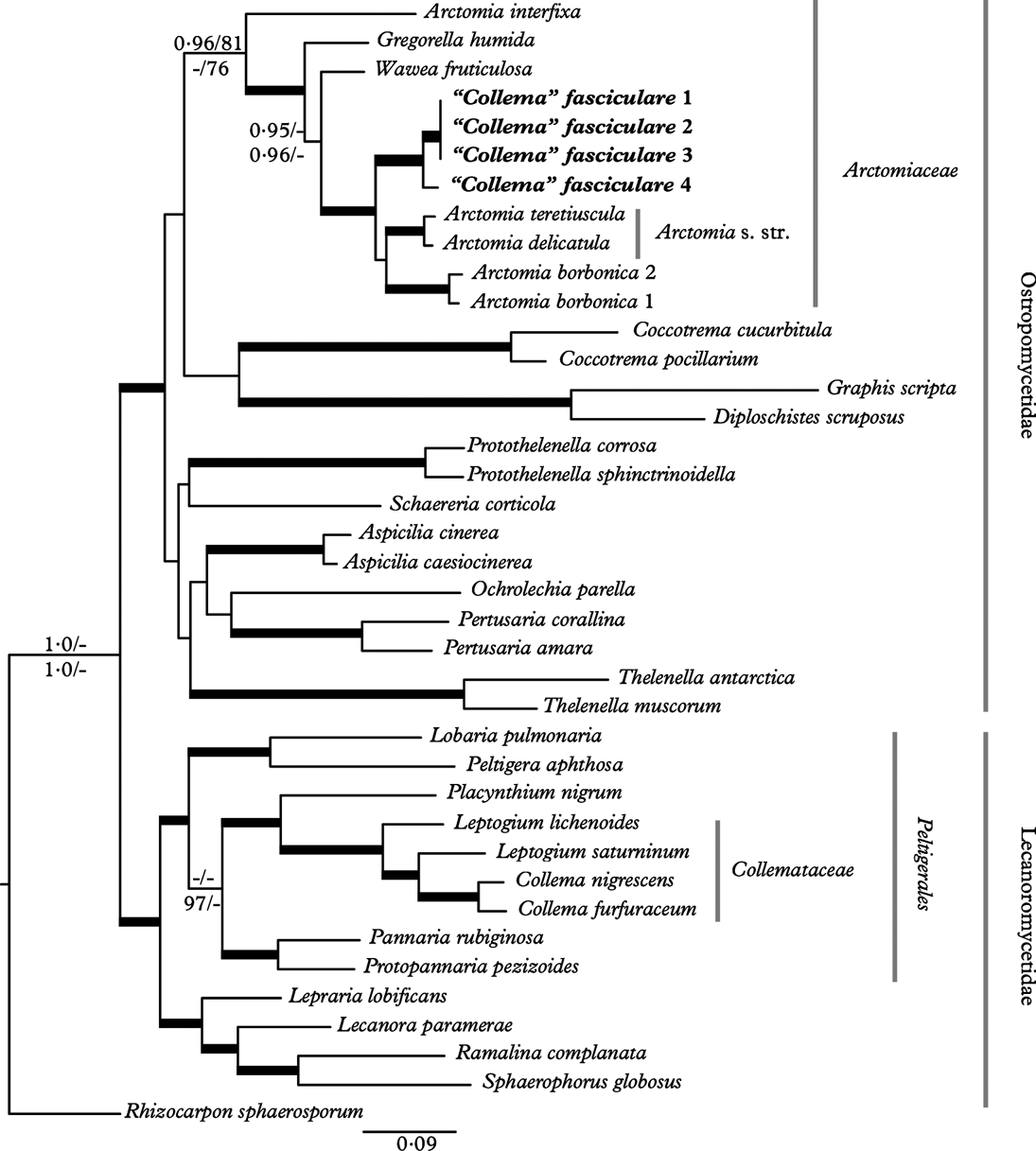
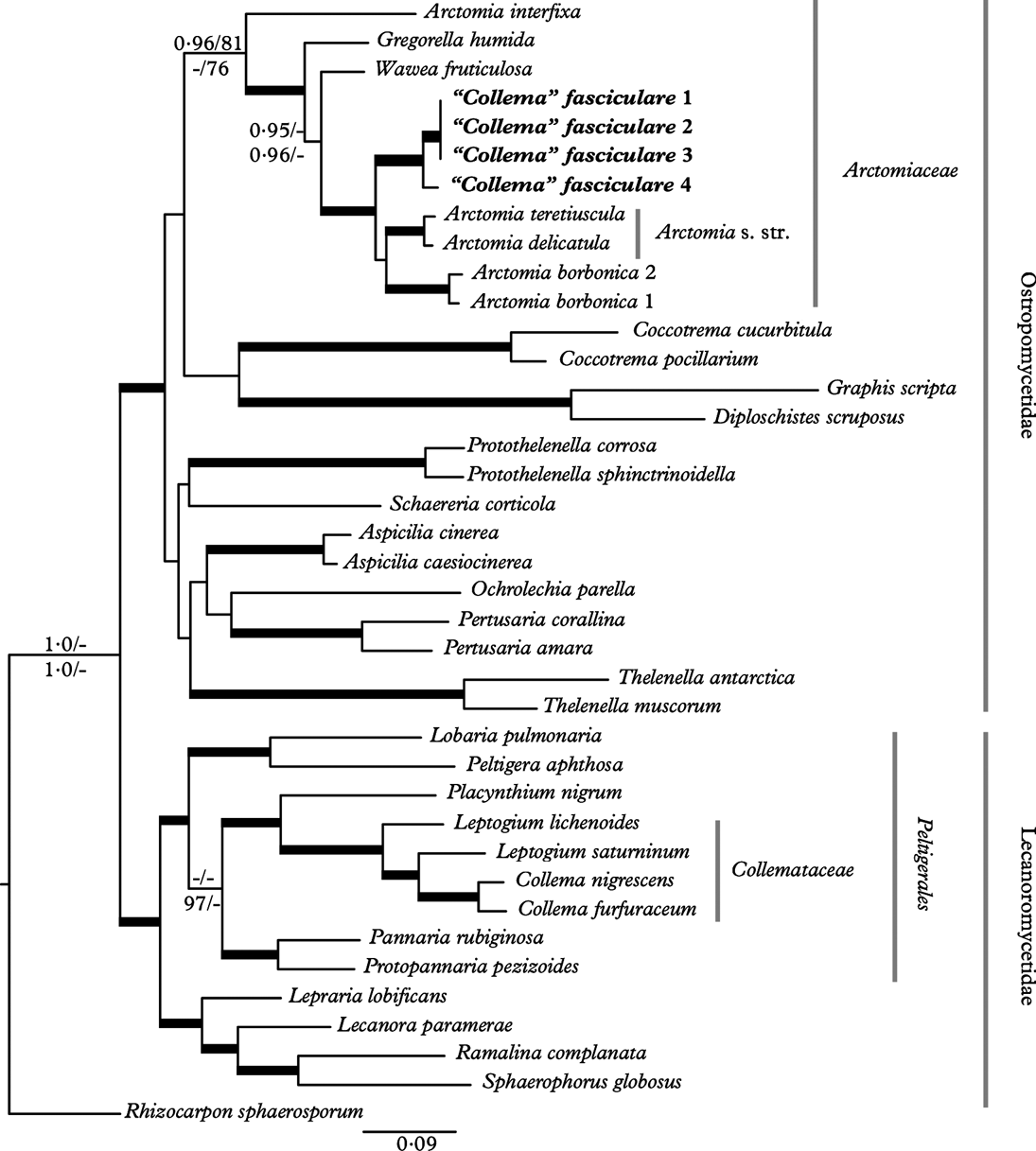
Twelve new sequences were generated in this study, four for each of the genes. These new sequences were aligned with 83 sequences obtained from GenBank (Table 1). After excluding 514 ambiguously aligned sites, the 3-locus data set contained 1807 sites, of which 984 were variable. Of the variable sites, 338 belonged to the mtSSU partition, 367 to RPB1 and 279 to the MCM7. In the 2-locus data set, the entire MCM7 partition was excluded. Maximum likelihood analyses resulted in a single most likely tree with ln-likelihood of −15922·3654 for the 2-locus and −21191·7847 for the 3-locus data sets. The majority rule consensus trees from the Bayesian analyses were based on 60 000 credible trees from two runs for each one of the data sets. The harmonic mean ln-likelihood was -15985·49 for the 2-locus data set and −21228·13 for the 3-locus data set. The tree topologies obtained from the 2-locus and 3-locus data sets did not show any significant conflict in either of the two methods of analysis, but the 3-locus data set resulted in lower branch support. Only the best tree from the maximum likelihood analysis of the 2-locus analysis is thus presented here, with both bootstrap support and posterior probabilities from both data sets (Fig. 1).
Phylogenetic relationships of cyanobacterial lichens within the Lecanoromycetes. Support values above branches correspond to the values obtained from the 2-locus data set, and support values below branches correspond to the ones obtained from the 3-locus data set (mtSSU rDNA+RPB1+MCM7). Thicker internodes indicate significant support in the two data sets for the two phylogenetic methods (PP>0·95, ML BS>70). Collema fasciculare constitutes a monophyletic group sister to the rest of Arctomia s. str., within a monophyletic Arctomiaceae in the Ostropomycetideae.
Morphological study
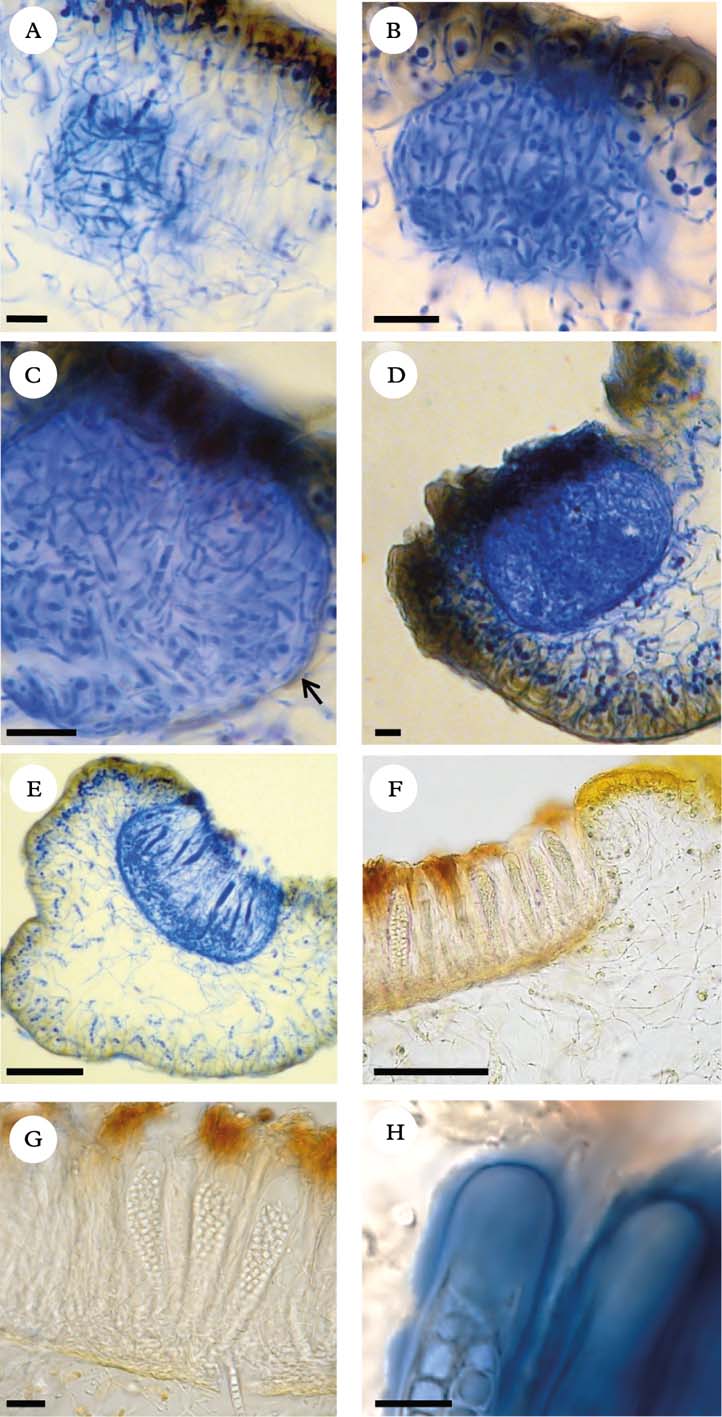
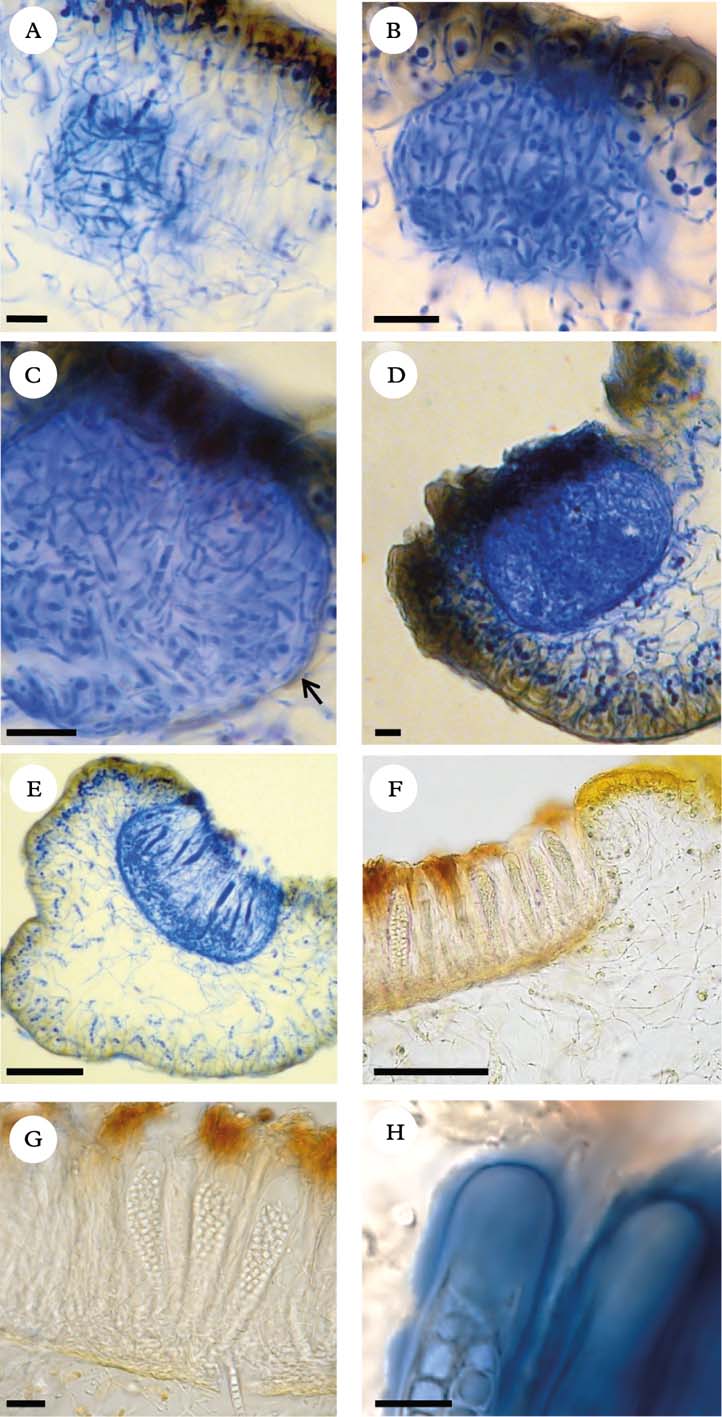
The earliest stages in the ascomatal development that we found were young primordia situated under the thallus surface in shallow thallus outgrowths (Fig. 2A). We did not see any stage corresponding to the outgrowth of generative tissue typical for the Arctomiaceae (Henssen Reference Henssen1969; Henssen & Kantvilas Reference Henssen and Kantvilas1985; Lumbsch et al. Reference Lumbsch, Prado and Kantvilas2005), despite several attempts, although we cannot rule out that such a stage occurred but quickly became overgrown by thallus tissue. When the primordium grows and reaches the thallus surface (Fig. 2B & C), the upper surface disintegrates and a simple, very thin primordium wall is differentiated (Fig. 2C & D). This wall is composed of thin-walled, slightly pigmented hyphae (Fig. 2C), which in the mature stage form the thin proper exciple (Fig. 2E–G). When the developing hymenium is exposed, asci and paraphyses are visible (Fig. 2E), and at the mature stage (Fig. 2F), an indistinct, thin thalline exciple is present. The paraphyses are thin (1·0–1·5 µm) and lax, branched, and distinctly brown-pigmented at the apices (Fig. 2G) which are slightly swollen. The ascus wall is I+ reddish to blue, KOH/I+ blue, and the tholus contains no amyloid structures (Fig. 2H). It contains eight long (c. 65–170 µm) and thin (c. 4·5–5·0 µm) spores formed by 10–17 cells (Fig. 2G & H).
Ascoma development in Collema fasciculare [Karström 562 (UPS)]. A, young primordium situated under the thallus surface; B, somewhat older primordium reaching the thallus surface; C, older primordium where a thin, slightly pigmented wall is differentiated (arrow); D, older primordium where the upper surface is disintegrating during the development; E, older stage showing young asci and young paraphyses; F, marginal part of mature apothecium with pigmented epihymenium and thalline exciple visible; G, detail showing the proper exciple, asci and ascospores; H, detail of asci in Lugol's iodine solution after pre-treatment with KOH. Scales: A–D, G & H=10 µm; E & F=100 µm.
We also studied sections of C. leptosporum, for comparison. In C. leptosporum, the proper exciple is distinct, euparaplectenchymatous and thick (70–105 µm); the paraphyses are 1·5–2·0 µm thick, simple and slightly swollen at the apices. Collema leptosporum has ascus characteristics similar to C. fasciculare, and the spores are also long (115–160 µm) and thin (2–4 µm), formed by 6–8 cells.
Discussion
The two cyanolichen lineages within Lecanoromycetes are both recovered here as monophyletic. Arctomiaceae formed a weakly-supported clade within Ostropomycetidae, and Peltigerales formed a well-supported clade within Lecanoromycetidae (Fig. 1). These results agree with previous Lecanoromycete studies (Lumbsch et al. Reference Lumbsch, Prado and Kantvilas2005, Reference Lumbsch, Schmitt, Mangold and Wedin2007; Wedin et al. Reference Wedin, Wiklund, Crewe, Döring, Ekman, Nyberg, Schmitt and Lumbsch2005). The monophyly of Arctomiaceae is well supported in the 2-locus analysis, but lacks Bayesian support in the 3-locus analysis. This is probably due to the large amount of missing data in the MCM7 data set. The backbone of the topology within Ostropomycetidae lacks support, which makes the detailed relationships of Arctomiaceae within this group uncertain. All analyses supported the monophyly of the four specimens of C. fasciculare with high confidence (1·0 PP, 100 ML) as a member of the monophyletic Arctomiaceae. Arctomia delicatula, A. borbonica Magain & Sérus., A. teretiuscula P. M. Jørg. and C. fasciculare form a well-supported monophyletic group. Collema fasciculare is thus suggested here to belong to Arctomia. Arctomia was previously considered monophyletic (Lumbsch et al. Reference Lumbsch, Prado and Kantvilas2005) but in our investigation it is paraphyletic, with A. interfixa (Nyl.) Vain. as sister to the rest of Arctomiaceae, including Gregorella Lumbsch and Wawea Henssen & Kantvilas. This is similar to the result of Magain & Sérusiaux (Reference Magain and Sérusiaux2012), who considered A. interfixa to be of uncertain position within Arctomiaceae, and who interpreted the paraphyly of Arctomia as the result of an incomplete data set. It should be noted that we too have no data of MCM7 and RPB1 for A. interfixa, and therefore this relationship is also uncertain in our investigation. The phylogenetic relationship between Gregorella humida and Wawea fruticulosa is also uncertain. Lumbsch et al. (Reference Lumbsch, Prado and Kantvilas2005) and Magain & Sérusiaux (Reference Magain and Sérusiaux2012) found them to form a well-supported monophyletic group, but neither our study nor Lumbsch et al. (Reference Lumbsch, Schmitt, Mangold and Wedin2007) supported that relationship. The fact that Arctomiaceae is monophyletic including Collema fasciculare is, however, beyond doubt.
Degelius previously (1954: 103) suggested that, in view of the different type of ascospores and paraphyses, C. fasciculare should better be recognized as a separate genus. This recognition was never done, probably because of the many characteristics that this species shares with various species of Collema. For instance, C. fasciculare is similar to C. leptaleum Tuck. regarding habit. The anatomical characteristics of the thallus are similar to C. multipartitum Sm. and C. multipunctatum Degel., and the apothecial habit is similar to several other Collema species (Degelius Reference Degelius1954, Reference Degelius1974; Jørgensen Reference Jørgensen2007).
The ascoma ontogeny was the criterion used by Henssen (Reference Henssen1969) to delimit the Arctomiaceae. The ontogeny had not been studied earlier in C. fasciculare, but our study suggested that there actually are distinct differences compared with other Arctomiaceae. Henssen (Reference Henssen1969) excluded Arctomia from Collemataceae because of the distinct external outgrowth of generative tissue in which ascogonia develop, in Arctomia, and because the whole ontogeny thus took place above the surface of the thallus proper. In Collemataceae s. str., the development of the ascoma commences within the thallus (beneath the upper surface). Studies after Henssen (Reference Henssen1969) have likewise found that the ontogeny in other Arctomiaceae starts with an outgrowth of generative tissue (Henssen & Kantvilas Reference Henssen and Kantvilas1985; Lumbsch et al. Reference Lumbsch, Prado and Kantvilas2005). We have no indications that such an outgrowth is produced in C. fasciculare, and as far as we have been able to find, the whole ontogeny in C. fasciculare takes place within the thallus beneath the upper surface (Fig. 2A), and the resulting apothecia have a distinct thalline excipulum (Fig. 2F).
Even if the ascoma ontogeny deviates somewhat from the typical Arctomiaceae, there are other important similarities. Collema fasciculare is similar to other Arctomia in the spores and paraphyses, the ascus structure, and in the hymenium type. The hymenial gel in C. fasciculare is hemi-amyloid, as in Arctomia. Collema fasciculare possesses asci with a non-amyloid tholus, similar to the Trapelia-type present in some Arctomiaceae (Fig. 2H). This ascus type lacks the typical internal amyloid tube structure present in Collema. The ascospores of C. fasciculare are further similar to the fusiform, multiseptate ascospores in A. delicatula and A. teretiuscula. Finally, the paraphyses in C. fasciculare are also similar to those in Arctomia.
Arctomia as circumscribed by Henssen (Reference Henssen1969) and Jørgensen (Reference Jørgensen2003), includes crustose-squamulose, semi-gelatinous cyanolichens with a single-layered cortex, biatorine apothecia and fusiform, multiseptate ascospores. It could be argued that the putative differences in ascoma ontogeny, and the fact that C. fasciculare is sister to Arctomia s. str., would be a reason to accept it as a distinct genus. Several rather deviating new species have been accepted in Arctomia lately, however, and the genus clearly needs a full revision, something that is beyond the scope of this study. Øvstedal & Gremmen (Reference Øvstedal and Gremmen2001, Reference Øvstedal and Gremmen2006) described two Arctomia species which have relatively small, ellipsoid ascospores, with 3 transverse septa, which are different to the ones in Arctomia s. str. and C. fasciculare. In fact, the authors claimed that these two species do not belong in Arctomia s. str., and that they should be studied further. Recently, Magain & Sérusiaux (Reference Magain and Sérusiaux2012) included the new species A. borbonica, which also deviates from the typical Arctomia species by producing goniocysts at the lobe margins and by having a thallus that, in general, is similar to the thallus in Leptogium. No apothecia are hitherto known from A. borbonica.
Even if including C. fasciculare in Arctomia results in a yet more morphologically heterogeneous genus, we believe that this is currently a better option than describing a new genus, as the family now is in desperate need of a thorough revision of the generic delimitations. Collema leptosporum also has asci and ascospores similar to Arctomia and to C. fasciculare. This suggests that C. leptosporum does not belong to Collema and it could be related to Arctomiaceae, although the proper exciple and paraphyses differ considerably from other Arctomia and from C. fasciculare. We feel, however, that C. leptosporum fits considerably better in Arctomia than in Collema. Finally, we suggest that the remaining two species of the Fasciculare-group (which we have not studied material of) should also be better placed in Arctomia, as it is clear from the literature (Degelius Reference Degelius1974) that they share important characteristics with C. fasciculare and C. leptosporum, particularly the Arctomia-type spores.
Nomenclature
Arctomia fascicularis (L.) Otálora & Wedin comb. nov.
MycoBank No.: MB802158
Basionym: Lichen fascicularis L., Mantissa Pl. 1: 133 (1767).
Arctomia leptospora (Malme) Otálora & Wedin comb. nov.
MycoBank No.: MB802161
Basionym: Collema leptosporum Malme, Ark. f. Bot. 19 (8): 6 (1924).
Arctomia papuanarum (Degel.) Otálora & Wedin comb. nov.
MycoBank No.: MB802165
Basionym: Collema papuanorum Degel., Symb. Bot. Upsal. 20 (2): 196 (1974).
Arctomia uviformis (Hue) Otálora & Wedin comb. nov.
MycoBank No.: MB802168
Basionym: Collema uviforme Hue, Bull. Soc. Bot. France 63 (28): 5 (1916).
We thank the curators of the herbaria of MA and UPS, and Gregorio Aragon for the loan of specimens. We also thank the staff at the Molecular Systematics Laboratory at the Swedish Museum of Natural History, who assisted with laboratory work and A. Herrero for advice on nomenclature. This study was supported by the Swedish Research Council (VR 621-2009-537). The first author gratefully acknowledges support from a postdoctoral grant from the Spanish Ministry of Education and Science (EDU3495/2010).