Economic interests play an important role in the politics of American foreign economic policy. Recent research indicates that individual economic self-interest shapes preferences about trade protection.1
There is also substantial evidence that the economic interests of constituents and contributors influence the way members of Congress vote on commercial policy issues. A similar set of interests appears to influence congressional voting on other foreign economic policy questions as well.2Does the influence of economic interests extend beyond the foreign economic policy matters to which they are immediately relevant, shaping broader foreign policy attitudes as well? While there is some evidence that economic stakes in the broad policy goals of the United States have influenced congressional voting on some national security issues, there has been little research on the influence of economic interests on broader public attitudes toward American foreign policy.3
Using data from the American National Election Study (ANES) covering most of the postwar era, this research note will present evidence that both individual self-interest and regional stakes in the international economy have helped shape public support and opposition to American global activism. These results hold up to a variety of robustness tests and are quite stable over time.At first glance, general attitudes toward American global activism may seem less important than opinions about more narrowly defined policy questions. The conventional wisdom is that “isolationism” was a potent political force before World War II but was pushed to the margins of American political life after the Japanese attack on Pearl Harbor. The paucity of survey data makes it difficult to say whether the early twentieth century was radically different, but elite surveys from the recent past strongly suggest that few Americans with any role in the policymaking process inside or outside the government have held isolationist views in recent decades. The Chicago Council on Foreign Relations (CCFR) has surveyed a sample of Americans in leadership positions in business, government, labor, academia, and the nonprofit sector every four years since 1974. Genuinely isolationist attitudes are almost completely absent in this elite group. The CCFR surveys found at least 96 percent support for taking “an active part in world affairs” between 1974 and 2002.4
Chicago Council on Foreign Relations 1975–2002.
If elite opinion resembled that of the general public, there would be little reason to explore general attitudes toward American global activism. Taking an internationalist consensus for granted, one could turn instead to debates over specific policy goals and instruments, as most research on elite opinion has done.5
The general public is far less monolithically internationalist than the elites surveyed by the CCFR, however. Asked of the general public, the same question about taking an active part in world affairs elicited between 54 and 72 percent support for American global activism, suggesting that a sizeable minority of Americans still harbor isolationist sentiments. The existence of this group is not lost on American policymakers. Indeed, Kull and Destler found that elites tended to overestimate public isolationist sentiment.6Kull and Destler 1999, 36–38.
This research note has four parts. The first part explains why economic interests should influence public attitudes toward the world role of the United States. The next section briefly reviews the data used in the empirical test. The third part presents the results. A final section summarizes and concludes.
Economic Interests and the World Role of the United States
Although the possibility that economic interests could influence public opinion on foreign policy issues has been considered before, most research on this topic has focused on other sources of explanation. Political ideology,7
See Bartels 1994; Hurwitz and Peffley 1987; Peffley and Hurwitz 1993; Rieselbach 1960; and Wittkopf 1987.
Conover and Sapiro 1993.
Lubell 1956.
Rieselbach 1960.
The Economic Stakes in American Global Activism
One way in which economic interests influence public opinion on issues beyond foreign economic policy is already widely recognized: the local and individual economic stake in Pentagon spending influences public support for it.14
For example, Bartels 1994.
As the dominant power in the postwar world, the United States has sought to shape the rules governing the international system. This international order has produced domestic as well as international winners and losers. Since World War II, American policymakers have sought to establish and maintain a world order open for American trade and investment. Although the United States has not been as unambiguously supportive of free trade as Britain was during its period of nineteenth century predominance, American policymakers have nevertheless worked to develop international institutions to promote increased international trade and more liberal rules on foreign investment. The architects of postwar American foreign policy believed that a relatively liberal world order would ensure the security of the nation as well its prosperity.15
The construction of the postwar order entailed the use of military as well as economic power. The United States made commitments to the security of economically important states in Europe and Asia. It also sought to contain or eliminate challengers to the world order, including not only the Soviet Union and China but also less powerful states, such as Cuba, that promoted alternative models of economic and political development. Since the 2001 terrorist attacks, the role of military power in American efforts to shape and enforce the rules of behavior in the international system has become especially clear. As a number of observers have pointed out, however, this role is not really new but rather characteristic of the entire postwar era.16
Because establishing and maintaining a relatively liberal international economic order has been such an important part of postwar American foreign policy, varying regional and individual stakes in this order should influence public attitudes toward American global activism. Although the defense and security benefits of the American-supported world order are public goods, the same cannot be said of its economic dimensions. Not everyone benefits equally from international trade and investment. Indeed, even though a relatively liberal international economy brings aggregate benefits to the nation as a whole, some individuals can nevertheless expect to see their incomes decline relative to what they would have enjoyed under more autarkic conditions. Even those who receive a relatively small but positive share of the benefits might not find this advantage sufficient to offset the considerable costs of American international activism.
This line of argument about economic interests in American foreign policy is not new. In treating economic interests as fundamental to the politics of American foreign policy, recent writers such as Trubowitz continue a tradition going back to the work of Williams and Beard.17
However, with a few notable exceptions,18For example, Bailey 2003.
Two Pathways for the Influence of Economic Interests on Public Opinion
There are at least two complementary pathways through which the economic stakes in American foreign policy could influence public opinion about it. The first is self-interest. Their personal stakes in the world order should influence individuals' foreign policy opinions. Those who stand to benefit from international trade or investment should support the policies needed to ensure an international order in which these activities are possible. Individuals whose incomes depend less on the international economy, and especially those whose livelihoods are threatened by foreign competition, should be less supportive of the effort to maintain this world order and more likely to hold isolationist views.
Theories about the distributive impact of international trade suggest that Americans who are relatively well-endowed with human or financial capital are likely to benefit most from a liberal international trading order. Stolper and Samuelson showed that owners of the relatively scarce factor in a two-good, two-factor economy would receive a lower income under free trade than they would in an autarkic world.20
Stolper and Samuelson 1941.
While self-interest is the most obvious pathway through which the economic stakes in American foreign policy could influence public opinion, it is not the only one. The aggregate impact of the international economy on different parts of the country could also influence individual opinion through its effects on the local political climate. Some areas of the country contain more industries that benefit from international trade and investment than others. Individuals living in one of these areas are likely to hear more arguments in favor of local economic interests than against them. Part of the effect of these regional differences simply follows from individual economic self-interest: individuals with particular economic interests will be more abundant in areas where those interests are also reflected in the aggregate local economy. Local political culture may reflect these interests simply because of their presence in the population. Those who do not share these interests may adopt positions favorable to them as a result of frequent interaction with those who do. For example, because of the importance of the import-competing automobile industry in the state, people living in Michigan are likely to have friends, relatives, or acquaintances whose economic welfare depends on the fate of this industry. This fact may well influence their foreign policy views, even if they have nothing to do with the automobile industry themselves.
The effect of regional economic interests on local political culture is not entirely a function of individual self-interest, however. Many opinion leaders promote policies that support local economic interests out of concern about aggregate economic performance rather than local public opinion. Local politicians have a substantial stake in continuing economic growth in their area. Because voters may turn their anger over poor economic performance against their political representatives, these representatives have reasons to care about the economic implications of foreign policy even if voters know little about such matters. Similarly, local media depend on advertising revenue that may diminish if the economy in their area performs poorly. Newspaper editors, broadcasters, and the like may also identify with local economic interests for more altruistic reasons, such as a public-spirited desire to promote economic prosperity in their home area. In advocating foreign policies that benefit the local economy, opinion leaders may generate more local public support for these policies than one would expect based only on the self-interest of individuals living there.
The fact that regional economic interests might influence public opinion through their effect on local political culture is important because some empirical research calls into question the impact of material self-interest on political opinions. Lau, Brown, and Sears found that the involvement of relatives in the Vietnam War had relatively little effect on civilian attitudes toward the war. Political symbols associated with it were more important.22
Lau, Brown, and Sears 1978.
Citrin et al. 1997.
Hainmueller and Hiscox 2006.
These empirical findings provide ample basis for skepticism. Still, self-interest remains theoretically relevant to the formation of opinions about American global activism, especially in light of the evidence that it shapes opinions on foreign economic policy. One need not argue that self-interest determines these opinions in order to expect regional economic interests to have an effect, though. The analysis that follows will consider both the impact of individual self-interest and the more diffuse effect of the local economy.
Measuring Economic Interests and Public Opinion
The American National Election Study (ANES) is an excellent source of data on public opinion about a wide range of political issues throughout the postwar period. The fact that the ANES asked the same questions repeatedly over time is especially important in this context, because it provides an additional source of variation in regional economic interests, which differ over time as well as cross-sectionally.25
National Election Studies 2004.
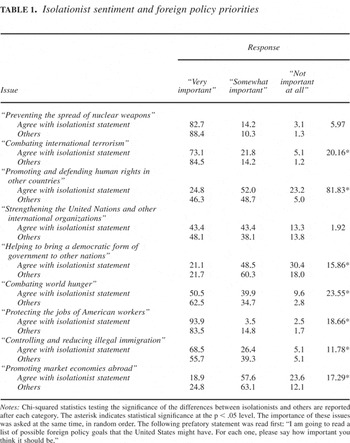
What issues did respondents have in mind when they agreed with this broad statement? Their assessment of more specific American foreign goals provides a sense of their priorities. In 2004, the ANES asked respondents about the importance of nine such goals.26
National Election Studies 2005.
Isolationist sentiment and foreign policy priorities

The ANES also includes questions that tap individual interests in international trade and investment, as well as a wide range of other demographic information. ANES questions about respondents' education, family income, and occupation can be used to represent access to capital, including human capital, which should help explain attitudes toward American global activism.27
Unfortunately, the ANES does not include questions that tap individuals' sectoral interests. In the analysis presented here, these sectoral interests are represented in the aggregate economic data, but not the individual data. This decision reflects the limits of the available data, not a theoretical judgment that sectoral interests are not important.
Education is the most commonly used indicator of human capital, and has been shown to influence attitudes toward international trade.28
Education is not an unproblematic indicator of economic self-interest, however. Hainmueller and Hiscox present evidence that much of the effect of education on attitudes toward trade protection may stem from exposure to arguments about the benefits of trade in college economics classes rather than from its effect on an individual's stock of human capital.29Hainmueller and Hiscox 2006.
The analysis that follows includes two efforts to discern whether the models capture the effects of economic interests or exposure to the elite consensus. First, rather than rely on education alone as an indicator of human capital, it also examines the effects of occupation and family income. Because occupation is closely related to the skills individuals have, it is an alternative indicator of human capital. Individuals who hold professional and managerial positions stand to benefit more from a relatively liberal world order than do individuals who hold blue-collar jobs. International trade and investment may increase demand for white-collar labor while the work performed by blue-collar workers is more likely end up being performed overseas. Holders of financial as well as human capital stand to benefit from the world order American foreign policy supports. Individuals who report a high family income should be better positioned to take advantage of both overseas investment opportunities and the higher demand for capital that should prevail under free trade in a relatively capital-abundant country like the United States. These variables do not share the problems of education as indicators of economic self-interest.
Second, some of the effects of the elite consensus may be controlled by including an indicator of respondents' interest and knowledge about politics. The ANES did not include questions specifically tapping interest in foreign affairs, but it did collect data on the interviewer's impression of each respondent's level of political information. Previous research indicates that the interviewer's assessment is a reliable indicator of respondents' level of political information.30
This variable has the added virtue of being present in a relatively large number of the ANES surveys. If exposure to the elite consensus supporting American global activism accounts for the effect of education, the inclusion of this political information variable should eliminate or greatly reduce its effect on support for isolationism.Measuring regional economic stakes in the world order American foreign policymakers sought to build and maintain during the postwar era presents a more substantial data collection problem. There are many potential costs and benefits, which are often difficult to measure. Using state-level data on manufacturing and agriculture and industry-level data on exports and imports, it is possible to compute indices that reflect the economic impact of exports or imports in manufacturing or agriculture on the economy of the state. Details on the sources and computation of these indices are posted online with the data used in this analysis. The variables used here indicate the value of agricultural or manufactured exports, or the value of agricultural or manufactured imports produced in the state, as a share of personal income.31
Personal income was used instead of gross state product, because the latter is available only since 1977. Personal income is highly correlated with gross state product, and is available for the entire period considered here.
The analysis will also include the military share of personal income in each state. The major alternative indicator of the value of military spending to a state, the value of prime contracts with the Pentagon, does not reflect the actual location of military production very well. These figures do not consider subcontracting, or the fact that many prime contractors maintain production facilities in more than one state.
Empirical Results
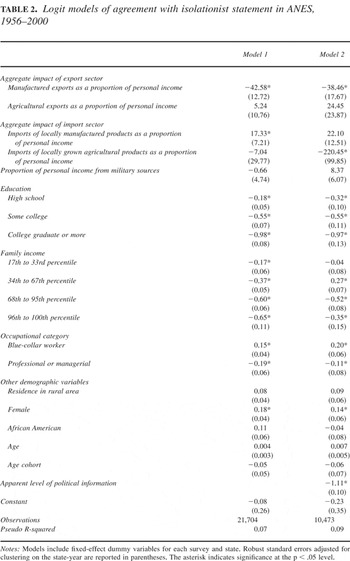
Table 2 presents the results of two logistic regression models of responses to the survey question about American global activism. The first set of estimates is based on a much larger number of observations because interviewer impressions of the respondents' political information were not recorded in every case. The dependent variable is coded “1” if the respondent agreed with the isolationist statement that “this country would be better off if we just stayed home and did not concern ourselves with problems in other parts of the world.”
Logit models of agreement with isolationist statement in ANES, 1956–2000

The models include the variables indicating the aggregate impact of international trade on the respondent's home state, as well as his or her individual self-interest, discussed in the last section. They also reflect several other considerations. First, domestic and international conditions varied enormously between 1956 and 2000. Developments in the Cold War, the changing performance of the domestic economy, and the different candidates on the ballot in each election year, among other things, may have altered the mean response for each survey. In order to control for this source of variation, a fixed-effect dummy variable is included for each separate survey. Second, regions with similar scores on the aggregate economic variables have many other similarities. In order to ensure that the estimated effects of the state economic variables reflect exposure to the international economy rather than correlated features of the states, the models include a fixed effect dummy variable for each state. Finally, the use of aggregate indicators of state economic conditions in an analysis of individual-level survey responses makes it likely that the errors will be correlated within each unit, where the economic indicators are constant.32
Moulton 1990.
As Table 2 indicates, all of the individual self-interest variables had the expected effects on support for isolationism. Among the regional economic interest variables, however, only those associated with the manufacturing sector were statistically significant. This result is not surprising. During the postwar era, many more Americans were involved in manufacturing than in agriculture or in providing goods and services to the military. Although the coefficient for import sensitivity narrowly misses the threshold for statistical significance in the second model, this is almost certainly due to the loss of six of the sixteen survey years in this model—and thus a substantial part of the variation in the regional impact of international trade—rather than the inclusion of the political information variable.
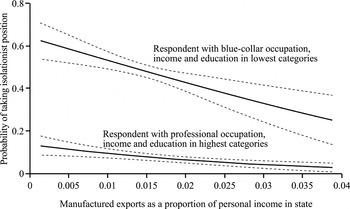
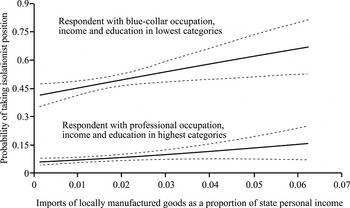
Both individual self-interest and the exposure of the local economy to international trade had substantial effects on attitudes toward American global activism. Based on the estimates reported in the first column of Table 2, Figures 1 and 2 show the estimated effects of export orientation and import sensitivity on respondents with different material self-interests. The dark lines indicate the point estimates for each type of respondent, while the dotted lines display 95 percent confidence intervals surrounding these estimates. As the graphs suggest, the effect of aggregate economic conditions depended on the self-interest of the respondent. Individuals with professional occupations, high family incomes, and a college education—the winners in the American-backed world order—rarely took isolationist positions in the ANES survey, regardless of aggregate economic conditions in their home state. By contrast, individuals with blue-collar occupations, little education, and low family income were heavily influenced by the exposure of their state to the world economy. The probability that an such a respondent would express isolationist views on the ANES survey varied between 0.62 and 0.25 across the range of observed values for manufacturing export orientation, and between 0.41 and 0.67 across observed values of manufacturing import sensitivity.

State export orientation, individual self interest, and support for isolationism

State import sensitivity, individual self interest, and support for isolationism
The differences based on individual self-interest are just as striking. Individuals with relatively greater access to capital, as indicated by their education, income, and occupation, were much less likely to express support for isolationism. These differences are quite large across all levels of export-orientation and import-sensitivity. Indeed, at low levels of export orientation or high levels of import sensitivity, the model predicts that more than half of blue-collar respondents with low levels of income and education would express support for isolationism, a noteworthy result given the rarity of these sentiments. By contrast, professionals with the highest levels of education and income, like the elites in the CCFR sample, rarely express support for isolationism, regardless of local economic conditions.
Overall, the combined effect of the economic self-interest variables on the probability that a respondent will express support for isolationism is somewhat greater than the effect of aggregate export orientation and import sensitivity. High levels of education and family income, as well as holding a professional occupation, tend to go together. Individuals who have one of these demographic traits thus also tend to have others that affect their attitude toward American global activism in the same way. By contrast, while export-orientation and import sensitivity are also positively correlated, they have opposite effects and thus tend to cancel each other out.
The Role of Education: Information or Human Capital?
As was noted earlier, the work of Hainmueller and Hiscox suggests an important potential objection to these results.33
Hainmueller and Hiscox 2006.
First, Hainmueller and Hiscox found that the effect of education was nonlinear.34
Ibid., 480–81.
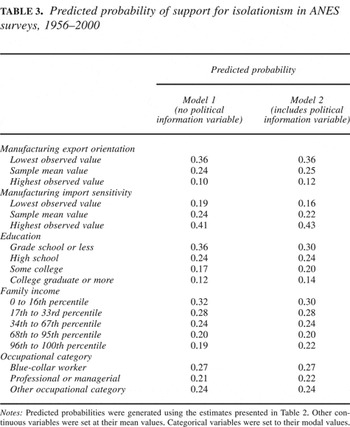
Predicted probability of support for isolationism in ANES surveys, 1956–2000

Second, the inclusion of a variable tapping respondent's level of political information does not eliminate the effect of education. The second model in Table 2 includes a variable that indicates the interviewer's impression of the respondent's level of political information. Following the practice suggested by Bartels the categories of “very high,” “fairly high,” “average,” “fairly low,” and “very low” were assigned values of 0.95, 0.8, 0.5, 0.2, and 0.05, respectively.35
Bartels 1996, 203–4.
Third, the other indicators of ownership of human and financial capital are also significant predictors of attitudes toward global activism. The last two sets of predicted probabilities in Table 3 show these effects. Controlling for the effect of education, individuals who reported relatively high family incomes were much less likely to express support for isolationism than were those with relatively low family income. Similarly, individuals engaged in blue collar occupations were more likely to take isolationist positions than were individuals who held professional or managerial positions. As was the case with education, these results are somewhat diminished, but remain statistically significant when an indicator of political information is added to the model. Just as the better-educated have more exposure to the elite consensus, so do wealthier respondents and those holding professional or managerial jobs. These results line up well with respondents' material self-interest in the relatively liberal world order that American global activism supports. Even if the effect of education were due entirely to increased exposure to the elite internationalist consensus, this line of argument could not account for these other relationships.
Stability over Time
The principal reason for estimating the model using data from several surveys across the 1956–2000 period rather than a single cross-sectional sample is that this approach allows more variation in aggregate regional economic interests. With fewer than fifty different state-level observations on aggregate economic interests in any given year, a single cross-section does not provide enough explanatory leverage for a reasonable test of their effects. The use of multiple surveys also allows the testing of an additional observable implication of the argument advanced here. Theoretically, the relationship between economic interests and attitudes toward isolationism should be consistent over the 1956–2000 period. The world order goals of American foreign policy did not change, and the implications of exposure to the international economy for individual self-interest also remained the same. Evidence that these relationships were inconsistent over time would call into question the line of argument advanced here. Changing domestic and international conditions should certainly influence support for global activism from year to year. However, these exogenous events should not eliminate the differences between the economic winners and losers. Those with better access to human and financial capital should always be more supportive of American global activism.
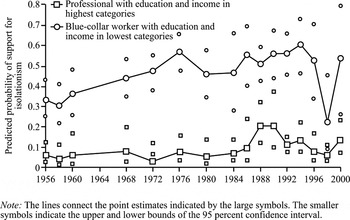
Figure 3 plots the probability of support for isolationism based on separate cross-sectional estimates from each ANES survey for two hypothetical respondents: a blue-collar worker with the lowest levels of education and family income, and a professional who fell into the highest categories on these variables. The large circles and squares indicate the point estimates for these respondents in each year. The smaller symbols indicate the upper and lower bounds of the 95 percent confidence interval surrounding each estimate. Although the predicted probabilities vary from year to year, the cleavage between those with better and worse access to human and financial capital remains large and consistent. As expected, the hypothetical blue collar respondent was always more likely to express support for isolationism than the hypothetical professional respondent. Only the 1998 survey produced a notable deviation from this pattern. There is a slight upward trend in support for isolationism, but the difference between the two types of respondent has not changed as much as one might suppose in light of the momentous changes in the international environment since 1956, especially the end of the Cold War.

Predicted probability of support for isolationism
Conclusion
Maintaining a world order open for American trade and investment has been a central goal of postwar American foreign policy. Different individual and regional stakes in this goal have influenced domestic support and opposition to American global activism. The estimated effects are substantively large and fairly consistent over time. Several conclusions follow from these results.
First, the effect of involvement in the international economy on foreign policy opinion appears to work most strongly through its considerable impact on individual self-interest. The effects of variables indicating the impact of trade on the economy of respondents' home states were not as great as the combined effects of the variables associated with individual access to human and financial capital. Stated differently, the economic interests of one's neighbors make a difference, but one's own economic interest appears to be more important. This result does not mean that regional differences in public opinion based on economic interests are politically unimportant. On the contrary, not only were the effects of aggregate regional economic variables substantively meaningful but individual self-interest should reinforce the regional differences in public opinion associated with them. States that are relatively import-competing will contain more individuals whose economic self-interest predisposes them to be skeptical of American global activism. States that are relatively export-oriented will contain more individuals holding the opposite view.
Second, the evidence considered here suggests that previous research has understood economic interests in broader foreign policy issues too narrowly. Except for work focused exclusively on foreign economic policy issues such as trade or international lending, most studies have used the distributive impact of military spending to represent divergent economic interests in foreign policy. Military spending had little effect here. International trade in manufactured goods was a much more important determinant of support for American global activism. This result makes sense in light of the fact that military spending has steadily decreased as a share of the national economy since the Korean War, while the importance of international trade has risen sharply, especially since the early 1970s. Military spending remains a potential influence on foreign policy opinion, but its effects need to be kept in perspective alongside the broader interests at stake in debates about American global activism.
The evidence presented here also has some intriguing implications concerning the effects of globalization on support for American global activism. Increasing globalization has contradictory effects on support for American foreign policy. Greater integration into the world economy increases both the number of Americans with a stake in exports and the number whose incomes are threatened by imports. As long as exports and imports increase together, these effects may cancel one another out. If imports exceed exports, however, as they currently do, the net effect may be to decrease aggregate support for an activist foreign policy. Obviously, there are many other forces at work in shaping public opinion at particular points in time, but the evidence considered here suggests that the potential impact of exposure to the international economy deserves to be taken seriously as a source of support and opposition to American internationalism.
Finally, the results point to a potential blind spot in academic research on foreign policy attitudes. Support for isolationism is found primarily among the poor and uneducated. Those who typically produce academic research are exceedingly unlikely to take such a position. It may be tempting to attribute attitudes that are so unusual in one's experience to ignorance or psychological pathology, as academic research on isolationism has sometimes implied. The results of this analysis suggest that this attribution is a mistake. Support for American global activism varies with economic interests. Individuals with little education may not be able to articulate effectively the logic of their position, but their attitude may be no less rational than that of their more educated compatriots in light of their economic interests.