INTRODUCTION
In October 2014 metal-detectorists discovered a Roman vessel hoard near Pewsey which was recorded on the Portable Antiquities Scheme (PAS) database (WILT-0F898C). The hoard consists of a large copper-alloy cauldron with an iron band, within which two bowls, a straight-sided vessel with feet, and four scale pans had been carefully placed. The micro-environment created by the metal corrosion products within the stacked group led to the remarkable preservation of organic packing material. The hoard was removed by the detectorists contrary to best practice, but crucially the vessels were neither separated nor cleaned, allowing analysis of material within them. The combination of exceptional preservation and detailed artefactual and environmental analysis provides a unique window on the deposition of vessel hoards in the late Roman period. A second late Roman vessel hoard, without such good organic preservation, was found nearby at Wilcot in 2017 and is also reported here (WILT-047110). This hoard was also removed by the detectorist contrary to best practice and three of the vessels are in a fragmentary condition. As with the Pewsey hoard, crucially the vessels were not cleaned, allowing analysis of the material within them.
THE PEWSEY HOARD: DISCOVERY AND CONTENT
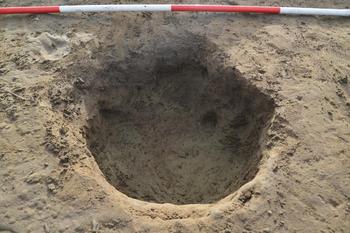
The findspot of the Pewsey hoard lies on a natural Upper Greensand Formation terrace, overlain by freely draining loamy soils, above the now canalised upper section of the Salisbury Avon; the precise findspot is not given here to protect the location. The finders reported that the hoard was discovered at a depth of c. 0.3–0.4 m below the topsoil, within a pit cut into the natural Greensand. Excavation of a 4 m2 trench around the findspot in January 2015 confirmed the hoard's location in a pit cut into natural (fig. 1).Footnote 1 The entirety of the small amount of pit fill that remained in situ was retrieved for flotation. Excavation also uncovered two ephemeral linear stone spreads either side of the pit and showed that the subsoil contained Roman material: a small number of sherds of British and imported ceramics and ceramic building material, all Roman in date and of apparent domestic character.Footnote 2 It is possible that the finds derive from Roman manuring, or from an undiscovered Roman settlement in the vicinity. Geophysical survey was also conducted around the findspot with inconclusive results, probably due to geological interference.Footnote 3 Overall it appears that the hoard was deposited in a pit dug for that purpose and with no immediately adjacent structures or ditches, albeit within an actively used landscape.
South-facing excavation photo of the hoard findspot. A small amount of in-situ pit fill remained in the south-east side of the pit following its excavation by metal-detectorists, but the remainder of the pit fill and cut had been removed.

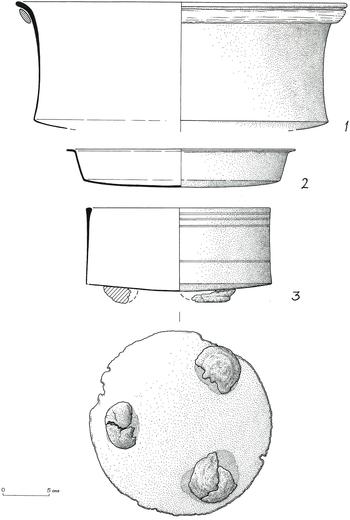
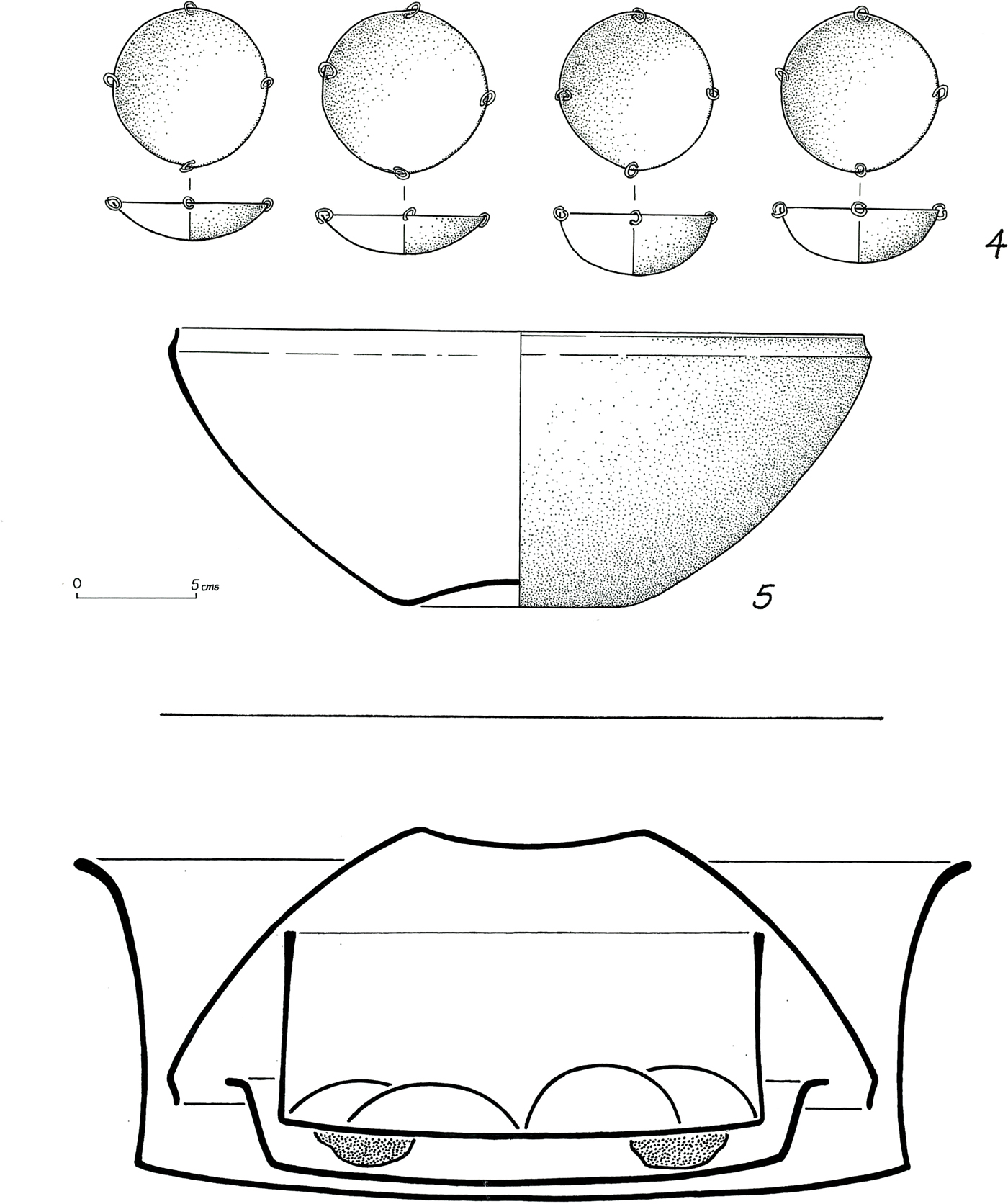
The vessels were placed within the cauldron (fig. 2.1) as shown in fig. 3, with the inverted Irchester bowl (vessel C, fig. 3.5) covering a copper-alloy bowl (vessel A, fig. 2.2), within which was placed a copper-alloy vessel (vessel B, fig. 2.3), within which were four scale pans (fig. 3.4). The feet of vessel B had become detached, and were included in a minerogenic deposit that lay beneath the Irchester bowl and around the outside of vessel B. This deposit also contained some fragments of copper alloy. The scale pans within vessel B were surrounded by, and contained, organic remains preserved by copper-alloy corrosion product mineralisation, which had taken place within the microenvironment between vessel B and the inverted bowl (vessel C).
(1) Copper-alloy cauldron with iron band; (2) Copper-alloy bowl (vessel A); (3) Copper-alloy vessel (vessel B).

(4) Four copper-alloy scale pans; (5) Copper-alloy Irchester bowl (vessel C). The configuration of the Pewsey vessel hoard.

A description of each of the vessels within the hoard is provided below. The alloy composition of each vessel was established non-destructively using portable X-ray Fluorescence Spectrometry (pXRF). No cleaning of the vessels was undertaken after excavation, meaning that the sediments and organic material within, and adhering to, each vessel were retained in situ. This has allowed sampling and analysis of material from the various vessels to understand their use, the material used to pack them, the local environment at the time of deposition and the date of deposition.
1. Copper-alloy cauldron with iron band (fig. 2.1)
The cauldron is c. 310 mm in diameter, 0.3 mm thick and constructed from bronze with a high tin content with a reinforced iron band at the rim.Footnote 4 The one-piece lathe-turned cauldron is carinated with a concave body. The cauldron is similar to examples from the Wotton hoard, which have reinforced iron bands, and in form to those from Burwell.Footnote 5
The cauldron was heavily damaged during its removal from the ground and survives in two main sections (the body and the base) and many smaller fragments. The examples from Burwell were heavily patched and repaired, but no repairs were noted from this example.
The Irchester bowl (vessel C) was inverted and placed within the cauldron, leaving an impression of the rim of vessel C on the internal face of the cauldron base. The base of vessel A is also visible as an impression on the base of the cauldron. Black sooting is visible externally on the cauldron.
2. Copper-alloy bowl (vessel A; fig. 2.2)
Vessel A is made from a leaded bronze with a high tin content.Footnote 6 It has been defined as a ‘bowl’ as it is an open-rimmed basin with height less than the radius at its rim.Footnote 7
The rim of the vessel is uneven, but is generally c. 8 mm wide and c. 2.5 mm thick. The sides of the vessel narrow from the rim, where it is 246 mm in diameter, to the concave base, which is 210 mm in diameter. The vessel is 38 mm in depth at the wall of the bowl. Soot is visible on the exterior base.
Two parallels for this vessel are recorded from Sutton Courtney.Footnote 8 MilesFootnote 9 notes that these bowls are likely to be from a cemetery dating to the second to third centuries, although the findspot was not specifically recorded. It is therefore possible that vessel A was an antique when it was deposited. A further broadly similar parallel is known from Trier.Footnote 10
3. Copper-alloy vessel (vessel B; fig. 2.3)
Vessel B is made from a leaded bronze.Footnote 11 The walls of the vessel are vertical and straight (85 mm in height) with a thicker rim that expands internally and very slightly outwards (6.25 mm thick); the rim expands from 9.7 mm below the flattened top. The external walls show evidence of tinning, and are decorated with three sets of double parallel incised circumferential grooves towards the top of the vessel, with another two sets towards the base.
The base of the vessel is concave and has become detached. The breaks occurred post-deposition but are patinated, so are unlikely to be recent. The vessel has three fragmentary feet (approximately 55 mm wide, 36 mm long and 13.35 mm thick). The feet are made of lead internally and are covered with a sheet of bronze externally. They are ‘D’-shaped or shell-shaped and appear to taper in towards the base of the foot.
4–7. Four copper-alloy scale pans (fig. 3.4)
The scale pans are of a broadly similar form and appear to be two pairs, distinguished mainly by height and weight (pans A and B, and C and D).
Scale pan A measures 65.4 mm in diameter, 15.3 mm in height and weighs 28.6 g. Scale pan B is slightly wider and deeper, measuring 68.6 mm in diameter, 15.6 mm in height and weighs 27.7 g. Both pans are undecorated; around the rim are four small rings placed at regular intervals set within circular drilled perforations. The rings are c. 7.5 mm in diameter and 1.5 mm wide. Both pans were constructed from a leaded bronze and their similarity suggests that they may be a pair.Footnote 12
Scale pan C measures 66.5 mm in diameter, 24.7 mm in height and weighs 19.1 g. Scale pan D measures 67.3 mm in diameter, 24.5 mm in height and weighs 18.5 g. Both pans are undecorated and around the rim are four small rings placed at regular intervals and set within circular drilled perforations. The rings are c. 7.4 mm in diameter and 1.65 mm wide. Both pans were constructed from a leaded bronze and their similarity suggests that they may be a pair.Footnote 13
8. A copper-alloy Irchester bowl (vessel C; fig. 3.5)
This high tin bronze Irchester bowl is 296 mm in diameter at the rim and 110 mm in height.Footnote 14 The rim is in-turned (3.65 mm thick) and the bowl tapers from its widest point (below the rim) to the base.
The Irchester bowl has incurving sides, an omphalos base and an in-turned rim. Irchester bowls are basins manufactured in the fourth or fifth centuries in Britain, although they remained in circulation into the early Anglo-Saxon period.Footnote 15 The uniformity of the design suggests that the vessel was a product of one or more centralised or associated workshops, and that they were used as part of a dinner service or perhaps for hand washing.Footnote 16 Examples from elsewhere in the south of Britain include Amersham, Bucks.,Footnote 17 Drapers’ Garden, London,Footnote 18 Wotton, SurreyFootnote 19 and Bishops Canning, Wilts.Footnote 20 Recently further examples from Wiltshire have been reported to the PAS from Lacock (WILT-029D2B) and Wilcot, catalogued here as part of the Wilcot vessel hoard.
THE WILCOT HOARD: DISCOVERY AND CONTENT
The Wilcot findspot was not excavated but lies in a similar position on an Upper Greensand Formation terrace above a tributary stream of the Avon, close to the site of the fifth-century Stanchester hoard and Stanchester villa.Footnote 21 Geophysical survey was also conducted around the findspot, with no archaeological features recorded.Footnote 22
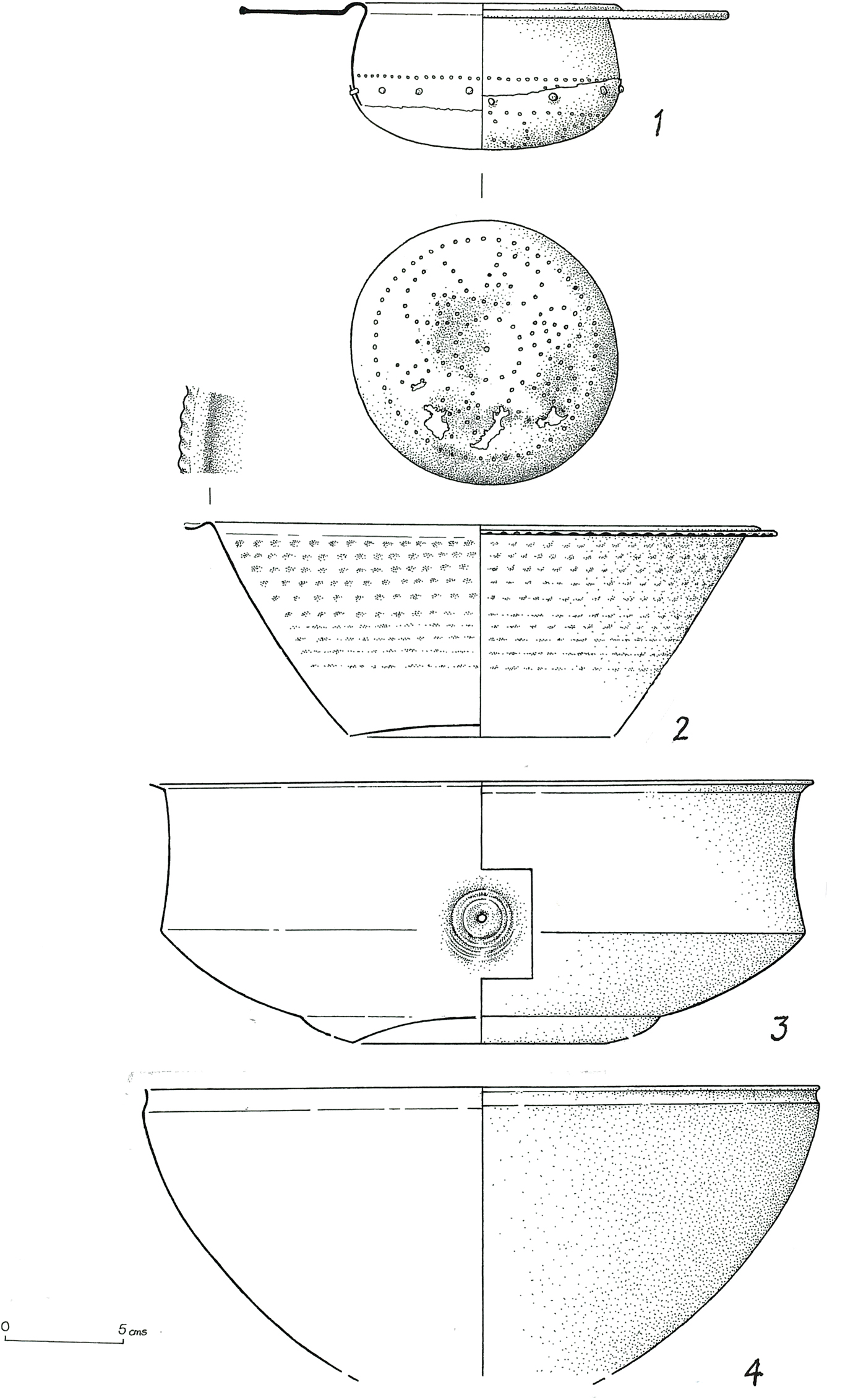
The Wilcot hoard consists of a symmetrical flanged bowl strainer, a basin with an out-turned rim (Bassin Uni), a carinated basin with a foot-ring and an Irchester bowl. The vessels nestled within one another and all were contained within the Irchester bowl. The vessels are fragmentary and fragile: the carinated basin and Irchester bowl are in multiple pieces and the bases of the Irchester bowl, cauldron and Bassin Uni have become detached.
1. The symmetrical flanged bowl strainer (fig. 4.1)
The strainer is circular (260 mm in diameter, 61 mm in height) with a flat out-turned and expanded rim (45.55 mm in width and 4 mm thick at the end). The exterior margin of the flange is upturned. The interior band is raised with a convex curving form rolling downwards into the body, which then widens outwards to undercut the internal rim top. The strainer is hemispherical and 100 mm in width at the rim before expanding to 150 mm. The strainer was originally a single piece of copper alloy, but was repaired in antiquity with an additional piece of copper alloy. The original basin of the strainer was decorated with two rows of circumferential perforations (28.8 mm below the rim), below which are further perforations, but due to the original break this decoration is now indiscernible. At this point a piece of curved copper-alloy sheet has been riveted to the body of the strainer as a repair. The sheet has a circumferential band of circular perforations (95 mm wide) surrounding four scrolls (85 mm wide), themselves surrounding a circular band of perforations (40 mm wide) and a central pellet. The perforations on the repair begin 41.9 mm below the rim. The perforations on the original vessel are circular, 1.7 mm in diameter and regular in spacing, whereas the perforations on the repair are irregularly spaced, not all circular and range from 1.7 to 2.65 mm.
(1) Copper-alloy symmetrical wine strainer; (2) Copper-alloy Bassin Uni; (3) Copper-alloy carinated basin; (4) Copper-alloy Irchester bowl.

The strainer was deposited within the Bassin Uni, which in turn was placed inside the basin and the Irchester bowl, with the rim facing the ground surface. A similar form of wine strainer was recorded in the Langdale hoard (NMGW-9C0216). The strainer is part of a small group which date from the first century a.d. with broad flanges and no handles, including examples from the Coygan Caves and Helmsdale.Footnote 23
2. Bassin Uni (fig. 4.2)
A Bassin Uni is a basin with an out-turned rim.Footnote 24 The incomplete basin (250 mm in diameter) has a crimped out-turned rim (10 mm wide) and a slight omphalos base. The crimped edge was achieved by hammering the upper surface. The hammer marks are c. 5 mm wide and c. 5 mm apart. The vessel tapers from the rim to the break where the base has become detached. The sides of the vessel are decorated with repoussé decoration in bands. A Bassin Uni from the Wotton hoardFootnote 25 has repoussé decoration consisting of herringbone and square stamps.
3. The carinated basin (fig. 4.3)
The carinated basin is 110 mm in height and c. 270 mm in diameter at the 7 mm wide out-turned rim, narrowing to 260 mm in diameter before expanding to 270 mm, then tapering towards the base. The basin has been constructed from two pieces of copper alloy. The omphalos base is 110 mm in diameter and has a central perforation from its production on a lathe. At the base is a foot-ring and a raised centre.
The basin is similar in form to two carinated basins from the Helmsdale hoard which is thought to date to the second half of the second century to the fourth century.Footnote 26 The basin also bears similarities to the carinated bowl from the Drapers’ Garden hoard.Footnote 27 All three had been repaired, but there appear to be no repairs in the surviving fragments of this basin.
4. The Irchester bowl (fig. 4.4)
The Irchester bowl is 99 mm in height. From the convex base the body expands to its maximum width just below the rim (286 mm) before tapering inwards slightly to the rim (284 mm), which has a 3 mm thick bevelled edge. The omphalos base has an internal diameter of 93 mm.
The strainer and possibly the carinated basin would have been antiques when the hoard, dated by the Irchester bowl to the fourth or fifth century, was deposited. The basin could date as early as the first half of the second centuryFootnote 28 and the symmetrical strainers were probably produced in Britain during the first century a.d.;Footnote 29 the Langdale hoard was deposited c. a.d. 25–75. The repairs to the strainer also suggest a prolonged period of use prior to final deposition.
THE PEWSEY HOARD: THE ORGANIC MATERIAL
Visible plant macrofossils were present between vessel A and vessel B and in the interior of vessel B, as the pan scales were originally wrapped. Sub-samples were taken for pollen analysis from the surface corrosion deposits, plant packing material and the interior and exterior sediments. The remaining material was sieved and sorted for identifiable and quantifiable plant macrofossils.
SAMPLING AND QUANTIFICATION
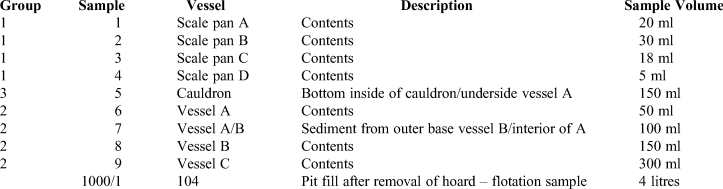
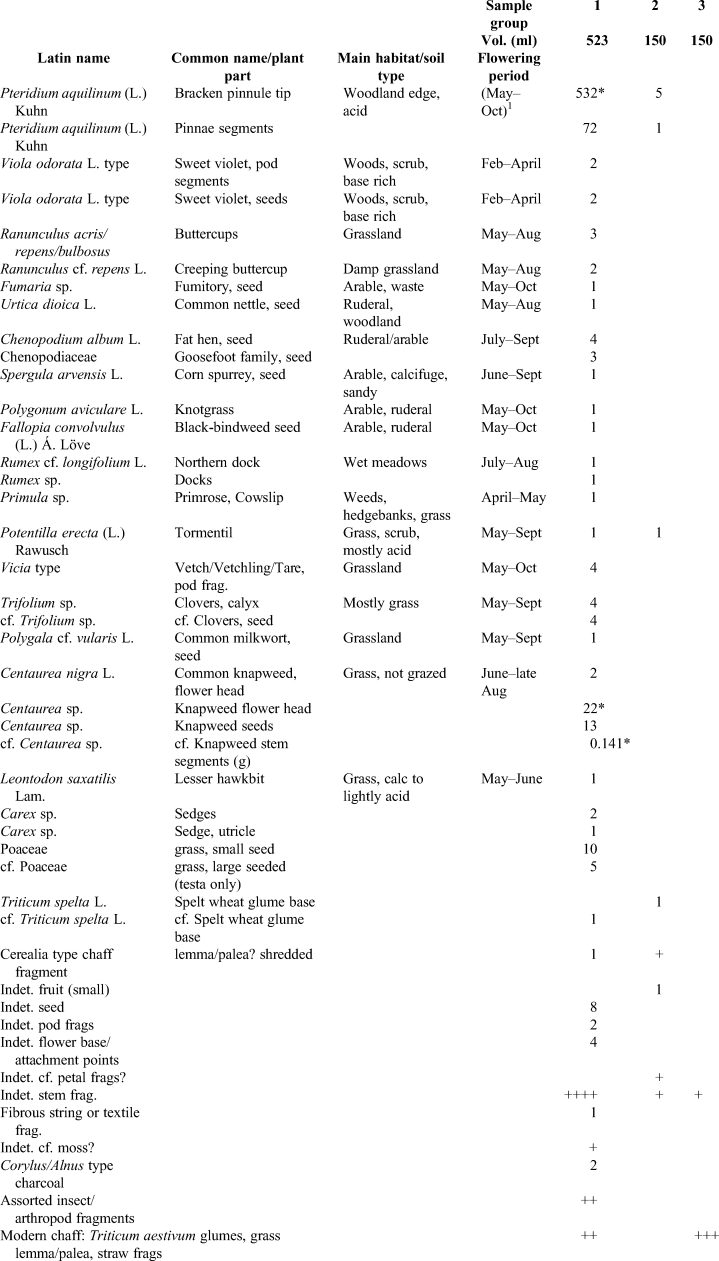
Eleven samples were taken for plant macrofossil analysis (table 1): nine dry-sieved samples were taken from between and within the vessels of the hoard, while the sediment retrieved from the fill of the pit was processed by flotation. Visible flower heads from the interior of vessel C had been placed in a crystal box by the detectorists. All remaining loose material was 100 per cent sampled by vessel. The flotation samples were processed at Fort Cumberland, Historic England, using a standard Siraf type flotation machine, with flots collected on a 250μm mesh and the residue retained on a 500μm mesh. No ancient plant remains were present in the flotation samples.
LIST OF PLANT MACROFOSSIL SAMPLES ASSESSED

Given the fragility of the remains within the hoard, samples were dry sieved only over a stack of sieves from 4 mm to 0.25 mm and sorted under a binocular microscope at x10 to x40. Any quantifiable and identifiable material (seeds, seed pods, flower heads, bracts and chaff items) was extracted. Stem material was taken from the large sieves (>2 mm). Stem fragments were not extracted from the smaller sieves although an approximate relative abundance was recorded (present, common or abundant).
Identification was made based on the examination of microscopic structure, and with the aid of floras, seed atlases and the modern comparative botanical reference collection held at Fort Cumberland, and fresh material collected from the hoard's immediate environment during the summer of 2016. Quantification was based on counts of individual items (seed, flower head or chaff) where possible. For fragmented material such as stem segments or leaf fragments a relative abundance score was used (present, common or abundant). Pteridium aquilinum (bracken) frond fragments were counted on the basis of pinnule or frond tips, while the presence of large fragments supporting several pinnule tips was noted. Nomenclature and habitat information follows Stace.Footnote 30
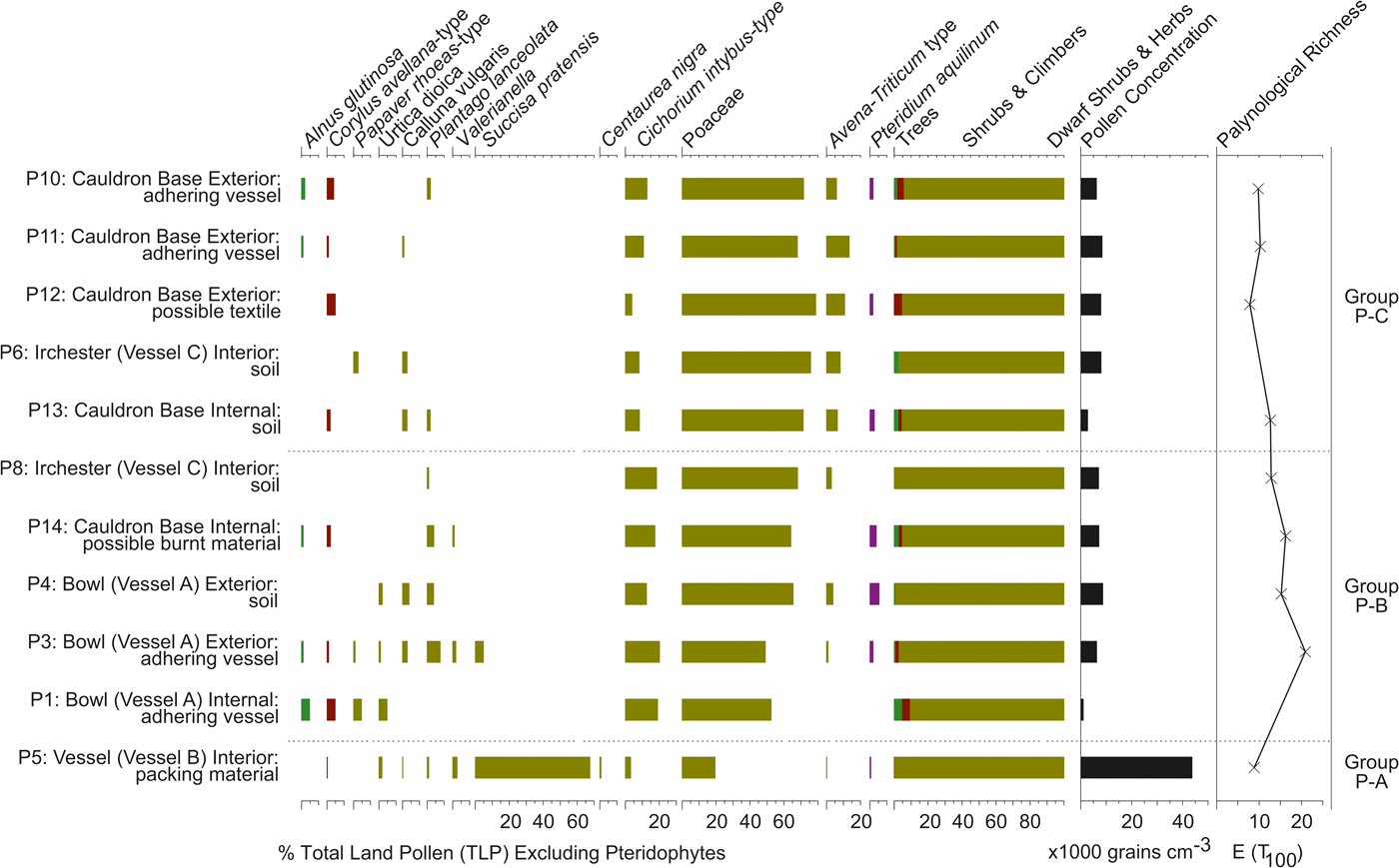
Fourteen samples (fig. 5) were taken to assess the pollen content, with standard preparation procedures used.Footnote 31 The volume of sediment available from each sample was determined by the availability of sediment still adhering to each vessel. Due to the highly minerogenic nature of some of the samples the maximum available sediment was processed in order to ensure that a pollen residue could be extracted, although three sediment samples failed to yield any pollen.
Summary pollen diagram (selected taxa) of samples obtained from the Pewsey hoard.

Determinable pollen and spore types were identified to the lowest possible taxonomic level as defined by Bennett,Footnote 32 with plant nomenclature ordered according to Stace.Footnote 33 Pollen counts of 100 total land pollen (TLP; excluding aquatics and pteridophyes) were sought from each sample, with counting extended to 400 TLP for sample P5 from the interior of vessel B. Statistical analysis was performed using rarefaction and cluster analysis, using both CONISS and TWINSPAN, which showed a broad agreement with the groups used for the macrofossils based upon position within the hoard.
PRESERVATION
The exceptional plant macrofossil and pollen preservation was the result of the unique micro-environmental conditions within the hoard, caused by the production of corrosion salts upon the metalwork surfaces.Footnote 34 When plant material comes into contact with metals that are corroding rapidly, the salts can cover or impregnate the organic material and act as a natural fungicide,Footnote 35 inhibiting attack by micro-organisms in the soil. The macrofossil plant material recovered from the vessel hoard was completely desiccated and variably encrusted with green copper, blue-grey or grey to white glassy metallic deposits, or coated in fine silt, while other fragments were desiccated with no visible metallic deposits. Not all the preserved plant material had been in direct contact with the sides of the vessels, although the better preserved material was enclosed within the centre of the hoard creating an unusual environment evidently highly conducive to metallic mineral preservation. The material was extremely brittle and fragile, but sufficiently well preserved that petals and bracts were recognisable and in two examples the bracts of the Centaurea sp. (knapweed) flowers were intact enough to enable identification to species level. The hairs on the underside of the Pteridium aquilinum (bracken) fronds were visible on most specimens, even when coated in either sediment or metallic corrosion deposits. It was possible to radiocarbon date a single flower of Centaurea nigra (common knapweed or hardheads) and Centaurea sp. stems, an indication that sufficient carbon remained. Subsequent attempts to date further flowers and bracken have failed. Both lead and copper signals were obtained when coated plant items were examined under the XRF at Fort Cumberland.
BOTANICAL COMPOSITION
The plant macrofossil material and pollen can be divided into three groups in terms of sample composition, character and context: Group 1, derived from the interior of the hoard (from within vessel B and the upturned Irchester bowl (vessel C) and including material from the pan scales); Group 2, the sample from the bowl (vessel A), on which vessel B stood; and Group 3, the samples from the cauldron and base of the pit.
Group 1
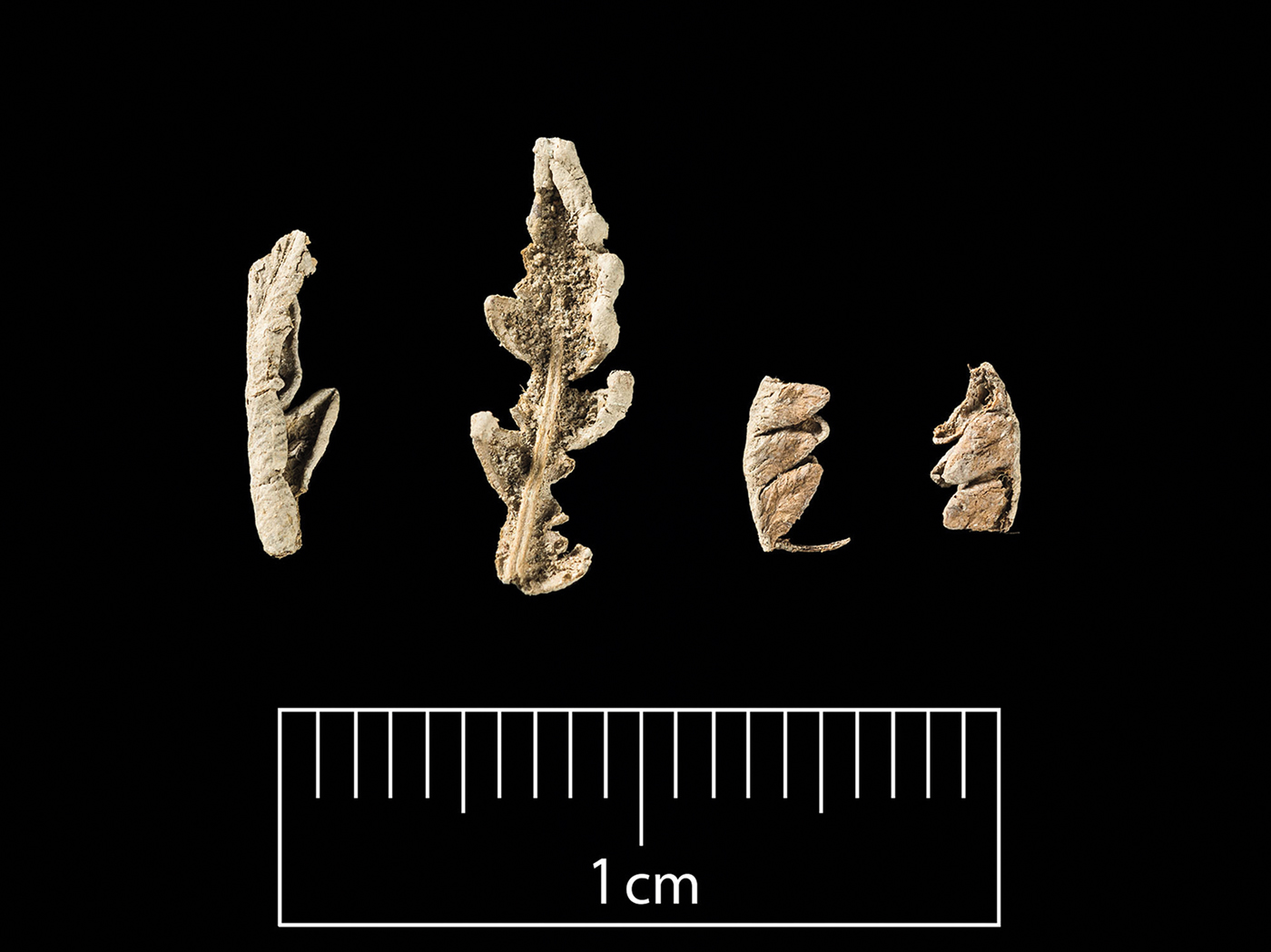
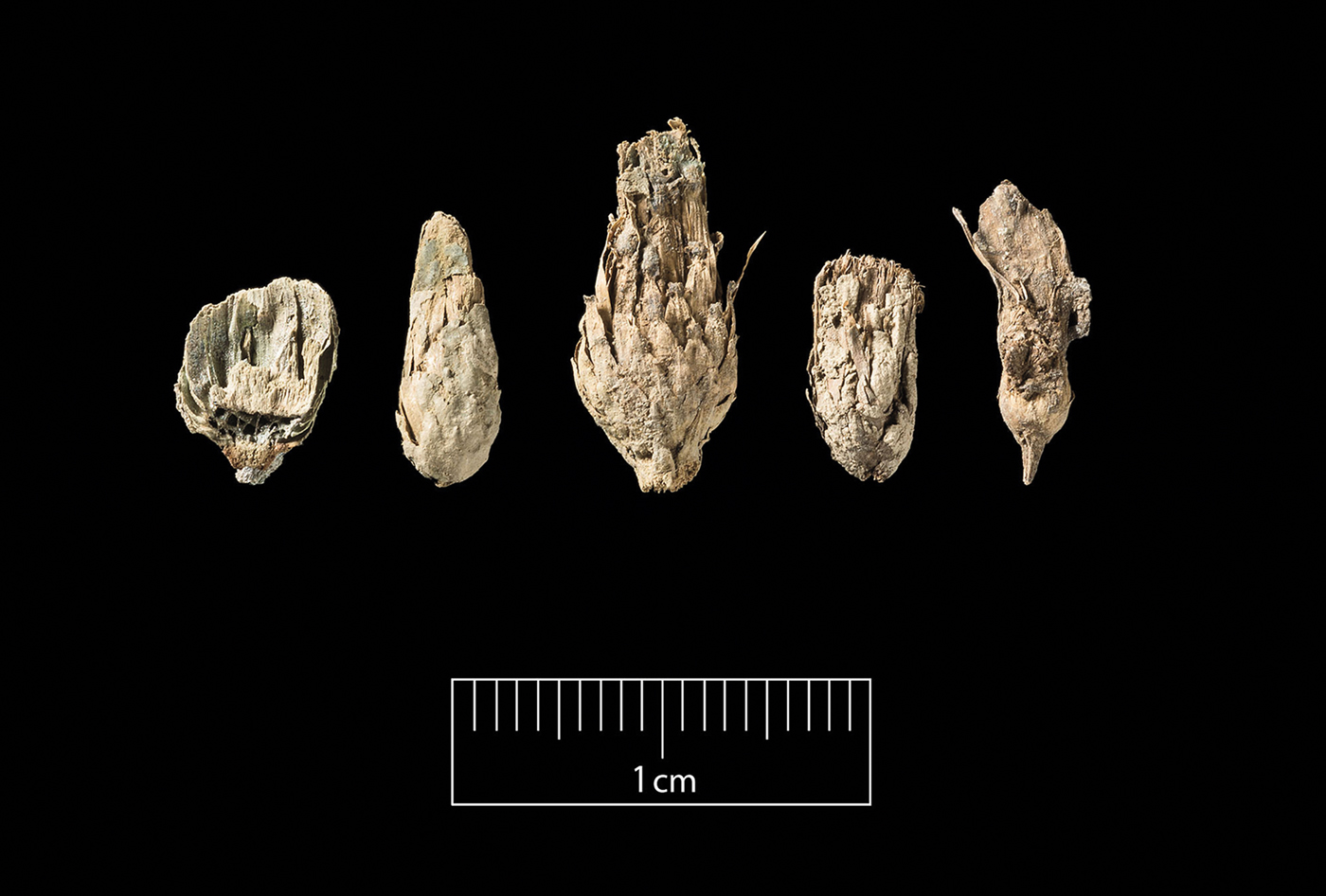
The macrofossil material from the interior of the hoard was dominated by the remains of Pteridium aquilinum (fig. 6), flowers and stems of Centaurea sp. (fig. 7), and unidentified herbaceous stem fragments. Two flowers were identified as Centaurea nigra (common knapweed or hardheads). One flower head had broken open and the mature seeds were visible, indicating the plants were at a late stage of flowering. Pteridium aquilinum (bracken) is a very widely distributed fern, which is most suited to woodland edge habitats and slightly acidic soil, although it will thrive on any undisturbed soils. It is particularly characteristic of upland, sheep-grazed habitats where the selective grazing of the sheep limits growth of competitive vegetation. In lowland habitats it tends to be restricted to areas that are not ploughed or grazed by cattle and is commonly encountered on woodland edges, road sides and at the base of walls. In much of Wiltshire bracken is limited to the base of hedgerows or walls and field margins; it commonly occurs as an understory of semi-natural oak, ash and hazel woodland on clay with flints.Footnote 36 Bracken occurs sporadically at the base of hedgerows in the Vale of Pewsey (pers. obsv.). The fronds of bracken emerge in May and are fully open by June or July, dying back during the autumn frosts. Centaurea nigra is a summer-flowering, purple thistle-type flowered member of the daisy family, which is typical of ungrazed grassland on a range of soils types. It flowers throughout the summer months (June to September).
Pteridium aquilinum pinnule tips from Group 1. (© Historic England)

Centaurea sp. flowers from Group 1. (© Historic England)

A range of other plant taxa was represented by occasional seeds, pod fragments and calyxes of grassland taxa or taxa of broad habitat requirements. Ranunculus cf. repens (creeping buttercup) and Rumex cf. longifolius (northern dock), both only tentatively identified, are characteristic of wetter meadows or seasonally flooded grassland. Other grassland taxa present were seeds of a Primula species (primrose, cowslip), Polygala cf. vulgaris (common milkwort), Leontodon saxatilis (lesser hawkbit), unidentified grasses and Carex sp. (sedges), as well as seeds and calyces of Trifolium sp. (clovers), and seed and pod fragments of Vicia/Lathyrus sp. (vetches/vetchlings/tare). All of these taxa will grow in grassy woodland edge environments or at the base of walls. Seed pods and seeds of Viola odorata (sweet violet) were also identified, a plant that again occupies grassy ground at the base of walls or on woodland edges. Viola odorata and Primula are spring flowering, although the seed capsules will persist on the plant into summer. Vicia type vetches are twining plants, found commonly in long grassland or amongst bracken, where they scramble up the taller vegetation. In addition to the grassland/woodland edge species, a few taxa of arable fields and/or disturbed habitats were recorded, including the seeds of Chenopodium album (fat hen), Polygonum aviculare (knotgrass), Fallopia convolvulus (black bindweed) and Spergula arvensis (corn spurrey).
Pollen sample P5, taken from the packing material within vessel B, was distinctive from all other pollen samples by the dominance of Succisa pratensis (devil's-bit scabious; 67% TLP), with Poaceae (grasses; 19%), Valerianella (cornsalads; 3%) and traces of Centaurea nigra (1%) and Pteridium aquilinum (0.5%). With the exception of sample P3 (the contents of scale pan C), Succisa pratensis pollen is not found within any other samples and therefore is definitively associated with the Group 1 packing material rather than being a post-burial contaminant. The dominance of Succisa pratensis is surprising given its absence within the plant macrofossil assemblage, while Centaurea nigra and Pteridium aquilinum, the dominant macrofossil components, only have a low pollen abundance. The spores of Pteridium aquilinum are derived from sori located on the underside of fronds, but these are not produced every year.Footnote 37 Analysis of the fronds contained within the hoard packing material demonstrated an absence of sori accounting for the very low spore presence within the pollen samples. The absence of Succisa pratensis flowers within the plant macrofossil assemblage may be due to their fragility compared to those of knapweed. In the absence of replicate pollen samples from the packing material fill, it is not possible to reflect on how representative this single sample is of the pollen associated with the packing material as a whole. Pollen samples (P6 and P8) taken from the sediment within the Irchester bowl (vessel C) contained a very different pollen assemblage (pollen group P-C), with stronger similarities to samples associated with Group 2.
A few insect remains were found with this sample group, all coated in green copper residues apart from one silt-coated mite. The insects tended to be small arthropods, mostly likely Diplopoda (millipedes and centipedes) and had presumably crawled into the vessels or were living on the bracken.
Group 2
The plant macrofossil assemblage between the bowl (vessel A) and vessel (B) was much more limited than the interior (Group 1) assemblages and consisted of a single glume base of Triticum spelta (spelt wheat) and occasional fragments of Pteridium aquilinum as well as a small number of weed seeds. Spelt is a hulled wheat in which the chaff does not fall freely from the ear unless it is processed (usually by pounding or milling). It would not be expected to occur on the ground within an arable field, but rather at a processing site or where processing by-products had been deposited. The occasional fragment of Pteridium aquilinum must have fallen into the bowl (vessel A) at the time of packing or potentially during excavation and handling of the hoard. The absence of flowers and the much more limited quantities of bracken from the bowl would suggest that either packing material was not placed between these vessels, or that preservation was less favourable in this vessel and the material has not survived.
The pollen associated with the bowl (along with sediment within the Irchester bowl: sample P8; and internal base of the cauldron: sample P14; pollen group P-B) showed a greater pollen diversity than that from the packing material (pollen group P-A) and included pollen indicators of ground disturbance and/or nutrient enrichment (Urtica dioica (common nettle), Plantago lanceolata (ribwort plantain), Cichorium intybus-type (including dandelion and chicory) and Pteridium aquilinum)) and calcareous grassland/arable fields (Papaver rhoeas-type (poppies) and Valerianella (cornsalads)). The samples within this group are all derived from the interior of the hoard (i.e. within the cauldron) and, with the exception of samples P8 and P4, from samples directly adhering to the vessels as opposed to the sediment. Poaceae values are between 49 and 67 per cent, and can be sub-divided between those associated with sediment fills (>65%) and those directly adhering to the vessels (<65%). This division is mirrored by the presence of Avena-Triticum-type (oat-wheat) and Calluna vulgaris (heather), which, with the exception of sample P3, are predominantly found in sediment samples external to the cauldron (pollen group P-C; equivalent to macrofossil group 3). Sample P3 is also the only other sample containing Succisa pratensis. As such it is probable that sample P3 contains a mixed assemblage containing elements from all three groups.
Group 3
The macrofossil sample derived from the interior of the outer vessel, the large cauldron, produced only modern cereal chaff and a very few stem fragments. The modern chaff must have fallen into the pit during the removal of the vessel hoard. The deposits from the base of the pit, which were taken retrospectively, similarly produced large quantities of modern cereal chaff derived from recent arable activity within the field. The modern chaff is entirely derived from Triticum aestivum (bread wheat), a free-threshing cereal which, in contrast to spelt wheat, sheds its chaff in the field, resulting in often substantial amounts of chaff on the surface of the plough soil.
Group 3 pollen samples (pollen group P-C) are all associated with either the cauldron exterior or sediment samples within it. Pollen preservation was poorer in these samples, with a higher number of corroded and degraded grains, along with lower pollen concentrations. These samples are distinct from those within pollen group P-B by having lower pollen richness and higher Poaceae (68–78%) and Avena-Triticum-type (6–13%) values. These are likely to reflect pollen derived from the local burial site, either at the time of burial or during removal of the vessel, as demonstrated by the correlation of high cereal pollen percentages and presence of Triticum aestivum chaff.
DETERMINATION OF SEASON
The bracken had fully unfurled at the time it was cut, suggesting a mid to late summer or autumnal date for its collection. As a packing medium it is more likely that the bracken would be cut while green when it is more pliable, although it is not possible to confirm this. Centaurea nigra is a summer-flowering plant, in bloom from July to late August, although the dried heads will persist into September or October. Flowering time for other taxa ranges from spring to late summer (flowering time is given in table 2). Where seeds are recovered we can assume the plant material was collected after flowering, although for many taxa the flowers and seed pods will overlap and (particularly in the case of the Primula and Viola) seed pods will persist for weeks or months after flowering. The known time of flowering of plants represented by the main pollen types within the packing material and directly adhering to the vessels can also be used to estimate when the hoard was packed (flowering seasons are given in table 3). When combined with the plant macrofossil evidence, the pollen evidence strongly suggests a July or August date for the cutting of the vegetation. It is not possible to establish how quickly the hoard was buried after packing. Experiments by the authors suggest bracken begins to dry and fold within a day or two of being cut, while the robustness of knapweed flowers means they may stay intact for several months. However, if the pollen external to the cauldron is contemporary with the original burial, then the hoard must have been buried in late summer or early autumn.
THE PLANT MACROFOSSILS RECOVERED FROM THE VESSEL SUMMARISED BY SAMPLE GROUP

* Material submitted for radiocarbon dating
1 period in full leaf
FLOWERING SEASONS OF MAIN POLLEN TYPES ASSOCIATED WITH PACKING MATERIAL / ADHERING VESSELS

ORIGIN OF THE PLANT MATERIAL
The extraordinary assemblage of plant material recovered from within the Pewsey hoard is assumed to derive from vegetation used as packing material. Both the plant macrofossil and pollen evidence indicate a distinctive interior assemblage with only limited transfer of material to the outer elements of the hoard, and an absence of intrusive material in the interior. Collectively this biological evidence suggests much of the material may have been collected from environments today commonly associated in Wiltshire with woodland edges (including hedgerows), the base of walls, road sides or field margins. Grasses and knapweeds, coupled with sorrel, buttercups, ribwort plantain, primroses/oxlips and vetchling are all typically found within neutral grassland. In addition, the presence of betony, devil's bit scabious and vetch may be taken as an indicator of long continuity in the management of this grassland and the absence of phases of land use change such as ploughing or conversion to crops. While it may be feasible that the packing material was derived from a single location, it remains a possibility that it may have been sourced from different plant communities scattered around a settlement.
While the purple of the knapweed against the green of fresh bracken would have been striking, there is no evidence to indicate a deliberate floral bouquet offering. Bracken has a long history of use as a packing medium,Footnote 38 particularly for fresh fruitFootnote 39 and fish,Footnote 40 and it is likely the knapweed flowers, grasses and other vegetation was simply collected alongside the bracken. The soils of the Vale of Pewsey are variable from chalk marl to acidic Greensand, and there are considerable areas of overlap, such that the material could have been collected within a limited area despite the varied soil requirements of the different taxa.
The presence of a single spelt wheat glume base is of interest given the date for the deposit, although the presence of a single glume base is, of course, difficult to interpret. Spelt, a hulled wheat, in which the grain is held in tightly adhering glumes, is very much associated with Iron Age and Roman populations in Britain and was largely replaced by free-threshing wheat early in the Saxon period.Footnote 41
WIDER ENVIRONMENT
The pollen and plant macrofossils associated with the packing material demonstrate a largely open grassland environment with probable areas of woodland edge along with enclosure/exclosure features such as walls and hedgerows. The pollen assemblage suggests areas of grassland, possibly grazed, associated with plants such as nettles, plantains and bracken, with some arable activity within the wider area suggested by the presence of poppies and cornsalads. The low presence/absence of cereal pollen in these interior samples suggests that grain crops were not within the immediate vicinity when the hoard was packed. Small woodland components are indicated by the presence of Alnus glutinosa (alder) and Corylus avellana (hazel), though any such woodland is likely to be restricted to localised areas of scrub or, for Alnus glutinosa, damp ground associated with the upper reaches of the river Avon.
Pollen associated with the exterior of the hoard showed a very different environment containing higher grass and cereal pollen values, implying burial within an arable field. Whether this reflects an arable field at the time of burial of the hoard, or contamination during its recent recovery, is unclear. The presence of modern chaff associated with the cauldron suggests in-wash during its recovery. However, in many instances pollen samples were taken from the thin residues directly adhering the hoard surfaces — surfaces that would have been in direct contact with the soil at the point of burial and subsequently became incorporated within the corrosion layers that permitted their preservation. It is therefore possible that this hoard burial site was an arable field at both burial and recovery stages; if this is correct, then it is probable that the hoard was deliberately buried below the plough zone.
RADIOCARBON DATING
Six samples including Centaurea nigra flower-heads, Centaurea stems and Pteridium aquilinum frond fragments were submitted to the 14CHRONO Centre, Queen's University, Belfast, Oxford Radiocarbon Accelerator Unit (ORAU) and Scottish Universities Environmental Research Centre (SUERC) for radiocarbon dating. The four samples submitted to ORAU and SUERC both failed during pre-treatment (table 4).
PEWSEY VESSEL HOARD: RADIOCARBON RESULTS

Radiocarbon dating laboratory methods
The samples dated at the 14CHRONO Centre were pretreated using an acid wash, graphitised using hydrogen reduction,Footnote 42 and dated by Accelerator Mass Spectrometry (AMS).Footnote 43
Quality assurance
The Queen's University laboratory maintains a continual programme of quality assurance procedures, in addition to participating in international inter-comparisons.Footnote 44 These tests indicate no significant offsets and demonstrate the validity of the precision quoted.
Radiocarbon results
The radiocarbon results given in table 4 are quoted according to the international standard set at the Trondheim convention.Footnote 45 The measurements are conventional radiocarbon age.Footnote 46
The two radiocarbon determinations are not statistically consistent (T’=4,4; T’(5%) = 3.8; ν=1Footnote 47), and given the other evidence all suggests that the plant remains were collected and deposited as part of a single event, this reproducibility is not within statistical expectations. Given the two measurements are consistent at the 1% confidence level, it is probable that one of them is a statistical outlier.
Bayesian modelling
The chronological modelling described below has been undertaken using OxCal 4.2,Footnote 48 and the internationally agreed calibration curve for the northern hemisphere (IntCal13Footnote 49). The model is defined by the OxCal CQL2 keywords and by the brackets on the left-hand side of fig. 8. In the diagram, calibrated radiocarbon dates are shown in outline and the posterior density estimates produced by the chronological modelling are shown in solid black. The Highest Posterior Density intervals that describe the posterior distributions are given in italics.
Probability distribution of the dates from the Pewsey hoard. Each distribution represents the relative probability that an event occurs at a particular time. For each of the dates two distributions have been plotted: one in outline, which is the result of simple radiocarbon calibration, and a solid one, based on the chronological model used. Other distributions are based on the chronological model defined here, and shown in black. For example, the distribution ‘Pewsey Hoard’ is the estimated date when deposition of the hoard took place. Posterior/prior outlier probabilities are shown in square brackets. The large square brackets down the left-hand side of the figure along with the OxCal keywords define the model exactly.

The chronological model
The model shown in fig. 8 uses the OxCal function COMBINE and s-type outlier model,Footnote 50 with each date being given a prior probability of 5% of being an outlier. In cases where measurements fail a χ2 test, outlier detectionFootnote 51 can be used to downweight those measurements that most disagree with the others. The s-type outlier model assumes that any offsets are proportional to the uncertainty quoted in the date and means any shift in a measurement is drawn from a normal distribution that has double the measurement uncertainty.Footnote 52
Only UBA-32636 (14%) has a posterior outlier probability of more than 10%, and the outlier analysis downweights this date proportionately. The model provides an estimate for the date of deposition of the Pewsey hoard of cal a.d. 255–295 (5% probability) or cal a.d. 320–430 (91% probability), probably cal a.d. 340–405 (68% probability).Footnote 53 Further analysis shows it is 91.9% probable that the hoard was deposited before a.d. 410.
THE WILCOT VESSEL HOARD: ORGANIC MATERIAL
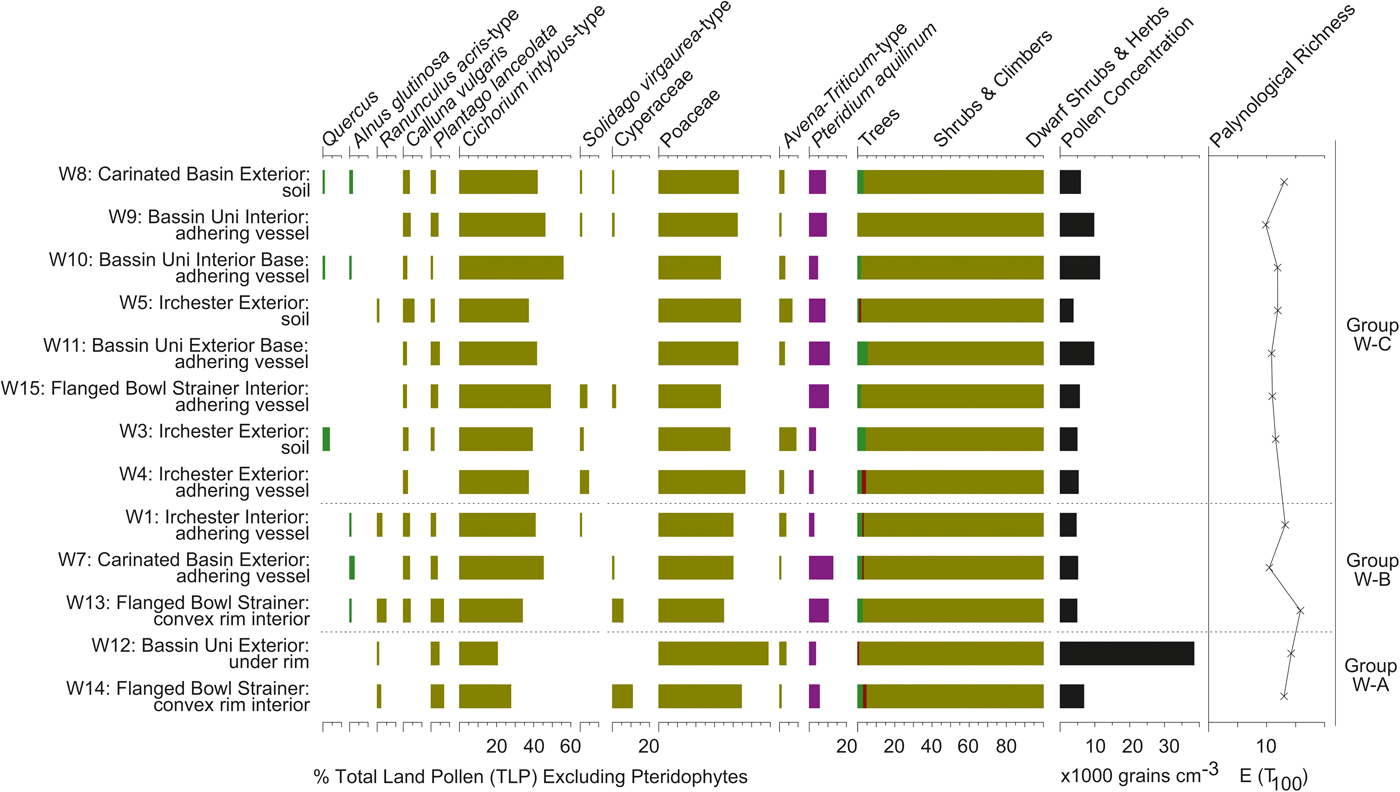
Unlike the Pewsey hoard, the Wilcot vessel hoard was in a fragile state with the bases of most vessels (except the strainer) broken, which had allowed the overlying soils to penetrate the interior of the hoard. No visible plant macrofossil remains survived. Nonetheless, a pollen assessment of both the interior and exterior surfaces of the hoard was undertaken to establish whether any palaeoenvironmental signal could be recovered. Fifteen samples were examined from the four vessels, with the majority containing a pollen assemblage dominated by Cichorium intybus-type (chicory type, including dandelion) and Poaceae (grasses), a consistent presence of Calluna vulgaris (heather) and Pteridium aquilinum (bracken), and Avena-Triticum-type (oat-wheat) also well represented in most samples (fig. 9). These samples show some strong similarities to the Pewsey hoard pollen group P-C (macrofossil group 3) samples. Unfortunately, at the time of recovery of the Wilcot hoard no surface sediment samples were taken by the finders that could have been used to establish the modern pollen signal at the site. This could have determined whether the sediment sampled from the hoard itself is a recent addition (and therefore breakage of the vessels bases was also recent).
Summary pollen diagram (selected taxa) of samples obtained from the Wilcot hoard.

Even though the Wilcot hoard pollen samples are dominated by locally derived pollen present within the soil, there still remains a secondary pollen signal that may relate to the pre-depositional environment. Statistically the two most distinctive samples (group W-A) are those from under the external rim of the Bassin Uni (sample W12) and from within the interior of the external surface of the strainer (sample W14). The main distinguishing features are the absence of Calluna vulgaris pollen, higher Poaceae and lower Cichorium intybus-type, along with a significantly higher pollen concentration in sample W12. Samples from the strainer (W13–15) also contained a higher abundance of Cyperaceae pollen. This could be derived from the local vegetation indicative of damp or wet areas or from contact with the strainer during use, from liquids passing over it (either straining or washing), or could relate to packing material. Alternatively, Cyperaceae pollen could derive from a domestic context such as sedges used as flooring or roofing.
VESSEL HOARDS IN CONTEXT
Radiocarbon dating allows us to locate the deposition of the Pewsey hoard in the fourth or early fifth century, and artefactual evidence indicates that the Wilcot hoard was deposited in the same period. The phenomenon of widespread hoarding in the fourth and fifth centuries in Britain is unusual, as hoarding in the wider Roman Empire beyond Britain is uncommon at this time.Footnote 54 Considerable resources have been invested in understanding the reasons for this pattern in recent decades, particularly since the advent of the PAS and the Coin Hoards of Roman Britain series.Footnote 55 Hoarding has previously been interpreted as a result of the apparently especially rapid ending of Roman imperial authority in Britain.Footnote 56 KennettFootnote 57 in his study of late Roman bronze hoards also suggests that the deposition of these hoards is indicative of the troubled nature of the last years of Roman Britain. Guest argues that the hoarding of late Roman metalwork perhaps belongs to the post-Roman period, which shares characteristics of the practices of ‘barbarian societies’ as hoarding is more common outside the Empire's frontiers, particularly in Scandinavia.Footnote 58 A number of recent studies have emphasised that hoarding occurs for reasons beyond traditional interpretations.Footnote 59 In general, it is important to distinguish between vessel and coin hoards, and between base and precious metal hoards.
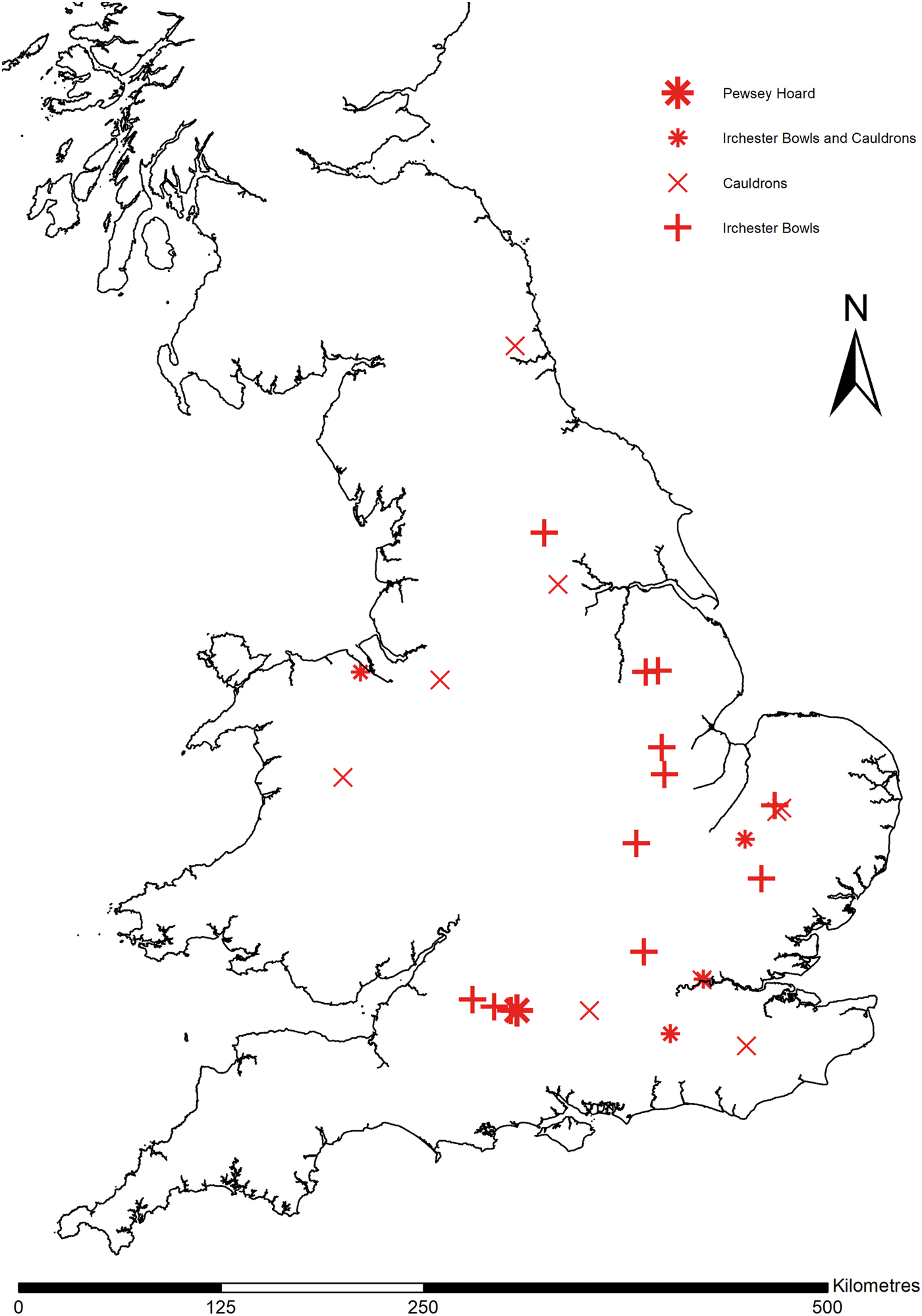
Vessel hoards form part of a wider pattern of hoarding in late Roman Britain, and several late Roman copper-alloy vessel hoards contain cauldrons and Irchester bowls.Footnote 60 Their distribution (fig. 10) appears to predominantly mirror broader distribution patterns of material wealth in Roman Britain.Footnote 61 Unfortunately, the Drapers’ Gardens hoard from London is the only example excavated using modern archaeological techniques.Footnote 62 The hoard was deposited after a.d. 375 and consists of 20 copper-alloy, lead and iron vessels, including an Irchester bowl.Footnote 63 As with the Wilcot hoard and possibly the Pewsey hoard, some of these vessels are early Roman, demonstrating that they had been curated for a long period.Footnote 64 The hoard's association with deliberately broken artefacts and a partial juvenile red deer skeleton has led to its interpretation as a votive deposit, perhaps marking the end of occupation in one particular part of Londinium.Footnote 65 The red deer was aged four or five months, perhaps suggesting that the hoard was deposited in the autumn or early winter.Footnote 66 As discussed above, the Pewsey hoard was probably deposited in late summer or early autumn of a year in the period cal a.d. 340–405 (68% probability).
Distribution of Irchester bowls and cauldrons in Britain.

The Pewsey hoard is unusual in a number of respects. The inclusion of scale pans is unparalleled in copper-alloy hoards from the fourth century. An equal arm balance and a steelyard were included in the Santon hoard of late Iron Age and early Roman objects deposited within a cauldron.Footnote 67 The inclusion of the scale pans suggests that this was not exclusively a hoard of tableware or vessels for ablution.Footnote 68 No scale arm, chains or weights are present in the Pewsey hoard, suggesting that the scale pans were selected from a wider repertoire of material culture for deposition, other elements of which were unavailable or rejected. Cauldrons are also unusual in vessel hoards from Roman Britain; LundockFootnote 69 lists only 17 cauldrons from such hoards, all of which are from late Roman structured deposits. Many such structured deposits consist of vessels nestled within one another in a similar manner to the Pewsey vessel hoard, e.g. those from Wilcot, Irchester, Amersham and Weeting.Footnote 70 Such copper-alloy hoards have recently been interpreted as votive deposits; metal vessels may have been perceived to be appropriate gifts to the gods in this period.Footnote 71
Ideas of structured deposition were first explicitly articulated by Richards and ThomasFootnote 72 and were further developed by HillFootnote 73 for Iron Age Wessex; Pollard,Footnote 74 GarrowFootnote 75 and many others for the Neolithic; and Clarke,Footnote 76 Fulford,Footnote 77 Woodward and Woodward,Footnote 78 and HingleyFootnote 79 (amongst many others) for the Roman period. There has sometimes been an elision of the concepts of ‘structured’ and ‘ritual’ deposition in work that has attempted to follow these studies,Footnote 80 with the extent to which a deposit is made in a formalised or spatially organised manner, or contains unusual (or unusually altered) artefacts or ecofacts used to suggest a range of ritual associations.Footnote 81 Diverse and interwoven motivations are cited for the creation of such deposits, from apotropaic or chthonic practicesFootnote 82 to symbolising a transition in the terms of interaction between a community and place. ChadwickFootnote 83 highlights that the dichotomy between structured/ritual and unstructured/ordinary is false, and that the depositional practices that are often interpreted as ‘ritual’ and ‘structured’ are only part of the spectrum of practice deriving from wider habitus and cosmologies. Whilst some acts of deposition were part of formalised, perhaps even mysticised, acts, these represent points on a continuum stretching from defixiones Footnote 84 and large-scale animal sacrificeFootnote 85 to the shifting of middensFootnote 86 and disposal of domestic waste.Footnote 87 It is thus not useful to consider the structured nature of the deposition of these hoards as evidence for ritual in a general sense, or as an interpretation in itself.Footnote 88 Instead, the character of the deposits and social contexts of deposition should be examined to locate this particular act within local and regional practice.
The Pewsey vessel hoard clearly demonstrates a degree of formality and care in its packing and deposition. The interior of vessel B, which contained four scale pans, was packed with bracken, a widely used packing material in more recent times,Footnote 89 and a range of stem material and flowers that may have been gathered from local grassland or along boundaries such as woodland edges, walls or hedgerows. The placement of the vessels and the packing demonstrates care, the focus of which appears to be the scale pans. Indeed, the evidence presented above suggests that the entire configuration of the vessels and packing enfolds and protects the four scale pans; although no mineralogical preservation was present in the outer layers of the hoard, the difference in character of the plant macrofossil assemblage suggests that only the inner cavity of the hoard was packed with plant material.
The closest parallel in terms of packing comes from a set of bowls recovered from the Hoxne hoard, which were wrapped within linen cloth (identified from the fibres within textile fragments adhering to the outer vessel), while wheat (Triticum sp.) straw was used as padding between the stacked bowls.Footnote 90 The paucity of comparable examples from Roman Britain is likely due to the unusual preservation of this hoard, rather than a lack of organic packing material generally. Scale pans have not been found in other vessel hoardsFootnote 91 and represent a divergence in function from other elements of the hoard, which appear to comprise bowls associated with eating and accompanying ablutions. The paired scale pans indicate that they were from an equal balance or a dual balance used to weigh smaller quantities of goods rather than steelyards, which were used to weigh heavier goods such as grain. SmitherFootnote 92 argues that most weighing instruments were used in the more ‘Romanised’ areas of Britain, and while they occur from the first century onwards they become more common in rural areas only in the fourth century. It is suggested that equal and dual balances played an important role in metal-working and cloth-dying and were associated with trade and production.Footnote 93 Finds of individual scale pans from the Roman period are uncommon, with SmitherFootnote 94 recording only 13 examples.
Two explanations appear plausible for the presence and centrality of the scale pans in this structured deposit. Firstly, the scale pans may have been included because of their economic value alongside other copper-alloy vessels. This argument explains the combination of objects of different functions by considering them more broadly as metal artefacts valuable to the community or individual burying them. Although copper-alloy vessels are not found in hoards considered to be created primarily as repositories of economic value in the late Roman or post-Roman period (e.g. Traprain Law or the Hoxne hoardFootnote 95), this is not necessarily the case in southern Britain where coinage appears to be the principal means of deposited wealth.Footnote 96 Value is also relative; the vessels may not have belonged to a particularly wealthy and powerful group or individual and could have been the most valuable possessions of a farming community, while value may also be imbued through use, ownership or gift. This argument does not, however, fully explain either the careful configuration of the vessels overall, or the care taken to pack the scale pans in particular.
Secondly, it may be that the symbolic or social associations of the scale pans led to their careful packaging. The four scale pans appear to be pairs and would represent two sets of equal or dual balance scales. It is suggested that these scales played an important role in manufacture and are less common on rural sites.Footnote 97 It is likely that the scale pans had associations with weighing and measuring, particularly small or valuable objects where a higher degree of precision was essential, although their burial without the other components of the scales suggests an element of symbolic inclusion in the burial assemblage, rather than a direct practical reference.
The hoard was probably buried in late summer, around the time of the arable harvest, or just after, possibly in an arable field. The timing of deposition may have been significant: the late weeks of summer would have seen intensive activity in processing crops and preparing grain for storage.Footnote 98 Late summer was a key period for agricultural communities in the ancient world, and one celebrated in Roman Italy and beyond with festivals in late August.Footnote 99 Taken together, the material associations of the two hoards’ constituent artefacts, their context and the seasonality of deposition suggest that these acts of deposition may have been apotropaic rituals, aimed to engender continuing fertility, particularly at a time of increasing social instability, through the deposition of items of symbolic and cultural value associated with weighing and dining.Footnote 100
REGIONAL CONTEXT
To understand the context in which the Pewsey and Wilcot hoards were deposited, we must consider their social and landscape context in the late Roman period. At this time the Vale of Pewsey was a mixed agricultural and industrial landscape, possibly with wetlands in its lowest lying areas. Late Roman Wiltshire was a productive and wealthy agricultural landscape, able to produce considerable quantities of grain for export to the ContinentFootnote 101 alongside other goods traded in the region.Footnote 102 Two Roman kilns excavated in the nineteenth century within a short distance of the Pewsey hoardFootnote 103 are associated with the production of early Roman Savernake ware, similar to the kilns from Orme, further north-west of the hoard.Footnote 104 SwanFootnote 105 also suggests that a Romano-British settlement of second- to fourth-century date was associated with the kiln site, but no other reference to this has been found. Two possible villas at Sunnyhill Farm and Milton Lilbourne lie short distances to the west and south-east of the Pewsey hoard respectively, although their identifications as villas rest on limited evidence of structural material and box-flue tiles respectively.Footnote 106 A more securely identified villa lies further west, at Stanchester,Footnote 107 north-west of Wilcot, across a stream from the location where the Wilcot hoard was deposited; and a second rural settlement with masonry buildings has been excavated c. 1 km to the north-east.Footnote 108 Further Roman settlements have been identified on the southern escarpment of the Marlborough Downs,Footnote 109 and in the valley base further to the west.Footnote 110 DraperFootnote 111 demonstrates that several such agricultural settlements across Wiltshire were occupied until the very end of the fourth century, and probably into the fifth.
In general, secure late Roman and post-Roman evidence in much of Wiltshire is limited. Late Roman coinage is the largest dataset available for the end of the Roman period and its distribution provides a proxy for economic and social activities. To this end, a synthesis of all late Roman coins and coin hoards from Wiltshire has been undertaken using PAS data, including data from the ‘Hoarding in Iron Age and Roman Britain’ project,Footnote 112 itself incorporating data from Robertson.Footnote 113 These numismatic data were analysed using Reece's ABCD analysis, rather than the finer grained Reece period analysis,Footnote 114 allowing a broader view of coin use and length of circulation.Footnote 115 Despite this, the broader brush ABCD analysis is also flawed when analysing trends in the fourth century, as Reece's period D (a.d. 330–402) combines the Valentinianic period with the periods before and after; in Wiltshire and surrounding counties Valentinianic period coins are found in far greater quantities than the national average.Footnote 116 Reece's period D has therefore been split into D (a.d. 330–364, pre-Valentinianic) and E (a.d. 364–402, Valentinianic and later).Footnote 117
This regional Valentinianic peak may highlight an increase in rural activity possibly associated with the increased export of grain to the Continent beginning in the reign of Julian the Apostate (a.d. 355–363)Footnote 118 and the presence of state operatives in the region.Footnote 119 Copper-alloy Valentinianic issues often show significant levels of wearFootnote 120 and have been found in hoards such as Bishops Cannings, which was deposited after a.d. 402.Footnote 121 This suggests that at least some Valentinianic coins remained in circulation and served a monetary purpose along with later Theodosian bronze issues circulating in large quantities as part of a tri-metallic currency system which was in use into the early fifth century.Footnote 122
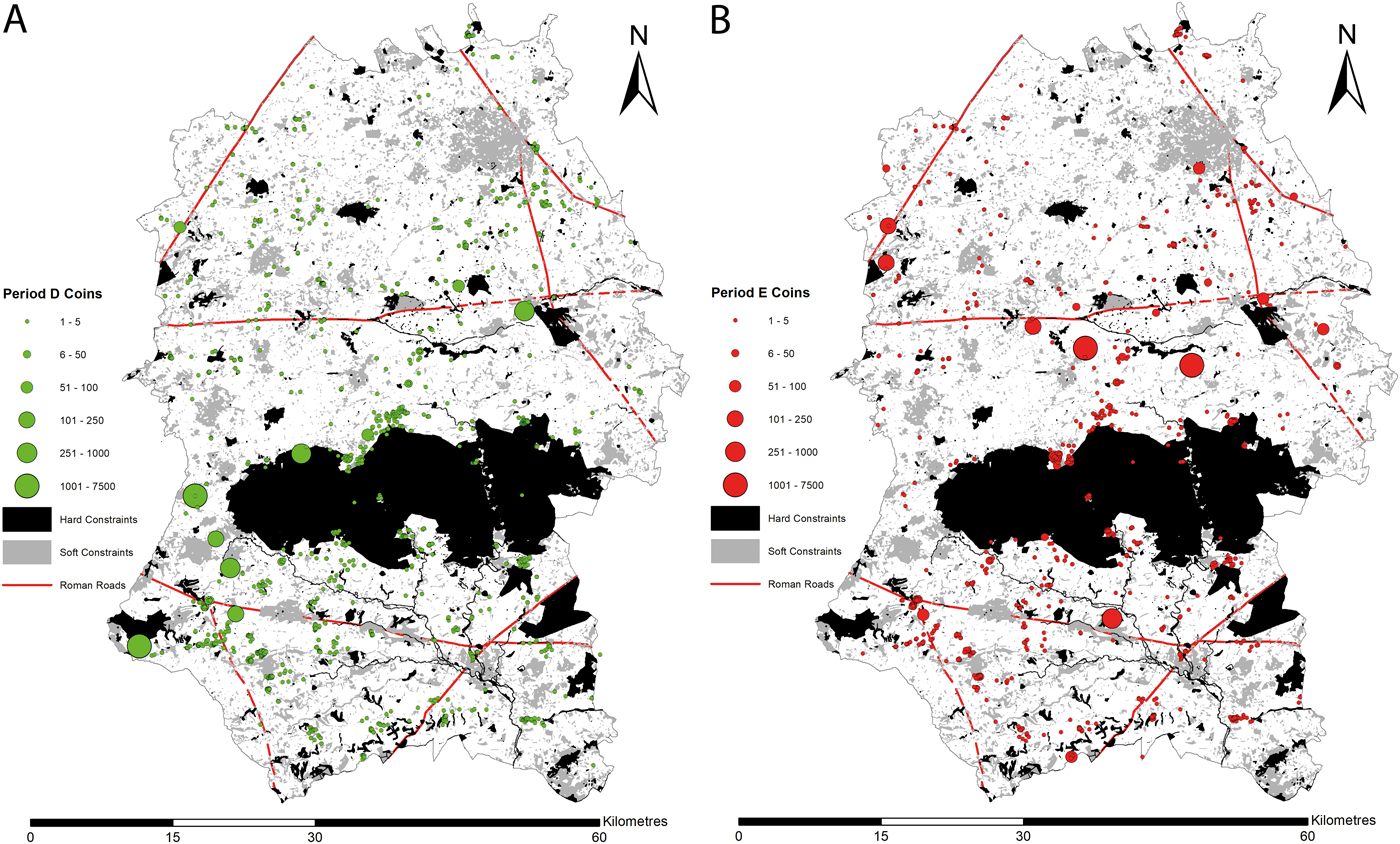
The PAS numismatic dataset from Wiltshire for Period D consists of 14 coin hoards and 4,935 stray finds, with 28 coin hoards and 3,863 stray finds for Period E. BrindleFootnote 123 has set out the biases in the PAS dataset for Wiltshire, developing the pioneering work of Robbins.Footnote 124 HenryFootnote 125 has mapped ‘hard’ constraints (where metal-detecting is banned) and ‘soft’ constraints (where metal-detecting is unlikely) on metal-detecting in Wiltshire, and these are shown alongside coin distributions here to provide context for areas that would otherwise appear as indicating an absence of evidence. The major biases of distribution include large Ministry of Defence and National Trust landholdings, where metal-detecting is prohibited, and the urban sprawl of Swindon, which prevents detecting in much of the north-east of the county.
The distributions for north and south Wiltshire — Salisbury Plain forms the division — show that proportionally more coins are found in Period E than Period D in north Wiltshire (fig. 11). The distribution of finds in these periods reinforces this pattern, with a significant shift in Period E in the distribution of large coin hoards and coin finds in general towards the central part of north Wiltshire, primarily the Vale of Pewsey and the hinterlands of Cunetio, Verlucio and Wanborough to the north of the Vale (fig. 12).
Reece ABCDE diagram of coin finds from north and south Wiltshire.

Distribution of Period D (A) and Period E (B) coins in Wiltshire.

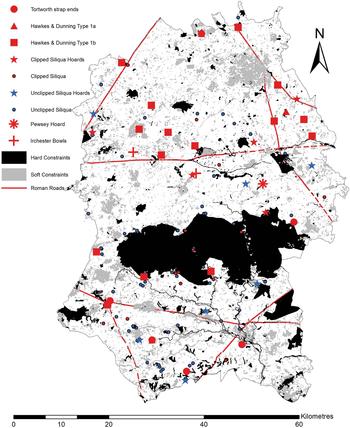
This shift is further emphasised by the distribution of late Roman belt fittings, which cluster quite strongly in the same region as Period E coins, and by the contrast between the distributions of clipped and unclipped silver siliquae (fig. 13). Belt fittings are a key artefact group associated with late Roman military groupsFootnote 126 and as such likely to be associated with late Roman — including Theodosian — activity at Cunetio and possibly Verlucio.Footnote 127 After a.d. 364 there is a sharp increase in the supply of gold and silver coinage that correlates with the increase in siliquae recorded as stray finds in Britain.Footnote 128 The clipping of siliquae is generally accepted to have become widespread at the beginning of the fifth century and to have continued until at least a.d. 420, and possibly even to the middle of the fifth century;Footnote 129 it thus coincides with the latest part of the possible date range for both vessel hoards. KingFootnote 130 suggests that clipping is a post-Roman phenomenon undertaken by the British, because clipping is common in areas of the South-West, where there is no evidence of Saxon settlement in the earlier fifth century.Footnote 131 MoorheadFootnote 132 notes that regions with less Anglo-Saxon contact could provide a setting for the continued use of bronze coinage and clipped coins are likely to have circulated with bronze issues.Footnote 133 Clipping thus provides an indication of coin use in the decades after the end of Roman Britain.Footnote 134 Twenty-one hoards have been recorded from Wiltshire which have termini post quem of a.d. 378 or later, including heavily clipped examples, such as a hoard from Everleigh near Pewsey.Footnote 135 A small number of unclipped hoards from the county also have very late termini post quem, including the Stanchester hoard, found close to the Wilcot hoard, which included three solidi of Honorius dating to a.d. 405–406.Footnote 136
Distribution of hoards containing siliquae with no clipping, hoards containing siliquae including clipped coins, clipped and unclipped siliquae stray finds, Hawkes and Dunning belt fittings, Tortworth strap ends, Irchester bowls and the Pewsey hoard.

The concentration of clipping in central-north Wiltshire is thus likely to demonstrate the continued use of Roman coinage with the implication of a monetary economy into the early post-Roman period, i.e. the latter part of the possible date range of these vessel hoards. Given the lack of clipping in southern Wiltshire, despite considerable quantities of siliquae in circulation, the clipping in central-north Wiltshire requires explanation. For clipping to occur, siliquae (along with nummi) must surely still have played an important role as currency or in exchange.Footnote 137 Clipped siliquae and nummi minted after a.d. 408 from the parish of Box in Wiltshire suggest the presence of, or at least contact with, late Roman officialdom amongst sections of post-Roman society.Footnote 138 The evidence for a continuing monetary use for siliquae, possible contact with late Roman officialdom and the concentration of very late Roman belt fittings suggest that this area of central Wiltshire may have seen continuity of control into the immediate post-Roman period by late Roman military groups based on the fortified towns of Cunetio and Verlucio.Footnote 139
A HOLISTIC VIEW OF THE PEWSEY AND WILCOT VESSEL HOARDS
The Pewsey and Wilcot hoards provide insights into the late fourth and early fifth centuries in the Vale of Pewsey, on the cusp of major changes to landscape and society. The unusual configuration of the Pewsey hoard and the survival of organic remains demonstrate that considerable care was taken to protect the scale pans at the centre of the hoard; although preservation conditions were not so beneficial for the Wilcot hoard, the nestled pans hint that similar care was taken in deposition. The collection of Romano-British vessels and scale pans and their symbolic associations with Romano-British ways of eating, ablution and weighing, their deposition in an apparently apotropaic act echoing long-held traditions in Iron Age and Romano-British rural life and the presence of spelt wheat, all attest to an enmeshment of lifeways with long-term roots in the locality.
The hoards were deposited at a time and in a place where social and economic circumstances were beginning to change significantly; but these were not impulsive acts in order to protect material wealth from raiders. Instead, their deposition may illustrate the continuing importance of ensuring a good harvest, even in unstable times. It is also possible that the chronological and symbolic transition of the harvest provided a stimulus for this deposition in a wider sense. The community or individual depositing these vessels were entering a period of social, economic and political upheaval, but as the regional evidence for coinage shows, in some respects the Vale of Pewsey saw significant continuity in the later fourth and early fifth centuries in comparison to southern Wiltshire and beyond. Society in the west of Britain changed differently in the late fourth and fifth century a.d. to that in eastern Britain,Footnote 140 but still saw major changes such as the collapse of the monetary economy,Footnote 141 a reduction in agricultural output,Footnote 142 the abandonment of villas, many of which had already seen changes from luxury accommodation to industrial activity,Footnote 143 and the advent of new styles of material culture, ways of burial and settlement.Footnote 144 This wider transition may have altered attitudes to the vessels in the hoard, perhaps making them more appropriate for deposition than they had been in previous years. The knowledge and attachment to Romano-British practices discussed above may also have extended to the realisation of their passing. Of course, this is speculation, but there must have been a powerful combination of factors behind the deposition of such vessels, given the rarity of such hoards.
The circumstances of the retrieval of these hoards were not ideal, but their reporting to the PAS and the retention of sediment and plant material from these hoards by their finders have allowed a series of rare insights into hoarding in late Roman Wiltshire and beyond. Without the PAS and the relationships it has built with metal-detectorists, all of this information would have been lost. This case study also demonstrates the importance of engagement with environmental and scientific dating specialists when hoards are discovered, even if finds have not been archaeologically excavated, and the importance of not cleaning such artefacts prior to this advice being sought. Every effort must be made to undertake similar work on other late and potentially post-Roman material, to allow more nuanced narratives of this period of upheaval and change across England.
ACKNOWLEDGEMENTS
The analysis of the Pewsey hoard is a collaboration between the Portable Antiquties Scheme, COARS (University of Southampton), Historic England and the Wiltshire Museum, Devizes. The radiocarbon dates were funded by Historic England. Thank you to Nick Griffiths for his assistance with the illustrations and Steve Baker for assistance with the photography. Thanks to Dr Derek Pitman, Dr James Gerrard, Dr Bruce Eagles, Nick Griffiths and Mark Corney for their assistance with the article. The macrofossil analysis was undertaken by Dr Ruth Pelling, Senior Archaeobotanist at Historic England. Funding for the pollen analysis for both the Pewsey and Wilcot hoards undertaken by Dr Michael Grant came from a Community Outreach Grant provided by COARS. The Association for Roman Archaeology funded the illustrations for the Pewsey hoard by Nick Griffiths and the conservation of the organic materials. The Roman Finds Group funded the illustrations of the Wilcot hoard by Nick Griffiths. Wiltshire Museum funded the analysis of the ceramic material from the excavation of the Pewsey hoard. The excavation of the findspot was directed by Dr David Roberts (Historic England) with the assistance of the Assistant County Archaeologist, the Wiltshire Archaeology Field Group and the finders. Artefactual analysis from the excavation and post-excavation management were conducted by Rebecca Venn of the PASt Landscapes Project. Richard Henry led the development of the research presented in this paper, and undertook arefactual analysis. David Roberts contributed extensively to the discussions of regional context and landscape, including creating distribution maps and 14CHRONO Centre, Queen's University Belfast undertook the radiocarbon dating. Neither hoard meets the criteria of the Treasure Act 1996 and therefore thanks should be given to the finders who after their initial discovery reported the find. The finders of the Pewsey hoard generously donated the organic material from the hoard to Wiltshire Museum to allow detailed further research (DZSWS:2016.15).