

Introduction
In addition to their symptoms, people whose lives have been affected by mental disorders must cope with the stigma that surrounds these disorders. Stigmatising attitudes may have a number of adverse effects. These can include delays in seeking help, psychological distress, difficulties with personal relationships and the ability to achieve educational and vocational goals (Wells etal. Reference Wells, Robins, Bushnell, Jarosz and Oakley-Browne1994; Link etal. Reference Link, Struening, Rahav, Phelan and Nuttbrock1997).
Stigma has been conceptualised as comprising three constructs: knowledge (ignorance), attitudes (prejudice) and behaviour (discrimination) (Thornicroft etal. Reference Thornicroft, Rose, Kassam and Sartorius2007).
At the individual level, people with mental health problems are affected by both public stigma and self-stigma. Self-stigma, a process in which a person with a mental illness applies and internalises stigmatising attitudes and beliefs held by the public, is linked to lower self-efficacy (Link etal. Reference Link, Struening, Neese-Todd, Asmussen and Phelan2001; Corrigan etal. Reference Corrigan, Watson and Barr2006), worse functioning (Alonso etal. Reference Alonso, Buron, Rojas-Farreras, de Graaf, Haro, de Girolamo, Bruffaerts, Kovess, Matschinger and Vilagut2009), less treatment seeking (Conner etal. Reference Conner, Copeland, Grote, Koeske, Rosen, Reynolds and Brown2010) and higher rates of hospitalisations (Rusch etal. Reference Rusch, Corrigan, Wassel, Michaels, Larson, Olschewski, Wilkniss and Batia2009).
In a European study linking two large international data sets to explore the association between public stigma in 14 European countries (Eurobarometer survey) and individual reports of self-stigma, perceived discrimination and empowerment among persons with mental illness (n = 1835) residing in those countries [the Global Alliance of Mental Illness Advocacy Networks (GAMIAN) study], individuals with mental illness living in countries with less stigmatising attitudes, higher rates of help seeking and treatment utilisation and better perceived access to information had lower rates of self-stigma and perceived discrimination. Those living in countries where the public felt more comfortable talking to people with mental illness had less self-stigma and felt more empowered (Evans-Lacko etal. Reference Evans-Lacko, Brohan, Mojtabai and Thornicroft2011).
In Ireland, efforts to improve mental health knowledge and attitudes have been increasing over time, in the form of media education campaigns and through the Social, Personal and Health Education (SPHE) curriculum in the junior cycle, although the level of exposure to the latter can vary from school to school as can the emphasis on mental health within it.
Less knowledge exists in the literature regarding the attitudes of adolescents towards mental illness when compared with the older age groups; a recent study (Economou etal. Reference Economou, Louki, Peppou, Gramandani, Yotis and Stefanis2012) evaluated 616 high school students before and after an anti-stigma intervention with regard to schizophrenia and found improvements in the areas of beliefs, attitudes and social distance, although the latter was not maintained 12 months post intervention. The authors therefore suggested that anti-stigma interventions be implemented throughout the school years.
Another study examined 40 educational interventions and found the three core components of stigma – knowledge, attitudes and behaviour – to be improved in the majority, particularly in the interventions involving direct patient contact (Yamaguchi etal. Reference Yamaguchi, Mino and Uddin2011).
This paper examines the effect of a week-long placement for two separate groups of transition year students in St. Patrick's Hospital on knowledge and attitudes towards mental health before commencement and immediately following the sessions.
Method
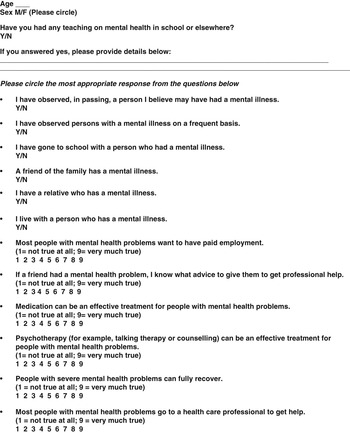
Two groups (comprising 12 students per group) were given talks on mental health in 2012 from psychiatry, psychology, nursing, social work and occupational therapy, covering many aspects of mental health including case studies, specific disorders and treatments. A questionnaire was formulated as an adaptation of the Mental Health Knowledge Schedule (Evans-Lacko etal. Reference Evans-Lacko, Little, Meltzer, Rose, Rhydderch, Henderson and Thornicroft2010) and the Level of Contact Report (Holmes etal. Reference Holmes, Corrigan, Williams, Canar and Kubiak1999), the latter having been designed in research examining the effect of an educational programme on societal attitudes to mental illness (see Appendix, Fig. A1).
A number of different measures and rating scales examining attitudes to and knowledge of mental health were evaluated, with the items used in this amalgamation of measures deemed by the authors to be the most relevant to the study in terms of what it set out to learn about young peoples’ views and the improvements in knowledge and attitudes, which were the aims of the placement. In all, there were 16 girls and eight boys in the groups, ranging in age from 15 to 16 years. All 24 students completed the baseline questionnaire, with 21 students completing it post intervention.
Data were analysed using the Student's t-test for paired samples, and p < 0.05 was considered statistically significant. Data collected were entered into an MS-Excel worksheet and SPSS software was used for analysis. Data from three questionnaires were excluded because of missing information.
The participating students were from transition years from schools throughout Ireland. The hospital obtained a database from the national transition year coordinator of all the schools in Ireland who provided a transition year for their students. Being aware of the difficulties schools have in providing work experience for their students, and as part of the hospital ethos of promoting mental health awareness and breaking down stigma, letters were sent to the schools’ transition year coordinators offering week-long placements for two students in each school. The morning sessions would involve work experience in the different departments within the hospital for pairs of students, and then the entire group would have teaching sessions on mental health from members of the Adolescent Inpatient Unit Team in a classroom off the unit. The placements were initially piloted in late 2010/early 2011, and because of very positive feedback from schools they continue to run four times per year.
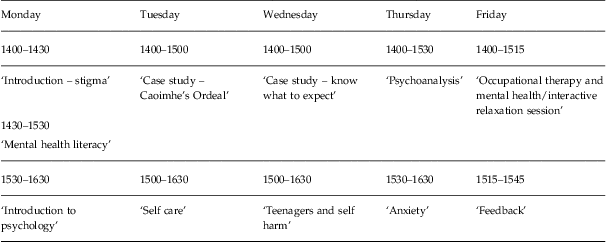
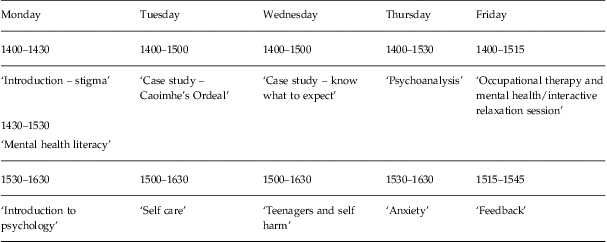
Information about the study was given to the parents and the students. As they were all under 18, written consent was obtained from their parents before participation in the study. Assent was obtained from the students. The timetable of the input the students received during their placement is presented in Table 1.
Mental health component of student placement
Results
Only five of the 24 students (21%) had received some form of mental health teaching in school or elsewhere, although one student named the source of the teaching as being a relative rather than through school.
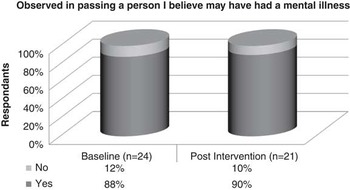
Twenty-one out of 24 (88%) believed they had observed in passing someone who they believed may have had a mental illness before the placement, with 19 out of 21 (90%) believing so following the placement. Two of those who responded no changed their answer to yes after the placement (see Fig. 1).
Response to the question ‘I have observed in passing a person I believe may have had a mental illness’.

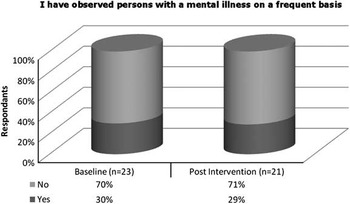
By contrast, only seven out of 23 (30%) said they had observed persons with a mental illness on a frequent basis. Post intervention, this number was six out of 21 (29%), although seven students had changed their responses from baseline (see Fig. 2).
Response to the question ‘I have observed persons with a mental illness on a frequent basis’.

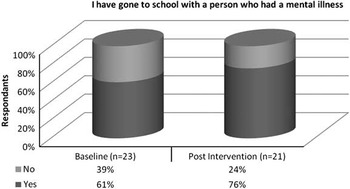
Fourteen out of 23 students (61%) reported that they had gone to school with a person who had a mental illness at baseline, and this number changed to 16 out of 21 (76%) post intervention, with four students changing their responses from no to yes (see Fig. 3).
Response to the question ‘I have gone to school with a person who has a mental illness’.

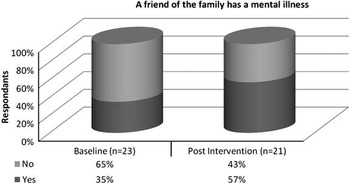
Eight out of 23 (35%) stated that a friend of the family had a mental illness, increasing to 12 out of 21 (57%) post intervention, with six students having changed their responses from no to yes (see Fig. 4).
Response to the question ‘A friend of the family has a mental illness’.

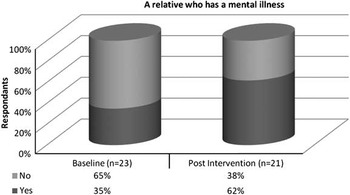
Eight out of 23 (35%) at baseline had a relative who had a mental illness, increasing to 13 out of 21 (62%), with seven respondents changing from no to yes (see Fig. 5).
Response to the question ‘I have a relative who has a mental illness’.

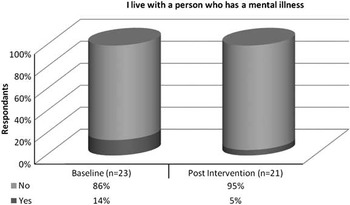
In contrast, only three out of 22 (14%) described living with someone with a mental illness, and only one out of 21 (5%) post intervention, with two respondents changing their answer from yes to no (see Fig. 6).
Response to the question ‘I live with a person who has a mental illness’.

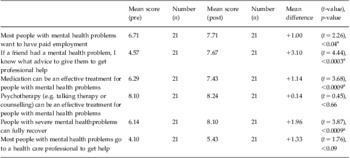
Most of the sample strongly felt that people with mental illness wanted to have paid employment at baseline (mean score of 6.71 on a scale of 0–9), rising to 7.71 post intervention, p < 0.04.
The sample initially scored in the mid-range in relation to knowing what advice to give a friend with a mental health problem, but this became much more strongly positive post teaching (mean 4.57 v. 7.67, p < 0.0003).
The sample felt that medication can be quite effective in treating mental health problems, and felt even more strongly in favour of this response following the week (mean 6.29 v. 7.43, p < 0.0009).
The sample was strongly in favour of psychotherapy as being an effective treatment before the placement, and this increased marginally at the end of the week, although the difference was not statistically significant (mean 8.10 v. 8.24, p < 0.66).
At the beginning of the week, the students felt moderately confident that people with severe mental illness can fully recover, and they became very confident at the end of the week (mean 6.14 v. 8.10, p < 0.0009).
The view that most people with mental health problems go to a health professional to get help was felt to be only somewhat true, and this improved only marginally post intervention, but not at the level of statistical significance (mean 4.10 v. 5.43, p < 0.09) (see Table 2).
Responses to questions 7–12 at baseline and following intervention

n–1 Degrees of freedom.
aStatistically significant.
Discussion
A survey of 93 15–18-year-olds in a secondary school in the south-east of Ireland demonstrated that 40% felt they should have more information and education on mental health (Brennan & McGilloway, Reference Brennan and McGilloway2012). The SPHE curriculum does not extend beyond the junior cycle; these views may indicate that more emphasis needs to be placed on mental health within its teaching, or that it should be extended into the senior cycle, particularly as only 21% of students stated that they had had any mental health teaching before the week-long placement and yet the sample reported a lot of exposure to mental illness. Two Irish studies indicated that approximately one-fifth of adolescents have at least one psychological disorder or are at risk of developing mental health disorders at any given time (Lynch etal. Reference Lynch, Mills, Daly and Fitzpatrick2005; Martin etal. Reference Martin, Carr, Burke, Carroll and Byrne2006). A very large study exploring adolescent and young adult mental health in Ireland was published this year (Dooley & Fitzgerald, Reference Dooley and Fitzgerald2012).
In this study, 76% of respondents had gone to school with someone who had a mental illness, 90% felt they had seen a person in passing with a mental illness, 57% stated a friend of the family had a mental illness and 62% had a relative who was mentally ill.
Interestingly, in reference to the above four questions, four, two, five and six students, respectively, changed their baseline answers from no to yes, which may suggest that the knowledge gained during the week helped them decide better what constitutes a mental illness. However, in the case of seeing someone in passing who had a mental illness, this figure may have referred to seeing people who they thought were patients in the hospital grounds rather than a change in interpretation of previous experiences.
Only 5% of the sample post intervention described living at home with a person with a mental illness; two of the students changed their responses from baseline from yes to no, which may reflect misperceptions they may have had of the interactions with family members, and the reasons for certain actions or behaviours (see Figs 1–6 for graphical representations of the above).
Their attitudes to individuals with mental illness as regards employment, treatment, assistance and recovery were encouraging, even at baseline, and all their responses improved following the sessions. Positive responses were given regarding effectiveness of medication, psychotherapy, willingness to work and potential for recovery.
The least confidence was expressed regarding the likelihood of individuals with mental health problems seeking professional help, although a small increase was noted from baseline to post intervention. This may be due to the effect of societal stigma on the behaviour of individuals as described in the European study (Evans-Lacko etal. Reference Evans-Lacko, Little, Meltzer, Rose, Rhydderch, Henderson and Thornicroft2010).
Limitations
Although the information gathered from this study suggests some cause for optimism regarding the views of young people in relation to mental illness and the effect of a week of input by health professionals, the low numbers in the study make generalisation of the findings difficult.
There is also the possibility of responder bias, as the students at the beginning of the week may have been eager to give the researchers a positive impression regarding their views.
Conclusions
Stigma remains a significant problem in society, particularly towards mental illness, although health promotion and educational interventions can continue to play an important role going forward, with the adolescent age group being ideal with all its emphasis on identity formation and development of strong opinions. If 79% of school-going young people have not received mental health input by transition year (as is the case in this sample), despite 20% suffering from psychological problems at any given time, then the need to urgently address this in the school curriculum is clear, particularly with Insel and Fenton describing mental illnesses as being the chronic diseases of the young (Insel & Fenton, Reference Insel and Fenton2005). Ongoing efforts are required on the part of health and education to make mental health education a priority. Greater mental health knowledge and improved attitudes can lead to better treatment access, helping to prevent chronic mental health problems into the future.
Acknowledgements
The authors are most grateful for the help of Yvonne Buggy and Margaret Nichol for their assistance with statistics and graphs.
Conflict of Interest
None.
Appendix
Knowledge and attitudes questionnaire.