Non-technical Summary
C.A. Taboada and collaborators analyzed the bryozoan fauna from several rock samples of Carboniferous age in central-western Patagonia. This region was situated in higher latitudes and colder conditions in the context of the Late Paleozoic Ice Age (LPIA). The authors described and figured 12 species of fenestrate bryozoans. Furthermore, faunal affinities were found to other regions of the world, revealing three fenestrate species in common with eastern Australia and one in common with central-western Argentina during the LPIA. Despite its affinities, the bryozoan fauna of central-western Patagonia demonstrates a high level of endemism within species that suggests some degree of biogeographical isolation during the Carboniferous. Moreover, the authors used colony growth habits and autoecology of bryozoans and associated fauna, supplemented with available sedimentological data, to interpret some ancient paleoenvironmental conditions such as turbidity, relative water depth, and sedimentation rate, among others.
Introduction
Carboniferous bryozoan records come mainly from carbonate or mixed carbonate–siliciclastic settings situated in low to middle paleolatitudes, tropical to subtropical regions (among others, Bambach, Reference Bambach, McKerrow and Scotese1990; Ross and Ross, Reference Ross, Ross, MacKerrow and Scotese1990). Boreal records are absent, whereas austral ones come mainly from siliciclastic outcrops from eastern and western regions of southern Gondwana (Crockford, Reference Crockford1949; Engel, Reference Engel1975, Reference Engel1979; Sabattini, Reference Sabattini1986, Reference Sabattini2002; Kelly et al., Reference Kelly, Doubleday, Brunton, Dickins, Sevastopulo and Taylor2001 and references therein). In this sense, the study of high-latitude records has taken on some importance for providing new data about the diversity and distribution of Carboniferous bryozoans.
Late Paleozoic bryozoans from southwestern Gondwana were first recorded from the Calingasta–Uspallata Basin in the Central Andes Precordillera of central-western (CW) Argentina (Reed, Reference Reed and Du Toit1927). Later, bryozoans were mentioned from the Tepuel–Genoa Basin (TGB) in CW Patagonia (Suero, Reference Suero1948) although systematic descriptions appeared later (Sabattini, Reference Sabattini1972, Reference Sabattini1983, Reference Sabattini1990, Reference Sabattini2002). These monographs coupled with new material collected and new field observations from key sections may provide valuable information about the biodiversity and the paleobiogeographic affinities of Patagonian bryozoans, especially their relationships with other southern Gondwana faunas during the Late Paleozoic Ice Age (LPIA).
Carboniferous bryozoans from CW Patagonia have been reported mainly from a few glacially influenced exposures from the Pampa de Tepuel Formation (PTF), the majority of them belonging to the cold-water Lanipustula patagoniensis Biozone of Simanauskas and Sabattini (Reference Simanauskas and Sabattini1997), Carboniferous, upper Serpukhovian–Moscovian in age (Sabattini, Reference Sabattini1986; Taboada and Shi, Reference Taboada and Shi2011; Taboada et al., Reference Taboada, Pagani, Pinilla, Tortello and Taboada2019, Reference Taboada, Pagani, Pinilla, Taboada, Robles Vilches, Pardo and Giacosa2022). During this period, the TGB was situated approximately up to 70°S in the cold climatic belt (Ramos, Reference Ramos2008; Taboada and Shi, Reference Taboada and Shi2011; Renda et al., Reference Renda, Alvarez, Prezzi, Oriolo and Vizán2019). The presence of fenestrates with subordinate cystoporates and rhabdomesines characterizes the Carboniferous bryozoan fauna from CW Patagonia, whereas trepostomes have not yet been reported (Sabattini, Reference Sabattini1986, Reference Sabattini2002; Pagani and Taboada, Reference Pagani and Taboada2010; Taboada, Reference Taboada2018).
The aims of this paper are to report new records of the bryozoan fauna from the PTF at the type section in Sierra de Tepuel, provide a detailed taxonomic analysis of this fauna, and interpret the taxonomic status of previously recorded bryozoans according to modern taxonomy, as well as their environmental and paleobiogeographical affinities. Thus, we add new data to the general knowledge of the Carboniferous bryozoans from southern South America during the LPIA.
Geological setting
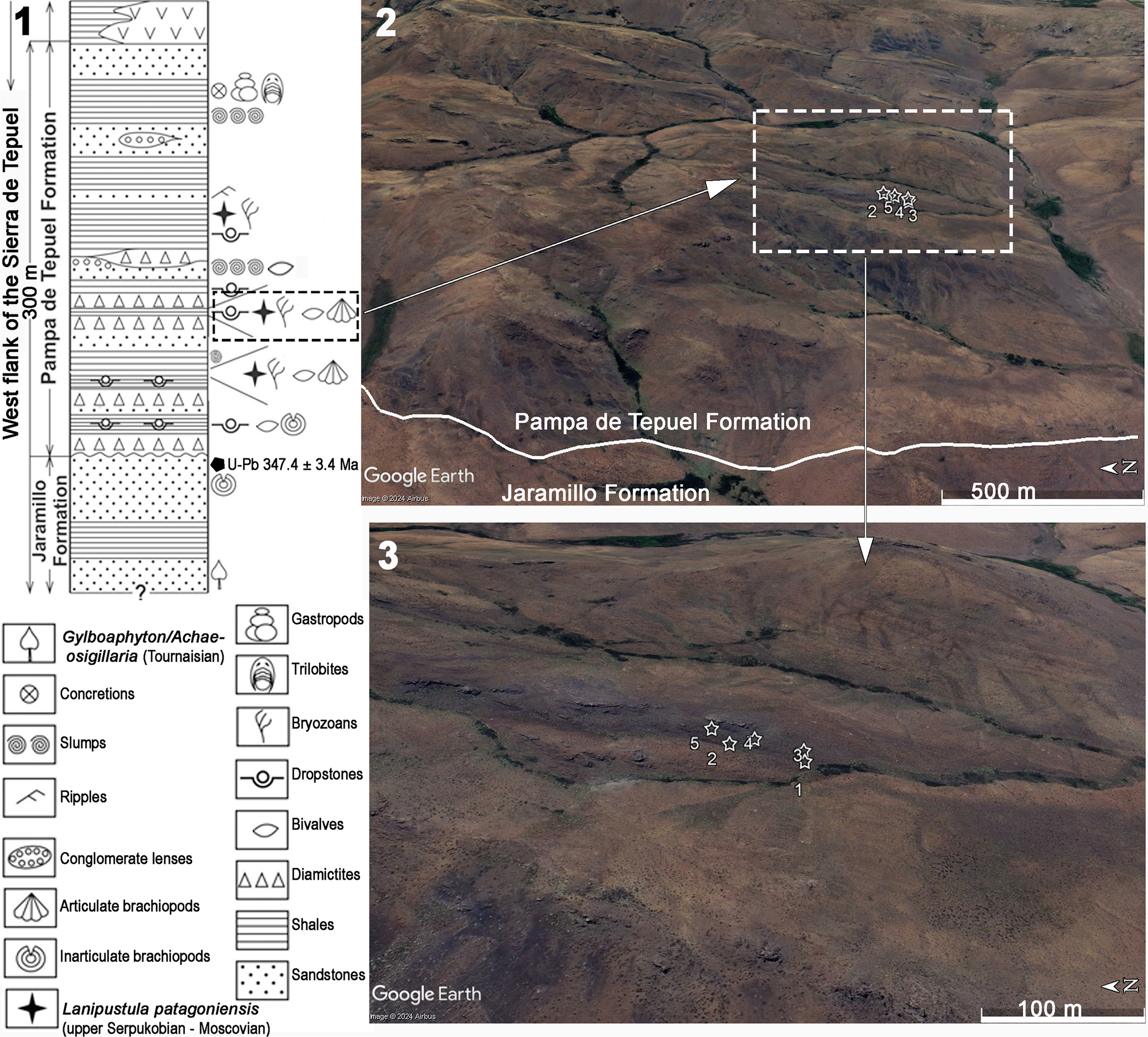
The studied area belongs to the type section of the Tepuel Group at Sierra de Tepuel (Fig. 1), located 22 km southeast (135°) from Tecka town and 19 km south of the National Route 25 (42°40’12"S, 69°49’60"W), Chubut Province, CW Patagonia, Argentina. This stratigraphic type section consists of three consecutive litho-stratigraphic units reaching a thickness of approximately 5 km ranging from Mississippian (Tournaisian) to Permian Cisuralian (Sakmarian) (Suero, Reference Suero1948, Reference Suero1953; Page et al., Reference Page, Limarino, López Gamundi and Page1984). The sequence begins with the mostly sandstone Carboniferous Mississippian (Tournaisian–lower Viséan) Jaramillo Formation. U–Pb detrital zircon dating of the sandstones at the top of the Jaramillo Formation provides a maximum sedimentation age of ca. 347.4 ± 3.4 Ma (Mississippian, upper Tournaisian–lower Viséan) (Uriz et al., Reference Uriz, Cingolani, Taboada, Arnol, Basei, Abre and Coelho dos Santos2022). The PTF overlies the uppermost sandstones of the Jaramillo Formation by an erosive contact, starting with the first of five stratigraphically successive glaciomarine horizons and related interglacial–postglacial fossil-bearing beds characteristic throughout the unit (Fig. 2). The section continues with the overlying mostly sandstones of the Cisuralian Permian (Sakmarian–Artinskian) Mojón de Hierro Formation (Taboada, Reference Taboada2001; Taboada and Pagani, Reference Taboada and Pagani2010) (Fig. 2).
Location map showing the extent and principal outcrops of the Tepuel Group in the Tepuel–Genoa Basin, Argentina, including the study area, which corresponds to lower and middle beds of the Pampa de Tepuel Formation at the type section of the Tepuel Group in Sierra de Tepuel.

General view of Sierra de Tepuel at the studied area. (1) Partial stratigraphic scheme of the Pampa de Tepuel Formation at the type section (modified from Taboada and Shi, Reference Taboada and Shi2011, fig. 5a). (2) Detail of the type section and the “Productus y Fenestella” fossil-bearing bed. White line indicates the boundary between Jaramillo and Pampa de Tepuel formations. (3) Detail of the sampled fossil-bearing bed within the five sampled points.

PTF is a siliciclastic unit of upper Viséan–Asselian age exposed at several places of the TGB and was interpreted as submarine fans by Page et al. (Reference Page, Limarino, López Gamundi and Page1984) or as grading from littoral/near-shore environments to hemipelagic environments in the neritic zone by González Bonorino et al. (Reference Gonzalez Bonorino, Rafine, Vega and Guerín1988). More recently, the recognition of clinoforms in the PTF at the type section led to indication of deposition on the outer shelf and upper slope in an offshore setting (Isbell et al., Reference Isbell, Gulbranson, Taboada, Pagani, Limarino, Fraiser, Pauls, Henry, Lucas, DiMichele, Barrick, Schneider and Spielmann2013). Las Salinas Formation (Gonzalez, Reference Gonzalez1972) and other outcrops from Sierra de Languiñeo, from northern Sierra de Tecka, near El Molle, and Pampa de Agnia regions have been considered partially equivalent to the PTF (Taboada, Reference Taboada2008; Taboada and Shi, Reference Taboada and Shi2011; Taboada et al., Reference Taboada, Pagani, Pinilla, Tortello and Taboada2019, Reference Taboada, Pagani, Pinilla, Taboada, Robles Vilches, Pardo and Giacosa2022).
Stratigraphic information
A total of three invertebrate biozones and 11 facies associations were recognized from the PTF (Isbell et al., Reference Isbell, Gulbranson, Taboada, Pagani, Limarino, Fraiser, Pauls, Henry, Lucas, DiMichele, Barrick, Schneider and Spielmann2013; Taboada et al., Reference Taboada, Pagani, Pinilla, Taboada, Robles Vilches, Pardo and Giacosa2022). Bryozoan remains were obtained from the middle section of the cold-water Lanipustula patagoniensis Biozone (upper Serpukhovian–Moscovian) of Simanauskas and Sabattini (Reference Simanauskas and Sabattini1997) (Fig. 2). The later authors designated the holo-stratotype as the “Productus y Fenestella” bed (Complex B, section 8) of Suero (Reference Suero1948), Sierra de Tepuel, and they designated the para-stratotype as member LS5 of the Las Salinas Formation (Gonzalez, Reference Gonzalez1972), Sierra de Languiñeo (Simanauskas and Sabattini, Reference Simanauskas and Sabattini1997). The studied bryozoan remains were sampled from five nearby sites within a rich fossil-bearing dark gray shale located approximately 770 m above the base of PTF (see Pagani and Taboada, Reference Pagani and Taboada2010) (Fig. 2), here interpreted as equivalent to the “Productus y Fenestella” bed (Complex B, section 8) of Suero (Reference Suero1948). The sampled fossil-bearing bed belongs to lithofacies 2 (thick fossil-bearing mudrock) of Isbell et al. (Reference Isbell, Gulbranson, Taboada, Pagani, Limarino, Fraiser, Pauls, Henry, Lucas, DiMichele, Barrick, Schneider and Spielmann2013), overlying glaciomarine deposits (i.e., tillites, shales with dropstones).
Materials and methods
Material preservation and preparation
Bryozoans in the PTF are preserved in two ways: as poorly silicified specimens lacking the original skeletal material (uncommon) and/or as a composite natural mold of the colony and the modular units (common). Sometimes both preservation modes occur in the same sample. In the first and less common case, morphological characteristics are poorly preserved, so serial sections and pictures of these colonies are poorer quality. In the second case, silicon rubber or polyvinylsiloxane casts were made (see Wyse Jackson and Buttler, Reference Wyse Jackson and Buttler2015, and references therein). Samples were cleared of sediment with a hand brush, and some were coated with sublimated magnesium oxide for the first optical microscopy exploration (Jeffords and Miller Reference Jeffords and Miller1960).
Morphological remarks
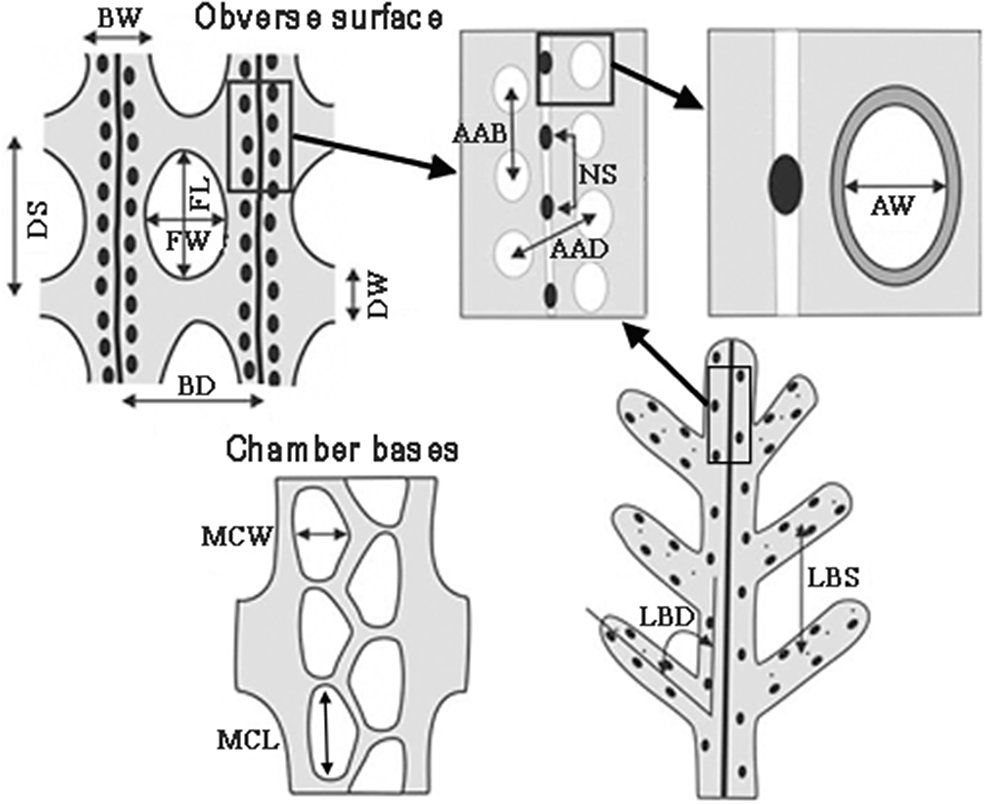
Morphologic character terminology and numerical procedures are adopted partly from McKinney and Wyse Jackson (Reference McKinney and Wyse Jackson2015a) and Hageman (Reference Hageman1991), respectively (Fig. 3). Due to the presence of external homeomorphy being a common feature within this group (Morozova, Reference Morozova2001), the shape of zooecia observed in different planes (i.e., transverse, longitudinal, tangential), coupled with other internal characters such as the presence/absence of skeletal partitions (i.e., hemisepta, diaphragms), is crucial for discrimination between fenestrate genera. Nevertheless, homeomorphy in the shape and size of autozooidal chambers was also noted (Morozova, Reference Morozova2001). We could not produce any thin sections because of the preservation of bryozoans mainly as composite natural molds, which is usual in many glacially influenced basins along southern Gondwana during the LPIA (Engel, Reference Engel1979; Sabattini, Reference Sabattini1986; Kelly et al., Reference Kelly, Doubleday, Brunton, Dickins, Sevastopulo and Taylor2001), and elsewhere (Elias, Reference Elias1957; González Mora and Sour Tovar, Reference González Mora and Sour Tovar2014; González Mora et al., Reference González Mora, Wyse Jackson, Quiroz Barroso, Sour Tovar, Key, Porter and Wyse Jackson2023). However, sediment-infilled zooecia yield natural three-dimensional casts of zooecial chambers, allowing the evaluation of some zooecial features such as the shape of the living chambers throughout the branches and, sometimes, the presence of zooecial partitions (i.e., hemisepta, terminal diaphragms). Heterozooecia are also recognizable (Sabattini, Reference Sabattini1983, Reference Sabattini2002). Moreover, external characters are often very well preserved and represent important morphological features, allowing an accurate study of the fenestrates (Hageman and McKinney, Reference Hageman and McKinney2010).
Measurements taken from fenestrate bryozoans: AAB = autozooecial aperture spacing along branch; AAD = autozooecial aperture spacing diagonally; AW = autozooecial aperture width; BW = branch width; DW = dissepiment width; FW = fenestrule width; FL = fenestrule length; BD = branch distance; DS = dissepiment spacing; NS = node spacing; MCW = maximum chamber width; MCL = maximum chamber length; LBS = lateral branch spacing; LBA = lateral branch diverging angle (modified from Ernst et al., Reference Ernst, May and Marks2012).

Morphological data collection
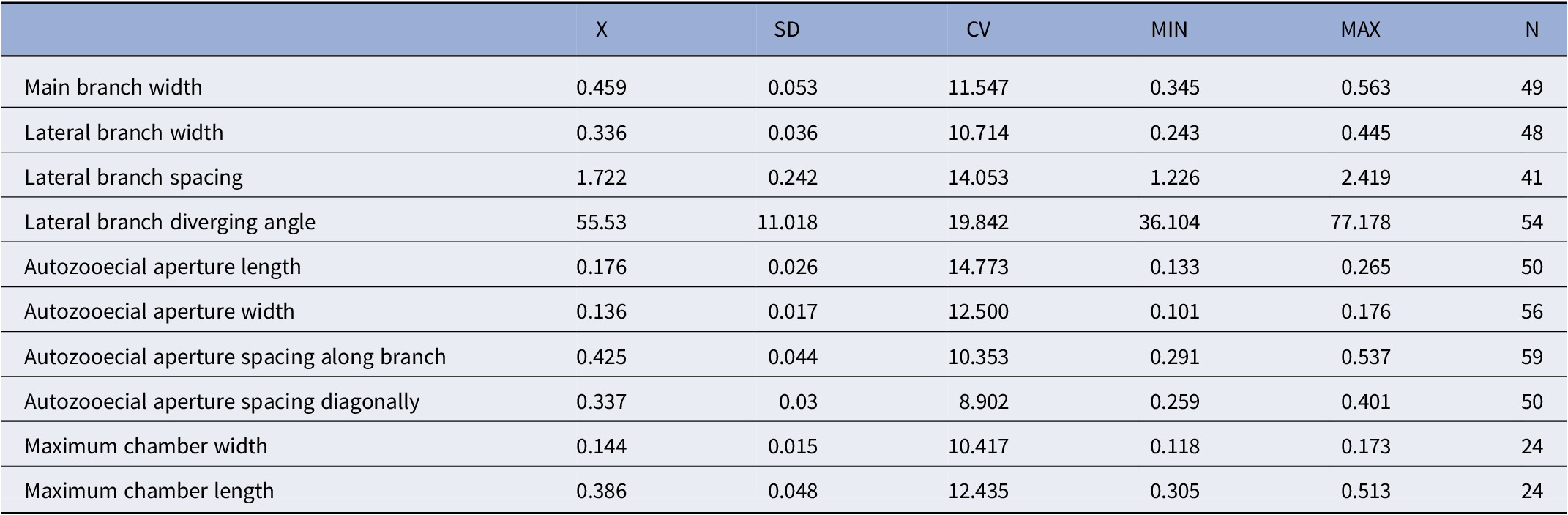
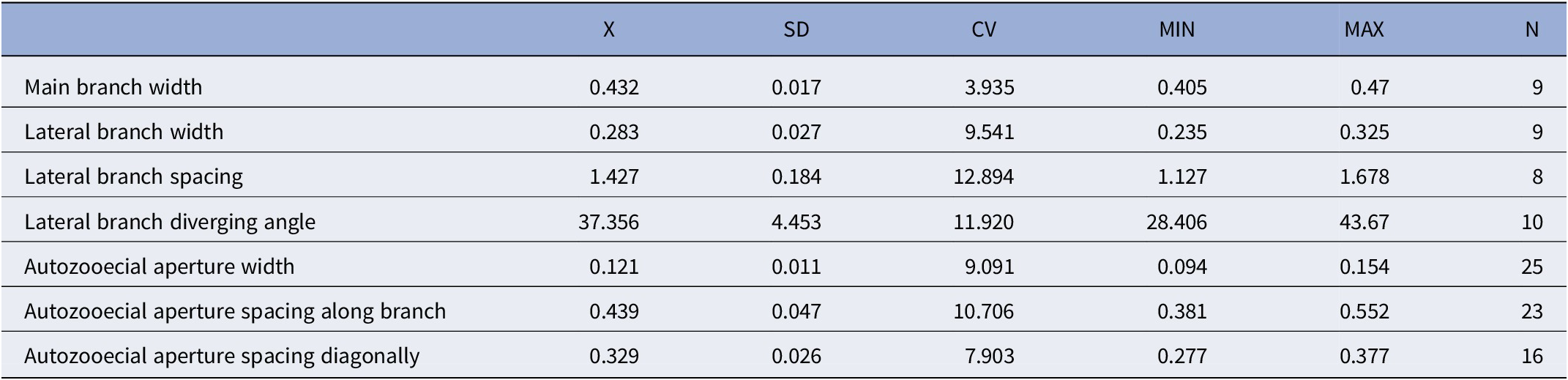
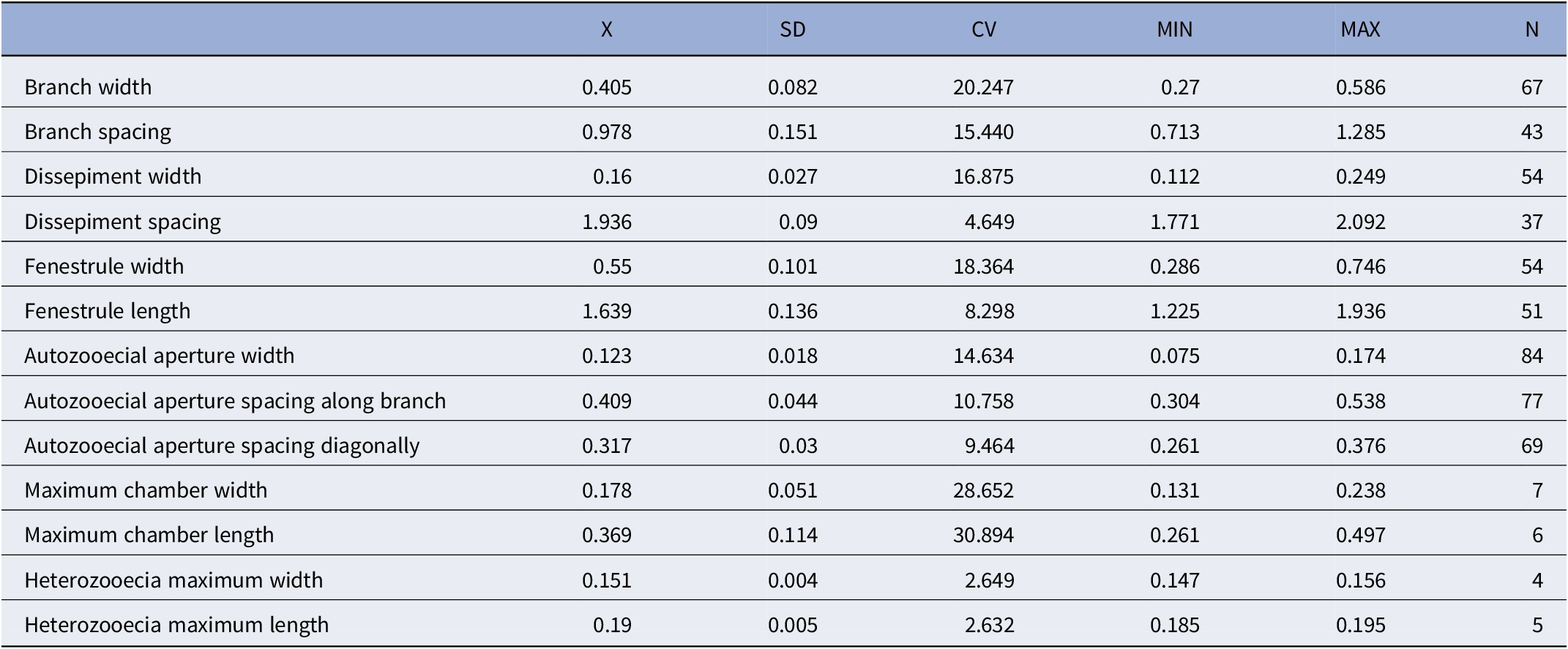
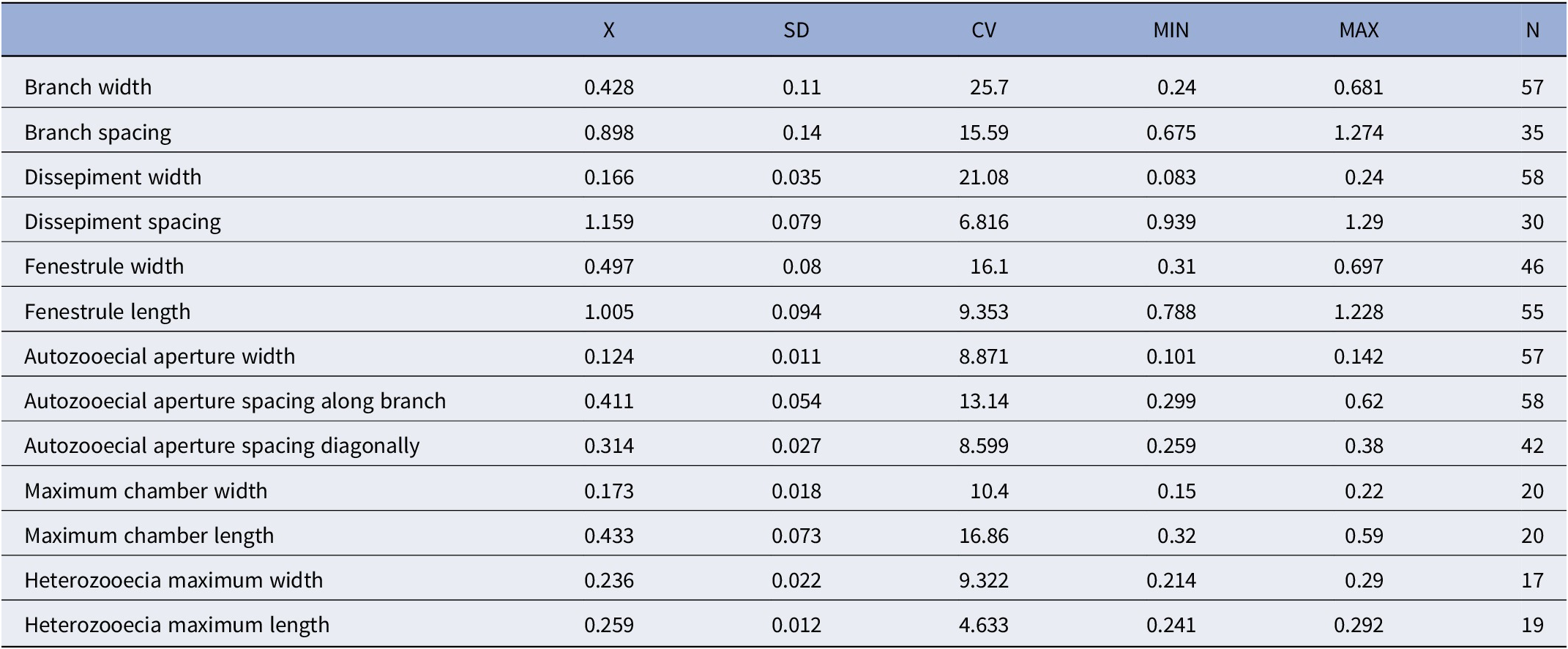
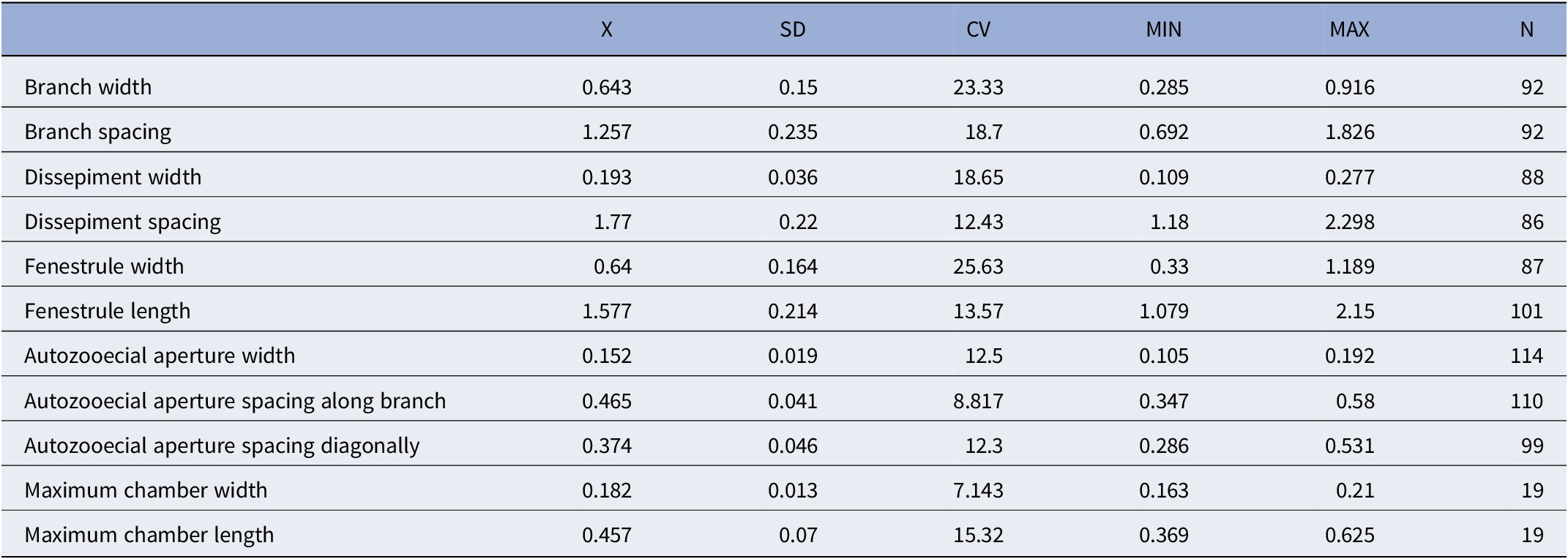
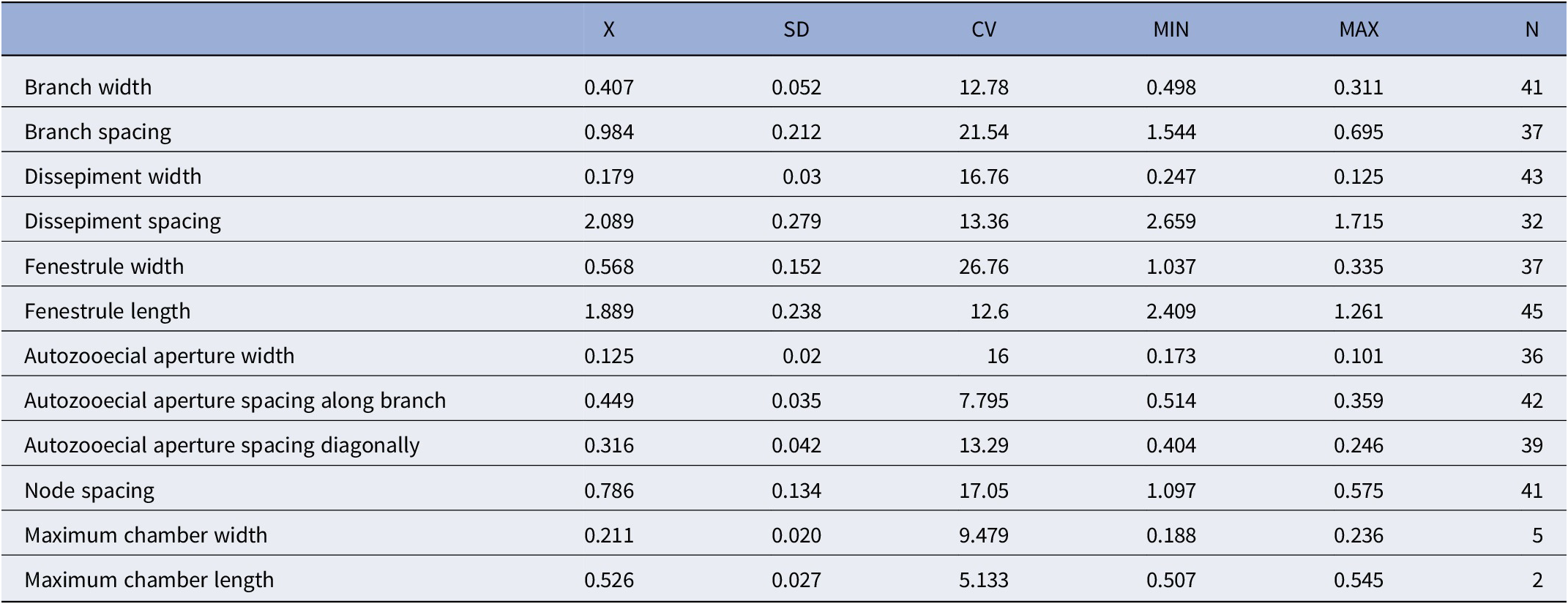
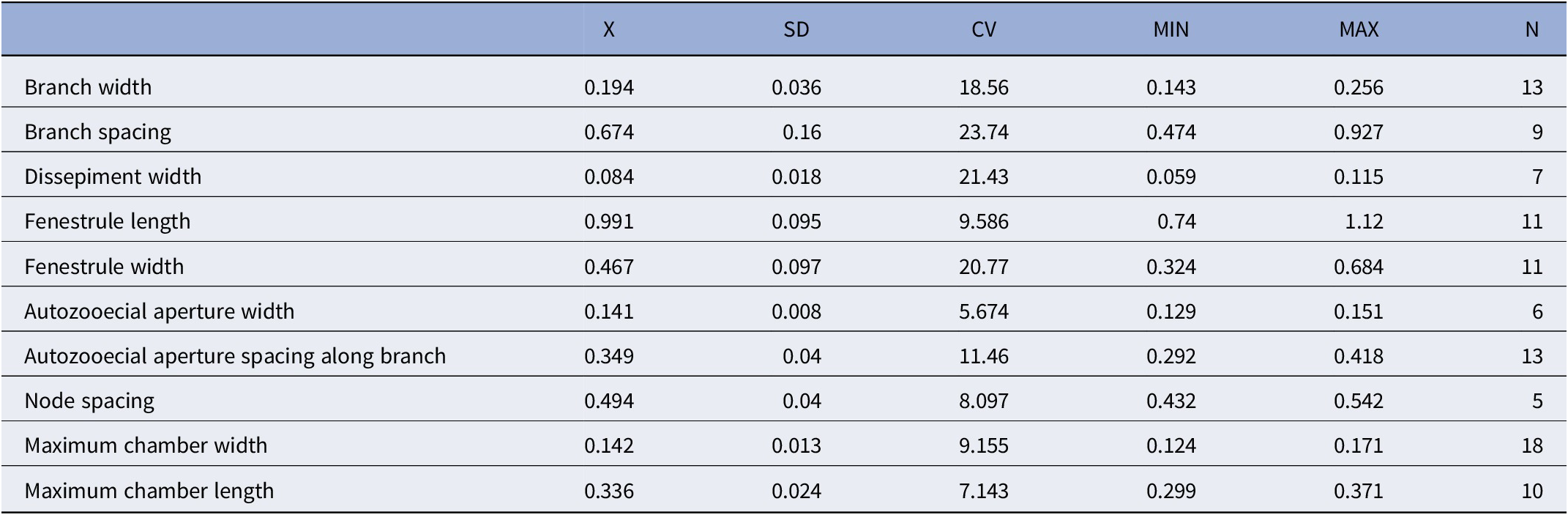
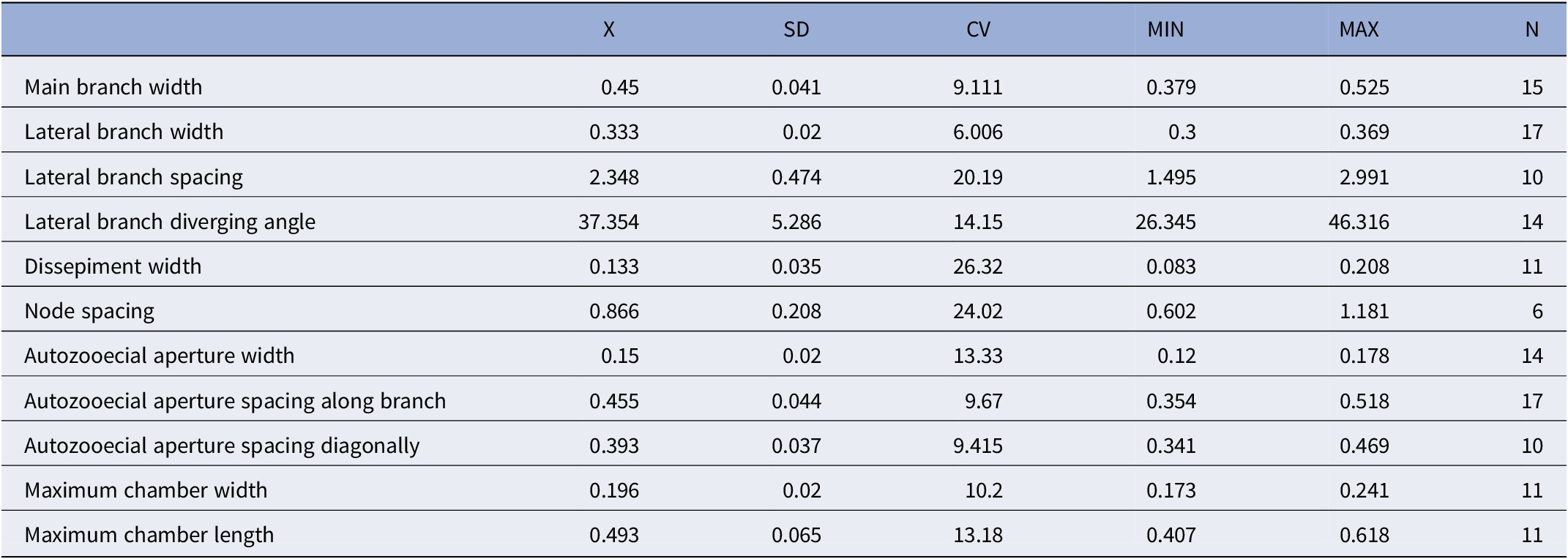
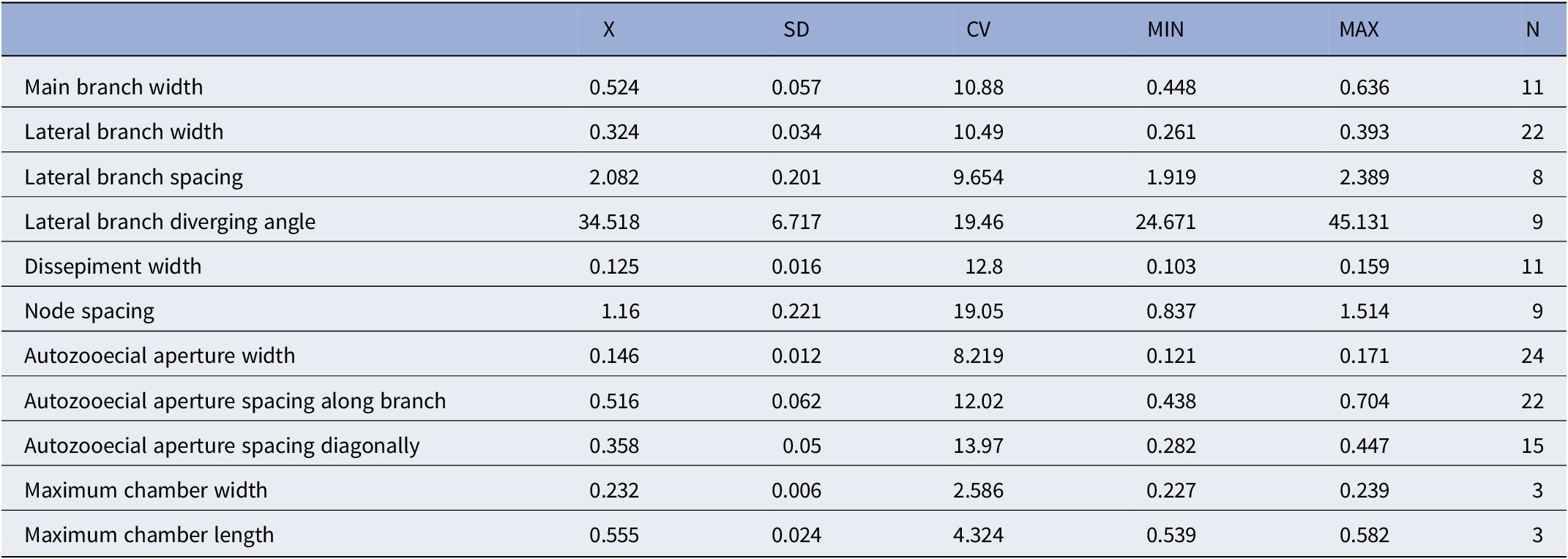
The morphological measurements were obtained from digital images using ImageJ software (Schneider et al., Reference Schneider, Rasband and Eliceiri2012; https://imagej.net). Coated specimens were photographed optically with digital cameras at the Museo Paleontológico Egidio Feruglio (MEF). Some details were also photographed from uncoated specimens with a Jeol JSM-6460LV scanning electron microscope (SEM) in low-vacuum and backscattered electron signal conditions (at ALUAR S.A., Puerto Madryn, Chubut). All morphological measurements are presented in millimeters except angles, which are in decimal degrees, and all were statistically summarized using arithmetic mean (X), sample standard deviation (SD), coefficient of variation (CV), minimum and maximum values (MIN and MAX, respectively), and number of measurements (N).
Repository and institutional abbreviation
Fossil materials are stored at the paleoinvertebrate collection of the MEF, Trelew, Chubut, Argentina, under the prefix MPEF-PI.
Systematic paleontology
Suprafamilial systematics were adopted from Ernst (Reference Ernst and Schwaha2020). Generic concepts largely follow Morozova (Reference Morozova2001). Synonymy and open nomenclature qualifiers follow Matthews (Reference Matthews1973).
Phylum Bryozoa Ehrenberg, Reference Ehrenberg1831
Class Stenolaemata Borg, Reference Borg1926
Superorder Paleostomata Ma et al., Reference Ma, Buttler and Taylor2014
Order Fenestrata Elias and Condra, Reference Elias and Condra1957
Suborder Fenestellina Astrova and Morozova, Reference Astrova and Morozova1956
Family Acanthocladiidae Ulrich, Reference Ulrich1890
Genus Penniretepora d’Orbigny, Reference d’Orbigny1849
Reference Young and Young1875 Acanthopora Young and Young, p. 327.
Reference Vine1883 Pinnatopora Vine, p. 191.
Type species
Retepora pluma Phillips, Reference Phillips1836 from the Carboniferous, Mississippian (Viséan) of Yorkshire, England, by subsequent designation (Olaloye, Reference Olaloye1974).
Remarks
Penniretepora d’Orbigny, Reference d’Orbigny1849 differs from Filites Počta, Reference Počta and Barrande1894 mainly in having lateral branches not recurved backward. Penniretepora d’Orbigny, Reference d’Orbigny1849 differs from Diploporaria Nickles and Bassler, Reference Nickles and Bassler1900 in having nearly opposite, regularly arranged lateral branches. Gorjunopora Ernst et al., Reference Ernst, Wyse Jackson and Aretz2015 differs from Penniretepora d’Orbigny, Reference d’Orbigny1849 mainly in having internal hemisepta and alternating rows of keel nodes.
The type material originally studied by Phillips (Reference Phillips1836) remained missing for a long period. During a revision of the genus Penniretepora d’Orbigny, Reference d’Orbigny1849, Olaloye (Reference Olaloye1974) collected material from one of the localities studied by Phillips (Reference Phillips1836) and designated one of those specimens as a neotype. Recently, Wyse Jackson (Reference Wyse Jackson2011) rediscovered a single original syntype of Retepora pluma deposited in the collection of the Natural History Museum in London and proposed designating it as a lectotype, leaving aside the neotype previously designated by Olaloye (Reference Olaloye1974) according to what was stated in Article 75.8 of the International Code of Zoological Nomenclature (ICZN, 1999, p. 86). In a detailed description of the Retepora pluma lectotype, Wyse Jackson (Reference Wyse Jackson2011) mentioned the presence of triangular-shaped zooecial chambers in deep tangential section on lateral branches. As noted recently, a major revision of Penniretepora d’Orbigny, Reference d’Orbigny1849 is needed (Ernst, Reference Ernst2001; Ernst et al., Reference Ernst, Wyse Jackson and Aretz2015, Reference Ernst, Claussen, Seuss and Wyse Jackson2022).
Penniretepora tenuissima Sabattini, Reference Sabattini1972
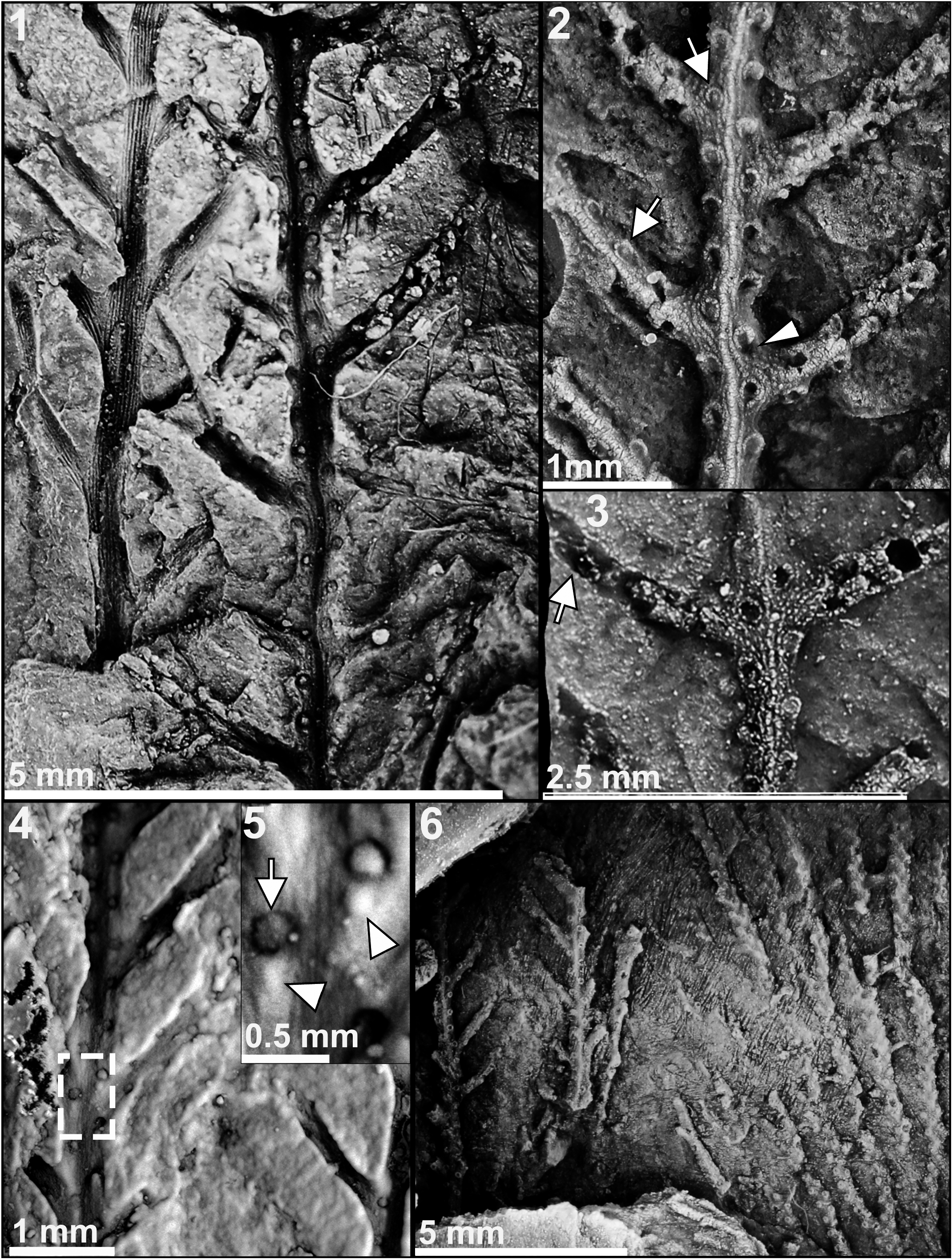
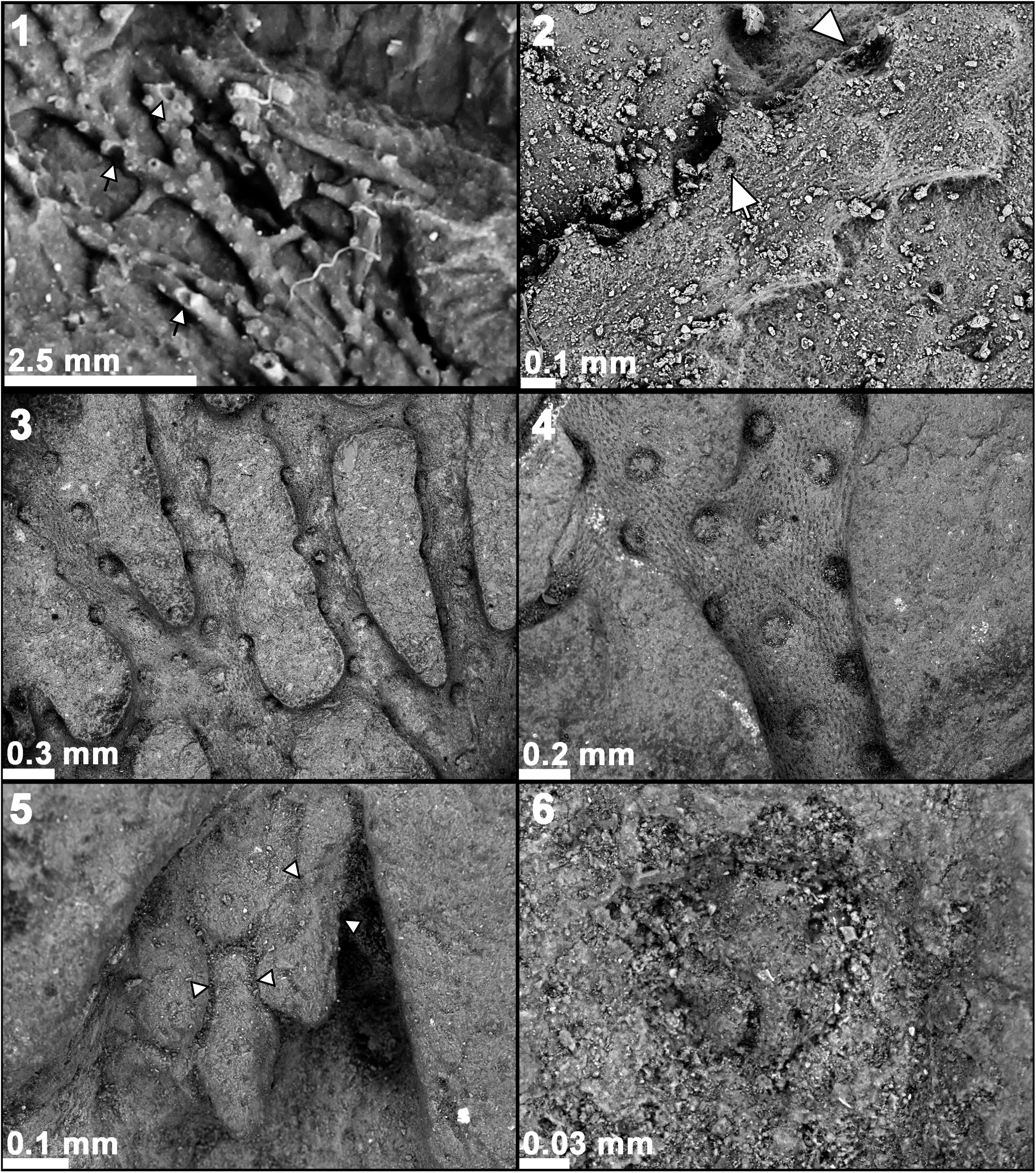
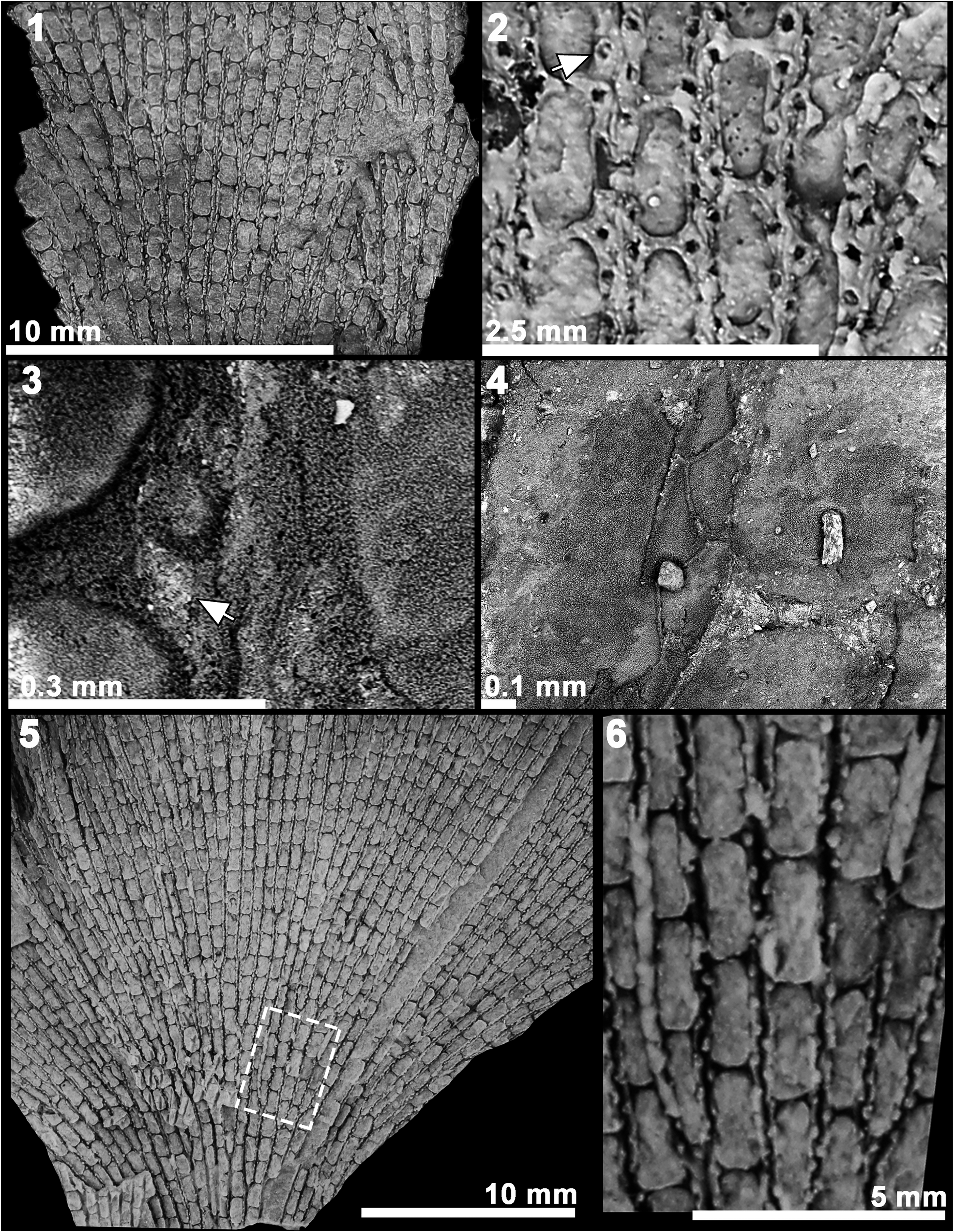
(1–3) Penniretepora tenuissima Sabattini, Reference Sabattini1972 from the Carboniferous (upper Serpukhovian–Bashkirian) of the Pampa de Tepuel Formation, Sierra de Tepuel, central-western Patagonia, Argentina: (1) composite mold of main stem and lateral branches MPEF-PI 4848a, including details of surface ornamentation; (2) cast of main stem and lateral branches MPEF-PI 4848a, including details of surface ornamentation, piriform autozooecial apertures with apertural pores (arrowhead), and secondary nanozooecium (arrows); (3) cast of main stem and lateral branches MPEF-PI 2020a, including details of surface ornamentation, and endozonal chamber bases on lateral branches (arrow). (4–6) Penniretepora patagónica Sabattini, Reference Sabattini1990 from the Carboniferous of the Pampa de Tepuel Formation, Sierra de Tepuel, central-western Patagonia, Argentina: (4) composite mold of main stem and lateral branches MPEF-PI 2016; (5) detail showing surface ornamentation, autozooecial aperture with stellate structure (arrow), and apertural pores proximally adjacent to the autozooecial apertures (arrowheads); (6) cast of pinnate zoarium MPEF-PI 2016 (left) in association with zoarium MPEF-PI 2014 of Septatopora freytesi Sabattini, Reference Sabattini1983 (right).

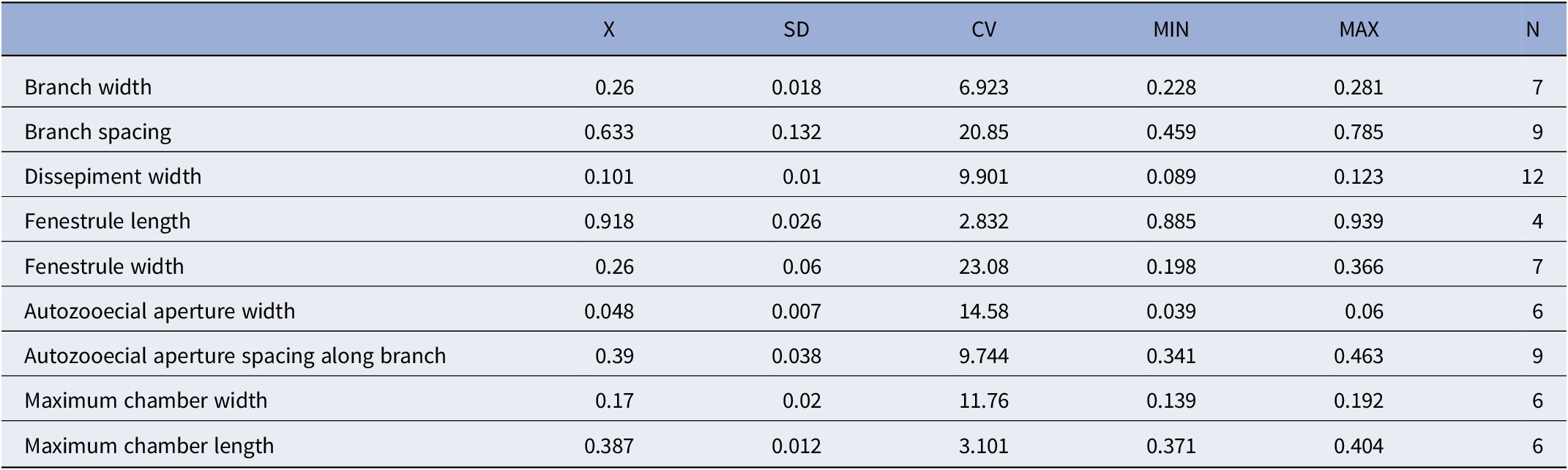
Descriptive statistics for Penniretepora tenuissima Sabattini, Reference Sabattini1972. Measurements are expressed in millimeters, except for angles in decimal degrees; CV in percentage. X = arithmetic mean; SD = sample standard deviation; CV = coefficient of variation; MIN = minimum value; MAX = maximum value; N = number of measurements.

1972 Penniretepora tenuissima Sabattini, p. 363, pl. 11, fig. 5.
1979 Penniretepora tenuissima; Amos, p. 68, fig. 2 (cop. Sabattini, 1972).
v.2010 Penniretepora? sp.; Pagani and Taboada, pl. 9, fig. 11.
v.2022 Penniretepora tenuissima; Taboada et al., p. 650, fig. 9c.
Holotype
MLP 10807 from the Pampa de Tepuel Formation, 6.7 km east of Casa Herrera (National Route 40), Sierra de Tepuel, Chubut Province, Argentina (Sabattini, 1972, pl. 11, fig. 5).
Description
Zoarium pinnate composed of main branch and opposite, nearly opposite, or alternating lateral branches. Some lateral branches thickened and developed subordinate pinnae. There are two rows of autozooecial apertures on both main and lateral branches, separated by a filiform, slightly undulating triserial keel, the middle more prominent. Keel with pustules but without distinct nodes. On the obverse surface, autozooecial apertures are subcircular, often pear-shaped in outline, with low peristomes thickened distally. Stylets indenting apertural outline. Apertural pore or fossula present, positioned proximally to the autozooecial aperture. There are three to four autozooecial apertures between neighboring lateral branches. Obverse and reverse side of the zoarium ornamented with fine longitudinal striae bearing pustules. Autozooecial chamber bases elongate pentagonal in outline. Axial wall between autozooecial rows zigzag at basal plate. Terminal diaphragms with a central perforation representing secondary nanozooecia often present. Heterozooecia not observed.
Materials
Composite natural molds of five colonies: MPEF-PI 4848 (a, b) from site 2; MPEF-PI-2015, MPEF-PI 2020 (a), MPEF-PI 2027, MPEF-PI 5912 from site 5. All colonies from a rich fossil-bearing bed of dark gray shales, located approximately 770 m above the base of PTF overlying the Jaramillo Formation (see Pagani and Taboada, Reference Pagani and Taboada2010). Middle section (upper Serpukhovian–Bashkirian) of the Lanipustula patagoniensis Biozone of Simanauskas and Sabattini (Reference Simanauskas and Sabattini1997).
Remarks
The studied specimens fall within the range of morphologic variation exhibited in Penniretepora tenuissima Sabattini, Reference Sabattini1972, originally described from the Carboniferous (upper Serpukhovian–Moscovian) of the PTF at several sites: 4.3 km and 6.7 km east of Casa Herrera, Sierra de Tepuel, and from a bed near Entresierras ranch, 10 km west-southwest apart from Colán Conhué town, Sierra de Languiñeo (Sabattini, Reference Sabattini1972, Reference Sabattini1986). A closer comparison is not possible as the internal morphology of Penniretepora tenuissima Sabattini, Reference Sabattini1972 is unknown due to the poor preservation.
In its original description, Penniretepora tenuissima Sabattini, Reference Sabattini1972 has been externally compared to P. trilineata (Meek, Reference Meek and Hayden1872), P. paucanoda (Moore, Reference Moore1930), P. belluda (Ulrich, Reference Ulrich1890), P. flexuosa Ulrich, Reference Ulrich1890 and P. pyriformipora (Rogers, Reference Rogers1900) from the Carboniferous of the United States; P. crassicaulis (Bassler, Reference Bassler1929) from the lower Permian (Sakmarian) of Timor; P. fossata Crockford, Reference Crockford1944 from the lower Permian (Sakmarian) of Australia; and P. tropica Sakagami, Reference Sakagami1966 from the lower Permian (Sakmarian–Artinskian) of Thailand, concluding that it is an endemic taxon of Patagonia (Sabattini, Reference Sabattini1972, p. 363–365).
The studied specimens clearly differ from the type species Penniretepora pluma (Phillips, Reference Phillips1836) as re-described by Wyse Jackson (Reference Wyse Jackson2011) mainly in having triserial keel and pentagonal instead of triangular chamber bases on lateral branches, which also are more distantly spaced (1.23–2.42 mm versus 1.00–1.02 mm, respectively). In addition, the studied specimens differ from Penniretepora cf. P. pluma (Phillips, Reference Phillips1836), described by Ernst et al. (Reference Ernst, Wyse Jackson and Aretz2015) from the Carboniferous, Mississippian (Viséan) of France, mainly in having triserial keel, pentagonal instead of rectangular to pentagonal chamber bases on lateral branches, which also are more distantly spaced (1.23–2.42 mm versus 0.72–1.05 mm, respectively), thinner main branches (0.34–0.56 mm versus 1.00–1.05 mm, respectively) and thinner lateral branches (0.24–0.44 mm versus 0.52–0.60 mm, respectively), autozooecial apertures more closely spaced across branches (0.25–0.40 mm versus 0.44–0.60 mm, respectively), and wider autozooecial chambers (0.12–0.17 mm versus 0.22–0.23 mm, respectively).
Penniretepora tenuissima Sabattini, Reference Sabattini1972 clearly differs from P. pseudotrilineata Ceretti, Reference Ceretti1963 sensu Ernst and Minwegen (Reference Ernst and Minwegen2006, p. 582–584) from the Carboniferous, Pennsylvanian (Moscovian–Gzhelian) of Spain and Italy, in having considerably thinner main branches (0.34–0.46 mm versus 0.7–0.85 mm, respectively), thinner lateral branches (0.24–0.44 mm versus 0.39–0.42 mm, respectively), and normally three to four instead of two to three autozooecial apertures in the space between neighboring lateral branches.
In addition, Penniretepora tenuissima Sabattini, Reference Sabattini1972 differs from Penniretepora sp. in Ernst and Wrinkler Prins (Reference Ernst and Winkler Prins2008) from the Carboniferous, Pennsylvanian of Spain, mainly in having a distinct keel on lateral branches, which are more distantly spaced (1.23–2.42 mm versus 0.75–1.00 mm, respectively), and in having three to four, instead of two autozooecial apertures in the space between neighboring lateral branches.
Penniretepora patagónica Sabattini, Reference Sabattini1990
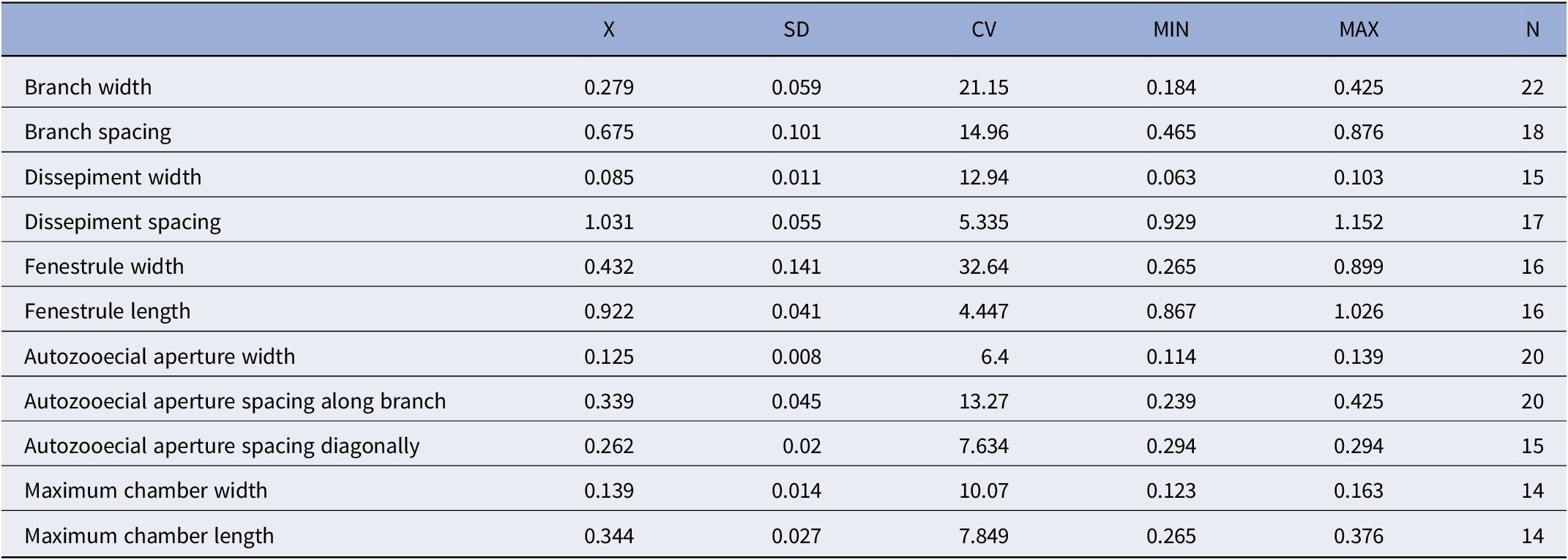
Descriptive statistics for Penniretepora patagónica Sabattini, Reference Sabattini1990. Measurements are expressed in millimeters, except for angles in decimal degrees; CV in percentage. X = arithmetic mean; SD = sample standard deviation; CV = coefficient of variation; MIN = minimum value; MAX = maximum value; N = number of measurements.

1972 Penniretepora sp. III Sabattini, p. 367, pl. 11, fig. 8.
1990 Penniretepora patagónica Sabattini, p. 185, fig. 1a–f.
v.2022 Penniretepora patagónica; Taboada et al., p. 650, fig. 9c.
Holotype
MLP 10812 from the Pampa de Tepuel Formation; 4.3 km east of Casa Herrera (National Route 40), Sierra de Tepuel, Chubut Province, Argentina (Sabattini, Reference Sabattini1990, fig. 1a, b).
Description
Zoarium pinnate composed of main branch and opposite, nearly opposite, or alternating lateral branches. There are two rows of autozooecial apertures on both main and lateral branches, separated by well-developed median keel, without nodes. On the obverse surface, autozooecial apertures are circular, with stellate structures composed by eight septa. There are two to normally three autozooecial apertures between neighboring lateral branches. Apertural pore present, positioned proximally to the autozooecial aperture. Obverse and reverse side of the zoarium ornamented with fine longitudinal rows of pustules. Autozooecial chamber bases not observed in the available material.
Material
Natural external molds of two colonies: MPEF-PI 5899 (a, b) from site 2 and MPEF-PI 2016 from site 5. Both colonies from a rich fossil-bearing bed of dark gray shales, located approximately 770 m above the base of the PTF overlying the Jaramillo Formation (see Pagani and Taboada, Reference Pagani and Taboada2010). Middle section (upper Serpukhovian–Bashkirian) of the Lanipustula patagoniensis Biozone of Simanauskas and Sabattini (Reference Simanauskas and Sabattini1997).
Remarks
The studied specimens fall mostly within the range of morphologic variation exhibited in Penniretepora patagónica Sabattini, Reference Sabattini1990 from the PTF at 4.3 km east of Casa Herrera, Sierra de Tepuel, but slightly differ in having lateral branches diverging at lower angles (28–44° versus 40–50°). A closer comparison is not possible as the internal morphology of Penniretepora patagónica Sabattini, Reference Sabattini1990 is unknown.
Penniretepora patagónica Sabattini, Reference Sabattini1990 differs from the other Penniretepora species from Argentina in autozooecial apertures having stellate structure composed of eight septa and apertural pore positioned proximally.
In its original description, Penniretepora patagónica Sabattini, Reference Sabattini1990 has been externally compared to P. stellipora (Young and Young, Reference Young and Young1874) and P. spinosa (Young and Young, Reference Young and Young1874) from the Carboniferous of Scotland, concluding that it is an endemic taxon of Patagonia (Sabattini, Reference Sabattini1990, p. 363–365). In addition, the studied specimens clearly differ from Penniretepora flexistriata Richards, Reference Richards1959 sensu Ernst et al. (Reference Ernst, Claussen, Seuss and Wyse Jackson2022) from the Carboniferous, Pennsylvanian (Virgilian) of the United States in having two to normally three autozooecial apertures in the space between the two neighboring lateral branches instead of a single one, lateral branches diverging at lower angles (28–44° versus 59–82°, respectively), wider main (0.40–0.47 mm versus 0.22–0.43 mm, respectively) and lateral branches (0.23–0.32 mm versus 0.12–0.24 mm, respectively), and wider autozooecial apertures (0.09–0.15 mm versus 0.06–0.08 mm, respectively) more widely spaced along branches (0.38–0.55 mm versus 0.28–0.38 mm, respectively). A closer comparison is not possible as the internal morphology of Penniretepora patagónica Sabattini, Reference Sabattini1990 is unknown.
Family Septatoporidae Engel, Reference Engel1975
Genus Septatopora Engel, Reference Engel1975
Type species
Polypora pustulosa (Crockford, Reference Crockford1949) from the Carboniferous, Mississippian (upper Serpukhovian) to Pennsylvanian (Kasimovian) of eastern Australia, by original designation (Engel Reference Engel1975, p. 578).
Occurrence
Carboniferous, Mississippian (upper Serpukhovian) to Pennsylvanian. Carboniferous (upper Serpukhovian–Kasimovian), Australia. Carboniferous (upper Serpukhovian–Moscovian), Argentina.
Remarks
Fundamental features occurring in the type species Septatopora pustulosa (Crockford, Reference Crockford1949) are the presence of multiserial arrangement of autozooecial apertures on branches, autozooecial apertures with stellate structures composed of eight septa, single exozonal tube present in each autozooecium, opening often proximally between longitudinally successive autozooecial apertures, hemiseptum distinctly positioned at the base of distal tube, and apparent reproductive heterozooecia bearing type B brood chambers (after Engel, Reference Engel1975; Morozova, Reference Morozova2001).
Septatopora Engel, Reference Engel1975 differs from Dissotrypa Ernst and Königshof, Reference Ernst and Königshof2010 in having oligo- or multi-serial arrangement of autozooecial apertures and absence of median keel, instead of distinctly biserial with well-developed median keel, often with a third autozooecial aperture only immediately before a bifurcation (Ernst and Königshof, Reference Ernst and Königshof2010; Ernst, Reference Ernst2012; Ernst et al., Reference Ernst, May and Marks2012).
The species S. acarinata (Crockford, Reference Crockford1947), S. nodosa Engel, Reference Engel1975, S(?) williamsensis Engel, Reference Engel1975 from the Carboniferous, Mississippian (Tournaisian–Viséan) of eastern Australia and S. engeli Sabattini, Reference Sabattini1983 and Septatopora sp. from the Carboniferous of CW Patagonia have biserial arrangement of autozooecial apertures, well-developed median keel, and a third row of autozooecial apertures only immediately before a bifurcation, features not occurring in the type species S. pustulosa (Crockford, Reference Crockford1949) but more characteristic of Dissotrypa Ernst and Königshof, Reference Ernst and Königshof2010. In addition, reproductive heterozooecia have been described in S. acarinata, S. nodosa, and S(?) williamsensis but remain unknown in S. engeli and Septatopora sp. (after Engel, Reference Engel1975; Sabattini, Reference Sabattini1983). We consider that these species should be segregated from Septatopora Engel, Reference Engel1975 as they align more closely with the diagnostic features of Dissotrypa Ernst and Königshof, Reference Ernst and Königshof2010. However, the presence and type of heterozooecia should be reviewed in Sabattini’s (Reference Sabattini1983) species as it is a fundamental feature in septatoporid bryozoans.
Septatopora freytesi Sabattini, Reference Sabattini1983
Septatopora freytesi Sabattini, Reference Sabattini1983 from the Carboniferous (upper Serpukhovian–Bashkirian) of the Pampa de Tepuel Formation, Sierra de Tepuel, central-western Patagonia, Argentina. (1) Cast of fertile zoarium MPEF-PI 2061b showing obverse surface and reproductive heterozooecia (arrows). (2) Cast of fertile zoarium MPEF-PI 1978 showing details of a three-rowed branch, including proximal pore of exozonal tube (arrow) and reproductive heterozooecium (arrowhead). (3–6) Composite mold of the same colony showing branch bifurcation (3), detailed branch bifurcation (4), endozonal chamber bases with hemisepta (arrowheads) (5), and aperture with stellate structure composed of eight septa (6).

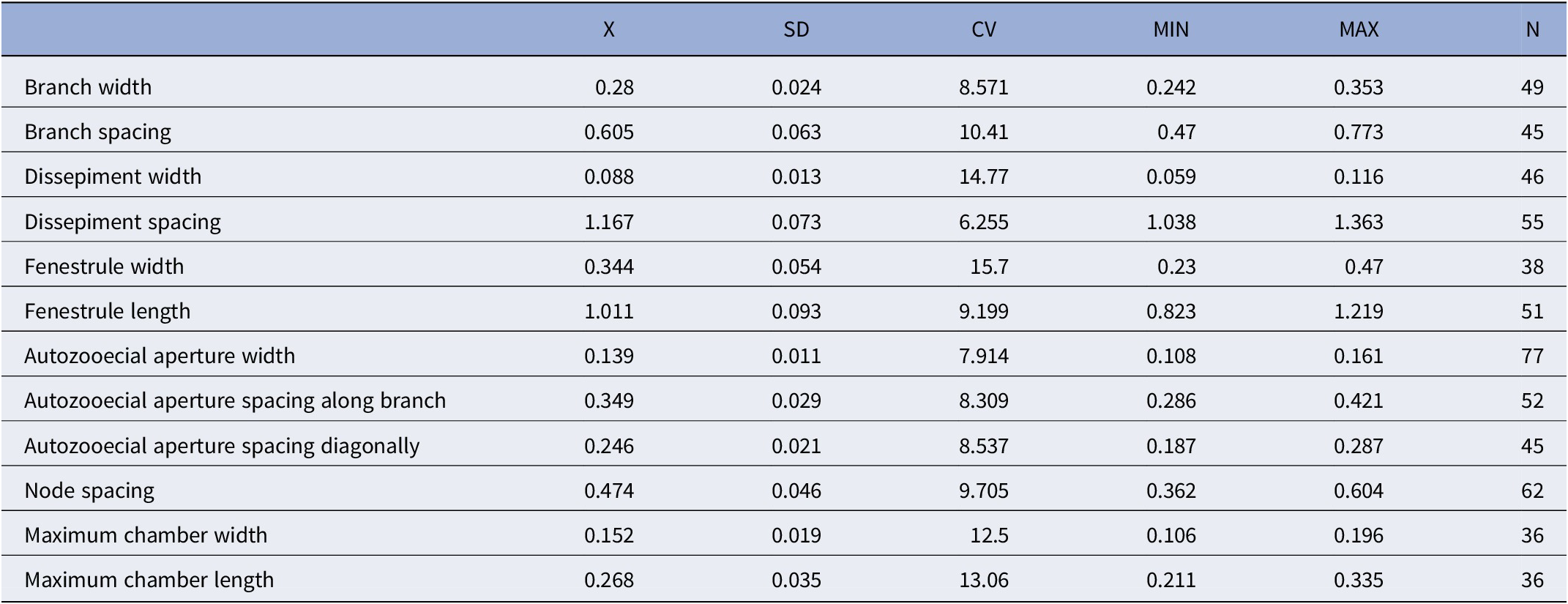
Descriptive statistics for Septatopora freytesi Sabattini, Reference Sabattini1983. Measurements are expressed in millimeters; CV in percentage. X = arithmetic mean; SD = sample standard deviation; CV = coefficient of variation; MIN = minimum value; MAX = maximum value; N = number of measurements.

1983 Septatopora freytesi Sabattini, p. 64, pl. 1, figs. 4, 5 and pl. 2, figs. 1–4.
v.2010 Septatopora freytesi?; Pagani and Taboada, p. 139, pl. 9, figs. 8, 10.
v.2022 Septatopora freytesi; Taboada et al., p. 650, pl. 9, fig. 9h.
Holotype
MLP 14643 from the Pampa de Tepuel Formation; 6 km east of National Route 40 and 30 km south of Tecka town, Sierra de Tepuel, Chubut Province, Argentina (Sabattini, Reference Sabattini1983, pl. 2, fig. 1).
Description
Zoarium reticulate, presumably simple fan shape, composed of branches joined by thin dissepiments. There are two to three rows of autozooecial apertures on each branch. On the obverse surface, autozooecial apertures are circular with stellate structures composed of eight septa. There are normally four to five autozooecial apertures per fenestrule; the latter are rectangular in shape, rhombic after branch bifurcations. Obverse and reverse sides of the zoarium ornamented with longitudinal rows of pustules (styles); obverse side often with single, undulating keel-like structure on narrower branches. Reverse surface not observed in the available material. Autozooecial chamber bases are rhomboidal–hexagonal (middle rows) to subpentagonal (lateral rows) in outline. Hemisepta present at the base of the distal tube. Single exozonal tube present in each autozooecium, opening proximally between longitudinally successive autozooecial apertures. Axial wall between autozooecial rows zigzag to undulating at basal plate. Apparent reproductive heterozooecia bearing type B brood chambers often present, occurring irregularly arranged or grouped in certain areas of the zoarium.
Material
Composite natural molds of seven colonies: MPEF-PI 1972, MPEF-PI 1978, MPEF-PI 1988, MPEF-PI 2003, MPEF-PI 2014, MPEF-PI 2061 (a, b), MPEF-PI 5759 (a, b) from site 5. All colonies from a rich fossil-bearing bed of dark gray shales, located approximately 770 m above the base of the PTF overlying the Jaramillo Formation (see Pagani and Taboada, Reference Pagani and Taboada2010). Middle section (upper Serpukhovian–Bashkirian) of the Lanipustula patagoniensis Biozone of Simanauskas and Sabattini (Reference Simanauskas and Sabattini1997).
Remarks
The studied specimens fall mostly within the range of morphologic variation exhibited in the original description of Septatopora freytesi Sabattini, Reference Sabattini1983 from the Carboniferous (upper Serpukhovian–Moscovian) of the PTF in several sites: 6 km east of National Route 40 and 30 km south of Tecka town, Sierra de Tepuel; 4.3 km east of Casa Herrera, Sierra de Tepuel; Cerro Antinao, south of Almacén Nazer, Sierra de Languiñeo; and from a bed near Entresierras ranch, 10 km west-southwest apart from Colan Conhué town, Sierra de Languiñeo (Sabattini, Reference Sabattini1972, Reference Sabattini1983). Although there is strong overlapping, the studied material slightly differs in having autozooecial apertures more distantly spaced along branches (0.30–0.54 mm versus 0.32–0.44 mm).
Septatopora freytesi Sabattini, Reference Sabattini1983 differs from the type species S. pustulosa (Crockford, Reference Crockford1949) as re-described by Engel (Reference Engel1975) from the Carboniferous (upper Serpukhovian–Kasimovian) of eastern Australia mainly in having two to three rows of autozooecial apertures on each branch instead of normally three autozooecial apertures on each branch, increasing to four before and decreasing to two after branch bifurcations as in the type species.
Septatopora freytesi Sabattini, Reference Sabattini1983 differs from the closely comparable S. stellaris (Campbell, Reference Campbell1961) from the Carboniferous (upper Serpukhovian) Booral Formation (Southern New England Fold Belt, New South Wales, Australia) in normally having four to five instead of two to three autozooecial apertures per fenestrule, and in lacking nodes on the obverse surface and spines on the reverse surface.
The studied specimens differ from S. gloucesterensis Engel, Reference Engel1975 from the Carboniferous (Tournaisian–Viséan) of eastern Australia in having three rows of autozooecial apertures before branch bifurcations instead of three to four rows, in addition to wider branches (0.40 mm versus 0.30 mm, respectively), longer fenestrules (1.64 mm versus 1.12 mm, respectively), and autozoecial apertures more widely spaced along branches (0.41 mm versus 0.27 mm, respectively).
Septatopora pustulosa (Crockford, Reference Crockford1949)
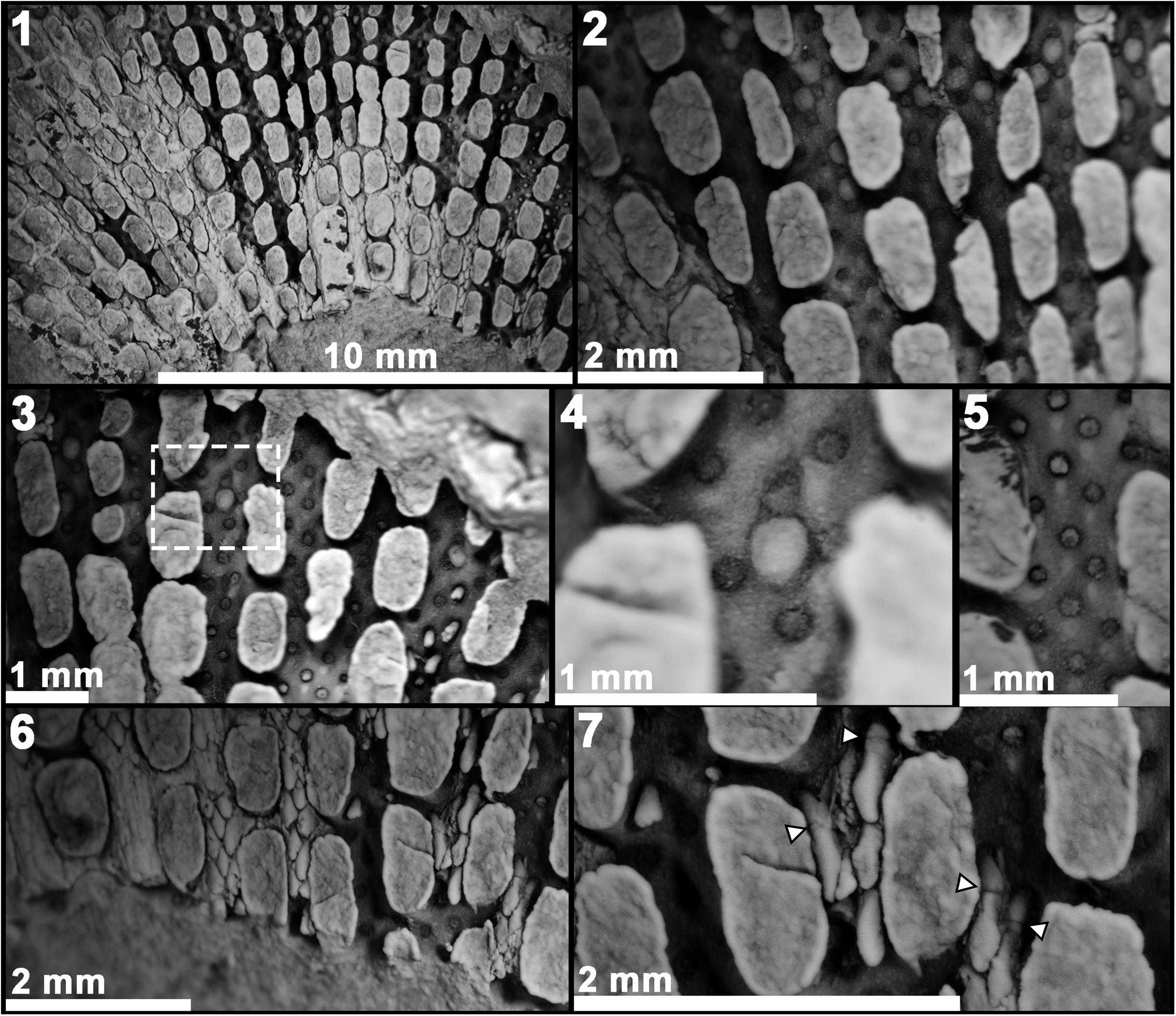
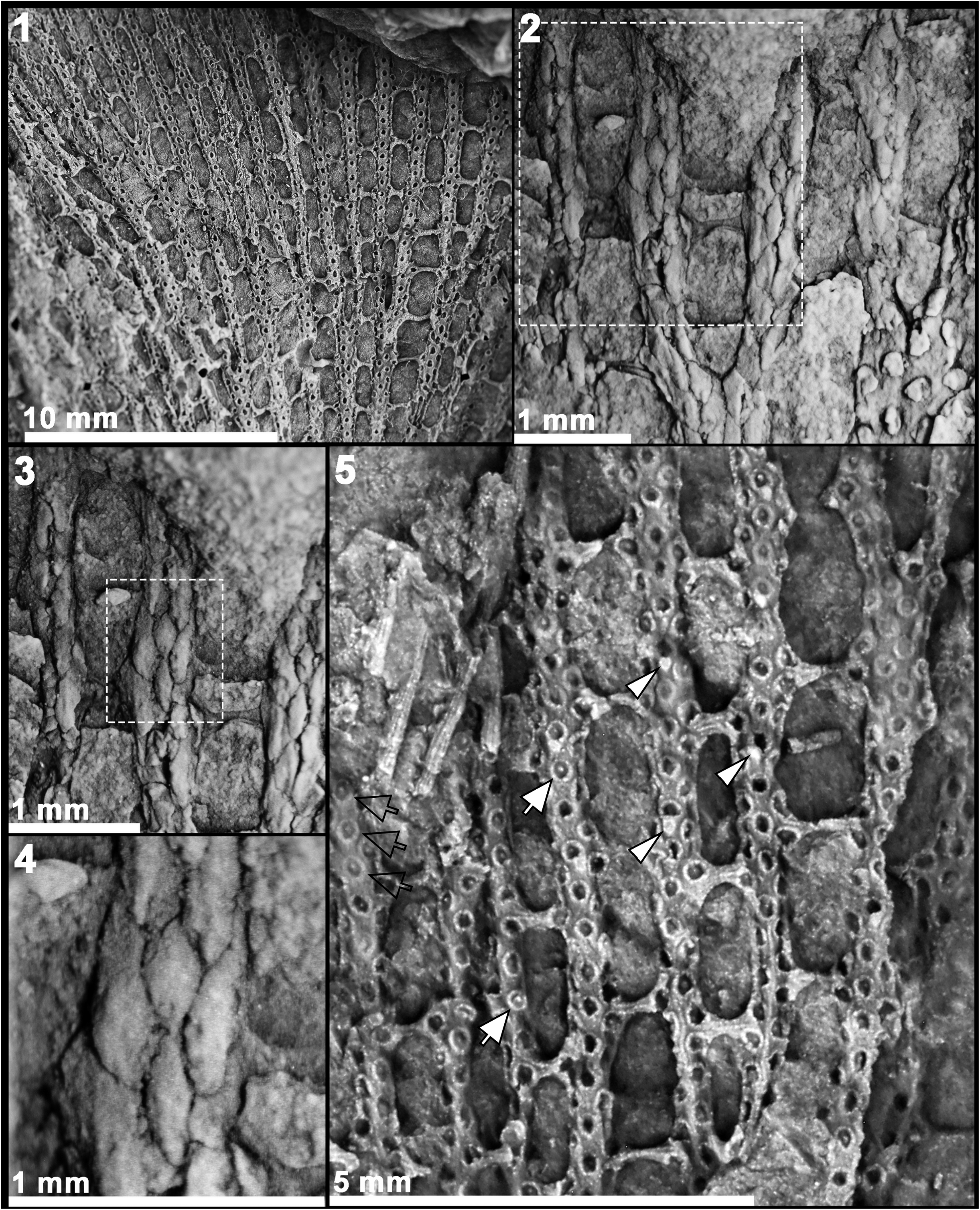
Septatopora pustulosa (Crockford, Reference Crockford1949) from the Carboniferous (upper Serpukhovian–Bashkirian) of the Pampa de Tepuel Formation, Sierra de Tepuel, central-western Patagonia, Argentina. (1–7) Composite mold of partially silicified zoarium MPEF-PI 5671b showing general view of reticulate zoarium (1), cluster of reproductive heterozooecia (2, 3), detail of branch with single reproductive heterozooecium (4), detail of autozooecial apertures with stellate structure and proximal pore of exozonal tube (5), detail of branch reverse side, endozonal chamber bases, and autozooecial apertures (from left to right) (6), and detail of autozooecia with hemisepta (arrowheads) (7).

Descriptive statistics for Septatopora pustulosa (Crockford, Reference Crockford1949). Measurements are expressed in millimeters; CV in percentage. X = arithmetic mean; SD = sample standard deviation; CV = coefficient of variation; MIN = minimum value; MAX = maximum value; N = number of measurements.

1949 Polypora pustulosa Crockford, p. 426, text-fig. 9.
1949 Polypora tenuirama Crockford, p. 428, text-fig. 11.
1961 Polypora septata Campbell, p. 462, pl. 58, figs. 1, 2.
1962 Polypora cf. P. septata; Campbell, p. 47, pl. 13, fig. 8a–c.
1972 Polypora septata; Sabattini, p. 351, pl. 11, fig. 2.
1972 Polypora sp. I; Sabattini, p. 353, pl. 11, fig. 3.
1975 Septatopora pustulosa; Engel, p. 579, pl. 67, figs. 1–9.
1979 Polypora septata; Amos, p. 67, fig. 1 (cop. Sabattini, 1972).
1983 Septatopora pustulosa; Sabattini, p. 62, pl. 1, figs. 1–3.
v.2022 Septatopora pustulosa; Taboada et al., p. 650, fig. 9g.
Holotype
QUF 24980 from the Neerkol Formation; near Rockhampton district, Queensland, Australia (Crockford, Reference Crockford1949, text-fig. 9; see Engel, Reference Engel1975).
Description
Zoarium reticulate, presumably simple fan shape, composed of branches joined by thin dissepiments. There are three rows of autozooecial apertures on each branch, increasing to four before and decreasing to two after branch bifurcations. On the obverse surface, autozooecial apertures are circular with stellate structures composed of eight septa. There are two to four, but normally three autozooecial apertures per fenestrule; the latter are rectangular in shape, rhombic after branch bifurcations. Obverse and reverse sides of the zoarium ornamented with longitudinal rows of pustules (styles); obverse side often with undulating median keel-like structure on narrower branches. Autozooecial chamber bases are rhomboidal (middle rows) to subpentagonal (lateral rows) in shape. Hemisepta present at the base of the distal tube. Single exozonal tube present in each autozooecium, opening proximally between longitudinally successive autozooecial apertures. Axial wall between autozooecial rows zigzag to undulating at basal plate. Apparent reproductive heterozooecia bearing type B brood chambers often present, occurring irregularly arranged or grouped in certain areas of the zoarium.
Material
Composite molds of seven colonies: MPEF-PI 3414 (b) from site 2; MPEF-PI 2045, MPEF-PI 2065, MPEF-PI 3419 (3), MPEF-PI 3419 (7), MPEF-PI 5758 (a-b), and MPEF-PI 5908 (a-b) from site 5. Composite mold of two colonies partially silicified: MPEF-PI 2024 (a), MPEF-PI 5670 from site 5. All colonies from a rich fossil-bearing bed of dark gray shales, located approximately 770 m above the base of the PTF overlying the Jaramillo Formation (see Pagani and Taboada, Reference Pagani and Taboada2010). Middle section (upper Serpukhovian–Bashkirian) of the Lanipustula patagoniensis Biozone of Simanauskas and Sabattini (Reference Simanauskas and Sabattini1997).
Remarks
The studied specimens fall mostly within the range of morphologic variation exhibited in the original description of Polypora pustulosa Crockford, Reference Crockford1949 from the Carboniferous (upper Serpukhovian–Kasimovian) Neerkol Formation (Bowen Basin, Queensland, Australia) but slightly differ in having wider autozooecial apertures (0.12 mm versus 0.09 mm, respectively). Engel (Reference Engel1975, p.579) subsequently combined this species with Polypora tenuirama Crockford, Reference Crockford1949 from the Carboniferous (upper Serpukhovian–Kasimovian) Neerkol Formation (Bowen Basin, Queensland, Australia), P. septata Campbell, Reference Campbell1961 from the Carboniferous (upper Serpukhovian) of the Booral Formation, and Polypora cf. P. septata described by Campbell (Reference Campbell1962) from the Carboniferous (upper Serpukhovian) of the Kullatine Formation (Southern New England Fold Belt, New South Wales, Australia) into a single species, Septatopora pustulosa (Crockford, Reference Crockford1949) and designated it as the type species of his new genus Septatopora Engel, Reference Engel1975. Septatopora pustulosa (Crockford, Reference Crockford1949), as re-described by Engel (Reference Engel1975), has also been recorded from the Carboniferous (Pennsylvanian) Rands Formation (Bowen Basin, Queensland, Australia) by Maxwell (Reference Maxwell1964). In this regard, the studied specimens fall mostly within the range of morphologic variation exhibited in Septatopora pustulosa (Crockford, Reference Crockford1949), as re-described by Engel (Reference Engel1975), but differ in having narrower fenestrules (0.79–1.23 mm versus 1.0–2.6 mm long and 0.31–0.70 mm versus 0.6–1.15 mm wide, respectively).
Septatopora pustulosa (Crockford, Reference Crockford1949) has also been described from the Carboniferous (upper Serpukhovian–Moscovian) of the PTF in several sites: 4.3 km east of Casa Herrera, Sierra de Tepuel; Cerro Chato, Sierra de Languiñeo; north of Puesto Antinao, Sierra de Languiñeo; and from a bed near Entresierras ranch, 10 km west-southwest of Colan Conhué town, Sierra de Languiñeo (Sabattini, Reference Sabattini1972, Reference Sabattini1983). The studied specimens fall within the range of morphologic variation exhibited in Sabattini’s material.
Septatopora pustulosa (Crockford, Reference Crockford1949) differs from S. isaacsensis (Campbell, Reference Campbell1961) as re-described by Engel (Reference Engel1975) from the Carboniferous (upper Serpukhovian) McKinnes Formation (Southern New England Fold Belt, New South Wales, Australia) mainly in having two rows of autozooecial apertures after branch bifurcation instead of normally three and three to five autozooecial apertures per fenestrule instead of two to three, and in lacking nodes irregularly developed distally adjacent to autozooecial apertures and spines on reverse surface.
Septatopora pustulosa (Crockford, Reference Crockford1949) differs from S. flemingi Engel, Reference Engel1975 from the Carboniferous (Moscovian?–Kasimovian) upper levels of the Neerkol Formation (Bowen Basin, Queensland, Australia) mainly in having three rows of autozooecial apertures on each branch, increasing to four before and decreasing to two after branch bifurcations instead of three to four rows of autozooecial apertures on each branch, increasing to five to six before and decreasing to two to three after branch bifurcations.
Family Fenestellidae King, Reference King1849
Subfamily Polyporinae Vine, Reference Vine1884
Genus Polyporella Simpson, Reference Simpson1895
Type species
Fenestella fistulata Hall, Reference Hall1884 from the Middle Devonian (Givetian) of the Hamilton Group, New York, USA, by original designation.
Occurrence
Devonian to Permian; worldwide.
Remarks
Polyporella Simpson, Reference Simpson1895 differs from Polypora M’Coy, Reference M’Coy1844 in normally having three rows of autozooecial apertures on each branch, increasing to four before and decreasing to two after branch bifurcation instead of normally four, with up to six before and three after branch bifurcation in the latter.
Polyporella neerkolensis (Crockford, Reference Crockford1949)
Polyporella neerkolensis (Crockford, Reference Crockford1949) from the Carboniferous (upper Serpukhovian–Bashkirian) of the Pampa de Tepuel Formation, Sierra de Tepuel, central-western Patagonia, Argentina. (1) Cast of reticulate zoarium MPEF-PI 3468a showing obverse surface and arrangement of autozooecial apertures along branches and fenestrules. (2–4) Composite mold of the same zoarium showing branch bifurcation, arrangement of autozooecial chamber bases and apertures (2), and detail of autozooecial chamber bases (3, 4). (5) Cast of reticulate zoarium MPEF-PI 2513 showing obverse surface, arrangement of autozooecial apertures along branches and fenestrules, autozooecial apertures with peristomes bearing pustules, distinct nodes proximally adjacent to autozooecial apertures (head arrows), and secondary nanozooecia (arrows).

Descriptive statistics for Polyporella neerkolensis (Crockford, Reference Crockford1949). Measurements are expressed in millimeters; CV in percentage. X = arithmetic mean; SD = sample standard deviation; CV = coefficient of variation; MIN = minimum value; MAX = maximum value; N = number of measurements.

1949 Polypora neerkolensis Crockford, p. 426, text-fig. 10.
?1961 Fenestella? altinodosa Campbell, p. 458, pl. 57, figs. 2a, b.
1962 Polypora neerkolensis; Campbell, p. 46, pl. 13, figs. 1a–d.
1964 Polypora neerkolensis; Maxwell, p. 39, pl. 13, figs. 8, 9.
1972 Polypora neerkolensis; Sabattini, p. 350, pl. 11, fig. 1.
1972 Polypora neerkolensis; Fleming, p. 5, pl. 3, figs. 4–7.
1979 Australopolypora neerkolensis (Crockford); Engel, p. 147, figs. 2, 6–13.
1979 Polypora neerkolensis; Amos, p. 66, fig. 1 (cop. Sabattini, 1972).
?2001 Australopolypora cf. A. neerkolensis; Kelly et al., p. 224, fig. 6t.
v.2022 Australopolypora neerkolensis (Crockford); Taboada et al., p. 650, fig. 9f.
Holotype
QUF 25005 from the Neerkol Formation, Mt. Barney, Queensland, Australia (Crockford, Reference Crockford1949, text-fig. 10; see Engel, Reference Engel1979).
Description
Zoarium reticulate, presumably simple fan shape, composed of branches joined by thin dissepiments. There are normally three rows of autozooecial apertures on each branch, increasing to four to five before and decreasing to two to three after branch bifurcation; extensive two-rowed branches are occasionally present. On the obverse surface, autozooecial apertures are circular with distinct peristomes. Distinct nodes (large styles) often present, irregularly developed proximally adjacent to autozooecial apertures. There are normally three to four autozooecial apertures per fenestrule; the latter are rectangular in shape, rhombic after branch bifurcations. Obverse side of the zoarium ornamented with undulating longitudinal ridges between autozooecial apertures. Reverse side longitudinally striated and bearing pustules (styles). Autozooecial chamber bases are rhomboidal–hexagonal (middle rows) to subpentagonal (lateral rows) in outline. Distal tube surrounded by stylets indenting apertural outline. Hemisepta present at the base of the distal tube. Axial wall between autozooecial rows undulating at basal plate. Terminal diaphragms with a central perforation representing secondary nanozooecia often present. Heterozooecia not observed.
Material
Composite molds of four colonies: MPEF-PI 3468 (a, b) from site 1; MPEF-PI 4855 from site 2; MPEF-PI 2513 from site 4; MPEF-PI 5708 from site 5. All colonies from a rich fossil-bearing bed of dark gray shales, located approximately 770 m above the base of the PTF overlying the Jaramillo Formation (see Pagani and Taboada, Reference Pagani and Taboada2010). Middle section (upper Serpukhovian–Bashkirian) of the Lanipustula patagoniensis Biozone of Simanauskas and Sabattini (Reference Simanauskas and Sabattini1997).
Remarks
The studied specimens fall within the range of morphologic variation exhibited in Polyporella neerkolensis (Crockford, Reference Crockford1949) as re-described by Engel (Reference Engel1979) from the Carboniferous (upper Serpukhovian–Kasimovian) of eastern Australia. Polyporella neerkolensis (Crockford, Reference Crockford1949) originally described from the Neerkol Formation (Bowen Basin, Queensland, Australia) has also been recorded from the Kullatine Formation (Southern New England Fold Belt, New South Wales, Australia) and from the Carboniferous (Serpukhovian–Pennsylvanian) of the upper half of the Poperima and lower half of the Rands formations (Bowen Basin, Queensland, Australia) (Campbell, Reference Campbell1962; Maxwell, Reference Maxwell1964, respectively).
Polyporella neerkolensis (Crockford, Reference Crockford1949) has been also described from the Carboniferous (upper Serpukhovian–lower Bashkirian) of La Capilla Formation and Hoyada Verde Member of the San Eduardo Formation, Calingasta–Uspallata Basin, at Central Andes Precordillera, CW Argentina. Specimens from CW Patagonia have been described from the Carboniferous of the PTF at several sites: 4.3 km east of Casa Herrera, Sierra de Tepuel; La Carlota locality, “bed 3” of Suero (Reference Suero1948), northern Sierra de Tepuel; north of Puesto Antinao, Sierra de Languiñeo; Cerro Antinao, south of Almacen Nazer, Sierra de Languiñeo (Sabattini, Reference Sabattini1972, Reference Sabattini1986). The studied specimens fall within the range of morphologic variation exhibited in Sabattini’s material.
Polyporella altinodosa (Campbell, Reference Campbell1961) from the Carboniferous (upper Serpukhovian) of the Booral Formation (Southern New England Fold Belt, New South Wales, Australia), falls mostly within the range of morphologic variation exhibited in Polyporella neerkolensis (Crockford, Reference Crockford1949) but slightly differs in having extensive development of two rows of autozooecial apertures (Engel, Reference Engel1979). However, extensive two-rowed branches are often present in Polyporella neerkolensis (Crockford, Reference Crockford1949) and in the studied specimens. In addition to morphometric overlap, other fundamental features in common are the presence of multiserial arrangement of autozooecial apertures on branches, autozooecial apertures with peristomes bearing pustules (styles), distinct nodes (large styles) irregularly developed proximally adjacent to autozooecial apertures, longitudinal ridges between autozooecial apertures, autozooecial chamber bases rhomboidal–hexagonal (middle rows) to subpentagonal (lateral rows) in outline, axial wall between autozooecial rows undulating at basal plate, and terminal diaphragms with a central perforation representing secondary nanozooecia often present.
Subfamily Fenestellinae King, Reference King1849
Genus Levifenestella Miller, Reference Miller1961
Type species
Levifenestella maeve Miller, Reference Miller1961 from the Carboniferous, Mississippian (Tournaisian) of the Limestone Group, Ireland, by original designation.
Occurrence
Carboniferous to Permian; worldwide.
Remarks
The validity of the genus Levifenestella Miller, Reference Miller1961 has been questioned by some authors because most of species have been described without the use of thin sections (Morozova, Reference Morozova2001; McKinney and Wyse Jackson, Reference McKinney and Wyse Jackson2015b). However, key diagnostic features of Levifenestella Miller, Reference Miller1961 included the development of reticulate colonies composed of branches joined by thin dissepiments, two rows of autozooecial apertures on each branch separated by a filiform median keel lacking nodes, and pentagonal-shaped autozooecial chamber bases (after Miller, Reference Miller1961; Morozova, Reference Morozova2001; Reid, Reference Reid2003). Levifenestella Miller, Reference Miller1961 differs from Rectifenestella Morozova, Reference Morozova1974 by lacking keel nodes. Similarly, Levifenestella Miller, Reference Miller1961 differs from Banastella Snyder, Reference Snyder1991 by lacking rarely distributed keel nodes, star-shaped in cross section.
Levifenestella? sp.
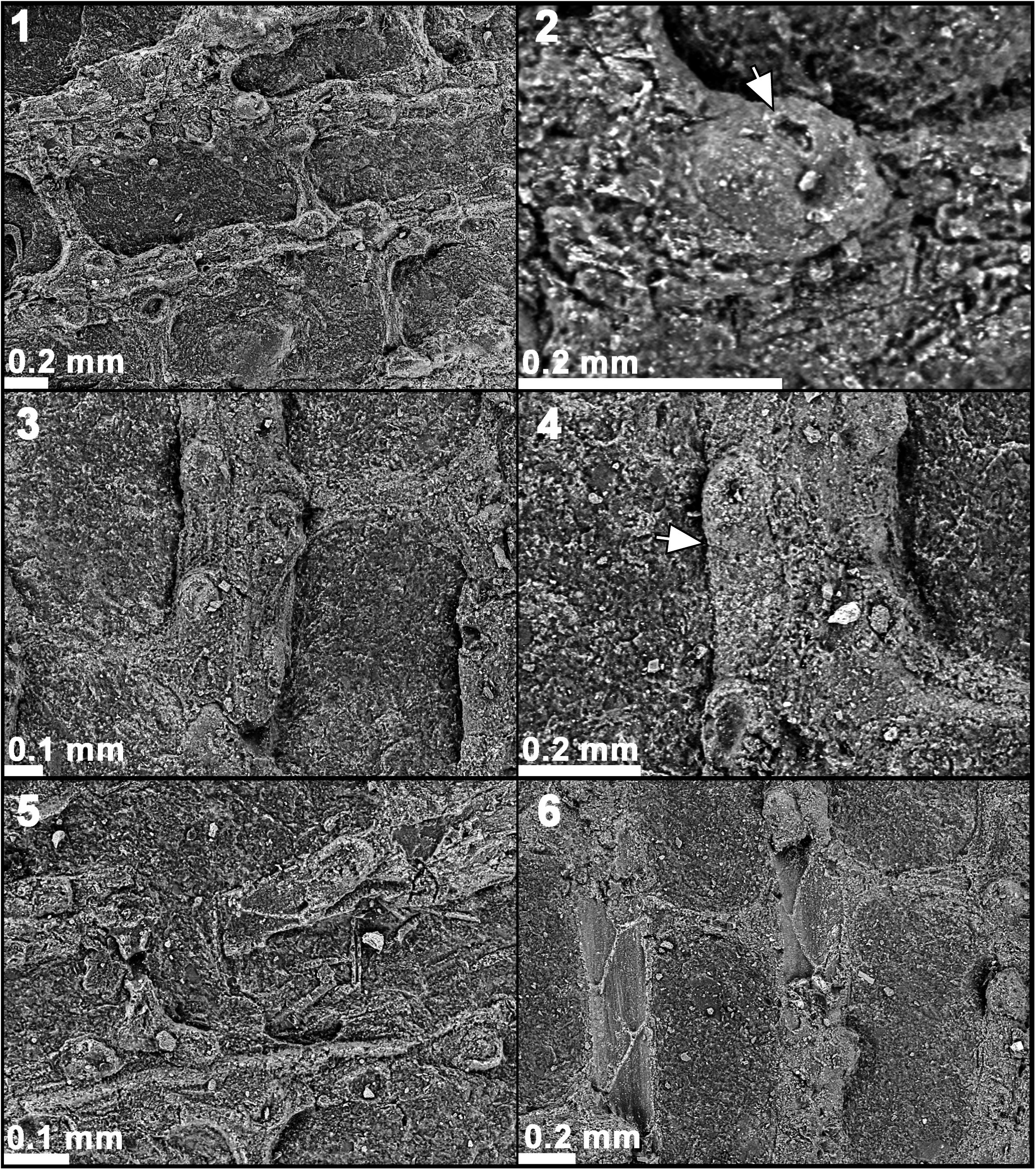
Levifenestella? sp. from the Carboniferous (upper Serpukhovian–Bashkirian) of the Pampa de Tepuel Formation, Sierra de Tepuel, central-western Patagonia, Argentina. (1–6) Cast of reticulate zoarium MPEF-PI 3429 showing obverse surface ornamented with fine longitudinal striae, detail of median keel between well-exerted autozooecial apertures, and arrangement of autozooecial apertures along fenestrules (1), autozooecial aperture with apertural pore (arrow) (2), detail showing obverse surface ornamented with fine longitudinal striae and median keel between autozooecial apertures (3), obverse surface partially and autozooecium with hemisepta (arrow) (4), median keel between autozooecial apertures (5), and autozooecial chamber bases (6).

Descriptive statistics for Levifenestella? sp. Measurements are expressed in millimeters; CV in percentage. X = arithmetic mean; SD = sample standard deviation; CV = coefficient of variation; MIN = minimum value; MAX = maximum value; N = number of measurements.

Description
Zoarium reticulate, presumably simple fan shape, composed of branches joined by thin dissepiments. There are two rows of autozooecial apertures on each branch, separated by a filiform median keel without nodes. On the obverse surface, autozooecial apertures are subcircular to tear shape in outline, with peristomes thickened distally. Apertural pore (0.02–0.04 mm in diameter) or fossula present, positioned proximally to the autozooecial aperture. There are normally three autozooecial apertures per fenestrule; the latter are rectangular in shape, rhombic after branch bifurcations. Obverse and reverse side ornamented with fine longitudinal striae; finely pustulose. Autozooecial chamber bases triangular to irregularly pentagonal at basal plate. Hemisepta present at the base of the distal tube. Axial wall between autozooecial rows zigzag at basal plate.
Material
Composite natural mold of one colony: MPEF-PI 3429 from site 5. It is from a rich fossil-bearing bed of dark gray shales, located approximately 770 m above the base of the PTF overlying the Jaramillo Formation (see Pagani and Taboada, Reference Pagani and Taboada2010). Middle section (upper Serpukhovian–Bashkirian) of the Lanipustula patagoniensis Biozone of Simanauskas and Sabattini (Reference Simanauskas and Sabattini1997).
Remarks
The studied specimen closely resembles Levifenestella Miller, Reference Miller1961 in having pentagonal-shaped autozooecial chamber bases and filiform meadian keel without nodes. However, apertural pore is unknown in Levifenestella Miller, Reference Miller1961.
Levifenestella? sp. resembles Levifenestella chubutensis Sabattini, Reference Sabattini1972 in having pentagonal-shaped chamber bases and keel without nodes. However, it differs notably from Sabattini’s species by having single instead of triserial keel, narrower autozooecial apertures (0.04–0.06 mm versus 0.12–0.15 mm, respectively) having single apertural pore, autozooecial apertures more distantly spaced along branches (0.34–0.46 mm versus 0.27–0.37 mm, respectively), and significantly wider dissepiments (0.09–0.12 mm versus 0.06–0.08 mm, respectively).
Levifenestella chubutensis Sabattini, Reference Sabattini1972 n. comb.
(1–4) Levifenestella chubutensis Sabattini, Reference Sabattini1972 from the Carboniferous (upper Serpukhovian–Bashkirian) of the Pampa de Tepuel Formation, Sierra de Tepuel, central-western Patagonia, Argentina. (1) Composite mold of reticulate zoarium MPEF-PI 5916b. (2–4) Cast of the same zoarium MPEF-PI 5916b-1 showing obverse surface and secondary nanozooecium (arrow) (2), distinct node proximally adjacent to autozooecial aperture (arrow) (3), and detail of autozooecial chamber bases (4). (5, 6) Rectifenestella tepuelensis (Sabattini, Reference Sabattini1972) from the Carboniferous (upper Serpukhovian–Bashkirian) of the Pampa de Tepuel Formation, Sierra de Tepuel, central-western Patagonia, Argentina: (5) composite mold of reticulate zoarium MPEF-PI 2073 showing general view; (6) detail of autozooecial apertures and autozooecial chamber bases.

Descriptive statistics for Levifenestella chubutensis Sabattini, Reference Sabattini1972. Measurements are expressed in millimeters; CV in percentage. X = arithmetic mean; SD = sample standard deviation; CV = coefficient of variation; MIN = minimum value; MAX = maximum value; N = number of measurements.

1972 Levifenestella chubutensis Sabattini, p. 330, pl. 10, figs. 1, 2.
1972 Levifenestella sp. II Sabattini, p. 335, pl. 10, fig. 6.
1979 Levifenestella chubutensis; Amos, p. 67, fig. 2 (cop. Sabattini, 1972).
v.2022 Levifenestella chubutensis (Sabattini, 1972); Taboada et al., p. 650, fig. 10a.
Holotype
MLP 10816 from the Pampa de Tepuel Formation; 4.3 km east of Casa Herrera (National Route 40), Sierra de Tepuel, Chubut Province, Argentina (Sabattini, Reference Sabattini1972, pl. 10, figs. 1, 2).
Description
Zoarium reticulate, presumably simple fan shape, composed of branches joined by thin dissepiments. There are two rows of autozooecial apertures on each branch, separated by a filiform, slightly undulating triserial keel, the middle more prominent. Keel with pustules but without distinct nodes. On the obverse surface, autozooecial apertures are subcircular with distinct peristomes. Distinct nodes (large styles) often present, irregularly developed proximally adjacent to autozooecial apertures. There are three zooecial apertures per fenestrule; the latter are rectangular in shape, rhombic after branch bifurcations. Reverse side of the zoarium ornamented with fine longitudinal striae; finely pustulose (styles). Autozooecial chamber bases are elongated, triangular to regularly pentagonal in shape. Distal tube surrounded by stylets indenting apertural outline. Hemisepta not observed in the available material. Axial wall between autozooecial rows zigzag at basal plate. Terminal diaphragms with a central perforation representing secondary nanozooecia often present.
Material
Composite natural molds of two colonies: MPEF-PI 5916-1 (a, b) and MPEF-PI 5916-2 (a, b) from site 5. Both colonies from a rich fossil-bearing bed of dark gray shales, located approximately 770 m above the base of the PTF overlying the Jaramillo Formation (see Pagani and Taboada, Reference Pagani and Taboada2010). Middle section (upper Serpukhovian–Bashkirian) of the Lanipustula patagoniensis Biozone of Simanauskas and Sabattini (Reference Simanauskas and Sabattini1997).
Remarks
The studied specimens fall within the range of morphologic variation exhibited in Levifenestella chubutensis Sabattini, Reference Sabattini1972 from the Carboniferous (upper Serpukhovian–Moscovian) of PTF at Sierra de Tepuel. In its original description, Levifenestella chubutensis Sabattini, Reference Sabattini1972 has been externally compared with Levifenestella limitaris (Ulrich, Reference Ulrich1890) from the Carboniferous (Viséan) of the United States, concluding that it is an endemic taxon of Patagonia (Sabattini, Reference Sabattini1972, p. 330–331). Furthermore, the Viséan species has subsequently been described as Banastella limitaris (Ulrich, Reference Ulrich1890) by having rarely distributed keel nodes, star-like shaped in cross section (after Snyder, Reference Snyder1991, p. 81–83), unlike L. chubutensis Sabattini, Reference Sabattini1972.
In addition, L. chubutensis Sabattini, Reference Sabattini1972 differs from the type species L. maeve Miller, Reference Miller1961 mainly by having three instead of four to five autozooecial apertures per fenestrule and by having significantly narrower dissepiments (0.06–0.10 mm versus 0.10–0.20 mm, respectively).
Genus Rectifenestella Morozova, Reference Morozova1974
Type species
Fenestella medvedkensis Schulga-Nesterenko, Reference Schulga-Nesterenko1951 from the Carboniferous, Pennsylvanian (Kasimovian) of the Submoscovian Basin, Russia, by original designation.
Occurrence
Devonian to Permian; worldwide.
Remarks
Rectifenestella Morozova, Reference Morozova1974 differs from Fenestella Lonsdale, Reference Lonsdale and Murchison1839 in having pentagonal chamber bases instead of tetragonal–parallelogram. Rectifenestella Morozova, Reference Morozova1974 differs from Spinofenestella Termier and Termier, Reference Termier and Termier1971 in having pentagonal chamber bases instead of triangular-trapezoidal. Rectifenestella Morozova, Reference Morozova1974 differs from Ptylopora M’Coy, Reference M’Coy1844 in having a reticulate colony form instead of a pinnate one.
The original diagnosis of Rectifenestella Morozova, Reference Morozova1974 points out the presence of autozooecia having pentagonal chamber bases and superior hemisepta. However, autozooecia in Rectifenestella Morozova, Reference Morozova1974 were mentioned later as angular–rounded pentagonal in outline with superior hemisepta often absent or poorly developed (Mckinney and Kříž, Reference McKinney and Kříž1986).
Rectifenestella tepuelensis (Sabattini, Reference Sabattini1972)
Descriptive statistics for Rectifenestella tepuelensis (Sabattini, Reference Sabattini1972). Measurements are expressed in millimeters; CV in percentage. X = arithmetic mean; SD = sample standard deviation; CV = coefficient of variation; MIN = minimum value; MAX = maximum value; N = number of measurements.

1972 Fenestella tepuelensis Sabattini, p. 303, pl. 15, figs. 1, 2.
1979 Fenestella tepuelensis; Amos, p. 62, fig. 2 (cop. Sabattini, 1972).
Holotype
MLP 11305 from the Pampa de Tepuel Formation; 4.3 km east of Casa Herrera (National Route 40), Sierra de Tepuel, Chubut Province, Argentina (Sabattini, Reference Sabattini1972, pl. 4, figs. 1, 2).
Description
Zoarium reticulate, presumably simple conical, composed of branches joined by thin dissepiments. There are two rows of autozooecial apertures on each branch, separated by a distinct median keel and bearing conical nodes, with a third autozooecial aperture only immediately before a bifurcation. On the obverse surface, autozooecial apertures are circular in outline, with peristomes thickened distally. There are normally three to rarely four autozooecial apertures per fenestrule; the latter are rectangular in shape, rhombic after branch bifurcations. Obverse side of the zoarium smooth; reverse side ornamented with fine longitudinal striae, finely pustulose, and with nodes in a single median row but often irregularly distributed. Autozooecial chamber bases are rounded, triangular to pentagonal in outline. Distal tube surrounded by stylets indenting apertural outline. Hemisepta present at the base of the distal tube. Axial wall between autozooecial rows zigzag at basal plate.
Material
Composite natural mold of one colony: MPEF-PI 2073 from site 5. Additional material: natural external mold of one colony, MPEF-PI 5902 from site 5. All colonies from a rich fossil-bearing bed of dark gray shales, located approximately 770 m above the base of the PTF overlying the Jaramillo Formation (see Pagani and Taboada, Reference Pagani and Taboada2010). Middle section (upper Serpukhovian–Bashkirian) of the Lanipustula patagoniensis Biozone of Simanauskas and Sabattini (Reference Simanauskas and Sabattini1997).
Remarks
The studied specimens fall within the range of morphologic variation exhibited in Rectifenestella tepuelensis (Sabattini, Reference Sabattini1972) from the Carboniferous (upper Serpukhovian–Moscovian) of PTF, at 4.3 km east of Casa Herrera, Sierra de Tepuel, and probably from Cañadón El Culero, Pampa de Agnia (Gonzalez et al., Reference Gonzalez, Musacchio and Amos1972; Amos, Reference Amos1979). This species has originally been described as Fenestella tepuelensis Sabattini, Reference Sabattini1972. However, it could be segregated from Fenestella Lonsdale, Reference Lonsdale and Murchison1839 by having pentagonal chamber bases instead of tetragonal–parallelogram as in the latter. Indeed, Fenestella tepuelensis Sabattini, Reference Sabattini1972 closely aligns with the diagnostic features of Rectifenestella Morozova, Reference Morozova1974 (after Morozova, Reference Morozova2001); therefore, it is herein regarded as Rectifenestella tepuelensis (Sabattini, Reference Sabattini1972).
The studied specimens also fall within the range of morphologic variation exhibited in Fenestella osbornei (Crockford, Reference Crockford1949) originally described from the Booral Formation (Southern New England Fold Belt, New South Wales, Australia) and from the Neerkol Formation (Bowen Basin, Queensland, Australia) and later recorded from the Carboniferous (upper Serpukhovian) of the Booral and Kullatine formations (Southern New England Fold Belt, New South Wales, Australia) (Campbell, Reference Campbell1961), but differs mainly in having triangular to irregularly pentagonal autozooecial chamber bases instead of rhomboidal ones. However, autozooecial chamber bases in Fenestella osbornei (Crockford, Reference Crockford1949) were mentioned later as triangular to irregularly pentagonal (Campbell, Reference Campbell1961), a feature more characteristic of Rectifenestella Morozova, Reference Morozova1974.
The range of morphologic variation exhibited in the studied material is also closely comparable to that of Rectifenestella loganensis (Wass, Reference Wass1966) (Fenestrellina rectangularis Crockford, Reference Crockford1949, p. 425) originally described from the Carboniferous (upper Serpukhovian–Kasimovian) of the Neerkol Formation (Bowen Basin, Queensland, Australia) and later recorded from the Carboniferous (upper Serpukhovian) of the Booral and McInnes formations (Southern New England Fold Belt, New South Wales, Australia) and the upper levels of the Carboniferous (Serpukhovian) Poperima Formation (Bowen Basin, Queensland, Australia) (Campbell, Reference Campbell1961; Maxwell, Reference Maxwell1964, respectively), but differs from it in having considerably more closely spaced nodes (0.36–0.6 mm versus 0.6–0.78, respectively) and triangular to pentagonal chamber bases instead of pentagonal ones. In addition, a form identified as Rectifenestella cf. R. loganensis (Wass, Reference Wass1966) from the Carboniferous (upper Serpukhovian) of Antarctic Peninsula has been figured but without description (Kelly et al., Reference Kelly, Doubleday, Brunton, Dickins, Sevastopulo and Taylor2001).
Rectifenestella malchi (Crockford, Reference Crockford1949) n. comb.
Rectifenestella malchi (Crockford, Reference Crockford1949) from the Carboniferous (upper Serpukhovian–Bashkirian) of the Pampa de Tepuel Formation, Sierra de Tepuel, central-western Patagonia, Argentina. (1) Cast of reticulate zoarium MPEF-PI 5901 showing obverse surface and in association with a pectinoid bivalve. (2) Composite mold of same zoarium MPEF-PI 5901 showing autozooecial apertures and autozooecial chamber bases. (3) Detailed autozooecial chamber bases. (4) Cast of reticulate zoarium MPEF-PI 5589 showing obverse surface.

Descriptive statistics for Rectifenestella malchi (Crockford, Reference Crockford1949). Measurements are expressed in millimeters; CV in percentage. X = arithmetic mean; SD = sample standard deviation; CV = coefficient of variation; MIN = minimum value; MAX = maximum value; N = number of measurements.

1949 Fenestrellina malchi Crockford, p. 422, text-fig. 4.
1961 Fenestella cerva Campbell, p. 455, pl. 59, fig. 1a–c.
1964 Fenestella malchi (Crockford); Maxwell, p. 38, pl. 12, fig. 13.
1972 Fenestella cf. F. cerva Campbell; Sabattini, p. 319, pl. 7, fig. 1.
1972 Fenestella malchi (Crockford); Fleming, p. 4, pl. 2, figs. 1–3.
1979 Australofenestella malchi (Crockford); Engel, p. 160, pl. 4, figs. 4–9.
1979 Fenestella cf. F. cerva Campbell; Amos, p. 65, fig. 1 (cop. Sabattini, 1972).
v.2022 Fenestella cf. F. macleayensis (Campbell, 1961); Taboada et al., p. 650, fig. 9a.
v.2022 Fenestella cf. F. malchi (Crockford, 1949); Taboada et al., p. 650, fig. 9b.
Holotype
QUF 24952 from the Neerkol Formation; Malchi Creek, Rockhampton district, Queensland, Australia (Crockford, Reference Crockford1949, text-fig. 4; see Engel, Reference Engel1979).
Description
Zoarium reticulate, presumably simple fan shape, composed of branches joined by thin dissepiments. There are two rows of autozooecial apertures on each branch, separated by a median keel bearing distinct nodes, with a third autozooecial aperture only immediately before a bifurcation. On the obverse surface, autozooecial apertures are circular in outline, with peristomes thickened proximally. There are normally four to five autozooecial apertures per fenestrule; the latter are rectangular in shape, rhombic after branch bifurcations. Obverse ornamented with fine longitudinal striae; finely pustulose. Reverse side not observed in the available material. Autozooecial chamber bases pentagonal in outline. Hemisepta not observed in the available material. Axial wall between autozooecial rows undulating to zigzag at basal plate. Terminal diaphragms with a central perforation representing secondary nanozooecia poorly preserved.
Material
Composite natural molds of two colonies: MPEF-PI 5901, MPEF-PI 5589 from site 5. Both colonies from a rich fossil-bearing bed of dark gray shales, located approximately 770 m above the base of the PTF overlying the Jaramillo Formation (see Pagani and Taboada, Reference Pagani and Taboada2010). Middle section (upper Serpukhovian–Bashkirian) of the Lanipustula patagoniensis Biozone of Simanauskas and Sabattini (Reference Simanauskas and Sabattini1997).
Remarks
The studied specimens fall within the range of morphologic variation exhibited in Rectifenestella malchi (Crockford, Reference Crockford1949) as re-described by Engel (Reference Engel1975), originally described from the Neerkol Formation (Bowen Basin, Queensland, Australia) and from the Booral Formation (Southern New England Fold Belt, New South Wales, Australia); later recorded from the Carboniferous (upper Serpukhovian) of the Booral and McInnes formations (Southern New England Fold Belt, New South Wales, Australia) and from the Carboniferous (Serpukhovian–Pennsylvanian) of the Poperima Formation and lower half of the Rands Formation (Bowen Basin, Queensland, Australia) (Campbell, Reference Campbell1961; Maxwell, Reference Maxwell1964, respectively).
This species was originally described as Fenestrellina malchi Crockford, Reference Crockford1949, but later reassigned to Fenestella Lonsdale, Reference Lonsdale and Murchison1839 (Maxwell, Reference Maxwell1964; Fleming, Reference Fleming1972) and subsequently designated as the type species of Australofenestella Engel, Reference Engel1979 (Engel, Reference Engel1979, p. 154). The genus Australofenestella has been distinguished from Fenestella Lonsdale, Reference Lonsdale and Murchison1839 by having centrally perforated terminal diaphragms, and from Australopolypora Engel, Reference Engel1979 by having biserial arrangement of autozooecial apertures and median keel bearing nodes. However, perforated terminal diaphragms representing secondary nanozooecia have been also described in Fenestella Lonsdale, Reference Lonsdale and Murchison1839 and many other fenestrates (Rectifenestella Morozova, Reference Morozova1974, Laxifenestella Morozova, Reference Morozova1974, Polyporella Simpson, Reference Simpson1895, Polypora M’Coy, Reference M’Coy1844, and Penniretepora d’Orbigny, Reference d’Orbigny1849, among others), regarding this feature as an environmental or species-specific character. In addition, both Australofenestella Engel, Reference Engel1979 and Australopolypora Engel, Reference Engel1979 have been recently classified as “unrecognizable” in the last Treatise (McKinney and Wyse Jackson, Reference McKinney and Wyse Jackson2015b). Indeed, Fenestrellina malchi Crockford, Reference Crockford1949 closely aligns within the diagnostic features of Rectifenestella Morozova, Reference Morozova1974 (after Morozova, Reference Morozova2001); therefore, it is herein regarded as Rectifenestella malchi Crockford, Reference Crockford1949.
The studied specimens also show the same range of morphologic variation exhibited in Fenestella cf. F. cerva Campbell, Reference Campbell1961 described by Sabattini (Reference Sabattini1972, p. 319–321) from the Carboniferous (upper Serpukhovian–Moscovian) of PTF in two sites: 4.3 km east of Casa Herrera, Sierra de Tepuel and from a bed near Entresierras ranch, 10 km west-southwest of Colán Conhué town, Sierra de Languiñeo (Sabattini, Reference Sabattini1972, Reference Sabattini1986).
The range of morphologic variation exhibited in the studied material is also closely comparable to that of Rectifenestella macleayensis (Campbell, Reference Campbell1961) as re-described by Engel, (Reference Engel1979), originally described from the Carboniferous (upper Serpukhovian) of the Booral and Kullatine formations (Southern New England Fold Belt, New South Wales, Australia) (Campbell, Reference Campbell1961, Reference Campbell1962), but differs mainly in having shorter (1.26–2.40 mm versus 2.08–3.92 mm, respectively) and narrower (0.33–1.04 mm versus 0.56–1.66 mm, respectively) fenestrules. In addition, a form identified as Australofenestella cf. A. macleayensis (Campbell, Reference Campbell1961) from the Carboniferous (upper Serpukhovian) of Antarctic Peninsula has been figured but without description (Kelly et al., Reference Kelly, Doubleday, Brunton, Dickins, Sevastopulo and Taylor2001).
Genus Spinofenestella Termier and Termier, Reference Termier and Termier1971
1971 Alternifenestella Termier and Termier, p. 42.
Type species
Fenestella spinulosa Condra, Reference Condra1902 from the Permian, Cisuralian (Asselian–Sakmarian), of the Coal Measures of Nebraska, USA, by original designation.
Occurrence
Devonian to Permian; worldwide.
Remarks
Spinofenestella Termier and Termier, Reference Termier and Termier1971 differs from Minilya Crockford, Reference Crockford1947 in having a single row of keel nodes instead of alternating ones.
Spinofenestella sp.
Spinofenestella sp. from the Carboniferous (upper Serpukhovian–Bashkirian) of the Pampa de Tepuel Formation, Sierra de Tepuel, central-western Patagonia, Argentina. (1, 2) Composite mold of reticulate zooarium MPEF-PI 1979 showing branch bifurcation, arrangement of autozooecial apertures per fenestrule, single row of keel nodes (arrows), and autozooecial chamber with hemisepta (arrowheads) (1), and detail of the obverse surface and autozooecial apertures (2). (3) Cast of same zooarium MPEF-PI 1979 showing obverse surface, autozooecial aperture with low peristome bearing pustules (arrow), and autozooecial chamber bases. (4–6) Composite mold of same zooarium MPEF-PI 1979 showing arrangement of autozooecia (4), autozooecial chambers with hemisepta (arrowheads) and obverse surface (5), and detailed autozooecial chamber bases (6).

Descriptive statistics for Spinofenestella sp. Measurements are expressed in millimeters; CV in percentage. X = arithmetic mean; SD = sample standard deviation; CV = coefficient of variation; MIN = minimum value; MAX = maximum value; N = number of measurements.

Description
Zoarium reticulate, composed of branches joined by thin dissepiments. There are two rows of autozooecial apertures on each branch, separated by a median keel bearing distinct nodes. On the obverse surface, autozooecial apertures are subcircular in shape, with low peristomes. There are three autozooecial apertures per fenestrule; the latter are rectangular in shape, rhombic after branch bifurcations. Obverse and reverse side of the zoarium ornamented with fine longitudinal striae. Autozooecial chamber bases triangular–trapezoidal in outline, subpentagonal proximal to branch bifurcation. Hemisepta present at the base of the distal tube. Axial wall between autozooecial rows strongly zigzag at basal plate.
Material
Composite natural mold of one colony: MPEF-PI 1979 from site 5. Colony from a rich fossil-bearing bed of dark gray shales, located approximately 770 m above the base of the PTF overlying the Jaramillo Formation (see Pagani and Taboada, Reference Pagani and Taboada2010). Middle section (upper Serpukhovian–Bashkirian) of the Lanipustula patagoniensis Biozone of Simanauskas and Sabattini (Reference Simanauskas and Sabattini1997).
Remarks
The studied specimen resembles Spinofenestella major (Nikiforova, Reference Nikiforova1933) sensu Ernst et al. (Reference Ernst, Wyse Jackson and Aretz2015), originally described from the Carboniferous, Mississippian–Pennsylvanian (Viséan–Bashkirian) of Ukraine and later described from the Mississippian (upper Viséan) of France, Mississippian (Serpukhovian) of Russia, and Mississippian–Pennsylvanian (Serpukhovian–Bashkirian) of Kazakhstan, but differs in having wider autozooecial apertures (0.13–0.15 mm versus 0.075–0.08 mm, respectively) and larger maximum chamber width (0.12–0.17 mm versus 0.10–0.12 mm, respectively), and significantly more widely spaced nodes (0.43–0.54 mm versus 0.14–0.18 mm, respectively). In addition, the studied specimen differs from Alternifenestella cf. A. major described by Sakagami et al. (Reference Sakagami, Sciunnach and Garzanti2006) from the Carboniferous (Bashkirian) of South Tibet mainly in having longer fenestrules (0.77–1.02 mm versus 0.60–0.65 mm, respectively) and wider autozooecial apertures (0.13–0.15 mm versus 0.12 mm, respectively).
The range of morphologic variation exhibited in the studied specimen also resembles Fenestella sp. III described by Sabattini (Reference Sabattini1972, p. 324–325) from the PTF, northeast of Benito Aleman ranch, Sierra de Languiñeo, but differs mainly in having three autozooecial apertures per fenestrule instead of single ones and wider autozooecial apertures (0.13–0.15 mm versus 0.10–0.13 mm, respectively). Furthermore, Fenestella sp. III described by Sabattini (Reference Sabattini1972) could be segregated from Fenestella Lonsdale, Reference Lonsdale and Murchison1839 by having trapezoidal chamber bases instead of tetragonal–parallelogram chambers bases and presence of autozooecia with inferior hemisepta.
Genus Paraptylopora Morozova, Reference Morozova2001
Type species
Ptylopora varioclada Schulga-Nesterenko, Reference Schulga-Nesterenko1941 from the Permian, Cisuralian (Sakmarian), of the central Urals, by original designation.
Occurrence
Carboniferous to Permian, Cisuralian (Artinskian). Carboniferous, Mississippian (Tournaisian–Viséan/Serpukhovian?), Australia. Carboniferous, Mississippian (Viséan), Ireland. Carboniferous, Mississippian–Pennsylvanian (upper Serpukhovian–Bashkirian), Argentina. Carboniferous, Pennsylvanian (upper Moscovian–upper Gzhelian), Svalbard. Permian, Cisuralian (Sakmarian), central Urals. Permian, Cisuralian (Sakmarian–Artinskian), Austria.
Remarks
Paraptylopora Morozova, Reference Morozova2001 differs from Ptylopora M’Coy, Reference M’Coy1844 mainly in having autozooecia with hemisepta and alternating rows of keel nodes instead of being single-rowed. Paraptylopora Morozova, Reference Morozova2001 differs from Fabifenestella Morozova, Reference Morozova1974 in having pinnate colony form instead of reticulate. Paraptylopora Morozova, Reference Morozova2001 differs from Polycladiopora Morozova, Reference Morozova2001 mainly in lacking autozooecia on the dissepiments.
The original diagnosis of Paraptylopora Morozova, Reference Morozova2001 points out the presence of low keel with alternating keel nodes, autozooecia bean shaped (= fabiform) in tangential section and having hemisepta. Moreover, keel nodes in Paraptylopora Morozova, Reference Morozova2001 were mentioned later as occurring in a single row, besides the tetragonal to pentagonal shape of autozooecial chambers in deep to mid-tangential sections and having well-developed hemisepta (after Morozova, Reference Morozova2001; Ernst, Reference Ernst2003).
During the Carboniferous, many Ptylopora-like species could be segregated from Ptylopora M’Coy, Reference M’Coy1844 sensu stricto as re-described by Wyse Jackson et al. (Reference Wyse Jackson, Mckinney and Bancroft2005) because of the presence of hemisepta, and this reason was the principal criterion for species re-assignment from Ptylopora M’Coy, Reference M’Coy1844 to Paraptylopora Morozova, Reference Morozova2001 (i.e., Wyse Jackson et al., Reference Wyse Jackson, Mckinney and Bancroft2005). Same criteria could be applied to other Carboniferous Ptylopora-like species from the Tournaisian–Viséan/?Serpukhovian of Australia (Crockford, Reference Crockford1947; Maxwell, Reference Maxwell1964), from the upper Moscovian–upper Gzhelian of Svalbard (Nakrem, Reference Nakrem1994, Reference Nakrem, Wyse Jackson, Buttler and Spencer Jones2002), and from the Patagonian material. Moreover, none of these Carboniferous species has alternating rows of keel nodes as in Paraptylopora Morozova, Reference Morozova2001 sensu stricto. Nevertheless, the presence of hemisepta has been regarded as a main feature in the taxonomy of fenestrates (Morozova, Reference Morozova2001). This aforementioned characteristic allows us to assign one new species to Paraptylopora Morozova, Reference Morozova2001 instead of to Ptylopora M’Coy, Reference M’Coy1844.
Although it is beyond the scope of the present research, additional work is needed to reveal whether this new species, along with the carboniferous species mentioned in the preceding, undoubtedly belong to Paraptylopora Morozova, Reference Morozova2001 or actually belong to other closely related taxa not yet described. For example, the presence (or absence) and type of nodes on the keel (i.e., singular or alternating) have been used to distinguish between reticulate fenestellids displaying both similar colony form and autozooecial morphology (e.g., Levifenestella Miller, Reference Miller1961 lacks keel nodes, instead Rectifenestella Morozova, Reference Morozova1974 has keel nodes in a single row; Spinofenestella Termier and Termier, Reference Termier and Termier1971 has keel nodes in a single row instead of alternating ones as in Minilya Crockford, Reference Crockford1947; similarly, Exfenestella Morozova, Reference Morozova1974 has a single row of keel nodes instead of alternating ones as in Fabifenestella Morozova, Reference Morozova1974) (after Morozova, Reference Morozova2001).
Paraptylopora gondwanica new species
Paraptylopora gondwanica n. sp. from the Carboniferous (upper Serpukhovian–Bashkirian) of the Pampa de Tepuel Formation, Sierra de Tepuel, central-western Patagonia, Argentina. (1–6) Composite mold of pinnate zoarium MPEF-PI 5900 showing general view and dissepiments (arrows) and pillars (arrowheads) (1), autozooecial chamber bases on main stem and lateral branches (2), detail of autozooecial chamber bases (arrow points to hemisepta) (3), obverse surface, autozooecial apertures, and dissepiment (arrows) (4–6).

Descriptive statistics for Paraptylopora gondwanica n. sp. Measurements are expressed in millimeters, except for angles in decimal degrees; CV in percentage. X = arithmetic mean; SD = sample standard deviation; CV = coefficient of variation; MIN = minimum value; MAX = maximum value; N = number of measurements.

Holotype
Composite natural mold of one colony: MPEF-PI 5900 from site 5. Colony from a rich fossil-bearing bed of dark gray shales, located approximately 770 m above the base of the PTF overlying the Jaramillo Formation (see Pagani and Taboada, Reference Pagani and Taboada2010). Middle section (upper Serpukhovian–Bashkirian) of the Lanipustula patagoniensis Biozone of Simanauskas and Sabattini (Reference Simanauskas and Sabattini1997).
Diagnosis
Zoarium pinnate composed of wider main branch and narrower opposite, nearly opposite, or alternating lateral branches joined by sterile dissepiments. Some lateral branches thickened and developed subordinate pinnae. Two rows of autozooecial apertures on each branch. Three autozooecial apertures between two consecutive lateral branches, four to six per fenestrule. Keel with single row of distinct nodes. Autozooecial chamber bases elongate, irregularly triangular–pentagonal to bean shaped. Hemisepta present. Distal tube surrounded by stylets indenting apertural outline.
Description
Zoarium pinnate composed of main branch and opposite, nearly opposite, or alternating lateral branches joined by long, sterile striated dissepiments. Some lateral branches thickened and developed subordinate pinnae. There are two rows of autozooecial apertures on each branch, separated by a median keel bearing distinct nodes with elliptical base. On the obverse surface, autozooecial apertures are subcircular in outline, with low peristomes bearing pustules (stylets). There are four to six autozooecial apertures per fenestrule, which are rectangular, rhombic, or subpentagonal in shape. There are three autozooecial apertures in the interval between two consecutive lateral branches. Obverse side of the zoarium ornamented with fine longitudinal striae; reverse side unknown. Autozooecial chamber bases elongate, irregularly triangular–pentagonal in outline, reaching bean shaped in the main branch. Distal tube surrounded by stylets indenting apertural outline. Hemisepta present at the base of the distal tube. Axial wall between autozooecial rows strongly zigzag at basal plate. Pillars with spines or reverse barbs rarely preserved.
Etymology
Species name refers to its occurrence in the Gondwana paleocontinent.
Remarks
This work constitutes the first record of the genus in Argentina. Paraptylopora gondwanica n. sp. resembles Ptylopora konincki (Crockford, Reference Crockford1947) from the lower Carboniferous (Tournaisian–Viséan) of New South Wales at Glen William and Rouchel Brook (Burindi Group), Australia, in the presence of second-order main branches and in having similar dimensions of the main branch and the dissepiments. However, it differs by having wider autozooecial apertures (0.12–0.17 mm versus 0.08–0.11 mm, respectively), autozooecial apertures more widely spaced (0.35–0.51 mm versus 0.31–0.38 mm, respectively), lateral branches more widely spaced (1.49–2.99 mm versus 0.8–2.23, respectively), wider lateral branches (0.3–0.36 mm versus 0.16–0.32, respectively), and more elongate irregularly triangular–pentagonal to bean-shaped autozooecial chamber bases instead of triangular ones as in the Australian species. P. konincki (Crockford, Reference Crockford1947) could be segregated from Ptylopora M’Coy, Reference M’Coy1844 sensu stricto because of the presence of triangular instead of pentagonal autozooecial chamber bases and autozooecia with well-developed hemisepta, a feature more characteristic of Paraptylopora Morozova, Reference Morozova2001. Furthermore, P. konincki (Crockford, Reference Crockford1947) has been also recorded from the Carboniferous (Serpukhovian) of the Poperima Formation (Bowen Basin, Queensland), eastern Australia.
Paraptylopora gondwanica n. sp. is similar to P. parva (Tavener-Smith, Reference Tavener-Smith1973) from the Mississippian (Viséan) of Ireland in width of lateral branches but differs in having thinner main branches, irregularly triangular–pentagonal autozooecial chamber bases instead of “D shaped,” and longer autozooecia lacking well-developed inferior hemisepta.
Paraptylopora gondwanica n. sp. is comparable to “Ptylopora” sp. briefly described in Nakrem (Reference Nakrem, Wyse Jackson, Buttler and Spencer Jones2002) from middle Carboniferous (upper Moscovian) outcrops of Spitsbergen, Svalbard, by the presence of hemisepta at the base of the distal tube but differs by having irregularly triangular–pentagonal to bean-like zooecial shape instead of rectangular to pentagonal and by the absence of well-developed inferior hemisepta. The characteristic features seen in “Ptylopora” sp. in Nakrem (Reference Nakrem, Wyse Jackson, Buttler and Spencer Jones2002) are more related to Paraptylopora Morozova, Reference Morozova2001.
Paraptylopora gondwanica n. sp. resembles Ptylopora sp. A described by Nakrem (Reference Nakrem1994, p. 100–102) from the Carboniferous, Pennsylvanian (upper Gzhelian) of Spitsbergen, Svalbard, mainly by the presence of hemisepta at the base of the distal tube, but clearly differs by having irregularly triangular–pentagonal to bean-like zooecial shape instead of oval to bean shaped and by having a narrower main branch (0.38–0.52 mm versus 0.63–0.71 mm, respectively), wider autozooecial apertures (0.12–0.18 mm versus 0.10–0.11 mm, respectively), and keel nodes more distantly spaced (0.60–1.18 m versus 0.60–0.64 mm, respectively). Moreover, characteristic features seen in Ptylopora sp. A in Nakrem (Reference Nakrem1994) are more related to Paraptylopora Morozova, Reference Morozova2001. There are no other comparable species known by the authors.
“Fenestellida sp. indet. aff. Paraptylopora ”
“Fenestellida sp. indet. aff. Paraptylopora” from the Carboniferous (upper Serpukhovian–Bashkirian) of the Pampa de Tepuel Formation, Sierra de Tepuel, central-western Patagonia, Argentina. (1–4) Composite mold of pinnate zoarium MPEF-PI 5907-1 (a, b) showing general view (1), main branch bifurcation and lateral branches with dissepiments (2), detailed autozooecium chamber base (3), obverse surface, autozooecial apertures, and median keel (4). (5) Cast of same zooarium MPEF-PI 5907-1 (a, b) showing obverse surface and secondary nanozooecium (arrow).

Descriptive statistics for “Fenestellida sp. indet. aff. Paraptylopora.” Measurements are expressed in millimeters, except for angles in decimal degrees; CV in percentage. X = arithmetic mean; SD = sample standard deviation; CV = coefficient of variation; MIN = minimum value; MAX = maximum value; N = number of measurements.

v.2022 Ptylopora sp., Taboada et al., p. 650, fig. 9e.
Description
Zoarium pinnate composed of a main branch from which arise nearly opposite lateral branches; they arise at regular intervals and are joined by long, sterile, and striated dissepiments. There are two rows of autozooecial apertures on each branch, separated by a sinuous, filiform median keel and bearing widely spaced elliptical nodes. On the obverse surface, autozooecial apertures are subcircular to pear shape, with low peristomes. Stylets indent the apertural outline. There are four to six zooecial apertures per fenestrule; the latter are rectangular, rhombic, or subpentagonal in shape. There are two to three autozooecial apertures in the interval between two consecutive lateral branches. Obverse and reverse side of the zoarium ornamented with fine longitudinal striae; those on the reverse surface finely pustulose (styles). Autozooecial chamber bases flat, tetragonal (main branch) to pentagonal (lateral branches) in outline. Hemisepta not observed in the available material. Axial wall between autozooecial rows is straight (main branch) to weakly undulating (lateral branches) at basal plate. Terminal diaphragms with a central perforation representing secondary nanozooecia rarely present.
Material
Composite natural molds of two colonies: MPEF-PI 5907-1 (a, b) and MPEF-PI 5907-2 (a, b) from site 3. Both colonies from a rich fossil-bearing bed of dark gray shales, located approximately 770 m above the base of the PTF overlying the Jaramillo Formation (see Pagani and Taboada, Reference Pagani and Taboada2010). Middle section (upper Serpukhovian–Bashkirian) of the Lanipustula patagoniensis Biozone of Simanauskas and Sabattini (Reference Simanauskas and Sabattini1997).
Remarks
“Fenestellida sp. indet. aff. Paraptylopora” differs from Paraptylopora gondwanica n. sp. mainly in having tetragonal to pentagonal autozooecial chamber bases instead of triangular–pentagonal to bean shape, filiform keel with smaller nodes and terminal diaphragms (nanozooecia). Moreover, the main branch is wider (0.44–0.63 mm versus 0.37–0.52 mm, respectively), the lateral branches are closer (1.91–2.38 mm versus 1.49–2.99 mm, respectively), and there are longer distances between autozooecial apertures (0.43–0.70 mm versus 0.35–0.51 mm, respectively) as well as between consecutive nodes (0.83–1.51 mm versus 0.60–1.18 mm, respectively).
“Fenestellida sp. indet. aff. Paraptylopora” differs notably from both Paraptylopora konincki (Crockford, Reference Crockford1947) by having a more robust mesh, tetragonal to pentagonal autozooecial chamber bases instead of triangular ones, terminal diaphragms, and autozooecia lacking well-developed inferior hemisepta.
“Fenestellida sp. indet. aff. Paraptylopora” shares only superficial affinity with Paraptylopora Morozova, Reference Morozova2001 but differs in having different autozooecial shape (tetragonal to pentagonal versus tetragonal–pentagonal to bean shaped, respectively), singular row of keel nodes instead of alternating ones, and autozooecia lacking well-developed hemisepta. “Fenestellida sp. indet. aff. Paraptylopora” resembles Ptylopora M’Coy, Reference M’Coy1844 in having keel nodes in a single row but differs notably from it in having tetragonal to pentagonal chamber bases instead of pentagonal to hemi-hexagonal. On the basis of these comparative morphological characteristics, “Fenestellida sp. indet. aff. Paraptylopora” is apparently neither congeneric nor conspecific with any of the known Carboniferous species referred to the Fenestellidae. However, the available material may lack the reliability needed for discerning fine diagnostic features and replicated measures supporting the erection and introduction of a new genera and species for this taxon. The aforementioned influence us to leave the former taxon in open nomenclature until additional material becomes available.
Bryozoan fauna composition and characterization
Bryozoans in the PTF are represented by fenestrates, cystoporates, and rhabdomesines (Sabattini, Reference Sabattini1972, Reference Sabattini1983, Reference Sabattini1990, Reference Sabattini2002; Pagani and Taboada, Reference Pagani and Taboada2010; Taboada et al., Reference Taboada, Pagani, Pinilla, Taboada, Robles Vilches, Pardo and Giacosa2022). Trepostomes have not been recorded in CW Patagonia during the LPIA, according to the known records from bryozoan-bearing localities (Pagani and Taboada, Reference Pagani and Taboada2010; Taboada et al., Reference Taboada, Pagani, Pinilla, Taboada, Robles Vilches, Pardo and Giacosa2022). Fenestrates Septatopora Engel, Reference Engel1975, Fenestella Lonsdale, Reference Lonsdale and Murchison1839, Levifenestella Miller, Reference Miller1961, Thamniscus King, Reference King1849, Penniretepora d’Orbigny, Reference d’Orbigny1849, Australlofenestella Engel, Reference Engel1979, Australlopolypora Engel, Reference Engel1979, Polypora M’Coy, Reference M’Coy1844; rhabdomesine Rhombopora Meek, Reference Meek and Hayden1872, cystoporate Fistulamina Crockford, Reference Crockford1949, and ?ctenostome Eliasopora Bassler, Reference Bassler1952 were earlier recorded from several fossil-bearing beds from PTF and correlative units, totaling up to 29 species (Sabattini, Reference Sabattini1972, Reference Sabattini1982, Reference Sabattini1983, Reference Sabattini1986, Reference Sabattini1990, Reference Sabattini2002). Moreover, important improvements in modern taxonomy and systematics of bryozoans were made throughout the second half of the twentieth and the beginning of the twenty-first centuries (see Morozova, Reference Morozova1974, Reference Morozova2001), affecting taxonomic identities of the previously identified species from the PTF and other Argentinean formations (i.e., La Capilla Formation and Hoyada Verde Member of the San Eduardo Formation, Calingasta–Uspallata Basin, CW Argentina).
In reviewing new and existing records, the following three issues are worthy of discussion: (1) the genera Levifenestella Miller, Reference Miller1961, Australofenestella Engel, Reference Engel1979, and Australopolypora Engel, Reference Engel1979 were classified as “unrecognizable” in the last Treatise leaving previously recognized PTF bryozoans species as species inquirenda (McKinney and Wyse Jackson, Reference McKinney and Wyse Jackson2015b); (2) PTF species previously classified as Fenestella Lonsdale, Reference Lonsdale and Murchison1839 could be segregated by having different autozooecial morphology or were named considering only external features, and their status remains unclear; (3) 80% of previously recognized PTF bryozoan species have been considered endemic to Patagonia (Sabattini, Reference Sabattini1986, Reference Sabattini1990, Reference Sabattini2002).
Our study has provided additional new records of Levifenestella Miller, Reference Miller1961, Rectifenestella Morozova, Reference Morozova1974, Spinofenestella Termier and Termier, Reference Termier and Termier1971, Paraptylopora Morozova, Reference Morozova2001 , Polyporella Simpson, Reference Simpson1895, Penniretepora d’Orbigny, Reference d’Orbigny1849, Septatopora Engel, Reference Engel1975, and other fenestellids still under study, in association with some species in Fistulamina Crockford, Reference Crockford1947 and a form closely comparable to Rhombopora? bifurcata Campbell, Reference Campbell1961 (Pagani and Taboada, Reference Pagani and Taboada2010; Taboada, Reference Taboada2018; Taboada et al., Reference Taboada, Pagani, Pinilla, Taboada, Robles Vilches, Pardo and Giacosa2022). In this sense, principal modern criteria for fenestrate taxonomy (sensu Hageman, Reference Hageman1991; Morozova, Reference Morozova2001; Hageman and McKinney, Reference Hageman and McKinney2010; McKinney and Wyse Jackson, Reference McKinney and Wyse Jackson2015a) and modern microscopic methods will be key to the discrimination and characterization of bryozoans from the entire Tepuel–Genoa Basin, to assess their stratigraphical and paleobiogeographical significance. This topic will be the principal scope of a future paper by the present authors.
Herein we described 12 fenestrate species belonging to six or possibly more genera. Penniretepora d’Orbigny, Reference d’Orbigny1849, Polyporella Simpson, Reference Simpson1895, Rectifenestella Morozova, Reference Morozova1974, and Spinofenestella Termier and Termier, Reference Termier and Termier1971 are cosmopolitan and stratigraphically widely distributed. Levifenestella Miller, Reference Miller1961 is currently known in the Carboniferous and Permian of the Urals and the Paleotethys, in the Carboniferous of the Midcontinent, in the Upper Mississippian–Lower Pennsylvanian of southwestern Gondwana, and in the Permian Cisuralian of southeastern Gondwana (after Sabattini, Reference Sabattini1972; Ross and Ross, Reference Ross, Ross, MacKerrow and Scotese1990; Reid, Reference Reid2010, and references therein). Paraptylopora Morozova, Reference Morozova2001 is known from Carboniferous to Cirsuralian (Viséan–Artinskian) rocks of the Urals and the Paleotethys (after Morozova, Reference Morozova2001; Morozova and Lisitsyn, Reference Morozova and Lisitsyn2002; Ernst, Reference Ernst2003; Wyse Jackson et al., Reference Wyse Jackson, Mckinney and Bancroft2005). Records from southern Gondwana are known in the Mississippian–Pennsylvanian of CW Patagonia (this study) and presumably in the Mississippian of Australia (Crockford, Reference Crockford1947; Maxwell, Reference Maxwell1964). Furthermore, some species similar to Paraptylopora Morozova, Reference Morozova2001 are known from the Pennsylvanian of Svalbard (Nakrem, Reference Nakrem1994; Nakrem, Reference Nakrem, Wyse Jackson, Buttler and Spencer Jones2002), so the presence of the genus in the Arctic cannot be ruled out. Septatopora Engel, Reference Engel1975 (Viséan–Kasimovian) is restricted to southern Gondwana basins. The species Septatopora pustulosa (Crockford, Reference Crockford1949), Polyporella neerkolensis (Crockford, Reference Crockford1949), and Rectifenestella malchi (Crockford, Reference Crockford1949) occur in the Upper Mississippian–Pennsylvanian (upper Serpukhovian–Kasimovian) of Queensland, Australia (Bowen Basin) and the Upper Mississippian (upper Serpukhovian) of New South Wales, Australia (Southern New England Fold Belt). Polyporella neerkolensis (Crockford, Reference Crockford1949) has been also recorded from the Carboniferous (upper Serpukhovian–lower Bashkirian) of CW Argentina and from faunal components of the cold-water Lanipustula patagoniensis Biozone (upper Serpukhovian–Moscovian) and the younger Verchojania inacayali Biozone (Moscovian?–Kasimovian) of CW Patagonia. However, species herein described came from the middle section of the Lanipustula patagoniensis Biozone and could be largely constrained to the upper Serpukhovian–Bashkirian due to the stratigraphic position of the studied fauna. Finally, 75% of the studied fenestrate species are unknown outside CW Patagonia, suggesting some degree of biogeographical isolation, while the remaining 25% supports faunal migration pathways between the western and eastern margins of southern Gondwana during the LPIA.
Paleoecology
In the studied assemblage, the paleostomate bryozoans possess erect rigid delicate colonies that are reticulate, branching, or pinnate in order of abundance. Reticulate growth habits are represented by oligoserial Polyporella Simpson, Reference Simpson1895 and Septatopora Engel, Reference Engel1975 species and by biserial forms of Fenestellidae. Branching growth habits are represented by thin ramose colonies of ?Rhombopora Meek, Reference Meek and Hayden1872 and the thin bifoliate Fistulamina Crockford, Reference Crockford1947. Pinnate growth habits are represented by the biserial Penniretepora d’Orbigny, Reference d’Orbigny1849. There is a clear dominance of reticulate bi-oligoserial growth habits (flabelliform and/or infundibuliform) followed by erect branching oligoserial bifoliate, while erect branching oligoserial ramose and biserial pinnate growth habits are subordinate forms.
The present bryozoan association is also characterized by colonial morphotypes lacking a robust or massive appearance and the development of macules, monticules, or superstructures. Although root-like structures were often not recorded, some fenestrate pillars (sensu Bancroft, Reference Bancroft1988; McKinney and Wyse Jackson, Reference McKinney and Wyse Jackson2015a) were identified by the authors in the studied material. Despite the fact that bryozoan colonies are partially fragmented, they do not appear to have been widely transported, often reaching a significant size, and lacking signs of severe abrasion, which may have favored the preservation of external ornamentation.
In modern austral seas, this type of growth habit association is linked to a middle shelf (80 to 110 m depth) through upper deep shelf (110 to 140 m depth) reaching the lower deep shelf setting (140 to 220 m depth), or within an outer shelf (80 to 180 m depth) to a slope setting (160 to 450 m depth) (Hageman et al., Reference Hageman, Bone, Mcgowran and James1997; Amini et al., Reference Amini, Adabi, Burrett and Quilty2004). In high-latitude lower Permian Gondwana outcrops, erect fenestrate and delicate branching growth habits along with productid and spiriferid brachiopods dominated in low-energy environments typical of offshore or mid- to outer-shelf settings, but also they could be found in calm shallow-water onshore settings in protected areas (Reid, Reference Reid2010). These mixed bryozoan–brachiopod associations occur commonly in siltstones or bioclastic limestones and linked to onshore–offshore transgressive depositional settings (Reid, Reference Reid2010).
The bryozoan growth habit association from the middle part of the PTF co-occurs with brachiopods (productids and spiriferids), bivalves (pectinoids and limoids), crinoids, sporadically ostracods, and very few colonial and solitary corals (see Pagani and Taboada, Reference Pagani and Taboada2010; Taboada et al., Reference Taboada, Pagani, Pinilla, Taboada, Robles Vilches, Pardo and Giacosa2022). The studied bryozoans are not found encrusting bioclasts or shells, and they were not encrusted by epibionts. Hierarchical tiering occupancy for PTF benthic invertebrates is semi-infaunal, lower epifaunal, and erect epifaunal in the sediment–water column boundary. Bryozoans, crinoids, and corals all exhibit erect epifaunal growth habits (unpublished data, Taboada, Reference Taboada2018). Productids have semi-infaunal free-lying growth habits, whereas spiriferids commonly have an epifaunal free-lying growth habit but semi-infaunal free-lying is also present (Robles Vilches, Reference Robles Vilches2016). Productids dominate among the brachiopods and may be indicative of low-nutrient settings (Pérez-Huerta and Sheldon, Reference Pérez-Huerta and Sheldon2006). Bivalves developed epifaunal (supported and/or epibyssate) or semi-infaunal (endobyssate) growth habits (Pagani and Taboada, Reference Pagani and Taboada2010). Both brachiopods and bivalves are common to abundant faunal elements in the studied fauna (unpublished data, Taboada, Reference Taboada2018). The dominance of stationary suspension-feeding growth habits is indicative of low turbidity levels, and the abundance of strictly stenohaline faunal elements (i.e., bryozoans, strophomenid brachiopods, and crinoids) indicates normal marine water. The aforementioned suggests the bryozoan growth habit association and accompanying fauna developed in an environmental setting characterized by deep quiet water (>80 m depth), with normal marine salinity, slow sedimentation rate, and soft to firm substrate. The depositional environment corresponds well with a mid-shelf to upper-slope setting, while a transgressive system tract character for the sampled fossil-bearing bed is well supported from the present analysis and available sedimentological data.
Concluding remarks
We described new records of bryozoan species from Patagonia. In addition to those reported in previous studies, 12 species from the Pampa de Tepuel Formation are described herein, including Paraptylopora gondwanica n. sp. These new records add to the taxonomic diversity of the Carboniferous bryozoan assemblage of CW Patagonia. The studied fossil-bearing horizon could be largely constrained to the Upper Mississippian–Lower Pennsylvanian (upper Serpukhovian–Bashkirian) of the Carboniferous. The sampled fossil-bearing bed corresponds well with a mid-shelf to upper-slope environment in a transgressive depositional setting.
Acknowledgments
A.C. Taboada, C. Pardo, J. Isbell, M. Fraiser, C. González, P. Diaz Saravia, I. Escapa, M. Ferrari, P. Puerta, L. Canessa, M. Caffa, J. Gallego, and D. Menghini participated in field trips, and their help is greatly acknowledged. Many thanks are expressed to E. Ruigomez (MEF Collection Manager) for his help in the laboratory and in obtaining digital images. Thanks are extended to L. Canessa (MEF Staff) who prepared rubber casts. SEM photographs were taken with the help of M. Luquet. We acknowledge the reviewers A. Ernst and C. Reid, and the associate editor M. Key, for their very helpful advice and comments that significantly improved this work. Financial support and logistics were provided by the MEF (Trelew, Argentina) and CIEMEP (Esquel, Argentina). Financial support was also granted by Consejo Interuniversitario Nacional (CIN) through an undergraduate research studentship to C.A.T., and from Asociación Paleontológica Argentina (APA) and Fundación Bunge y Born (B&B) through an undergraduate research grant to C.A.T. Moreover, this work was carried out during the tenure of a CONICET research studentship to C.A.T.
Competing interests
The authors declare none.