Today, Captain Ropars is fondly, albeit mythically, remembered by Ida ou Zeddout Ishelhin as the blond rumi (‘Roman,’ or European) in the time of ‘colonialism’ (al isti‘mar) who spoke Tashelhit; an unusually light-haired Zeddouti man in the 1990s was nicknamed Ropars. The original Ropars, though, as head of a rural military outpost, voiced a consequential language ideology that was prevalent from the early days of French colonial native policy (politique indigène) and its planning across Africa. Unfortunately, no jail or court records remain that could confirm whether Ropars acted on his language policing. However, the archival record is replete with evidence that French military officers and administrators like him went to great lengths to prevent language shift in the countryside from vernacular Berber to vernacular Arabic, as they had attempted to do in the neighboring colony of Algeria from 1830. Mentions of Arabic language in the colonial archive consistently characterize it as wedded to Islamic religion and thus inherently anti-European, even xénophobe. The indivisibility of Arabic and Islam echoed pre-colonial, Salafist associations (McDougall Reference McDougall2003; Merad Reference Merad1967). Nationalist rhetoric across North Africa returned to the semiotic content of the Salafis, inverted the negative associations of colonial rhetoric, and positively endowed Arabo-Islamism as the foundation for an emergent anti-colonialism.
What was commonly called France's politique berbère (Berber policy) and later its politique indigène (native policy)—a less explicitly ethnic framing—was principally concerned with identifying and codifying the political, linguistic, and legal practices particular to different tribes and tribal sections—social groups whose geographical and political limits during the Protectorate were officially determined by French military and Native Affairs officers. Key to colonialism's cultural policy was the management of difference, and linguistic difference appeared easy to ascertain. Descriptions of the subject populations in terms of their social organizational, cultural, or linguistic practices were common to colonial projects, Irvine and Gal argue, because they “made it possible to imply that indigenous political structures were epiphenomenal and dispensable” (2000: 50). With a few exceptions such as Captain Ropars, Native Affairs officers, like European settlers (colons) in North Africa, were typically more competent in speaking colloquial Arabic than Berber, and their language practices arguably accelerated a language shift away from Berber toward vernacular Arabic, and increased the prestige of using classical Arabic outside of religious domains (Bourilly Reference Bourilly1932: 39).
In this article, I consider the linguistic ideological underpinnings of both French native policies and the scholarly studies that bolstered them in the first two decades of the Moroccan Protectorate. Reflections on language emerge from reports of high-ranking French authorities, including the residents general and their advisors, regional military and civil commanders, and bureau chiefs, and also from reports produced by the lower-ranking (but industrious) rural Native Affairs officers, interns, inspectors, and civil translators. Protectorate officials consulted this array of sources when formulating policy. In some instances, the best scholarship came from enlisted or then-career military professionals; later generations knew Berque (Reference Berque1967), Montagne (Reference Montagne1973 [1931]), and Laoust (Reference Laoust1920) not as Protectorate civil and military officials but rather as ethnologist, sociologist, and linguist, respectively. Many other officials remained unknown outside of Protectorate circles, but they contributed to policy and administration nonetheless.
REGIONAL LANGUAGES, ETHNIC DIFFERENCE, AND THE STATE IN FRANCE AND ITS COLONIES
Ideologies of language prevalent in the French metropole informed native policies in French overseas territories, particularly regarding minority and regional languages. In late-eighteenth-century France, an “unusual tolerance of patois” (Higonnet Reference Higonnet1980: 41) led to both official and unofficial efforts to translate laws and other documents of citizenship into the regional French languages so as to afford equal access to the information that governed the contract between citizens and the state after the Revolution. However, in the century that followed, and especially with the Third Republic (1879–1940), the tolerance for regional languages gave way to increasing suspicion and disdain, and to a view of the Ile-de-France French language variety as universal, even requisite for national unity (Ford Reference Ford1990; Grillo Reference Grillo1989: 22–42; Weber Reference Weber1976). In this view, the perpetuation of regional patois impeded peasants' ability to expand their horizons beyond their immediate communities (Ford Reference Ford1990). Compounded by the expansion of the state, the generalization of education, and a lessening desire to associate with local identities, French increasingly became the unmarked vernacular, and patois the marked variety. Europeanist scholars of language have argued that ignorance about language origins, whether intentional or inadvertent, may be particularly acute when nationalist narratives obfuscate histories of regional diversity (Blommaert and Verschueren Reference Blommaert and Verschueren1992; Higgonet 1980; Kuter Reference Kuter and Dorian1989; McDonald Reference McDonald1989; Swiggers Reference Swiggers, Joseph and Taylor1990).
In their colonies and protectorates, the French encountered populations speaking a variety of regional vernaculars that evinced a range of policy responses and philosophical perspectives. Adopting an ideology similar to that prevalent in the metropole—that shared language implied shared interests and affinities—French contrôle abroad yielded a different policy approach, given that linguistic unification could bring about national unity among colonized populations and thereby mount a challenge to French rule. In pre-Protectorate Morocco, some Moroccan Berberophone groups, then between half and three-quarters of the Moroccan population, had already shifted towards an everyday use of the Moroccan Arabic that had long been more closely associated with towns and cities. This was true whether the groups had undergone cultural shifts as well, or instead had developed a sort of cultural disemia by which Arabic and Berber cultural practices, including but not limited to language, were used in different social domains (Hoffman Reference Hoffman2006: 150). Under the Protectorate, although vernacular Arabic served as lingua franca in many rural regions, French policymakers and administrators attempted to discourage its use. Steedly notes that in multiethnic Indonesia, Malay (Bahasa Indonesia) came to serve as the Dutch colonial administrative language and to index anti-colonialism, while simultaneously iconizing both Muslim and Indonesian identities (1996: 460). Similarly, in rural Morocco Arabic became the de facto administrative language for the French (who rarely learned Berber), yet also served as a marker of anti-colonialism, particularly because of Arabic's perceived inherent relationship to its twin nationalist emblem, Islam.
The solid presence of Berber language, culture, and social organizational institutions such as councils and customary law led to constant speculation among French scholars and policymakers about what precisely made a person or group Arab or Berber, and the degree to which this was a linguistic or ethnic distinction. As the colorful, preeminent French legal scholar George Surdon claimed in a 1929 lecture to Protectorate Native Affairs officers, “All that shines is not gold and all those who speak Arabic are not Arabs” (Surdon Reference Surdon1929: 10). A glance at the formulation of such assessments provides insight into ideologies around ethnolinguistic variation, where ideologies are “conceptual schemes … suffused with the political and moral issues” that are “subject to the interests of their bearers' social position” (Irvine and Gal Reference Irvine, Gal, Kroskrity, Schieffelin and Woolard2000: 35). During the colonial period, such conceptual schemes were not simply claims about subjectivities, but also crucial poles of administrative policies.
There were key moments in which colonial administrators grossly misjudged their subject populations, or at least committed lapses in judgment that became iconic of the broader colonial endeavor and easily elaborated into nationalist narratives. In West Africa, this involved the endorsement of Islam noir, allegedly an innocuous form of Islam with presumed animist undertones, against a version of Islam oriented toward the Middle East. In North Africa, a key misjudgment in French colonial native policy was the perception that Berbers were potential allies with the French (Goodman Reference Goodman2005: 7–10). In many policy formulations, they seemed only superficially Islamized (Terrasse Reference Terrasse1950, in Burke Reference Burke, Gellner and Micaud1972: 177), or even ancestrally related to Europeans (Gross and McMurray Reference Gross and McMurray1993), although their legal status remained separate and inferior to that of Europeans. Some wishful-thinking Protectorate officials and French scholars imagined that Berbers would eventually assimilate to French civilization, or at least to French law, rather than Arab civilization and Islamic law, and forge a staunch front against what Protectorate officials characterized as an intransigent Arabo-Islamic civilization. This was in contrast to the view of those advocating association, a policy of promoting progress among the natives “in tandem rather than as one” (Lorcin Reference Lorcin1999: 7), with native elites working alongside French administrators, as advocated in West Africa after World War I (Conklin Reference Conklin1997: 6–10). We might keep in mind that the French did not intend for the Protectorate of Morocco to be controlled directly, as were Algeria and Senegal, but indirectly. The stated goal was to preserve Moroccan institutions and most particularly the sultanate through better management than the indebted kingdom was able to muster independently. The pre-existing Moroccan social organizational components—at least those that were in France's favor—were to be identified, preserved, and administered under French guidance. In reality, the distinction between protectorate and colony was not clearly applied. It is unsurprising that today Moroccan laypeople typically refer to the French period as al isti‘mar and only rarely as al himaya (the protectorate).
As scholars have amply documented, many Moroccan tribes and communities defied the dichotomies undergirding French native policy: Arab—Berber; bled makhzen (central government-controlled land)—bled siba (dissident land); shari‘a (Islamic law)—‘urf (customary law) (Bidwell Reference Bidwell1973; Combs-Schilling Reference Combs-Schilling1989; Rosen Reference Rosen1984; Waterbury Reference Waterbury, Gellner and Micaud1972; see also the essays in Gellner and Micaud Reference Gellner and Micaud1972; and Hoffman and Miller n.d.; and for Algeria, Goodman Reference Goodman2005: 6–10). How villagers and tribesmen performed ethnolinguistic differentiation is one matter. How colonial officials, qayds (rural Muslim tribal and regional chiefs governing in the service of the French), and bashas (French-endorsed Muslim rulers of urban areas) mapped these concepts onto human groups to administer them is yet another matter (Aouchar Reference Aouchar2002: 159–84; Bidwell Reference Bidwell1973: 73–127, 155–98; Hoisington Reference Hoisington1995: 93–108; Rivet Reference Rivet1999). Launay and Soares write that West Africans became “Bete, Senufo or Bambara in relationship to the state and its authorities, that is to say in a radically new sense, whether or not they had ever before identified themselves or been identified in these terms” (1999: 503). Under the French Protectorate, Moroccans became Arab or Berber in much the same way.
Resident General Lyautey arrived in Morocco with the conviction that Moroccan natives would best be administered on their own terms, an approach he regretted not having taken in earlier service to the colonial regime in neighboring Algeria (Hoisington Reference Hoisington1995). Yet Lyautey did not alone determine early policy in the new Protectorate. French scholars and administrators were complicit in the combined ethnological, administrative, and military adventure in Morocco (Burke Reference Burke, Gellner and Micaud1972), as they had been in Egypt (Al-Jabarti Reference Al-Jabarti1993; Fabian Reference Fabian1986; Mitchell Reference Mitchell1991) and Algeria (Lorcin Reference Lorcin1999; Goodman Reference Goodman2005: 99–103).
LANGUAGE IDEOLOGIES AND NATIVE POLICY IN MOROCCO
Language ideologies, meaning beliefs about the inherent nature of language freighted with their political interests (Bauman and Briggs Reference Bauman and Briggs2003; Irvine and Gal Reference Irvine, Gal, Kroskrity, Schieffelin and Woolard2000; Schieffelin and Woolard Reference Schieffelin and Woolard1994; Woolard Reference Woolard and Schieffelin1998), were central to efforts to understand rural Muslim society and thus to French native policy. Language ideologies naturalize linkages between language, law, and belief systems, among other aspects of culture and society (Schieffelin and Woolard Reference Schieffelin and Woolard1994), and I use the concept to refer to two phenomena relevant to the present discussion. First, following Silverstein's original formulation (Reference Silverstein and Clyne1979), language ideologies refer to cultural conceptions that people have of language itself—its nature, structure, and use. Here, this includes the nature of the relationship among language, religion, law, and ethnicity. Second, language ideologies concern conceptions of communicative behavior as enacting a socio-political order. Social orders are always situated in space and time, and thus the language ideology paradigm is inherently comparative and cross-cultural, serving to denaturalize what are essentially social processes. Attention to language ideologies permits an exploration of the ways in which people in different places, political economies, and historical moments vary in their understandings of the relationship between language and structures of power. Practices here are as central as beliefs, demanding that we probe their interrelationship.
From 1912 and the early stages of development of French native policy in Morocco, we see both of these approaches to language ideology. The first concerns the cultural conception of the inherent qualities of language, such as the role of lexicon as a powerful force in shaping thought. As an illustration, directives from the Resident General's office in Rabat, as well as from sub-territorial officers such as those in Marrakech and later Agadir, mandated that Native Affairs officers enforce language policies particularly in regard to word choice. They were to take special care when talking and writing about local institutions having a religious character. For example, officials were warned to exercise caution when using the Arabic word shaykh for a local leader as opposed to the Tamazight Berber term amghar. There were also stark metalinguistic directives to the subject population, like Ropars' order to speak Tashelhit. Even such ad-hoc directives iconized a more general language ideology informing Protectorate administration.
The second aspect of language ideology that pertains here regards the relation between language and social order, and more specifically, the perceived indivisibility of Arabic language from Islamic religion. Aspects of this language ideology were shared by the Moroccan population during the French period, but few Moroccans contended then or would now that religious piety obligated them to use vernacular Arabic as their everyday communicative medium, even if the Muslim language of prayer is most commonly classical Arabic.Footnote 1 In the link between Arabic and Islam made by French policymakers, key concepts remained undefined, and often the term l'arabe indiscriminately characterized both classical and colloquial Arabic varieties. Moroccan Arabic speakers clearly have an inherent sense of the difference between the two, but in policy, this difference has generally been downplayed or erased altogether. Moreover, conflation between the modalities of writing and speaking was endemic to colonial native policymaking, much as it was to policymaking in the post-independence Moroccan state. Given this complexity even within the realm of “Arabic” use, particular individuals with linguistic agility and familiarity were needed to mediate across expressive forms. We still need to know more about these Protectorate-era individuals; about the perceived relationship between communicative code and religious faith; and about the contexts, situations, institutions, and practices in which people perceived this indivisibility between Arabic and Islam.
Protectorate control over rural Morocco came piecemeal between 1912 and 1934, but two periods are of particular interest regarding native policy and language ideologies: the first years of the Protectorate (1912–1915) and the final years of conquest, la pacification (1927–1934). The last stalwarts of resistance to French/makhzen (Moroccan central government) rule were Berbers of the eastern Anti-Atlas and eastern High Atlas mountains. Each tribe and even tribal section had to be cajoled into the French fold with economic or political incentives, or permissions to travel or transport goods; resisting tribes were eventually aerial-bombed into submission. Road building and ethnography were tools for military conquest, orchestrated throughout the south by the local Muslim qayds. As each tribe submitted, it furnished the next group of soldiers and construction workers to extend the boundaries of French authority. Even prior to submission, tribes often came under the scrutiny of ethnologists, sociologists, linguists, historians, and legal scholars who rendered Moroccan tribesmen into French political and sociological subjects.
During both of these periods, there was constant communication between, on one hand, native policy theorists in the capitals (including both policymakers and scholars) and, on the other, administrators of the rural territories. Rural administrators bridged civil and military responsibilities; they included advisors, regional military and civil commanders, industrious (but lower-ranked) rural Native Affairs officers, interns, inspectors, and civil translators. Indispensable to the functioning of the Protectorate, despite their low profile, were the Native Affairs officers who worked for the Bureau des Affaires Indigènes, later called political information officers when their office changed its name to the Bureau des Informations Politiques. These mostly young, single male officers were often posted individually to rural outposts. Their memoirs and work notes alternate between optimism over their responsibility, frustration with their lack of resources, and desperation over the impossibility of fulfilling their superiors' demands (Méraud Reference Méraud1990). In regards to native policy, these officers struggled to reconcile the tidy schemas advanced by officials in Rabat and Paris—like the stark Arab-Berber distinction that effectively erased Arabic-Berber bilingualism and context-specific language shifting and mixing—with the dizzying heterogeneity of practices and orientations among the Muslim populations under their administrative control.
One of the earliest formulations of language ideology in native policy originated in a foundational but little-analyzed questionnaire from Resident General Lyautey that called for a database of tribal files (fiches de tribus). I turn now to this project before discussing, in subsequent sections, the key metaphorical concepts of “purity” and “contamination” in regard to language and ethnicity, and the training through which Native Affairs officers were socialized into European language ideologies as well as their administrative duties.
ARABIZATION AND ISLAMIZATION IN THE TRIBAL FILES
Before an administrative system could be set in place in Morocco to ensure the preservation of pre-conquest social organization structures, those structures needed to be identified and documented, and their compatibility with French administrative principles assessed. Information gathered for the tribal files early on responded to an unsigned 1914 questionnaire circulated by Resident General Lyautey to regional military commanders, then later to directives in 1927 and 1947. The Berber Society (La société berbère) questionnaire outlined a system for classifying the Berber population according to a list of social organizational traits that reads much like an early-twentieth-century anthropological trait inventory: spoken language, family and tribal structure, habitat and environmental context, property, law, war, and religion.Footnote 2 Its Section XI identifies the goal of the studies to be carried out by information section officers, the precursors of Native Affairs officers: to assess “the degree of Arabization and Islamization of the ethnic group (tribu) from four perspectives: social, political, administrative, and religious (in relation to the geographic situation).” The questionnaire glossed ethnic group (groupe ethnique) as tribe (tribu). This was counter to contemporary documents from 1914–1915 in which the phrase canon berbère was used more frequently than tribu when describing geographical areas. Ethnie and race were often used interchangeably in North Africa, as in West Africa (Launay and Soares Reference Launay and Soares1999: 502). Launay and Soares characterize race as biological and ethnie as social; in characterizations of the North African population, French colonial configurations were simultaneously biological and social insofar as it was believed these were inherently linked.
Substantively, the tribal files were to determine “the degree of the tribe's resistance to Arab contamination [la contamination arabe] (noting above all its receptiveness to Arab political and administrative relations),” and to determine, “in a word, the catégorie in which we may classify the tribe and its classification in a chart going from the purely Arab society to the purely Berber society.”Footnote 3 A concept of ethnic and linguistic purity underlay this epidemiologically inspired discourse on “contamination,” as it would later discourse on nationalist “contagion.” Lyautey asked Native Affairs officers to deduce four characteristics for each group studied: (1) if the group tended towards Arabization; (2) if French policies should favor or hinder this tendency, and what means they disposed of to do so; (3) whether it would be possible to attempt, or in certain cases provoke or encourage, the “regression” toward Berber legal custom (through the maintenance or suppression of qadis (judges) or policies for certain religious characters to follow; and (4) whether it would be possible for French policies to reduce to the minimum, in the group, the “stage of Arabization” and to bypass it as an intermediary to a period of Francification, first by language, then by laws (schools, French and professional instruction).
Lyautey circulated the questionnaire to general commanders in the military regions, requesting immediate action on their part to conduct research into the forms of Berber society found in their jurisdictions, without attempting to generalize. This latter point is significant: Lyautey recognized the potential for diversity among Berber groups and wanted to consider its range before finalizing policy. Tribal reports responding to the questionnaire would comprise a database of both Islamic law-abiding and customary law-abiding tribes, which would guide authorities in their development of legal and administrative frameworks for governing Moroccans, and for shielding Berbers from Arabic language, the makhzen, and Islamic law. This could potentially halt what French policymakers saw as a threatening shift away from Berber customary law toward Islamic law and the Arab social organizational structures associated with it. Scholarly and political tasks were intertwined (Asad Reference Asad and Asad1973; Cohn Reference Cohn1985); policymakers would simply design administrative measures to further French interests according to a profound conviction that, as the linguist Edouard Destaing termed it in a report advocating the creation of a Berber studies center, the Moroccan “substratum” was Berber to its core, and covered with a “superficial Arab veneer.”Footnote 4 Several decades later, when the initial ethnological data collection was nearly complete, requests for information on rural Berber areas by Lyautey's successors became less attentive to ethnographic detail and more specifically geared toward matters of governance and the monitoring of nationalist influences en tribu.
In a fundamental respect, Lyautey's vision of what made a group Berber was its lack of Arab and Islamic characteristics, and only secondarily its possession of uniquely Berber elements. Islam and Arabic language had influenced Berber communities to different degrees, he suggested, and wherever French intervention could impede further change, Arabization was not inevitable. At the foundation of his vision was the conviction reiterated in administrative and scholarly circles that Moroccans were Berber, regardless of whether they fully manifested their Berber nature. Arabization, in Lyautey's view, did not merely entail a linguistic shift. Instead, it was a transformative process that altered a Berber group's culture, religion, politics, legal system, and even morality—all unequivocally undesirable as far as French authorities were concerned. It is worth noting that the Berber Society questionnaire, rather than presuming francisation would result from French occupation, inquired whether it would be possible. The French conquest of the Moroccan hinterlands necessitated study of the forces in place, political groupings and leaders, alliances, and recent histories. The initial years of this study required, in the words of Contrôleur Civil Morel-Francoz, “discovering and bringing around” (découvrir et apprivoiser) (Morel-Francoz Reference Morel-Francoz1939: 6). “Bringing around” or “winning over” involved the adaptation of traditional practices to better conform to French philosophies and ideals. In a broader sense, it meant bringing the natives around to French political, military, and economic interests.Footnote 5
One illustration of this ideology is in De Caix's quip, “Arabiser, c'est Islamiser (to Arabize is to Islamicize).” He explained this equation: “It is thus furthering the hold of a religion of holy war and spreading a language that can be the vehicle of hostile ideas” (in Bidwell Reference Bidwell1973: 55). For a rural tribe, linguistic Arabization during the Protectorate period demonstrated a dangerous and anti-imperialist solidarity among the native population, a movement whose vanguard included Muslim students in Paris and points east in Egypt and Lebanon (Halstead Reference Halstead1967; Abun-Nasr Reference Abun-Nasr1987; Laroui Reference Laroui1993; Brignon Reference Brignon1994 [1967]; Lafuente Reference Lafuente1999). Yet the converse was not objectively true: the alleged spread of Islam, under the guise of Islamic law, did not in itself bring about a language shift from the Berber vernaculars to the Moroccan Arabic vernacular in everyday life. The tribal files document this.
Section I.5 of the Berber Society questionnaire, entitled “La tribu la qbila—le langage” (tribe and language) is of particular interest to understanding notions of purity and contamination. It asks the following three questions: “(1) Is the tribe Berber and of Berber language or Berber and of Arabic language?; (2) When the tribe is Arabic speaking, is there more or less widespread use of Berber among women and children?; and (3) In entirely Arabized tribes, does the language contain numerous residues of Berber terms in place names, nicknames, etcetera.”
The first question echoes a conviction found throughout contemporary archival and scholarly records, one found in Surdon's instructions to Native Affairs officers a decade later: Moroccans were essentially Berber, even though only some were Berber-speaking. Building on this characterization, the second question makes clear that a tribe could be considered “of Berber language” when its women and children commonly spoke Berber, implying that its men spoke or claimed to speak primarily Arabic. In the second question, the “tribe” is male. The third question, regarding tribes in which no one used Berber, suggests that perhaps the local Arabic vernacular contained Berber residues.
LEXICAL POLICING AND SOCIO-SEMANTIC DIFFERENTIATION
Part of the endemic problem with such dichotomies established in the questionnaire was the discrepancy between the French idea of ‘urf (customary law) and Berbers' understanding of it. I will treat this matter only briefly here with an example from the Anti-Atlas mountains that illustrates Protectorate language ideologies and lexical monitoring. The sharp distinction in French policy between customary and Islamic law led to discontent among tribesmen in the Anti-Atlas mountains, including the Ida ou Zeddout under the jurisdiction of the Igherm post in the Taroudant cercle, then headed by Captain Mondet. Mondet brushed off an anonymous letter of complaint signed by the Ida ou Zeddout as evidence of tribesmen's irritation with the year's eight personnel changes at the Igherm post, and he concluded that radical elements must have been involved. Residents of Ida ou Zeddout, Mondet wrote, were under the impression that their Native Affairs office was not treating them as good Muslims. The root of the problem was the French use of the term ‘urf, Mondet wrote; the Ida ou Zeddout believed that they were following the shari‘a even when they were following what the French considered customary law. The following letter in Arabic, addressed to the Sultan (the “Prince of Believers”), was copied anonymously to the Igherm bureau where it was received in January 1936 (Morel-Francoz 1939: 57):
On the part of all the members of the tribe of Zeddouati [Ida ou Zeddout] to the Prince of Believers, Our Lord and Master Mohammed son of our Seigneur and Master Youssef may God protect and save him.
May the greetings, mercy, and benedictions of God be on you.
We wish that Our Master take into account the wishes and desires of people [Muslims] and goods.
We hereby bring to his attention that the Chief of the Igherm Bureau, in the Doui-Kensoussa [Ida ou Kensus], obliges us to abandon the rules of the Muslim law and justice in order to conform to custom which has no divine foundation.
We do not wish to accept such a thing from him and we beg Our Sovereign if he so desires to closely examine such affairs of interest to Muslims.
We cannot abandon either the divine law or justice because if we do so, we will no longer be able to distinguish what is pleasing to God from that which He forbids.
We beseech God and you, oh Prince of the Believers!
Our qayd is named Mohammed Ben Brahim [El Tiouti] may God endow him with His trust.
It is up to you to decide.
We request of Our Master that he address our supplication to the highest [French authorities] at the most favorable moment.
We are your devout servants. Greetings.
3 Chaoual 1354 [29 Dec. 1935]There is something more fundamental at stake here than the question of whether Ida ou Zeddout people were or were not adherents of some form of ‘urf or ‘urf-inflected Islamic law prior to French rule. The letter's author interpreted French attempts to codify and impose customary law as a challenge to tribesmen's piety, even though they may have recognized that they could be both pious Muslim community members and followers of legal structures condoned by their ancestors as compatible with Islamic law, although influenced by ‘urf (as is most Islamic law).Footnote 6
The solution to the tension Mondet described, as delivered from Rabat, was lexical monitoring. In response to the Zeddoutis' complaint, a note de service from French authorities advised Mondet to “correct the misunderstanding” among tribesmen and thus—using another language ideology—avoid the “tyranny of words”: “We are no longer to talk of Berber justice, but simply of justice; do not utter the word ‘urf which was used against us. Avoid any term that can be pejorative. Justice may be translated as djemaa hadria, or mehakma, no more. On the other hand, for certain chiefs we should use the [Berber] term amghar instead of [the Arabic] cheikh and avoid the further penetration of terms and phrases from Arabic in order to better learn the Shleuh's [Berber's] traditions so that we can better maintain them. Oh leaders of our simple people, we must pay attention to simple things.”Footnote 7
This prescriptive command was framed such that it would both clarify and obfuscate French legal reforms in Berber areas. Rather than excluding Arabic altogether from officials' terminology, Mondet singled out iconic terms loaded with religious associations. The gloss suggested for ‘justice’ was the Arabic mehakma (also meaning ‘court’), whereas the recommended term for a notable or leader was the Berber amghar. The latter term had religious connotations, yet remained more secular than the Arabic title cheikh (shaykh).
Language policing was believed necessary to the Protectorate's stability, and it sometimes elicited comparisons with other parts of the French empire. For instance, in the first years of the Protectorate, the Contrôleur Civil Maurice Le Glay, the only officer-scholar in 1912 familiar with the Middle Atlas Berber tribes, who were among the first conquered by the French military, wrote of Morocco as the “linchpin” “holding together or destroying France's Muslim Outre-Mer.” The French, he argued, had failed to win the hearts and minds of Muslims, even while conquering them, because it had failed to “deal with Islam.” Portending numerous critiques of the Protectorate that would emerge from post-World War II reports (some of the most searing of which were anonymous), Le Glay sent a warning to Protectorate officials, laying responsibility on the French empire for spreading Islam in the French colonies. He wrote this in a widely circulated, undated essay entitled “How to administer the Berbers: Preliminary measures,” around 1913–1914 (Le Glay n.d.). Le Glay linked Arabic language and Islamic religion explicitly, writing that the French renewed “‘Arab letters’ everywhere we have pushed our troops.” He blamed the French for Islamizing le Soudan (present-day Mali and Mauritania), noting, “the Arabic language is the same as Islam, in the sense that the Qur'an is the only book the masses can learn to read.” Le Glay contended that Morocco did not need to evolve in the direction of West Africa or Algeria; indeed it must not, he declared, because, “Morocco can help us to maintain the whole block or dissolve our hegemony.” As a partial remedy to increasing Arabization, he advocated sending French soldiers to educate Berbers in French. The subjects taught, he contended, were less important than usurping Arabic's role as literacy medium, given that Arabic was usually taught with religious texts (Le Glay n.d.: n.p.). In regards to the Moroccan Berber population, Le Glay wrote, around 1914, “By a fortunate accident, we find ourselves faced with a people that Islam has touched very unevenly.” The Moroccan population was divided, he wrote, into “two large divisions corresponding essentially to peoples of different ethniques: what is called the bled makhzen and the bled siba.” The “whole bled makhzen is completely Islamized,” he wrote, so that “There is nothing left to do but to accommodate the Islam that rules there, to live with it in a community of interests without having illusions that it can be a community of sentiments. Here thus under the guidance of the Sultan and our chaperone the shari‘a reigning over the soul of peoples … [the shari‘a] remains the uncontested source of personal statute and inheritance for Muslims” (Le Glay n.d.: n.p.).
In contrast to the makhzen lands, however, was what Le Glay called “all the rest”: the bled siba of the “central and eastern Berbèrie and the Riff that seems little Islamized.” He continued, “One thing to keep in mind is that the majority of these people have up to this point passed up Muslim shari‘a. Many are not aware of the makhzen or hate it” (Le Glay n.d.: n.p.). In this respect, Le Glay proposed a pair of bundled, idealized “ethnic” oppositions, following the semiotic process of recursivity, in which differences at one level are projected onto other levels (Irvine and Gal Reference Irvine, Gal, Kroskrity, Schieffelin and Woolard2000). Here the implicit assumption opposes Westerners and Muslims/Arabs, then displaces this difference onto the Berber/Arab pair. We may diagram these differences as follows:
Le Glay's Dichotomous Ethnic Schema.

In the discourse of Protectorate cultural policy, there was an erasure of the Arabic diglossia that characterizes Arabic-speaking populations (Haeri Reference Haeri2003). Arabic-speaking societies use at least two varieties of Arabic (classical and vernacular) according to a division by communicative domain, as determined according to local conventions. Speakers of Arabic are viscerally aware of this diglossia, yet in situations where Arabic is only one of several native vernaculars (as with the Berber varieties of North Africa), a rhetorical elision between spoken and written varieties of Arabic can occur. This erasure of difference obscures the dynamics of language contact and the different associations speakers have with the varieties in use. For Protectorate authorities, both writing classical Arabic and speaking colloquial Arabic evinced linguistic and religious contamination, and constituted Arabization. Le Glay misstated his central concern by failing to distinguish between the spoken and written modalities of Arabic. What threatened the “French empire” was not, we can presume, linguistic Arabization per se, in the sense of a spoken language shift from Berber to Moroccan Arabic. Instead, the threat was in the acquisition of Arabic literacy practices, given that Arabic-language texts (most importantly the Qur'an) allegedly challenged the authority of French codifications of legal traditions. As a rule, Protectorate authorities did not differentiate explicitly between the communicative modalities of speaking, listening, reading, and writing in terms of their usefulness for or obstruction of Protectorate goals. But they clearly suggested that a Berber who read classical Arabic with the local tâlīb or fqih#x0323; was more dangerous than an illiterate Berber who spoke vernacular Arabic at market with a sheep salesman. Captain Ropars probably would not have minded if the tribesmen had spoken to him in French. French measures to decrease Arabization in Berber areas, Le Glay argued, were compromised by the tribes' mixed legal systems, which were less pronounced in the “purely Berber” High Atlas mountains and most notable in the “very Islamized” south (Le Glay ibid: n.d.).
That French administrators and officers found “mixed” groups in the countryside is not surprising given that the ethnographic record demonstrates that the constitution of ethnic groups need not be constant over time (Barth Reference Barth and Barth1969; Hutchinson and Smith Reference Hutchinson and Smith1996; Balzer Reference Balzer1999). More generally, categories of classification constructed from without follow the interests of the classifier, and the ideologies and circumstances of people in historical moments and specific places (see Galaty Reference Galaty1982; Fabian Reference Fabian1986; Malkki Reference Malkki1995; Frye Reference Frye1996; Hensel Reference Hensel1996; Karakasidou Reference Karakasidou1997; Ramos Reference Ramos1998; Lorcin Reference Lorcin1999). This has been attested for Morocco specifically (Rosen Reference Rosen1984; Ilahiane Reference Ilahiane1998). Historically, there were important shifts in European differentiation between Arabs, Berbers, Moors, and others in the Maghrib. Portuguese explorers in the fifteenth and sixteenth centuries knew Berber and Arab tribal names, and they generally called those who dwelled in the plains and in towns “Arabs” and the mountain dwellers “Berbers.” By the eighteenth century, the French differentiated primarily between black and white North Africans, and the term Moor was also used in opposition to Christian. In the nineteenth century, European scholars employed the terms Arab, Maure, and Barbare without precision (La Veronne Reference La Veronne, Galley and Marshall1973: 264).
Early-twentieth-century French writings on Morocco may have permitted more ambiguity of categories, or fluidity between them (Burke Reference Burke, Gellner and Micaud1972; Seddon Reference Seddon and Montagne1973). Later in the Protectorate period, however, rigidity became the norm as the object of ethnographic, descriptive writings shifted from curiosity about native populations to the more pressing matter of their administration. For French officials tasked with the administration of rural areas, particularly bilingual ones, there was a pervasive tension between these tendencies—an acknowledgement of fluidity versus a classificatory impulse—that complicated both policy formulation and its implementation. Reading the archival record, one feels the abiding urge to definitively document, in positivist fashion, “Berber words and things” (mots et choses berbères) as Laoust aptly entitled his 1920 mini-encyclopedia, but also the seductive pull of the ambiguity, uncertainly, and accidental character of the human communities whose boundaries were sometimes ambivalently demarcated. Yet the variability encountered by officials posted in rural areas was unwelcome in Native Affairs headquarters.
The alleged Berber hatred of the makhzen represented for Le Glay an opportunity to strengthen the Protectorate's relative position. His opinion, he wrote, was shared by “very enlightened personalities” whom Le Glay contended also favored the “establishment among Berbers of a regime completely different than that of the shari‘a.” This “productive” idea, as he called it, would allow the French “to halt Islamization completely among people who have only a light borrowing and diminish by the same amount the number of subjected but hostile subjects [sujets soumis mais hostiles].” His strategy did not guarantee success, he conceded, given that it had failed in Algeria. Writing about the northernmost Algerian Berber region, he reflected, “In Kabylia we eliminated the shari‘a and left tribes to their customs. Are they less hostile toward us for it? I do not think so.” The Moroccan case could be different, however: “What matters is the proper approach and we must find it.” It would be futile to forcefully resist Arabization and Islamization by suppressing the shari‘a and the qadi in Berber lands, because “one would see what we saw in Kabylia, a vanquished and struggling people pushing back the settler (colon), taking up by cash (à coup de douros) what we would have taken from him by force (à coup de fusil), and remaining hostile.”Footnote 8 He added to this somewhat cryptic message, “We must bring the Berber to us by those protective measures he holds dearest: his land and his liberty. For this he will quickly understand that he is not threatened.” The French could curry the favor of rural Berbers, he argued, by keeping dreaded administrative action to a minimum, but still discouraging the then-current tendency toward “tribes weakened by war” selling their land “indiscriminately” to Europeans. All of this could only be accomplished, according to Le Glay, by defining the regions where land transfers from Moroccans to Europeans would be forbidden, seizing control of the eminent domain lands that Europeans were effectively acquiring in the bled siba, and removing from Islamic qadis and customary courts their lower-level jurisdiction over Berber lands (Le Glay n.d.: n.p.).
Perhaps the staunchest believer in the language ideology that Arabic language and Islamic faith were inseparable was Destaing, who in a January 1915 report to Lyautey outlined a plan for the creation of a Berber studies center (Destaing Reference Destaing1915). He designed its research agenda to complement the training of French and native officials for service in rural areas as administrators, translators, educators, and health care workers. Berber regions required special conditions, he argued, since their populations were fundamentally different from those of the Arabs whom the French had hitherto administered. Handled carefully, he reasoned, Berbers would be willing partners in French Protectorate plans.
Although Destaing's descriptive linguistic work on several Berber tribes is widely cited (Destaing Reference Destaing1938, Reference Destaing1940), the language ideologies shaping his œuvre have gone unexamined. Like the Protectorate officials he advised from the early years of the Protectorate, Destaing was distressed at the preponderance of information collected on Arab institutions and social characteristics at the expense of research on Berbers. Using an agricultural metaphor, he described the layers of Moroccan society that scholars and policymakers had attempted to understand. The “Moroccan soil,” he argued, was “worked by good workers,” but “without concern for the sous-sol, the Berber substratum, their efforts have yielded but a thin layer of alluvium deposited by the Arab invasions, in the regions of easy access. And now that we are digging into the plains, that we are climbing into the mountains, we realize that everything there is amazir˙, the inhabitants call themselves Imazir˙en, the language is Tamazir˙t, and in their villages, we are stupefied to encounter a rudimentary organization, the jemaa, not the fossilized jemaa of Algeria, but the living jemaa organism” (Destaing Reference Destaing1915: n.p.).
Thus Destaing conceived of Moroccan society as comprised of a Berber foundation thinly veiled by an Arab coating. The implication was that what should interest the French most was the foundation, since the coating was superficial and fleeting. He complained about what he called the “Arab palace” built by these reports; what France wanted to “visit” were the “Berber tents” of the yet-unconquered mountains (Destaing Reference Destaing1915: n.p.).
Destaing's report to Lyautey outlined a strategy for resolving the problem in the form of the aforementioned Berber Studies Center. He envisioned the center as coordinating the gathering and distribution of information and facilitating Lyautey's formulation of an appropriate native policy. Destaing's recommendations engaged the spirit of an 11 September 1914 dahir (decree) that guaranteed to tribes that they could retain their customary law subsequent to submission to the central government; they would not be forced to follow Islamic law, as had previously been the case in bled al makhzen.Footnote 9 He wrote, “It is thus incumbent upon the Protectorate administration to furnish these tribes with such an organization, all the while remaining Berber in its essence and respecting their traditional customs;” this would “allow us to bend them increasingly toward our ideas of civilization and progress” (Destaing Reference Destaing1915: n.p.). Destaing's strategy was to freeze Berber traditions and customs in time, in effect, so as to have more control over the directions that political, social, and legal changes would take. This followed what Méraud has characterized as Lyautey's vision of the Native Affairs officers as inspectors or supervisors rather than collaborators, not only overseeing the present but also managing the future (1990: 65). Destaing urged that more detailed information be gathered on individual groups and their language, customs, and organization, recognizing that these differences presented “sometimes sensitive difficulties.” From there, he continued, it was urgent to train military officers and civil servants, both French and native, for the administration of tribes following Berber custom. To do this properly, he argued, required a team of researchers and a study center to carry out “analytical work” on “Berber land and society in Morocco,” and “from the materials collected to deduce the general rules that inspire our Berber policy (notre politique berbère), and … to choose those that it would be useful to popularize by publishing them, and by giving them as a basis for an education targeted primarily at administrators, an education that is not broad but solidly specialized and that initially will comprise Berber history and civilization and the study of Berber dialects in Morocco” (Destaing Reference Destaing1915: n.p.). Like many other reports during the Protectorate's early years, Destaing's opened with an extensive essay describing “Berber Morocco,” and introduced the population and specific characteristics that set it apart from Arab Morocco. Writing in the style of a nineteenth-century adventurer and travel writer, the linguist asked, “What are these tribes of Berber custom? Travelers have noted them since time immemorial. Since these tribes have often been in the mountains, they have often escaped the scientific investigation of explorers. We have nonetheless established these two points: that Morocco is the most Berber part of North Africa, and that the Imazighen there form the large majority of inhabitants and occupy the near totality of the country” (Destaing Reference Destaing1915: n.p.).
Civilian and government officials of the Protectorate expressed the same exhilaration in discovering in twentieth-century Morocco a “Berber society” seemingly little touched by Arab culture, Arabic language, or Islamic law. Colonial administrators in Kabylia had the same initial reaction several decades earlier, but were eventually disillusioned. The “discovery” of “Berber society” in Morocco offered Protectorate officials hope that perhaps Moroccan tribesmenFootnote 10 were not so Muslim and, at least until pacification was complete, not so attached to the Moroccan Sultan and his government, and so that they would therefore go along with French designs on them.Footnote 11 The logic went that tribesmen could not really be Muslim if their legal codes contained few or no elements of Islamic law. By extrapolation, early French Berber Policy spearheaded by Lyautey and his advisors enlisted administrator-ethnographers to document the legal codes in place in each tribe. Native policy was designed from the start as a malleable set of decrees and priorities that would evolve in response to the accumulation of knowledge about tribal groups.
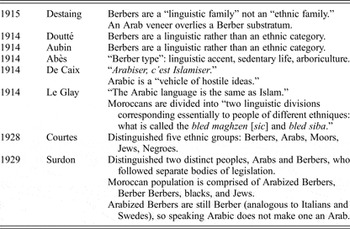
The description mirrored that of other early Protectorate officials reporting on the nature of the Moroccan population, as outlined in Table 1.
French Authorities and Scholars on Moroccan Language and Ethnicity

Sources: Destaing Reference Destaing1915; Doutté and Aubin ca. 1914, in Lafuente Reference Lafuente1999: 48–49; Abès n.d. (ca. Reference Abès1914); De Caix 1914 in Bidwell Reference Bidwell1973: 55; Le Glay n.d. (ca. 1914); Courtes Reference Courtes1928: 4–5; Surdon Reference Surdon1929: 3, 10, 14.
Destaing, linguist Edmond Doutté, and the diplomat Eugène Aubin (né Descos) of the French Legation in Tangier contended that Berbers constituted a linguistic family, not an ethnic group. Destaing argued that the Berber language, Tamazight, distinguished the Berber populations from the Arab populations in Morocco. Echoing eighteenth- and nineteenth-century descriptions of the language shift away from French regional languages toward a national French, Destaing cautioned that for the Moroccan Berbers, “This is nonetheless an approximation because it is well-established that numerous populations of ancient Barbary have forgotten their language—but not always their customs—[in order] to speak the Arabic language” (Destaing Reference Destaing1915: n.p.). Doutté seconded Destaing's position of highlighting linguistic rather than ethnic categories on the grounds that language was the only criteria on which to base the Berber-Arab distinction (Hammoudi Reference Hammoudi1993; Lafuente Reference Lafuente1999: 48; Rosen Reference Rosen1984; Seddon Reference Seddon and Montagne1973). The positions of Doutté and Aubin contrasted with Le Glay's argument that a constellation of associated characteristics distinguished Berber from Arab (Lafuente Reference Lafuente1999: 48–49). Both wrote of a complex pre-Protectorate state that had interacted with different interest groups, so that even dissident siba tribes were in contact with the makhzen, despite their refusal to pay taxes or tribute. To further support his argument, Destaing included a section in his report that listed the various Berber groups and compared their language to that of the Kabyles of the Djurjura—hitherto the quintessential Berber group under French control (Lorcin Reference Lorcin1999)—much as the Kabyle Interprète Civil Mohand Abès had done in a 1914 note on the Middle Atlas Iguerouan tribe (Abès n.d.).Footnote 12 The linguistic differences between regional groups were significant enough, Destaing noted, that “A Beni Iznacen understands with difficulty a Riffi; the Berabers and the Chleuhs converse without experiencing too much difficulty, but understand only imperfectly the Zeneta of the North and vice-versa” (Destaing Reference Destaing1915: n.p.).
The perpetuation of Berber language and institutions in Morocco led some early French policymakers and scholars to find Berbers lacking, and thereby rejecting, Islam. Abès, with his linguistic agility and fieldwork experience, embraced the ideological basis of Destaing's conviction, but reported that his own research indicated that the argument did not fit the empirical evidence. In his study of the Middle Atlas Zerhoun from around 1914, Abès generalized about Berbers' attachment to Islam. He asserted that, with the exception of the site of Moulay Idris, a pilgrimage site between Fes and Meknes, it was “undeniable” that the area of “Zerhoun is entirely Berber.” This was evidenced in native proclivities and institutions, and even their linguistic accent. “An anthropometric examination of the inhabitants, however superficial,” he wrote, “confirms that the large majority are of the Berber type—love of sedentary life, the taste of the Zerhoun for arboriculture, and the Berber accent even among educated Muslims are all indicators that characterize this facet.” The Imazighen loved liberty, in apparent contrast to unnamed sectors of the population who allegedly preferred restrictions on their freedom, probably the “Arabs” whom Abès characterized as Arabic-speaking, nomadic pastoralists with a penchant for social hierarchy and political despotism (Abès n.d.: n.p.).
In sum, consolidating an image of a distinct Berber people who required a separate native policy engaged the efforts of linguists, legal scholars, and sociologists whose studies complemented and guided Native Affairs officers' work. Studies of the Iguerouan, carried out by Abès and Henri Bruno, were the first tribal reports of the Protectorate period. The bulk of these tribal studies were completed in the 1930s, although many files were only finished in the early 1950s. Reprimands from the Resident General's office to various southern Moroccan Native Affairs posts further substantiate complaints that the posts had insufficient personnel to research and write tribal reports while also overseeing the day-to-day post operations and the customary law courts. The post in Igherm, for example, had as few as one and (rarely) as many as four Native Affairs officers to tend to civil complaints, staff the courts, oversee regional markets, carry out census and taxation, and organize public works crews. Little time remained for sociological investigations.
Despite pay bonus incentives, few officers developed competence in Berber rather than vernacular Arabic, as evidenced by the paucity of bonus pay sheets relative to the ample documentation of salary incentives.Footnote 13 What is harder to determine is the extent to which French officers' training shaped the ideologies on which they drew in describing and categorizing populations under their administration. In the following section, I examine the legal philosophies of key Protectorate officials and contemporary scholars involved in training Native Affairs officers, particularly in regards to how they perceived the relationship between language and ethnicity, and the ways in which language ideologies grounded their perceptions and policies.
NATIVE AFFAIRS SOCIAL SCIENCE TRAINING ON BERBERISTANFootnote 14
The presence of Islamic law among Berbers challenged the pervasive French insistence that Berbers were “attached” to “their customs” “from antiquity” (Morand Reference Morand1931: 291; also Courtes Reference Courtes1928: 7), a claim also made by some Eastern Anti-Atlas men among whom I researched in the late 1990s (Hoffman Reference Hoffman2008: 113). This claim was never elaborated, however, and it remains unclear what forms such attachment took, how it was measured, and which customs were jealously guarded. One wonders whether the idea was engrained in Native Affairs officers through their ethnographic reading on Algerian Berbers, or whether they came to this conclusion through their own experiences en tribu.
These officers were at the heart of the administration of Berber areas in the sense that the Protectorate relied on them to implement policy according to the conditions they encountered en tribu. Young officers were trained at the Institut des Hautes Etudes Marocaines (IHEM), which gathered renowned Berberist scholars of law, history, language, and politics to lecture to men who would be assigned to administer the Berberophone populations in Morocco's rural hinterlands. In the 1920s and 1930s, incoming Native Affairs officers and future military or civil controllers received nine months of instruction in Moroccan history, demography, Berber and Arabic languages, and Islamic and Berber law.Footnote 15 Some twenty-five to thirty-five officers generally trained at a time, more than twice the typical ten-to-fifteen-student class size in Algiers. Upon successful completion of IHEM courses, officers were given the title Adjoints stagiaires in the Native Affairs hierarchy; those with the highest marks were most likely to be assigned to posts of their choosing. Officers often found discrepancies between the theoretical and general training and the everyday specificities of administering a particular tribu (Méraud Reference Méraud1990: 75).
In a 1928 Native Affairs training course on the Moroccan population, Captain Courtes admitted that when approached to offer this training, he originally wanted to leave what he called the “serious topic of ethnology” to someone more experienced such as Robert Montagne, then a well-known Berberist and Director of the Center of Sociological Documentation in Morocco (1928: 1). In Courtes' remarks to the young officers, he provided an overview of the Moroccan population. The country's population density in 1926, he remarked, was low: only ten inhabitants/km2, compared with France's 73/km2. Excluding the European population recently installed in Morocco, he named five ethnic groups: “Berbers, Arabs, Maures, Jews, and Negros.” But “the central idea to absorb,” he argued, was “that the Moroccan people is not Arab. Morocco is a Berber country, but one that was never governed by Turks as in Algeria and Tunisia” (Courtes Reference Courtes1928: 4–5). This presents a theme that became a mantra in the training of Native Affairs officers—Morocco was a Berber country, and all Moroccans who were not black or Jewish were Berbers, although only some of them had remained true to their origins.
Surdon's courses, too, particularly one titled “Moroccan Psychology as Seen Through Law,” reinforced the view that most Moroccan groups were Berber with only an Arab veneer (Surdon Reference Surdon1929). Aspects of these lectures seem disingenuous because they indicate Surdon's lack of familiarity with Muslim law, as Lafuente has noted (1999: 88–93), yet he had studied Muslim law extensively in Algeria. Rather than presuming that Surdon was implicated in a divide-and-rule scheme, as Lafuente suggests, I want here to examine the ways in which his 1928–1929 Rabat lessons fit into the broader French ideology relating ethnicity to language and law. From the outset, however, I should stress Surdon's political view. Because the French were “pacifying” Berber lands, he reasoned, they had the right to establish the legal system of their choosing. Since there were two written codes in the country, it was better that customary law be absorbed into French rather than Islamic law, (Surdon Reference Surdon1928: 213).
Surdon was a former officier interprète in the French Army of Africa who had served in southern Tunisia, especially the Berber-speaking Djerba island, and in the Sahara desert before coming to Morocco where he “worked towards breaking up the dissident Berber block” (Méraud Reference Méraud1990: 75). He moved through roles as IHEM professor of Islamic and customary law, to counselor to the Native Affairs Direction, to civil magistrate. Courses on Islamic and Berber law were part of officers' required sociology training, and Surdon was valued as much for his synthetic analyses of the bases and evolution of Moroccan society as for his research into Berber and Muslim law (Méraud Reference Méraud1990: 75). The goal of his courses, he claimed, was to allow officers to “penetrate into the bare foundation of the psychology and mentality of our protégés.” He acknowledged that the legal details he offered might seem “heavy” and “boring,” but insisted that they served an important function. Law, he lectured, was “determined by social facts … when a social fact is modified or disappears, the law falls out of favor.” He continued, “In a nutshell, law is like a mirror in which the life of a people to whom it applies is reflected. Let us look into this mirror. Let us try hard to see in it the image of the Moroccan people” (Surdon Reference Surdon1929: 2–3).
To grasp the image Moroccans saw of themselves, Surdon noted two basic postulates. First, presumably in contrast to Algeria's large foreign population, he argued, “Morocco is inhabited by Moroccans. Regardless of how much you are surrounded by Europeans, Moroccans occupy the country.” Second, he asserted, “There are two very distinct people: the Arab and the Berber, who are subject to two very different legislations.” Historians and ethnologists, Surdon reminded his student officers, had affirmed that, in Morocco, the Arab was but himself an Arabized Berber (1929: 3). Protectorate officials should not be blinded into thinking that Morocco was an Arab country, even though the Sultan and his makhzen presented themselves as Arabs (1929: 10). As had Courtes, Surdon explained that the Moroccan population was comprised of Arabized Berbers, Berber Berbers, blacks, and Jews; there was no mention of the country's Jewish or black Berbers. The Sultan, as well as his appointed qadis and jurists, stressed the Islamic nature of their institutions and authority to head them. But the Moroccan population, only partly under the makhzen's grasp, had its own forms of political, economic, and social organization. To rule effectively, Surdon stressed, officers should become familiar with the “Berber soul (âme)” (1929: 14).
What precisely delineated these groups? How could one distinguish between Arab and Berber groups? The distinction was not simply linguistic, Surdon noted, disagreeing with the arguments forwarded by Destaing, Doutté, and Aubin fourteen years earlier. The presence of Arabized Berbers, Surdon argued, was “proof that language does not supply the criterion that is needed to distinguish between the two groups of Moroccans” (1929: 10). Using a nationalist model, he elaborated, “All of these many Berbers are, essentially, bilingual and speak Arabic comfortably in their relations with Europeans. They remain no less authentically Berber, no less different from Arabs, than an Italian may be from a Swede” (1929: 10).
Instead of language, Surdon argued, it was law that differentiated Arab from Berber. Governing powers had long recognized this fact, he contended, referring to the Sharifian throne and its makhzen (and by extension, the French Protectorate). “There was always a Berber Policy” in Morocco, he stated, “even when on the Sherifi throne Berber sovereigns were seated, such as the Almohads for example. The reason is simple: there have always been Berbers, and that is a fact.” Although the governing powers may have had a Berber policy, all Berbers were not necessarily governed by it, since “the Berbers have never been completely subject to the Sultans.” Surdon argued that certain groups, such as the Middle Atlas Imazighen, never had been the Sultan's subjects (1929: 10). Seemingly contradicting himself, Surdon noted that there had been no Berber policy in place at the start of the Protectorate because the Berber lands were in such disarray. The rulers in Fez allegedly had never systematically studied the Berbers because they found them to be “such backward populations” (populations tellement arriérées), “as evidenced by their unintelligible language and their clothes fit only for animals” (1929: 14). At the start of the Protectorate, then-reigning Moulay Youssef had agreed to the 11 September 1914 dahir guaranteeing Berbers the respect of their customary law, which suggested to Surdon that the idea was not such a far-fetched or particularly French fabrication. Even in his expository lecture, Surdon anticipated criticism from his detractors: “To those sad or perfidious spirits who accuse us of wanting to divide to rule, this is contrary to our engineering (génie) and, moreover, useless in Morocco. Let us ask what they have done to garner the Berber's affection. Ask them who these Berbers are” (1929: 15).
CONCLUSION
Early-twentieth-century French Protectorate officials and scholars developed policies to govern the native Moroccan population according to only sometimes-articulated ideologies about the powerful, if deceptive, role of language in collective life. This conviction resonated with both colonial administrators and contemporary scholars who sought to identify and codify the essence of different colonized group. Here I have sketched the contours of those language ideologies as they shaped emergent configurations of ethnolinguistic differentiation, and their consequences for native policy.
The Protectorate archival record clearly documents two kinds of language ideologies that informed each other. The first concerns the “nature” of words as both powerful in shaping thought and deceptive in revealing ancestry. The second concerns language's relations to the social order, in which Arabic language and Islamic religion were indivisible, and in which an “Arab” society was alternatively nomadic and urbane—but uniformly hostile to European designs. Even the terminology used by Native Affairs officers, civil assistants, and translators strongly suggests that they considered the practice of speaking or writing Arabic in the Berber countryside to be an inherently subversive act. It became clear by the post-World War II period, through secret unpublished reports written by eminent scholars such as Montagne, that the mere presence of Native Affairs officers in the countryside unintentionally but effectively encouraged a language shift away from Berber and towards Arabic. There were abiding tensions where ideologies that were destined for policy implementation came up against sociocultural complexities on the ground. Regardless of the Moroccan population's heterogeneity, nationalists influenced by the budding pan-Arab movement in the 1920s positioned the twin pillars of Arabic language and Islamic religion as the foundation of Moroccan resistance. This formulation denied the legitimacy of Berber language, legal systems, and cultural practices, and linked them to the colonial project based on a perceived collusion between Berbers and the French. These same nationalists were key figures in the post-independence government that developed linguistic and cultural Arabization policies and generalized a unified legal system for the Moroccan population. A nationalist rhetoric posited the Berber population as French collaborators, or separatists. This framework—however short-sighted—took up European language ideologies developed during France's own consolidation of national identity with the shift from various patois to the French language, and elaborated this experience for colonial expansion, solidifying the perceived unity of language, ethnicity, and law. In this way, colonial language ideologies were a crucial force in the noisy rise and the quiet demise of French native policy and, ultimately, the French empire itself.