Chile has for several years won the reputation of the model republic of South America. She has been a law-abiding and peace-loving community, allowing her people the enjoyment of all wholesome liberty, and so conducting her administration and ruling her finance as to be able in the most difficult times to fulfill her engagements, to ensure order and prosperity at home and maintain her credit abroad.
(The Times of London, April 22, 1880)
1. Introduction
Institutions matter for economic growth (Acemoglu and Robinson, Reference Acemoglu and Robinson2012; Besley and Persson, Reference Besley and Persson2011). Thus, the leaders who help to develop institutions, and their ideas and beliefs, must play a central role in any narrative that seeks to explain such growth. Different features of formal institutions may be important in practice. Formally, these represent different strands in the literature on institutional economics: state capacity (Besley and Persson, Reference Besley and Persson2009), the rule of law (North et al., Reference North, Wallis and Weingast2009), and legal institutionalism (Hodgson, Reference Hodgson2015). Behind the development of each of these institutional dimensions we will find an agent or group of agents, which we label as “institutional entrepreneurs,” who seek to make the newly designed formal institutions consistent with a given society's existing informal institutions: after all, it is this network of formal and informal institutions that represents the institutional system that is relevant for economic development.
Institutional entrepreneurs have been studied before in the literature; for instance, by Greif (Reference Greif2006). In a related fashion, Schneider and Teske (Reference Schneider and Teske1992) and Leighton and López (Reference Leighton and López2012) talk about “political entrepreneurs,” and Mokyr (Reference Mokyr2016) refers to “cultural entrepreneurs.” We are especially interested in the part played by these agents in the context of institutional change associated to nation or state-building. Nation building has been important in a historical sense (Tilly, Reference Tilly1975), and is an area that can offer many wider lessons for institutional analysis (e.g. North, Reference North1981; Besley and Persson, Reference Besley and Persson2011). The temptation to regard historical processes as indeterminate or, from a different perspective, to consider that in national histories only great men matter,Footnote 1 has hurt an analytical approach to the problem of institutional change. Statesmen, especially distinguished institutional leaders, matter, but not in an overly simple Carlylean heroic fashion (Carlyle, Reference Carlyle1966).
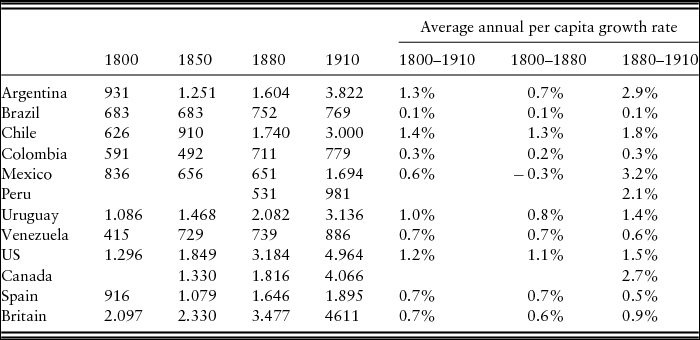
We employ an argument relating ideas, leaders, and institutions, to examine a neglected economic success story (and also a story of state-building in Latin America), namely, the case of Chile in the 19th century. While the available historical data on economic conditions in America and other European nations may suffer from measurement errors, during this period Chilean economic performance portrays a remarkable picture that deserves to be considered more carefully (see Table 1). As the last two columns show, Chile's comparatively high average growth rates during the 19th century are not the sole consequence of the nitrate bonanza experienced after the War of the Pacific (1879–83; on this episode, see: Collier and Sater, Reference Collier and Sater1996). The editorial from The Times of London that opens this paper is an interesting invitation to examine this relatively unexamined case study more carefully.
GDP per capita (1990 Int. GK$)

Source. The Maddison Project, https://www.rug.nl/ggdc/historicaldevelopment/maddison/releases/maddison-project-database-2013 (accessed January 15, 2018).
For this analysis we propose that the Chilean experience can be viewed as a quasi-natural experiment as to the influence of leaders and the institutions they implement in terms of economic performance; we consider three key leaders around the first-half of the 19th century, Mariano Egaña, Andrés Bello, and Manuel Rengifo. We approach the problem of hypothesis testing through a methodology that combines a comparative strategy in terms of a historical-narrative framework, and a counterfactual inference strategy.Footnote 2 The counterfactual strategy is an old approach, popularized by Fogel (Reference Fogel1967) in his important work on economic history. While we recognize that this method sometimes awakens strong reactions and methodological criticism when it is badly used (Bunzl, Reference Bunzl2004), we follow Fearon (Reference Fearon1991) in recognizing the valuable role of counterfactuals in causal hypothesis testing in the social sciences. In fact, we believe it is important to recognize that, as Fogel (Reference Fogel1967) has argued, an open strategy avoids the problems related to using concealed standards in this sense.
2. Related literature and our analytical framework: ideas, leaders, and institutions
Institutions, the set of rules that regulate social behavior, matter for the problem of economic development (e.g. Acemoglu and Robinson, Reference Acemoglu and Robinson2012). Nation- and state-building was originally a problem of interest in comparative politics (Tilly, Reference Tilly1975), but there is a newer theoretical interest in these issues in the field of development economics, as can be seen in the recent work by Besley and Persson (Reference Besley and Persson2009, Reference Besley and Persson2011). Historians interested in Latin America have also shown a renewed interest in this problem: the work by Centeno (Reference Centeno2002), Centeno, and Ferraro (Reference Centeno and Ferraro2013), and Saylor (Reference Saylor2012), represent important recent examples along these lines.
Theoretically we expect that good institutions affect economic growth via the promotion of entrepreneurial activities (Baumol et al., Reference Baumol, Litan and Schramm2007) and related increases in total factor productivity (Parente and Prescott, Reference Parente, Prescott, Balcerowicz and Fischer2006). And yet, given our interest in state-building, and since there are other theoretical perspectives that may be relevant in this sense, some further explaining may be necessary here. The notion of legal constitutionalism elaborated by Hodgson (Reference Hodgson2015), the concept of inclusive and extractive institutions proposed by Acemoglu and Robinson (Reference Acemoglu and Robinson2012), and that of social orders, and limited-access and open-access orders advocated by North, Wallis, and Weingast (Reference North, Wallis and Weingast2009), are some alternatives in this sense. Besley and Persson (Reference Besley and Persson2009, Reference Besley and Persson2011) rescue the concept of state capacity focusing on the institutions underlying such capacity: fiscal capacity, supporting markets, providing order, and providing public goods. Interestingly, these different theories overlap in the importance they afford to the rule of law and state capacity. This link, encouraging a multidimensional approach to institutional analysis, helps to establish a positive relationship between state capacity and economic growth, via entrepreneurship, as opposed to simply having a strong centralized government, which may have negative effects on growth. Human capital is also important in this sense (Glaeser et al., Reference Glaeser, La Porta, de Silanes and Shleifer2004), but this mechanism may turn out to be related to institutional quality (Acemoglu et al., Reference Acemoglu, Gallego and Robinson2014).
Cultural factors also play a role in the problem of economic development (e.g. McCloskey, Reference McCloskey2010; Mokyr, Reference Mokyr2016); indeed, the interplay between ideas and institutions is an important point in the modern literature on institutional economics (e.g. Alesina and Giuliano, Reference Alesina and Giuliano2015; Langlois, Reference Langlois2016; Tabellini, Reference Tabellini2008). The point here is that to the extent that ideas are theories of how the world works, they must be considered in any model that seeks to explain the process of economic development. There is a vibrant literature that examines the relationship between institutions and ideas: important recent work in this area includes that of Eggerston (Reference Eggertsson2005), Greif (Reference Greif2006), Mokyr (Reference Mokyr2016), and North et al. (Reference North, Wallis and Weingast2009). This type of analysis has also been applied in concrete case studies on the problem of economic development: the work by Schlueter (Reference Schlueter2014) on New Zealand and Uruguay, Zhang (Reference Zhang2015) on China, and Alston et al. (Reference Alston, Melo, Mueller and Pereira2016) on Brazil represents some recent examples in this sense. But how do ideas influence institutions, and how do the latter emerge or change? In a general sense, one can postulate that the influence of ideas comes about through social learning mechanisms (e.g. Hall, Reference Hall1993), or some type of cultural evolution (e.g. Bisin and Verdier, Reference Bisin, Verdier, Benhabib, Bisin and Jackson2010). Such influence can also come about directly through intellectual or cultural entrepreneurs (Mokyr, Reference Mokyr2016). We follow this approach and argue that ideas matter in institutional terms because of the actions of leaders who direct the process of institutional change and influence the formation of human capital.
Leaders, viewed as “institutional entrepreneurs,” are really distinguished statesmen who happen to be in the right place at the right time, face a challenge, and stand up to it. In this sense, they have the ability to extend a society's opportunity set and to influence the behavior of other agents to achieve institutional change; therein their “entrepreneurial” character. They do so by persuasion (a universal “natural desire,” according to Adam Smith), although this process may also involve some political manipulation, as Riker (Reference Riker1984) has explained.Footnote 3
What motivates these agents? Standard cost–benefit assessments may be relevant in this sense (Schneider and Teske, Reference Schneider and Teske1992), and we also add Schumpeterian motivations in terms of fame and desire to make a difference in the world (Schumpeter, Reference Schumpeter and Opie1934). Two additional points are important here. While the environment in which they act is crucial for motivating institutional entrepreneurs, it is important to note that, as Greif (Reference Greif2006) has remarked, this context also constrains them. Successful institutional change requires new formal institutions to be consistent with informal social rules. This is an important theoretical issue (Greif, Reference Greif2006; North et al., Reference North, Wallis and Weingast2009), which has important consequences for institutional change. Institutional entrepreneurs must be able to perceive how the formal rules they design interact and coexist with existing informal rules, rules that they must grasp at and try to understand even as they are tacit (Boettke et al., Reference Boettke, Coyne and Leeson2008; Couyoumdjian, Reference Couyoumdjian2012). Their belief system will be crucial to make this merge successful.
On the other hand, the role that leaders/statesmen have in terms of forming human capital, directly or via institutional creation, must also be remarked: these educated agents will end up acting in policy areas. Human capital will thus play an important part in a narrative that focuses on the influence of institutions on economic performance. This mechanism highlights the role of educated agents acting within the context of a system of rules. The notion of the rule of law assumes it is government by the law and not by men that leads to good policies, but it is also important to take into account the behavior of political agency. After all, establishing state capacity involves the implementation of different types of policies.
As we pay special emphasis on acting leaders we should note that there is an extensive literature on statecraft in political history, but the field of political economy has been reluctant to include these types of agents. This may be due to the fact that economists disapprove of the incorporation of heroes in their models. At any rate, it is important to reiterate that we are not advocating a Carlylean “great man history” and that merely having a fully developed model of institutional change requires that consideration is paid to the agents who lead such processes. Statesmen matter, but national conditions and opportunities shape and determine their behavior: historical contingency is important here (Acemoglu and Robinson, Reference Acemoglu and Robinson2012).
3. Our case-study and methodology
We have proposed a framework that links leaders and institutions, and relates these variables to economic performance. We now propose to evaluate this model considering the Chilean experience in the 19th century. The leaders we consider, Mariano Egaña (1783–1846), Andrés Bello (1781–1865), and Manuel Rengifo (1793–1845) are critical actors in the Portalean era, to use a commonly used expression in Chilean historiography (Collier, Reference Collier2003). Before we examine the institutional setup erected by these statesmen it is thus important to look into the main features of this period, which began in 1830. Following Independence (in 1818), a period of constitutional experimentation had led to different levels of political disorder and, eventually, to a military conflict between liberal and conservative factions where the latter prevailed; a “conservative settlement” started in early 1830 when, under the new regime, Diego Portales took over as Minister of the Interior and of Foreign Affairs. Collier and Sater (Reference Collier and Sater1996) have characterized this period in the following terms:
The Conservative coalition that took power in 1830 . . . helped lay the foundations of a tradition of political stability unique in nineteenth-century Spanish America – where mutinous armies, caudillo dictatorships, palace revolutions, and civil wars were constant and commonplace. (p. 51)
In this context, the country's institutional matrix was to be designed anew. The statesmen we are considering acted in (and created the fundamental institutions of) this Portalean era, which has been viewed as stressing the importance of tradition, and which was based on the new constitution promulgated in 1833. This is something Portales captured in a well-known letter where he referred to the “weight of the night” in the country.Footnote 4 But Portales did not seem to care much about formal institutions. The fact that his legacy persisted after he died in 1837 is, mainly, related to his strict approach to the problem of political (and civil) disorder, disabling caudillismo in the process, that meant a temporary return to authoritarian modes of governance and, in turn, generating the opportunity for a rigorous process of institutional nation building. As Halperín Donghi has argued, the political vision of Portales was, “at least in part, to be an emergency solution for an emergency situation” (Reference Halperín Donghi and de Bunsen1973, 137). At any rate, as we continue it is important to recall the reference by the Argentinean leader Juan Bautista Alberdi of Chile as the “honorable exception” in South America.Footnote 5
In this paper we wish to view this experience as a quasi-natural experiment, which we will assess through a methodology that combines a quasi-natural comparison strategy and a counterfactual analysis (Bunzl, Reference Bunzl2004; Fearon, Reference Fearon1991). This work will be based on a historical-narrative case-study analysis, a valuable although sometimes neglected methodology in the social sciences (Alston, Reference Alston, Brousseau and Glachant2008; Bates et al., Reference Bates, Greif, Levi, Rosenthal and Weingast1998).
On the problem of causation, we start with David Hume's views, especially as related to the progress of the arts and sciences, where we find a useful framework for addressing these questions. In this respect, Hume noted that:
What depends upon a few persons is, in a great measure, to be ascribed to chance, or secret and unknown causes: What arises from a great number, may often be accounted for by determinate and known causes. (. . .) Chance, therefore, or secret and unknown forces, must have a great influence on the rise and progress of all the refined arts. (1777/Reference Hume1987, pp. 112, 114)
Here we interpret the “arts and sciences” in the widest possible terms, including (the art and science of) legislation and the development of entrepreneurial activities within a given institutional framework. Following Hume, if the development of these fields depends on a few persons, then it can be said that it depends on chance. This is important from a methodological perspective, as some form of exogenous shock is vital in quasi-natural experiments (Diamond and Robinson, Reference Diamond and Robinson2011; Dunning, Reference Dunning2012).
The “experimental” nature of our analysis follows from a situation where if we consider initial “artificial” national borders in Spanish America (Alesina et al., Reference Alesina, Easterly and Matuszeski2011), we can assume similar original conditions across nations in the region, specifically in an institutional and cultural sense. Thus, any difference between nations in the post-Independence period can be attributed to differences in (the newly established) institutions. This is why it is important to examine the processes by which different countries developed their institutional frameworks. Based on our previous argument, and contra historical determinism and path-dependence types of arguments, we examine the mechanisms of institutional formation in 19th-century Chile. Here we consider a distinctive perturbation, which we characterize in terms of unique statesmen qua institutional entrepreneurs. While we are aware that few historical processes have a single cause, we focus on what we will argue are unique events. Specifically, we propose that Mariano Egaña, Andrés Bello, and Manuel Rengifo were crucial statesmen in Chile in the first half of the 19th century.
Given the data limitations for a complete comparative historical argument (ours is a small-N problem), we also complement our analysis using a counterfactual strategy that will be required to meet rigorous consistency standards (Bunzl, Reference Bunzl2004; Fearon, Reference Fearon1991; Tetlock and Belkin, Reference Tetlock and Belkin1996). Following Fogel (Reference Fogel1967), we wish to be transparent in pursuing this avenue.
4. Ideas, leaders and institutions in 19th-century Chile
Leaders
Let us start this section by presenting a brief sketch of the three leaders we want to focus on and their unique work in Chile: Mariano Egaña, Andrés Bello, and Manuel Rengifo.
While he was born in Chile, Mariano Egaña lived in France and England (between 1824 and 1829), and from there observed the political disorder in his home country during those years (Brahm, Reference Brahm2007). In Europe, he also read extensively and amassed a major library on legislation, philosophy, and politics (Salinas Araneda, Reference Salinas Araneda1982), which changed his world perspective and influenced his work as major author of the 1833 constitution. Egaña was in Europe because he had been named Plenipotentiary Minister, in charge of negotiating the recognition of independence, reviewing the accounts of the Chilean loan of 1822, and attracting “useful men” to Chile (Brahm, Reference Brahm2007, p. 35). In this circumstance, he met Andrés Bello in London and invited him to Chile. Back in Chile he was a “driver” of the codification process that was to take place in the country during the Portalean era, taking part in the drafting of other legislation complementary to the Constitution, including laws on voting, interior government, and other matters (Brahm, Reference Brahm2007, p. 200).
Andrés Bello was born in Caracas, but lived in London from 1810 and worked at the Chilean legation from 1822. Following some disagreements, at some point he decided to leave for the Colombian legation, although Mariano Egaña would later invite him to Chile. Despite some differences with Colombian officials this government was also interested in inviting him there but Bello finally preferred Chile. Before he left England, the American liberator Simón Bolívar is quoted as encouraging Colombian agents in London, in very passionate terms, to do something: “I implore you to not lose our enlightened friend [Bello] to the land of anarchy [i.e. Chile]” (quoted by Jaksic, Reference Jaksic2001, p. 124).
As an “institutional entrepreneur” Bello participated in the drafting of the constitution (1833), where at the very least he was consulted, and held a major role in the design of the Civil Code (1855) (Collier, Reference Collier2003, p. 23; also, Jaksic, Reference Jaksic2001). Having worked with James Mill and Jeremy Bentham in London in the 1820s, Bello was a strong advocate of codification. The argument that Bello was a true leader is thus quite straightforward, and he was fundamental in the establishment of the rule of law in Chile (Jaksic, Reference Jaksic2001).
Finally, Manuel Rengifo was Minister of Finance in two different periods (1830–5 and 1841–4) and had an important role in opening the economy to free trade, and organizing the national public finances.Footnote 6 In this sense, he was a crucial figure in terms of establishing an orderly and comprehensible system of public accounts in the country (Bernedo et al., Reference Bernedo, Camus and Couyoumdjian2014, pp. 33–42). Moreover, Rengifo reorganized the customs system in Chile, liberalizing internal shipping and creating free-trade warehousing zones for transit goods; this provided the main foundation of the country's fiscal capacity.Footnote 7
Formal and informal institutions in 19th-century Chile
The formal political institutions of the Portalean era, designed by Egaña and Bello, turned out to be consistent with the underlying ideas, culture, and shared experiences in the country. This was a constraint on their work that they effectively dealt with and, as noted, is an important issue regarding what we known about successful institutional change (also: North, Reference North2005). In the convulsive year of 1848, when he was trying to articulate his views regarding the role of constitutions in a society, Andrés Bello had noted that the fact that a constitution reflects the viewpoints of society is a necessary, yet not a sufficient condition for its success:
Constitutions are often the work of a few architects, who sometimes get it right and sometimes not; not really because the work did not arise from the social base, but because it lacks the qualities necessary to influence society gradually, and to receive its influences, so that this reciprocal action, by modifying the two, brings them closer and harmonizes them.Footnote 8
The Portalean system was also adamant about generating and preserving political stability, a priority after the disorder in previous years. Portales himself had argued that in this context some authoritarian elements could be necessary, at least in the short run.Footnote 9 Given this authoritarian thrust, Loveman (Reference Loveman1993, p. 330) has even referred to the governing elite's ideology, and the institutions they erected during most of the 19th century, as a “constitutional dictatorship.” So, can we really talk these ideas leading to “good” institutions that generated the conditions for promoting economic growth?
Historians such as Jaksic and Serrano (Reference Jaksic and Serrano2010) have qualified this type of claim, noting that even though Chilean governments throughout the mid-19th century were authoritarian, they were deferential to the constitutional system (p. 74). Furthermore, the major liberal reforms undertaken during the 19th century impeded revolutions. Therein the “peculiar” nature of Chilean liberalism, specifically in terms of “the absence of radicalism and its emphasis on reform,” such that “transformations were made via reform, not revolutions, or new constitutional experiments beyond that of 1833” (p. 102).Footnote 10
Contemporary liberal thinkers would disagree with some of these assessments (e.g. Lastarria, Reference Lastarria1896), yet as Collier (Reference Collier2003), Jaksic and Serrano (Reference Jaksic and Serrano2010), and Safford (Reference Safford and Bethell1985) note, the existing Constitution was able to accommodate to a new liberal environment. As the so-called “conservative settlement” waned towards the mid-19th century, liberal values became more widely accepted, and the Constitution was able to adjust and change, although electoral intervention would persist throughout the 19th century. It is difficult to know if this was an element that the institutional framers had foreseen, although it is important to keep Bello's deep institutional design in mind here. As he noted regarding the Constitution's role in protecting individual liberty:
There are no theories inapplicable to the circumstances of the country but, rather, clear and certain rules for managing the public interest. (. . .) These provisions contain all that can be desired to defend individual liberty against the attacks of power, and property against invasions of the mishandling of justice. (Bello, Reference Bello1833/Reference Bello1981, pp. 86, 91)
An analytic narrative
We have proposed a causal relationship between ideas, institutions, and economic performance, and that leaders as statesmen and mentors (in terms of human capital) played an important role in this process. But it is important to review the mechanisms in operation here in greater detail. We note three channels through which leaders are important. These are related to the ways in which institutions are important to economic growth, which we have reviewed above.
They are related primarily via political stability and the creation of “state capacity,” which we oppose to the notion of “failed states,” a modern term and a big problem in 19th century Spanish America. Political stability was possible to a large degree because of the harmonious balance reached between the newly designed formal institutions and the existing informal norms, and was an important goal of the Chilean Constitution of 1833, in the context of a process of political learning and nation building. State capacity involves several dimensions, including the capacity to tax and provide public goods while also providing order and delineating a legal system within which markets can develop (Besley and Persson, Reference Besley and Persson2011). In the Chilean context, Egaña, Rengifo, and Bello are crucially important in these dimensions, both directly as well as indirectly through the transmission of institutions and the implementation of policies via the creation of human capital. The direct influence of Egaña was mainly through his approach to the problem of political order, while Bello was fundamental in creating the institutions supporting markets, which we will refer to in greater detail below. The role of Rengifo merits further inspection here. The creation of the free-trade warehousing zones mentioned above propelled the development of Valparaíso as the most important port (and distribution center) on the Pacific coast of the Americas and, by improving the control of the traffic of goods and increasing tax revenues, it represented the main foundation of the country's capacity to provide public goods. On the other hand, the opening of the Chilean economy to international trade represented the beginning of the country's very successful process of export-led growth, in the context of a relatively stable macroeconomic environment (Bernedo et al., Reference Bernedo, Camus and Couyoumdjian2014).
It is important to note that fiscal capacity and economic progress also generate a military capacity that makes it easier to suppress dissent (Safford, Reference Safford and Bethell1985, p. 417). Contra the legacy of “blood and debt” attributed to wars (Centeno, Reference Centeno2002), in the Chilean case the war against the Peruvian–Bolivian Confederation in the mid-1830s may have had a positive effect in terms of the provision of common-interest public goods (on this episode, see: Collier and Sater, Reference Collier and Sater1996, pp. 63–9). Then again, with economic progress liberalism expanded (Collier, Reference Collier2003; Jaksic and Serrano, Reference Jaksic and Serrano2010), and thus the demand for more public goods: international trade and the diffusion of public education may also be important here (on these issues see, e.g. Will, Reference Will1960).
The country's strong statistical building capacity is another evidence of the nation's unique state capacity. Estefane (Reference Estefane2012) has used the expression “count what is governed” to capture the political impulse behind the organization of a national statistical system in Chile in the first decades after independence. These efforts were realized in 1843, when a Central Statistical Office was organized in a provisional manner. That very same year a law establishing regular censuses was promulgated; while early censuses were undertaken in 1813 and 1835, this law institutionalized a 10-year interval between such surveys.Footnote 11 The work associated with the Anuario Estadístico, which would publish a rich assortment of indicators, would require important adjustments in the country's administrative organization and in the arrangement of the bureaucracy; the first volumes, published in 1860, contained information going back to the 1840s.
The development of Chilean railways in the 19th century must also be mentioned here, specifically in terms of building new networks in the country. The early railway lines had an important private investment component, sometimes as a joint-venture with the state; such was the case of the railway between Valparaíso and Santiago, and the railway along the country's central valley. These lines were, however, eventually taken over by the state, who also provided technical assistance (Oppenheimer, Reference Oppenheimer1982), as well as providing a basic legal/institutional setup that made these ventures possible.
We wish to underscore the role of third-party enforcement and the rule of law as the second channel linking ideas, institutions, and leaders (North et al., Reference North, Wallis and Weingast2009). While this is related to the provision of order and the supporting markets dimension noted above, it merits an independent mention. In terms of the generation of an environment that provided secure contract-enforcement with low fear of expropriation (with a strong state that would not be extractive), Andrés Bello (and Mariano Egaña) played a crucial function. As details are important here, we should note that not only was the Civil Code vital in terms of detailing the rules for the acquisition, use, and circulation of property, and establishing the foundations of civil equality, including the abolishment of entailed estates (mayorazgos) in the country.Footnote 12 The Constitution of 1833 also afforded a strong protection of private property. Consider, for instance, Art. 12 No. 5, which stated that the Constitution guarantees to all inhabitants:
The inviolability of all property, without distinction of those belonging to individuals or communities, and without anyone being deprived of his domain, or a part of it however small, or of the right that he has on it, but by virtue of a judicial decision; except in the case where the utility of the state, qualified by a law, requires the use or alienation of any; which will take place previously giving to the owner the compensation that is arranged with him, or is appraised in the judgment of good men. (Chile, 1833; also: Cordero Quinzacara, Reference Cordero Quinzacara2006, and the discussion in Letelier, Reference Letelier1901).
Here we must also include the protection of inventions (in Art. 152 of the Constitution), an almost unique element in the region (apart from Brazil and the US), and where Mariano Egaña played a vital part (Escobar, Reference Escobar2014). This represented a vital incentive for new innovations in the Chilean economy.
And still, this is not all. The impersonal nature of government, as underscored by Alberdi (Reference Alberdi1852), and Bello himself,Footnote 13 is an important feature of the Chilean political system. Compliance with the laws is also critical; here it is important to consider Andrés Bello's influential (earlier) essay on the “Observance of the Laws”:
If we want freedom as it can exist on earth, we must love the subjection to the law . . . Discuss all you like: form grand projects for useful establishments; find courage to fight against the enemies of the state, and resolution to undertake risky undertakings; if the love of the laws is lacking, all is nothing: the foundations of the building to be raised will be undermined; because without the observance of the laws, all the advantages are pure illusions. (1836/Reference Bello1981, p. 52)
Bello's system, with his successful merge of formal and informal norms, made this conciliation possible. In turn, this could be expected to reduce uncertainty in economic activities, a fundamental attribute of a successful institutional arrangement.
The third channel relates to the role of human capital both in terms of institutional design as statesmen build institutions and establish political order as examined above, and also in terms of policy choices. Here, Andrés Bello was important as a channel of good policymaking and transmission of good institutions. His role at the University of Chile, established in 1843, is crucial; Bello was the first president of the university, and held that office till his death in 1865. In fact, the University of Chile played a fundamental function in forming the Chilean elite and in terms of thinking about the nation's problems (Serrano, Reference Serrano1994). Bello was also the editor of El Araucano, the nation's official newspaper, since its creation in 1833, to 1853, thus cementing the intellectual environment in the country. And yet, we acknowledge that the Chilean bureaucracy was limited in the 19th century and, in this sense, institution building was incomplete (e.g. López Taverne, Reference López Taverne2014).
The human capital formed at the university promoted an expansion of primary education in the country. In 1842 the Normal School for Preceptors, in charge of forming teachers, was created, and a law on primary instruction was promulgated in 1860. The state thus assumed financial responsibility on this issue (Monsalve, Reference Monsalve1998), in what was a leading program in Latin America (Newland, Reference Newland1991). This was a result of a political consensus between conservatives and liberals; possibly, the solution of first-order political problems and a favorable economic environment, also facilitated these agreements.
Another important figure in this respect is Jean Gustave Courcelle-Seneuil, the first true professor of political economy in the country, who lived in Chile between 1855 and 1863, with an interlude in 1858–9 (Couyoumdjian, Reference Couyoumdjian, Peart and Levy2008). Courcelle-Seneuil shares some of the characteristics we have ascribed to Bello, Egaña, and Rengifo: his influence in the country includes a direct role in policymaking, for example, in the (Free-) Banking Law of 1860, and also involves an intellectual influence, in terms of (liberal) economic thought (Will, Reference Will1960). In the latter sense, his impact endured much longer than his tenure in the country (Couyoumdjian, Reference Couyoumdjian2015). All of the above being said, we do not include Courcelle-Seneuil as one of our statesmen since the men we have been examining created the main Chilean institutions of an earlier period: the 1830s and 1840s (regarding the Civil Code, it is important to note that Bello was named part of a Commission that would prepare such a code as early as 1840, and had started writing about this much earlier).
The role played by Mariano Egaña as Attorney General of the Supreme Court between 1830 and 1846, on the other hand, ties more directly with the achievement of political stability proper. In effect, it was in this capacity that he helped imposed order during the “Portalean era.” For his part, Manuel Rengifo was key in terms of having ordered and refinanced the government's internal public debt, which had been a burden in the country (Couyoumdjian, Reference Couyoumdjian and Lira1989). This was a major step in allowing the country to return to the international capital (debt) markets, and in progressively more favorable conditions helping to maintain a stable exchange rate (Bernedo et al., Reference Bernedo, Camus and Couyoumdjian2014).
In the end, there are several contemporary assessments that suggest that Chile was quite exceptional in an institutional sense that it is important to consider. One representative view is that of the Argentinean leader Domingo F. Sarmiento, who lived as an exile in Chile, and who, writing in 1842, noted that:
while Peru is surrounded by enemies and the Argentine Republic is plucking its bowels with its own hands, blessed be Chile, which enjoys so many goods and to whom the blessings of heaven come like rain! Internal tranquility, constitutional government, an administration that is keeping abreast of progress and of the regular. What else do you want? (Quoted by Sagredo, Reference Sagredo2014, pp. 134–5)Footnote 14
All of this can be expected to be associated with better institutional quality (and policymaking); Bello's confidence in codification endured. The Patent Law of 1840, where Chile was a leader in the region, is one important example (Escobar, Reference Escobar2014). And during the 1850s several other legislative proposals were implemented that had long-lasting economic consequences: the Joint Stock Act of 1854 (Ley de Sociedades Anónimas), the Mortgage Bank Act of 1855, and the Banking Law of 1860 must be especially highlighted, as the development of the financial sector is a condition for investment and growth (e.g. Beck and Levine, Reference Beck, Levine, Ménard and Shirley2005; Rajan and Zingales, Reference Rajan and Zingales1998). And yet, market developments in some of these areas occurred independently of some of these statutes, which suggests the supremacy of Bello's Civil Code (Islas, Reference Islas2013; also, Couyoumdjian et al., Reference Couyoumdjian, Millar and Tocornal1993).
In turn, all of the above led to the development and expansion of private value-creating entrepreneurial activities and growth. The success of Chile's export-led growth process in the 19th century can be surmised from the Chilean economic history: the evidence provided by Silva Vargas (Reference Silva Vargas, Durán, Vargas, de Arce, S-M, Cáceres, Ojeda, Huneeus, Sanfuentes, Vicuña, Valdés and Prieto1977), Cavieres (Reference Cavieres1988), Couyoumdjian et al. (Reference Couyoumdjian, Millar and Tocornal1993), Lüders (Reference Lüders1998), and Ortega (Reference Ortega2005) is consistent with the theoretical arguments by Baumol, Litan, and Schramm (Reference Baumol, Litan and Schramm2007) (more recently: Larroulet and Couyoumdjian, Reference Larroulet and Couyoumdjian2017). An additional piece of contemporary evidence may also be relevant here. In 1882 Benjamín Vicuña Mackenna published a list of Chilean “fortunes,” from which we can gather the important role of a “new” prosperity, related to mining, industry, trade, and banking, versus old agricultural wealth.Footnote 15 The importance of immigrants in this context is also very interesting to note, and suggests the development of a new entrepreneurial elite in the country (Nazer, Reference Nazer, Bonelli and Stabili2000).
As we continue with our narrative we now wish to underscore the operation of the causal links we have proposed regarding the role of ideas, institutions, and development as mediated by statesmen. We also want to rule out the effect of other independent variables that may be at play here, and discuss our representation of Chilean exceptionalism as a quasi-natural experiment.
On the issue of the exogeneity of the “shock” we are considering, we should keep in mind how Andrés Bello came to Chile: Mariano Egaña visiting Europe and meeting Bello is consistent with an exogenous event in a context of similar initial conditions. (The same could be said of how Jean Gustave Courcelle-Seneuil came to Chile, hired by the Chilean government, as examined by Couyoumdjian, Reference Couyoumdjian, Peart and Levy2008.)
Regarding the uniqueness of the statesmen we have focused on, one could wonder whether any type of leader would have also led to similar outcomes. On this point, it is important to note that Simón Bolívar (who happened to leave Caracas for England together with Andrés Bello in 1810), also tried to implement a Code Napoleon in newly independent Spanish America, specifically in Colombia in 1829, but he failed; in this respect, it has been argued that his program was not one of liberal nation building (Mirow, Reference Mirow2000). At any rate, transplanting Bello's Civil Code, and the rule of law, to other countries in Spanish America was not automatic. As Jaksic has argued:
The southern country [Chile] was uniquely prepared to adopt and implement a new code of civil law because of the comparative strength of its political institutions, its manageable size, and its very isolation from international destabilizing factors. (2001, p. 210)
Let us examine some of these points. The importance of political institutions, including political order, in the “rise and progress of the arts and sciences” was raised by Hume (Reference Hume1987); this is a type of argument that has also been made in the literature on development economics and institutions (e.g. Besley and Persson, Reference Besley and Persson2011; North et al., Reference North, Wallis and Weingast2009), and is one where Chile was indeed exceptional. Regarding country size, if we compare similarly populated countries between 1800 and 1850 (using Maddison's data), we find that Chile was quite similar to Argentina and Venezuela, and yet political stability was very different in these countries. Maybe the problem has more to do with heterogeneity of the population, but Chile and Argentina were quite similar in this dimension.
And yet it is possible that other countries had similar constitutional provisions to those of Chile. According to data from the Comparative Constitutions Project (CPP; Elkins et al., Reference Elkins, Ginsburg and Melton2014), respect for private property and protection from unjustified restraint appears in most constitutions in the region in the early post-independence period. But these effects are mediated by acquiescence to the laws in each country (recall Bello's emphasis on the observance of laws), and political instability as manifested in revolutions and “constitutional cycling.” The evidence of Halperín Donghi (Reference Halperín Donghi and Chasteen1993), North et al. (Reference North, Summerhill, Weingast, de Mesquita and Root2000), and especially the figures on civil unrest in the region collected by Dean (Reference Dean1970) are very eloquent in this sense. On the other hand, we can examine the constitutional chronology in the region using the CPP. Looking back from (arbitrarily) 1880 and considering only new constitutions, not amendments, we find that Brazil, Uruguay, and Chile have had the longest-lasting constitutions in Latin America.Footnote 16 This points to significant experimentation and an evolution of constitutional thought in the region and to an appreciation of the Chilean model both in terms of its main features and its flexibility, successfully merging formal and informal institutions within the context of an impersonal government, opening the path to a more liberal ideology (Halperín Donghi, Reference Halperín Donghi and Chasteen1993). All of the above being said, there are other important dimensions where Chile's constitution was quite distinctive; the protection afforded to inventions noted above is especially noteworthy in this sense.
Can it, on the other hand, be said that Chile was unique because of a favorable economic cycle? On this issue, Saylor (Reference Saylor2012) has proposed an argument in the sense that Chile's economically progressing elites (in the context of its dynamic agricultural and mining export sectors) brokered for state-supplied public goods. Saylor is actually proposing a reverse-causation argument as to the relationship between institutions and development (à la Glaeser et al., Reference Glaeser, La Porta, de Silanes and Shleifer2004), while also putting forward new “motivators” for the build-up of state capacity, focusing especially on the role of (economic) interests. Yet as Rodrik (Reference Rodrik2014) has forcefully argued in a more general context, and as we have been arguing here, ideas also matter, and Saylor tends to dismiss the importance of these effects. While the relationship between the economic elite and politics is a significant issue, the limited weight that Saylor gives to the early institutional constructions is noteworthy. The development of transportation (railway) networks was important in terms of the country's modernization, but the legal developments that made such developments possible must be considered; note, for example, the possibilities for the formation of joint-stock companies (and the availability of human capital in the country). The lack of attention given to the build-up of fiscal capacity is also significant especially since, in comparative terms, his analysis actually highlights the primary role of such capacity; the Colombian case is relevant in this sense (e.g. Deas, Reference Deas1982).
All of the above suggests that Chile was unique because of its unique leaders. But in light of the data limitations we face, which may fail to make our analysis fully conclusive, we propose next to complement our argument with an explicit counterfactual analysis. We once again build on Jaksic's argument.
Had Bello migrated elsewhere (maybe to Colombia?), would Chile have imported his Codes? Probably yes, but the relevant point to consider here is whether this transplantation would have worked out, given that Chile may have been different without the constitutional and economic framework built in the country. We take the conservative victory in 1830 as a given. But in this case, the “Portalean era” may have been different as it is not clear a successful merge of formal and informal institutions, in a system flexible enough to allow for successive adaptations that provide it with greater legitimacy, would have taken place. Thus, there is no guarantee that Chile would have been much different from the rest of Spanish America.
If the institutions built by the statesmen we have studied made Chile exceptional, Chile was unique because it had an early start (in terms of such institution building). As the Argentinean politician and intellectual Juan Bautista Alberdi noted in the early 1850s:
The peace of Chile, that continuous peace of eighteen years in the midst of strange storms, which has made it admired in South America, does not come from the form of the soil, nor from the nature of the Chileans, as it has been said; it comes from its Constitution. (Alberdi, Reference Alberdi1852, p. 160)
It is thus that Argentina started catching up with Chile from the 1850s. The intellectual role of Alberdi who, notwithstanding the previous comment, considered that the Chilean constitution was not a model for Argentina, is significant here (Botana, Reference Botana1997). Once again, this argument points to the importance of the combination of ideas, leaders, and institutions as generating the conditions for economic development.
5. In closing
In this paper we have stressed the importance of considering the role of ideas and institutions in the process of economic development, examining the link between them via the actions of leaders qua statesmen. While some interest in ideas and leadership is appearing in recent studies on the problems of institutional reform (e.g. Alston et al., Reference Alston, Melo, Mueller and Pereira2016; Zhang, Reference Zhang2015), the study of statecraft in particular seems to be neglected. Here we apply a causal framework relating ideas, leaders, and institutions to Chilean economic history. Some of the claims regarding 19th-century Chilean exceptionalism that we have reviewed may seem pretentious and even incompatible with high levels of inequality and the existing authoritarian limited-access society (to use North, Wallis, and Weingast's expression), but they are consistent with improving living standards in the country (also: Prados de la Escosura, Reference Prados de la Escosura, Hatton, O'Rourke and Taylor2007). Institutional change involves a reconciliation between formal and informal institutions, and the Chilean leaders we considered accomplished this successfully; therein the flexibility and stability of the Chilean system, which did not require a critical mass of intellectual heirs of our leaders (Jaksic and Serrano, Reference Jaksic and Serrano2010). Our works offers an invitation to continue examining the relationship between state capacity and economic progress in Latin America, something that is being gradually analyzed from a historiographical perspective, but is still incomplete from an economic perspective.
Acknowledgments
Previous versions of this paper were presented at the WINIR 2016 conference, WEAI 2017 conference in Santiago, RIDGE May 2017 Forum, and workshops at the Universidad del Desarrollo. Comments from participants are acknowledged. We are especially grateful for the suggestions from an anonymous referee which have greatly improved this paper. Any remaining error is our responsibility.