Introduction
Policymakers in liberal welfare states such as the UK have promised a personalised approach to the delivery of services aimed at improving the employability of jobseekers at risk of long-term unemployment. This promise of personalisation matters, because it has been used to justify the extension of welfare conditionality and compulsory activation to vulnerable groups such as lone parents (LPs) (Johnsen and Blenkinsopp, Reference Johnsen and Blenkinsopp2018). However, LPs often describe their engagement with state-funded employability services as involving being compelled to engage with standardised provision that is not suited to their needs or aspirations (Lindsay et al. , Reference Lindsay, Pearson, Batty, Cullen and Eadson2018a). Accordingly, it is perhaps unsurprising that compulsory welfare-to-work programmes, such as the UK Government’s ‘Work Programme’ (WP), have proven unpopular with LPs and failed to achieve targets for activating this group (Johnsen and Blenkinsopp, Reference Johnsen and Blenkinsopp2018). Indeed, the evidence suggests that a combination of strict welfare conditionality (which applies sanctions to benefit claimants who fail to comply with activation) and standardised ‘work-first’ services (which pressure jobseekers to accept any job, irrespective of appropriateness) have impacted negatively on the financial security and wellbeing of LPs (Hudson-Sharp et al., Reference Hudson-Sharp, Munro-Lott, Rolfe and Runge2018).
This article seeks to demonstrate that more progressive, and effective, approaches to enhancing LPs’ employability are possible. We report on our research with street-level practitioners and LPs involved in ‘Making It Work’ (MIW), a voluntary employability programme that operated in five local government areas in Scotland. Central to our analysis is the concept of co-production. We argue that MIW – which operated independently of compulsory welfare-to-work delivered by the UK Government’s contractors – was able to develop a personalised approach to employability, co-produced with service users. Collaborative governance and programme management, and partnership-working between public and third sector providers, facilitated co-production at street-level resulting in personalised services and a sense of voice and empowerment among participating LPs.
Following this introduction, we review literatures that are relevant to our research: on LPs and welfare-to-work in liberal welfare states; and the potential of co-production as a route to genuinely personalised services. We then outline the context and methods for our research, before reporting findings on the benefits and challenges of co-producing employability. We conclude by identifying lessons for the governance and delivery of employability for LPs and other vulnerable jobseekers.
Lone parents, employability and personalisation
LPs have increasingly been targeted by welfare-to-work, with policymakers justifying intensified conditionality with the promise of personalised employability support. In the UK, a series of policy changes has increased pressure on LPs: since 2004, all LPs claiming benefits have been required to participate in work-focused interviews with advisers at public employment service (Jobcentre Plus); and since the introduction of ‘Lone Parent Obligations’ in 2008, they have been subject to broadly the same conditionality as other jobseekers, including (for some) participation in WP (Johnsen and Blenkinsopp, Reference Johnsen and Blenkinsopp2018).
Unemployed LPs face specific barriers to work, including: poor access to childcare services; gaps in skills and work records, often linked to time out of the labour market due to caring; and low self-esteem and self-efficacy, sometimes linked to social isolation (Millar and Crosse, Reference Millar and Crosse2018). There is also evidence that LPs are at greater risk of mental health problems (Stack and Meredith, Reference Stack and Meredith2018). In liberal welfare states like the UK, the low level of unemployment benefits and low pay in entry-level service work means that many LPs experience poverty, further curtailing their ability to progress in the labour market (Johnsen and Blenkinsopp, Reference Johnsen and Blenkinsopp2018).
However, despite this evidence on the complex barriers faced by many LPs, UK Government-funded welfare-to-work has been criticised as failing to make good on policymakers’ promises of personalised services. Rather, LPs engaging with Jobcentre Plus have evaluated services as ‘dismal’ and ‘not child-friendly’ (meaning that LPs who brought their children into this environment found no facilities or support to help manage caring and jobseeking roles) (Skills Network, 2014: 15). Research with LPs has noted the ‘pressure and distress experienced when engaging with the jobseeking and benefits regime managed by Jobcentre Plus’ (Lindsay et al., Reference Lindsay, Pearson, Batty, Cullen and Eadson2018b: 328), with service users complaining of ‘being treated in a way that made them feel like a non-person’ (Skills Network, 2014: 20). LPs have also reported that WP providers demonstrate little understanding of the need to balance work with childcare responsibilities (Rafferty and Wiggan, Reference Rafferty and Wiggan2017). More generally, there is evidence that the governance of WP – which has been contracted-out mainly to for-profit companies that are paid-by-results (i.e. the number of job entries achieved) – has led to an increasingly standardised model of work-first provision, as contractors seek to drive down costs and compel service users to increase their job search effort (Considine et al., Reference Considine, O’sullivan and Nguyen2018). As noted above, a combination of low-level benefits, strict conditionality and standardised welfare-to-work provision has had a negative impact on the wellbeing of many LPs (Hudson-Sharp et al., Reference Hudson-Sharp, Munro-Lott, Rolfe and Runge2018).
This article discusses an alternative, and potentially more effective, approach to the governance and delivery of employability services that can offer genuine personalisation in assisting LPs from welfare-to-work. We argue that the concept of co-production provides a useful starting point.
Co-production as a route to personalised employability services
We define co-production as the process by which ‘users produce and shape their own services in collaboration with street-level workers’ (Lindsay et al., Reference Lindsay, Pearson, Batty, Cullen and Eadson2018c: 39). Burns (Reference Burns, Löffler, Power, Bovaird and Hine-Hughes2013: 31) adds that: ‘co-production is the process of active dialogue and engagement between people who use services and those who provide them. It is a process which puts service users on the same level as the service provider’. There is a clear connection with the discussion above about personalisation in welfare-to-work. Co-production is an ‘asset-based approach’: ‘co-produced services work with individuals in a way that treats individuals as people with unique needs, assets and aspirations, but also as people that want support tailored to their needs… services learn to work with people and not do things to them’ (Burns, Reference Burns, Löffler, Power, Bovaird and Hine-Hughes2013: 31). So, co-production promises tailored, personalised services, but crucially sees users as equal partners in shaping those services. There are clear potential benefits for public services and their users – services may be more tailored to users’ needs (Burns, Reference Burns, Löffler, Power, Bovaird and Hine-Hughes2013) and more generally better-informed (and therefore potentially of higher quality) because of users’ feedback and insights (Pestoff, Reference Pestoff, Pestoff, Brandsen and Verschuere2012); users may feel empowered by having a clear influence over the services that they engage with (Verschuere et al., Reference Verschuere, Brandsen and Pestoff2012), and may commit more of their ‘assets’ (in the form of commitment and energy) to making services work (Lindsay et al., Reference Lindsay, Pearson, Batty, Cullen and Eadson2018b); and their collective engagement and support for services and peer service users may have positive impacts on social capital within targeted communities and groups (Lindsay et al., Reference Lindsay, Pearson, Batty, Cullen and Eadson2018c). (For further discussion of the concept of co-production, see for example: Burns, Reference Burns, Löffler, Power, Bovaird and Hine-Hughes2013; Crompton, Reference Crompton2018; Löffler and Bovaird, Reference Löffler, Bovaird, Ongaro and Van 2018).
It should be noted that a critical literature sees co-production as part of a neoliberal agenda of rolling back the state and shifting responsibility to citizen-consumers (Crompton, Reference Crompton2018) and/or questions whether claims of empowerment in fact mask the reproduction of existing power inequalities (between service users and street-level professionals), validating pre-ordained policy prescriptions (Osborne et al., Reference Osborne, Radnor and Strokosch2016). While there may be merit in these critiques in some circumstances, we do not intend to discuss further here given that there seems little connection with the evidence that we present below on the realities of co-production in this case.
Brandsen and Pestoff (Reference Brandsen and Pestoff2006) identify potentially important facilitating mechanisms in the form of: ‘co-governance’, meaning governance mechanisms through which different stakeholders, drawn from relevant actors in the public, private and/or third sectors, pool resources and share decision-making in the planning of services; and ‘co-management’, referring to collaboration across stakeholders in the design and management of street-level services and the sharing of resources and expertise in the delivery of personalised support. An emerging evidence base points to such collaborative approaches to governance and management as laying the groundwork for co-production between service users and street-level professionals, by establishing norms that value equality of status between different stakeholders and the creation of opportunities to share assets and insights (Verschuere et al., Reference Verschuere, Brandsen and Pestoff2012; Strokosch and Osborne, Reference Strokosch and Osborne2017; Lindsay et al., Reference Lindsay, Pearson, Batty, Cullen and Eadson2018b).
Yet, while co-production has gained increasing prominence in studies of ‘what works’ in supporting disadvantaged groups, current mainstream welfare-to-work funded by the UK Government is governed by a very different set of principles. Contracted providers delivering the WP (rebranded ‘Health and Work Programme’ in 2018) rely on the threat of benefit sanctions administered by Jobcentre Plus, rather than the promise of empowerment, to recruit participants. There are few opportunities for users to exercise agency or shape the content of services. While the government and its contracted providers use the language of partnership, many third sector organisations and other expert agencies have found themselves denied funding and excluded from service delivery (Lindsay et al., Reference Lindsay, Pearson, Batty, Cullen and Eadson2018a). As a result, there is little evidence of co-production or personalisation in how vulnerable jobseekers like LPs experience services.
Nevertheless, local voluntary employability services have long provided complementary, or sometimes corrective, alternatives to compulsory welfare-to-work in the UK. In Scotland, the geographical focus for our research, previous studies identified a strong culture of partnership-working between local government and the third sector that has provided an alternative to contracted-out, work-first activation (Lindsay et al., Reference Lindsay, Pearson, Batty, Cullen and Eadson2018a). And grant funding provided by charities and non-departmental public bodies has allowed for innovative local experiments in co-producing high quality employability services (Lindsay et al., Reference Lindsay, Pearson, Batty, Cullen and Eadson2018c). It is one such innovative initiative – co-producing services with LPs – that provided the context for our research.
It is important to identify potential positive lessons (and challenges) from this and other attempts at co-producing employability services precisely because they remain relatively rare in liberal welfare states. If new public management-oriented contractualism, which has long dominated the UK’s governance of welfare-to-work, has not driven innovation, and if work-first activation has not delivered sustainable job outcomes for vulnerable groups such as LPs, then we need to explore new approaches to both the organisation and content of employability services. This article argues that co-governance and co-management to foster co-production – as an emergent but potentially important area in employability practice – is worthy of consideration as an alternative to extant policy. This article thus proposes two research questions:
Did MIW allow for the co-production of employability with service users?
If co-production did take place, what were the facilitators in terms of programme management and governance mechanisms?
Context and research methods
Making it work and our research
MIW offered personalised employability services for LPs. It was funded by the Big Lottery Fund – a non-departmental public body charged with distributing a substantial proportion of ‘good causes’ funds raised through the UK National Lottery. MIW was granted £7 million between 2013 and 2017. It supported 3,115 LPs in five local government areas. 30 per cent of service users moved into paid employment (although there was significant variation across local labour markets – see Batty et al., Reference Batty, Dayson, Eadson, Pearson, Sanderson, Lindsay and Cullen2017), and most participants achieved this or another positive outcome (such as progression into training). We have provided extensive evaluation elsewhere suggesting that MIW was cost-effective and achieved its objectives in engaging with and helping vulnerable LPs to progress towards employability (Batty et al., Reference Batty, Dayson, Eadson, Pearson, Sanderson, Lindsay and Cullen2017).
The governance and management of MIW involved the establishment of local partnerships, co-led by third sector organisations, working with local government, and with other partners drawn from the public and third sectors. The funder required partnerships to demonstrate how their services were able to respond to the multiple barriers faced by LPs. ‘Up front’ grant funding allowed partnerships to build gradually, to include a range of stakeholders. Accordingly, the five partnerships featured local partner agencies with a variety of expertise, including: employability/skills training; personal development; mental health and wellbeing; money advice and debt management; and childcare provision. Such a holistic, multi-agency offer is quite distinctive from UK Government-funded welfare-to-work, which increasingly focuses on using conditionality to increase job search effort (Johnsen and Blenkinsopp, Reference Johnsen and Blenkinsopp2018). There were some differences in the partnerships and delivery models across the five areas, which we have discussed in detail elsewhere (Batty et al., Reference Batty, Dayson, Eadson, Pearson, Sanderson, Lindsay and Cullen2017), but the similarities were much more important – all five areas developed (with the support and encouragement of the funder) holistic, partnership-based services tailored to LPs’ needs.
Each MIW service user also had access to a keyworker based within a partner agency, who offered intensive support and helped to co-produce personalised employability services. Keyworkers’ caseloads were small compared to those dealt with by advisers within compulsory welfare-to-work programmes (Considine et al., Reference Considine, O’sullivan and Nguyen2018). Participation was voluntary.
Research methods
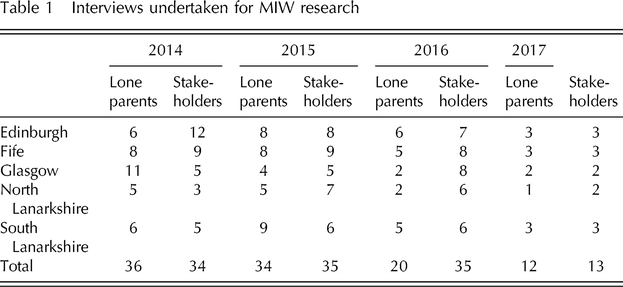
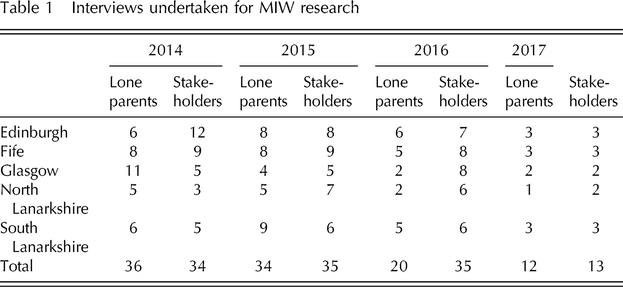
The study reported here involved four blocks of research, undertaken between 2014 and 2017. Further information on our sample is provided in Table 1. Semi-structured interviews were undertaken with MIW service users at different stages of involvement with the programme and at different points in their progression towards employability. A purposive sample was established, involving the research team working with MIW partnerships to identify a range of service user experiences (so that LPs with different numbers and types of barriers, and different family circumstances were engaged), and including some interviewees who had successfully transitioned to work, alongside the majority who continued to face barriers to progression (Batty et al., Reference Batty, Dayson, Eadson, Pearson, Sanderson, Lindsay and Cullen2017).
Interviews undertaken for MIW research
We also conducted semi-structured interviews with key stakeholders – keyworkers, other members of the management and delivery team, representatives of partner organisations, and other service providers who provided ‘signposting’ options for MIW’s LPs. Interviews explored the governance, management and delivery of MIW; relationships between partners, and engagement with mainstream welfare-to-work; and strategies for engaging and supporting LPs. The research was governed by the ethics regulations of both of our institutions.
All service user and stakeholder interviews were transcribed and analysed thematically. Data analysis was undertaken by four different research team members across two separate institutions in order to minimise risk of bias. Our data were drawn from a programme evaluation, so both interview schedule questions and key themes for the data analysis initially focused on engagement with MIW, barriers to employability, potential outcomes, views of the quality of provision and LPs’ broader experiences in the labour market. Analysing key stakeholder interviews, we sought to explore themes around resource allocation, the effectiveness (or otherwise) of partnership-working, and arrangements for the management and delivery services. Neither co-governance/co-management nor street-level co-production were programmed as initial foci for the data analysis – rather, LPs’ sense of control and empowerment though co-production emerged as themes through the data analysis, as did insights as to how MIW’s collaborative governance and management supported co-production on the frontline.
Findings
Co-producing employability journeys
Co-production involves active dialogue and engagement between service users and providers, based on a relationship of equals – ‘full co-production occurs when both service providers and recipients are active and make a joint contribution to the outcomes to be achieved’ (Löffler, Reference Löffler, Bovaird and Löffler2016: 322). We found clear evidence of relationships of co-production with service users leading to positive outcomes in all MIW partnership areas. All partnerships invested heavily in keyworker support for LPs. In most cases, keyworkers were employed by, and located within, third sector organisations acting as co-lead partners. Keyworkers were responsible for providing one-to-one support; co-producing a combination of personalised services with LPs, MIW partners and other providers; and building networks with local communities and agencies. Crucially, relationships with keyworkers were based on co-production, which was a source of empowerment for all of the LPs who we spoke to (including those who had made limited progress and continued to face substantial barriers to employability). LPs consistently spoke of being encouraged and supported to make choices, in terms of how and how much they engaged with a range of services, and the kind of employment or other outcomes that they targeted.
It’s not someone saying, “You have to do this.” It’s like, “Do you want to do this? Is this what you want? Do you feel happy about doing this?” They would always bring it back to you… Changing it to a more positive place and, “Do you want to?” It’s changing words and speaking to people a wee bit differently and just making someone feel, “Wow, I actually do have a choice here.” It’s all about choices and wanting to do stuff, if that makes any sense?
MIW Service User, South Lanarkshire, 2017
She (MIW keyworker) never shoved me into anything. It was always take your time, think about it… She probably gave off hints that I could think about. Everything was like, “It’s your choice.” If you know you’re getting that choice, I think that was the next step to working. They’re giving you that choice.
MIW Service User, Fife, 2017
The empowerment, sense of choice and control felt by those engaging with MIW keyworkers is in stark contrast to how many LPs (including some of our interviewees) often tend to describe encounters with Jobcentre Plus and/or UK Government welfare-to-work programmes, which leave them feeling ‘deflated and frustrated’ (Skills Network, 2014: 25) or ‘pressured, and sometimes even intimidated or humiliated’ (Lindsay et al., Reference Lindsay, Pearson, Batty, Cullen and Eadson2018c: 49).
I think the staff that are working for MIW are fantastic, they’re a really good team, really nice and approachable… it’s nice to not think that you’re talking to somebody that’s going to judge you… like at the Jobcentre you feel like you’re being judged all the time, but when you go in to see (MIW keyworker) she’s like, “Hello, how are you? How’s your day been?” Stuff like that, it’s more personal.
MIW Service User, Edinburgh, 2015
Sometimes, the focus of co-produced activities undertaken by keyworkers and service users was to protect the latter from Jobcentre Plus’s conditionality regime. Under ‘Lone Parent Obligations’, claimants are required to demonstrate that they have undertaken extensive job search activity, or face benefit sanctions. Many of the LPs who we spoke to saw Jobcentre Plus’s demands in this area – which focus on the number of applications made, irrespective of the appropriateness of the job – as a poor use of time. Nevertheless, the fear that they would be judged as not doing enough to look for work, and so lose benefits, was common. Thus, keyworkers were sometimes required to help service users to comply with Jobcentre Plus obligations, before moving on to the real work of addressing their barriers to employability.
You know sometimes these girls (MIW keyworkers) are actually coming to my flat to help me with my job search. In my home! The other week my son was unwell, so they said, “Well we’ll come to you!” Because I’m always worried about the Jobcentre and doing the job search and they’re like, “Don’t worry about that, we’ll help you”.
MIW Service User, North Lanarkshire, 2014
The time and resources available to keyworkers to engage one-to-one (including in service users’ homes), combined with an ethos of co-production (which was fundamental to the values of the third sector organisations co-leading local partnerships), thus resulted in the kind of flexible, personalised support that LPs told us was quite different from their experiences of compulsory welfare-to-work. Survey and interview data gathered with LPs similarly pointed to a strong element of personalisation in their experiences of MIW services. Whereas UK Government-funded welfare-to-work has become increasingly standardised (Fuertes and Lindsay, Reference Fuertes and Lindsay2016), MIW LPs reported engaging with a variety of services and partner agencies, receiving support in different aspects of employability ranging from debt and benefits advice, support to deal with housing problems, basic and vocational training, health and wellbeing services, advice on accessing childcare, and the aforementioned intensive, personal development support provided by keyworkers. The diverse range of partners involved and flexible funding and signposting options meant that there were few pressures on keyworkers to constrain service users’ choices. That said, there were, of course, limits to the co-production options open to LPs and keyworkers due to gaps in local employability provision that might have offered signposting options, and the relatively limited discretionary budgets available to ‘buy in’ additional services. And as with other welfare-to-work initiatives, the outcomes achieved by LPs were also shaped by the availability of decent jobs within local labour markets (Rafferty and Wiggan, Reference Rafferty and Wiggan2017), and limited by weaknesses in the availability of childcare (Millar and Crosse, Reference Millar and Crosse2018). Nevertheless, service users often described how keyworkers (and the broader MIW programme) had responded to their personal choices, aspirations and preferences – clear evidence of co-production in action. Indeed, it is striking that all of the more than 100 MIW participants who we spoke to were generally positive about the programme and its impact on their employability and wellbeing. Most spoke of a renewed sense of control and empowerment through MIW – it was a defining theme of our interviews with LPs, driven by them, as was how they contrasted MIW with negative experiences of Jobcentre Plus and WP services that they viewed as unhelpful and sometimes a source of humiliation.
Co-producing employability: facilitators and challenges
We have argued above that co-production in the field of employability is more likely to emerge where governance and service management arrangements are conducive to local collaboration. Our interviews with key stakeholders involved in MIW found strong evidence of the sort of co-governance and co-management arrangements that Brandsen and Pestoff (Reference Brandsen and Pestoff2006) and others have suggested are key facilitators of co-production. First, the funder, the Big Lottery Fund, provided strong leadership in encouraging the establishment of genuinely diverse, multi-stakeholder partnerships that were able to pool expertise and therefore build personalised services responding to the needs and aspirations of LPs. As noted above, the funder also required that third sector organisations adopted a co-leadership role. This meant that both local charities with strong roots in disadvantaged communities and LPs’ groups played a prominent role in leading partnerships, building credibility with service users. As noted above, such grassroots third sector organisations often find themselves excluded from mainstream welfare-to-work contracts, because they are not considered to be sufficiently activation-focused by lead contractors, or because of their own ethical concerns regarding the treatment of vulnerable groups under compulsory programmes (Lindsay et al., Reference Lindsay, Pearson, Batty, Cullen and Eadson2018a).
The governance of MIW was also quite distinctive in eschewing the elaborate payment-by-results contracting that has arguably come to dominate – and add substantial transaction costs to – the organisation of UK Government-funded welfare-to-work (Fuertes and Lindsay, Reference Fuertes and Lindsay2016). Partnerships were granted funding by the Big Lottery Fund. While appropriate audit and evaluation practices were put in place by the funder, and user engagement targets were agreed with lead partners, partnerships were supported to develop their own approaches. The lack of dirigiste top-down control and absence of inappropriate performance management was appreciated by partners in all five localities.
Big Lottery Fund was an excellent partner. They didn’t micro-manage. They were clear on priorities and then said “Here’s the project – get on with it”.
MIW Lead Partner Representative, Fife, 2017
These co-governance arrangements fed into similarly collaborative approaches to the co-management of services on the ground. With up-front grant funding available to partnerships, they were able to build services from the ground up, and include a broad range of delivery partners with specific areas of expertise. Accordingly, the diverse suite of services described above were offered by partners such as: grassroots third sector organisations run by and for LPs; Citizens Advice Bureaux with expertise in debt and money advice; community health organisations; and public and third sector employability and training providers. Keyworkers and MIW partners also worked hard to network with (and establish signposting routes to) other stakeholders including further education colleges, social work and (crucially) childcare providers. Keyworkers were able to use small discretionary budgets to help LPs to access childcare and other services. As noted above, many LPs facing multiple barriers chose to engage with a number of different MIW services. Our LP interviewees valued the personalised approach of MIW, which they saw as offering a combination of support tailored to their needs, delivered by people and organisations who understood the barriers that they faced.
It’s a lot easier if you go to somewhere that deals only with lone parents, you’re at an advantage… they know how hard it is, because a lot of them have got kids … they all know what it’s like.
MIW Service User, North Lanarkshire, 2014
It is worth reiterating that this is quite different from the welfare-to-work delivered by UK Government contractors, which focuses on standardised activities to enforce increased job search effort (Fuertes and Lindsay, Reference Fuertes and Lindsay2016). Much of the core service offer to LPs was co-ordinated by keyworkers, who emphasised that they had considerable autonomy to shape provision in collaboration with, and in response to, service users’ needs and aspirations. This meant that LPs were active in co-producing their own employability journeys, but also in informing the broader content of MIW and the practice of keyworkers.
We never had a plan of how we were going to do things when we started. It has really evolved, and that is mainly because of the people that we’re working with. Certainly, from my point of view, all the group work that I have done… has actually been as a result of people asking for particular things, and I’ve thought, “Wow, I could do that”.
MIW Keyworker, Fife, 2015
In summary, mechanisms to support the co-governance of the MIW programme and the co-management of services on the ground appear to have been important in creating opportunities for co-production with LPs. A number of conditions were also in place that are important facilitators of co-production. For example, the decision to build services through local partnerships meant that partners, keyworkers and LPs benefited from proximity – partner organisations found each other and signposting options to be easily accessible (Verschuere et al., Reference Verschuere, Brandsen and Pestoff2012). The fact that local third sector organisations were granted the resources and had the expertise to contribute was also important. It has been suggested that the third sector has a particular capacity to co-produce with vulnerable user groups and communities (Pestoff, Reference Pestoff, Pestoff, Brandsen and Verschuere2012), and our evidence suggests that this was the case with MIW (Lindsay et al., Reference Lindsay, Pearson, Batty, Cullen and Eadson2018a). Effective leadership to champion co-production was also important (Verschuere et al., Reference Verschuere, Brandsen and Pestoff2012) – the funder made strong decisions that supported and demanded inter-disciplinary collaboration in the governance, management and delivery of MIW; and lead partners demonstrated openness and inclusiveness in their engagement with other stakeholders. Finally, we should also acknowledge that – unlike much of state-funded welfare-to-work in the UK – MIW was well-resourced. As Löffler and Bovaird (Reference Löffler, Bovaird, Ongaro and Van 2018) note, co-production requires time and resources to be focused on partnership development and community engagement, and the funding model in this case allowed partners to engage in building relationships and establishing credibility in target communities. It also ensured that keyworkers had manageable caseloads, which in itself has been shown to be an important facilitator of good quality employability provision (Considine et al., Reference Considine, O’sullivan and Nguyen2018).
Discussion and conclusions
Policymakers have sought to justify the extension of welfare conditionality and compulsory activation to vulnerable groups by promising that they will have access to personalised employability services. In liberal welfare states such as the UK, welfare-to-work has instead come to be defined by standardised, work-first provision and a disciplinary regime that has done considerable harm to vulnerable groups such as LPs (Lindsay et al., Reference Lindsay, Pearson, Batty, Cullen and Eadson2018b). Our research demonstrates that there are progressive alternatives.
To address our first research question, deploying the concept of co-production in this context is appropriate given the evidence that MIW was informed by an asset-based approach: the aim was to work with LPs, tapping their agency, energy, knowledge and networks, rather than enforcing behaviour change through the threat of sanctions. The experience of LPs was one of empowerment. There is always a risk of sample bias when engaging with interviewees who volunteered to share their experiences. However, it is important to note that the positive experiences of co-production reported above were volunteered both by service users who had made substantial progress and/or transitioned into paid work, and those who continued to face multiple barriers. The in-depth nature of our interviews allowed us to probe LPs and elicit detailed stories of how they brought their agency to bear on the co-production process.
As to the second research question on facilitators of co-production, in the case of MIW, important conditions for co-production with service users were in place. Strong leadership from MIW’s funder supported the emergence of collaborative governance and partnerships that brought together stakeholders on the basis of ‘functional matching’ – i.e. delivery partners were included on the basis of their expertise in co-producing relevant support with service users, rather than their capacity to compete for contracts. This approach allowed for the development of multi-disciplinary, multi-stakeholder services that enabled LPs and keyworkers to co-produce flexible employability provision tailored to the former’s needs, assets and aspirations. Eschewing the payment-by-results contractualism that dominates state-funded activation in the UK also allowed MIW to invest resources in partnership-building, network development and proactive engagement with communities and service users. The co-governance mechanisms established by the funder and MIW partners, and the proximity of local stakeholders, created the conditions for resource-sharing and the development of co-managed services that offered a range of personalised support for LPs. Crucially, that support proved effective because it was co-produced with service users, drawing on their assets, resources and agency, responding to their specific needs and aspirations, and creating a sense of control and empowerment.
All of this matters for two reasons. First, our study adds to evidence that co-production can enhance feelings of empowerment among service users and deliver on the promise of personalisation. Second, the sort of approach described above demonstrates that there are alternatives to the new public management-oriented governance, standardised work-first provision and disciplinary activation regime imposed in liberal welfare states like the UK. The UK’s reliance on contractualism in relations between the state and employability providers, and conditionality and compulsion in its dealings with the unemployed, amounts to a disciplinary regime that all but eliminates the capacity to make choices for both those delivering and receiving services. The result is a toxic activation regime that is completely at odds with the principles of co-production and empowerment. And that is perhaps the key limitation of our research – there are severe constraints on the extent to which co-produced approaches to employability can be mainstreamed within extant disciplinary activation regimes. Previous studies in the field of employability have demonstrated that disciplinary regimes that seek to enforce behavioural change through compulsion and conditionality stymie attempts to involve service users in co-production (Pestoff, Reference Pestoff, Pestoff, Brandsen and Verschuere2012).
There is a need for a fundamental shift in how UK policymakers think about activation and employability. Our evidence suggests that empowering and co-producing with LPs (and potentially with other vulnerable groups) can deliver high quality, genuinely personalised employability services. Given the limited evidence of positive outcomes, and the substantial evidence of harm to the most vulnerable, delivered by work-first activation and welfare conditionality, it is to be hoped that policymakers will eventually consider more progressive and effective approaches to employability.