Virginia laughs as she talks about burning down El Alto, Bolivia’s city hall during a protest in February 2003. An indigenous grandmother well into her 80s, she excitedly recounts how a group of unionized street vendors gathered in front of city hall chanting their demands, set city hall on fire, and then sat down with city officials to negotiate. The arson had a lasting effect: the city’s residents still call the (repaired) building la alcaldía quemada or the burned city hall.
After the event, street vendor unions negotiated a generous ten-year agreement with the mayor and then ran a successful campaign to replace him with one of their leaders (Dangl Reference Dangl2007). Fifteen years later, the same union publicly threatened another mayor and then set fire to a different government building on camera and in broad daylight. These are not isolated events; every few months, Bolivian journalists record street vendor leaders, coca grower unionists, and neighborhood association leaders setting fire to public buildings or kidnapping, assaulting, and even executing officials (Gingerich Reference Gingerich2009; Spedding Reference Spedding2003; Velasco Guachalla Reference Velasco Guachalla2020). Bolivian history is replete with similar stories, including a group of teachers and market women vandalizing the presidential palace and executing President Gualberto Villarroel in 1946 (Albó 2008). Some perpetrators of these crimes are arrested, charged, and found guilty, while many others are not. Civil society leaders and organizations in countries beyond Bolivia, such as Argentina (Perez Reference Perez2018), Peru (Paredes Reference Paredes2016), Nigeria (Grossman et al. Reference Grossman, Phillips and Rosenzweig2018), India (Berenschot Reference Berenschot2011; Wilkinson 2009), and Kenya (Cooper Reference Cooper2014), confront officials and institutions with destructive protest tactics, including arson, assault, and kidnapping. Why do civil society leaders publicly engage in destructive protest?
In places like El Alto; Lagos, Nigeria; and Uttar Pradesh, India, leaders of civil society groups, such as street vendor unions and neighborhood associations, make agreements with officials about where and how their members can work, who will keep streets clean, and who will build and maintain new markets and roads (Grossman 2020; Post et al. Reference Post, Bronsoler and Salman2017; Tassi et al. Reference Tassi, Hinojosa and Carnaviri2015). These agreements are crucial to civil society leaders and organizations because officials’ decisions affect their work and profits (Boulding 2014; Helmke and Levitsky Reference Helmke and Levitsky2004; Nelson-Nuñez and Cartwright Reference Nelson-Nuñez and Cartwright2018). The agreements are crucial to officials because local governments do not have the resources to secure markets or neighborhoods or to build new infrastructure (Hummel 2017; Tassi et al. 2013). Officials in cash-strapped municipalities like El Alto or Tucumán, Argentina delegate many of these tasks to civil society groups to fill in goods and services where the state falls short (Amengual Reference Amengual2016; Auerbach Reference Auerbach2019; Bodea and LeBas Reference Bodea and LeBas2016). These organizations have dense webs of working relationships and agreements with local officials (Davies and Falleti Reference Davies and Falleti2017; Derpic 2019; Hummel Reference Hummel2016). The agreements help both officials and civil society leaders get their work done in cities with tiny budgets, new and weak institutions, and unreliable information (Auyero Reference Auyero2001; Goldstein Reference Goldstein2016; Helmke and Levitsky Reference Helmke and Levitsky2004).
This article argues that targeting officials with destructive protest makes sense when civil society leaders believe that officials will concede policy and lucrative informal agreements in order to stop such protests, and that the protests will give leaders reliable information about officials’ behavior, resources, or decisionmaking processes. Officials and civil society leaders, as well as their organizations and followers, rely on informal agreements to work and to profit in a weakly institutionalized, highly politicized, and resource-strapped environment. Officials facing destructive protest also act strategically in order to manage their resources, achieve their goals, and advance their careers. Officials responding to destructive protest encounter a dangerous trade-off. They can stop destructive protest right away and make useful alliances by buying off leaders with informal agreements, which stops the problem today and builds governing alliances but encourages future destructive protest. Or they can use limited political resources to punish perpetrators, making powerful enemies but discouraging future violence.
This article will proceed to outline research on civil society, destructive protest, and official response. It will then develop the conditions under which civil society leaders strategically and publicly engage in destructive protest, explain how officials strategically respond to these tactics, and elaborate on when these dynamics catch officials in a dangerous trap. It will discuss why minoritized officials like women and indigenous people may be more likely to become targets of destructive protest—but also more likely than their peers from dominant groups to punish destruction and violence. The study analyzes three cases of peaceful protest, destructive protest, and informal agreements between street vendor unions and municipal officials in El Alto, Bolivia in a Bayesian process-tracing framework (Fairfield and Charman 2017) to illustrate the theoretical conditions and implications. It concludes with implications for officials and civil society groups that want to reach agreements without destructive confrontations.
Puzzle: Civil Society, Destructive Protest, and Official Response
Civil society leaders and their organizations engage in protest to influence government and wrest concessions from officials (Ritter Reference Ritter2014; Tilly Reference Tilly1993; Velasco Guachalla Reference Velasco Guachalla2020). People and groups engage in protest strategically; people protest when they believe that they have an actionable chance to influence policy or government (Ritter Reference Ritter2014; Machado et al. Reference Machado, Scartascini and Tommasi2011). Governments respond strategically with a mix of concessions, repression, or intentional neglect (Grossman et al. Reference Grossman, Phillips and Rosenzweig2018; Ritter and Conrad Reference Ritter and Conrad2016; Sullivan Reference Sullivan2016).
Scholars disagree on the effects of different protest tactics and why groups choose one tactic over another. Tilly (Reference Tilly1993) argues that groups draw from evolving repertoires of collective action. Cross-national protest data validate Tilly’s theory by demonstrating that tactics diffuse across groups but that groups diversify tactics and innovate to distinguish themselves (Cunningham 2013b; Cunningham et al. 2017). Research on political violence and terrorism argues that small extremist groups use destructive tactics when small, peaceful protests would be ignored (Kydd and Walter 2006, 2002) and that these campaigns influence governments’ actions (Crossley et al. Reference Crossley, Edwards, Harries and Stevenson2012; Kydd and Walter 2002; Maldonado et al. Reference Maldonado, Merolla and Zechmeister2019; Soifer and Vergara Reference Soifer and Vergara2019). Chenoweth and Stephan (Reference Chenoweth and Stephan2011) dispute the efficacy of violent tactics and find that peaceful antiregime movements are more successful than violent ones, in part because of government response to different tactics.
Research on extremist or antiregime violence does not explain why many civil society actors choose destructive protest. Many of the leaders and organizations that choose arson, assault, and other destructive protest tactics—such as miners in South Africa and Peru (Muñoz et al. Reference Muñoz, Paredes and Thorp2007; Paredes Reference Paredes2016), coca growers and street vendors in Bolivia (Dangl Reference Dangl2007; Kohl and Farthing Reference Kohl and Farthing2006), unemployed people in Argentina (Perez Reference Perez2018), or students in Kenya (Cooper Reference Cooper2014)—are not part of terrorist or revolutionary campaigns. These actors demand policies or concessions that are well within the government’s purview. Contrary to the subjects of other studies, these protesters often support the system they demonstrate in. Boulding and Nelson-Nuñez (Reference Boulding and Nelson-Nuñez2014) find that Bolivian protesters who participate in civil society groups are more likely to support the political system during times of crisis, even though protests and groups could be linked to violence and destruction. Why do largely nonviolent groups who have a range of possible tactics to choose from opt to burn down buildings, attack officials, or issue death threats?
Street vendors and other civil society groups in Bolivia draw and learn from an impressive array of practices that follow Tilly’s concept of a repertoire of collective action (Albó Reference Albó2002; Anria 2018; Lehm et al. 1988). Arson, kidnapping, and assaulting public officials are established tactics in the Bolivian protest repertoire and not ones that distinguish one type of group from another (Dangl Reference Dangl2007; Goldstein Reference Goldstein2016; Spedding Reference Spedding2003). Bolivian civil society groups threaten and protest to officials with lynching, riots, death threats, and kidnapping. Accounts of these tactics in the press and scholarly accounts are strikingly similar across space and time, going back at least to the group of protesters who killed President Villarroel (Derpic and Ugarte 2013; Gingerich Reference Gingerich2009; Goldstein Reference Goldstein2016). Bolivian civil society’s broad use of violent and destructive tactics reflects more general findings in the civil conflict literature: Cunningham et al. (2012) find that where one group in a movement uses violence, other groups are more likely to as well.
Bolivia, like Palestine (El Kurd Reference Kurd2019), Kenya (Cooper Reference Cooper2014), and many other places (Migdal Reference Migdal2001), has strong civil society organizations that interact with weakly institutionalized and politicized bureaucracies. Under these conditions, state-society interactions may resemble the fraught coalition building of postconflict societies, where officials offer former and potential rebels access to the state in exchange for cooperation and disgruntled factions stage public showdowns to wring more money or power from the state (Cunningham et al. 2012; Driscoll Reference Driscoll2012).
Civil society leaders and local government officials benefit from reaching profitable agreements and avoiding public conflict, but they want very different agreements. Their resources and abilities affect the agreements they negotiate, and they do not have full information about what the other can do (Cunningham Reference Cunningham2013a). Leaders and officials cannot always reach agreements with officials through quiet negotiations; both make demands that they may not be able to back up with their abilities and resources. Hidden negotiations on informal agreements sometimes spill out into public, destructive conflict (Cunningham Reference Cunningham2013a; Driscoll Reference Driscoll2012).
Existing work on destructive or violent protest suggests three primary alternative explanations for why civil society leaders opt for destructive protest tactics. One possibility is that leaders have less control than suggested and that destructive protest happens spontaneously when a protest escapes the leaders’ grasp (Polletta Reference Polletta1998; Snow and Moss Reference Snow and Moss2014). Protests involve many people, hundreds of reactions, and complex and quickly evolving dynamics, and leaders are only a few people attempting to manage them.
Second, the rich literature on intraorganizational politics, factions, and tactical choice argues that leaders who engage in violent or destructive protest are strategically distinguishing their faction or organization from others in a crowded field (Chenoweth Reference Chenoweth2010; Cunningham et al. 2012; Cunningham 2013b). Closely related to this explanation is the idea that some factions may espouse more violent ideologies than others and may push for or use hardline or violent tactics. A third possible explanation is that leaders may engage in destructive tactics where state capacity and the rule of law are weak and where perpetrators know that they are unlikely to be punished by the state for engaging in violent or destructive acts (Fearon and Laitin Reference Fearon and Laitin2003). These alternative explanations and their implications are evaluated with the case study data.
Theory: The Strategic Logic of Destructive Protest
When officials come into positions of power in politicized bureaucracies, they bring new goals, policies, alliances, and strategies. Civil society leaders build new relationships with these officials and renegotiate previous agreements. New leaders in government can shake up alliances and increase uncertainty, which can lead to conflict as partners try to figure out what a new leader can do, as scholars in international relations have established (Wolford Reference Wolford2007; Wu and Wolford Reference Wu and Wolford2018). Officials and leaders need accurate information about whom they are working with in order to make alliances (Cunningham Reference Cunningham2013a). Officials come into new positions with information about civil society organizations and their leaders from their predecessors, colleagues, newspapers, and organizations’ reputations from decades of public behavior.
In politicized bureaucracies, civil society leaders may have less information about officials. If an official is promoted from another position or enters the public sector from civil society, leaders may have high-quality information about how to negotiate with the new official. If the official is a political appointee or new politician with a truncated resume, civil society leaders have poor information about their new counterpart. This presents a problem for leaders and organizations in places like El Alto or rural Nigeria, where written laws do not predict government response and matter as much or less than unwritten informal agreements, where policy and institutions change frequently and where rumor is a common source of information (Ellison Reference Ellison2017; Grossman et al. Reference Grossman, Phillips and Rosenzweig2018; Helmke and Levitsky Reference Helmke and Levitsky2004; Lazar Reference Lazar2007).
Civil society leaders form beliefs about officials from their existing reputation, the known resources of the government they work for, and the leaders’ experience negotiating with past individuals in the same position. This information does not always capture what an official can or will do in the new position. It also means that past officials can set precedents that may be dangerous for a new official to renegotiate. For example, past city officials working with street vendors in La Paz paid leaders to relocate their members’ stalls and not protest construction (Susz 2018). When a new official tried to relocate stalls without paying off leaders, the leaders initiated destructive protest. Similarly, when street vendors burned down El Alto’s city hall and then negotiated a lucrative agreement with the mayor, the agreement set an expensive and dangerous precedent for future mayors.
Officials may approach a strong and potentially combative group of civil society leaders with a “divide and conquer” mentality (Copa Pabón 2020; Díaz-Cuellar Reference Díaz-Cuellar2020; Driscoll Reference Driscoll2012). Officials need to cut deals with civil society organizations and leaders to govern (Hummel 2017), particularly in communities where civil society leaders are local powerbrokers and where voters look to local government’s alliances with civil society to gauge government responsiveness (Holland Reference Holland2017; Migdal Reference Migdal2001; Stokes Reference Stokes2005). Officials can manage the power of local civil society leaders by offering deals for cooperation, playing leaders off each other, and offering deals to breakaway leaders within a powerful organization if a given leader does not cooperate (Copa Pabón 2020; Díaz-Cuellar Reference Díaz-Cuellar2020). These divide and conquer tactics are similar to those that national leaders use to manage potentially destructive factions after a civil war or other internal conflict (Bakke et al. Reference Bakke, Gallagher Cunningham and Seymour2012; Driscoll Reference Driscoll2012).
Both leaders and officials prefer to form profitable governing alliances peacefully, through backroom deals (Driscoll Reference Driscoll2012; Lazar 200; Hummel 2018). Most of the time, they do. Sometimes, however, those hidden negotiations break down, such as when a leader demands more than an official will give or an official reneges on an existing agreement. Civil society groups may protest peacefully, but in places like Bolivia, where protest is routine, a march or sit-in may have limited impact. In places like El Alto (Lazar Reference Lazar2007), Buenos Aires (Perez Reference Perez2018), or Lucknow, India (Thachil Reference Thachil2020), where protest is common, officials of all types and persuasions may respond to peaceful protest—or not respond at all—in the same way, by ignoring the protest or by acknowledging protesters’ demands without ever taking concrete action. Leaders may then initiate destructive protest to force an official to respond. This process produces a mix of outcomes, including agreements, punishments, and more destructive protest, depending on the sequence of strategic choices by civil society leaders and government officials.
This process sets up a dangerous trade-off for officials facing destructive protest against the backdrop of weak institutions and politicized bureaucracies. The protests are costly to officials; no official wants to be threatened, hurt, or killed on the job. Additionally, damaged buildings cost money to repair; law enforcement and court proceedings cost money, time, and political capital; protest affects public opinion and voters; and destructive protest draws officials away from their existing work. Officials can stop the protests almost immediately by paying off the leaders with money or lucrative agreements. This tactic halts dangerous public showdowns and builds governing alliances with powerful civil society groups that can help an official govern and may deliver votes. However, paying off destructive leaders perpetuates incentives to engage periodically in destructive protest in order to secure another payment, and may encourage other civil society groups to use destruction for private gain (Cunningham et al. 2012). Alternatively, officials can choose to arrest perpetrators if they have the law enforcement capacity to arrest, investigate, and prosecute, as well as the political capital to weather a cycle of destructive protest while making enemies with a potential member of their governing coalition (Derpic Reference Derpic2017). This tactic discourages future destruction but costs political capital at the time that not all officials possess.
This strategic process suggests observable implications for the cases in this study. First, we should expect more destructive protests against officials with short records and officials facing structural and institutional weaknesses. We should expect more protest because these conditions suggest to civil society leaders that the official does not have the immediate political resources to punish destructive groups, weather the loss of a potential alliance, and still govern. Second, we should expect destructive protest to happen early in an official’s tenure or after a crisis in government, when an official’s resources and reputation are not well established. When leaders and officials know how public conflict will play out, they use that information in closed-door negotiations without escalating to destructive protest.
Furthermore, because the process rests on leaders’ beliefs about officials’ likely behavior, destructive protest may be more likely when leaders know that officials are in a precarious position or when leaders hold systematically faulty beliefs. This helps to explain why civil society leaders may target officials from minoritized groups. A large body of research demonstrates that women and ethnic minorities are more likely to rise to leadership positions during crisis (Morgenroth et al. Reference Morgenroth, Kirby, Ryan and Sudkämper2020; Ryan et al. Reference Ryan, Alexander Haslam and Kulich2010). This places minoritized leaders in precarious positions that set them up for poor performance or failure. If this study’s theory is correct, this pattern makes women and minoritized people likely targets of destructive protest.
Civil society leaders may systematically underestimate officials from minoritized groups. Leaders are then more likely to escalate to destructive protest when negotiating with officials from minoritized groups. I expect that these underestimated officials are, in turn, more likely to punish the perpetrators of destructive protest. In the case of Bolivia, I expect that women and indigenous officials are particularly likely to be targets of destructive protest. Indeed, existing research documents widespread violence against women in politics in Bolivia (Htun and Ossa 2012; Krook and Restrepo Sanín 2020).
Alternative Explanations and Observable Implications
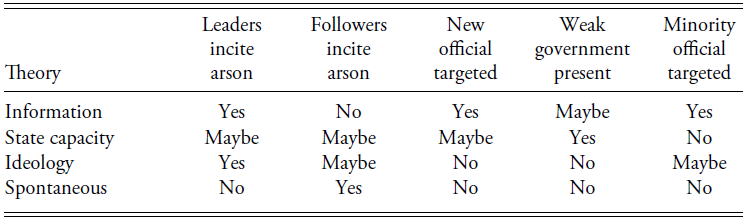
This project explains destructive protest with a theory of strategic information: civil society leaders use destructive protest tactics to extract information from officials and to reach profitable informal agreements. This theory suggests a number of observable implications for protest. If this theory helps explain destructive protest, we would expect to observe civil society leaders initiating destructive tactics (instead of followers or police), and leaders may be more likely to use these tactics during a political or economic crisis, at the beginning of an official’s tenure, or against minority officials. The literature on protest suggests a number of alternative explanations for destructive protest, including low state capacity or the weak rule of law, ideology, and spontaneous violence. These explanations have their own observable implications, summarized in table 1.
Observable Implications and Variables in Destructive Protests from the Theory and the Alternative Explanations

Table 1 summarizes what we should expect to see in destructive protests under different theories. These theories have overlapping observable implications for protest, which we can use to evaluate which theories explain episodes of destructive protest. If state capacity explains the tactical choice, then we may see either leaders or followers initiating destructive protest; and a weak government or crisis will increase the likelihood of protest, while an official’s background should have little influence. If ideology explains why some people engage in destructive protest, then leaders, and occasionally followers, may initiate, and officials from some backgrounds may become targets, but official tenure or state capacity should not matter. Furthermore, if destructive protest is spontaneous, we should see followers initiating destruction, rather than leaders, and no other variable should have a systematic effect. These observable implications can be used in a Bayesian process-tracing framework.
Methods
Bolivian politics encompasses a wide range of organized contention and tactics (Anria 2018; Boulding 2014; Velasco Guachalla Reference Velasco Guachalla2020). Historically, Bolivian political contestation has featured weekslong strikes and barricades, small explosives and dynamite, public death threats, and destructive protest (Albó 2008; Dangl Reference Dangl2007; Spedding Reference Spedding2003). The cases in this study occurred at different times in contemporary Bolivian political history. The 2003 arson in El Alto came at a heightened time of political contestation and destructive protest: the Gas War, which brought most of the country and the military into the streets for more than a year (Kohl and Farthing Reference Kohl and Farthing2006). These events propelled Evo Morales and the MAS party into power for the next 15 years and swept out the previous political establishment (Anria 2018; Madrid Reference Madrid2012).
The project’s other cases of peaceful and destructive contestation occurred between 2015 and 2018. National politics during this period of MAS control were predictable and routinized. When contention broke out or escalated to destructive protest, the targets were often local politicians in areas where power was less routinized, such as El Alto. National politics returned to frequent destructive contention in 2019, when allegations of electoral fraud spurred national protests, arsons at seven of the country’s nine electoral tribunal buildings, and a police mutiny that pushed Evo Morales to resign and leave the country (Copa Pabón 2020; Díaz-Cuellar 2020). Destructive contention continued through the COVID-19 pandemic (Hummel et al. 2020; Velasco Guachalla et al. 2021).
The case studies used newspaper reports and videos of arson, as well as journalistic coverage of policy negotiations before and after those episodes. I supplemented newspaper coverage with interview evidence and participant observation with the El Alto Street Vendor Federation and city bureaucrats. The fieldwork took place in El Alto between January and May 2015 and July and August 2018. Additional examples come from from fieldwork with street vendor leaders and local officials in La Paz, Bolivia between September 2014 and August 2018. Additionally, studies in El Alto by Arbona and Kohl (Reference Arbona and Kohl2004), Lazar (Reference Lazar2007), Dangl (Reference Dangl2007), Derpic and Ugarte (2013), Tassi et al. (2013), and Tassi et al. (Reference Tassi, Hinojosa and Carnaviri2015) fill in historical details, establish what is normal and abnormal in El Alto, and provide examples of agreements with other civil society organizations.
The case studies employ Fairfield and Charman’s Bayesian process-tracing framework (2017) by assessing how likely each piece of evidence is, given a world in which the proposed theoretical process is operative and a world in which the alternative explanations are operative. I utilize the Bayesian process-tracing steps in combination with standard process-tracing techniques (Bennett Reference Bennett2010; Herrera Reference Herrera2017; Mahoney Reference Mahoney2012). I evaluate three alternative explanations: that destructive protest happens spontaneously or when a protest escapes the leaders’ control (Polletta 1998; Snow and Moss Reference Snow and Moss2014); that leaders who engage in destructive protest are from a hardline faction within their organizations or share an ideology that espouses violent or destructive tactics (Chenoweth Reference Chenoweth2010; Cunningham et al. 2012); and that leaders engage in destructive tactics where state capacity and the rule of law are weak (Fearon and Laitin Reference Fearon and Laitin2003).
Case Studies: Arson In El Alto
El Alto is a self-built city on the plains above La Paz that became a social, political, and economic powerhouse in the 1990s and 2000s (Arbona and Kohl Reference Arbona and Kohl2004, 258, 261; Derpic 2019). Activists realized that the city’s placement between the capital, the international airport, and major highways made it possible to shut down the capital city with protests of a couple hundred people (Clandestina Reference Clandestina2020; Copa Pabón 2020). El Alto’s neighborhood associations and unions, particularly the El Alto Street Vendor Federation, played a major role in the 2003 Gas War, which barricaded the capital, toppled the government, and is widely credited to have brought Evo Morales, the country’s first indigenous president, to power (Díaz-Cuellar, Reference Díaz-Cuellar2020; Farthing and Kohl Reference Farthing and Kohl2014; Madrid Reference Madrid2012). The leaders of these organizations, their protest strategies, and the alteño officials they work with are the focus of the case studies.
Assumptions
El Alto has thousands of active civil society groups (Arbona and Kohl Reference Arbona and Kohl2004; Copa Pabón 2020; Tassi et al. Reference Tassi, Hinojosa and Carnaviri2015), and Bolivia writ large has a highly organized civil society (Boulding 2014). Most adults and many children participate in at least one civil society organization, and the groups are organized locally into associations or unions, then into municipal federations, and then into larger peak organizations or confederations (Anria 2018; Davies and Falleti Reference Davies and Falleti2017).
The theory assumes that these civil society organizations are largely peaceful and well known. The theory also assumes that the organizations are not clandestine resistance or terrorist organizations or part of antiregime movements (Chenoweth and Stephan Reference Chenoweth and Stephan2011). Civil society organizations in El Alto fit these assumptions: most residents belong to a neighborhood association, virtually all parents belong to a school association, and most adults belong to a workplace union, not to mention hundreds of active churches and sports leagues (Anria 2018; Davies and Falleti Reference Davies and Falleti2017; Lazar Reference Lazar2007). Groups register with the government, have known leaders and offices, and members are open about their membership. Leaders come from the rank-and-file membership and are typically elected by members, who value leaders with extensive experience in the area they represent, formal education, oratorical skills, and relationships with officials (Hummel Reference Hummel2016; Lazar Reference Lazar2007).
One of the more mundane interviews I conducted was with the leader of the Witches’ Union in El Alto, which was affiliated with the El Alto Street Vendor Federation during the 2003 and 2016 arsons. Hundreds of witches, healers, shamans, fortune tellers, and wisemen conduct business in rows of small, brightly painted concrete stalls and houses along the edge of downtown El Alto. The leader of the Witches’ Union was bored with my questions about why witches have unions, why they affiliated with the federation, and why and how they worked with the city government. He explained that these are basic elements of doing business in El Alto, particularly for self-employed or informal workers like witches and fortune tellers. Of course they organized, affiliated, protested, and made agreements with the local government, he said, and he explained how they paid taxes to the local government and that they needed the federation leaders to intercede with officials on their behalf (Civil society leader 1 2015).
The Witches’ Union is not an anomaly among civil society organizations and their leaders in El Alto (nor is it the only union of witches and fortune tellers; there appear to be half a dozen in the city). On most days in El Alto and other cities across Bolivia, civil society leaders and their membership gather at city offices waiting for appointments with officials to hash out projects and disagreements. Previous agreements are posted on office doors, and civil society leaders carry thick files of paperwork from past projects and existing disputes. Officials and civil society leaders greet each other by name and have each other’s cell phone numbers, often communicating over WhatsApp and loud phone calls. Leaders introduce group members with requests or grievances to officials in drawn-out group meetings that occur at regularly scheduled times. During these meetings, leaders and officials refer back to those posted previous agreements, as well as to often-contradictory informal verbal agreements that bend formal rules.
When they do engage in peaceful or destructive protest in El Alto, civil society leaders make clear and public demands. They often chant demands during a protest, with the help of bullhorns or slips of paper passed to protesters to repeat. Many marches, sit-ins, or blockades include a written list of demands hand-delivered to officials, posted on locked office doors, or affixed to barricades (Sagarnaga Reference Sagarnaga2020). These demands are not revolutionary or antiregime; instead, they are a mundane wish list of goods and services that the civil society organization demands from its local government. I have heard protesters who engaged in destructive acts chant demands such as “do not move market stalls,” “long live annual municipal payments,” and “finish construction projects within 90 days.”Footnote 1 These mundane demands are sometimes interspersed with threats, most commonly death threats to politicians who oppose policy demands, such as “Death to Councilman Omar Rocha!”Footnote 2
These demands are mostly about specific local policy and mostly within the purview of the local government. While the local government may decide not to pay attention to the demands, not moving market stalls, finishing construction projects within an agreed-on timeframe, and maintaining various ordinances are all items that the government can address. With the notable exception of death threats, these are not revolutionary or antiregime rallying cries. Even including death threats, these civil society leaders do not propose to overthrow the government, change the regime, or violently install their own government or faction.
When groups use destructive strategies, officials’ responses are varied and can include agreements, punishments, or policy concessions. In La Paz in 2017 and 2018, civil society leaders who threatened or attacked officials were not arrested and continued to negotiate with officials (Agencia de Noticias 2019; Página Siete 2018). Officials’ responses to destructive strategies like arson vary and can include generous agreements.
Process Tracing the Cases
Daily civic life in El Alto illustrates a peaceful negotiation strategy in which civil society leaders refrain from destructive protest tactics and officials construct a web of informal and formal agreements with them (Anria Reference Anria2016; Anria and Cyr Reference Anria and Cyr2017; Ellison 2018). The daily waiting, paperwork, and meetings are periodically punctuated by destruction and protest, especially when officials enter or rotate office. The peaceful strategy and outcome can be illustrated with an informal agreement between the leaders of the El Alto Street Vendor Federation and Mayor Édgar Patana to campaign for the mayor’s re-election in 2015. The burning of city hall in 2003 illustrates a destructive protest strategy, in which leaders believed that officials would respond to destructive protest with a profitable deal in order to stop the destruction. The 2016 burning of a city office building illustrates the same strategy with a different outcome: after a destructive protest in which leaders believed an official would strike a new deal, the new official instead arrested the organization’s leadership and offered new and less beneficial agreements with the leaders who took over.
Re-election Campaign
During fieldwork in 2015, I observed one of these quietly negotiated informal agreements. Mayor Édgar Patana, a former street vendor leader himself, was up for re-election. In organizational manifestos and public meetings, street vendor organizations proclaimed their political neutrality and stated that they were not affiliated with any political party (Public employee 1 2018; Civil society leader 2 2015). In reality, parties across the ideological spectrum court street vendors and their organizations and strike deals with organizations that agree to campaign for them (Public employee 2 2018). However, under Bolivian law, any official running for office must step down from their position once they start campaigning and let an interim official take over. Campaign season in Bolivia means official turnover and new agreements.
Patana stepped down to run for re-election and took many low-level bureaucrats, including some from the Markets Office, with him. Although new and untested officials joined the Markets Office and work slowed to a maddening crawl, street vendor organizations did not stage any destructive protests in El Alto during the campaign. Instead, they struck an informal deal to campaign for Patana and participated in a variety of marches, rallies, and other demonstrations of support. Some Market Office officials rarely showed up for work, and those who did were overworked or new and unsure of what to do, but street vendors did not publicly demonstrate or complain (Civil society leader 3 2015; Public employee 3 2015).Footnote 3 They abided by existing agreements and campaigned to re-elect the mayor (Public employee 4 2015).Footnote 4
The theory posits that civil society leaders need formal and informal agreements with officials in order to do their jobs and that leaders escalate to destructive protest if they believe that they can wring better agreements out of officials who cannot afford public chaos and violence. If this theory were operative in El Alto in early 2015, it would explain the web of agreements, mostly informal, between street vendor leaders and officials during campaign season. It also accounts for the lack of destructive protest during the same time: street vendor leaders had lucrative agreements with elected and appointed officials, and those agreements would probably end if those officials lost the election or were replaced. Destructive protest during the campaign would drain the mayor’s political resources and probably damage his re-election chances, further imperiling his and his appointees’ agreements with street vendor leaders. Thus, it was in the leaders’ interest to accept and abide by backroom deals and not to engage in destructive protest.
The alternative explanations partially account for the lack of destructive protest as well. If destructive protest is spontaneous or happens when a peaceful protest escapes leaders’ control, then the campaign season may not have experienced destructive protest through random chance. If hardline leaders with ideologies that espouse violence foment destructive protest, then those leaders may have been successfully sidelined by other factions during the campaign. Alternatively, public events and the media attention of a political campaign could make it easier for a small group of people or a faction to hijack events and attention through violent or destructive acts.
Furthermore, if destructive protest occurs when the rule of law is weak and protesters do not expect to be punished, then the rule of law may be comparatively stronger while the incumbent is trying to persuade voters to re-elect him, and protesters may believe that they are more likely to be punished for destructive acts during a campaign with plenty of media attention. On the other hand, rule of law and state capacity are typically sticky variables that change slowly over years, not weeks or months. In sum, the alternative explanations partially but do not fully account for peaceful cooperation.
The agreement to campaign for Patana was not a foregone conclusion. On the one hand, Patana, the former street vendor leader, had given the organizations unparalleled access to the El Alto city government, as well as dozens of agreements that had expanded street vending and the sector’s profits in the city (Civil society leader 3 2015; Public employee 4 2015). However, Patana’s administration was marred by corruption allegations and became deeply unpopular by 2015, and many street vendors wanted him out (Corz Reference Corz2015). The administration had promised public works to vendors and neighborhoods that never materialized, and the few projects that moved forward had displaced vendors’ stalls and remained unfinished, in direct violation of the 2005 agreement with the Street Vendor Federation.Footnote 5 While the organizational leadership agreed to campaign for Patana, and street vendors showed up at rallies and events, many privately voted for the opposition (Tarqui Triguero Reference Triguero2015). Patana lost re-election, and a new administration prepared to take power, setting up another round of turnover and negotiation.
Arson in 2016
The winner of the mayoral election was Soledad Chapetón, the millennial former vice president of the small Unidad Nacional opposition party. Chapetón’s transition team made public overtures through the press to civil society leaders and public statements about working with civil society groups. Chapetón also made it clear that many of the generous agreements that Patana had brokered with leaders would change (Agencia de Noticias Fides Reference de Noticias Fides2015, Rivas 2015c). The El Alto Street Vendor Federation responded with protest marches and threats. Braulio Rocha, the head of the federation, told Chapetón in front of journalists, “I will be your nightmare for the rest of your life” (Página Siete 2015).
On February 17, 2016, a protest through downtown turned violent. The march stopped at a government building, and a small group yelling Fuera Chapetón! (Chapetón get out!) tried to kick in the metal doors that employees had locked from
the inside (Cuiza Reference Cuiza2016). In video captured by members of the press accompanying the march, explosions ring out, and other participants’ pictures show a fire starting in front of the door (Cuiza Reference Cuiza2016). The fire spread before occupants could exit, leaving 18 injured and 6 bureaucrats dead.
Videos, photos, and dozens of eyewitnesses confirmed that Braulio Rocha’s sons and several other union leaders had started the fire. The perpetrators and suspected planners, including Braulio Rocha, were quickly arrested (Luizaga Reference Luizaga2016).
Chapetón did not negotiate with the planners. Instead, she punished the instigators and discontinued agreements with their organizations. She then offered small agreements to the next tier of leaders in the organization, who claimed ignorance of the arson and, in several cases, started new organizations that repudiated the now weaker and smaller Street Vendor Federation. This strategy follows the divide and conquer strategies that civilian leaders in postconflict zones often adapt with former and potential rebels (Driscoll Reference Driscoll2012).
This episode illustrates the strategy and outcome in which a powerful civil society leader faced a new and apparently inexperienced official. Chapetón was young, a woman, had little executive experience, and had been elected without a strong set of allies or preexisting agreements with civil society. Braulio Rocha judged her to be incapable of implementing her goals and negotiating new agreements for the city— and expected her to buy off powerful leaders who could cause big problems. Instead, Chapetón marshalled more political and material resources than Braulio Rocha expected, punished the destructive leaders, and imposed new agreements on new leaders that benefited the officials and the city. However, this new set of agreements came at a huge cost: a destroyed building, jailed civil society leaders, and six dead public servants.
The theory explains this episode of destructive protest in El Alto if Braulio Rocha and other civil society leaders held faulty beliefs about Chapetón’s likely reaction. Chapetón tried to renegotiate existing agreements when she assumed her new office. Braulio Rocha rejected these negotiations as offering too little and made public threats. When Chapetón did not counter with a better offer, Braulio Rocha planned a destructive protest with an inner circle of union leaders (Cuiza Reference Cuiza2016). It is a reasonable conjecture that Braulio Rocha and other leaders held faulty beliefs about Chapetón’s reaction: they had issued death threats, engaged in arson, and committed other destructive acts before with few consequences and against officials with more experience.
The perpetrators probably did not expect to be punished, given their past experience and their observations of other violent and destructive acts. Civil society leaders in El Alto and elsewhere in Bolivia had periodically burned public buildings and even killed officials and had faced few consequences. For example, Gingerich (Reference Gingerich2009) opens his book with the civil society leaders of Ayo Ayo setting fire to the mayor’s house and killing him, a crime for which they faced few consequences (Derpic and Ugarte 2013). Grievously injuring officials does not guarantee punishment either: in July 2018, union leaders marched through downtown La Paz and severely beat a city employee they came across. The employee was hospitalized and underwent surgery. The assault was caught on video, and multiple union leaders were identified doing the beating (ATB 2018). The city sued the union, but to date, none of the assailants have been arrested, and the city has since negotiated new agreements with the union (Agencia de Noticias 2019).
Further bolstering the case that civil society leaders may have held faulty beliefs, ethnographic work in La Paz and El Alto suggests that officials have better information about civil society leaders than the leaders do about officials. In interviews, officials stated that they knew what the organizations were capable of; they took precautions, like not showing up for work after sensitive decisions or operations, carrying out controversial policies in large groups for physical protection, and asking for preventative guards at their offices (Public employee 2 2018; Public employee 5 2018). They displayed a long organizational memory of past negotiations, agreements, and destructive protest, and past officials shared information with new officials about specific groups and leaders (Public employee 1 2018, Public employee 5 2018).
Street vendor leaders, on the other hand, responded to changes in officials by discussing their truncated resumes, stating that they would wait and see or that they hoped for new arrangements, and then claiming that they would pressure the official if necessary (Civil society leader 4 2018). In the Bolivian repertoire, pressure includes marches, strikes, sit-ins, and barricades, as well as dynamite, Molotov cocktails, and public death threats (Clandestina Reference Clandestina2020; Copa Pabón 2020; Spedding 2003). Ethnographic work points to the role of rumor in El Alto’s civil society groups and the difficulty of getting reliable information from the bureaucracy (Ellison 2017; Lazar Reference Lazar2007).
The alternative explanations only partially account for the arson in 2016. We can discard the first explanation; a later trial demonstrated that the arson was planned, not spontaneous, and video of the protest identifies street vendor leaders setting the fires. Therefore, this was not a crowd or agitators who escaped protest leaders’ control (Cuiza Reference Cuiza2016). As for the factional explanation, Braulio Rocha was the undisputed elected leader of a powerful federation that represented all of the city’s hundreds of street vendor unions in a united front. The final explanation, weak rule of law, partially explains protesters’ behavior if they believed at the time that they would not be punished, but the arrests, trial, and long jail sentences after the fact demonstrate that there was at least some local state capacity and rule of law. Recalling the episode of arson that opened this article, the El Alto Street Vendor Federation had burned a city building a decade before and had experienced a very different outcome.
Arson in 2003
One night in February 2003, members of the Street Vendor Federation held a protest at El Alto’s city hall. As the chants escalated, members started fires at the doors of city hall. The fires spread, burning the facade, the press room, and several other areas (Rivas 2015b). The federation leader, Braulio Rocha, was arrested for destroying government property (Página Siete 2016). He remained in jail as street vendors protested his arrest.
In the aftermath of the 2003 protests, Mayor José Luis Paredes released Braulio Rocha. With new information about Paredes’s capabilities from the massive protest movements rocking El Alto and the rest of the country, Braulio Rocha and the El Alto Street Vendor Federation then negotiated a generous ten-year agreement with the mayor (Página Siete 2016). The agreement froze licensing fees at a few dollars a year for ten years and returned 50 percent of those fees to the federation, among other things (Rivas Reference Rivas2015a). The agreement kept the city from collecting millions of dollars in potential licensing fees and designated roughly a million dollars for street vendor projects.
The arson at city hall, followed by a negotiated agreement with Mayor Paredes, illustrates the same destructive strategy with a different outcome. In this process, political conditions changed, and civil society leaders wagered that the mayor had fewer political resources to maintain his position in the city and his agreements with civil society. A powerful civil society organization staged a destructive protest to demand more attention and more resources from the mayor. Instead of roundly punishing the arsonists, the mayor caved to the protesters’ demands and signed an agreement that lavished benefits, at the city’s expense, on the organization that had burned down city hall.
The alternative explanations only partially explain the 2003 arson. We can discard the spontaneous explanation; street vendor leaders planned the arson and led the crowd in setting city hall on fire. Hardline strategies and rule of law hold more explanatory power. A faction of the Street Vendor Federation, a group of leaders espousing hardline strategies—but not the entire leadership committee—planned and executed the arson. Furthermore, El Alto in 2003 had weak rule of law, and no law enforcement appears to have been guarding city hall or other public installations, though a wave of protest was rocking the country.
Comparing Cases
This article’s central theory explains the two arsons, their differing outcomes, and the case of peaceful campaigning. The alternative explanations partially explain aspects of the cases. However, none of the alternative explanations fully accounts for all three events. The theory suggests implications that could further distinguish it from other explanations in future research.
As the clash between Mayor Chapetón and street vendor leader Braulio Rocha in 2016 suggests, when civil society leaders and officials are embedded in sexist or racist societies, officials who are women or from other minoritized communities and backgrounds may face more destructive protest than their predecessors from dominant groups. This is because they are more likely to assume leadership positions during crisis and because civil society leaders systematically underestimate minoritized officials and are therefore more likely to hold faulty beliefs about their responses to destructive protest (Morgenroth et al. Reference Morgenroth, Kirby, Ryan and Sudkämper2020; Ryan et al. Reference Ryan, Alexander Haslam and Kulich2010). An emerging literature on violence against women in politics documents many similar episodes in Bolivia, Peru, Mexico, the United States, and elsewhere (Krook and Restrepo Sanín 2020; Htun and Ossa 2013). The theory implies that in some cases, these officials are targeted with destructive protest more often than officials from privileged backgrounds, but that they capitulate to demands after destructive protest less frequently and may be more likely to punish perpetrators.
Conclusions and Implications
Why do civil society leaders use destructive protest tactics like arson and assault? Why do some officials arrest perpetrators while others pay them off? This project argues that strategically destructive protests reveal important information about how officials respond to crisis, as well as the resources at their disposal. Civil society leaders use this information to strike agreements with officials and use these tactics when they believe that officials will offer deals to stop public destruction.
Civil society organizations around the world use destructive protests to test officials and reach agreements. During an economic downturn in Argentina that sent officials scrambling for resources, unemployed people in the piqueteros movement used similar tactics, blocking highways and burning tires in front of officials until the officials negotiated or sent the police (Perez Reference Perez2018). Miners in Peru and union members in France escalated their work-based policy demands with destructive protest across cities (Muñoz et al. Reference Muñoz, Paredes and Thorp2007; Paredes Reference Paredes2016). Students in Kenya set fire to schools and principals’ residences to protest principals’ decisions (Cooper Reference Cooper2014).
The theory raises implications for state-society relations that could be tested in future research. The theory implies that officials with characteristics that suggest fewer resources or capabilities face more destructive protest. These characteristics should include officials in budget crises, with little prior experience, or with few allies, and may also include officials from minoritized communities. Officials with fewer resources, experience, and allies may be more frequent targets and may cave in to demands after protest. However, officials from minoritized communities, targeted because of their identities rather than their actual capabilities, may be less likely to cave after becoming targets. Future research could evaluate this hypothesis with more cases of minoritized officials and protests.
The theory points to a dangerous implication for civil society: arson and other destructive tactics can push officials to give civil society organizations policy input and resources, particularly when officials rely on these organizations to get their work done and when people have spotty information. Research in other cases validates this implication: Cooper (Reference Cooper2014) finds that students in Kenya continue to burn their schools because arson forces a response from education officials. Wilkinson (Reference Wilkinson2009) recounts the strategic logic of riots in India and the many electoral and economic benefits leaders can collect. Perez (Reference Perez2018) states that piqueteros repeatedly engaged in destructive protest because burning tires and blocking highways elicited an official response and often negotiation.
Officials interested in negotiating without arson, death threats, and roadblocks can proactively take actions to demonstrate what they can and cannot do. Higherups could publicly dedicate extra resources to departments and local administrations that are negotiating with civil society groups and could swiftly arrest leaders who engage in or even threaten destructive tactics. This is easier said than done, and municipalities in Bolivia have struggled with this response when offending civil society leaders control key votes or work as party operators.
Civil society organizations around the world strategically engage in destructive protest when they believe that tactics like arson will help them achieve their goals. Where tactics like arson force a response from officials, reveal important information about the state, or bring officials to the negotiating table, civil society organizations have clear incentives to engage in violent or destructive protest. Under these conditions, unclear and shifting webs of informal agreements and rules may encourage destructive protest tactics.
Author Interviews
I cite ten distinct interviews from a larger number conducted for this project. Some subjects were interviewed in El Alto, some in La Paz about El Alto, and some in La Paz but commented about dynamics in El Alto. I have left all but one source anonymous. Susz, the named source, is an elected public official whom I interviewed on the record. The other sources are street vendor leaders or appointed public servants to whom I promised anonymity and followed IRB confidentiality protocols. As such, I do not list any identifying details, including the exact date or location of the interview.
Civil society leader 1. 2015. Street vendor leader, El Alto. La Paz, March.
Civil society leader 2. 2015. Street vendor leader, El Alto. El Alto, May.
Civil society leader 3. 2015. Street vendor leader, El Alto. El Alto, February.
Civil society leader 4. 2018. Street vendor leader, La Paz. La Paz, July.
Public employee 1. 2018. City employee, La Paz. La Paz, August.
Public employee 2. 2018. City employee, La Paz. La Paz, July.
Public employee 3. 2015. City employee, El Alto. El Alto, March.
Public employee 4. 2015. City employee, El Alto. El Alto, February.
Public employee 5. 2018. City employee, La Paz. La Paz, August.
Susz, Pedro. 2018. City Council member, La Paz. La Paz, July 17.