Introduction
Hale (Reference Hale1974) erected the genus Bulbothrix as a segregate from Parmelia Ach. to accommodate species with marginal bulbate cilia; the cilia can be simple or branched. Bulbothrix is further characterized by laciniate lobes, cortical atranorin, hyaline unicellular, ellipsoid to bicornute ascospores, and bacilliform to bifusiform conidia (Hale Reference Hale1976; Elix Reference Elix1993; Benatti Reference Benatti2014). Bulbate cilia also occur in Relicina Hale, which differs, however, in the presence of usnic acid. Although the two genera exhibit similar morphologies, they are quite distinct as Bulbothrix belongs to the Parmelina-clade, and Relicina to the Parmelia-clade (Crespo et al. Reference Crespo, Kauff, Divakar, Del Prado, Pérez-Ortega, Amo de Paz, Ferencova, Blanco, Roca-Valiente and Núñez-Zapata2010). As currently circumscribed, Bulbothrix is a polyphyletic genus composed of two clades. The first, the B. isidiza group, is sister to Parmelinella Elix & Hale (Divakar et al. Reference Divakar, Crespo, Blanco and Lumbsch2006, Reference Divakar, Lumbsch, Ferencova, Del Prado and Crespo2010; Masson et al. Reference Masson, Benatti and Sérusiaux2015) which leads to this clade either nesting in the genus Parmelinella or being a small genus that contains salazinic acid (Benatti Reference Benatti2013; Kirika et al. Reference Kirika, Leavitt, Divakar, Crespo, Gatheri, Mugambi and Lumbsch2015). The second clade is the Bulbothrix goebelii (Zenker) Hale group, and the type species of Bulbothrix, B. semilunata (Lynge) Hale, may belong in this clade (Kirika et al. Reference Kirika, Leavitt, Divakar, Crespo, Gatheri, Mugambi and Lumbsch2015) on account of its distribution and morphological characteristics.
Twenty-nine species of Bulbothrix were accepted by Hale (Reference Hale1976). This number has grown to 61 (Bungartz et al. Reference Bungartz, Benatti and Spielmann2013; Benatti Reference Benatti2015; Masson et al. Reference Masson, Benatti and Sérusiaux2015), with many species from Brazil, which may be the centre of diversity for Bulbothrix (Spielmann & Marcelli Reference Spielmann and Marcelli2008; Benatti Reference Benatti2012a ). The genus is widespread in tropical and subtropical regions and reaches its highest diversity in semi-arid woodlands and secondary forests (Hale Reference Hale1976; Marcano et al. Reference Marcano, Mohali, Palacios-Pru and Mendez1996). Species concepts within the genus rely primarily on the branching patterns of cilia and rhizines, presence or absence of isidia, maculate or emaculate upper cortex, colour of the lower surface and secondary chemistry in the medulla.
Seven species of Bulbothrix have been reported from China: B. goebelii, B. isidiza (Nyl.) Hale, B. setschwanensis (Zahlbr.) Hale, B. tabacina (Mont. & Bosch) Hale, B. asiatica Y. Y. Zhang & Li S. Wang, B. subscortea (Asahina) Marcelli & Benatti and B. yunnana (Wang et al. Reference Wang, Chen and Elix2000; Chen et al. Reference Chen, Xu and Elix2009; Zhang et al. 2014). However, Bulbothrix yunnana was transferred to Parmotrema as P. yunnanum (Sheng L. Wang et al.) Marcelli & Benatti because the cilia have an enlarged base instead of being truly bulbate (Benatti & Marcelli Reference Benatti and Marcelli2010).
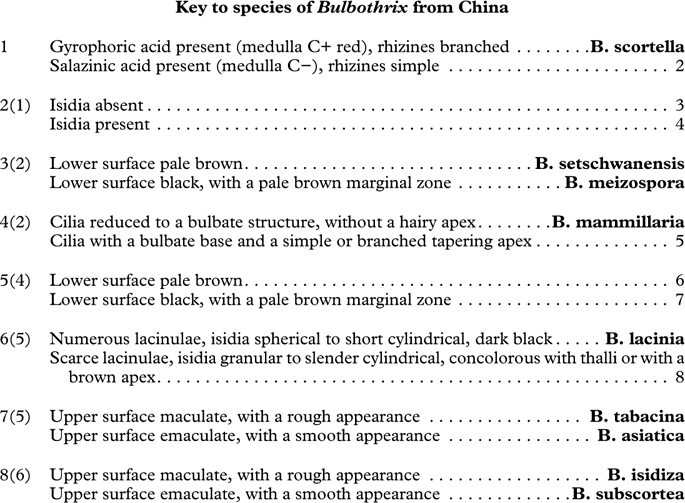
In this study, two new species are described and two species are newly recorded, resulting in a total of nine species of Bulbothrix occurring in China. Morphological and chemical descriptions, phylogenetic analyses together with a key to these species are presented.
Materials and Methods
Morphological and chemical studies
Approximately 400 specimens from the lichen herbarium of the Kunming Institute of Botany (KUN-L) and the Chinese Academy of Sciences were examined. Morphological characters were studied using standard stereoscopy and light microscopy. We sectioned apothecia, thalli, pycnidia and cilia with a razor blade under a NIKON SMZ745T dissecting microscope, then examined and measured traits using a micrometer under a NIKON Eclipse Ci-S microscope. Size of the thallus, apothecia and lobes are based on measurements for each specimen, and ascospore dimensions reflect ten measurements from a single apothecium per specimen. Size is represented by the range between the smallest and largest values. The chemical composition of each specimen was assessed using spot reactions and thin-layer chromatography with solvent system C (Orange et al. Reference Orange, James and White2001).
DNA extraction
Total genomic DNA was extracted from dry herbarium or fresh specimens using AxyPrep Multisource Genomic DNA Miniprep Kit 50–prep (Qiagen) according to the manufacturer’s instructions. The fungal internal transcribed spacer region (ITS) of the rDNA repeat was amplified via polymerase chain reaction (PCR) using the primers ITS1-LM (Myllys et al. Reference Myllys, Lohtander, Källersjö and Tehler1999) and ITS2-KL (Lohtander et al. Reference Lohtander, Myllys, Sundin, Källersjö and Tehler1998). Amplifications were performed in a 25 μl volume comprising 12·5 µl of 2× MasterMix (TaqDNA Polymerase, 0·1 units/µl−1; 4 mM MgCl2; 0·4 nMdNTPs; produced by Aidlab Biotechnologies Co., Ltd), 0·4 µl of each primer, 11 µl ddH2O, and 0·7 µl of DNA. PCR amplifications were performed using the following temperature profile: initial denaturation at 94 °C for 3 min, 30 cycles each composed of 94 °C for 40 s, 50 °C for 1 min, 72 °C for 1·5 min, and a final extension at 72 °C for 7 min. PCR products were sequenced using amplification primers by the company Sangon Biotechnology (Shanghai, China).
Sequence alignments
Sequence fragments obtained were assembled with SeqMan 7.0 (DNAStar) and manually adjusted. DNA sequences were aligned with MAFFT version 7 with the L-INS-I alignment algorithm (Katoh et al. Reference Katoh, Kuma, Toh and Miyata2005) using the web server (http://mafft.cbrc.jp/alignment/server/index.html) with all parameters set to default values.
Phylogenetic analyses
The ITS matrix was analyzed using a maximum likelihood (ML) optimality criterion and a Bayesian (BI) Markov chain Monte Carlo approach (B\MCMC), with Myelochroa aurulenta (Tuck.) Elix & Hale selected as outgroup.
ML analyses were performed using RAxML7.0.4 (Stamatakis Reference Stamatakis2006), implementing default settings. Support values were inferred from the 70% majority-rule tree of all saved trees obtained from 1000 non-parametric bootstrap replicates.
The Bayesian analyses were performed using MrBayes v3.1.2 (Huelsenbeck & Ronquist Reference Huelsenbeck and Ronquist2001), with 2 000 000 generations and four incrementally heated chains. MrModeltest 2.3 (Nylander Reference Nylander2005) was used in conjunction with PAUP* (Swofford Reference Swofford2003) to estimate the best-fitting substitution model (i.e., GTR+I+G) based on the AIC by jModelTest 3.7 (Posada Reference Posada2008). MCMC started from a random tree and was sampled every 1000th generation, with the first 10% of trees discarded as burn-in. The remaining trees were used to generate a majority-rule consensus tree with posterior probability (PP), inferred from consensus values, ≥0·95 considered as strongly supported. We used the program Tracer v1. 6 (Rambaut & Drummond Reference Rambaut and Drummond2003) to ensure that stationarity was achieved by checking whether the log-likelihood values of sample points reached a stable equilibrium. Phylogenetic trees were visualized using the program FigTree 1.4.0 (Rambaut Reference Rambaut2012).
Results
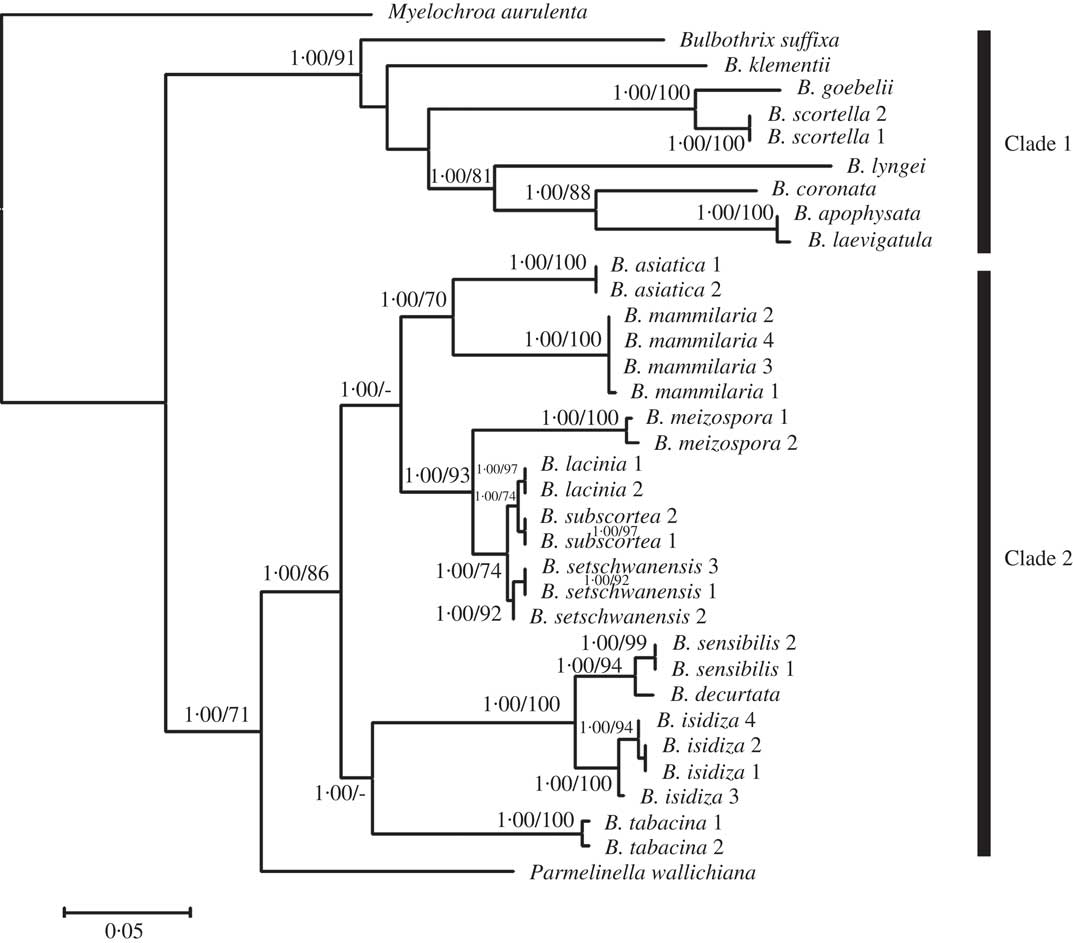
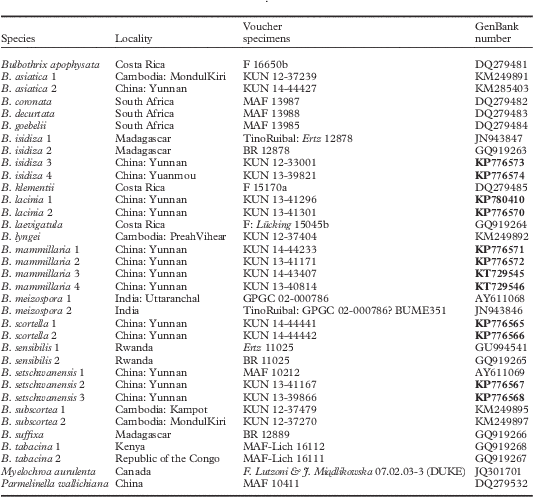
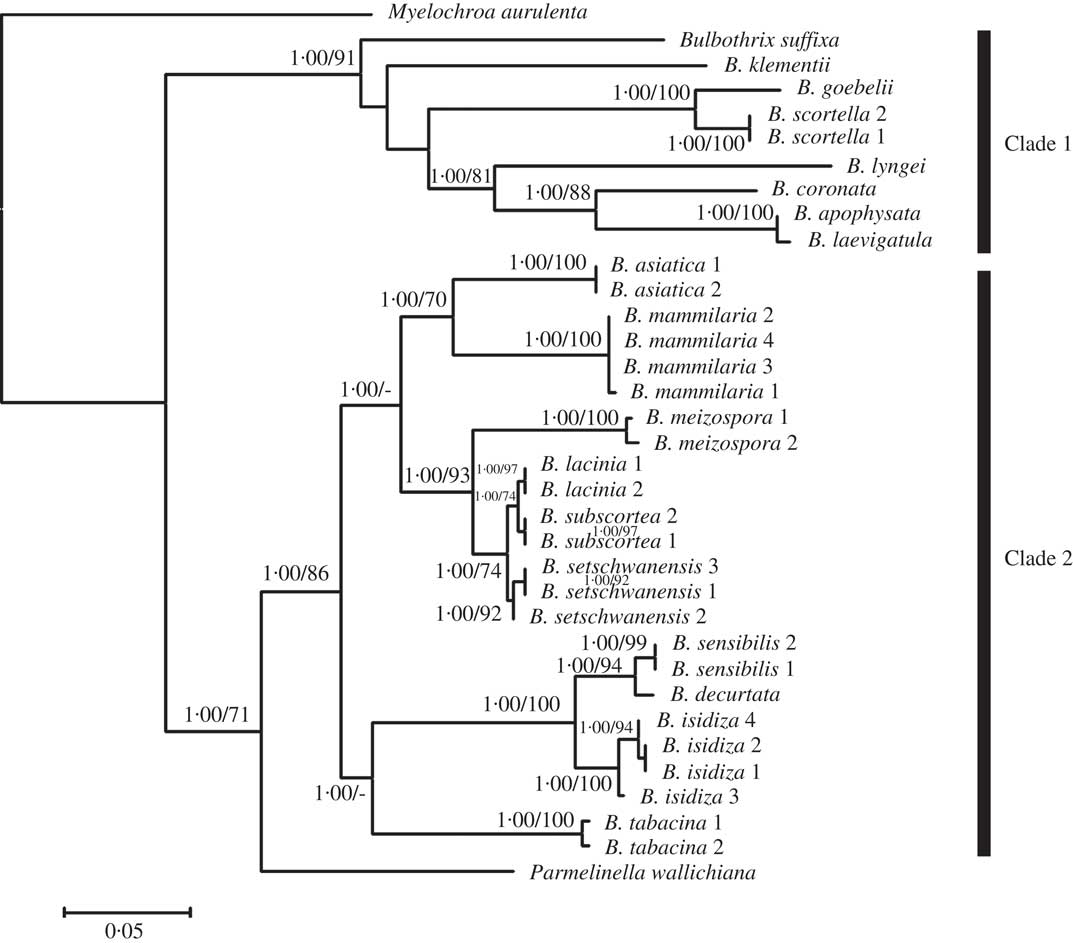
The ITS matrix contained a total of 35 sequences, including 12 that were newly generated (Table 1). The ITS topologies obtained by the maximum likelihood and Bayesian approaches were congruent, and ML topology was selected to represent the phylogenetic relationship (Fig. 1).
Phylogenetic relationships of the species used in this study based on Maximum Likelihood and Bayesian analyses of ITS sequences.
Specimen information and GenBank accession numbers for taxa used in this study. Newly obtained sequences are in bold

Two main clades that were identical to Kirika et al. (Reference Kirika, Leavitt, Divakar, Crespo, Gatheri, Mugambi and Lumbsch2015) were recovered in the phylogenetic trees. Clade 1 is characterized by narrow lobes usually with a truncate to subtruncate apex, branched rhizines and cilia (dichotomously, trichotomously to irregularly, densely branched), and the absence of medullary substances or containing secondary metabolites such as gyrophoric, conlensoinic, lecanoric, lobaric acids. Clade 2 is characterized by broad lobes (to 11 mm) generally with a round to subrotund to subtruncate apex, simple rhizines and cilia, and the presence of salazinic acid in the medulla. The two new species, B. mammillaria and B. lacinia, formed highly supported clades (MLBS=100%, PP=1·0 and MLBS=97%, PP=1·00, respectively). Bulbothrix lacinia is sister to B. subscortea but differs by granular to short cylindrical isidia that are dark brown or have a dark brown apex, and an upper surface with numerous lacinulae; it is also close to B. setschwanensis but differs by the presence of isidia. Bulbothrix mammillaria is sister to B. asiatica but the cilia of the latter are frequent along the lobe margins with a simple or rarely branched apex and its lower surface is uniformly black with a pale brown margin.
Taxonomy
New species
Bulbothrix mammillaria Y. Y. Zhang & Li S. Wang sp. nov.
MycoBank No.: MB 812997
Similar to B. asiatica, but differs by the sparse cilia reduced to a bulbate structure without a tapering apex to rarely with a very short apex, shorter isidia (60–360 μm), broader lobes (3–11 mm), variable colour of lower surface, broader pale brown lower marginal zone (2–5 mm), and rhizines normally with white apices.
Type: China, Yunnan Prov., Yongsheng Co., Dashan Village, on bark, 5 December 2013, L. S. Wang et al. 13–41171 (KUN-L22067—holotype).
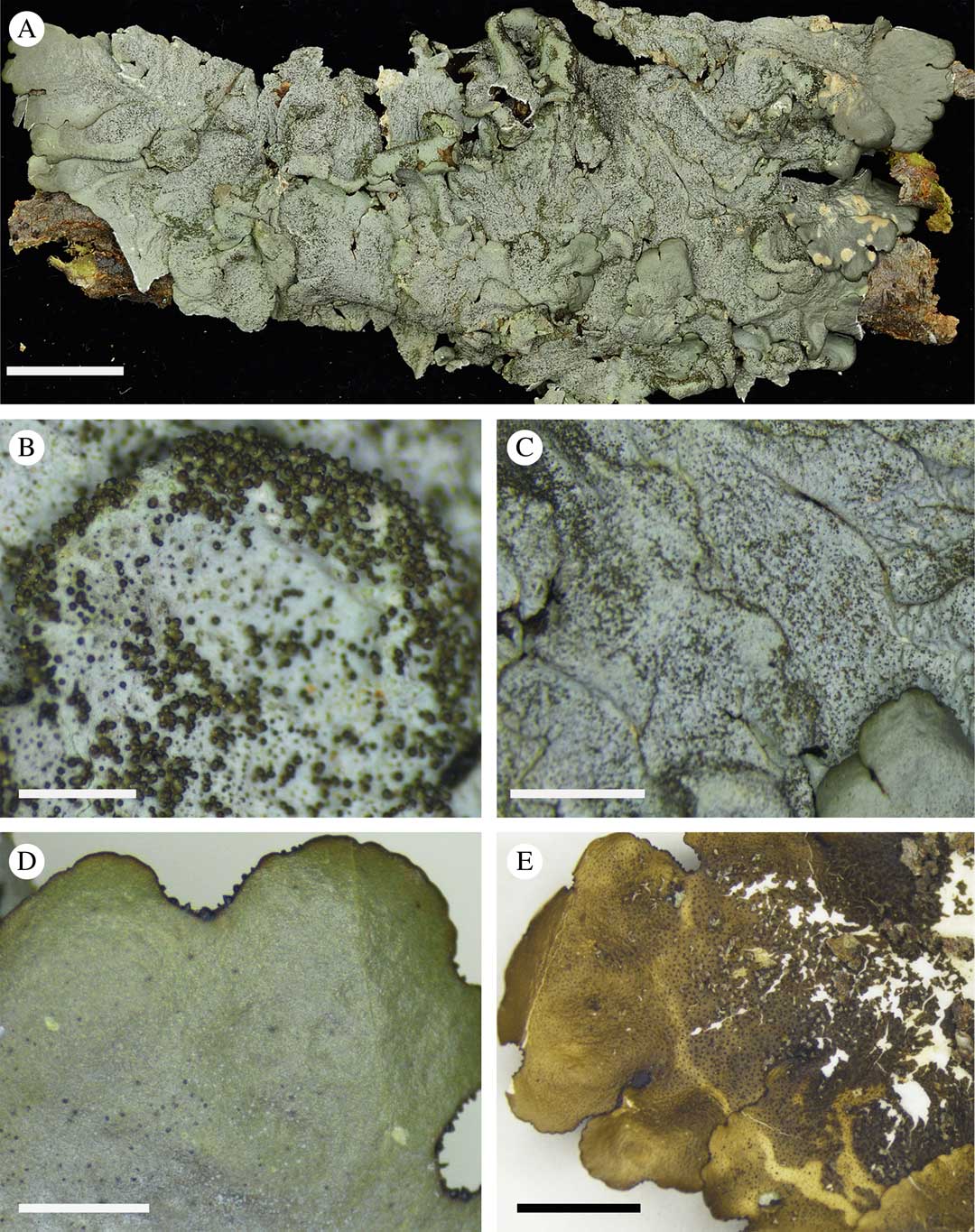
(Fig. 2)
Bulbothrix mammillaria habitus (holotype). A, thallus; B, isidia; C, upper surface of thallus; D, cilia reduced to a bulbate structure; E, lower surface of thallus. Scales: A=1 cm; B=1 mm; C & E=4 mm; D=2 mm. In colour online.
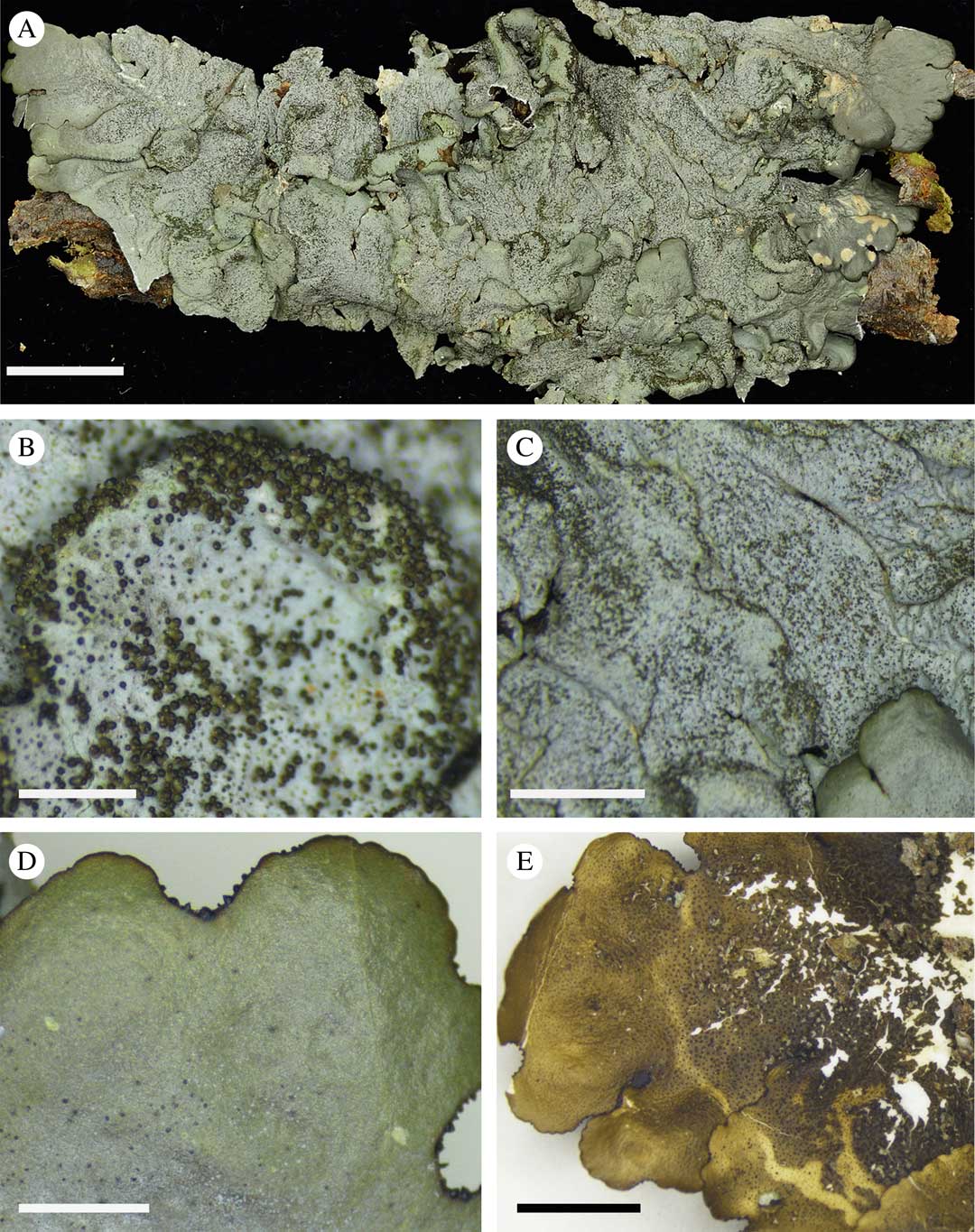
Thallus greenish grey to tan, to 10 cm diam., submembranaceous to subcoriaceous; upper cortex 12·5–17·0 μm thick, algal layer 12·5–22·0 μm thick, medulla 75–82 μm thick, lower cortex 7·5–25·0 μm thick. Lobes irregularly branched, 3–11 mm wide, contiguous and crowded at the centre, very appressed, with subrotund and incised apices. Upper surface often rough and rugose, rarely cracked at the centre, but smooth distally. Maculae absent. Cilia black, sparse, bulbate without a tapering apex or rarely with a very short apex. Isidia granular to occasionally short cylindrical, with black to brown apex, occasionally concolorous with upper thallus surface, evenly distributed on upper surface but lacking on distal part of lobes. Medulla white. Lower surface usually black, dark brown, rarely pale brown, rugose and often with ridge-like folds, with a wide (2–5 mm), papillate or smooth, pale brown, usually shiny marginal zone. Rhizines sparse to moderately abundant, pale brown to brown, usually with white apices that are sometimes branched and conglutinated, occasionally with a bulbate base near lobe margin.
Apothecia extremely rare, only one was found among 58 collections, and then small and immature.
Pycnidia not seen.
Chemistry. Upper cortex K+ yellow, medulla K+ yellow to red, C−, KC−; atranorin and salazinic acid.
Ecology and distribution. Growing on bark of Pinus spp. and Quercus spp., on branches of Phyllanthus emblica and Cotoneaster spp., and on rocks at an elevation of 1274–3160 m in semi-arid environments; known only from southern China.
Comments. Bulbothrix mammillaria is characterized by the sparse and very short cilia which are usually reduced to a bulbate structure, mostly wide lobes (5–11 mm), rugose and tan upper surface if it is exposed to sunlight, rhizines with normally white apices, mostly granular isidia with a black apex, and a black to dark, rarely pale brown lower surface, with a pale brown marginal zone.
Even though Bulbothrix mammillaria exhibits a wide range of colour in the upper and lower surfaces and lobe width, it can be recognized by the cilia reduced to a bulbate structure. The phylogenetic tree based on ITS sequence data also supports the evolutionary independence of this species. Specimens collected from the open habitats tend to have a tan-coloured upper surface that may be due to exposure to the sun.
Bulbothrix isidiza resembles this new species in the short cilia and presence of medullary salazinic acid, but differs by the cilia commonly having a simple apex, uniformly pale brown lower surface (Benatti Reference Benatti2013) and a distinctly maculate and pale dusky grey upper surface. Bulbothrix decurtata (Kurok.) Hale shares the granular to short cylindrical isidia and black to occasionally dark brown lower surface, but differs by the sparse, reduced cilia and by its broader lobes (3–11 mm). Bulbothrix subscortea can be recognized by longer, simple to occasionally branched cilia (200–825 μm), and the consistently pale brown lower surface. Bulbothrix mammillaria differs from B. tabacina in its rugose and often tan upper surface and the strictly bulbate cilia.
Selected specimens examined (here, and elsewhere, all specimens deposited in KUN-L unless otherwise stated). China: Guangxi Prov.: Longsheng Co., 760 m, 25°47'N, 110°02'E, decayed wood, 2001, J. B. Chen et al. 20178 (HAMS-L). Sichuan Prov.: Dukou, Ji Mt., 1200 m, on Quercus sp., 1983, L. S. Wang 83–65. Yunnan Prov.: Fumin Co., Chahe Village, 1540 m, 26°14'N, 101°25'E, on branches, 2013, L. S. Wang et al. 13–41275; near Pudu River, 1650 m, 25°31'N, 102°36'E, on rocks, 2014, L. S. Wang et al. 14–43075; Lancang Co., Taipingzheng Village, 1537 m, 22°36'N, 99°48'E, on bamboo, 2014, L. S. Wang et al. 14–44450; Lijiang Co., from Jinjiang to Heqing, 3160 m, 26°38'N, 100°17'E, on bark, 2013, L. S. Wang et al. 13–40923; Luquan Co., from Luquan to Yunlong water reservoir, 1952 m, 25°42'N, 102°29'E, on Quercus sp., 2014, L. S. Wang et al. 14–43131; Nanjian Co., 1426 m, 24°41'N, 100°04'E, on rocks, 2012, L. S. Wang et al. 12–34234; Puer, Tongxin Village, 870 m, 22°58'N, 101°03'E, on bark, 2014, L. S. Wang et al. 14–44579; Yongren Co., 1543 m, 26°13'N, 101°25'E, on rocks, 2013, L. S. Wang et al. 13–40814; on bark, L. S. Wang et al. 13–40771, 13–40772; Yongsheng Co., Dashan Village, 2200 m, 26°27'N, 101°07'E, on branches, 2013, L. S. Wang et al. 13–41208, 13–41169, 13–41187; Yuanmou Co., Langbapu Village, 1521 m, 25°41'N, 101°41'E, on Phyllanthus emblica, 2014, L. S. Wang et al. 14–43538; Liangshan Mt., 2148 m, 25°43'N, 101°57'E, on bark, L. S. Wang et al. 13–39736, 13–39823.
Bulbothrix lacinia Y. Y. Zhang & Li S. Wang sp. nov.
MycoBank No.: MB 812998
Similar to B. subscortea (Asahina) Marcelli & Benatti, but differs by common lacinulae on the upper surface, spherical to short-cylindrical isidia that are dark brown (longer ones concolorous with thallus but with dark brown apices) and by the narrower lobes (1·0–3·5 mm).
Type: China, Yunnan Prov., Chuxiong, Chahe Village, 2013, L. S. Wang et al. 13–41296 (KUN-L22192—holotype).
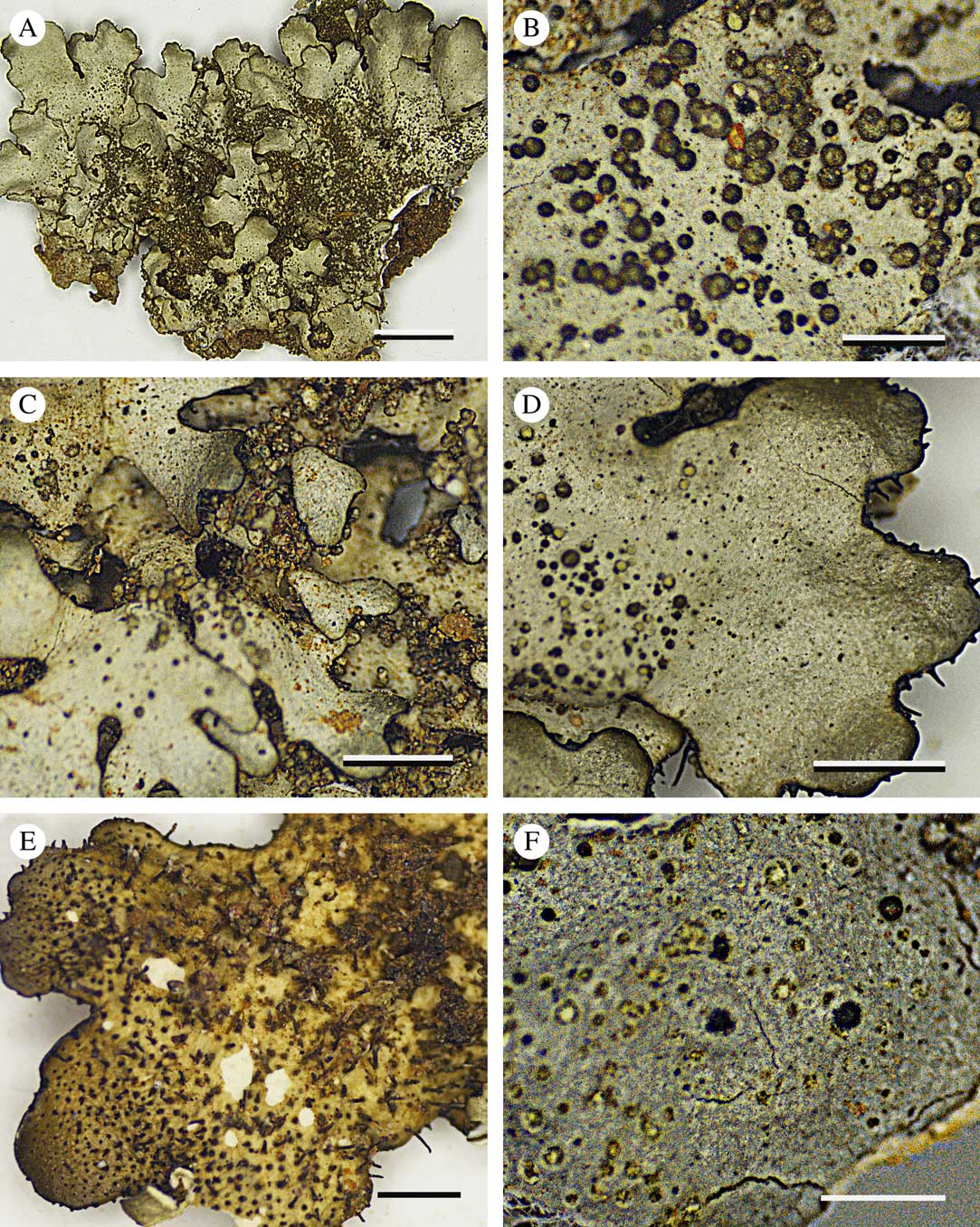
(Fig. 3)
Bulbothrix lacina habitus (holotype). A, thallus; B, spherical and dark black isidia; C, common lacinulae on upper surface of thallus; D, marginal black line and irregular cilia; E, uniformly pale brown lower surface of thallus; F, scarce pycnidia. Scales: A=4 mm; B, C & F=0·5 mm; D & E=1 mm. In colour online.
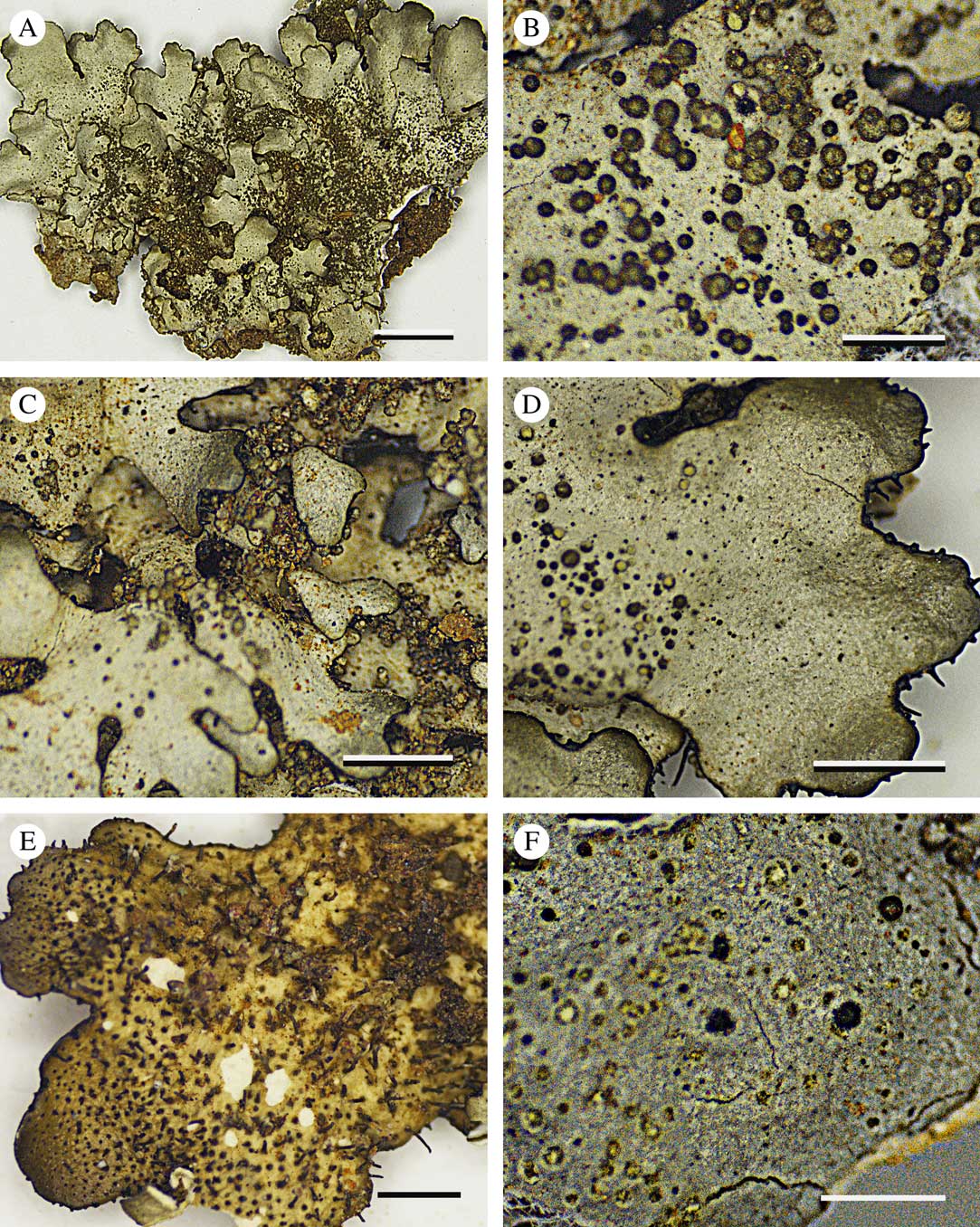
Thallus pale grey-white, to 8 cm diam., subcoriaceous; upper cortex 10–25 μm thick, algal layer 25–40 μm thick, medulla 50–75 μm thick, lower cortex 7·5–17·5 μm thick. Lobes irregularly branched, 1·0–3·5 mm wide, imbricate, very crowded at the centre, appressed, with plane, crenate to subtruncate apices. Upper surface smooth and shiny at the apices of lobes, covered with dense isidia in the centre, commonly lacinulate. Maculae absent. Cilia black, simple, moderately distributed along the margins, with irregularly inflated base, sometimes without bulbs. Isidia spherical to short cylindrical (90–500×80–160 μm), simple to rarely forked, shiny, dark brown or pale grey with dark brown apex. Medulla white. Lower surface pale brown, smooth; marginal zone shiny, brown, darker than centre, slightly papillate. Rhizines brown, simple, moderately distributed, without bulbate base.
Apothecia not seen.
Pycnidia scarce, with black ostioles, the thallus protruding around them. Conidia bacilliform, 5·0–7·5×0·75 μm.
Chemistry. Upper cortex K+ yellow, medulla K+ yellow to red, C−, KC−; atranorin and salazinic acid.
Ecology and distribution. Growing on rocks in secondary forest in dry to semi-arid environments; so far known only from Yunnan Province, China.
Comments. Bulbothrix lacinia is characterized by the narrow and irregularly branched lobes (1·0–3·5 mm), dense, dark brown, spherical to short-cylindrical isidia, emaculate upper surface, simple cilia and rhizines, irregularly inflated base of cilia, pale brown lower surface and the presence of medullary salazinic acid.
Bulbothrix decurtata resembles B. lacinia in terms of lobe size, saxicolous habitat, presence of isidia and medullary salazinic acid, but differs by its very cracked upper surface, black to occasionally dark brown lower surface, rhizines with bulbate bases and the greyish olive-green thallus (Benatti Reference Benatti2013); Bulbothrix australiensis Hale differs by having longer isidia (0·5–1·1 mm), rhizines commonly with a bulbate base, pycnidia usually abundant and a corticolous habitat. Bulbothrix subtabacina (Elix) Elix can be differentiated by its black lower surface, branched cilia and rhizines, maculate and cracked upper surface, and narrower lobes 0·4–1·1(–1·5) mm (Benatti Reference Benatti2013), and B. mammillaria by its broader lobes (3–11 mm) and cilia reduced to a bulbate structure.
Additional specimens examined. China: Yunnan Prov.: Chuxiong State, Chahe Village, 1540 m, 26°14'N, 101°25'E, on sandstone, 2013, L. S. Wang et al. 13–41301, 13–41265; Fumin Co., beside Pudu River, 1650 m, 25°31'N, 102°36'E, on sandstone, 2014, L. S. Wang et al. 14–43065; Yongren Co., from Menghu to Wanma, 1543 m, 26°13'N, 101°25'E, on sandstone, 2013, L. S. Wang et al. 13–40794.
New records
Bulbothrix meizospora (Nyl.) Hale
Phytologia 28(5): 480 (1974); type: India, Nilgiri Mountains (H-NYL 35107—lectotype).
Bulbothrix meizospora is characterized by: a lack of vegetative propagules; a weak to distinctly maculate upper cortex; cilia that are scarce, short, with a bulbate base, without or with simple to double apices; black lower surface with a brown marginal zone (0·5–)2·0–4·0 mm; and rhizines that are black without a bulbate base. Apothecia 0·8–6·2 mm diam., ascospores ellipsoid to oval, pycnidia laminal, and conidia bacilliform. For other details see Benatti (Reference Benatti2012b ).
Chemistry. Upper cortex K+ yellow, medulla K+ yellow to black-red, C−, KC−; atranorin and salazinic acid.
Ecology and distribution. The single specimen from China was growing on Cinnamomum sp. World distribution: Asia, Africa and South America (Benatti Reference Benatti2012b ), and added here to the flora of China.
Comments. This species is similar to B. setschwanensis, but can be distinguished by a black lower surface with a pale brown marginal zone, and the maculate upper surface. In Asia, B. meizospora has been reported from India, Pakistan, Nepal and Thailand, and only one population is known from Xizang.
Specimen examined. China: Xizang Prov.: Nyalam Co., 2450 m, 28°N, 86°E, on the bark of Cinnamomum sp., 1966, J. C. Wei & J. B. Chen 673 (HAMS-L 0021966).
Bulbothrix scortella (Nyl.) Hale
Phytologia 28(5): 480 (1974); type: USA, Texas, C. Wright (FH-Tuck—lectotype (Hale Reference Hale1976); H-NYL—duplicate).
Bulbothrix scortella is characterized by: a smooth to cracked upper cortex; simple, straight, granular to cylindrical isidia; black to brown, branched cilia; pale brown to brown lower surface with dense rhizines; and rhizines that are pale brown to cream, densely branched with a bulbate base. Apothecia and pycnidia not seen in Chinese specimens, but described by Benatti & Elix (Reference Benatti and Elix2012).
Chemistry. Upper cortex K+ yellow, medulla K−, C+ rose, KC+ rose; atranorin and gyrophoric acid.
Ecology and distribution. Growing on bark of deciduous trees in China. World distribution: Asia, Africa, Caribbean, USA and South America, as detailed by Benatti & Elix (Reference Benatti and Elix2012); reported here as new to China.
Comments. Bulbothrix scortella is characterized by simple to occasionally branched isidia, branched rhizines and cilia, and the presence of gyrophoric acid in the medulla.
Specimens of Bulbothrix scortella in China were identified as B. goebelii by Chen et al. (Reference Chen, Xu and Elix2009) and Lai (Reference Lai2000) who were following the concept of Hale (Reference Hale1976), which is composed of several morphologically and chemically similar species. Benatti & Elix (Reference Benatti and Elix2012) recently showed that the type specimen, Parmelia goebelii Zenker (Bulbothrix goebelii), comprises fragments of four different species of Bulbothrix, and a lectotype was chosen that conforms to the protologue of Zenker (Reference Zenker1827), whereby B. goebelii is characterized by the lack of isidia and the presence of lobaric, oxolobaric and colensoic acids but without accessory gyrophoric acid (Benatti & Elix Reference Benatti and Elix2012). Bulbothrix goebelii previously reported from China has isidia and gyrophoric acid, and is one of the species included in Hale’s B. goebelii concept. According to the current circumscription of species within that group, these records in fact correspond to B. scortella, and B. goebelii is therefore excluded from the flora of China.
Bulbothrix scortella is similar to B. subdissecta (Nyl.) Hale in sharing the presence of isidia and gyrophoric acid in the medulla, but the latter has a black lower surface and smaller ascospores (Benatti & Elix Reference Benatti and Elix2012).
Specimens examined. China: Fujian Prov.: Wuyishan Mt., 850 m, 26°54'N, 116°42'E, on deadwood, 1999, J. B. Chen & S. L. Wang 14127 (HAMS-L 021931). Yunnan Prov.: Lancang Co., Jinmai Mt., 1135 m, 22°12'N, 100°03'E, on Alnus nepalensis, 2014, L. S. Wang et al. 14–44441, 14–44442; Mengla Co., Longmen, on bark, 1974, M. Zang 528; Manla Village, 1079 m, 22°00'N, 101°26'E, on the branches of Camellia sinensis, 2006, L. S. Wang et al. 06–27337; Ruili Co., Nongdao, 780 m, on Quercus, 1983, L. S. Wang 83–2691a; Ninger Co., 1060 m, 23°16'N, 101°09'E, on bark, 2013, L. S. Wang et al. 13–40462.
Other species of Bulbothrix in China
Bulbothrix asiatica Y. Y. Zhang & Li S. Wang
Bryologist 117: 379–385 (2014); type: China, Yunnan, L. S. Wang et al. (KUN-L 46314—holotype).
Description. See Zhang et al. (Reference Zhang, Wang, Liu, Li, Shi, Ye and Wang2014).
Ecology and distribution. Growing on the bark of Alnus nepalensis, Hevea brasiliensis and other tree species, between 290–1135 m. Cambodia and China.
Comments. Specimens of this species from China have usually been identified as Bulbothrix tabacina (Chen et al. Reference Chen, Xu and Elix2009). These species are, however, clearly distinct as revealed by the phylogenetic inference (Fig. 1) and morphological characters: B. tabacina has a maculate upper surface especially when wet, whereas B. asiatica is emaculate.
New collections from Fujian Prov. in China. Wuyishan National Reserve, 980 m, 27°41'N, 117°38'E, on bark, L. S. Wang et al. 15–47228, 15–47240.
Bulbothrix isidiza (Nyl.) Hale
Phytologia 28(5): 480 (1974); type: Angola, Serra Chella, Newton (H—lectotype).
Description. See Benatti (Reference Benatti2013).
Ecology and distribution. In China this species usually grows on the bark of Pinus yunnanensis and some other trees, rarely on rocks, at altitudes of between 1500–2665 m. World distribution: Oceania and North Pacific, Asia, Africa, North America, Central America and South America, as detailed by Benatti (Reference Benatti2013). China: Yunnan Province.
Comments. Bulbothrix isidiza is characterized by the rough appearance of the upper surface, very delicate and small isidia (Nylander Reference Nylander1884; Hale Reference Hale1976; Benatti Reference Benatti2013), and commonly distinct maculae on the upper surface. Moreover, specimens from China are usually coriaceous, with a thicker thallus composed of an upper cortex 37·5−62·5 μm, algal layer 37·5−75·0 μm, medulla 100−257 μm and lower cortex 20−30 μm thick. The phylogenetic structure in the ITS tree lacks corresponding morphological variation, hence we treat all these specimens as B. isidiza.
Selected specimens examined. China: Yunnan Prov.: Anning, 30 km SW of Kunming, 1750–1800 m, 24°55'N, 102°29'E, on Pinus yunnanensis, 1981, T. Koponen 37991; Binchuan Co., Mt. Jizushan, 2620 m, 25°57'N, 100°22'E, on bark, 2012, L. S. Wang & D. Liu 12–33461; Chuxiong, Mt. Zixishan, 2300 m, 25°04'N, 101°24'E, on rock, 2005, L. S. Wang et al. 05–25257; Jianchuan Co., Mt. Shibaoshan, 2665 m, 26°22'N, 100°49'E, on bark, 2011, L. S. Wang et al. 11–32529; Jingdong Co., Wenjin, 1492 m, 24°21'N, 100°51'E, on Ficus, 2012, L. S. Wang et al. 12–34566; Kunming, Mt. Xishan, 1900 m, 1983, L. S. Wang 83–37891; Lufeng Co., Qinglongshao, 1700 m, 24°58'N, 102°30'E, on Pinus yunnanensis, 1987, Teuvo Ahti et al. 46114; Luquan Co., 1952 m, 25°42'N, 102°29'E, on bark, 2014, L. S. Wang et al. 14–43117; Nanjian Co., Leqiu Village, 2060 m, 25°00'N, 100°21'E, on Pinus yunnanensis, 2012, L. S. Wang & X. Y. Wang 12–37816, 12–37812; Mt. Wuliangshan, 2348 m, 24°52'N, 100°35'E, on bark, 2012, L. S. Wang et al. 12–32998, 12–33001; Xiaowandong, 1604 m, 24°43'N, 100°08'E, on bark, 2012, L. S. Wang et al. 12–34256, 12–34265, 12–34259; Songming Co., Baiyi Village, 2500 m, on Pinus yunnanensis, 2008, L. S. Wang & J. Wang 08–30314, 08–29619; Tengchong Co., Mt. Kongshan, 1500 m, on Pinus yunnanensis, 1996, L. S. Wang 96–16791; Xiangyun Co., Mt. Shuimushan, 2440 m, 25°22'N, 100°37'E, on Pinus yunnanensis, 2013, L. S. Wang et al. 13–38923; Yuanmou Co., Mt. Liangshan, 2148 m, 25°43'N, 101°57'E, 2013, L. S. Wang et al. 13–39820, 13–39822, 13–39829 (on bark), 13–39846, 13–39826, 13–39821 (on Pinus).
Bulbothrix setschwanensis (Zahlb.) Hale
Phytologia 28(5): 481 (1974); type: China, Sichuan, Handel-Mazzetti 2739 (WU—lectotype).
Description. See Benatti (Reference Benatti2012b ) and Hale (Reference Hale1974).
Ecology and distribution. Usually growing on the bark and branches of Pinus, Quercus or Juglans, at altitudes of 1200–2800 m. World distribution: Asia detailed by Benatti (Reference Benatti2012b ). China: Sichuan and Yunnan Provinces.
Comments. This species is characterized by the uniformly pale brown lower surface, short cilia (≤0·3 mm), delicate and pale brown rhizines, and salazinic acid in the medulla.
Selected specimens examined. China: Sichuan Prov.: Yanbian Co., Yankou, 1960 m, 1983, L. S. Wang 83–535a; from Dukou to Yanbian, 2300 m, 1983, L. S. Wang 83–225, 83–232; Miyi Co., Baiposhan Mt., 1983, L. S. Wang 83–735. Yunnan Prov.: Kunming, Xishan Mt., Xiaoshilin, 2345 m, 24°55'N, 102°37'E, on Pinus, 2013, D. Liu 13–39868b; Lijiang Co., Xiangshan, 2500 m, on branches, 1985, L. S. Wang 85–0017, 85–0210a; Yufengsi, 2780 m, on Juglans sp., 1985, L. S. Wang 85–0104; 2500 m, on Pinus armandii, 1982, L. S. Wang 82–1087; Yongsheng Co., Dashan Village, 2200 m, 26°27'N, 101°07'E, on branches, 2013, L. S. Wang et al. 13–41164, 13–41167; Yuanmou Co., Liangshan Village, Mt. Liangshan, 2148 m, 25°43'N, 101°57'E, 2013, L. S. Wang et al. 13–39853 (on Pinus yunnanensis), 13–39743, 13–39789 (on Quercus), 13–39692, 13–39747 (on bark).
Bulbothrix subscortea (Asahina) Marcelli & Benatti
Mycosphere 3: 46–55 (2012); type: China, Taiwan, Asahina 3324 (TNS—lectotype).
Description. See Benatti (Reference Benatti2012c ) and Zhang et al. (Reference Zhang, Wang, Liu, Li, Shi, Ye and Wang2014).
Ecology and distribution. Growing on rocks, shrubs, and on Quercus spp., Pinus spp., in open secondary forest, at elevations between 430–2850 m. World distribution: Asia. China: Fujian, Guangxi, Hainan, Hong Kong, Sichuan, Taiwan and Yunnan.
Comments. Bulbothrix subscortea is morphologically very variable: cilia vary in length (between 200–825 μm), lobes range from linear elongate to irregularly elongate regardless of habitat, and rhizines are with or without basal or displaced bulbs. However, it can be identified by the following characteristics: emaculate upper surface, pale brown lower surface and salazinic acid in the medulla.
New collections from Fujian Prov. in China. Wuyishan National Reserve, 980 m, 27°41'N, 117°38'E, on bark, L. S. Wang et al. 15–47233; 580 m, 27°43'N, 117°42'E, on bark, L. S. Wang et al. 15–47053; 430 m, 27°41'N, 117°44'E, on Quercus sp., L. S. Wang et al. 15–46797.
Bulbothrix tabacina (Mont. & Bosch) Hale
Phytologia 28(5): 481 (1974); type: Java, Junghuhn 335 (L—lectotype; P—isolectotype).
Description. See Benatti (Reference Benatti2013) and Hale (Reference Hale1974).
Ecology and distribution. The single specimen cited here grew on branches at an elevation of 860 m in Hainan. World distribution: Oceania, Asia, Africa, North America, Caribbean and South America. This species was also reported from Taiwan by Hale (Reference Hale1976) and Lai (Reference Lai2000).
Comments. This species can be recognized by the maculate upper surface, black lower surface with a pale brown marginal zone, and the presence of salazinic acid in the medulla.
Specimen examined. China: Hainan Prov.: Ledong Co., Jianfengling, 860 m, 18°44'N, 109°10'E, 2001, J. B. Chen et al. 20770 (HAMS-L).
Discussion
Bulbothrix and Relicina can be easily recognized by their bulbate cilia, and can be clearly distinguished by secondary metabolites, with the former containing atranorin versus usnic acid in the latter. Although similar overall, these genera belong to distinct clades within the Parmeliaceae: Bulbothrix shares a common ancestor with Parmelina, whereas Relicina belongs to a group centred on Parmelia (Crespo et al. Reference Crespo, Kauff, Divakar, Del Prado, Pérez-Ortega, Amo de Paz, Ferencova, Blanco, Roca-Valiente and Núñez-Zapata2010). Furthermore, our phylogenetic trees agree with previous studies (Divakar et al. Reference Divakar, Crespo, Blanco and Lumbsch2006, Reference Divakar, Lumbsch, Ferencova, Del Prado and Crespo2010; Kirika et al. Reference Kirika, Leavitt, Divakar, Crespo, Gatheri, Mugambi and Lumbsch2015), whereby Bulbothrix species with bulbate base cilia and atranorin do not compose a monophyletic group. The Bulbothrix isidiza group (Clade 2) is sister to Parmelinella (Divakar et al. Reference Divakar, Crespo, Blanco and Lumbsch2006, Reference Divakar, Lumbsch, Ferencova, Del Prado and Crespo2010; Masson et al. Reference Masson, Benatti and Sérusiaux2015) leading to this clade either nesting in the genus Parmelinella or being a small genus that contains salazinic acid. The type species of Bulbothrix (i.e., B. semilunata) may belong to Clade 1 (Kirika et al. Reference Kirika, Leavitt, Divakar, Crespo, Gatheri, Mugambi and Lumbsch2015) on account of its distribution and morphological characteristics. The genus concept for Bulbothrix thus requires further revision and a more extensive sampling of species to resolve the relationships and circumscription of Bulbothrix and Parmelinella.
Our work builds on studies on Cambodian Bulbothrix (Zhang et al. Reference Zhang, Wang, Liu, Li, Shi, Ye and Wang2014), clarifies the species of Bulbothrix from China, and thereby contributes to our knowledge of the lichen flora of Asia. Our phylogenetic inference shows that all Bulbothrix species from China belong to Clade 2 and have broader lobes, simple to rarely branched cilia and rhizines, and salazinic acid except for B. scortella, and confirms that Clade 2 is predominantly paleotropical as reported by Kirika et al. (Reference Kirika, Leavitt, Divakar, Crespo, Gatheri, Mugambi and Lumbsch2015). We discovered two new species, B. mammillaria and B. lacinia, that are distinguished by morphology and ITS sequences. Even so, more new species in this genus may eventually be found in southern China, given the great biodiversity of this region.
The authors are grateful to Prof. Bruce McCune (Oregon State University) and Prof. Bernard Goffinet (University of Connecticut) for their help with improving the English composition, and the curator (Yi–jian Yao) and specimen manager (Hong Deng) of HAMS. We also thank Prof. Zi–gang Qian, Dr Zhi–zhi Du and Dr Dong Wang for their help with the molecular and chemical analyses. This study was supported by grants from the National Natural Science Foundation of China (No. 31170023, 31370069, 31400022), West Light Foundation of The Chinese Academy of Sciences, Foundation of Key Laboratory for Plant Diversity and Biogeography, Kunming Institute of Botany, CAS (201306), and Flora Lichenum Sinicorum (KSCX2–EW–Z–9).