During the 1970s, Health technology assessment (HTA) developed as a special type of policy research in response to rising healthcare expenditures, concerns over the efficiency and quality of health system services, and questions about the role of technology in modern medicine. The debate about technology assessment in health care, however, is generally accepted as having begun in 1975 with the publication of Development of Medical Technologies: Opportunities for Assessment by the United States Office of Technology Assessment (15). In that report, the objectives and methodology of HTA were outlined for the first time.
The International Network of Agencies for Health Technology Assessment (INAHTA) has defined HTA as “the systematic evaluation of the properties, effects and/or other impacts of health care technology,” in order “to provide objective information to support health care decisions and policy making at the local, regional, national and international levels” (9). Effective HTA programs not only have to generate accurate information and analysis, but also to use the material effectively to influence healthcare decision makers.
Over the past several decades, HTA has received fairly strong support from governments and academicians in North America and Western Europe, where it is acknowledged that better information about health technology leads to improved policy making (Reference Banta, Oortwijn and van Beekum1). Nevertheless, the practice of HTA has developed pragmatically more than conceptually (Reference Leys13), with the focus being on solving specific problems largely through economic methods (i.e., cost-effectiveness analysis, or cost-utility studies) rather than by taking an integrated approach. As a result, a conceptual framework in which medical, economical, organizational, social, ethical, and legal aspects are considered together is lacking (Reference Hennen8;Reference Perry, Gardner and Thamer17).
Among developing areas, Latin America (LA) represents one of the most important emerging markets for health technology. Although there is a general recognition in LA of the importance of HTA (16), the difficulty in establishing an effective HTA program in a region where basic technologies are scarce is formidable. During the early 1980s, some of the commonly cited problems about healthcare systems in LA involved the excessive and indiscriminate use of expensive health technology, the lack of policies and standards to regulate the introduction and use of health technology, the underdevelopment of support technologies (especially management information systems), and inequalities in access to available health technology (Reference Perry and Marx18). In the 1990s, many countries in LA began reforming their healthcare systems in an effort to address the above problems, with the aim of increasing efficiency in resource allocation, promoting equal access to health care, and ensuring financial sustainability of the health system (16).
As in most developing countries, however, technological development in LA has been dependent on the transfer of technologies perfected in developed countries. In many cases, this transfer has been incomplete, as it has not been accompanied by modifications that would permit technologies being readily adapted to the organizational, economic, social, and cultural situations of the receiving countries (16). This study examines the extent to which the HTA philosophy has been implemented successfully in LA.
METHODS
The main objectives of this exploratory study were to identify HTA programs within LA, review HTA documents produced by those programs, and assess the extent to which the aims of HTA are being achieved. The methodology focused only on specific countries within LA that had programs dealing with HTA issues.
HTA programs in LA were identified by searching through two electronic databases: INAHTA (http://www.inahta.org) and Health Technology Assessment International (HTAi) (http://www.htai.org/index.php?id=43). A total of six programs (two in Mexico, one in Brazil, one in Chile, and two in Argentina) were selected and coded from A1 to A6. During the study period, three programs (A1, A3, and A4) were HTA units under order of the Ministry of Health within their countries; one program (A6) was an independent, not-for-profit HTA agency; and two programs (A2, A5) did not have a specific HTA component but, nevertheless, published papers that could be considered HTA documents in the context of this study.
The study period covered 7 years of publications from January 2000 to March 2007; during this period, all official HTA documents published by the above six programs were collected and analyzed. All programs provided a list of their outputs, including short documents (e.g., technical briefs, rapid assessments), systematic reviews, scientific papers published jointly with other organizations, and full HTA reports. A total of 236 HTA documents were obtained directly from programs, or downloaded from their Web sites.
For each program, qualitative and quantitative assessments were carried out in five areas, with the following mutually exclusive or nonmutually exclusive subcategories reviewed.
• Types of HTA documents, which included four mutually exclusive subcategories: short documents, systematic reviews, joint papers, and full HTA reports.
• Type of technologies assessed in HTA documents, which included eight mutually exclusive subcategories: drugs, diagnostic and/or screening technologies, medical procedures, surgical procedures, devices, health services, general essays and/or research tools (i.e., definition of a new diagnostic, reliability of a given database, guidelines for economic assessments), and vaccines.
• Issues addressed in HTA documents, which were defined through six nonmutually exclusive subcategories: clinical effectiveness (including safety); state of current practices; partial economic evaluation (i.e., cost analysis); full economic evaluation (i.e., cost-minimization, cost-effectiveness, cost-utility, or cost-benefit analysis); other outcomes (i.e., impact on service utilization, management of a given health problem, impact of a given health reform); and ethical, social, and/or legal issues.
• Target groups for HTA documents, which included seven mutually exclusive subcategories: third-party payers (e.g., government, private sector, insurance companies); government policy makers (e.g., national, state, local); provider organizations (e.g., hospitals, clinics, managed care organizations); clinicians (e.g., individuals, specialty/professional organizations); biomedical researchers; patients and consumers (e.g., individuals or organizations); and healthcare product companies.
• Conclusions or final recommendations issued, which included three mutually exclusive subcategories for conclusions (negative, neutral, and positive) as well as recommendations that may or may not have accompanied the conclusions.
Descriptive statistics were used in all five areas.
RESULTS
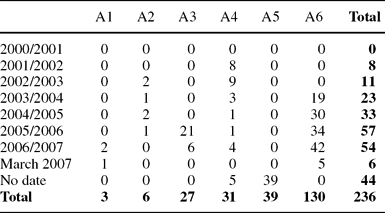
The number of HTA documents published in LA by all six programs (A1 through A6) between January 2000 and March 2007 is presented in Table 1. The number of documents increased incrementally from 2000 to 2004 and then peaked in the period from 2005 to 2007; as data collection stopped in early 2007, recent trends cannot be analyzed.
Published HTA Documents (2000–2007)

HTA, health technology assessment; A1, Centro Nacional de Excelencia Tecnológica en Salud (CENETEC) – Mexican Ministry of Health; A2, Instituto Mexicano del Seguro Social – Mexican Ministry of Health; A3, Coordenação Geral de Avaliaçã de Tecnologias em Saúde Departamento de Ciência e Tecnologia – DECIT Secretaria de Ciência, Tecnologia e Insumos Estratégicos – SCTIE MINISTÉRIO DA SAÚDE – Brazil Ministry of Health; A4, Unidad de Evaluación de Tecnologías de Salud (Unidad ETESA) – Departamento de Calidad en la Red dependiente de la División de Planificación y Presupuesto del Ministerio de Salud – Chile Ministry of Health; A5, Superintendencia de Servicios de Salud – Argentina Ministry of Health; A6, Instituto de Efectividad Clínica y Sanitaria (IECS) – Argentina.
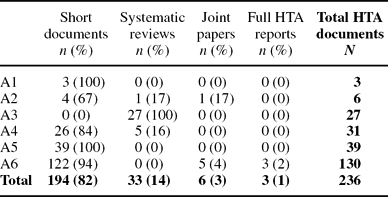
Table 2 reveals the types of HTA documents produced during the study period. The majority of programs focused their resources on producing short documents (n = 194; 82 percent) such as technical briefs and rapid assessments. One program (A3) exclusively published systematic reviews, but this type of document accounted for no more than 14 percent (n = 33) of total HTA production. By comparison, two programs (A2, A6) produced joint papers with other organizations (n = 6; 3 percent), while only one program (A6) generated full HTA reports (1 percent).
Types of HTA Documents (2000–2007)

HTA, health technology assessment; A1, Centro Nacional de Excelencia Tecnológica en Salud (CENETEC) – Mexican Ministry of Health; A2, Instituto Mexicano del Seguro Social – Mexican Ministry of Health; A3, Coordenação Geral de Avaliaçã de Tecnologias em Saúde Departamento de Ciência e Tecnologia – DECIT Secretaria de Ciência, Tecnologia e Insumos Estratégicos – SCTIE MINISTÉRIO DA SAÚDE – Brazil Ministry of Health; A4, Unidad de Evaluación de Tecnologías de Salud (Unidad ETESA) – Departamento de Calidad en la Red dependiente de la División de Planificación y Presupuesto del Ministerio de Salud – Chile Ministry of Health; A5, Superintendencia de Servicios de Salud – Argentina Ministry of Health; A6, Instituto de Efectividad Clínica y Sanitaria (IECS) – Argentina.
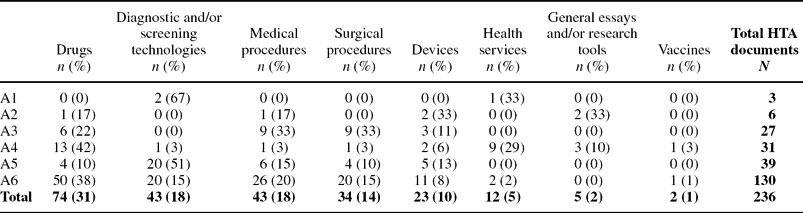
The type of technologies assessed in HTA documents is presented in Table 3. The technology that received the most attention was drugs (n = 74; 31 percent), with two programs (A4: 42 percent; A6: 38 percent) predominating. Diagnostic and/or screening technologies (n = 43; 18 percent), medical procedures (n = 43; 18 percent), surgical procedures (n = 34; 14 percent), and devices (n = 23; 10 percent) constituted less than one fifth of all HTA documents. Among all six programs, less attention was devoted to health services (n = 12; 5 percent), general essays and/or research tools (n = 5; 2 percent), and vaccines (n = 2; 1 percent).
Type of Technologies Assessed in HTA Documents (2000–2007)

HTA, health technology assessment; A1, Centro Nacional de Excelencia Tecnológica en Salud (CENETEC) – Mexican Ministry of Health; A2, Instituto Mexicano del Seguro Social – Mexican Ministry of Health; A3, Coordenação Geral de Avaliaçã de Tecnologias em Saúde Departamento de Ciência e Tecnologia – DECIT Secretaria de Ciência, Tecnologia e Insumos Estratégicos – SCTIE MINISTÉRIO DA SAÚDE – Brazil Ministry of Health; A4, Unidad de Evaluación de Tecnologías de Salud (Unidad ETESA) – Departamento de Calidad en la Red dependiente de la División de Planificación y Presupuesto del Ministerio de Salud – Chile Ministry of Health; A5, Superintendencia de Servicios de Salud – Argentina Ministry of Health; A6, Instituto de Efectividad Clínica y Sanitaria (IECS) – Argentina.
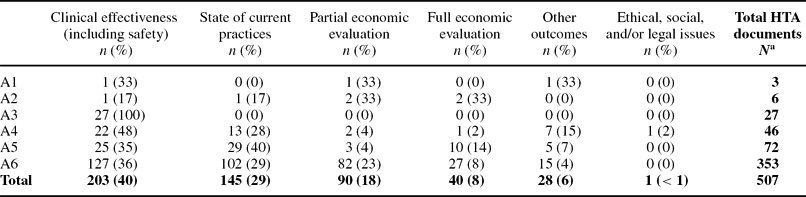
Table 4 shows that two thirds (n = 333; 66 percent) of all HTA documents addressed issues related to clinical effectiveness and economic evaluations (partial or full economic evaluations). Among all six programs, the most explored issue was clinical effectiveness (n = 203; 40 percent)—that is, how therapeutic problems respond to medical intervention from a safety or efficacy standpoint. Allied with clinical effectiveness, however, is the cost of intervention, which was considered in approximately one quarter (n = 130: 26 percent) of all HTA documents. Although 18 percent (n = 90) of program documents included a cost component as part of a partial economic evaluation, a full examination of cost on clinical effectiveness was discussed only in a small number of HTA documents (n = 40; 8 percent).
Issues Addressed in HTA Documents (2000–2007)

a The subcategories are not mutually exclusive, so more than one issue may be addressed per HTA document, Thus, the total number of HTA documents differs from the 236 total documents listed in other tables.
HTA, health technology assessment; A1, Centro Nacional de Excelencia Tecnológica en Salud (CENETEC) – Mexican Ministry of Health; A2, Instituto Mexicano del Seguro Social – Mexican Ministry of Health; A3, Coordenação Geral de Avaliaçã de Tecnologias em Saúde Departamento de Ciência e Tecnologia – DECIT Secretaria de Ciência, Tecnologia e Insumos Estratégicos – SCTIE MINISTÉRIO DA SAÚDE – Brazil Ministry of Health; A4, Unidad de Evaluación de Tecnologías de Salud (Unidad ETESA) – Departamento de Calidad en la Red dependiente de la División de Planificación y Presupuesto del Ministerio de Salud – Chile Ministry of Health; A5, Superintendencia de Servicios de Salud – Argentina Ministry of Health; A6, Instituto de Efectividad Clínica y Sanitaria (IECS) – Argentina.
The remaining one third of HTA documents focused primarily on the state of current practices (n = 145: 29 percent), or other outcomes (n = 28; 6 percent). Four of the six programs (A1, A4, A5, A6) included other outcomes in their documents—perhaps in response to specific requests, such as findings about organizational aspects (e.g., implementation of telemedicine, blood bank management), or to include data about the impact of a recent provincial policy (e.g., hospital wastes, waiting lists) in their assessments. Unfortunately, ethical, social, and/or legal issues were addressed in less than 1 percent of all documents; only one program (A4) discussed the topic, and the discussion was limited to a single document (2 percent).
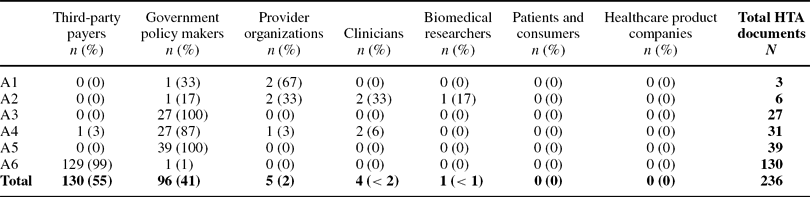
The target groups for HTA documents are presented in Table 5. Third-party payers (i.e., government programs, or private sector organizations such as insurance companies) and government policy makers were considered the most influential target groups, as they combined for approximately 96 percent (n = 226) of all HTA production. Most reports were issued by one program (A6; 99 percent) to third-party payers (n = 130; 55 percent), while two programs (A3, A5) focused exclusively on government policy makers and another program (A4) devoted most of its production (n = 27; 87 percent) to this group of decision makers. Provider organizations (e.g., hospitals, clinics, managed care organizations) and the private sector (e.g., clinicians, biomedical researchers) combined for a minimal number (n = 10; 4 percent) of HTA document production. Curiously, patients and consumers as well as healthcare product companies were not considered essential target groups, as no HTA documents were produced for their benefit.
Target Groups for HTA Documents (2000–2007)

HTA, health technology assessment; A1, Centro Nacional de Excelencia Tecnológica en Salud (CENETEC) – Mexican Ministry of Health; A2, Instituto Mexicano del Seguro Social – Mexican Ministry of Health; A3, Coordenação Geral de Avaliaçã de Tecnologias em Saúde Departamento de Ciência e Tecnologia – DECIT Secretaria de Ciência, Tecnologia e Insumos Estratégicos – SCTIE MINISTÉRIO DA SAÚDE – Brazil Ministry of Health; A4, Unidad de Evaluación de Tecnologías de Salud (Unidad ETESA) – Departamento de Calidad en la Red dependiente de la División de Planificación y Presupuesto del Ministerio de Salud – Chile Ministry of Health; A5, Superintendencia de Servicios de Salud – Argentina Ministry of Health; A6, Instituto de Efectividad Clínica y Sanitaria (IECS) – Argentina.
Finally, the conclusions and recommendations within HTA documents need to be addressed. In general, the documents were clearly written and contained three types of conclusions: (i) negative (n = 27; 11 percent), (ii) neutral (n = 90; 38 percent), and (iii) positive (n = 114; 48 percent). Negative conclusions involved aspects such as reporting on an ineffective technology, or emphasizing risks associated with its use. Neutral conclusions did not stipulate actions that should be followed based on the assessment; instead, neutral conclusions tended to emphasize the weakness of the evidence, while also stressing that further research was needed. Positive conclusions indicated either that a given technology was effective and safe, or that the cost-effectiveness ratio was reasonable.
Formal recommendations for a given health technology also were frequently incorporated in HTA documents (n = 136; 58 percent). With the exception of two programs (A1: 33 percent; A3: 11 percent), the other four programs included recommendations in nearly half, or more than half, of all documents (A2: 50 percent; A4: 45 percent; A5: 92 percent; and A6: 61 percent) produced.
DISCUSSION
HTA has five main aims: (i) Identification (monitoring technologies, setting priorities), (ii) Testing (data collection and analysis), (iii) Synthesis (collecting and interpreting existing information), (iv) Dissemination (providing HTA information to users), and (v) Implementation (helping to ensure the application of HTA results). Coordination of these aims is considered crucial to the successful development and implementation of HTA in any region (Reference Banta and Oortwijn2;Reference Banta and Oortwijn3).
This exploratory study shows that programs in LA were not adhering entirely to the concept of HTA in six important ways. First, although document production increased incrementally during the period of this study, the types of HTA documents produced were mostly short documents (82 percent) rather than comprehensive HTA reports (1 percent). Full HTA reports may be seen as too lengthy, technical, or detailed to be digestible for decision makers; furthermore, longer documents may be difficult to produce in situations where decisions need to be made within a very short timeframe. On the other hand, busy decision makers may prefer shorter documents that are either stand-alone summaries of full HTA reports, or rapid technology assessments that are designed to provide brief (and, perhaps, provisional) answers to specific questions. Nonetheless, producing short documents requires a systematic and rigorous approach to summarizing and interpreting evidence in a concise way (Reference Lehoux, Tailliez, Denis and Hivon12). If full HTA reports are viewed as impractical, then standards and guidelines for developing short documents should be developed—not only to facilitate supply side work, but also to help the demand side distinguish among the different types of HTA products (Reference Hailey, Corabian and Harstall7;Reference Mowatt, Grant, Bower, Stevens, Abrams and Brazier14).
Second, although HTA programs in LA seem to make a conscious effort to identify, test, and synthesize information about different technologies, the majority of programs focus on practical concerns that address current problems, rather than procedural areas or less-pressing needs. During the study period, most HTA programs focused on high-technology areas such as drugs (31 percent), diagnostic and/or screening technologies (18 percent), medical procedures (18 percent), or surgical procedures (14 percent). Little attention was paid to health services (5 percent), general essays and/or research tools (2 percent), or vaccines (1 percent). Perhaps this shift in focus is an acknowledgment of limited resources within LA, as well a conscious decision on behalf of programs to try to influence decision makers in areas where funding is concentrated.
Third, one of the tenets of HTA is that issues need to be integrated into a conceptual framework that embraces all aspects of HTA (e.g., medical, economical, organizational). From January 2000 to March 2007, however, 40 percent of published HTA documents in LA addressed clinical effectiveness, while 26 percent attempted to correlate the efficacy and safety of a new technology in economic terms. This trend does not suggest a balanced approach, but emphasizes how the current rate of healthcare spending weighs on the assessment process, almost to the exclusion of other considerations. In effect, the technology itself is being quantified, without considering that the data needed for quantification is often limited and subject to error (Reference Wilensky19). After all, health is not solely a scientific or technical activity, nor can values be analyzed by strict clinical or economical evaluations—especially when a concept such as “quality of life” does not explicitly include variables such as human rights or human dignity. In this sense, the central paradox of HTA emerges. HTA attempts to balance appraisal (values plus scientific data) against assessment (technical data analysis). To make an integrated conceptual framework practical in LA, a genuine positive attitude toward other issues needs to be encouraged as it has in evidence-based medicine or health economic analysis.
Furthermore, although other issues in LA were explored, the issues addressed are not key components of HTA guidelines, even though they may be relevant to practice and policy—for example, the state of current practices (29 percent) and other outcomes (6 percent) (i.e., impact on service utilization). Perhaps this can be interpreted as a subtle attempt to redefine HTA by providing a more contextualized informational base for decision makers, even though several related issues are ignored. Overall, although, it is fair to state that an integrated conceptual framework in LA is wanting.
Fourth, HTA is often promoted as an interdisciplinary process that addresses a wide spectrum of issues, from effectiveness to ethics (Reference Lehoux and Blume11). While the approach may be true in principle, this study suggests that it is not the case in practice. With the exception of one program (A4), ethical, social, and/or legal issues were not addressed in HTA documents. From a producers’ perspective, the oversight may be due to practical considerations, as the staffs of HTA programs are usually trained in epidemiology and may feel less equipped to analyze ethical, social, and/or legal issues (Reference Lehoux, Tailliez, Denis and Hivon12). From the users’ perspective, however, the need to obtain concise and simple answers to well-defined policy questions may prevent a sophisticated analysis of inherently complex issues (Reference Bero and Jadad5). Although these reasons may serve as explanations for current practices, it is an inescapable truth that both health policy and clinical practice are shaped by legal incentives (Reference Battista, Lance and Lehoux4). HTA has an obligation to examine equity and to encourage the socially responsible allocation of resources (Reference Cookson and Maynard6). Thus, collaboration between HTA practitioners and ethicists, sociologists, and jurists should be increased to respond to specific requests of decision makers as well as to maintain a broad interdisciplinary perspective (Reference Johri and Lehoux10).
Fifth, although HTA information is meant to be disseminated to all users, this study shows that HTA documents mainly targeted two groups: third-party payers (55 percent) and government policy makers (41 percent). As many HTA programs are legally part of the Ministry of Health within their respective countries, it is likely that the focus of their activities catered to those groups controlling economic resources. Private sector entities did not receive much attention, possibly because those organizations already possess their own internal Research and Development Units; thus, in many HTA programs, the perception may exist that those groups do not require further support. Although this perception may be accurate, it must also be accepted that information cannot be properly implemented if it is not disseminated thoroughly beforehand.
Sixth, the proper implementation of HTA results relies on recommendations put forward by HTA programs. During the study period, nearly half (48 percent) of all recommendations were positive, with formal recommendations for a given health technology advocated in nearly half or more (45 percent to 92 percent) of HTA documents produced by four programs (A2, A4, A5, A6). The balance of recommendations either questioned the weakness of the evidence while urging that additional research be conducted (38 percent) before reaching a final determination, or rejecting a new technology entirely (11 percent) because it was ineffective, risky, or not cost-effective. Therefore, a balanced approach to the responsibilities of HTA seems to be accepted, even if caution prevails.
As with any analysis, the shortcomings of the study must be acknowledged. First, the study was exploratory and thus limited to conditions in LA during the study period. Between 2000 and 2007, LA had only one proper HTA agency (A6), three HTA units (A1, A3, A4), and two programs (A2, A5) that produced HTA documents as a supplementary role within a Ministry of Health agenda. Second, most of the data came from one HTA agency (A6), which produced 55 percent of all HTA documents analyzed in this study. Although this concentration of information suggests a bias, the prejudice is not methodological because it reflects actual HTA conditions in LA throughout the study period. Despite these limitations, the underlying value of this study is that it explored HTA in a region not previously emphasized in the literature.
CONCLUSION
Although HTA is relatively new to LA, important advances have been achieved. The intent of this exploratory study was not to define the one best way for producing HTA, but to gauge how HTA was being practiced and applied in LA during a recent time period. While HTA programs in LA have attempted to address the five main aims of HTA, they have chosen to do so through the production of short documents that focus on practical high-technology areas of importance to two specific target groups (i.e., third-party payers and government policy makers). Although several programs have attempted to broaden their focus by assessing other technologies, the current trend still favors economic evaluations of clinical effectiveness at the expense of ethical, social, and/or legal issues. This approach does not follow HTA guidelines and suggests that an integrated conceptual framework is wanting in LA.
CONTACT INFORMATION
Luis E. Arellano, MD, MSc, MSc (luis.arellano@em-a.eu), HTA Researcher, Health Technology Assessment Unit, Mercedes Reza, DPharm, MSc, MEcon (mercedes.reza@salud.madrid.org), HTA Researcher, Health Technology Assessment Unit, Juan-Antonio Blasco, MD, MPH, MSc (juan.blascoa@salud.madrid.org), Director, Health Technology Assessment Unit, Elena Andradas, MD, MPH, MSc (elena.andradas@salud.madrid.org), Health Research Director, Health Research and Health Studies; Agencia Laín Entralgo, Gran Vía 27, Madrid, Spain, 28013