Beta-lactamases are enzymes capable of hydrolysing β-lactam antimicrobials, conferring resistance to Gram-negative bacteria. Among β-lactamase enzymes, the extended-spectrum β-lactamase enzymes (ESBL) have been under considerable focus because they provide resistance to a wide variety of β-lactam antimicrobials including penicillin and 2nd, 3rd and 4th generation cephalosporins and aztreonam (Seiffert et al., Reference Seiffert, Hilty, Perreten and Endimiani2013). Infections caused by Gram-negative bacteria harbouring these enzymes are challenging to treat and have increased in incidence in the human population (McDanel et al., Reference McDanel, Schweizer, Crabb, Nelson, Samore, Khader, Blevins, Diekema, Chiang, Nair and Perencevich2017), as well as in the dairy cattle population (Davis et al., Reference Davis, Sischo, Jones, Moore, Ahmed, Short and Besser2015). Despite limited evidence of transmission of ESBL-production from animal reservoirs to humans, the increasing gene pool from which pathogenic bacteria can pick up ESBL is a cause for concern (Madec et al., Reference Madec, Haenni, Nordmann and Poirel2017).
A specific group of ESBL, known as CTX-M, due to their capacity to hydrolyse cefotaxime (CTX), has been reported as the predominant type of ESBL (Xia et al., Reference Xia, Fan, Huang, Xia, Xiao, Chen, Xu and Zhuo2014; Bevan et al., Reference Bevan, Jones and Hawkey2017), and includes 5 subgroups (CTX-M-1, CTX-M-2, CTX-M-8, CTX-M-9, CTX-M-25) and over 120 variants (D'Andrea et al., Reference D'Andrea, Arena, Pallecchi and Rossolini2013). There are also plasmid-mediated β-lactamase enzymes (pAmpC) produced by E. coli, of which the most frequently reported is the CMY type, that typically confers antimicrobial resistance to cephamycins (Shin et al., Reference Shin, Jung, Won, Belaynehe, Yoon and Yoo2017). There is evidence suggesting transfer of the CMY-2 plasmid between different bacterial species and even between food animals and humans (Winokur et al., Reference Winokur, Vonstein, Hoffman, Uhlenhopp and Doern2001), therefore, their isolation from farm animal origins is particularly relevant from a Public Health point of view.
Waste milk (Brunton et al., Reference Brunton, Duncan, Coldham, Snow and Jones2012; Duse et al., Reference Duse, Waller, Emanuelson, Unnerstad, Persson and Bengtsson2013), is a mixture of excess colostrum, transition milk and non-saleable milk from cows that have been or are still being treated with antimicrobials or other substances with a milk withdrawal period. Feeding calves with waste milk may represent an economic benefit for farmers not only because it leads to savings in milk replacer, but also because feeding whole milk has been shown to lead to higher growth rates than feeding milk replacer with the same gross composition (Lee et al., Reference Lee, Khan, Lee, Yang, Kim, Ki, Kim, Ha and Choi2009). This practice may, however, present a risk for calves due to the potential infection with pathogens, including Mycobacterium avium subs. paratuberculosis leading to the spread of paratuberculosis if the milk is not subject to pasteurization (Leão et al., Reference Leão, Botelho, Martins, Aguiar, Rebelo, Nunes and Bexiga2017).
Exposing bacteria to concentrations of antimicrobials well below the minimum inhibitory concentrations has been shown to select for resistant bacteria (Gullberg et al., Reference Gullberg, Cao, Berg, Ilbäck, Sandegren, Hughes and Andersson2011). Waste milk may contain low concentrations of one or more antimicrobials, which may result in selection favouring antimicrobial resistance in enteric bacteria. Feeding calves with waste milk was observed to lead to increased antimicrobial resistance in faecal isolates (Aust et al., Reference Aust, Knappstein, Kunz, Kaspar, Wallmann and Kaske2013) and increased concerns about this potential problem has led European authorities to evaluate the risks and to recommend possible mitigation strategies (EFSA Panel on Biological Hazards (BIOHAZ), 2017).
This study aims to evaluate potential risk factors for the occurrence of antimicrobial multi-resistance by extended spectrum β-lactamase enzymes through determining ESBL production by E. coli isolates from 32 dairy farms.
Materials and methods
Sample collection and isolate identification
A group of 32 commercial dairy farms located in mainland Portugal, supported by three different veterinary practices, was selected to participate in this study. Farms ranged in size from 16 to 715 lactating animals, with a mean size of 151 lactating animals, with zero grazing and feeding largely being based on maize silage and ryegrass silage. In each farm, faecal samples were collected from the rectum of five healthy calves in the first month of life and 1 g of each sample was pooled into a single container. The pooled faecal sample was then mixed with a 9 ml solution of 0.9% NaCl, and 10μl of the suspension was plated onto MacConkey Agar and incubated at 37°C overnight. Whenever possible, five lactose-positive colonies were selected per plate and further inoculated onto sheep blood agar and incubated overnight at 37°C. These colonies were submitted to biochemical identification by use of the IMViC test – Indole, Methyl red, Voges-Proskauer, Citrate (Quinn et al., Reference Quinn, Carter, Carter and Ricketts1994), leading to 156 isolates presumptively identified as E. coli. This identification was then confirmed genotypically by amplification of the 16s rRNA gene (Chen et al., Reference Chen, Wright, Lee and Browning2003).
Determination of ESBL production
Phenotypic determination of ESBL production was performed according to the double-disk synergy test as defined by CLSI (2017). Briefly, each isolate confirmed genotypically as E. coli (n = 148) was submitted to an antimicrobial susceptibility test by the disk diffusion (Kirby-Bauer) method, with cefotaxime (CTX, 30 μg) and ceftazidine (CAZ, 30 μg). Results were interpreted according to criteria defined by the Clinical and Laboratory Standards Institute (CLSI, 2017). Isolates resistant to CTX and/or CAZ were submitted to a subsequent antimicrobial susceptibility test for phenotypic confirmation of ESBL production (CLSI, 2017). In this second test, 30 min prior to the CTX and CAZ disks being positioned on the plates, each paper disk was impregnated with a 10 μl suspension of potassium clavulanate (1 mg/ml reconstituted in phosphate-buffered saline). After a 24-h incubation period at 37°C, results were once more interpreted according to criteria defined by CLSI (2017). Phenotypic confirmation of ESBL production was evidenced by an increase in zone diameters of 5 mm or more for the test including clavulanate in comparison with the test without it.
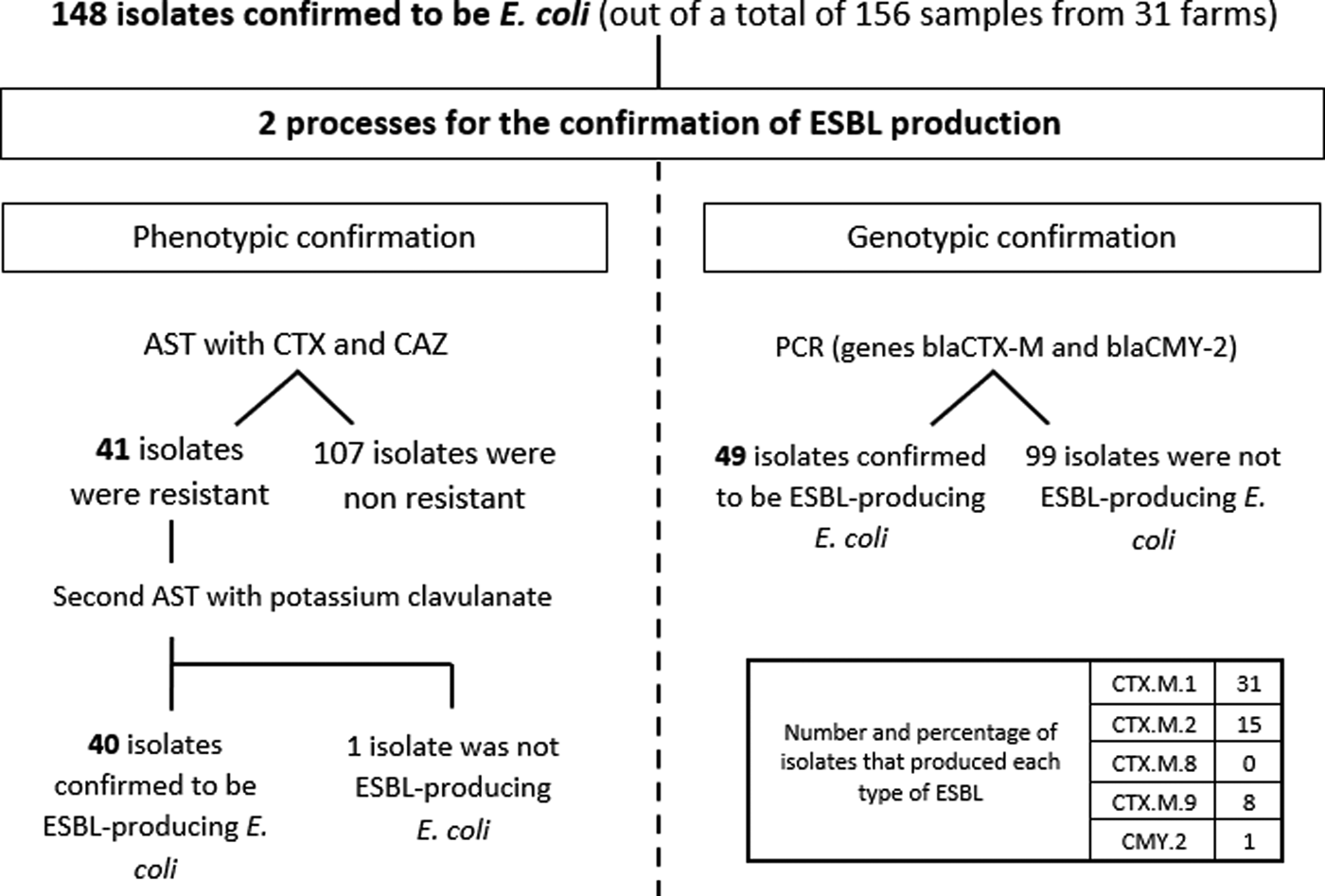
Each isolate confirmed genotypically as E. coli was submitted to genotypic evaluation of ESBL production capability through conventional PCR, for the genes blaCTX-M and blaCMY-2. The test was performed using the primers (shown in online Supplementary Table S1) that were used by Yan et al. (Reference Yan, Hong, Ko, Chen, Tsai, Chuang and Wu2004) and Shahid et al. (Reference Shahid, Al-Mahmeed, Murtadha, Qareeballa, Eltahir, Tabbara, Ismaeel, Dar, Giha, Bindayna and Bindayna2014). The 50 μl final volume included 2 μl of each primer (10μM), with the exception of blaCTX-M-8, for which 4 μl of each primer (10 μM) were used. Amplification reactions were performed in a VWR® Thermocycler Doppler, with distinct conditions for CTX-M and CMY-2. The first group was submitted to an initial denaturation at 94°C (7 min); 35 cycles of 94°C (50 s), 50°C (40 s) and 72°C (2 min), with a final extension at 72°C (5 min). For the second group, initial denaturation was performed at 94°C for 3 min, with 35 cycles of 94°C (1 min), 55°C (1 min) and 72°C (1 min), with a final extension at 72°C (7 min). Observation of amplification products was performed using the Chemidoc XRS + (Bio-Rad®Molecular Imager) equipment, with use of the Ladder V (NZYTech®) reference for the CTX-M group, and the Ladder VI (NZYTech®) reference for the CMY-2 group. Positive control isolates were kindly provided by Dr Lina Cavaco, National Food Institute, Technical University of Denmark. Both phenotypic and genotypic processes for the identification of ESBL production are summarized in Figure 1.
Summary of the phenotypical and genotypical detection of ESBL production (and its results), and numbers of each type of ESBL among all E. coli isolates. AST, Antimicrobial susceptibility test. PCR, Polymerase chain reaction. CTX, cefotaxime. CAZ, ceftazidime. ESBL, Extended Spectrum Betalactamase. CTX.M.1, CTX.M.2, CTX.M.8, CTX.M.9, CMY.2, are the different types of ESBL identified.

Questionnaire
A questionnaire was performed on all participating farms, undertaken by three different veterinarians, one from each practice. The questionnaire included questions regarding potential risk factors for the emergence of antimicrobial resistance, including feeding waste milk to calves, type of waste milk being fed (during antimicrobial treatment, during withdrawal period for treatment, from cows with mastitis or with high somatic cell counts), if the waste milk underwent any processing (such as pasteurization), use of preventive antimicrobial medicines fed to calves through milk, number of different intramammary tubes with antimicrobial drugs (different active substances) used on farm within the previous year to treat mastitis, if oral, systemic or both forms of antimicrobials were used for the treatment of diarrhoea in calves and if farms were open with respect to buying in animals.
Statistical analysis
A univariable logistic regression analysis was performed in order to understand if any of the considered risk factors (chosen considering the information provided by the questionnaire) had a significant impact on the presence of ESBL-producing E. coli. Each risk factor was used as an independent (or explanatory) variable, and the outcome variable was whether or not ESBL-producing E. coli was identified (on each farm) through genotypic confirmation. Each farm was regarded as one statistical unit.
Following this, the aim was to understand if there was any association between the aforementioned risk factors and the number of E. coli isolates from each farm that were able to produce ESBL. For this, a univariable negative binomial regression analysis was performed, in which the outcome variable was the number of E. coli isolates from each farm that were positive to ESBL. This analysis was performed considering each of the risk factors retrieved from the questionnaire separately, as an explanatory variable. These statistical procedures were performed using the software R®, version 4.1.2 and R Studio; the STATS package was used for the logistic regression procedure, and the MASS package was used to conduct the negative binomial regression analysis.
Results
Confirmation of ESBL production
Out of 156 isolates from 32 dairy farms, 148 isolates from 31 farms were confirmed to be E. coli. These were all submitted to an initial antimicrobial susceptibility test with CTX and CAZ, of which 41 isolates (27.7%) from 16 farms (51.6%) were resistant. A second susceptibility test performed after the inclusion of clavulanate in the test media, revealed that phenotypic production of ESBL occurred in 40 isolates from 15 farms (48.4%), with only one resistant isolate not being an ESBL producer.
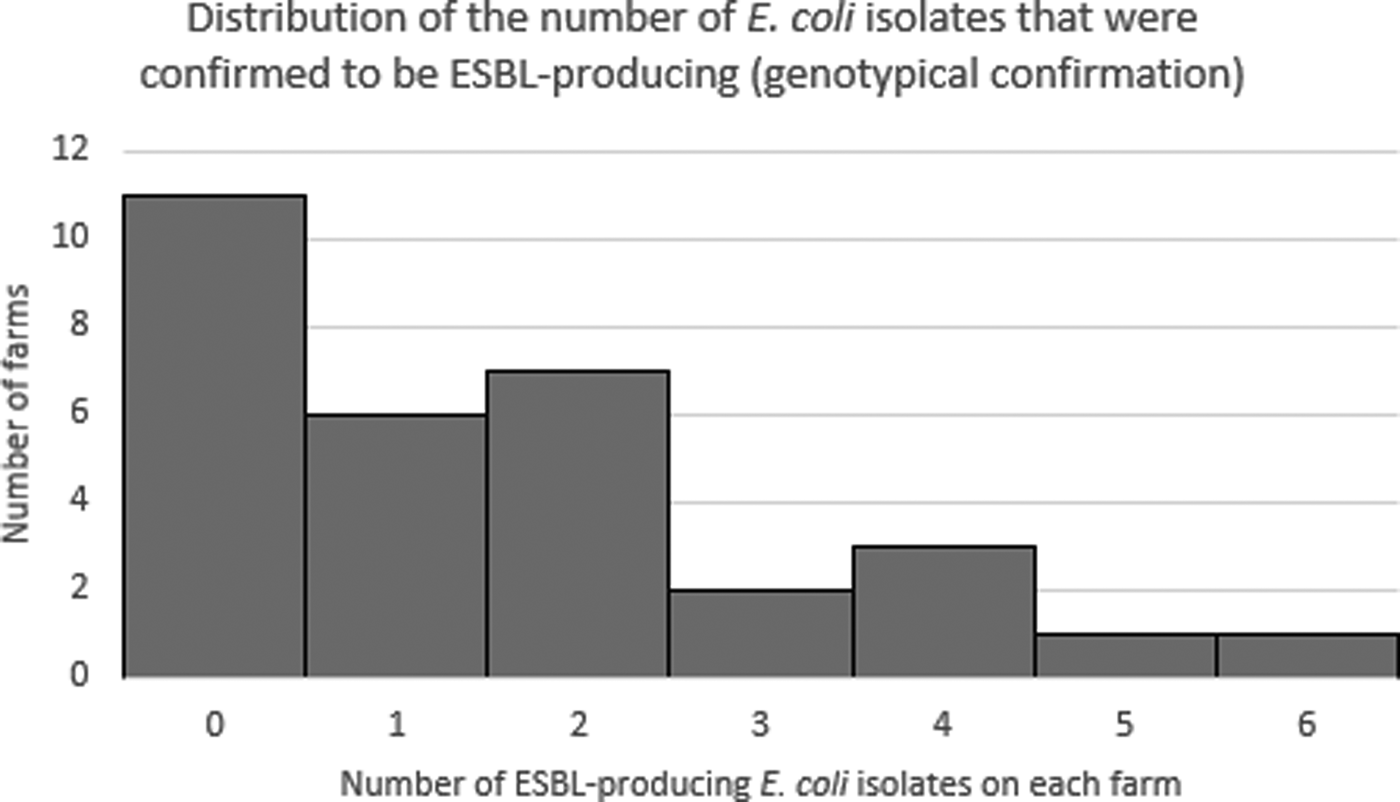
Based on the genotypic evaluation, there were ESBL producing isolates on 20 farms (64.5%). These results and the processes for phenotypic and genotypic identification of ESBL production are summarized in Figure 1. Figure 2 displays the distribution of the number of E. coli isolates, from each farm, that were genotypically identified as being ESBL-producing. Fifteen out of these 20 farms showed only one type of ESBL group, whereas 4 farms showed two different types and 1 farm had three different ESBL groups. Individual farm data are presented in online Supplementary Table S2.
Histogram representing the distribution of the number of ESBL-producing E. coli isolates identified in each farm.

There was a significant association (P < 0.05) between phenotypic and genotypic results of ESBL production; on 20 farms the results were coherent, whereas on 6 farms there were genotypically positive results with a negative phenotype, and on a single farm there was a positive phenotype and negative genotype.
Questionnaire
The questionnaire revealed that 28 out of 31 farms (90.3%) fed waste milk to calves. On all of the farms that had this practice, waste milk comprised milk from animals being treated with antimicrobials and milk originating from animals during the withdrawal period for antimicrobial treatment. For 17 of the farms, waste milk also included milk from animals with high somatic cell count.
On 7 of the 31 farms, an antimicrobial was added to milk, either waste milk or milk replacer, in a preventive way. The questionnaire also revealed that the number of different intramammary tubes used as treatment options for mastitis in the previous year varied from 1 to 7, considering different active substances or their combinations. Sixteen of the farms where the interview was conducted had made frequent use of 3 or more different intramammary formulations for this purpose. Fifteen (48.4%) farms bought in animals, 16 (51.6%) used oral antimicrobials to treat cases of neonatal diarrhoea, 26 (83.8%) used systemic antimicrobials and 12 (38.7%) farms used both oral and systemic antimicrobials to treat calves with diarrhoea. Results of individual farm questionnaires are presented in online Supplementary Tables S3 and S4.
Statistical analysis
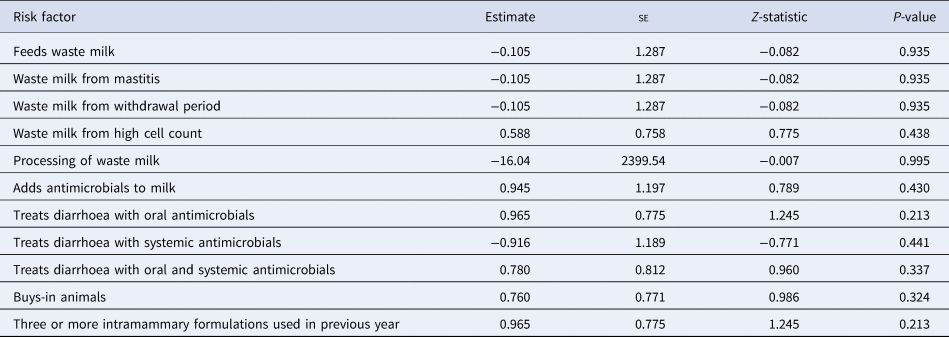
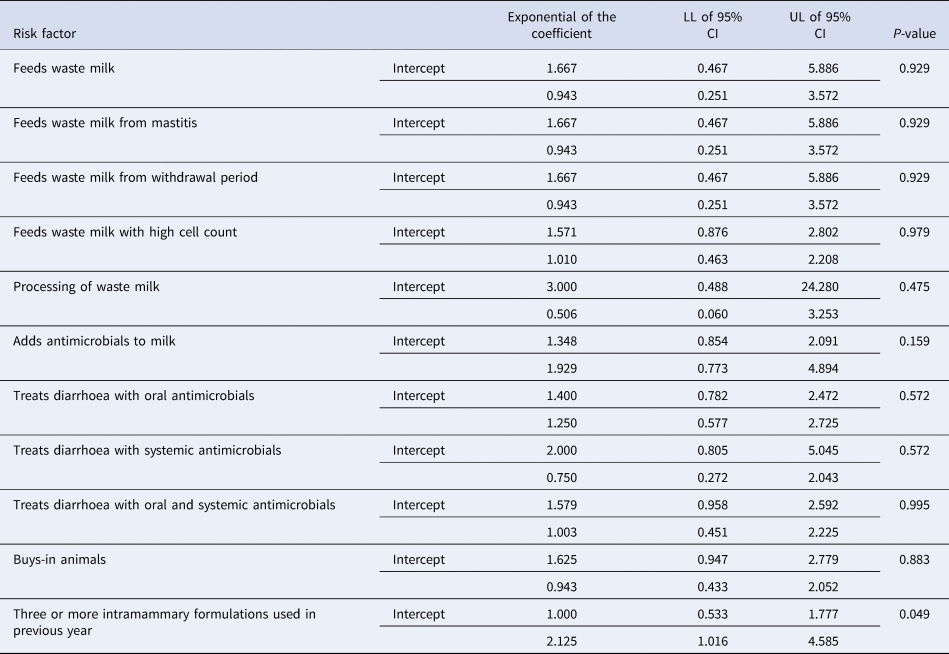
According to the results of the univariate logistic regression analysis (Table 1), none of the analysed risk factors had a significant influence on the presence of ESBL-producing E. coli on farm. The negative binomial regression analysis (Table 2) identified the number of intramammary antimicrobial formulations used in the previous year to treat mastitis as being significantly associated with a higher number of ESBL-producing E. coli isolates detected. According to the results of this analysis, in farms that had used three or more different intramammary formulations to treat mastitis during the previous year, the number of ESBL-producing E. coli isolates being detected in the samples from their calves was expected to increase by a factor of 2.125 in comparison with farms that had not done so (given that, for a given farm, the other risk factors remained unchanged). This means that, in farms that have used that many intramammary formulations during that period, we estimate that the number of ESBL-producing E. coli isolated from their calves will be, on average, 112.5% higher compared to farms that had used less intramammary formulations
Results of the univariable logistic regression analysis

se, Standard error.
Results of the univariate negative binomial regression analysis, expressed as the exponential value of the regression coefficients

LL, lower limit; UL, upper limit; CI, confidence interval.
Discussion
Feeding waste milk to calves is a common practice among the farms that participated in the study, with 90.3% of the farms from which E. coli was sampled having it as part of their feeding routine. This has been reported in other parts of the world as well, including 48.2% of the farms in Canada (Vasseur et al., Reference Vasseur, Borderas, Cue, Lefebvre, Pellerin, Rushen, Wade and de Passillé2010), 79% of the farms in Sweden (Duse et al., Reference Duse, Waller, Emanuelson, Unnerstad, Persson and Bengtsson2013) and 83% of the farms in England and Wales (Brunton et al., Reference Brunton, Duncan, Coldham, Snow and Jones2012).
In our study, none of the farm management practices addressed in the survey were found to be significant risk factors, per se, for the occurrence of ESBL-producing E. coli. However, we did find a significant association between having used a certain number of different intramammary antimicrobials in the previous year and the number of ESBL producing E. coli isolates detected. In farms that had used three or more different intramammary tubes to treat mastitis during the previous year, the number of ESBL-producing E. coli isolates being detected in the samples from their calves was expected to increase by a factor of 2.125 in comparison with farms that had not done so. Taking these results into account, we argue whether the number of ESBL-producing E. coli isolates detected in each farm could be an indicator of the intensity at which this microorganism is being excreted in that same farm, thus being a possible indicator of its prevalence. We find that further studies with larger samples are necessary to draw conclusions regarding this matter.
Mastitis is the main reason for the use of antimicrobials in dairy cattle (Kuipers et al., Reference Kuipers, Koops and Wemmenhove2016), and as such it will be the main driver for the generation of waste milk with antimicrobial residues. There are many licensed products for mastitis treatment, including 3rd and 4th generation cephalosporins, some of which have been reported as having the highest usages for mastitis treatment (Kuipers et al., Reference Kuipers, Koops and Wemmenhove2016). The use of many different intramammary tubes for the treatment of mastitis (instead of defined protocols with one or two treatment options) is contrary to good practice. The number of antimicrobials in each intramammary tube was not taken into account, even though there are intramammary tubes in the European market that contain up to four distinct antimicrobials, which might be relevant from the point of view of antimicrobial stewardship.
Feeding waste milk with antimicrobials to calves has been observed to increase the number of CTX-M-positive bacteria shed in faeces, leading to a longer excretion of such bacteria and a higher level of contamination of calf pens with CTX-M-positive E. coli, in comparison with feeding milk replacer (Brunton et al., Reference Brunton, Reeves, Snow and Jones2014). Several recent publications have found increased antimicrobial resistance in faecal E. coli from calves being fed waste milk with antimicrobial residues (Pereira et al., Reference Pereira, Siler, Bicalho and Warnick2014; Maynou et al., Reference Maynou, Migura-Garcia, Chester-Jones, Ziegler, Bach and Terré2017), but not necessarily in other bacterial species (Aust et al., Reference Aust, Knappstein, Kunz, Kaspar, Wallmann and Kaske2013). ESBL-producing E. coli has also been isolated from mastitic milk samples in a high proportion of samples (Ali et al., Reference Ali, Rahman, Zhang, Shahid, Zhang, Liu, Gao and Han2016). Pasteurization of waste milk to render it safer from a microbiological point of view has been shown not to affect the presence of antimicrobials in waste milk (Jorgensen et al., Reference Jorgensen, Hoffman and Nytes2006). The presence of ESBL-producing E. coli in raw bulk tank milk seems to vary between publications (Geser et al., Reference Geser, Stephan and Hächler2012; Odenthal et al., Reference Odenthal, Akineden and Usleber2016) but in this case, pasteurization renders milk safe for human consumption.
The potential risks and mitigation strategies of feeding waste milk to calves have recently been critically reviewed by EFSA (2017). Several options are discussed in that document to prevent waste milk with antimicrobial residues being fed to calves. However, due to the economic constraints put on many dairy farmers, the use of waste milk to feed calves will probably continue to be a routine for many farmers. Use of on-farm testing systems to identify mastitis pathogens and target treatment decisions for mastitis has been shown to decrease antimicrobial use by 50% and decrease milk withdrawal times (Lago et al., Reference Lago, Godden, Bey, Ruegg and Leslie2011). Using such a strategy could thus reduce the amount of waste milk being generated, while allowing for important economical savings.
Simply not feeding waste milk to calves may not be sufficiently safe to be recommended either. If waste milk is not used to feed calves, it will generally be delivered to manure, which in itself might carry other dangers relating to the transfer of resistance genes horizontally to indigenous soil bacteria (Beneragama et al., Reference Beneragama, Iwasaki, Lateef, Yamashiro, Ihara and Umetsu2013). However, there is evidence that anaerobic digestion or composting of manure reduces the load of initial antimicrobial resistant bacteria (Youngquist et al., Reference Youngquist, Mitchell and Cogger2016).
In conclusion, feeding waste milk to calves was performed in 90.3% of participating farms, and that included milk from animals under antimicrobial treatment, animals going through the withdrawal period of antimicrobial treatments and milk from animals with subclinical mastitis. None of the farm management practices analysed were significant risk factors for harbouring ESBL-producing E. coli. However, further statistical analysis suggested that farms that had used three or more different intramammary formulations to treat mastitis during the previous year would see an estimated increase of 112.5% in the number of ESBL-producing E. coli isolates being detected in the samples from their calves (provided that other risk factors remained equal).
Supplementary material
The supplementary material for this article can be found at https://doi.org/10.1017/S0022029922000486
Acknowledgements
This research was funded by FCT-Fundação para a Ciência e Tecnologia, I.P. (Portugal) through Centro de Investigação Interdisciplinar em Sanidade Animal (CIISA) project UIDB/00276/2020, Laboratório Associado para Ciência Animal e Veterinária (AL4AnimalS) project LA/P/0059/2020 and Magnomics. Doctor Lina Cavaco, National Food Institute, Technical University of Denmark, is acknowledged for kindly providing positive control isolates.