Introduction
An individual’s mental health is fundamental not only to their own health and well-being, but also to that of their families, communities and the population as a whole. Mental health disorders rank among the most substantial causes of morbidity and mortality worldwide.Reference Walker, McGee and Druss 1 , Reference Kessler, Matthias and Anthony 2 Almost half (45.5%) of Australian adults experience psychological distress, affective or substance use disorder at some point in their life.Reference Slade, Johnston and Teesson 3 Often beginning in childhood or adolescence, they can lead to considerable disability, contribute to adverse health behaviors and ill-health.Reference Walker, McGee and Druss 1 Despite improvements in treatment, there continues to be a substantial unmet need for appropriate screening and subsequent treatment, with less than half of people with mental health issues seeking professional help.Reference Kessler, Matthias and Anthony 2 Early detection and treatment can reduce the long-term impact of mental health disorders.
The gap in health status and life expectancy between Indigenous and non-Indigenous Australians is well documented. This divide is wider than for other western nations with Indigenous populations, such as New Zealand and Canada.Reference Lavoie 4 This gap is particularly evident in the Northern Territory (NT) where the life expectancies of Indigenous residents are, on average, 14 years less than non-Indigenous residents. 5 Indigenous Australians experience higher rates of poor health, poverty, poor diet, inadequate housing and mental health disorders. 6 , Reference Bailie, Stevens and McDonald 7
Indigenous adults are almost three times more likely than non-Indigenous to have experienced psychological distress. 6 They are more likely to experience stressful life events such as death of a family member, alcohol/drug problems or abuse/violent crime at a higher rate. 6 The NT has the highest rate of hospitalizations due to violent injury through interaction with a family member or intimate partner, highest in Indigenous people.Reference Berry, Harrison and Ryan 8 , Reference Tovell, McKenna, Bradley and Pointer 9 The Western Australian Aboriginal Child Health Survey (WAACHS) reported one in five Indigenous children lived in families that had recently experienced seven or more significant life events compared with only 0.02% of non-Indigenous young people.Reference Blair, Zubrick and Cox 10 An increased number of stressful life events can lead to psychological distress and adverse health behaviors. 6 , 11 Indigenous Australians have higher rates of suicide across all age groups compared with the national rate (4.2 v. 1.6%, respectively of all registered deaths). 12 The NT has the highest rates of suicide of all Australian jurisdictions over recent decades, with the highest rate seen in Indigenous people.Reference Leckning, Li and Cunningham 13 Depression, stressful life events and substance use can lead to an increased risk of self-harm or suicide. 11 , Reference Mościcki 14 , Reference Fergusson, Woodward and Horwood 15
Young adulthood is a time of increased vulnerability to mental health disorders. This is particularly evident in young women where the impact of mental ill-health affects not only themselves but the next generation. High levels of maternal stress increases the risk of preterm delivery,Reference Dole, Savitz and Hertz-Picciotto 16 low birth weight infantsReference Rondo, Ferreira and Nogueira 17 and small-for-gestational-age infants.Reference Rondo, Ferreira and Nogueira 17 , Reference Grote, Bridge and Gavin 18 These factors in turn are associated with impaired cognitive and social developmental outcomes for the infant, further magnifying the impact of maternal stress and rendering prevention and early intervention in young women particularly crucial.Reference Robinson, Mattes and Oddy 19
The aims of this study were three-fold: (a) to report the rates of psychological distress in Indigenous and non-Indigenous young adults in the NT; (b) to examine the association of psychological distress and other markers of emotional status; and (c) to examine the relationship between gender, socio-economic status, location and life events and emotional status.
Methods
Setting
Cross-sectional data was obtained as part of the Life Course Program based in Darwin, NT, Australia. The NT has the third largest area of the states and territories in Australia (1,346,200 km2). It has a small (244,300), relatively young (median age of 31.8 compared with the national 37.3) population, with the highest proportion of Indigenous people (~30%), of whom four out of five reside in remote or very remote areas. 20 Remote communities vary in population size from 200 to 2000 people, with many small family groups living in outstations (<50 people). Across the NT many (100+) varied dialects are spoken, with English often the second or third language.Reference Lawrance, Sayers and Singh 21 , Reference Gruen, Weeramanthri and Bailie 22 People who live in remote areas of Australia have limited access to appropriate mental healthcare.Reference Hinton, Kavanagh, Barclay, Chenhall and Nagel 23
Recruitment and retention
The Life Course Program is a prospective longitudinal study examining the effect of early life factors on later health and disease in Indigenous and non-Indigenous Australians. It encompasses two distinct but complementary cohorts; the Aboriginal Birth Cohort (ABC) and the Top End Cohort (TEC).
The recruitment and previous follow-up of the ABCReference Sayers, Singh and Mackerras 24 and TECReference Davison, Cunningham and Singh 25 studies have been described elsewhere. In brief, between 1987 and 1990, 686 (54% of those eligible) babies born to Indigenous mothers were recruited from the Royal Darwin Hospital, the main referral hospital for the NT, to the ABC study.Reference Sayers, Singh and Mackerras 24 , Reference Sayers and Powers 26 Subsequent follow-up has occurred at the participant’s residence in over 40 urban and remote communities across the Top End at age 11 (86% examined)Reference Sayers, Mackerras and Singh 27 and age 18 (71% examined).Reference Sayers, Singh and Mackerras 24 Between 2007 and 2009, 196 non-Indigenous people born in Darwin between 1987 and 1991were recruited to the TEC study. TEC participants were age matched to participants of the ABC study.Reference Davison, Cunningham and Singh 25 Participants of both studies were examined between August 2013 and June 2015 (age 21–27 years) in their community of residence.
Emotional status assessment
To understand the disparities in mental health between Indigenous and non-Indigenous Australians it is essential that appropriate tools are used. These need to be culturally appropriate, but also allow comparability with other populations.Reference McNamara, Banks and Gubhaju 28 Face-to-face computer assisted interviews were conducted by trained researchers. To increase cultural acceptance, gender specific or older team members conducted the interviews. Local interpreters were used when required.
The Emotional Status Assessment (ESA) used a combination of questionnaires which inquired about symptoms related to the previous 4 weeks. All questions used a five-point Likert scoring scale covering; none, little, some, most or all of the time.
Psychological distress
The Kessler-10 (K-10) is one of three consumer measures mandated for use throughout all Australian public mental health services to assess psychological distress.Reference Nagel, Robinson, Condon and Trauer 29 The shortened version Kessler-5 (K-5) has been used with Indigenous people in state-wide and national surveys. 6 , Reference McNamara, Banks and Gubhaju 28 , Reference Jorm, Bourchier, Cvetkovski and Stewart 30 Participants were asked ‘how often had they felt nervous; without hope; restless or jumpy; everything was an effort; and so sad that nothing could cheer them up.’
Emotional stress
The Short Perceived Stress Scale (SPSS) is a widely used psychological instrument for measuring an individual’s perception of stress, or the degree to which situations in one’s life are appraised as stressful.Reference Cohen, Kamarck and Mermelstein 31 The four-item scale provides a useful measure of perceived stress and has been previously used in Australian Indigenous and non-Indigenous adults.Reference Wiggers, Radvan and Clover 32 Participants were asked ‘how often they felt unable to control the important things in their life; confident about their ability to handle personal problems; that things were going their way; and that difficulties were piling up so high that they could not overcome them.’
Positive well-being
The Short Warwick-Edinburgh Mental Well-being Scale (SWEMWS) was used to ascertain subjective positive well-being.Reference Bartram, Sinclair and Baldwin 33 Although there is a scarcity of research available from Australia, this scale has been used widely in the United Kingdom and Scotland in teenagers and young adults.Reference Wiggers, Radvan and Clover 32 , Reference Clarke, Friede and Putz 34 Participants were asked ‘how often they felt happy about the future; useful; relaxed; dealt with problems well; thought clearly; close to other people; and been able to make up their own mind.’
Risk of self-harm
Questions from the Strong Souls suicidal ideation (SSSI) were used to classify those at increased risk of suicidal ideation and/or self-harm (hereafter called self-harm).Reference Thomas, Cairney, Gunthorpe, Paradies and Sayers 35 SSSI question were used and validated in the previous follow-up of ABC participants. At risk of self-harm was categorized as high if answered yes to ‘felt like killing yourself’ or to three out of the four of the following questions; ‘felt like giving up, no point in trying; hurting yourself; wished you were dead; and everyone would be better off without them.’ Further information was then obtained by the senior registered nurse or doctor regarding; immediacy of intent, method of harm, availability of support networks, previous harm and current or previous use of mental health services. Consenting to participation in this study included obtaining consent for referral to appropriate services for any abnormal results. For those who were categorized with high psychological distress and/or at risk of self-harm, the referral process was revisited and the specific pathway and immediacy of referral agreed on. Referral occurred by the local health center and/or relevant mental health service.
Life stressors
Additional questions were asked in regard to the occurrence of 13 major life events (yes/no) and were adapted from the Negative Life Events Scale.Reference Kowal, Gunthorpe and Bailie 36 It included ‘a close family member has been in an accident; has been in hospital; has been arrested; is in prison; has an alcohol problem; has a drug problem; needs their care most days; has passed away; they didn’t have enough money to buy food or pay bills; them or someone in the house gambles a lot and it gives them money problems; they felt their house doesn’t have enough space for all the people who live there; they were scared by other peoples’ behavior; and physically hurt by someone.’
Statistical analysis
All statistical analysis was performed in STATA 14.2. Representativeness of the participants in this study compared with those of the available ABC and TEC not included was assessed using Pearson’s χ2 and Mann–Whitney U-test. Response rates were examined by Indigenous identification, residence and gender, through Pearson’s χ2 tests and linear regression. Participants were categorized into three groups according to Indigenous identification and residence as per the Australian Bureau of Statistics (ABS) Socio-Economic Indexes for Areas. 37 Participants were either Indigenous remote/very remote (hereafter called remote) residing; Indigenous urban residing and non-Indigenous urban residing. Psychological distress was assessed by continuous Kessler-5 score and categorized into two levels: low/moderate 5–11 and high/very high 12–25.Reference Slade, Johnston and Teesson 3 , Reference Kessler, Andrews and Colpe 38 At risk of self-harm was categorized as high if answered yes to ‘felt like killing yourself’ or to three out of the four of the additional questions as per the SSSI as described previously.
Multivariable linear regression was used for dependent continuous variables and logistic regression for dependent categorical variables with adjustment for a range of confounding factors such as gender, Indigenous identification and residence. The explanatory variables, gender, socio-economic status (SES) factors, were treated as categorical variables. All other explanatory variables, age, positive well-being, perceived stress, life events, were treated as continuous. Factor analysis was used to identify common themes in the major life events. Factor loadings were then used to develop events variables. A factor loading of >0.6 is considered to indicate a high, with >0.3 a moderately high, correlation.Reference Jöreskog 39
Results
Demographics
Participants were young adults aged 21–27 years. All of the TEC participants and a subsection of the ABC (24%) were assessed in urban locations with the remaining 76% of ABC participants assessed in over 40 remote communities and outstations across the NT.
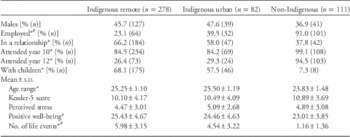
Of the 543 participants available for assessment, 471(87%) completed the ESA questionnaire. When stratified by Indigenous identification, no significant differences in gender, relationship status, employment status or education attainment was seen between those who completed the questionnaire and those who did not (see Supplementary Table 1 for full details). Significant differences in SES were seen between Indigenous and non-Indigenous participants. Majority of Indigenous participants were either married or in a de facto relationship and had one or more children. They had lower rates of employment and lower levels of educational attainment. These rates were similar between remote and urban Indigenous, however urban Indigenous participants had higher rates of employment than remote. Full details see Table 1.
Demographics of cohort by Indigenous identification and residence

*P<0.005 for Indigenous v. non-Indigenous.
# P<0.005 for urban Indigenous v. remote Indigenous.
Psychological distress
Rates of psychological distress were high (32.8%). SES factors such as being employed, in a relationship or having children did not impact on psychological distress level for the majority. The only exception being in remote Indigenous women where the odds of being distressed were 2.3 times higher if they were in a relationship. This association remained after accounting for each of the life events factors which included; family member arrested/in jail, problems with drugs, financial problems, physical/emotional violence and family death/disability.
Geographical location and ethnicity
Similar rates of psychological distress were seen in remote and urban Indigenous participants. Both groups had similar levels of positive well-being, perceived stress and risk of self-harm. Remote Indigenous participants had higher rates of life events than urban Indigenous (P=0.001). See Table 1 for results. For the purpose of this analysis remote and urban Indigenous are combined for further analysis.
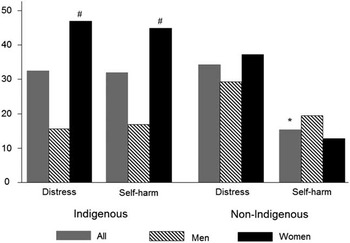
Similar rates of psychological distress and perceived stress were seen in Indigenous and non-Indigenous participants. Indigenous participants had significantly higher rates of positive well-being compared with non-Indigenous. Indigenous participants had twice the risk of self-harm than non-Indigenous (see Fig. 1).
Rates of psychological distress and suicidal ideation and/or self-harm by Indigenous identification and gender.#P<0.001 for Indigenous women v. Indigenous men; *P=0.001 for Indigenous v. non-Indigenous.

Emotional status
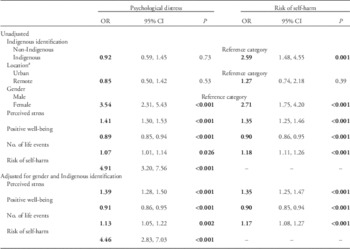
Those with high psychological distress also had lower levels of positive well-being, higher perceived stress levels and experienced a higher number of major life events. The correlation between psychological distress and risk of self-harm was highest in non-Indigenous participants (OR 52.4, P<0.0001; 95% CI 6.5, 417.4) compared with Indigenous (OR 4.0, P<0.0001; 95% CI 2.5, 6.5). On adjusting for gender and Indigenous identification these significances remained in all markers of emotional status (see Table 2).
Unadjusted and adjusted associations with psychological distress and risk of self-harm

OR, odds ratio; CI, confidence interval.
a Indigenous participants only.
Bold values signifies statistical significance.
Gender differences
Overall, women reported higher rates of psychological distress than men (see Fig. 1). However, this difference was largely evident in Indigenous participants with women having almost five times higher odds ratio (OR 4.76, P<0.0001; 95% CI 2.87, 7.88) than Indigenous men. This trend was also reflected in risk of self-harm with Indigenous women having a four times higher odds ratio (OR 4.01, P<0.0001; 95% CI 2.44, 6.57) than Indigenous men. Further analysis of increased risk of self-harm examining individual questions showed significantly increased risk of both self-harm and suicidal ideation in women. This was most evident in remote Indigenous where women had a three times higher rate of ‘felt like hurting yourself’ (women 31%, men 10%) and ‘felt like killing yourself’ (women 16% v. men 5.5%).
Life events
Of the 471 who completed the ESA, 402 answered additional questions in regards to major life events. Similar levels of perceived stress, positive well-being and risk of self-harm were seen between those who answered the life events and those who did not. However in the Indigenous cohort, higher rates of psychological distress (P=0.041) were evident in those who completed the life events questionnaire (see Supplementary Table 1). Significantly higher rates of life events were experienced in Indigenous compared with non-Indigenous. The occurrence of multiple life events was higher in Indigenous participants with 40% reporting having experienced seven or more life events compared with <1% of non-Indigenous.
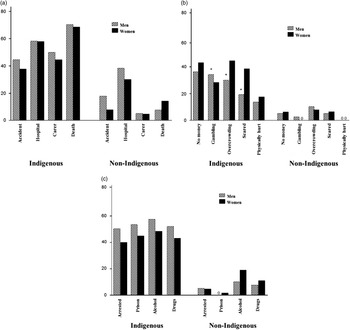
For Indigenous participants, death of a loved one was the most often reported stressor (69%), with approximately half reporting having someone in hospital (58%), family problems with alcohol (53%), other drugs (47%) and family member arrested (47%) or in prison (49%). Similar trends were seen in non-Indigenous participants but at a decreased rate (see Fig. 2a–2c for full results). Indigenous women were almost twice as likely to be scared by someone and 1.5 times as likely to report that their house was overcrowded compared with Indigenous men (see Fig. 2b). No differences were seen between non-Indigenous men and women on any of the life events.
(a), (b) and (c) Occurrence of life events by Indigenous identification and gender.*P<0.001 Indigenous men compared with Indigenous women. Accident, a close family member has been in an accident; Hospital, a close family member has been in hospital; Carer, a close family member needs their care most days; Death, a close family member has passed away; No money, they did not have enough money to buy food or pay bills; Gambling, them or someone in the house gambles a lot and it gives them money problems; Overcrowding, they felt their house does not have enough space for all the people who live there; Scared, they were scared by other peoples’ behavior; Physically hurt, they were physically hurt by someone; Arrested, a close family member has been arrested; Prison, a close family member is in prison; Alcohol, a close family member has an alcohol problem; Drugs, a close family member has a drug problem.

Impact of life events
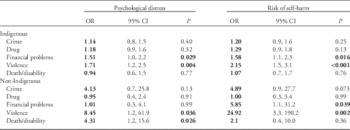
Factor analysis grouped the 13 Life Events into six factors, of which five had a loading >0.3 and were therefore used (see Supplementary Table 2 for results). 42 These were ‘crime,’ which mainly related to a family member being arrested or in prison; ‘drug issues,’ which related to a family member having a problem with alcohol or other drugs; ‘financial problems,’ which related to not having enough money to pay bills, someone has gambling problem causing financial worries or overcrowding; ‘violence,’ which related to having been scared by someone or physically hurt; and ‘death/disability,’ which related to having a family member pass away or providing care for someone.
In Indigenous participants, univariate analysis suggested associations between psychological distress with financial problems and violence. With risk of self-harm also associated with financial problems and violence. In non-Indigenous participants, univariate analysis suggested associations between psychological distress with violence and death/disability. With risk of self-harm associated with financial problems and violence. See Table 3 for details. On testing for gender interaction in Indigenous and non-Indigenous participants, no evidence was found.
Unadjusted association of life event factors with psychological distress and risk of self-harm by Indigenous identification

OR, odds ratio; CI, confidence interval.
Bold values signifies statistical significance.
Discussion
A third of young adults in this cohort had high psychological distress. This high rate was seen in both Indigenous and non-Indigenous young adults. This contrasts with the majority of research showing higher levels in Indigenous adults. 6 , Reference Blair, Zubrick and Cox 10 , Reference Cunningham and Paradies 40 However, a 2012 review of community surveys found only seven studies that included both Indigenous and non-Indigenous Australians. Two of the seven studies reported that there was no difference in prevalence of psychological distress between Indigenous and non-Indigenous adolescents.Reference Jorm, Bourchier, Cvetkovski and Stewart 30
We also showed no difference in psychological distress in relation to geographical location, with prevalence similar in both remote and urban residents. This is consistent with the Australian Aboriginal and Torres Strait Islander Health Survey which reported a prevalence of ~30% in both remote and non-remote areas. 6 Although those residing in remote communities have limited access to healthcare, adequate housing and nutrition,Reference Bailie, Stevens and McDonald 7 it has been postulated that they are also more resilient due to their connection to country and traditional culture.Reference Burgess, Johnston, Bowman and Whitehead 41 This may also, in part, explain the higher levels of positive well-being reported by remote Indigenous participants in this study.
Of particular note, the increased level of distress was seen in an environment of high perceived stress and, in Indigenous participants, a high number of stressful life events. Similar to Indigenous children and adolescents in the WAACHS, two in five remote and one in five urban Indigenous young adults had experienced seven or more stressful life events, compared with <1% of non-Indigenous people. In our cohort, death (70%) or ill-health (68%) of a loved one was the most often reported for both Indigenous men and women.Reference Blair, Zubrick and Cox 10 A high proportion of Indigenous women (42%) reported violence-related events (being scared and/or hurt by someone). In these women, violence-related events were positively associated with an increased risk of suicidal ideation and/or self-harm. This environment of increased distress, high stress and lower SES (poverty, poor diet, inadequate housing) 6 , Reference Bailie, Stevens and McDonald 7 may be contributing to the higher rates of morbidity and mortality in Indigenous Australians.
A direct correlation was seen between psychological distress and risk of suicidal ideation and/or self-harm in both Indigenous and non-Indigenous, men and women. This is not unexpected as, although suicidal ideation and self-harm does not necessarily predict suicide, it is definitely associated with depression and other mental or substance use disorders.Reference Leckning, Li and Cunningham 13 , Reference Mościcki 14 Depression, stressful life events and substance abuse have been shown to play an important role in the development of suicidal ideation, self-harm or suicide attempt during adolescence and early adulthood.Reference Mościcki 14 , Reference Fergusson, Woodward and Horwood 15 Given the high rates of suicide in the NT, and the impact mental health has on suicidal ideation and suicide risk, it is imperative that a holistic, culturally appropriate approach to mental health services is provided.
The high prevalence of psychological distress reported in this cohort is consistent with the national level for Indigenous young adults of a similar age. However, for non-Indigenous men and women, it is almost three times higher than the national rate for non-Indigenous young adults of a similar age (34 v. 11%). 42 It is also far greater than the prevalence rate reported for the NT (8.1%). 42 One reason to account for this difference might be the small sample size of non-Indigenous participants in this study. Another might be that the national samples have possible biases which can lead to under-estimating prevalence. For example, at risk people such as those with a mental illness, homeless people and remote location have been found to be less likely than others to participate in surveys.Reference Allgulander 43 The ABS does advise caution in regards to the relative standard error of data available for young people with psychological distress. 6 , 42 The ability to draw direct comparison is further complicated by the difference in age ranges. This cohort is aged 21–27 years while the national survey reports on 18–24 years and 25–34 years.
Of particular concern is the high level of psychological distress reported in women. The level of psychological distress seen is 1.4 times greater in Indigenous women (48 v. 34%) and 2.6 times greater in non-Indigenous women (37 v. 14%) than that reported nationally. 6 The majority of Indigenous women had children (n=167) or were pregnant (n=23). The strength of the mother–child relationship plays an important role in the child’s psychological development.Reference Robinson, Mattes and Oddy 19 , Reference Najman, Aird and Bor 44 The emotional status of the mother has direct implications on the health of the unborn child.Reference Rondo, Ferreira and Nogueira 17 In this environment where mothers have high levels of psychological distress and stressful life events, appropriate screening and treatment is essential. Most women will use obstetric services at some point during their pregnancies, thereby offering an opportune time to assess, treat and follow-up for signs of psychological distress during a several-month span.Reference Lancaster, Gold and Flynn 45
The main limitation of this study is the relatively small participant numbers that may have reduced the power to detect small associations. However, a number of significant associations were seen. There are limitations in the questionnaires used to assess emotional status. Although the K-5 and Negative Life Events Scale have been used with Indigenous people in state-wide and national surveys, neither the SPSS nor SWEMWS have been validated in this population. The content and delivery method of these questionnaires were acceptable to the targeted population, which augurs well for future assessments. However, their validity in Indigenous people is still to be ascertained. A major strength of this study is the ongoing nature which follows the life course approach. In addition to the demonstrated acceptability of these questionnaires, the ability to add to the already collected data increases both depth and breadth to this unique resource enhancing its value now, into the future and into the next generations.
Conclusion
One in three Indigenous and non-Indigenous young adults in the NT reported high psychological distress levels. Correspondingly high levels were seen in all other markers of emotional status; perceived stress, stressful life events and suicidal ideation and/or self-harm. A continued focus on early screening and treatment at this vulnerable age is required, particularly in young women with pregnancy being an opportune time to universally screen for mental health issues. There is a need to expand efforts upstream by advocating for amelioration of inequality and social disadvantage that creates constant stress on human systems and increases the risk of later disease. A concerted focus on improving the environs of young adults by lowering levels of stress, improving access to nutritious food, housing, educational and employment opportunity, will assist in improving an individual’s mental health status as well as the trajectory of disease into future generations.
Acknowledgments
The authors wish to acknowledge past and present study teams, in particular Dr Susan Sayers, founder of the ABC study. They especially thank the young adults belonging to the Aboriginal Birth Cohort and Top End Cohort and their families and community for their co-operation and support and all the individuals who helped in the urban and remote locations.
Financial Support
This work was supported by the National Health and Medical Research Council of Australia (Project Grant APP1046391).
Conflicts of Interest
The authors declare there are no competing interests.
Ethical Standards
The authors assert that all procedures contributing to this work comply with the Helsinki Declaration of 1975, as revised in 2008. All participants provided written informed consent to participate in this study, and all procedures were approved by the Human Research Ethics Committee of the Northern Territory Department of Health and the Menzies School of Health Research. The ABC study also obtained approval from the Aboriginal Ethical Sub-committee which has the power of veto.
Supplementary Material
To view supplementary materials for this article, please visit https://doi.org/10.1017/S2040174417000162