





The nearly two decades following the Qing collapse in 1911, commonly known as China’s “warlord period,” were a time marked by the erosion of central authority and the proliferation of local military power. Recurrent warfare, fiscal exhaustion, and administrative paralysis combined to produce prolonged social disorder, in which banditry emerged as a structural problem rather than an episodic disturbance. The issue of bandits in Republican China has attracted sustained scholarly attention, particularly with regard to their definition, typology, social origins, and causes.Footnote 1 Early studies, most notably those by Phil Billingsley, emphasized the socioeconomic dimensions of banditry, interpreting it as a rational response by marginalized groups to conditions of material insecurity. Yet this body of scholarship has largely focused on rural society, leaving urban banditry and its relationship to local governance comparatively underexplored.
In fact, the prevalence of banditry during the Late Qing Dynasty and the Republican period was closely intertwined with the widespread militarization of local society. Classic works by Frederic Wakeman, Philip Kuhn, and Edward A. McCord have traced the historical trajectory through which local military forces emerged and expanded from the late Qing onward.Footnote 2 More recent scholarship has moved beyond viewing military power as a mere instrument of coercion, situating it instead within broader configurations of local authority, elite politics, and state formation. McCord argues that warlordism produced an increasing militarization of elite power, whereby military authority became a central determinant of social and political status in early Republican China.Footnote 3 Lei Duan’s dissertation on private gun ownership argues that the widespread diffusion of firearms reshaped the social landscape of violence and challenged the state’s monopoly on legitimate force.Footnote 4
From the standpoint of local governance, militarization was not an abstract institutional condition but was concretely manifested in the control of armed force by gentry families, local strongmen, lineage organizations, and criminal actors. This diffuse pattern of armed control found its most concentrated expression in warlordism, which McCord has recently defined as a situation in which military commanders, operating in the absence of a strong central state, establish political and administrative control over a region based primarily on their personal command of military force. In this sense, local militarization can be more precisely conceptualized as a process of the privatization of military power to consolidate localized governance – a dynamic exemplified by the Ni (倪) clan’s domination of Fuyang (阜陽) county in Anhui Province.Footnote 5
The 1922 seizure of the city of Fuyang by the Henan bandit leader known as “Old Foreigner” (Laoyangren 老洋人) offers a revealing case of urban banditry during the Beiyang period. By analyzing this incident as a disastrous breakdown in local governance, this article clarifies the complex relationship between warlord predation and civic mobilization. Specifically, it uses this case study to contribute to the scholarly understanding of three interconnected phenomena in China during the Beiyang era: the limits and perils of local militarization, the realities of political disunity, and the development of a transregional public sphere. The analysis shows how the collapse of privatized local defense not only exposed the structural limits of warlord rule but simultaneously created the conditions for a new form of transregional civic politics. Situating Anhui not as a stable domain of a unified Beiyang regime but as a highly contested geopolitical buffer zone is essential to understanding the structural vacuum that enabled this crisis. The privatization of military power by the locally powerful Ni clan, essentially the privatization of violence, stripped the state of its protective function, exposing the deep structural vulnerabilities of local governance. Although previous studies have reconstructed the movements of the Old Foreigner band, a systematic social-historical analysis of Fuyang’s local power structure and defensive system remains lacking.Footnote 6
This article therefore approaches the Fuyang crisis from two angles: the local catastrophe itself and the urban response it provoked. It is in the latter – the sustained campaign of public criticism waged by Anhui elites in Shanghai – that this article develops its central argument about the public sphere. The Fuyang incident, in other words, did not remain a localized episode of violence. It triggered an extensive social response that extended far beyond the locality itself. Anhui-born veterans of the 1911 Revolution residing in Shanghai responded to the catastrophe, employing modern civic associations, telegrams, and newspapers to launch a sustained campaign of public criticism against the warlord network led by Ni Sichong (倪嗣沖). Through these efforts, the Fuyang crisis was transformed into a transregional public issue, offering a valuable lens through which to reconsider the historical configuration of the public sphere in modern China.
Since the 1990s, debates over the Chinese public sphere have occupied a central place in Anglophone scholarship. Drawing on a model developed by Jürgen HabermasFootnote 7, scholars such as William RoweFootnote 8 and David StrandFootnote 9 emphasized the emergence of spaces of social autonomy fostered by urban commerce and elite mobilization, while subsequent interventions by Philip HuangFootnote 10 and Frederic WakemanFootnote 11 have significantly revised this dichotomous framework that strictly separates state and society. This article intervenes in this debate by showing that the Chinese public sphere in this period was neither the autonomous civil society envisioned by Rowe and Strand, nor simply a space whose boundaries with state power were as clearly demarcated as Huang and Wakeman’s critiques suggest, but rather a contested arena shaped by the interplay of governance failure and revolutionary political agency.
Against this historiographical backdrop, this article examines the Fuyang incident as a key moment in the mobilization of social forces against warlord violence, highlighting the role of civic elites in shaping public discourse and collective action under conditions of failed governance. Methodologically, it adopts the social-historical approach advocated by McCord, reconstructing local power relations, military practices, and social networks to examine how the privatization of military power eroded everyday mechanisms of governance and, in moments of crisis, provoked collective social mobilization.Footnote 12 Many of the sources drawn on here – press reports, public telegrams, and native-place association records – were composed by literate Anhui natives in urban China, chiefly Shanghai. These sources serve a double purpose: they document the course of the crisis and, as objects of analysis in their own right, reveal through their rhetoric and circulation how a news-reading elite transformed a local catastrophe into a transregional public concern. Crucially, this article argues that when local administrative and military institutions became dysfunctional, the public sphere did not primarily emerge as a site of neutral, rational deliberation. Rather, it functioned simultaneously as a mechanism of social defense and a strategic arena of political contestation – serving both the immediate need for protection and the longer-term ambitions of a temporarily disarmed revolutionary elite.
Accordingly, this article first reconstructs the microstructure of power in Fuyang, analyzing how the Ni clan consolidated control over regular troops, local defense corps, and reorganized bandit forces to privatize military authority and hollow out formal institutions of governance. It then traces the dynamics of the bandit assault on the city, demonstrating that the collapse of Fuyang’s defenses was not simply the result of inferior weaponry but rather of a structural breakdown in organizational mobilization caused by military privatization. Finally, the analysis turns to Shanghai to examine how Anhui natives mobilized public opinion to construct a transregional network of social defense, and assesses the significance of this mobilization in light of the scholarly debate over civil society and the public sphere. This study contends that the 1922 Fuyang crisis was both a tragic outcome of governance failure driven by the privatization of violence and an unintended catalyst for the emergence of modern practices of the public sphere in early Republican China.
Military control and the power genealogy of the Ni clan
Located in the northwest of Anhui Province, at the border between Anhui and Henan, Fuyang lies on a flat plain. Traditionally, an agricultural region with underdeveloped commerce, it had few wealthy merchants or large trading houses.Footnote 13 However, after the founding of the Republic, especially between 1915 and 1922, local commerce developed rapidly. Various trade guilds and money shops were established, and the financial market became increasingly active.Footnote 14 This transformation of the local economy was inseparable from the political patronage of the Anhui clique warlord Ni Sichong, a native of Fuyang.
The Ni family of Fuyang rose to prominence in the 1850s and 1860s by suppressing the Nian (捻軍) Rebellion. Through the organization of militia forces and accumulated military merit, they entered the ranks of the local gentry and became one of the eight most influential families in the region.Footnote 15 During Ni Sichong’s tenure as military governor of Anhui (1913–1920), the family reached the height of its power, largely controlling the province’s military, political, and financial resources. As McCord has argued, warlords often leveraged their military and political status to misappropriate public assets for private accumulation, thereby fostering a predatory economic mode.Footnote 16
The Ni clan offers a paradigmatic case of this structural predation in its home county. Capitalizing on this unprecedented clout, the family built a power network that extended throughout Fuyang, consolidating control over the county’s military forces, political administration, and economic resources. Fuyang’s localized development during this period was driven by a combination of the relatively peaceful macro-environment between 1912 and 1922 and the deliberate political patronage of the Ni clan. It was reported that during Han Guojun’s (韓國鈞) term as civil governor (xun’anshi 巡按使) of Anhui (September 1915–April 1916), Ni Sichong had reached an agreement with Han that the latter would not interfere in Fuyang’s affairs.Footnote 17 In the economic realm, the Ni family accumulated vast tracts of land in FuyangFootnote 18 and operated numerous money shops and pawnshops. Among them, Ni Cuiheng (倪萃恒) and Ni Juheng (倪聚恒) owned two of the largest money shops in the county, each with capital exceeding one million yuan, effectively dominating the entire local financial system. A local saying suggests the extent of the Ni family’s influence: “Even the Ni family’s cats and dogs strut arrogantly in the streets.”Footnote 19
The structural vulnerabilities created by this localized predation were further compounded by Anhui’s precarious geopolitical position. Rather than an integrated component of a monolithic Beiyang government, Anhui functioned as a highly volatile buffer zone between competing national factions. While national figures such as Duan Qirui (段祺瑞) led the influential Anhui Clique (皖系) in Beijing, their power relied primarily on the central government apparatus rather than a consolidated provincial base in Anhui itself. This gap between nominal provincial affiliation and actual provincial control left Anhui exceptionally vulnerable to rapid political turnovers. Following Ni Sichong’s departure in 1920, nominal control of Anhui shifted chaotically among various factions and their proxies, including Zhang Wensheng (張文生), Ma Lianjia (馬聯甲), and later the Zhili Clique (直系) and the Fengtian Clique (奉系). The inability of these successive, short-lived provincial authorities to sustain their forces frequently led to mutinies, with unpaid soldiers turning to banditry. It was precisely this geopolitical instability at the provincial level that created the conditions in which bandit leaders like the Old Foreigner could operate with relative impunity.Footnote 20
After the Anhui clique’s defeat in the Zhili-Anhui War (直皖戰爭) of 1920, Ni Sichong retired from political life, and the Ni clan lost its key patron. Nevertheless, despite this broader provincial volatility, the clan continued its control over Fuyang through privatized military power. At that time, the 1st Regiment of the 2nd Mixed Brigade of Anhui was stationed in Fuyang, consisting of three battalions. The unit belonged to Ni Sichong’s former Anwu Army (安武軍) and was directly commanded by his clan descendant Ni Jinyong (倪金鏞). According to the Ni family genealogy (Ni shi zupu 倪氏族譜), Ni Jinyong, who had joined the army in his youth, was promoted to lieutenant general in 1911 by virtue of his family connections,Footnote 21 and in October 1920 he became commander of the 1st Regiment of the Second Mixed Brigade of Anhui.Footnote 22 Ni’s command over his home county, a clear departure from the convention of not assigning an official to govern his own home county during imperial times, indicated the privatization of military power during the warlord period. Crucially, Ni’s command of the local garrison, which stemmed from his personal ties of kinship, rather than formal state appointment, planted the seeds of future crisis when the bandit forces spawned by provincial chaos finally descended upon the county.
In addition to the local garrison, the Ni family also controlled local militia known as defense corps (baoweituan 保衛團). As early as May 1914, to “protect the villages and eliminate banditry,”Footnote 23 the government of Yuan Shikai (袁世凱) promulgated the Local Defense Corps Regulations (Difang baoweituan tiaoli 地方保衛團條例), which required counties without police forces to organize local defense corps, reorganizing the existing militia and baojia (保甲) systems accordingly.Footnote 24 Despite repeated orders from Anhui authorities, implementation was largely ineffective.Footnote 25 It was not until December 1921, when Governor Xu Shiying (許世英) again urged the northern Anhui counties to strengthen local defense in response to worsening banditry, that action was taken.Footnote 26 Under these directives, the Fuyang Defense Corps was officially established in August 1922, composed of seven companies with one hundred men each. Ni Daoxu (倪道煦, 1895–1937), a nephew of Ni Sichong, served as inaugural commander of the Defense Corps.Footnote 27
Ni Daoxu had followed his elders into the military during the late Qing. After 1911, he held several staff positions under the northern Anhui garrison command and the Anwu Army, and later served as adjutant in the offices of the Anhui military governor and the provincial inspector. Leveraging these posts, he also controlled the collection of lijin (厘金) taxes in Yingzhou (潁州) and customs revenues at Zhengyang Pass (正陽關).Footnote 28 After Ni Sichong’s downfall, Ni Daoxu returned to Fuyang. According to reports, he established the Defense Corps under the guise of a local gentry initiative, funding it by levying an additional 1,500 wen (文) in copper cash on every tael of the land-and-poll silver (diding 地丁).Footnote 29 Since the corps was personally controlled by Ni Daoxu, the county magistrate had no real authority over it, effectively making it the Ni family’s private militia.
While the defense corps system had originally been intended to augment the state’s limited capacity for local defense, the Ni clan exploited it to legitimize private armed power under the banner of public security. This reflects not only the weakness of state penetration into local society but also the tension between institutional design and local practice. Xavier Paulès has argued that warlords often promoted modernization in ways that inadvertently advanced state building; McCord’s framework of structural predation points in a different direction.Footnote 30 At first glance, the rapid economic development of Fuyang during Ni Sichong’s governorship might seem to support Paulès’s thesis. However, the Fuyang case ultimately qualifies his view: the Ni family appropriated both economic gains and modern military instruments as private resources, strengthening familial control rather than state capacity. The appropriation of public resources for familial ends ultimately hollowed out local governance and precipitated the crisis of 1922.
Ni Daoxu’s organization of the Defense Corps was supported by his cousin Ni Daolang (倪道烺, 1879–1951), the son of Ni Sichong’s eldest brother Ni Yuzao (倪毓藻). After 1912, Ni Daolang served successively as director of the Lu Salt Transportation Bureau, the Lishan Coal Company, and the Fengyang Customs Office, and maintained a firm and longstanding grip on Anhui’s mining and taxation networks.Footnote 31 In June 1921, amid the Jiang Gaoqi Incident (姜高琦案) following student protests in Anqing (安慶), Ni Daolang was accused of ordering the fatal beating of a middle school student and dismissed from office.Footnote 32 To escape political disgrace, he returned secretly to Fuyang and, with his brothers Ni Daowei (倪道煒) and Ni Daoxu, conspired to raise troops in the region.Footnote 33 At that time, Ni Jinyong’s regiment was still stationed in Fuyang, further strengthening the clan’s military presence. Under Ni Daolang’s direction, Ni Daoxu recruited the Defense Corps, while Ni Daolang transferred a large cache of weapons left by Ni Sichong to Fuyang for use by the family’s troops.Footnote 34
To expand their forces, the Ni family also incorporated a 300-man bandit group led by Wei Laopiao (魏老飄) into Ni Jinyong’s regiment. Reports indicate that in October 1921, several hundred bandits offered to surrender to Ni Daoxu and promised to forgo pay for three months after reorganization to boost the appeal of their offer. This offer proved too attractive for Ni to refuse, and he reorganized the bandits into a “Garrison Battalion.”Footnote 35 As shown in Table 1, according to a survey by the Shanghai-based Yingzhou Association, the Ni family’s combined armed forces exceeded 2,000 men, composed of regular troops, the Defense Corps, and reorganized bandits deployed throughout the county.
Troop deployment inside and outside Fuyang city

Table 1. Long description
The table has three main sections: Within the city, Outside the city, and Other areas. It lists specific sites and their corresponding designations. Within the city, there are four specific sites: Wenchang Temple, Magong Ancestral Hall, Gongyuan, and Daguang. Outside the city, there are five specific sites: Zushi Temple, Huoxing Temple, Guandi Temple, Dawang Temple, and All Four City Gates. Other areas include Taihe County, Western villages, Yangqiao Market, and Dili City. Each row provides details on the specific site and its designation, including various companies and battalions of the Ni Regiment and Defense Corps. The table captures the deployment of troops across different locations, both within and outside the city, as well as in other areas.
Source: Shenbao, January 12, 1923b.
Note: The report refers to Ni Daoxu’s armed organization as the bao’andui (保安隊 Security Corps), whereas most other sources call it the baoweituan (保衛團 Defense Corps); the latter term is used here.
Fuyang’s hybrid military structure – regular troops, defense corps, and reorganized bandits – was a disaster in the making. The integration of local bandits into Ni Jinyong’s forces blurred the boundary between regular troops and bandits, directly contributing to the later fall of Fuyang when Old Foreigner and his men attacked the city, and the bandits within the garrison promptly switched sides. Meanwhile, the county magistrate was reduced to a mere figurehead who was powerless to command the Defense Corps, while local defense was co-opted as an instrument in the hands of warlords who fought each other incessantly. Ni Daolang’s recruitment of bandits under the pretext of public order was, in essence, a political gamble that turned Fuyang into an arena for military adventurism. The Fuyang case thus illustrates how the privatization of military power and administrative failure became mutually reinforcing at the local level: the extraction of local resources for factional ends produced a cycle of institutional decay that formal governance mechanisms proved unable to arrest.
The bandit invasion and the sacking of Fuyang
The monopoly on military power enjoyed by the Ni family faced an unexpected challenge from the Henan bandit force led by Old Foreigner. His real name was Zhang Qing (張慶, 1886–1924), a native of Linru (臨汝), Henan. Zhang owed his nickname Old Foreigner to his foreign-looking appearance. Born into poverty, he had joined the Bailang (白朗) uprising in his youth. After its failure, he returned home, changed his name to Zhang Tingxian (張廷獻), and enlisted in the Hongwei Army (宏威軍) under Zhao Jie (趙傑), brother of Henan military governor Zhao Ti (趙倜). Following Zhao Ti’s defeat during the First Zhili–Fengtian War in May 1922, as well as his loss of the governorship, Zhao Jie’s troops were disbanded, and Old Foreigner took the opportunity to gather more than 300 rifles and returned to banditry. His forces soon expanded to seven or eight thousand men under the banner of the Henan National Construction Army (Henan jianguo jun 河南建國軍), roaming across central and southern Henan. Clearly, the rise of Old Foreigner was a direct product of warlord warfare and local disorder. By late October 1922, pursued by Wu Peifu (吳佩孚), his forces moved eastward, capturing Shangcai (上蔡), Xiangcheng (項城), and Shenqiu (沈邱), and finally approached Anhui. Fuyang, the key gateway of northwestern Anhui, now faced a grave threat.Footnote 36
As Old Foreigner drew nearer, the Fuyang authorities paid close attention to the situation in Henan. The county magistrate at the time, Chen Dichen (陳滌塵, 1881–1939), had only recently assumed office in September 1922.Footnote 37 When the Henan bandits captured Shangcai, Chen, deeply alarmed, telegraphed the provincial government about the pressing defense situation. After the bandits entered Fuyang territory and occupied Shenqiu, Chen dispatched troops to intercept them.Footnote 38 However, since the entire military force in Fuyang was controlled by the Ni clan, Chen only managed to mobilize a tiny force.
Logically speaking, the Ni family’s troops – mostly local men – should have been motivated to defend their hometowns. In reality, they were complacent. Several days before the invasion, Li Zishi (李自適), a Fuyang native serving as secretary at Wu Peifu’s headquarters in Luoyang (洛陽), telegraphed Ni Daoxu to warn that Old Foreigner might move east and urged him to make preparations for the city’s defense.Footnote 39 Ni ignored the warning, and Ni Jinyong likewise paid little attention. On October 31, Ni Jinyong went to the western suburbs of Fuyang to celebrate his father-in-law’s birthday, even after hearing that the bandits had entered Fuyang territory.Footnote 40 County magistrate Chen sent him four urgent letters demanding his return to the city, but Ni took his time, preoccupied with a land purchase.Footnote 41 Thus, military forces in the hands of individuals or clans proved incapable of defending public interests – their loyalty was to private gain, not to public security.
Accounts of Ni Daoxu’s whereabouts during the attack vary. Some reports claimed that he accompanied Ni Jinyong to the countryside for the birthday banquet, returning to the city only at dusk, still making no preparations for defense.Footnote 42 An eyewitness account by Huo Peilin (霍沛林), likely more reliable, offers a vivid picture. Huo, an eighteen-year-old apprentice from Shanxi, worked at the Huichanghe (匯昌和) money shop owned by Ni Sichong’s son-in-law Wang Pu (王普). He recalled that on the day before the bandits entered the city, Ni Daoxu was feasting and drinking at the Magongci (馬公祠) at noon and watching an opera performance at Deshenglou (德勝樓) that night. When a messenger arrived mid-performance with the news that Old Foreigner’s troops were only a few miles away at Yangqiaoji (楊橋集), panic immediately erupted in the theater.Footnote 43 Another report claimed that Ni had been hosting theatrical performances in the city for several days, ignoring repeated warnings.Footnote 44
In contrast, Magistrate Chen appeared far more attentive to the looming danger. On the morning of October 31, he discussed city defense with Ni Daoxu, proposing to send several defense corps units outside the city to block the enemy. However, since the troops lacked firearms and refused to obey Chen’s orders, the plan was abandoned. In the afternoon, Chen invited dozens of local gentry to organize emergency defense and imposed provisional martial law. By evening, defensive arrangements were in place: the city gates were ordered closed early, and a telegram was sent to provincial supervisor Ma Lianjia requesting reinforcements from nearby Su County (宿縣).Footnote 45 Yet without control over the defense corps, Chen could do little to bolster the city’s defenses.
At the front, Ni Jinyong’s regiment clashed with the bandits. On October 31, his troops engaged some two thousand bandits about forty li west of the city. Another bandit force of equal strength soon arrived, forcing Ni’s regiment to split its strength and fight on two fronts throughout the day.Footnote 46 That night, the bandits changed tactics: while feigning battle outside the city, a 400-man detachment secretly circled north to attack the city gate. As the fighting intensified, Ni Daoxu withdrew troops to guard his personal residence, leaving only the Wei Laopiao battalion in charge of the northern defenses. When the bandits reached the gate, the garrison not only offered no resistance but even set fires and opened the gates to welcome them.Footnote 47
In the early hours of November 1 (the thirteenth day of the ninth lunar month), Fuyang fell as some of the city’s defenders switched sides and collaborated with the attackers.Footnote 48 Ni Daoxu fled first with a hundred-odd men of the defense corps, while Ni Jinyong and his troops prioritized protecting their families and private property.Footnote 49 Though the garrison and defense corps were nominally government troops, their operations were entirely guided by family interests. Given the inability of the state to fulfill one of its most basic functions – the provision of defense, local elites transformed institutional tools into means of self-preservation – exposing the shallow penetration of state authority and the absence of public accountability.
After Fuyang fell, neighboring bandit groups poured into the city. Reports indicated that only a few hundred of Old Foreigner’s men had initially breached the city walls, but they met virtually no resistance. The next day, Li Mingsheng’s (李明盛) force of under a thousand entered, followed by numerous groups from the Henan-Anhui border region.Footnote 50 According to Governor Xu Shiying, over 3,000 bandits participated in the attack.Footnote 51 By November 3, the bandits had established two headquarters – at the Sixth County Middle School and the Fifth Agricultural School – equipped with machine guns and mountain artillery, totaling nearly two brigades of troops.Footnote 52
Hearing of the fall of Fuyang, Ma LianjiaFootnote 53, newly appointed as military governor of Anhui, was shocked. On November 3, he ordered immediate mobilization of units from Dangtu (當塗), Anqing (安慶), and Xuancheng (宣城) to retake the city.Footnote 54 The appointed commander, Yin Gongxian (殷恭先), advanced from Zhengyang Pass, while other brigades were dispatched to guard the southern front. Most of these officers and soldiers were from Fuyang and had once served under Ni Sichong, including Ni’s son-in-law Wang Pu and nephew Hua Xuanzhang (華璿章). With many of their families at the bandits’ mercy, Yin’s troops advanced rapidly to recapture Fuyang.Footnote 55 Outnumbered, Old Foreigner withdrew from Fuyang on November 3, retreating south to Sanhejian (三河尖). After looting the area, he then returned north to Henan.Footnote 56 Although Ma’s military response appeared successful, it only masked the deeper crisis of governance: when local defense depends solely on personal ties instead of institutional authority, public order cannot be maintained.
Worse still, after the bandits’ withdrawal, Ni Daoxu’s forces looted the devastated city under false pretenses. After both Ni Jinyong and Old Foreigner fled Fuyang, Ni Daoxu quickly entered the power vacuum in Fuyang, falsely reporting that his defense corps had “driven away the bandits.”Footnote 57 He even posted proclamations claiming the bandits had been “repelled.”Footnote 58 In fact, he ordered the city gates closed for two days and seized all remaining property, leaving Fuyang an empty city.Footnote 59 Trapped residents could neither bury the dead nor find food – “the wailing shook the heavens.”Footnote 60 The defense corps had become indistinguishable from the bandits themselves, and public authority was completely subordinated to private gain, revealing the corrosive effects of the privatization of military power on local governance.
It is worth noting that Old Foreigner’s decision to raid Fuyang was driven by several motives. First, the bandit chief was in desperate need of provisions. Pursued by Wu Peifu’s forces, the bandit army had been roaming from western to eastern Henan, passing mostly through poor regions that offered little sustenance. Reports noted that when the bandits captured Shangcai, they already “intended to move toward Fuyang, the richest and most prosperous area of northern Anhui, where the gentry and merchants mostly resided inside the city.”Footnote 61 Another report pointed out that because Fuyang was Ni Sichong’s hometown, “the city had prospered under his rule; even the poor had become rich,” so the Henan bandits “marched in with hopes of a grand plunder.”Footnote 62 Although the claim that “the poor had become rich” was an exaggeration, the city’s relative affluence was indisputable.
Second, they sought to seize weapons. Huo Peilin’s eyewitness account described how, when the bandits stormed the Huichanghe money shop at midnight, they first demanded to know whether any guns were kept inside and then searched for silver coins. When told that Huo was tending to a customer smoking opium, they seized all the opium in the shop as well.Footnote 63 According to other reports, the bandits – guided by spies – discovered and looted a large cache of arms secretly stored by the Ni family,Footnote 64 including around 8,000 rifles, two million bullets, thirteen machine guns, and several artillery pieces.Footnote 65 Although sources differ on the precise numbers, the plunder of weapons was clearly a key objective of the bandits.
Third, they came for opium. In 1922, Fuyang had a bumper harvest of opium, most of which was stored inside the city. After the fall, the bandits looted each household, “always asking first for opium, and then for silver and other valuables.”Footnote 66 Some reports added that after Ni Jinyong had recruited the Wei Laopiao bandit force, he executed two of its leaders, provoking resentment among the survivors. When the opium harvest was completed that year, the disaffected bandits, aware that many wealthy families in Fuyang stored large quantities of opium, allegedly conspired to lure Old Foreigner to attack the city for both revenge and profit.Footnote 67 According to contemporary accounts, about six million liang (兩) of opium were plundered.Footnote 68 Despite discrepancies in the figures cited in various accounts, it is clear that the quest for opium was one of the primary motivations for the invasion.
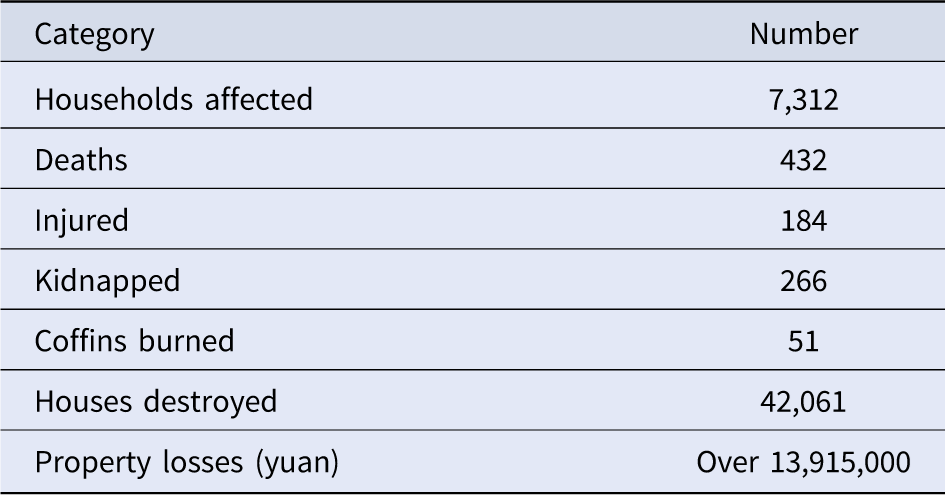
Once inside the city, the bandits engaged in indiscriminate killing, burning, and looting. According to a local investigation, ninety-four to ninety-five percent of the urban area was burned down; the remaining few percent consisted mostly of vegetable plots or thatched huts of poor residents. Only a few tiled buildings of the Confucian Temple, the City God Temple, and the ancestral hall of the Cheng (程) clan survived. The rest lay in ashes.Footnote 69 The countryside suffered at least as much devastation. Of the county’s nineteen townships, eleven were looted; the looting proved to be especially devastating since much of the rural wealth had been deposited in the city beforehand.Footnote 70 As shown in Table 2, the disaster was of considerable magnitude.
Statistics of losses from banditry in Fuyang, November 1922

Table 2. Long description
A table summarizing losses from banditry in Fuyang, November 1922. The table has two columns: Category and Number. It includes the following data: Row 1: Households affected, 7,312. Row 2: Deaths, 432. Row 3: Injured, 184. Row 4: Kidnapped, 266. Row 5: Coffins burned, 51. Row 6: Houses destroyed, 42,061. Row 7: Property losses (yuan), Over 13,915,000.
Source: Zun (Reference Zun1923), p. 7.
In fact, the real death toll far exceeded the official numbers, with women suffering disproportionately. A report on November 5 stated that over 600 corpses were collected in a single day and emphasized that “most of the dead were women.” As “the women of Yingzhou were known for their chastity,” many considered capture by the bandits a “great disgrace,” and “countless women resisted the bandits to the death.” Among the victims were the aunt and cousin of Zhu Qinghua (朱清華), former director of the Anhui Provincial Finance Department, both shot for cursing their captors.Footnote 71 These acts were praised in the press as moral heroism in a manner that obscured the fundamental failure of the defense corps and the state’s inability to provide protection.
Kidnapping for ransom became the bandits’ principal means of extortion. Hostages were priced according to their wealth, and families were ordered to pay hefty ransoms. One report stated that “over a thousand men and women of the gentry and commoners were kidnapped.”Footnote 72 The county gazette also recorded several thousand abductions. The lower number in later tallies – only about 300 – was likely due to many victims being ransomed or having escaped by the time of counting.Footnote 73 Even Magistrate Chen Dichen himself and two guards were captured, with the bandits repeatedly raising their ransom demands. Chen eventually escaped near Wulongji (烏龍集) in southern Gushi (固始) County, Henan, when the bandits let down their guard.Footnote 74 That even the highest local official could not guarantee his own safety vividly demonstrates the collapse of public authority. Teachers and students from the elementary school affiliated to the local teaching college were also kidnapped, while the bandits opened the Third Prison of Fuyang and released all inmates.Footnote 75
During the plundering, the once-thriving commerce of Fuyang was utterly destroyed. In May 1923, the Fuyang Chamber of Commerce sent a telegram to the National Chamber reporting that “all businesses have suffered total losses; the financial sector is especially devastated, and money shops have suspended all payments.”Footnote 76 Treasury securities worth 20,000 yuan belonging to the county treasury and another 1,930 yuan from the Sanliwan (三里灣) Tax Bureau were looted, rendering them void.Footnote 77
The wealthy gentry families suffered even greater devastation. Despite employing private guards, the Ni clan itself could not escape ruin. Ni Sichong’s residence was looted, fifteen concubines and maids were kidnapped,Footnote 78 and Ni Jinyong’s eight-year-old grandson was taken hostage.Footnote 79 Ni Daolang’s wife was murdered, his residence burned, and even the coffin of Ni Daoxu’s mother was destroyed.Footnote 80 Other prominent families suffered similar fates. The father of Wang Pingjie (王平階), commander of the Anhui River Fleet, was abducted; the family of regiment commander Hua Xuanzhang was captured; brigade commander Wang Zhisheng’s (王峙生) younger brother was killed. Ning Wenjun (甯文鈞), former director of the Anhui Rice Tax Bureau and relative of the Ni clan, lost all his urban properties to arson.Footnote 81 In a state of total breakdown, even local elites with wealth and arms could not protect themselves. Violence devoured not only the lower classes but also the very structures of local power and privilege. Public and private order depended on each other – once the former collapsed, the latter could not survive either.
The fall of Fuyang also threw the entire region of northern Anhui into panic. Postal and telegraph lines were cut, isolating communication between the provincial capital and northern counties. Rumors spread rapidly that after Fuyang, the bandits would attack Yingshang (潁上), Taihe (太和), and Boxian (亳縣); some even claimed those towns had already fallen.Footnote 82 Other counties rushed to fortify their defenses.Footnote 83 Business in Bengbu (蚌埠) also suffered, as its Chamber of Commerce reported: “The disaster in Fuyang caused the spread of banditry; with roads filled with rumors and fear, merchants dare not travel, and markets are deserted.”Footnote 84
In sum, the invasion by Henan bandits inflicted unprecedented devastation on Fuyang. One report called it “a catastrophe unseen in three hundred years.” During the Taiping (太平軍) and Nian Rebellions of the late Qing, the city had been besieged several times but survived through joint defense by local gentry and residents. Even during the 1911 Revolution, though briefly occupied, Fuyang suffered little damage.Footnote 85 Only the Japanese bombing of 1938 could rival the devastation of 1922 in scale and magnitude. Decades later, survivors still recalled the event with terror. Liu Min (劉民), who lived through the disaster, wrote in the late 1980s that old people in Fuyang still tremble when speaking of Old Foreigner’s entry into the city.Footnote 86 The catastrophe became an indelible scar in the collective memory of the local people. The Fuyang atrocities exemplify the “military disasters” identified by McCord as structural products of warlordism.Footnote 87 While confirming his emphasis on predatory violence and social trauma, this case further shows how the privatization of military power actively invited such disasters and transformed local suffering into elite-led political mobilization.
Anhui native-place associations in Shanghai and the publicization of a local disaster
The fall of Fuyang to Old Foreigner attracted wide attention from major national newspapers. Chief among these was Shenbao (申報), published in Shanghai. Founded in 1872 and owned during this period by the prominent media magnate Shi Liangcai (史量才), Shenbao was the most influential and widely circulated commercial newspaper in Republican China, reaching a broad nationwide readership of urban elites, merchants, and intellectuals.Footnote 88 It served as the primary platform for the Anhui natives’ media campaign. Alongside Shenbao, other major dailies such as Shanghai’s Shibao (時報) and Xinwenbao (新聞報), Tianjin’s Dagongbao (大公報), and Beijing’s Yishibao (北京益世報) all ran extensive serialized reports on the incident. Rather than merely reporting the news, these newspapers became central vehicles of civic mobilization. Beyond the editorial coverage, this response also found expression in other textual and organizational sources. These included the widespread publication of public telegrams, joint petitions from various provincial associations, and reward advertisements for capturing the culprits. Through these channels, Anhui natives in Shanghai gradually organized themselves into a cohesive pressure group.
News soon reached former Xinhai revolutionaries from Anhui who were then living in Shanghai, many of whom had fled after the failed Second Revolution (二次革命) of 1913. The calamity grieved them but also presented an opportunity to denounce the Ni family and Anhui warlords. These Shanghai-based revolutionaries, relying on various public associations (gongtuan 公團), convened assemblies, issued open telegrams, organized petitions, and launched a vigorous campaign to rally public opinion.
The Fuyang natives in Shanghai took the initiative, transforming a local bandit disaster into a political movement against the Ni family and the Anhui military clique. On November 12, 1922, three Anhui revolutionaries from Fuyang – Ding Xiangqian (丁象謙, 1875–1947), Zhang Qiubai (張秋白), and Lü Yinnan (呂蔭南, 1891–1957) – jointly telegraphed Anhui natives across China, denouncing Ni Daoxu and Ni Jinyong for dereliction of duty. These three men were not neutral civic actors but seasoned revolutionary operatives with long-standing grievances against the Ni family. All three were Tongmenghui (同盟會) veterans who had participated in declaring Yingzhou’s independence during the 1911 Revolution, only to be driven into Shanghai exile by Ni Sichong’s subsequent suppression. Ding had been arrested by Yuan Shikai in the nationally sensational Eight Beijing Delegates Incident (Beijing ba yiyuan beibu an 北京八議員被捕案) of 1914 at Ni’s personal instigation; Lü had served as Sun Yat-sen’s personal secretary and remained closely tied to Kuomintang networks; Zhang had worked alongside Lü in Shanghai’s revolutionary journalism circles. Having spent a decade in Shanghai exile and repeatedly failed in armed struggle, these men now turned to associational politics and media advocacy as their primary means of political action.Footnote 89
They proposed three measures for post-disaster settlement: (1) to strip the Ni family members involved of their official ranks and decorations and punish them under military law; (2) to confiscate their property for compensation; and (3) to mobilize charitable organizations to support needy Fuyang individuals and households through the winter.Footnote 90 Having been fugitives in Shanghai since the failure of the 1911 Revolution, Ding, Zhang, and Lü viewed the campaign both as a response to their hometown’s tragedy and as a continuation of their anti-warlord political struggle. Their use of modern media to turn a local event into a national public issue marked a significant transformation in the repertoire of modern Chinese political protest.
Subsequently, the community of Fuyang natives moved from individual action to organizational mobilization, forming the Shanghai Association of Natives from the Seven Counties of Yingzhou (Lü Hu Yingzhou qi xian tongxianghui 旅滬潁州七縣同鄉會). The association elected Ding Xiangqian as chairman, Zhang Qiubai as vice chairman, and Lü Yinnan as director of the council, with Ning Junyuan (寧雋元) and others serving as directors. A separate Yingzhou Relief and Reconstruction Association (Yingzhou feizai shanhou xiehui 潁州匪災善後協會) was also established to raise donations and organize relief efforts.Footnote 91 The emergence of these associations played an important role in uniting Anhui natives in Shanghai and coordinating collective action. Later, the two organizations jointly conducted an investigation into the Fuyang disaster and published their report in the press.Footnote 92 These organizational initiatives carried deep significance. They transcended the traditional kinship-based functions of native-place associations, evolving into modern civic organizations with explicit political and social agendas. By publishing investigative reports, they introduced new forms of civil oversight over local governance, providing evidence that sustained a broader public discourse. This process exemplified how revolutionary elites, operating within the fissures of warlord politics, sought to expand the public sphere.
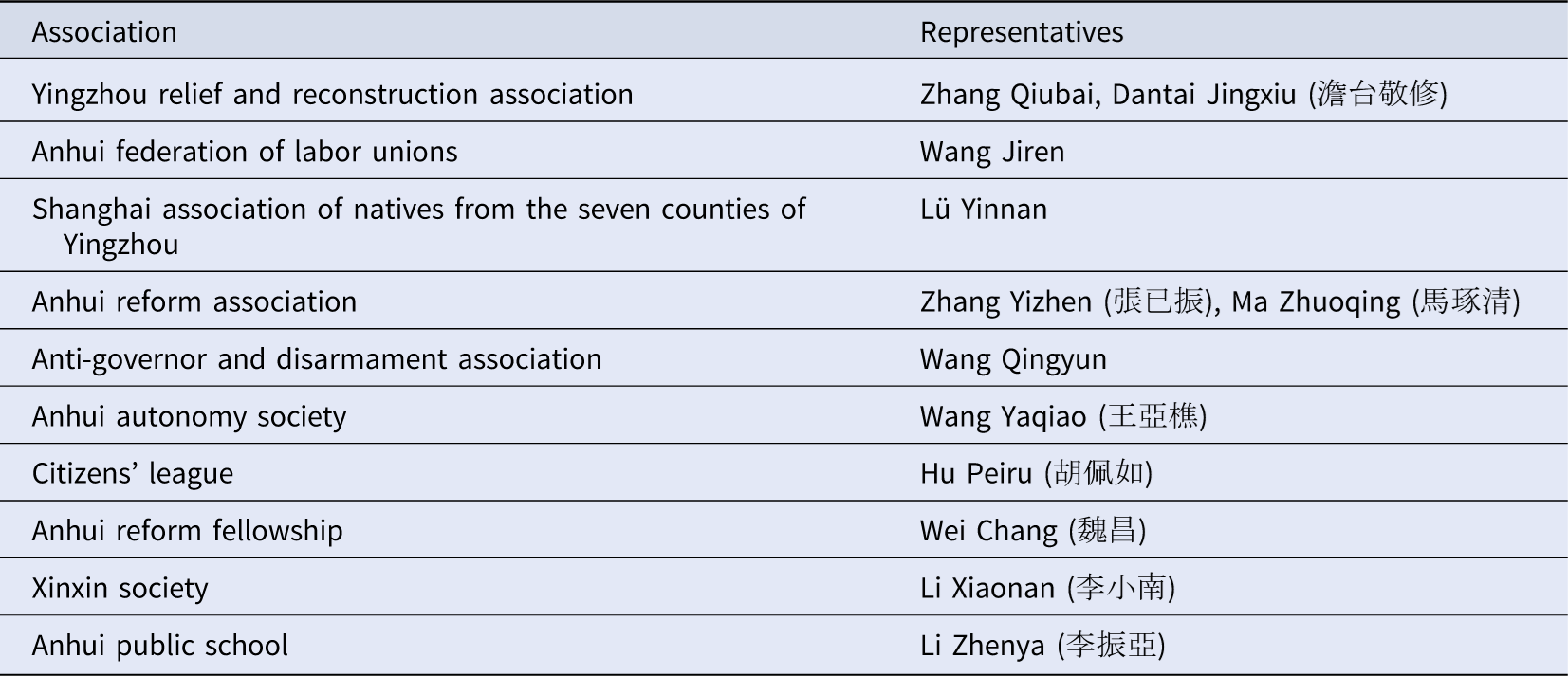
The mobilization quickly expanded beyond the Fuyang natives in Shanghai. Other Anhui associations in Shanghai expressed solidarity and joined a province-wide protest network. On November 19, 1922, representatives from more than ten Anhui associations convened a joint meeting at the Anhui Federation of Labor Unions (Anhui zhu Hu laogong zonghui 安徽駐滬勞工總會) in Shanghai. The participating organizations and their representatives are listed in Table 3. The meeting, chaired by former Huaishang Army (淮上軍) commander Wang Qingyun (王慶雲), focused on two issues: punishing the negligent Ni family officers and providing relief to the victims. Zhang Qiubai presented a report on the Fuyang disaster and read aloud a letter from Fuyang revealing details of Ni Daoxu’s misconduct.Footnote 93 Wang Jiren (王吉人) of the Labor Federation proposed sending representatives to Beijing to jointly denounce the two Ni family members and to petition the central government for disaster relief. Wang Qingyun suggested that the Yingzhou Relief and Reconstruction Association nominate one delegate, while other Shanghai associations send two additional representatives to present their case directly to the presidential office. All proposals were approved unanimously. The meeting also appointed four Anhui-born parliamentarians – Chang Hengfang (常恒芳), Chen Qinxuan (陳勤宣), Zhang Zhaohong (章兆鴻), and Ding Xiangqian – to assist in Beijing, while the Shanghai associations took charge of publicity, using telegrams and newspapers to expose the causes and consequences of the calamity.
Associations and representatives attending the joint meeting of Anhui associations in Shanghai (November 19, 1922)

Table 3. Long description
A table with two columns and eleven rows. The first column is labeled ʼAssociationʼ and the second column is labeled ʼRepresentativesʼ. The table lists the following associations and their representatives: Yingzhou relief and reconstruction association with Zhang Qiubai and Dantai Jingxiu, Anhui federation of labor unions with Wang Jiren, Shanghai association of natives from the seven counties of Yingzhou with Lv Yinnan, Anhui reform association with Zhang Yizhen and Ma Zhuoqing, Anti-governor and disarmament association with Wang Qingyun, Anhui autonomy society with Wang Yaqiao, Citizensʼ league with Hu Peiru, Anhui reform fellowship with Wei Chang, Xinxin society with Li Xiaonan, and Anhui public school with Li Zhenya.
Source: Shenbao, November 20, 1922.
Most of these activists were not neutral civic figures but KMT-affiliated revolutionary elites who had taken refuge in Shanghai after the failed Second Revolution and Ni Sichong’s suppression. Their campaign against the Ni family was simultaneously an act of native-place solidarity, a continuation of a decade-long anti-warlord political struggle, and a deliberate effort by KMT-linked networks to weaken the Anhui military clique in preparation for an eventual return to political power. Temporarily stripped of military force, they turned to the telegram, the newspaper, and the native-place association as their weapons of choice. The power of discourse over armed force became a crucial means of undermining warlord legitimacy precisely because direct armed challenge remained impossible. While scholars like McCord have emphasized how warlord atrocities generated broad societal denunciation and an anti-warlord consensus,Footnote 94 the Fuyang campaign illustrates a more partisan dynamic. As Marie-Claire Bergère has observed, the political fragmentation of the warlord era created spaces in which autonomous social and political associations were able to survive and operate.Footnote 95 Yet in this case, those spaces were occupied by men with explicit political affiliations and long-term power ambitions, who recognized in the Fuyang disaster an opportunity to mobilize public opinion in ways that served both humanitarian and partisan ends.
The campaign to bring Ni Daoxu and Ni Jinyong to justice met immediate obstruction at the provincial level. Ma Lianjia, governor of Anhui and a former subordinate of Ni Sichong, maintained close personal ties with the Ni clan. Though Ni Sichong had fallen, Ma still protected Ni Daoxu and Ni Jinyong from punishment. This reflected how interpersonal patronage networks among warlords continued to hamper the upholding of justice. In response, Shanghai-based Anhui revolutionaries, including Lü Yinnan and Ding Xiangqian, personally traveled to Beijing to submit a petition to President Li Yuanhong (黎元洪).Footnote 96 In January 1923, Li issued a presidential order dismissing Ni Jinyong from his command of the First Regiment, Second Mixed Brigade of the Anhui Army.Footnote 97 Ma Lianjia, under pressure from Beijing, dispatched troops to arrest him, but Ni fled and was soon declared a wanted criminal by the Beijing government.Footnote 98 By petitioning President Li Yuanhong directly, the Shanghai activists went over the head of the provincial administration, where Ma Lianjia’s patronage ties had shielded the Ni officers from punishment. The dismissal of Ni Jinyong was thus not the product of provincial justice taking its course; it was extracted from Beijing against the inclinations of the provincial authorities. The episode reveals where the associations’ leverage lay: amid the disjuncture between central and provincial authority, civic actors could play one level of the fragmented state against another.
Under sustained pressure from Anhui associations and disaster victims, the government also ordered the arrest of Ni Daoxu. Although Ni Jinyong was dismissed, Ni Daoxu initially remained untouched. In January 1923, a petition by over three thousand Fuyang residents – organized by Xing Zhaowei (邢兆偉) and Ning Dounan (甯鬥南) – urged Governor Xu Shiying to prosecute Ni Daoxu. Xu subsequently telegraphed the central government and recommended that Ni be stripped of his rank and decorations.Footnote 99 The government approved the request, though Ni had already escaped. Continued telegrams from Anhui associations throughout early 1923 kept the case in the public eye. On April 26, the government issued an official presidential warrant ordering Ni Daoxu’s arrest.Footnote 100
Although neither Ni Daoxu nor Ni Jinyong was ever captured, the unified campaign by Anhui native-place associations and Fuyang residents achieved symbolic accountability. Nevertheless, both the revolutionaries and ordinary Fuyang residents lamented the authorities’ failure to bring the Nis to justice. In May 1923, the Fuyang Chamber of Commerce sent a telegram to the National Chamber of Commerce lamenting that, despite the presence of local defense troops, “merchants suffered catastrophic losses; those responsible remain unpunished, which we cannot accept.” The chamber called on national business associations to support Fuyang in the name of justice and public security.Footnote 101 In contrast to the various provincial associations’ telegrams involving revolutionary activists, the Fuyang Chamber of Commerce refrained from directly naming the Ni family. This cautious form of protest reflects the helplessness and predicament of local gentry and merchants caught between warlord authoritarianism and appeals to the rule of law.
The provincial associations continued to take various measures to pursue Ni Daoxu. After Xu Shiying left office, Lü Diaoyuan (呂調元), who resumed his post as Governor of Anhui, immediately ordered the Fuyang authorities to investigate and apprehend him; yet the case remained unresolved for several months. The Ministry of the Army later sent reminders, prompting Lü to instruct the Fuyang authorities once again to double up on their efforts to arrest Ni.Footnote 102 It is likely that these reminders, together with public pressure from the provincial associations, influenced the authorities’ actions. The associations even participated directly in the pursuit: the Shanghai Association of Natives from the Seven Counties of Yingzhou, the Bandit Disaster Relief Association (Feizai shanhou xiehui 匪災善後協會), and the Fuyang Disaster Victims Association jointly published reward advertisements in Shenbao, offering 1,000 yang yuan (洋元) for Ni’s capture or 300 yuan for credible information leading to his arrest.Footnote 103 Despite these efforts, Ni remained at large.
The Ni family maneuvered frantically to remove the stigma of criminality. In a joint telegram, the Fuyang Disaster Victims Association, the Education Society, and the Chamber of Commerce reported that over the year since a wanted notice had been issued for Ni Daoxu, he had repeatedly bribed officials in Beijing to avoid punishment. Upon learning this, the provincial associations immediately issued a telegram exposing his actions, preventing this plan from succeeding.Footnote 104 Yet in March 1924, the central cabinet discussed and approved a measure to restore Ni Daoxu to his former post.Footnote 105 On April 27, Presidential Decree No. 681 granted Ma Lianjia’s request to cancel the warrant.Footnote 106 According to reports from the Fuyang Education Society and Disaster Victims Delegation, Ma Lianjia interceded on Ni’s behalf, with the Minister of the Interior Cheng Ke (程克) and the Minister of the Army Lu Jin (陸錦) petitioning President Cao Kun (曹錕), who was allegedly misled by Ma.Footnote 107 Ni Daoxu thus fully exploited his networks of personal connections to finally remove the criminal charges against him.
The decision provoked an uproar among Anhui activists. The Fuyang Chamber of Commerce and Educational Association sent delegates Li Caibai (李采白) and Liu Zicai (劉子才) to Shanghai to rally support.Footnote 108 On June 1, 1924, the twenty-second council meeting of the Anhui Association in Shanghai (Anhui tongxianghui 安徽同鄉會) convened, attended by Lü Yinnan and representatives of Fuyang organizations, to discuss the issue. The council resolved to telegraph other Anhui associations nationwide and coordinate protests.Footnote 109 Follow-up meetings continued to denounce the cancellation of the warrant.Footnote 110
Following coordination by the Anhui associations in Shanghai, the various Shanghai-based provincial associations and Anhui native-place organizations issued a series of telegrams, once again sparking a new round of public opinion campaigns. On June 15, the Fuyang Educational Association and Chamber of Commerce jointly issued a public telegram in Shenbao, accusing Ni Daoxu of dereliction of duty and bribery, and calling upon all Anhui compatriots to “speak out in righteousness for the sake of patriotism and justice.”Footnote 111 The message drew widespread support from prominent Anhui figures such as Li Jingxi (李經羲), Bai Wenwei (柏文蔚), Xu Shiying, Chang Hengfang, and Wang Qingyun.Footnote 112 The Shanghai Association of Natives from the Seven Counties of Yingzhou and the Yingzhou Relief Association also issued multiple follow-up telegrams.Footnote 113 Even Anhui members of the National Assembly in Guangzhou, including Ding Xiangqian and Ling Yi (淩毅), telegraphed their protest against the rescission, while the Nanjing Anhui Association admonished Ma Lianjia for “putting personal ties above public duty.”Footnote 114
The wave of telegrams created enormous public pressure. Reports noted that after the cancellation, Ni Daoxu attempted to reemerge politically in Bengbu, but fled to Tianjin after the renewed outcry. Fuyang representatives then traveled north to meet with Xu Shiying and planned to bring the case again to Beijing, with support from the Shanghai associations.Footnote 115 However, with the outbreak of the Northern Expedition (Beifa Zhanzheng 北伐戰爭), the pursuit eventually faded. Although both Ni Jinyong and Ni Daoxu remained unpunished, the Ni family’s political base in Fuyang had been fatally weakened. In 1924, Liu Pei (劉沛) – an official who had risen under Ni Sichong – was appointed magistrate of Fuyang, but faced local resistance.Footnote 116
Although the boycott did not achieve its intended effect, the campaign as a whole, for all the collateral harm it inflicted, nonetheless revealed that the Ni family’s power base in Fuyang was no longer as secure as before. It suggests that during China’s modern period, local associations and mass media gradually became an integral part of public politics. While the privatization of local military power revealed the deficiencies of modern state-building during the warlord era, the collective action undertaken by Anhui native-place associations in Shanghai highlights the concurrent expansion of China’s public space. This seemingly paradoxical coexistence bridges David Strand’s emphasis on the emergence of civic mobilization within the spaces of elite autonomyFootnote 117 with Emily M. Hill’s broader structural analysis of the era. As Hill points out, unity and disunity existed simultaneously during this period and should not be measured against a single endpoint of state building; rather, her research demonstrates that this environment produced uneven and contingent forms of institutional development.Footnote 118
Crucially, however, the Fuyang case illustrates the precise limits and contingencies of this process. As a movement motivated in part by pro-KMT ex-revolutionaries and unfolding within Anhui’s chaotic geopolitical buffer zone, this specific civic campaign did not – and could not – lead to formal institutional development or lasting structural change in local governance. While falling short of institutionalizing new governance structures, these campaigns pioneered alternative mechanisms of political contestation. Ultimately, the Fuyang case shows that, even as formal state authority fractured at the local level, new arenas of civic engagement and public mobilization emerged across regional boundaries, underscoring the complexity and multiplicity of state-building processes in modern China.
The trajectory of the campaign’s principal leaders after 1924 reveals the ultimately political character of what had appeared as civic mobilization. Following the establishment of the Nationalist Government in Nanjing in 1927, revolutionary elites finally regained the state authority they had lacked throughout the campaign years. Bai Wenwei, who reorganized revolutionary forces into the 33rd National Revolutionary Army, appointed Lü Yinnan as director of its political department, tasked specifically with confiscating Ni Sichong’s remaining assets to fund schools.Footnote 119 In 1928, serving as the Northern Route Pacification Commissioner (Guomin zhengfu beilu xuanweishi 國民政府北路宣慰使) and acting Special Commissioner for Relief in Northern Anhui, Lü returned to Fuyang. This coincided with Ni Jinyong’s clandestine return. As a principal actor in holding perpetrators accountable for the bandit disaster, Lü seized the opportunity to capture Ni Jinyong and execute him.Footnote 120 The Ni family’s properties in Fuyang and across Anhui were confiscated as “traitorous assets,” marking the definitive end of the family’s power in the province.Footnote 121 Ni Daoxu, meanwhile, remained in seclusion in Tianjin until his death from illness shortly before the outbreak of the Second Sino-Japanese War.
Taken together, these developments illustrate that the transition from civic petitioner to state official was not a rupture but a fulfillment: the associations, telegrams, and public investigations of 1922–1924 had served as the political groundwork for the reassertion of revolutionary state authority in Anhui. This history confirms that the public sphere constructed around the Fuyang crisis functioned less as an autonomous check on power than as a preparatory arena in which a temporarily disempowered political faction rebuilt its legitimacy and networks in anticipation of subsequent military-political victory.
Conclusion
The 1922 Fuyang crisis was a devastating local disaster, but its historical significance extends beyond the borders of Anhui. While it would be reductive to treat this isolated case as a simple illustration of a uniform Beiyang warlordism, the specific mechanisms it reveals speak to broader regional patterns of institutional breakdown that merit scholarly attention.
Chief among these mechanisms was the privatization of military power. As this study has shown, the Ni clan’s appropriation of local defense forces did not strengthen public security. In fact, it led to the creation of a fragile and self-serving security structure, one that was inherently incapable of withstanding external threats. What was presented as a solution – a patrimonial system of military controlFootnote 122 – later became the source of its own downfall when the bandit forces, led by the Old Foreigner, exploited the structural weaknesses created by elite control over military power. In this way, Fuyang’s collapse exposed the deep fissures within the political and military frameworks established during the waning years of the Qing and the chaotic early Republic, giving rise to the transregional civic mobilization that followed.
The aftermath of this breakdown, however, catalyzed a significant shift in the relationship between the state and society. The response of the Anhui natives in Shanghai demonstrates that the crisis led not only to further disintegration, but also to a reconfiguration of political engagement. Far from an idealized democratic awakening, the emerging civic mobilization was driven by practical, immediate concerns: a need for survival, the protection of communities, and the restoration of order in the face of governmental failure. Through the use of modern media, telegrams, and public associations, these activists initiated a form of collective political action that was not just reactive but also prefigurative, laying the groundwork for a more organized, albeit nascent, public discourse. This shift reveals that the public sphere in early Republican China emerged not from abstract theoretical debates, but from the urgent, lived necessity for self-defense and accountability in the face of state fragility. That this public sphere was shaped in part by partisan interests and revolutionary networks does not diminish its historical significance. The trajectory of key campaign leaders – most notably Lü Yinnan, who returned to Fuyang in 1928 as a Nationalist Government official to execute Ni Jinyong – suggests that the civic mobilization of 1922–1924 functioned as much as a preparatory arena for revolutionary political agency as an autonomous expression of civic defense. Yet this dual character only deepens its historical interest: in the absence of formal state authority, even politically motivated civic action could generate new forms of accountability that transcended the immediate goals of its architects.
The legacy of the Fuyang crisis is embedded in a dual movement: the crumbling of the “privatized violence” that the Ni clan had relied upon, and the subsequent mobilization of civic networks that constructed new forms of political accountability. While the collapse of local military power underscored the failures of the warlord era to establish durable state structures, the social response to the collapse demonstrated an emerging resilience within the nascent networks of civic and political association that flourished in the interstices of warlord rule. The Fuyang case thus serves as a poignant reminder that, even at a time of state failure, the forces of social autonomy and civic mobilization can shape the political landscape, pioneering alternative mechanisms of accountability in places where formal governance has long been absent.
In sum, the Fuyang crisis encapsulates both the fragility of warlordism and the contested potential for political reorganization outside state institutions. By tracing the mechanics of elite mobilization, media engagement, and civic response, this study uncovers a central tension: while the collapse of privatized local defense fractured state authority at the local level, it inadvertently created the conditions for an emergent public sphere – one that was neither purely autonomous nor simply instrumental, but shaped by the uneasy convergence of humanitarian impulse, revolutionary ambition, and the urgent necessity of accountability in an era of state failure.
Acknowledgements
I would like to thank the anonymous reviewers for their invaluable comments and suggestions, and Dr. Yi Meng Cheng for his assistance. An earlier version of this paper was presented at a seminar led by Professor Yuanzhou Wang in the Department of History at Peking University, and I am grateful to all participants for their helpful feedback.
Financial support
This research is supported by the Anhui Philosophy and Social Sciences Fund (Grant No. AHSKQ2024D186).
Competing interests
The author declares none.


 Open access

