


1. INTRODUCTION
The interaction of a charged particle with an electromagnetic wave is one of the extensively investigated research topics in plasma physics. The wave-particle interaction forms the basis for understanding a wide variety of phenomena such as particle motion in Van Allen radiation belts (Parker, Reference Parker1961), wave particle resonances (Rax, Reference Rax1992), particle scattering by waves (Kroll et al., Reference Kroll and Watson1973), Thomson scattering (Sarachick & Schappert, Reference Sarachick and Schappert1970; Sanderson, Reference Sanderson1965; Vaschapati, Reference Vaschapati1962), free electron lasers (Louisell et al., Reference Louisell, Lam, Copeland and Colson1979), stochastic acceleration (Bourdier & Drouin, Reference Bourdier and Drouin2009; Meyer-ter-vehn & Sheng, Reference Meyer-ter-vehn and Sheng1999; Tanimoto et al., Reference Tanimoto, Kato, Miura, Saito, Koyama and Koga2003), stochastic heating (Patin et al., Reference Patin, Bourdier and Lefebvre2005), microwave generation, laser-matter interaction (Umstadter, Reference Umstadter2001; Reference Umstadter2003), etc. The emergence and development of chirped pulse amplification (CPA) (Perry & Mourou, Reference Perry and Mourou1994; Strickland & Mourou, Reference Strickland and Mourou1985) technique has led to the generation of laser pulses with focused intensities far above 1018 Wcm−2. The fields produced by these focused optical beams can reach levels greater than 1012 Vm−1, which is orders of magnitude larger than that produced by conventional accelerators. At such a large field value, the particle attains a relativistic velocity within a laser cycle. Such enormous laser fields have revived the interest in theoretical (Bulanov et al., Reference Bulanov and Prokhorov2006; Esarey & Liu, Reference Esarey, Sprangle, Krall and Ting1996; Rosenbluth & Liu, Reference Rosenbluth and Liu1972; Tajima et al., Reference Tajima and Dawson1979) and experimental studies of laser driven particle acceleration in plasmas (Umstadter, Reference Umstadter2001; Sprangle et al., Reference Sprangle, Esarey and Krall1996) as well as in vacuum (Angus et al., Reference Angus and Krasheninnikov2009; Bulanov et al., Reference Bulanov and Prokhorov2006; Esarey et al., Reference Esarey, Sprangle and Krall1995; Feng et al., 2003; Hartemann et al., Reference Hartemann, Fochs, Le Sage, Luhmann, Woodworth, Perry, Chen and Kerman1995; Hauser et al., Reference Hauser, Scheid and Hora1994; Kaw et al., Reference Kaw and Kulsrud1973; Quensal & Mora, Reference Quensal and Mora1998; Scully & Zubairy, Reference Scully and Zubairy1991; Singh et al., Reference Singh, Gupta and Sajal2009; Singh, Reference Singh2005). Electrons accelerated to relativistic energies have been observed experimentally (Malka et al., Reference Malka, Lefebvre and Miquel1997; Reference Malka, Fritzler, Lefebvre, Aleonard, Burgy, Chambaret, Chemin, Krushelnick, Malka, Mangles, Najmudin, Pittman, Rousseau, Scheurer, Walton and Dangor2002; Mora & Quesnel, Reference Mora and Quesnel1998; Modena et al., Reference Modena, Najmudin, Dangor, Clayton, Marsh, Joshi, Malka, Darrow, Neely and Walsh1995; Umstadter et al., Reference Umstadter, Kim, Esarey, Dodd and Neubert1995). These accelerated particles find numerous applications (Umstadter, Reference Umstadter2001) in science such as a compact source of X-rays and gamma-rays for laser-driven radiography, nuclear processes driven by lasers (Gahn et al., Reference Gahn, Pretzler, Saemann, Tsakiris, Witte, Gassmann, Schatz, Schramn, Thirolf and Habs1998; Giulietti et al., Reference Giulietti, Galimberti, Giulietti, Gizzi and Tomassini2005; Norreys et al., Reference Norreys, Santala, Clark, Zepf, Watts, Beg, Krushelnick, Tatarakis, Dangor, Fang, Graham, Mccanny, Singhal, Ledingham, Creswell, Sanderson, Magill, Machacek, Wark, Allott, Kennedy and Neely1999), laser wakefield accelerators, and in medical science such as in the treatment of cancer.
In the present work, the charged particle dynamics has been studied in an inhomogeneous relativistically intense field of laser. The inhomogeneity in the laser field is due to the spatial variation of the laser intensity along the direction of propagation, which is characteristic of focused and de-focused laser beams. The acceleration of a charged particle by the focused field of a laser pulse has been studied previously (Kaw et al., Reference Kaw and Kulsrud1973; Xiaoshan et al., 2012; Singh et al., Reference Singh, Gupta and Sajal2009). Singh et al. (Reference Singh, Gupta and Sajal2009) have numerically studied the effect of polarization of the laser pulse on the particle dynamics, and have concluded that the maximum energy gain of a particle gets enhanced for a circularly polarized as compared to a linearly polarized laser pulse due to axial symmetry of the electromagnetic fields of a circularly polarized laser pulse. Xiaoshan et al. (2012) instead of taking a single pulse, have numerically studied particle motion in the overlapping field of two focused linearly polarized finite duration laser pulses. Based on numerical simulation, Xiaoshan et al. (2012) have concluded that energy gained by the particle can be enhanced considerably by suitable choice of pulse lengths. In the above mentioned studies, the conclusions on particle energy gain have been based on numerical work. In our study, in addition to numerical simulation of particle energy gain in the focused field of linearly polarized finite duration laser pulse, we have given an analytical understanding of our numerical results based on a higher order adiabatic theory developed using Lie transform perturbation method. Earlier analytical work in this area by Kaw et al. (Reference Kaw and Kulsrud1973) corresponds to zeroth order of the present work. In all the above works including ours, radiation reaction effects on particle dynamics have been neglected, as has been shown to be true for laser intensities as large as 1022 Wcm−2 (a 0 ~ 500) (Mao et al., Reference Mao, Kong and Ho2010).
In the absence of an inhomogeneity, the particle dynamics has been derived earlier either by solving the relativistic equation of motion directly (Acharya et al., Reference Acharya and Saxena1993; Angus et al., Reference Angus and Krasheninnikov2009; Gibbon, Reference Gibbon2005; Hartemann et al., Reference Hartemann, Fochs, Le Sage, Luhmann, Woodworth, Perry, Chen and Kerman1995; Kaw et al., Reference Kaw and Kulsrud1973; Ondarza & Gomez, Reference Ondarza and Gomez2004; Yang et al., Reference Yang, Craxton and Haines2011) or by using the Hamilton-Jacobi formalism (Bourdier, Reference Bourdier and Drouin2009; Bourdier et al., Reference Bourdier and Patin2005; Landau & Lifshitz, Reference Landau and Lifshitz1975; Sarachick et al., Reference Sarachick and Schappert1970). In this homogeneous case, particle motion is associated with three constants of motion that allows an exact integration of the problem analytically. The constants of motion correspond to symmetries associated with the independence of the Hamiltonian with respect to the two transverse coordinates and to the longitudinal coordinate x and the time t except through the combination t − x. From Hamiltonian dynamics and Livouville's integrability theorem (Arnold, Reference Arnold1988; Bourdier, Reference Bourdier and Drouin2009; Reference Bourdier and Patin2005; Lictchenber & Libermann, 1983; Tabor, Reference Tabor1989) it is known that a Hamiltonian describing a system with “n” degrees of freedom is completely integrable if, “n” invariants are present to characterize a solution of its “2n” equations of motion. Thus, the homogeneous case is integrable with dynamical variables i.e, the particle position and momentum expressed in terms of constants of motion and laser vector potential.
Physically, the particle motion in a monochromatic plane wave can be described in the following way. At the beginning of the interaction, the particle, which is initially at rest is accelerated along the electric field component of the laser field. It acquires a relativistic velocity along the field direction in a time much shorter than the period of the wave and is acted upon by the magnetic field component of the laser field. Under the effect of  $\vec{v} \times \vec{B}$ force, the particle drifts with a relativistic velocity along the direction of laser propagation. But due to its finite mass the particle gets slowly phase lagged from the laser field and eventually the direction of field is reversed, which brings the particle back to rest. At the end of each successive gyration the particle is displaced along the direction of propagation without any net energy transfer from the laser. For a finite duration laser pulse, which includes the light pressure effects, at the onset of pulse particle interaction, particle is acted upon by a radiation pressure in the rising front of pulse, which pushes the particle forward along the direction of propagation. In the trailing part of the pulse, direction of field is reversed, as a result of this the radiation pressure retards the motion of a particle. So, in this process there is no transfer of energy to the particle as pulse slips past it.
In an inhomogeneous laser field, the particle dynamics is devoid of the longitudinal constant of motion. As a result, the total number of constants of motion is reduced by one, which in turn makes the problem non-integrable. Thus, the particle dynamics cannot be described in terms of constants of motion and vector potential, as was possible previously. However, it is shown (Kaw et al., Reference Kaw and Kulsrud1973) that for the slow variation in the laser intensity, the particle dynamics can be expressed in terms of an adiabatic invariant. Slowness in variation of the laser intensity is parameterized in terms of adiabaticity parameter ɛ, which is defined as the ratio of gyration length of particle to scale length of variation in laser intensity. In the adiabatic approximation i.e., ɛ << 1, one can separate the particle dynamics in terms of fast varying quiver motion and phase averaged slow motion. Particle dynamics corresponding to the fast motion is associated with an adiabatic invariant, which in the present paper, is evaluated up to second order in the adiabaticity parameter using the Lie transform perturbation method (Boccaletti & Pucacco, Reference Boccaletti and Pucacco2002; Cary, Reference Cary1981; Dragt & Finn, Reference Dragt and Finn1976; Deprit, Reference Deprit1969; Kominis, Reference Kominis2008; Lichtenberg et al., Reference Lichtenber and Liebermann1983). In this method, a canonical transformation (Bourdier, Reference Bourdier and Drouin2009; Goldstein, Reference Goldstein1980; Licherber & Libermann, 1983; Struckmeier, Reference Struckmeier2005) from the lab variables to new phase averaged variables is carried out, which simplifies the form of Hamiltonian. The new phase averaged variables are expressed in terms of lab variables as an asymptotic series in the powers of adiabaticity parameter. In this method, carrying out a transformation from lab variables to phase averaged variables is equivalent to averaging over fast motion. The generators for such a transformation are derived and expressed in terms of Poisson brackets, which are invariant under canonical transformation and this makes the whole formalism canonically invariant. The problem is simplified on transforming from lab variables to phase averaged variables. Finally, the problem is solved by evolving the new phase averaged variables and subsequently carrying out an inverse transformation from the phase averaged variables to the lab variables. The variables as stated above are expressed in the form of an asymptotic series in the powers of adiabaticity parameter.
The organization of the paper is as follows: in Section 2, the dynamics of a particle in the field of finite duration laser pulse, which is spatially homogeneous, is derived using Hamiltonian dynamics and canonical transformation. These theoretical predictions are used to validate the results obtained by numerical integration of the relativistic equation of motion using Runge-Kutta (R-K) method with adaptive step size. In Section 3, perturbed Hamiltonian is derived for the inhomogeneous laser field. For slow variation in laser intensity an adiabatic formalism is presented, which is derived using Lie transform perturbation method. In Section 4, the above derived adiabatic formalism is used to study the acceleration of the charged particle by focused finite duration laser pulse in vacuum. The energy estimates obtained by numerically solving the relativistic equation of motion for a focused light field are compared with the results of adiabatic theory. Section 5, contains the summary and main conclusion of the present work.
2. CHARGED PARTICLE DYNAMICS IN HOMOGENEOUS LASER FIELD
The dimensionless Hamiltonian describing the motion of a charged particle placed in a linearly polarized finite duration laser pulse is given by,
 $$H\lpar \vec{r}\comma \; \vec{P}\rpar = \sqrt{1 + P_x^2 + \lpar P_y - A\lpar t - x\rpar \rpar ^2 + P_z^2}\comma \;$$
with the following normalizations H → H/mc 2, P x,y,z → P x,y,z /mc, and A 0 → eA 0 /mc 2, t → ωt, r → kr. The vector potential of the laser pulse is chosen to be  $\vec{A}\lpar \vec{r}\comma \; t\rpar = A_0 \phi \lpar {\rm \omega} t - kx\rpar \hat{y}$, where
 ${\phi} \lpar {\rm \omega} t - kx\rpar = \Theta \lpar {\rm \delta} \lpar {\rm \omega} t - kx\rpar \rpar P\lpar {\rm \omega} t - kx\rpar $, P is the oscillatory part, Θ is the pulse shaping factor with
 ${\rm \delta} = {{\rm \lambda} \over L} \lt\!\! \lt\; 1$. As coordinates “y” and “z” are cyclic, therefore the corresponding conjugate canonical momentum components (α) and P z are constants. This gives the “y” component of particle momentum as
 $$\,p_y = {\rm \alpha} - A\lpar t - x\rpar .$$
In the present geometry, the particle dynamics is confined in x-y plane only, and there is no motion along z direction, hence it is removed from the calculations hereinafter. On canonically transforming the old Hamiltonian to the new Hamiltonian using a type II generating function (Bourdier, Reference Bourdier and Drouin2009; Reference Bourdier and Patin2005) defined as,
 $$F_2 = \lpar t - x\rpar P_x^{\prime}.$$
The transformation equation for the Hamiltonian is,
 $$H^{\prime} = H + {\partial F_2 \over \partial t} = H + P_x^{\prime}\comma \;$$
with the transformed Hamiltonian H′ given by,
 $$H^{\prime} = \sqrt{1 + \lpar P_x^{\prime}\rpar ^2 + \lpar P_y^{\prime} - A\lpar {\rm \xi} \rpar \rpar ^2} + P_x^{\prime}\comma \;$$
and under canonical transformation the variables transform as,
 $$P_x = {\partial F_2 \over \partial x} = - P_x^{\prime}\semicolon \quad\; {\rm \xi} = {\partial F_2 \over \partial P_x} = \lpar t - x\rpar .$$
Since H′ does not explicitly depend upon time, it is a third constant of motion and is denoted by Δ. In terms of old coordinates, it can be written
 $$\Delta = \Gamma - P_x\semicolon \; \quad \lpar \because P_x = p_x \rpar \comma \;$$
where P x is the canonical momentum, p x is the particle momentum, and Γ (the total energy of the particle) is the value of the Hamiltonian given by Eq. (1). Using Eq. (1), Eq. (2), and Eq. (7), particle momentum and position can now be written in terms of constants of motion and vector potential as
 $$P_x = {1 - \Delta^2 \over 2\Delta} + {\lpar {\rm \alpha} - A\lpar {\rm \xi}\rpar \rpar ^2 \over 2\Delta} \semicolon\quad x = x_0 + \int_{{\rm \xi}_0}^{{\rm \xi}} {P_x \over \Delta} d {\rm \xi}\comma \;$$
 $$\,p_y = \lpar {\rm \alpha} - A\lpar {\rm \xi} \rpar \rpar \semicolon \; \quad y = y_0 + \int_{{\rm \xi}_0}^{{\rm \xi}} {\lpar {\rm \alpha} - A\lpar {\rm \xi} \rpar \rpar \over \Delta} d{\rm \xi}.$$
In the present work, the particle dynamics is explicitly derived by choosing Θ = sech(δξ) to define the envelope and P = sin(ξ) as oscillatory part of the finite duration laser pulse. The initial conditions are parameterized in terms of constants of motion Δ and α. Assuming the particle to be initially at rest before the arrival of laser pulse, which corresponds to Δ = 1 and α = 0, the expressions for particle position and momentum takes the form
 $$\,p_y + A_0 sech \lpar {\rm \delta} {\rm \xi}\rpar sin \lpar {\rm \xi}\rpar = 0\comma \;$$
 $$y - y_0 = \int_{- \infty}^{\infty}\, p_y d{\rm \xi} = 0.$$
From the above expression it can be seen that at the end of the interaction, the transverse component of momentum is zero and there is no displacement of a particle in the transverse direction. On substituting the initial conditions the longitudinal position and momentum are expressed as
 $$P_x = {A_0^2 sech^2 \lpar {\rm \delta} {\rm \xi} \rpar sin^2 \lpar {\rm \xi} \rpar \over 2}\comma \;$$
 $$x - x_0 = \int_{ - \infty}^{\infty} P_x d{\rm \xi} = A_0^2 /\lpar 2{\rm \delta}\rpar .$$
The integral containing the oscillatory motion does not contribute and is set equal to zero. At the end of the interaction, the longitudinal component of momentum is zero and there is finite displacement in particle position which is directly proportionalto the laser intensity A 02 and inversely proportional to delta (δ).
The analytical predictions obtained above are used for validating the results obtained by numerically integrating the relativistic equation of motion. The numerical integration is carried out using R-K method with an adaptive step size control for the following values of amplitude A 0 = 5 and pulse shaping factor δ = 1/15. In Figure 1, the particle position and momentum are plotted as function of the variable ξ. From Figures 1a and 1b, as also told in the analytical predictions, both longitudinal and transverse component of the momentum are zero at the end of interaction and hence no net transfer of energy to the particle takes place. The particle position along longitudinal and transverse directions are plotted in Figures 1c and 1d, it is shown that there is no sideways displacement of the particle along the transverse direction. The shift in the position of a particle along the direction of propagation is on the order of A 02 /2δ, which agrees with analytical results. The trajectory of the particle is plotted in Figure 2a, it is a result of the longitudinal and transverse oscillatory motion along with a finite drift in the direction of propagation. Over one laser cycle, the particle trajectory resembles the figure of the number eight when viewed in an average frame of reference drifting with the particle (Gibbon, Reference Gibbon2005; Sarachick & Schappert, Reference Sarachick and Schappert1970; Yang et al., Reference Yang, Craxton and Haines2011). It is further shown that the gyration length and transverse excursion amplitude increases with each successive gyration. This corresponds to the accelerating phase of the laser pulse reaching the maximum at the center of the pulse. Beyond this point, the particle due to its finite mass is out run by the wave and goes into retarding phase of the laser pulse. In the retarding phase of a laser pulse, the particle decelerates and comes back to rest while returning all its energy back to the laser pulse. The momentum space of the particle is shown in Figure 2b, which is parabolic representing the oscillation in particle energy. The total particle energy is shown in Figure 2c, which shows that the energy at the end of the pulse particle interaction is equal to its initial value. This confirms that there is no net transfer of energy to the particle. The new transformed Hamiltonian is shown in Figure 2d, which is the constant of motion. The particle dynamics has been described simply in terms of the laser vector potential and the constants of motion. The good agreement of the numerical results with the analytical predictions validates the numerical integration scheme for further applications.
(Color online) Description of evolution of particle position and momentum in the field of a finite duration laser pulse as a function of variable ξ for parameter a = 5 and δ = 1/15 using sech(δξ) envelope. (a)–(c). Normalized axial component of momentum and position. In (b)–(d). Normalized transverse component of momentum and position.

(Color online) (a) The trajectory of the particle in the field of a finite duration laser pulse. (b) Momentum space of the particle. (c): Plot of total particle energy as a function of variable ξ. (d) Transformed time independent Hamiltonian.
3. INHOMOGENEOUS LASER FIELD
In this section, we consider the particle dynamics in an inhomogeneous laser field, which is due to slow spatial variation of laser intensity along the direction of propagation of laser pulse. In the presence of inhomogeneity, the vector potential of the laser pulse is given by  $\vec{A}\lpar \vec{r}\comma \; t\comma \; {\rm \varepsilon} x\rpar = a\lpar {\rm \varepsilon} x\rpar P\lpar {\rm \delta} \lpar t - x\rpar \rpar \Theta \lpar t - x\rpar \hat{y}$, where as defined earlier, the slowness parameter ɛ is the ratio of particle gyration length to the scale length of intensity variation. For the sake of generality, the functional form of laser amplitude a(ɛx), has been kept arbitrary. The dimensionless Hamiltonian is given by,
 $$H\lpar \vec{r}\comma \; \vec{P}\rpar = \sqrt{1 + P_x^2 + \lpar P_y - A\lpar {\rm \varepsilon} x\comma \; \lpar t - x\rpar \rpar ^2}.$$
The Hamiltonian is cyclic in “y” co-ordinate, hence the conjugate canonical momentum is conserved and is expressed as,
 $$\,p_y + A\lpar {\rm \varepsilon} x\comma \; \lpar t - x\rpar \rpar = {\rm \alpha}.$$
Using the type II generating function (Lictenber & Liebermann, 1983) for canonical transformation, which is defined by
 $$F_2 = \lpar t - x\rpar J_{{\rm \xi}} + xJ_{{\rm \eta}}\comma \;$$
the transformed Hamiltonian is given by
 $$\eqalign{&H^{\prime} \lpar {\rm \xi}\comma \; y\comma \; J_{{\rm \xi}}\comma \; P_y\semicolon \; {\rm \varepsilon} {\rm \eta}\comma \; J_{{\rm \eta}}\rpar \cr &\quad= \sqrt{1 + \lpar - J_{{\rm \xi}} + J_{{\rm \eta}}\rpar ^2 + \lpar P_y - A\lpar {\rm \varepsilon} {\rm \eta}\comma \; {\rm \xi}\rpar \rpar ^2} + J_{{\rm \xi}}.}$$
Hamiltonian H′ is cyclic in “t” and thus is a constant of motion given by Δ′.
Under canonical transformation the variables transform as
 $$P_x = {\partial F_2 \over \partial x} = - J_{{\rm \xi}} + J_{{\rm \eta}}\semicolon \; \quad {\rm \xi} = {\partial F_2 \over \partial J_{{\rm \xi}}} = \lpar t - x\rpar \semicolon \; \quad {\rm \eta} = {\partial F_2 \over \partial J_{{\rm \eta}}} = x.$$
The corresponding Hamilton's equations may be expressed as
 $${dJ_{{\rm \xi}} \over dt} =- {\partial H^{\prime} \over \partial {\rm \xi}} = -{1 \over 2\Gamma} {\partial \lpar {\rm \alpha} - A\lpar {\rm \varepsilon} {\rm \eta}\comma \; {\rm \xi} \rpar \rpar ^2 \over \partial {\rm \xi}}\comma \;$$
 $${dJ_{{\rm \eta}} \over dt} =- {\partial H^{\prime} \over \partial {\rm \eta}} = - {1 \over 2\Gamma} {\partial \lpar {\rm \alpha} - A\lpar {\rm \varepsilon} {\rm \eta}\comma \; {\rm \xi}\rpar \rpar ^2 \over \partial {\rm \eta}}\comma \;$$
 $${d{\rm \xi} \over dt} = {\partial H^{\prime} \over \partial J_{{\rm \xi}}} = { - \lpar - J_{{\rm \xi}} + J_{{\rm \eta}} \rpar + \Gamma \over \Gamma} = {\Delta^{\prime} - J_{{\rm \eta}} \over \Gamma}\comma \;$$
 $${d{\rm \eta} \over dt} = {\partial H^{\prime} \over \partial J_{{\rm \eta}}} = { - J_{{\rm \xi}} +J_{{\rm \eta}} \over \Gamma}.$$
On expressing the new Hamiltonian in terms of old coordinates by substituting the value of J ξ from Eq. (18), J η is obtained from Eq. (20), Eq. (21), and Eq. (22) as,
 $$J_{{\rm \eta}} = - \int \left[{\partial \lpar {\rm \alpha} - A\lpar {\rm \varepsilon} {\rm \eta}\comma \; {\rm \xi} \rpar \rpar ^2 \over 2\lpar \Delta^{\prime} - J_{{\rm \eta}}\rpar \partial {\rm \eta}} \right]d{\rm \xi}.$$
In terms of the old coordinates, the Hamiltonian is expressed as,
 $$H^{\prime} = \Delta - {\rm \varepsilon} \int \left[{\partial \lpar {\rm \alpha} - A\lpar {\rm \varepsilon} x\comma \; {\rm \xi} \rpar \rpar ^2 \over 2\Delta \partial \lpar {\rm \varepsilon} x\rpar } \right]d{\rm \xi}.$$
Thus, in the presence of an inhomogeneity, the previously defined Δ is no longer an exact constant of motion. However, in the adiabatic approximation i.e., ɛ << 1, Δ is an adiabatic invariant and the particle dynamics can be studied adiabatically. The particle position and momentum can be described in terms of the laser vector potential, the constant of motion α, and the adiabatic invariant as was done previously for the homogeneous case. In the present problem, the adiabatic invariant evolves and its evolution is obtained by solving the following Hamilton's equations,
 $$\dot{\Delta} =- {\partial H^\prime \over \partial {\rm \xi}} = {\rm \varepsilon} {1 \over 2\Delta} {\partial \lpar {\rm \alpha} - A\rpar ^2 \over \partial \lpar {\rm \varepsilon} x\rpar }\comma \;$$
 $$\dot{{\rm \xi}} = {\partial H^\prime \over \partial \Delta} = 1 + {\rm \varepsilon} \int {1 \over 2\Delta ^2} {\partial \lpar {\rm \alpha} - A\rpar ^2 \over \partial \lpar {\rm \varepsilon} x\rpar }d{\rm \xi}\comma \;$$
corresponding to the Hamiltonian given by Eq. (24) and along with the particle position. In the present form, the above equation cannot be solved due to the presence of both slow and fast variables. The solution can be obtained by transfroming the Hamiltonian given by Eq. (24) into a simpler form and solving the problem in terms of the new coordinates and carrying out an inverse transfromations. Using the method of Lie transform, which utilizes the Deprit perturbation series (Boccaletti & Pucacco, Reference Boccaletti and Pucacco2002; Cary, Reference Cary1981; Dragt & Finn, Reference Dragt and Finn1976; Deprit, Reference Deprit1969; Kominis, Reference Kominis2008; Lichtenberg et al., Reference Lichtenber and Liebermann1983), generators of such a tranfromations are derived, which transfrom the present set of lab variables into phase avaeraged slow variables, in terms of which the new Hamiltonain is simplified. These phase averaged variables are evolved using the phase averaged Hamiltonian and the solutions in terms of lab variables is obtained by carryiong out an inverse transfromation. The transformations derived are on the orders of adiabaticity parameter ɛ and in the present work are derived till second order of adiabaticity parameter. The method described here is general and can be extended to higher orders. The summary of basic aspects of Lie-transforms essential for the present work along with Deprit perturbation series is given in Annexure-I.
As per the theory of Lie transform, the evolution operator T can be represented by T = exp(−L), where Lf = [w, f] represents its operation upon any function f(X, t) with [,] denoting the Poisson brackets and function w(X) is the Lie generator. The inverse evolution operator T −1 is given by T −1 = exp(L). For the second order adiabatic theory, the Lie generators to second order are expressed as,
 $$w = w_{10} + {\rm \varepsilon} w_{11} + {\rm \varepsilon} w_2\comma \;$$
where w 1 and w 2 are first and second order Lie generators. For the sake of clarity of presentation, the derivation of these generators is fully illustrated in Annexure(II), and as shown they are given by
 $$\eqalign{w_{10} &= {a^{\prime} a\Theta^2 \lpar {\rm \delta} {\rm \xi} \rpar \over 8\Delta} cos\lpar 2{\rm \xi} \rpar \semicolon \; \cr w_{11} &= {\rm \varepsilon} {\lpar a^{\prime 2} + a^{\prime \prime} a\rpar \Theta^2 \lpar {\rm \delta} {\rm \xi} \rpar \over 16\Delta} sin\lpar 2{\rm \xi}\rpar \comma \; \cr w_2 &=- {\rm \varepsilon} {a^{\prime} a\Theta^2 \lpar {\rm \delta} {\rm \xi} \rpar \over 8\Delta} cos2{\rm \xi} \int {a^{\prime} a\Theta^2 \lpar {\rm \delta} {\rm \xi} \rpar d{\rm \xi} \over \Delta^2} \cr &\quad + {\lpar a^{\prime} a\rpar ^2 \Theta^4 \lpar {\rm \delta} {\rm \xi}\rpar \over 16\Delta^3} sin\lpar 2{\rm \xi}\rpar .}$$
On substituting the various terms, the Lie generator to second order in the adiabaticity parameter takes the following form
 $$\eqalign{w &= {a^{\prime} a\Theta^2 \lpar {\rm \delta} {\rm \xi}\rpar \over 8\Delta} cos\lpar 2{\rm \xi}\rpar + {\rm \varepsilon} {\lpar a^{\prime 2} + a^{\prime \prime} a\rpar \Theta^2 \lpar {\rm \delta} {\rm \xi}\rpar \over 16\Delta} sin\lpar 2{\rm \xi} \rpar \cr &\quad - {\rm \varepsilon} {a^{\prime} a\Theta^2 \lpar {\rm \delta} {\rm \xi}\rpar \over 8\Delta} cos2{\rm \xi} \int {a^{\prime} a\Theta^2 \lpar {\rm \delta} {\rm \xi} \rpar d{\rm \xi} \over \Delta^2} + {\lpar a^{\prime} a\rpar ^2 \Theta^4 \lpar {\rm \delta} {\rm \xi}\rpar \rpar \over 16 \Delta^3} sin\lpar 2{\rm \xi}\rpar .}$$
The transformation of the lab variables to the slow phase averaged variables is obtained by the operation of the evolution operator T, which to second order in ɛ is given by
 $$\eqalign{\bar{\Delta} &=T\Delta\comma \; \cr \bar{\Delta} &=T_0 \Delta + T_1 \Delta + T_2 \Delta\comma \; \cr \bar{\Delta} &=\Delta - L_1 \Delta + {1 \over 2} L_1^2 \Delta - {1 \over 2} L_2 \Delta\comma \; \cr \bar{\Delta} &=\Delta - {\rm \varepsilon} [ w_{10}\comma \; \Delta\rsqb - {\rm \varepsilon} ^2 [ w_{11}\comma \; \Delta \rsqb + {{\rm \varepsilon} ^2 \over 2} [ w_{10}\comma \; [ w_{10}\comma \; \Delta \rsqb \rsqb \cr &\quad - {{\rm \varepsilon}^2 \over 2} [ w_{20}\comma \; \Delta\rsqb .}$$
By computing and substituting the values of Poisson brackets, it is expressed as
 $$\eqalign{\bar{\Delta} &= \Delta + {\rm \varepsilon} {a^{\prime} a\Theta^2 \lpar {\rm \delta} {\rm \xi}\rpar \over 4\Delta} sin\lpar 2{\rm \xi} \rpar - {\rm \varepsilon}^2 {\lpar a^{\prime 2} + a^{\prime \prime} a\rpar \Theta^2 \lpar {\rm \delta} {\rm \xi} \rpar ^2 \over 8\Delta} \cr &\quad \times cos\lpar 2{\rm \xi} \rpar - {\rm \varepsilon}^2\comma \; \cr &\quad {\lpar a^{\prime} a\rpar ^2 \Theta^4 \lpar {\rm \delta} {\rm \xi}\rpar \over 32\Delta^3} - {\rm \varepsilon}^2 {a^{\prime} a\Theta^2 \lpar {\rm \delta} {\rm \xi}\rpar \over 8\Delta} sin\lpar 2{\rm \xi} \rpar \int {a^{\prime} a\Theta ^2 \lpar {\rm \delta} {\rm \xi} \rpar d{\rm \xi} \over \Delta^2}.}$$
Similarly, the phase ξ is transformed as
 $$\bar{{\rm \xi}} = {\rm \xi} - {\rm \varepsilon} [ w_{10}\comma \; {\rm \xi} \rsqb - {\rm \varepsilon} ^2 [ w_{11}\comma \; {\rm \xi} \rsqb + {{\rm \varepsilon} ^2 \over 2} [ w_{10}\comma \; [ w_{10}\comma \; {\rm \xi} \rsqb \rsqb - {{\rm \varepsilon} ^2 \over 2} [ w_{20}\comma \; {\rm \xi} \rsqb .$$
By computing the various Poisson brackets and substituting them gives the required series for averaged phase
 $$\eqalign{\bar{{\rm \xi}} &= {\rm \xi} - {\rm \varepsilon} {a^{\prime} a\Theta ^2 \lpar {\rm \delta} {\rm \xi} \rpar \over 8\Delta ^2} cos\lpar 2{\rm \xi} \rpar - {\rm \varepsilon}^2 {\lpar a^{\prime 2} + a^{\prime \prime} a\rpar \Theta^2 \lpar {\rm \delta} {\rm \xi} \rpar \over 16\Delta^2} sin\lpar 2{\rm \xi} \rpar \cr &\quad+ {\rm \varepsilon}^2 {\lpar a^{\prime} a\rpar ^2 \Theta^4 \lpar {\rm \delta} {\rm \xi} \rpar \over 128\Delta^4} sin\lpar 4{\rm \xi}\rpar +{\rm \varepsilon} ^2 \lpar {a^{\prime} a\Theta^2 \lpar {\rm \delta} {\rm \xi}\rpar \over 16\Delta ^2} cos\lpar 2{\rm \xi} \rpar \cr &\hskip3pt\quad \times \int {a^{\prime} a\Theta^2 \lpar {\rm \delta} {\rm \xi} \rpar d{\rm \xi} \over \Delta^2} + {3\lpar a^{\prime} a\rpar ^2 \Theta^4 \lpar {\rm \delta} {\rm \xi}\rpar \over 32\Delta^3} sin\lpar 2{\rm \xi}\rpar \rpar .}$$
Thus the lab variables are canonically transformed to new phase averaged variables, which is equivalent to performing average over fast variables up to second order in ɛ. The above derived asymptotic series are not convergent and are valid in the limit ɛ << 1. With the increase in the value of adiabaticity parameter ɛ, the adiabatic condition becomes harder to satisfy and hence requires higher order terms of the series to improve it. The series becomes fully divergent when the adiabaticity parameter approaches the limit ɛ ≈ 1. These calculations are accurate up to an order of (ɛn), where n is the order of invariance calculation and for the present study restricted up to n = 2.
The transformed phase averaged Hamiltonian to the second order in adiabaticity parameter in terms of phase averaged variables is given by,
 $$\bar{H} = \bar{H}_0 + {\rm \varepsilon} \bar{H}_{10} + {\rm \varepsilon}^2 \bar{H}_{11} + {\rm \varepsilon}^2 \bar{H}_2\comma$$
where H 0, H 1, and H 2 are unperturbed Hamiltonians, all computed until second order in ɛ. The various terms have been derived in Annexure-II, and where they are given by
 $$\eqalign{\bar H_0 &= \bar{\Delta}\semicolon \; \quad \bar H_{10} = {\rm \varepsilon} \int {a^{\prime} a\Theta^2 \lpar {\rm \delta} \bar{{\rm \xi}}\rpar \over 2\bar{\Delta}} d\bar{{\rm \xi}}\comma \; \cr \bar H_{11} &=0\semicolon \; \quad \bar H_2 = {\lpar a^{\prime} a\rpar ^2 \Theta ^4 \lpar {\rm \delta} \bar{{\rm \xi}} \rpar \over 32 \bar{\Delta}^3}.}$$
On substituting various terms the new transformed phase averaged Hamiltonian is expressed as
 $$\bar{H} = \bar{\Delta} - {\rm \varepsilon} \int {a^{\prime} a\Theta ^2 \lpar {\rm \delta} \bar{{\rm \xi}} \rpar \over 2\bar{\Delta}} d\bar{{\rm \xi}} + {\rm \varepsilon}^2 {\lpar a^{\prime} a\rpar ^2 \Theta^4 \lpar {\rm \delta} \bar{{\rm \xi}}\rpar \over 32 \bar{\Delta}^3}.$$
The variables ( $\bar{\Delta}\comma \; \bar{{\rm \xi}}$) are evolved using the Hamilton's equations correponding to the averaged Hamiltonain given by Eq. (35). The particle position for the averaged case is obtained from
 $\bar{\Delta}$, as described earlier for the homogeneous case. The inverse transformation from the phase averaged variables to lab variables is carried out using inverse evolution operator T −1. The inverse evolution operator T −1 is expressed in terms of the Lie operator as asymptotic series in ɛ. It is important to mention that the Lie-transformation involves an operation on the functions, rather than the variables. The arguments of the functions are just dummy variables and hence variables in the Lie generator can be simply replaced by averaged variables. The operation of the inverse evolution operator T −1 is given by
 $$\eqalign{\Delta & = T^{ - 1} \bar{\Delta}\comma \; \cr \Delta & = T_0^{ - 1} \bar{\Delta} + T_1^{ - 1} \bar{\Delta} + T_2^{ - 1} \bar{\Delta}\comma \; \cr \Delta &=\bar{\Delta} + L_1 \bar{\Delta} + {1 \over 2} L_1^2 \bar{\Delta} + {1 \over 2} L_2 \bar{\Delta}\comma \; \cr \Delta & = \bar{\Delta} + {\rm \varepsilon} \big[ w_{10}\comma \; \bar{\Delta} \big] + {\rm \varepsilon}^2 \big[ w_{11}\comma \; \bar{\Delta}\big] + {{\rm \varepsilon}^2 \over 2} \big[ w_{10}\comma \; \big[ w_{10}\comma \; \bar{\Delta}\big] \big] \cr &\quad + {{\rm \varepsilon}^2 \over 2} [ w_{20}\comma \; \bar{\Delta}\rsqb .}$$
This leads to
 $$\eqalign{\Delta &= \bar{\Delta} - {\rm \varepsilon} {a^{\prime} a\Theta^2 \lpar {\rm \delta} \bar{{\rm \xi}}\rpar \over 4\bar{\Delta}} sin\lpar 2\bar{{\rm \xi}}\rpar + {\rm \varepsilon}^2 {\lpar a^{\prime 2} + a^{\prime \prime} a\rpar \Theta^2 \lpar {\rm \delta} \bar{{\rm \xi}}\rpar \over 8\bar{\Delta}} \cr &\quad \times cos\lpar 2\bar{{\rm \xi}} \rpar - {\rm \varepsilon}^2 {\lpar a^{\prime} a\rpar ^2 \Theta^4 \lpar {\rm \delta} \bar{{\rm \xi}}\rpar \over 32 \bar\Delta ^3} \cr &\quad + {\rm \varepsilon}^2 {a^{\prime} a\Theta^2 \lpar {\rm \delta} \bar{{\rm \xi}}\rpar \over 8\bar{\Delta}} sin\lpar 2\bar{{\rm \xi}}\rpar \int {a^{\prime} a\Theta^2 \lpar {\rm \delta} \bar{{\rm \xi}} \rpar d\bar{{\rm \xi}} \over \bar{\Delta}^2}.}$$
Similarly, the expression for inversion of variable  $\bar{{\rm \xi}} $ is given by
 $$\eqalign{{\rm \xi} &=\bar{{\rm \xi}} + {\rm \varepsilon} [ w_{10}\comma \; \bar{{\rm \xi}} \rsqb + {\rm \varepsilon}^2 [ w_{11}\comma \; \bar{{\rm \xi}}\rsqb + {{\rm \varepsilon}^2 \over 2} [ w_{10}\comma \; [ w_{10}\comma \; \bar{{\rm \xi}}\rsqb \rsqb \cr &\quad+ {{\rm \varepsilon}^2 \over 2} [ w_{20}\comma \; \bar{{\rm \xi}}\rsqb .}$$
By substituting the value of the Poisson brackets, one obtains
 $$\eqalign{{\rm \xi} &=\bar{{\rm \xi}}+{\rm \varepsilon} {a^{\prime} a\Theta ^2 \lpar {\rm \delta} \bar{{\rm \xi}}\rpar \over 8 \bar{\Delta}^2} cos\lpar 2\bar{{\rm \xi}}\rpar - {\rm \varepsilon}^2 {\lpar a^{\prime 2} + a^{\prime \prime} a\rpar \Theta^2 \lpar {\rm \delta} \bar{{\rm \xi}}\rpar \over 16 \bar{\Delta}^2} sin\lpar 2\bar{{\rm \xi}}\rpar \cr &\quad + {\rm \varepsilon}^2 {\lpar a^{\prime} a\rpar ^2 \Theta^4 \lpar {\rm \delta} \bar{{\rm \xi}}\rpar \over 128 \bar{\Delta}^4} sin\lpar 4\bar{{\rm \xi}}\rpar - {\rm \varepsilon}^2 \left({a^{\prime} a\Theta ^2 \lpar {\rm \delta} \bar{{\rm \xi}}\rpar \over 16 \bar{\Delta}^2} cos\lpar 2\bar{{\rm \xi}} \rpar \right. \cr &\hskip3pt\quad \left. \times \int {a^{\prime} a\Theta^2 \lpar {\rm \delta} \bar{{\rm \xi}}\rpar d\bar{{\rm \xi}} \over \bar{\Delta}^2} + {3\lpar a^{\prime} a\rpar ^2 \Theta^4 \lpar {\rm \delta} \bar{{\rm \xi}}\rpar \over 32 \bar{\Delta}^3} sin\lpar 2\bar{{\rm \xi}}\rpar \right).}$$
The above derived expressions lab variables obtained carrying inverse transformation expressing lab variables in terms of the slow variables. This is equivalent to Hamilton's equations of motion corresponding to Hamiltonian given by Eq. (25) and Eq. (26) to an accuracy of ɛ2. Thus the adiabatic theory takes into account the effect of fast variation on particle motion in the presence of an inhomogeneity in the laser field.
4. ACCELERATION OF CHARGED PARTICLE IN VACUUM BY RELATIVISTICALLY INTENSE FINITE DURATION LASER PULSE
In this section, we consider an one-dimensional model for vacuum acceleration of a charged particle in the focused laser field. The focused field of laser is described by a slow spatial variation of laser intensity along the direction of its propagation. In the focal region, the laser intensity is defined by a 2 = δf(F ± x), for x ≶ 0. The peak intensity at the focal point is given by A 02 = δfF, where f is an external parameter and the intensity drops to zero in distance of F/λ wavelengths on either side of the focus. Previously, the problem was analytically investigated by Kaw et al. (Reference Kaw and Kulsrud1973) using zeroth order adiabatic approximation, which corresponds to the consideration of only the first term of the series given by Eq. (37) and Eq. (38). In their work, optimum initial conditions were derived for maximum energy gain by the particle in terms of above defined parameters f, δ, A 02. In the present work, the problem has been revisited and studied by numerically integrating the exact equation of motion. The exact numerical results are compared with the results of an adiabatic theory, which we have found in first order. In this problem, using inverse transformations lab variables are described in terms of slowly varying variables, which includes fast motion to first order. The final energy gain is predicted in terms of these variables.
In the simulation, we have used sech(δξ) to define the pulse envelope, the particle is assumed to be at rest before the arrival of laser pulse and placed very close to focus. The final energy gain of the particle at the point when the laser intensity drops to zero is given by Γ ≃ 1/(2Δm), where the Δm is the minimum value of Δ at that point. The results of numerical simulation are presented in the Figure 3, the energy gain of the particle is studied as function ofparameter f keeping other parameters δ and peak laser intensity A 02 fixed. On the basis of the numerical results, the study can be divided in the following three different parameter regimes, f < 1, f ≈ 1 and f > 1.
(Color online) Plot for energy gain by the particle in the laser field as function of parameter f at different laser intensities A20 and 1/δ.
In region 1, for f < 1, the results of this regime are presented in Figure 4, the energy gain by a particle depends upon parameter f only. This can also be inferred from the results plotted in Figures 7 and 8 as well containing numerical and theoretical results. The dependence of energy on f along with the fitting function is given in the figure. In this regime, even though the adiabatic condition is very well satisfied and described by zeroth order adiabatic approximation only, it is not suitable for forward energy gain. This is in accordance with the predictions given in Kaw et al. (Reference Kaw and Kulsrud1973).
(Color online) Plot for particle energy gain as function of f for the region f < 1.
In region 2, f ≈ 1, results of the simulation are given in Figure 5, the dependence of energy gain by a particle on laser intensity A 02 and δ is studied keeping the value of f constant. It can be seen that the final energy gain depends upon the laser intensity A 02 and is independent of delta (δ). Using a fitting function, the dependence of energy gain on laser amplitude is established and shown along with the values of the fitting parameters. The energy gain approximately increases as a 2/3 with the laser amplitude. Thus, the energy gain of the particle increase at f ≈ 1, results are again in good qualitative and quantitative match with the previous predictions of the zeroth order adiabatic theory (Kaw et al., Reference Kaw and Kulsrud1973).
(Color online) Plot of particle energy gain as a function of laser intensity A20, in the region f ≈ 1 for fixed value of 1/δ.
For region 3, corresponding to f > 1, a parametric study is done to establish the dependence of the final energy gain on the peak laser intensity, delta (δ) and parameter f. In Figure 6, the dependence of the particle energy gain on the parameter delta (δ) is studied for different laser intensities with the value of f kept constant. From the results it is evident that the regime can be further divided into region A 0 ≤ 8 and A 0 ≥ 8. In region A 0 ≤ 8, the energy gain by particle is nearly independent of δ but depends only upon the laser intensity. For A 0 ≥ 8, the energy gain particle depends upon the parameterdelta (δ) as well as on the laser intensity A 02.
(Color online) Plot for particle energy gain as function of 1/δ at different laser intensities A20 for fixed value of parameter f.
In Figure 7, the numerical results of the parametric study establishing dependence of energy gain on parameter f at different laser intensities are compared with adiabatic results. In this study, value delta (δ) is kept constant and it is found that for a fixed laser intensity there is disagreement between the exact numerical and zeroth order results. Further at lower intensities the variation is smooth and is as per the predictions of zeroth order theory. However, at higher intensity the disagreement starts early for lower values of parameter f. The irregularities in the final energy gain of a particle can be explained by including the fast quiver motion till first order in ɛ, as this takes into account the information of phase at which the interaction between the laser and particle ends.
(Color online) Numerically obtained final energy gain of the particle is compared with analytical results. The parametric study is for the final energy gain of the particle as function of variable f, at different peak laser intensities A20 for a fixed pulse length of laser.
The parametric study for dependence on energy gain on parameter f at different delta (δ) values is given in Figure 8, in this study, the laser intensity A 02 is kept constant. By comparing the numerical results with adiabatic theory, it is seen that for given δ value, at higher f the energy gain is better predicted by the first order adiabatic theory. The energy prediction improves at lower values of δ, which corresponds to long pulses. Thus, from the above results we can infer that zeroth order adiabatic theory is valid for which f − 1 > 0 but not very large and smaller values of delta (δ).
(Color online) Numerically obtained final energy gain of the particle is compared with analytical results. The parametric study is for the final energy gain of the particle as function of variable f, for different pulse lengths 1/δ, keeping the peak laser intensity fixed.
In Figure 9, the final energy gain of the particle is studied as function of laser intensity A 02 for a given value of the parameters f and δ. It is evident from the results that the energy gain depends upon the laser intensity and there is a regime in which the energy gain increases linearly with laser intensity. For the linear regime, the energy gain for a given laser intensity is higher for higher values of parameter f. In Figure 9, the energy scales are above (f − 1)A 02 /f 2, which is in close agreement with the previous results (Kaw et al., Reference Kaw and Kulsrud1973). By further increasing the laser intensity the gain no longer remains linear. Comparing the Figure 9, we see that for higher values of f, the disagreement between the analytical prediction and exact numerical results begins at the lower values of intensity A 02. This is so because with increase in the value of f, the scale length of intensity variation reduces as result ɛ ~ 1. Thus, the adiabatic condition becomes harder to satisfy and the gain cannot be predicted using adiabatic theory.
(Color online) Parametric study for particle energy gain as a function of peak laser intensity A20, at different values of f and fixed value pulse length.
5. SUMMARY AND CONCLUSIONS
Particle motion has been studied in the inhomogeneous laser field utilizing the canonical transformation and the method of Lie transform. An adiabatic formalism is developed for studying the effect of slow and gradual perturbation of the particle motion in the laser field. It is used to construct and calculate higher order approximations of adiabatic invariants for the near-integrable Hamiltonian system. For a slow variation in the laser intensity, which corresponds to ɛ << 1, the particle dynamics is associated with an adiabatic invariant. The dynamical variables i.e., particle position and momentum, are described by one of the constants of motion and the adiabatic invariant. It is found that for the present problem, the adiabatic invariant evolves and the Hamilton's equation describing its evolution cannot be solved exactly in the given form. The evolution is obtained by transforming the old variables to the new variables in terms which the Hamiltonian takes a simple form. By solving the corresponding Hamilton's equations and carrying out an inverse transformation, the evolution of the adiabatic invariant is found.
The transformations are carried out by using the Lie-generator, which are derived and represented in the form of an asymptotic series in the powers of adiabaticity parameter ɛ. The transformations generated by these operators are canonical. The method described here is general and can be extended for the calculation of higher orders. The new set of phase averaged slow variables are derived by the operation of forward Lie-operator T and are in the form an asymptotic series in powers of the adiabatic parameter in terms of old co-ordinates. These series describing the transformed variables are non-convergent, requires higher orders of ɛ, which fully diverge in the limit ɛ ≈ 1. In terms of these phase averaged variables the form of the Hamiltonian is simplified and thus the Hamilton's equations are simpler to solve. The inverse transformation are derived using the inverse Lie-operator T −1 transforming the phase average variables to the lab variables. The evolution of the new phase averaged variable and the application of inverse transformation gives the required solution.
Further, the adiabatic theory is used to estimate the energy gain of the particle in the field of focused finite duration pulse. It is shown that such an acceleration scheme can be used to generate electrons in the MeV range. The theoretical predictions on the basis of newly formulated adiabatic theory are in good agreement with the results obtained by solving the exact equation of motion. It is shown that in a process of continuous energy gain the gyration length can become of the order of scale length of intensity variation. This corresponds to a non-adiabatic limit (i.e., l g ~ l n is ɛ ≈ 1), beyond which the energy gain is non-adiabatic and can not be estimated by adiabatic theory.
6. ANNEXURE-I: METHOD OF LIE TRANSFORM AND DEPRIT'S PERTURBATION SERIES (BOCCALETTI & PUCACCO, Reference Boccaletti and Pucacco2002; CARY, Reference Cary1981; DRAGT AND FINN, Reference Dragt and Finn1976; DEPRIT, Reference Deprit1969; KOMINIS, Reference Kominis2008; LICHTENBERG & LIEBERMANN, 1983)
The time evolution of any function f(X,t) from t 0 → t is given by
 $$\,f\lpar X\comma \; t\rpar = P_H \lpar t_0 \rightarrow t\rpar \circ f\lpar X_0\comma \; t_0\rpar \comma \;$$
where X 0 = X(t 0) are the initial conditions and P H (t 0 → t) is the time evolution operator. The evaluation of P H (t 0 → t), which is equivalent to solving the equations of motion, may not be possible for the original choice of variables. The Lie transforms theory is used to map the phase space in X onto the phase space spanned by the new set of variables Y. The canonical transformation T(X, t) for this mapping is such that Y = T(X, T).X, where T(X, t) = exp[−L(X, t)] with L(X, t) being the lie operator. L(X, t) is obtained from the generating rating function w(X, t) such that L.f = [w, f]PB where [,] denotes the Poisson brackets in X phase space. The transformation is chosen in such a way that the new Hamiltonian  $\bar{H}\lpar Y\comma \; t\rpar $ with the corresponding time evolution operator
 $P_{\bar{H}} \lpar t_0 \rightarrow t\rpar $is easier to evaluate. An important and basic property of Lie transform operator is that it generates canonical transformations and that it commutes with any function of the space variables. The latter property implies that the evolution of f(X 0, t 0) can be obtained by transforming to new variables set Y 0, applying the time evolution operator
 $P_{\bar{H}} \lpar t_0 \rightarrow t\rpar $ to the transformed function back to the original variables X,
 $$\,f\lpar X\comma \; t\rpar = T\lpar X_0\comma \; t_0 \rpar \;\circ\; P_{\bar{H}} \lpar t_0 \rightarrow t\rpar \;\circ\; T^{ - 1} \lpar X_0\comma \; t_0 \rpar \;\circ\; f\lpar X_0\comma \; t_0\rpar .$$
The above described procedure apart from being applicable to integrable systems, also serves as perturbation method for solving approximately near integrable systems in which the Hamiltonian has a small non-integrable part on the order of ɛ. In such cases, the canonical transformation can be constructed as a power series of ɛ by utilizing the method of the Deprit (Boccaletti & Pucacco, Reference Boccaletti and Pucacco2002; Cary, Reference Cary1981; Dragt & Finn, Reference Dragt and Finn1976; Deprit, Reference Deprit1969; Kominis, Reference Kominis2008). According to this method, the old Hamiltonian H, the new Hamiltonian  $\bar{H}$ and the transformation generator T along with the Lie generator expanded in power series of ɛ and may be presented by
 $$H = \sum\limits_{n=0}^{\infty} {\rm \varepsilon}^n H_n\comma \;$$
 $$\bar{H} = \sum\limits_{n = 0}^{\infty} {\rm \varepsilon}^n \bar{H}_n\comma \;$$
 $$T = \sum\limits_{n = 0}^{\infty} {\rm \varepsilon}^n T_n\comma \;$$
 $$w = \sum\limits_{n = 0}^{\infty} {\rm \varepsilon}^n w_{n + 1}.$$
Where the expansion of w has been appropriately chosen in orders to generate the identity transformation T o = I to the lowest order. The n th order forward and backward transformation generators are given by
 $$T_n = - {1 \over n}\sum\limits_{n = 0}^{\infty} T_m L_{n - m}\comma \;$$
 $$T_n^{ - 1} = {1 \over n} \sum\limits_{m = 0}^{n - 1} L_{n - m} T_m^{ - 1}\comma \;$$
upto fourth order are given below
 $$T_o = I\comma \;$$
 $$T_1 = - L_1\comma \;$$
 $$T_2 = - {1 \over 2} L_2 + {1 \over 2} L_1^2 \comma$$
 $$T_3 = - {1 \over 3} L_3 + {1 \over 6} L_2 L_1 + {1 \over 3} L_1 L_2 - {1 \over 6} L_1^3 .$$
The inverse operator is given by
 $$T_o^{ - 1} = I\comma \;$$
 $$T_1^{ - 1} = L_1\comma \;$$
 $$T_2^{ - 1} = {1 \over 2} L_2 + {1 \over 2} L_1^2\comma \;$$
 $$T_3^{ - 1} = {1 \over 3} L_3 + {1 \over 6} L_1 L_2 + {1 \over 3} L_2 L_1 + {1 \over 6} L_1^3.$$
The equations providing the Lie generator w and the new Hamiltonian  $\bar{H}$, to third order can derived from the general perturbation equation
 $${\partial w_1 \over \partial t} + L_1 H_o = \lpar \bar{H}_1 - H_1\rpar \comma \;$$
 $${\partial w_2 \over \partial t} + L_2 H_o = 2\lpar H_2 - H_2 \rpar - L_1 [ \bar{H}_1 + H_1\rsqb \comma \;$$
 $$\eqalign{{\partial w_3 \over \partial t} + L_3 H_o &=3\lpar \bar{H}_3 - H_3 \rpar - L_1 [ \bar{H}_2 + 2H_2\rsqb \cr &\quad - L_2 [ \bar{H}_1 + {1 \over 2}H_1 \rsqb - {1 \over 2} L_1^2 H_1\comma \; }$$
the general n th order perturbation equation can be written as
 $${\partial w_n \over \partial t} + L_n H_o = n\lpar \bar H_n - H_n \rpar - \sum\limits_{m = 1}^{n - 1} \big[ L_{n - m} \bar{H}_m + mT_{n - m}^{ - 1} H_m\big].$$
By selecting the arbitrary function  $\bar{H}_m$ so that the angle independent part of the right-hand side is eliminated. Further for the case of adiabatic perturbation the Lie operator is separated in the form of fast and slow component. That is expressed in the following manner
 $$L = L_f + {\rm \varepsilon} L_s\comma \;$$
 $$L_f = \left({\partial w_n \over \partial {\rm \xi}} {\partial \over \partial \Delta} - {\partial w_n \over \partial \Delta} {\partial \over \partial {\rm \xi}} \right)\comma \;$$
 $$L_s = \sum\limits_i \left[{\partial w_n \over \partial \lpar {\rm \varepsilon} q_i\rpar } {\partial \over \partial \lpar {\rm \varepsilon} p_i\rpar } - {\partial w_n \over \partial \lpar {\rm \varepsilon} p_i\rpar } {\partial \over \partial \lpar {\rm \varepsilon} q_i\rpar } \right]\comma \;$$
here  $w=w\lpar {\rm \xi}\comma \; \Delta\comma \; {\rm \varepsilon} p\comma \; {\rm \varepsilon} q\comma \; {\rm \varepsilon} t\rpar $. As can be seen from the above expressions T n−1 is given in terms of the coefficients of power series expansion of L f and L s as an n th order polynomial in ɛ. The term
 ${\partial w_n \over \partial t}$ in the nth-order perturbation equation is itself of the order
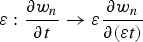 ${\rm \varepsilon}\colon {\partial w_n \over \partial t} \rightarrow {\rm \varepsilon} {\partial w_n \over \partial \lpar {\rm \varepsilon} t\rpar }$. One of the procedures for solving this equation is to expand w n and
 $\bar{H}_n$ as power series in ɛ.
 $$w_n = \sum\limits_{k = 0}^{\infty} {\rm \varepsilon}^k w_{nk}\comma \;$$
and equate the like powers of ɛ. This gives a chain of equations which can be solved successively for  $w_{n0\comma } w_{n1 \cdots\dots} $. At each step in the chain, a corresponding
 $\bar{H}_{nk} $ is chosen to eliminate the secular term in the fast variable ξ. The method is equivalent to other methods of carrying out the averaging. It is systematic in that it automatically separates the fast and slow variables by order ɛ, thus allowing an average over the fast variable in any order to eliminate the secular terms.
7. ANNEXURE 2: CALCULATION OF HIGHER ORDERS OF ADIABATIC INVARIANCE
Derivation of Generators of canonical transformation: In this section, explicit calculations for deriving the generator of canonical transformation to second order is presented. The generators are derived using the previously described Lie transformation method, which is based on Deprit (Boccaletti & Pucacco, Reference Boccaletti and Pucacco2002; Cary, Reference Cary1981; Dragt & Finn, Reference Dragt and Finn1976; Deprit, Reference Deprit1969; Kominis, Reference Kominis2008; Lichtenberg et al., Reference Lichtenber and Liebermann1983) series method. The canonical transformation of the variables is brought about by these generators. As a starting point for the calculations we consider the Hamiltonian derived in Section 2 for driving these generators,
 $$H^{\prime} = \Delta - {\rm \varepsilon} \int \left[{\partial \lpar {\rm \alpha} - A\lpar {\rm \varepsilon} x\comma \; {\rm \xi} \rpar ^2 \over 2\Delta \partial \lpar {\rm \varepsilon} x\rpar } \right]d {\rm \xi}.$$
In the present case, Θ (δξ) = sech(δξ), P(ξ) = sin(ξ) and for simplicity we set α = 0.
Zeroth – Order: In zeroth order the perturbation equation is given by
 $$\bar H_0 = H_0 = \bar{\Delta}.$$
First Order: First order correction to second order(ɛ2) Hamiltonian corresponding to fast motion is given by,
 $$w_1 = w_{10} + {\rm \varepsilon} w_{11}.$$
Using the first order perturbation equation,
 $${\partial w_1 \over \partial t} + L_1 H_o = \lpar \bar{H}_1 - H_1\rpar .$$
As there is no explicit dependence on time, the first term on the left-hand side is zero. Hence, re-writing the equation with H 0 = Δ = Γ − p x. Substituting the value of transformed unperturbed Hamiltonian H 0 from Eq. (5) in the following equation and solving with Δ and (t − x) as independent variables,
 $$\eqalign{&\left({\partial w_{10} \over \partial {\rm \xi}} {\partial H_0 \over \partial \Delta} - {\partial w_{10} \over \partial \Delta} {\partial H_0 \over \partial {\rm \xi}} \right)+{\rm \varepsilon} \left({\partial w_{11} \over \partial {\rm \xi}} {\partial H_0 \over \partial \Delta} - {\partial w_{11} \over \partial \Delta} {\partial H_0 \over \partial {\rm \xi}} \right)\cr &\quad+ {\rm \varepsilon} \left({\partial w_{10} \over \partial \lpar {\rm \varepsilon} x\rpar } {\partial H_0 \over \partial p_x} - {\partial w_{10} \over \partial p_x} {\partial H_0 \over \partial \lpar {\rm \varepsilon} x\rpar }\right)= \left(\bar{H}_{10} + {\rm \varepsilon} \bar{H}_{11} - H_1 \right).}$$
Separating in the powers of ɛ as
 $$\eqalign{{\partial w_{10} \over \partial {\rm \xi}} &= \bar{H}_{10} + \int {a^{\prime} a\Theta \lpar {\rm \delta} {\rm \xi} \rpar ^2 \over 2\Delta} d{\rm \xi} - \int {a^{\prime} a\Theta \lpar {\rm \delta} {\rm \xi}\rpar ^2 cos \lpar 2{\rm \xi} \rpar d{\rm \xi} \over 2\Delta}\comma \; \cr {\partial w_{11} \over \partial {\rm \xi}} &= \bar{H}_{11} + {\partial w_{10} \over \partial \lpar {\rm \varepsilon} x\rpar }.}$$
These equations can be solved by removing the secular part by equating it to arbitrary constant  $\bar{H}_{10}$ and setting it to zero. In the absence of second order secular term in the Hamiltonian the arbitrary constant
 $\bar{H}_{11} = 0$ is set equal to zero. While considering fast motion for δ << 1 we can write
 $$\int {a^{\prime} a\Theta \lpar {\rm \delta} {\rm \xi} \rpar ^2 cos\lpar 2{\rm \xi} \rpar d{\rm \xi} \over 2\Delta} \approx {a^{\prime} a\Theta \lpar {\rm \delta} {\rm \xi}\rpar ^2 \over 2\Delta} {sin\lpar 2{\rm \xi} \rpar \over 2}\comma \;$$
thus we have
 $$w_1 ={a^{\prime} a\Theta \lpar {\rm \delta} {\rm \xi}\rpar ^2 \over 2\Delta} {cos\lpar 2{\rm \xi}\rpar \over 4} + {\rm \varepsilon} {\lpar a^{\prime 2} + a^{\prime \prime} a\rpar \Theta \lpar {\rm \delta} {\rm \xi} \rpar ^2 \over 2\Delta} {sin\lpar 2{\rm \xi}\rpar \over 8}\comma \;$$
 $$\bar{H} = \bar{H}_0 + {\rm \varepsilon} \bar H_1\comma \;$$
 $$\bar{H} = \bar{\Delta} - \int {a^{\prime} a\Theta \lpar {\rm \delta} {\rm \xi} \rpar ^2 d{\rm \xi} \over 2\bar{\Delta}}.$$
Second – Order: For second order w 2 the perturbation equation is given by,
 $${\partial w_2 \over \partial t} + L_2 H_o = 2\lpar \bar{H}_2 - H_2 \rpar - L_1 [ \bar{H}_1 + H_1\rsqb \comma \;$$
second order require only w 2 = w 20, for the present case H 2 = 0. Re-writing the above equation we have
 $$[ w_{20}\comma \; H_0 \rsqb = 2\bar{H}_2 - [ w_{10}\comma \; \lpar \bar{H}_1 + H_1\rpar \rsqb \comma \;$$
re-writing it we have,
 $$\eqalign{&\left({\partial w_{20} \over \partial {\rm \xi}} {\partial H_0 \over \partial \Delta} - {\partial w_{20} \over \partial \Delta} {\partial H_0\rpar \over \partial {\rm \xi}} \right)= 2\bar{H}_{20} \cr &\quad - \left({\partial w_{10} \over \partial {\rm \xi}} {\partial \lpar \bar{H}_1 + H_1\rpar \over \partial \Delta} - c\partial w_{10} \partial \Delta {\partial \lpar \bar{H}_1 + H_1\rpar \over \partial {\rm \xi}} \right)\comma \; }$$
on calculating various terms of the Poisson of the brackets we have,
 $$\eqalign{{\partial \lpar 2\bar{H}_1 + \lcub H_1 \rcub \rpar \over \partial {\rm \xi}} &= {a^{\prime} a\Theta^2 \lpar {\rm \delta} {\rm \xi}\rpar \over 2\Delta} cos \lpar 2{\rm \xi}\rpar \comma \; \cr {\partial \lpar 2\bar{H}_1 + \lcub H_1 \rcub \rpar \over \partial \Delta} &= \;\int {a^{\prime} a\Theta \lpar {\rm \delta} {\rm \xi} \rpar ^2 d{\rm \xi} \over \Delta^2} - {a^{\prime} a\Theta \lpar {\rm \delta} {\rm \xi} \rpar ^2 \over 4\Delta^2} sin\lpar 2{\rm \xi}\rpar .}$$
Here the terms inside the curly bracket signify fast terms and on substituting the various terms,
 $$\eqalign{{\partial w_{20} \over \partial {\rm \xi}} &= 2\bar{H}_{20} - {\lpar a^{\prime} a\rpar ^2 \Theta \lpar {\rm \delta} {\rm \xi} \rpar ^4 \over 16\Delta^3} + {a^{\prime} a\Theta ^2 \lpar {\rm \delta} {\rm \xi}\rpar \over 4\Delta} sin\lpar 2{\rm \xi} \rpar \cr &\quad \times \int {a^{\prime} a\Theta^2 \lpar {\rm \delta} {\rm \xi}\rpar d{\rm \xi} \over \Delta^2}.}$$
The secular term can be removed by equating it to arbitrary constant
 $$2\bar{H}_{20} - {\lpar a^{\prime} a\rpar ^2 \Theta \lpar {\rm \delta} {\rm \xi} \rpar ^4 \over 16\Delta ^3} = 0.$$
Thus second order generator is given as,
 $$\eqalign{w_{20} &= - {a^{\prime} a\Theta^2 \lpar {\rm \delta} {\rm \xi}\rpar \over 8\Delta} cos \lpar 2{\rm \xi} \rpar \int {a^{\prime} a\Theta \lpar {\rm \delta} {\rm \xi}\rpar ^2 d{\rm \xi} \over \Delta ^2}\cr &\quad + {\lpar a^{\prime} a\rpar ^2 \Theta^4 \lpar {\rm \delta} {\rm \xi}\rpar \over 16\Delta^3} sin \lpar 2{\rm \xi}\rpar .}$$
Thus we have the averaged and the oscillatory Hamiltonian to second order given by,
 $$\bar{H} = \bar{\Delta} - {\rm \varepsilon} \int {a^{\prime} a\Theta ^2 \lpar {\rm \delta} \bar{{\rm \xi}}\rpar \over 2\bar{\Delta}} d\bar{{\rm \xi}} + {\lpar a^{\prime} a\rpar ^2 \Theta^4 \lpar {\rm \delta} \bar{{\rm \xi}}\rpar \over 32\Delta^3}.$$
The generator of the canonical transformation to second order is given by,
 $$w = w_{10} + {\rm \varepsilon} w_{11} + {\rm \varepsilon} w_{20}\comma \;$$
 $$\eqalign{w &= {a^{\prime} a\Theta^2 \lpar {\rm \delta} {\rm \xi}\rpar \over 8\Delta} cos\lpar 2{\rm \xi}\rpar + {\rm \varepsilon} {\lpar a^{\prime 2} + a^{\prime \prime} a\rpar \Theta^2 \lpar {\rm \delta} {\rm \xi}\rpar \over 16\Delta} sin\lpar 2{\rm \xi} \rpar \comma \; \cr &\quad - {\rm \varepsilon} {a^{\prime} a\Theta^2 \lpar {\rm \delta} {\rm \xi}\rpar \over 8\Delta} cos2 {\rm \xi} \int {a^{\prime} a\Theta ^2 \lpar {\rm \delta} {\rm \xi}\rpar d {\rm \xi} \over \Delta^2} \cr &\quad + {\lpar a^{\prime} a\rpar ^2 \Theta^4 \lpar {\rm \delta} {\rm \xi}\rpar \rpar \over 16\Delta^3} sin\lpar 2{\rm \xi} \rpar .}$$
ACKNOWLEDGEMENTS
Vikram Sagar would like to acknowledge Dr. Pintu and friends for their support, Dr. S.K. Mishra for improving the manuscript, and Aditya for sharing his computational resources.



