Exposure to child maltreatment greatly increases the risk for psychopathology in childhood and adulthood (Kim & Cicchetti, Reference Kim and Cicchetti2010; McLaughlin et al., Reference McLaughlin, Green, Gruber, Sampson, Zaslavsky and Kessler2010). Specifically, as many as 80% of young adults exposed to maltreatment in childhood meet diagnostic criteria for at least one psychiatric disorder at age 21 (Silverman, Reinherz, & Giaconia, Reference Silverman, Reinherz and Giaconia1996). The magnitude and longevity of these consequences have led researchers to direct considerable attention toward identifying the mechanisms that play pivotal roles in the effects. Of particular interest to clinicians are malleable mechanisms that could serve as targets for interventions. One such mechanism that is malleable (Chambers, Gullone, & Allen, Reference Chambers, Gullone and Allen2009; Collins, Woolfson, & Durkin, Reference Collins, Woolfson and Durkin2014) and linked with both psychopathology (Cline et al., Reference Cline, Belsky, Li, Melhuish, Lysenko, McFarquhar and Jaffee2015; D'Avanzato, Joormann, Siemer, & Gotlib, Reference D'Avanzato, Joormann, Siemer and Gotlib2013; Silk, Steinberg, & Morris, Reference Silk, Steinberg and Morris2003; Sontag & Graber, Reference Sontag and Graber2010) and maltreatment exposure (Cicchetti & Rogosch, Reference Cicchetti and Rogosch2009; Kim & Cicchetti, Reference Kim and Cicchetti2010; Maughan & Cicchetti, Reference Maughan and Cicchetti2002; Milojevich, Levine, Cathcart, & Quas, Reference Milojevich, Levine, Cathcart and Quas2018; Perlman, Dawson, Dardis, Egan, & Anderson, Reference Perlman, Dawson, Dardis, Egan and Anderson2016; Romens & Pollak, Reference Romens and Pollak2012; Shields & Cicchetti, Reference Shields and Cicchetti1998) is emotion regulation. Traditionally, emotion regulation has been defined as the “internal and external processes involved in initiating, maintaining, and modulating the occurrence, intensity, and expression of emotions” (Thompson, Reference Thompson1994, p. 27). Adults and children implement specific regulation strategies to alter or modulate their emotional state that can be measured through observation or self-report.
Of note, in the present report we focus on emotion regulation strategies and their links to child maltreatment and psychopathology; however, where relevant, we also refer to findings from the coping literature. Coping is defined as the cognitive and behavioral efforts to manage specific emotional demands that are appraised as taxing or exceeding the resources of that person (e.g., Lazarus & Folkman, Reference Lazarus and Folkman1984). As such, coping efforts by an individual can be considered to fall under the broader definition of emotion regulation (Garnefski, Kraaij, & Spinhoven, Reference Garnefski, Kraaij and Spinhoven2001), and measures of coping, such as the one utilized in the present study, have been included in investigations of emotion regulation (Aldao & Nolen-Hoeksema, Reference Aldao and Nolen-Hoeksema2012; Aldao, Nolen-Hoeksema, & Schweizer, Reference Aldao, Nolen-Hoeksema and Schweizer2010). Moreover, specific regulation or coping strategies are generally utilized with the goal of adaptive behavior; however, when strategies are employed in a manner that interferes with adaptive goal-oriented behavior, it is considered emotion dysregulation—a defining risk factor for psychopathology (Beauchaine, Reference Beauchaine2015; Cole, Hall, & Hajal, Reference Cole, Hall, Hajal, Beauchaine and Hinshaw2017).
To date, most studies on emotion regulation in the face of child maltreatment have combined children into a single maltreatment group and compared their functioning to nonmaltreated controls. As such, it is unclear how exposure to the different forms of maltreatment (e.g., physical abuse vs. neglect) differentially predict regulation tendencies. Recently, Sheridan and McLaughlin (Reference Sheridan and McLaughlin2014) have proposed an alternative, novel conceptual framework, termed the Dimensional Model of Adversity and Psychopathology (DMAP), for studying the effects of early adversity exposure. The central distinction they make is between experiences of deprivation and threat. Specifically, they suggest that, although exposure to deprivation (operationalized here as exposure to neglect) and threat (operationalized here as exposure to physical and/or sexual abuse) likely co-occur (McLaughlin et al., Reference McLaughlin, Green, Gruber, Sampson, Zaslavsky and Kessler2012), these dimensions can be measured separately and have unique effects on developmental outcomes (Sheridan, Peverill, Finn, & McLaughlin, Reference Sheridan, Peverill, Finn and McLaughlin2017). Within DMAP, deprivation refers to the absence of species- or age-expectant cognitive and social inputs (Sheridan & McLaughlin, Reference Sheridan and McLaughlin2014, Reference Sheridan and McLaughlin2016). Exposure to deprivation is conceptualized as reductions in species-expected social and cognitive inputs, generally through a lack of interaction, or a lack of scaffolding by primary caregivers. This lack of early learning experiences leads to reduced abilities to perform complex cognitive functions, including social problem solving in the future. Exposure to threat, in contrast, involves the presence of atypical learning experiences around traumatic violence. These early learning experiences lead to changes in neural circuits that underlie emotion reactivity and regulation, resulting in enhanced reactivity to negative affective stimuli. Evidence suggests that, in models where both exposures are simultaneously introduced, exposure to threat is selectively associated with increased emotion reactivity, deficits in automatic emotion regulation processes, and disrupted fear learning, while exposure to deprivation is selectively linked to poor cognitive control, working memory, and language ability (Lambert, King, Monahan, & McLaughlin, Reference Lambert, King, Monahan and McLaughlin2017; McLaughlin et al., Reference McLaughlin, Sheridan, Gold, Duys, Lambert, Peverill and Pine2016; Miller et al., Reference Miller, Sheridan, Hanson, McLaughlin, Bates, Lansford and Dodge2018; Sheridan et al., Reference Sheridan, Peverill, Finn and McLaughlin2017). In the present study we extend the deprivation and threat predictions to examine regulation strategies as potential emotion-focused mediators linking exposure to abuse and neglect early in life to symptoms of psychopathology in adolescence. As such, the present study provides insight into the nature of maltreated children's emotion dysregulation by pinpointing the types of regulation strategies that differ by exposure to deprivation and threat and indicating whether these strategies confer risk for psychopathology in adolescence.
The present study contributes to what is known about the development of emotion dysregulation and its links to psychopathology in three ways. First, the roles of threat and deprivation in early childhood as unique predictors of adolescents’ subsequent use of regulation strategies are documented within a large, diverse sample of high-risk youth. Specifically, the study includes a sample of children who had been maltreated or were at risk of maltreatment. These children were recruited when they were 4 years old or younger and followed longitudinally into adolescence. As such, the present study allows for an examination of how exposure to maltreatment experienced prior to age 6 predicts emotion dysregulation in adolescence. Second, in-depth assessments of the parenting and home environment obtained via multiple sources (child report, parent report, and official case files) are integrated to more comprehensively characterize early abuse and neglect exposure. Third, the present study expands on the mediational pathways initially proposed and tested in DMAP (Busso, McLaughlin, & Sheridan, Reference Busso, McLaughlin and Sheridan2017; Miller et al., Reference Miller, Sheridan, Hanson, McLaughlin, Bates, Lansford and Dodge2018; Sheridan & McLaughlin, Reference Sheridan and McLaughlin2014) by testing specific regulation strategies as potential mediators linking exposure to maltreatment to subsequent psychopathology.
Emotion Dysregulation and Psychopathology
Across both the emotion regulation and coping literatures, specific strategies have been consistently linked to a range of mental health outcomes (Aldao et al., Reference Aldao, Nolen-Hoeksema and Schweizer2010; Compas et al., Reference Compas, Jaser, Bettis, Watson, Gruhn, Dunbar and Thigpen2017; Gross, Reference Gross2014). For example, strategies such as problem solving and seeking social support are predictive of improved functioning (i.e., fewer problems) across childhood and adolescence (Aldao et al., Reference Aldao, Nolen-Hoeksema and Schweizer2010; Compas et al., Reference Compas, Jaser, Bettis, Watson, Gruhn, Dunbar and Thigpen2017; Downey, Johnston, Hansen, Birney, & Stough, Reference Downey, Johnston, Hansen, Birney and Stough2010; Machmutow, Perren, Sticca, & Alsaker, Reference Machmutow, Perren, Sticca and Alsaker2012). In contrast, disengagement strategies, particularly avoidance, have been repeatedly and strongly associated with poor mental health outcomes and increased risk for psychopathology (Aldao et al., Reference Aldao, Nolen-Hoeksema and Schweizer2010; Aldao, Jazaieri, Goldin, & Gross, Reference Aldao, Jazaieri, Goldin and Gross2014; Aldao & Nolen-Hoeksema, Reference Aldao and Nolen-Hoeksema2010; Cisler, Olatunji, Feldner, & Forsyth, Reference Cisler, Olatunji, Feldner and Forsyth2010; Compas et al., Reference Compas, Jaser, Bettis, Watson, Gruhn, Dunbar and Thigpen2017; Gross, Reference Gross2014; Schäfer, Naumann, Holmes, Tuschen-Caffier, & Samson, Reference Schäfer, Naumann, Holmes, Tuschen-Caffier and Samson2017; Silk et al., Reference Silk, Steinberg and Morris2003; Sontag & Graber, Reference Sontag and Graber2010).
In children, for example, more frequent use of avoidance has been linked to greater psychopathology (Coyne & Thompson, Reference Coyne and Thompson2011; Horwitz, Hill, & King, Reference Horwitz, Hill and King2011; Silk et al., Reference Silk, Steinberg and Morris2003). This association seems to be particularly strong later in development, specifically during adolescence. Avoidance, as well as other disengagement strategies, in adolescents is associated with greater substance use (McConnell, Memetovic, & Richardson, Reference McConnell, Memetovic and Richardson2014), more internalizing and externalizing symptoms (Compas et al., Reference Compas, Jaser, Bettis, Watson, Gruhn, Dunbar and Thigpen2017; Cisler et al., Reference Cisler, Olatunji, Feldner and Forsyth2010; Schäfer et al., Reference Schäfer, Naumann, Holmes, Tuschen-Caffier and Samson2017), and elevated aggression (Sontag & Graber, Reference Sontag and Graber2010). Even more striking, in a recent meta-analysis (Compas et al., Reference Compas, Jaser, Bettis, Watson, Gruhn, Dunbar and Thigpen2017), only avoidance and other forms of disengagement predicted psychopathology over time. Overall, these findings suggest that avoidance may be a particularly robust predictor of psychopathology, especially with regard to internalizing symptoms.
Maltreatment and Adolescent Emotion Dysregulation
A number of studies have documented evidence that maltreatment during childhood is linked to emotion dysregulation (Flannery, Singer, Williams, & Castro, Reference Flannery, Singer, Williams and Castro1998; Flett, Druckman, Hewitt, & Wekerle, Reference Flett, Druckman, Hewitt and Wekerle2012; Maughan & Cicchetti, Reference Maughan and Cicchetti2002; Milojevich et al., Reference Milojevich, Levine, Cathcart and Quas2018; O'Mahen, Karl, Moberly, & Fedock, Reference O'Mahen, Karl, Moberly and Fedock2015; Perlman et al., Reference Perlman, Dawson, Dardis, Egan and Anderson2016; Romens & Pollak, Reference Romens and Pollak2012; Shields & Cicchetti, Reference Shields and Cicchetti1998; Shields, Ryan, & Cicchetti, Reference Shields, Ryan and Cicchetti2001; Thabet, Tischler, & Vostanis, Reference Thabet, Tischler and Vostanis2004), which in turn increases risk for psychopathology (Burns, Jackson, & Harding, Reference Burns, Jackson and Harding2010; Kim & Cicchetti, Reference Kim and Cicchetti2010; Kim-Spoon, Cicchetti, & Rogosch, Reference Kim-Spoon, Cicchetti and Rogosch2013; Messman-Moore & Bhuptani, Reference Messman-Moore and Bhuptani2017; Peh et al., Reference Peh, Shahwan, Fauziana, Mahesh, Sambasivam, Zhang and Subramaniam2017). Some studies indicate that maltreated adolescents tend to utilize disengagement strategies such as avoidance or escape more so than nonmaltreated youth (Arslan, Reference Arslan2017; Milojevich et al., Reference Milojevich, Levine, Cathcart and Quas2018). Other studies have found that maltreated individuals tend to have more global deficits in regulation and coping (Filipas & Ullman, Reference Filipas and Ullman2006), while still others indicate that maltreatment is related to more emotion-focused (e.g., self-blame) regulation (Hager & Runtz, Reference Hager and Runtz2012). Of particular importance, as mentioned, these studies tend to combine individuals into a single maltreatment group and compare their functioning to that of nonmaltreated controls. As such, it is unclear how exposure to the different forms of maltreatment (e.g., physical abuse vs. neglect) differentially predict emotion dysregulation. However, in a community sample of pregnant women, exposure to emotional abuse versus neglect differentially predicted women's regulation strategy use (O'Mahen et al., Reference O'Mahen, Karl, Moberly and Fedock2015). Specifically, emotional abuse was associated with rumination (a form of cognitive avoidance), while emotional neglect predicted the use of behavioral avoidance. Both strategies were associated with greater depression. Moreover, findings with children exposed to other forms of threat (e.g., domestic violence and community violence) indicate that these children exhibit emotion dysregulation, often in the form of greater use of avoidant strategies (Holt, Buckley, & Whelan, Reference Holt, Buckley and Whelan2008; Rosario, Salzinger, Feldman, & Ng-Mak, Reference Rosario, Salzinger, Feldman and Ng-Mak2003; Schwartz & Proctor, Reference Schwartz and Proctor2000; Street, Gibson, & Holohan, Reference Street, Gibson and Holohan2005). This work suggests that exposure to early and severe forms of threat may have long-term consequences on adolescents’ regulation skills, particularly their use of avoidant strategies (e.g., Milojevich et al., Reference Milojevich, Levine, Cathcart and Quas2018).
While neglect is commonly included in the above described studies of maltreatment, findings on the links between exposure to neglect alone, or other forms of deprivation, and emotion dysregulation are considerably less common. One study that we are aware of specifically tested the association between neglect (outside of other forms of maltreatment) and children's emotion regulation and understanding. This study found that, compared to nonneglected peers, neglected children tend to inhibit the expression of negative emotions (Shipman, Edwards, Brown, Swisher, & Jennings, Reference Shipman, Edwards, Brown, Swisher and Jennings2005).
Although findings differentiating between the roles of abuse and neglect in predicting regulation strategy are rare, there is evidence to suggest that these forms of maltreatment impact emotional functioning differently (e.g., Pollak, Cicchetti, Hornoung, & Reed, Reference Pollak, Cicchetti, Hornung and Reed2000; Warmingham, Handley, Rogosch, Manly, & Cicchetti, Reference Warmingham, Handley, Rogosch, Manly and Cicchetti2018). For example, physically abused children tend to recognize and react more quickly to emotional expressions of anger, while neglected children demonstrate more global deficits in emotion recognition (Pollak et al., Reference Pollak, Cicchetti, Hornung and Reed2000). These differential impacts support the possibility that abuse and neglect will be differentially associated with regulation strategies as well.
Exposure to Threat, Emotion Dysregulation, and Psychopathology
Within DMAP, several mediational pathways have been explored to explain the consistent link between early adversity exposure and subsequent psychopathology. DMAP proposes that experiences of deprivation will result in deficits in cognitive control, at least in part due to synaptic pruning in the prefrontal cortex. Neglect is one form of deprivation, which is characterized by a reduction in species-expected early inputs, such as cognitive and social stimulation. Hypothetically, this reduction in these inputs in early life may lead to accelerated pruning of synapses in cortical regions implicated in cognitive control similar to the way in which elimination of visual input in early life in rodents and humans leads to reductions in synapses in primary visual cortex measurable as cortical thinning (Leporé et al., Reference Leporé, Voss, Lepore, Chou, Fortin, Gougoux and Toga2010; O'Kusky, Reference O'Kusky1985). Children exposed to extreme deprivation, such as institutionalization, demonstrate global deficits in executive functioning leading to increases in psychopathology (Bos, Fox, Zeanah, & Nelson, Reference Bos, Fox, Zeanah and Nelson2009; Tibu et al., Reference Tibu, Sheridan, McLaughlin, Nelson, Fox and Zeanah2016). Children exposed to less extreme forms of deprivation, such as reductions in cognitive and social stimulation related to poverty, also demonstrate reductions in executive function, complex learning, and language ability leading to increases in psychopathology (Miller et al., Reference Miller, Sheridan, Hanson, McLaughlin, Bates, Lansford and Dodge2018; Rosen, Sheridan, Sambrook, Meltzoff, & McLaughlin, Reference Rosen, Sheridan, Sambrook, Meltzoff and McLaughlin2018; Sarsour et al., Reference Sarsour, Sheridan, Jutte, Nuru-Jeter, Hinshaw and Boyce2011; Sheridan, Sarsour, Jutte, D'Esposito, & Boyce, Reference Sheridan, Sarsour, Jutte, D'Esposito and Boyce2012).
In contrast to the deprivation pathway, exposure to threat in early childhood creates long-term changes in neural circuits that underlie reactivity to, regulation of, and associative learning about threatening stimuli because children are exposed to an excess of learning opportunities about threat. Behaviorally, these changes result in heightened attention to threat-related cues, generalization of learned fear to previously neutral stimuli, and elevated emotional reactivity to a wide range of emotional cues, which are predictive of greater internalizing and externalizing symptomatology (Busso, McLaughlin, Brueck, et al., Reference Busso, McLaughlin, Brueck, Peverill, Gold and Sheridan2017; Lambert et al., Reference Lambert, King, Monahan and McLaughlin2017; McLaughlin, Peverill, Gold, Alves, & Sheridan, Reference McLaughlin, Peverill, Gold, Alves and Sheridan2015; McLaughlin et al., Reference McLaughlin, Sheridan, Gold, Duys, Lambert, Peverill and Pine2016; Miller et al., Reference Miller, Sheridan, Hanson, McLaughlin, Bates, Lansford and Dodge2018).
The present study serves as an expansion by investigating the mediational role of emotion dysregulation postadversity exposure. Given the heightened emotional responses to threatening stimuli and the overall reduction in control experienced in the case of abuse, children exposed to threat may learn to disengage or avoid emotionally negative situations, a potentially adaptive response in high-threat contexts, as a means of protecting themselves from further harm (Pollak, Messner, Kistler, & Cohn, Reference Pollak, Messner, Kistler and Cohn2009). However, prolonged avoidance is associated with increases in intrusive thoughts, greater emotional distress, and overall increases in psychopathology symptoms (Aldao et al., Reference Aldao, Nolen-Hoeksema and Schweizer2010, Reference Aldao, Jazaieri, Goldin and Gross2014; Aldao & Nolen-Hoeksema, Reference Aldao and Nolen-Hoeksema2010; Cisler et al., Reference Cisler, Olatunji, Feldner and Forsyth2010; Compas et al., Reference Compas, Jaser, Bettis, Watson, Gruhn, Dunbar and Thigpen2017; Gross, Reference Gross2014; Schäfer et al., Reference Schäfer, Naumann, Holmes, Tuschen-Caffier and Samson2017; Seiffge-Krenke & Klessinger, Reference Seiffge-Krenke and Klessinger2000; Silk et al., Reference Silk, Steinberg and Morris2003; Sontag & Graber, Reference Sontag and Graber2010). In contrast, children exposed to deprivation, as in the case of neglect, may not witness normative emotional displays by their parents (Shipman et al., Reference Shipman, Edwards, Brown, Swisher and Jennings2005) and, as such, may fail to learn how to identify and differentiate among emotions and thus appropriate strategies for regulating. These children may, therefore, demonstrate more general emotion dysregulation rather than specific differences in strategy use. The goal of the current study is to test these possibilities. Specifically, we first hypothesized that greater levels of threat (i.e., abuse) would be selectively associated with an increased use of avoidant strategies, while deprivation (i.e., neglect) would selectively predict poorer total regulation. Second, we hypothesized that emotion dysregulation, such as greater avoidance, would mediate the association between maltreatment exposure and psychopathology, particularly internalizing symptomatology (Aldao et al., Reference Aldao, Nolen-Hoeksema and Schweizer2010, Reference Aldao, Jazaieri, Goldin and Gross2014; Aldao & Nolen-Hoeksema, Reference Aldao and Nolen-Hoeksema2010; Compas et al., Reference Compas, Jaser, Bettis, Watson, Gruhn, Dunbar and Thigpen2017; Connor-Smith & Compas, Reference Connor-Smith and Compas2004).
Method
A detailed description of the methods used in the Longitudinal Studies on Child Abuse and Neglect (LONGSCAN) has been presented elsewhere (Runyan et al., Reference Runyan, Curtis, Hunter, Black, Kotch, Bangdiwala and Landsverk1998). With the exceptions of elements unique to the current analyses, only a brief description of the sample and methods is given.
Sample, design, and procedures
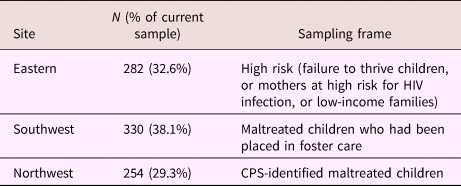
LONGSCAN is a consortium of studies operating under common protocols, located at five sites in different regions of the United States: South, East, Midwest, Northwest, and Southwest. The current analysis is based on pooled data from three of these studies (East, Northwest, and Southwest). Data from the South and Midwest were not included as these sites did not administer the regulation measure at age 18. At each of the included sites, a sample of children who had been maltreated or were at risk of maltreatment was recruited when children were 4 years old or younger. The sampling frame used at each site is described in Table 1. Assessments of children and caregivers were conducted at ages 4, 6, 8, 12, 14, 16, and 18. Brief questionnaire packets were mailed to children's teachers to assess functioning in other domains. The analyses reported here focus on data collected at ages 4, 6, 8, 16, and 18. In the present study, for ages 4 and 6, all 866 participants were interviewed; 727 of the participants (83.9%) were reassessed at age 8; 516 (59.6%) at age 16; and 601 (69.3%) at age 18.
Description of the sampling at each LONGSCAN site

Note: CPS, Child Protective Services.
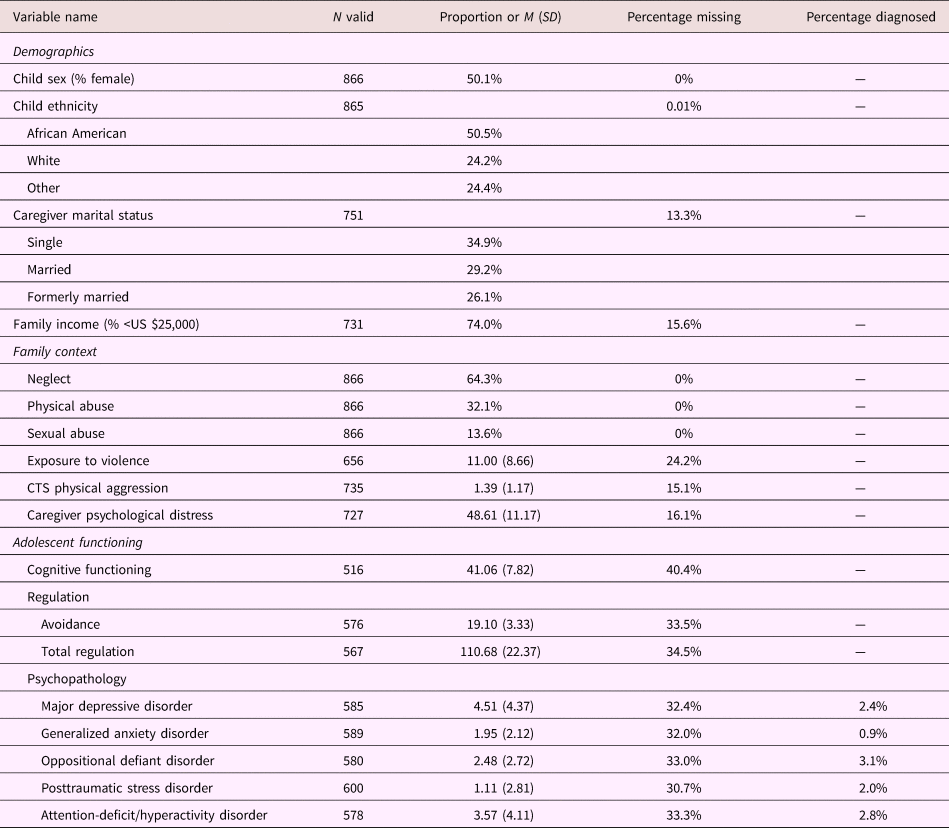
With the approval of each site's institutional review board, a protocol of common measures and procedures was implemented across sites. Informed consent was obtained from caregivers. Children and caregivers participated separately in interviews administered by trained interviewers that included measures of demographics, parental and family functioning, life events and other contextual variables, and child functioning. Families were compensated financially for their participation. Overall, the total sample size for the current study was 866. Table 2 presents descriptive data on the sample, the number of cases that had valid data for each variable, and percentage missing. The sample was almost equally split between boys and girls. A little more than half of the children were African American and about a fourth were White. Roughly three-fourths of the sample had annual family incomes less than US $25,000. Thus, children in the study were more likely to be poor and less likely to be White than children in the general population.
Descriptive statistics for the sample

Measures
Adolescent regulation
The 54-item Adolescent Coping Orientation for Problem Experiences (ACOPE; Patterson & McCubbin, Reference Patterson and McCubbin1987) was administered at the age 18 visit to assess adolescents’ self-reported coping strategies. Using a 5-point Likert scale (1 = never, 5 = most of the time), adolescents were instructed to record how often they utilized each behavior in answer to the question, “When you face difficulties or feel tense, how often do you … .” Responses were averaged to create separate mean scores for 12 strategies of regulation: ventilating feelings, seeking diversions, developing self-reliance and optimism, developing social support, solving family problems, avoiding problems, seeking spiritual support, investing in close friends, seeking professional support, engaging in demanding activity, being humorous, and relaxing. Higher scores indicate the use of more positive regulation strategies, except for avoidance in which case higher scores indicate poorer regulation. Three of the scales (ventilating feelings, seeking professional support, and relaxing) had poor reliability in the current sample (αs < 0.50) and were therefore excluded from the analyses. The remaining scores were further summed (avoidance excluded) to create a total regulation score (individual strategy scores were significantly correlated; rs > .20, ps < .001). The avoidance subscale was excluded from the total score given our interest in examining avoidance, and its links to maltreatment and psychopathology, separately. The ACOPE has high internal consistency and test–retest reliability (McCubbin, Thompson, & McCubbin, Reference McCubbin, Thompson and McCubbin2001; α = 0.81 and 0.89, for avoidance and total regulation respectively, in current sample).
Threat
Early exposure to threat was assessed via four separate measures. First, investigators at the three sites reviewed Child Protective Services (CPS) data to determine the presence and nature of allegations of physical and sexual abuse that occurred before the target child was age 6 years. Coders at each site were trained to use the Modified Maltreatment Classification System (MMCS; a LONGSCAN modified version of Barnett, Manly, & Cicchetti, Reference Barnett, Manly and Cicchetti1993) by experienced coders until they reached 90% agreement with the gold standard. Second, to further ensure reliable coding, coders at all sites coded a subsample (n = 109) of the CPS narratives that represented cases from each site. Kappas for MMCS codes by LONGSCAN coders were high (ranging from .73 to .87; English & LONGSCAN Investigators, Reference English1997). Reviews of CPS data were used to determine the presence and nature of allegations of (a) physical abuse and (b) sexual abuse on children in their samples. Children were assigned a dichotomous code, based on whether abuse allegations had occurred, and differentiated by type (physical vs. sexual) using the MMCS.
Third, an expanded version of the child-report Things I Have Seen and Heard scale (Richters & Martinez, Reference Richters and Martinez1992) was administered at the age 6 visit to assess exposure to violence and feelings of safety at home, at school, and in the community. Things I Have Seen and Heard has high test–retest reliability and good validity (Richters & Martinez, Reference Richters and Martinez1992; α = 0.74 in current sample). The LONGSCAN version used in the current study added five items to include violence witnessed in the home. Children were asked to endorse the frequency of each item using a visual Likert-type scale.
Fourth, at the age 6 visit, the caregiver-report Conflict Tactics Scales: Caregiver-to-Child (Straus, Reference Straus1979) assessed the extent to which caregivers use reasoning and nonviolent discipline, verbal aggression, or physical aggression in response to their child's behavior. Participant responses are summed into three broad categories: nonviolent discipline, psychological aggression, and minor assault. For the current study, minor assault scores were used, with higher scores indicating greater physical threat to the child (α = 0.85 in current sample). Finally, we z-transformed and summed the four measures (CPS reports of physical and sexual abuse, Things I've Seen, and Conflict Tactics Scale) to create an overall threat exposure composite, with higher scores indicating greater exposure to threat.
Deprivation
Using the methods described above for threat, reviews of CPS data were utilized to determine the presence and nature of allegations of neglect. For the current analyses, neglect allegations were limited to those that occurred before the target child was age 6 years. The present study used a dichotomous indicator (i.e., 0 = not alleged, 1 = alleged) of neglect.
Psychopathology
Adolescent psychopathology was assessed at the age 18 visit via the National Institute of Mental Health Computerized Diagnostic Interview Schedule for Children (Young Adult DISC-IV; Shaffer, Fisher, Lucas, Dulcan, & Schwab-Stone, Reference Shaffer, Fisher, Lucas, Dulcan and Schwab-Stone2000). The DISC-IV included assessment for diagnostic status as well as for symptoms of each disorder that had occurred over the preceding year. This version of the DISC-IV assesses symptoms and diagnostic status is based on the DSM-IV-TR (Shaffer et al., Reference Shaffer, Fisher, Lucas, Dulcan and Schwab-Stone2000). The present study included symptom counts for major depressive disorder (MDD), generalized anxiety disorder, oppositional defiant disorder (ODD), posttraumatic stress disorder (PTSD), and attention-deficit/ hyperactivity disorder (ADHD).
Demographics
At the age 4 visit, a caregiver-report measure was developed by LONGSCAN including items that assess sociodemographic variables measured either at one time (i.e., child sex and race) or at each interview (i.e., number of dependents) to reflect changes in the home environment experienced by many of the children. Caregiver reports of family income from the age 4 visit were also included. For the purposes of the present study, income was recoded so that higher scores indicated lower incomes.
Cognitive functioning
The Wide Range Achievement Test (Wilkinson, Reference Wilkinson1993), administered at age 16, provided an assessment of adolescents’ basic academic skills. The present study utilized the standard age-based reading scores; higher scores were reflected of higher achievement.
Caregiver psychological distress
Caregiver psychological distress was assessed at the age 8 visit using the global severity index of the Brief Symptom Inventory (Derogatis & Spencer, Reference Derogatis and Spencer1993), a 53-item scale assessing psychological symptomatology that is valid and strongly related with other indices of psychological distress (Derogatis & Spencer, Reference Derogatis and Spencer1993). The global severity t score on the Brief Symptom Inventory was used in all relevant analyses.
Statistical analyses: Overview
Our analyses proceeded in three steps. First, we tested for bivariate associations between adolescents’ emotion regulation and childhood exposure to deprivation and threat, sex, race, caregiver psychological distress, income, and cognitive functioning. Second, we tested via multiple regression models whether the relation between child maltreatment and adolescents’ emotion regulation held after accounting for relevant demographic (e.g., sex) and other family factor (e.g., income) measures. Third, we estimated mediation models in a structural equation modeling framework to test whether the association between child maltreatment exposure at age 6 and adolescent psychopathology at age 18 was mediated by specific regulation strategies, while controlling for demographic and family factors. The statistical significance of the indirect and total effects in each model were assessed via bootstrapped confidence intervals (95%). All analyses were conducted in Mplus Version 8 (Muthén & Muthén, Reference Muthén and Muthén1998–2017) using maximum likelihood estimation. In all analyses missing data (see Table 2 for percentages) were handled through full information maximum likelihood procedure (Raykov, Reference Raykov2005), which performs equally well, and often better than multiple imputation techniques, with respect to correcting bias in estimates and recovering known population parameters (Schafer & Graham, Reference Schafer and Graham2002).
Results
Descriptive analyses
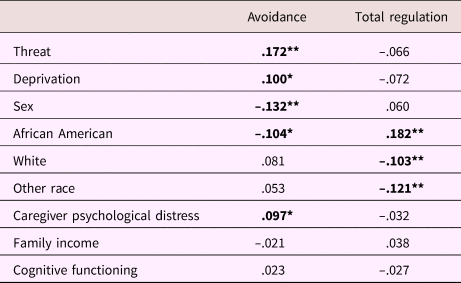
Correlations among potential predictor variables and adolescent regulation scores are presented in Table 3. Overall, greater threat and deprivation exposure, being male, being non-African American, and greater caregiver psychological distress were associated with greater use of avoidance. Moreover, being African American was associated with better total regulation, while being White or of another race was related to poorer total regulation. Of note, exposure to deprivation and threat were positively correlated (r = .089, p = .025).
Correlations among main predictor and adolescent regulation scores

Note: Sex: female = 2, male = 1; *p < .05. **p < .01.
Child maltreatment and adolescent emotion dysregulation
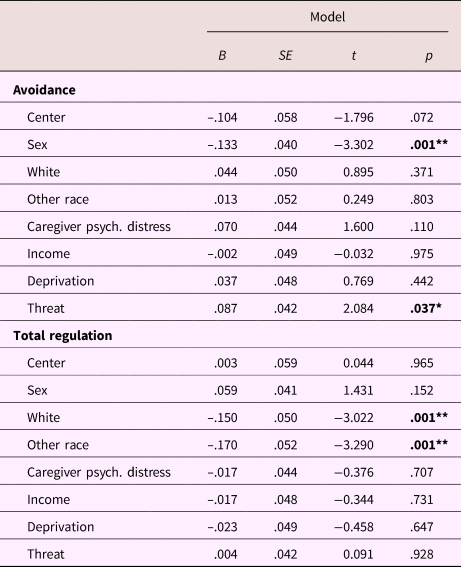
One of the primary goals of the present study was to examine whether specific forms of maltreatment exposure differentially predicted subsequent regulation strategy use in adolescents. In particular, we were interested in whether threat exposure predicted avoidant regulation and deprivation predicted total regulation. As illustrated in Table 4, when controlling for deprivation, demographic, and family factors, avoidant regulation differed significantly by exposure to threat, such that higher threat exposure was associated with more avoidance. In this model, we also observed that boys reported more avoidance than girls. For total regulation, race was a significant predictor, such that adolescents who were White or of another race reported poorer total regulation relative to African Americans, but no significant associations were found between total regulation and deprivation once controlling for threat and other family factors.
Regression results for adolescent regulation

Note: Sex: female = 2, male = 1; White (Yes = 1; No = 0); Other race (Yes = 1; No = 0); African American served as reference group. *p < .05. **p < .01.
Mediational pathways to adolescent psychopathology
We estimated mediation models in a structural equation modeling framework to examine the direct effect of threat and deprivation on adolescent psychopathology and the indirect effect(s) of threat and deprivation on adolescent psychopathology through the use of regulation strategies. Based on the regression results reported above, we focused the mediational analyses on exposure to threat as the predictor and on avoidance as the mediator. In all models, we continued to account for deprivation, demographic, and family factors. We analyzed separate mediational models predicting a range of internalizing (e.g., depression) and externalizing (e.g., oppositional defiant disorder) symptomatology. Due to the timing of the original data collection, we were unable to estimate a truly longitudinal mediation model. Specifically, our predictor variable (exposure to threat) was measured at Time 1 (age 6), and our mediator and outcome variables (regulation and psychopathology, respectively) were measured at Time 2 (age 18). Cole and Maxwell (Reference Cole and Maxwell2003) refer to this as a half-longitudinal design and warn that this may result in a biased estimate of the effect of the mediator on the outcome. To address this limitation, we estimated alternative models in which adolescent psychopathology mediated the effect between threat and regulation strategies.
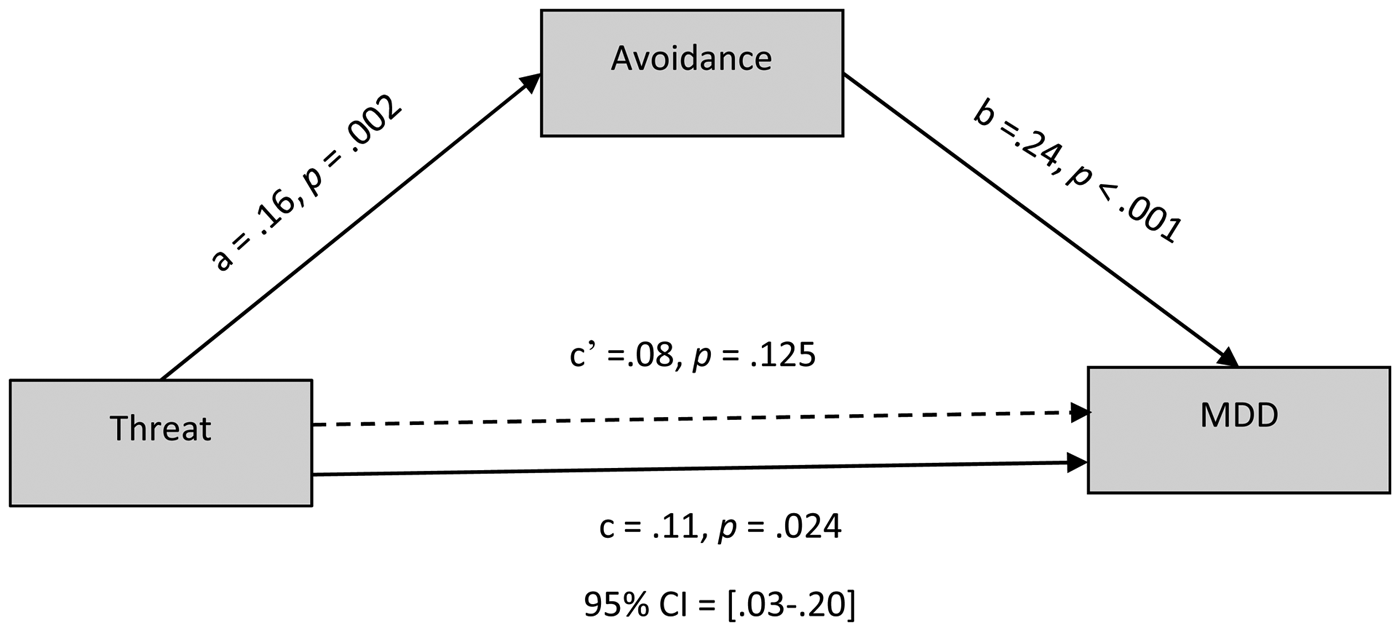
First, we tested whether the association between exposure to threat and adolescent MDD was explained by avoidance. Four main paths were estimated: path a, the association between threat (the predictor) and avoidance (the mediator); path b, the association between avoidance and MDD (the outcome); path c, the total effect of threat (the predictor) on MDD (the outcome), not adjusting for avoidance (the mediator); and path c’, the association between threat and MDD, adjusted for avoidance. We also tested the statistical significance of the indirect effect of threat on MDD via bootstrapped confidence intervals. The indirect effect was considered statistically significant if the 95% confidence interval (CI) for a parameter estimate did not include a value of zero. We included deprivation and child sex as covariates in the model.
Results for MDD are shown in Figure 1. All paths in the model, with the exception of the total effect (path c), were statistically significant. The direct effect of exposure to threat on adolescent MDD (path c) was reduced once the mediational pathway was estimated (the effect size reduces by .03). The indirect effect of exposure to threat on adolescent MDD (path a*path b) was significant, 95% CI [.01, .06]. For the alternative model, the MDD and avoidance variables were interchanged so that MDD served as a mediator in the association between exposure to threat and avoidance. All paths in the model remained significant, including the indirect effect, b = .03, 95% CI = [.01 − .05]; however, the direct effect of exposure to threat on adolescent MDD (path c') remained statistically significant when the mediational pathway was estimated (p = .008).
Mediational model for major depressive disorder. The model controls for deprivation and child sex. Dashed line denotes an effect accounting for the mediator.

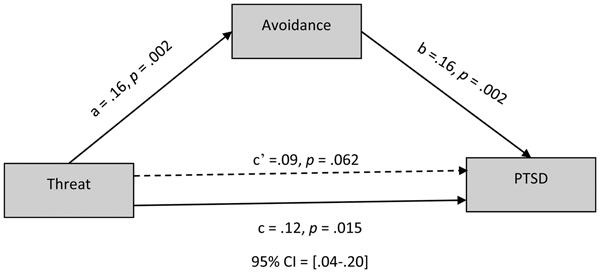
Second, for PTSD, we again estimated four paths: path a, the association between threat (the predictor) and avoidance (the mediator); path b, the association between avoidance and PTSD (the outcome); path c, the total effect of threat (the predictor) on PTSD (the outcome), not adjusting for avoidance; and path c’, the association between threat and PTSD, adjusted for avoidance. Deprivation and child sex were once again included in the model. Results are shown in Figure 2. All paths in the model were statistically significant. The total effect of exposure to threat on adolescent PTSD (path c) was reduced and became nonsignificant once the mediational pathway was estimated (the effect size reduces by .02). The indirect effect of exposure to threat on adolescent PTSD (path a*path b) was significant, 95% CI [.03, .23]. For the alternative model in which avoidance and PTSD were interchanged, all paths remained significant, including the indirect effect of threat on avoidance through PTSD, b = .02, 95% CI = [.003 – .03]; however, the direct effect of exposure to threat on adolescent PTSD (path c′) remained statistically significant when the mediational pathway was estimated (p = .006).
Mediational model for posttraumatic stress disorder. The model controls for deprivation and child sex. Dashed line denotes an effect accounting for the mediator.

Third and finally, for generalized anxiety disorder, oppositional defiant disorder, and ADHD all paths were once again estimated as described above. The direct effects of exposure to threat on adolescent generalized anxiety disorder, oppositional defiant disorder, and ADHD were not statistically significant (ps = .068–.259); therefore, avoidance was not considered as a possible mediator.
Discussion
Children exposed to maltreatment are at increased risk for psychopathology both during childhood and across the life span. Findings from the present study add to what is known about exposure to maltreatment and adolescents’ subsequent development of psychopathology in two ways. First, results show exposure to threat (in the form of physical and/or sexual abuse), but not deprivation (neglect), predicts the use of avoidant regulation, with adolescents who were exposed to higher levels of threat utilizing avoidant strategies more so than adolescents with lower rates of exposure. Second, mediational analyses suggest that avoidant regulation may help explain why differences in psychopathology, particularly internalizing symptomatology, are observed between adolescents exposed to higher versus lower threat.
Despite evidence that child maltreatment predicts deficits or alterations in emotional functioning (Cicchetti & Rogosch, Reference Cicchetti and Rogosch2009; Flett et al., Reference Flett, Druckman, Hewitt and Wekerle2012; Kim & Cicchetti, Reference Kim and Cicchetti2010; Maughan & Cicchetti, Reference Maughan and Cicchetti2002; Milojevich et al., Reference Milojevich, Levine, Cathcart and Quas2018; Perlman et al., Reference Perlman, Dawson, Dardis, Egan and Anderson2016; Romens & Pollak, Reference Romens and Pollak2012; Shields & Cicchetti, Reference Shields and Cicchetti1998), few studies have examined the specific strategies that adolescents report using to regulate their negative emotions or how the use of these strategies may vary by exposure to different forms of maltreatment. The present study tested a model distinguishing between dimensions of threat and deprivation (McLaughlin et al., Reference McLaughlin, Sheridan, Gold, Duys, Lambert, Peverill and Pine2016; Sheridan & McLaughlin, Reference Sheridan and McLaughlin2014) in a longitudinal study spanning 18 years of development. Overall, findings indicated that, as expected, exposure to threat early in life predicted greater use of avoidance during adolescence. Early threat exposure, such as physical abuse, places children in harmful or potentially harmful situations often beyond the control of the child. Moreover, abusive parents often fail to teach their children a range of appropriate and adaptive regulation and coping strategies (Shipman et al., Reference Shipman, Schneider, Fitzgerald, Sims, Swisher and Edwards2007). As such, one explanation for the present study's findings is that threat-exposed children may not have developed the regulation skills to elicit change in emotionally taxing situations and thereby respond by avoiding their emotions or the emotion-causing situation. Alternatively, threat-exposed children tend to have more extreme emotional reactivity to negative events compared to nonexposed children (McLaughlin, Sheridan, Alves, & Mendes, Reference McLaughlin, Sheridan, Alves and Mendes2014), which may make it more difficult for them to regulate or cope with intense negative feelings than for non-threat exposed children. As a result, threat-exposed children may be overwhelmed in emotion-eliciting situations, leading them to avoid such situations and emotions. Future work is needed to test these possible explanations. Future work on this subject is important given that the present study highlights the role of avoidance in the development of psychopathology longitudinally in threat-exposed youth.
Furthermore, tests of mediation in the present study suggested that the reliance on avoidant regulation partially explained the association between early threat exposure and subsequent symptoms of psychopathology, particularly symptoms of depression and PTSD. As expected, the effect of threat and avoidant regulation was found for internalizing, but not externalizing, disorders. Previous findings have suggested that avoidance is more robustly associated with internalizing symptomatology, with avoidance longitudinally predicting increases in internalizing, but not externalizing, symptomatology (Compas et al., Reference Compas, Jaser, Bettis, Watson, Gruhn, Dunbar and Thigpen2017). However, Compas et al. combined disorders into broad “internalizing” and “externalizing” categories; therefore, the effect of avoidance on specific disorders could not be ascertained. In the present study, we elected to analyze each disorder individually, thereby providing novel insight into the ways in which threat exposure leads to specific forms of internalizing psychopathology in adolescents. Of note, given the half-longitudinal nature of our data (i.e., mediator and outcome variables were both measured at age 18), we estimated alternative models in which adolescent psychopathology mediated the effect between threat and regulation strategies. These models were significant, however, the direct effect of exposure to threat on adolescent psychopathology (path c) remained statistically significant when the mediational pathways were estimated. These results suggest that symptoms of psychopathology partially mediate the relation between threat and avoidance. We focused on regulation as the mediator given previous longitudinal findings indicating the importance of emotion regulation in predicting psychopathology (Alink, Cicchetti, Kim, & Rogosch, Reference Alink, Cicchetti, Kim and Rogosch2009; Campos et al., Reference Compas, Jaser, Bettis, Watson, Gruhn, Dunbar and Thigpen2017; Kim & Cicchetti, Reference Kim and Cicchetti2010; Moulton, Newman, Power, Swanson, & Day, Reference Moulton, Newman, Power, Swanson and Day2015); however, future longitudinal work is needed to establish temporal relations.
Despite our expectations, exposure to deprivation did not predict adolescents’ overall regulation. Two possible explanations for the lack of associations are as follows. First, the questionnaire used to assess adolescent regulation in the present study, ACOPE, taps into predetermined forms of regulation, such as ventilating feelings, developing social support, and solving family problems. While the ACOPE captures many adaptive strategies that adolescents use, there may be additional strategies not assessed by ACOPE that do vary as a function of deprivation exposure (e.g., regulation strategies that rely more heavily on cognitive abilities such as cognitive reappraisal or acceptance). Second, it is possible that differences in regulation resulting from deprivation are observed early in development (e.g., Shipman, et al., Reference Shipman, Edwards, Brown, Swisher and Jennings2005) but this association diminishes over time. It is of course also possible that the one early observation of this association was hampered by study limitations. Shipman et al. (Reference Shipman, Edwards, Brown, Swisher and Jennings2005) found that neglected children tend to inhibit the expression of negative emotions. However, their study was limited to concurrent associations in a small (N = 24) sample of 6- to 12-year-olds. In contrast, in the present study, deprivation was assessed prior to age 6, while regulation was measured at age 18. As such, perhaps with time, other environmental or contextual influences worked to reduce emotion dysregulation resulting from lack of cognitive and social stimulation endured by neglected children. Future research should directly test these explanations.
This study offers several methodological strengths resulting from the LONGSCAN study design, although future research would benefit from addressing the limitations in the present work. As mentioned, one notable limitation that should be addressed by future research is the concurrent assessment of adolescent regulation and psychopathology. In LONGSCAN, measures of regulation were not introduced until the age 18 wave of data collection, therefore limiting our ability to address temporal relations between regulation and psychopathology. Future work should investigate how specific regulation strategies predict later symptoms of psychopathology, thus more directly testing any causal associations. Future work should also include additional measures of deprivation. In the present study, we focused on CPS case records of child neglect exposure as our measure of deprivation. While the use of official case records was appropriate for our focus on neglect exposure, other measures of deprivation, such as cognitive stimulation, language complexity, and access to learning tools in the home, should be included to provide a more wholistic assessment of children's deprivation exposure and allow for a more nuanced analysis of DMAP and how the model relates to adolescent regulation tendencies.
Despite these limitations, findings from the present study have important clinical implications. For example, our findings highlight the need to consider the role of specific maladaptive regulation strategies, specifically avoidance, in the treatment and prevention of psychopathology in abuse-exposed children. Many therapy strategies, including cognitive behavioral therapy, focus on improving children's regulation through the implementation of adaptive strategies, such as cognitive reappraisal/restructuring (e.g., Smith et al., Reference Smith, Yule, Perrin, Tranah, Dalgleish and Clark2007). While adaptive regulation is vital to promoting resilience in children exposed to abuse (Cicchetti & Rogosch, Reference Cicchetti and Rogosch2009), findings from the present study also highlight the need to focus on reducing the use of maladaptive strategies, including avoidance, in abuse-exposed children. Overall, by knowing what strategies these children use and how their use is associated with the development of psychopathology over time, we can better tailor our treatment and prevention efforts thus mitigating the effects of maltreatment exposure and improving the mental health of maltreated youth.
Acknowledgments
The data used in this publication were made available by the National Data Archive on Child Abuse and Neglect, Cornell University, Ithaca, NY, and have been used with permission. Data from Longitudinal Studies of Child Abuse and Neglect (LONGSCAN) Assessments 0–12 were originally collected by Desmond K. Runyan, Howard Dubowitz, Diana J. English, Jonathan Kotch, Alan Litrownik, Richard Thompson, and Terri Lewis & The LONGSCAN Investigator Group.
Financial support
Funding for the project was provided by the Office on Child Abuse and Neglect (OCAN), Children's Bureau, Administration for Children and Families, Department of Health and Human Services (National Center on Child Abuse and Neglect [NCCAN], under the Office of Human Services funded this consortium of studies during the early years of data collection from 04/01/1991 until NCCAN became part of OCAN in 1998;Award Number: 90CA1467, 90CA1481, 90CA1466, 90CA1458, 90CA1572, 90CA1569, 90CA1568, 90CA1566, 90CA1678, 90CA1681, 90CA1680, 90CA1676, 90CA1677, 90CA1679, 90CA1744, 90CA1745, 90CA1746, 90CA1747, 90CA1748, 90CA1749). The collector of the original data, the funder, NDACAN, Cornell University, and their agents or employees bear no responsibility for the analyses or interpretations presented here. This work was supported in part by Postdoctoral Fellowship T32-HD07376 (to H. M.M.) provided by the National Institute of Child Health and Human Development through the Center for Developmental Science, University of North Carolina at Chapel Hill.