Introduction
The preservation of invaluable genetic lines in domestic and laboratory animals is largely dependent on the cryopreservation techniques. A core component of any programme for embryo production and transfer is embryo cryopreservation. An efficient cryopreservation protocol makes embryo storage and transport possible, and these are the fundamental requirements of an embryo-marketing programme (Mandawala et al., Reference Mandawala, Harvey, Roy and Fowler2016). Cryobiological and embryological factors are two main categories of factors that affect the efficiency of an embryo freezing protocol (Van der Elst, Reference Van der Elst, Van Soom and Boerjan2002). Type and concentration of cryoprotectant agents (CPAs), cooling and warming rates, and the methods of freezing are cryobiological factors (Leibo and Loskutoff, Reference Leibo and Loskutoff1993). The vitrification method has been shown to have better efficiency in cryopreserving both oocytes and embryos (Mandawala et al., Reference Mandawala, Harvey, Roy and Fowler2016). In this method a combination of both permeable and non-permeable CPAs, at high concentrations, with extremely high cooling and warming rates is usually used. Using this method, the chance of ice crystal formation considerably decreases, and post-warming survival and pregnancy rates of the embryos are higher compared with conventional slow-freezing methods (Saragusty and Arav, Reference Saragusty and Arav2011).
The source of embryos (in vivo vs. in vitro), the developmental stage of embryos, and the quality of embryos are embryological factors that can affect the efficiency of cryopreservation (Mandawala et al., Reference Mandawala, Harvey, Roy and Fowler2016). In vivo-derived embryos are able to better withstand cryopreservation compared with in vitro-derived embryos (Greve et al., Reference Greve, Avery and Callesen1993; Dobrinsky, Reference Dobrinsky2002). For the embryo stage, the blastocyst is the most resistant embryo stage for cryopreservation (Shirazi et al., Reference Shirazi, Soleimani, Karimi, Nazari, Ahmadi and Heidari2010) and, as demonstrated, the quality of embryos undergoing cryopreservation has a profound effect on their cryo-survival (Massip and Leibo, Reference Massip, Leibo, Van Soom and Boerjan2002; Van der Elst, Reference Van der Elst, Van Soom and Boerjan2002).
Despite all the recent advances in cattle embryo production technologies, the quality of embryos produced in vitro is still far from desirable compared with embryos produced in vivo (Rodrigues-Cunha et al., Reference Rodrigues-Cunha, Mesquita, Bressan, del Collado, Balieiro, Schwarz, de Castro, Watanabe, Watanabe and de Alencar Coelho2016; Ascari et al., Reference Ascari, Martins, Camargo, Mendez-Otero and Jasmin2018;). Embryo quality is mainly affected by culture conditions at the post-fertilization period (Young et al., Reference Young, Sinclair and Wilmut1998; Lange-Consiglio et al., Reference Lange-Consiglio, Maggio, Pellegrino and Cremonesi2012). In vivo preimplantation development of embryos is affected by factors released by the oviduct, uterus, and embryo, including insulin like growth factor (IGF)-I, IGF-II, transforming growth factor (TGF)α, TGFβ, interleukin (IL)-1β, epidermal growth factor (EGF), stem cell factor (SCF) and leukaemia inhibitory factor (LIF) (Hardy and Spanos, Reference Hardy and Spanos2002). Therefore, measures such as co-culture systems and serum supplementation to the embryo culture medium have been adopted to compensate for the shortage of in vitro culture conditions. Using these approaches, however, causes the components of culture medium to be undefined, producing uncertain consequences (Yoshioka, Reference Yoshioka2011). Nonetheless, due to the relatively low efficiency of chemically defined medium in supporting the development of bovine embryos, the above approaches are still used. We previously showed that co-culture with bovine oviduct epithelial cells (BOECs) improved the freezability of bovine embryos produced in vitro (Shirazi et al., Reference Shirazi, Nazari, Ahmadi, Heidari and Shams-Esfandabadi2009). However, preparation of BOECs has its own disadvantages. For example, based on our experience, because of their slow growth, the successive subculturing of BOECs is difficult. These cells, therefore, should be prepared in the form of primary cultures from new oviducts whenever they are intended to be used as feeder cells. Therefore, primary culture preparation increases the risk of microbial contamination. In addition, changes in BOEC sources and the various physiological and hormonal conditions governing the body at the time of oviductal sampling may lead to variable results. Therefore, using cells for which their culture is reproducible and their functionality is maintained in successive cultures is preferred. In this context, using stem cells, considering the stability of their functional characteristics in successive subcultures and their high capability in secreting various substances such as growth factors, cytokines, and even microRNAs, might be superior to other somatic cells in supporting embryonic development (Lange-Consiglio et al., Reference Lange-Consiglio, Maggio, Pellegrino and Cremonesi2012; Miranda et al., Reference Miranda, Nascimento, Costa, Costa, Brito, Lopes, Santos, Cordeiro and Ohashi2016). In our study, we aimed to evaluate the effect on in vitro development and cryo-survival of resulting blastocysts of co-culturing IVF-derived bovine embryos with bovine amniotic membrane stem cells (bAMSCs).
Materials and methods
All chemicals were obtained from Sigma Chemicals Co. (St. Louis, MO, USA) unless otherwise stated.
Experimental design
In this study, bovine embryos were produced using oocytes harvested from ovaries of slaughtered cows. The IVF-derived zygotes were cultured in three groups: (i) without co-culture in our standard IVC-synthetic oviduct fluid (SOF) culture medium (Con group), (ii) co-cultured with bovine oviduct epithelial cells as feeder cells (BOEC group), and (iii) co-cultured with bovine amniotic membrane stem cells as feeder cells (bAMSC group). Early and expanded blastocysts were vitrified on days 7 and 8 of culture (Day 0 = IVF day). After warming, recovered blastocysts were cultured for 72 h in IVC-SOF and their re-expansion (2–4 h post-warming), survival (24 h post-warming), and hatching were monitored and recorded. This study was conducted in five replicates.
Preparation of feeder cells
The preparation and stemness confirmation of bAMSCs were performed in accordance with our previous study (Nazari et al., Reference Nazari, Shirazi, Shams-Esfandabadi, Afzali and Ahmadi2016). Briefly, the uterus of a pregnant cow (pregnancy age: 70–90 days) was transferred to the laboratory. In the laboratory, the uterus was aseptically opened and amniotic membrane was separated and underwent a 30 min enzymatic digestion process in Dulbecco’s modified Eagle’s medium (DMEM) containing collagenase type IV (1 mg/ml), hyaluronidase (0.5 mg/ml), trypsin (1 mg/ml/), and DNase (50 IU/ml). After 10 min centrifugation at 500 g, isolated cells were resuspended in DMEM containing 20% fetal calf serum (FCS) and 5 ng/ml fibroblast growth factor (FGF) and were cultured at 38.5°C in 5% CO2 in air. To remove non-adherent cells, the medium was replaced after 72 h. At 70–80% confluency, the cells were isolated by incubation in 0.25% trypsin/EDTA for 10 min and were then plated at 2 × 10⁴ cells/ml. At the third passage, the stemness status of AMSCs was confirmed by immunocytochemical assessment of Oct-4 expression using specific primary antibody, monoclonal anti-Oct-4 (Abcam, ab18976), and FITC-conjugated secondary antibody. Moreover, the stemness status of AMSCs was also confirmed by their osteogenic and adipogenic differentiation. Osteogenic medium was comprised of 10% FCS, 150 mg/ml β-glycerophosphate, 50 mg/ml ascorbic acid, and 10−8 M dexamethasone, and adipogenic differentiation medium consisted of 2% FCS and 100 IU/ml insulin–transferrin–selenium (ITS). Osteogenic and adipogenic differentiation were assessed by colorimetric visualization of calcium sediment (alizarin red S stain) and intracellular accumulated lipid-rich vacuoles (oil red stain) in culture plates, respectively. At 48 h before using culture dishes for embryo culture, passages 3–7 bAMSCs at a density of 1 × 10⁵ cells/ml were prepared in 50-μl droplets of complete medium [DMEM containing 20% fetal bovine serum (FBS) and 5 ng/ml FGF] in 60 × 15 mm culture dishes, and overlaid with light paraffin oil.
Considering the difficulty of subculturing BOECs, these cells were prepared as primary cultures for use as feeder cells. At 48 h before using culture dishes for embryo culture, bovine oviducts were aseptically separated from the uterus. While the ampullary end of the oviduct was in a 1.5-ml microtube, using a disposable syringe 1 ml trypsin–EDTA solution was injected into the lumen through the infundibular end. After 2 min, the content of the oviduct was squeezed into the microtube using sterile thumb forceps. The cell suspension was then homogenized by gentle and repeated pipetting for 2 min through a 30G needle. After addition of 0.5 ml FBS, the suspension was centrifuged at 500 g for 5 min. After discarding supernatant, cells were resuspended in bicarbonate-buffered medium 199 containing 10% FBS and were added to the 50-μl droplets of the same medium at a density of 1 × 10⁵ cells/ml overlaid with light paraffin oil. The culture plates were incubated at 38.5°C in a humid atmosphere with 5% CO2. For both bAMSCs and BOECs, 4 h before embryo culture, the culture medium of the droplets was replaced by IVC-SOF medium (without serum).
In vitro embryo production
In vitro bovine embryos were produced as described in our previous study (Shirazi et al., Reference Shirazi, Nazari, Ahmadi, Heidari and Shams-Esfandabadi2009) with slight modifications. Briefly, bovine ovaries were collected at a local slaughterhouse and transported to the laboratory in normal saline within 2–3 h at a temperature between 30 and 35°C. All visible follicles with a diameter of 2–8 mm were aspirated using a 10-ml syringe via an 18G short bevelled needle. The follicle content was released into pre-incubated HEPES-buffered medium 199, supplemented with 5% FBS, Gibco 10270) and 50 IU/ml heparin. The cumulus–oocyte complexes (COCs) with at least three layers of cumulus cells, oocytes with a uniform granulated cytoplasm and homogenous distribution of lipid droplets in the cytoplasm were selected for the experiments. The selected COCs underwent in vitro maturation in TCM199 supplemented with 10% FBS and 0.1 IU/ml follicle stimulating hormone. Next, 10– 15 COCs were transferred to 50-µl droplets of maturation medium in a 60 mm Petri dish, overlaid with light paraffin oil, and cultured for 24 h in 5% CO2 in air at 38.5°C. The matured oocytes were exposed to motile spermatozoa obtained by centrifugation of frozen–thawed semen on a discontinuous Percoll density gradient (1 ml 40% Percoll over 1 ml 90% Percoll) at 700 g for 20 min. Oocytes were cultured in TALP medium [114 mM NaCl, 3.2 mM KCl, 25 mM NaHCO3, 0.4 mM NaH2PO4.H2O, 2.8 mM Na lactate, 2 mM CaCl2.2H2O, 0.5 mM MgCl2.6H2O, 0.33 mM Na pyruvate, 100 IU/ml penicillin-G, 100 µg/ml streptomycin, and 6 mg/ml bovine serum albumin (BSA)] and incubated with motile spermatozoa at 1 × 10⁶ spermatozoa/ml concentration overlaid with light paraffin oil, for 22–24 h at 38.5°C in an atmosphere of 5% CO2 in air. After fertilization, presumptive zygotes were mechanically denuded of their cumulus cells by 2 min vortexing at 2500 rpm/min and cultured in the three different culture study systems in a humid incubator with 5% CO2, 7% O2 for 8 days. The culture medium used for embryo culture was IVC-SOF [107.7 mM NaCl, 7.16 mM KCl, 25 mM NaHCO3, 1.19 mM KH2PO4, 3.3 mM Na lactate, 1.78 mM CaCl2.2H2O, 0.5 mM MgCl2.6H2O, 1.5 mM glucose, 0.33 mM Na pyruvate, 2 % (v/v) BME amino acid solution, 1 % (v/v) MEM amino acid solution, 100 IU/ml penicillin-G, 100 µg/ml streptomycin, and 8 mg/ml fatty acid-free BSA]. Embryonic cleavage was assessed on the third day of culture (day 0 = IVF day) and only cleaved embryos were transferred to new culture droplets. The embryo culture medium was refreshed again on the fifth day of culture. In the Con group, during refreshment the embryos were transferred to new droplets of IVC-SOF medium containing 5% charcoal striped-FBS in new culture plates. During refreshment for the BOEC and bAMSC groups, culture medium from 48-h cultured BOEC or bAMSC in droplets was replaced by IVC-SOF medium (without serum) and, after equilibration in incubator, the embryos were transferred to these droplets.
Vitrification and warming procedures
Vitrification and warming of embryos were conducted as our previous study (Shirazi et al., Reference Shirazi, Soleimani, Karimi, Nazari, Ahmadi and Heidari2010) with some modifications. Briefly, the blastocysts were placed in a 100-µl drop of base medium (HEPES-buffered medium 199 + 20% FBS) for 20–30 s. Then, they were transferred to 100-µl drops of equilibration solution (base medium + 1.35 M ethylene glycol + 1.05 M DMSO) for 8 min. Blastocyst were then transferred to a 100-µl drop of vitrification solution (base medium + 2.7 M ethylene glycol + 2.1 M DMSO + 0.5 M sucrose). Embryos were then loaded with a fine-bore pasture pipette on a Cryotop device (Kitazato Ltd, Tokyo, Japan) with a minimum volume of vitrification solution. After loading, almost all of the solution was removed using a fine-bore pasture pipette and the straw was quickly immersed in liquid nitrogen. The total incubation time of embryos in vitrification solution, including loading on the Cryotops and plunging in liquid nitrogen, lasted for 30 s. For warming, the tip of the Cryotops was directly immersed into a 100-µl drop of warming solution (base medium + 0.5 M sucrose) for 5 min and then washed (two times) in base medium. The cryopreserved blastocysts were cultured in IVC-SOF medium for 72 h. The vitrification step was performed at room temperature (25°C) and the warming step was performed on a warm stage at 37°C. Post-warming re-expansion assessment was performed 2–4 h after warming and the blastocysts that reformed their blastocoel cavity were considered re-expanded blastocysts. At 24 h after warming, blastocyst that maintained their morphology and did not degenerate were considered survived blastocysts.
Statistical analysis
Data on embryonic development were analyzed using one-way analysis of variance (ANOVA). All proportional data before analysis were subjected to an arcsine transformation, and the data were expressed as mean ± standard error of the mean (SEM). Data on vitrification/warming process were analyzed by chi-squared test, or Fisher’s exact test, when appropriate. Statistical analysis was performed using the IBM-SPSS v.20 software package. Differences were considered significant at the level of P < 0.05.
Results
Both bAMSCs and BOECs displayed typical polygonal epithelial morphology. In BOECs, sometimes clumps of cells were observed at the time of medium replacement, these were attached to the plate bottom and by thorough examination showed ciliary movements. These clumps were not distinguishable 48 h after medium replacement. The stemness status of bAMSCs was confirmed after their differentiation to adipoctyes and osteocytes followed by oil red and alizarin red staining, respectively. Their stemness status was also confirmed by the presence of OCT4 protein accessed by immunocytochemistry.
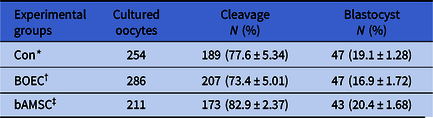
As shown in Table 1, cleavage and blastocyst rates did not differ between experimental groups. After warming the vitrified blastocyst, the re-expansion rate of blastocysts (evaluated 2–4 h after warming) did not differ between experimental groups, neither in accordance with the blastocyst age nor as total (day 7 + day 8 blastocysts, Table 2). After 24 h culture of vitrified/warmed blastocysts, significantly more blastocysts maintained their morphology or continued growing in BOEC and bAMSC groups compared with cells in the Con group (P < 0.05). Considering the age of the vitrified/warmed blastocysts, the survival rate of the 7-day-old blastocysts from the bAMSC and BOEC groups tended to be higher compared with that of their counterparts in the Con group (P = 0.51 and P = 0.067, respectively). In this regard, the survival rates of the 8-day-old blastocysts of bAMSC and BOEC groups were significantly higher compared with that of the 8-day-old blastocysts in the Con group (P < 0.05). When continuing to culture of the vitrified/warmed blastocysts, the rate of hatched blastocysts tended to be higher in bAMSC and BOEC groups compared with those in the Con group (P = 0.07).
The effect of embryo culture systems (with BOECs or bAMSCs co-culture or without co-culture (control)) on the development of bovine IVF-derived embryos. Data are presented as mean ± standard error of mean (SEM)

*Con, control group; †BOEC, bovine oviduct epithelial cells; ‡bAMSC, bovine amniotic membrane stem cells.
The effect of embryo culture systems (with BOECs or bAMSCs co-culture or without co-culture (control)) on the cryo-survival of bovine IVF-derived embryos

a,b In each column indicate significant differences (P < 0.05).
*Con, control group; †BOEC, bovine oviduct epithelial cells; ‡bAMSC, bovine amniotic membrane stem cells.
Discussion
The quality of embryos has a profound effect on their cryo-survivability and post-implantation development (Van der Elst, Reference Van der Elst, Van Soom and Boerjan2002). In this context, culture conditions are important determinants of the quality of in vitro-produced embryos (Lonergan et al., Reference Lonergan, Rizos, Gutierrez-Adan, Fair and Boland2003; Mantikou et al., Reference Mantikou, Youssef, van Wely, van der Veen, Al-Inany, Repping and Mastenbroek2013). It has been shown that co-culturing embryos with the various types of somatic cells has some beneficial effects on embryonic development (Rizos et al., Reference Rizos, Ward, Boland and Lonergan2001). Additionally, in our previous work, we observed that bovine embryos co-cultured with BOECs had higher freezability compared with their non-co-cultured counterparts (Shirazi et al., Reference Shirazi, Nazari, Ahmadi, Heidari and Shams-Esfandabadi2009). Various lines of evidence indicate that mesenchymal stem cells (MSCs) secrete a broad range of growth factors with different biological activities (Madrigal et al., Reference Madrigal, Rao and Riordan2014). Therefore, we hypothesized that MSCs due to this secretory activity might be superior to BOECs in supporting embryonic development. Our results showed, despite the lack of difference in embryonic development among the three groups, that the embryos co-cultured with either bAMSCs or BOECs had a higher cryo-survivability compared with non-co-cultured control embryos. It is noteworthy that some parameters in co-cultured groups, although not significant, were higher compared with those parameters in the Con group. Probably, if the sample size of our study had been larger, the differences might have been significant.
As indicated in the Materials and methods section, we transferred embryos to new dishes on the third and fifth days of the culture period. In our standard embryo culture method, similar to the Con group of the present study, culture refreshment is necessary because, without changing the embryo culture medium, hatching rate decreases. In co-culture groups, especially in the BOECs group, cells adhered to the plate bottom started to detach 48 h after changing their culture medium to serum-free IVC-SOF. Our previous experiments showed that transferring BOECs-co-cultured embryos to new culture plates containing BOECs is necessary for proper embryonic development (un-published data). For the bAMSC group, the procedure was the same as for the BOECs group.
Chemically defined media for in vitro embryo production have important advantages such as improving the reliability of media formulations, yielding a higher reproducibility of results, and ensuring the biosafety of culture medium by eliminating protein and cellular preparations, which may be contaminated with pathogens (Yoshioka, Reference Yoshioka2011). Unfortunately, these media formulations often yield either a low rate of embryonic development or low-quality embryos. Therefore, the use of undefined components such as serum or co-culture systems is still ongoing. Serum supplementation to the culture medium of bovine embryos is routine practice that is necessary for achieving an appropriate blastocyst rate. It has been shown that serum could accelerate blastocyst formation (Gómez et al., Reference Gómez, Rodríguez, Muñoz, Caamaño, Hidalgo, Morán, Facal and Díez2008) through providing growth factors and energy sources for developing embryos (Wydooghe et al., Reference Wydooghe, Heras, Dewulf, Piepers, Van den Abbeel, De Sutter, Vandaele and Van Soom2014). However, the presence of serum, by deviating the pattern of gene expression (Rizos et al., Reference Rizos, Gutierrez-Adan, Perez-Garnelo, De La Fuente, Boland and Lonergan2003), increasing the amount of cytoplasmic lipid droplets and affecting the metabolism of embryos (Abe et al., Reference Abe, Yamashita, Satoh and Hoshi2002), compromises the quality and cryotolerance of in vitro-produced embryos (Mucci et al., Reference Mucci, Aller, Kaiser, Hozbor, Cabodevila and Alberio2006). As a result, in our study, it might be inferred that one of the reasons for higher cryo-survivability of the co-cultured embryos compared with non-co-cultured ones, was the lack of serum in the co-culture medium. We had previously showed that, in co-culture systems, serum inclusion in culture medium was no longer needed, especially when using SOF medium supplemented with fatty acid-free BSA (Shirazi et al., Reference Shirazi, Nazari, Ahmadi, Heidari and Shams-Esfandabadi2009).
As shown in Table 1, cleavage and blastocyst rates were similar between the three experimental groups. Therefore, co-culturing embryos with bAMSCs and BOECs was as effective as the presence of serum in the culture medium in supporting embryonic development up to the blastocyst stage. Oviduct epithelial cells have been used for a relatively long time as feeder cells for embryo culture (Gandolfi and Moor, Reference Gandolfi and Moor1987). Their extensive use had been based on the assumption that these cells might create conditions similar to the in vivo environment of the early stages of embryonic development. Despite the evidence of dedifferentiation of BOECs during culture, they continue to support embryo development and enhance the quantity and quality of resulting blastocysts (Schmaltz-Panneau et al., Reference Schmaltz-Panneau, Locatelli, Uzbekova, Perreau and Mermillod2015).
Recently, it has been shown that various types of stem cells as feeder layers could improve the quality and developmental competence of embryos in different species (Moshkdanian et al., Reference Moshkdanian, Nematollahi-Mahani, Pouya and Nematollahi-Mahani2011; Lange-Consiglio et al., Reference Lange-Consiglio, Maggio, Pellegrino and Cremonesi2012; Jasmin et al., Reference Jasmin, Peters, Spray and Mendez-Otero2016; Miranda et al., Reference Miranda, Nascimento, Costa, Costa, Brito, Lopes, Santos, Cordeiro and Ohashi2016; Ascari et al., Reference Ascari, Martins, Camargo, Mendez-Otero and Jasmin2018). Moreover, stem cell conditioned medium (Kim et al., Reference Kim, Lee, Park, Jeong, Riu and Park2011; Park et al., Reference Park, Kim, Lee, Choi, Moon, Park, Son, Lee, Jeong, Lee, Riu and Park2013; Lee et al., Reference Lee, Moon, Kim and Park2015) and MSC-derived extracellular vesicles (Blazquez et al., Reference Blazquez, Sanchez-Margallo, Alvarez, Matilla, Hernandez, Marinaro, Gomez-Serrano, Jorge, Casado and Macias-Garcia2018) can improve the outcome of embryo production in vitro. To our knowledge, our study is the first study in which the effect of co-culturing embryos with bAMSCs on the embryo cryo-survival has been evaluated. The cryo-survival of bAMSCs-co-cultured embryos was comparable with that of BOECs-co-cultured embryos. The exact mechanism of the positive effects of somatic cells on embryonic development is not clear. However, it has been shown BOECs cells can secret growth and embryotrophic factors such as IGFI, IGFII), TGFα, TGFβ, platelet-derived growth factor (PDGF), and FGF (Gandolfi, Reference Gandolfi1995) so that their conditioned medium or their extracellular vesicles can improve the developmental competence of embryos (Lopera-Vasquez et al., Reference Lopera-Vasquez, Hamdi, Fernandez-Fuertes, Maillo, Beltran-Brena, Calle, Redruello, Lopez-Martin, Gutierrez-Adan, Yanez-Mo, Ramirez and Rizos2016). They also can positively modify culture medium metabolites (Edwards et al., Reference Edwards, Batt, Gandolfi and Gardner1997), and protect embryos against oxidative stress by increasing the expression of antioxidant enzymes (Harvey et al., Reference Harvey, Arcellana-Panlilio, Zhang, Schultz and Watson1995). Similar to BOECs, MSCs as feeder cells, can protect embryos against oxidative stress (Moshkdanian et al., Reference Moshkdanian, Nematollahi-Mahani, Pouya and Nematollahi-Mahani2011). Moreover, it has been shown that stem cells can secret various embrytrophic factors such as fibroblast growth factor 2 (FGF2), vascular endothelial growth factor A (VEGFA), and IL-6 (Kim et al., Reference Kim, Lee, Park, Jeong, Riu and Park2011; Lange-Consiglio et al., Reference Lange-Consiglio, Maggio, Pellegrino and Cremonesi2012; Park et al., Reference Park, Kim, Lee, Choi, Moon, Park, Son, Lee, Jeong, Lee, Riu and Park2013; Miranda et al., Reference Miranda, Nascimento, Costa, Costa, Brito, Lopes, Santos, Cordeiro and Ohashi2016).
In conclusion, our results showed that the cryo-survivability of in vitro-produced bovine embryos could be improved by co-culturing with BOECs or bAMSCs. Moreover, due to the possibility of preparing subcultures of bAMScs without losing their functionality, the use of this source of somatic cells in the co-culture system is preferable to BOEC.
Acknowledgements
The authors would like to thank the Research Institute of Animal Embryo Technology for its technical support.
Financial support
This study was supported by Deputy of Research, Shahrekord University, as a DVM dissertation project.
Conflict of interest
None of the authors have any conflict of interest to declare.
Ethical approval
This study was approved by the Animal Research Committee of Shahrekord University.