Exposure to violence is part of daily school life for many children worldwide (UNESCO, 2019). Experiences of school violence are manifold and encompass various types, including physical and emotional violence, perpetrated by other students and school staff. In Tanzania, for instance, exposure to school violence was found to be almost universally prevalent in a nationally representative sample of secondary school students. Almost two-thirds reported experiences of peer violence, and nearly all children experienced physical and emotional violence by their teachers (Hecker, Goessmann, Nkuba, & Hermenau, Reference Hecker, Goessmann, Nkuba and Hermenau2018). The exposure to school violence can severely impact children's educational engagement and academic achievement (Delfabbro et al., Reference Delfabbro, Winefield, Trainor, Dollard, Anderson, Metzer and Hammarstrom2006). School violence exposure has also been linked to serious impairments in children's psychological well-being and mental health (Devries et al., Reference Devries, Child, Allen, Walakira, Parkes and Naker2014). For example, previous findings demonstrate extensive evidence for the linkage between internalizing problems such as depression, anxiety, low self-esteem, and peer problems with teacher violence (Gershoff, Reference Gershoff2017). Similarly, a wide array of externalizing problems, including attention problems, aggression, antisocial behavior, and delinquency were linked to exposure to teacher violence (Gershoff, Reference Gershoff2017; Hecker, Hermenau, Isele, & Elbert, Reference Hecker, Hermenau, Isele and Elbert2014). In Tanzania, for instance, mental health problems as well as delinquent, rule-breaking, and aggressive behavior in secondary school students have been related to the exposure to emotional violence by teachers (Nkuba, Hermenau, Goessmann, & Hecker, Reference Nkuba, Hermenau, Goessmann and Hecker2018a, Reference Nkuba, Hermenau and Hecker2019).
School violence has further been associated with a wide range of negative consequences for victimized children's social relations and interactions, subsequently affecting their status in the social network (Sentse, Dijkstra, Salmivalli, & Cillessen, Reference Sentse, Dijkstra, Salmivalli and Cillessen2013). Generally, higher social status offers greater access to peer influence, relationships, and resources in social networks (Eder, Reference Eder1985). For instance, children with high social status are characterized as the coolest and most admired children, who have a large number of friends and who are in positions of leadership with a high degree of social control (Lansu, Cillessen, & Karremans, Reference Lansu, Cillessen and Karremans2014; Lease, Musgrove, & Axelrod, Reference Lease, Musgrove and Axelrod2002). In considering social status, there have been two primary conceptualizations utilized: social preference and social centrality (Parkhurst & Hopmeyer, Reference Parkhurst and Hopmeyer1998). Social preference is based on student ratings of liking or disliking a specific peer, whereas social centrality describes an individual's visibility and dominance within the social network.
The relation between school violence and aspects of social status has received mixed attention in research. Substantial findings are available for peer violence but are scarce regarding violence by teachers. For example, victims of peer violence are more disliked and less popular than nonvictimized children (de Bruyn, Cillessen, & Wissink, Reference de Bruyn, Cillessen and Wissink2010). Peer victimization is further associated with lower social acceptance and higher social rejection (Salmivalli, Lagerspetz, Björkqvist, Österman, & Kaukiainen, Reference Salmivalli, Lagerspetz, Björkqvist, Österman and Kaukiainen1998). In addition, victimized children are less often included in affiliations with other children and are largely barred from obtaining and maintaining friendships, causing further risks of peer victimization (Sentse et al., Reference Sentse, Dijkstra, Salmivalli and Cillessen2013). Only very few studies are available that link violent behaviors by teachers with the social status of children, but there is some evidence that it has an equally negative effect. For instance, the social reputation of children within their peer group was negatively affected by conflictual teacher–student relationships (Hughes & Im, Reference Hughes and Im2016). Further, students who were bullied by teachers were more likely to be socially alienated and were more disliked by a greater number of peers (Delfabbro et al., Reference Delfabbro, Winefield, Trainor, Dollard, Anderson, Metzer and Hammarstrom2006).
The fact that knowledge about the impacts of teacher violence on children's social functioning, including social status of children, is still limited gives rise to great concern, especially for the well-being of children from societies where violence by teachers toward students is the norm (Gershoff, Reference Gershoff2017). It is fundamental to explore the relation between teacher violence and children's social status in extremely violent school environments, as virtually all children, albeit at different levels, are affected by teacher violence and may therefore be at risk for social impairments. However, if all students are victimized by teacher violence, it may be more difficult to discern a social status hierarchy based on the level of violence exposure. In these circumstances, additional indicators, such as children's mental health, may influence the relation between violence and social status. Emotional and behavioral problems have been related to lack of social skills, and thus also affect children's social status (Nixon, Reference Nixon2001). Furthermore, emotional and behavioral problems are particularly prevalent in highly violent school environments (Devries et al., Reference Devries, Child, Allen, Walakira, Parkes and Naker2014; Nkuba et al., Reference Nkuba, Hermenau, Goessmann and Hecker2018a). Nevertheless, not all children in these environments develop mental health problems. Therefore, we argue that in school environments where violence is ubiquitous, in addition to the exposure to violence, other factors that influence children's behavior in the classroom, such as mental health problems, are critical for their level of social status.
Mental health problems typically come along with insecurity and inadequacy in social interactions, low social participation, and poor interpersonal skills, contributing to social exclusion and rejection by peers (Lansford, Malone, Dodge, Pettit, & Bates, Reference Lansford, Malone, Dodge, Pettit and Bates2010; Nixon, Reference Nixon2001). Mental health problems are therefore also related to children's social preference and centrality status. For instance, children with internalizing problems have been nominated as less liked and less central in their social networks by their peers (Gest, Graham-Bermann, & Hartup, Reference Gest, Graham-Bermann and Hartup2001). Similarly, children with higher levels of depression and anxiety symptoms were more likely members of withdrawn cliques, and were rated lower in social centrality and preference than children from other cliques (Kwon & Lease, Reference Kwon and Lease2007). Investigations of externalizing problems led to non-intuitive and mixed findings: even though aggressive children were rated as more unpopular, they were as likely to be central members of the social network as nonaggressive children (Bagwell, Coie, Terry, & Lochman, Reference Bagwell, Coie, Terry and Lochman2000; Farmer, Estell, Bishop, O'Neal, & Cairns, Reference Farmer, Estell, Bishop, O'Neal and Cairns2003). In fact, aggression may be used as a strategy to obtain peer influence and dominance and thus lead to higher social centrality, explaining the positive association (Xie, Swift, Cairns, & Cairns, Reference Xie, Swift, Cairns and Cairns2002). Deviant behavior and school misconduct, such as engaging in vandalism or smoking, may attract attention of peers and is therefore positively associated with children's reputation and centrality status (Ellis & Zarbatany, Reference Ellis and Zarbatany2007). Moreover, children showing attentional deficits and symptoms of hyperactivity scored lower on social preference, but received significantly more nominations as liked or disliked than other children, indicating enhanced visibility in the social network (Mrug, Hoza, Pelham, Gnagy, & Greiner, Reference Mrug, Hoza, Pelham, Gnagy and Greiner2007).
The current study
Social status is closely related to children's socioemotional adjustment and the establishment of a stable self-concept, abilities that are crucial in the development phases from childhood to adulthood (Chen & Chen, Reference Chen and Chen2019). Social status has further implications for academic competence, indicating a significant relevance for educational outcomes and future opportunities (Curlee, Aiken, & Luthar, Reference Curlee, Aiken and Luthar2019). The importance of social status for developmental success stands in sharp contrast to the limited knowledge about the manner in which the social status of children is threatened by teacher violence. Insufficient scientific evidence, especially from societies with high levels of teacher violence, highlights the urgent need for investigations into this association. Recognizing this discrepancy, the current study implemented a cross-sectional study design with all its limitations to obtain initial evidence. More specifically, we address the gap in the literature by investigating how children's social status is related to teacher violence in a society where it is highly prevalent and socially normed, and how this relation is influenced by children's mental health problems. For this purpose, children from primary schools distributed throughout Tanzania participated in our study. High prevalence of violence by teachers toward students has previously been reported in Tanzanian school environments (Hecker et al., Reference Hecker, Hermenau, Isele and Elbert2014, Reference Hecker, Goessmann, Nkuba and Hermenau2018), indicating suitable conditions to investigate this research question.
We expected to observe a negative association between exposure to teacher violence and children's social status. We also presumed independent associations between mental health problems and social status. In particular, we expected internalizing problems to be negatively associated with both social preference and social centrality. However, for externalizing problems, we hypothesized a negative relation with social preference, but a positive relation with social centrality status. Furthermore, we proposed that children's mental health problems would influence the association between exposure to teacher violence and social status. More specifically, we hypothesized that internalizing problems would increase the negative relation between teacher violence and both social centrality and social preference. Regarding the moderating effects of externalizing problems, we expected the negative relation between teacher violence and social preference to increase with more externalizing problems. For social centrality status, however, we hypothesized that the negative relation between teacher violence and social centrality status would decrease with more externalizing problem symptoms.
Method
Design and sampling
Data were collected from April to November 2019 during the baseline assessment of a randomized controlled trial aiming to reduce violence by teachers toward students (Masath, Hermenau, Nkuba, & Hecker, Reference Masath, Hermenau, Nkuba and Hecker2020). Sampling was based on a multistage cluster randomized sampling approach. One region was randomly selected from each of the five zones of Tanzania. The capital Dar es Salaam was added purposely as a sixth region due to its social, economic, political, and populational relevance. Two districts were randomly chosen from each of the six regions, for a total of 12 districts. In each district, one school was selected at random. The inclusion criterion was the classification as a public primary school with an annual enrolment rate of more than 40 students. At the school level, one class was randomly selected from each of the fifth and sixth grades. Students in the selected class were stratified by gender and 20 students per strata were randomly selected. The sample size was determined using a priori power analysis to fulfil requirements of the underlying randomized controlled trial (Masath et al., Reference Masath, Hermenau, Nkuba and Hecker2020). For randomization purposes the true random number service www.random.org was used.
Participants
A total of 914 students enrolled in 24 classes in the fifth or sixth year of formal schooling at 12 public primary schools in six regions in Tanzania participated in the study. Participation rates were consistently high, ranging from 75% to 100% of the planned 40 students per class. In seven classes, disproportionally large class sizes (>80 students) prevented the valid determination of social status characteristics from the information provided by the participating students. The methodological requirements of the peer nomination measure therefore resulted in the exclusion of 271 children from the analyses. The final sample for this study consisted of 643 children from 17 classes, including seven fifth-grade classes (n = 254, 40%) and 10 sixth-grade classes (n = 389, 60%), at 10 public primary schools across six regions in Tanzania. The mean age was 12.79 years (SD = 1.36). In total, 51.0% (n = 328) of children were female. The majority of children lived with both (n = 411, 63.9%) or one parent (n = 152, 23.6%).
Procedure
A team of four local interviewers was trained in data collection in a 4-day workshop. Standardized procedures were developed to ensure objectivity and reliability. To evaluate the feasibility of data assessment, a pilot-study was conducted at one primary school.
At all schools, a formal information session took place for children from selected classes. Selected children were provided with letters for their parents that contained information about the study and informed consent forms. If children returned a signed parental consent form and also declared their own consent, they were asked to fill in the questionnaire. The assessments lasted approximately 45 minutes and took place on the school premises. Under the guidance of one assessor, one to three children completed the assessment in one session. For age-appropriate implementation, the assessors guided participants through the assessment with explanations of instructions, items, and response scales. The seating arrangement ensured data privacy protection and was intended to increase participants’ openness to sensitive topics. Data collection took approximately one week per school. The Ethics Committee of Bielefeld University approved the study. Research permission was further obtained from the University of Dar es Salaam, as well as from the relevant local authorities.
Measures
All information regarding the survey instrument and study information were provided in Swahili, and were translated into Swahili following recommended international guidelines (Brislin, Lonner, & Thorndike, Reference Brislin, Lonner and Thorndike1973). Instruments assessing exposure to violence and children's behavioral and emotional problems have previously been used in several research projects with Swahili-speaking populations (Hecker et al., Reference Hecker, Goessmann, Nkuba and Hermenau2018; Hermenau, Kaltenbach, Mkinga, & Hecker, Reference Hermenau, Kaltenbach, Mkinga and Hecker2015). The first part of the questionnaire consisted of sociodemographic information including age, gender, and questions about living conditions.
Exposure to teacher violence
An adapted version of the Parent–Child Conflict Tactic Scale (Straus, Hamby, Finkelhor, Moore, & Runyan, Reference Straus, Hamby, Finkelhor, Moore and Runyan1998) was used to obtain information about teacher violence. This version has been implemented for similar purposes in previous studies in East Africa (Hecker et al., Reference Hecker, Goessmann, Nkuba and Hermenau2018; Nkuba et al., Reference Nkuba, Hermenau, Goessmann and Hecker2018a). The 22-item instrument measures behavioral management strategies and disciplinary methods used by teachers toward students. It includes the subscales physical and emotional violence. Children reported how often they were exposed to a certain behavior in the past month on a 7-point Likert scale (never; once; twice; 3 to 5 times; 6 to 10 times; 11 to 20 times; more than 20 times). For the analysis, we recoded ranges of frequency of a given act into its average value (Straus et al., Reference Straus, Hamby, Finkelhor, Moore and Runyan1998). For example, 11 to 20 times was coded as a value of 15, and more than 20 times was coded 25. A sum score was created by summing up item scores across the subscales for physical and emotional violence. Internal consistency in the present study was .78 for the total score.
Mental health problems
The Strength and Difficulties Questionnaire (SDQ; Goodman, Reference Goodman1997) was implemented to assess participants’ behavioral and emotional problems. The 25-item instrument is an established screening tool with five subscales: emotional problems, peer relationship problems, conduct problems, hyperactivity, and prosocial behavior. Each subscale comprises five items, which are rated “Not true” (0), “Somewhat true” (1) or “Certainly true” (2). A score for externalizing problems was created by summing the subscales of conduct problems and hyperactivity, and for internalizing problems by summing the subscales of emotional and peer problems. Both scores ranged from 0–20, with higher scores indicating more problems. To report prevalence of clinically relevant mental health problems, we applied cut-off criteria according to Goodman (Reference Goodman2001). In the past, the SDQ has been used as a behavioral screening instrument in diverse settings and cultures (Stone, Otten, Engels, Vermulst, & Janssens, Reference Stone, Otten, Engels, Vermulst and Janssens2010), including Tanzania (Nkuba et al., Reference Nkuba, Hermenau, Goessmann and Hecker2018a). In the current study the Cronbach's alpha coefficient was .53 for the internalizing problems score and .60 for the externalizing problems score, which is comparable with the internal consistencies reported in other studies (Hecker, Hermenau, Salmen, Teicher, & Elbert, Reference Hecker, Hermenau, Salmen, Teicher and Elbert2016; Panter-Brick, Grimon, & Eggerman, Reference Panter-Brick, Grimon and Eggerman2014). The rather low Cronbach alpha coefficient may be explained by the heterogeneity of items across two subscales for each score.
Social status
The social cognitive map (SCM) technique identifies peer group composition and centrality status in social networks by collecting and aggregating observations from network members (Cairns, Perrin, & Cairns, Reference Cairns, Perrin and Cairns1985). According to empirical findings, SCM composition of social groups corresponds almost entirely to self-reported groups and observed patterns of peer interactions (Cairns, Leung, Buchanan, & Cairns, Reference Cairns, Leung, Buchanan and Cairns1995; Gest, Farmer, Cairns, & Xie, Reference Gest, Farmer, Cairns and Xie2003). As described by Cairns, Gariepy, Kindermann, and Leung (Reference Cairns, Gariepy, Kindermann and Leung1997), participants were asked to name members of their own group (“Do you have a group of three or more kids in your class that you hang around with a lot?”) and members of other groups in their class (“Are there other people in your class who hang around together a lot?”). They could identify members of up to four groups (including their own), without restrictions on the maximum number of members in each group. The information were subsequently analyzed using the SCM 4.0 computer program (Leung, Reference Leung1998). Based on the similarity of children's co-nominations, the program uses a complex sequence of arithmetic steps to assign participants to nonoverlapping peer groups (see Supplementary File or Cairns et al., Reference Cairns, Gariepy, Kindermann and Leung1997).
As a result of the arithmetic steps used in SCM which aggregates data from respondents, it requires a relatively small proportion of respondents from a social network to reliably identify social groups (Cairns et al., Reference Cairns, Gariepy, Kindermann and Leung1997). Findings from studies with respondent ratios (i.e., the number of respondents in relation to the total number of individuals in a social network) of 50% showed no difference in group composition characteristics and reliability compared to studies with respondent ratios of >98% (Cairns et al., Reference Cairns, Gariepy, Kindermann and Leung1997). Therefore, we used a respondent ratio of 50% as the lowest boundary for inclusion in data analysis. This led to the exclusion of 254 children from seven classes. Although 75%–100% of the randomly selected students per class participated in the study, the class size in these cases was disproportionally high (>80 pupils), causing overall respondent ratios below 50%. The excluded and included students did not differ in regard to the exposure to teacher violence (t(912) = −1.05, p = .296). Further, children (n = 17) whose co-nomination profiles offered no similarities to qualify for any group membership were treated as “isolated” and were not included in subsequent calculations. Children treated as “isolated” did not differ concerning their exposure to violence (t(658) = −0.37, p = .711), internalizing problems (t(658) = −1.01, p = .311) and externalizing problems (t(658) = −0.68, p = .496) from the children included in further analyses.
Social centrality status
Based on the frequency of individual nominations, the procedure first determined the centrality of each group in the social network (group centrality) and how central each group member was in their respective group (within-group centrality). Subsequently, the individual centrality status within the social network was determined by a combination of both values. The underlying calculation procedure (see Supplementary Files or Cairns et al., Reference Cairns, Gariepy, Kindermann and Leung1997, for details) allows comparison between centrality measures of different social networks by classifying individuals as “nuclear”, “secondary”, or “peripheral” in centrality. Nuclear centrality was assigned to children who received the highest number of individual nominations and were placed in a group with other frequently nominated children. Children with the fewest individual nominations or from groups with the fewest nominations were classified as peripheral. Secondary centrality was assigned if the number of individual nominations lies between these extrema. Hence, the individual centrality status is a three-level ordinal variable with a range from 1 (peripheral) to 3 (nuclear).
Social preference status
Participants were asked to choose the three classmates they liked most (“Who do you really enjoy being with at school?”) and the three classmates they liked least (“Who do you not care to be with at school?”). For each participant, a class-standardized difference score of like-most and like-least nominations was created to obtain an indicator of social preference status.
Data analysis
Data analysis was carried out with SPSS version 25. In order to identify possible moderation effects of mental health problems on the relation between teacher violence and social status, regression analyses with interaction terms were conducted. Separate analyses were performed using internalizing problems and externalizing problems as moderator variables. Independent variables were z-standardized before computing the interaction terms. All analyses included gender and grade as control variables. As the intraclass correlation coefficients did not exceed 0.08, we did not need to take potential cluster effects at the level of schools into account. For the ordinal scaled dependent variable social centrality status, ordinal logistic regression analyses were carried out. The analyses were conducted according to the cumulative proportionality method with the SPSS Polytomous Universal Model (PLUM) procedure. The assumption of proportional odds (i.e., a consistent effect of the independent variables across the different thresholds of the ordinal outcome variable) was tested with a test for parallel lines, with a nonsignificant test result indicating that the assumption was met. The −2-log-likelihood (−2LL) statistic was used to evaluate the model fit compared to the baseline model. Further, goodness-of-fit between model predictions and observed data was assessed with the Pearson chi-squared goodness-of-fit test.
Sequential multiple linear regression analyses were performed using social preference status as dependent variable. Necessary assumptions for linear regression analyses were tested for all regression models. Univariate and multivariate outliers were identified. However, exclusion of outliers did not influence the overall findings, thus all cases were kept in the final regression models. Assumptions of linearity and homoscedasticity of residuals were met. With a maximum variance inflation factor of 1.14, we did not need to take multicollinearity into account. Durbin–Watson tests did not indicate autocorrelation. In all analyses, a probability value of less than 0.05 was considered significant. Results from the ordinal regression analyses are stated as odds ratios (OR). Effect size measures ƒ 2 ≥ 0.02, ƒ 2 ≥ 0.15, and ƒ 2 ≥ 0.35 indicate small, medium, and large effects, respectively.
Results
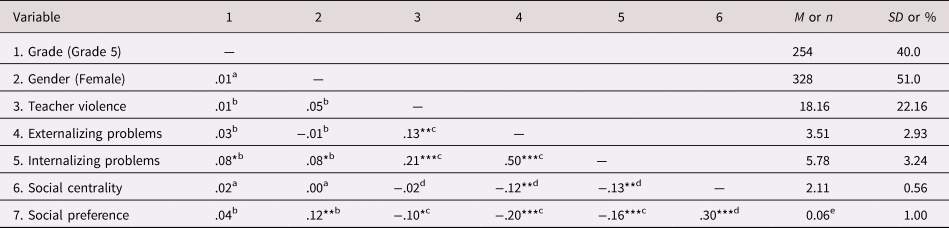
In total, 95.5% (n = 614) of the children experienced at least one event of teacher violence in the past month. Regarding mental health problems, 17.4% (n = 112) and 54.9% (n = 353) exceeded cut-off values for externalizing problems and internalizing problems, respectively. Table 1 presents the descriptive statistics and bivariate correlations.
Descriptive statistics and intercorrelations

Note. aCramer's V.
b Eta coefficient.
c Pearson correlation.
d Spearman's rho.
e Social preference scores were z-standardized for all children nominated within a class. As only the preference scores of children in our sample are reported here, the mean value deviates slightly from 0.
*p < .05. **p < .01. ***p < .001.
Social status
Analysis of the social centrality status resulted in the identification of 212 groups, including 87 fifth-grade groups and 125 sixth-grade groups. Group size ranged from 2 to 13 members (M = 5.11, SD = 2.13). The distribution of respondents on the three levels of social centrality status was as follows: 10.9% (n = 70) of students were peripheral members of their social networks, 67.4% (n = 434) were secondary members, and 21.7% (n = 140) were nuclear members. Chi2-tests revealed no differences between grades (χ2(2) = 0.95, p = .622) and gender (χ2(2) = 0.71, p = .701) in the distribution of respondents regarding the individual centrality status within the social network.
Regarding social preference status, participants on average received 2.17 (SD = 1.82) “Like most” and 2.42 (SD = 2.14) “Like least” nominations. The z-standardized difference score describing social preference had a range of 8.69 (Min = −4.86, Max = 3.83).
Mental health problems moderate the association between teacher violence and social centrality
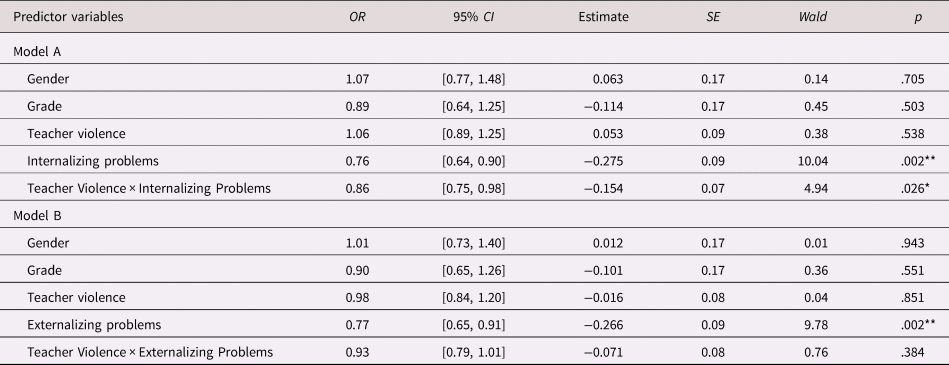
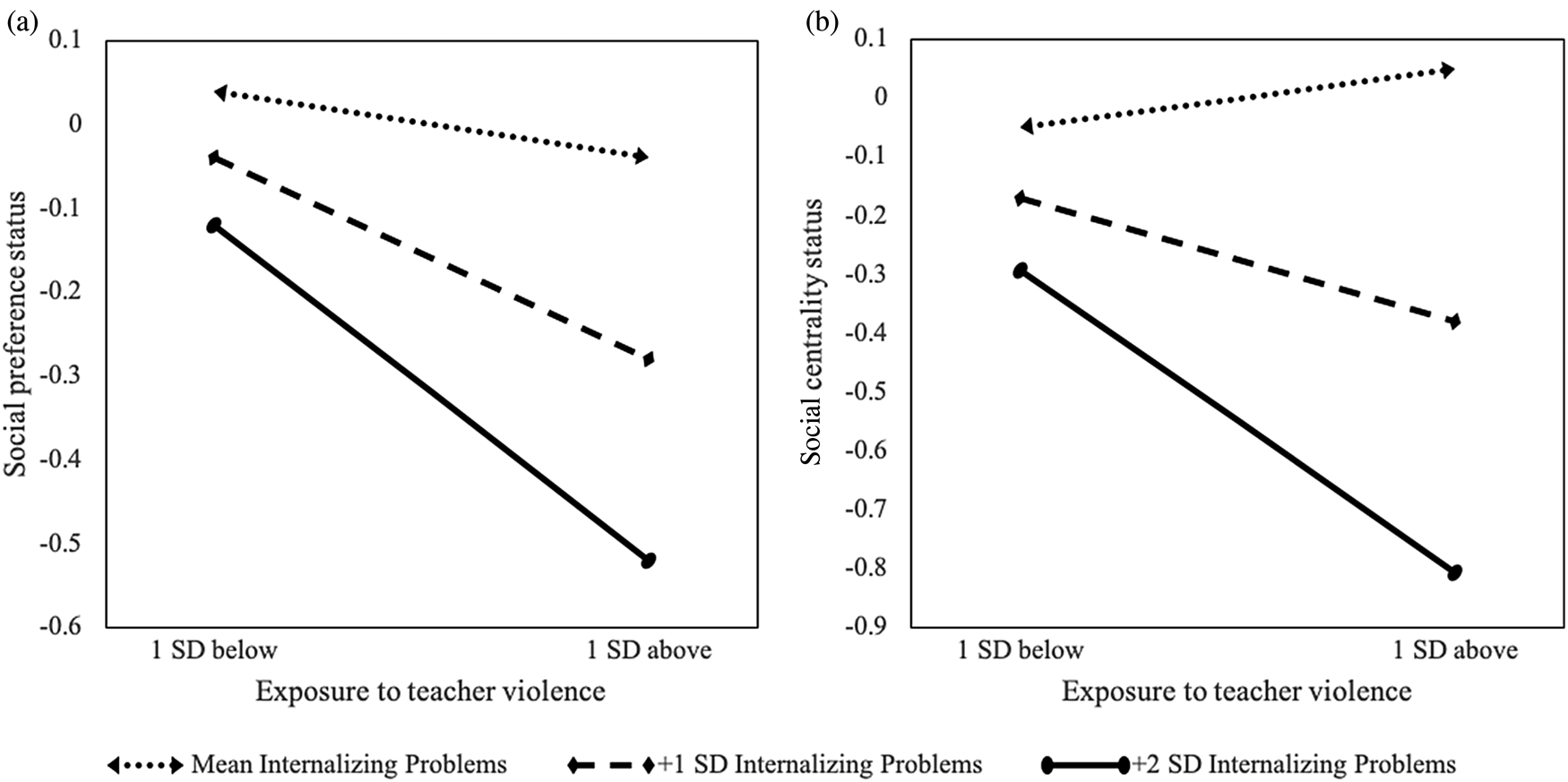
Results of the final analyses including parameter estimates are shown in Table 2. Predicting children's social centrality status with internalizing problems as moderator variable included in the model (Model A) significantly improved model fit compared to the baseline model (χ2(5) = 17.23, p < .005). The test of parallel lines was nonsignificant, retaining the assumption of proportional odds (χ2(5) = 3.67, p = .598). The regression model showed no significant main effect of teacher violence on children's social status. An increase on the internalizing problems scale was significantly associated with a decrease in the odds of having a higher social status. Testing the moderating effect of internalizing problems revealed a significant interaction between children's exposure to teacher violence and their internalizing problems (see Figure 1). Chances of higher social centrality status decreased significantly stronger for higher exposure to teacher violence with increasing internalizing problem symptoms.
Ordinal logistic regression analyses of children's social centrality status including Teacher Violence × Mental Health interactions

Note. OR = odds ratio, CI = confidence interval, SE = standard error.
* p < .05. **p < .01. ***p < .001.
Model A: Nagelkerke Pseudo R 2 = .03; Goodness-of-fit χ 2 = 1025.67, p = .643.
Model B: Nagelkerke Pseudo R 2 = .02; Goodness-of-fit χ 2 = 939.62, p = .789.
Exposure to Teacher Violence × Internalizing Mental Health Problems predicting social preference status (a) and social centrality status (b). Children with more internalizing mental health problems showed lower levels of social preference status and lower chances of higher social centrality status in association with higher exposure to teacher violence.

The investigation of the moderating effect of externalizing problems on the relation between teacher violence and children's social centrality status showed a similar pattern concerning the observed odds ratios. The overall model (Model B) fulfilled the assumption of proportional odds (χ2(5) = 2.11, p = .834) and was statistically significant (χ2(5) = 11.76, p < .005). While no significant main effect of teacher violence on children's social status was found, a significant decrease in the odds of having a higher social centrality status for every unit increase in externalizing problems was observed. The model, however, did not show a significant interaction between children's exposure to teacher violence and their externalizing problems.
Mental health problems moderate the association between teacher violence and social preference
In a first step, the two regression models included children's exposure to teacher violence and externalizing problems or internalizing problems. In addition, children's gender and class were included as control variables. In a subsequent step, the interaction terms between teacher violence and mental health problems were entered into the regression models. The final linear regression models are presented in Table 3.
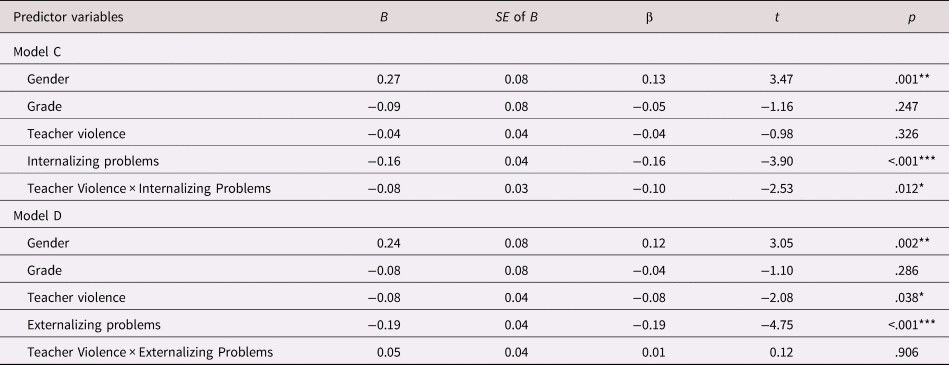
Linear regression analyses of children's social preference status including Teacher Violence × Mental Health Interactions

Note. B = unstandardized regression weight, SE = standard error, β = standardized regression weight.
* p < .05. **p < .01. ***p < .001.
Model C: adjusted R 2 = .05; F(5, 637) = 7.81, p < .001, f 2 = 0.06.
Model D: adjusted R 2 = .05; F(5, 637) = 7.65, p < .001, f 2 = 0.05.
The final regression model, including internalizing problems as a moderator variable (Model C), explained 5% of the variability of social preference status. While internalizing problems were independently associated with lower levels of social preference status, no significant independent association was observed for the exposure to teacher violence. The model revealed a significant negative interaction between exposure to teacher violence and internalizing problems in predicted children's social preference status. Children with more internalizing problems showed lower levels of social preference status in response to higher levels of violence exposure (see Figure 1). Adding the interaction term of exposure to teacher violence and internalizing problems signifantly improved the model by ΔR = .02 (F(1, 637) = 6.41, p = .012, f 2 = 0.02).
Using externalizing problems as a moderator variable resulted in a regression model (Model D) explaining 5% of the variability of social preference status. Children's exposure to teacher violence and their externalizing problems were independently associated with lower social preference. The interaction term between children‘s exposure to teacher violence and externalizing problems was not significant. In both models, female gender was associated with higher social preference status. Whether children were enrolled in Grade 5 or 6 did not show significant associations with social preference status.
Post-hoc analysis: Children's social status and academic performance
Additional to our main analyses, we calculated post-hoc bivariate correlation analyses between students’ grade point average (GPA) and social status, in order to facilitate the interpretation of our findings regarding the current cultural context (see below). The analyses revealed significant positive associations between academic performance and social preference (r = .27, p < .001) as well as academic performance and social centrality (r = .17, p < .001).
Discussion
The present cross-sectional study investigated the association between experiences of teacher violence and children's social status in a society where teacher violence is highly prevalent. Our findings offer new insights and uniquely take children's mental health problems into consideration. First, our results primarily showed that teacher violence was not related to children's social centrality status and only inconsistently to children's social preference status. This means that, contrary to our hypothesis, experiencing more violence at school was only partly associated with lower levels of social status if no other variables were considered. Second, children's mental health problems, however, were independently related to lower social status. Finally, internalizing mental health problems negatively moderated the relation between teacher violence and social status.
Associations between teacher violence and social status
Regarding the association between teacher violence and children's social status, our results are inconsistent with previous studies, in so far as research from countries with low prevalence of school violence have consistently shown a direct negative relation between school violence and the social status of children (e.g., de Bruyn et al., Reference de Bruyn, Cillessen and Wissink2010; Sentse et al., Reference Sentse, Dijkstra, Salmivalli and Cillessen2013). However, school violence in these studies predominantly encompassed peer violence and did not take teacher violence into account. Further reason for the discrepancies with existing research might be the extremely violent school climate in the current study. In accordance with previous studies from Tanzania (Hecker et al., Reference Hecker, Goessmann, Nkuba and Hermenau2018), virtually all children in the present sample experienced teacher violence in the past month. Our results suggest that if all children experience violence albeit to a varying degree, drawing conclusions about children's attributes and characteristics on the basis of the experience of violence alone is impeded. In other words, in extremely violent school environments, the exposure to violence is no longer a distinguishing feature by itself and therefore has limited independent relations to the social status of children.
The role of mental health problems
Illustrating the importance of mental health for social status, we found significant negative moderating effects of internalizing problems on the relation between teacher violence and children's social status. As expected, children who experienced teacher violence and showed higher levels of internalizing problems had significantly lower social preference and social centrality status than those with comparatively fewer internalizing problems. Generally, this is consistent with research on internalizing problem disorders, which report that internalizing problems are associated with deficits in social interactions, such as social withdrawal and low social participation (Hirschfeld et al., Reference Hirschfeld, Montgomery, Keller, Kasper, Schatzberg, Möller and Bourgeois2000). The results are also in accordance with previous analyses of social networks regarding negative implications of internalizing problems for children's social centrality and preference status (e.g., Kwon & Lease, Reference Kwon and Lease2007). Corresponding to findings from a longitudinal study on peer acceptance, our results suggest grave consequences stemming from internalizing problem symptoms in relation with violence exposure for children's establishment of healthy peer relationships (Kochel, Ladd, & Rudolph, Reference Kochel, Ladd and Rudolph2012).
In the present study, externalizing problems did not significantly moderate the relation between teacher violence and children's social status. Nonetheless, we found that externalizing problems were independently associated with lower levels of social preference as well as with lower levels of social centrality, supporting the idea of mental health problems as a contributing factor for children's lower social status in highly violent school environments. This is surprising insofar as, according to literature, externalizing problem symptoms usually manifest in lower levels of social preference but in higher levels of social centrality (e.g., Cairns et al., Reference Cairns, Gariepy, Kindermann and Leung1997). Moreover, a particularly wide range of studies has described the relation between aggressive behavior and social status, with the frequent conclusion that aggressive behavior is used to exercise social dominance and enhance social status (e.g., Ellis & Zarbatany, Reference Ellis and Zarbatany2007). However, since most studies investigating social centrality originate from Western countries (i.e., Europe, North America), it may be that social centrality is attributed to a different mix of behavior styles in other contexts depending on relevant cultural conditions. In contrast to Western countries, Tanzanian society can be characterized by a collectivistic rather than an individualistic culture (Hofstede, Reference Hofstede2011). This means that social cohesion and community belonging are essential, and the development of behavior is influenced by these norms. As a consequence, behavior (e.g., respect, cooperation) complying with these cultural norms is highly esteemed in Tanzanian society (Jukes et al., Reference Jukes, M., Gabrieli, Mgonda, Nsolezi, Jeremiah, Tibenda and Bub2018). However, though the importance of social status for children's social developmental achievements (socioemotional adjustment, stable self-concept, academic competence) has also been shown in collectivistic cultures (e.g., Chen & Chen, Reference Chen and Chen2019), it remains still unclear how cultural norms influence the role of social status during development. Further research on this is needed, particularly from collectivistic cultures.
Development and appraisal of behavior may be further influenced by the stark contrast between the limited access to education and its importance for later life in Sub-Saharan Africa (Majgaard & Mingat, Reference Majgaard and Mingat2012). In Tanzania, school enrolment rates are high for the first years of primary school, but then fall drastically towards the entry to secondary school (Lewin, Reference Lewin2009). Nevertheless, the level of education is strongly associated with desired future outcomes like reduced risk of poverty and better health care (Majgaard & Mingat, Reference Majgaard and Mingat2012). In the Tanzanian context, educational achievement and performance can be seen as critical opportunities to overcome the prevailing cycle of poverty (Majgaard & Mingat, Reference Majgaard and Mingat2012). Similar to collectivistic norms, educational attainment may therefore be a fundamental value that is promoted from childhood to adulthood throughout society. In fact, asked for their values and aspirations, Tanzanian youths placed great importance on the values of integrity, wealth, and work, while reporting education as their priority life aspiration (Awiti & Orwa, Reference Awiti and Orwa2019). Children's behaviors that correspond to these values are particularly respected and rewarded in society, including among peers. For instance, social responsibility competencies (e.g., obedience, respect, discipline) were seen as central for success in life and in school, and were most valued by Tanzanian teachers, parents, and students (Jukes et al., Reference Jukes, M., Gabrieli, Mgonda, Nsolezi, Jeremiah, Tibenda and Bub2018). Moreover, in the current study, post-hoc analyses between students’ GPA and social status revealed significant positive correlations between academic performance and social preference as well as academic performance and social centrality, supporting the hypothesis of a specific relevance of educational attainment in the Tanzanian society. Conversely, externalizing problem behaviors are incongruous with collectivistic norms and societal values and moreover jeopardize future life chances. Thus, compared to Western countries, these behaviors yield lower benefits and may not exert social dominance and social centrality in the Tanzanian context. Our results correspond with previous literature concluding that the development and appraisal of behavior underlies cultural differences (Jukes et al., Reference Jukes, M., Gabrieli, Mgonda, Nsolezi, Jeremiah, Tibenda and Bub2018; Hofstede, Reference Hofstede2011); however, further investigations are required to test this hypothesis.
Limitations
To our knowledge, this is the first study to examine the association between teacher violence and children's social status in a school environment where violence is the norm. For the first time, mental health is included as an additional influencing factor, enabling the explanation of interrelations between children's exposure to teacher violence, social status, and mental health. Implementation of a multi-informant approach, including self-reports and peer nomination measures, reduced self-reporting bias and strengthened the reliability and validity of the data. Nevertheless, the present study is not free of limitations. First, the cross-sectional study design did not allow us to draw conclusions of causality. The direction of the relation between the variables could be reversed, with social status and mental health problems actually determining the levels of exposure to teacher violence. Research suggests bi-directional relations, whereby continuous exposure to school violence can be seen both as a cause and a result of children's mental health problems and lower levels of social status (Sentse et al., Reference Sentse, Dijkstra, Salmivalli and Cillessen2013). In the current setting, the effect of teacher violence on children's psychological and social adjustment may predominate, since teacher violence is partially institutionalized, deeply embedded in societal beliefs, and universally experienced by children and thus can only be influenced to a limited extent by children's individual attributes. Moreover, previous longitudinal research suggests causal effects of violence on mental health problems, but did not indicate effects of children's attributes (e.g., aggressive behavior) on later exposure to violence (Berlin et al., Reference Berlin, Ispa, Fine, Malone, Brooks-Gunn and Brady-Smith2009). Further prospective studies are, however, necessary to clarify links of causality and directionality in extremely violent school settings. Because extremely violent school settings are associated with a generally highly violent climate in society and the risk for multiple victimization in other contexts (Nkuba et al., Reference Nkuba, Hermenau, Goessmann and Hecker2018a; Ssenyonga, Muwonge, & Hecker, Reference Ssenyonga, Muwonge and Hecker2019), future studies may also take children's exposure to violence in other contexts into account (e.g., in the family, by peers). Furthermore, although our study design and sampling method in principle allow the generalization of results for primary school children in Tanzania, the use of the peer nomination measure limits this generalization. Immensely large class sizes (>80 students) led to the omission of several classes, and a nonnegligible proportion of students, from our initial sample. In excluding classes with respondent ratios below 50%, we followed proven requirements of the Social Cognitive Mapping technique to ensure the validity of our measurement of social status. Here, achieving the highest possible data validity limited the representativity of our final sample. Due to our multi-informant approach (i.e., self-reports and peer nominations), we can exclude the possibility of similar response patterns caused only by self- and mono-report bias, therefore the relatively small proportion of explained variability of the children's social status in our regression models is not very surprising. Furthermore, associations of mental health problems were consistent across the analyzed constructs and statistically significant results were found despite the use of different measurement methods and different sources of information.
Implications and future research
This study offers initial empirical evidence on mechanisms that may be underlying the relation between teacher violence and social status in extremely violent school environments. Future research that replicates these findings and more closely examines the psychological and social consequences of teacher violence for affected children is highly needed. The interrelations between teacher violence, mental health, and social variables are of importance for interventions to address societal and cultural beliefs and effectively curtail institutionalized violent behavior. We support earlier studies in their call and contribution for effective interventions to reduce teacher violence in schools in Sub-Sahara Africa (Kaltenbach, Hermenau, Nkuba, & Hecker, Reference Kaltenbach, Hermenau, Nkuba and Hecker2018; Nkuba, Hermenau, Goessmann, & Hecker, Reference Nkuba, Hermenau, Goessmann and Hecker2018b).
Conclusions
Our findings do not invalidate teacher violence as an important contributor to children's social deficits but rather highlight the negative association between teacher violence and children's social status in interaction with children's mental health problems. Our results paint a bleak picture, particularly for children who not only experience teacher violence in their daily life but also show emotional and behavioral problems. The present study suggests that the association between teacher violence and children's social status in societies where violence is the norm may differ from the relation observed in previous studies from high-income and low-violence societies.
Supplementary Material
The supplementary material for this article can be found at https://doi.org/10.1017/S095457942000228X.
Acknowledgments
We are grateful to the Daimler and Benz Foundation for funding this project. Much appreciation goes to Leonard Masatu, Yusuf Salawati, Upendo Mwakitalu, Mabula Nkuba, Laura Hinze, and all the teachers, parents, and students who participated in this study. We acknowledge their devotion to make this study a success.
Financial Statement
This research was funded by the Daimler and Benz Foundation (32-03/18).
Conflicts of Interest
None