Oil and dynastic rule have led to an idiosyncratic pattern of state formation in the Gulf, and in few parts of the state are the idiosyncrasies more pronounced than in the security sector. Oil income has allowed the ruling families of the Gulf Cooperation Council (GCC) to engineer a relatively soft, rent- and patronage-based authoritarianism characterized by multiple centers of power and huge institutional redundancies. Having constructed their police and military forces along these lines, their monarchical rule has become more resilient, but their armed forces also more hapless.
GCC armed forces tend to be fragmented for two main reasons. First, and similar to some of the Arab republican regimes, ruling elites have historically built up rival security forces and an “army to watch the army” to reduce the risks of a military takeover. Officers from outside the ruling family planned a number of coups during the 1960s and 1970s, but none of the plots got very far. Second, and more specific to the GCC, ruling elites have in important instances created parallel military institutions for the purpose of satisfying the ambitions of different members and factions of the ruling family. This follows a broader pattern of state building in which rulers have tended to settle conflicts and build alliances within the ruling family by creating new institutions, positions, and sources of patronage, including outside of the security sector. This not only has led to a cumulative and redundant state-building process that has stabilized dynastic rule but also has imposed great long-term costs and made policy coordination in important areas difficult.Footnote 1 Of course, ruling families have also expanded into the military apparatuses of some Arab republics, notably, Syria, Yemen, and (oil-rich) Libya. But resources to support the full-fledged emergence of parallel militaries have been more limited, and the family networks to be served have been less expansive.
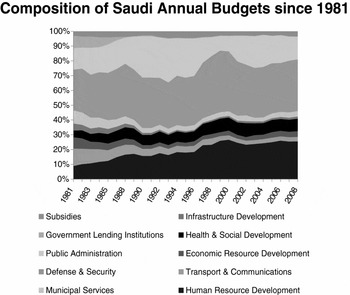
In Saudi Arabia, the current set-up of parallel security agencies dates back to the final phase of the struggle between King Saʿud and Crown Prince Faysal in 1962 and 1963. When Faysal emerged as the victor, he rewarded his senior allies in the ruling family with the Ministry of Defense and Civil Aviation, the Ministry of Interior, and the National Guard. In the course of rapid state growth in the 1970s, all three emerged as veritable “states within the state,” developing not only parallel security forces but also parallel infrastructures in housing, education, and health. The princes in charge repeatedly sparred over budgetary allocations and tried to ensure that none of their rivals would gain a technological edge. Procurement and military planning were accordingly incoherent. The three institutions are still controlled by, respectively, the same prince who acceded to office in 1962, a full brother of the 1962 incumbent, and a son of the 1963 incumbent. The Ministry of Interior alone reportedly employs 750,000 individuals and was granted another 60,000 “military” positions in March 2011, when King Abdullah issued a number of expansionary job-creation and welfare decrees. The use of the term “military” in the context of an agency tasked with domestic security and police work is striking. The share of royally controlled security agencies in total state spending has been consistently high and protected through all economic crises, offering scope for patronage employment as well as rent income in the course of procurement (Fig. 1). Hundreds of princes are employed throughout the armed forces according to firsthand accounts.
Saudi annual budgets since 1981.

The situation in most other GCC countries is similar. Military budgets are huge, the security forces often fragmented and shot through with informal patronage, and senior ranks include many members of the ruling families. Levels of centralization differ somewhat, however. After Dubai opted to disband its own military, UAE forces have been unified under the command of Abu Dhabi's crown prince Mohammad bin Zayed, and Oman—a state in some ways built around the security forces—has fewer ruling family members in the security forces and the state apparatus more broadly than other Gulf states. GCC security forces have come to include a number of small, crack divisions over the decades. More broadly, however, military employment has often been used as a tool of patronage rather than of capacity building. In some cases, armies have been kept deliberately weak and unprofessional. Archival records on the Saudi military in the 1960s and 1970s report low levels of motivation and training and—in contrast to most non-GCC regimes—limited social status associated with military employment. The officer corps’ “new middle class” ethos that led to successful military coups in other Arab countries seems not to have taken hold on the Arabian peninsula, where most commoner officers remain subordinate clients of individual princes.
Reluctance to give the military social prominence has also led GCC regimes to largely forego conscription despite repeated debates on the issue. GCC militaries are neither vanguards nor “people's armies” but rather large, passive, and dependent clienteles of individual regime figures. That GCC regimes have never been led by military elites might explain not only the relatively low levels of coercion with which most of them rule their populations but also the secondary status of their militaries. The size of GCC military budgets only underlines the focus on patronage rather than efficiency, as the focus is on acquiring high-tech expensive equipment rather than training. Arms purchases have often been a function of rent seeking by different family camps and have served to buy military protection from the exporting countries rather than to build up operational capacity that would rival that of the GCC's more populous neighbors. The UAE has recently worked on seriously improving its military capability but is hampered by its thin demographic base. By contrast, the military of Saudi Arabia, a populous country of 19 million nationals, is said to have stagnated, as reflected by its lackluster performance during the 2010 and 2011 campaign on the Yemeni border.
As the age of the military coup seems to have passed in most of the Arab world, and the GCC–U.S. security alliance has come under some strain, GCC ruling elites might seek to build more effective and unified national militaries. For the time being, however, they are hampered by an institutional legacy from a time when “coup-proofing,” ruling family politics, and patronage employment were the predominant motives shaping their armed forces.