Familial clustering of muscular ventricular septal defects is unusual, despite the fact that such defects are encountered at a rate of 53.2 per 1000 live births.Reference Roguin, Du, Barak, Nasser, Hershkowitz and Milgram1 The isolated ventricular septal defect is the most common congenital cardiac malformation. It accounts for one quarter to one half of all cases of congenitally malformed hearts.Reference Anderson, Baker and Macartney2 The lesion is usually said to be of multifactorial aetiology, and although there is a genetic component in its origin, it has been rare to find the defect running in families, with all types of isolated defects being considered as single entities in older studies. The embryological mechanisms underscoring formation of muscular, perimembranous, doubly committed, and atrioventricular septal defects are markedly different. The reported risk for recurrence of a congenital cardiac lesion in siblings of a proband with ventricular septal defect has varied from 0.9 to 4.2 percent.Reference Nora and Nora3 The rate of recurrence in offspring of males and females with all types of congenital cardiac defects ranges between 2.2 and 6.5 percent, with females having the higher risk.Reference Nora and Nora4–Reference Sanchez-Cascos6 To date, therefore, the reported risk of recurrence of a ventricular septal defect has been less than in other lesions. In the study performed by Corone and his colleagues,Reference Corone, Bonaiti, Feingold, Fromont and Berthet-Bondet7 which examined all congenital cardiac defects, concordant lesions were found in just under half of affected first degree relatives, and in just over one-quarter of affected second and third degree relatives. There was no concordance, however, for ventricular septal defects. Modern studies using echocardiography for diagnosis have detected a high incidence of small muscular ventricular septal defects present in the neonate, but with the likelihood of spontaneous closure.Reference Roguin, Du, Barak, Nasser, Hershkowitz and Milgram1, Reference Anderson, Baker and Macartney2 It may well be, therefore, that the lack of precise diagnosis in the past may have accounted for some of the anomalies in incidence and recurrence.
Not surprisingly, first cousin marriages have produced a significant risk of recurrent ventricular septal defect,Reference Khalid, Ghina and Fadi8 suggestive of recessive inheritance. In contrast, there have been only rare reports of non-consanguineous families with ventricular septal defect.Reference Czeizel and Meszaros9 We report here a family in whom there appears to be dominant Mendelian inheritance of muscular ventricular septal defects, together with the association of a rare symptomatic aneurysm of the muscular interventricular septum.
Presentations of the cases
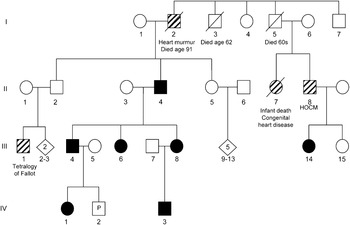
The first sibling, who was the older brother, and is identified as III 4 in Figure 1, was diagnosed with a ventricular septal defect in 1974. At five weeks of age, he was failing to thrive and was in congestive heart failure. Chest radiography demonstrated cardiomegaly with marked pulmonary plethora. The electrocardiogram showed left ventricular dominance. Cardiac catheterisation confirmed a left-to-right shunt at the ventricular level, with a ratio of pulmonary to systemic flows of 3.7 to 1. The pulmonary arterial pressures were elevated, at 65 over 28 millimetres of mercury, with a mean of 45 millimetres of mercury. He underwent banding of the pulmonary trunk. He was also found to have persistent patency of the arterial duct, which was ligated. At 21 months of age, he had cyanosis, early clubbing, and poor appetite. Repeat cardiac catheterisation showed reversal of the shunt and a tight pulmonary arterial band. A large intramuscular ventricular septal defect was confirmed at surgery, and this was successfully closed with a Dacron patch. At the same time the pulmonary trunk was debanded. He had an uneventful post-operative recovery He remained totally asymptomatic, and was discharged from the clinic after 21 years follow-up.
The family genealogic tree. Squares represent males and circles females. Black symbols show individuals with ventricular septal defects; hatched symbols show individuals with some other form of congenital heart disease. Abbreviations: CABG: coronary arterial bypass graft; HOCM: hypertrophic obstructive cardiomyopathy.

The next sibling, the middle sister, identified as III 6 in Figure 1, was seen in the neonatal period. She had three muscular ventricular septal defects and a perimembranous defect. All defects closed spontaneously over 23 years, with formation of an aneurysm of the membranous septum. She was discharged from the clinic at 23 years of age.
The third sibling, the youngest sister, identified as III 8 in Figure 1, was noted to have a cardiac murmur shortly after birth, and an echocardiogram revealed a muscular ventricular septal defect, along with an interatrial defect in the floor of the oval fossa. She thrived and was asymptomatic, so was initially managed conservatively. A diagnostic cardiac catheterisation at two years of age confirmed the presence of ventricular and atrial septal defects, with normal pulmonary vascular resistance, and with a ratio of pulmonary to systemic flows of 2 to 1. Successful direct closure of three muscular ventricular septal defects, and the atrial septal defect, was performed at five years of age. She was discharged from the clinic after 18 years follow-up. She underwent caesarean section for premature birth at 26 weeks gestation almost 20 years after her corrective surgery.
The baby, identified as IV 3 in Figure 1, was shown to have several small muscular ventricular septal defects and an aneurysm of the atrial septum on echocardiography. He thrived, and the defects had closed spontaneously within 1 year.
The daughter of the first described sibling, shown as IV 1 in Figure 1, had been followed antenatally because of an unusual appearance of the muscular ventricular septum and a small right ventricle as detected on fetal ultrasound. A postnatal echocardiogram showed an aneurysm of the muscular ventricular septum with impaired left ventricular function, but with no evidence of obstruction of the right ventricular outflow tract. She thrived initially, but at four weeks of age she was reviewed because of a cyanotic episode. Examination was unremarkable, apart from a faint third heart sound. Chest radiography showed marked cardiomegaly with diversion of venous blood from the upper lobes, suggestive of a degree of left ventricular failure. A cardiac magnetic resonance study showed a dilated left ventricle with global hypokinesia and paradoxical motion of a markedly thinned and mobile ventricular septum, with aneurysmal formation. There was no delayed gadolinium enhancement. At cardiac catheterisation, there was no evidence of a coronary arterial anomaly. She underwent successful resection of the muscular septal aneurysm, with direct closure. Histology showed septal endocardial fibroelastosis, with a very thin and scarred septum. The post-operative course was uneventful, and there was improvement in her left ventricular function. She remains well at 2 years follow up. During the second pregnancy of the first sibling, identified as III 4 in Figure 1, prenatal ultrasound revealed no evidence of ventricular septal defects in the male fetus, shown as IV 2 in Figure 1.
The father of the previously described three siblings, identified as II 4 in Figure 1, underwent a screening echocardiogram recently at 59 years of age. It demonstrated a closed apical muscular ventricular septal defect. There was no previous clinical diagnosis, and he remains asymptomatic.
A paternal cousin, shown as III 1 in Figure 1, was born with tetralogy of Fallot and underwent surgical correction in 1976. He had replacement of his pulmonary valve for severe pulmonary incompetence 23 years later.
A distant paternal cousin, shown as III 14 in Figure 1, had clinical and echocardiographic evidence of muscular ventricular septal defects, during routine screening in infancy. She remains asymptomatic after eight years follow up. Her father, shown as II 8 in Figure 1, was diagnosed in childhood with hypertrophic cardiomyopathy. He remains asymptomatic on appropriate treatment after a follow up lasting 42 years. He also had a sister, II 7 in Figure 1, who died in infancy from complex congenital cardiac disease.
There are no other documented affected family members. This family has no consanguinity, but both the maternal and the paternal lines originated from Denmark. No evidence of 22q11 deletion has been found using fluorescent insitu hybridisation in the patients identified as IV 1 and III 8 in Figure 1.
Discussion
Although there is a high incidence of muscular ventricular septal defects at birth,Reference Roguin, Du, Barak, Nasser, Hershkowitz and Milgram1 it is suggested that up to nine-tenths of these will close within a period of 1 to 10 months. For decades, attempts have been made to ascertain the risk of recurrence of ventricular septal defects, regardless of their anatomical site, in the offspring of affected parents. Early data revealed a risk for first degree relatives at 5%, with a higher risk if the affected parent was the mother.Reference Nora and Nora4, Reference Nora and Nora5 The risk for relatives of males with ventricular septal defects has been quoted at 0.9%.Reference Sanchez-Cascos6 A cumulative rate of prevalence for ventricular septal defects of 1.72% was found in siblings of patients with isolated ventricular septal defects in two populations from Hungary.Reference Czeizel and Meszaros9 This was 11.5 times higher than the prevalence at birth of 1.5 per 1000 total births quoted for isolated ventricular septal defects in Hungary during the period of the study, which was from 1965 to 1974. When 238 families with congenital heart disease, made up of 202 families with two affected members, and 36 families with more than two affected members, were studied for two affected members having the same defect, there was a low rate of concordance for those with ventricular septal defects.Reference Corone, Bonaiti, Feingold, Fromont and Berthet-Bondet7
Concordance of ventricular septal defects has also been studied in identical twins, and this was less than 1 in 10 in the early data.Reference Newman10 More recent data, from the Korean Twin Registry, revealed that concordance was higher in like sex than opposite sex twins.Reference Sung, Cho and Cho11 The risk of recurrence for ventricular septal defects was calculated at 41.2 for like-sex twins, and 19.8 for opposite sex twins.Reference Sung, Cho and Cho11 Although information was lacking concerning zygosity, the numbers of like and opposite sex twins suggest that approximately three-quarters of the same sex twins were monozygous, and hence the increased risk of recurrence could reflect increased genetic homogeneity in the same sex twins.
Analysis of the data from the Baltimore – Washington Infant study showed that the familial aggregation of congenital cardiovascular malformations in families of probands with ventricular septal defects was closely associated with race, with an indication of increased risk in relatives of non-white patients.Reference Maestri, Beaty, Liang, Boughman and Ferencz12, Reference Maestri, Beaty and Boughman13 The National History Study showed an occurrence rate of 2.9% of congenital heart disease, with a predominance of ventricular septal defects, in children of subjects who also had ventricular septal defects. This was higher when compared with children of those having aortic and pulmonary stenosis.Reference Driscoll, Michels and Gersony14 Consanguinity was also shown to be associated with an increased risk of ventricular septal defects in two studies from the Middle East.Reference Khalid, Ghina and Fadi8, Reference Nabulsi, Tamim, Sabbagh, Obeid, Yunis and Bitar15
The data presented so far indicates that autosomal dominant or recessive patterns of inheritance cannot be attributed to the genetic aetiology for ventricular septal defects when no anatomical location is specified. Families with several affected siblings with muscular ventricular septal defects are rare, and we could only identify three other reports of familial clustering of muscular ventricular septal defects. NoraReference Nora16 reported a family in which two unaffected sisters, with three affected siblings, produced only affected children. SzaboReference Szabo17 studied a Kurdish family, with no known consanguineous marriages. In one sibship, five of ten siblings were affected. In the second sibship, from a maternal cousin, three of the five siblings were affected. None of the parents were diagnosed with ventricular septal defects. In these reports, however, the ventricular septal defects were diagnosed clinically in the era prior to availability of echocardiography, and therefore the anatomic location of the defects was not specified. More recently,Reference Cymbron, Anjos, Cabral, Macedo, Pereira Duarte and Mota-Vieira18 two familial clusters of ventricular septal defects were described in the Azores Islands. This region has a high incidence of ventricular septal defects, at 3.49 per 1000 live births, and the highest level of consanguinity in Portugal. One family had three first cousins born with muscular ventricular septal defects, with one patient also having pulmonary stenosis. In the second family, three children had ventricular septal defects, albeit in unspecified locations.Reference Cymbron, Anjos, Cabral, Macedo, Pereira Duarte and Mota-Vieira18 To our knowledge, therefore, ours is the first report of long term follow-up of familial clustering of muscular ventricular septal defects.
A congenital aneurysm of the muscular ventricular septum is also a rare condition, with only 16 cases reported of which we are aware.Reference Fasoli, Della Valentina and Scognamiglio19–Reference Baspinar, Karaaslan, Oran, Baysal and Keles30 Familial clustering has previously been described in 4 families.Reference Chen, Rigby and Redington20, Reference Eriksson, Cooper, Rosenbaum and Ruckmann25, Reference Fujiwara, Sase, Kondou and Furukawa27, Reference Donofrio, Allen, Tekin and Bodurtha29 Only one other child underwent surgery for excision of the septal aneurysm.Reference Prabhakar, Kumar, al-Oufi, DeMoor, al-Halees and Duran22 Such aneurysms, however, have been described as early as 26 weeks gestation.Reference Fujiwara, Sase, Kondou and Furukawa27–Reference Donofrio, Allen, Tekin and Bodurtha29 A histopathological report on a human embryo, obtained at termination of an extrauterine pregnancy, also described a muscular ventricular septal defect due to lack of trabecular fusion at 6 weeks gestation, indicating that muscular defects can be present early in fetal life.Reference Wenink31
Our particular family shows a high incidence of congenital cardiac disease consistent with autosomal dominant inheritance. There is no evidence of 22q11 deletion.Reference Beauchesne, Warnes and Connolly32 Mutations in the GATA4 gene, which encodes a transcriptional factor with a critical role in cardiogenesis, TBX5 mutations, known to cause Holt-Oram syndrome, mutations of NKX2-5, associated mainly with defects in the oval fossa and patent oval foramens, and mutations of CRELD1, known to cause atrioventricular septal defects,Reference Gelb33 have recently been associated with congenital cardiac malformations. The association of the GLI gene with ventricular septal defect has been suggested,Reference Qiu, Gong and He34 but the exact type of defect was not specified.
Suppression subtractive hybridization has been used to analyse changes in gene expression in myocardial biopsies obtained from 10 patients with ventricular septal defects, and from 10 volunteers with normal hearts.Reference Zhang, Zhou and Yang35 These studies showed 551 unique genetic changes, with 299 genes upregulated, and 252 genes downregulated in the patients with ventricular septal defects. These genes were involved in processes such as energy metabolism, the cell cycle and cell growth, cytoskeletal formation, cellular adhesion, gene regulation via LIM proteins and zinc finger proteins, and development. The authorsReference Zhang, Zhou and Yang35 postulated that ventricular septal defect is a multigenic disorder, albeit with poorly understood basic mechanisms. Our present report, showing a strong familial occurrence of muscular ventricular septal defects and other congenital cardiac defects, lends support to the autosomal dominant pattern of inheritance. Screening of the immediate family members, therefore, is indicated. The family described was negative for 22q11.2 deletion. The association with other congenital cardiac defects, such as tetralogy of Fallot, hypertrophic cardiomyopathy, and congenital aneurysm of the muscular ventricular septum, suggests a spectrum of clinical presentations for the same genetic predisposition. The apparent lack of familial cases with muscular ventricular septal defects in the past probably relates to a high tendency for these defects to close spontaneously. When this occurs, a careful echocardiographic study may identify the site of the previous muscular ventricular septal defect. After the birth of two affected children, the family was counselled that the recurrence risk was about 1 in 6. On examination of the extended family history and with more sophisticated diagnostic techniques, it became clear that the possibility of autosomal dominant inheritance should be considered, and the risk of any affected person having an affected child is likely to be 1 in 2. In addition, the nature of the defect in the affected relatives is quite variable, and a mildly affected parent may have a more severely affected offspring.
We have presented, therefore, an unusual familial clustering of muscular ventricular septal defects with apparent autosomal dominant inheritance. Future genetic research into familial clusterings like ours will shed further light on the pattern of inheritance and potential candidate genes for this common congenital cardiac malformation.
Acknowledgement
We thank Dr Robert Justo, who cares for the children identified as III 14 and IV 1 in Figure 1.