INTRODUCTION
Schistosomiasis is a snail-borne neglected parasitic disease which affects over 207 million people in 76 countries, with a further 779 million people at risk of infection (Steinmann et al. Reference Steinmann, Keiser, Bos, Tanner and Utzinger2006). Schistosomiasis japonica, caused by the infection of the blood fluke Schistosoma japonicum (Platyhelminthes: Trematoda), is mainly endemic in the People's Republic of China, the Philippines and parts of Indonesia (Engels et al. Reference Engels, Chitsulo, Montresor and Savioli2002; Zhou et al. Reference Zhou, Bergquist, Leonardo, Yang, Yang, Sudomo and Olveda2010). In China, the disease was historically endemic in 12 southern provinces (Chen and Feng, Reference Chen and Feng1999). The control efforts since the 1950s have achieved a remarkable reduction in the prevalence of the infection and the disease burden among humans (Engels et al. Reference Engels, Wang and Palmer2005; Utzinger et al. Reference Utzinger, Zhou, Chen and Bergquist2005; Zhou et al. Reference Zhou, Wang, Chen, Wu, Jiang, Chen, Zheng and Utzinger2005), and historically, the strategy to control the transmission of S. japonicum in China has shifted three times: disease elimination strategy through snail control (1950s to early 1980s), morbidity control strategy based on chemotherapy (mid 1980s to 2003) and integrated control strategy (since 2004) (Collins et al. Reference Collins, Xu and Tang2012). However, schistosomiasis japonica remains a current major public-health concern in China, which is one of the highest priorities in communicable disease control defined by the central government (Zhou et al. Reference Zhou, Wang, Chen, Wu, Jiang, Chen, Zheng and Utzinger2005). Currently, about 0·7 million people living in China are thought to have this disease (Zhou X. N. et al. Reference Zhou, Guo, Wu, Jiang, Zheng, Dang, Wang, Xu, Zhu, Wu, Li, Xu, Chen, Wang, Zhu, Qiu, Dong, Zhao, Zhang, Zhao, Xia, Wang, Zhang, Lin, Chen and Hao2007), and the intermediate host Oncomelania hupensis (Gredler, 1881) is still present in numerous areas covering a total of 3·73 billion m2 (Zheng et al. Reference Zheng, Zhang, Zhu, Xu, Li, Guo, Xiao and Zhou2012). As the transmission of this neglected tropical disease is governed by the geographic distribution of O. hupensis, control of this snail, as a major part of the National Schistosomiasis Control Program of China, has been implemented in attempts to interrupt the transmission of the disease (Zhou, Reference Zhou2005; Wang et al. Reference Wang, Utzinger and Zhou2008, Reference Wang, Guo, Wu, Chen, Wang, Zhu, Zhang, Steinmann, Yang, Wang, Wu, Wang, Hao, Bergquist, Utzinger and Zhou2009; McManus et al. Reference McManus, Li, Gray and Ross2009).
Many approaches have been used in attempt to control the intermediate host snails in China, including environmental modification, physical methods, tree building, molluscicide treatment and biological control (Yuan et al. Reference Yuan, Xu, Dong, Jiang and Zhu2005), in which molluscicide treatment is the most widely used method for snail control due to wide application coverage, easy procedure and fast action (Yang et al. Reference Yang, Sun, Hong, Zhu, Yang, Gao and Zhou2012). Since the 1950s, many chemicals have been screened and evaluated for molluscicidal actions in the laboratory, and some agents have been used for snail control in the schistosomiasis-endemic field of China, including sodium pentachlorophenol, calcium cyanamide, metaldehyde, niclosamide and META-Li (Zhu et al. Reference Zhu, Yao and Bao1999, Reference Zhu, Zhou, Zhang, Zhang, Liu, Lu, Cai, Ni, Cao and Wu2006; Zhou et al. Reference Zhou, Ma and Huang2002; Wu et al. Reference Wu, Yang, Zhang and Ge2006). However, most of these chemicals are no longer used due to high cost, a comparatively low efficacy and heavy environmental pollution (Zhou, Reference Zhou2005). Currently only one chemical molluscicide, niclosamide, is acceptable for operational use in snail control programmes (WHO, 1992); however, the agent suffers from the problem of being difficult to dissolve in both water and organic solvents.
Since 1992, when the World Bank Loan Project for Schistosomiasis Control was initiated in China, a novel formulation of niclosamide, a 50% wettable powder of niclosamide ethanolamine salt (WPN) was introduced and has replaced other molluscicides to become the only molluscicide used for snail control in the endemic field of China (Xianyi et al. Reference Xianyi, Liying, Jiming, Xiaonong, Jiang, Jiagang, Xiaohua, Engels and Minggang2005). WPN is recommended by the Ministry of Health, the People's Republic of China at a dose of 1 mg L−1 for snail control in the field (MOH, 2000). Following extensive, long-term, repeated use for more than 2 decades, the likelihood of emergence of niclosamide resistance in the intermediate host snails has received much attention (Cao et al. Reference Cao, Wang, Zhang, Tian, Zhu, Zhang, Yao, Jin and Yang2012). Therefore, a systematic survey of the sensitivity to niclosamide in O. hupensis is of great significance to assess the molluscicidal actions of niclosamide in the endemic field and monitor the emergence of niclosamide-resistant snail populations. This study was therefore designed, in the laboratory, to evaluate the molluscicidal activities of WPN against O. hupensis sampled from 20 counties of 10 schistosomiasis-endemic provinces in China in 2012 and compare them with those determined in the same sampling sites in 2002, so as to investigate the likelihood of resistance to niclosamide in O. hupensis snails.
METHODS
Study area and snail populations
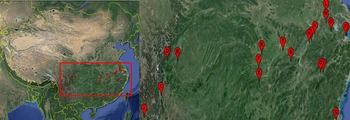
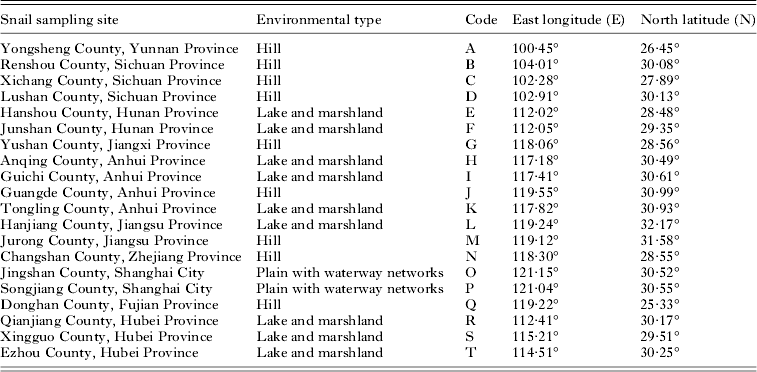
Adult O. hupensis snails were sampled by individual picking with forceps (Mao, Reference Mao1990), from snail habitats in 20 counties of 10 schistosomiasis-endemic provinces of China during the period from 7 April through 7 May 2012 (Table 1, Fig. 1). After feeding in the laboratory for 24 h, active adult snails with 7–8 spirals were randomly grouped for the evaluation of molluscicidal activity in the laboratory.
The sampling sites of Oncomelania hupensis snails in China. The O. hupensis snails used for molluscicidal tests were collected from 20 counties of 10 provinces in China, including Yongsheng County of Yunnan Province, Renshou, Xichang and Lushan counties of Sichuan Province, Hanshou and Junshan counties of Hunan Province, Yushan County of Jiangxi Province, Anqing, Guichi, Guangde and Tongling counties of Anhui Province, Qianjiang, Xingguo and Ezhou counties of Hubei Province, Hanjiang and Jurong counties of Jiangsu Province, Changshan County of Zhejiang Province, Jingshan and Songjiang counties of Shanghai City and Donghan County of Fujian Province.

Location and environmental types of the snail sampling sites in China

Drug solutions
WPN was kindly provided by the Nanjing Essence Fine Chemical Co., Ltd (Nanjing, China; lot number: 1012031). WPN was weighed and solutions of 1, 0·5, 0·25, 0·125, 0·063, 0·032, 0·016 and 0·008 mg L−1 of niclosamide were prepared with dechlorinated tap water for the subsequent experiments.
Laboratory evaluation of molluscicidal activity
One hundred-millilitre flasks were filled with the solutions, 10 active adult snails transferred to each and the flasks covered with gauze to prevent their escape. Snails in flasks of dechlorinated water without drug treatment served as controls. After being immersed for 24 and 48 h at 25 °C, the snails were washed with dechlorinated water and fed for a further 48 h. Those suspected of being dead were tested by the knocking method (Gönnert, Reference Gönnert1961; Webbe, Reference Webbe1961), and the snail mortality was estimated. All tests were performed in triplicate, and the median lethal concentration (LC50) was calculated.
Comparison of molluscicidal activity of WPN to that determined in 2002
In April and May 2002, O. hupensis snails were collected from 37 sampling sites in 33 counties of 10 Chinese provinces using a stratified random sampling method, to evaluate their response to WPN. After 24-h feeding in the laboratory, active adult snails, with 10 snails in each drug concentration, were immersed in WPN at concentrations of 1, 0·5, 0·25, 0·125, 0·063, 0·032, 0·016 and 0·008 mg L−1 for 24 and 48 h at 25 °C, and the molluscicidal tests were performed in triplicate. The LC50 values were then calculated (Dai et al. Reference Dai, Zhou, Liang, Zhang, Jiang, Xi, Huang, Chen, Huang and Zhu2002a ). To test the concern about reduced sensitivity of O. hupensis to niclosamide, the LC50 values of WPN for O. hupensis snails estimated in this study were compared with those determined in the 20 same sampling sites in 2002.
Ethics statement
The study protocol was approved by the Scientific Steering Committee and Ethics Review Committee of Yunnan Institute of Endemic Diseases Control (permission number: 2012-01), Sichuan Provincial Centre for Disease Control and Prevention (permission number: ERC2012-11), Hunan Provincial Institute of Parasitic Diseases (permission number: 2012-01), Zhejiang Academy of Medical Sciences (permission number: SSERC2012-20), Jiangxi Provincial Institute of Parasitic Diseases (permission number: 2012-05), Anhui Provincial Institute of Parasitic Diseases (permission number: 2012-01), Jiangsu Institute of Parasitic Diseases (permission number: [2012]05), Shanghai Municipal Centre for Disease Control and Prevention (permission number: ERC2011-57), Fujian Provincial Centre for Disease Control and Prevention (permission number: 2011-127) and Hubei Provincial Centre for Disease Control and Prevention (permission number: [2012]-05). All field surveys did not involve endangered or protected species.
Statistical analysis
All data were double-entered into a Microsoft Excel database version 2007 (Microsoft Corporation; Redmond, WA, USA) and all statistical analyses were performed using the statistical software SPSS version 17.0 (SPSS Inc.; Chicago, IL, USA). The difference in the sensitivity to WPN in the O. hupensis snails sampled from various sites was tested for statistical significance with analysis of variance (ANOVA), while comparison of the WPN LC50 values for O. hupensis between 2002 and 2012 was performed with Student's t-test. A P value <0·05 was considered statistically significant.
RESULTS
LC50 values of niclosamide for O. hupensis
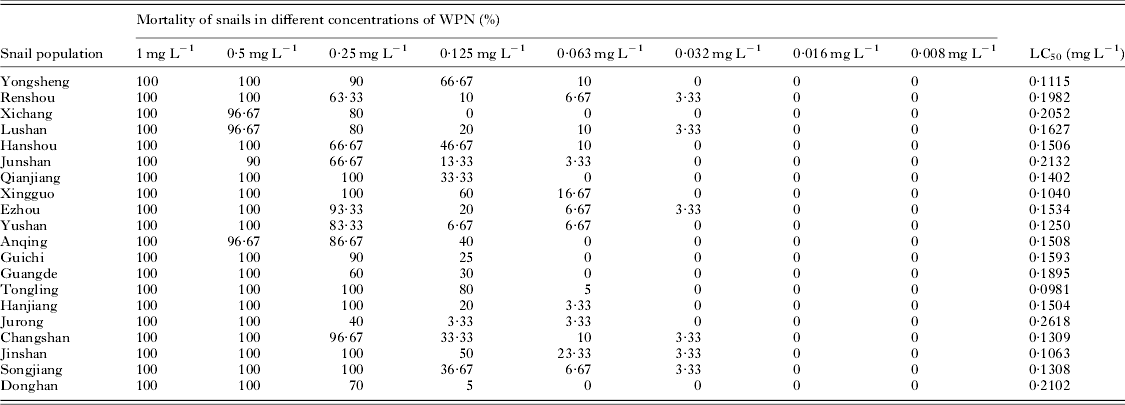
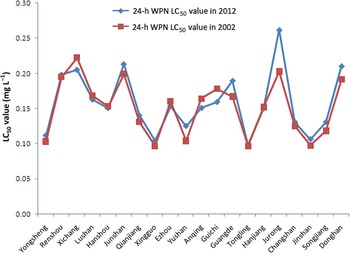
All field-derived O. hupensis snails were dead following immersion in 1 mg L−1 WPN for 24 h, whereas no death was observed after immersion in 0·008 or 0·016 mg L−1 WPN for 24 h. Immersion in 0·5, 0·25, 0·125, 0·063 and 0·032 mg L−1 WPN for 24 h resulted in 90–100%, 40–100%, 0–80%, 0–23·33% and 0–3·33% mortalities of snails, respectively (Table 2). The 24-h WPN LC50 values for the O. hupensis snails derived from 20 sampling sites in China ranged from 0·0981 to 0·2618 mg L−1, and no regional variation was detected by ANOVA (P>0·05).
Mortality rates and LC50 values of Oncomelania hupensis snails sampled from different regions of China following immersion in various concentrations of WPN for 24 h

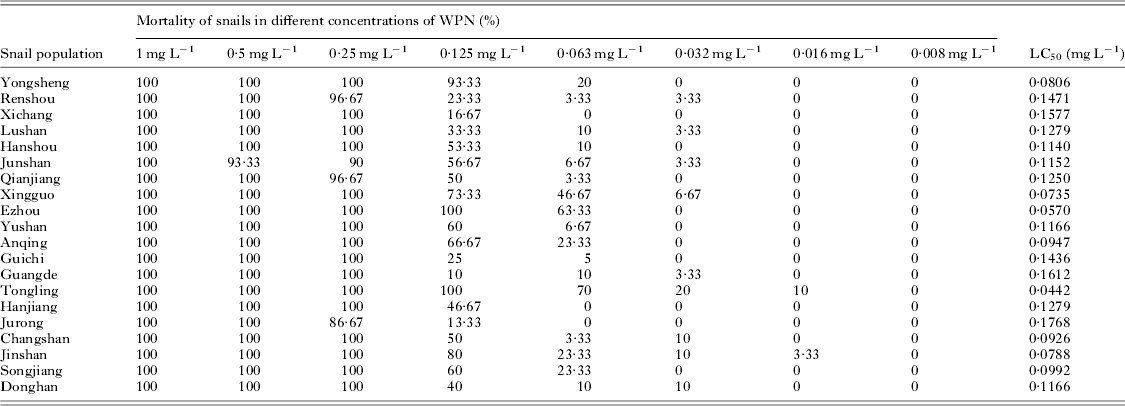
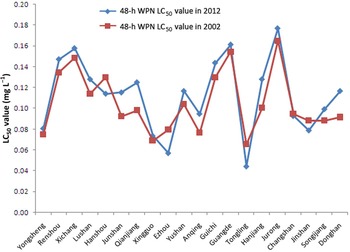
Nearly all snails were dead following immersion in 0·5 (except the snails sampled from Junshan of Hunan province) and 1 mg L−1 WPN for 48 h, whereas all snails were alive following immersion with 0·008 mg L−1 WPN for 48 h. Immersion in 0·25, 0·125, 0·063, 0·032 and 0·016 mg L−1 WPN for 48 h resulted in 86·67–100%, 10–100%, 0–63·33%, 0–20% and 0–10% mortalities of snails, respectively (Table 3). The 48-h WPN LC50 values for the O. hupensis snails derived from 20 sampling sites in China ranged from 0·0442 to 0·1768 mg L−1, and ANOVA revealed no regional variation (P>0·05).
Mortality rates and LC50 values of Oncomelania hupensis snails sampled from different regions of China following immersion in various concentrations of WPN for 48 h

Difference in niclosamide LC50 values between 2002 and 2012
There was a minor variation in the 24-h LC50 values of WPN for the O. hupensis snails derived from the same 20 sampling sites estimated between 2012 and 2002 (Fig. 2); however, no significant difference was observed (P = 0·202). Similarly, the 48-h WPN LC50 values varied in the O. hupensis snails between 2012 and 2002 (Fig. 3); however, no significant difference was detected (P = 0·796).
Comparison of 24-h WPN LC50 values for O. hupensis between 2002 and 2012. The 24-h WPN LC50 values for O. hupensis in all 20 sampling sites in 2012 were compared with those determined in 2002, and no significant difference was detected (P = 0·202), revealed by Student's t-test.

Comparison of 48-h WPN LC50 values for O. hupensis between 2002 and 2012. The 48-h WPN LC50 values for O. hupensis in all 20 sampling sites in 2012 were compared with those estimated in 2002, and no significant difference was observed (P = 0·796), detected by Student's t-test.

DISCUSSION
Oncomelania hupensis (Gredler, 1881) is the only intermediate host of S. japonicum, which causes schistosomiasis endemic in the Far East, and especially in mainland China. Epidemiological studies have shown that O. hupensis largely determines the geographical range of the parasite (Zhou, Reference Zhou2005). The snail O. hupensis can be separated phenotypically into a ribbed-shelled morphotype, with its distribution restricted to the marshland and lake region and plain region along the middle and lower reaches of the Yangtze River, and smooth-shelled morphotypes which are only detected in mountainous regions (Li et al. Reference Li, Wang, Yang, Liu, Wang, Zhang, Wu, Guo, Bergquist and Zhou2009; Zhao et al. Reference Zhao, Jiang, Littlewood and Nie2010). The snails from different regions are found to vary in morphology, genetic, physiological and biochemical characteristics, and various subspecies have been differentiated (Davis et al. Reference Davis, Zhang, Guo and Spolsky1995; Wilke et al. Reference Wilke, Davis, Chen, Zhou and Zeng2000; Zhou Y. B. et al. Reference Zhou, Yang, Zhao, Wei and Jiang2007; Li et al. Reference Li, Wang, Yang, Liu, Wang, Zhang, Wu, Guo, Bergquist and Zhou2009; Zhao et al. Reference Zhao, Jiang, Littlewood and Nie2010). In addition, it is reported that niclosamide treatment results in varied molluscicidal activities in different endemic foci (Yang et al. Reference Yang, Sun, Hong, Zhu, Yang, Gao and Zhou2012). It is still unknown whether such a variation is attributable to the snail populations or reduced niclosamide susceptibility following repeated, extensive use of the agent for more than 2 decades in China. Therefore, there is an urgent need to assess the current molluscicidal activities of niclosamide against O. hupensis snails in regions where since it is the only commercially available chemical it is widely used, and test the concern about the resistance to niclosamide in O. hupensis.
Our findings showed that no field-derived O. hupensis snails survived the 24- or 48-h treatment with 1 mg L−1 WPN, the currently recommended dose for snail control in the endemic field, and nearly all snails (except the snails sampled from Junshan of Hunan province) were dead following immersion in 0·5 mg L−1 WPN for 48 h. The results from this study demonstrate that the molluscicidal activity of niclosamide against O. hupensis is still high in the main endemic areas of China. In addition, the 24-h WPN LC50 values for the O. hupensis snails derived from 20 sampling sites in China ranged from 0·0981 to 0·2618 mg L−1, and the 48-h LC50 values between 0·0442 and 0·1768 mg L−1. Although the LC50 value of WPN varied in the O. hupensis snails from different regions, no regional variation was detected (both P values >0·05), revealed by ANOVA. Compared with the WPN LC50 values determined in the same 20 sampling sites in 2002, no significant differences were found in the 24- and 48-h LC50 values of WPN for O. hupensis snails (P = 0·202 and 0·796). This finding further demonstrates no reduced sensitivity to niclosamide in O. hupensis snails detected in mainland China.
Many factors have been reported to affect the efficacy of molluscicidal treatment in the endemic field, including temperature, sunlight, snail habitats, soil content, operational skills, as well as the brand, quality and concentration of the chemical (Paulini, Reference Paulini1958; Oliveira-Filho et al. Reference Oliveira-Filho, De-Carvalho and Paumgartten1999; Zhou, Reference Zhou2005). In laboratory tests, the temperature, molluscicide solution volume and the duration of snail breeding in the laboratory are found to affect the molluscicidal actions of niclosamide against O. hupensis snails (Zhang et al. Reference Zhang, Dai, Huang, Xi and Jiang1999; Dai et al. Reference Dai, Zhang, Jiang, Xi, Yang and Liang2002b , Reference Dai, Liang, Zhang, Xu, Li and Zhu2003). A study to evaluate the sensitivity to niclosamide of O. hupensis snails sampled through a year showed no significant differences in the 24- and 48-h WPN LC50 values for the snails sampled at various months, with minor fluctuations observed (Li et al. Reference Li, Xing, Li, Qu, Wang, Wei, Liang and Dai2012). In addition, 10 snails in each drug concentration are considered to be an optimum quantity for molluscicidal tests in the laboratory (Dai et al. Reference Dai, Xi, Liang and Zhang2002c ). In the present study, the snails were collected within a month to reduce the effect on the molluscicidal test, and 10 snails were assigned to each dose group for evaluating the molluscicidal actions. Our findings showed that the sensitivity to niclosamide varied in snail populations sampled from 20 sites of China; however, no regional variation was detected in the 24- and 48-h WPN LC50 values for O. hupensis snails, which was consistent with previous studies (Dai et al. Reference Dai, Zhou, Liang, Zhang, Jiang, Xi, Huang, Chen, Huang and Zhu2002a , Reference Dai, Li, Wang, Xing, Qu and Liang2014). Further studies are required to investigate the mechanisms underlying the wide fluctuation in the LC50 values of WPN for O. hupensis snails.
The present study shows that the current sensitivity of niclosamide against O. hupensis has not changed after more than 2 decades of repeated, extensive use in China. This is important information for both the public health workers and health policymakers in the field of schistosomiasis control, considering that niclosamide, currently the only chemical available for snail control, plays an essential role in the current Chinese National Schistosomiasis Control Program of China. Currently, a unique WPN regimen (spraying at a dose of 1 mg L−1) is recommended for field snail control in China (MOH, 2000). It is therefore suggested that the dose of molluscicides should be appropriately adjusted based on the actual field conditions, so as to maximize the efficacy of molluscicidal treatment, and simultaneously reduce resource consumption and environmental pollution.
In conclusion, the current efficacy of niclosamide against O. hupensis snails appears satisfactory in China, and no evidence of niclosamide resistance in O. hupensis is detected in China. However, it does not mean that resistance cannot develop or that the response of O. hupensis snails to niclosamide has no regional variation. We, therefore, should not reduce our vigilance to the possible emergence of niclosamide resistance in the intermediate host snails. A dynamic monitoring of the sensitivity to niclosamide in O. hupensis seems justified, which would be of great significance for the prevention, reduction and active management of niclosamide-resistant snail populations, as well as for the elimination of schistosomiasis japonica in China.
FINANCIAL SUPPORT
This work was supported by the National Important Sci-Tech Special Projects [2012ZX10004-220], the Natural Science Foundation of China [81071379], the Jiangsu Province's Outstanding Medical Academic Leader Programme [LJ201132], Jiangsu Department of Health [X201103] and Jiangsu Government Scholarship for Overseas Studies [JS-2012-130].
CONFLICTS OF INTEREST
The authors have declared that no competing interests exist.
AUTHOR CONTRIBUTIONS
JRD, WW and YSL conceived and designed the study; JRD, YZL, WW, YTX and GLQ conducted the study. JRD and YZL collected the data and performed analysis of data. WW prepared the first draft of the manuscript; YSL provided strategic advice and assisted with editing of the manuscript. All authors read and approved the final version of the manuscript.