Introduction
Party switching has a pejorative connotation in many countries. In South Korea, a politician who switches parties is referred to as a cheolsae (migratory bird); in Indonesia, such politicians are known as kutu loncat (jumping fleas). Frequent party switching is believed to undermine effective representation of citizen interests in democracies (Chang, Reference Chang2007; Cox and McCubbins, Reference Cox and McCubbins1993; S. W. Desposato, Reference Desposato2006). Parties promise to represent the interests of social groups and individuals in the election, and politicians aim to keep their party's promises to avoid punishment in the next election (Dahl, Reference Dahl1998; Powell, Reference Powell2000). Thus, in order for citizens to hold their representatives accountable for delivery of promised policies, it is necessary to have politicians loyal to their parties so that they are bound to the party promises. Where legislators often switch to other parties, voters have greater difficulty finding reliable representatives who will consistently stand for their interests.
Why, then, do some legislators tend to switch parties frequently – a decision that may ultimately weaken citizen support for democracy – while others tend to stay put? I argue that voters' demands for local/individual benefits, or pork, and legislators' lack of access to resources for such benefits are likely to lead the legislators to switch parties in order to improve their electoral chances in the following election.
The ultimate goal of legislators is to get reelected (Mayhew, Reference Mayhew1974). Thus, scholars of political science often link prospects for party switching to politicians’ ambitions to win the subsequent election. For example, politicians are more likely to switch to other parties where voters desire pork rather than national public policies, insofar as switching allows for better access to resources (S. W. Desposato, Reference Desposato2006; Kato, Reference Kato1998; Reed and Scheiner, Reference Reed and Scheiner2003). In addition, strong party discipline (Heller and Mershon, Reference Heller and Mershon2008) or a large ideological distance between legislator and party (S. W. Desposato, Reference Desposato2006; Nokken, Reference Nokken2000) can drive politicians to leave their party in order to better respond to the demands of their constituents. Changes in the economy can also increase the likelihood of switching parties in that a bad economy could harm the governing party members’ electoral chances (Zielinski et al., Reference Zielinski, Slomczynski and Shabad2005). Lack of access to resources for pork (S. Desposato and Scheiner, Reference Desposato and Scheiner2008; S. W. Desposato, Reference Desposato2006; Kamath, Reference Kamath1985; Kasuya, Reference Kasuya2005) or lack of local electoral support advantages (Kato, Reference Kato1998) often lead politicians to switch parties for better access to resources, as well. Finally, candidate-centered electoral institutions that encourage politicians to cultivate a personal vote tend to foster party switches because the cost of switching parties is relatively low in those institutions (Carey and Shugart, Reference Carey and Shugart1995; Chang, Reference Chang2007; Heller and Mershon, Reference Heller and Mershon2005, Reference Heller and Mershon2009).
This paper focuses in particular on two causal factors – voter demands and party access to resources – as an explanation for party switching by legislators. First, voter demands are a first-order concern for politicians and underlie other potential explanations for party switching. For instance, whether or not the ideological distance between a legislator and his/her party affects the odds of switching parties depends on what type of benefits the constituents desire. Where constituents prefer pork to national public policies, ideology may play no role; rather, access to resources for pork may be more critical to a legislator's electoral success (S. W. Desposato, Reference Desposato2006). Moreover, where voters desire policy, they tend to vote for a party that promises to deliver those policies, and it is thus likely that party leaders impose strong party discipline on rank-and-file party members in order to get necessary bills passed in the legislature. Thus, contrary to Heller and Mershon (Reference Heller and Mershon2008), who argue that strong party discipline leads politicians to leave their parties, it may be that the importance of party discipline for delivering promised policies keeps politicians tied to their parties. Hence, whether party discipline affects party switching is also a function of voter demands.
Second, interaction between voter demands and party access to resources influences politicians’ choices to switch parties or stay put. Whether a party controls access to resources for pork should matter little to legislators where voters desire policy; it matters most to legislators where voters desire pork. Naturally, in the pork-oriented context, it is expected that legislators whose parties lack access to the pork pipeline will have strong incentives to switch parties (S. W. Desposato, Reference Desposato2006). This implies that legislators in parties with access to resources should have little incentive to switch parties irrespective of voter demands, because switching parties would not help them improve electoral chances in a policy-oriented context, not to mention in the pork-oriented context.
In this paper, I test the impact of interaction between voter demands and party access to resources on the frequency of party switching in a new democracy in Asia, South Korea. In South Korea, because control over pork allocation is centralized with the president, the expectation is that opposition party legislators who are elected from less-developed districts – where voters tend to desire pork over policy – will be more likely to switch parties in an effort to gain access to state resources, whereas opposition party legislators elected from more-developed districts – where voters tend to desire policy over pork – will be less likely to leave their current party. In addition, the president's party legislators who are already granted access to the pork pipeline are expected to be more likely to stay put, regardless of voter demands. Finally, independents who lack both access to resources for pork and legislative support to deliver policy should be more likely to join a party (change party affiliations), irrespective of the demands of constituents.
I rely on party affiliation data for all Korean legislators from the 13th National Assembly, beginning shortly after the first democratic legislative election of April 1988, through the 17th National Assembly, which concluded in April 2008. Studying party switching among South Korean legislators offers two advantages. First, since a regional party system dividing the country primarily into Gyeongsang, Jeolla, and Chungcheong provinces has been established since the transition to democracy in 1987, South Korea provides us with the opportunity to test the effects of voter demands and party access to resources on the behavior of politicians where electoral competition is based primarily on geographic divisions. Conventional wisdom says that Korean legislators from Gyeongsang, Jeolla, and Chungcheong are highly loyal to their parties because getting endorsed by the regional champion party is of critical importance in winning the subsequent election (Choi, Reference Choi2002; Kang, Reference Kang2003; G.-Y. Lee, Reference Lee1998). Where voters want their representatives to deliver local and individual benefits, however, opposition party legislators may want to switch from their regional party to the president's party in order to gain access to state resources. Hence, we can observe how interaction between voter demands for pork and access to resources influences politicians’ choice to either switch parties or to stay put in a setting where loyalty to the regional party plays an important role in garnering votes.
Second, since the South Korean National Assembly keeps a record of the dates of party switches by legislators, an event history analysis can be conducted. Most existing studies rely on binary outcome variables – whether or not a party switch occurs between elections, for example. That approach, however, lacks information regarding the number of parties with which each legislator is affiliated and for how long the legislator stays with each party between elections. Since the event history model in this paper tracks the number of parties and the length of stay within each party, it generates insights into party switching behavior that go beyond those of binary models.
The paper proceeds as follows. First, I present a brief sketch of party switchers (cheolsae) in the South Korean National Assembly. In the following section, I articulate a theory to explain how voter demands and party access to resources affect the politician's decision to switch parties or stay put. In section 3, I describe the appropriateness of the Cox proportional hazards model for explaining individual party switching and introduce the data and measures used in the study. In section 4, I test hypotheses and present results, which suggest that where constituents desire pork over policy, opposition politicians are more likely to switch to the president's party in an effort to gain access to government resources. I discuss the findings and conclude in section 5.
1. Party switchers in the South Korean National Assembly, 1988–2008
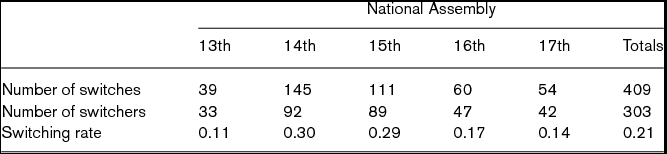
Despite the fact that party switching is condemned by most voters, approximately 21% of South Korean legislators have switched parties since the 13th National Assembly (1988–1992). Table 1 shows the party switching rate in each National Assembly (hereafter NA).
Party switching rates in the South Korean National Assembly
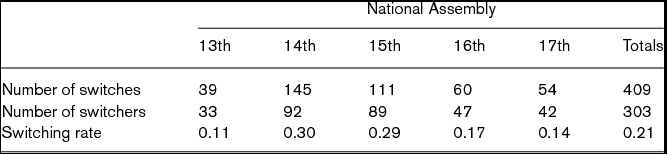
Party switching reached its peak in the 14th NA (1992–1996), where 30% of legislators switched parties; a clear downward trend in switching rates began thereafter. The inverse correlation with national prosperity suggests right away that switching parties hardly improves the legislators’ electoral chances as more voters become well-off and well-educated, and thus more likely to desire public policies rather than individual/local benefits. I revisit this trend below after data analysis.
The low switching rate during the first democratically elected NA – just 11%, a sharp contrast to the 30% rate during the subsequent NA and to the 29% rate of the 15th NA – is likely a function of a merger of three parties during the 13th NA. In 1990, two opposition parties, Kim Young-sam's Reunification Democratic Party and Kim Jong-pil's New Democratic Republican Party, joined the president's party, the Democratic Justice Party, and formed a new large governing party, the Democratic Liberal Party. Thus, potential individual party switchers, who otherwise may have switched to one of the alternative parties, were absorbed into the new large party through the mergers.
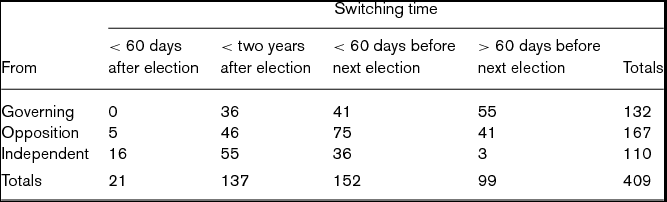
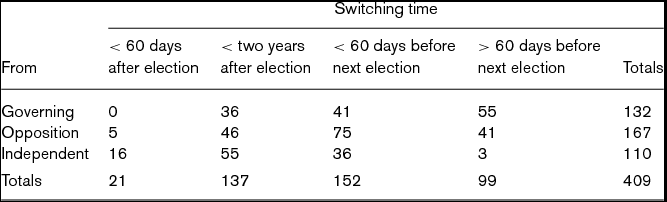
When, precisely, did South Korean legislators switch parties during each National Assembly? Parliamentary cycles may affect the pattern of party switching. For example, office benefits tend to drive party switching in the earlier period of a legislative term, while vote-seeking incentives should be the primary cause of switching parties near the next election (Mershon and Shvetsova, Reference Mershon and Shvetsova2008). Table 2 summarizes the timing of party switching by the Korean legislators. In a four-year term, about 5% (21 out of 409) of all party switches took place within the first 60 days after an election, while about 24% of switches were made within 60 days before the next election. More importantly, the table illustrates a different pattern in switching timing according to the legislators’ original party affiliations. Sixteen independents joined parties within 60 days after an election, whereas no governing party legislators switched parties during that immediate post-election period.Footnote 1 Furthermore, 41.7% (55 out of 132) of party switchers from the governing party or coalition to alternative parties made their switches within 60 days prior to the next election; most failed to receive endorsement from the governing party for the upcoming election, and thus sought to run for reelection as independents or as opposition party candidates. Conversely, just 24.6% of those from opposition parties and only 2.7% of independents switched their party affiliation during that same pre-election period. Instead, 44.9% of party switchers from opposition parties (75 out of 167) made switches between two years after an election and 60 days prior to the next election, and 50% of independent switchers changed affiliation between 60 days and two years after an election. This pattern suggests that legislators from the presidents’ parties or coalitions tend to stay with their parties longer than other legislators, while independents tend to join other parties earlier than their counterparts. Hence, the information about how long a legislator remains in one party should be taken into consideration in the analysis of legislators’ choices to switch parties or stay put.
Timing of party switching in the South Korean National Assembly, 1988–2008
Note: Legislators have a four-year term.
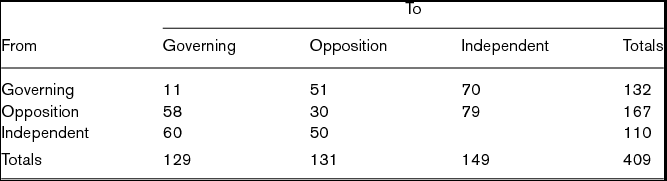
The parties that switchers tend to join are also illuminating. Since only the president's party or coalition has access to government resources, it is expected that opposition party members or independents would be likely to switch to the governing parties. Nonetheless, Table 3 seems to reveal few clear patterns in the direction of party switching in South Korea.
Direction of party switching in the South Korean National Assembly, 1988–2008
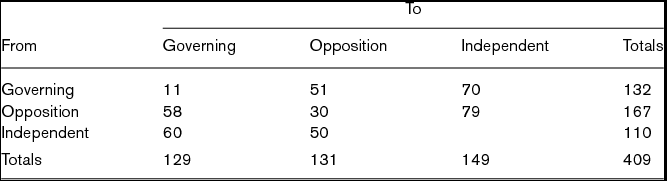
About a third of all party switches were made by governing party members. As shown in Table 2, however, most of these switches took place in the second half of their term, which indicates that some of the president's party legislators switched to an opposition party or became independents in order to affiliate with parties of strong presidential candidates or to seek party endorsement of other parties just before the subsequent elections. On the other hand, among 167 party switchers from opposition parties, only 34.7% of them switched to governing parties, while 18.0% switched to other opposition parties and 47.3% became independents.Footnote 2 Moreover, among 110 independent switchers, almost half (45.5%) joined opposition parties. This is a function of electoral cycle and the regional appeal of the Jeolla, Gyeongsang, and Chungcheong regional champion parties entrenched in the South Korean party system since the transition to democracy in 1987.Footnote 3 In other words, independents tend to join a governing party after an election, while they are more likely to join an opposition party as the subsequent election approaches.Footnote 4 Additionally, it is often as beneficial for an independent to join an opposition party that is dominant in the region as it is to join the governing party that would provide access to government resources for pork.
Except for those who became independents who are likely to join a regional party or to affiliate with the president's party earlier and with the opposition later,Footnote 5 it should be noted that 65.9% of switchers from opposition parties chose to join the president's party. Furthermore, among the 30 cases where opposition party legislators switched to other opposition parties, 14 are the cases where they joined another party to obtain party endorsement just before the next election, nine are where they switched to a larger opposition party, and seven are where they joined a regional champion party. In short, sometimes opposition party politicians switched to another opposition party because they sought party endorsement, particularly from a regional party or a party larger than the previous one, to increase their electoral chances in the subsequent election. It can be concluded, therefore, that excluding those independents and opposition party legislators who joined or switched to a regional champion party or who pursued party endorsement just before the next election, the majority of independents and opposition party legislators who ever switched parties went to the president's party in South Korea.
It is still unclear, however, why some politicians switch parties, while others do not. Subsequent sections examine the effects of voter demands and party access to resources on the politician's decision to switch parties or stay put.
2. Voter demands, access to resources, and party switching
Insofar as the principal goal of legislators is to get reelected, politicians sometimes switch to other parties because they expect their new party affiliations to benefit them in the next election, even though the decision may undermine accountability and hence weaken citizen support for democracy in the long run. The vital question, therefore, is under what conditions can switching parties help them improve their electoral chances.
To increase their electoral chances, politicians need most of all to be responsive to their constituents’ desires. Broadly speaking, there are two types of benefits that voters desire from their representatives: particularistic goods and programmatic goods (Crisp et al., Reference Crisp, Escobar-Lemmon, Jones, Jones and Taylor-Robinson2004; S. W. Desposato, Reference Desposato2006). The former are targeted to individuals (i.e., patronage in the form of money, jobs, and food) or to narrower geographic areas (pork for local projects or policies); the latter are targeted to broader segments of the population and can include national economic development plans, social welfare programs, and universal health care.
In addition to the fact that constituents in less-developed regions need more public infrastructure (S. W. Desposato, Reference Desposato2006: 71), poor, less-educated voters prefer tangible benefits because poverty gives them shorter time horizons and because individual benefits are easy to monitor, unlike programmatic goods (Scott, Reference Scott1972: 117–118). It usually takes more time to receive programmatic goods than particularistic goods, and the poor often do not want to wait for programmatic goods to be delivered. Moreover, even when they are willing to wait, the poor and less educated often have no way of telling whether promised programmatic benefits have been delivered. The information requirements for democratic monitoring are simply too high.
Where the majority of constituents are poor and less educated, and thus where they tend to desire pork and patronage, candidates who deliver such particularistic benefits should have higher chances of getting elected than those who deliver programmatic benefits. Knowing that their representatives prioritize delivering pork and patronage and that they normally deliver individual benefits to those who desire such benefits, a minority of constituents who would otherwise have preferred programmatic goods will also demand particularistic goods from politicians. Thus, in less-developed countries or districts where the majority of voters are poor and less educated, almost all voters are likely to desire that their representatives deliver individual or local benefits (Proposition 1).
In contrast, well-off and well-educated voters tend to prefer programmatic goods to particularistic goods, because ‘basic infrastructural needs have been satisfied’ in more-developed regions (S. W. Desposato, Reference Desposato2006: 71) and because wealth provides them with longer time horizons and the ability to meet the information requirements for monitoring universal benefits. Hence, they are more willing to wait until programmatic goods are delivered, and are better able to tell whether the promised programmatic benefits have been delivered, compared to the poor and less educated.
Even if all voters desire programmatic goods, however, there will be a strong incentive for any of them to seek particularistic goods, as well, because they might have the opportunity to receive particularistic goods on top of the programmatic goods – the classic collective action problem (Lyne, Reference Lyne1999). Nonetheless, at least two problems arise when politicians seek to deliver pork in this policy-centric context. First, since those well-off voters who desire programmatic goods usually reside in densely populated urbanized areas, the cost of distributing particularistic goods tends to be markedly greater than in rural areas (Cox, Reference Cox1987). Moreover, even when politicians deliver pork despite the higher cost, since political particularism harms the efficient delivery of programmatic goods (Hicken and Simmons, Reference Hicken and Simmons2008), if the majority of voters prefer to receive programmatic goods, they will sanction particularistic transactions to make the cost of such transactions greater than the benefit, which will lead everyone to demand programmatic goods. Thus, in developed countries or districts where the majority of voters are well-off and well-educated, almost all voters are likely to express a desire for programmatic goods (Proposition 2).
Voters who desire pork and patronage may want their representatives to respond to those particularistic interests rather than remain loyal to their parties. Where pork allocation is centralized in the president, parties in the president's coalition are usually granted access to the pork pipeline, while opposition party legislators and independents normally lack such access (Proposition 3). Thus, when voters desire pork and their representative's party is not a part of the president's coalition, for instance, voters may want their representative to switch to the president's party, which controls the access to state resources for pork (Proposition 3-1). In other words, voters seeking particularistic goods are likely to want their representatives to be less loyal to their party, especially when the party does not achieve power. In contrast, the president's party legislators should tend to stay put in the pork-oriented context because voters should want their representative to be loyal to the president when their representative's party is part of the president's coalition (Proposition 3-2).
On the contrary, voters who prefer to receive programmatic goods are highly likely to want their representatives to vote along party lines and to remain loyal to their parties. Since most programmatic goods (national public policies) can be delivered only through the passage of bills, which requires the support of the majority of legislators, voting coherence among party members facilitates the delivery of such goods when the party is in the majority or a part of the majority coalition. Moreover, even when a party is not a part of the majority coalition, its members are less likely to switch to a majority party in this context, since voters seem willing to vote for the party that promises preferred policies as they know that only that party can deliver the desired goods. Thus, politicians are expected to be more loyal to their parties, regardless of whether or not their parties are in the majority, in more-developed districts where the majority of voters are well-off and well-educated (Proposition 4). An exception is that independents, who often lack a stable legislative coalition, tend to join a party in order to facilitate the passage of policy bills (Proposition 4-1).
Critical to this theory of party switching is politicians' access to resources. Where pork allocation is centralized in the president, members of the president's party are highly likely to stay put regardless of the type of goods desired by their constituents because the president has access to government resources for pork if pork is desired and because switching to other parties would not improve their electoral chances if policy is desired (Hypothesis 1). Independents have difficulty delivering desired goods because they often lack access to government resources for pork or legislative support to deliver a policy, and they thus tend to join a party (that is, change party affiliations) irrespective of whether the desired goods are pork or policy (Hypothesis 2). By this logic, voter demands should have a prominent effect only on opposition party members, who would be more likely to switch to governing parties if pork is desired and less likely to do so if policy is desired. Thus, opposition party members who are elected from less-developed districts, where the majority of voters are poor and less educated and almost everyone thus desires pork, are expected to switch parties more frequently (Hypothesis 3).
To summarize these arguments:
Proposition 1: In less-developed regions where the majority of voters are poor and less educated, almost all voters tend to desire particularistic goods, or pork.
Proposition 2: Conversely, in more-developed regions where the majority of voters are well-off and well-educated, almost all voters tend to desire programmatic goods, or policy.
Proposition 3: Opposition party legislators and independents lack access to state resources for pork, whereas governing party legislators have access to the pork pipeline. Thus, where voters desire pork:
Proposition 3-1: Opposition party members and independents tend to switch parties.
Proposition 3-2: Governing party members tend to stay put.
Proposition 4: Politicians tend to stay put when they deliver policy.
Proposition 4-1: Independents tend to join a party when they deliver policy. Therefore:
Hypothesis 1: Governing party legislators are more likely to stay put, irrespective of voters’ socio-economic conditions.
Hypothesis 2: Independents are more likely to join a party, irrespective of voters’ socio-economic conditions.
Hypothesis 3: Opposition party legislators are more likely to switch parties particularly in less-developed regions.
3. Model, data, and measures
Most existing studies of party switching by legislators use logit or probit models in which the dependent variable is whether a legislator switched parties or not between elections. Hence, those binary models (similar to panel data models with two different time points) lack information about how many parties each legislator switches to and how long he/she stayed with each of those parties between elections. That information is significant because, among party switchers who change their party affiliations at least once between elections, those who switch to other parties more frequently should be regarded as more personalistic (cultivating personal reputations with constituents). For instance, if legislator A switches from Party X to Y, while legislator B switches from Party V to W to X to Y to Z, B can be said to be less tied to ideology and more personalistic than A. The binary (panel data) models, however, can hardly distinguish one from the other.
Furthermore, it is possible that a switcher returns to her original party prior to the subsequent election (e.g. Party X → Y → X). A binary model might code the legislator as a non-party switcher because he/she appears to stay with the same party in two consecutive elections. Conversely, an event history model is able to trace the change of party affiliations for each legislator within a term. Information on the length of stay with each party is also significant since those who switch parties one month after an election should be considered more inclined to frequently switch parties than those who switch two years after the election. S. W. Desposato (Reference Desposato2006) and Desposato and Scheiner (Reference Desposato and Scheiner2008) use conditional logit models in which the dependent variable is whether a legislator changes her party affiliation each month of her term, a strategy that can capture multiple party switches between elections but which nevertheless fails to incorporate information on how long the legislator stays with each party. An event history model that keeps track of the number of parties and the length of stay with each party thus constitutes an improvement on pre-existing binary panel data and conditional logit models for the study of party switching.
In this study, a legislator is considered to switch parties whenever there is a change in his/her party affiliation. Thus, if an independent joins a party or a party member becomes an independent, he/she is coded as having switched parties. Some politicians first become independents before switching to other parties to avoid public disapproval. Hence, if a legislator joins another party within 60 days after having become an independent, the short period of party independence is regarded as transitional and does not count. In addition, party mergers and splits are not considered switches; only individual choices to change affiliation count as party switching in this study.Footnote 6 I use one electoral cycle as one period of time during which a legislator chooses to stay put or switch. In total, 1,472 South Korean legislators in five time periods since the 13th National Assembly are pooled in the dataset.Footnote 7
Since the aim of this study is to analyze the effects of multiple variables on times until the event (party switching) occurs, I use a Cox proportional hazard model. Unlike the Weibull hazard model, which assumes a particular parametric form for the hazard function, the Cox model assumes no specific parametric distribution; hence, it is highly flexible and can be adapted to many types of event history data (Blossfeld et al., Reference Blossfeld, Golsch and Rohwer2007).
In the Cox model, the hazard rate for legislatori to switch parties at time t is defined as
 \[
h(t) = \frac{{\Pr _{t,t + \Delta t} (switch_{\rm i} )}}{{\Pr _{\Delta t} (switch_i )}},
\]
where Pr t,t + Δt(switchi) indicates the probability of legislatori switching parties between times t and t + Δt, and PrΔt(switchi) the probability of legislatori switching parties after time t. When modeling the hazard rate as a function of the ‘baseline hazard’ (h 0) at time t and the effects of multiple independent variablesFootnote 8
 \begin{equation}
h(t) = h_0 (t)\exp (\beta _1 x_1 + \beta _2 x_2 + ... + \beta _m x_m )\end{equation}
 \begin{equation}
\frac{{h(t)}}{{h_0 (t)}} = \exp (\beta _1 x_1 + \beta _2 x_2 + ... + \beta _m x_m )\end{equation}
Therefore, exp (βj) is the hazard rate of the jth independent variable (m ⩾ j ⩾ 1). We can measure the effects of independent variables on legislators’ choices to switch parties by looking at the change in the hazard rate for each independent variable as we change the variable value.
For the event history analysis, the dependent variable is the time for which each legislator stays with a party, which incorporates information about whether the legislator switches to another party or not. I increase the accuracy of the measurement by using days rather than months. The independent variables include voter demands, access to resources, and controls.
Voter demands and access to resources
Socio-economic status of the voter largely determines the type of voter demands, either pork or policy (S. Desposato, Reference Desposato2001; Lyne, Reference Lyne1999). I rely on the mean education level of voters in each district as a proxy for constituent demands, since less-educated voters tend to be poor and thus to prefer pork and patronage over public policies, whereas the well-educated tend to be well-off and to prefer policies over pork. Edui represents the proportion of legislator i's constituents who received tertiary education beyond high school, including college, university, and vocational schools.Footnote 9 I use district-level census data for this variable; the proportion varies in the dataset from 0.036 to 0.756, with a mean of 0.262.Footnote 10
To test the hypotheses that voter demands have a significant effect on opposition party members and little effect on governing party members and independents (Hypotheses 1 to 3), I interact the proxy for constituent demands with the legislator's party affiliation (governing or opposition party member, or independent). GovPartyi is coded ‘1’ if legislator i is with a governing party, and ‘0’ otherwise; OppPartyi is coded ‘1’ if legislator i is with an opposition party, and ‘0’ otherwise; Independenti is coded ‘1’ if legislator i is an independent, and ‘0’ otherwise. Opposition party members whose constituents desire policy over pork should be less likely to switch parties, whereas constituent demands should hardly affect the decision of governing party members and independents to switch parties. Thus, Edu*OppParty is expected to have a negative and significant effect on party switching, while Edu*GovParty and Edu*Independent are expected to have insignificant effects.
Control variables
First, because South Korea has maintained a solid regional party system since its transition to democracy in 1987, I control for the effects of regional advantages. Legislators who benefit from their regional champion parties would likely not want to switch to other parties (Nemoto, Reference Nemoto2009). Thus, I include dummy variables for the three regions, Jeolla, Gyeongsang, and Chungcheong, which have served as electoral support bases for regional parties.Footnote 11 I expect these regional dummies to have negative effects on party switching;that is, legislators elected from those three regions are less likely to switch parties.
Second, I control for electoral institutions. In South Korean legislative elections, about 80% of legislators are elected from single-member districts while the rest are elected from party lists. The party-list legislators should be less likely to switch parties because, since March 1994, they have been forced to forfeit their parliamentary memberships upon leaving their original parties. Thus, PartyListi is coded ‘1’ if legislator i was elected from a party list after March 1994, and ‘0’ otherwise. PartyList is expected to have a negative effect on party switching.
Third, days until next election/total days in term is included to control for the effects of the timing of a legislator's party affiliation. For instance, a legislator who is elected in a by-election one year prior to the next election should be less likely to switch to another party in his/her term than someone who is elected in a regular election and has four full years. Furthermore, those who switch to another party shortly before the subsequent election should be less likely to switch again. Controlling for time until the next mandatory election as a percentage of a full term of office (four years) accounts for these timing artifacts. I use actual days until the next election as a percentage of total days in the term as the control.
Finally, legislative session fixed effects are included in the model to control for unobservable factors specific to each session.
4. Empirical results
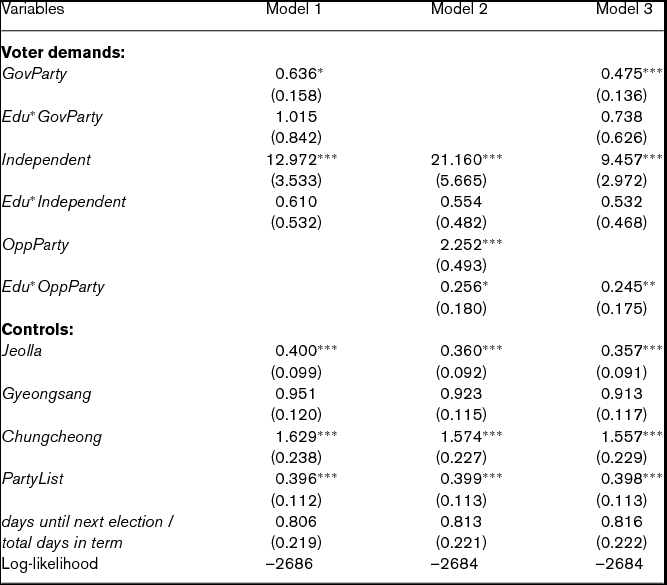
Table 4 summarizes the hazard model estimates of the effects of the aforementioned variables on the duration of legislators’ party affiliations. The null hypothesis suggests a coefficient of 1; hence, a coefficient 1.5 signifies that a one-unit increase in the independent variable raises the hazard of party switching by 50%, whereas a coefficient 0.5 indicates that a one-unit increase in the variable halves the hazard.
Hazard analysis of party switching by South Korean legislators, 1988—2008

Notes: Coefficients denote hazard ratios (h(t)). All estimates are based on 1,472 observations with legislative session dummies. Standard errors are indicated in parentheses.
***p<0.01; **p<0.05; *p<0.1.
Models 1–3 assess the effects of voter demands.Footnote 12 In order to avoid a multicollinearity problem, I exclude OppParty and Edu*OppParty from Model 1, and exclude GovParty and Edu*GovParty from Model 2. The hazard ratios in Model 1 show expected signs: being a governing party member decreases the risk of party switching by 36.4%, and the education level of constituents has little effect on this trend, suggesting that legislators with the president's party or coalition are less likely to switch parties irrespective of their constituents’ desire for pork or policy. Conversely, being an independent increases the risk of changing party affiliation by 13 times; in other words, almost all independents join a party sooner or later. Voter demands also have little effect on the decision of independents to switch or stay put. When I replace GovParty and Edu*GovParty with OppParty and Edu*OppParty in Model 2, the results confirm the hypothesis that opposition party members from more-developed regions where constituents are assumed to desire policy over pork are less likely to switch parties (since doing so would not improve their electoral chances), even though being an opposition party member itself doubles the risk of party switching. As the percentage of constituents with a tertiary education increases by 10%, the risk that an opposition party member will switch to another party decreases by 12.7%.Footnote 13
Model 3 includes the full set of independent variables.Footnote 14 The result confirms all three hypotheses: first, governing party members are less likely and independents are more likely to change their party affiliations. The risk of switching parties is 52.5% lower for governing party legislators and 945.7% higher for independents, holding other factors constant. Yet, their decisions to switch parties are unaffected by voter demands: Edu*GovParty and Edu*Independent do not have statistically significant effects on party switching (Hypotheses 1 and 2). Second, constituent demands greatly affect the decision of opposition party members to switch or stay put; the data reveal that opposition legislators from more-developed districts (where constituents are assumed to care more about policies) are less likely to switch parties, compared to those from less-developed districts (Hypothesis 3). The effects are also substantial: as the percentage of constituents with tertiary education increases by 10%, the risk that the opposition party legislator will switch to another party decreases by 13.1%, all else equal.
Lastly, among control variables, the effects of dummy variables for the three support bases of regional parties on party switching deserve close attention. Contrary to the expectation that those variables would have consistently negative effects on party switching (meaning legislators from all of those regional support bases would be less likely to switch to other parties), the dummy variables have different effects from one region to another. That is, only legislators elected from Jeolla are less likely to switch parties as expected, while those from Gyeongsang show little difference from the others and those from Chungcheong are even more likely to change their party affiliations. The different behaviors of legislators from these three regions are discussed in the subsequent section.
5. Discussion and conclusion
A caveat in interpreting the results from the event history model is that they do not show us the direction of party switching. For instance, even though opposition party members (and independents) tend to switch parties more frequently than governing party members do, these findings do not provide information as to whether the switchers went to the president's party or another opposition party. Table 3, however, shows that, except for those who became independents, more than 65% of party switchers from opposition parties went to the president's party, which confirms that the necessity to gain access to state resources often, if not always, drives opposition party legislators to switch parties.
With that caveat in mind, the event history analysis of party switching by legislators in the post-authoritarian South Korean National Assembly substantiate the argument that a legislator's choice to switch parties or stay put is generally a function of two factors: voter demands and party access to resources. Where voters desire local and individual benefits (pork) over national public policies (policy), politicians may choose to join the party that controls access to resources. Hence, politicians tend to switch parties more frequently in less-developed areas where voters usually demand pork over policy. However, politicians in parties with access to resources for pork should be likely to stay put. Thus, in South Korea where pork allocation is centralized in the president, it is opposition party legislators (and independents) who should have strong incentives to switch parties, whereas the president's party members tend to stay put. In contrast, in more-developed areas where voters often desire policy, it matters little to legislators whether their parties control access to the pork pipeline (except for independents who should have strong incentives to join a party to deliver policy). Therefore, the president's party members should be less likely (and independents more likely) to switch parties, regardless of voter demands; voter demands should affect the likelihood of party switching only of opposition party members.
These findings distinguish this study from pre-existing studies of voter demands and party switching by legislators. S. W. Desposato (Reference Desposato2006), for instance, also tests the impact of voter demands (measured by the average education level of the constituency) on the frequency of party switching in Brazil. He finds that legislators in parties with access to government resources are more likely to stay put, while opposition party legislators are more likely to switch parties, and that the differential behavior between governing party members and opposition party members is more conspicuous in less-developed areas where voters are less educated and thus assumed to desire pork. That finding is different from this paper's in the sense that, in this study, only opposition party legislators show significant differences in the frequency of party switching between more- and less-developed areas; the president's party legislators are consistently loyal to their party, irrespective of the socio-economic conditions of voters. S. W. Desposato (Reference Desposato2006) tests the impact of various factors including voter demands and access to resources on the legislator's choice of party each month using a conditional logit model. As a result, he finds that ‘when choosing between two otherwise identical parties,’ legislators are more likely to pick a governor's party than an opposition party in less-developed areas. Using an event history model, however, this paper tests the impact of voter demands and access to resources on the legislator's choice to switch parties or stay put. Hence, I find that when choosing between leaving the current party or not, the president's party legislators are more likely to stay put, regardless of voter demands or the socio-economic conditions of voters. This finding is significant insofar as it demonstrates that interaction between voter demands and party access to resources influences politicians’ party loyalty: voter demands for pork (or policy) tend to lead politicians to be less (or more) loyal to their current parties. Voter demands, however, have little effect on the party loyalty of those already in parties with access to the pork pipeline.
To be certain, the substantive meaning of these findings should not be overstated. My analyses are based on quantitative studies using just a few variables that would affect the legislator's choice of party affiliations. The complete picture of such choices in the real world may be more complicated than this simple model can suggest. In the 1990s, for instance, under the Kim Dae-jung administration, the ruling party based in the Jeolla region ‘rented’ several National Assembly members to join the Jaminryeon, a mid-sized party based in the Chungcheong region, in order to maintain a governing coalition between the two parties. Thus, these legislators’ switches to Jaminryeon were due to a political decision at the national level instead of to individual choices based on the demands of constituents. This story illustrates that sometimes the politics of the central government, rather than voter demands and party access to resources, can influence a politician's decision to switch parties.
Nevertheless, this research reveals a general pattern regarding how voter demands for pork and lack of party access to resources lead politicians to switch parties; it thus suggests a powerful interaction between what voters desire from their representatives and what politicians can deliver to their constituents as a vital strategic tool in democratic elections. This adds insight into discussions over political particularism and democratic accountability. Party switchers (cheolsae) are thought of as harmful to delivering promised programmatic goods to voters. Findings from the South Korean National Assembly suggest, however, that it is voter demands for pork that drive politicians to switch parties. More specifically, where constituents are poor and less educated, and where they can thus be thought of as desiring particularistic goods instead of programmatic goods, opposition party legislators tend to switch parties in an effort to be responsive to constituent demands. Thus, some may argue that such efforts to deliver particularistic goods that voters desire can help improve the responsiveness of the government. Recent research shows, however, that such political particularism also harms the government's performance, which may undermine citizen support for democracy in the long run. Since those particularistic benefits are distributed to constituents to help politicians build personal reputations, government resources spent on public services (e.g. education) are allocated less efficiently (Hicken and Simmons, Reference Hicken and Simmons2008), and public policies that promote general interests (e.g. health care reform) are blocked by those who advocate more narrow interests (O’Dwyer, Reference O’Dwyer2006).
To better understand the persistence of political particularism in democracies, especially in the developing world, attention must be paid to the politician's dilemma. Democratically elected politicians, it should be noted, would in most cases want a new democracy like South Korea's to survive and be supported by citizens. Toward this long-term goal, politicians would need to stay with their original parties to deliver promised policies. At the same time, however, they must respond to voters’ proximate demands in order to increase their own electoral chances in the subsequent election. Toward this short-term goal, politicians often switch to other parties to obtain access to pork pipelines. This tension can explain a myopic political calculus that leads opposition party members in less-developed areas to change party affiliations even though it may harm their long-term interests.
A testable implication for future study can be drawn from the theory: if voters’ socio-economic conditions affect the decision of politicians to switch parties, we should expect a country's party switching rate to decline as its economy grows, or, to put it differently, to find less party switching in more-developed countries. The downward trend in the party switching rate in the South Korean National Assembly (see Table 1) offers a case illustration, since GDP per capita in South Korea grew at an average annual rate of 6.6% from 1988 to 2007. Some may argue that new democracies have higher party switching rates than advanced democracies,Footnote 15 simply because voters do not have adequate time to build strong loyalty (identification) to newly emerging parties following transitions to democracy. Many new democracies, however, still suffer from frequent party switching well after the entrenchment of parties.Footnote 16 Furthermore, the declining party switching rate in South Korea can hardly be explained by growing party loyalty among voters, since the Korean voter's partisanship has drastically changed since 2005 (N.-Y. Lee and Jeong, Reference Lee and Jeong2007). A cross-national study that includes both economic factors and time from the transition to democracy as key independent variables could properly adjudicate between those competing hypotheses.
In addition, how legislators choose party affiliations in a regional party system deserves special attention. In contrast to the conventional wisdom that says regional party legislators are loyal to their parties, differential behavior by legislators from the three electoral support bases of regional parties indicates that those elected from Jeolla are the most loyal to their regional champion parties, while those from Gyeongsang are less loyal and those from Chungcheong the least loyal to their parties. Jeolla parties have maintained a more consistent support base in their region since the first democratic presidential election in 1987, compared to the other regional parties: Jeolla party candidates gained 62–86% of the vote in their stronghold region in each of the last five legislative elections (1988–2004), whereas Gyeongsang party candidates received 42–79% and Chungcheong party candidates 23–47% of the vote in their respective regions during the same time period. This close relationship between legislators’ party loyalty and the electoral strength of the party in their constituencies indicates that politicians are also highly sensitive to the electoral value of party labels. That is, the more valuable a party label is for a legislator to attract voter support, the less likely he/she is to switch parties for better access to resources. As the Jeolla parties have been consistently more liberal than their conservative Gyeongsang and Chungcheong counterparts, the regional parties have developed policy reputations over time, as well. Hence, the interaction between pork and policy in maintaining party loyalty among voters and legislators in the Korean regional party system is a subject for future study.
About the authors
Jae Hyeok Shin is an assistant professor of political science and international relations at Korea University. He teaches courses in Southeast Asian politics and political institutions. He received his Ph.D. in political science from University of California, Los Angeles in 2011; his dissertation topic was ‘Electoral System Choice and Personalistic Parties in New Democracies’. His research interests include electoral systems, parties, legislative politics, and democratization especially in East and Southeast Asia. His works have appeared in journals including Political Science Quarterly and Democratization and in Party Politics in Southeast Asia: Clientelism and Electoral Competition in Indonesia, Thailand, and the Philippines.