Implications
There is an increasing interest in the use of by-products, such as citrus pulp and crude glycerin, in animal feed, since the addition of these ingredients can reduce feed costs avoiding environmental problems and becoming good energy sources for ruminants. The evaluated non-fiber carbohydrates source, corn grain and citrus pulp, promoted similar cattle performance, carcass and meat characteristics, allowing the use of citrus pulp replacing corn in the diet. The addition of crude glycerin altered meat fatty acid profile providing a healthier product for human consumption.
Introduction
Biodiesel production worldwide has grown exponentially in the last decade, its production is expected to expand to reach, almost 39 billion liters by 2024 (Organization for Economic Co-operation and Development – Food and Agricultural Organization, 2015). Considering that the production of crude glycerin corresponds to ~10% of the total volume of biodiesel, it is necessary an environmentally friendly and economically viable destination for this agribusiness waste. The energy content of crude glycerin turns it into a promising ingredient for animal feed, allowing nutritionists to replace part of the energy of concentrates in rations.
The use of crude glycerin in diets for ruminants is viable because it does not affect animal performance or meat quality (Lage et al., Reference Lage, Berchielli, San Vito, Silva, Ribeiro, Reis, Dallantonia, Simonetti, Delevatti and Machado2014). In most studies, crude glycerin was evaluated in diets with high starch content, due to the use of large amounts of corn (Mach et al., Reference Mach, Bach and Devant2009; Parsons et al., Reference Parsons, Shelor and Drouillard2009). However, high intake of starch can cause significant reduction in ruminal pH and digestion of fiber, which adversely affects feed intake and animal performance (González et al., Reference González, Manteca, Calsamiglia, Schwartzkopf-Genswein and Ferret2012). Furthermore, the production of propionate is greater in animals fed high concentrate diets, and glycerol is also converted to propionate in the rumen (Lee et al., Reference Lee, Lee, Cho, Kam, Lee, Kim and Seo2011), which reduce the possibility of improving energy efficiency by the inclusion of crude glycerin (Drouillard, Reference Drouillard2008), when compared with feeding low levels of starch.
Citrus pulp has been widely used in animal feed, but its association with crude glycerin has not been studied so far. This by-product can partially or totally replace corn grain in rations for growing and finishing ruminant (Prado et al., Reference Prado, Pinheiro, Alcalde, Zeoula, Nascimento and Souza2000). Citrus pulp has considerable amount of neutral detergent-soluble fiber (NDSF 22% to 44%), such as pectin, and low starch content (1% or less), having little or no adverse effect on ruminal fermentation (Hall, Reference Hall2000). Along with the beneficial effects of NDSF on ruminal fermentation, studies showed no negative effects on meat quality (Caparra et al., Reference Caparra, Foti and Scerra2007) of ruminants fed citrus pulp. Therefore, the objective of this study was to evaluate the use of corn and citrus pulp in diets containing 10% or 15% crude glycerin and their effects on intake, performance, carcass characteristics and meat quality of feedlot Nellore young bulls.
Material and methods
All animal procedures were approved by the Institutional Animal Care and Use Committee at the São Paulo State University (protocol: 021578/11).
Animal management and experimental diets
A total of 30 intact Nellore bulls, with ~18 months of age and 402±31 kg initial BW were used in this trial. Initially, the animals were individually weighed, identified with ear tags, vaccinated, housed in individual pens and adapted to the facilities and management for 25 days.
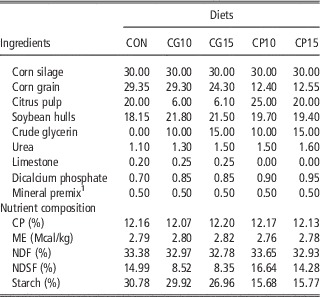
The experimental diets contained 30% corn silage and 70% concentrate composed of corn grain, citrus pulp, soybean hulls, urea, crude glycerin (obtained from soybean and sunflower oil containing 83% glycerol, 11% water, 6% ash and <0.01% methanol), limestone, dicalcium phosphate and mineral supplement (Table 1). After adaptation, animals were randomly assigned to one of the five treatments (CON=control, without crude glycerin; CG10=10% crude glycerin and 29.3% corn grain; CG15=15% crude glycerin and 24.3% corn grain; CP10=10% crude glycerin and 25% citrus pulp, CP15=15% crude glycerin and 20% citrus pulp). Diets were formulated according to National Research Council (1996) to provide nutrients for a daily weight gain of 1.4 kg. The experiment lasted 75 days and feed was delivered twice daily at 0800 and 1600 h allowing 10% of orts.
Ingredient (% DM) and nutrient composition of experimental diets

ME=metabolizable energy; NDSF=neutral detergent-soluble fiber; DM=dry matter; CON=control, without addition of crude glycerin; CG10=corn grain and 10% crude glycerin; CG15=corn grain and 15% crude glycerin; CP10=citrus pulp and 10% crude glycerin; CP15=citrus pulp and 15% crude glycerin.
1 Cattle commercial supplement (1000 g): 40 g P, 80 g Ca, 195 g Na, 300 g Cl, 5 g Mg, 26 g S, 2000 mg Zn, 1000 mg Cu, 500 mg Mn, 100 mg Co, 100 mg I, 5 mg Se, 400 mg F.
Dry matter intake (DMI) and feedlot performance
DMI was evaluated daily by weighing the feed delivered and refused. Diets and orts were sampled every 18 days for 7 consecutive days, composited by animal and stored at −18°C for further manipulation. At the end of the experiment, samples were forced-air oven dried at 55°C for 72 h, and ground in a Wiley-type mill (1 mm sieve). Samples were analyzed for dry matter (DM), mineral matter, CP, ether extract contents, according to Association of Official Agriculture Chemists (1995), NDSF according to Hall (Reference Hall2000) and starch following the methodology proposed by Hendrix (Reference Hendrix1993). For determination of NDF, samples were treated with thermostable α-amylase without sodium sulfite (Mertens, Reference Mertens2002), and ADF was determined sequentially due to the use of citrus pulp in the formulation of diets.
To monitor the weight gain, animals were weighed every 25 days, before the morning feeding, and after a 14-h solid fasting period. Average daily gains (ADG) were calculated by dividing the weight gain by the total number of days on feed.
Slaughter and carcass quantitative characteristics
At the end of the experimental period, animals were transported for 100 km to a commercial slaughterhouse, where they were slaughtered. The transport was carried out during the morning, respecting the carrying capacity of the vehicle. Pre-harvest handling was in accordance with good animal welfare practices, and slaughtering procedures followed the Sanitary and Industrial Inspection Regulation for Animal Origin Products (Ministry of Agriculture, Livestock and Supply, 1997). The slaughter followed a stunning procedure, using compressed air gun and subsequent bleeding by jugular section. The carcasses were divided longitudinally and weighed to obtain the hot carcass weight (HCW), and the hot carcass yield (HCY) was obtained by the ratio of HCW and slaughter weight, expressed as percentage. The half-carcasses were stored at 4°C for 24 h, and then they were re-weighed to obtain the cold carcass weight (CCW) and carcass cooling loss (CCL) was calculated. The pH of carcass was measured about 4 cm deep, using a digital pH meter. Samples of the Longissimus muscle, between the 12th and 13th ribs, were collected, vacuum packed and frozen at −18°C for further analysis.
Meat qualitative characteristics
Samples of the Longissimus muscle from each left carcass were divided into three steaks 2.54 cm thick for determining the Longissimus muscle area (LMA), rib fat thickness (RFT), meat and subcutaneous fat color, Warner-Bratzler shear force (WBSF), cooking losses (CKL), and meat cholesterol and fatty acid profile. The LMA was drawn on tracing paper and the RFT was measured in the third-quarter of muscle, perpendicularly, using a digital paquimeter (Greiner et al., Reference Greiner, Rouse, Wilson, Cundiff and Wheeler2003).
The determination of meat and fat color was performed as described by Houben et al. (Reference Houben, van Dijk, Eikelenboom and Hoving-Bolink2000). Cuts were made on the sample surface to expose the myoglobin to oxygen for 30 min before measurements then three different points were evaluated using a colorimeter (CR 400 model; Minolta Camera Co. Ltd Osaka, Japan), calibrated to white and black standard by CIELAB system. The variables measured were: brightness (L*=0 black, 100 white), a* index ranging from green (−) to red (+) and b* index varying from blue (−) to yellow (+).
CKL were determined by the weights of steaks before and after cooking. Steaks were grilled in a gas oven at 175°C, and a thermometer was used to monitor the internal temperature of the sample until it reached 75°C (geometric center), and then samples were removed from the oven and, after temperature stabilization, steaks were weighed to obtain the CKL. The WBSF was measured in the same samples used for CKL analyses. Six 1.27 cm diameter cylinders were removed from the center of cooked steaks (muscle free from visible fat and connective tissue) parallel to the longitudinal muscle fibers (American Meat Science Association, 1995). Cylinders were completely cut perpendicularly to the muscle fiber with a Warner-Bratzler blade of 1.016 mm at a speed of 200 mm/min (G-R Manufacturing Company, Manhattan, KS, USA). The average force to cut the six cylinders determined the WBSF of the samples.
Meat cholesterol content
Extraction and quantification of cholesterol were performed using the method described by Al-Hasani et al. (Reference Al-Hasanai, Hlavac and Carpenter1993). The cholesterol content was determined using a gas chromatograph (Model GC-14A; Shimadzu, Kyoto, Japan) equipped with a flame ionization detector (FID) and a fused silica capillary column (25 m length, 0.25 mm internal diameter and 0.20 µm in SE-30). Temperatures of the injector, column and detector were 260°C, 300°C and 300°C, respectively. Gas flows were as follows: 1.5 ml/min for the carrier gas (H2); 25 ml/min for the replacement gas (N2) and the flame; 300 ml/min for the synthetic air, and 30 ml/min for the H2. The sample splitting ratio was 1 : 150, and the integration of the peaks was performed with the integrator-processor CG-300. Cholesterol identification was made by comparison of the standards from Sigma® and the quantification was performed after the verification of the method linearity, by preparing standard cholesterol solutions with concentrations of 0.10, 0.25, 0.50 and 1.00 mg/ml, containing 0.20 mg/ml of 5-cholestane (internal standard).
Fatty acid profile
Extraction of fatty acids was performed according to Bligh and Dyer (Reference Bligh and Dyer1959). Fatty acid profile was determined using a gas chromatograph (Model GC-14B; Shimadzu) with a FID using a fused silica capillary column 30 m length, 0.25 mm internal diameter and 0.25 µm thick film (Supelco Omegawax® 250, Sigma-Aldrich). The carrier gas used was helium at a flow rate of 1 ml/min, the injection volume was 1 µl with sample splitting ratio of 1 : 100. The oven temperature was programmed to begin at 100°C for 2 min, and then brought to 220°C at a rate of 4°C/min, remaining at this temperature sfor 25 min. The detector and injector temperatures were 280°C and 250°C, respectively, with gas flows of 23, 50 and 180 kPa for the synthetic air, helium and nitrogen, respectively.
Statistical analysis
The experimental design was completely randomized and the initial BW was considered as a covariate. The GLM procedure of SAS (SAS 9.2; SAS Institute, Carry, NC, USA), was used to analyze the fixed effects of treatment on intake, performance, carcass and meat quality traits, with animal serving as the experimental unit. Data were analyzed by using the model:
 $Y_{{ij}} \,{\rm {\equals}}\,\mu {\plus}T_{{i\,}} {\plus}\beta (X_{{ij}} \,{\minus}\,\bar{X}){\plus}e_{{ij}} $
, where Y
ij
=observed measurement, μ=overall mean, T
i
=effect of the treatments (i=1 to 5), X
ij
=observed values of the covariate,
 $\bar{X}$
=covariate mean, β=linear coefficient between covariate (X) and observed measurement (Y) and e
ij
=residual error. Orthogonal contrasts were performed to test: the effect of crude glycerin inclusion (CON v. treatment with crude glycerin (CG10, CG15, CP10 and CP15)); the effect of crude glycerin concentration in corn grain-based diets (CG10 v. CG15); the effect of crude glycerin concentration in citrus pulp-based diets (CP10 v. CP15); and the effect of non-fiber carbohydrates source (CP15 and CP10 v. CG10 and CG15), with significance considered at P<0.05.
Results and discussion
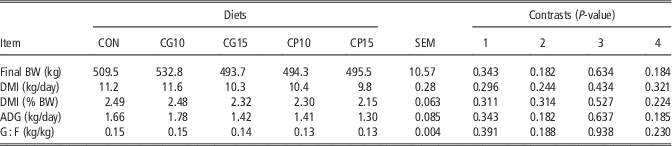
The addition of 10% and 15% crude glycerin to the diets did not affect feed intake, and this result was observed for both corn grain and citrus pulp-based diets, averaging 10.62 kg/day (P>0.05; Table 1). Mach et al. (Reference Mach, Bach and Devant2009) fed feedlot dairy calves with up to 12% of a very similar crude glycerin (85.7% glycerol, 8.6% water, 5.5% salt and 0.09% methanol) and found no differences in DMI, indicating this by-product has the potential to be used as energy source in feedlot diets. On the other hand, the lack of effect of addition of citrus pulp on DMI corroborates a previous study conducted by Prado et al. (Reference Prado, Pinheiro, Alcalde, Zeoula, Nascimento and Souza2000), which evaluated the replacement of corn with citrus pulp at 40%, 60%, 80% or 100%, and reported no variation in DMI.
Previous studies suggest an increase in ADG and feed efficiency when feedlot cattle are fed up to 10% crude glycerin in the DM (Parsons et al., Reference Parsons, Shelor and Drouillard2009). However, other studies reported no effect of crude glycerin on weight gain and/or feed efficiency even when animals were fed up to 30% crude glycerin (van Cleef et al., Reference van Cleef, Ezequiel, D’aurea, Fávaro and Sancanari2014). In the present study, the addition of up to 15% crude glycerin in the diets, regardless the carbohydrate source used, did not affect animal performance. On average, the final BW was 505.2 kg, the ADG was 1.51 kg, and gain : feed ratio (G : F) was 0.14 (P>0.05; Table 2), suggesting a similar use of diets by the animals, and confirming the potential of crude glycerin as energy source and allowing the use of this ingredient associated with citrus pulp. Thus, diets with citrus pulp and crude glycerin can be used strategically to reduce feed costs.
Feedlot performance of Nellore bulls fed corn or citrus pulp-based diets associated with crude glycerin

DMI=dry matter intake; ADG=average daily gain; G : F=gain : feed ratio; CON=control, without addition of crude glycerin; CG10=corn grain and 10% crude glycerin; CG15=corn grain and 15% crude glycerin; CP10=citrus pulp and 10% crude glycerin; CP15=citrus pulp and 15% crude glycerin.
Contrasts: 1=CON v. crude glycerin treatments, 2=CG10 v. CG15, 3=CP10 v. CP15, 4=(CG10 and CG15) v. (CP10 and CP15).
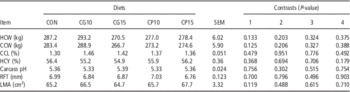
Carcass characteristics (HCW, CCW and carcass yield) are directly or indirectly related to DMI and performance. As any variation in these variables was detected, the lack of effect on carcass characteristics is justified. The average HCW and CCW were 282.3 and 277.4 kg, respectively, leading to a CCL of 1.38% (P>0.05; Table 3). The low weight loss during chilling process indicates that the carcasses, besides having proper fat, were also handled and stored properly in the cold room. The back fat acts as insulation, preventing fluid loss during cooling. The average RFT in present study was 6.89 mm, greater than the value considered minimum to avoid penalties in Brazilian slaughterhouse (3 mm). Therefore, it can be inferred that the degree of finishing of the carcasses was uniform between treatments at slaughter, reducing cooling losses
Carcass characteristics of Nellore bulls fed corn or citrus pulp-based diets associated with crude glycerin

HCW=hot carcass weight; CCW=cold carcass weight; CCL=carcass cooling loss; HCY=hot carcass yield; RFT=rib fat thickness; LMA=Longissimus muscle area; CON=control, without addition of crude glycerin; CG10=corn grain and 10% crude glycerin; CG15=corn grain and 15% crude glycerin; CP10=citrus pulp and 10% crude glycerin; CP15=citrus pulp and 15% crude glycerin.
Contrasts: 1=CON v. crude glycerin treatments, 2=CG10 v. CG15, 3=CP10 v. CP15, 4=(CG10 and CG15) v. (CP10 and CP15).
The average LMA was 65.9 cm2 and the lack of difference between treatments can be related to similar genetic composition of the animals used. For cattle, values of HCY ranges from 53% and 56% and may vary according to breed, rumen volume, fasting period, transport and carcass cleaning process (Jorge et al., Reference Jorge, Fontes, Paulino, Gomes Junior and Ferreira1999). Thus, the values found in this experiment (average 55.7%) are suitable for HCY of Nellore bulls (P>0.05; Table 3).
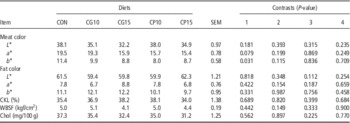
The average 24-h carcass pH value (5.35) was lower than 5.8, which is the limit value to occur dark firm and dry meat, therefore the meat obtained in the present study is considered of good quality and had adequate shelf-life (Mach et al., Reference Mach, Bach, Velarde and Devant2008). Usually, cattle fed grain-based diets have more glycogen at slaughter and lower carcass final pH. The evaluation of the final pH of the carcass is important because it accounts for changes in meat quality characteristics such as color, WBSF, texture and water holding capacity (Resende et al., Reference Resende, Gesualdi Junior, Queiroz, Faria and Viana2014). Values of CKL, meat cholesterol and WBSF were not affected by treatments (P>0.05; Table 4). Carvalho et al. (Reference Carvalho, Chizzotti, Ramos, Machado Neto, Lanna, Lopes, Teixeira and Ladeira2014) and Mach et al. (Reference Mach, Bach and Devant2009) did not observe any change in WBSF of meat from feedlot cattle fed crude glycerin. The tenderness is the characteristic that most influences consumer satisfaction with meat. The WBSF in present study was, on average, 4.7 kgf/cm2, and according to Miller et al. (Reference Miller, Carr, Ramsey, Crockett and Hoover2001) values below 4.9 kgf/cm2 result in better consumer acceptance.
Characteristics of meat and subcutaneous fat of Nellore bulls fed corn or citrus pulp-based diets associated with crude glycerin

L*=brightness; a*=intensity of red; b*=intensity of yellow; CKL=cooking losses; WBSF=Warner-Bratzler shear force; Chol=Cholesterol; CON=control, without addition of crude glycerin; CG10=corn grain and 10% crude glycerin; CG15=corn grain and 15% crude glycerin; CP10=citrus pulp and 10% crude glycerin; CP15=citrus pulp and 15% crude glycerin.
Contrasts: 1=CON v. crude glycerin treatments, 2=CG10 v. CG15, 3=CP10 v. CP15, 4=(CG10 and CG15) v. (CP10 and CP15).
Slaughtered young bulls finished in a feedlot, provide total cholesterol rates ranging between 34.1 and 55.3 mg/100 g of beef (Rotta et al., Reference Rotta, Prado, Moletta, Silva and Perotto2009). The average content of cholesterol found in this study was 34.3 mg/100 g, which leads to a daily intake of 68.6 mg of cholesterol, considering an intake of 200 g meat per day. This corresponds to only 22.9% of the recommended maximum daily intake of cholesterol (300 mg/day; Krauss et al., Reference Krauss, Eckel, Howard, Appel, Daniels, Deckelbaum, Erdman, Kris-Etherton, Goldberg, Kotchen, Lichtenstein, Mitch, Mullis, Robinson, Wylie-Rosett, Jeor, Suttie, Tribble and Bazzarre2000).
Color of meat is the first criterion used by the consumer at the time of purchase. In this study, the intensity of the yellow color in meat was reduced in treatments containing crude glycerin compared with the control (P<0.05); however, fat color was not affected by treatments (Table 4). Regarding the meat color, Muchenje et al. (Reference Muchenje, Dzama, Chimonyo, Strydom, Hugo and Raats2009) reported that, in cattle, the brightness values vary between 33.2 and 41.0, the red color from 11.1 to 23.6 and the yellow color between 6.1 and 11.3. The average of L* and a* were, respectively, 35.7 and 17.2 and remained within the range previously described. Carvalho et al. (Reference Carvalho, Chizzotti, Ramos, Machado Neto, Lanna, Lopes, Teixeira and Ladeira2014) observed increase in b* indices in the muscle of animals fed crude glycerin. However, the authors reported that, the increase in yellowness value could be explained by addition of corn gluten meal to the diets containing glycerin, an ingredient rich in β-carotene. Therefore, one possibility for reducing yellow intensity in meat, in the present study, is the reduction of intake of carotenoid pigments by animals fed diets containing crude glycerin, since, to add this ingredient, corn grain and citrus pulp were gradually removed (Table 1), which were the main sources of these pigments.
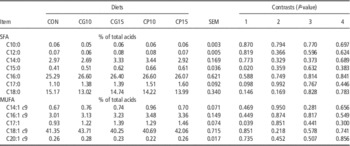
The fatty acid composition of intramuscular fat of cattle has received attention due to the implications for human health and meat quality characteristics. In this study, saturated, monounsaturated and polyunsaturated fatty acids (SFA, MUFA and PUFA, respectively) with major participation in the Longissimus muscle samples were: palmitic (26.2%), oleic (41.6%) and linoleic (3.1%). The inclusion of crude glycerin in the diets increased the concentration of pentadecanoic (C15:0) and heptadecenoic (C17:1) fatty acids (P<0.05; Table 5). Odd-chain fatty acids are synthesized by rumen bacteria using mainly propionate as precursor (Berthelot et al., Reference Berthelot, Bas, Schmidely and Duvaux-Ponter2001), and the concentration of pentadecanoic acid may be related to the increase in propionate production derived from the fermentation of glycerol (Lee et al., Reference Lee, Lee, Cho, Kam, Lee, Kim and Seo2011). The increase in C15:0 is not a health risk, because the undesirable fatty acids to human health usually are the C12:0 and C14:0. They are responsible for the increase in serum concentrations of low-density lipoprotein cholesterol in humans (Sexten et al., Reference Sexten, Krehbiel, Dillwith, Madden, McMurphy, Lalman and Mateescu2012) and corresponded, in this study, for only 0.07% and 3.05% of SFA present in the Longissimus muscle, respectively (Table 5).
SFA and MFA of Longissimus muscle of Nellore bulls fed corn or citrus pulp-based diets associated with crude glycerin

SFA=saturated fatty acids; MUFA=monounsaturated fatty acids; CON=control, without addition of crude glycerin; CG10=corn grain and 10% crude glycerin; CG15=corn grain and 15% crude glycerin; CP10=citrus pulp and 10% crude glycerin; CP15=citrus pulp and 15% crude glycerin.
Contrasts: 1=CON v. crude glycerin treatments, 2=CG10 v. CG15, 3=CP10 v. CP15, 4=(CG10 and CG15) v. (CP10 and CP15).
Lage et al. (Reference Lage, Berchielli, San Vito, Silva, Ribeiro, Reis, Dallantonia, Simonetti, Delevatti and Machado2014) evaluated the fatty acid profile of Nellore cattle fed diets with 10% crude glycerin replacing corn or soybean hulls and found an increase in MUFA, including heptadecenoic acid, agreeing with the results reported in this study. The performance of crude glycerin on the synthesis and biohydrogenation of fatty acids in the rumen is not clearly established yet. Abo El-Nor et al. (Reference Abo El-Nor, Abu Ghazeleh, Potu, Hastings and Kattab2010) observed a reduction in DNA concentration for Clostridium proteoclasticum and Butyrivibrio fibrisolvens when replaced corn with crude glycerin. These microorganisms play an important and central role in ruminal biohydrogenation process (Maia et al., Reference Maia, Chaudhary, Figueres and Wallace2007). According to Krueger et al. (Reference Krueger, Anderson, Tedeschi, Callaway, Edrington and Nisbet2010) the use of glycerol in ruminant diets may inhibit lipolysis, a prerequisite for ruminal biohydrogenation, and may provide passage of total lipids through the rumen, thus providing higher proportions of beneficial unsaturated fat for incorporation in muscle. There are some hypotheses for increased concentration of C17:1 in the Longissimus muscle, including the reduction of ruminal biohydrogenation reducing the conversion of C17:1 into C17:0. In a research on the origin of C17:1, Fievez et al. (Reference Fievez, Vlaeminck, Dhanoa and Dewhurst2003) suggested that may occur endogenous desaturation of C17:0 by Δ9-desaturase enzyme activity, originating C17:1. In fact, Carvalho et al. (Reference Carvalho, Chizzotti, Ramos, Machado Neto, Lanna, Lopes, Teixeira and Ladeira2014) observed a tendency to increased Δ9-desaturase activity in muscle and subcutaneous fat of cattle fed crude glycerin. This enzyme is responsible for converting C16:0 and C18:0 into C16:1 and C18:1, respectively; however, based on such results, further investigation of the mechanism of action of crude glycerin on the Δ9-desaturase enzyme activity and the synthesis of odd-chain fatty acids should be conducted.
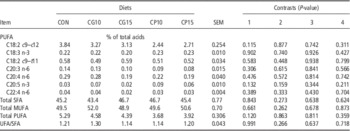
Changes in the fatty acid profile were not enough to change the total amount of SFA, MFA and PFA, or the ratio between saturated and unsaturated fatty acids (P>0.05; Table 6). It was expected that the use of crude glycerin would increase the concentration of PUFA, due to the influence of crude glycerin on lipolysis and ruminal biohydrogenation (Krueger et al., Reference Krueger, Anderson, Tedeschi, Callaway, Edrington and Nisbet2010), but our results showed no changes in PUFA of meat, corroborating previous report of Carvalho et al. (Reference Carvalho, Chizzotti, Ramos, Machado Neto, Lanna, Lopes, Teixeira and Ladeira2014).
Polyunsaturated fatty acids, total SFA, total MUFA, total PUFA and unsaturated : saturated ratio of Longissimus muscle of Nellore bulls fed corn or citrus pulp-based diets associated with crude glycerin

SFA=saturated fatty acids; MUFA=monounsaturated fatty acids; PUFA=polyunsaturated fatty acids; UFA=unsaturated fatty acids; CON=control, without addition of crude glycerin; CG10=corn grain and 10% crude glycerin; CG15=corn grain and 15% crude glycerin; CP10=citrus pulp and 10% crude glycerin; CP15=citrus pulp and 15% crude glycerin.
Contrasts: 1=CON v. crude glycerin treatments, 2=CG10 v. CG15, 3=CP10 v. CP15, 4=(CG10 and CG15) v. (CP10 and CP15).
Although the increased concentrations of pentadecanoic and heptadecenoic acids in the meat of animals fed crude glycerin represent <2% of total fatty acids, C15:0 and C17:1 seem to play an important role in human health. Research has indicated that odd and branched-chain fatty acids have anticarcinogenic effects. According to Wongtangtintharn et al. (Reference Wongtangtintharn, Oku, Iwasaki and Toda2004), branched-chain fatty acids induce cell death by apoptosis and inhibit the growth of human cancer cells. The authors found that the C15:0 affects the dynamics of cells, reducing the substrates for DNA replication, and membrane biosynthesis. The mechanism of the inhibitory role of C15:0 on proliferation of cancerous cells is similar to that of CLA. The intake of odd-chain saturated fatty acids is also related to a reduced incidence of type II diabetes in humans (Forouhi et al., Reference Forouhi, Koulman, Sharp, Imamura, Kröger, Schulze, Crowe, Huerta, Guevara, Beulens, van Woudenbergh, Wang, Summerhill, Griffin, Feskens, Amiano, Boeing, Clavel-Chapelon, Dartois, Fagherazzi, Franks, Gonzalez, Jakobsen, Kaaks, Key, Khaw, Kühn, Mattiello, Nilsson, Overvad, Pala, Palli, Quirós, Rolandsson, Roswall, Sacerdote, Sánchez, Slimani, Spijkerman, Tjonneland, Tormo, Tumino, van der A, van der Schouw, Langenberg, Riboli and Wareham2014). Thus, further studies are needed to evaluate the effects of crude glycerin on the synthesis and biohydrogenation of fatty acids and rumen bacteria involved in this process, in order to obtain meat with healthier fatty acid profile for human consumption.
Conclusion
The use of up to 15% crude glycerin associated with corn grain or citrus pulp does not affect negatively the performance, carcass and meat quality. Furthermore, the concentrations of heptadecenoic and pentadecanoic fatty acids in meat were higher when glycerol was added to the diets, being beneficial to human health.
Acknowledgments
The authors thank the Sao Paulo Research Foundation (FAPESP) for the scholarship and Caramuru Food Company for supplying a portion of the feed ingredients used in this experiment.