Introduction
Verbal fluency tasks are used to measure the extent of verbal generativity, a function that is compromised in various neuropsychological conditions, including those affecting executive functions, language and semantic memory. The general method is to provide a specific cue for the participant to generate categories of words, within a given time constraint. In phonemic fluency tasks, participants generate words based on phonological criteria (e.g., words beginning with “S”), while for semantic fluency tasks, participants generate names of objects based on a semantic category (e.g., “tools”). Both phonemic and semantic fluency tasks involve several subcomponent cognitive operations, creating demands on search retrieval operations, essential lexical representation, and semantic knowledge (Henry, Crawford, & Phillips, Reference Henry, Crawford and Phillips2004; Nutter-Upham et al., Reference Nutter-Upham, Saykin, Rabin, Roth, Wishart, Pare and Flashman2008; Robinson, Shallice, Bozzali, & Cipolotti, Reference Robinson, Shallice, Bozzali and Cipolotti2012); there is evidence to suggest that semantic fluency requires greater involvement of semantic memory (Martin, Wiggs, Lalonde, & Mack, Reference Martin, Wiggs, Lalonde and Mack1994). Studies comparing the two types of fluency in Alzheimer's disease (AD) have found that there is a disproportionate impairment in semantic fluency (Monsch et al., Reference Monsch, Bondi, Butters, Paulsen, Salmon, Brugger and Swenson1994; Murphy, Rich, & Troyer, Reference Murphy, Rich and Troyer2006; Rosser & Hodges, Reference Rosser and Hodges1994; Salmon, Heindel, & Lange, Reference Salmon, Heindel and Lange1999), which increases with disease progression (Salmon et al., Reference Salmon, Heindel and Lange1999). This has been interpreted as being due to the AD pathology having a greater impact on semantic memory.
Small vessel disease (SVD) is disease of the small perforating end arteries which supply the white matter and the deep gray matter nuclei. It leads to focal lacunar infarcts as well as more diffuse regions of ischemia referred to as leukoaraiosis and seen as regions of white matter hyperintensity (WMH) on T2-weighted magnetic resonance imaging (MRI) (Erkinjuntti et al., Reference Erkinjuntti, Kurz, Small, Bullock, Lilienfeld and Damaraju2003). SVD is associated with progressive neuropsychological impairment and vascular dementia, the second most common form of dementia after AD (O'Brien et al., Reference O'Brien, Erkinjuntti, Reisberg, Roman, Sawada, Pantoni and Gorelick2003). The pattern of cognitive deficits found in SVD differs from cortical dementias and large vessel stroke populations. In SVD, executive dysfunction and impaired information processing speed are prominent, while deficits of episodic memory and semantic memory are usually mild or absent (Charlton, Morris, Nitkunan, & Markus, Reference Charlton, Morris, Nitkunan and Markus2006; Nitkunan, Barrick, Charlton, Clark, & Markus, Reference Nitkunan, Barrick, Charlton, Clark and Markus2008; O'Sullivan, Morris, & Markus, Reference O'Sullivan, Morris and Markus2005). There is evidence that verbal fluency is impaired in SVD (Charlton et al., Reference Charlton, Morris, Nitkunan and Markus2006; Lafosse et al., Reference Lafosse, Reed, Mungas, Sterling, Wahbeh and Jagust1997; O'Sullivan et al., Reference O'Sullivan, Morris and Markus2005), however, the majority of studies have investigated only one type of verbal fluency (i.e., either semantic or phonemic fluency). One study comparing both types of fluency found that individuals with vascular dementia performed better on a semantic fluency task than a phonemic fluency task, which was opposite to the pattern of performance observed in AD patients (Carew, Lamar, Cloud, Grossman, & Libon, Reference Carew, Lamar, Cloud, Grossman and Libon1997)
This study investigated whether there is a unique pattern of performance for patients with SVD, across different levels of overall cognitive impairment and also with different vascular lesion profiles. Given what is already known about the neuropsychological profile of patients in the early stages of SVD and AD (Brookes, Hannesdottir, Lawrence, Morris, & Markus, Reference Brookes, Hannesdottir, Lawrence, Morris and Markus2012; O'Brien et al., Reference O'Brien, Erkinjuntti, Reisberg, Roman, Sawada, Pantoni and Gorelick2003; O'Sullivan et al., Reference O'Sullivan, Morris and Markus2005), one might expect these clinical groups to display different patterns of performance on verbal fluency tasks. If differences do exist, it is important to identify them, because they may aid in differential diagnosis.
The purpose of the current study was, therefore, to compare the pattern of verbal fluency impairment in SVD and AD. We hypothesized that in SVD, where executive dysfunction is a prominent feature but semantic memory is relatively spared, there would be similar levels of impairment in semantic and phonemic fluency, both driven by the executive impairment, and that this would hold across degrees of impairment. Conversely, as previously found, participants with AD would display disproportionate impairment in semantic fluency, due to deficits in semantic memory.
Methods
Participants
SVD group
Forty-five patients with symptomatic cerebral SVD were recruited from specialized cerebrovascular services in hospitals in London, UK. SVD was defined a clinical lacunar stroke syndrome (pure motor hemiparesis, pure sensory syndrome, sensorimotor stroke, ataxic hemiparesis or dysarthria-clumsy hand) (Bamford, Sandercock, Dennis, Burn, & Warlow, 1991) confirmed by a consultant neurologist (H.S.M) together with radiological confirmation of an anatomically corresponding lacunar infarct on MRI. Patients with any potential stroke mechanism other than SVD (e.g., a cardioembolic source, large cerebral artery stenosis) were excluded. Patients were also excluded if they had any other central neurological or major psychiatric condition other than depression and anxiety or if they were not fluent in English. All subjects were studied at least three months after stroke to avoid the effects of acute ischemia on cognition [mean (SD) time from last stroke = 3.1 years (3.4)].
SVD sub-group with cognitive impairment
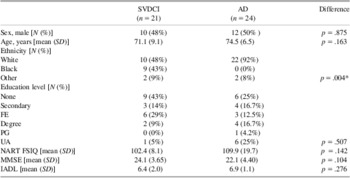
To ensure that any cognitive impairment was likely to result from SVD, the SVD group were selected according to the presence of lacunar stroke, rather than cognitive impairment. Therefore, they had a range of cognitive abilities. A subgroup of SVD patients that were designated as having vascular cognitive impairment (SVDCI) was defined for further comparison with the AD patient group. This group was defined using the SVD cognitive screening procedure, the Brief Memory and Executive Test Battery (BMET), a test battery specifically developed to detect cognitive impairment in SVD (Brookes et al., Reference Brookes, Hannesdottir, Lawrence, Morris and Markus2012) (described below). A previously established threshold was used by which performance at least 1.5 SD below the control mean on any four of the eight subtests defined cognitive impairment. Twenty-one (47%) had neuropsychological impairment and 24 (53%) were without impairment, according to these criteria. The SVDCI and AD groups were well matched on Mini-Mental State Examination (MMSE) score and instrumental activities of daily living (IADL) scores as a proxy for general cognitive impairment.
AD group
Twenty-four patients diagnosed with probable Alzheimer's type dementia were recruited from specialist dementia clinics in London, UK, the diagnosis made according to DSM IV criteria (American Psychiatric Association, 2000). All patients had neuropsychological testing as part of their diagnostic assessment and showed deficits in two or more areas of cognition: progressive worsening of memory and other neuropsychological functions; no disturbance of consciousness suggestive of confusional state; onset between ages of 40 and 90 years and absence of systemic disorders or other brain diseases that could account for the progressive deficits in memory and cognition, including brain infarction on imaging. Before entry into the study, patient brain imaging data were reviewed to exclude patients with cerebral infarcts, extensive leukoaraiosis, or other pathologies.
Control group
A control group consisting of 80 healthy individuals was recruited from other studies, patient contacts and a family doctor practice in southwest London. Controls were excluded if they had a history of, or current central neurological condition, including stroke or other ischemic attack and if there was a past or current history of a psychiatric condition.
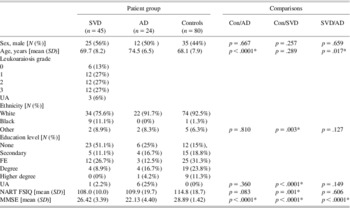
Tables 1 and 2 provide the demographics for the different groups. All participants were fluent in English.
Group demographics

Note. To calculate group differences independent t-tests and chi2 was used where applicable.
*Significant (p < .05).
MMSE = Mini mental state examination; NART FSIQ = National adult reading test full scale IQ; Secondary = Secondary certificates (e.g. GCSEs in UK, ∼ aged 16); FE = Further education certificate (e.g. A-levels in UK; ∼ aged 16-18); Degree = Bachelor's degree; PG = Postgraduate degree (e.g. Masters, PhD); UA = Unavailable.
Group demographics: Cognitively impaired small vessel disease (SVDCI) versus Alzheimer's disease (AD)

Note. To calculate group differences independent t-tests and chi2 was used where applicable.
*Significant (p < .05).
MMSE = Mini mental state examination; NART FSIQ = National adult reading test full scale IQ; Secondary = Secondary certificates (e.g. GCSEs in UK, ∼ aged 16); FE = Further education certificate (e.g. A-levels in UK; ∼ aged 16-18); Degree = Bachelor's degree; PG = Postgraduate degree (e.g. Masters, PhD); UA = Unavailable; IADL = Instrumental activities of daily living.
Ethics
All research was conducted as a part of studies approved by a UK NHS ethics committee. In accordance with the 1964 Declaration of Helsinki, full written consent was obtained for all participants in this study.
Procedure
Verbal fluency measures
For the purposes of this study, phonemic fluency was measured by requiring participants to generate words beginning with “F” and “S,” each for 60s. Semantic fluency was measured for Animals and Tools, again with participants being given 60 seconds for each category. Instructions were to generate as many words as possible within the time available and to avoid producing proper nouns or repeating a word that they had already said with a different suffix (e.g., small and smaller). Instructions were based on standard published versions of phonemic and semantic fluency tests (Spreen & Strauss, Reference Spreen and Strauss1998).
The Brief Memory and Executive Test (BMET)
The BMET (Brookes et al., Reference Brookes, Hannesdottir, Lawrence, Morris and Markus2012) is a neuropsychological assessment tool specifically designed to detect cognitive impairment in patients with SVD, focusing on memory, executive functioning and processing speed. It is standardized on normal older adults and has been shown to have good reliability and established validity. It measures memory using a 10-question time and place orientation task and a five-word free recall task (three trials), with delayed five-item recall and recognition memory; processing speed using a letter-number matching task (analogous to digit symbol coding); and executive function with a motor, letter and number-letter sequencing (analogous to the trail making test procedure).
The Mini-Mental State Examination (MMSE)
The MMSE is a test of global cognitive functioning which is widely used as a screening tool for cognitive impairment (Folstein, Folstein, & McHugh, Reference Folstein, Folstein and McHugh1975). It assesses orientation to time and place, registration, attention, recall, language and visual construction. The maximum total score is 30. Higher scores indicate better cognitive functioning.
The National Adult Reading Test-Revised (NART-R)
The NART-R is a widely used measure of pre-morbid intellectual ability (Nelson & Willison, Reference Nelson and Willison1991). It consists of 50 words with an irregular pronunciation, which participants are required to read aloud. Studies have shown that the NART-R is a valid measure of pre-morbid intelligence (Bright, Jaldow, & Kopelman, Reference Bright, Jaldow and Kopelman2002; Crawford, Deary, Starr, & Whalley, Reference Crawford, Deary, Starr and Whalley2001) and performance on the NART is relatively preserved in patients with cognitive impairment (Fromm, Holland, Nebes, & Oakley, Reference Fromm, Holland, Nebes and Oakley1991; Maddrey, Cullum, Weiner, & Filley, Reference Maddrey, Cullum, Weiner and Filley1996; Patterson, Graham & Hodges, Reference Patterson, Graham and Hodges1994).
Instrumental Activities of Daily Living (IADL)
This scale measures the higher level activities related to independent living, such as the ability to manage finances and use public transport (Lawton & Brody, Reference Lawton and Brody1969). Participants are required to provide information about eight areas of functioning. Summary scores range from 0 (low function) to 8 (high function).
Leukoaraiosis scale
Leukoaraiosis or the extent of WMH, seen as high signal on brain T2 structural MRI was graded using the modified Fazekas scale (Fazekas, Chawluk, Alavi, Hurtig, & Zimmerman, Reference Fazekas, Chawluk, Alavi, Hurtig and Zimmerman1987). Grade 0 indicates no leukoaraiosis, grade 1 indicates mild leukoaraiosis, grade 2 indicates moderate confluent leukoaraiosis, and grade 3 indicates severe confluent leukoaraiosis.
Statistical Analyses
All statistical analyses were performed with SPSS software (version 19; SPSS Inc; Chicago, IL). The groups were compared on demographic variables using independent t tests for continuous variables and χ2 tests for categorical variables. Z scores for each of the eight subtests from the BMET were calculated using the mean and standard deviation of the control group. The mean number of correct words generated for the phonemic and semantic fluency tasks was calculated. The distribution of scores within each group was examined initially using visual inspection of histograms. The normality assumption of these data was further investigated using the Shapiro-Wilk test for normality. Levene's test determined the equality of variances.
A mixed-model analysis of covariance (ANCOVA) was performed, comparing performance on the phonemic and semantic fluency tasks (within-subject factor) between the groups (SVD, AD, and controls). The initial analysis included only age as a covariate; however, further analyses were conducted including also educational level. The assumption of homogeneity of regression slopes was met for the covariates. Given the selection criterion of lacunar stroke, which was based on the presence of lacunar infarction regardless of the degree of leukoaraiosis, there was a range of leukoaraiosis in our SVD population. To investigate this aspect we split the group based on degree of leukoaraiosis using the Fazekas scale: isolated white matter lesion (Fazekas 0 or 1), or confluent white matter lesions (Fazekas 2 or 3). A mixed model ANCOVA was conducted to look at these effects with age held as a covariate. To investigate the subgroup of SVD patients specifically defined as having overall neuropsychological impairment, the mixed model ANCOVA was repeated, this time restricting the SVD group to those with neuropsychological impairment. Additional two-group ANCOVAs were conducted to follow-up on the initial three-group analyses. Statistically significant interaction effects were decomposed with a simple effects analysis. Pairwise comparisons were based on ANCOVA adjusted means, controlling for the covariates in the model. Effect sizes were calculated using partial eta squared.
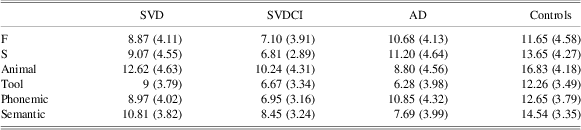
Finally, raw scores for the semantic and phonemic fluency tasks were entered into discriminant function analyses. The discriminant score is calculated from the individual test scores. The analysis weights the individual scores such that the maximum group discrimination is achieved. Raw scores are given in Table 3.
Verbal fluency scores comparing SVD, SVDCI, AD, and control groups

Note. Mean given, followed by standard deviations in parentheses.
Results
Main Analysis
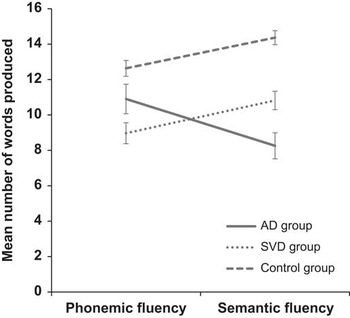
A mixed-model ANCOVA for SVD, AD, and controls revealed a significant main effect of fluency task, F(1,145) = 6.06, p = .02, ηp 2 = .04, a significant main effect of group, F(2,145) = 25.54, p < .001, ηp 2 = .26, and a significant fluency task x group interaction, F(2,145) = 10.50, p < .001, ηp 2 = .13. To establish where the group differences in interaction terms lay, further two-group mixed-model ANCOVAs were conducted. These revealed that there was no significant difference between the pattern of performance observed in the SVD group and the control group, F(1,122) = .03, p = .87, ηp 2 = .00. However, the AD group displayed a different pattern of performance relative to both the SVD group, F(1,66) = 23.53, p < .001, ηp 2 = .26, and the control group, F(1,101) = 17.47, p < .001, ηp 2 = .15. Specifically, whereas the SVD group and the control group displayed significantly worse performance on the phonemic fluency compared with semantic fluency task (Control: F(1,145) = 13.47; p < .001; ηp 2 = .09; SVD: F(1,145) = 8.85; p = .003, ηp 2 = .06), the AD group displayed significantly worse performance on the semantic fluency task, F(1,145) = 9.04, p = .003, ηp 2 = .06 (see Figure 1).
Group by fluency interactions. Mean (± SEM) number of words generated by the three groups of participants on each of the verbal fluency tests

Additional pairwise comparisons to investigate the pattern of deficits revealed that compared to controls, the SVD group demonstrated significantly worse performance on both phonemic, F(1,122) = 25.17, p < .001, ηp 2 = .17, and semantic fluency, F(1,122) = 31.13, p < .001, ηp 2 = .20. The AD group performed significantly worse than controls on the semantic fluency task only (Phonemic fluency: F(1,101) = 3.43; p = .07; ηp 2 = .03; Semantic fluency: F(1,101) = 54.33; p < .001; ηp 2 = .35). There were no significant differences between the SVD and AD groups in phonemic fluency, F(1,66) = 3.11, p = .08, ηp 2 = .05. The AD group performed significantly worse than the SVD group on the semantic fluency task, F(1,66) = 6.37, p = .01, ηp 2 = .09.
Educational Levels
Given that there was some group variation in education, we repeated the main analysis with highest level of education added as a covariate. Education data for 6 AD patients and 1 SVD patient were unavailable. The main effect of fluency task, F(1,137) = 7.0, p = .009, ηp 2 = .05; the main effect of group, F(2,137) = 15.1, p < .0001, ηp 2 = .18; and the interaction between fluency task and group F(2,137) = 9.4, p < .0001, ηp 2 = .12 remained significant.
Leukoaraiosis Analysis
To examine the effect of extent of leukoaraiosis we conducted a mixed-model ANCOVA for lesion damage by fluency type, including age as a covariate. Data was unavailable for 3 patients. The analysis revealed a significant main effect of fluency type, F(1,39) = 5.3, p < .03, ηp 2 = .12 with both SVD groups performing higher on the semantic fluency task than the phonemic fluency task: isolated lesion (mean (SD) category = 11.47 (3.63), letter = 8.92, (3.59)), confluent lesion (mean (SD) semantic (4.10), phonemic (4.32)). There was no significant main effect of leukoaraiosis grade, F(1,39) = .05, p = .82, ηp 2 = .001, and no significant interaction between fluency type and leukoaraiosis grade, F(1,39) = .93, p = .342, ηp 2 = .02.
SVDCI Subgroup Analysis
A mixed-model ANCOVA revealed that the main effects of fluency task, F(1,121) = 4.21, p = .04, ηp 2 = .03, group, F(2,121) = 37.76, p < .001, ηp 2 = .38, and the fluency task x group interaction, F(2,121) = 10.01, p < .001, ηp 2 = .14, remained significant. In line with our initial analysis, separate mixed-model ANCOVAs comparing the groups directly revealed that there were no significant differences between the SVDCI and the control group in the pattern of performance on the different fluency tasks, as shown by the interaction, F(1,98) = .004, p = .95, ηp 2 = .00. However, the AD group displayed a pattern of performance that was significantly different from both the control group, F(1,101) = 17.47, p < .001, ηp 2 = .15, and the SVDCI, F(1,42) = 22.86, p < .001, ηp 2 = .35.
Discriminant Function Analysis
Phonemic and semantic fluency scores were entered into a discriminant function analysis to investigate how well these measures discriminated between the SVD and AD patients. A single function based on the two fluency scores accounted for 32% of the variance and maximally discriminated AD patients (centroid = -.93) from the SVD overall group (centroid = .49). The measures correctly classified 36 (80%) of the SVD patients and 22 (92%) of the AD patients. To look at the effect of overall cognitive impairment in addition to the fluency scores, we added MMSE score to the discriminant analysis for all patients. The function including MMSE score accounted for 46% of the variance in group membership. Group classification was similar, correctly classifying 38 (84%) of the SVD patients, and 19 (79%) of the AD patients. Indicating that inclusion of MMSE score did not add anything to the overall model beyond fluency.
The discriminant function analysis was also repeated including only those patients defined as having cognitive impairment. A single function based on the two fluency scores accounted for 39% of the variance and maximally discriminated AD patients (centroid = .74) from the SVD impaired group (centroid = -.84). The measures correctly classified 17 (81%) of the SVD patients with cognitive impairment and 17 (71%) of the AD patients.
Discussion
The aims of this study were to (1) conduct a detailed examination of verbal fluency in participants with SVD with or without defined cognitive disability and with differing degrees of white matter damage; and (2) compare the pattern of performance in participants with AD and SVD. The analysis indicates that SVD is associated with impairments in both phonemic and semantic fluency. In addition, we found that the SVD group, in common with the controls, displayed poorer phonemic fluency compared with semantic fluency. Furthermore, this pattern was the same for SVD patients both with isolated lesions and those with confluent lesions. The reverse pattern was true for the AD group, with poorer performance observed in the semantic fluency task.
One of the difficulties in studying vascular cognitive impairment and vascular dementia is that patients often have coexistent AD and SVD pathology. This particularly applies to patients with vascular dementia who present with memory impairments to a memory clinic. To try to overcome this difficulty we identified patients who presented with lacunar stroke due to SVD (rather than to a Memory Clinic). There is strong evidence that these patients have cognitive impairment predominantly due to SVD, and in particular the neuropsychological profile is almost identical to that seen in the young onset monogenic form of SVD, CADASIL (Charlton et al., Reference Charlton, Morris, Nitkunan and Markus2006). A consequence of our selecting SVD cases on the basis of confirmed lacunar infarction rather than cognitive impairment is that not all had cognitive impairment. Therefore, we identified a subgroup of SVD patients with neuropsychological impairment, using previously established criteria of more than 1.5 SDs below the control mean on any four of the eight subtests of the BMET (Brookes et al., Reference Brookes, Hannesdottir, Lawrence, Morris and Markus2012). These patients were found to be well matched to the AD group in terms of overall cognitive impairment as measured by the MMSE and IADL. We found the same pattern of performance over the two fluency tasks for this subgroup of SVD patients, with the group by task interaction remaining significant for the comparison with the AD group.
Previous research into the neuropsychological profile of SVD has demonstrated absolute impairments in verbal fluency (Charlton et al., Reference Charlton, Morris, Nitkunan and Markus2006; Lafosse et al., Reference Lafosse, Reed, Mungas, Sterling, Wahbeh and Jagust1997; O'Sullivan et al., Reference O'Sullivan, Morris and Markus2005); and in a comparison of vascular dementia and AD, one previous study has demonstrated a differential pattern of phonemic and semantic fluency similar to that seen in our SVD versus AD comparison (Carew et al., Reference Carew, Lamar, Cloud, Grossman and Libon1997). Our findings are also strikingly similar to a study conducted by Rosser and Hodges (Reference Rosser and Hodges1994), in which verbal fluency was investigated in patients with AD, Huntington's disease and progressive supranuclear palsy. They found that the healthy controls displayed superior performance on the semantic fluency task and that this pattern of performance was repeated in the Huntington's disease and progressive supranuclear palsy groups. The similarities between these findings may reflect the pathology in the non-AD groups being predominantly subcortical where executive dysfunction is a more central feature. We suggest that data from the current study provide support for the hypothesis that overall fluency impairment in SVD is related to the executive function and processing speed deficits that are characteristic of this condition. Furthermore, there is no added disadvantage in semantic fluency for these patients as semantic memory is relatively preserved.
Given that verbal fluency tasks are complex, it is important to consider precisely which cognitive processes are impacted by SVD to produce impairments in phonemic and semantic fluency. A study by McDowd and colleagues (Reference McDowd, Hoffman, Rozek, Lyons, Pahwa, Burns and Kemper2011) reported that processing speed was the best predictor of performance on both phonemic and semantic verbal fluency tasks, with inhibition accounting for some additional variance. Also of relevance here is research by Lamar and colleagues (Lamar, Price, Davis, Kaplan, & Libon, Reference Lamar, Price, Davis, Kaplan and Libon2002; Lamar, Price, Giovannetti, Swenson, & Libon, Reference Lamar, Price, Giovannetti, Swenson and Libon2010). This research has shown that compared to patients with AD and healthy controls, patients with subcortical dementia produce a large proportion of responses in the first 15 s of a phonemic fluency task, indicating a differential capacity to maintain mental set. Using a Boston process approach, Lamar and colleagues (2010) have identified several constructs which are related to the dysexecutive syndrome seen in ischemic vascular disease. Future studies should attempt to elucidate the specific mechanism by which verbal fluency is affected in SVD by including additional measures of cognitive functions such as processing speed, mental search and mental set maintenance.
For the AD group, the pattern of impairment replicates findings from numerous published reports (Monsch et al., Reference Monsch, Bondi, Butters, Paulsen, Salmon, Brugger and Swenson1994; Murphy et al., Reference Murphy, Rich and Troyer2006; Rosser & Hodges, Reference Rosser and Hodges1994; Salmon et al., Reference Salmon, Heindel and Lange1999). The discrepancy between phonological and semantic fluency is thought to arise from the greater dependence of semantic fluency tasks on semantic memory, which is degraded in AD (Henry et al., Reference Henry, Crawford and Phillips2004; Monsch et al., Reference Monsch, Bondi, Butters, Paulsen, Salmon, Brugger and Swenson1994; Rosser & Hodges, Reference Rosser and Hodges1994; Salmon et al., Reference Salmon, Heindel and Lange1999). The semantic-phonemic fluency discrepancy has also been shown to differentiate AD from frontotemporal dementia (Rascovsky, Salmon, Hansen, Thal, & Galasko, Reference Rascovsky, Salmon, Hansen, Thal and Galasko2007) and semantic fluency scores have been found to predict transfer from pre-clinical impairment to AD (Gomar et al., Reference Gomar, Bobes-Bascaran, Conejero-Goldberg, Davies and Goldberg2011; Jones, Laukka, & Backman, Reference Jones, Laukka and Backman2006) which may suggest a role for fluency discrepancy in differential diagnosis.
To test this idea, we performed a discriminant function analysis of fluency scores for AD and SVD patients. We found that the fluency scores showed good discriminant validity; correctly classifying 80% of the SVD patients and 92% of the AD patients. When the discriminant function analysis was repeated including only those SVD patients with cognitive impairment, the analysis still correctly classified 81% of the SVD patients and 71% of AD patients.
This study shows that in a well-defined SVD group with cognitive impairment, comparison between phonemic and semantic fluency may help differentiation. This also has to be considered within the overall clinical context. For example, more generally the discriminant power may be reduced if only individuals with subcortical ischemic vascular dementia are considered. Of note, in the current study, the AD group showed a slightly lower MMSE performance than the SVDCI. Comparisons between overall severity of cognitive impairment may be difficult when considering these groups because of differential patterns of cognitive impairment, for example, the MMSE test being less appropriate for SVD. However, we included an additional analysis of the groups adding in MMSE as an index of overall cognitive impairment. We found that the inclusion of overall impairment did not change classification. This further supports the utility of semantic-phonological fluency differences as a tool in assessing patients with these conditions, although considering other diagnostic features in context.
Patient demographics are also important in considering the impact of these results for wider use. In addition to overall cognitive impairment, the influence of educational level should be considered. We carried out an additional ANCOVA analysis with age and educational level as a covariate; the group by fluency type interaction remained significant indicating that the fluency discrepancy was still different between SVD and AD even when age and education were considered.
Previous research has examined the relationship between leukoaraiosis and cognition in both healthy older adults and a range of neurological conditions (Jokinen et al., Reference Jokinen, Schmidt, Ropele, Fazekas, Gouw and Barkhof2013; Lamar et al., Reference Lamar, Dannhauser, Walker, Rodda, Cutinha and Shergill2011; Pettersen et al., Reference Pettersen, Sathiyamoorthy, Gao, Szilagyi, Nadkarni, St George-Hyslop and Black2008; Schmidt et al., Reference Schmidt, Berghold, Jokinen, Gouw, van der Flier and Barkhof2012). When cognition was assessed in a group of patients with both cortical and subcortical dementia, more severe leukoaraiosis was associated with a dysexecutive syndrome (Libon et al., Reference Libon, Price, Giovannetti, Swenson, Bettcher, Heilman and Pennisi2008; Price, Jefferson, Merino, Heilman, & Libon, Reference Price, Jefferson, Merino, Heilman and Libon2005). Several studies have investigated the relationship between the degree of leukoaraiosis and performance on verbal fluency tests specifically. A study by Price and colleagues (2005) in patients with AD and probable ischaemic vascular dementia found that more severe leukoaraiosis was related to better performance on a semantic fluency task. A more recent study by Libon and colleagues (2008) found that there was no significant relationship between severity of leukoaraiosis and scores based on the ratio of semantic to phonemic fluency responses. In the current study, the SVD population was split into two groups; patients with isolated lacunes and patients with confluent leukoaraiosis. Overall, there was no significant effect of leukoaraiosis grade on phonemic or semantic fluency scores. In addition, we found the same pattern of performance on verbal fluency tasks (i.e., superior semantic fluency), irrespective of whether patients had isolated lacunes or confluent leukoaraiosis. However, these results should be interpreted with caution given that the leukoaraiosis scale that we used in this study is a crude measure of disease progression. Studies which include neuroradiologic variables such as lacunar infarct count, diffusivity from DTI and brain atrophy may be more likely to identify a relationship with cognitive variables such as verbal fluency (Lawrence et al., Reference Lawrence, Patel, Morris, MacKinnon, Rich, Barrick and Markus2013).
In summary, SVD is associated with deficits in semantic and phonemic fluency, with a similar pattern to controls; contrasting with AD, where semantic fluency deficits predominate, suggesting that this comparison may add to procedures helping to distinguish between these two patient populations.
Acknowledgments
The authors have no conflicts of interest to declare. Recruitment to the study was supported by the English National Institute of Health Research Clinical Stroke Research Network. This research was supported by The Stroke Association (TSA 2006/12).