




No CrossRef data available.
Multiple cognitive capabilities/deficits in children with an autism spectrum disorder: “Weak” central coherence and its relationship to theory of mind and executive control
Published online by Cambridge University Press: 10 February 2006
Abstract
This study examined the validity of “weak” central coherence (CC) in the context of multiple cognitive capabilities/deficits in autism. Children with an autism spectrum disorder (ASD) and matched typically developing children were administered tasks tapping visuospatial coherence, false-belief understanding and aspects of executive control. Significant group differences were found in all three cognitive domains. Evidence of local processing on coherence tasks was widespread in the ASD group, but difficulties in attributing false beliefs and in components of executive functioning were present in fewer of the children with ASD. This cognitive profile was generally similar for younger and older children with ASD. Furthermore, weak CC was unrelated to false-belief understanding, but aspects of coherence (related to integration) were associated with aspects of executive control. Few associations were found between cognitive variables and indices of autistic symptomatology. Implications for CC theory are discussed.
The authors thank all of the children, families, and teachers for their generous support and participation in this study. Invaluable help with recruitment was provided by Sue Luscombe, Emma Glasson, Kathy Ziatas, various speech pathologists, ISADD, the Autism Association, Therapy Focus, FOCAS, and the Asperger's Syndrome and Second Step support groups. We are also grateful to Western Psychological Services for providing prepublication copies of the SCQ and to the Apex Foundation Trust for Autism for awarding a grant to the first (E.P.) and third authors (K.D.), which funded administration of the Autism Diagnostic Interview—Revised. The second author (M.M.) was supported by Australian Research Council Grant DP0452312.
Information
- Type
- Research Article
- Information
- Copyright
- © 2006 Cambridge University Press
Cognitive theories of autism have been concerned with pinpointing the underlying deficit(s) that gives rise to the profound impairments in socialization, communication, and imagination integral to autism (Happé, 2001; Wing & Gould, 1979). Prominent theories, such as the theory of mind (ToM) and executive dysfunction accounts, have generated much research and led to important insights, but have struggled to provide a complete account of the disorder. Indeed, Frith (1989) argued that such accounts, which construe autism in terms of cognitive impairments, have difficulty explaining the “islets of ability” that are often present in individuals with autism, including good visuospatial ability, enhanced rote memory, and an uneven IQ profile. To account for the weaknesses and strengths associated with autism, Frith (1989; Frith & Happé, 1994) proposed that individuals with autism exhibit a peculiar style of information processing that she termed “weak” central coherence (CC). According to these authors, typically developing individuals display a natural propensity for coherence, to process stimuli as Gestalts; conversely, individuals with autism exhibit a weak drive for coherence, a preference for processing parts over wholes, at the expense of higher level meaning.
Frith and Happé's (1994) CC theory aptly explains the relative superiority of individuals with autism on tasks where a local processing bias is beneficial, such as the Embedded Figures Test (EFT; Witkin, Oltman, Raskin, & Karp, 1971; Shah & Frith, 1983) and the Block Design task (Happé, 1994; Shah & Frith, 1993). A preference for processing parts in autism has been evidenced on tasks using hierarchical stimuli (Plaisted, Swettenham, & Rees, 1999; Rinehart, Bradshaw, Moss, Brereton, & Tonge, 2000), and on drawing tasks (Jolliffe & Baron-Cohen, 1997; Mottron & Belleville, 1993; Ropar & Mitchell, 2001). Similarly, CC theory accounts for relatively poor performance by those with autism when integration of information in context is required, such as canonical dot counting (Jarrold & Russell, 1997) and integrating fragments of objects (Jolliffe & Baron-Cohen, 2001).
Nonetheless, there is uncertainty surrounding the validity of the CC construct. First, several studies have failed to demonstrate superior performance by persons with autism on various tasks expected to favor local processing (e.g., Brian & Bryson, 1996; Ozonoff, Pennington, & Rogers, 1991). Second, whereas weak CC theory links superior parts-based processing in autism to limited holistic processing, research has not confirmed a disruption in the latter (Mottron, Burack, Iarocci, Belleville, & Enns, 2003; Plaisted, Saksida, Alcántara, & Weisblatt, 2003). Third, it is unclear whether performance on CC tasks is mediated by an underlying mechanism of coherence, as Frith and Happé (1994) claim. Indeed, research with typically developing preschool children has failed to support the notion of CC as a cognitive style (Pellicano, Maybery, & Durkin, 2005). Nevertheless, it might still be reasonable to expect that a (weak) coherence mechanism underlies performance on visuospatial coherence measures in children with autism. Thus, the current study sought to investigate the validity of the CC construct in a group of young children with autism.
Weak CC and Other Cognitive Theories
Although Frith (1989) originally proposed that weak CC could account for the social and nonsocial deficits in autism, Frith (2003) and Happé (2003) now favor the view that weak CC represents one of several coexisting (yet independent) deficits, including deficits in ToM and executive functioning (EF). This parallels the growing consensus among researchers of the need to invoke several coexisting cognitive capabilities/deficits to account for the extant heterogeneity in autism, evident at the genetic, neurobiological, and behavioral levels (Bailey & Parr, 2003; Dawson et al., 2002). An important question, then, is the nature and extent of the relationship between weak CC and deficits in other cognitive domains. Happé has reported evidence in support of the dissociation between weak CC and ToM abilities. She showed that weak CC, as indexed by superior Block Design performance (Happé, 1994) or impaired performance on a homograph task (Happé, 1997), was pervasive in autism, regardless of performance on first- and second-order ToM tasks. Also, a study of preschoolers with autism and matched typically developing children showed no significant associations between putative precursors of ToM (joint attention and pretend play) and CC (as indexed by performance on the EFT and Pattern Construction, a task similar to Block Design; Morgan, Maybery, & Durkin, 2003), suggesting that CC and ToM are unrelated domains of functioning in autism.
However, contrary to Frith and Happé's (1994) claims, Baron-Cohen and Hammer (1997) observed that fast times on the EFT coincided with poor performance on an advanced ToM test, prompting the authors to suggest that “weak CC may go hand in hand with impaired mindreading” (p. 550). Jarrold, Butler, Cottington, and Jiminez (2000) reported similar results using standard ToM (false belief) tasks and two CC measures (EFT and Pattern Construction) in a group of children with autism. Again, poor ToM ability was linked to weak CC (a relationship demonstrated after controlling for age and verbal ability). These authors consider weak CC as a causal explanation of autism and speculate that this domain-general processing style might have a significant effect on inputs necessary for the development of ToM.
Less attention has been directed toward the relationship between weak CC and executive dysfunction in autism. Both theories describe a domain-general information processing style/impairment, which has led some authors to suggest that notions of weak CC and EF may overlap. On the one hand, Rinehart et al. (2000) suggest that difficulties in global processing might be a result of an executive function deficit, namely, an inability to switch between local and global aspects of a stimulus (see also Mottron, Belleville, & Ménard, 1999). On the other hand, Pennington et al. (1997) speculate that the executive dysfunction account could be subsumed by weak CC. Indeed, this is similar to arguments regarding ToM in autism, and how such deficits might be subsumed by the EF account (e.g., Zelazo, Müller, Frye, & Marcovitch, 2003).
Only one study has empirically examined the possible link between CC and EF in autism. Booth, Charlton, Hughes, and Happé (2003) tested the drawing abilities of typically developing boys and two clinical groups of boys (autism spectrum disorder [ASD] and attention-deficit/hyperactivity disorder [ADHD]), both of which present with difficulties in planning. Children were asked to draw a picture (e.g., a snowman) and to redraw it while inserting a new element to the drawing (e.g., teeth). Both clinical groups demonstrated planning problems, but only children with autism exhibited a detail-focused drawing style over and above their difficulties with planning, supporting Frith (2003) and Happé's (2003) suggestion that cognitive capabilities/deficits might be separable in children with autism. Yet, among typically developing children, Pellicano et al. (2005) found that, contrary to predictions made by CC theory, aspects of CC (integrative processing) were significantly related to components of EF (particularly planning abilities). These findings question whether CC is, in fact, distinct from executive control. Thus, in addition to assessing the validity of weak CC in autism, the present study investigated the links between capabilities/deficits in CC and deficits in ToM and EF in children with autism.
Links to Behavioral Symptomatology
Both Frith (2003) and Happé (2003) describe the multiple capabilities/deficits in CC, ToM, and executive control as complementary, where each theory is purported to best capture some of the core symptoms of autism. Weak CC seems to account best for the perceptual and visuospatial anomalies associated with the disorder; executive deficits might directly relate to the nature and severity of the repetitive behaviors and stereotyped interests; a ToM deficit might encapsulate the lack of reciprocal social interaction and/or level of language difficulty.
Unfortunately, few studies have examined the relationship between cognition and behavior in autism, and those that have done so have reported mixed results (Capps, Kehres, & Sigman, 1998; Dawson, Meltzoff, Osterling, & Rinaldi, 1998; Joseph & Tager-Flusberg, 2004; Liss et al., 2001; Turner, 1997, 1999). There have been only two studies, both by the same group, examining the links between performance on CC measures and levels of behavioral symptomatology. Teunisse, Cools, van Spaendonck, Aerts, and Berger (2001) assessed weak CC and cognitive set-shifting ability in high-functioning adults with autism. They reported little relationship between these cognitive domains and aspects of social functioning. In a longitudinal follow-up of the same individuals, Berger, Aerts, van Spaendonck, Cools, and Teunisse (2003) examined whether weak CC and cognitive set-shifting ability were prognostic indicators. Cognitive set-shifting ability 3 years earlier significantly predicted social functioning; weak CC did not. However, patterns of cognitive and social abilities in adults are outcomes of lengthy developmental processes and quite possibly entail accommodations that have been made in response to pragmatic demands, learning experiences or, in some cases, interventions and training. A more comprehensive picture of the associations between autistic symptoms and cognitive functioning in the domain of CC, and also in ToM and EF, requires study of samples at much earlier stages of development.
The Present Study
This study investigated several issues surrounding weak CC in autism, specifically at the visuospatial level, in a reasonably large group of young children with ASD and a group of typically developing children, matched on chronological age, gender, verbal ability, and nonverbal ability. Visuospatial coherence was measured using four tasks, three of which required local analysis and the fourth relied heavily on integrative processing. Several ToM and EF tasks were also administered, assessing false-belief understanding, planning ability, set-shifting ability, and motor inhibition. The EF tasks were primarily chosen on the grounds that these widely used tests tap a range of EFs that appear reasonable a priori candidates for explaining aspects of performance on CC tasks.
Our first two objectives concerned the validity of the CC construct. First, in accord with the claim that there is a reciprocal relationship between local and global processing, we expected that children with ASD would show superior performance on the local tasks, but would fare worse on the integrative task, relative to comparison children. Second, to determine the “coherence” of the CC construct in children with ASD, individual patterns of performance on CC tasks were examined, once variation in chronological age, verbal ability, and nonverbal ability had been taken into account. After partialing out these influences, scores on the coherence measures should be highly interrelated (at least in the ASD group; Pellicano et al., 2005), if indeed performance on these measures is mediated by a mechanism of coherence.
Our third aim was to assess the putative links between weak CC and co-occurring cognitive deficits in ToM and EF in children with ASD using correlational analyses. According to Frith (2003) and Happé (2003), individual differences in performance on coherence measures should be unrelated to individual differences in performance on measures of ToM and EF in the ASD group, when the effects of chronological age, verbal ability, and nonverbal ability are taken into account. We also used discriminant function analysis to examine which cognitive capability or deficit could best predict ASD/comparison group membership. Assessment of cognition across several domains lent itself to an examination of multiple cognitive capabilities/deficits in children with ASD. Although abnormal cognitive functioning in autism has been reported largely within the domains of CC, ToM, and EF, no study has examined functioning across these areas of cognition in the same sample. Therefore, we also assessed the pervasiveness of capabilities or deficits in weak CC, ToM, and EF, and the extent of any developmental change with age in the resulting profile of cognitive capabilities/deficits in children with ASD.
Our final objective was to investigate the links between cognitive functioning and autistic symptomatology. This is a potentially informative approach, which has not been well utilized in the field. The Autism Diagnostic Interview—Revised (ADI-R; Lord, Rutter, & Le Couteur, 1994) was chosen as a measure of symptom severity because it includes symptom scores in all domains (social interaction, communication, and repetitive behaviors) in its formal diagnostic algorithm. If capabilities/deficits in the three cognitive domains are responsible for the core impairments in autism, then we should expect significant correlations between task scores and domain scores on the ADI-R.
Method
Participants
Table 1 shows descriptive statistics for psychometric variables for all participants. Forty children (35 boys) with ASD aged 4–7 years were recruited through an autism register, various early intervention agencies, speech pathologists and support groups. Children were excluded from participation if they had a comorbid medical (e.g., epilepsy) or neurodevelopmental (e.g., ADHD) diagnosis, a disorder with a genetic basis (e.g., fragile X) or a verbal or nonverbal IQ below 80, as assessed by the Peabody Picture Vocabulary Test—Third Edition (PPVT-III; Dunn & Dunn, 1997) and the Leiter International Performance Scale—Revised version (Leiter-R; Roid & Miller, 1997), respectively (see Table 1). All the ASD children had been diagnosed by experienced clinicians according to DSM-IV criteria (American Psychological Association [APA], 1994) and had a formal diagnosis of autistic disorder (N = 30) or pervasive developmental disorder—not otherwise specified (N = 10). Diagnosis was verified using the ADI-R (Lord et al., 1994), administered by a trained clinician (A.M.). Children either met full ADI-R criteria for autism (N = 33) or scored above the cutoff in at least two of the three domains (N = 7). To examine whether heterogeneity within the ASD group might have a negative impact on the results, we selected a homogenous autism group using more stringent inclusion criteria: children who had a clinical diagnosis of autism and who met criteria on all three ADI-R domains. The 23 children who fell into this “pure” autism group were compared to the remaining 17 ASD children on each cognitive variable. No significant group differences were found (all ps > .05). Given that we failed to find significant evidence of the diversity of the ASD sample affecting the central results, all 40 children were retained in subsequent analyses.
Descriptive statistics for chronological age, verbal IQ, nonverbal IQ, and domain scores from the ADI-R

A comparison group comprising 40 typically developing children (31 boys) aged 4–7 years was recruited from several schools in suburban areas. Children were excluded from the group if they had any clinically significant impairment or diagnosis, such as ADHD. Parents of typically developing children completed the lifetime version of the Social Communication Questionnaire (SCQ; Rutter, Bailey, & Lord, 2003). The SCQ is a screening tool for autism, which comprises 40 items derived from the ADI-R. All children in the comparison group fell below the cutoff score of 15 specified by Rutter et al. (2003; M = 4.30, SD = 3.52), suggesting that the typically developing children assessed here showed few behavioral symptoms of autism.
The two groups were closely matched in terms of age, t (78) = .58, p = .56, verbal IQ, t (78) = .91, p = .37, nonverbal IQ, t (78) = .33, p = .74, and gender composition.
Measures of verbal and nonverbal ability
The PPVT-III (Dunn & Dunn, 1997) assesses receptive vocabulary, and it was used as a measure of verbal ability. Although it is acknowledged that the PPVT may overestimate general verbal ability in children with ASD (Mottron, 2004), we used it here in an effort to avoid underestimating verbal ability due to possible limitations in expressive abilities, as might be the case with the verbal subscales of the Weschler scales or the Differential Ability Scales (although see Discussion). The Leiter-R (Roid & Miller, 1997) was used to measure nonverbal ability. We chose to use the Leiter-R over the nonverbal subtests of the Wechsler scales of intelligence because some of the subtests (Block Design and Object Assembly) are similar to the CC tasks used in this study. Four subtests from the Leiter-R were used to estimate nonverbal ability: Matching, Associated Pairs, Forward Memory, and Attention Sustained. The use of these four subtests from the Leiter-R as an estimate of nonverbal ability is not an established procedure. However, it was justified when a principal components analysis with varimax orthogonal rotation was conducted on the four subtest scores across both groups of children (N = 80). The analysis yielded a single factor that explained 55% of the variance in the data. We also conducted a further principal components analysis on the ASD group alone; again, a single factor emerged, which explained 60% of the variance in subtest scores. Raw scores from the PPVT-III and the Leiter-R are reported and used in statistical analyses as these scores reflect both developmental and individual differences in verbal and nonverbal ability.
CC measures
EFT
Both the Preschool version of the EFT (PEFT; Coates, 1972) and the triangle set of the Children's version of the EFT (CEFT; Witkin et al., 1971) were administered because of the age range of the participants. For each trial of the PEFT, children were shown a picture of a triangle and then asked to find the same triangle in a larger black and white meaningful figure as quickly as they could. Children completed 3 practice and 24 test trials. For the CEFT, children were shown a cardboard cutout of a triangle and asked to quickly locate the same triangle in a larger colored picture. Children were given four demonstrations, 2 practice trials, and 11 test trials. Response latencies (s) are more sensitive than accuracy (Jarrold et al., 2000), and they were recorded for all trials. For both versions of the EFT, if the child failed to identify the hidden triangle within 30 s, she/he was given a maximum score of 30 s for that trial. Six trials of the PEFT overlap with 6 trials from the CEFT; therefore, the order of administration of the PEFT and CEFT was counterbalanced across participants.
Pattern Construction task from the Differential Ability Scales
The Pattern Construction subtest (Elliott, 1990) is very similar to the Block Design task from the Wechsler Preschool and Primary Scale of Intelligence—Revised (WPPSI-R; Wechsler, 1989), but it contains a larger range of items (two-, four-, and nine-block patterns) and can be used for a wider age range (3–17 years). Children were required to produce patterns using three-dimensional blocks whose surfaces are yellow, black, or half-yellow and half-black, to match a two-dimensional model. The test yields a composite score, based on both accuracy and speed.
Figure-Ground task from the Developmental Test of Visual Perception—Second Edition
In this task (Hammill, Pearson, & Voress, 1993) children were shown several different shapes (e.g., triangles, squares, circles) and were required to identify as many of the shapes as they could, where the shapes were embedded in a complex background. A score of 1 was awarded for every trial in which all of the hidden figures were located (maximum score = 18).
Developmental Test of Visual–Motor Integration (VMI)
The normed VMI test (Beery, 1997) requires children to copy 24 drawings, which begin as simple shapes and move on to more complex integrated shapes. To obtain a score of 1 on any given trial, children needed to maintain the overall configuration of the figure they were copying, ensuring that the spatial relationships between the parts were preserved (maximum score = 24).
ToM measures
First-order false belief
Six stories involved child protagonists performing Unexpected Transfer scenarios similar to Baron-Cohen, Leslie, and Frith's (1985) Sally-Ann task. These were presented to participants via a CD-ROM. Three additional scenarios were presented, modeled on Perner, Leekam, and Wimmer's (1987) Unexpected Contents task, each including an own belief and other belief test question (see Appendix A for details of these tasks). For both first-order tasks, children were required to predict the protagonist's behavior based on his/her attributed false belief. Children received a score of 1 for correctly answering each belief question (total score out of 12).
Second-order false belief
This task involved two scenarios of an unexpected transfer similar to Perner and Wimmer's (1985) task (see Appendix A), presented via CD-ROM. This advanced test of ToM required the child to attribute a mistaken belief about a belief to a character. Children were given one point for each correctly answered belief question (total score out of 2).
EF measures
Luria's handgame
Following Hughes (1996), the task began by asking the child to point his/her index finger, and to form a fist, to ensure that he/she could copy the experimenter. In the Imitation condition, the child was told “First we both put our hands behind our backs; now when I show my hand I want you to make the same shape as me. So if I make a fist, you make a fist, and if I point a finger you point a finger” (p. 231). Children scored one point for each correctly imitated trial (out of 10). In the Conflict condition, the child was instructed to perform the opposite action: “Now, if I point a finger, I want you to show a fist, and if I show a fist I want you to point a finger, so we're not making the same shapes. What do you do if I show a fist? … And if I point a finger?” (p. 231). Again, children were given one point for successful completion of each conflict trial (out of 10). Feedback was provided after each trial. The five fist and five finger trials in each condition were presented in a randomized order, and the order of presentation of conditions was counterbalanced across participants. High scores on the Conflict condition reflect good inhibitory processes.
Mazes task
This task (taken from the WPPSI-R; Wechsler, 1989) required children to complete a series of progressively more complex mazes. Children needed to plan their route ahead, to reach the opening of the maze while making minimal errors. An error was scored as any instance where the child deviated from the correct path. Success was determined by the number of errors made in each maze. Testing discontinued if children failed two consecutive mazes (i.e., completed the mazes, but with numerous errors). High scores indicate good planning ability (maximum score = 26).
Tower of London
The Tower of London (Shallice, 1982), is a task of higher order planning. Our version consisted of three vertical pegs of differing lengths and three beads colored red, black, and white. There were 16 problems in total, divided into four levels of increasing difficulty according to the number of moves required to achieve the goal state. The first four problems (1-move) involved minimal planning. Children were then given four problems in each of the following problem sets: 2-move, 3-move, and 4-move. They were shown a picture of the Tower of London puzzle displaying the beads in a desired end state. They were required to move the pegs on their own apparatus from a prearranged start state to match the goal state using as few moves as possible. Instructions stressed moving only one bead at a time and not placing any beads on the table. If a child failed all of the problems in a single problem set, testing ceased. The number of problems solved within the minimum number of moves was recorded (maximum score = 16). High scores reflect good planning ability.
Set-Shifting task
This task was originally developed by Hughes (1998), and it is a developmentally appropriate version of the Wisconsin Card Sorting Task. It is a measure of flexibility and requires children to switch cognitive set in response to verbal feedback. Children were shown one of three decks of cards; the cards in each deck differed on three dimensions: color (green vs. pink, blue vs. red, or yellow vs. purple), picture shown (hearts vs. diamonds, squares vs. moons, or stars vs. happy faces), and size of picture (small vs. large). Children were told that they were to work out which cards were the teddy's favorite cards. If the card was one of teddy's favorites, the child was to post it into a postbox. Alternatively, if the card was not one of teddy's favorites, then the child turned the card facedown on the table. Feedback was provided after each trial. Three rules were used (color, shape, size), the order of which was counterbalanced across participants. The sorting rule changed either when the child had successfully sorted six cards consecutively, or when a maximum of 20 trials had been presented. Importantly, children were not told that the sorting rule had changed; nonetheless, this was implicit in the fact that the child was presented with a new teddy and new deck of cards. Set-Shifting performance was rated by the total number of trials to criterion on all three rules (out of 60). A low score (i.e., minimal cards needed to identify the sorting rule) indicates good cognitive flexibility.
Symptom severity
We used the ADI-R (Lord et al., 1994) to measure symptom severity in the ASD group. The ADI-R is a standardized, caregiver interview for use in the differential diagnosis of pervasive developmental disorders and autism, as defined by the DSM-IV (APA, 1994) and International Classification of Diseases—10th Edition (World Health Organization, 1993). The ADI-R assesses three primary areas: quality of reciprocal social interaction; communication and language; and restricted and repetitive, stereotyped interests and behaviors. An algorithm is used to calculate a total score within each domain, using predominantly items that focus on the 4–5 year age range, when symptoms are most pronounced. This algorithm was used to confirm children's clinical diagnosis. To examine relationships between cognitive capabilities/deficits and autistic symptoms, the ADI-R algorithm was also rerun using current scores to provide information about the child's current functioning in all ADI-R domains (social interaction, communication, repetitive behaviors).
General procedure
Children were seen individually by the principal investigator in a quiet room, either at home or at school. All measures were administered in two 1-hr visits, approximately 1–2 weeks apart. Breaks were included to ensure that children remained motivated throughout each session. Measures of verbal and nonverbal ability were always administered first. The order of presentation of the remaining tasks was randomized across participants.
Results
Preliminary analyses
Table 2 shows descriptive statistics on all measures for each group. Preliminary analysis indicated that most of the data met assumptions of normality; however, performance was at ceiling across groups for the Imitation condition of Luria's handgame. This was not a crucial condition, and so was not analyzed further. The data were screened for outliers more extreme than 3 SD from the mean. One child with ASD scored more than 3 SD above the mean on the Pattern Construction task and one typically developing child scored more than 3 SD above the mean on the Mazes task; however, results of analyses did not change with the exclusion of these outliers, and therefore analyses are reported on the full data set. Analyses of variance (ANOVAs) are typically reported for group comparisons; nonparametric tests are reported where assumptions concerning heterogeneity of variance were questionable. Reliability of measures was also assessed where possible.
Mean performance on central coherence, theory of mind, and executive functioning measures for ASD and comparison groups

Relationships of cognitive variables to age and general ability variables
For both groups, correlational analyses revealed significant relationships between most cognitive variables and age, verbal ability and nonverbal ability (see Table 3), although there were some exceptions. Correlations between age and EFT time, Pattern Construction scores, Figure-Ground scores, or ToM scores were not significantly correlated in the ASD group, and nor were significant associations observed between verbal ability and EFT times or Figure-Ground scores. Set-Shifting scores were unrelated to age or nonverbal ability in the comparison group, and the correlations between age or verbal ability and Figure-Ground scores were also nonsignificant.
Pearson correlation coefficients between variables in all three cognitive domains and chronological age, verbal ability, and nonverbal ability for ASD (N = 40) and typically developing (N = 40) groups

Group differences on cognitive tasks across domains
To begin, we created a composite score of the EFTs (EFT time) by averaging the mean times for the two tasks. This was well justified by the facts that there were no effects of presentation order for the two EFTs, and mean response times for the PEFT and CEFT correlated highly, r (80) = .89, p < .001. In addition, intercorrelations between latencies derived from trials unique to each test and latencies derived from trials involving repeated stimuli were moderate to high, the lowest being, r (80) = .64, p < .001. ANOVAs revealed significant differences between children with ASD and matched comparison children on all CC variables (see Table 2). Compared with typically developing children, children with ASD obtained significantly faster times on the EFT, F (1, 78) = 135.16, p < .001, η2 = .63, higher scores on the Pattern Construction subtest, F (1, 78) = 61.07, p < .001, η2 = .44, and the Figure-Ground task, F (1, 78) = 94.34, p < .001, η2 = .55, and lower scores on the VMI task, F (1, 78) = 7.51, p < .01, η2 = .09.
Nonparametric Mann–Whitney U tests revealed that, as expected, children with ASD performed significantly worse than comparison children on each false-belief test (largest U = 1489.50, all ps < .05). Spearman rank-order correlations showed that the three ToM scores were significantly correlated within each group (r range = .41–.77, all ps < .005). To simplify further analyses, we calculated a total ToM score by summing performance across tasks (total score out of 14). Internal consistency for the 14 test questions was high (Cronbach's α = .89). An ANOVA confirmed that children with ASD obtained significantly lower ToM composite scores than typically developing children, F (1, 78) = 20.45, p < .001, η2 = .21. To ensure that any difficulties in second-order ToM did not adversely affect ToM composite scores in the ASD group, analyses were also conducted using scores on first-order ToM tests only. Again, significant differences between groups were obtained, F (1, 78) = 20.82, p < .001, η2 = .21, with the ASD children performing much worse (M = 4.10, SD = 3.47) than typically developing children (M = 7.62, SD = 3.44) on first-order false-belief understanding. The inclusion of scores on second-order ToM tests did not affect these, or indeed, any subsequent results; therefore, the ToM composite score reflects scores on all 14 test questions.
Children with ASD also performed significantly worse than comparison children on Luria's handgame (Conflict condition), F (1, 78) = 9.11, p < .005, η2 = .10, the Tower of London task, F (1, 78) = 19.58, p < .001, ηp2 = .20, and the Set-Shifting task, F (1, 78) = 15.43, p < .001, η2 = .16, but not on the Mazes task, F (1, 78) = 1.38, ns.
CC: The coherence of the construct
Table 4 presents the intercorrelations of interest within each group separately. We operationalized weak CC as low times on the EFT, high scores on the Pattern Construction task, high scores on the Figure-Ground task, and low scores on the VMI task. If weak CC were an underlying factor that varies within children with autism, then CC variables should be intercorrelated in ways that would reflect this cognitive bias.
Pearson correlations and partial correlations between central coherence scores for ASD (N = 40) and typically developing (N = 40) groups

In the ASD group, we found that most of the CC variables were significantly interrelated. As predicted, time taken on the EFT was negatively associated with Pattern Construction and Figure-Ground scores, and the Pattern Construction and Figure-Ground scores were positively correlated. However, Pattern Construction scores were also positively correlated with VMI scores. The direction of this latter correlation is contrary to expectations based on CC theory, but is in line with findings from a previous study (Pellicano et al., 2005), where it was argued that these two tasks may be positively related due to their shared demands on visuospatial integration. (Note that whereas segmentation of the pattern may be a critical component of Pattern Construction performance, combining blocks to form the pattern is also a necessary component.) To determine how much of the relationship between CC measures was due to the effects of chronological age, verbal ability, and nonverbal ability, partial correlations were run with these developmental variables as the covariates. With age partialed out, a similar pattern of correlations emerged, with the exception of the Pattern Construction and VMI correlation, which was no longer significant. When age, verbal ability and nonverbal ability were partialed out, only a negative correlation between EFT time and Pattern Construction scores remained significant (albeit weak).
For the typically developing group, the raw correlations between CC variables were of a similar pattern to that of the ASD group, although the correlations were a little more substantial, and generally confirmed previous findings (Pellicano et al., 2005). When we adjusted for age, most of the associations dropped to nonsignificance, apart from the positive correlation between Pattern Construction and VMI task scores. This pattern of results was upheld when we accounted for the effects of age, verbal ability, and nonverbal ability.
Relationships between weak CC and deficits in ToM and EF
CC and ToM
Within-group correlations between CC and ToM measures are presented in Table 5. In the ASD group, ToM scores were significantly and positively associated with scores on the Pattern Construction, Figure-Ground, and VMI tasks. These correlations remained significant when age was partialed out, but all correlations dropped to nonsignificance when we adjusted for age, verbal ability, and nonverbal ability. A similar pattern of results was found in the typically developing group; all CC variables (with the exception of Figure-Ground scores) were initially correlated with ToM scores. Once again, when general and individual differences were partialed out of these relationships, the correlations were no longer significant.
Pearson correlations and partial correlations for relationships of central coherence variables with theory of mind variables and executive functioning variables for ASD (N = 40) and typically developing (N = 40) groups

With the exception of the VMI–ToM correlations, these results are contrary to what Jarrold et al. (2000) would have predicted; that is, that weak CC (reflected in better local processing) would be associated with poor ToM skills after controlling for general sources of individual and developmental differences. Note that the significant raw correlations of ToM scores with the Pattern Construction, Figure-Ground and EFT variables are in the direction of better ToM performance being associated with weak CC, and so are contrary to previous findings (Baron-Cohen & Hammer, 1997; Jarrold et al., 2000).
CC and executive control
Intercorrelations between CC and EF variables are presented in Table 5. Generally, good performance on the Pattern Construction, Figure-Ground, and VMI tasks was related to better scores on EF tasks in the ASD group. Fast times on the EFT, however, were only significantly associated with high scores on the Tower of London task. These correlations generally remained significant when the effects of age were partialed out; however, when age, verbal ability, and nonverbal ability were all partialed out, the only significant correlations involved VMI scores coupled with scores from Luria's handgame and the Mazes and Set-Shifting tasks.
In the typically developing group, there were significant relationships between most CC and EF variables. The exception was Set-Shifting scores, which were unrelated to any CC variables. When all general and developmental differences were taken into account, we found that only the Pattern Construction scores remained significantly correlated with planning ability on the Mazes task (similar to Pellicano et al., 2005).
Discriminating the groups
A stepwise discriminant function analysis was carried out to determine if variables from the three cognitive domains accurately predicted group membership (ASD, typical development). If performance in the domain of CC is independent of ToM and EF, then variables tapping these latter two domains should add further to discriminating children in the clinical and comparison groups after controlling for CC variables. Alternatively, if performance on CC tasks is in some way related to performance on ToM and EF tasks (perhaps with CC being primary, and therefore mediating performance in the other domains), after the CC variables have been entered into the function, the ToM and EF variables should not add further to discriminating children with autism and comparison children. All potential predictors were included together. A stepwise approach allows those variables that are most predictive to enter the function first. The variables that entered the discriminant model were: EFT time, VMI, Figure-Ground, ToM, Pattern Construction, and Tower of London scores (see Table 6). Chronological age, verbal ability, nonverbal ability, Luria's handgame, Mazes, and Set-Shifting scores failed to enter the model. Chi squared analysis showed a strong relationship between the group variable and the predictors, χ2 (6) = 139.33, p < .001 (Wilks' λ = .156). The canonical R2 associated with the model was .92, and the discriminant function analysis correctly classified 99% of cases. Only one clinical case was misclassified.
Summary of discriminant function analysis (N = 80)

Hierarchical analyses were also performed to control the order in which the six successful predictors (listed in Table 6) were entered into the discriminant function. When each predictor was added last to the function, it significantly improved the discrimination of the two groups (see Table 6). The exception to this was the VMI measure, which failed to make an independent contribution when added last to the function.
Multiple capabilities/deficits
Universality
To assess the prevalence of these capabilities/deficits in ASD, we examined the percentage of children with ASD whose scores fell more than 1 SD from the mean of the typically developing group on each cognitive variable. For CC tasks, we found that fast times on the EFT were present in 92% of children with ASD; and 78 and 92% of children with ASD performed at least 1 SD above the mean of the typically developing group on the Pattern Construction and Figure-Ground tasks, respectively. Only 35% of children with ASD performed worse than 1 SD below the comparison group mean on the VMI task.
Examining performance on ToM tasks, we found that 68% of children with ASD performed 1 SD or more below the mean of the typically developing group. For performance on EF measures, the percentage of children with ASD who fell at least 1 SD below the mean of the typically developing group was 38% for Luria's handgame, 28% for the Mazes task, 48% for the Tower of London task, and 55% for the Set-Shifting task.
Developmental change
Our reasonably large samples of children permitted the use of a “blocking” method, where groups were blocked according to chronological age into younger (ASD: M = 57.67 months, SD = 5.11; typical impairment: M = 57.04 months, SD = 4.51) and older (ASD: M = 74.91 months, SD = 7.77; typical impairment: M = 76.28 months, SD = 7.83) subgroups. Age (younger, older) was then used as an additional blocking factor in two-way ANOVAs on scores on cognitive measures. For the majority of cognitive variables, no significant Group × Age interaction effects were found, suggesting similar developmental pathways for the two groups. For two variables, however, this was not the case. Superiority in Pattern Construction performance in the ASD group was more evident in younger children (ASD: M = 130.83, SD = 13.33; typical development: M = 96.68, SD = 10.43) than in older children (ASD: M = 133.86, SD = 16.61; typical development: M = 115.72, SD = 9.38), F (1, 76) = 6.31, p < .05, η2 = .08, for the interaction. For ToM, the greater impairments in the ASD group were demonstrated for children in the older subgroup (ASD: M = 4.41, SD = 3.91; typical development: M = 10.33, SD = 3.16) compared with the younger subgroup (ASD: M = 3.89, SD = 3.37; typical development: M = 6.62, SD = 3.57), F (1, 76) = 5.33, p < .05, η2 = .07, for the interaction.
Relationships between cognitive capabilities/ deficits and behavioral symptomatology
To examine links between cognitive capabilities/deficits and concurrent behavioral symptoms, we conducted correlational analyses between cognitive variables and domain scores of the ADI-R (for ratings of current behavior). It was expected that weak CC, poor ToM, and poor executive control would be related to higher ADI-R total scores and scores in each ADI-R symptom domain. Contrary to predictions, all cognitive variables failed to correlate significantly with either ADI-R total or domain scores (all ps > .05). Following Joseph and Tager-Flusberg (2004), we tried controlling for verbal ability using partial correlations to examine relations between cognitive variables and ADI-R scores. All of these partial correlations were nonsignificant also (all ps > .05). One could argue that symptom scores for 4–5 years should have been used in these analyses, as the validity of the diagnostic algorithm is based on these scores and also, these might have better represented the “preintervention” behaviors of the child, yielding closer relationships with cognitive variables, which may be less influenced by the effects of intervention. However, subsequent correlational analyses between cognitive functioning and symptom scores based on reported behavior at 4–5 years also yielded few significant relationships. A significant negative correlation did emerge between EFT time and scores on the social domain, r (80) = −.41, p = .01, but this correlation failed to survive Bonferroni correction.
Discussion
Weak CC: The validity of the construct
At the group level, it would seem that CC theory's predictions are borne out: children with ASD outperformed typically developing children on those tasks where a local processing bias was beneficial (the EFT, Pattern Construction, and Figure-Ground tasks). These findings are consistent with previous studies, which have also demonstrated superior performance in autism on disembedding tasks (Baron-Cohen & Hammer, 1997; Morgan et al., 2003; Ropar & Mitchell, 2001; Shah & Frith, 1983; but see Brian & Bryson, 1996) and on block construction tasks (Happé, 1994; Morgan et al., 2003; Ropar & Mitchell, 2001). Furthermore, compared with typically developing children, children with ASD underperformed on the VMI task, which placed demands on global processing. This is also in line with predictions made by weak CC theory, where a complementary relationship is purported to exist between local and global processing (Frith & Happé, 1994).
However, when we look at patterns of individual performance on coherence measures, we find little evidence to suggest that performance indicates an underlying continuum that reflects a reciprocal relationship between piecemeal and holistic processing. The raw correlations initially revealed significant associations between most CC task scores in the ASD and typically developing groups. Most of these relationships disappeared when the effects of age, verbal ability, and nonverbal ability were partialed out. The exception to this was the relationship between the EFT and Pattern Construction scores, which remained significantly (yet weakly) correlated for the ASD group. The results from the discriminant function analysis confirmed this finding: each CC measure contributed unique variance to distinguishing between ASD and typically developing children (with the exception of the VMI variable). It is important to note that despite having potentially greater reliability than the ToM and EF tasks, the CC measures were not highly intercorrelated once we adjusted for individual and developmental differences. This causes us to feel quite confident that performance on the visuospatial coherence measures were not driven by an underlying mechanism of coherence.
These results conflict with previous studies (Jarrold et al., 2000; Ropar & Mitchell, 2001) that report substantial correlation coefficients between scores on tasks tapping visuospatial coherence in autism. One possible explanation for the discrepancy between these findings relates to variation in nonverbal ability in the ASD group. Neither Jarrold et al. (2000) nor Ropar and Mitchell (2001) partialed out the effects of nonverbal ability from relationships between coherence task scores (as nonverbal ability was not measured as part of these studies), and this might have contributed to differences in the magnitudes of correlation coefficients across studies. One further possibility concerns the VMI task in particular, which places additional demands on children's fine-motor skills. Motor coordination difficulties (e.g., poor handwriting) have been reported in children with high-functioning autism (Beversdorf et al., 2001); therefore, it is possible that poor VMI task performance reflects poor motor coordination to some extent. However, it is unlikely that the poor performance of the ASD children on the VMI task is attributable to motor coordination difficulties exclusively, given that the ASD children performed similarly to comparison children on the Mazes task, another measure which requires intact fine-motor coordination.
It is difficult to reconcile the consistent evidence favoring weak CC in autism at the group level with the absence of consistent relationships among CC variables at the level of individual differences. Nonetheless, these findings for children with ASD corroborate earlier results from a study examining weak CC in typically developing preschoolers, which also failed to find evidence for a single factor of coherence uniting individual differences in performance across tasks (Pellicano et al., 2005). Indeed, relationships between coherence measures could not be established independently of the variation in CC scores explained by differences in age, verbal ability, and nonverbal ability. In combination, these results cast doubt on Frith and Happé's (1994) notion of a “continuum of coherence”: CC does not appear to be operating as a unitary cognitive style in either typically developing or ASD populations, at least at the visuospatial level.
Multiple capabilities/deficits in ASD
The limitations of cognitive theories that attempt to explain autism in terms of a single primary deficit has forced researchers (e.g., Frith, 2003; Happé, 2003) to consider a less parsimonious, but perhaps more plausible, multiple capabilities/deficits view. This is the first study to confirm the presence of multiple capabilities/deficits in CC, ToM, and EF. Remarkably, exceptional performance on local processing tasks was present in most children with ASD. In contrast, difficulties with integration were present only in a modest proportion (35%) of children with ASD. This is similar to findings from Jarrold and Russell (1997), who report that approximately half of their ASD sample exhibited a weak coherence bias, as indexed by the failure to use canonical patterns to augment counting speed. These results, in combination, suggested that concomitant difficulties in global or integrative processing might not be characteristic of all children with ASD.
Weaknesses in false-belief attribution and aspects of EF were found to be less pervasive than abnormalities in CC in young children with ASD. In line with earlier estimates (Ozonoff et al., 1991; see also Yirmiya, Erel, Shaked, & Solomonica-Levi, 1998), poor performance on false-belief tasks accounted for only 68% of children with ASD, suggesting that such understanding might not be universal in autism. Meanwhile, executive deficits characterized, at most, only half of our sample of children with ASD. These results contrast with results from Ozonoff et al. (1991), who found pervasive impairments on tasks of EF in their sample of high-functioning individuals with autism. However, Ozonoff et al. (1991) employed a liberal criterion (percentage of children with autism scoring below the mean performance of the comparison group), which probably explains the discrepancy between our results and theirs.
The results of the discriminant function analysis confirmed that capabilities/deficits in each core domain are necessary to successfully predict ASD/comparison group membership. Remarkably, the function was able to successfully classify 99% of cases. The analysis further showed that each variable made a significant contribution when added last to the function (with the exception of the VMI task), indicating that each variable provided unique variance in discriminating the groups. This finding seems to be at odds with the findings regarding universality of capabilities/deficits, which demonstrated that weak CC, rather than ToM or EF difficulties, accounted for the majority of children with ASD. It is important to note, however, that the ASD and control groups were not entirely separated on CC scores, and so for that reason, ToM and EF variables were able to add significantly to the discrimination of groups.
Interestingly, this cognitive profile of capabilities/deficits was generally upheld in both younger and older children with ASD. There were, however, two exceptions. Superiority in Pattern Construction performance in the ASD group was more evident in younger children than in older children. For ToM, the greatest impairments in the ASD group were demonstrated for children in the older subgroup compared with the younger subgroup. It could be that superior local processing (at least performance on the Pattern Construction task) is more indicative of children's development in the early stages of autism, but that deficits in false-belief attribution become more central to autism later in development. Certainly, this highlights the importance of understanding the profile of strengths/weaknesses in performance in the context of the child's developmental level (see Burack, Iarocci, Bowler, & Mottron, 2002). Future research will need to chart the developmental trajectory of each capability/deficit in autism to establish whether such capabilities/deficits are present in infancy, or whether they emerge later in development, and how it is that these capabilities/deficits are related throughout development.
Weak CC: Links with ToM and executive control
The results provide evidence for the independence between false-belief understanding and visuospatial coherence in both ASD and typical development. Part of the discrepancy between our results and the two reports of an inverse relationship between ToM and disembedding ability (Baron-Cohen & Hammer, 1997; Jarrold et al., 2000) could be because we partialed out variance attributable to nonverbal ability, in addition to variance attributable to age and verbal ability. However, note that when we controlled just for age and verbal ability, the only significant correlation was consistent with a positive relationship between ToM skill and disembedding ability.
Contrary to predictions made by weak CC theory (and findings from Booth et al., 2003), we did find some reliable relationships between CC and EF measures. Scores on these measures, for the most part, were significantly intercorrelated, such that superior performance on the CC tasks was related to better planning, inhibition, and set-shifting abilities. Most of these correlations, however, did not hold up when variance shared with age, verbal ability, and nonverbal ability was controlled. One exception was performance on the VMI task, which remained robustly related to performance on Luria's handgame and the Mazes and Set-Shifting tasks, indicating that better visuomotor integration was associated with better inhibition, planning, and cognitive flexibility. Interestingly, it was performance on the task involving global processing (on which children with ASD fared worse than comparison children), rather than on those requiring local processing, that was related to executive control. This corroborates findings with typically developing children (Pellicano et al., 2005), consisting of relationships between integrative processing and one EF component, higher order planning. Perhaps better executive abilities might assist performance on tasks necessitating the integration of information, by allowing one to hold concurrently in mind representations of parts and wholes, and to shift flexibly between these representations. Indeed, this is quite similar to conceptualizations of some aspects of EF, such as working memory (see Mottron et al., 1999). However, it is equally possible that relationships could occur in the opposite direction: that somehow good integrative ability facilitates performance on tasks requiring flexible, goal-oriented behavior. Clearly, the relationship between global processing and EF in autism is in need of further exploration.
It is important to bear in mind that our findings are restricted to determining “online” relationships (or the lack thereof) between these cognitive domains; they say nothing, however, about “developmental” causal relationships (see Happé, 2001). For example, although our results suggest that weak visuospatial coherence might be unnecessary for the online attribution of false beliefs, they do not preclude the possibility that there is a developmental link between these two domains. Longitudinal studies are needed to track the development of cognitive capabilities/deficits so as to establish causal relations, if any, between these domains.
Relationships to symptomatology
Surprisingly, we obtained scant evidence of reliable relationships between performance on cognitive tasks and reports of current symptoms, or those at age 4 to 5. Given the relatively large sample of children with ASD assessed in the current investigation, and the use of a highly reliable and valid measure of autistic symptomatology, the ADI-R, it is somewhat puzzling how the cognitive variables in each domain were able to discriminate successfully between clinical and comparison groups, yet failed to relate to behavioral symptomatology. Nonetheless, these null findings are not unique; limited relations between cognitive measures and reports of behavioral symptoms have been reported elsewhere (e.g., Rumsey, Rapoport, & Sceery, 1985; Travis, Sigman, & Ruskin, 2001).
Our findings, however, are incongruous with a recent study (Joseph & Tager-Flusberg, 2004), which found that communicative symptoms were inversely related to ToM and planning abilities (on a task similar to the Tower of London). Joseph and Tager-Flusberg used the Autism Diagnostic Observation Schedules (ADOS; Lord, Rutter, DiLavore, & Risi, 1999), where knowledge regarding symptom severity is gained via a structured observation of the child. It may be the case that direct observational measures provide the clearest picture of the child's current symptoms. However, using solely observational techniques to index symptom severity has its own problems; the child's behavior is observed only in a limited range of situations, which may decrease the sensitivity to detect infrequent but highly salient events that may be indicative of the child's severity. Furthermore, unlike in the ADI-R, information regarding repetitive behaviors is not included in the formal diagnostic algorithm of the ADOS. In addition, Bishop and Norbury (2002) showed that diagnostic information obtained from caregiver interview and structured observational techniques, the ADI-R and the ADOS, respectively, were not always in agreement regarding the diagnosis of children with autism. This highlights the importance of obtaining information regarding symptom severity from multiple sources, including via parental interview and direct observational techniques, to ensure that investigators acquire a valid representation of the child's current symptomatology.
Establishing links between performance on cognitive tasks and everyday behavioral symptoms in autism is clearly a key challenge for future research. However, one must consider whether it is reasonable to expect one–one mapping between cognition and behavior (see Karmiloff-Smith, Scerif, & Thomas, 2002). Although certain autistic symptoms persist throughout development, behaviors are likely to change over time. Similarly, a cognitive abnormality could manifest itself in several different ways across development. Therefore, the paucity of correlations between current ADI-R scores and cognitive variables might then reflect the possibility that there is no simple or direct relationship between current cognitive functioning and current behavioral symptoms.
Several important limitations of the present study warrant caution with regard to our interpretation of these results. First, although every effort was made to include several tasks tapping each cognitive domain, we were unable to test all aspects of the constructs. This is particularly the case for ToM, where only one aspect was measured, that of false-belief understanding. Intact or impaired performance on false-belief tasks does not necessarily preclude the presence of other deficits or capabilities in understanding other minds (see Bowler, 2001). Second, we are unable to assume that the underlying processes and/or mechanisms used to succeed on ToM and EF tasks are necessarily the same for children with and without ASD. Indeed, although some children with ASD do achieve success on ToM tasks, it is not clear that they do so because they possess the ability to “mentalize” as such (Frith, Morton, & Leslie, 1991). Our data are silent as to whether those children who passed ToM tasks (and EF tasks) in this study did so by utilizing strategies similar to those used by typically developing children. Third, comparing the relative strength of group differences across measurement domains may be problematic for psychometric reasons. The EFT, Figure-Ground, Pattern Construction, and false-belief measures are reported to have good reliability, and evidence of atypical performance in the ASD group was most pronounced for these variables. It is possible that lower reliability contributed to our inability to find evidence of pervasive EF deficits in the ASD group, as low reliability has been reported for tasks such as the Tower of Hanoi (e.g., Bishop, Aamodt-Leeper, Creswell, McGurk, & Skuse, 2002). Thus, we must be cautious when interpreting the universality results, as differences in effect sizes across domains could be related to variation in the reliability of measurement.
Finally, our matching measures were not optimal. The PPVT-III is known to overestimate verbal ability (Mottron, 2004), and therefore, some of the significant group differences on tasks in the various domains could be a result of differences in language ability. The Leiter-R was used to ensure that any group differences on coherence measures could not be accounted for by nonverbal ability; however, matching on nonverbal ability might have diminished group differences in other domains, particularly given the significant correlations between nonverbal ability and performance on false-belief and EF tasks. Nevertheless, it was important to match groups on verbal and nonverbal ability because a central focus of our study was the identification of cognitive capabilities/deficits specific to autism (rather than capabilities/deficits attributable to low intelligence).
Summary and Conclusions
Our results provide partial support for the construct “weak CC” at the visuospatial level in children with ASD. Children with ASD do seem to perform much better than typically developing children on tasks for which performance is favored by a facility in local processing, but are less adept on a task requiring visuospatial integration, as Frith and Happé (1994) propose. However, our findings for the coherence measures in both children with and without ASD fail to confirm that a single processing style unites individual patterns of performance. Other analyses further revealed a profile of strengths and weaknesses in young children with autism, including CC, false-belief understanding, and aspects of executive control, which are generally unrelated to each other and provide independent contributions to predicting group membership. Moreover, this cognitive profile in children with ASD is similar in 4- and 6-year-olds, although longitudinal studies are necessary to ascertain how this profile develops in individual children. Thus, our results support the emerging consensus: that there is not one deficit, but several core underlying capabilities/deficits that coexist in ASD. The particularly large sample of children with ASD studied here encourages confidence in these conclusions. Future work will need to ascertain how cognitive capabilities/deficits in ASD both relate to children's behavioral symptoms, and contribute to the pathogenesis of autism.
Appendix A: Detailed Procedure for ToM Tasks
First-order false belief
Unexpected Transfer task
Six scenarios were presented via CD-ROM with child actors playing the characters. In three scenarios, children watched as one character displaced another character's object. They saw one character (e.g., Sarah) leave an object in one location and then leave the scene. While the character was away, another character (e.g., Andy) shifted the object to a different location. Children were then asked by the experimenter to predict where the first character would look for the object (e.g., “Where will Sarah look for her apple?”). Children were also asked a reality control question (e.g., “Where is the apple really?”) and a memory control question (e.g., “Where was the apple in the beginning?”). In three additional scenarios, children watched as one character replaced another character's object with a different object. Children saw one character place an object in a particular location and then leave the room. While the character was absent, another character removed the object from the location, and replaced it with a different object. Control questions were also asked. For each of the six trials, children were asked to predict the returning character's false belief.
Unexpected Contents task
This task involved a prototypical box (Smarties box, milk carton, or egg carton), whose contents had been replaced with something unexpected (colored pencils, rubber bands, or cotton wool). For example, the child was first shown a closed Smarties box and asked what he or she thought was inside. He/she was then told to open the box to see its actual contents (pencils). Children were then asked a test question requiring them to recall their own false belief, “Before you looked inside, what did you think was in the box?,” and a reality control question, “What is in the box really?” After the own belief and control questions, a puppet, Elly, was taken out and placed in front of the box. The children were then asked a second test question to predict Elly's false belief, “What will Elly think is inside the box?,” as well as a second control question, “What is in the box really?”
Second-order ToM task
Children watched two CD-ROM scenarios involving an unexpected transfer. They observed a character (e.g., Jane) place an object (e.g., a book) in a location and then leave the room. Another character (e.g., Tom) transferred the object to a different location. However, unbeknownst to Tom, Jane was watching the transfer through a window. The child was then asked to predict where Tom would think that Jane would search for the object when she returns, (e.g., “Where will Tom think that Jane will look for her book?”). Reality control (e.g., “Where is the book really?”) and memory control (e.g., “Where did Jane put the book in the beginning?”) questions were also asked.
References
REFERENCES
American Psychiatric Association.
(1994).
Diagnostic and Statistical Manual of Mental Disorders
(4th ed.).
Washington, DC:
Author.
Bailey, A., &
Parr, J.
(2003).
Implications of the broader phenotype for concepts of
autism. In
G. Bock &
J. Goode (Eds.),
Autism: Neural basis and treatment possibilities. Novartis
Foundation Symposium 251 (pp.
26–47).
Chichester:
Wiley.
Baron-Cohen, S., &
Hammer, J.
(1997).
Is autism an extreme form of the “male brain”?
Advances in Infancy Research,
11,
193–217.Google Scholar
Baron-Cohen, S.,
Leslie, A. M., &
Frith, U.
(1985).
Does the autistic child have a “theory of mind”?
Cognition,
21,
37–46.Google Scholar
Beery, K. E.
(1997).
Manual for the Beery–Buktenica Developmental Test of
Visual–Motor Integration.
Parsippany, NJ:
Modern Curriculum Press.
Berger, H. J. C.,
Aerts, F. H. T. M.,
van Spaendonck, K. P. M.,
Cools, A. R., &
Teunisse, J. P.
(2003).
CC and cognitive shifting in relation to social improvement in
high-functioning young adults with autism.
Journal of Clinical and Experimental Neuropsychology,
25,
502–511.CrossRefGoogle Scholar
Beversdorf, D. Q.,
Anderson, J. M.,
Manning, S. E.,
Anderson, S. L.,
Nordgren, R. E.,
Felopulos, G. J.,
et al.
(2001).
Brief report: Macrographia in high-functioning adults with autism
spectrum disorder.
Journal of Autism and Developmental Disorders,
31,
97–101.CrossRefGoogle Scholar
Bishop, D. V. M.,
Aamodt-Leeper, G.,
Creswell, C.,
McGurk, R., &
Skuse, D.
(2002).
Individual differences in cognitive planning on the Tower of Hanoi
task: Neuropsychological maturity or measurement error?
Journal of Child Psychology and Psychiatry,
42,
551–556.Google Scholar
Bishop, D. V. M., &
Norbury, C. F.
(2002).
Exploring the borderlands of autistic disorder and specific language
impairment: A study using standardized diagnostic instruments.
Journal of Child Psychology and Psychiatry,
43,
917–929.CrossRefGoogle Scholar
Booth, R.,
Charlton, R.,
Hughes, C., &
Happé, F.
(2003).
Disentangling weak coherence and executive dysfunction: Planning
drawing in autism and attention deficit/hyperactivity disorder.
Philosophical Transactions of the Royal Society of London B,
358,
387–392.CrossRefGoogle Scholar
Bowler, D. M.
(2001).
Autism: Specific cognitive deficit or emergent end point of
multiple interacting systems? In
J. A. Burack,
T. Charman,
N. Yirmiya, &
P. R. Zelazo (Eds.),
The development of autism: Perspectives from theory and
research (pp.
219–235).
Mahwah, NJ:
Erlbaum.
Brian, J. A., &
Bryson, S. E.
(1996).
Disembedding performance and recognition memory in
autism/PDD.
Journal of Child Psychology and Psychiatry,
37,
865–872.CrossRefGoogle Scholar
Burack, J. A.,
Iarocci, G.,
Bowler, D., &
Mottron, L.
(2002).
Benefits and pitfalls in the merging of disciplines: The example of
developmental psychopathology and the study of persons with autism.
Development and Psychopathology,
14,
225–237.CrossRefGoogle Scholar
Capps, L.,
Kehres, J., &
Sigman, M.
(1998).
Conversational abilities among children with autism and children
with developmental delays.
Autism,
2,
325–344.CrossRefGoogle Scholar
Coates, S. W.
(1972).
Manual for the Preschool Embedded Figures Test.
Palo Alto, CA:
Consulting Psychologists Press.
Dawson, G.,
Meltzoff, A.,
Osterling, J., &
Rinaldi, J.
(1998).
Neuropsychological correlates of early symptoms of autism.
Child Development,
69,
1276–1285.CrossRefGoogle Scholar
Dawson, G.,
Webb, S.,
Schellenberg, G. D.,
Dager, S.,
Friedman, S.,
Aylward, E.,
et al.
(2002).
Defining the broader phenotype of autism: genetic, brain, and
behavioral perspectives.
Development and Psychopathology,
14,
581–611.CrossRefGoogle Scholar
Dunn, L. M., &
Dunn, L. M.
(1997).
Peabody Picture Vocabulary Test—Third Edition.
Circle Pines, MN:
American Guidance Service.
Elliott, C. D.
(1990).
Differential Ability Scales.
New York:
Psychological Corporation.
Frith, U.
(1989).
Autism: Explaining the enigma.
Oxford:
Blackwell.
Frith, U.
(2003).
Autism: Explaining the enigma
(2nd ed.).
Oxford:
Blackwell.
Frith, U., &
Happé, F.
(1994).
Autism: Beyond “theory of mind.”
Cognition,
50,
115–132.CrossRefGoogle Scholar
Frith, U.,
Morton, J., &
Leslie, A. M.
(1991).
The cognitive basis of a biological disorder: Autism.
Trends in Neurosciences,
14,
433–438.CrossRefGoogle Scholar
Hammill, D. D.,
Pearson, N. A., &
Voress, J. K.
(1993).
Developmental test of visual perception.
Austin, TX:
Pro-Ed.
Happé, F.
(1994).
Wechsler IQ profile and theory of mind in autism: A research
note.
Journal of Child Psychology and Psychiatry,
35,
1461–1471.CrossRefGoogle Scholar
Happé, F.
(2001).
Social and nonsocial development in autism: Where are the
links? In
J. A. Burack,
T. Charman,
N. Yirmiya, &
P. R. Zelazo (Eds.),
The development of autism: Perspectives from theory and
research (pp.
237–253).
Mahwah, NJ:
Erlbaum.
Happé, F.
(2003).
Cognition in autism: one deficit or many? In
G. Bock &
J. Goode (Eds.),
Autism: Neural basis and treatment possibilities. Novartis
Foundation Symposium 251 (pp.
198–212).
Chichester:
Wiley.
Happé, F. G. E.
(1997).
Central coherence and theory of mind in autism: Reading homographs
in context.
British Journal of Developmental Psychology,
15,
1–12.CrossRefGoogle Scholar
Hughes, C.
(1996).
Control of action and thought: Normal development and dysfunction in
autism: A research note.
Journal of Child Psychology and Psychiatry,
37,
229–236.CrossRefGoogle Scholar
Hughes, C.
(1998).
Executive function in preschoolers: Links with theory of mind and
verbal ability.
British Journal of Developmental Psychology,
16,
233–253.CrossRefGoogle Scholar
Jarrold, C.,
Butler, D. W.,
Cottington, E. M., &
Jiminez, F.
(2000).
Linking theory of mind and CC bias in autism and in the general
population.
Developmental Psychology,
36,
126–138.CrossRefGoogle Scholar
Jarrold, C., &
Russell, J.
(1997).
Counting abilities in autism: Possible implications for central
coherence theory.
Journal of Autism and Developmental Disorders,
27,
25–37.CrossRefGoogle Scholar
Jolliffe, T., &
Baron-Cohen, S.
(1997).
Are people with autism and Asperger syndrome faster than normal on
the Embedded Figures Test?
Journal of Child Psychology and Psychiatry,
38,
527–534.Google Scholar
Jolliffe, T., &
Baron-Cohen, S.
(2001).
A test of CC theory: Can adults with high-functioning autism or
Asperger syndrome integrate fragments of an object?
Cognitive Neuropsychiatry,
6,
193–216.Google Scholar
Joseph, R. M., &
Tager-Flusberg, H.
(2004).
The relationship of theory of mind and executive functions to
symptom type and severity in children with autism.
Development and Psychopathology,
16,
137–155.Google Scholar
Karmiloff-Smith, A.,
Scerif, G., &
Thomas, M.
(2002).
Different approaches to relating genotype to phenotype in
developmental disorders.
Developmental Psychobiology,
40,
311–322.CrossRefGoogle Scholar
Liss, M.,
Fein, D.,
Allen, D.,
Dunn, M.,
Feinstein, C.,
Morris, R.,
et al.
(2001).
Executive functioning in high-functioning children with
autism.
Journal of Child Psychology and Psychiatry,
42,
261–270.CrossRefGoogle Scholar
Lord, C.,
Rutter, M.,
DiLavore, P. C., &
Risi, S.
(1999).
Autism Diagnostic Observation Schedule—WPS (ADOS-WPS).
Los Angeles:
Western Psychological Services.
Lord, C.,
Rutter, M., &
Le Couteur, A.
(1994).
Autism Diagnostic Interview—Revised.
Journal of Autism and Developmental Disorders,
24,
659–685.CrossRefGoogle Scholar
Morgan, B.,
Maybery, M., &
Durkin, K.
(2003).
Weak central coherence, poor joint attention, and low verbal IQ:
Independent deficits in early autism.
Developmental Psychology,
39,
646–656.CrossRefGoogle Scholar
Mottron, L.
(2004).
Matching strategies in cognitive research with individuals with
high-functioning autism: Current practices, instrument biases, and
recommendations.
Journal of Autism and Developmental Disorders,
34,
19–27.CrossRefGoogle Scholar
Mottron, L., &
Belleville, S.
(1993).
A study of perceptual analysis in a high-level autistic subject with
exceptional graphic abilities.
Brain and Cognition,
23,
279–309.CrossRefGoogle Scholar
Mottron, L.,
Belleville, S., &
Ménard, E.
(1999).
Local bias in autistic subjects as evidenced by graphic tasks:
Perceptual hierarchization or working memory deficit?
Journal of Child Psychology and Psychiatry,
40,
743–755.Google Scholar
Mottron, L.,
Burack, J. A.,
Iarocci, G.,
Belleville, S., &
Enns, J. T.
(2003).
Locally oriented perception with intact global processing among
adolescents with high-functioning autism: Evidence from multiple
paradigms.
Journal of Child Psychology and Psychiatry,
44,
904–913.CrossRefGoogle Scholar
Ozonoff, S.,
Pennington, B. F., &
Rogers, S. J.
(1991).
Executive function deficits in high-functioning autistic
individuals: Relationship to theory of mind.
Journal of Child Psychology and Psychiatry,
32,
1081–1105.CrossRefGoogle Scholar
Pellicano, E.,
Maybery, M., &
Durkin, K.
(2005).
Central coherence in typically developing preschoolers: Does it
cohere and does it relate to ToM and executive control?
Journal of Child Psychology and Psychiatry,
46,
533–547.Google Scholar
Pennington, B. F.,
Rogers, S. J.,
Bennetto, L.,
McMahon, E.,
Reed, D. T., &
Shyu, V.
(1997).
Validity tests of the executive dysfunction hypothesis of
autism. In
J. Russell (Ed.),
Autism as an executive disorder (pp.
143–178).
Oxford:
Oxford University Press.
Perner, J.,
Leekam, S. R., &
Wimmer, H.
(1987).
Three-year-olds' difficulty with false belief: The case for a
conceptual deficit.
British Journal of Developmental Psychology,
5,
125–137.CrossRefGoogle Scholar
Perner, J., &
Wimmer, H.
(1985).
“John thinks that Mary thinks that …”
Attributions of second-order beliefs by 5–10 year old
children.
Journal of Experimental Child Psychology,
39,
437–471.CrossRefGoogle Scholar
Plaisted, K.,
Saksida, L.,
Alcántara, J., &
Weisblatt, E.
(2003).
Towards an understanding of the mechanisms of weak central coherence
effects: Experiments in visual configural learning and auditory
perception.
Philosophical Transactions of the Royal Society of London B,
358,
375–386.CrossRefGoogle Scholar
Plaisted, K.,
Swettenham, J., &
Rees, L.
(1999).
Children with autism show local precedence in a divided attention
task and global precedence in a selective attention task.
Journal of Child Psychology and Psychiatry,
40,
733–742.CrossRefGoogle Scholar
Rinehart, N. J.,
Bradshaw, J. L.,
Moss, S. A.,
Brereton, A. V., &
Tonge, B. J.
(2000).
Atypical interference of local detail on global processing in
high-functioning autism and Asperger's disorder.
Journal of Child Psychology and Psychiatry,
41,
769–778.CrossRefGoogle Scholar
Roid, G. H., &
Miller, L. J.
(1997).
Leiter International Performance Scale, Revised.
Chicago:
Stoelting Co.
Ropar, D., &
Mitchell, P.
(2001).
Susceptibility to illusions and performance on visuospatial tasks in
individuals with autism.
Journal of Child Psychology and Psychiatry,
42,
539–549.CrossRefGoogle Scholar
Rumsey, J.,
Rapoport, M., &
Sceery, W.
(1985).
Autistic children as adults: Psychiatric, social and behavioral
outcomes.
Journal of American Academy of Child Psychiatry,
24,
465–473.CrossRefGoogle Scholar
Rutter, M.,
Bailey, A., &
Lord, C.
(2003).
SCQ: Social Communication Questionnaire.
Los Angeles:
Western Psychological Services.
Shah, A., &
Frith, U.
(1983).
An islet of ability in autistic children: A research note.
Journal of Child Psychology and Psychiatry,
24,
613–620.CrossRefGoogle Scholar
Shah, A., &
Frith, U.
(1993).
Why do autistic individuals show superior performance on the Block
Design task?
Journal of Child Psychology and Psychiatry,
34,
1354–1364.Google Scholar
Shallice, T.
(1982).
Specific impairments in planning.
Philosophical Transactions of the Royal Society of London B,
298,
199–209.CrossRefGoogle Scholar
Teunisse, J.,
Cools, A. R.,
van Spaendonck, K. P. M.,
Aerts, F. H. T. M., &
Berger, H. J. C.
(2001).
Cognitive styles in high-functioning adolescents with autistic
disorder.
Journal of Autism and Developmental Disorders,
31,
55–66.CrossRefGoogle Scholar
Travis, L.,
Sigman, M., &
Ruskin, E.
(2001).
Links between social understanding and social behavior in verbally
able children with autism.
Journal of Autism and Developmental Disorders,
31,
119–130.CrossRefGoogle Scholar
Turner, M.
(1997).
Towards an executive dysfunction account of repetitive behavior in
autism. In
J. Russell (Ed.),
Autism as an executive disorder (pp.
57–100).
Oxford:
Oxford University Press.
Turner, M.
(1999).
Generating novel ideas: Fluency performance in high-functioning and
learning disabled individuals with autism.
Journal of Child Psychology and Psychiatry,
40,
189–201.CrossRefGoogle Scholar
Wechsler, D.
(1989).
Wechsler Preschool and Primary Scale of
Intelligence—Revised.
New York:
Psychological Corporation.
Wing, L., &
Gould, L.
(1979).
Severe impairments of social interaction and associated
abnormalities in children: Epidemiology and classification.
Journal of Autism and Developmental Disorders,
9,
11–29.CrossRefGoogle Scholar
Witkin, H. A.,
Oltman, P. K.,
Raskin, E., &
Karp, S.
(1971).
A manual for the Embedded Figures Test.
Palo Alto, CA:
Consulting Psychologists Press.
World Health Organization.
(1993).
International Classification of Disease
(10th ed.).
Geneva:
Author.
Yirmiya, N.,
Erel, O.,
Shaked, M., &
Solomonica-Levi, D.
(1998).
Meta-analyses comparing theory of mind abilities in individuals with
autism, individuals with mental retardation and normally developing
individuals.
Psychological Bulletin,
124,
283–307.CrossRefGoogle Scholar
Zelazo, P. D.,
Müller, U.,
Frye, D., &
Marcovitch, S.
(2003).
The development of executive function in early childhood.
Monographs of the Society for Research in Child Development,
68,
8–155.Google Scholar
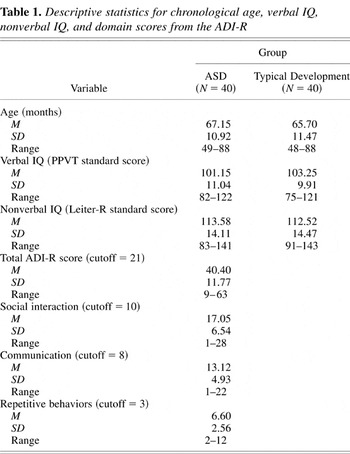
Descriptive statistics for chronological age, verbal IQ, nonverbal IQ, and domain scores from the ADI-R
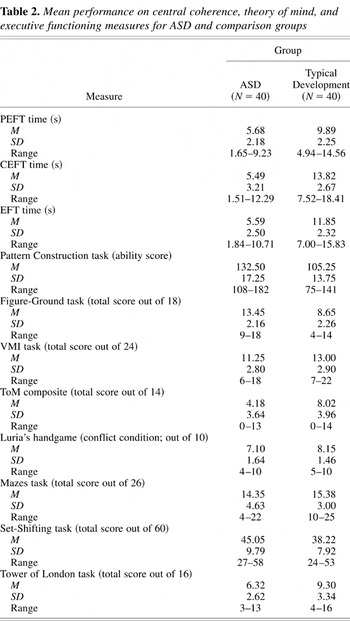
Mean performance on central coherence, theory of mind, and executive functioning measures for ASD and comparison groups
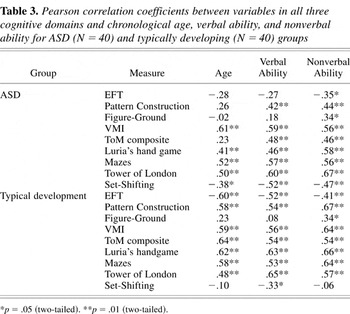
Pearson correlation coefficients between variables in all three cognitive domains and chronological age, verbal ability, and nonverbal ability for ASD (N = 40) and typically developing (N = 40) groups
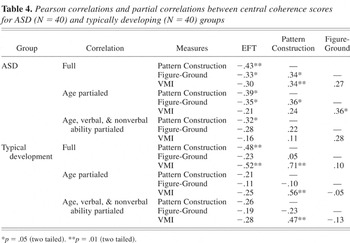
Pearson correlations and partial correlations between central coherence scores for ASD (N = 40) and typically developing (N = 40) groups
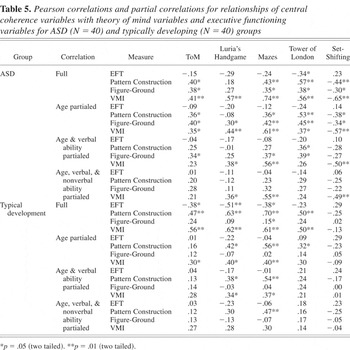
Pearson correlations and partial correlations for relationships of central coherence variables with theory of mind variables and executive functioning variables for ASD (N = 40) and typically developing (N = 40) groups
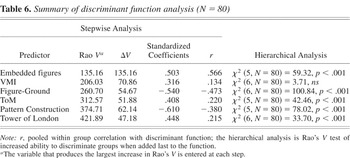
Summary of discriminant function analysis (N = 80)
 You have
Access
- 187
- Cited by