




No CrossRef data available.
Article contents
Cardiac troponin-I in the serum of infants of diabetic mothers
Published online by Cambridge University Press: 24 May 2005
Abstract
A transient form of hypertrophic cardiomyopathy has been previously described in infants of diabetic mothers. When it occurs, it is generally benign. The purpose of our study was to establish the extent of injury to the cardiomyocytes in symptomatic and asymptomatic patients with and without hypertrophic cardiomyopathy.
Thus, we compared 35 consecutive patients to 20 healthy controls, establishing the significance, if any, of differences in cardiac troponin-I and creatine kinase, including its MB-fraction, and seeking to establish the value of these parameters in the diagnosis of cardiac injury. We also determined to levels of glucose and insulin in the serum, and took note of electrocardiographic and echocardiographic investigations. Values were determined at the 1st and 7th days after admission in the patients, while parameters were measured in the control group only on the first day.
We found that the levels of cardiac troponin-I in the serum, known to be a marker for cardiac injury, were significantly elevated in symptomatic patients with life-threatening respiratory or haemodynamic distress. We speculate that transient ventricular hypertrophy is neither the cause nor the consequence of damage to the cardiomyocytes. It would be interesting, nonetheless, to determine the relationship, if any, between cardiomyocytic damage and clinical outcome.
Keywords
Information
- Type
- Original Article
- Information
- Copyright
- © 2003 Cambridge University Press
Since the 1930s, an association has been noted in infants of diabetic mothers between the presence of a large heart on chest radiography, or an increased weight of the heart at the time of autopsy.1 Currently, cardiac involvement of the heart is known to make a considerable impact on neonatal mortality and morbidity in these patients.2 The aim of our study was to establish if the cardiomyocytes were injured in symptomatic or asymptomatic infants of diabetic mothers with and without cardiac hypertrophy. We did this by measuring serial levels of cardiac troponin-I in the serum, comparing the values to those of creatine kinase and its MB fraction.
Patients and methods
We studied patients seen in our units of Paediatric Cardiology and Neonatology from January 2001 to July 2002. In all, we included in our study 35 patients, 22 males and 13 females, and 20 healthy controls, 12 males and 8 females. We found no significant differences regarding gender and gestational age between the patients and their controls. All the controls were healthy neonates born at term. There was no evidence of any infectious, immunological, allergic or neoplastic disorders. Our patients were newborns born to mothers with gestational or maternal diabetes mellitus. We used the criterions of the World Health Organization to determine the abnormal glucose tolerance in all mothers.3 Body weights were significantly elevated in the patients (4.250 ± 0.50 g) compared with their controls (3.290 ± 0.70 g) (p < 0.05). The study was carried out after obtaining written informed consent from the parents of all the subjects. The hospital ethics committee approved the protocol.
Cardiac function and anatomy was determined by cross-sectional M-mode echocardiography and electrocardiography, performed in the patients on the 1st and 7th days after birth, and 4 to 6 months after admission, but only on the 1st day in the controls. A Hewlett-Packard Sonos 1000 system ultrasonic imager was used for echocardiographic assessments. Appropriate transducers of 3.5 MHz were used to define the cardiac structures. The echocardiograms were obtained in the standard precordial positions, following the recommendations of the American Society of Echocardiography.4 Because of the significant difference in body weight between the patients and their controls, we compared absolute M-mode measurements to body weight.5 When assessing the electrocardiographic tracings, we used ST depression in V6 of more than 0.2 mV, and the QT interval, corrected by the Bazett formula, as evidence of ischemia. We analyzed the levels of enzymes in the serum using an optimized method incorporating an auto analyzer (Vitros 250. CDS-Johnson and Johnson). Values of cardiac troponin-I were determined by radio immunoassay. Blood was sampled via venous lines, as routinely performed in our unit, at 09 a.m. in the patients on the 1st and 7th days after admission, and on the 1st day in the controls. Specimens were not stored. Values of cardiac troponin-I were measured in the serum by two-side sandwich immunoassay using direct chemiluminometric technology (The Chiron Diagnostics ACS: 180 cTn-I assay). The sensitivity level of this test is ≤0.15 ng/dl (Fig. 1, Table 1).

Figure 1. Values of cardiac enzymes in the serum on the 1st and 7th days as compared with the controls. Cardiac troponin-I measures were multiplied by 100 and creatine kinase divided into 10 to obtain clear depiction.
Table 1. Levels of cardiac troponin-I, creatine kinase and creatine kinase-MB in the patients and the controls.

We compared the differences in all variables between sub-groups of patients with or without hypertrophy, 12 of the patients fulfilling our criterions for hypertrophy in this respect. In addition, we also studied whether differences existed between the 13 symptomatic and the 22 asymptomatic patients. Those in the symptomatic group had developed cardiac and respiratory symptoms, had low APGAR scores, and required positive inotropic drugs along with admistration of intravenous fluids and electrolytes, oxygen or ventilatory support. Among those with symptoms, two had echocardiographic features of septal hypertrophy, three had hypertrophy of the left ventricular free wall, and one had both septal and left ventricular free wall hypertrophy with congestive heart failure. Respiratory distress syndrome was seen in four patients, while three had sepsis, two congestive heart failure, two transient neonatal tachycardia, and one perinatal asphyxia. Only one patient demonstrated signs of either congestive heart failure or cardiac hypertrophy. Among those without symptoms, three had septal hypertrophy, two had hypertrophy of the left ventricular free wall, and one had both septal and left ventricular free wall hypertrophy. Half of the patients with cardiac hypertrophy were asymptomatic (Table 2). No patient had obstructions of the left ventricular outflow tract. Of the patients with symptoms, four died, two with respiratory distress syndrome and two with neonatal sepsis. Permission for autopsy could not be obtained in any case.
Table 2. Clinical and echocardiographic findings.

Statistical analysis was done by SPSS for Windows v. 10.0 computer program. Parameters and variables in the two groups were compared using the t-test or the Wilcoxon test for non-parametric data. Pearson's correlations were determined and compared for levels of enzymes using the t-test for linearity, and taking p values of less than 0.05 as being significant.
Results
Levels of cardiac troponin-I, and the MB fraction of creatine kinase were significantly elevated in the patients at the 1st and 7th days compared with their controls (p < 0.05). No differences were found in levels of creatine kinase on the 1st and 7th days when compared to controls (p > 0.05), and no correlation was found between the levels of the different enzymes (Table 1, Fig. 1). The values are divergent, with many patients having normal MB fractions of creatine kinase with elevated cardiac troponin-I, and vice versa. No significant differences were found in values of the enzymes in those patients with hypertrophy (p > 0.05), nor could significant differences be found in values of the enzymes compared with control values in those without symptoms (p > 0.05) (Table 1, Fig. 1). In three patients, however, along with one with perinatal asphyxia, one of three with congestive heart failure, and two with respiratory distress syndrome, levels of cardiac troponin were higher than in patients without symptoms and the mean values for the controls.
Values of cardiac troponin-I, but not the MB fraction of creatine kinase, were significantly elevated in those patients with low APGAR scores (p < 0.05) (Fig. 2). No significant differences were found in values of cardiac troponin-I compared with simultaneously measured levels of insulin, glucose, calcium, or magnesium in the serum, nor with haemoglobin, body weights, and the duration of phototherapy. The corrected values of the QT interval were normal, as was left ventricular fractional shortening as seen as echocardiography, in all but one patient with congestive heart failure in the presence of symptoms. All patients had normal echocardiographic and electrocardiographic findings when reviewed after 4 to 6 months.

Figure 2. APGAR scores and levels of cardiac troponin-I in the serum on the 1st day in our patients.
Discussion
Infants of diabetic mothers, during intrauterine life, are exposed to chronic hyperinsulinism, and then to reactive hypoglycaemia at birth. Cardiac and respiratory distress are prominent findings in such infants. During the first few days of life, many patients develop tachypnea, which may be a transient manifestation of hypoglycaemia. Others develop hypothermia, polycythemia and tachypnea with or without congestive heart failure, or cerebral oedema due to perinatal asphyxia. Respiratory distress is seen with greater frequency in infants of diabetic as compared to non-diabetic mothers. Currently, cardiomegaly is seen in up to one-third, while heart failure occurs in up to one-tenth of these infants. The neonatal death rate is over five times that of infants of non-diabetic mothers. Asymmetric septal or ventricular hypertrophy may occur, becoming manifest in similar fashion to idiopathic hypertrophic subaortic stenosis. This well recognized phenomenon is unrelated to markers of cardiomyocytic damage in the serum in the absence of obstruction to either ventricular outflow tract.6, 7
Infants of diabetic mothers usually have plethoric faces, and are subject to hypoglycaemia, hypocalcaemia, hypomagnesaemia, hyperinsulinemia, and polycythemia.7 In our study, we found no significant differences in values of cardiac troponin-I in the serum when compared with simultaneous levels of insulin, glucose, calcium, and magnesium, nor with haemoglobin, body weights, or duration of phototherapy. The left ventricular fractional shortening is typically normal in asymptomatic patients, but may be increased in those with congestive heart failure. Of two patients with congestive heart failure in our study, however, only one had significantly low fractional shortening, specifically with a value less than 25%.
Levels of cardiac troponin-I are known to be specific markers of cardiac damage that are of prognostic value in acute myocardial infarction,8 unstable angina,9 myocarditis,10 cardiac trauma,11 coronary arterial disease,12 early sepsis,13 and congestive heart failure.14, 15 The reference values for these enzymes have been reported for children.16, 17
Recently, cardiac troponin-I and T have emerged as biochemical markers for the detection of myocardial cell damage, largely replacing measurements of creatine kinase and its MB fraction in children. In particular, cardiac troponin-I is established as a marker with high specificity for cardiac injury.18, 19 In our study, this enzyme was significantly elevated in those patients with symptoms, those with low APGAR scores, and in those with cardiovascular and respiratory distress when compared to those having no symptoms and the controls. It would be interesting to determine the relation between cardiomyocytic damage and clinical outcome. Levels of the MB fraction of creatine kinase were elevated at the 1st day when compared with values taken at the 7th day and with controls. Poor correlations of cardiac troponin and the MB fraction of creatine kinase have been noted during the first year of life.16–18 But these enzymes were elevated in those having no symptoms without a comparable rise in cardiac troponin.
The management of asymptomatic patients is purely supportive. The patients with severe congestive heart failure, or cardiovascular and respiratory distress, however, present more of a problem. The high neonatal mortality rate in infants of diabetic mothers remains unexplained, and prospective trials will be needed on this subject. Whatever the mechanisms leading to death, there have been a few clinical investigations supporting the hypothesis that high levels of cardiac troponin in the serum is a marker for increased risk in patients with cardiac hypertrophy. Despite the clinical and echocardiographic similarities of the cardiomyopathy in infants of diabetic mothers to familial hypertrophic cardiomyopathy as seen in childhood, its benign and transient nature suggests that it is a separate phenomenon. It is postulated that the fetus of the diabetic mother, in whom hyperinsulinism develops, will have increased myocardial receptor sites, increased affinity for insulin, and increased capacity for degrading insulin. This could lead to increased synthesis of protein, glycogen, and fat in the myocardium, and subsequent hyperplasia and hypertrophy of myocardial cells. Postnatally, as levels of insulin regress in the serum, and the number of insulin receptors decrease, the septal hypertrophy should also regress. It is well recognized that suboptimal diabetic control during pregnancy increases the risk of these abnormalities.6, 7
In conclusion, in contrast to creatine kinase, we found that levels of cardiac troponin-I in the serum have clinical utility as a biochemical marker of myocytic injury in infants of diabetic mothers with life-threatening respiratory and haemodynamic distress, but not in those with cardiac hypertrophy. We speculate that cardiac hypertrophy is a separate phenomenon, and is neither the cause nor the consequence of cardiomyocytic damage. An increase number of control patients might offer a better support for our results.
Acknowledgments
The authors thank Professor Said Bodur for assistance in the statistical analysis.
References
Gutgesell HP, Speer ME, Rosenberg HS. Characterization of the cardiomyopathy in infants of diabetic mothers. Circulation 1980; 61: 441–450.Google Scholar
Henry WY, Clarc CE, Epstein SE. Asymmetric septal hypertrophy: Echocardiographic identification of the patognomonic anatomic abnormality of IHSS. Circulation 1973; 47: 225–233.Google Scholar
World Health Organization: Definition, Diagnosis and Classification of Diabetes: Mellitus and its Complications. Part 1: Diagnosis and Classification of Diabetes Mellitus. Department of Noncommunicable Disease Surveillance, Geneva, 1999.
Feigenbaum H. Echocardiography. Lea & Febiger, Philadelphia, 1994, pp 658–675.
Henry WL, Ware J, Gardin JM, Hepner SI, McKay J, Weiner M. Echocardiographic measurements in normal subjects. Growth-related changes that occur between infancy and early adulthood. Circulation 1978; 57: 278–285.Google Scholar
Stoll BJ, Kliegman RM. The fetus and the neonatal infant. In: Behrman RE, Kliegman RM, Jenson HB (eds). Nelson Textbook of Pediatrics, 16th edn. W.B. Saunders Company, Philadelphia, 2000, pp 532–533.
Caddell JL. Metabolic and nutritional disease and diseases in the tropics. In: Allen HD, Gutgesell HP, Clark EB, Driscoll DJ (eds). Moss and Adams' Heart Disease in Infant, Children and Adolescent, 6th edn. Lippincott Williams & Wilkins Company, Philadelphia, 2001, pp 1257–1258.
Wu AHB, Valdes R Jr, Apple FS, Gornet T, Stone MA, Mayfield-Stokes S. Cardiac troponin T immunoassay for diagnosis of acute myocardial infarction. Clin Chem 1994; 40: 900–907.Google Scholar
Galvani M, Ottani F, Ferrini D, Ladenson JH, Destro A, Baccos D. Prognostic influence of elevated values of cardiac troponin I in patients with unstable angina. Circulation 1997; 95: 2053–2059.Google Scholar
Smith SC, Ladenson JH, Mason JW, Jaffe AS. Elevations of cardiac troponin I associated with myocarditis: experimental and clinical correlates. Circulation 1997; 95: 163–168.Google Scholar
Adams JE, Davilla-Roman VG, Bessey P, Blake DP, Ladenson JH, Jaffe AS. Improved detection of cardiac contusion with cardiac troponin I. Am Heart J 1996; 131: 308–312.Google Scholar
La Wu AH, Apple FS, Gibler WB. National Academy of Clinical Biochemistry standards of laboratory practice: recommendations for the use of cardiac markers in coronary artery diseases. Clin Chem 1999; 45: 1104–1121.Google Scholar
Spies C, Haude V, Fitzner R, et al. Serum cardiac troponin T as a prognostic marker in early sepsis. Chest 1998; 113: 1055–1063.Google Scholar
Missov E, Calzolari C, Pau B. Circulating cardiac troponin I in severe congestive heart failure. Circulation 1997; 96: 2953–2958.Google Scholar
La Vecchia L, Mezzena G, Ometto R, et al. Detectable serum troponin I in patients with heart failure of non-myocardial ischemic origin. Am J Cardiol 1997; 80: 88–90.Google Scholar
Soldin SJ, Murthy NJ, Agarwalla PK, Ojeifo O, Chea J. Pediatric reference ranges for creatine kinase, CKMB, troponin I, iron, and cortizol. Clin Biochem 1999; 32: 77–80.Google Scholar
Hirsch R, Landt Y, Porter S, Canter CE, Jaffe AS, Ladenson JH. Cardiac troponin I in pediatrics: normal values and potential use in the assessment of cardiac injury. J Pediatr 1997; 130: 872–877.Google Scholar
Ottlinger M, Pearsall L, Rifai N, Lipshultz SE. New developments in the biochemical assessment of myocardial injury in children: Troponin T and I as highly sensitive and specific markers of myocardial injury. Prog Pediatr Cardiol 1998; 8: 71–81.Google Scholar
Adams JE, Bodor GS, Davilla-Roman VG, et al. Cardiac troponin I: a marker with high specificity for cardiac injury. Circulation 1993; 88: 101–106.Google Scholar

Values of cardiac enzymes in the serum on the 1st and 7th days as compared with the controls. Cardiac troponin-I measures were multiplied by 100 and creatine kinase divided into 10 to obtain clear depiction.
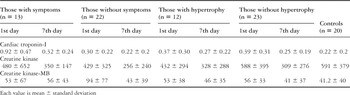
Table 1.
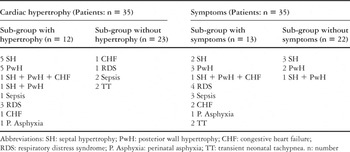
Table 2.

APGAR scores and levels of cardiac troponin-I in the serum on the 1st day in our patients.
 You have
Access
- 6
- Cited by