Introduction
Graftonite, ideally  ${\rm Fe}_{\rm 3}^{2 +} $(PO4)2, was described from a granitic pegmatite in New Hampshire by Penfield (Reference Penfield1900). Beus (Reference Beus1950) and Brooks and Shipway (Reference Brooks and Shipway1960) reported a graftonite-like mineral with Mn2+ dominant over Fe2+, and beusite, ideally
 ${\rm Mn}_{\rm 3}^{2 +} $(PO4)2, was formally described as a distinct species from the pegmatites of the San Luis area, Argentina, by Hurlbut and Aristarain (Reference Hurlbut and Aristarain1968). Graftonite and beusite form a solid-solution series and are common as late-stage accessory minerals in complex granite pegmatites (e.g. Fransolet, Reference Fransolet1977; Fransolet et al., Reference Fransolet, Keller and Fontan1986; Lahti, Reference Lahti1981; Wise and Černý, Reference Wise and Černý1990; Wise et al., Reference Wise, Hawthorne and Černý1990; Černý et al., Reference Černy, Selway, Ercit, Breaks, Anderson and Anderson1998; Smeds et al., Reference Smeds, Uher, Černý, Wise, Gustafsson and Penner1998; Pieczka, Reference Pieczka2007; Guastoni et al., Reference Guastoni, Nestola, Mazzoleni and Vignola2007; Vignola et al., Reference Vignola, Diella, Oppizzi, Tiepolo and Weiss2008; Galliski et al., Reference Galliski, Oyarzábal, Márquez-Zavalía and Chapman2009; Ercit et al., Reference Ercit, Tait, Cooper, Abdu, Ball, Anderson, Černý, Hawthorne and Galliski2010). They also occur as constituents of phosphate-oxide inclusions in IIIAB iron meteorites (Bild, Reference Bild1974; Steele et al., Reference Steele, Olsen, Pluth and Davis1991; Olsen et al., Reference Olsen, Kracher, Davis, Steele, Hutcheon and Bunch1999), and Stalder and Rozendaal (Reference Stalder and Rozendaal2002) reported graftonite as a primary phase in a P-rich iron formation. The chemical composition of the graftonite series is written as (Fe2+, Mn2+, Ca)3(PO4)2, and although previously considered a minor constituent, Ca plays an important role in the structure of these minerals.
The crystal structures of graftonite and beusite were solved by Calvo (Reference Calvo1968) and Hurlbut and Aristarain (Reference Hurlbut and Aristarain1968), respectively. Steele et al. (Reference Steele, Olsen, Pluth and Davis1991) and Wise et al. (Reference Wise, Hawthorne and Černý1990) refined the structures of Ca-free and Ca-rich beusite, respectively. Nord (Reference Nord1982) and Nord and Ericsson (Reference Nord and Ericsson1982a) looked at solid solution and Fe–Mn order in synthetic phases along the join graftonite–beusite, and Nord and Ericsson (Reference Nord and Ericsson1982b) looked at Fe2+–(Ca2+, Mg2+, Co2+, Ni2+, Zn2+, Cd2+) order in synthetic graftonite-structure phases by Mössbauer spectroscopy.
Structural considerations
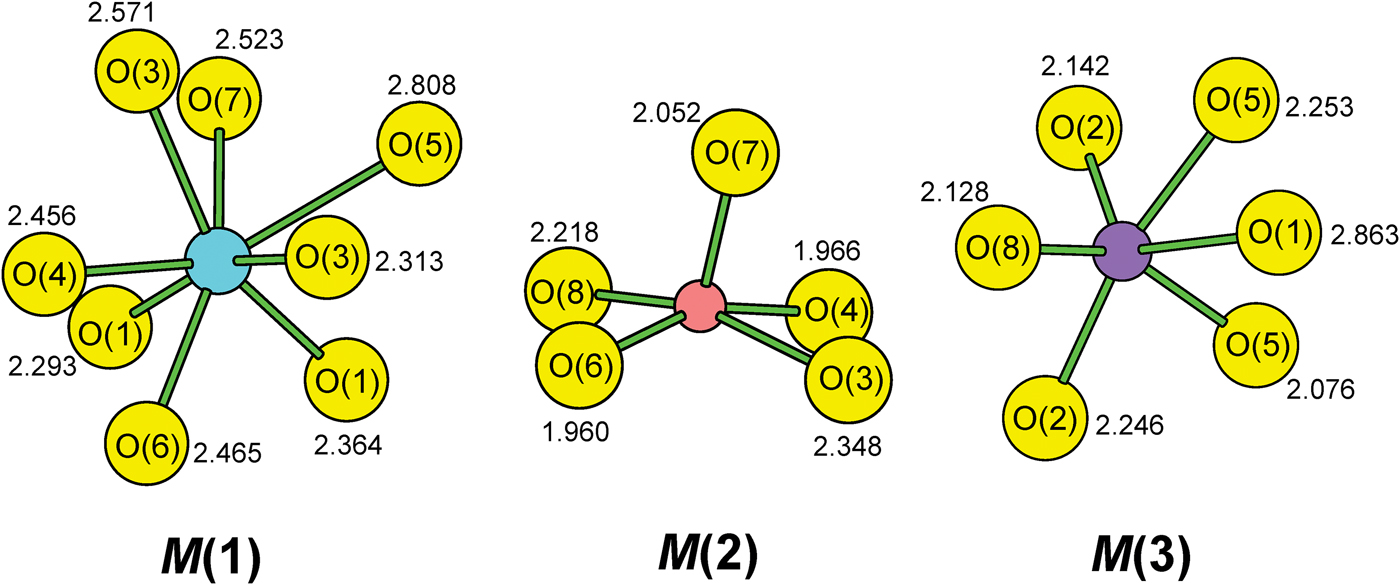
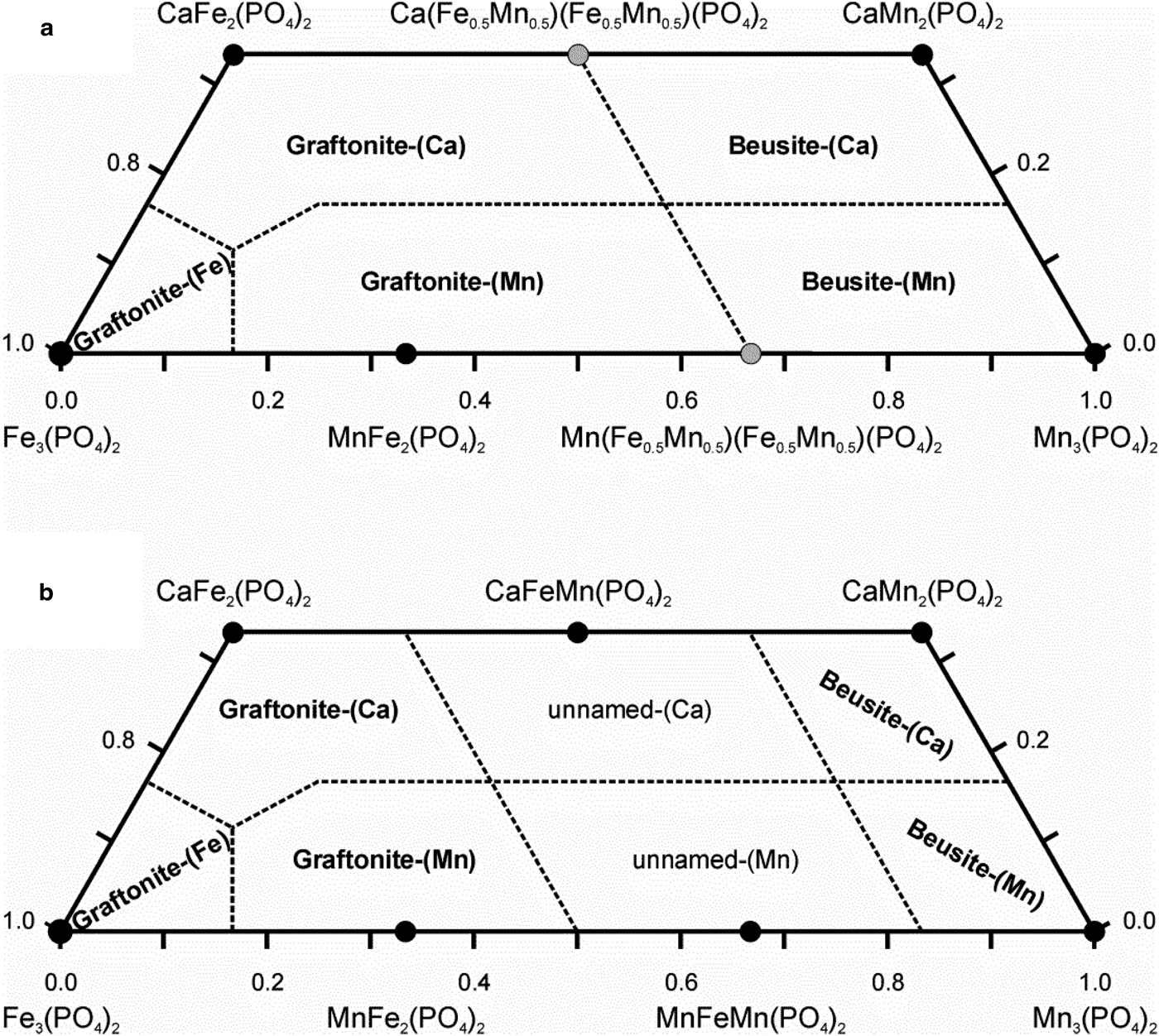
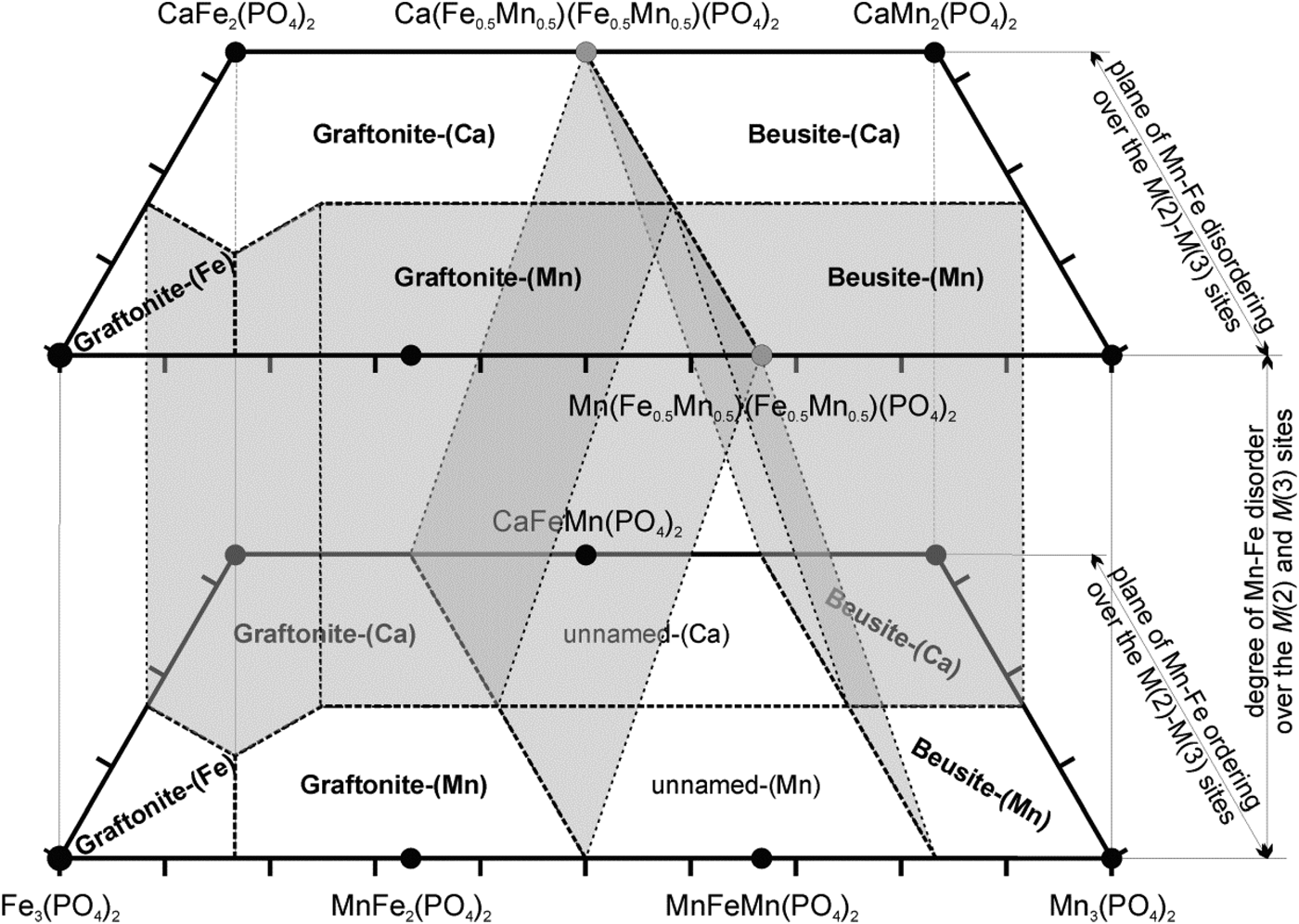
The structure of graftonite–beusite is a dense framework of polyhedra, with extensive edge- and corner-sharing (Hawthorne, Reference Hawthorne1998; Huminicki and Hawthorne, Reference Huminicki, Hawthorne, Kohn, Rakovan and Hughes2002) between phosphate tetrahedra and [5]- to [8]-coordinated divalent-metal-oxide polyhedra. There has been extensive discussion as to the coordination numbers of the M(1), M(2) and M(3) sites in the graftonite–beusite structure; detailed examination of the issue by Tait et al. (Reference Tait, Hawthorne and Wise2013) led to the following conclusion: M(1) = [8], M(2) = [5] and M(3) = [6] (Fig. 1). All authors who have worked on the structures of graftonite–beusite minerals and their synthetic analogues have noted very strong ordering of cations over the M(1), M(2) and M(3) sites. In particular, in the Ca-rich beusite of Wise et al. (Reference Wise, Hawthorne and Černý1990), all Ca was completely ordered at the M(1) site and the site was dominated by Ca2+: Ca0.98Mn0.02, which warrants recognition as new species: Ca(Mn,Fe)2(PO4)2. However, inspection of all crystallographic work on these structures shows strong order of Mn2+ and Fe2+ over the M sites, indicating that other distinct species are also possible. Mössbauer spectroscopy shows that Mn–Fe ordering over the M(1) and M(3) sites is not complete, and we may recognize two different schemes of order for Ca2+ completely ordered at M(1): [1] Mn2+ enters M(1), and Mn2+ and Fe2+ are disordered over the M(2) and M(3) sites; and [2] Mn2+ fills the sites in the order M(1) > M(3) > M(2) with Fe2+ making up the difference. These two schemes are illustrated in Figs 2a and 2b. The two schemes shown in Fig. 2 are end-members of an order–disorder series. This is illustrated in Fig. 3, which incorporates a third axis as representing the degree of disorder of Mn2+ and Fe2+ over the M(2) and M(3) sites.
The M(1), M(2) and M(3) sites in the graftonite–beusite structure; distances are from beusite-(Ca) (Hawthorne et al., Reference Hawthorne, Wise, Černý, Abdu, Ball, Pieczka and Włodek2018).

(a) Classification based on (Fe,Mn) disorder over M(2) and M(3); (b) classification based on (Fe,Mn) order over M(2) and M(3).

Classification based on (Fe,Mn) order–disorder over M(2) and M(3).

Classification
It is desirable to develop a classification scheme that is useful to petrology as well as mineralogy, and thus a classification scheme should not involve details of cation order that depend on techniques (such as Mössbauer spectroscopy) that are not very widespread in the mineralogy community. Thus we have based the classification of graftonite-group minerals on Fig. 2a, in which the mineral formula is based on 8 O2– anions per formula unit and: (1) Ca2+ is assigned completely to the M(1) site, and any deficiency at M(1) is filled first with Mn2+ and then with Fe2+; and (2) Mn2+ and Fe2+ are considered as disordered over the M(2) and M(3) sites.
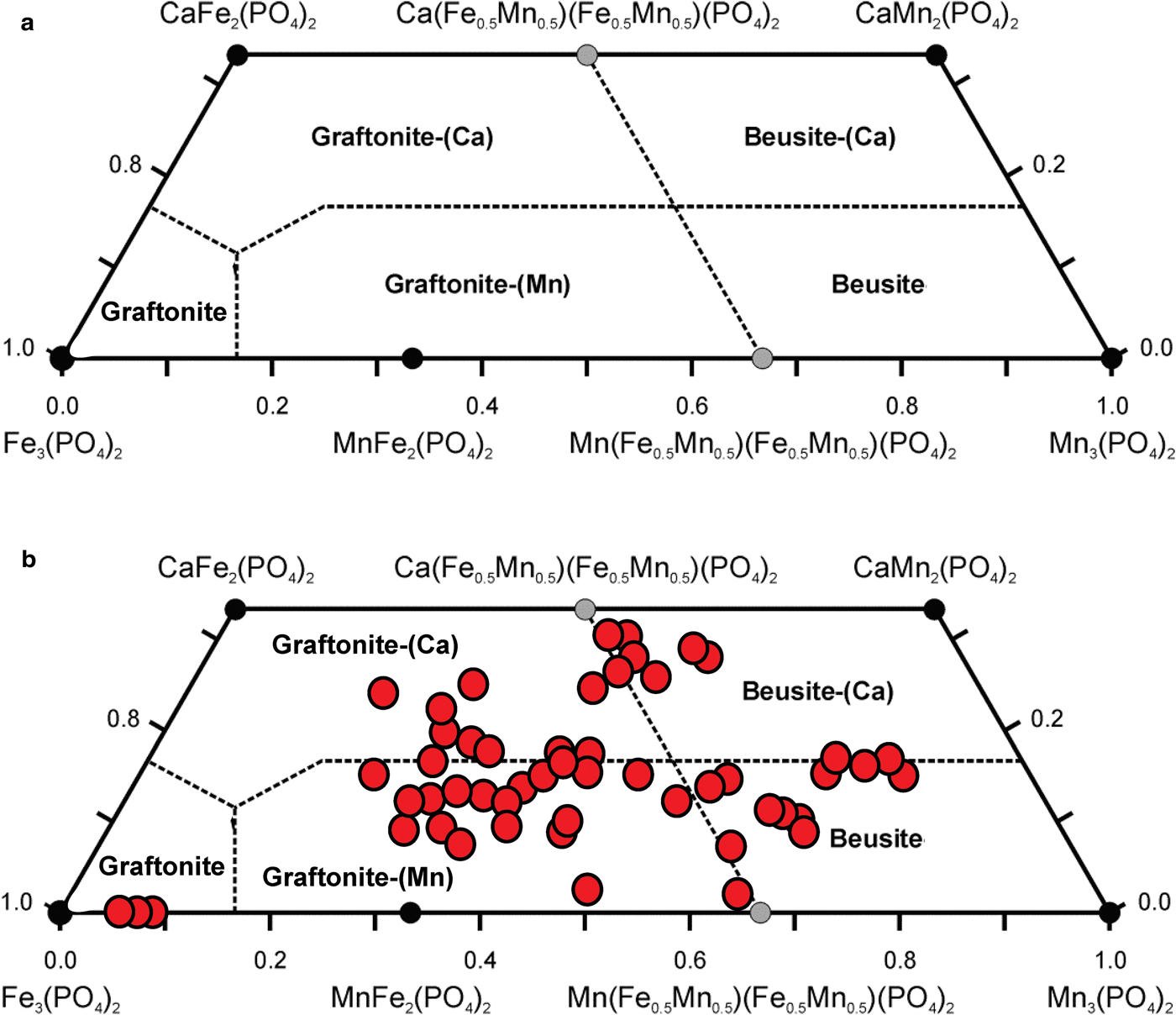
The resulting divisions of the compositional field are shown in Fig. 4a.
(a) Approved classification of the minerals of the graftonite–beusite group; (b) compositions of graftonite-group minerals from Brooks and Shipway (Reference Brooks and Shipway1960), Hurlbut and Aristarain (Reference Hurlbut and Aristarain1968), Olsen and Fredriksson (Reference Olsen and Fredriksson1966), Fransolet et al. (Reference Fransolet, Keller and Fontan1986), Wise and Černý (Reference Wise and Černý1990), Wise et al. (Reference Wise, Hawthorne and Černý1990), Staněk (Reference Staněk1991), Černý et al. (Reference Černy, Selway, Ercit, Breaks, Anderson and Anderson1998), Smeds et al. (Reference Smeds, Uher, Černý, Wise, Gustafsson and Penner1998), Pieczka (Reference Pieczka2007) and Tait et al. (Reference Tait, Hawthorne and Wise2013).

End-member compositions and mineral names
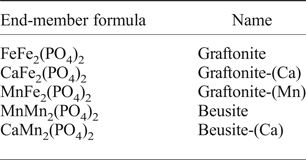
These are listed in Table 1. Graftonite was described by Penfield (Reference Penfield1900) and beusite was described by Hurlbut and Aristarain (Reference Hurlbut and Aristarain1968); thus in terms of a group name, graftonite has priority (Mills et al., Reference Mills, Hatert, Nickel and Ferraris2009). Moreover, the un-suffixed names graftonite and beusite are retained in accord with guidelines from the Commission on New Minerals, Nomenclature and Classification for the use of suffixes and prefixes in mineral nomenclature, and for the preservation of historical names (Hatert et al., Reference Hatert, Mills, Pasero and Williams2013). The classification scheme proposed in Table 1 and Fig. 4a introduce three new mineral species: graftonite-(Ca), graftonite-(Mn) and beusite-(Ca). Figure 4b shows that compositional data for minerals from the literature occupy all five fields. This classification and nomenclature scheme has been approved by the International Mineralogical Association Commission on New Minerals, Nomenclature and Classification (memorandum 66–SM/17, Hålenius et al., Reference Hålenius, Hatert, Pasero and Mills2017).
End-member formulae and names for the minerals of the graftonite group.

Acknowledgements
This work was supported by a Canada Research Chair in Crystallography and Mineralogy, and Research Tools and Equipment, Major Facilities Access and Discovery Grants from the Natural Sciences and Engineering Research Council of Canada to FCH, and by a National Science Centre (Poland) grant 2015/17/B/ST10/03231 to AP.