Non-suicidal self-injury (NSSI) behaviors are deliberated self-injurious behaviors inflicted without intending death which results in immediate tissue damage (Nock & Kessler, Reference Nock and Kessler2006). Among adolescents, they are a widespread public health problem with serious impact on health and well-being. In recent years, they have become more frequent, with important negative consequences for family and society (Gastaminza, Herreros, Ortiz, & Sánchez, Reference Gastaminza, Herreros, Ortiz and Sánchez2005). In addition, researchers agree that NSSI behaviors are risk factors and precursors of suicidal behavior as well as indicators of psychopathology (Kokkevi et al., Reference Kokkevi, Richardson, Olszewski, Matias, Monshouwer and Bjarnason2012).
Numerous studies have described the effect of poor emotional regulation strategies, poor emotional cognition, behavioral impulsivity or self-criticism on the development of NSSI behaviors (Claes, Klonsky, Muehlenkamp, Kuppens, & Vandereycken, Reference Claes, Klonsky, Muehlenkamp, Kuppens and Vandereycken2010; Stein et al., Reference Stein, Chiu, Hwang, Kessler, Sampson, Alonso and Nock2010), which leads to suspect the existence of affective regulation vulnerability (Cohen et al., Reference Cohen, Stange, Hamilton, Burke, Jenkins, Ong and Alloy2015) in the root of these behaviors. It also has been pointed out that the reduction of emotion dysregulation decreases the need for maladaptive behaviors, such as self-injury, that function to regulate emotions, (Gratz, Reference Gratz2007).
In order to document self-regulatory problems, a dysregulation profile (DP) has been defined. The DP has shown to be related to functional impairment and psychopathological symptom severity (Althoff, Rettew, Ayer, & Hudziak, Reference Althoff, Rettew, Ayer and Hudziak2010). Patients with a high dysregulation profile usually show restlessness, irritability, “affective storms”, mood instability, and aggression in a level disproportionate to the situation (Althoff et al., Reference Althoff, Ayer, Crehan, Rettew, Baer and Hudziak2012). Its presence in childhood and adolescence seems to be related with the development of psychopathology, mood and substance disorders in adulthood (Althoff, Rettew et al., Reference Althoff, Rettew, Ayer and Hudziak2010; Holtman, Buchmann et al., 2011; Jucksch et al., Reference Jucksch, Salbach-Andrae, Lenz, Goth, Döpfner, Poustka and Holtmann2011; Mbekou, Gignac, MacNeil, Mackay, & Renaud, Reference Mbekou, Gignac, MacNeil, Mackay and Renaud2014). In addition, a DP in earlier years of development is a risk factor for disruptive behavior disorders 14 years later (Althoff, Verhulst, Rettew, Hudziak, & van der Ende, Reference Althoff, Rettew, Ayer and Hudziak2010) and pathological personality traits in adulthood (De Caluwé, Decuyper, & De Clercq, Reference De Caluwé, Decuyper and De Clercq2013). Thus, available evidence indicates the relationship between the DP and pathological emotional and self-regulatory processes.
Initially, the DP was described as an index assessed by the Child Behavior Checklist (CBCL) the CBCL-DP (Achenbach, Reference Achenbach1991). Criteria include high scoring on three of the CBCL syndrome scales: Aggressive behavior, Anxious/Depressed, and Attention problems (Ayer et al., Reference Ayer, Althoff, Ivanova, Rettew, Waxler, Sulman and Hudziak2009). Although the CBCL-DP was first associated with juvenile bipolar disorder (Biederman et al., Reference Biederman, Wozniak, Kiely, Ablon, Faraone, Mick and Kraus1995), later investigations showed that it does not correspond with any of the diagnoses proposed by current classification systems (Carballo et al., Reference Carballo, Serrano-Drozdowskyj, García, Díaz, Pérez-Fominaya, Molina-Pizarro and Baca-García2014; Holtmann, Becker, Banaschewski, Rothenberger, & Roessner, Reference Holtmann, Becker, Banaschewski, Rothenberger and Roessner2011), being defined as an index of self-regulatory problems in multiple domains (Althoff et al., Reference Althoff, Ayer, Crehan, Rettew, Baer and Hudziak2012). Afterwards, it also has been described a DP assessed by the Strengths and Difficulties Questionnaire, the SDQ-DP (Goodman, Reference Goodman1997; Holtmann, Becker et al., Reference Holtmann, Becker, Banaschewski, Rothenberger and Roessner2011). Both the SDQ-DP and CBCL-DP share similar validity and psychometric characteristics (Althoff, Rettew et al., Reference Althoff, Rettew, Ayer and Hudziak2010) and have demonstrated similar prevalence and correlates of psychopathology in patients with a high Dysregulation Profile (Carballo et al., Reference Carballo, Serrano-Drozdowskyj, García, Díaz, Pérez-Fominaya, Molina-Pizarro and Baca-García2014). We can therefore accept the DP as a valid construct, independently of a specific questionnaire, although these are the only two instruments to assess DP so far.
Given the former considerations, it is to be expected that a relation between the DP and self-harmful behaviors may be found. Studies examining the relationship between the DP and suicidal behavior have shown a higher risk for suicidal ideation and suicidal attempts in children and adolescents with higher DP scores (Althoff, Rettew et al., Reference Althoff, Rettew, Ayer and Hudziak2010; Holtmann, Buchmann et al., Reference Holtmann, Becker, Banaschewski, Rothenberger and Roessner2011; Mbekou et al., Reference Mbekou, Gignac, MacNeil, Mackay and Renaud2014; Meyer et al., Reference Meyer, Carlson, Youngstrom, Ronsaville, Martinez, Gold and Radke-Yarrow2009). Although it is to be pointed out that these studies do not differentiate between suicidal gestures, suicide attempts and NSSI behavior.
In addition to emotional regulation, other constructs have been related to NSSI. Stressful life events (SLE) are a remarkable one (Chartrand, Bhaskaran, Sareen, Katz, & Bolton, Reference Chartrand, Bhaskaran, Sareen, Katz and Bolton2015). Among the most typically reported stressful life events associated with NSSI behaviors are: History of sexual and psychological abuses (Cerutti, Manca, Presaghi, & Gratz, Reference Cerutti, Manca, Presaghi and Gratz2011), history of aggressions, accidents and family violence (Keenan, Hipwell, Stepp, & Wroblewski Reference Keenan, Hipwell, Stepp and Wroblewski2014), as well as interpersonal problems and a poor social network (Mandelli et al., Reference Mandelli, Nearchou, Vaiopoulos, Stefanis, Vitoratou, Serretti and Stefanis2015). Although initial reports claimed that a constant cause-effect relationship between specific life events and their psychological consequences existed, recent investigations have consistently reported that it is the accumulation of SLE, and not the presence of an isolated SLE, that appears to be related to emotional disturbances, (de Tychey, Garnier, Lighezzolo-Alnot, Claudon, & Rebourg-Roesler, Reference de Tychey, Garnier, Lighezzolo-Alnot, Claudon and Rebourg-Roesler2010).The “accumulation theory” of SLE also seems to apply to suicidal behaviors (Stein et al., Reference Stein, Chiu, Hwang, Kessler, Sampson, Alonso and Nock2010).
The issue then is to connect self-regulatory problems and SLE with NSSI. So far, the mechanisms that link affective regulation vulnerability, stressful life events and NSSI behaviors are still not well understood. As not all children exposed to SLE develop psychopathology, NSSI or suicidal behaviors, it is plausible to assume that there are additional variables behind these outcomes. We claim that one of these causal variables in the root of NSSI behaviors could be the capacity of self-regulation, which can be identified as the DP.
DP is a psychopathological feature associated with suicidal behaviors and it is plausible to assume its relationship also with NSSI behaviors, although there is less evidence. As the SDQ-DP is a short and easily applicable instrument in clinical settings, knowing the implications of the presence of DP in children and adolescents who can develop future NSSI behaviors, could be of major importance. The aim of the present investigation was to study the relationship between DP, assessed with SDQ-DP, and NSSI behaviors in a sample of children and adolescents attending mental health services. We posit that this relationship will be mediated by stressful life events.
Method
Sample
267 subjects were recruited from the Child and Adolescent Outpatient Psychiatric Services, Jiménez Díaz Foundation (Madrid, Spain) from November 1st 2011 to October 31st 2012. Exclusion criteria were restricted to the patients’ age (subjects under 11 years old and subjects over 18 years old were duly excluded) and the patients and parents’ inability to understand the questionnaires used. The final sample consisted of 239 subjects. Comparative analyses between the excluded patients and the final sample were conducted and no differences were found in the main psychosocial and clinical characteristics (age, sex, ethnicity, negative life events, functional impairment, socioeconomic level, family organization, diagnosis, suicidal ideation, suicidal plans, suicidal gestures, suicide attempts, and non-suicidal self-injury behaviors) apart from the subscale Thoughts of Non-Suicidal Self-Injury of the Self-Injurious Thoughts and Behaviors Interview (SITBI) (Nock, Holmberg, Photos, & Michel, Reference Nock, Holmberg, Photos and Michel2007) (χ2 = 3.875, df = 1, p = .049).
Written informed consent was obtained from patients and parents or legally authorized representatives. The Jiménez Díaz Foundation Ethics Committee approved the study.
Material
All subjects were administered the Spanish version of the Self-Injurious Thoughts and Behaviors Interview, SITBI (García-Nieto, Blasco-Fontecilla, Paz, & Baca-García, Reference García-Nieto, Blasco-Fontecilla, Paz and Baca-García2013; Nock et al., Reference Nock, Holmberg, Photos and Michel2007), a structured interview that assesses the presence, frequency, and characteristics of suicidal ideation, suicidal plans, suicidal gestures, suicide attempts, NSSI thoughts and NSSI behaviors. It is an exhaustive tool as it assesses if the subject has ever had thoughts/plans/intentions of killing or self harm in any form. If the subject responds affirmatively then he or she is interrogated about frequency, intensity, method, mental state and other characteristics. Validation of the SITBI in the Spanish sample show similar psychometric properties than the English version (García-Nieto et al., Reference García-Nieto, Blasco-Fontecilla, Paz and Baca-García2013). Test-retest reliability ranges from .47 to .91 and construct validity ranges from k = .65 to k = .99.
Parents or legally authorized representatives were administered the Spanish version of the Parents-Rated Strengths and Difficulties Questionnaire, SDQ (Goodman, Reference Goodman1997). The SDQ is composed of 25 Likert-type items, divided into five scales. The first four scales measure emotional symptoms, behavioral problems, hyperactivity, and peer relationship problems while the fifth scale measures prosocial behaviors. A total difficulties score was generated by summing items of the first four scales. The SDQ-DP is calculated from the Parent-Rated SDQ (Holtmann, Becker et al., Reference Holtmann, Becker, Banaschewski, Rothenberger and Roessner2011), composed of the unweighted sum of the different items from each scale. The cutoff point recommended to define the Parent-Rated SDQ-DP is ≥ 5 points (Sensitivity = 94,6%; Specificity = 80%; α= .52) (Holtmann, Becker et al., Reference Holtmann, Becker, Banaschewski, Rothenberger and Roessner2011). In our sample, Cronbach’s alpha was .59, so these criteria as defined by Holtmann Becker et al. (2011) was used to discriminate between adolescents with higher and lower levels of affective and behavioral dysregulation (the DP and NO_DP group, respectively).
The Stressful Life Events Scale (Oliva, Jiménez, Parra, & Sánchez-Queija, Reference Oliva, Jiménez, Parra and Sánchez-Queija2008) was administered to obtain information regarding life stressors. In this case, adolescents responded whether a given negative life event of a list of possible negative life events had been present or not in their lives over the last three years.
Demographic data, developmental features and family data were obtained by a semi-structured interview.
Diagnoses were assigned by experienced clinicians who also completed the Children´s Global Assessment Scale, C-GAS (Shaffer et al., Reference Shaffer, Gould, Brasic, Ambrosini, Fisher, Bird and Aluwahlia1983), which yields a measure of the severity of patient’s symptoms.
Data analysis
Chi square and Student’s t-test were used to test SDQ-DP differences regarding gender, age, demographic data, SLE, SITBI and C-GAS.
Mediation models were developed to test the role of SLE in the relationship between SDQ-DP and NSSI behaviors. We followed standard methods for the testing which required meeting four criteria (Baron & Kenny, Reference Baron and Kenny1986): (1) The independent variable must be correlated with the dependent variable; (2) the independent variable must be correlated with the potential mediator; (3) the potential mediator must be correlated with the dependent variable, controlling for the independent variable; and (4) once the three conditions are met, the correlation between the independent and the dependent variable must decrease significantly with the inclusion of the potential mediator in the model.
The analysis of mediation models was developed by bootstrap sampling methods. Bootstrapping is a nonparametric approach to test hypothesis, estimate size-effects and construct confidence intervals without making any assumptions about the shape of the distribution (normality, for example, which is needed in classical parametrical methods). It is obtained by taking a large number of samples with replacement, of size N from the data (where N is the original sample size) (Preacher & Hayes, Reference Preacher and Hayes2004) and it is presuming to be of great interest in psychology research (Ledesma, Reference Ledesma2008). We used open syntax by Preacher and Hayes (Reference Preacher and Hayes2004) for SPSS to apply bootstrapping method in the analysis of the mediation model. In our study, 1,000 bootstrap samples on each calculation were chosen.
Once the mediation model was developed, a formal test is needed in order to determine the presence of the mediation effect (Holmbeck, Reference Holmbeck2002). Usually Sobel test is used, however, due to some limitations described for the Sobel test, especially when applied in small samples (Preacher & Hayes, Reference Preacher and Hayes2004), we studied indirect effects via bootstrapping procedures.
The independent variable (SDQ-DP) and the potential mediator (SLE) were examined as continuous measures. The dependent variable (NSSI behaviors) was examined as an accumulative measure (number of NSSI behaviors, from zero to the maximum quantity reported by the sample).
Results
Sample features
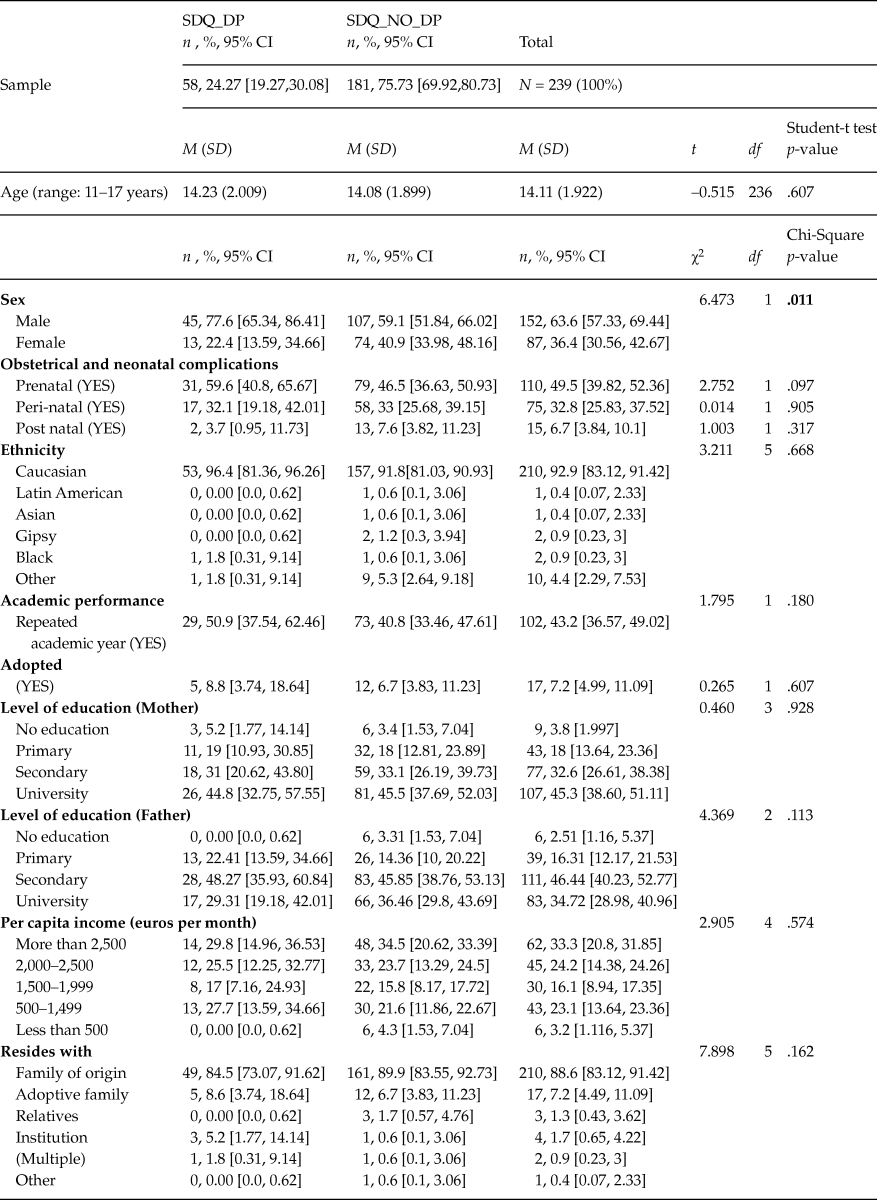
239 subjects (63.6% males, 36.4% females) aged between 11 and 17 years old, M = 14.11, SD = 1.92, took part in the present study. Most subjects were Caucasian (92.9%), lived with their family of origin (88.6 %), and lived in a family with more than 2,000 Euros/month of income (57.5%) which could be interpreted as medium socioeconomic level. Only 7.2 % (n = 17) of subjects were adopted, but 43.2% (n = 102) had repeated at least one academic year. 24.3% of the subjects (n = 58) matched criteria for DP (called the DP group) and 75.7% of them (n = 181) did not (called the No-DP group). Socio-demographic results for both groups are reported in Table 1. Significant differences in sex, χ2 = 6.473, n = 239, df = 1, p = .01, were found. No other significant differences in the socio-demographic variables were found.
Socio-Demographic Characteristics of the Sample, Categorized by SDQ-DP Status

Regarding SLE, persistent conflicts at home, economic difficulties, addiction problems of a close relative or friend, breaking up or problems with a partner, having a serious argument with close friends and drug problems were the main stressful experiences mentioned.
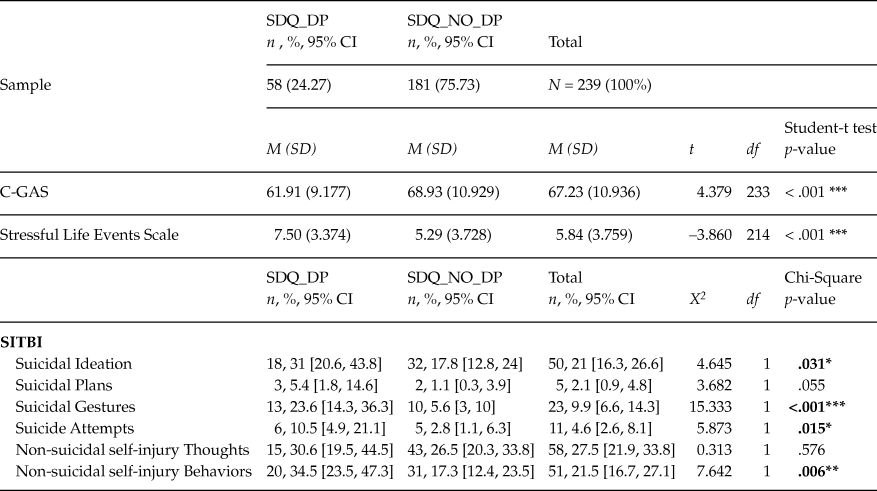
Comparisons of clinical variables between both groups are reported in Table 2. Most of the variables studied showed significant differences between groups, being higher in the DP-group, with the exception of two SITBI subscales: Suicidal plans, χ2 = 3.682, n = 5, df = 1, p = .06 and NSSI thoughts (χ2 = 0.313, n = 58, df = 1, p = .57) in which there were no differences between groups.
Clinical Characteristics of the Sample, Categorized by SDQ-DP Status
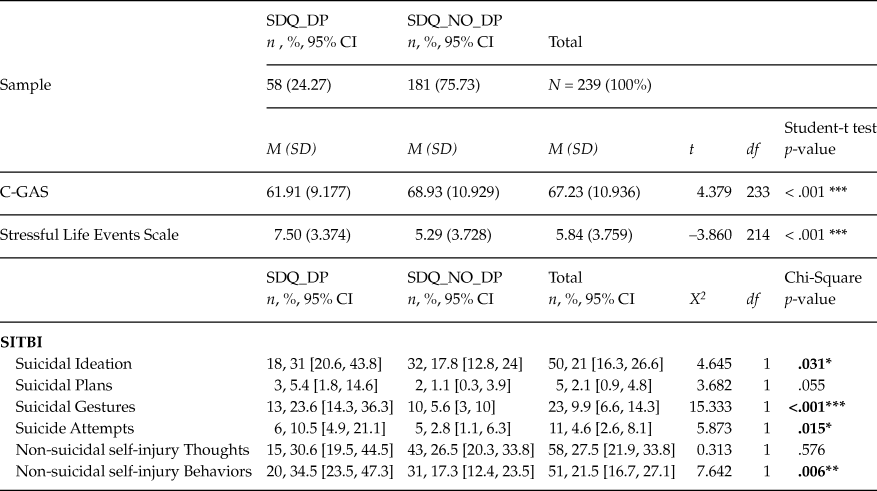
Note: C-GAS = Children’s Global Assessment Scale (n = 235); Stressful Life Events Scale (n = 216). SITBI = Self-Injurious Thoughts and Behaviors Interview; Suicidal Ideation (n = 238), Suicidal Plans (n = 235), Suicidal Gestures (n = 233), Suicide Attempts (n = 237), Non-suicidal self-injury Thoughts (n = 211), Non-suicidal self-injury Behaviors (n = 237).
Mediation analysis
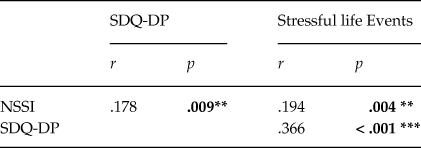
Correlation analyses revealed significantly small correlation between SDQ-DP and NSSI behaviors and significantly small correlation between SLE and NSSI behaviors. In addition, SDQ-DP and SLE are moderately correlated (see table 3).
Correlation Analyses

Note: SDQ-DP = Strengths and Difficulties Questionnaire - Dysregulation Profile; NSSI = Non-suicidal self-injury behaviors.
** p < 0.05; *** p < 0.001.
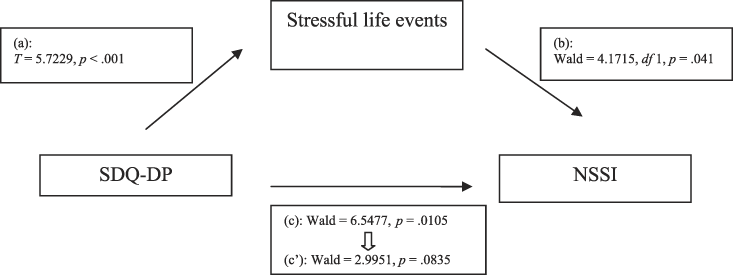
We followed standard methods to develop the mediation model, with our results meeting the four criteria described above (see Figure 1):
Stressful Life Events Mediate the Relation between SDQ-DP and NSSI.
SDQ-DP = Strengths and Difficulties Questionnaire - Dysregulation Profile; NSSI = Non-suicidal self-injury behaviors. (a) = Correlation between the Independent Variable (SDQ-DP) and the proposed mediator (Stressful life events); (b) = effect of the proposed mediator (Stressful life events) on the dependent variable (NSSI), controlling for the independent variable (SDQ-DP); (c) = the total effect of the independent variable (SDQ-DP) on the dependent variable (NSSI), not controlling for the mediator; (c’) = the effect of the independent variable (SDQ-DP) on the dependent variable (NSSI), controlling for the proposed mediator (Stressful life events).

We found that: (1) SDQ-DP significantly correlates with NSSI behaviors; (2) SDQ-DP significantly correlates with SLE; (3) SLE significantly correlates NSSI behaviors, and the relation remains significant whilst controlling for SDQ-DP; and (4) the relation between SDQ-DP and NSSI behaviors stop being significant whilst controlling for the potential mediator (SLE).
Study of indirect effect via bootstrap support the mediation model as the indirect effect is significantly different from zero at p < .05, .058 CI [.001, .126]. Remarkably, the formal test for the mediation model with SLE as an independent variable and SDQ-DP as mediator is not supported, since its 95% Confidential Interval contains zero, .029, CI [–.004, .066], supporting the specificity of the model presented in Figure 1.
Discussion
NSSI behaviors are a serious problem among children and adolescents, increasing the risk of developing additional dangerous behavior such as suicidal behavior. However, many of the determinants of this behavior are still undefined. Emotional dysregulation seems to be of mayor importance on the development of NSSI behaviors and it is marked the existence of affective regulation vulnerability in these behaviors (Cohen et al., Reference Cohen, Stange, Hamilton, Burke, Jenkins, Ong and Alloy2015). Some stressful life events, such as sexual abuse or physical neglect have shown a strong association with NSSI behaviors too. But it is the accumulation of SLE which is most clearly related with the presence of psychopathology and maladaptive behavior (de Tychey et al., Reference de Tychey, Garnier, Lighezzolo-Alnot, Claudon and Rebourg-Roesler2010). The mechanisms linking self regulatory abilities, SLE and NSSI behaviors are not clear, and they seem to depend on mediation models. We conducted a cross-sectional study in order to clarify the relationship between SDQ-DP and NSSI behaviors, based on the mediating role of stressful life events.
Results showed that adolescents with higher levels of DP present more NSSI behaviors than adolescents with lower levels of DP. Results showed here also support the mediation model: Stressful live events seem to be a total mediator of the relationship between SDQ-DP and NSSI behaviors.
Regarding the first finding, which shows the relationship between DP and the probability of present more NSSI behaviors, this is a new finding, as previous studies on DP and self-injury do not differentiate between suicidal and NSSI behaviors (Althoff, Rettew et al., Reference Althoff, Rettew, Ayer and Hudziak2010; Ayer et al., Reference Ayer, Althoff, Ivanova, Rettew, Waxler, Sulman and Hudziak2009; Holtmann, Buchmann et al., Reference Holtmann, Becker, Banaschewski, Rothenberger and Roessner2011; Mbekou et al., Reference Mbekou, Gignac, MacNeil, Mackay and Renaud2014; Meyer et al., Reference Meyer, Carlson, Youngstrom, Ronsaville, Martinez, Gold and Radke-Yarrow2009). To our knowledge, there are only two papers that have studied the relationship between NSSI behaviors and the SDQ, but not specifically with the SDQ-DP (Lacina et al., Reference Lacina, Staub-Ghielmini, Bircher, Bianchi, Schmeck and Schmid2014; Lundh, Wångby-Lundh, & Bjärehed, Reference Lundh, Wångby-Lundh and Bjärehed2011). This result supports the hypothesis of NSSI behaviors as a maladaptive regulation strategy (Brown, Comtois, & Linehan, Reference Brown, Comtois and Linehan2002). It seems that children and adolescents with more difficulties in emotional and behavioral regulation are more likely to harm themselves whilst attempting to regain control (Bornovalova et al., Reference Bornovalova, Gratz, Daughters, Nick, Delany-Brumsey, Lynch and Lejuez2008). Alternatively, it is possible that NSSI behaviors facilitate the maintenance of the dysregulation profile via negative reinforcement (discomfort relief) or positive reinforcement (social attention) (Gratz, Tull & Gunderson, Reference Gratz, Tull and Gunderson2008).
Regarding the results supporting the mediation model, it is reasonable to think that children and adolescents with more difficulties in self-regulation will probably develop worse coping strategies for SLE, will be more affected and will show more frequent NSSI behaviors. In other words, children and adolescents with higher dysregulation profiles are more likely to enact NSSI behavior when they encounter stressful life events. Even more, it is possible that children and adolescent with poorer regulation abilities would be in more vulnerability to risk themselves to certain stressful life events (such as problems with pairs, parents or teachers, breakouts, infidelities, withdrawal or bullying, pregnancy, drug or legal problems, etc.).
On the contrary, a mediation model in which SDQ-DP was the mediator variable between stressful life events and NSSI behaviors has been rule out due to the fact that the relationship between SDQ-DP and NSSI disappears whilst controlling for stressful life events.
However, the findings of this study should be interpreted with care. There are some typical limitations of this kind of study: the instruments used are based on patients and parents’ reports and no coefficient of agreement between interviewers’ diagnoses was computed; the clinical origin of the sample limits the generalizability of the findings; and, as analyses are cross-sectional, it is difficult to establish the real direction of the relationship found. Another limitation is that significant differences in sex between the DP group and the No-DP group were found, resulting in a sample unbalance in terms of gender, which could bias the conclusions and also limits the generalizability of the finding.
Besides, there is another major limitation that should be noticed. Stressful life events are treated as a single accumulative variable in this study when they could be classified in different domains (such as family relationship problems, peer relationship problems, abuse and violence, etc). It is sensible thinking that there were some acute events that may act as moderators of dysregulation as presented here, but they could be other stressful life events with a chronic trajectory that could be fitting the model in the other way round (as an independent variable). However, regarding our sample size these analyses couldn’t be done so a further consideration of this measure is warranted.
Finally, there is a theoretical limitation regarding mediation models. As some authors have pointed, (Pardo & Román, Reference Pardo and Román2013) mediation models are based on confirmatory analysis, that is to say that when data support the hypothesis it doesn’t mean that the hypothesis is true or correct, although it’s plausible and probably useful. So, in order to state that confirmatory evidence of the presence of mediation has been found, the theory must be previous to the data. In case of total mediation there is no other way to distinguish it from a spurious relationship. In our case, we posit a mediation relationship before we started the analyses but we cannot anticipate if it would be a partial or a total mediation relationship. However, based on previous literature among dysregulation vulnerability, SLE and its relationship with NSSI behaviors (Gratz, Reference Gratz2007), it is sensible thinking the relationship between dysregulation difficulties and NSSI behaviors is not spurious.
Despite these limitations, results presented here have important implications in NSSI behaviors study, prevention and treatment. Identifying the DP as an indirect risk factor of NSSI behaviors, via SLE opens a new field for intervention.
From a psychological perspective, interventions could go beyond the treatment of symptoms to focus on regulation skills. This perspective supports the theoretical models behind new therapies such as those from the third generation of behavioral and cognitive therapies (Hayes, Reference Hayes2004) or the Mentalization based treatment (Bateman & Fonagy, Reference Bateman and Fonagy2010) for example. The SDQ is a short and easy-to-use instrument and seems to provide powerful information about severe affective and behavioral dysregulation through the SDQ-DP. Patients showing a DP are at a higher risk of developing different self-harmful behaviors, so identifying these patients could help to prevent these behaviors. Even more, identifying the DP in a patient who is at risk of any SLE will permit preventing NSSI behaviors by focusing treatment not only on psychopathology but also on regulation skills.
Although our findings are compatible with the complete mediation scenario, we cannot posit a clear cause-consequence relationship. Future studies could contribute to solve this theoretical concern.
The other possible roles of different kinds of SLE in the relationship between DP and NSSI behaviors must be investigated, as well as the role of the DP with regards to NSSI behaviors, in relation with other potential mediators. We hope that this study will help to spark investigations concerning NSSI behaviors and emotional and behavioral dysregulation.
The DP, assessed with the SDQ-DP, seems to be a risk factor for NSSI behaviors, totally mediated by SLE. These results indicate the importance of self-regulatory problems in coping strategies for SLE and the development of NSSI behaviors. These findings are of great importance in the clinical setting, which involves NSSI behaviors prevention and treatment of psychopathology.
Further investigation is needed in order replicate the mediation model, to clarify other possible mediators in the relationship between DP and NSSI behaviors, as well as other possible roles of different kinds of SLE in the relationship.