INTRODUCTION
An important aspect of rethinking multiracial analyses of neighborhood racial-composition preferences has to do with the remarkable increase in immigration from Latin America and Asia since 1970. According to official estimates, nearly 85% of the 15.5 million immigrants to the United States between 1971 and 1993 are of Latin American or Asian origin (roughly 50% and 35%, respectively); estimates of illegal or undocumented immigration push the total figure up by at least another 3 million, the majority of which are Mexican (Massey Reference Massey1995; Warren and Passel, Reference Warren and Passel1987; Woodrow-Lafield Reference Woodrow-Lafield1993). The composition of this “new” immigration is a reversal of the so-called “classic era” of immigration (1901 to 1930), when 80% of immigrants to the United States came from Europe (Massey Reference Massey1995; Portes and Rumbaut, Reference Portes and Rumbaut1996). Moreover, unlike the classic era of European immigration, which was followed by a forty-year hiatus, there is no indication that the flow or the origins of immigrants will change in any meaningful way in the foreseeable future (Massey Reference Massey1995; Waldinger and Bozorgmehr, Reference Waldinger and Bozorgmehr1996).
Since spatial mobility is so central to social mobility, how do recent Asian and Latino/a immigrants develop ideas about the racial and ethnic makeup of the neighborhoods in which they want to live? And what implications do processes of immigrant adaptation have for the likely dynamics of race and ethnic relations in increasingly diverse communities?Footnote 2 I address these questions guided by Massey and Denton's (Reference Massey and Denton1985) theory of spatial assimilation, according to which individuals convert socioeconomic gains into higher-quality housing, often by leaving ethnic neighborhoods for areas with more Whites. A key aspect of this process for immigrants is acculturation—learning and adopting the language, culture, and values of their new home—with the accumulation of time in the United States and increasing contact with native-born residents (Massey and Denton, Reference Massey and Denton1985, Reference Massey and Denton1987; Massey et al., Reference Massey, Alarcon, Durand and Gonzalez1987; Portes and Rumbaut, Reference Portes and Rumbaut1996, Reference Portes and Rumbaut2001).Footnote 3
Studies of neighborhood racial-composition preferences have only recently begun to include Latinos and Asians, having historically focused on understanding the extreme levels of Black-White residential segregation (Emerson et al., Reference Emerson, Chai and Yancey2001; Farley et al., Reference Farley, Schuman, Bianchi, Colasanto and Hatchett1978, Reference Farley, Krysan, Jackson, Steeh and Reeves1993, Reference Farley, Steeh, Krysan, Jackson and Reeves1994; Krysan and Farley, Reference Krysan and Farley2002; Krysan Reference Krysan2002; Timberlake Reference Timberlake2000). We know comparatively little, however, about the racial preferences of Asians and Latinos, and less still about whether and/or how they are shaped by processes of immigrant adaptation (beyond a crude native- vs. foreign-born dichotomy). The few existing analyses of Asian and Latino/a preferences shed little light on the effects of acculturation on neighborhood preferences, relying on only a crude measure of nativity status (a dummy variable indicating native- vs. foreign-born status), ignoring the potentially important role of English-language ability entirely, and paying little or no attention to national origin (Bobo and Zubrinsky, Reference Bobo and Zubrinsky1996; Charles Reference Charles2000a, Reference Charles, Bobo, Oliver, Johnson and Valenzuela2000b, Reference Charles, O'Connor, Tilly and Bobo2001; Zubrinsky and Bobo, Reference Zubrinsky and Bobo1996). Given the increasing racial diversity in American society—due in large part to immigration from Asia and Latin America—a better understanding of these issues is essential for understanding the future of race relations and neighborhood outcomes in the United States.
This research fills a major gap in extant studies of Latino/a and Asian neighborhood racial composition preferences, examining whether and how differences in the characteristics of immigrants—particularly those associated with acculturation—influence preferences for same-race, White, and Black neighbors. I begin with a brief overview of immigration and population trends, followed by a more detailed discussion of how immigrant characteristics and processes of immigrant adaptation might influence the way that Asians and Latinos think about neighborhood racial composition that prior research on preferences have largely ignored. Then, using data from a large sample of Los Angeles County Asians and Latinos (N = 1921), I examine how processes of immigrant adaptation shape preferences for same-race, White, and Black neighbors. As one of the largest and most racially/ethnically diverse cities in the world, and a top destination for new immigrants (Logan Reference Logan2001a; Portes and Rumbaut, Reference Portes and Rumbaut1996), Los Angeles provides a setting indicative of our national future. I end with a discussion of the implications of these findings for understanding processes of immigrant adaptation, racial residential segregation, and race relations more broadly, as well as implications for future research.
BACKGROUND
As a result of the continuous flow of non-European immigrants, Whites are projected to become a numerical minority in the United States sometime during this century, and this shift has already occurred in Los Angeles (Edmonston and Passel, Reference Edmonston and Passel1991; Massey Reference Massey1995). Between 1980 and 2000, the Latino/a and Asian populations increased by 17% and 7%, respectively; during this period, the White population share declined by more than one-fifth. Consequently, Los Angeles County is a majority-minority metropolis dominated by Latinos (nearly 45% in 2000), with a White population of just over 31%. A related consequence of these trends in immigration and population composition is the noteworthy increase in Asian and Latino/a segregation from Whites. By 2000, Latino/a segregation from Whites in Los Angeles can be characterized as extreme (a dissimilarity score of 63.2), a label once exclusive to Black-White residential segregation; Asians in Los Angeles remain moderately segregated from Whites (a dissimilarity score of 48.3). In contrast, both groups have experienced declining segregation from Blacks (Charles Reference Charles2003; Logan Reference Logan2001a; Massey and Denton, Reference Massey and Denton1987, Reference Massey and Denton1989).Footnote 4 Similar changes are underway in other metropolitan areas that attract large numbers of immigrants (Charles Reference Charles2003; Farley and Frey, Reference Farley and Frey1993; Logan Reference Logan2001a; Massey and Denton, Reference Massey and Denton1987).
These trends have important consequences for larger processes of immigrant adaptation. The relatively rapid incorporation of classic-era European immigrants—who were largely White in phenotype and low- or unskilled—is attributed to an expanding economy and the nearly complete cessation of the high-volume immigration that lasted several decades. These conditions set the stage for a process in which new immigrants arrived as “ethnics,” beginning at the bottom of the U.S. stratification hierarchy—both socially and economically—and moving up gradually. Over time, the “immigrant influence” weakened, social-class status improved, and “ethnics” became “Americans,” moving out of ethnic enclaves and into the mainstream (Alba and Nee, Reference Alba and Nee1997; Lieberson Reference Lieberson1980; Massey and Denton, Reference Massey and Denton1985; Massey Reference Massey1995).
Post-1970 immigrants are more varied in their personal characteristics (racial distinctiveness, as well as English-language ability, social class, and skill), and enter a labor market with declining opportunities for the low/unskilled (Massey Reference Massey1995; Portes and Rumbaut, Reference Portes and Rumbaut1996; Waldinger and Bozorgmehr, Reference Waldinger and Bozorgmehr1996; Wilson Reference Wilson1987). Their socioeconomic diversity means that new arrivals enter the United States at various points in the stratification hierarchy, rather than being concentrated at the bottom; at the same time, however, declining labor market opportunities may extend the time it takes for low/unskilled immigrants, and/or those who do not speak English, to “make it” in America, relative to decades past. And, irrespective of social-class characteristics and English-language ability, the racial distinctiveness of today's newcomers acts as a barrier to the full-fledged assimilation that characterized the experience of European immigrants. The ceaseless influx of newcomers also has implications for immigrant incorporation. Recent arrivals consistently outnumber second- and third-generations, maintaining strong ties to “old-country” ways (e.g., language and culture) and ethnic enclaves, both within and across immigrant generations (Massey Reference Massey1995; Waldinger and Bozorgmehr, Reference Waldinger and Bozorgmehr1996; Wilson Reference Wilson1987). As an added twist, the increasing geographic, occupational, and linguistic concentration that is increasingly characteristic of Latin American immigrants (and some Asian groups) “reduces the incentives and opportunities” to acquire English-language proficiency and/or internalize the cultural and behavioral attributes of U.S. society—including residential integration (Alba et al., Reference Alba, Logan, Stults, Marzan and Zhang1999; Logan Reference Logan2001b; Logan et al., Reference Logan, Zhang and Alba2002; Massey Reference Massey1995, pp. 647–648).
Immigrant Adaptation and Neighborhood Racial-Composition Preferences
Both aggregate- and individual-level tests of the spatial assimilation model consistently show that Latino/a and Asian segregation from Whites declines markedly with the accumulation of time in the United States, English-language proficiency, and socioeconomic gains (Alba and Logan, Reference Alba and Logan1993; Logan and Alba, Reference Logan and Alba1993; Massey and Denton, Reference Massey and Denton1987; for a thorough review, see Charles Reference Charles2003). Between 1980 and 1990, however, there appears to be a decline in the importance of acculturation to the achievement of spatial assimilation that is consistent with the more varied characteristics of immigrants; the continuous flow of new arrivals and concomitant population growth; and the emergence of high-status, ethnic suburbs offering alternate residential options for non-English-speaking newcomers with the same or above-average socioeconomic status.Footnote 5 Specifically, English-language ability became less critical for improving residential outcomes for Latinos, and neither English-language ability nor native-born status advantaged Asians (Alba et al., Reference Alba, Logan, Stults, Marzan and Zhang1999, Reference Alba, Logan and Stults2000; Logan et al., Reference Logan, Zhang and Alba2002). Nonetheless, the spatial assimilation model is a useful framework for understanding the spatial distribution of Asians and Latinos—two groups with large numbers of immigrants—and for increasing our understanding of what shapes their neighborhood racial preferences.
Acculturation
The way that immigrants think about the racial and ethnic composition of their neighborhoods may be influenced by their (in)ability to communicate in English and/or their length of time in the United States, which is suggestive of aspects of acculturation beyond English-language ability (e.g., the need for parallel social institutions and/or social networks; the internalization of American culture, values, and norms). Due to their heterogeneous characteristics (both personal and contextual), immigrants enter the United States with varying degrees of familiarity with American life; images of the stereotypic recent arrival—beginning life in the United States with little or no English-language proficiency and few skills—are countered by the presence of those arriving with professional credentials and/or a strong command of English, and those with a variety of intermediate combinations of characteristics. Recent arrivals and/or those with few or no English-language skills may prefer more same-race and fewer outgroup neighbors compared to longer-term or native-born coethnics, and/or those who speak fluent English. For immigrants, these factors may be driving forces in contemplating the racial composition of their neighborhoods. I hypothesize, therefore, that preferences for same-race neighbors are strongest among the most recent immigrants, and those lacking the ability to communicate effectively in English, and decline with the accumulation of time in the United States and with increasing English-language ability, ultimately resembling the preferences of the native-born. Preferences for White and Black neighbors will also be influenced by immigrants' level of acculturation, becoming stronger with increasing acculturation. Prior studies of Asian and Latino/a racial preferences find that the foreign-born of these groups have more in common with each other than with their native-born coethnics, including a stronger preference for entirely same-race neighborhoods (Charles Reference Charles2000a).
Furthermore, little is known about whether and how differences in immigrant acculturation influence the importance of racial attitudes in determining whom to share residential space with.Footnote 6 Negative racial stereotypes are powerful predictors of neighborhood racial-composition preferences, indicative of two forms of prejudice: (1) simple outgroup hostility unreceptive to reason and new information (Allport Reference Allport1954; Jackman Reference Jackman1994); and (2) a collective process in which groups “define their positions vis-à-vis each other,” forming a sense of group position based on socially learned commitments to maintaining a particular group status or relative group position (Blumer Reference Blumer1958, pp. 3–4; Bobo Reference Bobo1999; Jankowski Reference Jankowski, Smith and Feagin1995). Evidence suggests that both types of prejudice influence neighborhood racial-composition preferences (Bobo and Zubrinsky, Reference Bobo and Zubrinsky1996; Charles Reference Charles2000a; Emerson et al., Reference Emerson, Chai and Yancey2001; Farley et al., Reference Farley, Steeh, Krysan, Jackson and Reeves1994; Krysan and Farley, Reference Krysan and Farley2002; Krysan Reference Krysan2002). Yet, if the internalization of patently American racial stereotypes (and other attitudes, values, and norms) occurs over time as a part of the larger acculturation process, both the adherence to negative racial stereotypes and their effect on preferences may intensify as immigrants accumulate time in the United States, again coming to resemble those of their native-born counterparts. In light of increasingly tense relations between Blacks and both Asian and Latino/a immigrants—most notably Koreans and Central Americans (Min Reference Min, Light and Bhachu1993; Oliver and Johnson, Reference Oliver and Johnson1984; Yoon Reference Yoon1997)—this may be especially true with respect to Blacks as potential neighbors. In short, racial stereotypes will be a less salient factor in preferences for recent immigrants as compared to longer-term immigrants and the native-born.
Alternatively, it has been suggested that groups perceived as economically disadvantaged are less desirable neighbors. In this case, it is the collection of undesirable social-class characteristics associated with Blacks and/or the neighborhoods where they are concentrated—joblessness, welfare dependence, proclivity to criminal behavior—not race, per se, that motivates aversion to Black neighbors. Conversely, the collection of desirable social-class characteristics associated with Whites and predominantly White neighborhoods may motivate preferences for integration with Whites; thus, composition preferences simply reflect a desire to avoid living among poor people (Clark Reference Clark1986, Reference Clark1988; Ellen Reference Ellen2000; Harris Reference Harris1999, Reference Harris2001; Thernstrom and Thernstrom, Reference Thernstrom and Thernstrom1997, p. 223). Tests of this assertion yield little or no evidence to support it; nor, however, do these same tests adequately account for differences between immigrants and the native-born (Bobo and Zubrinsky, Reference Bobo and Zubrinsky1996; Charles Reference Charles2000a). For example, concerns about the social-class positions of outgroups may be more salient for mobility-conscious immigrants generally, but particularly so for those who either (1) enter U.S. society in the middle of the stratification hierarchy, or (2) have accumulated some time in the United States and improved their socioeconomic status relative to when they arrived.
Finally, it has been argued that all groups prefer neighborhoods with a substantial same-race presence, reflecting a simple, natural ethnocentrism rather than active racial prejudice (Clark Reference Clark1992); yet empirical evidence suggests that ethnocentrism plays only a minor role. Again, however, the importance of ingroup attachment among Asians and Latinos may vary substantially by their degree of acculturation. For example, it is possible that ingroup attachment is more salient among recently arrived and/or less acculturated immigrants, who may still feel a strong attachment to their homeland. Under this scenario, the accumulation of time in the United States might reduce feelings of ingroup attachment. On the other hand, recent arrivals and/or immigrants in general may embrace American individualism and opportunity to a greater extent than do longer-term immigrants and/or the native-born and, consequently, be more inclined to believe that anyone willing to work hard can make it in America. With the accumulation of time in the United States, however, come opportunities to experience racial discrimination, and the accumulation of these experiences may strengthen feelings of group solidarity. If this scenario were accurate, then ingroup attachment would increase over time. A third possibility is that the continuous flow of new arrivals acts to sustain feelings of group solidarity indefinitely. In this case, all immigrants would have a stronger sense of common fate than do their native-born counterparts. Nonetheless, ingroup attachment should strengthen preferences for same-race neighbors and have the opposite effect for outgroup neighbors.
Socioeconomic Status
In addition to the indicators of acculturation described above, there are important differences among respondents and across groups with respect to socioeconomic status that are known to influence both actual residential outcomes and neighborhood racial-composition preferences. Educational attainment and household income are both positively associated with Asians' and Latinos' residential proximity to Whites (Alba et al., Reference Alba, Logan, Stults, Marzan and Zhang1999, Reference Alba, Logan and Stults2000); and, in general, those with higher levels of educational attainment also express more favorable racial attitudes—including preferences for integrated neighborhoods—relative to those with less education [Schuman et al., Reference Schuman, Steeh, Bobo and Krysan1997; see Jackman and Muha (Reference Jackman and Muha1984), for an important exception]. The effect of income is less consistent (Schuman et al., Reference Schuman, Steeh, Bobo and Krysan1997, p. 236). Homeownership is also a relevant socioeconomic-status characteristic, to the extent that the purchase itself requires financial resources, and ownership signals the accumulation of assets. Some research indicates that homeowners are less inclined to share neighborhood space with Blacks (Charles Reference Charles2000a; Ellen Reference Ellen2000).
Associations between socioeconomic-status characteristics and neighborhood racial preferences may be complicated, moreover, by (1) the diverse social-class characteristics of new immigrants; and (2) the continuous, high volume of immigration. New arrivals who are highly educated, who have professional occupations, but who speak little English, may be influenced more by their need to communicate in a native language, particularly with the increasing availability of high-status ethnic residential enclaves as residential alternatives to increased contact with outgroups (Logan et al., Reference Logan, Zhang and Alba2002). Thus, it is generally to be expected that increasing socioeconomic status will strengthen preferences for White neighbors, while weakening preferences for both same-race and Black neighbors, since, traditionally, close residential proximity to Whites is associated with high-quality neighborhoods and upward social mobility, and close residential proximity to Blacks symbolizes downward mobility and low status (Wilson Reference Wilson1987; Massey and Denton, Reference Massey and Denton1993). Any exceptions to this pattern resulting from differences in immigration-related characteristics should have more to do with preferences for same-race and/or White neighbors, and have little impact on preferences for Black neighbors.
Demographic and Neighborhood Characteristics
Several demographic characteristics may also be important predictors of neighborhood racial-composition preferences, particularly within and across groups with large immigrant populations from diverse backgrounds. Women tend to express more tolerant racial attitudes than do men, and, similarly, younger individuals tend to be more open-minded than their elders (Schuman et al., Reference Schuman, Steeh, Bobo and Krysan1997); marital status and the presence of one or more minor children influence the actual residential patterns of Whites and Asians (Alba et al., Reference Alba, Logan, Stults, Marzan and Zhang1999). For immigrants, the presence of school age children could accelerate the acquisition of English-language skills and/or increase concerns about financial security, school quality, neighborhood safety, and access to recreational facilities. Alternatively, having children could heighten parents' desires to maintain cultural ties for the preservation of an ethnic or national identity across generations. In the first instance, immigrant parents would prefer more White neighbors and fewer same-race and/or Black neighbors compared to the native-born; in the second, preferences for same-race neighbors should be strong.
Though considering characteristics specific to immigration—both socioeconomic-status characteristics and acculturation—may account for a good deal of intragroup diversity, there may be meaningful differences across national-origin groups, both within and across broad racial categories. For example, Logan and Alba (Reference Logan and Alba1993) find that more recently settled immigrant groups live in lower-income neighborhoods than do those with longer histories in the United States (net of other individual-level socioeconomic-status characteristics), and national-origin differences are most pronounced among Latinos and Asians, the two most heterogeneous and rapidly growing groups. National-origin groups also vary in their circumstances of entry (e.g., documented vs. undocumented, refugees, professional immigrants), metropolitan-area group size, and the reception they receive from the host country. With respect to the latter issue, some Asian groups are perceived as model minorities, while many Latino/a groups are negatively stereotyped, suggesting the importance of national origin as an indicator of phenotypic distinctiveness and the potential for experiencing hostility. In light of the aforementioned tensions between Koreans and Blacks, and the tensions between Central Americans and Blacks, for example, it is possible that these two subgroups would be particularly averse to sharing residential space with Blacks. Clearly, a thorough analysis of Asian and Latino/a neighborhood racial-composition preferences should include national origin; in many ways, however, the impact of national origin on preferences is not obvious.
Finally, because issues of race and class overlap to such a great degree, neighborhood characteristics are likely to influence preferences in meaningful ways. First, the contact hypothesis asserts that sustained contact with outgroup members results in more tolerant attitudes toward those groups (Allport Reference Allport1954; Sigelman and Welch, Reference Sigelman and Welch1993; Ellison and Powers, Reference Ellison and Powers1994). At the same time, however, economically disadvantaged neighborhoods are undesirable because of their high rates of unemployment and crime, and their deteriorating property (Clark Reference Clark1988; Leven et al., Reference Leven, Little, Nourse and Read1976; Wilson Reference Wilson1987); these neighborhoods are likely to have higher concentrations of Blacks, standing in stark contrast to the image of “highly desirable,” predominantly White neighborhoods (Massey and Denton, Reference Massey and Denton1993; Wilson Reference Wilson1987). To date, evidence suggests a positive association between actual neighborhood contact and preferences, but only a minimal association between neighborhood poverty and preferences (Bobo and Zubrinsky, Reference Bobo and Zubrinsky1996; Charles Reference Charles2000a, Reference Charles, Bobo, Oliver, Johnson and Valenzuela2000b). Once again, however, differences in immigration-related characteristics could alter expected associations. For example, for Asian and/or Latino/a subgroups with historically tense relations with Blacks (i.e., Central Americans and Koreans), neighborhood contact could increase hostility rather than harmony. Moreover, immigrants living in poor neighborhoods will also tend to have more contact with (poor) Blacks. Contact under these circumstances could facilitate or intensify anti-Black affect.Footnote 7
In sum, the serious consideration of immigration-related characteristics as influential in how Asians and Latinos—two largely understudied groups with sizeable immigrant populations—think about the preferred racial/ethnic composition of their neighborhoods adds to our understanding of the spatial and social mobility of these groups. Furthermore, processes of immigrant adaptation have implications more broadly for societal racial/ethnic relations. To the extent that both Whites and Blacks view the newcomers as competitors over scarce resources (e.g., housing, jobs, political power, schools), both Asians and Latinos are vulnerable to experiences of discrimination and feelings of hostility, all of which contribute to tense relations (Bobo and Hutchings, Reference Bobo and Hutchings1996; Bobo and Johnson, Reference Bobo, Johnson, Bobo, Oliver, Johnson and Valenzuela2000). For immigrants, on the other hand, the desire to “make it” in America may make them particularly attentive to status relations; in response, attitudes toward Blacks may be especially negative, and aversion to them especially high as compared to immigrants' attitudes toward the native-born and/or Whites.
DATA AND METHODS
Data are from the 1993–1994 Los Angeles Survey of Urban Inequality (LASUI); a large multifaceted research project designed to explore inequality in Los Angeles County. Analysis is limited to Latino/a respondents (n = 919) of Mexican or Central American ancestry and Asian respondents (n = 1002) of Chinese, Japanese, or Korean ancestry, for an overall sample size of 1921.Footnote 8 Interviews were conducted in Spanish, Korean, Mandarin, and Cantonese, in addition to English, based on respondent preference. Race matching between respondent and interviewer occurred in 74% of the Latino/a interviews and 80% of the Asian interviews.Footnote 9 Within each major racial group, the distribution of sample characteristics on key social-background characteristics closely resembles data from the 1990 Census. The primary sampling unit for the LASUI is the census tract, stratified by racial/ethnic composition and the percentage of the population with incomes below the poverty line (Bobo et al., Reference Bobo, Johnson, Oliver, Farley, Bluestone, Browne, Danziger, Green, Holzer, Krysan, Massagli and Charles2000, Chapter 1). All descriptive statistics are weighted using statistical procedures designed to adjust for the multistage area probability sampling design, producing accurate, design-based point estimates, standard errors, and tests of significance (STATA 1999, pp. 321–333). Multivariate regression analyses are not weighted because the variables on which the data are stratified (race and poverty level) are independent variables in the multivariate models; when this is the case, weighted regressions produce biased standard errors (Winship and Radbill, Reference Winship and Radbill1994).
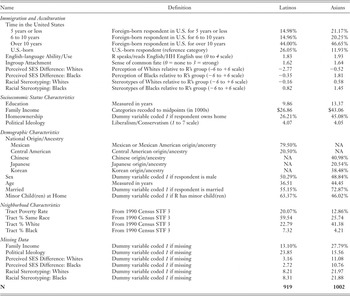
Table 1 presents summary and coding information for all explanatory variables. The first set of measures captures immigration- and acculturation-related characteristics. Respondents' nativity status and length of time in the United States are measured as a set of dummy variables which were coded based on respondents' self reports for place of birth and year of initial U.S. entry (length of time in the United States). English-language ability/use is a scaled measure of respondents' English-language ability and the frequency of household English use. Scores range from 0 (respondent does not communicate in English, and English is never spoken in the household) to 4 (respondent communicates very well in English and lives in an English-only household).Footnote 10 Latino/a respondents are more than twice as likely as Asians to be U.S.-born, and Asian respondents are more likely to have fewer than ten years in the United States (p < 0.01). Asians report slightly higher English-language ability/use, on average; however, this difference is not statistically significant.
Variable Definitions and Summary Statistics: Factors Influencing Latino and Asian Neighborhood Racial-composition Preferences

Notes: 1993–1994 Los Angeles Survey of Urban Inequality, p < 0.001, except: Time in the United States (p < 0.01); English-language ability, ingroup attachment, political ideology, sex, and missing political ideology (p = ns).
Three types of racial attitudes are also considered as indicators of acculturation. First, ingroup attachment is measured as respondents' sense of common-fate identity, or the belief that “what happens to my group happens to me.” Prior research indicates the sense of common fate is an important aspect of minority-group identities (Dawson Reference Dawson1994, Reference Dawson and Lamont1999; Gurin et al., Reference Gurin, Hatchett and Jackson1989; Tate Reference Tate1993; Tuan Reference Tuan1998) that influences ingroup favoritism (Tajfel Reference Tajfel1982). Scores range from 0 (no sense of common fate/no ingroup attachment) to 3 (strong sense of common fate/strong ingroup attachment). On average, both Latino/a and Asian respondents report having “some” sense of common-fate identity. Perceived Socioeconomic Status (SES) difference measures capture respondents' images of Whites and Blacks as “tending to be rich” or “tending to be poor,” relative to their own group, and test the hypothesis that people avoid neighborhoods with more than token numbers of those whom they perceive as economically disadvantaged as part of a rational desire for upward social mobility, rather than prejudice toward outgroups (Clark Reference Clark1988; Ellen Reference Ellen2000; Harris Reference Harris1999, Reference Harris2001; Leven et al., Reference Leven, Little, Nourse and Read1976). For each respondent, ratings of Whites and Blacks as tending to be rich or poor are subtracted from ratings of their own groups on the same trait, with scores ranging from −6 (a favorable outgroup perception, relative to the respondent's own group) to +6 (an unfavorable outgroup perception, relative to the respondent's own group); a score of 0 indicates a perception of no social-class difference between the outgroup and one's own group. On average, Latinos and Asians both perceive Whites as relatively well-off economically; however, Latinos perceive Whites' relative economic advantage to be substantially larger (−2.77) than do Asians. In fact, Asians perceive very little difference in their own economic status relative to Whites (−0.52). The pattern is reversed with respect to respondents' perceived economic position vis-à-vis Blacks. That is, while Asians clearly perceive Blacks as economically disadvantaged relative to their own group (1.81), Latinos perceive little or no difference between themselves and Blacks, and, on average, they tend to perceive Blacks as slightly better off than their own group (−0.35).
Research indicates that prejudice is associated with the avoidance of particular groups as neighbors. This hostility can result from simple outgroup hostility or from socially learned expectations about group status and position (Blumer Reference Blumer1958; Jankowski Reference Jankowski, Smith and Feagin1995; Gans Reference Gans1999). Thus, both the presence and the magnitude of perceived difference are important, and I employ a measure of racial stereotyping that captures both aspects. Like the perceived SES difference measure, respondents' ratings of Whites and Blacks on five traits—intelligence, preference for welfare dependence, difficulty to get along with socially, tendency to discriminate, and involvement in drugs and gangs—are subtracted from ratings of their own group.Footnote 11 Scores range from −6 (favorable outgroup rating) to +6 (unfavorable outgroup rating); a score of 0 indicates no perceived difference. Stereotypes of Whites are, on average, close to neutral for both Latino/a and Asian respondents; however, the former tends to view Whites in favorable terms, relative to their own group, while the reverse is true among Asians (−0.16 and 0.58, respectively, p < 0.001). Racial stereotypes of Blacks are clearly negative for both groups, and this is especially true among Asian respondents (1.45, compared to 0.82 for Latinos, p < 0.001).
Socioeconomic status is measured as respondents' education, annual household income, and housing tenure. Education is measured in years, family income is the midpoint of the ordered category that contained the respondent's total household income for the year prior to the survey (divided by 1000), and homeownership is a dummy variable coded 1 if the respondent is a homeowner. Also included here is a measure of respondents' political ideology, ranging from “extremely liberal” (1) to “extremely conservative” (7). Though not a traditional indicator of SES, political ideology is an individual-level characteristic known to be associated with racial attitudes, including neighborhood racial-composition preferences. On average, Asian respondents report roughly three more years of education than Latinos and 60% more income than do Latinos (for both, p < 0.001); Asians are also significantly more likely to own their homes. On average, both Latinos and Asians are politically moderate.
The third panel of Table 1 presents data definitions and summary statistics for a set of demographic characteristics. National origin/ancestry is measured as a set of dummy variables for both native- and foreign-born respondents; respondents' sex, marital status, and the presence of one or more minor children in the home are measured as dummy variables coded, respectively, 1 if respondents are male, or married, or have one or more minor children living at home. Latino/a respondents are largely Mexican, though a meaningful minority (nearly 21%) reports Central American origins.Footnote 12 Asian respondents are more evenly distributed; the modal category of national origin/ancestry among Asian respondents is Chinese (about 41%), followed by Korean (38.48%), and Japanese (20.54%). Latino/a and Asian respondents are about equally split between men and women. Latinos are approximately eight years younger than Asians, on average (p < 0.001); slightly more than one-half of Latino/a respondents were married at the time of the interview, compared to nearly three-quarters of Asians (p < 0.001), but Latino/a respondents were nearly 20% more likely to report having one or more minor children in the household (p < 0.001). Recall that family status (i.e., being married and having children) is associated with greater residential mobility for Asians, but not for Latinos (Alba et al., Reference Alba, Logan, Stults, Marzan and Zhang1999).
Neighborhood characteristics measures, including neighborhood-level poverty and racial composition, come from census-tract information available in a nonpublic version of the LASUI data (U.S. Bureau of the Census 1990), and are presented in the fourth panel of Table 1. On average, Latinos reside in neighborhoods with higher poverty rates, double the percentage of same-race neighbors, and about one-half as many White neighbors compared to the average neighborhoods of Asians (for all p < 0.001). Residential contact with Blacks is low for both groups; however, consistent with trends in residential segregation, Latinos tend to live in areas with substantially more Black neighbors than do Asians (p < 0.001).
Finally, a substantial number of respondents had missing values on the perceived SES difference and racial stereotyping items, as well as on family income and political ideology; patterns of missing data are not random (bottom panel, Table 1). For the perceived SES-difference measures, roughly 11% of Asians had missing values, compared to approximately 3% of Latinos; similarly, about 22% of Asians had missing values on the racial stereotyping measures, compared to 8% of Latino/a respondents. With respect to family income, 27.8% of Asians and 13.1% of Latinos had missing values; nearly one-quarter of Latinos had missing values on political ideology, compared to 15.6% of Asians (for all except missing political ideology [ns], p < 0.001). The nonrandom distribution of missing values could bias coefficients for these measures; they are, therefore, imputed using best subset imputation (Little and Rubin, Reference Little and Rubin1987) and relevant available data from respondents. All multivariate analyses include dummy variables coded 1 if the response to an item—perceived SES difference, racial stereotyping, family income, and/or political ideology—was missing.Footnote 13
RESULTS
Neighborhood Racial-Composition Preferences
To understand group differences in preferences for neighbors from various racial/ethnic groups, respondents were shown a blank neighborhood show card like the one in Figure 1 and instructed to:
Imagine an ideal neighborhood that had the ethnic and racial mix you, personally, would feel most comfortable in. Here is a blank neighborhood card like those we have been using. Using the letters A for Asian, B for Black, H for Hispanic, and W for White, please put a letter in each of the houses to represent your ideal neighborhood, where you would most like to live.Footnote 14
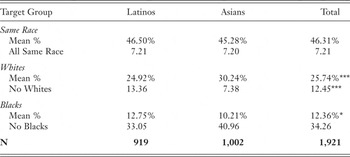
The three dependent variables considered in this analysis are the percentage of same-race, White, and Black neighbors included in respondents' ideal neighborhoods.Footnote 15Table 2 summarizes responses by racial category.
Multiethnic Neighborhood Experiment Show Card*
*Source: 1993–1994 Los Angeles Survey of Urban Inequality.

Summary Statistics: Multiethnic Neighborhood Show Card Experiment, by Respondent Race

Source: 1993–1994 Los Angeles Survey of Urban Inequality
Notes: Measures are based on the total number of houses, including the respondent's house in the center of the card. Means will not sum to 100%, since the percentage of Asian neighbors included in Latinos' ideal neighborhoods and the percentage of Latinos in Asians' ideal neighborhoods are not included.
* p < 0.05.
** p < 0.01.
*** p < 0.001.
On average, Latinos and Asians have similar preferences for same-race neighbors: for both groups, the ideal neighborhood is one that is between 45% and 47% same race. Both groups are also equally likely to express a preference for entirely same-race neighborhoods, and this is the ideal scenario for about 7.20% of respondents. Preferences for White neighbors differ significantly between the two groups. For Latinos, the ideal multiethnic neighborhood is roughly one-quarter White, while Asians prefer a neighborhood that is just over 30% White, on average (p < 0.001). Consistent with this pattern, Latinos are nearly twice as likely as are Asians to exclude Whites entirely (p < 0.001). Preferences for Black neighbors differ substantially from those for Whites and are indicative of a clear-cut tendency toward aversion. On average, Latinos prefer a neighborhood that is about one-half as Black as it is White; a similar, but more extreme pattern is evident among Asians, who prefer three times as many Whites as Blacks, on average (p < 0.05). Nonetheless, preferences for integration with Blacks parallel the group's share of the overall population in Los Angeles, which was 10.55% Black in 1990 (U.S. Bureau of the Census and the Lewis Mumford Center, State University of New York, 1990). More striking about preferences for Black neighbors is the preference of substantial shares of Latinos and Asians to avoid any contact. Fully one-third of Latinos and two-fifths of Asians prefer a neighborhood without a single Black resident. Finally, no respondent indicates a preference for neighborhoods that are entirely White, entirely Black, or devoid of same-race neighbors.Footnote 16
These preliminary results are consistent with those from previous studies (Charles Reference Charles2000a; Clark Reference Clark1992) and support the assertion that the race of potential outgroup neighbors is important to understanding neighborhood racial-composition preferences. Both groups prefer a neighborhood that is nearly one-half same race, on average, while at the same time showing a clear desire to share residential space with Whites but avoid contact with Blacks. This is seen in two ways. First, Whites outnumber Blacks by at least two to one, on average, in respondents' ideal neighborhoods. Even more striking, however, are differences in the likelihood of outgroup exclusion: both groups are several times more likely to exclude Blacks entirely than they are to completely exclude Whites. This is clear evidence that preferences are conditioned by the race of the potential neighbor, and suggests an awareness of a racial hierarchy in which Whites are the most advantaged group in society, and Blacks are the least advantaged group—both socially and economically. These results also highlight similarities across broad racial categories, each with substantial proportions of immigrants within their ranks. Before moving to multivariate analysis, the potential influence of actual population composition on preferences for White and Black neighbors should also be noted. In proportional terms, both groups express preferences for White and Black neighbors that are consistent with their proportional representation in Los Angeles County (40.85% and 10.55%, respectively, in 1990). At the same time, however, preferences for same-race neighbors appear oblivious to actual patterns: the Latino/a population in Los Angeles County (37.81% in 1990) is more than three times the size of the Asian population (10.77% in 1990), yet both Latinos and Asians express similar preferences for same-race neighbors (U.S. Bureau of the Census and the Lewis Mumford Center, State University of New York, 1990).
Before pursuing multivariate analysis, a final consideration is the degree to which the measures of neighborhood racial-composition preferences employed in this analysis are interrelated. Specifically, percentages of same-race, White, and Black neighbors are calculated from responses to a single question with a fixed number of houses, suggesting that model errors for each dependent variable are contemporaneously correlated (Griffiths et al., Reference Griffiths, Hill and Judge1993). Zellner's Seemingly Unrelated Regression Equations (SUR) is a useful statistical tool in these circumstances, producing what appear to be joint estimates of several regression models (each with its own error term) and a correlation matrix of the residuals between equations (STATA 1999, pp. 9–10).Footnote 17
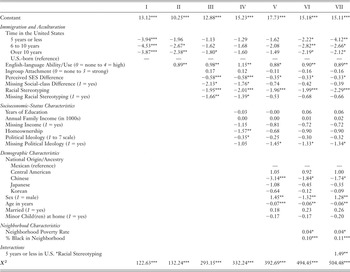
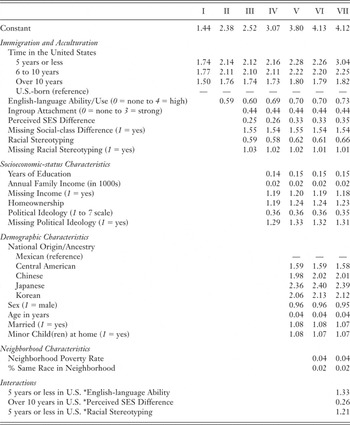
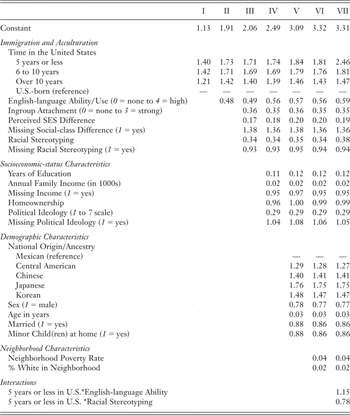
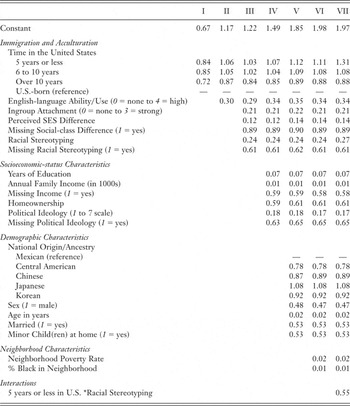
The analysis that follows uses SUR to estimate a set of models for each outcome measure, beginning with a baseline model estimating the effect of length of time in the United States on neighborhood racial-composition preferences (Model I).Footnote 18 Remaining models are as follows: Models II and III introduce remaining measures of acculturation (English-language ability/use and those relating to racial attitudes, respectively); Model IV adds measures of socioeconomic-status characteristics, and Models V and VI introduce demographic and neighborhood characteristics, in that order. A final set of estimates (Model VII) explores potentially important interactions between length of time in the United States, English-language ability/use, and racial attitudes. Estimates of preferences for same-race, White, and Black neighbors are presented in Tables 3, 4, and 5, respectively.Footnote 19 Due to space constraints, Tables 3, 4, and 5 do not include standard errors; corresponding tables of model standard errors are located in the Appendix (Tables A1, A2, and A3).
Preferences for Same-Race Neighbors
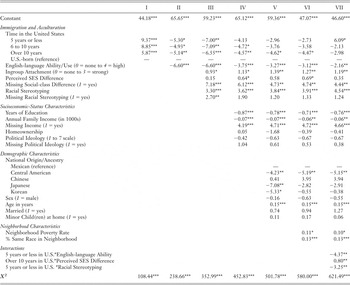
Overall, estimates of preferences for same-race neighbors (located in Table 3) point to the particular importance of acculturation and, to a lesser extent, socioeconomic status. Effects of time in the United States (Model I) are as expected: immigrants prefer significantly more same-race neighbors than do native-born Latinos and Asians. This is most true for the most recently arrived respondents, and least so for those with over ten years in the United States (p < 0.001). The addition of English-language ability/use (Model II) points to the particular importance of English-language fluency relative to time in the United States, associated with a significant and meaningful decline in preferences for same-race neighbors, net of time in the United States. Indeed, those with the highest reported level of English-language ability/use (a score of 4) prefer 26.4% fewer same-race neighbors than those who do not communicate in English at all (p < 0.001). Introducing English-language ability/use reverses the coefficient signs for length of time in the United States, suggesting that these aspects of acculturation may interact with one another (see Model VII).
Seemingly Unrelated Regression (SUR) Coefficients: Factors Influencing Latino and Asian Preferences for Same-Race Neighbors (N = 1921)

Source: 1993–1994 Los Angeles Survey of Urban Inequality.
Notes: Standard Errors are shown in Appendix Table 1.
* p < 0.05.
** p < 0.01.
*** p < 0.001.
Model III introduces each of the three measures of racial attitudes—ingroup attachment, perceived SES difference, and racial stereotyping—considered here as a second set of acculturation measures. Of the three measures, racial stereotyping is the most powerful predictor of preferences for same-race neighbors, introduced here as a pooled measure of attitudes toward Whites and Blacks (scaled in the same way as the individual measures). As outgroup stereotypes become increasingly unfavorable, preferences for same-race neighbors increase (3.30, p < 0.001), net of other factors. Ingroup attachment is positively associated with preferences for same-race neighbors; on average, those with the strongest sense that “what happens to my group happens to me” (a score of 3) prefer roughly 3% more same-race neighbors, net of other factors, than do those who report no common-fate identity. This effect, however, is fairly small and only marginally significant (0.94, p < 0.05). The perception of outgroups as economically disadvantaged, relative to the respondent's own group, does not influence same-race preferences in any meaningful way. The addition of racial attitude measures increased the magnitude of effects for time in the United States, while that for English-language ability/use does not change. Finally, respondents with missing (and, therefore, imputed) values for perceived SES difference (7.18, p < 0.001) and racial stereotyping (2.70, p < 0.01) prefer significantly more same-race neighbors, on average, than do those with valid responses.
Socioeconomic-status indicators are introduced in Model IV, and the influence of each of these measures on preferences for same-race neighbors is generally as anticipated. Increasing socioeconomic status, measured in terms of years of education and annual family income (in $1000s), is negatively associated with same-race preferences. Most notable here is the nearly 1% decline in same-race preferences with each additional year of education, all other things being equal (p < 0.001). The effect of income is, comparatively, much smaller (−0.07, p < 0.001), and both are consistent with research by Alba et al. (Reference Alba, Denton, Leung and Logan1995) on actual residential patterns for these groups. Effects for both homeownership and political ideology are not significant. Controlling for respondents' socioeconomic status substantially alters the influence of racial attitudes, intensifying the effects of ingroup attachment, perceived SES difference (which is now marginally significant, but remains relatively small), and racial stereotyping. As one would expect, controlling for socioeconomic status reduces the influence of traditional indicators of acculturation: the effect of English-language ability/use is nearly one-half as large as in the previous model, and time in the United States effects are also substantially smaller and less powerful predictors of same-race preferences. The pattern of effects for missing values remains fairly consistent. Respondents with missing data on any of the items with imputed values tend to prefer more same-race neighbors than do those with valid responses; however, only family income (4.19, p < 0.001) and perceived SES difference (6.12, p < 0.001) are statistically significant.
Models V and VI introduce demographic- and neighborhood-level characteristics, respectively. On average, older respondents prefer more same-race neighbors than do their younger counterparts (p < 0.001), and, compared to respondents of Mexican ancestry, Central Americans, Japanese, and Korean respondents all prefer significantly fewer same-race neighbors, on average. Contrary to expectation, marital status and the presence of minor children in the household are not significant predictors of preferences for same-race neighbors. Effects of education and income persist with little change; however, the influence of time in the United States and English-language ability/use declined and those for ingroup attachment and racial stereotyping increased with the introduction of demographic characteristics. Controlling for respondents' relevant neighborhood characteristics eliminates most of the national-origin/ancestry differences; however, the effect of racial stereotyping reaches nearly a 4% increase in same-race preferences for each one-unit increase in negative stereotypes (p < 0.001). The statistically significant difference between those with valid responses on the perceived SES difference measure and those with imputed values declines substantially relative to Model IV, while the effect of missing data on income remains constant.
Finally, Model VII in Table 4 re-estimates the previous equation, including significant interactions between length of time in the United States and the remaining indicators of acculturation, and illustrates the complexity of understanding patterns of neighborhood racial-composition preferences among immigrant groups. Two results are especially noteworthy: the effects of both English-language ability/use and racial stereotyping vary by time in the United States. Specifically, English-language ability is more important for the most recent immigrants than for any other category of respondent. Controlling for other factors, the effect of English-language ability/use on preferences is −6.53 (−2.16 − 4.37, p < 0.01) for respondents with five years or less in the United States, three times the effect for longer-term immigrants and/or the native-born. This is consistent with expectations, since part of the accumulation of time in the United States—and the acculturation process more generally—is the acquisition of English-language skills.
Seemingly Unrelated Regression (SUR) Coefficients: Factors Influencing Latino and Asian Preferences for White Neighbors (N = 1921)

Source: 1993–1994 Los Angeles Survey of Urban Inequality.
Notes: Standard Errors are shown in Appendix Table 2.
* p < 0.05.
** p < 0.01.
*** p < 0.001.
It was also suggested that, if racial attitudes are, in fact, indicative of acculturation, one might expect them to vary across categories of time in the United States. Specifically, it was hypothesized that the impact of racial stereotyping might be smaller for the most recent immigrants, coming to resemble that for the native-born over time. This turns out to be the case: the effect of racial stereotyping for recent immigrants is about one-half that for longer-term immigrants and/or the native-born (p < 0.01). This is striking evidence of acculturation, given the racialization of U.S. society: immigrants' attitudes about the dominant group become unfavorable with the accumulation of time in the United States, ultimately coming to resemble those of the native-born. The third significant interaction indicates that perceived SES difference matters only for immigrants with more than ten years in the United States. For this group, as the perception of outgroup economic disadvantage increases, so do preferences for same-race neighbors. To some extent, this may represent a heightened concern with economic mobility among immigrants.
In short, Model VII estimates tell a story that is consistent with the spatial assimilation model. The most recently arrived immigrants who lack the ability to communicate in English prefer more same-race neighbors, net of other factors; as time in the United States and/or English-language ability/use increase, preferences for same-race neighbors decline. Of the racial-attitude measures, racial stereotyping is the most powerful predictor of preferences, but its effect also varies in predictable ways with time in the United States. To a lesser extent, ingroup attachment is positively associated with preferences; however, this does not appear to depend on more standard indicators of acculturation. And, to a lesser degree still, socioeconomic-status measures (education and family income) reveal hypothesized associations with preferences, net of other factors.
Preferences for White Neighbors
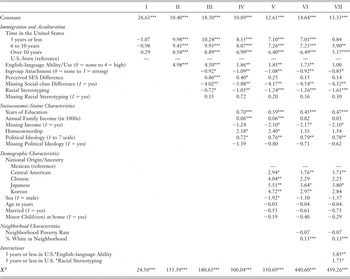
Models estimating preferences for White neighbors are presented in Table 4. The baseline model suggests that preferences for White neighbors do not differ significantly by length of time in the United States; this changes, however, with the introduction of English-language ability/use in Model II. Effects for both time in the United States and English-language ability/use are positive, suggesting that immigrants prefer more White neighbors than do the native-born, controlling for English-language ability/use; this is most true for recent immigrants (10.02, p < 0.001) and less so for the longest-term immigrants (8.64, p < 0.001). As expected, increasing English-language ability/use is also associated with greater preference for Whites as neighbors.
Once again, racial attitudes emerge as significant predictors of neighborhood racial-composition preferences (Model III). Effects of ingroup attachment and racial stereotyping are as expected: increasing ingroup attachment reduces preferences for White neighbors, as do negative racial stereotypes (for both, p < 0.05). Compared to preferences for same-race neighbors, however, the impact of racial stereotyping is considerably smaller. Contrary to expectations, the perception of Whites as economically disadvantaged, relative to respondents' own groups, increases preferences for Whites as neighbors; those with missing values on this measure, on the other hand, prefer substantially fewer White neighbors (−4.02, p < 0.01). Adding the second set of acculturation measures slightly increases the effect of time in the United States, while the effect of English-language ability/use declines slightly. In general, however, patterns of association remain unchanged.
Each of the socioeconomic-status indicators—introduced in Model IV—is a significant predictor of preferences for White neighbors. As expected, both years of education and family income are positively associated with preferences for White neighbors, and the effect of family income is slightly higher for those with missing values (p < 0.001). Homeowners also prefer significantly more White neighbors relative to nonhomeowners (p < 0.05), consistent with a racial-proxy hypothesis in which Whites are associated with desirable neighborhoods (Ellen Reference Ellen2000). And respondents with more conservative political beliefs prefer more White neighbors than do their liberal counterparts. Controlling for socioeconomic status intensifies the effects of both ingroup attachment and racial stereotyping, while decreasing the effect of perceived SES difference by about half. The addition of socioeconomic-status measures also reduces the effects for time in the United States and English-language ability/use.
Again, Models V and VI consider relevant demographic and neighborhood characteristics, respectively. Model V results show substantial variation across national-origin/ancestry groups, with a slight racial character to the differences: each of the Asian subgroups prefers decidedly more White neighbors than do either of the Latino/a groups, on average. The only remaining demographic characteristic to significantly influence preferences for White neighbors is sex, with men preferring roughly 2% fewer White neighbors than women (p < 0.05). The inclusion of demographic characteristics increases effects of all socioeconomic-status characteristics, as well as those of ingroup attachment and racial stereotyping; perceived SES difference is now nonsignificant, except for those with missing data who continue to prefer significantly fewer White neighbors than those with valid responses (about twice the size of the effect for missing income, which is also negative and significant). Conversely, accounting for differences in national origin/ancestry and other demographic characteristics reduces effects of time in the United States and the effect of English-language ability/use is unchanged from the previous model.
The addition of neighborhood characteristics reveals a positive association between residential contact with Whites and preferences for Whites as neighbors, consistent with the contact hypothesis.Footnote 20 Controlling for neighborhood characteristics eliminates gender differences and reduces national-origin differences, eliminating the racial character to those patterns noted above. Still, Central Americans, Japanese, and Korean respondents stand out as preferring significantly more residential contact with Whites than do respondents of Mexican origin. Socioeconomic-status effects are also altered, with only the positive effects of years of education and political ideology remaining. Effects for each of the acculturation measures in Model VI are also slightly smaller, though overall patterns detailed in the previous model persist.
The final model of preferences for White neighbors (Model VII) introduces significant interactions, again highlighting variations in the impact of English-language ability/use and racial stereotyping by length of time in the United States. In each case, the pattern of effects is consistent with those presented for comparable interactions in the previous section: English-language ability/use matters only for recent immigrants (0.99 + 3.86 = 4.85, p < 0.01). Thus, a recent immigrant who speaks no English has preferences for White neighbors that do not differ significantly from those of their native-born counterparts; however, with increasing English proficiency and/or time in the United States, immigrants all prefer significantly more White neighbors, net of other factors. And, similar to the findings for same-race preferences, the effect of negative racial stereotyping for the most recently arrived immigrants is near zero (and positive). For all other respondents, a one-unit increase in negative racial stereotyping reduces preferences for White neighbors by 1.61% (p < 0.001). Once again, results are generally consistent with the spatial assimilation hypothesis, but point to the particular importance of acculturation, with respect to immigration-related characteristics associated with residency and language, as well as those associated with racial attitudes.
Preferences for Black Neighbors
The final set of models, summarized in Table 5, estimate Latino/a and Asian preferences for Black neighbors. Once again, early models reveal important differences among respondents by length of time in the United States (Model I) and English-language ability/use (Model II). A clear pattern emerges whereby all categories of immigrants prefer significantly fewer Black neighbors than do their native-born counterparts. Effects of time in the United States decline, however, with the addition of English-language ability/use, the effect of which is in the expected direction.
Seemingly Unrelated Regression (SUR) Coefficients: Factors Influencing Latino and Asian Preferences for Black Neighbors (N = 1921)

Source: 1993–1994 Los Angeles Survey of Urban Inequality.
Notes: Standard Errors are shown in Appendix Table 3.
* p < 0.05.
** p < 0.01.
*** p < 0.001.
As anticipated, racial attitudes are potent predictors of preferences, controlling for length of time in the United States and English-language ability/use (Model III). Effects for both perceived SES difference disadvantage and racial stereotyping are in the expected direction, and the effect of racial stereotyping is nearly three times that of perceptions of Blacks as economically disadvantaged, relative to respondents' own groups. Respondents with missing/imputed data on both racial stereotyping and perceived SES difference also prefer significantly fewer Black neighbors compared to those with valid responses on these items (p < 0.05). Consistent with prior studies of preferences, ingroup attachment is not a significant predictor of preferences for Blacks as neighbors. The addition of racial attitude measures reduces differences among categories of nativity status, and the effect of English-language ability/use increases slightly.
Model IV introduces measures of socioeconomic-status characteristics. Only two indicators—homeownership and political ideology—are significant predictors of preferences. Latino/a and Asian homeowners prefer fewer Black neighbors than do nonhomeowners (−1.58, p < 0.01), and increasing political conservatism reduces preferences for Black neighbors slightly (−0.35, p < 0.05). Controlling for socioeconomic-status characteristics eliminates remaining differences in preferences for Black neighbors by time in the United States; effects of English-language ability/use and racial stereotyping increase slightly. The addition of demographic characteristics in Model V eliminates significant effects for homeownership and political ideology and decreases the size of effects for racial attitudes and English-language ability/use. Differences between respondents with imputed values on racial attitude items are now nonsignificant; however, respondents with missing/imputed values for political ideology emerge with a marginally significant preference for fewer Black neighbors than among those with valid responses (−1.45, p < 0.05). Net of acculturation and socioeconomic status, Chinese respondents prefer significantly fewer Black neighbors than do other national-origin groups (−3.07, p < 0.001); men prefer more Black neighbors than do women (p < 0.01); and preferences for residential integration with Blacks decline with age (−0.07, p < 0.001).
Both neighborhood poverty and racial composition (Model VI) are positively associated with preferences for Black neighbors; on average, increasing neighborhood poverty and Black population share are associated with increasing preferences for Black neighbors (though the reader is again cautioned about the inability to ascertain causal order with cross-sectional data). Controlling for neighborhood characteristics substantially reduces the difference between Chinese respondents and other groups, slightly increases the positive influence of English-language ability/use, and reveals statistically significant differences in preferences for Black neighbors by time in the United States. On average, all immigrants prefer between 2% and 3% significantly fewer Black neighbors than do their native-born counterparts (p < 0.05 for five years or less and over ten years in the United States; p < 0.01 for six to ten years in the United States).
Finally, Model VII presents additional support for treating racial attitudes as indicators of acculturation. Consistent with patterns of association between racial stereotyping and time in the United States detailed in the previous two sections, the effect of stereotyping increases with the accumulation of time in the United States. For all categories of immigrants, preferences for Black neighbors are negatively associated with racial stereotyping; however, the effect among longer-term immigrants and the native-born (−2.29, p < 0.001) is nearly three times larger than it is for the most recent arrivals (−2.29 + 1.50 = −0.79, p < 0.01), and the addition of the interaction term eliminates national-origin differences. Overall, results from this final model support the importance of acculturation beyond simple distinctions between the native- and the foreign-born. Time in the United States and racial stereotypes are the two most powerful predictors of preferences for Black neighbors; moreover, the impact of racial stereotyping increases substantially over time to resemble that for the native-born. And, though smaller, the ability to communicate effectively in English also influences preferences for residential contact with Blacks.
DISCUSSION
Both aggregate- and individual-level research on Latino/a and Asian residential segregation details important distinctions within the Latino/a and Asian populations based on levels of acculturation and socioeconomic status (Alba et al., Reference Alba, Logan, Stults, Marzan and Zhang1999; Denton and Massey, Reference Denton and Massey1988; Logan et al., Reference Logan, Alba and Leung1996; Massey and Denton, Reference Massey and Denton1987; Massey and Fong, Reference Massey and Fong1990). However, previous research on Latino/a and Asian neighborhood racial-composition preferences has paid only cursory attention to these differences. This analysis attempts to address these shortcomings, in the hopes of better understanding: (1) whether and, if so, how processes of immigrant adaptation shape ideas about the preferred racial/ethnic composition of neighborhoods; and (2) the implications of these processes for the future of race and ethnic relations in increasingly diverse environments. Results point to the critical role of acculturation—both immigration-related characteristics and racial attitudes—and to the complexities involved in accurately modeling preferences while at the same time providing additional evidence of the continuing significance of race.
The way that immigrants think about the racial and ethnic composition of their preferred neighborhoods varies meaningfully by the number of years that they have lived in the United States, as well as their ability to communicate effectively in English. As expected, immigrants prefer more same-race and fewer outgroup neighbors, relative to the native-born, and differences between the native- and foreign-born decline as time in the United States increases. English-language ability/use is also a critical predictor of preferences, particularly for the most recently arrived immigrants; increasing English-language ability decreases preferences for same-race neighbors, but has the opposite effect on preferences for both White and Black neighbors. The greater import of English-language ability among the most recent arrivals is consistent with an adaptation process in which language ability increases over time (Espinosa and Massey, Reference Espinosa and Massey1997). Overall, these patterns are entirely consistent with analyses of actual neighborhood outcomes based on the spatial assimilation model and, as such, hint at the connection between preferences and actual behavior for these groups.Footnote 21
The pattern of effects for racial attitudes is also consistent with the suggestion that these beliefs and the status advantages associated with racial-group membership have a specific meaning in the U.S. context: a meaning that is internalized with the passage of time as a part of the acculturation process. Racial stereotypes stand out as the most potent predictors of preferences, yet the effect is substantially weaker for recent immigrants than it is for other categories of immigrants: after five years of residence in the United States, the influence of racial stereotyping is the same for immigrants as it is for the native-born, and more important than either ingroup attachment or perceived group differences in socioeconomic status. This is not to say, however, that recent immigrants are less likely to hold negative stereotypes of Blacks and/or Whites compared to longer-term immigrants or the native-born; in fact, the reverse tends to be true. A comparison of mean racial-stereotype scores across categories of time in the United States reveals that shorter- and intermediate-term immigrants hold the most negative stereotypes of both Blacks and Whites.Footnote 22 In fact, this is strong evidence supporting the prejudice as group position hypothesis: stereotypes are strongest among the most recent immigrants, yet the potential for those attitudes to influence behavior increases, arguably, as newcomers internalize and negotiate America's racialized-status hierarchy.
The influence of perceived socioeconomic status is also telling, though effects are always smaller than for racial stereotypes. The perception of Whites as economically disadvantaged does not significantly reduce preferences for integration with that group; however, a similar perception of Blacks does. This suggests that preferences are guided to some extent by concerns about personal and/or neighborhood characteristics associated with race, in addition to clear-cut racial prejudice. Specifically, it appears that the elevated social position of Whites—a privilege that transcends social class—may make them desirable neighbors for mobility-conscious immigrant groups, irrespective of their (the Whites') economic position. This is unlikely to be the case for Blacks who, as a group, occupy the bottom of the social hierarchy, irrespective of their economic status.
Socioeconomic-status characteristics tend to influence preferences in the anticipated ways, with education and income emerging as the strongest predictors. Ultimately, there are few meaningful differences across demographic characteristics and/or neighborhood level characteristics, with the possible exception of national-origin/ancestry differences. Relative to other national-origin/ancestry groups, and net of other characteristics, Central Americans prefer significantly less residential contact with coethnics; at the same time, they, along with the Japanese, prefer significantly more residential contact with Whites. With respect to potential integration with Blacks, it is the Chinese who are the most resistant subgroup, controlling for other characteristics. Explanations for national-origin/ancestry differences are not immediately evident and do not conform to hypothesized differences based on the historic group tensions between these groups.
Finally, recall that Seemingly Unrelated Regression (SUR) is the preferred multivariate method when dependent variables are interrelated and, consequently, model errors are contemporaneously correlated (Griffiths et al., Reference Griffiths, Hill and Judge1993). The residual correlations (not shown) for the final models of preferences for same-race, White, and Black neighbors reveal a strong, negative correlation between the same-race and White preference models (−0.59, p < 0.001); the residual correlation between the same-race and Black preference models is roughly two-thirds the size (−0.44, p < 0.001). The implication is that, when respondents decrease the number of same-race neighbors in their preferred multiethnic neighborhoods, they are much more inclined to replace them with Whites than with Blacks. The residual correlation between the White and Black preference models is even weaker (−0.24, p < 0.001). Here, too, results conform to both the tenets of the spatial assimilation model and prejudice-based explanations of preferences and actual residential patterns (Alba and Logan, Reference Alba and Logan1993; Bobo and Zubrinsky, Reference Bobo and Zubrinsky1996; Charles Reference Charles2000a; Farley et al., Reference Farley, Steeh, Krysan, Jackson and Reeves1994; Massey and Denton, Reference Massey and Denton1993).
These results do not bode well for the dynamics of race/ethnic relations in multiethnic contexts. As racial minorities, Asians and Latinos are located in subordinate positions in the U.S. racial hierarchy—better off than Blacks (at least perceptually), but locked out of the dominant position by their phenotypic distinctiveness (or by surname). Thus, the end game of assimilation is decidedly different than it was (and is) for immigrants who are White—becoming part of the dominant group is not an option. As immigrants of color come to understand this, distancing themselves from Blacks and, therefore, the bottom of the status hierarchy, takes on especial importance. This is seen in immigrants' greater preference for White neighbors relative to the preferences of native-born. Despite potential concerns about hostility and/or discriminatory treatment from Whites (Charles Reference Charles, Bobo, Oliver, Johnson and Valenzuela2000b; Zubrinsky and Bobo, Reference Zubrinsky and Bobo1996), greater proximity to Whites symbolizes upward mobility and is, therefore, desirable for immigrants in a way that may be less true among the native-born. Heightened mobility consciousness—both economic and racial—is also implicated in both groups' high rates of Black exclusion. Among the native-born, rates of Black exclusion are similar to those of Whites reported by Charles (Reference Charles2000a), at about 19%; the high rates of exclusion reported in Table 2 are driven entirely by immigrants' aversion to Black neighbors.Footnote 23 Rates of White exclusion are much lower for immigrants; between 16% and 20% for recent and intermediate arrivals, respectively, and dropping to 12% for long-term immigrants. Only 5.8% of native-born Asians and Latinos exclude Whites entirely, about one-half the rate of exclusion reported for Black respondents by Charles (Reference Charles2000a).Footnote 24
All told, these results reinforce the need to consider a wider and more nuanced set of individual-level characteristics when studying the attitudes of groups with large and/or increasing numbers of immigrants.Footnote 25 Though not always easy or straightforward, acknowledging and addressing their diverse characteristics is crucial to adequately understanding intergroup relations in an increasingly diverse society. While highlighting important, nonracial predictors of preferences associated with immigration—time in the United States and English-language ability/use—this analysis clearly details the persistence of a powerful racial ideology in America (Bashi and McDaniel, Reference Bashi and McDaniel1997) that is internalized by newcomers, fostering group tensions and competition, and making increased and/or sustained residential contact between immigrant groups and Blacks unlikely.Footnote 26 Sadly, patterns of racial attitudes and preferences among Asian and Latino/a immigrants reflect an adaptation process that serves to reinforce and sustain the common belief among early twentieth-century Blacks that the first or second English word an immigrant learns on the path to becoming American is nigger and, even for groups who cannot “become White,” the ability to distance oneself from Blacks is itself a form of social currency, ensuring a social position at least once removed from the bottom (Toni Morrison, cited in Angelo Reference Angelo1989; Ignatiev Reference Ignatiev1995; Malcolm X with Haley, Reference X and Haley1965, p. 339).
APPENDIX
Standard Errors: Factors Influencing Latino and Asian Preferences for Same-Race Neighbors

Source: 1993–1994 Los Angeles Survey of Urban Inequality.
Standard Errors: Factors Influencing Latino and Asian Preferences for White Neighbors

Source: 1993–1994 Los Angeles Survey of Urban Inequality.
Standard Errors: Factors Influencing Latino and Asian Preferences for Black Neighbors