The introduction of the variable rule (Labov, Reference Labov1969) began an ongoing effort to link the study of language variation and change to linguistic theory. The variable rule was couched within the framework (and formal notation) of the transformational-generative phonology developed by Chomsky and Halle (Reference Chomsky and Halle1968) in The Sound Pattern of English (SPE). In SPE, each word (or morpheme or lexeme) is stored as a string of phonemes in the lexicon. To derive the surface form, each word passes through the morphological and phonological modules, where it undergoes a series of rules (some crucially ordered with respect to each other), before being passed to the physiological-articulatory system for phonetic implementation. The variable rule essentially constituted a theoretical adaptation of the SPE framework that added a probabilistic component to the formal specification of the rule. Later developments in phonological theory formalized rules differently (e.g., Clements & Hume, Reference Clements, Hume and Goldsmith1995; Goldsmith, Reference Goldsmith1976), proposed additional levels within the phonological module (e.g., Kiparsky, Reference Kiparsky1985; Mohanan, Reference Mohanan1986), or exchanged rules for competing violable constraints on phonological representations (e.g., Prince & Smolensky, Reference Prince and Smolensky1993, Reference Prince and Smolensky2004), and some abandoned serial derivation for parallel derivation (ibid.). Although some variationist work has attempted to keep pace with these newer developments (e.g., Guy, Reference Guy1991a, Reference Guy1991b; Nagy & Reynolds, Reference Nagy and Reynolds1997), phonological theory remains concerned with form or structure and (implicitly or explicitly) excludes considerations of function, usage, and social factors. Thus, incorporating nonformal dimensions of language into phonological theory poses a longstanding dilemma.
In recent years, formal phonology has increasingly been challenged by an alternative approach that emphasizes the role of usage and function in building up linguistic structure (e.g., Bybee, Reference Bybee2001, Reference Bybee2007; Goldinger, Reference Goldinger1998; Johnson, Reference Johnson, Johnson and Mullennix1997; Pierrehumbert, Reference Pierrehumbert, Bybee and Hopper2001, Reference Pierrehumbert, Gussenhoven and Warner2002). Usage-based approaches call into question the need for an independent phonological module of the linguistic system. Rather, the phonological system is built up dynamically in the individual's memory by generalizing across stored occurrences or tokens of words. Because the contextual information (linguistic and social) of each token is also stored (Pierrehumbert, Reference Pierrehumbert2006:517), this approach is obviously appealing to research in sociolinguistic variation, which is concerned with the contextual effects on variation. Also appealing to many variationists is the inherently quantitative nature of a usage-based approach, because words that occur more frequently have more robust representations in the individual's memory than do less frequent ones (Bybee, Reference Bybee and Singh1994:249; Pierrehumbert, Reference Pierrehumbert2006).
Clearly, the formal and usage-based approaches to phonology not only propose different and apparently irreconcilable conceptions of the linguistic system, but they also make competing predictions about the effects exhibited in linguistic performance. Relying on previous studies to decide among these approaches is made difficult by the different methodologies and analyses adopted by the studies that advocate each approach. In many cases, the data are coded or configured in such a way that the simultaneous testing of different models is not possible. However, any decision among competing approaches must be made on the basis of explicit tests of their predictions that do not privilege one or the other approach a priori. Although the variable rule was originally proposed within the SPE framework, variationist analysis does not require the assumption of a rule-based theory (pace Pierrehumbert, Reference Pierrehumbert2006:518). Rather, the variable rule may be seen as a useful heuristic for modeling speaker choices (Fasold, Reference Fasold1991; Walker, Reference Walker2010). Due to its “pretheoretical” nature (Laks, Reference Laks1992), variationist analysis does not require us to adopt either a formal or a usage-based approach, and both may be tested using the same data and methodology. Moreover, the incorporation of multivariate statistics in variationist analysis allows us to test competing predictions simultaneously.
In this paper, I use an analysis of the English variable of (t/d)-deletion to investigate the relative contribution of formal, functional, and frequency effects to phonological variation. I chose this well-studied variable because its conditioning by language-internal factors is already well understood and because it has figured in discussions of both formal and usage-based constraints on variation (e.g., Bybee, Reference Bybee, Barlow and Kemmer2000; Guy, Reference Guy1991a, Reference Guy1991b). I begin by reviewing the literature on (t/d)-deletion, focusing on the effects of language-internal considerations and the formal explanations that have been offered for them, as well as more recent functionalist perspectives on the variation. I then proceed to an analysis of (t/d)-deletion in a recently collected corpus of Canadian English, testing for the effects of form, function, and frequency. Results show that formal constraints are consistently selected as significant and that functional effects play no role in conditioning the variation. Although frequency initially appears to condition the variation, its effects cannot be disentangled from the consideration of a small class of lexical items. Once these are accounted for, the role of frequency becomes insignificant. I conclude with some ideas about the implication of these results for a usage-based approach to phonology and about the role of frequency in phonology more generally.
(T/D)-DELETION: FORM, FUNCTION, AND FREQUENCY
The variable deletion of /t/ and /d/ (TD) in word-final consonant clusters is one of the “showcase” variables of sociolinguistic variation and change. As a result of over 40 years of analysis in different varieties of English (e.g., Fasold, Reference Fasold1972; Guy, Reference Guy and Labov1980; Hazen, Reference Hazen2011; Labov, Cohen, Robins, & Lewis, Reference Labov, Cohen, Robins and Lewis1968; Tagliamonte & Temple, Reference Tagliamonte and Temple2005), we have a good understanding of the linguistic conditioning of this variable, which involves the phonological context and morphological status of TD.
Phonological effects concern the nature of the segments that precede and follow TD. Guy and Boberg (Reference Guy and Boberg1997) related the effect of the preceding phonological context to the Obligatory Contour Principle (Goldsmith, Reference Goldsmith1976), which prohibits adjacent identical phonological features. Decomposing the preceding segment into separate factor groups on the basis of distinctive features, they show that the Obligatory Contour Principle accounts quite well for the observed variation: the more features shared between TD and the preceding context, the more likely is deletion. Similarly, every study of (t/d)-deletion has found the following segment to be important, with deletion favored by a following consonant. Although this effect may reflect the difficulty of resyllabifying TD as the onset of the following syllable if it would create an impossible consonant cluster, explicit tests of resyllabification have produced mixed results (Labov, Reference Labov, Hinskens, Hout and Wetzels1996; Walker, Reference Walker2010).
More attention has been paid to the morphological conditioning of (t/d)-deletion, which is favored if TD is part of the word stem (“monomorphemic”) and disfavored if it is the verbal past tense suffix, whereas “semiweak” verbs, which form the past tense not only through suffixation of TD but also with a stem change (e.g., keep ~ kept, tell ~ told), show intermediate effects.Footnote 1 These morphological effects have been interpreted in two ways. A functional interpretation appeals to the different “functional load” of TD in each context. Deletion of past-tense TD creates potential ambiguity in the interpretation of tense, whereas deletion of monomorphemic TD creates no such ambiguity. A formal account appeals to the relationship between morphology and phonology (Guy, Reference Guy1991a, Reference Guy1991b). Within the framework of lexical phonology (Kiparsky, Reference Kiparsky1985; Mohanan, Reference Mohanan1986), affixes are added at different levels of the phonology and phonological rules apply at each level. Thus, depending on the level at which an affix is attached, the phonological rule will have different opportunities to apply. Because monomorphemic TD, which is present in the underlying form, has more opportunities of undergoing deletion than do semiweak or past TD, which are affixed at a later level (Guy, Reference Guy1991a, Reference Guy1991b), the different effects of morphological status result from the different levels at which each morphological form is derived.
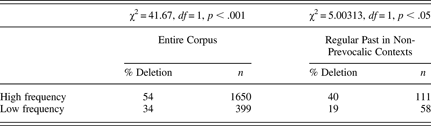
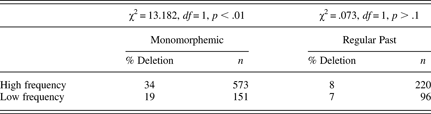
The recent challenges to formal phonology also challenge the theoretical assumptions on which much of the interpretation of the morphological effects has rested. In contrast with the approach in which phonological processes make reference only to formal considerations, a usage-based approach (e.g., Bybee, Reference Bybee2001, Reference Bybee2007; Pierrehumbert Reference Pierrehumbert, Bybee and Hopper2001, Reference Pierrehumbert, Gussenhoven and Warner2002) views the phonology as an emergent system, built up out of generalizations across tokens stored in memory. Under such an approach, the frequency of individual words plays an important role in the linguistic system. Bybee (Reference Bybee and Singh1994:249; Reference Bybee2002:271) argued that the lexical strength of a word is defined as the form most frequently stored in memory, and that highly frequent words are more likely to undergo reductive phonological processes (Bybee, Reference Bybee2007:13). Assuming a usage-based approach, Bybee (Reference Bybee, Barlow and Kemmer2000, Reference Bybee2007) tested the effect of word frequency on the application of (t/d)-deletion in data from Chicano English (Santa Ana, Reference Santa Ana1992, Reference Santa Ana1996). Using frequency counts from Francis and Kučera (Reference Francis and Kučera1982), she divided lexical items into “high frequency” or “low frequency” according to whether they occur more or less than 35 times per million words. As the left half of Table 1 shows, high-frequency words have a significantly higher rate of deletion than do low-frequency words (see also Jurafsky, Bell, Gregory, & Raymond, Reference Jurafsky, Bell, Gregory, Raymond, Bybee and Hopper2001). Myers and Guy (Reference Myers and Guy1997), who used similar measures of frequency in a study of (t/d)-deletion in data from Philadelphia, found a significant frequency effect, although only in monomorphemic TD, as shown in Table 2.
Rates of (t/d)-deletion in Chicano English by word frequency
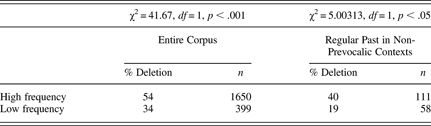
Notes: The data rates are from Santa Ana (Reference Santa Ana1992, Reference Santa Ana1996). Frequencies are adapted from Tables 9.2 and 9.4 in Bybee (Reference Bybee2007).
Rates of (t/d)-deletion in two morphological contexts in Philadelphia English
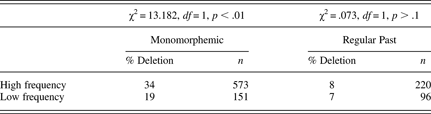
Note: TD rates from Myers and Guy (Reference Myers and Guy1997:220).
Although a lexical account of (t/d)-deletion is more amenable to a usage-based approach, it should be noted that lexical effects can be modeled within a formal approach. For example, standard practice in studies of (t/d)-deletion excludes some highly frequent lexical items that also favor deletion very highly, such as and, which almost never occurs with a final TD. Guy (Reference Guy2007) suggested two ways of dealing with such lexical exceptions: an exception-feature approach, in which and contains a feature that skews the probability of application of the variable rule; or a lexical approach, in which there are two underlying representations of and, one with a TD and one without. He used distributional evidence to argue for the latter approach, which presumably could be extended to all words that feature exceptionally high rates of deletion.
Clearly, it is possible to propose compelling formal and functional explanations for the effects of linguistic factors on (t/d)-deletion, but such explanations give rise to conflicting predictions. Which explanation provides a better account of the variation? First, as any empirical result may lend itself to multiple interpretations (see, for example, the discussion over calculating rates of copula contraction and absence [e.g., Rickford, Ball, Blake, Jackson, & Martin, Reference Rickford, Ball, Blake, Jackson and Martin1991; Walker, Reference Walker2000]), we must always question the assumptions and underlying hypotheses of each factor group. More importantly, most explanations (whether formal, functional, or usage-based) rely on the test of a single factor group that represents one hypothesis, rather than testing competing hypotheses simultaneously. However, a fundamental principle of variationist analysis is that variation is likely to be conditioned by multiple factors (Bayley, Reference Bayley, Chambers, Trudgill and Schilling-Estes2002; Sankoff ,1988). Thus, statistical tests of the effect of a single factor group may obscure the contribution of other factor groups.
In the following section, I report on a multivariate analysis of (t/d)-deletion in a recently compiled corpus of Canadian English, examining the competing effects of formal (phonological, morphological, and lexical) and functional (functional load, frequency) explanations. I focus in particular on the issues involved in defining and measuring frequency as a factor group in variationist analysis. To facilitate comparison with previous studies, I first examine frequency as a nominal factor group in multivariate analysis with the other factor groups, using GoldVarb X (Sankoff, Tagliamonte, & Smith, Reference Sankoff, Tagliamonte and Smith2005), before conducting multivariate analysis in Rbrul (Johnson, Reference Johnson2009), which allows frequency to be examined as a continuous factor group.
(T/D)-DELETION IN TORONTO ENGLISH
Data and method
The data on which this study is based were taken from a corpus of Toronto English developed as part of the Contact in the City project (Hoffman & Walker, Reference Hoffman and Walker2010). I selected a subsample of interviews with 47 speakers who were born in Toronto or arrived before the age of 5 and had spent their whole lives there, ranging in age from 18 to 80 years. Beginning 15 minutes into each recording, I extracted between 50 and 100 consecutive tokens (where possible) of TD in a word-final consonant cluster (excluding preceding /r/, in which deletion rarely occurs). As in previous studies, I excluded tokens that occurred before [t], [d], [θ], and [ð], because these are neutralization contexts in which the variant could not reliably be distinguished. I also excluded frequent lexical items that rarely occur with an overt TD (namely, and, just, kind of, and –n't) and I extracted no more than five tokens per lexical item per speaker. The final dataset consists of 4022 tokens.
In addition to noting whether the TD was deleted or pronounced,Footnote 2 I coded each token for the linguistic factor groups examined in previous studies.
Three factor groups test formal effects: the preceding and following phonological contexts and the morphological status of TD. The phonological factor groups were initially coded finely for the specific segment, but based on preliminary examination of the distributions, the preceding context was simplified to a four-way distinction (nasal [m, n, ŋ], sibilant [s, z, ʃ, ʒ, tʃ, dʒ], liquid [l], other consonant [p, b, f, v, k, g]), and the following context was reduced to a three-way context (consonant, vowel, pause). Morphological status was coded slightly differently from previous studies. In addition to coding tokens as monomorphemic, in which the TD is part of the word stem (as in mist, pact),Footnote 3 and regular or weak past tense, in which past is marked through simple suffixation of TD (as in missed, packed), I divided other past-tense tokens between semiweak past tense, in which there is a change in the stem vowel as well as suffixation of TD (as in kept, left, told), and ambiguous past tense, in which it is unclear whether the TD is a past tense suffix or part of the stem (as in went, found, built).Footnote 4
Two factor groups test the functional-load interpretation of morphological status. If this interpretation is true, we not only expect lower rates of deletion with past forms than with monomorphemic forms, but we also expect lower rates of deletion with preterite forms (1a), in which the TD is the sole marker of tense, than with participles (1b), in which tense is marked through the auxiliary and the TD functions to mark the participle (note that this applies only to regular past-tense forms). If this interpretation is predictive, we expect higher rates of deletion in third-person singular past tense contexts, which are marked with –s in the present tense, than in other grammatical persons.
(1)
a. I stopp_' going on field trips. (TO.6/57:04)
b. … from what I've learned in high school. (TO.56/39:07)
Finally, several factor groups test the effect of individual lexical items and their frequency. Despite the discussion of lexical frequency in variationist analysis, the measurement of frequency is not without problems. On the one hand, using the frequency of each lexical item in the token file may provide a misleading picture of its frequency in the English language, especially because I limited the number of tokens per lexical item per speaker during the extraction of tokens. On the other hand, relying on external measures of frequency may be just as misleading, as there is no guarantee that the frequency of lexical items is similar across all corpora (or, for that matter, across all English speech communities). To overcome these problems, I measured the frequency of each lexical item found in the token file in four different ways. First, the number of occurrences of each lexical item in the token file was coded as “dataset frequency.” Second, a concordance of all of the transcribed interviews in the corpus was used to code the “corpus frequency” of each lexical item. Third, to provide a comparison with previous studies (e.g., Bybee, Reference Bybee, Barlow and Kemmer2000, Reference Bybee2007; Myers & Guy, Reference Myers and Guy1997; and others), I coded the number of occurrences of each lexical item in Francis and Kučera (Reference Francis and Kučera1982) as “standard frequency.” Finally, I also coded the number of occurrences of each lexical item in a more recently compiled corpus, the CELEX database (Baayen, Piepenbrock, & Gulickers, Reference Baayen, Piepenbrock and Gulikers1996), as “CELEX frequency.”
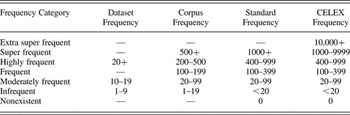
To compare my results with those of previous studies, I needed to divide the numerical measurements of frequency into categories of “low” and “high.” However, because frequency represents a continuum, any such categorization is necessarily arbitrary. Furthermore, the sizes of the token file and the different corpora used to measure frequency are vastly different. Therefore, I divided each numerical measurement of frequency into categories based on the distribution of numerical values within each factor group. As Table 3 shows, although a three-way division can be made for dataset frequency (highly frequent, moderately frequent, infrequent), a finer distinction is required for the other measurements. In addition, both standard frequency and CELEX frequency require a “nonexistent” category, because some lexical items that occurred in the token file were not found in the other corpora.
Four measurements of lexical frequency (number of occurrences)

Frequency
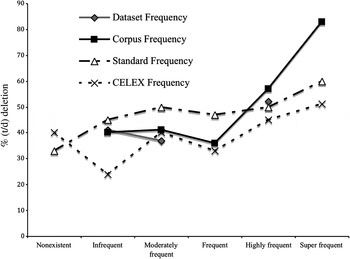
Before proceeding to the multivariate analyses, let us first consider the individual effects of the different measurements of lexical frequency. As shown in Figure 1, in which the rate of deletion is plotted for each of the four measurements of frequency, there is a gradual increase in deletion as we proceed from the lower-frequency categories to the higher-frequency categories. Moreover, the categories shared by the four measurements of frequencies (infrequent, moderately frequent, highly frequent) show a high degree of convergence in terms of rates of deletion, with the only disagreements in the category “infrequent,” where CELEX frequency shows a much lower rate of deletion, and in the category “super frequent,” where corpus frequency shows an extremely high rate of deletion. Thus, there appears to be some support for the previous finding that higher-frequency lexical items are more likely to undergo (t/d)-deletion than lower-frequency items. However, the effect of frequency may be obscured by differences between corpora.
Rate of (t/d)-deletion by four measurements of lexical frequency.

Multivariate analysis, round 1
One of the basic tenets of variationist linguistics is the “principle of multiple causes,” which holds that a single factor group is unlikely to account for the observed variation on its own (Young & Bayley, Reference Young, Bayley and Preston1996:253). Thus, examining frequency (however it is measured) in a single-factor analysis may obscure the contribution of other contextual factor groups, as well as obscuring potential interaction or overlap between factor groups (e.g., Sankoff, Reference Sankoff, Ammon, Dittmar and Mattheier1988; Sigley, Reference Sigley2003). Previous studies, recognizing these considerations, have narrowed the analysis to particular linguistic contexts, to obviate potentially intrusive effects of other factor groups (see, e.g., Bybee's Reference Bybee2007 and Myers and Guy's Reference Myers and Guy1997 analyses in Tables 1 and 2, respectively). However, a better way of accounting for the relative contribution of factor groups is to consider them simultaneously in multivariate analysis.
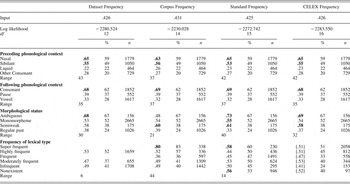
Because all four measurements of frequency cannot be considered together in the same analysis, Table 4 displays the results of independent multivariate analyses of the contribution of the factor groups coded to the application of (t/d)-deletion, with a different measurement of frequency used in each analysis. First, note that neither of the factor groups coded to test for functional effects (past vs. preterite, grammatical person) is selected as significant. By far the greatest effect is that of the preceding and following phonological contexts, which are selected as significant across all measurements of frequency, with preceding nasals and sibilants favoring deletion over preceding liquids and other consonants and following consonants favoring deletion over following vowels and pauses. Morphological status is selected as significant, although its effects are secondary to those of the phonological context (as revealed by the lower ranges across all runs). Across all measurements of frequency, regular past forms disfavor deletion, although the relative ranking of monomorphemic, semiweak, and ambiguous forms is inconsistent.Footnote 5 All measurements of frequency are selected as significant, except for CELEX frequency, for which there is a general tendency for higher-frequency categories to favor deletion over lower-frequency categories.
Factors contributing to (t/d)-deletion in Toronto English, using four measures of frequency (fixed-effects model using GoldVarb X). (N = 4,022)

Notes: GoldVarb X (Sankoff et al., Reference Sankoff, Tagliamonte and Smith2005). Factor weights favoring deletion shown in bold. Not selected as significant: preterit/participle status, grammatical person.
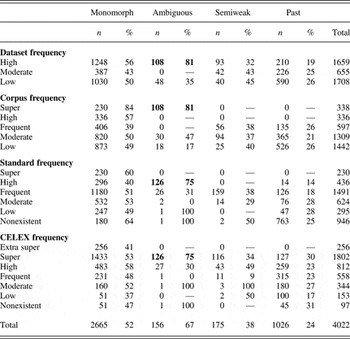
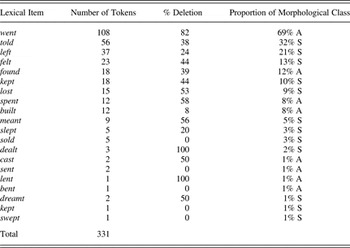
A closer examination of Table 4 reveals that the relative ranking of factor weights and percentages within each factor group does not always match. In particular, morphological status and frequency show the most inconsistency in rankings, as well as in the relative ranking of factors within each factor group. Such inconsistency usually results from overlap or nonorthogonality between factor groups, which can best be isolated by cross-tabulating each factor group against every other factor group. As seen in Table 5, in which each of the four measurements of frequency is cross-tabulated with morphological status, regular past forms tend to occur in the low-frequency category (except for CELEX frequency), in keeping with the general morphological productivity of this category, and ambiguous forms almost exclusively occur in the high or super high frequency categories. In fact, decomposing the ambiguous and semiweak factors into their constituent lexical items, as shown in Table 6, reveals that the ambiguous class is overwhelmingly dominated by one lexical item, went, which represents 69% of the tokens in this morphological category. Although went features a high rate of deletion (82%), the remaining lexical items within this category and the semiweak class show no one-to-one correlation between proportion of tokens and rate of deletion. Thus, the results shown in Table 4 reflect not only the interaction between each measurement of frequency and the morphological status of TD, but also the contribution of a small set of individual lexical items that feature different rates of deletion.Footnote 6
Cross-tabulation of morphological status and four measurements of lexical frequency, with rate of (t/d)-deletion

Lexical items comprised in the ambiguous (A) and semiweak (S) morphological classes

Multivariate analysis, round 2
The results shown in Table 4 are unsurprising, in that the phonological and morphological constraints are consistent with previous findings, but they do raise questions about the relative role of frequency, morphological, and lexical effects in conditioning (t/d)-deletion. Apart from the inherent problem of deciding on the appropriate source for the measurement of frequency, the restriction to nominal factor groups forces us to make arbitrary decisions about categorizing frequency (Pierrehumbert, Reference Pierrehumbert2006:519). Thus, if frequency has the consistent, monotonic effect predicted by a usage-based account, this effect may be masked by dividing the continuum of frequency into discrete categories (File-Muriel, Reference File-Muriel2010:19). However, if frequency effects simply reflect the skewed distribution of morphological categories across frequency categories, GoldVarb provides no way of taking this skewing into account. In addition, if the contribution of some morphological categories to the variation can be traced to the competing effects of individual lexical items, the results for morphological status may reflect the accidental distribution of lexical items within each morphological category in this dataset.
Some of these limitations can be overcome through the recent development of Rbrul (Johnson, Reference Johnson2009), a variable-rule application on the open-source statistical platform R (R Development Core Team, 2011). Rbrul's implementation of both continuous and nominal factor groups allows us to use the numerical measurements of frequency rather than having to convert them into categories. Not only do the different measurements of frequency in Table 4 involve different numerical scales, but frequency effects may also be nonlinear. To overcome these problems, as well as to reduce the effects of outlying values that might skew the effect, I logistically transformed the numerical value for each measurement of frequency, converting all of them to similarly scaled values. In performing multivariate analysis, I also used Rbrul to test a “mixed-effects” model (e.g., Agresti, Reference Agresti2002; Pinheiro & Bates, Reference Pinheiro and Bates2000), taking into account not only the contribution of “fixed effects” (preceding phonological context, following phonological context, morphological status, and each measurement of frequency) but also the fluctuations in overall rate produced by “random effects,” that is, different sources of data (the individual speakers and the individual lexical items). Because of persistent interaction between the ambiguous and semiweak morphological categories on the one hand (Table 5), and the preceding phonological context on the other hand (as can be seen in Table 6), the former were excluded from subsequent analysis.
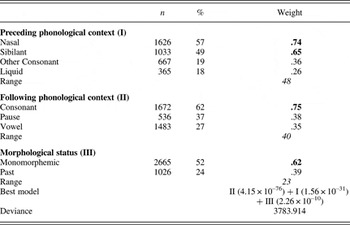
Although Table 7 displays one set of results, it actually represents all four of the independent variable rule analyses for each of the different measurements of lexical frequency, because the results are identical across all runs. Preceding and following phonological context are significant, with preceding nasals and sibilants and following consonants favoring deletion, and preceding liquids and other consonants and following vowels and pauses disfavoring. Morphological status is also selected as significant, with regular past verbs disfavoring deletion and monomorphemic forms favoring. No measurement of lexical frequency is selected as significant. Clearly, once the interaction between factor groups and the contribution of individual lexical items is accounted for, any apparent effect of frequency disappears, and we are left with the formal factor groups that have been found to be significant in other studies of this variable.
Factors contributing to (t/d)-deletion in Toronto English, using four measures of frequency (mixed-effects model, with lexical item and speaker as random factors, using Rbrul (Johnson, Reference Johnson2009)) Ambiguous and semiweak verbs excluded N = 3691

Notes: Rbrul (Johnson, Reference Johnson2009). Bold values favor deletion. Not selected at significant: dataset frequency, corpus frequency, standard frequency, CELEX frequency. “Best model” indicates the p values for the improvement of fit of the model with the sequential addition of each significant factor group.
DISCUSSION
The analyses reported here demonstrate that the primary considerations in the conditioning of (t/d)-deletion are phonological, with morphology a secondary consideration. Functional considerations are not significant. Although different corpora appear to show different correlations between deletion and the frequency of the lexical item, once we take into account the contribution of a small set of highly frequent lexical items in the current dataset,Footnote 7 frequency does not achieve significance. Thus, the best account of (t/d)-deletion is provided by formal accounts.
These results are at odds with a body of work that suggests a major role for frequency in phonology. How can we explain this mismatch? First, as noted, different studies have relied on different measurements of frequency, not only in terms of the corpora they use to arrive at frequency counts, but also how the continuum of frequency is divided into categories. As the initial results showed (Figure 1), the choice of corpus used to code lexical frequency produces slightly different results. Studies also tend to make different and arbitrary distinctions between high- and low-frequency categories. Because frequency categories overlap with morphological categories, which themselves consist of sets of individual lexical items that have different preferences for deletion, the effects of frequency reported in other studies may reflect interaction with factors that were not taken into consideration. This possibility is compounded by the tendency for these studies to examine factors individually rather than considering the contribution of several factors simultaneously.
However, because many studies have taken steps to minimize such statistical problems, this mismatch may not be due entirely to methodological differences, but may instead lie in the choice of variable used to test claims about frequency effects. Although Bybee (Reference Bybee, Barlow and Kemmer2000) used (t/d)-deletion as an example of the tendency for highly frequent forms to undergo reductive changes at higher rates than lower-frequency forms do, there is simply no evidence that (t/d)-deletion is a change in progress; that is, it is a case of stable variation (as Abramowicz [Reference Abramowicz2007:29] also noted). This suggests that examining actual changes in progress might reveal a frequency effect, although studies of ongoing vowel changes in American English (e.g., Dinkin, Reference Dinkin2008; Labov, Reference Labov2011) have failed to find such an effect. However, these variables do not represent the type of lenitive changes cited in accounts of frequency and language change (e.g., Bybee, Reference Bybee and Singh1994, Reference Bybee, Barlow and Kemmer2000; Philipps, Reference Phillips1984, Reference Phillips2006). If it is indeed the case that frequency is relevant only in ongoing changes involving processes of consonant reduction, this type of variable should be investigated in future research into frequency effects.
More generally, the lack of a frequency effect is also at odds with claims made by a usage-based approach to phonology in which an emergent system is built up through generalizations across stored tokens. However, because such an approach is based primarily on studies of perception rather than the production data analyzed in this study (e.g., Goldinger, Reference Goldinger1998; Johnson, Reference Johnson, Johnson and Mullennix1997), a usage-based approach may account well for frequency effects in the way phonological systems are built up while leaving unanswered questions about the relationship between perception and production (Pierrehumbert, Reference Pierrehumbert2006:524). If a speaker stores each perceived token of a word along with its realized variant, it is possible that they are more likely to access the more frequent variant. However, the more frequent variant for each word is not necessarily the reduced one. For example, if a word frequently occurs with an overt TD, that variant will be stored more frequently and the speaker will be more likely to access that form. This interpretation of the relationship between perception and production would explain why some frequent words nevertheless have low rates of deletion. In other words, even if the individual's phonological system is built up by generalizing across stored tokens, this system may still be revealed through its effects on production. In fact, Pierrehumbert (Reference Pierrehumbert2006:523) pointed out some of the findings of formal phonology that a usage-based approach has difficulty accounting for and argued for the necessity of maintaining a phonological level within the linguistic system. Note that this level need not be identical to the models proposed in formal phonology (e.g., Port, Reference Port2007).
A final possibility is that the locus of frequency effects is somewhere other than the word. For example, in a study of the variable omission of complementizer that in English, Torres Cacoullos and Walker (Reference Torres Cacoullos and Walker2009) found that it was not so much the frequency of the matrix verb that correlated with that-omission as much as the frequency of particular collocations of the matrix verb and subject pronoun. Thus, claims about the frequency of words may better be explained in terms of frequent collocations. In fact, although Bybee (Reference Bybee2002:272) emphasized that the exemplar model takes the word as the unit of storage, she (somewhat confusingly) also argued (2002:273) that frequency effects derive from the frequency of the word in particular contexts. For example, she predicted that words that occur more often before vowels (a disfavoring context for deletion) are more likely to undergo (t/d)-deletion, an effect supported by examining a subsample of her data (Bybee, Reference Bybee2002:275). In the present dataset, although a correlation test of the relative frequency of individual lexical items before vowels (as opposed to consonants or pauses) and the rate of deletion does show a negative correlation (Spearman's rho = –.3188761), it does not quite achieve significance (p = .105).
A more promising candidate is the preceding phonological context. As Bybee (Reference Bybee2002:274) noted, although the following phonological context for each lexical item varies, the preceding context remains constant (at least, for all forms but regular past). In fact, Tables 4 and 7 show that the more frequent preceding segments do tend to have higher rates of deletion. Although extricating the effects of phonological-context frequency from the phonological-feature explanation of Guy and Boberg (Reference Guy and Boberg1997) is beyond the scope of this paper, it suggests an interesting area for future research.
CONCLUSIONS
This paper has investigated competing claims about the influence of formal, functional, and frequency effects on phonological variation by operationalizing factor groups investigated in previous studies in a study of word-final (t/d)-deletion in Toronto English. Formal constraints exhibit the greatest effect on the variation, with phonological constraints primary and morphological constraints secondary (although still significant). Because neither of the functional constraints (the distinctions between preterites and participles, and grammatical person) was selected as significant, we can conclude that function (in this interpretation) does not appear to play any role in deletion. Presumably, the nonsignificance of these constraints arises from the fact that, whereas deletion of the past-tense TD may result in ambiguity of (morphological) tense, there is enough redundant information in the discourse context to disambiguate (semantic or pragmatic) temporal reference.
The usage-based hypothesis that lexical frequency constrains (t/d)-deletion receives no support, once its interaction with morphological status and the contribution of a small set of lexical items are taken into account. Formal interpretations of the effects of language-internal factor groups on (t/d)-deletion thus receive support from the analyses presented in this paper, although supporters of usage-based accounts should not despair. A frequency-based account of (t/d)-deletion may still be possible, although further work is required to extricate the feature-based analysis explored by Guy and Boberg (Reference Guy and Boberg1997) from the interacting effects of the preceding context and the frequency of the phonological context. More generally, we need to be careful to distinguish between stable variation and change in progress. All change requires variation, but not all variation implies change. We must also distinguish between types of change. Vowel systems may function differently from consonant systems, and a change involving chain shifts (whether vowels or consonants) may differ from low-level phonetic-reductive changes. Regardless, we need to recognize that frequency may not operate monotonically but may have a more dynamic interaction with the lexicon.