I refer to what could be termed the shop window quality of things . . . The exhibition with its emphasis on amusement attempts a new synthesis between the principles of external stimulus and the practical functions of objects, and thereby takes this aesthetic superadditum to its highest level.
Georg SimmelFootnote 1In the heart of the twenties, the shop window forced the spectator to a double confrontation with the reflection of his pleasure and the materialization of his desire.
Jean-Paul BouillonFootnote 2A guest of Vera and Vladimir, starting from Berlin's main avenue of Unter den Linden and passing west under the Brandenburg Gate, would walk right through the heart of the Tiergarten; he would turn south as the park ends and pass the Gedächtniskirche, or Kaiser Wilhelm Memorial Church, increasingly incongruous amidst Berlin West's neon shop signs and newly-constructed cinema palaces; finally, he would turn off from the large avenue of Tauentzienstraße by one of Europe's largest department stores, the Ka De We—or Kaufhaus des Westens—whose famous ground-floor window displays lined the corner block fully a third of the way down Passauer Straße en route to the Nabokovs’ two-room apartment at number 12. Arriving at night, the guest would have witnessed a series of spectacles typical of Weimar Berlin: colorful electric advertising, elaborate and fully illuminated window displays, the startling beams of automobile headlights, cabaret clubs and music halls. It seemed that the city, along with its citizens, was self-consciously on display.
The residence of Russian émigré novelist Vladimir Nabokov at 12 Passauer Straße, from fall 1926 to spring 1929, coincided with the zenith of Weimar Berlin's “surface culture.” This temporary but fruitful alliance, if not devil's bargain, between avant-garde art and an incipient consumer culture led to the dominance of new forms of electric media, which projected an exuberant, almost hysterical, optimism into the German metropolis. In October 1928, this spectacularization of consumption and aestheticization of function by nocturnal displays reached a climax in Berlin im Licht—a four-day festival of Berlin in Lights.Footnote 3 That very same month, a Russian in Berlin could have read Vladimir Nabokov's own kaleidoscopic description of Berlin's visual arrays in his newly-published novel Korol΄, dama, valet (King, Queen, Knave).
The novel Korol΄, dama, valet, Nabokov's second, was distinguished as much by its financial success in translation as by its artistic success with a Russian émigré readership.Footnote 4 Weeks after its Russian publication, Germany's largest publishing concern Ullstein purchased translation rights for a figure which dwarfed the amount received for the Russian original: the princely sum of 7500 Marks plus 12% royalties, compared with the Russian publisher Slovo's paltry 300 Marks.Footnote 5 In fact, this was merely the continuation of prior business between Nabokov and Ullstein. Only two months into the novel's composition, Nabokov received word that the Ullstein newspaper Vossische Zeitung, which had just bought the translation rights to his first novel, Mashen΄ka (Mary), wanted to get hold of his second.Footnote 6
It is against this background that Korol΄, dama, valet explores the interpenetration of art and commerce. The novel's street-level view of Weimar surfaces, with its trade in visual, commercial, and sexual cultures, forces us to reconsider the relation of Nabokov's fiction to the marketplace. Nabokov appears strikingly astute in his understanding of commercial practices, manifested not only in his representation of his entrepreneurial contemporaries at the height of Weimar culture, but also in his own interactions with the literary marketplace.Footnote 7 In this regard, the shop window of the protagonist Kurt Dreyer's menswear emporium appears as a metonym of the novel and its commercial angle.
The early German sociologist Georg Simmel, himself a native of Berlin, had referred thirty years previously to die Schaufenster-Qualität der Dinge to describe the aestheticization of commodities on display in fin-de-siècle Berlin.Footnote 8 In Simmel's original coinage, the focus is on the transformation of materiality (things, or material objects) by the “aesthetic superadditum” of display (for example, in shop windows). By the 1920s, as Jean-Paul Bouillon writes, the shop window functioned as both a reflective surface and a frame for the spectator's desiring gaze.
Korol΄, dama, valet functions like such a shop window, as both reflective surface and frame for the phantasmagoria staged within. In this sense, the novel reflected back to its early readership of Russian and German Berliners a distorted yet recognizable version of their own urban culture of commercialized erotic spectacle. At the same time, it framed an idiosyncratic and parodically shop-worn drama of adultery, arranged and stage managed by an émigré window dresser.
In rediscovering the “shop window quality of things” in Nabokov's second Russian novel, our task is to uncover what Russian and German Berliners saw both reflected back in the novel's surfaces and staged in its depths. Grasped as a radical commercial and multilingual experiment in creating one's own audience from the periphery of the Russian émigré diaspora, the novel is no longer a work that does not quite fit the Nabokovian canon, but an uncommonly successful attempt—at once serious and ironic—to engage mass urban visual culture through marketable “high” art.
In the case of Nabokov's second novel, perhaps more so than any other, a discussion of the original Russian version is essential, as both the 1928 Russian text and its referents are so radically different from the English rewrite of 1968.Footnote 9 In a 1995 article, Jeff Edmunds proposed to tackle the original Russian novel, and his close readings of the text served to argue for the validity of a relatively neglected work.Footnote 10 Yet in restoring the novel “to its original unspectacular state” by stripping the Russian version of its later English accretions, Edmunds obscured the extent to which Korol΄, dama, valet struck contemporary reviewers precisely by its “spectacular” quality—by a “poetic precision of vision” that was not underdeveloped, but if anything too sharp.Footnote 11
By reading the novel alongside German sources on fashion and mannequins, and reappropriating the insights of contemporary Berlin reviewers, I show that the fusion of materiality and display in the “shop window quality of things” is central to Korol΄, dama, valet. On my reading, it emerges as a novel intent on exploring the nexus of erotic and commercial desire prompted by the rapidly developing mass urban culture of the 1920s. Nabokov was a good deal more familiar—and indulgent with—the commonplaces of Weimar German culture than his English forewords and rewrites would suggest.Footnote 12 This Russian novel written about and for Berliners was far more an insider's account than has commonly been thought, revealing him to be informed not only about Germany's latest fashions and technology, but also about the historical place of Weimar Berlin in the development of European visual culture. Most strikingly, in his original portrayal of the career of the entrepreneur Kurt Dreyer, Nabokov shows remarkable insight into the economic fragility of the Weimar Republic, even while conjuring so knowingly with the elements of this culture for his own artistic and financial gain. By reexamining the sources of Nabokov's fascination with shop windows, waxworks, mannequins, and other more macabre human simulacra, I uncover his complex relation to European visual culture: fascinated but repelled, sympathetic yet disdainful. Ultimately, by analyzing the figure of Dreyer alongside the authorial cameos made by Nabokov and Vera toward the close of the novel, I argue that Nabokov maintained a careful biographical and artistic distance from the searching gaze strategically deployed in his Weimar novel, privileging a very different kind of optic than that prized by “surface culture.”
Ка Де Ве/Ka De We
The very title of Korol΄, dama, valet echoes in its Russian first letters (ka de ve) the Ka De We, or Kaufhaus des Westens, that most famous of Berlin department stores.Footnote 13 As Barbara Wyllie points out, not only was this store on Nabokov's street, it was opposite Berlin's largest Russian bookstore, the Buchhandlung des Westens, where Nabokov often browsed his way through whole tomes for free.Footnote 14 Following this set of literary and commercial displays, one of the titular characters of Korol΄, dama, valet, the “king” Kurt Dreyer, is the proprietor of a menswear emporium. An entrepreneur by nature, Dreyer had gambled on investments during the 1923 hyperinflation and won. Not a manager by training, by the “stabilization” year of 1928, Dreyer is losing his grip on his business. When visited by an itinerant inventor “with an indefinite surname and of indefinite nationality,” he takes another gamble by investing, more out of curiosity than calculation, in the stranger's proposed “automannequin” robotic display dummies.Footnote 15
Although they are eventually sold to an American businessman, the automannequins are at one point destined for Dreyer's fantastical window displays, which represent an alluring showcase of commercial spectacle:
In sapphire letters, with a diamond tail prolonging sideways the final “y,” the five-sazhen sign glittered: “Dandy.” Dreyer took [Franz] under the arm and silently led him up to one of the five display windows shining in series. In it, as in a hothouse, ties blossomed in the heat, now corresponding in color with flat silk socks, now swooning on the gray-blue and cream rectangles of folded shirts, now drooping lazily from gilded branches; and in the depths, like the god of that garden, an opal set of pajamas with a wax face stood at full height. But Dreyer did not allow Franz to dally in contemplation; he led him smartly past the remaining four windows; there flashed by in turn an orgy of brilliant footwear, a Fata Morgana of jackets and coats, a graceful flight of hats, gloves, and canes, a sunny paradise of sporting things . . .Footnote 16
These windows frame less a sampling of saleable goods than a phantasmagoria of waxworks and literally fetishized (“the god of that garden”) commodities.Footnote 17 The passage's many metaphors, subtly parodying the intended associations of the objects on display, perform the work of the window's Simmelesque “aesthetic superadditum.”
Particularly striking is how such a “shop window quality of things” pervades the narrator's view of the rest of the city's surfaces:
On the glazed, smooth asphalt there were vague, blending reflections—reddish, purplish—as if covered in a film, in which here and there rain puddles tore large holes, and through them showed vivid authentic colors—a raspberry diagonal, a dark blue segment—separate glimpses into a humid upside-down world, into a dizzying, geometrical variety of colors [raznotsvetnost΄]. The perspectives were variable, as if the street were being shaken, changing the combinations of numberless colored fragments in the black depths. Shafts of light passed by, marking the course of every car. Shop windows, bursting with tense radiance, oozed, squirted, splashed into the blackness.Footnote 18
As the slick asphalt becomes the site of an impromptu magic lantern show, the narrator's phantasmagoric and erotically-charged perspective transmits some of Nabokov's fascination with the fortuitous and fleeting aesthetic combinations held in store by the city.
In his Russian fiction of the 1920s, Nabokov had been drawn to Berlin surface culture as dynamic, playful, and buoyant. In fact, Nabokov's early literary career paralleled the creative florescence of Weimar commerce from 1924 to 1929. Nabokov's stories set in Berlin for the Russian-language Berlin daily Rul΄ (The Rudder) were shaped to the tastes of their newspaper audience and aimed exclusively at a local readership.Footnote 19 These stories attest to the fact that Nabokov was particularly struck by the city's nocturnal displays, which offered the late-night flâneur a form of secular re-enchantment. Along with his first novel of 1926, Mashen΄ka (Mary), they hinted at the manipulative hold of Berlin's commercial displays on a male protagonist.Footnote 20 As Nabokov put it in his 1927 article “Iubilei” celebrating ten years of exile, “A courageous longing for our homeland does not always prevent us from enjoying an alien country, a refined solitude in an alien electric night.”Footnote 21 In other pieces such as “On Generalities” (1926), Nabokov held up the chance combinations of the metropolis, and the delight they afforded the sensitive observer, as an example contrary to the pessimistic commonplaces of the postwar era, such as the émigré distemper of the Russian Berlin literary tradition and European historicist claims of cultural decline.Footnote 22
As Alexander Dolinin has shown, Nabokov's portrayal of Berlin in his Russian fiction is deeply idiosyncratic and characteristically against the grain, resembling neither the prevalent émigré myth of “russkii Berlin” (Russian Berlin) nor the much-mythologized and anthologized metropolis of Western journalistic, literary, and later memoiristic accounts.Footnote 23 Furthermore, Dolinin is doubtless right to explore the profound influence of Franco-Russian literary models on the novel, from Émile Zola and Honoré de Balzac's novels of Parisian adultery and Bildung to Aleksandr Pushkin's Pikovaia dama and the governing metaphor of chance and gambling.Footnote 24 Contemporary reviewers also noted that Korol΄, dama, valet neither records the daily life of the Russian émigrés (bezhenskii byt) nor reproduces the vistas of fashionable Franco-German avant-garde culture. What some honed in on, however, was the relationship of Nabokov's fictional Berlin to the urban environment in which it is set.
In his contemporary German review of the novel, the Russian-born German Arthur Luther highlights the extent of the novel's serious if idiosyncratic engagement with Weimar Berlin. A historian of Russian and German literature and a prolific translator in his own right, Luther is particularly drawn to the Russian author's choice of characters, who are “from the German middle class, little Berliners [Kleinberliner].”Footnote 25 It is precisely through them that Nabokov filters a unique perspective on Berlin:
He enables us to see German life with Russian eyes, to see through the eyes of a Russian who grew up in Germany, who is thoroughly acquainted with the circles he describes, is free of any bias against Germany and the German manner, but yet who is so different from us that he highlights, emphasizes, and makes us aware that a lot of what we all too easily overlook [hinwegsehen], because it appears [erscheint] to us self-evident, is in fact perhaps not quite as self-evident as we had thought. It is said that this novel of Sirin's will also [like Mashen΄ka] shortly appear in German translation. Hopefully it will not make us wait too long.Footnote 26
Luther's praise of the author's defamiliarizing vantage point is remarkable: Nabokov's novel is valuable to a German audience in its ability to go beyond appearances and bring out by means of an acute visual sense (“Russian eyes”) what Germans habitually “overlook.” Treated as neither a blasé German nor a Russian prejudiced against German urban life, Nabokov is said to have enough familiarity to provide insight, but enough distance to supply novelty. As we have seen, the critic's call for a swift translation of Korol΄, dama, valet was in fact heeded.
Even émigré reviewers, the majority of whom were by 1928 based outside Germany, remarked that both the novel's subject matter and its artistic treatment had a German flavor.Footnote 27 Thus Mikhail Tsetlin wrote in Sovremennye zapiski that the novel “seems at times to be a translation from the German, although in its language there are no discernible Germanisms,” while Mikhail Osorgin in Poslednie novosti described it as “a talented novel, which could have appeared in any language, most naturally of all in German, and which will probably have no less success in translation than in the original.”Footnote 28 Intriguingly, the language of the text is treated as arbitrary—as if the novel itself were stateless, and Russian were merely a transit point on the way to (or indeed from) German.
Mikhail Osorgin went on to write perceptively about the extraordinary aesthetic attention that Nabokov pays to material objects (or “things,” to recall Simmel) in Korol΄, dama, valet. Osorgin points out that the novel's characters are “fabricated in the required quantities at the very same factories where they produce automobile parts, gramophones, antennas, propellers, footballs, playing cards, artificial jaws, and incandescent lightbulbs.”Footnote 29 Osorgin is correct to point out the importance of stylized mannequins modernes to Nabokov's vision of Weimar society, and is accurate in his description of such mannequins’ visual features:
. . . [they are] not the good-natured semblances of people, with little painted cheeks, blue eyes and elegant porcelain fingers; not hairdressers’ dolls of the old type, but those others, [made] without any attempt at naturalism, skinny, with stylized figures and faces only hinting at human features, expressionless and lifeless in wooden poses, comfortably holding a coat, pajamas, a ball dress . . .Footnote 30
Osorgin uses these factory-produced models, who parade their industrial origins no less than the apparel they advertise, as a metaphorical portrait of the knave and queen Franz and Martha, who are so often described by the narrator as “mechanical.”Footnote 31
Complementing this critical attention to objects was the visually-attuned review of Korol΄, dama, valet by the well-respected professional critic Iulii Aikhenval΄d. A friend of Nabokov and resident of Berlin, Aikhenval΄d worked as the literary reviewer for Rul΄, where Korol΄, dama, valet was excerpted. Aikhenval΄d echoes Arthur Luther's appreciation of the defamiliarizing power of Nabokov's gaze when applied to the overfamiliar appearances of daily life: “His rare powers of observation and perception [nabliudatel΄nost΄ i primetnost΄] in regard to the external world, to all its details and mundane trifles effaced for us by habit, makes this world far richer and more complex, fresher and more colorful, than it seems to ordinary eyes.”Footnote 32
For Aikhenval΄d, Nabokov's second novel was remarkable precisely as a spectacle. He praised above all its depiction of Berlin: “those who live in Berlin or Germany will be able to appreciate that sense of the “capital,” that feeling of its specificity . . . which a Russian describer of non-Russian daily life has brought forth.”Footnote 33 Aikhenval΄d hones in especially on the conjunction between public display and private desire found in exhibitionism and voyeurism. The critic points out that linking the narrator's attention to surfaces and the characters’ superficial desires is a “vneshnii erotizm”—what we might call an erotics of surface.Footnote 34 Nabokov is said to unite a remarkable feeling for material objects with a psychologically insightful depiction of physiologically-founded desires. In other words, in displaying the fetishization of form inherent in Weimar surface culture, Nabokov pinpoints the shop window quality of Berlin itself.
Surface Culture
These important contemporary critiques of materiality and display were based on Nabokov's numerous representations of visual culture in the novel. In its stunningly sympathetic and insightful perspective on 1920s Berlin, Korol΄, dama, valet presents a kaleidoscopic sequence of seeing machines, techniques of observation, and framed displays. These sites of vision (including the train carriage, shop window, night streets, crime museum, and the inventions of the mechanical sex doll and the automannequins) are not just presented disparately and discreetly, but are strung together by Nabokov into a chain of causation, whose effects are made manifest through the increasingly strained body of Franz. Even after mannequinification, Franz displays the strain of visual overstimulation: “behind the lenses of his glasses were restless eyes of an impure color, with permanently inflamed veins on the whites.”Footnote 35 These different modes of vision have in common a concern with desire, commerce, and a privileging of superficial detail.
The railroad carriage is the first of the novel's window displays: the use of glass in the first chapter prepares the way for the double play of reflection and penetration that characterizes the shop windows later.Footnote 36 The train's windows have a dual function, both of which revolve around Berlin: they are at once a screen displaying Franz's speeding approach to Germany's cultural capital and a frame for exhibiting Martha as the embodiment of fantasies provoked by erotic metropolitan advertising.Footnote 37 For if Franz's Berlin desires are the initial motor of this novel, the spark had been given at the provincial train station of the novel's opening. Here, a bit of metropolitan mass culture resides in the “seductive magazine covers—photographs of naked, pearl-gray beauties,” who are implicitly contrasted with Franz's plain sister, who is dressed in “a check cape that they do not wear in the capital,” “smelling of an unpleasant, empty-stomach smell [natoshchak].”Footnote 38 Once on the train, Franz incorporates pieces of his fellow passenger (later revealed to be Martha) into a daydream: “keeping the splendid shoulders, he changed the head . . . and, in its place, attached the face of one of those bold metropolitan [stolichnykh] beauties that one encounters mainly in liquor and cigarette advertisements. Only then did the image come to life: the bare-breasted lady lifted her glass to her crimson lips, swinging her fishnet leg as a red backless slipper slid off her foot.”Footnote 39 Upon his arrival in Berlin, the game continues, as Franz enjoys staring at permissive and provocative passersby, even spontaneously propositioning girls in their homes while apartment hunting (“Who do you need to see?” . . . “Maybe you, eh?”).Footnote 40
The supreme example of Nabokov's linking of commercial entertainment, via imaginative stimulation, with subjective desire comes when Franz walks home from the Dandy store after viewing its window displays and receiving a tutorial in salesmanship from his future employer Dreyer. To Franz, “choking with fabulous excitement,” the streets appear as a phantasmagoric pleasure garden:
And at every corner, emblem of ineffable happiness, stood a sleek-hosed woman; but there was no time to peer into her face, another already beckoned in the distance, and beyond her, a third—and Franz already knew, already knew, where those mysterious live beacons led. Every street lamp, spreading like a star in the dark, every crimson glow, every spasm of mobile, synchronized lights; and the silhouettes of women entrusting one another with sweet, sultry secrets in recessed porches; and those half-open lips that flitted past him; and the black, moist, tender asphalt—all of it was assuming a significance, combining together, and receiving a name.Footnote 41
Returning home like a sleepwalker, “saturated with sweat, limp with delicious languor,” Franz falls into a dream where all his street-level impressions resolve into a single image and name. Franz is given the “keys to the city” in an erotic dream of Martha:
[Franz] understood the meaning of all the lights [ognei], sounds [gudkov], and women's glances, as everything slowly blended into a single blissful image . . . anticipating indescribable bliss, Franz carefully opened the door and saw Martha sitting on the edge of the bed . . . now he saw quite closely her glossy lips, her neck swelling with glee . . . but he suddenly could not contain his boiling ecstasy.Footnote 42
From store to street to dream, a trail of desire leads Franz from Dreyer's shop displays to a scopophilic climax while observing Dreyer's wife Martha. To put it abstractly, the commerce of fashion leads, via the surface technology and sex trade of the city, to the erotic transaction of adulterous fantasy.
The conjunction established by Nabokov between sexuality and surfaces, display and consumption, was historically present in Weimar Berlin, where display became an end in itself. Scholars have pointed out that the function of Weimar commercial arrays was less about commerce than about pure spectacle, sight for sight's sake: German consumers had very little buying power throughout the twenties, and the goods on sale were democratized to a far lesser extent than the aesthetic object of their public exhibition.Footnote 43 As contemporaries realized, this condition already had a history, dating back at least to the World Fairs, such as the 1896 Berlin Exhibition commented on by Simmel.Footnote 44
In Nabokov's portrayal, Weimar surface culture reveals a similar disdain for saleable goods in favor of stimulation through sight and simulacrum. Nabokov's positing of a male spectator and, in the case of Dreyer's windows, a male intended audience, shifts the emphasis in his portrait of Weimar surface culture from the displaced eroticism of commodity fetishism to the fetishism of the artificial, simulated, or mediated female form. As Jean Bouillon succinctly puts it: “the display window needs a voyeur, and the voyeur a girl in the window.”Footnote 45 A contemporary German source more clearly shows the historical background against which Nabokov's portrayal stands out.
Die Dame
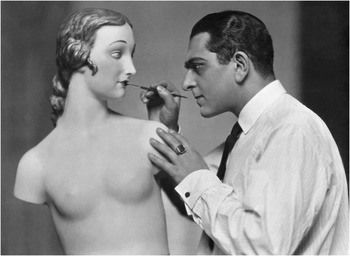
In 1925 the well-known Berlin women's fashion magazine Die Dame (The Lady) ran an article entitled “Mannequins or Wax Dolls?” promoting the Berlin-based Austrian artist and photographer Karl Schenker. In one of several illustrations, Schenker is pictured with his new creations, waxwork, mannequins in an image captioned “At Work” [bei der Arbeit].Footnote 46 (See Figure 1). In 1928, Nabokov was likely familiar with the popular magazine, which was part of the same Ullstein publishing house that bought the translation rights to Mashen΄ka and Korol΄, dama, valet; moreover, his novel Kamera obskura, started three years later, pictures a character reading Die Dame.Footnote 47 Like the fictional Dreyer, whose automannequins’ lifelike effect is achieved by a collaboration between specialists, Karl Schenker had assembled a team around him in order to produce wax mannequins of extraordinary realism:
The artist consulted with young sculptors, had the drawing translated into clay, corrected and worked on the model with these assistants, such that it all came out unaffectedly and naturally. It was carried out with dogged patience. Then, when the plaster model had been formed from the clay model and the wax cast from this, he personally undertook the painting of the faces, did the coloring of the skin, and conferred with the hairdresser, who had taken care of the head hair and eyelashes and eyebrows. The body from the waist up was also most precisely and carefully modeled in wax, so that where the neck and back and breast show through, living truth is suggested, and under the cloth, reality seems to breathe.Footnote 48
Similarly, in Korol΄, dama, valet, Kurt Dreyer achieves his automannequins’ lifelike effect by a remarkable collaboration between the inventor of the mechanism that enables them to walk, and an anatomist and a sculptor who perfect the external forms:
It was necessary to create not only a semblance of human legs, but also the semblance of a human body, with soft shoulders, with a flexible torso, with expressive eyes. The inventor, however, was neither an artist nor an anatomist. Dreyer therefore found him two helpers: a sculptor whose work was distinguished by a particular lightness, tenderness, a slightly fantastical elegance; and a professor of anatomy, who had written in his day a dryish but interesting treatise on the self-awareness of muscles.Footnote 49
As a result, the real-life artist Karl Schenker's success in conveying both lifelike skin and the illusion of subcutaneous life accords with Kurt Dreyer's impressions of his automannequins: a triumph of anatomy, sculpture, and ingenuity.
Karl Schenker (1886-1954). Mannequin Maker, 1925 © Granger.

The aim of Schenker's “wax dolls” is to approach as nearly as possible the condition of a live human mannequin, hence the title of the Die Dame article (“Mannequins or Wax Dolls?”), which is meant to convey a putative viewer's doubt about the figures’ identity.Footnote 50 The commercial aim of such realism is ostensibly clear: to demonstrate better to potential customers (presumably female, like all the wax dolls in the article's illustrations) how a dress will fit on “a creature of flesh and blood.”Footnote 51 On the face of it, Schenker's purpose is more clearly utilitarian than Dreyer's somewhat whimsical interest in a diverting, rather than immediately profitable, spectacle.
Yet the Die Dame article is bookended by two notable instances of male desire which showcase an Aikhenval΄dian erotics of surface—as if successfully attracting this gaze would be the ultimate proof of verisimilitude. Ruminating on the future fate of Schenker's wax dolls as they are mounted in shop windows, the author imagines how a passerby could even “fall in love with them, as E.T.A. Hoffmann's rapturous young man fell in love with the doll Olympia.”Footnote 52 This reference to “The Sandman,” an iconic instance of the uncanny animation of the inanimate, takes us back, via the illustration of Schenker gazing at his own wax doll, to the article's opening description of an “unspeakably comic” scene of unexpected arousal.Footnote 53 We are told of a scandal caused several years previously by a Berlin shop window displaying wax dolls “in lovely negligee.” The Die Dame author goes on to deride the ensuing demonstrations outside a local police station, which appear to the author so unlikely in the light of the pitiful lack of realism in the primitive dolls of yesteryear (described in much the same terms as Osorgin discusses the old Russian hairdressers’ mannequins).Footnote 54 What the author does not pause to consider is the complexity of consumption such exhibitions were intended to encourage, and the latent misalignment between an erotic (putatively male) and an aesthetic (ideally female) appreciation of the display. Yet the author clearly recognized, as did contemporary window dressers, that such displays as Schenker's, with their hyper-realistic female simulacra, were intentionally framed as diversely desirable, open to consumption in a variety of ways.
It is therefore curious to note that in the Russian version of Korol΄, dama, valet, the automannequins developed by the inventor under Dreyer's commission are all male, intended, if not for immediate resale, at least for display in the “Dandy” store, a menswear emporium. In fact, the increasing automatization of Franz, noted by numerous scholars, is an inversion of a gendered Weimar-era topos, the machinification of department store saleswomen, whose training made them “appear stiff, almost like automatons.” The phrase is Mila Ganeva's, summarizing a 1929 report in the Frankfurter Zeitung: “The mandatory training in the department stores had taught [the shop girls] to suppress their own personalities and emotions in interactions with customers; it had disciplined their body gestures, straightened their posture, streamlined their appearance, cleansed their language of regional accents, and supplied them with an arsenal of stock phrases.”Footnote 55 Franz, a bumbling provincial male, is similarly sanitized in terms of clothing, mannerisms, and especially grooming as part of his training at the Dandy menswear store:
[Franz] had his neck shaved into a semicircle at a good hairdresser's. The pimples on his bridge were first powdered, then disappeared altogether. The tiny blackheads, which had lived amicably on the sides of his nose near his angular nostrils, were squeezed out. The hollow of his chin stopped appearing glossy, and he shaved daily, destroying not only the coarse dark hair on his cheeks and neck, but also the light fluff on his cheekbones. He started tending to his hands and scenting his hair.Footnote 56
The narrator's intense focus on the sterilization and homogenization of Franz's facial surfaces is missing in the English, replaced by a focus on lower-stratum bodily hygiene that is fairly typical of the rewrite.Footnote 57 What this elides is the detailed transformation of Franz into one of the Kleinberliner that, according to Arthur Luther, Nabokov captured so convincingly. Through such training and grooming, and through the repetitiveness of his work in Dreyer's store, Franz starts to imagines himself as “one of those dashing figures with wax faces, in suits pressed by the iron of idealization, standing on pedestals with arms slightly extended and bent at the elbow.”Footnote 58
What would later become a Nabokovian commonplace (objects have lives of their own, whereas humans are often lifeless), was a variant of the observation, frequently made in the Weimar context, that shop mannequins often appeared as full of life as the impassive shop girls.Footnote 59 Notably, the one variety of mannequin not on display in Nabokov's novel is the live mannequin. Dreyer is attracted by the ingenuity and aesthetic challenge inherent in the artificial auto-mannequins—he does not even consider using live models. Yet historically such live models, invariably young and female, provided the clearest instances of provocatively eroticized display. Of the various street scandals caused by live mannequins modeling (for example) lingerie, perhaps the most famous representation occurs in Joe May's 1929 film Asphalt, where a crush of late-night onlookers in front of a live display at a hosiery store allows a pickpocket to ply his trade.Footnote 60
As we have seen in the novel's opening chapters, Franz had imaginatively framed and exhibited Martha in the train carriage in a similarly eroticized way. As the novel progresses Martha takes a more active role. Her eventual operation—taking a lover in her home for financial gain—is aptly described by the Weimar Berlin slang term “mannequin” as documented by Mel Gordon:
DEMI-CASTORS—[From French underworld jargon—literally: “half-beavers,” or “amateur hookers.”] Young women from good families who supplemented their allowances by working in secretive, high-class houses in Berlin West. Normal hours of operation were late afternoon/early evening. [Variant name: MANNEQUINS.]Footnote 61
As the streetwalkers had illuminated, beacon-like, Franz's path to an adulterous liaison with Martha, so the term “mannequin” leads back from commercial display to a kind of privatized prostitution behind closed doors.Footnote 62
Advertising and film culture were explicitly and strategically gendered during this period, most obviously by either playing into well-established notions of women's susceptibility to emotion and subjectivity or, equally successfully, by appealing and catering to younger women's attempts to construct a lifestyle in conspicuous opposition to prewar roles.Footnote 63 This reversal of the conventional iconography of modern spectacle and consumption prompts us to reconsider the commonplace of mass culture as a “ladies’ paradise,” from Zola's Au Bonheur des dames to Weimar-era theories in Die Dame about the New Woman, and from Siegfried Kracauer's contemporary sociological studies of the “little shopgirls” to influential scholarly accounts like Andreas Huyssen's binary between a passive, feminized mass consumer and an ironic, dominant male modernist artist.Footnote 64 Ultimately, the novel contorts the gendered commonplaces of visual culture, presenting an idiosyncratic retelling of the development of technologies of spectacle and consumption from an exclusively male—and significantly darker—perspective.
Unlike the journalists of Die Dame, guided by their magazine's strictly promotional function, Nabokov in his novel Korol΄, dama, valet produces an ironic exposure of the darkness inherent in the artificial stimulation of sexual desire by commercial enterprise. What is more, he used his ambivalent status as both insider and outsider to turn this critique into another selling point: this intellectually engaged novel is also a book of attractions.
Chambers of Horrors
It is important to note that, if the novel is a shop window, the objects on display within Korol΄, dama, valet are strikingly different than many readers have assumed. The most important human simulacra in the novel are not factory-made symbols of lifeless conventionality, as described by Mikhail Osorgin, but idiosyncratic, experimental “one-offs”: custom-made pieces of somewhat rickety ingenuity, whose lifelike sinews and interior heating raise them to the level of dubious, even obscene, artistry. Once these “things” are brought to light, it is clear that their “shop window quality”—the display designed to elicit desire—is more complex than habitually understood. As a cultural chronicler of Weimar Berlin, Nabokov penetrates far beyond the licit (or illicit, yet sanctioned) transactions of western tourists, to reveal the horror of a residual and instinctive violence at the heart of Weimar surface consumption.Footnote 65
As the novel progresses, Nabokov unearths the historical connection between dolls and the macabre.Footnote 66 For Nabokov is keen to demonstrate the link between the desire for human simulacra and the pleasurable spectacle of death. The connection between sex and death—and especially between their perversions, adulterous lust and murder—is most obviously present in the novel's second-hand plot, where Franz and Martha plan to kill Dreyer as an obstacle to their liaison. But Nabokov also encodes allusions to this dark prehistory of Weimar surface culture throughout the opening of Korol΄, dama, valet.
Setting up the fascination of Korol΄, dama, valet with wax figures—in both their alluring shop window and macabre crime museum variants—are Franz's childhood memories, described on the train in terms of a waxworks museum.Footnote 67 Franz is revolted by the sights and smells in the third class carriage, not least of which is the uncanny spectacle of a man without a nose—a phenomenon which in the immediate postwar years would have brought to mind the many mutilated veterans of the Great War, whose disfigured faces haunted the pages of the pacifist tract and international bestseller, Krieg dem Kriege.Footnote 68 At this sight, Franz's “memory became a waxworks museum [panoptikum], and he knew, he knew, that there, somewhere in the depths, was a chamber of horrors [kamera uzhasov].”Footnote 69
Nabokov was attuned to the historical development of visual technologies, which he would have personally experienced during his own 1900s St. Petersburg childhood and 1910 visit to Berlin at age 11.Footnote 70 As he knew, the panoptikum (German: Panoptikum) was a waxworks museum of a particular type: a pseudoscientific cabinet of medical and criminal curiosities. Nabokov's contemporary in Berlin, Walter Benjamin, pointed out the etymological and teleological connection between Bentham's Panopticon prison, the German Panoptikum, and its Parisian contemporary, the panorama: “Pan-opticon: not only does one see everything, but one sees it in all ways.”Footnote 71 Traditionally the waxworks museum would contain a Chamber of Horrors on a lower level, often with special warnings and gendered restrictions on admission.Footnote 72 Nabokov would have known, and perhaps visited, the most famous of these, Castan's Panoptikum, founded in 1871, which only closed its doors in Berlin's Kaiser-Gallerie arcades in 1922.Footnote 73
As in the Chamber of Horrors, the workshop in which Dreyer's automannequins are produced is strewn with apparently tortured body parts: “The workshop soon began to look as if they had just carefully sliced up two dozen human arms and legs, and in the corner, with carefree expressions on their faces, were heaped several heads, on one of which someone had stubbed out a cigarette.”Footnote 74 Here Nabokov links the waxwork with the corpse, and the creation of a human simulacrum with the torments of a live body.
These connections, which comprise the dark side of Weimar's pervasive consumer spectacle, are on fullest display in the crime museum, termed by the Russian narrator (in a wonderful Russo-German palimpsest, hearkening back to the panoptikum) a “Kunstkamera of transgressions” (kunstkamera bezzakonii).Footnote 75 Here Dreyer unearths a child-murderer's sex doll, which has come to his attention through newspaper reports on its uniqueness.Footnote 76 Like the inventor's mobile mannequins, for the benefit of which he and Dreyer hope to extract some trade secret from the doll, the macabre female simulacrum is custom-made and adorned with idiosyncratic attempts at lifelike detail:
One respectable burgher, who suddenly, for no good reason, had dismembered a neighbor's child, was found to have, among other secret curios, an artificial woman. This woman was now in the [crime] museum. Impelled by professional anxiety, the inventor wanted to look at her. The woman turned out to be rather crudely made, and the mysterious substance of which the papers had spoken was only gutta-percha. True, she could close her glass eyes, she heated up from within, and her hair was real—but in general, nonsense, nothing new—a vulgar doll.Footnote 77
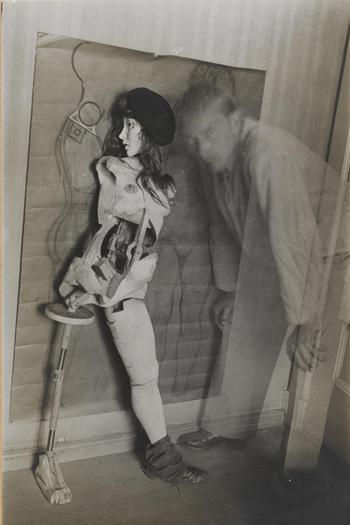
This doll, which seems to double Martha, just as the all-male automannequins double the male characters, is less in line with the sleek female robots of Metropolis than with the contemporary dolls of Berlin artist Hans Bellmer.Footnote 78
Bellmer's uncanny figures revealed the latent violence of surface culture, to which contemporaries often turned a blind eye. Images of Bellmer's dolls, produced partly as a retrospective protest against Weimar mass surface culture, were first exhibited in a private publication in 1934, before famously being adopted and promoted by the Paris Surrealists in their journal Minotaure.Footnote 79 In the image included here, part of the two-page spread in Minotaure entitled Poupée, Bellmer himself appears as a ghostly presence. (See Figure 2). This creator's relationship with his mannequin, their gazes divergent, contrasts with that of Karl Schenker, whose eyes are fixed upon the lips he is painting, posed within an almost symmetrical composition. Bellmer's doll, photographed in various stages of construction and states of disarray, is constructed to resist the impenetrable, maximally-flawless surfaces of a commercial mannequin. Instead, the creator has exposed the interior.
Hans Bellmer (1902-1975) © Artists Rights Society. Self-Portrait with Doll, 1934. Digital Image © 2018 Museum Associates / Los Angeles County Museum of Art. Licensed by Art Resource, NY.

Perhaps the most extraordinary feature of Bellmer's doll is an embedded optical device, present only in the earliest stages of its construction. In the picture reproduced here, one can perceive a mechanism, at once clunky and elaborate, inside the exposed abdomen of the doll. It is a viewing machine, fashioned to be “deliberately archaic, like a ‘primitive’ cinematic machine,” through the lens of which is visible “a succession of six tiny dioramas.”Footnote 80 Rivaling Nabokov's crime museum object, Bellmer's doll had a functional left nipple, which, when manipulated, set into motion a mechanism that displayed the images sequentially. Bellmer's introductory essay to the original German book edition claims that the purpose is to “lay bare suppressed girlish thoughts, so that the ground on which they stand is revealed . . . visible as colorful panorama electrically illuminated deep in the stomach.”Footnote 81 The Minotaure display, which removes the essay but adds the subtitle “Variations on the Assemblage of an Articulated Minor,” recalls the prevalent Weimar theme of sexual murder of women and children, from Otto Dix and George Grosz to Fritz Lang's M. Footnote 82
It is all the more remarkable that Nabokov, from the position of a partial outsider, perceived the same latent violence as early as 1928. In Korol΄, dama, valet, Nabokov conjures with Weimar surfaces in a way enticing enough to attract a German readership—as Arthur Luther had pointed out—but in a way distanced enough to signal to Russian readers his perception of the darkness and inherent instability in the depths of this new culture. Nabokov charts a course between Karl Schenker's commercial surface culture and Bellmer's proto-Surrealist undermining, or rather disemboweling, of that culture, creating a panorama of its interior. Furthermore, Nabokov portrayed commercial display's dubious animation of the inanimate, without himself perpetuating it. He manages to avoid direct implication in the darker criminality unearthed by his own novel. In part this is made possible by a careful separation of the human artist from his creations.
The Man in the Machine
The separation of inventor and object is seen in the novel's final mechanical curio, which symbolizes the dominance of a human creator over (or within) the artificial facets of surface culture. This curio, the Turk, has received little commentary, and is only found in the Russian original: “Dreyer interrupted [the American businessman] and began to tell him about an old-fashioned chess playing automaton which he had seen in a provincial museum. The chess player was dressed as a Turk.”Footnote 83 The chess-playing Turk was a post-Enlightenment wonder of mechanical ingenuity that was eventually revealed to house a human operator, despite its artificial exterior. This was a discovery made by Edgar Allan Poe, among others, who noted that its surfaces were deliberately less lifelike than contemporary waxworks (much like Bellmer's deliberately primitive mechanism).Footnote 84 The Turk's historical legacy was to give the human mind a mechanical extension. Although the strongest players of the day were able to defeat the machine, whose skill was of course dependent on its operator, the arm mechanism by which the operator made his moves on the board later contributed to the development of prosthetics, much in demand in the postwar years of the 1920s.Footnote 85
By including the Turk as the last in a series of human simulacra, Nabokov asserts the historical basis for the indomitable supremacy of the human inventor over his created simulations of humanity. The Turk, an antiquated mystification hundreds of years old, now languishing in “a provincial museum,” invites comparison with the machines of the 1920s. Despite their increased verisimilitude, they are still simulations, dependent on the control of an artist, or team of artists. In Korol΄, dama, valet the Turk is symbolic of the protagonist Kurt Dreyer's own relationship to the technological extension of his fertile fantasy. Whereas the Dandy shop window, with its “Fata Morgana of jackets and coats,” is the surface sign of his fancy, the real genius and motor of the commercial enterprise is located in Dreyer himself, deep within the heart of the store.Footnote 86
Doubtless one of the novel's most attractive elements for Berlin readers was Nabokov's subtle characterization of Kurt Dreyer. Particularly insightful, even in retrospect, is the distance—far greater in the Russian version—that separates the humanity of Kurt Dreyer from the potentially murderous mediocrity of Franz and Martha. Until the authorial cameo, Dreyer is the emotional and creative center of the novel, a stumbling block to any theories of the novel's critique of the mechanicity of modern man. Scholars have pointed to the historical rarity of such a sensitive literary portrayal of a rich businessman (travestied in the English version, where Dreyer is a buffoon).Footnote 87 The author-figure's exclusive focus on his attractive companion during his cameos (see below) indicates that, by analogy, Dreyer's most sympathetic trait is not his quixotic attempt at imbuing commerce with artistry, but his love for his wife (bilious toad though she may be).Footnote 88
In the English version, Dreyer's reaction to his wife's death is portrayed from Franz's perspective as hysterical and burdensome, a “demented stranger in a rumpled open shirt, with swollen eyes and a tawny-stubbled trembling jaw” importuning Franz with an awkward, wet-bristled embrace. In the Russian, however, the scene is utterly different: “In the darkness of the night, where he was looking, there was only one thing: a smile . . . what can you do, when a person's recent life is still reflected in all objects, on all faces. . . . ”Footnote 89 The scene is a sensitive play with darkness and light, the afterimages of the recently deceased, and the silent gestures of grief. This silence, Dreyer's questioning, and the presence of moths tie the scene into Nabokov's early fictional explorations of bereavement following the murder of his father in 1922.Footnote 90 In the Russian version, the contrast between Franz's maniacal laughter at the hoped-for demise of his lover, and Dreyer's devastation at his wife's death, is an ultimate reassertion of the dignity of the individual.
In fact, we could go so far as to say that in the original novel Dreyer is the only true Berliner, precisely through his refusal to conform to the Russian literary stereotypes of Germany.Footnote 91 Instead of Dreyer the Berliner, with his cosmopolitanism, multilingualism, and unpredictability, it is Franz the greasy provincial and Martha the ruined Hamburg merchant's daughter who are the true “Germans” scorned by Nabokov in his correspondence with Vera: “German speech makes me feel sick—you can't live only on the reflections of street lamps in the asphalt—apart from these reflections . . . there's also the squalid vileness, the coarse tiresomeness of Berlin, the aftertaste of rotten sausage, and the smug ugliness.”Footnote 92 Those features which make Dreyer's perspective so attractive—his lightness of touch, his fantasy, sharp-sightedness, his joyful approach to life—are those which Aikhenval΄d imputes so proudly to Nabokov. These are in turn the qualities that Nabokov attributes to Weimar Berlin and its surface culture. Accordingly, the faults that Dreyer has are also those of Berlin: living entirely for the present, joyfully if solipsistically conjuring with surfaces, possessing a “pointillist consciousness” and a dangerous love of risk-taking.Footnote 93
Dreyer's career unfolds within the specific historic and economic circumstances of Weimar Germany, to which Nabokov was a direct eyewitness and active participant. Dreyer's success, we are told, occurred in 1923, when he was enriched by the “ballast jettisoned from the balloons of inflation.”Footnote 94 The German social nadir of the 1923 Hyperinflation—part of the trigger for the exodus of Russians from Berlin to Paris—was paradoxically Dreyer's annus mirabilis. Dreyer can be seen as a product of the “inflationary culture” that came to define the Weimar intellectual and artistic temper even after the post-1923 economic recovery.Footnote 95 Nabokov intuits the momentum of this career, portraying its arc from 1923 up until 1928, and anticipating where that trajectory would lead:
As happens in the lives of many businessmen, [Dreyer] began to feel that spring that his affairs somehow or other were assuming a certain independent existence; that his money, in a state of constant fruitful gyration, was moving by momentum [inertsii], and moving rapidly; and that he seemed to be losing control over it, seemed unable to stop this great golden wheel at will. His enormous fortune, which he made in that year of fabulous successes—at the very moment when a light touch, luck, and imagination happened to be necessary—had now become too lively, too mobile. Always an optimist by nature, he hoped that this was only a temporary loss of control—and did not for an instant suppose that the gyration might gradually transform into a golden specter, or that when he stopped it, he would see that it had disappeared.Footnote 96
Written in 1928, this prophetic description of the following year's Wall Street Crash and attendant Great Depression could equally be applied to the Weimar political and artistic culture within which Dreyer's enterprise is embedded: born of an unexpected second chance after the humiliating military and economic collapses of 1918 and 1923, sustained by the golden specter of American investment, and ultimately evanescent once the top had stopped spinning.
Nabokov had an intuitive sense of the fatal instability of both the Weimar economy and its culture. The market for Russian books pitched to fellow-émigrés in Berlin and to Germans interested in foreign translations like Kurt Dreyer was soon to dwindle remarkably from 1929.Footnote 97 Rul΄ closed its doors in 1931, and when the German version König, Dame, Bube—Ein Spiel mit dem Schicksal (subtitle: “Playing with Fate”) appeared in 1930, it found a very different audience than Ullstein had anticipated in 1928. Barely reviewed, let alone read, the German translation sank without a trace.Footnote 98 In one important way, this is Nabokov's “goodbye to Berlin”: in 1927 he had already published his long poem “Universitetskaia poema” in the prestigious Parisian thick journal Sovremennye zapiski, preparing the ground for his next novel, Zashchita Luzhina (The Luzhin Defense), to be serialized in Sovremennye zapiski in 1929 and 1930, thereby reaching a far larger audience. In June 1929 he and Vera moved away from the center of Berlin to quieter Kolberg, an hour to the southeast. Although they continued to reside in Germany until 1937, Korol΄, dama, valet was the last novel Nabokov published exclusively in Berlin.Footnote 99
Ex Machina
The modern novel has always sensed an anxiety of influence with regard to industrial, commercial, and entertainment technologies, from the magic lantern and the railway to the popular cinema. The Turk represents a playful rejoinder to 1920s debates about the power of technology and the threat of “the machine” in postwar Europe. Nabokov's specific intervention into his own age's variant on these cultural debates is the re-assertion of the individual genius as the determinant of technology's output. In this sense, the Turk is a metonym of Nabokov's relation to his Berlin novel. Thus, this novel of attractions appears to be a temporary prosthesis—or, better, a proprietary shop window—extending and amplifying an independent artistic imagination for an audience of Russian and German Berliners at once entertained and reflected back to themselves.
In writing for both a German and a Russian audience, as Arthur Luther's review has shown, Nabokov was aware that his dual status as insider and outsider presented the danger of appearing complicit in the surface culture whose darkness he so ironically exposed. In addition to his inclusion of the Turk and sympathetic portrayal of Dreyer, Nabokov resorted to a final mechanism for establishing his own position more clearly for a select group of readers: a brief pair of authorial cameos toward the close of the novel. Together, these three elements serve to distance the author from his narrator's perspective, in a way that carefully calibrates the level of comprehension of this distance based on the reader's prior knowledge of Berlin and the author himself.
Nabokov's most insightful Berlin reader, Iulii Aikhenval΄d, articulated the danger of complicity inherent in the narrator's penetrating gaze. Despite Aikhenval΄d's praise for the novel's spectacular “multitude of bright spots and flashes, infinitesimals and nuances of observation, mosaic and microscopy of brilliant details,” he makes two related complaints. First, that the novel's gaze is overly harsh, and second, that there is an absence of true feeling between the main characters, whose lust does not become love.Footnote 100 Aikhenval΄d goes on to make the tongue-in-cheek request for less “sharp-sightedness” [zorkost΄] from Nabokov, an author whose power to expose threatens to become “a danger to society.”Footnote 101 The solution offered—for Nabokov to take on some of his character Franz's “near-sightedness” [blizorukost΄]—is poignant: Aikhenval΄d, famously myopic, was making his way home from a party at the Nabokovs’ Passauer Straße apartment two months after writing this review when he was struck by an unseen tram and killed.Footnote 102
Aikhenval΄d's criticisms knowingly draw attention to one of the most startling scenes in the novel, the authorial cameos. In the novel's final chapters, set at a Baltic resort, Nabokov and his wife Vera make two visits incognito: they are unnamed, while the characters see them only as a “foreign couple.” This scene actually compensates for the deficits Aikhenval΄d imputes to the novel, yet it is strikingly absent from Aikhenval΄d's account. When he gives a qualified endorsement of the novel's virtuoso exploration of surface culture near the close of his review, he is fully aware that the scenes that he refuses to give away in fact address those very qualifications—but in a way only insiders can pick up on.Footnote 103
Thus the uninitiated reader, such as, for example, a Russian émigré in Paris or a German reading in translation, will not identify the authorial cameo—and Aikhenval΄d does not give the game away. Nonetheless, their external appearance—even in the much more subtle Russian version, which neither calls Nabokov's surrogate “remarkably handsome,” nor gives him a “butterfly net”—is described in unmistakably identifying terms for the initiated:
[Franz's] gaze became entangled amid the legs of the dancers and attached itself desperately to a gleaming blue dress. It was a foreign woman in a blue dress and a tanned man in an old-fashioned dinner jacket. . . . The lady in blue had a delicately painted mouth, tender, as if near-sighted [budto blizorukie], eyes, and her fiancé or husband, with a high forehead and a receding hairline on his temples, was smiling at her, and against his tan his teeth seemed especially white.Footnote 104
The author-foreigner has eyes only for his companion, and they are clearly in love, whereas Franz and Martha are joined only by what Aikhenval΄d describes as an increasingly morbid lust, leading to Franz's desire for, and ultimate glee at, his lover's death.Footnote 105
A little later, as Martha lies ill with the pneumonia that will soon kill her, the couple reappears “in beach robes.” The author-surrogate, a “damned happy foreigner hurrying to the beach with his tanned, charming companion,” is said to pity Franz, “as if to say, here is a young man tricked and ensnared by an aging woman—beautiful, perhaps, but who nonetheless somehow resembled a large white toad.”Footnote 106 Vladimir's exclusive focus on Vera (to the detriment of the toad-like Martha) stands in contrast to Franz's restlessly wandering eyes. We should recall that these eyes have, in the form of style indirect libre, provided much of the leering narration that Aikhenval΄d objects to in his review.
The happy foreigner's “charming companion,” the character of Vera Nabokova, is described in terms thoroughly removed from the novel's gyrating circle of erotic commercial transactions. Instead of the provincial train station's magazine rack of “pearl-gray beauties” and the beacon-like streetwalkers who prime Franz's passion for Martha, Franz sees in her charm and gentleness, traits which do not enflame but soften him to sadness. It is crucial that in the Russian version Vera's eyes appear as if myopic: other than Franz, she is the only other character who has “near-sighted” (blizorukie) eyes. Aikhenval΄d approvingly cites Nabokov's introduction of the aphorism “nearsightedness is chaste” (blizorukost΄ tselomudrenna), implying that nearsightedness may be a cure for the novel's voyeuristic erotics of surface. We recall that it is only when Franz's spectacles—broken on his first day in Berlin—are repaired, and his sight restored, that he is able to resume his erotic engagement with the city.
Much as Franz's blue pinstripe suit, five seasons out of date, instantly gives him away to Dreyer as a provincial, Nabokov's clothes here emphatically mark him as anything other than a well-heeled Berliner. Dressed on his first appearance in an “old-fashioned dinner jacket” and on his second in a “beach robe,” he is both down-at-heel and at leisure. These outfits, so antithetical to the surface glamor of Weimar Berlin, distance him, already singularly unattracted to Martha, even further from the novel's male leads (we recall Franz's rapid superficial transformation in the opposite direction). Vera's charmingly nearsighted eyes represent the standpoint from which the Berlin burlesque is judged, and illuminate the novel's implicit valorization of closeness and companionship.Footnote 107 In that sense, the novel is an ironic essay on the benefits of nearsightedness.Footnote 108
Based on his extended proximity to central sites of Weimar surface culture like the Ka De We department store, Nabokov had written a novel exploring the twinned concepts of display and materiality. Korol΄, dama, valet appealed variously to Russian and German readers, functioning as a shop window in both the sense of frame and reflective surface. In Arthur Luther and Iulii Aikhenval΄d's terms, in its new engagement with Berlin and its erotics of surface, the novel both revealed to readers previously overlooked insights and reflected back to them their own self-perceptions. Nabokov's achievement in appealing to both sets of readers lies in the deftness with which he managed to present a sympathetic portrait of the creative intelligence at work in surface culture, while retaining a sufficiently ironic distance to enable him to expose the inherent instability of that culture. Nabokov's insight into the culture's instability was practical as well as theoretical: following this novel, the author withdrew from Weimar Berlin as a home, publishing center, and thematic focus.Footnote 109
As we have seen in Korol΄, dama, valet, the tone, dress, and mannerisms of the Nabokovs’ cameo appearances explain perfectly Nabokov's ambivalent insider-outsider view of Berlin. To Nabokov, Berlin in 1928 was an intermittently enticing spectacle produced by a dying culture's final flare-up, unstable as a Catherine wheel. In Korol΄, dama, valet Nabokov reclaimed the city of his exile by rendering its streets and stores and citizens part of his own plot design, orchestrated from a resort where, unperturbed and in charming company, he could envision spending his advance from the book, always at a safe distance from the metropolis. On this occasion the Nabokovs took the advance offered by Ullstein and paid off their debts; Vera tendered her resignation at work and the Nabokovs departed Berlin in early 1929 to hunt butterflies for four months in the Pyrénées-Orientales along the French border with Spain—a moment of cherished nearsightedness, demanding a quite different kind of visual acuity.Footnote 110