Introduction
Exposure to mass trauma has led to increasing concern about the well-being of children, families, and communities. While the impact of mass violence is well recognized, little is known about the ways in which children adapt to disasters and terrorism. Children's coping has been addressed theoretically and empirically,Reference Compas, Connor-Smith, Saltzman, Thomsen and Wadsworth 1 – Reference Losoya, Eisenberg and Fabes 3 but researchers have only recently begun to investigate coping within these contexts. 4
Coping is a complex process of cognitive, behavioral, and emotional responses to stress,Reference Compas, Connor-Smith, Saltzman, Thomsen and Wadsworth 1 and is important in shaping children's post-disaster adjustment. Disaster mental health interventions are typically strengths-based, and focus on the development of effective coping skills to foster resilience. Information about an individual child's existing coping repertoire and the manner in which the child approaches a novel stressful situation (e.g., disaster, terrorism) provides a basis on which to explore coping strategies that are more or less effective and to build new and/or additional strategies. Information gleaned from assessments of coping in larger groups of children can inform the development of prevention and intervention programs to demonstrate and instill effective coping strategies.
The purpose of this article is to examine the theoretical and practical issues in the assessment of coping among children affected by mass trauma. Specifically, issues relevant to measuring the coping styles and strategies of children are reviewed in the context of disasters and terrorism. An examination of two decades of literature highlighted several issues and recommendations to guide future examination of children's coping.
Coping in the Context of Mass Trauma
The World Health Organization defines a disaster as “a severe disruption, ecological and psychosocial, which greatly exceeds the coping capacity of the affected community.” 5 At the level of the individual, coping describes effortful responses to stress that are intended to reduce the perceived discrepancy between environmental (or internal) demands and personal resources.Reference Lazarus 6 More than 20 years of research in the area of mass trauma has provided evidence that many victims, especially children, may experience substantial event-related distress, difficulty coping, and impairmentReference Norris, Friedman, Watson, Byrne, Diaz and Kaniasty 7 , Reference Silverman and La Greca 8 that may extend into adulthood.Reference Bolton, O'Ryan, Udwin, Boyle and Yule 9 – Reference Yule, Bolton, Udwin, Boyle, O'Ryan and Nurrish 12
In a series of studies following Hurricane Andrew, La Greca and colleaguesReference La Greca, Silverman, Vernberg and Prinstein 13 and Vernberg and colleaguesReference Vernberg, LaGreca, Silverman and Prinstein 14 proposed a conceptual model containing several variables considered central to understanding children's disaster reactions. The model identified coping (along with disaster exposure, pre-existing child characteristics, and features of the post-disaster recovery environment) as a primary factor for consideration in predicting children's immediate and long-term disaster reactions.Reference La Greca, Silverman, Vernberg and Prinstein 13 Thus, two critical goals for disaster research and clinical endeavors are: (1) to identify how children cope with the devastating effects of disasters and terrorism; and (2) to develop prevention and intervention programs to enhance effective coping.
Obtaining information about children's coping in the aftermath of mass trauma is essential to achieve these goals. However, the post-disaster environment is chaotic, and presents numerous obstacles to the implementation of sound assessment methods. In addition to practical barriers, clinicians and researchers who seek to understand children's reactions to disasters may face other difficulties, including parents who tend to underestimate their children's distress and suffering.Reference Stoppelbein and Greening 15 Furthermore, the construct of coping has proven exceptionally difficult to define and measure in typical public health and clinical settings.Reference Compas and Epping 16 Understanding how children cope is essential for the prediction and prevention of adverse disaster outcomes, and is important for enhancing their recovery and the development of interventions.
This examination of the coping literature revealed several reviews.Reference Compas, Connor-Smith, Saltzman, Thomsen and Wadsworth 1 , 4 , Reference Knapp, Stark, Kurkjian and Spirito 17 – Reference Saylor and Deroma 20 These reviews, while mostly research-oriented rather than clinically-focused, have identified developmental and contextual issues relevant to the assessment of children's coping with mass trauma that are crucial in guiding response and recovery efforts for children in the aftermath of an incident. Their recommendations for improving empirical assessments of coping are helpful for guiding future investigations of children's coping in the context of mass trauma. First, reviewers advocated for coping methods and measures traditionally used with adults to be modified for children. Additionally, they recommended that certain domains be addressed in measures of children's coping, including: (1) child-appropriate language;Reference Knapp, Stark, Kurkjian and Spirito 17 (2) child-specific stressors (often less amenable to change by children themselves than are adults’ stressors);Reference Ryan-Wenger 18 (3) developmentally-informed measurement of children's cognitive appraisal process;Reference Compas, Connor-Smith, Saltzman, Thomsen and Wadsworth 1 , Reference Ryan-Wenger 18 , Reference Saylor and Deroma 20 (4) ratings of children's perceptions of the efficacy of their coping efforts;Reference Knapp, Stark, Kurkjian and Spirito 17 , Reference Oakland and Ostell 19 (5) context-specific and global assessments of functioning;Reference Knapp, Stark, Kurkjian and Spirito 17 and (6) both self- and informant-reports of coping.Reference Compas, Connor-Smith, Saltzman, Thomsen and Wadsworth 1 , Reference Saylor and Deroma 20 To advance the knowledge base about coping, the reviews emphasized the importance of developing and testing unifying theory for understanding the meaning children attach to their stressors; categorizing coping according to particular strategies; recognizing how coping relates to both positive and negative outcomes; and assisting children with recognizing, modifying, and expanding their coping repertoires to deal with current and future stressors.
Key Issues for Coping Assessment in the Disaster Context
In this review, theoretical and practical issues involved in assessing disaster coping are addressed, and information about the assessment of coping in children in the context of mass trauma is presented. An approach to assessing children's disaster coping that is guided by existing theory and empirical findings is proposed. The primary issues of importance in assessments of child disaster coping include: (1) defining coping dimensions and strategies; (2) addressing the role of cognitive appraisal; (3) evaluating coping efficacy and effectiveness; and (4) understanding the function of external resource support.
Coping Dimensions and Strategies
Various features of coping can be assessed, but most coping measures address styles and strategies. Coping styles involve individuals’ typical reactions across and within stressful situations, while strategies are the behaviors exhibited during a specific stressful episode.Reference Compas 21 Because data regarding coping with mass trauma are typically obtained after an event, coping strategies tend to comprise the variables assessed. Existing coping measures (e.g., self-reports, interviews) do not consistently incorporate all of the potential coping responses children might employ. When possible, clinicians and researchers should address the most commonly discussed and evaluated subtypes of coping responses in their assessments, including: problem solving, information seeking, cognitive restructuring, seeking understanding, catastrophizing, emotional release or ventilation, physical activities, acceptance, distraction, distancing, avoidance, self-criticism, blaming others, wishful thinking, humor, suppression, social withdrawal, resigned acceptance, denial, alcohol/drug use, seeking social support, seeking informational support, and use of religion.Reference Compas, Connor-Smith, Saltzman, Thomsen and Wadsworth 1
Discussed in more detail in a review of the child disaster coping literature, 4 coping responses are commonly classified according to dimensions of problem- and emotion-focused, primary and secondary control, and engagement and disengagement (which may also be referred to as approach and avoidance).Reference Compas, Connor-Smith, Saltzman, Thomsen and Wadsworth 1 A debate exists regarding whether coping responses or strategies should be considered as broad dimensions or specific categories, and which dimensions or strategies best characterize the underlying variability in coping.Reference Compas, Connor-Smith, Saltzman, Thomsen and Wadsworth 1 Measures of coping include categories or types of coping responses often grouped to reflect the broader underlying dimensions of coping through conceptual analysis, factor analysis, or both.Reference Compas, Connor-Smith, Saltzman, Thomsen and Wadsworth 1 Clinicians and researchers benefit from understanding the broader components of the coping process, as well as from asking children specific questions about what behaviors, thinking patterns, and/or emotions they use in response to general and specific stress.
The Role of Cognitive Appraisal
Cognitive appraisal is an essential component of the coping process, and represents a key variable to consider when assessing child disaster mental health. According to Lazarus and Folkman,Reference Lazarus 22 cognitive appraisal is a two-step process in which individuals first evaluate the level of threat created by a stressful event. When a situation is appraised as stressful, individuals evaluate the opportunity for potential growth as well as the potential for harm, loss, and threat as they subsequently determine a course of action for coping with the situation.Reference Lazarus 22 Some assessment techniques (e.g., open-ended questions, interviews) may provide rich information about children's appraisal process. However, as argued by Schwarzer and Schwarzer in their review of coping instruments, it is impractical to attempt to distinguish stress appraisal from the process of coping.Reference Schwarzer and Schwarzer 23
Some researchers have explicitly or implicitly identified “controllability” as another factor (in lieu of harm, loss, threat, and potential for growth) in the appraisal process, and have incorporated it into their assessments of appraisal and coping. For example, Zeidner included one item regarding Israeli adolescents’ perceived control over the Persian Gulf War as an indication of cognitive appraisal.Reference Zeidner 24 In a study of child victims of residential fires, Jones and Ollendick considered children's self-reported fear at the time of the fire to reflect primary appraisal, and their level of perceived control over the fire served as a measure of secondary appraisal.Reference Jones and Ollendick 25 By and large, however, perceived threat to one's own life and the level of fear experienced at the time of the incident are assessed as indications of the cognitive appraisal process. It is essential to understand the impact of fear and sense of controllability over the traumatic incident in children's appraisal processes, as both are likely to affect the coping strategies used and the extent to which they are effective.
Several disaster studies have included assessments of cognitive appraisal. For example, Lengua and colleagues directly assessed general, “dispositional” threat appraisal (from previous-year life stressors) and September 11, 2011-specific, “situational” appraisal.Reference Lengua, Long and Meltzoff 26 Children who tended to perceive threat from prior stressors were more likely to perceive threat from the September 11 attacks, and situational appraisal (and coping) mediated the relationship between dispositional threat and post-traumatic stress. Other studies have included some measure of degree of fear or threat, but do not directly analyze it as a contributing factor to outcomes. 27 – Reference Weisenberg, Schwarzwald, Waysman, Solomon and Klingman 29 Braun-Lewensohn and colleagues demonstrated that their “Subjective Exposure Index,” which includes items related to feelings of danger for self, family, and friends, was moderately related to coping, and was the variable most predictive of post-traumatic stress symptoms.Reference Braun-Lewensohn, Celestin-Westreich, Celestin, Verte and Ponjaert-Kristoffersen 30
Similar findings have been identified in studies with adolescents and their parents following the September 11 attacks,Reference Gil-Rivas, Silver, Holman, McIntosh and Poulin 31 victims of a tornado,Reference Lack and Sullivan 32 children exposed to a hurricane,Reference La Greca, Silverman, Vernberg and Prinstein 13 , Reference Vernberg, LaGreca, Silverman and Prinstein 14 adolescent victims of a shipping disaster,Reference Udwin, Boyle, Yule, Bolton and O'Ryan 33 and children involved in motor vehicle accidents.Reference Stallard and Smith 34 Appraisal may play a stronger role in the maintenance of distress than either exposure or coping itself.Reference Lack and Sullivan 32 In the context of mass trauma, asking children about the cognitive processes that occurred in response to the stressor is crucial for identifying how coping relates to positive and negative disaster outcomes, and for assisting children with modifying and expanding their coping repertoire in preparation for future events.
Several challenges exist in assessing cognitive appraisal, including a lack of consensus regarding the definition and appropriate assessment of appraisal. For example, in their 1996 study of child hurricane victims, Vernberg and colleagues identified exposure as the most important variable for predicting post-traumatic stress disorder (PTSD);Reference Vernberg, LaGreca, Silverman and Prinstein 14 however, perceived life threat was a component of this measure along with actual loss and life disruption experiences. The exposure factor accounted for a significant portion (35%) of the variance in PTSD at follow-up, but it is unclear which aspects of the exposure construct (i.e., cognitive appraisal of threat or actual loss and disruption experiences) may have more predictive utility for child disaster victims. Additional research is needed to clarify the long-term implications of disaster-related appraisals. In a study of a shipping disaster, Udwin and colleagues found that at five to eight years post-disaster, adolescents’ disaster-related appraisals were no longer associated with PTSD.Reference Udwin, Boyle, Yule, Bolton and O'Ryan 33 The meaning children make of stressors is an extension of their initial reactions to the incident, and likely changes over time; this meaning-making process represents a key issue to be addressed in interventions.
Coping Self-Efficacy and Effectiveness
Coping self-efficacy refers to one's perception of his or her capacity to effectively manage a similarly stressful situation in the future. According to Bandura, individuals’ beliefs in their abilities to cope influence the level of stress experienced when they are faced with threatening situations. 35 Individuals who believe they can manage extremely stressful situations, including controlling disturbing thoughts, are more likely to experience less arousal in response to the stressor, envision more successful scenarios, and engage in fewer avoidant strategies and more approach strategies. Moreover, perceptions of one's ability to manage stress have significant implications for appraisals, coping, and reactions to future stressful situations. 35 Unfortunately, clinicians and researchers often overlook this important element of children's coping process. In the post-disaster context, children's coping self-efficacy should be assessed, and then targeted for enhancement through intervention and prevention programming.
Coping effectiveness refers to one's perception of the degree to which coping strategies used reduced distress related to a particular stressor. Coping effectiveness can be assessed by asking children to rate their own perceptions of the effectiveness of coping strategies employed, as illustrated by Jeney-Gammon and colleagues, who obtained ratings of coping strategy effectiveness from children geographically exposed to Hurricane Hugo.Reference Jeney-Gamon, Daugherty, Finch, Belter and Foster 36 Alternatively, the effectiveness of certain coping strategies can be determined through their associations with various outcomes. For example, Terranova and colleagues combined strategies thought to represent “negative coping” and used them to predict post-traumatic stress symptoms among children and adolescents post Hurricane Katrina.Reference Terranova, Boxer and Morris 37 Specifically, behavioral venting of negative emotions, fighting back when bullied, emotional withdrawal, and behavioral avoidance of stressor-related situations and persons contributed to higher post-traumatic stress symptoms eight months after the hurricane. Of the disaster studies reviewed, only four included measures of coping effectiveness,Reference Jones and Ollendick 25 , Reference Lack and Sullivan 32 , Reference Jeney-Gamon, Daugherty, Finch, Belter and Foster 36 , Reference Barath 38 and only one analyzed the relationships between coping effectiveness ratings and other study variables.Reference Jeney-Gamon, Daugherty, Finch, Belter and Foster 36
Importantly, Compas and colleagues warned against interpretations of coping effectiveness because of the potential bidirectional relationship between coping and distress or maladjustment, noting that it is “equally plausible” that coping efforts lead to reduced distress, and distress leads to use of certain coping responses.Reference Compas, Connor-Smith, Saltzman, Thomsen and Wadsworth 1 Overall, however, they identified problem-focused and engagement coping strategies as those strategies typically associated with better outcomes. In general, researchers consider avoidance,Reference Pina, Villalta, Ortiz, Gottschall, Costa and Weems 28 self-criticism, and blaming othersReference La Greca, Silverman, Vernberg and Prinstein 13 , Reference Russoniello, Skalko, O'Brien, McGhee, Bingham-Alexander and Beatley 39 to have negative implications for children, and these strategies have been shown to be associated with post-traumatic distress.Reference Lack and Sullivan 32 Such strategies may represent emotion-focused and disengagement coping, which Compas and colleagues have concluded are coping dimensions associated with poor adjustment.Reference Compas, Connor-Smith, Saltzman, Thomsen and Wadsworth 1 Distraction, seeking social support, wishful thinking, cognitive restructuring, and resignation or acceptance constitute potentially beneficial coping responses.Reference Gil-Rivas, Silver, Holman, McIntosh and Poulin 31 , Reference Lack and Sullivan 32 , Reference Jeney-Gamon, Daugherty, Finch, Belter and Foster 36 , Reference Russoniello, Skalko, O'Brien, McGhee, Bingham-Alexander and Beatley 39 Compas and colleagues cited problem-focused and engagement coping styles as associated with better adjustment.Reference Compas, Connor-Smith, Saltzman, Thomsen and Wadsworth 1 Given these known relationships with positive outcomes, clinicians should incorporate these strategies into their assessments and interventions with children following mass trauma events.
Extending from these theoretical conceptualizations, some researchers have simply assigned qualifiers of “positive” and “negative” to various coping strategies in assessment tools, and thus consider some children to have “positive” or “negative” coping styles.Reference Silverman and La Greca 8 Despite documented relationships between coping strategies and maladaptive outcomes, alternative terms that are less pejorative allow for unbiased analyses of the harm or benefit of various coping strategies. Furthermore, the dearth of controlled studies containing unbiased examinations of the effectiveness of coping strategies underscores the importance of carefully assessing the relative value of each coping strategy as it pertains to each child in the post-disaster context. Oakland and Ostell cited the omission of coping effectiveness ratings as one explanation of inconsistent, contradictory results in the coping literature.Reference Oakland and Ostell 19 Perhaps representing an additional step involved in the cognitive appraisal process, evaluating the success of one's coping efforts provides an opportunity to reappraise the situation and seek out new resources or implement new or additional coping strategies.Reference Lazarus 22
External Resource Support
Following a mass trauma event, children seek support from external sources, including parents, teachers, professionals, siblings, classmates, and friends. In terms of measurable effectiveness, social support may serve a protective role against the development of psychopathology following disaster exposure. According to Schwarzer and Schwarzer, social support is a multidimensional concept, the relation of which to coping is so complex that some researchers have advocated for a distinction between “social” and “nonsocial” coping strategies.Reference Schwarzer and Schwarzer 23
Many studies with child disaster victims have incorporated separate measures of social support (received and/or perceived), and overall results indicate that social support is associated with lower levels of distress and impairment (e.g., La Greca et alReference La Greca, Silverman, Vernberg and Prinstein 13 and Dekovic et alReference Dekovic, Koning, Stams and Buist 40 ). Clinicians and researchers can assess children's social support according to source, type, and availability. Importantly, however, the specific type of support children receive may not be as important as their perceptions (or appraisals) of the amount and quality of support provided.
Results of the disaster studies reviewed indicate relationships between social support and specific types of coping, including a positive correlation with competency beliefsReference Cryder, Kilmer, Tedeschi and Calhoun 41 and a negative correlation with blame and anger coping.Reference Vernberg, LaGreca, Silverman and Prinstein 14 The source of children's support may have particular associations with coping and specific outcomes. For example, Pina and colleagues identified the importance of social support networks, reporting that greater perceived familial social support was associated with the use of fewer active and avoidant coping strategies.Reference Pina, Villalta, Ortiz, Gottschall, Costa and Weems 28 In addition, extra-familial support was associated with decreased post-traumatic stress reactions, and professional support was associated with increased post-traumatic stress. These results correspond with those from a study by Vernberg and colleagues, which found extra-familial support (specifically from teachers and classmates) was associated with fewer PTSD symptoms.Reference Vernberg, LaGreca, Silverman and Prinstein 14
The provision of social support and advice may stimulate other coping responses.Reference Oakland and Ostell 19 Clinicians and researchers are encouraged to incorporate items that assess children's seeking of social support from various sources as well as their appraisals of its adequacy. Certainly, children's perceptions of received support affect their appraisal processes and coping efforts, and their post-disaster adjustment is likely to be affected by the abilities of support providers to impart effective support. The nature of the relationship between caregivers’ disaster reactions, their abilities to provide support, and the subsequent effect on children's coping has yet to be fully explored.
Approaches to Assessing Coping
Children's coping, whether in terms of their general coping style or the specific coping strategies used in response to a mass trauma event, involves a multifaceted process of cognition, emotion, and behavior. As a result of its complexity, clinicians and researchers have developed a wide range of approaches to assessing coping, rooted in a diverse array of theories about how children cope with stressors. Children's coping in response to mass trauma is an area of relatively recent focus, and further work is needed to build consensus in the terminology, theory, methods, and techniques involved in coping assessment in this context. This review of both the coping literature and the existing body of knowledge about children's disaster reactions provides some general guidelines for assessing children's coping in the context of mass trauma.
Questionnaires
Questionnaires are the most widely-used assessment tool employed in child disaster research. Typically administered in a self-report, closed-question format, questionnaires offer a relatively efficient means for collecting information about children's coping strategies. Coping questionnaires typically are comprised of items regarding children's general coping style and/or items more specifically related to an identified stressful situation or incident. In the child disaster literature, researchers usually administer measures of general coping style, although they may also modify items to address a specific disaster. Most often, children respond to questions or checklist items by indicating retrospectively whether they used particular coping strategies in the context of the specific stressor. The extent to which a child used each coping strategy is measured with a frequency rating scale.
Advantages
—Compared with other more labor-intensive approaches (e.g., interviews), questionnaires are logistically simpler for data collection in the post-disaster context. Questionnaires provide an efficient way to assess children, and can be administered to their parents, teachers, siblings, and peers as well. Flexibility exists in the administration of questionnaire items as they can be given orally or in written (including electronic) format, and through individual or group delivery.
Disadvantages
—As in other areas of psychological assessment, response biases affect the validity of self-report data collection approaches. Children may report socially desirable or even defensive responses, undermining the credibility of their answers to questionnaire items. Additionally, the accuracy of information obtained from young children may be questionable, as they may lack the conceptual and verbal skills to participate meaningfully. Questionnaires are not usually culturally sensitive, and their appropriateness for use in cross-cultural settings should be evaluated through extensive pilot testing and development. Finally, when obtaining information from large samples, questionnaires that produce quantitative data may be preferable. However, the depth of information is often exchanged for breadth, creating limitations in what can be learned.
Interviews
Interviews are important tools that serve a different function than questionnaires in assessing psychological constructs such as coping. Because of the virtually immeasurable coping responses used by children in response to stressful situations, interviews allow children to describe, typically through narrative responses to open-ended inquiries, their personal experiences with the event. Clinicians and researchers are able to glean information about children's appraisal processes and specific coping strategies used, as well as accounts of the external resource support they may have received from important others.
Advantages
—In contrast to questionnaires, interviews have the capacity to elicit rich and detailed reports of children's coping processes, beginning with their thoughts and feelings at the moment the stressor was first recognized, and extending through the months and years of their recovery. Through a series of open-ended questions, children can be asked to explore the degree to which they experienced a sense of threat and/or danger to themselves and important others; to express their fear; to describe the various ways in which they responded to the disaster experience; and to evaluate the extent to which their coping efforts were beneficial. Similarly, parents can provide additional qualitative information about their own and their children's disaster coping, which enhances the depth of information obtained.
Disadvantages
—Interviews are time-consuming to conduct, and thus not efficient for use in the post-disaster context. Additionally, training is required for the administration of interviews and examination of responses necessitating additional time and cost. Even if questions are standardized, children's responses are likely to be quite varied, requiring extensive time to understand and categorize them. Finally, in contrast to questionnaires, interviews exchange depth of information for the breadth of topics they are able to assess.
Collateral Sources
The use of multiple informants as collateral sources of information, such as parents, teachers, and other professionals, allows for the most comprehensive appraisal of children's reactions and functioning. When possible, both subjective (from the children themselves) and objective (from collateral sources) information should be gathered in regards to the coping strategies the children used. While they may be difficult to access, siblings and other family members, classmates, and friends may provide unique perspectives of a child's situation.Reference Pfefferbaum and North 42 While practical difficulties in accessing children and those who can provide information about them typically drive decisions about who should serve as respondents, parental reports should accompany those of their children whenever possible.Reference Balaban 43 For example, parents of children in the World Trade Center during the 1993 bombing reported a decrease in their children's post-traumatic stress and incident-related fears at nine months, but their children reported no decrease.Reference Koplewicz, Vogel, Solanto, Morrissey, Alonso, Abikoff, Gallagher and Novick 44 Parents tend to be better at reporting externalizing symptoms while children may provide more accurate information regarding internalizing symptoms.Reference McClellan and Werry 45
Recommendations
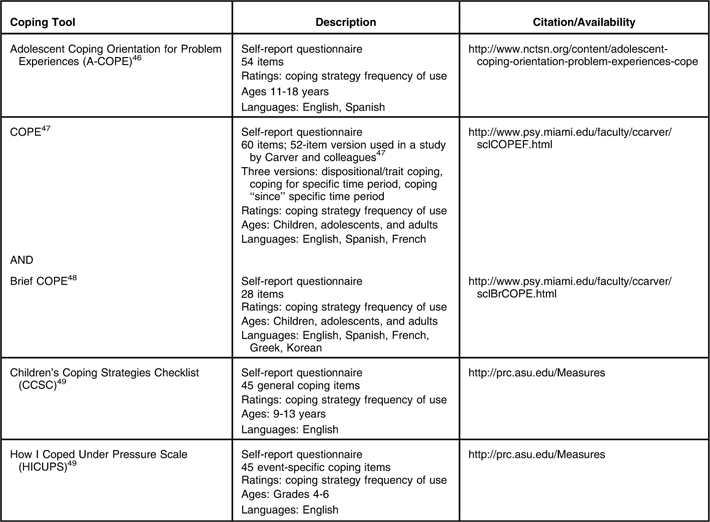
Despite some recent focus on coping in the context of disasters, a number of gaps persist that have yet to be addressed in the child disaster literature, and should be considered in the practice of child disaster mental health. An overview of components to include in assessments of children's disaster coping provides some general guidelines for the application of clinical and research work within this specialized context. Coping instruments that have been used commonly in child mass trauma studies are shown in Table 1.
Coping measures frequently used in mass trauma studies

Coping Domains
Clinicians and researchers should attempt to incorporate the most commonly discussed and evaluated subtypes of coping responses in their assessments. Ideally, questions should be designed to reflect the primary theoretical domains of coping including, for example, problem- and emotion-focused, primary and secondary control, and engagement (approach) and disengagement (avoidance). As Knapp and colleagues suggested, however, children should be asked to report all coping strategies they considered, not just those they ultimately employed.Reference Knapp, Stark, Kurkjian and Spirito 17
Cognitive Appraisal Process
The appraisal process is the first step in children's coping response to the stress of mass trauma. As children determine the potential degree of threat, harm, or loss caused by a situation, they begin to respond with cognitive, emotional, and behavioral coping strategies. The stress appraisal process is critical in determining the specific type and effectiveness of coping strategies employed. Open-ended approaches can be used to glean complex and detailed information related to children's appraisal processes and use of coping strategies (that would otherwise be missed by a standardized measure), and serve to advance knowledge of children's disaster coping. Information related to the “meaning” children attach to the stressor is likely to have implications for their initial and long-term adjustment in response to the disaster. To assess children's appraisal process, disaster coping assessments should include questions related to:
-
• What the child recalls about the experience of first learning of the event, including specific thoughts, feelings, and behavioral reactions;
-
• The child's exposure to disaster-related injuries, deaths, horror/terror, losses, and inconveniences, including displacement from home and separation from loved ones and friends;
-
• The degree of fear, threat of harm and danger to self or others, and level of controllability experienced immediately after the child learned of the event and the hours, days, and weeks following;
-
• Strategies that were helpful in dealing with the initial negative impact of the event;
-
• Strategies that were ineffective in dealing with negative reactions to the event; and
-
• Persistent reactions to the event, including relevant symptoms and their impact on the child's functioning.
Perceived Coping Efficacy
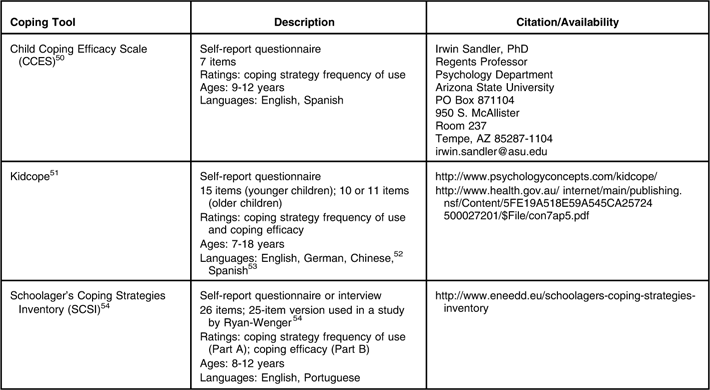
The appraisal process and its effect on disaster-related outcomes are affected by the child's perceptions of his or her ability to manage stress. This is an area for further exploration throughout the interview process. Clinicians should ask children to rate their abilities to manage extremely stressful situations in general, as well as those specifically related to the incident. Instruments designed to assess coping efficacy are shown in Table 2.
Measures with ratings of coping efficacy

Sources of Information
The breadth and depth of information about children's disaster coping can be maximized through the use of multiple sources of information. Whenever possible, both quantitative and qualitative information should be collected to provide a more complete and in-depth portrayal of children's disaster coping processes. Both parents and children should participate in the assessment. While children may provide details about their experiences, perceptions, and reactions, parents provide information about the child's history, experiences, and observable coping behaviors.
Additionally, information should be collected from others in the family or outside the family, as they may have insights and/or observations to share about the child in the context of the entire family, familial subunits, and/or extra-familial situations and settings. These outside sources offer opportunities to enhance the appreciation of the people, structures, and dynamics influencing the child's coping.
External Resource Support
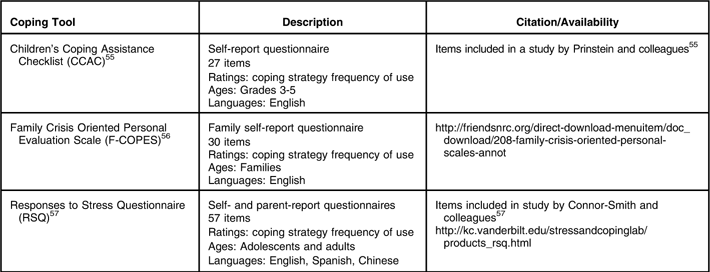
Finally, external resource support is vitally important to children who are dependent on others to care for them. Open-ended questions regarding the presence of parents, teachers, and other key adults or children in the aftermath of a disaster provide a foundation from which further inquiries can address issues related to the type of support provided, as well as children's perceptions of the amount and quality of the support provided. Instruments designed to assess external resource support are shown in Table 3.
Measures with ratings of external resource support

Conclusion
This article provides an overview of theoretical and practical issues relevant for assessing coping in children exposed to mass trauma. While empirical knowledge about the impact of disasters on children has grown significantly, the understanding of children's coping within this context remains underdeveloped. Coping has yet to emerge as a unified psychological construct, particularly across diverse settings, samples, and time periods associated with disasters. Significant progress must be made in creating and utilizing appropriate measures for children that incorporate assessments of context-specific coping, subjective appraisals of stressors and one's own coping efficacy, self- and multiple-informant reports, external support, and associations with other stress responses. Advancements in understanding disaster coping and these important related variables will require the use and evaluation of both quantitative and qualitative measures that seek to enhance our understanding of the complex stress appraisal and coping response of children.
Continued efforts in this field will contribute to a more comprehensive appreciation of children's cognitive, behavioral, and emotional responses to the effects of mass trauma. Further understanding of the process by which children evaluate stressful events, use and modify their repertoire of coping strategies, rely on support from others, and make meaning of their experiences is needed to enhance the development and delivery of interventions for children coping with the potentially life-altering effects of mass trauma.
Abbreviations
- PTSD:
-
post-traumatic stress disorder