

Introduction
The Great Bustard Otis tarda has garnered significant attention from researchers due to its unique biological characteristics and endangered status (Alonso and Palacín Reference Alonso and Palacín2022; Liu et al. Reference Liu, Li, Kessler, Flatz, Meng and Wei2022). As the largest extant flying terrestrial bird by weight, the Great Bustard exhibits pronounced sexual dimorphism, with adult males reaching up to 2.4 times the body weight of females (Palacín et al. Reference Palacín, Alonso, Alonso, Martín, Magaña and Martin2009). The species is divided into two subspecies: the nominate subspecies O. t. tarda and the Eastern subspecies O. t. dybowskii, which show significant differences in their geographical distribution. The eastern subspecies has a relatively restricted range, with breeding grounds primarily concentrated in Mongolia, Russia, and northeastern China, while its wintering sites are mainly found in the Northeast Plain, North China Plain, and Hanzhong Plain of China (Kessler et al. Reference Kessler, Batbayar, Natsagdorj, Batsuur’ and Smith2013; Lu et al. Reference Lu, Zhai, Meng, Kou, Li and Liu2021; Wang et al. Reference Wang, Purev-Ochir, Gungaa, Erdenechimeg, Terbish and Khurelbaatar2022). Given its significant ecological value, the Great Bustard is classified as a first-class nationally protected wild animal in China. In 2023, the International Union for Conservation of Nature (IUCN) designated it as an Endangered (EN) species, highlighting the urgency of its conservation (BirdLife International 2023).
Animals can respond directly to cyclical changes in the environment, and understanding the behavioural rhythms of threatened species is important for comprehending their physiological habits and ecological requirements (Häfker and Tessmar-Raible Reference Häfker and Tessmar-Raible2020). Studies have shown that wintering ducks and geese aggregate into large groups, with feeding and resting being the primary behavioural patterns. Individuals have a low vigilance budget, and a high resting budget is advantageous for energy conservation in winter (Hamdi et al. Reference Hamdi, Charfi and Moali2008; Wang et al. Reference Wang, Yang and Zhou2021). In contrast, wintering cranes typically move in family units, with adult cranes spending more time feeding and being vigilant (Ma et al. Reference Ma, Wang and Tang1999; Zhou et al. Reference Zhou, Zhou, Chen, Cheng and Xu2010). In winter, Great Bustards live in groups and share similar dietary preferences with cranes, with open farmlands being their main habitat (Li et al. Reference Li, Liu, Gong, Zheng, Zhang and Li2021; Lu et al. Reference Lu, Li, Wang, Wang, Meng and Liu2022). Obtaining effective behavioural data in open environments is challenging. Current research on the diurnal behavioural rhythms of the Great Bustard is limited and needs improvement (Sun et al. Reference Sun, Li, Li, Wu and Li2006; Wu and Xu Reference Wu and Xu2017), and data obtained through manual instantaneous scanning methods are often affected by observer bias.
In China, farmlands are typically excluded from protected areas and are subject to severe human disturbance (Li et al. Reference Li, Hu, Huang, Bürgi, Zhu and Zhong2020). In recent years, the increase in the area of winter fallow land, the development of rail transport, the expansion of facility agriculture, and the use of toxic baits have posed serious threats to the wintering population of the Great Bustard (López-Jamar et al. Reference López-Jamar, Casas, Díaz and Morales2011; Lu et al. Reference Lu, Guo, Meng, Meng and Liu2024). Cangzhou, located in the northeastern part of the North China Plain (37°29′38°57′ N, 115°42′–117°50′ E), experiences a temperate monsoon climate with pronounced seasonal variation. Winter is characterised by cold and dry conditions, with January identified as the coldest month (Li et al. Reference Li, Zhang, Han, Wang, Chen and Zhang2014; Xu et al. Reference Xu, Zhou, Gong, Chen and Wang2023). The region’s terrain is flat and extensively cultivated, typically employing a dual cropping system of winter wheat and summer corn, and it serves as an important wintering and stopover site for the Great Bustard (Mi et al. Reference Mi, Huettmann, Sun and Guo2017). Great Bustards are observed in the area from October, with their presence diminishing by April (Wang et al. Reference Wang, Purev-Ochir, Gungaa, Erdenechimeg, Terbish and Khurelbaatar2022). Survey records indicate that the Great Bustard population in Cangzhou is estimated at 300 individuals, accounting for approximately 18% of the overwintering Great Bustard population in China (Lu et al. Reference Lu, Wang, Jia, Meng and Wu2025; Mi et al. Reference Mi, Huettmann, Sun and Guo2017). To protect this Endangered species, this study monitored the distribution of wintering Great Bustards in the Cangzhou area through field surveys. The aim was to understand the types of their wintering habitats and their daytime behavioural patterns, providing a scientific basis for implementing necessary human interventions and management measures.
Methods
Species occurrence records
The study area was divided into 10 × 10 km grid cells, and vehicle-based line transects were conducted along agricultural roads at speeds ranging from 20 to 40 kilometres per hour. Each survey team comprised at least three individuals (a driver and two observers/recorders). The surveys were carried out from December to February during the years 2019 to 2022, with 2–3 days of fieldwork per month, covering an area of approximately 7,100 km². A total of 205 activity records for the Great Bustard were collected through repeated field investigations. Long-term observations indicated a pronounced habitat dependency during the winter months within the study area, with the birds repeatedly utilising a limited number of core overwintering habitats. Each of these habitats comprises numerous adjacent smallholder farms. Within these regions, the positions of the flocks exhibit temporal variability on both daily and annual scales. The land-cover types associated with these occurrence locations have been categorised into three distinct classes: corn stubble, winter wheat fields, or fallow land (Figure 1). The proportional representation of each land-cover type across the entire exploitable area has not been quantified; consequently, the analysis is confined to assessing habitat utilisation rather than selection.
The wintering habitat locations and habitat cover types of the Great Bustard in Cangzhou, A: maize stubble field, and B: the winter wheat field.
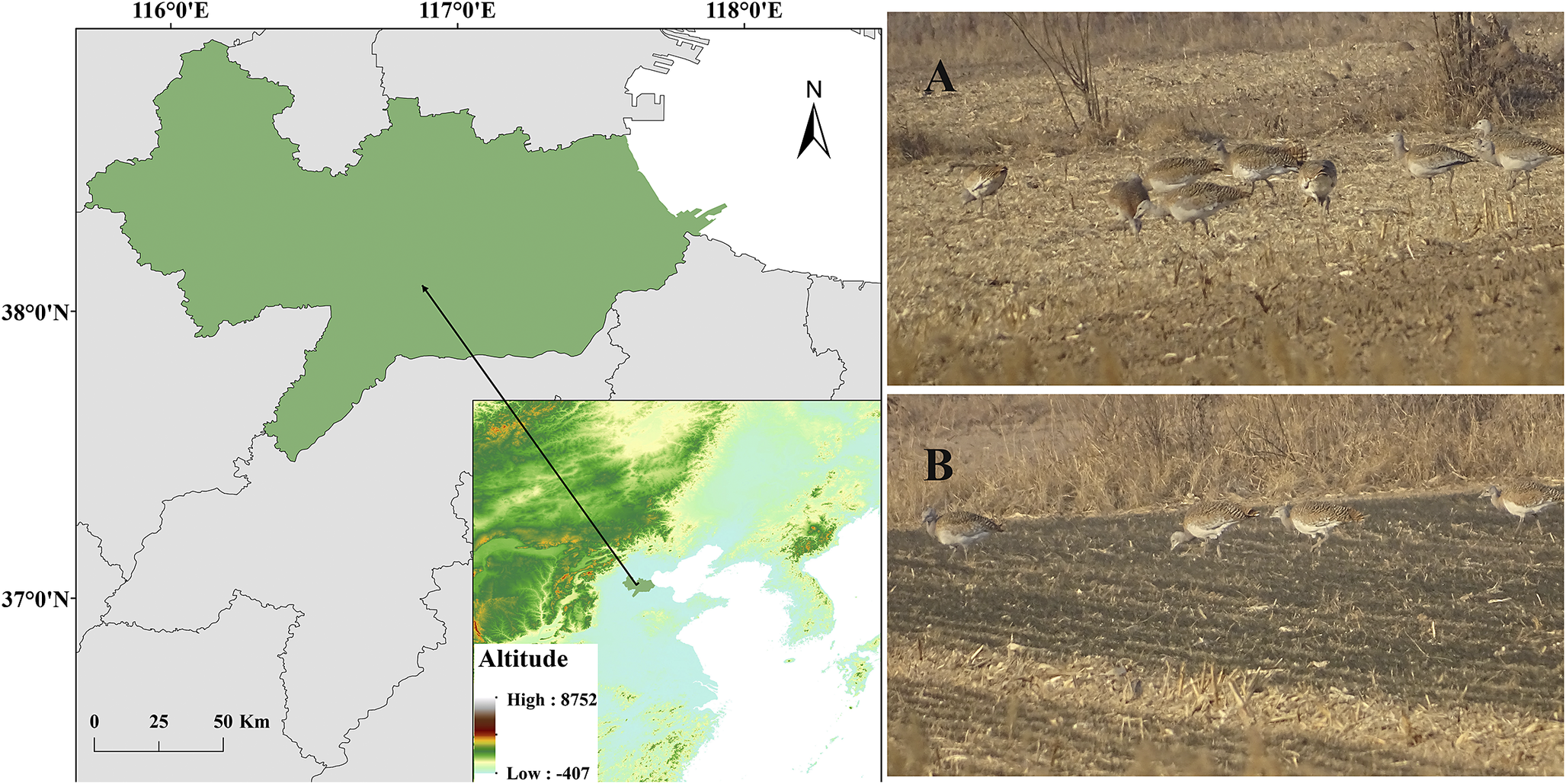
Figure 1. Long description
The figure is divided into a large left panel and two stacked right panels.
Left Panel: A geographical map of the Cangzhou region highlighted in green against a light gray background. The map includes a North arrow in the top right and a scale bar at the bottom left indicating 0, 25, and 50 K m. Latitude coordinates 37 degrees North and 38 degrees North are on the Y axis, and longitude coordinates 116 degrees East, 117 degrees East, and 118 degrees East are on the X axis. An inset map at the bottom right shows the broader regional context with an Altitude legend ranging from a High of 8752 in dark brown to a Low of minus 407 in light green. An arrow points from the specific green region in the inset to the larger map above.
Right Panel A: A photo showing a flock of Great Bustards foraging in a maize stubble field. The ground is covered in dry, light-colored crop residue.
Right Panel B: A photo showing Great Bustards in a winter wheat field. The field shows dark, tilled soil with sparse green growth appearing in rows.
Daytime behavioural rhythm monitoring
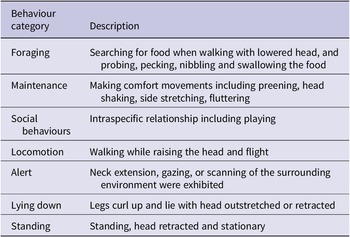
Activity rhythms were monitored intensively in January 2022. Daily sessions began before sunrise. We drove to core wintering sites and located target flocks with 8×42 binoculars or 20–60× telescopes. After selecting an unobstructed vantage point 200–400 m from the birds, we mounted a digital camcorder on a tripod and recorded continuous focal-group footage. Personnel remained hidden behind natural or artificial screens to eliminate observer interference; each clip lasted ≥ 20 min. We classified all visible behaviours into seven mutually exclusive categories (Zhou et al. Reference Zhou, Zhou, Chen, Cheng and Xu2010): foraging, maintenance, social behaviours, locomotion, alert, lying down, and standing (Table 1).
Description of the Great Bustard behaviour categories used in this study.
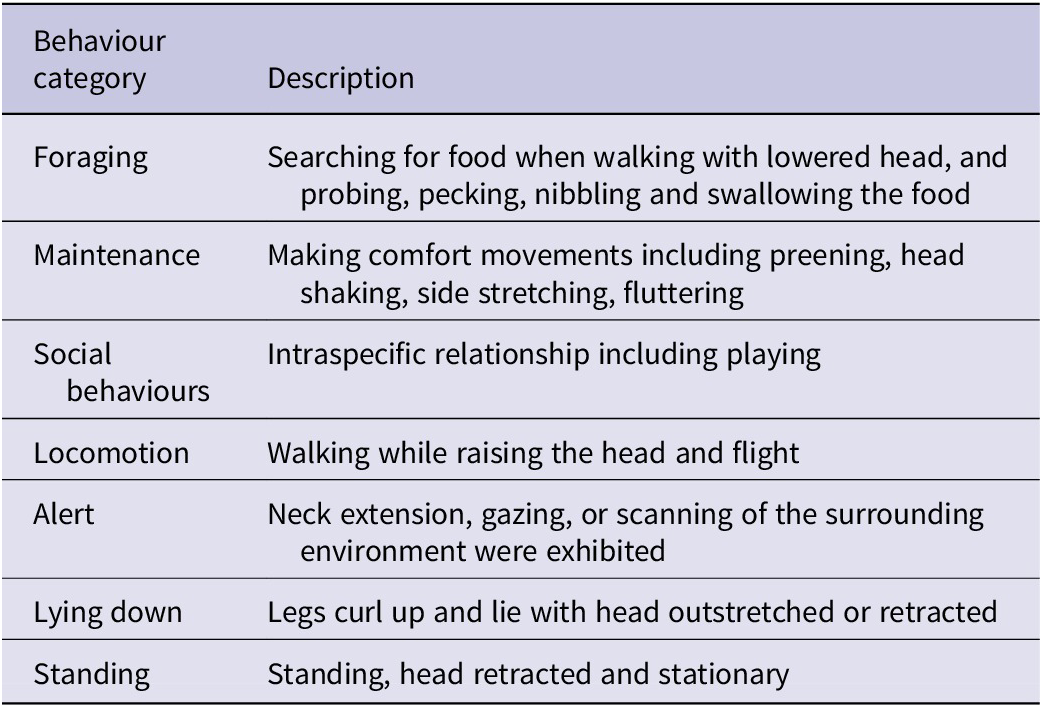
Table 1. Long description
The table consists of two columns: Behaviour category and Description.
* Foraging: Searching for food when walking with lowered head, and probing, pecking, nibbling and swallowing the food.
* Maintenance: Making comfort movements including preening, head shaking, side stretching, fluttering.
* Social behaviours: Intraspecific relationship including playing.
* Locomotion: Walking while raising the head and flight.
* Alert: Neck extension, gazing, or scanning of the surrounding environment were exhibited.
* Lying down: Legs curl up and lie with head outstretched or retracted.
* Standing: Standing, head retracted and stationary.
Data analysis
Only continuous video sequences ≥ 20 min that contained at least six simultaneously visible individuals were retained. Behavioural data were extracted with scan sampling at 10s intervals. To minimise start-up disturbance, the first scan was accepted only when ≥50% of the birds were engaged in non-vigilant activities. Additionally, any sudden abnormal group alert behaviour (defined as ≥50% of individuals shifting to vigilance) that emerged during video collection were excluded from the analysis. Each scan was treated as a single data collection event, and the proportion of individuals performing a given behaviour was calculated as the number of actors divided by the total number of birds in the frame (Fiore and Rodman Reference Fiore and Rodman2001). Local sunrise and sunset times were used to delimit the diurnal observation window (07:30–17:30), which was subdivided into five two-hour blocks. Mean behavioural proportions were computed for each block per flock-day. Using the “dunn.test” package in R, the Kruskal-Wallis H test was employed to test the differences between different time periods, the post-hoc pairwise comparisons with appropriate correction by Dunn test with Bonferroni. Results are reported as means ± SE; significance was set at α = 0.05 and highly significant at α = 0.01.
Results
Behavioural sampling
During winter, Great Bustards occurred in flocks and concentrated in several repeatedly used habitat patches, typically field complexes rather than single fields. Although the total number of individuals within these patches generally remains constant, the number of groups exhibits dynamic fluctuations. In January 2022, the total overwintering Great Bustard population was recorded at 236 individuals, with group sizes ranging from 23 to 116 birds. Behavioural data were collected using a fixed-interval random sampling method. Over 13 field days we obtained 97 video clips (total 1,766 min) of wintering Great Bustards. After excluding sequences shorter than 20 min or with poor visibility, 51 clips (1,254 min) remained for analysis. These were distributed across the diurnal time blocks as follows: 07:30–09:30, 13 clips; 09:30–11:30, 10 clips; 11:30–13:30, 11 clips; 13:30–15:30, 8 clips; and 15:30–17:30, 9 clips.
Daytime activity budget
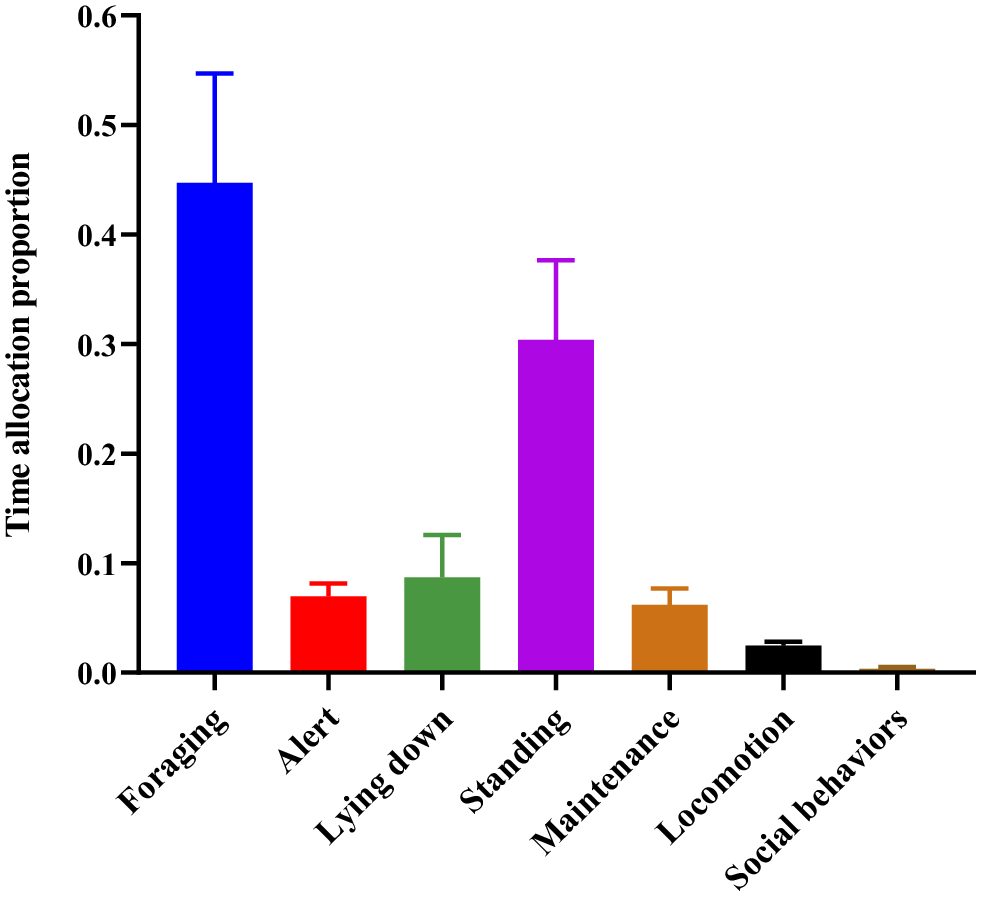
During the wintering period, the primary behaviours of the Great Bustard in Cangzhou are foraging and standing, accounting for 44.69 ± 10.02% and 30.38 ± 7.26% of their time, respectively. Other behaviours such as lying down, alert, maintenance, locomotion, and social behaviours are relatively less common, comprising 8.67 ± 3.88%, 6.96 ± 1.19%, 6.17 ± 1.49%, 2.45 ± 0.35%, and 0.34 ± 0.18%, respectively (Figure 2). Observational video recordings indicate that, in the absence of human disturbances, foraging and resting are the main activities during the wintering period. Both standing and lying down can be considered different manifestations of resting behaviour; however, together they still account for a slightly lower proportion than foraging. When faced with human disturbances, the appearance of raptors, or alarm calls from other birds in the vicinity, the group generally exhibits alert behaviours. Maintenance behaviours often occur alongside resting behaviours, with activities such as preening and wing stretching indicating that individuals are in a relaxed state. Locomotion behaviour frequently accompanies foraging; during the foraging process, the bustard group tends to move slowly in a specific direction. Additionally, when distant human disturbances are detected, the bustard group will also move away from the source of disturbance. The occurrence of social behaviours is relatively low, typically manifesting as chasing or fighting when individuals are too closely spaced during movement. Interestingly, the videos recorded multiple instances of male individuals displaying courtship behaviours around female individuals, which usually last from several seconds to a few minutes.
Time budget of wintering Great Bustard in Cangzhou.
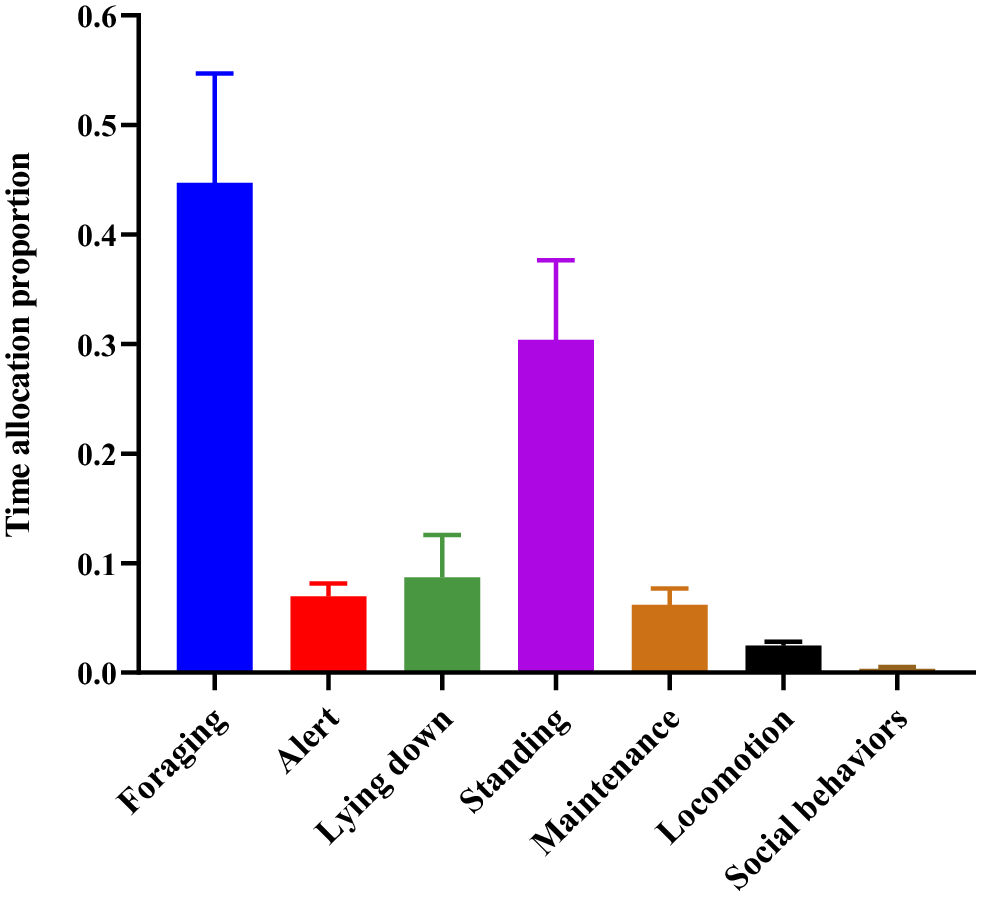
Figure 2. Long description
A vertical bar chart with a Y-axis labeled Time allocation proportion ranging from 0.0 to 0.6 in increments of 0.1. The X-axis lists seven behavioral categories from left to right, each represented by a colored bar with an error bar indicating variability.
* Foraging: A blue bar reaching approximately 0.45 with a high error bar extending to 0.55.
* Alert: A red bar at approximately 0.07.
* Lying down: A green bar at approximately 0.09.
* Standing: A purple bar reaching approximately 0.30 with an error bar extending to nearly 0.38.
* Maintenance: An orange bar at approximately 0.06.
* Locomotion: A black bar at approximately 0.02.
* Social behaviors: A brown bar at approximately 0.005, representing the lowest proportion.
Daytime behavioural rhythm
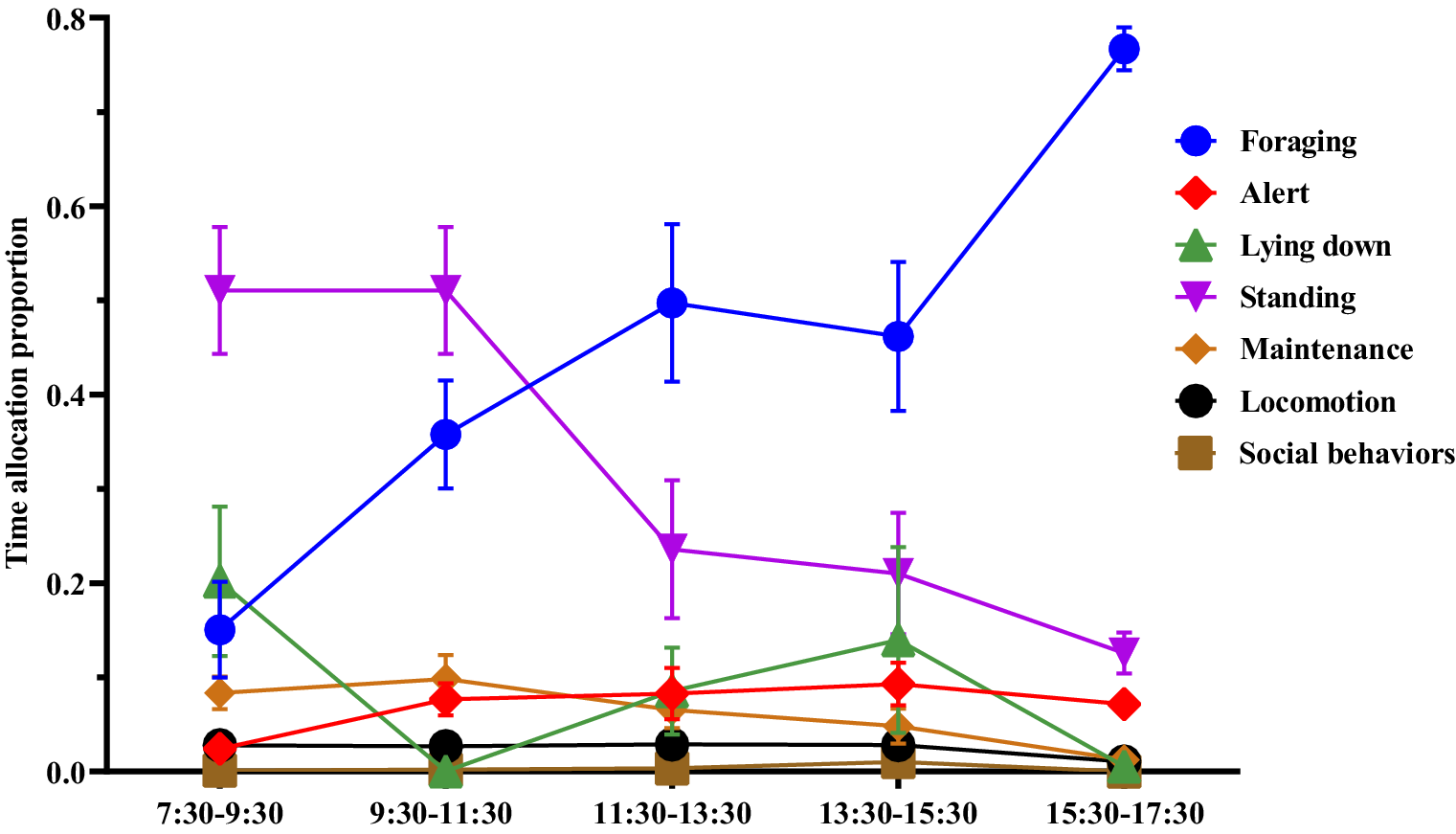
Behavioural rhythms of Great Bustards during the wintering period in Cangzhou varied significantly across the five time blocks for several behaviours (Figure 3). Kruskal–Wallis tests indicated significant time-block effects on foraging (H = 27.222, df = 4, P < 0.001), standing (H = 19.857, df = 4, P < 0.001), alert (H = 11.743, df = 4, P = 0.019), and maintenance (H = 14.507, df = 4, P < 0.01). In contrast, lying down (H = 7.239, df = 4, P = 0.124), locomotion (H = 3.214, df = 4, P = 0.523), and social behaviour (H = 6.125, df = 4, P = 0.19) did not differ significantly among time blocks.
Behavioural rhythms of wintering Great Bustard in Cangzhou
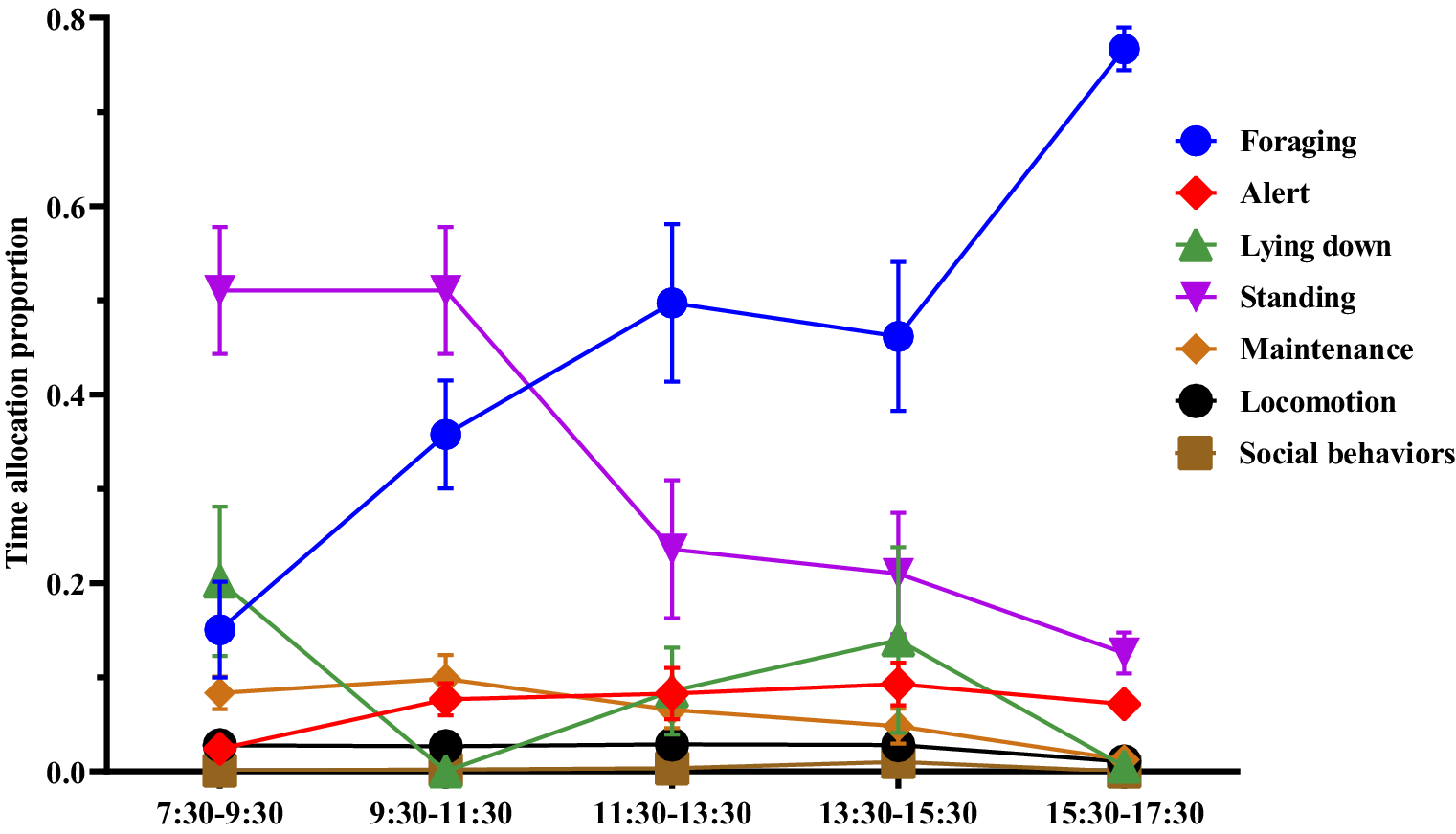
Figure 3. Long description
The X axis represents five time intervals: 7:30-9:30, 9:30-11:30, 11:30-13:30, 13:30-15:30, and 15:30-17:30. The Y axis represents Time allocation proportion ranging from 0.0 to 0.8.
Seven behaviors are tracked with error bars:
- Foraging (blue circles): Shows a steady linear increase from 0.15 at 7:30 to a peak of nearly 0.8 by 17:30.
- Standing (purple inverted triangles): Starts high at 0.5, remains stable until 11:30, then decreases to approximately 0.12 by the final interval.
- Lying down (green triangles): Fluctuates at low levels, peaking at 0.2 in the first interval and 0.15 in the fourth, dropping to near zero in others.
- Alert (red diamonds): Maintains a low, relatively stable proportion between 0.02 and 0.1 throughout the day.
- Maintenance (orange diamonds): Remains stable and low, hovering around 0.05 to 0.1.
- Locomotion (black circles): Stays consistently near the 0.02 mark across all time periods.
- Social behaviors (brown squares): Remains at or near 0.0 for the entire duration.
Post-hoc pairwise comparisons using Dunn’s tests with Bonferroni correction further clarified these patterns (Supplementary Material Table S1). Due to minimal anthropogenic disturbance in the early morning (07:30–09:30), Great Bustards primarily rested, with standing being more frequent than lying down (median standing proportion = 0.547; median lying proportion = 0.023). Foraging was relatively low during this period (median = 0.043), and locomotion and social behaviours were rare. Individuals exhibiting standing and foraging behaviours occasionally perform maintenance actions such as preening, wing stretching, and leg extending. As the day progressed, foraging increased and reached its highest median proportion in the last observation block (15:30–17:30; median = 0.771). During this period, flocks generally shifted to a more mobile foraging state and covered a larger area; movement was mainly associated with rapid pecking rather than typical head-up walking. Pairwise comparisons showed that foraging in 15:30–17:30 was significantly higher than in 07:30–09:30 (P < 0.001) and 09:30–11:30 (P = 0.014), but was not significantly different from 11:30–13:30 or 13:30–15:30 after correction (both P > 0.05). Standing showed the opposite pattern, with the highest median in the early morning (0.547) and the lowest median at 15:30–17:30 (0.110). Pairwise comparisons indicated that standing in 07:30–09:30 was higher than in 11:30–13:30, 13:30–15:30, and 15:30–17:30 (all P < 0.05). Alert behaviour peaked at 13:30–15:30 (median = 0.100) and was significantly higher than 07:30–09:30 (P = 0.0195); during this timeframe, disturbance more readily triggered flight and subsequent relocation.
Daytime habitat utilisation
Analysis of 205 wintering locations revealed that Great Bustards exhibit clear differences in use among available land-cover types. Winter wheat fields were used most often, accounting for 56.59% of all records, followed by post-harvest maize stubble at 38.05%. Fallow land was used least, representing only 5.36% of the records. Field observations showed that occupied winter wheat fields were flat, with low vegetation height, typically not exceeding 10 cm during the wintering period. Maize stubble fields, formed after mechanical harvesting in the previous autumn, retained root stumps 10 – 20 cm in height (Figure 1). In contrast, fields where whole maize stalks (> 1.5 m) were left behind after manual harvest were never used by the birds. Fallow land used by Great Bustards were usually farmland left uncultivated for over a year, scattered between wheat and maize stubble fields. These areas were sparsely covered with seasonal weeds, which had withered by winter, with an average vegetation height of less than 30 cm.
Discussion
Food resources are often insufficient to meet the nutritional and energy needs of wintering birds in high-latitude regions. Crops play an essential role in the diet of wintering Great Bustards, and the availability of food resources is a significant factor in their selection of wintering habitats (Liu et al. Reference Liu, Shafer, Hu, Li, Ning and Gong2018). Survey results indicate that wintering Great Bustards tend to prefer winter wheat fields as their primary habitat, feeding on winter wheat seedlings and scattered crop seeds, which is consistent with the habitat types of the wintering population in the Yellow River wetland of Shaanxi (Wu and Xu Reference Wu and Xu2017). In the Cangzhou region, winter temperatures typically fall below 0°C, and rivers and ponds freeze over; thus, the consumption of winter wheat seedlings helps the Great Bustards supplement their moisture intake. Corn stubble fields are also important wintering habitats for these birds, as some farmers abandon winter wheat cultivation after the autumn harvest, leaving a substantial amount of corn seeds in the stubble which becomes an important food source for the wintering Great Bustards in Cangzhou. Similarly, the Great Bustard population in central Spain has shown a preference for wheat and barley stubble fields (Lane et al. Reference Lane, Alonso and Martín2001). Occasionally, Great Bustards also forage in fallow fields, where weed seeds constitute an important part of their diet. The population in southwestern England has exhibited similar dietary patterns (Gooch et al. Reference Gooch, Ashbrook, Taylor and Székely2015). Moreover, field surveys show that wintering habitats for Great Bustards in Cangzhou are predominantly flat agricultural lands, with the height of the vegetation usually not exceeding 30 cm, similar to the vegetation characteristics of their foraging habitats during the breeding season (Osborne et al. Reference Osborne, Alonso and Bryant2001). As a large terrestrial bird, the Great Bustard faces dual threats from both aerial and ground predators, necessitating a wide field of vision for vigilance at all times (Collar et al. Reference Collar, Baral, Batbayar, Bhardwaj, Brahma and Burnside2017). Additionally, due to their larger size and relatively poor flying ability, Great Bustards require a considerable distance to run before taking off (Keskin et al. Reference Keskin, Durmus, Özelmas and Karakaya2019). Tall or dense cover would impede both vigilance and escape, explaining the consistent avoidance of manually harvested maize fields left with > 1.5 m stalks. Due to the lack of availability data, only habitat usage and not habitat selection was quantified. However, the consistent winter recurrence of low-stature wheat and maize stubble indicates that these cover types remain associated with overwintering Great Bustards and may constitute key components of the living landscape.
The Cangzhou region serves as both a wintering ground and a migratory stopover for the Great Bustard. In January, the population size and habitat distribution of the species exhibit the greatest stability, making this period optimal for conducting behavioural data collection (Wang et al. Reference Wang, Purev-Ochir, Gungaa, Erdenechimeg, Terbish and Khurelbaatar2022). The results indicated that the overwintering Great Bustards primarily engage in foraging and resting behaviours, which together account for 75% of their daytime activities. Influenced by low temperatures and limited food resources, Great Bustards need to spend substantial time foraging to maintain their energy supply, while a high proportion of resting behaviour is also a crucial strategy for reducing energy expenditure (Wu and Xu Reference Wu and Xu2017). During the early-morning window, low temperatures coincided with minimal human activity; birds therefore allocated the first two hours chiefly to resting. As the day progressed, foraging became dominant and vigilance increased accordingly. Although foraging reached its highest median level in the late afternoon (15:30–17:30), pairwise comparisons indicated that this level was significantly higher than the early- and mid-morning periods, but not significantly different from midday and early afternoon after Bonferroni correction (11:30–13:30 and 13:30–15:30). Thus, our data support a trend of increasing foraging toward late afternoon. During the 13:30–15:30 interval, During the 13:30–15:30 interval, alert behaviour reached its highest level, and disturbance more readily triggered flight and subsequent relocation. This period also corresponded to the greatest difficulty in obtaining behavioural data in farmland, resulting in the fewest usable video segments.
Quantifying human disturbance intensity has therefore been identified as a critical avenue for future research (Sastre et al. Reference Sastre, Ponce, Palacín, Martín and Alonso2009). Contrary to earlier findings that feeding activity subsides before dusk (Sun et al. Reference Sun, Li, Li, Wu and Li2006), we observed that Great Bustards often remained in an active foraging state late in the day, with high foraging levels recorded when light conditions precluded further observation. Whether this twilight feeding continues into true darkness remains unknown Currently, there are no reports on the nocturnal behavioural rhythms of Great Bustards, indicating a need for further observational studies utilizing satellite tracking technology or infrared camera monitoring.
Conservation implications
This study indicates that overwintering Great Bustards in Cangzhou use predominantly low-stature croplands (winter wheat and maize stubble) and show pronounced within-day variation in foraging and resting. Because the wintering habitat lies largely outside formal protected areas, effective conservation will likely depend on integrating seasonal, low-conflict measures into farmland management.
Timing: seasonal disturbance reduction with emphasis on late-afternoon foraging
Seasonal protection measures are recommended for December–February. Priority should be given to “soft” approaches with low social and economic conflict, including targeted public outreach, voluntary compliance mechanisms and, where needed, compensation paid to, for example, farmers. Birds are actively foraging in the evening (15:30–17:30), so enhancing management during this period is expected to yield higher protection returns. Practical actions include reducing close approaches by vehicles, photographers, and moving livestock to fields used by bustards. If such actions are ever implemented, they should be government-led, with participation by local communities (farmers) and trained volunteers/NGOs under an agreed protocol.
Space: protecting repeatedly used core patches with adaptive buffers
Given strong site fidelity, conservation planning should delineate repeatedly used wintering patches as core use areas. Around these areas, adaptive buffer distances can be implemented as a temporary, “soft-boundary” management instrument. Rather than physical barriers, buffers can be enacted through prominent information boards, locally agreed codes of conduct, and regular patrols and communication to reduce repeated flushing. Winter is typically an agricultural slack season in the region; accordingly, short-term, non-coercive measures may be more socially acceptable and economically low-cost. Field experience during filming suggests that an initial buffer of approximately 200 m may be a cautious starting point for limiting approaches, but the appropriate distance should be iteratively refined using local feasibility and behavioural-response monitoring.
Habitat persistence: maintain traditional rotations and apply contingency measures during extreme weather
Because most records occur in winter wheat and maize stubble, maintaining these low-stature crop types within core patches and avoiding conversion of key areas to high-disturbance land uses (e.g., greenhouses, orchards) is likely to benefit overwintering Great Bustards. If agricultural ecological subsidies are deemed feasible, incentive schemes may be devised in collaboration with local communities to encourage the maintenance of traditional crop rotation practices, to prevent intensive field clearing during winter, and to preserve usable post-harvest food resources. Furthermore, supplementary feeding should only be considered as an emergency intervention under extreme conditions, such as prolonged snow and ice that restrict natural food acquisition. Risk control concerning the composition of the feed and the frequency of provisioning should be carried out under the guidance of the relevant wildlife management authorities.
Overall, a pragmatic strategy is indicated: conserve Great Bustards in working farmland by protecting a limited number of high-value core wintering patches, reducing time-specific disturbance (especially late afternoon), and sustaining traditional low-intensity cropping mosaics through locally acceptable incentives and governance.
Conclusions
In the Cangzhou region, overwintering Great Bustards are primarily found in low-lying agricultural fields, particularly in winter wheat fields and corn stubble. Their daytime activities are mainly concentrated on foraging and resting, with foraging activity becoming especially frequent during the evening. Based on these findings, protective measures are recommended, including the maintenance of traditional low-height winter crop cultivation, the establishment of seasonal buffer zones around repeatedly used fields to mitigate disturbance, and the implementation of emergency feeding measures during extreme weather events. The integration of these actions into local agricultural environmental policies could provide a practical pathway for the conservation of Great Bustards within production landscapes.
Supplementary material
The supplementary material for this article can be found at http://doi.org/10.1017/S0959270926100550.
Acknowledgements
This work was supported by the National Natural Science Foundation of China (42071257), the Science Research Project of the Hebei Education Department (QN 2023106), the S&T Program of Hebei (19K56233D).
Author contribution
Experimental design: Zhiyuan Lu. Manuscript preparation: Zhiyuan Lu. Data analysis: Guanqun Kou. Data collection: Zhucheng Wang, Derong Meng. Revision of the manuscript: Hao Li. All authors contributed to manuscript revision, read and approved the submitted version.