
Introduction
The goal of those in power in any society, to borrow Adam Smith's (Reference Smith2015) evocative term, is to make a ‘political machine’ that each member of that society wants to sustain through their collective effort. Cross-culturally, scholars differentiate heuristically between the exclusionary and corporate political strategies used to build and maintain this machine (Renfrew Reference Renfrew1973; Blanton & Fargher Reference Blanton and Fargher2008; Carballo Reference Carballo2013). Smaller-scale societies generally have incipient social hierarchies that place greater emphasis on a leader's privileged access to the spirit world. In larger, more socially complex societies, corporate strategies tend to be employed to coordinate collective action. These latter strategies attempt to bridge socio-economic differences, often via the sponsorship of large feasts, rituals and other communal events that foster greater social cohesion through shared activities (Dietler & Hayden Reference Dietler and Hayden2001; Stanish Reference Stanish2017). One of the critical functions of these events, albeit an often highly contested one among participants, is to showcase the relationships between increasingly individualised roles and to demonstrate why each role is necessary to sustain a properly functioning society (Lincoln Reference Lincoln1989).
Psychoactive substances often play an essential role in defining political relationships, with hallucinogens and alcoholic beverages representing two distinct potential avenues to altered states of consciousness (Coe Reference Coe1994; Dietler Reference Dietler2006; Guerra-Doce Reference Guerra-Doce2014). Mass-produced alcoholic beverages permit widespread consumption and are therefore often critical to sustaining political economies by emphasising collective experiences (Joffee Reference Joffee1998; Jennings et al. Reference Jennings2005; Dietler Reference Dietler2006). Alcohol tends to intensify the shared euphoria of communal events, providing visceral reinforcement of the participating individual's place in society. By contrast, the specialised knowledge required to safely procure, prepare and consume hallucinogens offers those with this expertise an opportunity to limit their use and secure a powerful role in the political machine (Appadurai Reference Appadurai1986; Hayden Reference Hayden2014; Fitzpatrick Reference Fitzpatrick2018). The psychotropic effects of hallucinogens often separate a few users from a group of non-users, creating a different type of communitas that is based on watching a shared performance (Turner Reference Turner1969; Fitzpatrick Reference Fitzpatrick2018). Hence, while both hallucinogens and alcoholic beverages can be used in communal events, they may facilitate very different political structures.
This article addresses the relationship between psychoactive substances and political change in the pre-Columbian Central Andes by presenting the first archaeobotanical evidence from the region for the addition of a hallucinogen to alcohol. The prehistory of the Central Andes is punctuated by three major epochs: the Formative Period, the Middle Horizon and the Late Horizon (Rowe Reference Rowe1962). The Formative Period (900–300 BC) is associated with ceremonial centres where priests often drew on established ritual traditions that foregrounded their use of hallucinogens (Rick Reference Rick2004; Burger Reference Burger2011). The Inca Empire of the Late Horizon (AD 1450–1532) hosted feasts featuring copious amounts of chicha (an Andean term for alcoholic beverages) made from maize (Cobo Reference Cobo1990; Janusek Reference Janusek2004; Bray Reference Bray, Jennings and Bowser2009). Although still consumed during the Late Horizon, hallucinogens were no longer a significant part of the political process. Between these two epochs the Wari state of the Middle Horizon (AD 600–1000) emphasised smaller-scale feasts featuring a chicha made from Schinus molle drupes (Sayre et al. Reference Sayre, Goldstein, Whitehead and Williams2012; Biwer Reference Biwer2019; Williams & Nash Reference Williams and Nash2021). Some Wari serving vessels depict vilca (Anadenanthera colubrina), a powerful hallucinogen of long-standing use in the Andes (Knobloch Reference Knobloch2000).
Our palaeoethnobotanical evidence from the Wari outpost of Quilcapampa strongly suggests that vilca was added to molle beer at feasts. Combining a hallucinogen with alcohol altered the experience of both psychoactive substances and, we argue, provided Wari leaders with a corporate strategy of governance via patron-client feasting relationships. Since alcohol use in the pre-Columbian Andes has been more widely reported (Jennings & Bowser Reference Jennings and Bowser2009), we frame our present discussion around the political implications of the changing patterns of vilca consumption.
Pre-Columbian vilca consumption in the Central Andes
A leguminous plant in the Fabaceae family, Anadenanthera colubrina, or vilca, grows in the dry tropical forests of Ayacucho, Urubamba and other Andean valleys, up to an altitude of around 2700m asl (Torres & Repke Reference Torres and Repke2005; Gade Reference Gade2015). The tree produces a 0.10–0.32m-long legume that contains 8–16 thin, disc-like seeds measuring 12–20mm in diameter. Anadenanthera species are sources of timber, dyestuffs, paper and tannins for leather curing. Vilca is used medicinally as a purgative and to treat upper respiratory infections (Shultes & Hoffmann Reference Shultes and Hoffmann1979; Torres & Repke Reference Torres and Repke2005; Gade Reference Gade2015).
The seeds, bark and other parts of Anadenanthera spp. trees contain tryptamine alkaloids that include the psychedelic substance DMT (N, N-dimethyltryptamine), but only bufotenine (5-hydroxy-DMT) (Shultes & Hoffmann Reference Shultes and Hoffmann1979; Torres & Repke Reference Torres and Repke2005) is regularly found at pharmacologically significant levels (Torres & Repke Reference Torres and Repke1996, Reference Torres and Repke2005). Since bufotenine is deaminated in the gut by monoamine oxidase enzymes (MAO), its effects are neutralised if taken orally. In contemporary Indigenous South America, vilca is therefore typically ingested as a snuff, used as an enema, or smoked (Chagnon et al. Reference Chagnon, Lequesne and Cook1971; Torres & Repke Reference Torres and Repke1996). Psychotropic effects when taken orally are nonetheless possible if ingested alongside substances that inhibit MAO (Ott Reference Ott2001).
The earliest archaeological evidence for the use of vilca in South America is from the site of Inca Cueva in northern Argentina, dating back 4000 years (Aschero & Yacobaccio Reference Aschero and Yacabaccio1999). A pipe with bufotenine residue, along with vilca seeds, spatulas, spoons and small containers were found in the cave, beginning a long tradition in the Andes of personal kits for the smoking or inhalation of vilca (Torres Reference Torres1998). The use of these kits was linked to ritual practices wherein hallucinogens were consumed to enable a personal journey into the spiritual world (Miller et al. Reference Miller, Albarracin-Jordan, Moore and Capriles2019).
Rising political complexity in the Formative Period centred on temple complexes, the leaders of which developed priestly authority by continuing earlier traditions of the exclusionary use of hallucinogenic substances (Rick Reference Rick2004). This is most clearly seen at Chavín de Huántar in Peru, where a limited number of priests may have consumed vilca snuff and other hallucinogens in the enclosed galleries. While vilca remains have not been found at Chavín, the recovery of snuff trays and tubes decorated with vilca iconography supports its use by Chavín priests (Sayre Reference Sayre and Fitzpatrick2018). Sculpted heads projecting along the temple's façade depict humans in the process of transforming into something non-human, replete with mucus flowing from their nostrils, which suggests the inhalation of hallucinogens (Cordy-Collins Reference Cordy-Collins1980). The temple's labyrinth of small, dark rooms containing evocative imagery seems designed to facilitate the individual psychotropic journeys between the physical and spiritual realm of a few trusted intermediaries (Rick Reference Rick2004).
Hallucinogens such as vilca continued to be inhaled and smoked into the Late Horizon, yet its use was often ancillary, if not in opposition, to Inca events that emphasised communal action and mass consumption of chicha (Morris Reference Morris, Gastineau, Darby and Turner1979; Hastorf & Johannessen Reference Hastorf and Johannessen1993; Giovannetti Reference Giovannetti2021). Ethnohistoric accounts note that religious specialists used vilca to engage with oracles (Polo de Ondegardo Reference Polo de Ondegardo1914), whereby a “juice” (likely a tea) from the seeds was added to chicha (Cobo Reference Cobo1990: 169). These psychotropic effects are possible because the beta-carbolines typically produced during fermentation can suppress the MAO enzymes. The result of the hallucinogenic substances is nonetheless different with oral intake, producing a more delayed, long-lasting and perhaps weaker effect (Ott Reference Ott2001). Collective consumption of vilca-infused beverages is also documented ethnographically, with the more sustained experiences recounted contrasting with the overwhelming hallucinogenic rush produced when consumed in other manners (Isbell Reference Isbell1978; Shultes & Hoffmann Reference Shultes and Hoffmann1979).
Wari vilca use
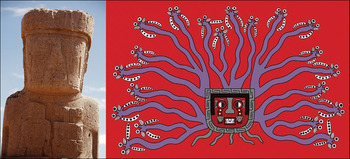
The Middle Horizon is defined by the development and expansion of the Wari and Tiwanaku states in the Central Andes. Tiwanaku leaders favoured the parallel use of hallucinogens and alcohol, as exemplified by monoliths depicting figures holding a snuff tray in one hand and a drinking cup in the other (Figure 1). The plazas and publicly accessible platforms at the site of Tiahuanaco suggest that large-scale communal events were critical to Tiwanaku rule (Janusek Reference Janusek2004). Copious amounts of maize beer were consumed at these events in what Goldstein (Reference Goldstein and Bray2003) has called a ‘chicha economy’. Vilca continued to be smoked and inhaled in the region as it had been for more than a millennium, ensuring that the hallucinogens remained part of an ongoing ritual tradition focused on individual spiritual journeys (Torres Reference Torres, Isbell, Uribe, Tiballi and Zegarra2018).
Depictions of Anadenanthera colubrina use in the Middle Horizon: left) the Ponce Stele at Tiahuanaco portrays an elite individual holding a drinking cup and snuff tablet (photograph courtesy of A. Roddick); right) a vessel from the Wari site of Conchopata features the tree and its tell-tale seed pods sprouting from the head of the Staff God (illustration courtesy of J. Ochatoma Paravicino).

We argue that Wari leaders took vilca in a different direction. During the Formative Period, Chavín de Huántar-related ceremonial centres were located in what would become the Wari heartland (Quispe Ulpiana Reference Quispe Ulpiano1969; Matsumoto Reference Matsumoto2010). Religious traditions continued to emphasise the types of small, enclosed spaces conducive for vilca use into the Middle Horizon (Ochatoma Reference Ochatoma1998). The city of Huari, for example, was built around a series of circumscribed ritual buildings that culminated in niched, D-shaped structures (Ochatoma et al. Reference Ochatoma, Romero and Rojas2015). The latter, along with the internal patios of elite residences, were the primary locations of feasts at Huari and surrounding settlements (Cook & Glowacki Reference Cook, Glowacki and Bray2003; Mancilla Rojas Reference Mancilla Rojas2012; Nash & deFrance Reference Nash and deFrance2019). As the Wari Empire expanded, satellite centres replicated these feasting spaces to highlight state hospitality, cement social relationships and place guests in the hosts’ debt (Dietler & Hayden Reference Dietler and Hayden2001; Nash Reference Nash, Halperin and Schwartz2017; Jennings et al. Reference Jennings, Alaica and Biwerin press).
Alcoholic beverages were often consumed during the feasts, as evidenced by the copious quantities of maize and molle found at Wari sites. Molle is tied particularly closely to Wari feasting. The drupes are routinely recovered in Wari contexts in the heartland and in peripheral Wari-affiliated sites (e.g. Tung Reference Tung2007; Mayer et al. Reference Mayer, Sayre and Jennings2016; Sayre & Whitehead Reference Sayre and Fitzpatrick2017; Biwer Reference Biwer2019). Chemical analysis of pre-Hispanic serving vessels confirms that molle beer was also consumed at Wari sites (Williams et al. Reference Williams, Nash, Henkin and Armitage2019), and an alcoholic beverage using molle drupes is still brewed in the region today (Valdez Reference Valdez2012).
Molle was probably an attractive ingredient for Wari brewers because it is not a food crop (like maize), and the high sugar content of the drupes means that a beverage with a higher alcohol content could be brewed (Jennings & Valdez Reference Jennings, Valdez and Fitzpatrick2018). Molle is also drought tolerant and grows well in a variety of environments, facilitating its movement across the Andes by Wari colonists. We suggest another reason for the continued use of molle brewing was that the drupes are rich in monoterpene hydrocarbons that act as moderate MAO inhibitors (Zahed et al. Reference Zahed, Hosni, Brahim and Sebei2011; Dos Santos Passos et al. Reference Dos Santos Passos2013). The hydrocarbons, when combined with the beta-carbolines produced by fermentation, would have heightened the psychotropic effects of vilca. The addition of vilca to molle chicha is suggested by depictions of vilca seedpods on oversized Wari jars appropriate for serving chicha (Knobloch Reference Knobloch2000; Gudemos Reference Gudemos, Jiménez, Till and Howell2013) (Figure 1). Yet neither physical evidence for the addition of vilca to molle chicha, nor the implications of its oral consumption in a feasting setting, have been previously demonstrated or adequately explored.
Quilcapampa
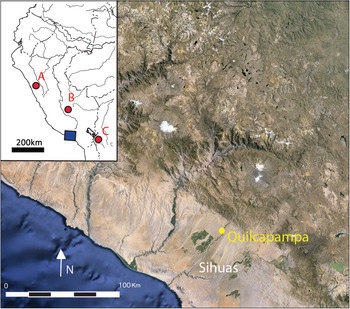
Quilcapampa is a 2ha Wari outpost in the Sihuas Valley, Department of Arequipa, Peru (Figure 2). Founded in the mid-ninth century AD and abandoned a few decades later, the settlement was located along a major coastal trail linking Sihuas to the broader region (Yépez Álvarez & Jennings Reference Yépez Álvarez, Jennings and Barría2016). Quilcapampa was organised around three residential compounds that housed extended families who traced their ancestry to the Wari heartland (Jennings et al. Reference Jennings, Álvarez and Bautista2021).
Location of Quilcapampa in the Sihuas Valley. The inset map of Peru marks the Quilcapampa region in blue and the red dots show the locations of Chavín de Huántar (A), Huari (B) and Tiahuanaco (C) (USGS/NASA Landsat).

Our excavations at Quilcapampa have recovered vilca seeds, which were probably imported, in direct association with large quantities of molle drupes used to create the beer for a feast that was held just before the site was abandoned. Botanical, faunal, ceramic and lithic evidence suggests that this was one of many such events hosted by Quilcapampa's Wari-associated families (see Yépez Álvarez & Jennings Reference Yépez Álvarez, Jennings and Barría2016; Jennings et al. Reference Jennings, Álvarez and Bautista2021).
Materials and methods
A standard 5l sample of soil was collected from every locus excavated at Quilcapampa. The hyper-arid conditions of the valley have resulted in the preservation of large quantities of well-preserved archaeobotanical materials, including carbonised and desiccated plant remains. Soil samples were therefore dry sieved using a standard geological sieve set (2mm, 1mm and 0.71mm screen sizes) to sort remains by size and were then scanned using a stereoscopic microscope to recover plant materials. Wood remains were weighed only; all other plant material was both counted and weighed. Wood, molle and maize were collected solely from the 2mm screen, while other seeds were collected from all screens.
Most Quilcapampa samples were too large (>500g) to be fully sorted. Where this was the case, a subsample was created using two large, overlapping trays. This method empties the entire soil sample over the trays and spreads the contents evenly between them. The first round of splitting creates a 50 per cent subsample; a 25 per cent subsample can be created by a subsequent split. After samples were split, extrapolated counts were made.
Results
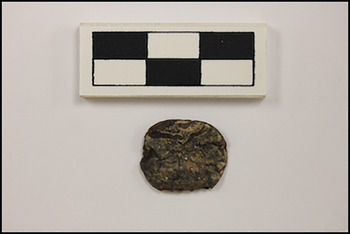
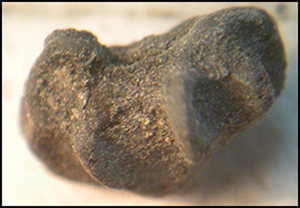
A variety of plant remains were recovered from Quilcapampa (Table 1) (Biwer Reference Biwer2019; Biwer & Melton Reference Biwer, Melton, Jennings, Yépez Álvarez and Bautista2021), amongst which were 16 vilca seeds (Figure 3)—the first ever recovered from a Wari site. The vilca seeds range from whole to fragments; most are well preserved due to the hyper-arid conditions in Sihuas. The vilca seeds exhibit low overall ubiquity (per cent presence in analysed contexts) at Quilcapampa (18 per cent), suggesting its use was limited to certain contexts or activities. Its low absolute count and ubiquity is understandable, given that the tree only grows on the other (eastern) side of the Andes from Quilcapampa.
Botanical remains recovered from Quilcapampa.

Vilca seed recovered from Component II at Quilcapampa (scale in cm; photograph by M. Biwer).

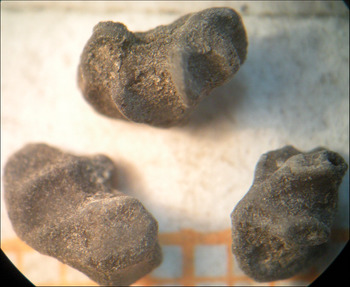
Molle is the most abundant plant remain at Quilcapampa. Identified in every unit, an extrapolated total of 1 400 361 molle drupes and stems were recovered. Molle grows in Sihuas today and was probably locally available during the Middle Horizon. Almost all (99 per cent) drupes have morphological signs consistent with being used to brew molle chicha. Specifically, they lack resin and have an overall deformed shape—a result of soaking and/or boiling to remove sugars (Figure 4; see also Sayre et al. Reference Sayre, Goldstein, Whitehead and Williams2012). Although molle drupes can be used for fuel and other purposes, soaked drupes are associated with beer making (Jennings & Valdez Reference Jennings, Valdez and Fitzpatrick2018). Molle drupes exhibiting these morphological changes have been recovered from other Wari-affiliated sites (see Biwer Reference Biwer2019).
Carbonised molle drupes presenting evidence for boiling and/or soaking to brew chicha molle (scale in mm; photograph by M. Biwer).

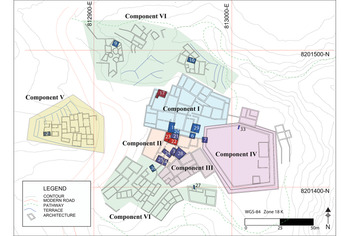
In contrast to the wide distribution of molle drupes, vilca seeds were recovered only from Wari residential compounds (12 from Component II midden and four from Component I) (Figure 5). Correspondence analysis can be used to investigate associations between plant remains and architectural spaces. The results of our correspondence analysis confirm the clustering of vilca in Component II (Figure 6), in close association with a high abundance of plant remains from the final feast. Molle remains were not included in the correspondence analysis due to their overwhelming abundance, which skewed the results.
Overview of the Quilcapampa site showing excavated units. Vilca was found in the red units, while molle was found in all units (figure by J. Jennings).

Correspondence of botanical materials recovered from Quilcapampa (figure by M. Biwer).

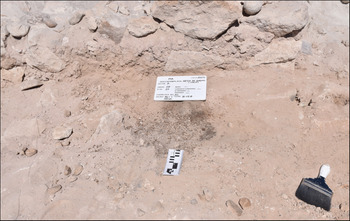
Comparing the densities of archaeobotanical remains across the site further underscores the observation that molle drupes are not uniformly distributed. Component II was found to have an overwhelmingly high density of molle (Figure 7); furthermore, a large pit was uncovered here containing 1 200 000 drupes (Figure 8). The pit lacked internal stratigraphy and contained almost exclusively molle drupes, suggesting that it was dug just prior to the site's abandonment. Similar molle-filled pits have been identified at other Wari-affiliated sites (Sayre et al. Reference Sayre, Goldstein, Whitehead and Williams2012; Biwer & Melton Reference Biwer, Melton, Jennings, Yépez Álvarez and Bautista2021). Component II was a residence rather than a dedicated brewery similar to that found at the Wari-affiliated site of Cerro Baúl (Moseley et al. Reference Moseley, Nash, Williams and deFrance2005). Nevertheless, our data point to the brewing of molle chicha in the same location where the bulk of the vilca seeds were recovered.
Molle density at Quilcapampa (figure by M. Biwer).

Molle pit located in Component II (Locus 2707) (photograph by S. Bautista).

Discussion
Our Quilcapampa excavations have recovered many well-preserved archaeobotanical remains, analysis of which demonstrates that the distribution of vilca was limited to the site's core area, where it was found in feasting-related contexts (Biwer & Melton Reference Biwer, Melton, Jennings, Yépez Álvarez and Bautista2021). These vilca seeds would have been collected from tropical woodlands on or near the eastern flanks of the Andes. Communities living in Sihuas could potentially have had access to vilca prior to the Middle Horizon, although evidence to date suggests that most long-distance exchange was confined to the coast (Jennings & Reid Reference Jennings, Reid, Jennings, Yépez Álvarez and Bautista2021). The Wari state expanded long-distance exchange networks, placing particular emphasis on transporting Amazonian products into the sierra (Wilkinson Reference Wilkinson2018). When Wari llama caravans widened coastal–highland exchanges in the Arequipa region (Williams Reference Williams, Chacaltana, Arkush and Marcone2017), they also offered greater access to tropical woodland products such as vilca. The Wari affiliation of Quilcapampa's core families most likely granted them exclusive access to, and control over, vilca in Sihuas. Forthcoming stable isotope analysis will be used to determine the probable regional source of the vilca.
The considerable effort required to obtain the hallucinogen suggests that the use of vilca to access the supernatural through altered states of consciousness was an important part of the Wari political economy. Snuffing or smoking paraphernalia, however, are absent from Quilcapampa and non-existent or rare at other Wari sites (Knobloch Reference Knobloch2000; Bélisle Reference Bélisle2019), while evidence for alcohol consumption is ubiquitous (Biwer Reference Biwer2019). Molle chicha may represent a new mechanism of vilca ingestion. As previously discussed, molle beer would act as a moderate MAO inhibitor (Bosin et al. Reference Bosin, Krogh and Zabik1987; Zahed et al. Reference Zahed, Hosni, Brahim and Sebei2011; Dos Santos Passos et al. Reference Dos Santos Passos2013), allowing psychotropic effects to occur. These effects are celebrated on some Wari vessels that depict vilca pods (Knobloch Reference Knobloch2000). While chemical residue analysis is needed to confirm this hypothesis, evidence to date strongly suggests that people drank vilca-infused molle beer at Quilcapampa and perhaps other Wari-affiliated sites.
We argue that the addition of vilca to molle chicha was an effective method for the hosts of Wari feasts to channel its psychotropic effects into a more collective experience. Soaked molle and vilca remains were most frequently associated with the activities that took place within Component II and are probably linked to feasting (see Jennings et al. Reference Jennings, Álvarez and Bautista2021). This association provides convincing evidence for the creation of vilca-infused molle beer that was then consumed on the occasion of the site's final abandonment. In contexts dating to the period prior to the Middle Horizon, vilca has been recovered from snuff-kit pouches and identified as a residue on other snuff paraphernalia (Torres & Repke Reference Torres and Repke1996; Torres Reference Torres1998). Consuming the substance in this manner induced sharp, powerful psychotropic effects that were more conducive to an individualising experience. The oral consumption of vilca in molle beer changed the experience, most likely creating weaker but more enduring effects that could be enjoyed collectively.
The use of psychoactive substances occurs in virtually all cultures (Withington Reference Withington2014). The powerful effects of hallucinogens often deter widespread use and result in individualising experiences that favour more exclusionary leadership strategies (Wadley Reference Wadley2016). Vilca-infused molle chicha enabled a more inclusive psychotropic experience in Wari society. For perhaps the first time in the Andes, the consumption of vilca therefore moved beyond those spiritual leaders who communed with the supernatural realm.
The importance of Wari feasting, especially in forging hierarchical ties within and between groups, is well documented (Cook & Glowacki Reference Cook, Glowacki and Bray2003; Nash Reference Nash and Bergh2012; Nash & deFrance Reference Nash and deFrance2019; Jennings et al. Reference Jennings, Alaica and Biwerin press). A host who provides alcohol and food to guests reinforces patron-client relationships, forging an indebtedness that confirms the heightened position of the hosts (Dietler & Hayden Reference Dietler and Hayden2001; Dietler Reference Dietler2006). At Quilcapampa, guests who consumed Wari-related foods at feasts were offered alcohol infused with vilca, which guided participants into a spiritual realm. The experience, however, could not be reciprocated by guests, who lacked access to the imported vilca seeds and knowledge of how the drink was prepared. Communally consumed beer was a powerful tool in Wari governance. The vilca-infused brew brought people together in a shared psychotropic experience, while ensuring the privileged position of Wari leaders within the social hierarchy as the providers of the hallucinogen.
Conclusions
As societies grow in size and complexity, leaders face considerable challenges in both the coordination of collective actions and in building and maintaining the heightened status often required for this coordination (Blanton Reference Blanton2016). Archaeological and historical evidence suggests that more corporate political strategies often prevailed over time, but the mechanisms through which they were adopted are often unclear. One such mechanism may have been a shift in the induction of altered states of consciousness.
In the Formative Period Andes and earlier, psychoactive substances were often tied to exclusionary leadership strategies. Early practitioners undertook trance-induced journeys to contact spiritual forces on behalf of their communities. During the subsequent Middle Horizon, we suggest that the Wari practice of combining alcoholic beverages with psychoactive substances represents a fulcrum of Andean political development, wherein larger numbers of participants could collectively experience the effects of a hallucinogen, potentially to contact or become closer to spiritual forces. As seen in the core area of Quilcapampa, Wari leaders hosted intimate feasts focused on the communal consumption of vilca added to alcoholic beverages.
By tying their esoteric knowledge of obtaining and using vilca as an additive to molle chicha, an intoxicant that stimulated communitas, Wari leaders were able to legitimise and maintain their heightened status. These individuals were able to offer memorable, collective psychotropic feasts, but ensured that they could not be independently replicated. By the Late Horizon, greater emphasis would be placed on the mass consumption of alcohol in its own right, without the addition of vilca. In this way, maize beer became the psychoactive substance of choice during the Inca Empire, supporting a different political machine. Shifts in psychoactive use similar to those in the Andes were almost certainly a fundamental part of the political process in other parts of the world.
Acknowledgements
We thank the members of the Proyecto Investigación Arqueología de Quilcapampa La Antigua, and acknowledge Pat Knobloch, Dana Bardolph and Constantino Torres for providing constructive comments on an earlier version of this manuscript. Two anonymous reviewers provided thoughtful comments for which we are thankful. We also thank the Peruvian Ministry of Culture for permission to excavate (Permit 218-2016-GDPA/VMPCIC/M).
Funding statement
Research was funded by the Social Sciences and Humanities Research Council of Canada (grant 43150212), the National Geographic Society (grant 9730015), the Royal Ontario Museum (Kircheis Family, Louise Hawley Stone Charitable Trust and New World Archaeology grants) and the University of Toronto Archaeology Centre.