Introduction
Hoya R.Br. (Apocynaceae) is a monophyletic genus well rooted within Asclepiadoideae (Wanntorp et al., Reference Wanntorp, Kocyan, Van Donkelaar and Renner2006). It was last revised in De Candolle’s Prodromus (Decaisne, Reference Decaisne and De Candolle1844) and is in urgent need of revision (Meve, Reference Meve2002).
The International Plant Names Index lists more than 600 Hoya species names but estimates of the true number of species are extremely variable, ranging between 200 and 300 (Forster et al., Reference Forster, Liddle and Liddle1998; Kleijn & Van Donkelaar, Reference Kleijn and Van Donkelaar2001). These are very conservative estimates and likely many more species are still undescribed.
Apart from the lack of a complete revision, the broad Indomalesian-Australian-Western Pacific distribution also makes an accurate estimate of the number of species difficult. The regions with the highest known species diversity are the Philippines and New Guinea but many parts of the distribution of the genus are still undercollected (Forster et al., Reference Forster, Liddle and Liddle1998).
Chinese Hoya are rather better known because they have recently been revised for the Flora of China (Li et al., Reference Li, Gilbert and Stevens1995) where 32 species and one variety of Hoya are recorded. With the recently published Hoya baishaensis Shao Y.He & P.T.Li (He et al., Reference He, Zhuang, Li, Lin and Li2009a), H. bawanglingensis Shao Y.He & P.T.Li (He et al., Reference He, Li, Lin and Zeng2009b) and H. persicinicoronaria Shao Y.He & P.T.Li (He et al., Reference He, Li, Lin and Yang2009c), the total number of Chinese Hoya species has been raised to 35. In these treatments Hoya yuennanensis was considered a synonym of H. lyi although neither species has been lectotypified. While searching for suitable lectotypes at the herbaria of B, BM, C, E, FI, GH, HBG, HITBC, IBSC, K, L, P, S, SING, TO, W, WRSL, WU and Z it became apparent that two separate morphological entities are present and, therefore, the name Hoya yuennanensis should be resurrected. It also became apparent that Hoya mekongensis (Gilbert et al., Reference Gilbert, Stevens and Li1995) is morphologically indistinguishable from H. yuennanensis.
In the present paper I (i) discuss the taxonomic history of Hoya lyi and H. yuennanensis, (ii) emend their descriptions, (iii) lectotypify H. lyi and H. yuennanensis, (iv) resurrect the name H. yuennanensis, and (v) synonymise H. mekongensis with H. yuennanensis.
Taxonomic History and Current Study
In 1907, when Hoya lyi was published (Léveillé, Reference Léveillé1907), only two Chinese Hoya species had previously been described, H. carnosa R.Br. and H. pottsii Traill (Dunn, Reference Dunn1911). In 1934, Hoya lyi was synonymised into H. carnosa (Rehder, Reference Rehder1934) but two years later Tsiang (Reference Tsiang1936) resurrected it, stating ‘It cannot be confused with H. carnosa which belongs to a different series of the section’, citing his two collections (Tsiang 4681 and 4738) as ‘exactly matching the type’. Nonetheless, attached to specimen 4738 there is a note by Tsiang: ‘Tsiang 4738 = Ching 6727 seems not identical with Hoya lyi, but more material will show transitions H. Handel-Mazzetti, in litt., June 11, 1935’. On the specimen Tsiang 4681, Tsiang annotated instead: ‘Identical with the type of H. lyi and I agree now that it is a good species, different from H. carnosa H. Handel-Mazzetti, in litt’. Here Tsiang was probably referring to specimen Handel-Mazzetti 7971, collected in China in 1915 and distributed as Hoya carnosa. After revising his Chinese collections Handel-Mazzetti (Reference Handel-Mazzetti1936) published Hoya yuennanensis based on this specimen. Surprisingly, Tsiang & Li (Reference Tsiang and Li1977) considered Hoya yuennanensis a synonym of H. lyi.
In the most recent edition of the Flora of China Li et al. (Reference Li, Gilbert and Stevens1995) made no changes from the earlier Chinese language version (Tsiang & Li, Reference Tsiang and Li1977) but did provide an extended description of the taxon.
The name Hoya yuennanensis was recently misapplied in Wanntorp & Forster (Reference Wanntorp and Forster2007) to Micholitzia obcordata N.E.Br., a species now included in Hoya and whose currently recognised name is H. manipurensis Deb.
Correct application of names in Hoya is still problematic due to the complex and often confused nomenclature, partly caused by horticultural interest in Hoya species that has led to a proliferation of synonyms.
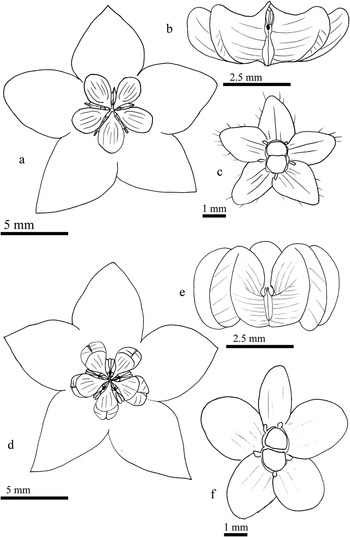
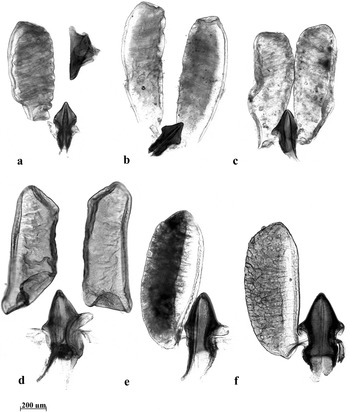
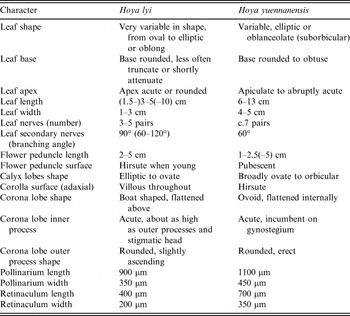
It is clear from the examination of the lectotypes and of the cited specimens of Hoya lyi and H. yuennanensis that there are two separate species, both ecologically and morphologically. Hoya lyi is a small lithophytic species with variable leaves that can be oval, elliptic or oblong. It is found only on limestone, in deep shade, growing tightly appressed to the rock surface. Hoya yuennanensis, in contrast, is a more rampant climber, generally with elliptic or oblanceolate leaves found on siliceous and limestone outcrops in exposed locations. Both species have white to pale pink flowers of similar size but they can be easily discriminated by the shape of their coronas. Hoya lyi has a rather flat-topped corona with rounded and flattened slightly ascending outer corona lobes while H. yuennanensis has erect corona lobes with rounded outer processes and a depressed stigmatic head (Fig. 1). They can also be discriminated in their pollinia: Hoya lyi has smaller pollen masses with an elongated retinaculum while H. yuennanensis has a massive retinaculum compared to the size of the pollinium (Fig. 2). For these reasons Hoya yuennanensis should be reinstated. A complete comparison between Hoya lyi and H. yuennanensis based on all examined specimens is presented in Table 1.
Hoya lyi H.Lév. (above; a, b, c) and H. yuennanensis Hand.-Mazz. (below; d, e, f). a, d: corolla, only shape of corolla lobes drawn; b, e: corona, from side; c, f: calyx. Drawn by M. Rodda from Ly 1879 (Hoya lyi, E, lectotype) and Handel-Mazzetti 7971 (Hoya yuennanensis, E, isolectotype).

Pollinaria from herbarium specimens of Hoya lyi (above; a, b, c) and H. yuennanensis (below; d, e, f). a: Ly 1879 (E, lectotype); b: Martin & Bodinier 1853 (E); c: Poilane 2138 (P); d: Handel-Mazzetti 7971 (E, isolectotype); e: Soulié 1598 (P, holotype of Hoya mekongensis); f: Kingdon Ward 1139 (E). The pollinia of Handel-Mazzetti 7971 appear to be immature or not well preserved.

Morphological comparison between Hoya lyi and H. yuennanensis

Hoya yuennanensis was initially confused with H. carnosa (Handel-Mazzetti, Reference Handel-Mazzetti1927) but the two species can be easily separated by the flat-topped corona lobes of H. carnosa that have acute inner and outer lobes.
Often Hoya species are known from one or just a few specimens and an assessment of their variation is, therefore, impossible. The study of an extensive number of specimens of Hoya lyi has highlighted its morphological variation across the distribution range. Leaves can vary greatly in shape (oval, elliptic, oblong) and size, ranging from 1.5 to 10 cm long. The calyx can have very short narrow lobes or rather broad lobes. Flowers can be variable in colour, from fully white to white with a prominent pink or purple centre, and corona lobes that can be either completely flat and perpendicular to the pollen tube, or slightly ascending. The large variation may be due to the broad distribution range. Hoya lyi appears to be closely related to H. thomsonii Hook.f. They are both lithophytic species adapted to limestone rocks, they grow in very shady conditions and they bear white villous corollas and rounded corona lobes.
Hoya thomsonii was described from India but is also found in northern Thailand and southern China. Biogeographic links have been observed between the floras of Nepal and Thailand (Pendry et al., Reference Pendry, Parnell and Van Welzen2009) suggesting that the distribution of Hoya thomsonii, and possibly of H. lyi, may be more extensive than so far observed. Since the extent of morphological variation of Hoya thomsonii is unknown, further studies are required to establish whether H. lyi falls within the range of variation of H. thomsonii.
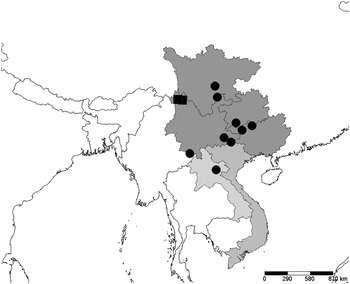
While searching for specimens of Chinese Hoya species, the holotype of Hoya mekongensis was compared with specimens of H. yuennanensis. The two species appear to be indistinguishable on morphological grounds. Furthermore, Hoya yuennanensis and H. mekongensis are together known only from three collections in a very restricted area along the Mekong River (Fig. 3). Pollinaria from Hoya mekongensis have been included in Fig. 2 for comparison. It is therefore suggested that Hoya mekongensis is a new synonym of H. yuennanensis.
Distribution of Hoya lyi and H. yuennanensis based on specimens indicated by (*) within main text. Hoya lyi is indicated by a full circle; H. yuennanensis by a full square. The Chinese provinces of Guangxi, Guizhou, Sichuan and Yunnan are indicated in dark grey. In lighter shades of grey are indicated Vietnam and Lao PDR. Map constructed using SimpleMappr (www.simplemappr.net).

Taxonomy
Hoya lyi H.Lév., Bull. Soc. Bot. France 54: 369 (1907); H.Lév., Fl. Kouy Tchéou 42 (1915). – Type: China, Guizhou, Tsien-Sen-Kiao, xi 1904, Ly 1879 (lecto E! (barcode E00279452), designated here). Figs 1,2.
All measurements from rehydrated material.
Semi-woody, lithophytic or rarely epiphytic vine, delicate, with white latex. Leafy stems up to 2–3 m, generally shorter, cylindrical up to 3 mm in diameter, young stems hirsute. Internodes 1–5(–10) cm, conspicuously rooting along stems. Leaves opposite, petiolate; petiole 3–5(–10) mm long, 1–1.5 mm wide, hirsute; lamina stiff, fleshy, very variable in shape, from oval to elliptic or oblong, (1.5–)3–5(–10) × 1–3 cm, apex acute or rounded, base rounded, less often truncate or shortly attenuate, margin entire, adaxially dark green, hirsute, lighter green on abaxial side, hirsute, penninerved, main vein ridged on adaxial surface, less evident on abaxial surface, secondary veins 3–5 pairs evident when dry, nearly at right angles from main nerve but variable, from 60 to 120°, anastomosing near leaf margins. Inflorescences pseudo-umbelliform, convex, 4–10(–20)-flowered; peduncle extra-axillary, perennial, 2–5 cm long, 1.5–3 mm wide, hirsute when young; pedicels 2.5–3 cm × c.1 mm, hirsute. Calyx 4–5 mm in diameter, lobes elliptic to ovate, 2–3 × 1–1.5 mm, apex rounded, glabrous inside, sparsely pubescent outside, rugose, margins ciliate, 1–3 basal glands at the junction between the lobes. Corolla flattened to slightly convex, white to light pink, 14–18 mm in diameter, abaxial side glabrous, adaxially villous throughout; lobes 7–8 × 4–5 mm, ovate to rhomboid with acute apex. Corona staminal, ivory white with purple centre, 2–3 mm high, 5–7 mm diameter, lobes boat shaped, 2.5–3 × 1.5 mm, flattened above; outer processes rounded, slightly ascending, inner processes acute, about as high as outer processes and stigmatic head; basal anther process free from the filament tube. Pollinarium (all measurements approximate) 1100 × 750 μm, pollinia oblanceolate, 900 × 350 μm, base obliquely truncate, apex rounded, retinaculum 400 × 200 μm, caudicles thin, 100 μm long. Ovary bottle shaped, c.2 mm long, 1 mm wide. Fruits and seeds not seen.
Distribution. The localities of the syntypes indicated in Léveillé (Reference Léveillé1907) could not be equated with modern Chinese localities. Léveillé (Reference Léveillé1915) noted that the three specimens were collected in Guizhou. More recent collections have been made in Sichuan, Guangxi and Yunnan, as mentioned by He et al. (Reference He, Zhuang, Li, Lin and Li2009a). Zhu et al. (Reference Zhu, Wang, Li and Sirirugsa2003) identified Hoya lyi as one of the characteristic species in limestone habitats in southern Yunnan. In the present study I have also identified specimens of Hoya lyi from Vietnam and Lao PDR, a first record for these countries (Fig. 3).
Ecology. Hoya lyi is a delicate climber, often lithophytic on limestone where it grows tightly appressed to the rock surface. It prefers moderately moss-covered rocks in very shady places, usually on the north side of cliffs or in deep gorges or where the sunlight is filtered by an overhanging tree canopy. It can be found at the northern limit of the distribution area of Hoya (in particular Wilson 5071) and appears to be one of the most cold-tolerant species in the genus.
Specimens examined (* indicates specimens mapped in Fig. 3). China. Guangxi: Nandan, sin. coll. 99659* (IBSC barcode 520490); Baise Qin, Wanglao Shan, Langping, sin. coll. 618173* (IBSC barcode 520491). Guizhou: Kouy Tcheou, Cavalerie s.n. (P); sin. loc., vii 1909, Esquirol 1590 (E barcode E00281697); Ha Hai Tre, x 1910, Esquirol 2517 (P); Na-Kan, Cheng-Feng, Tsiang 4738* (IBSC barcodes 520503 & 520504); Na-Kan, Cheng-Feng, Tsiang 4681* (IBSC barcodes 520505 & 520506); Gan-Pin, 20 ix 1897, Martin & Bodinier 1853 (syn E barcode E00279451, P); Lo-Pié, 7 x 1897, Martin & Bodinier 1853 (syn P barcode P00634485). Sichuan: Leibo, Zhongshan Ping, Z.T. Guan 9658* (IBSC barcode 520622); Mt. Omi, Wilson 5071* (BM, IBSC, K); sin. loc., Wilson 4098 (BM, K). Yunnan: sin. loc., xi 1904, Cavalerie 1879 (K); ibid., 10 ii 1905, Ducloux 3477 (P); ibid., Xishuangbanna, 100°30′E, 21°30′N, 14 x 1978, Tao Guo Da 35474* (HITBC); Yan Shan, Wang 591772* (IBSC barcode 520495); Le Tchong, 15 x 1904, Ducloux 2909 (P).
Laos. Xieng Khouang: Tam La, 19 x 1920, Poilane 2138* (P barcodes P00700446 & P00700534).
Vietnam. Ha Giang: Yen Minh distr., Lao Va Chai municipality, vicinity of Lao Va Chai village, 9 x 1999, Hiep, Binh, Averyanov, Cribb NTH 3470* (K).
Notes. There are some inaccuracies in the citation of specimens by Léveillé in the first publication of Hoya lyi (Léveillé, Reference Léveillé1907). The three specimens cited are: Gan Pin, Martin & Bodinier s.n., 20 ix 1897; Lo Pie, Martin & Seguin 1853, 7 x 1897 and Ly 1879, xi 1904.
Martin & Bodinier s.n., the material from Gan Pin, has been located in E and P but bearing the collection number 1853. On the E specimen there is a reference to specimen Lo Pie, Martin & Seguin s.n., 7 x 1897 as belonging to the same species. It is reasonable to assume that this is actually a reference to Martin & Bodinier 1853, 7 x 1897 from Lo Pie, a specimen extant in P.
Specimen Ly 1879, xi 1904 was found in E and is here selected as lectotype since it does not present any citation incongruence with the original publication and was collected by the person, Jean Ly, after which Hoya lyi is named. Also, the specimen is in good condition, possessing leafy stems and two pseudo-umbels.
Hoya yuennanensis Hand.-Mazz., Symb. Sin. Pt. VII: 1001 (1936). – Type: China, Yunnan, Lota Tanschan & Tsedjrong, ad fluvium Landsang-djiang (Mekong), 10 ix 1915 or 4 x 1915 (see notes below), Handel-Mazzetti 7971* (lecto WU (number WU0043535), designated here; isolecto E (barcode E00281696), GH (barcode A00076426), K, W (number 1924-0011093), WU (number WU0043536)). Figs 1,2.
Hoya mekongensis M.G.Gilbert & P.T.Li, Novon 5(1): 10 (1995), syn. nov. – Type: China, Yunnan: Tsékou, 1895, Soulié 1598* (holo P (barcode P00639769); iso P (barcodes P00639770, P00639771, P00639772)). Fig. 2.
All measurements from rehydrated material.
Semi-woody, lithophytic or epiphytic climbing vine. Leafy stems cylindrical up to 5 mm in diameter, young ones hirsute, mature ones glabrescent. Internodes (5–)10–20 cm, conspicuously rooting along stems. Leaves opposite, petiolate; petiole flattened above, rugose, 0.7–1.6 cm long, 3–4 mm wide, densely puberulent; lamina stiff, fleshy, variable, elliptic or oblanceolate (rarely suborbicular), 6–13 × 4–5 cm, apex apiculate to abruptly acute, base rounded to obtuse, margin entire, minutely hairy, penninerved, main vein sulcate on adaxial side, secondary veins c.7 pairs, poorly defined, held at c.60° from main nerve, anastomosing and forming a secondary reticulate venation. Inflorescences pseudo-umbelliform, convex, at least 8-flowered; peduncle extra-axillary, perennial, 1–2.5(–5) cm long, c.2 mm wide, pubescent; pedicels 2–3 cm × c.1 mm, sparsely hairy. Calyx 4–5 mm in diameter, lobes broadly ovate to orbicular, 1.5–2 × 1.5 mm, apex rounded, inside glabrous, outside rugose with a few hairs, margin sparsely ciliate, 1–2 basal glands at the junction between the lobes. Corolla flattened to slightly convex, white to light pink, 17–19 mm in diameter, abaxial side glabrous, adaxially hirsute; lobes 6–8 × 5 mm, ovate with acute reflexed apex. Corona staminal, ivory white, c.3 mm high, 5–7 mm in diameter, lobes ovoid, flattened internally, 2.5–3 × 2 mm; outer processes rounded, erect, inner processes acute, incumbent on gynostegium, just meeting in the centre; stigmatic head depressed; anther free from the filament tube. Pollinarium (all measurements approximate) 1350 × 1100 μm, pollinia oblanceolate, 1100 × 450 μm, base and apex rounded, retinaculum 700 × 350 μm, caudicles thin, 200 μm long. Ovary triangular, c.2.5 mm long, 1 mm wide. Fruits and seeds not seen.
Distribution. Hoya yuennanensis has only been found in three localities along the Mekong River, near the villages of Lota, Tsékou and Loudre. These localities have been identified using the map in Handel-Mazzetti (Reference Handel-Mazzetti1927) where Tsékou is spelled Tseku (Fig. 3).
Ecology. Handel-Mazzetti (Reference Handel-Mazzetti1927) provides a description of the habitat where Hoya yuennanensis was collected: ‘Among other plants growing on the arid rocks, receiving a little shade from the sclerophyllous shrubs above them, were numerous orchids, now out of flower, and Hoya carnosa, a creeper with thick fleshy leaves; Sedum diymarioides, a little stonecrop with numerous glands, and the large S. indicum, Polypodium nipponicum, a fern with bluish creeping rootstocks, and a few mosses’. In the same book there is a picture of the collection locality above Lota, along the Mekong River (Handel-Mazzetti, Reference Handel-Mazzetti1927, cap. 18, fig. 31).
The species appears to be adapted to grow on rocks along the Mekong River and can be quite a rampant climber. From the limited material available it does not look like it grows tightly attached to the rock surface as is the case for Hoya lyi. Since it grows above 2000 m a.s.l. at the northern limit of the distribution area of Hoya it is one of the most cold-tolerant species in the genus.
Additional specimen examined (* indicates specimen mapped in Fig. 3). China. Yunnan: Loudre, 18 x 1913, Kingdon Ward 1139* (E barcode E00281698).
Notes. An attempt at lectotypification was made by D. H. Kent in 1989 who labelled the specimen Handel-Mazzetti 7971 (W) as the lectotype of Hoya yuennanensis, a name he considered to be a synonym of H. lyi. However, it was never published so has no standing. The same specimen was cited in Wanntorp & Forster (Reference Wanntorp and Forster2007) as the holotype. It must be noted that Handel-Mazzetti 7971 is likely a mixed accession. On the labels of the various duplicates studied two collection dates co-occur: 10 ix 1915 and 4 x 1915. Probably plants were collected with the same collection number at the same locality on different days. This is also suggested by the reference on the specimens to two notes in Handel-Mazzetti’s diary (1477 and 1569). Unfortunately the diary is missing and these notes cannot be verified (Handel-Mazzetti, Reference Handel-Mazzetti1996). Among the duplicates of Handel-Mazzetti 7971, the specimen here designated as the lectotype is the only one with a single leafy shoot with attached flowers. Although it is impossible to determine on which of the two possible dates it was collected it cannot be a mixed accession and is, therefore, available for lectotypification. Likewise it is impossible to state definitively which isolectotype was collected on which date and it is possible that not all of them are, strictly speaking, duplicates of the lectotype.
Acknowledgements
I thank David Boufford, Vichith Lamxay, Boon Leng and Mark Newman for the translation of Chinese labels and for locating old Chinese and Lao localities, and the curators of B, BM, C, E, FI, GH, HBG, HITBC, IBSC, K, L, P, S, SING, TO, W, WRSL, WU and Z herbaria for providing high quality images or for the loan of specimens. This study is part of an ongoing research project on the systematics of Hoya. Financial support has been received from the National Parks Board, Singapore and the Synthesys programme, grant nos GB-TAF-5657, NL-TAF-676 and DE-TAF-675.